Part 1 — ESSENCE OF PARLIAMENT.
Reading edition
EXTRACTED FROM THE DIARY OF TOBY, M.P.
House of Commons, Monday, March 20.—"That's the best speech Harcourt has made this Session," said George Curzon, as we walked into Lobby to support Government against onslaught of Sage of Queen Anne's Gate, who disapproves its Uganda policy.
"Which speech?" I asked, eagerly, always anxious to learn. George Curzon just back from far East; has sat astride the Wall of China, and taken five-o'clock tea with the Queen of Corea. Ulysses, with his twenty-years' tramp, not in it with him. "Which speech?" I repeated. "The speech he didn't make just now in reply to Chamberlain," said Curzon, in that sententious tone, and with that grave manner he has learned among the Apaches of the Ural Mountains.
Wants thinking over, this; but is quite true. A great temptation for the Squire; would have been irresistible at one time. Joseph had made a brilliant speech, scintillating with diamond dagger-points. Yielding to the habit of heredity, he had been more than usually disagreeable towards his Brethren. "The original Joseph," as the Squire remarked, in a little aside, whilst the speech went on amid uproarious delight of the Gentlemen of England, "had one soft place in his resentful heart. But our Joe finds no Benjamin among us—unless, indeed, it be Trevelyan, and, I believe, if, after filling up his sack, he had put in any extraneous substance, it would not have been a cup of silver."
Time was when the Squire would have jumped at this opportunity. Benches crowded with jubilant gentlemen in dinner dress; excitement of cheers and counter-cheers filled House. Few things delight it more than encounter between these two brilliant swordsmen. Only half-past eleven; Twelve-o'clock Rule suspended; plenty of time for business by-and-by; half an hour's sport hurt nobody.
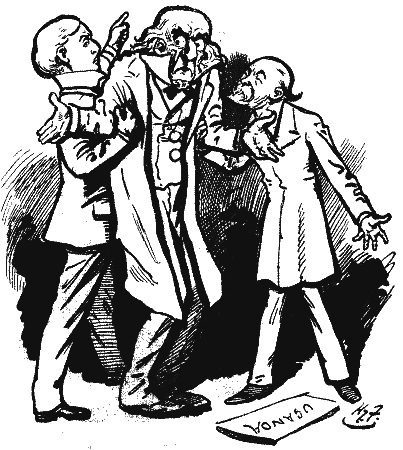
Mr. G. (sings sotto voco), "How happy could I be with either! Were only Uganda away!"
When Squire rose, a ringing cheer went up from Ministerialists. Their turn now. Joe was "going to catch it." But Squire knew better than that. Opportunity tempting; almost irresistible. But business first, pleasure after. With touching air of resignation, Squire said they had listened to a very good speech, and now he hoped the Vote would be agreed to; at which point he meekly sat down. Shock so sudden and unexpected that no one but Nolan moved, and he, finding himself on his legs, had no words ready. Whilst he was gasping in search of them, Closure moved; Chairman, who is getting well into the saddle, put question with lightning-like rapidity; before Committee quite knew where it was, it was dividing on the Uganda Vote.
Business done.—Supplementary Estimates concluded; Report of Supply agreed to; way cleared for Appropriation Bill.
Tuesday Night.—Henry Fowler explained Parish Council Bill in speech of equal force and lucidity. "Hands all round," as Tennyson said, in applause of speech and approval of Bill. Jesse Collings rather hinted that anything good in measure was conveyed from Ritchie's Bill, and everyone knows that Ritchie was mere lay-figure behind which Jesse controlled policy of Local Government Board under last Administration. Even this criticism meant as compliment. No harsher note disturbed chorus of approval.
Jokim, in effusion of moment, led into making interesting confession. As he says, only he put it stronger, general impression is that he is not particularly attached to Agricultural Labourer. Bobby Spencer, when he made his historic declaration—"Mr. Speaker, Sir, I am not an Agricultural Labourer"—understood to have Jokim in his mind; endeavouring to ingratiate himself with the statesman who, at the time, was Chancellor of Exchequer. Jokim, certainly, through long and honourable career, never lost opportunity of hustling Hodge. Deductions drawn from this attitude entirely erroneous. Only been dissembling his love. Made clean breast of it to-day. Clasping his hands with genuine emotion, tear plainly tickling through his voice, he exclaimed, "It has been the dream of my life to educate the Agricultural Labourer in Parish affairs!"
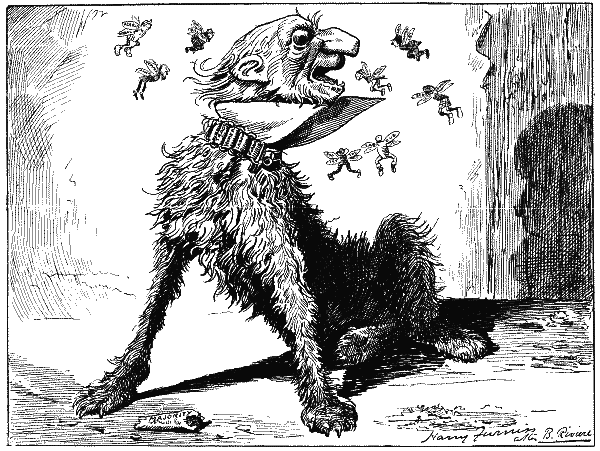
"CATCHING VOTES."
(Suggested by the Picture "Catching Flies.")
"Well, I must say, I never would have thought it," said Grandolph, regarding with new interest his Right Hon. friend.
Business done.—Parish Councils Bill brought in.
Thursday.—Pretty to watch Mr. G. in conversation with Prince Arthur on question of Vote of Censure. When Cameron, "doing a bit of bounce," as Brodrick said, asked Premier whether, supposing Opposition resolved to move Vote of Censure, a day wouldn't be found for them, Ministerialists cheered and Opposition responded. House never more like public school than when a fight is being got up. Now spirit rose to bubbling point; cheering and counter-cheering incessant. Only Mr. G. sat silent, apparently so deeply interested in Orders that he had not noticed what was forward. But he saw it all, saw a foot or two further into futurity than the jubilant throng behind him. Cameron had unwittingly dealt trump card to Opposition avowedly bent on obstructing Home-Rule Bill. Had a pretty good go to-day. Two hours for Questions; two hours more to be used up on Motion for Adjournment. That would serve to throw Registration Bill over sitting and spoil Mr. G.'s little programme. But this suggestion of Vote of Censure coming from other side, worth at least couple of days. Mr. G. saw it all, and once glanced quickly across table in search of sign that anyone on Front Bench opposite had made the discovery. Thought he saw a gleam of intelligence in Grandolph's eye. Hoped things might blow over; but there was inconvenient questioner behind, with Scotch persistency waiting answer. Ministerialists cheering like mad; Opposition truculently responding; all waiting for him. Must do or say something. Wouldn't commit himself by saying anything. Half rose from seat and bowed assent.
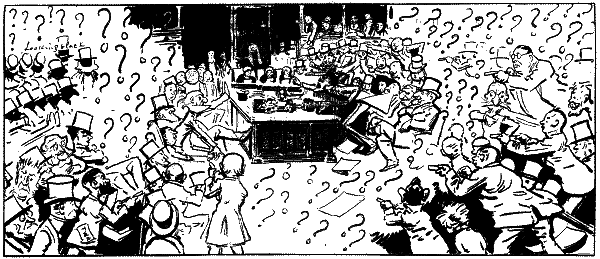
POPPING THE QUESTIONS;
Or, Scene from old Burlesque of "Obstruction" as revived at St. Stephen's Theatre Royal.
By this time Prince Arthur began to see light. Some smart fencing followed; Prince Arthur pressed home Vote of Censure question; Mr. G., whilst carefully avoiding any movement that might seem like retreat, evaded the point. Later, when Grandolph remarked that Prime Minister had challenged them to move Vote of Censure, Mr. G. angrily retorted, "I did nothing of the sort." Too late now; Right Hon. Gentlemen on Front Opposition Bench having put their heads together, determined to ride in at gate Cameron obligingly opened. Drew up Motion of Vote of Censure, and Mr. G. must needs, out of his diminishing hoard of days, find one for debating it; Opposition mean to make it two, or even three.
"I wish," said Mr. G., in those chest-notes that indicate profounder indignation, "my people would leave me to manage the business of House."
Business done.—Four hours wasted. Vote of Censure invited.
Friday Midnight.—Wonder to find Sage of Queen Anne's Gate still at post of duty. Business rather heavy work; think it would be well that so precious a life should be cared for. Say this to him.
"You're very kind, Toby," he answered, just a little wearily "but I never think of myself when the interests of my Queen and Country are at stake. Fact is, I have charge of a Bill drafted in the interests of our fellow-citizen the Sweep. He has thrown himself into my arms (of course I use the phrase in a Parliamentary sense) and I am resolved to do my best for him. I am told that the business which called the Judges into private consultation the other day was a proposal to place my bust, crowned with laurel, on a prominent pedestal in the Royal Courts of Justice. Well, I have done something in my time for justice; just now all my sympathies are with the Sweep. I receive deputations of them every day. No, they don't enter by the chimney, but come in by the front-door in ordinary fashion. When there are more than five of them, and they stay over twenty minutes, they leave a little smell lingering in the room. But that's nothing. I'm waiting now to move Second Reading of my Bill. Want Mr. G. to take it up. Have told him people really don't care for Home-Rule Bill, whereas, if he gave his mind to it, he might rouse the country on the question of the harmless necessary Sweep. But no use. He's too deeply rooted in his attachment to his Home-Rule scheme. Daresay I shall get my Bill through first."
Business done.—Patience of long-suffering Speaker breaks down at last. Jemmy Lowther did it. On Appropriation Bill moved incomprehensible Amendment, in unintelligble speech; Speaker came down on him "like cartload of bricks," as John Burns put it. James only temporarily subdued; will probably come up smiling on Monday.
Transcriber's Note: Missing or illegible/damaged punctuation has been repaired.