THE ADVENTURES OF PICKLOCK HOLES.
Reading edition
(By Cunnin Toil.)
No. VI.—THE UMBROSA BURGLARY.
During one of my short summer holidays I happened to be spending a few days at the delightful riverside residence of my friend James Silver, the extent of whose hospitality is only to be measured by the excellence of the fare that he sets before his guests, or by the varied amusements that he provides for them. The beauties of Umbrosa (for that is the attractive name of his house) are known to all those who during the summer months pass up (or down) the winding reaches of the Upper Thames. It was there that I witnessed a series of startling events which threw the whole county into a temporary turmoil. Had it not been for the unparalleled coolness and sagacity of Picklock Holes the results might have been fraught with disaster to many distinguished families, but the acumen of Holes saved the situation and the family-plate, and restored the peace of mind of one of the best fellows in the world.
The party at Umbrosa consisted of the various members of the Silver family, including, besides Mr. and Mrs. Silver, three high-spirited and unmarried youths and two charming girls. Picklock Holes was of course one of the guests. In fact, it had long since come to be an understood thing that wherever I went Holes should accompany me in the character of a professional detective on the lookout for business; and James Silver though he may have at first resented the calm unmuscularity of my marvellous friend's immovable face would have been the last man in the world to spoil any chance of sport or excitement by refraining from offering a cordial invitation to Holes. The party was completed by Peter Bowman, a lad of eighteen, who to an extraordinary capacity for mischief, added an imperturbable cheerfulness of manner. He was generally known as Shock-headed Peter, in allusion to the brush-like appearance of his delicate auburn hair, but his intimate friends sometimes addressed him as Venus, a nickname which he thoroughly deserved by the almost classic irregularity of his Saxon features.
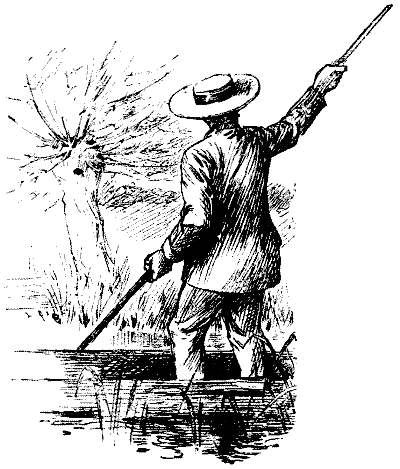
"Propelled by an athletic young fellow."
We were all sitting, I remember, on the riverbank, watching the countless craft go past, and enjoying that pleasant industrious indolence which is one of the chief charms of life on the Thames. A punt had just skimmed by, propelled by an athletic young fellow in boating costume. Suddenly Holes spoke.
"It is strange," he said, "that the man should be still at large."
"What man? Where? How?" we all exclaimed breathlessly.
"The young puntsman," said Holes, with an almost aggravating coolness. "He is a bigamist, and has murdered his great aunt."
"It cannot be," said Mr. Silver, with evident distress. "I know the lad well, and a better fellow never breathed."
"I speak the truth," said Holes, unemotionally. "The induction is perfect. He is wearing a red tie. That tie was not always red. It was, therefore, stained by something. Blood is red. It was, therefore, stained by blood. Now it is well known that the blood of great aunts is of a lighter shade, and the colour of that tie has a lighter shade. The blood that stained it was, therefore, the blood of his great aunt. As for the bigamy, you will have noticed that as he passed he blew two rings of cigarette-smoke, and they both floated in the air at the same time. A ring is a symbol of matrimony. Two rings together mean bigamy. He is, therefore, a bigamist."
For a moment we were silent, struck with horror at this dreadful, this convincing revelation of criminal infamy. Then I broke out:
"Holes," I said, "you deserve the thanks of the whole community. You will of course communicate with the police."
"No," said Holes, "they are fools, and I do not care to mix myself up with them. Besides, I have other fish to fry."
Saying this, he led me to a secluded part of the grounds, and whispered in my ear.
"Not a word of what I am about to tell you. There will be a burglary here to-night."
"But, Holes," I said, startled in spite of myself at the calm omniscience of my friend, "had we not better do something; arm the servants, warn the police, bolt the doors and bar the windows, and sit up with blunderbusses—anything would be better than this state of dreadful expectancy. May I not tell Mr. Silver?"
"Potson, you are amiable, but you will never learn my methods." And with that enigmatic reply I had to be content in the meantime.
The evening had passed as pleasantly as evenings at Umbrosa always pass. There had been music; the Umbrosa choir, composed of members of the family and guests, had performed in the drawing-room, and Peter had drawn tears from the eyes of every one by his touching rendering of the well-known songs of "The Dutiful Son" and "The Cartridge-bearer." Shortly afterwards, the ladies retired to bed, and the gentlemen, after the customary interval in the smoking-room, followed. We were in high good-humour, and had made many plans for the morrow. Only Holes seemed pre-occupied. Once I heard him muttering to himself, "It's bound to come off properly; never failed yet. They wired to say they'd be here by the late train. Well, let them come. I shall be ready for them." I did not venture at the time to ask him the meaning of these mysterious words.
I had been sleeping for about an hour, when I was suddenly awakened with a start. In the passage outside I heard the voices of the youngest Silver boy and of Peter.
"Peter, old chap," said Johnny Silver, "I believe there's burglars in the house. Isn't it a lark?"
"Ripping," said Peter. "Have you told your people?"
"Oh, it's no use waking the governor and the mater; we'll do the job ourselves. I told the girls, and they've all locked themselves in and got under their beds, so they're safe. Are you ready?"
"Yes."
"Come on then."
With that they went along the passage and down the stairs. My mind was made up, and my trousers and boots were on in less time than it takes to tell it. I went to Holes's room and entered. He was lying on his bed, fully awake, dressed in his best detective suit, with his fingers meditatively extended, and touching one another.
"They're here," I said.
"Who?"
"The burglars."
"As I thought," said Holes, selecting his best basket-hilted life-preserver from a heap in the middle of the room. "Follow me silently."
I did so. No sooner had we reached the landing, however, than the silence was broken by a series of blood-curdling screams.
"Good Heavens!" was all I could say.
"Hush," said Holes. I obeyed him. The screams subsided, and I heard the voices of my two young friends, evidently in great triumph.
"Lie still, you brute," said Peter, "or I'll punch your blooming head. Give the rope another twist, Johnny. That's it. Now you cut and tell your governor and old Holes that we've nabbed the beggar."
By this time the household was thoroughly roused. Agitated females and inquisitive males streamed downstairs. Lights were lit, and a remarkable sight met our eyes. In the middle of the drawing-room lay an undersized burglar, securely bound, with Peter sitting on his head.
"Johnny and I collared the beggar," said Peter, "and bowled him over. Thanks, I think I could do a ginger-beer."
The man was of course tried and convicted, and Holes, who had explained how he had been certain that the burglary was contemplated and had taken his measures accordingly, received the thanks of the County Council.
"That fellow," said the great detective to me, "was the best and cleverest of my tame team of country-house burglars. Through him and his associates I have fostered and foiled more thefts than I care to count. Those infernal boys nearly spoilt everything. Potson, take my advice, never attempt a master-stroke in a house full of boys. They can't understand scientific induction. Had they not interfered I should have caught the fellow myself. He had wired to tell me where I should find him."
Precept and Practice.—It's not sufficiently recognised that a Bishop is bound to side with the masters, as by the terms of his contract he engages to be "no striker."
"How To Make England Sober."—"It can't be done," says the Bishop of Chester, "sans Jayne."
A Striking Headline (all rights reserved).—Loch Out in Matabeleland!
A Jingo Paradox.—We pot the natives to preserve ourselves.
A MISTY CRYSTAL.
Darlings, I am growing old, Silver threads among the gold. Cannot see beyond my nose, Must have glasses I suppose. At the fair I bought a pair, Golden rimmed, of pebbles rare, Paid the money then and there, Glad my spectacles to wear. But, how strange! I could not see What was just in front of me! Took them off and rubbed them well; Cleaned they seemed; but, strange to tell, When I put them on again Everything was plain as plain, But reflected from behind! Then I found that tho' so blind, Many little things I saw Which I had not seen before. First, my page, of doubtful age, Put me in a dreadful rage; Dipped his fingers in the cream; (Turned and faced him—made him scream!) Dropped the pot, upset a lot— Caught it from me pretty hot. Next the footman kicked my cat Sleeping on its lamb's-wool mat. Loosed my dicky from its cage (Shall deduct this from his wage). When the housemaid scrubbed the floor, Watched her through the open door At my eldest making eyes. Packed her off to her surprise, Heeding not her tears and cries. Truly blindness makes one wise! Then I caught my little son Putting mustard in a bun; Going to give it to the pug. Seized him by the nearest lug, Boxed it hard. He howled with pain; Never teased the dog again. Saw my girl of twenty-three Kiss the curate, after tea. Sent the pair to right about. (Wondered how I found them out!) So, you see, I really find Much amusement of a kind. Eyes before and eyes behind, Is there anyone would mind Being just a little blind?
TRUE COMPUNCTION.
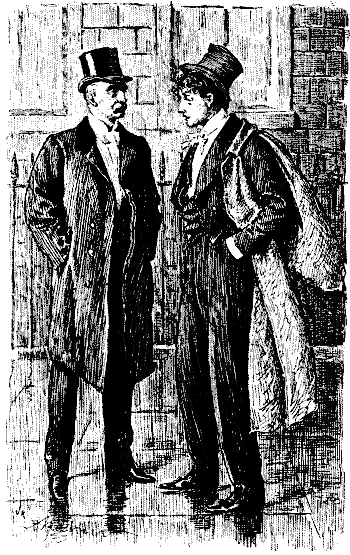
Young Hopeful (who has been celebrating, not wisely but too well, the last day of his Exam.). "Look here, Major! If You don't tell my Father of my D'sgrasheful Conduck, I shall!"
N.B. !
[In the "Report of the Royal Commission on Labour" it is said that "domestic economy is not now practised among the Scotch peasants with such closeness as formerly; wives have ceased to use oatmeal and other simple fare, and buy from the passing cart inferior goods which they could very well prepare at home." The married labourer's clothing is "finer, but less durable," and he himself is "less unknown in places of amusement."]
Scots, wha hae on parritch fed! Scots, in thrifty habits bred! Air ye leavin' barley bread, And frugality? Now's the day, much more the night, For stickin' to your bawbees tight! See approach proud Fashion's might, Chains o' luxury! Wha will to the flesher's wend, Buy thin breeks that will na mend, Wha sae base as saxpence spend On an evenin' spree? Wha for Scotland's knitted hose, Oaten cakes and homespun clo'es, Now will deal some auld-warld blows? He will live, not dee! By each braw and kilted laddie, Gudeman douce, and gude-boy caddie, Ye may weel at once eradi- -cate frivolity! Strike, and break amusement's yoke, Or your ainsells may be broke! Siller's saved in every stroke Of economy!
First-rate Foreign Advertisement for a Medical Friend of Ours.—Every dinner in France is now served "à la Roose."