Volume 146 — AT THE PLAY.
Reading edition
"The Dangerous Age."
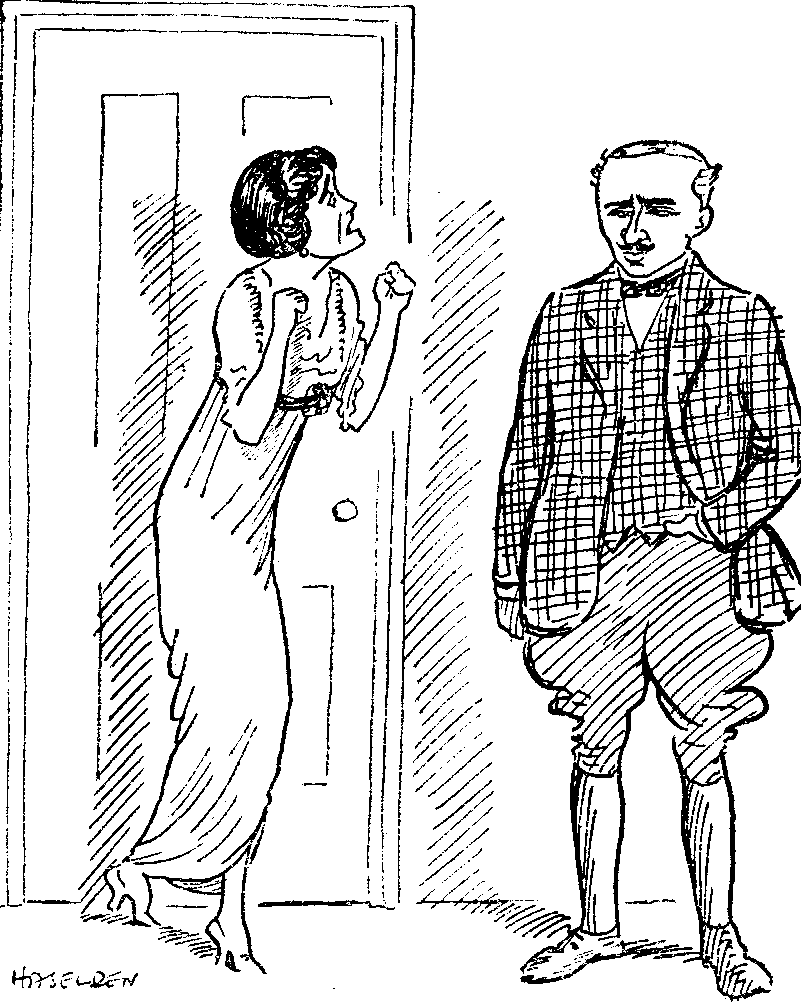
Distracted Mother (at the top of her voice, outside sick son's room). "He won't die! Tell me he won't die!"
Author of Play. "No, he won't die, because this is a 'happy ending' play, but the noise that goes on outside his room would kill him in ordinary life."
Betty Dunbar: Miss Eva Moore. Sir Egbert Englefield: Mr. H. V. Esmond.
When there is a good deal of talk on the stage about a certain character, who however remains "off" throughout the play and gives you no chance to discover for yourself what he is like, then I have an instinctive distrust of him. If his name is as bad as Cecil he is practically doomed. Betty Dunbar, widow, ran away from her rich sister's house and spent a night in London with such a Cecil. Betty had arrived at the dangerous age of forty, and was temporarily and ridiculously in love with this young bounder (as I felt him to be) of twenty-two. But the fact that, at the very time when she was thus making a fool of herself in London, her younger son, Jack, was falling off a tree and nearly killing himself in the country brought her to her senses. When she returned to the country to find Jack at death's door, her love for Cecil died and she could only think of him with hatred.
Now I can remember wondering, when I read The Vicar of Wakefield at an early and innocent age, why Dr. Primrose was so anxious that his daughter Olivia should be married to the beast with whom she had eloped, when it would be so much better for her if Thornhill left her (as he was willing to do) and she returned unmarried to her father. I am older now, and I know that in the good Vicar's opinion only thus could his daughter's "honour" be "preserved." But the world is also older now, and perhaps the oldest person in it is the woman suffragist—such a one, for instance, as Betty's elder sister, Ethel, who carried copies of Votes for Women about with her when she strolled through the home park. That Ethel should share Dr. Primrose's ingenuous views on this matter is unbelievable—by me, but not by the author. For she insisted, under threat of cutting off supplies, that Betty should marry Cecil, and (so to speak) become a lady again. Betty wisely refused, which left the way clear for Sir Egbert Englefield, and so brought down the curtain. I haven't mentioned Sir Egbert before, but he was there or thereabouts all the time, and being in the flesh Mr. H. V. Esmond, author of the play, it was obvious that he would have the pull over any unseen Cecil in the final arrangement of partners.
Although Ethel appears to be impossible, and the other characters mostly conventional, The Dangerous Age makes a very charming entertainment at the Vaudeville, a patchwork of humour and pathos ingeniously woven together; of which the humour was as fresh and jolly as anything I have heard on the stage, and the pathos put me in greater danger of being caught "blubbering like a seal" than I have ever been before. It is to Masters Reginald Grasdorff and Roy Royston that I owe my special thanks. Two more delightful boys on the stage cannot be imagined. Indeed I was at least as sorry as Betty when Jack fell off his tree, for I knew then that I should not see Master Roy again that evening. Fortunately Reginald remained, and acted with great skill a part which suddenly became serious. But I wish Osborne boys on the stage wouldn't wear their uniforms in the holidays when they climb trees. It emphasizes their Osbirth (if I may use the word) at the expense of their boyishness. Miss Eva Moore and Mr. Esmond were excellent, the latter playing a perfect Wyndham part without the Wyndham mannerisms. Mr. Leslie Banks, representing an entirely incredible person, was exactly like somebody I knew; a feat, it seems to me, of some skill.
M.
"The Wynmartens."
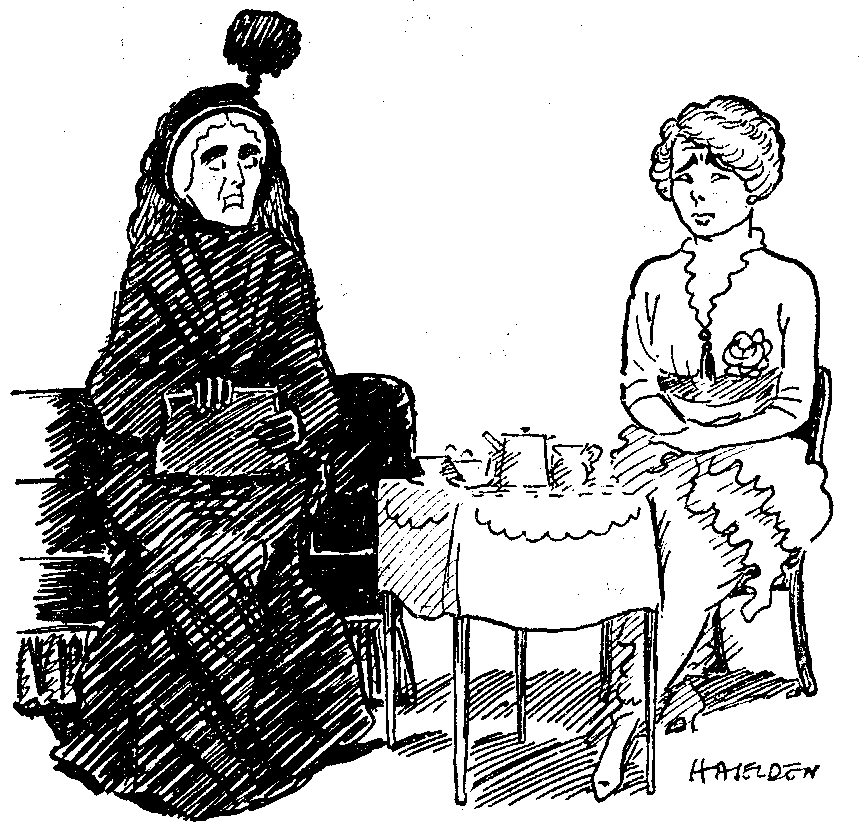
BLACK TRIES TO CHECK WHITE.
Lady Wynmarten: Miss Marie Tempest. Dowager Lady Wynmarten: Miss Agnes Thomas.
When a young widow wants to commit a flagrant outrage on the proprieties in order to scandalise a detested mother-in-law, and selects the first likely man for her accomplice, she will probably not be deterred by fear of any damage that may occur to his reputation. When Lady Wynmarten engaged the services of Bill Carrington she had the less compunction because he was only over from India for a week and might rely upon the fresh air of the high seas to repair the damage and displace the breath of scandal. Unfortunately, his very limited time in England had been carefully scheduled for the execution of several important contracts; and when his firm heard of his escapade and found him twenty minutes late for a business appointment, he was briefly booted.
It was at this point that the critics began to think of taking notes on their cuffs about Browning's views on the danger of "playing with souls," but found on reflection that the case was not so serious as that. For we knew all the time (by the splendour of her frocks) that the lady was rich, and we had gathered half-way through that she was prepared to accept Bill in marriage and make an honest man of him. Not that their joint adventure had actually achieved immorality. She had simply dined with him, done a play, had supper at the Savoy, gone on to a Covent Garden ball, failed to effect an entrance into her house (having deliberately mislaid her latch-key and cut the bell-wire), and been taken a little before milk-time to her mother-in-law's, where her appearance had caused the greatest confusion and scandal, which was indeed the ultimate purpose of the scheme. But the fatal devotion of her French maid, who telephoned next morning to all her mistress's friends to say that her bed had not been slept in, and that a dark mystery brooded over her whereabouts, tended to promote a garrulous interest in her conduct.
It was a sad pity that we were not permitted to witness any phase of this adventure. One seemed to be assisting at a farce with the fun left out. I should have greatly enjoyed being present at the moment when her ladyship claimed the hospitality of her mother-in-law's roof. But perhaps this experience would have left me in a frame of mind too frivolous for the right reception of the grave things that were to follow.
Yet the play was mixed of all moods, from gay to earnest, and offered excellent scope for the versatility of Miss Marie Tempest. Mr. Clarence's humour, on the other hand, was not so well served; and there were frequent longueurs during the episodes in which the Dowager Lady Wynmarten figured. She was meant to be a terror, and had some very vicious things to say; but Miss Agnes Thomas delivered them with superfluously well-bred restraint, and the level tone of her bitter suavity tended to become a little tedious.
Mr. Graham Browne showed a very nice self-repression as the widow's dummy. But he let himself go with his cigarettes which in moments of emotion he threw away with an appalling recklessness after the first two whiffs.
The rest of the cast did ample justice to a play which, if it is Mr. Powell's first, must be commended for its promise. But the next time he writes a Four-Act Comedy he must try and give us more than one Act without any tea in it.
O. S.