NO. II ALMAGEST; BOOK II. EXTRACT FROM CHAP. IX
J. M. Ashmand translation
Of Circumstances regulated by Ascensions
In any climate whatever, the magnitude of a given day or night is to be computed by the number of ascensional times proper to that particular climate. For example, the magnitude of the day will be ascertained by numbering the times between the Sun’s zodiacal degree and the degree diametrically opposite, in the succession of the signs; and that of the night, by numbering the times, from the degree diametrically opposite to the Sun, onwards, in the order of the signs, to be the degree actually occupied by the Sun: because, by dividing the respective amounts of these times so obtained, by fifteen, the number of equatorial hours belonging to each space will be exhibited; and if the division be made by twelve, instead of fifteen, the result will show the numbers of degrees equivalent to one temporal hour of either of the said spaces respectively.[286]
The magnitude of any temporal hour may be, however, more easily found by referring to the annexed Table of Ascensions, and taking the difference between the respective aggregate numbers, inserted therein under the heads of the equinoctial parallel or right sphere, and of any particular climate for which the magnitude of the temporal hour is required; and, if the said hour be a diurnal hour, the aggregate times as stated against the zodiacal degree occupied by the Sun; but, if nocturnal, those stated against the degree diametrically opposite, are to be compared; and the sixth part of the difference between them is to be added, if the said degree be in the northern signs, to the fifteen times of an equatorial hour; but subtracted therefrom, if in the southern signs. The amount thus obtained will be the required number of degrees of the temporal hour in question.[287]
And if it be required to reduce the temporal hours of any given day or night, in a certain climate, into equatorial hours, they must be multiplied by their proper horary times, whether diurnal or nocturnal, as the case may be; the product is then to be divided by fifteen, and the quotient will necessarily be the number of equatorial hours in the climate in question, on the given day or night.[288] On the other hand, equatorial hours are also to be reduced into temporal hours by being multiplied by fifteen, the product of which is to be divided by the horary times proper to the given day or night in the said climate.
The degree ascending in the ecliptic, at any given temporal hour, may also be ascertained by multiplying the number of temporal hours since sunrise, if the given hour be diurnal, but if nocturnal, since sunset, by their proper horary times; and the product is to be added, in the succession of the signs, to the aggregate number (as shown by the ascensions proper to the climate) of the Sun’s degree, if the given hour be diurnal, but, if nocturnal, to that of the degree diametrically opposite, and that particular degree of the ecliptic which shall correspond with the total number thus found in the ascensions of the climate will be the degree then ascending.[289]
But, in order to ascertain the degree on the meridian above the earth, the number of temporal hours since the preceding noon are also to be multiplied by their proper horary times, and the product is to be added to the aggregate number of the Sun’s right ascension; and that degree of the ecliptic, with which the total number as found in the aggregate times of right ascension shall correspond, will then be on the meridian.[290] The degree on the oriental horizon will, however, also show what degrees occupy the meridian; for, by subtracting 90 times (the amount of the quadrant) from the aggregate number ascribed to the said ascending degree in the Table proper to the climate, the number so reduced will be found, in the aggregate times of the Table of Right Ascension, to correspond with the degree on the meridian. And again, on the other hand, by adding 90 to the aggregate times ascribed by right of ascension to the degree on the meridian above the earth, the degree ascending may be obtained, for it will be that degree which corresponds to that total number, as stated in the Table proper to the climate.[291]
The Sun always preserves an equal distance in equatorial hours from all parts of the same meridian; but his distance in equatorial hours from different meridians varies according to the degrees of distance between meridian and meridian.
The foregoing extracts have been made to show the entire agreement between the astronomy of the Tetrabiblos and that of the Almagest. The Tables herein given from the latter work are, of course, now, in some degree, superseded by others of modern calculation, infinitely more complete.
Table of Latitudes, as Shown by the Duration of the Longest Day
[From the Almagest.]
LONGEST DAY. LATITUDE.
H. M. D. M.
12 0 0 0
12 15 4 15
12 30 8 25
12 45 12 30
13 0 16 27
13 15 20 14
13 30 23 51
13 45 27 40
14 0 [292]30 22
14 15 33 18
14 30 36 0
14 45 38 35
15 0 40 56
15 15 43 5
15 30 45 1
15 45 46 51
16 0 48 32
16 15 50 15
16 30 [293]51 35
16 45 52 50
17 0 54 1
17 15 55 0
17 30 56 0
17 45 57 0
18 0 58 0
18 30 59 30
19 0 61 0
19 30 62 0
20 0 63 0
21 0 64 30
22 0 65 30
23 0 66 0
24 0 66 10
Extract from the Table of Ascension (Contained in the Almagest), Calculated for every Tenth Degree of the Zodiac.
SIGNS Tenth Degree In a Right Sphere under the Equator, Diurnal Arc 12 Hours. 3rd Climate, thro’ Lower Ægypt, Lat. 30° 22′ N. Diurnal Arc 14 Hours. 8th Climate thro’ Southern Britain, Lat. 51° 30′ N. Diurnal Arc 16 Hs. 20 Mts.
Times of Ascen. Aggregate Times. Times of Ascen. Aggregate Times. Times of Ascen. Aggregate Times.
D. M. D. M. D. M.
Aries 10 9.10 9.10 6.48 6.48 4.05 4.05
20 9.15 18.25 6.55 13.43 4.12 8.17
30 9.25 27.50 7.10 20.53 4.31 12.48
Taurus 10 9.40 37.30 7.33 28.26 4.56 17.44
20 9.58 47.28 8.02 36.28 5.34 23.18
30 10.16 57.44 8.37 45.05 6.25 29.43
Gemini 10 10.34 68.18 9.17 54.22 7.29 37.12
20 10.47 79.05 10.00 64.22 8.49 46.01
30 10.55 90.00 10.38 75.00 10.14 56.15
Cancer 10 10.55 100.55 11.12 86.12 11.36 67.51
20 10.47 111.42 11.34 97.46 12.45 80.36
30 10.34 122.16 11.51 109.37 13.39 94.15
Leo 10 10.16 132.32 11.55 121.32 14.07 108.22
20 9.58 142.30 11.54 133.26 14.22 122.44
30 9.40 152.10 11.47 145.13 14.24 137.08
Virgo 10 9.25 161.35 11.40 156.53 14.19 151.27
20 9.15 170.50 11.35 168.28 14.16 165.45
30 9.10 180.00 11.32 180.00 14.15 180.00
Libra 10 9.10 189.10 11.32 191.32 14.15 194.15
20 9.15 198.25 11.35 203.07 14.18 208.33
30 9.25 207.50 11.40 214.47 14.19 222.52
Scorpio 10 9.40 217.30 11.47 226.34 14.24 237.16
20 9.58 227.28 11.54 238.28 14.22 251.38
30 10.16 237.44 11.55 250.23 14.07 265.45
Sagittarius 10 10.34 248.18 11.51 262.14 13.39 279.24
20 10.47 269.05 11.34 273.48 12.45 292.09
30 10.55 270.00 11.12 285.00 11.36 303.45
Capricornus 10 10.55 280.55 10.38 295.38 10.14 313.59
20 10.47 291.42 10.00 305.38 8.49 322.48
30 10.34 302.16 9.17 314.55 7.29 330.17
Aquarius 10 10.16 312.32 8.37 323.32 6.25 336.42
20 9.58 322.30 8.02 331.34 5.34 342.16
30 9.40 332.10 7.33 339.07 4.56 347.12
Pisces 10 9.25 341.35 7.10 346.17 4.31 351.43
20 9.15 350.50 6.55 353.12 4.12 355.55
30 9.10 360.00 6.48 360.00 4.05 360.00
NO. III THE CENTILOQUY, OR HUNDRED APHORISMS OF CLAUDIUS PTOLEMY[294]; OTHERWISE CALLED, THE FRUIT OF HIS FOUR BOOKS
I. Judgment must be regulated by thyself, as well as by the science; for it is not possible that particular forms of events should be declared by any person, however scientific; since the understanding conceives only a certain general idea of some sensible event, and not its particular form. It is, therefore, necessary for him who practices herein to adopt inference. They only who are inspired by the deity can predict particulars.
II. When an enquirer shall make mature search into an expected event, there will be found no material difference between the event itself and his idea of it.
III. Whosoever may be adapted to any particular event or pursuit, will assuredly have the star indicative thereof very potent in his nativity.
IV. A mind apt in knowledge will discover truth more readily than one practised in the highest branches of science.
V. A skilful person, acquainted with the nature of the stars, is enabled to avert many of their effects, and to prepare himself for those effects before they arrive.
VI. It is advantageous to make choice of days and hours at a time well constituted by the nativity. Should the time be adverse, the choice will in no respect avail, however favourable an issue it may chance to promise.
VII. The mingled influences of the stars can be understood by no one who has not previously acquired knowledge of the combinations and varieties existing in nature.
VIII. A sagacious mind improves the operation of the heavens, as a skilful farmer, by cultivation, improves nature.
IX. In their generation and corruption forms are influenced by the celestial forms, of which the framers of talismans consequently avail themselves, by observing the ingresses of the stars thereupon.
X. In the election of days and hours, make use of the malefics, to the same moderate extent as the skilful physician would use poisons in order to perform cures.
XI. A day and hour are not to be elected until the quality of the object proposed shall be known.
XII. Love and hatred prohibit the true accomplishment of judgments; and, inasmuch as they lessen the most important, so likewise they magnify the most trivial things.
XIII. In every indication made by the constitution of the heavens, secondary stars, whether auxiliary or injurious thereto, are also to be used.
XIV. The astrologer will be entangled in a labyrinth of error, when the seventh house and its lord shall be afflicted.
XV. Signs cadent from the ascendant of any kingdom are the ascendants of that kingdom’s enemies. But the angles and succedent houses are the ascendants of its friends. It is the same in all doctrines and institutions.
XVI. When the benefics may be controlled in the eighth house, they bring mischief by means of good men: if, on the other hand, they be well affected, they will prevent mischief.
XVII. Give no judgment as to the future life of an aged person, until the number of years he may live shall have been reckoned.
XVIII. If, while a benefic may ascend, both the luminaries should be in the same minute[295], the native will be equally and highly prosperous in all things which can befall him. So, likewise, if the luminaries be mutually opposed by the east and west. But the contrary effect will be produced, should a malefic be on the ascendant.
XIX. The efficacy of purgation is impeded by the Moon’s conjunction with Jupiter.
XX. Pierce not with iron that part of the body which may be governed by the sign actually occupied by the Moon.
XXI. When the Moon may be in Scorpio or Pisces, purgation may be advantageously used, provided the lord of the ascendant be coupled with some star posited below the earth. If he be coupled with a star placed above the earth, the potion swallowed will be vomited up.
XXII. Neither put on nor lay aside any garment for the first time, when the Moon may be located in Leo. And it will be still worse to do so, should she be badly affected.
XXIII. Aspects between the Moon and stars give the native much activity; and, if the stars be in power, they indicate an efficient, but if weak an inert, excitation to action.
XXIV. An eclipse of the luminaries, if in the angles of the nativity, or of an annual revolution, is noxious; and the effects take place according to the space between the ascendant and the place of eclipse. And as, in a solar eclipse, a year is reckoned for an hour, so likewise, in a lunar eclipse, a month is reckoned for an hour.
XXV. The progression of a significator, posited in the mid-heaven, is to be made by right ascension; of another posited in the ascendant, by the oblique ascension of the particular latitude.
XXVI. There is obvious concealment in the case, if the star significative of any particular affair be in conjunction with the Sun, either under the earth or in a place foreign to its own nature. On the other hand, there is manifestation, should the star be raised to elevation out of its depression, and be located in its own place.
XXVII. Venus gives pleasure to the native in that part of the body which may be ruled by the sign she occupies. It is the same with other stars.
XXVIII. When the Moon may not hold a familiarity with two planets, as is desirable, care should be taken to connect her, if possible, with some fixed star combining their qualities.
XXIX. The fixed stars grant extremely good fortune, unconnected with the understanding; but it is most commonly marked by calamities, unless the planets also agree in the felicity.
XXX. Observe the creation of the first king of any dynasty; for if the ascendant at that creation should agree with the ascendant of the nativity of the king’s son, he will succeed his father.
XXXI. When the star ruling over any kingdom shall enter into a climacterical place, either the king, or some one of the chief men of his kingdom, will die.
XXXII. Concord between two persons is produced by an harmonious figuration of the stars, indicative of the matter whereby good will is constituted, in the nativity of either person.
XXXIII. Love and hatred are discernible, as well from the concord and discord of the luminaries, as from the ascendants of both nativities: but obeying signs increase good will.
XXXIV. If the lord of the place of the new Moon be in an angle, he is indicative of the events liable to happen in that month.
XXXV. When the Sun arrives at the place of any star, he excites the influence of that star in the atmosphere.
XXXVI. In the foundation of cities, consider the fixed stars which may seem to contribute thereto; but in the erection of houses, observe the planets. The kings of every city which has Mars in culmination will most commonly perish by the sword.
XXXVII. If Virgo or Pisces be on the ascendant, the native will create his own dignity; but if Aries or Libra is on the ascendant, he will cause his own death. The other signs are to be contemplated in the same way.
XXXVIII. Mercury, if established in either house of Saturn, and in power, gives the native a speculative and inquisitive intellect: if in a house of Mars, and especially if in Aries, he gives eloquence.
XXXIX. Affliction of the eleventh house, in the creation of a king, indicates damage in his household and his treasury: affliction of the second house denotes the detriment of his subject’s wealth.
XL. When the ascendant is oppressed by the malefics, the native will delight in sordid things, and approve ill-favoured odours.
XLI. Beware the affliction of the eighth house and its lord, at a time of departure; and that of the second house and its lord, at a time of return.
XLII. Should a disease begin when the Moon may be in a sign occupied at the birth by some malefic, or in quartile or opposition to any such sign, such disease will be most severe; and if the malefic also behold the said sign, it will be dangerous. On the other hand, there will be no danger if the Moon be in a place held at the time of birth by some benefic.
XLIII. The malefic figures of a nation are strengthened by adverse figurations of existing times.
XLIV. It is an evil case if the ascendant of a sick person resist the figuration of his own nativity; and if the time should not bring up any benefic.
XLV. If the ascendant, or principal significators, be not in human signs, the native himself will be also estranged from human nature.
XLVI. In nativities much happiness is conferred by the fixed stars; and also by the angles of the new Moon, and by the place of a kingdom’s Part of Fortune, should the ascendant be found in any of them.
XLVII. If a malefic in one nativity fall on the place of a benefic in another nativity, he who has the benefic will suffer damage from him who has the malefic.
XLVIII. If the mid-heaven of a prince be the ascendant of his subject, or if their respective significators be configurated in a benevolent form, they will continue long inseparable. It will be the same, also, should the sixth house of a subject or servant be the ascendant of his prince or master.
XLIX. If the ascendant of a servant be the mid-heaven in his master’s nativity, the master will place so much confidence in that servant as to be ruled by him.
L. Overlook none of the hundred and nineteen conjunctions; for on them depends the knowledge of worldly operations, whether of generation or of corruption.
LI. Make the sign occupied by the Moon at the time of birth the sign ascending at the conception; and consider that in which she may be posited at the conception, or the opposite one, as the sign ascending at the birth.
LII. Men of tall stature have their lords of nativity in elevation, and their ascendants in the beginnings of signs; but the lords of men of short stature will be found in declination.[296] It must also be seen whether the signs be right or oblique.
LIII. The lords of nativity of slight or thin men have no latitude, but those of stout or fat men have; and, if the latitude be south, the native will be active; if north, inactive.
LIV. In the construction of a building, the principal rulers, if coupled with a star below the earth, will impede the erection.
LV. Mars’ evil influence over ships is diminished if he be neither in the mid-heaven nor in the eleventh house; but if in either of those places, he renders the ship liable to be captured by pirates. And if the ascendant be afflicted by any fixed star of the nature of Mars, the ship will be burned.
LVI. While the Moon is in her first quarter, withdrawing from her conjunction with the Sun, the bodily humours expand until her second quarter: in her other quarters they decrease.
LVII. If, during a sickness, the seventh house and its lord be afflicted, change the physician.
LVIII. Observe the place of an aspect, and its distance from the ascendant of the year; for the event will happen when the profection may arrive thither.
LIX. Before pronouncing that an absent person shall die, observe whether he may not become intoxicated; before declaring that he shall receive a wound, see whether he may not be let blood; and before saying that he shall find treasure, examine whether he may not receive his own deposit; for the figures of all these things may be similar.
LX. In cases of sickness, observe the critical days, and the Moon’s progress in the angles of a figure of sixteen sides. If those angles be well affected, it is favourable for the invalid; if they be afflicted, unfavourable.
LXI. The Moon is significative of bodily matters, which, in respect of motion, resemble her.
LXII. By marking exactly the beginning of a conjunction,[297] judgment may be made of the variation of the weather in the ensuing month. It will depend upon the lord of the angle of every figure, for he controls the nature of the atmosphere; assuming also at these times the quality of the existing weather.
LXIII. In the conjunction of Saturn and Jupiter, pronounce according to the nature of that one which may be higher in elevation. Follow the same rule with other stars.
LXIV. After ascertaining the lord of the inquiry, see what power he may have in the annual revolution, or in the ascendant of the new Moon; and pronounce accordingly.
LXV. In the least conjunction, the difference of the mean conjunction, and in the mean conjunction the difference of the greatest conjunction.[298]
LXVI. Consider no profection by itself alone, but make reference also to the qualifications and impediments of the stars.
LXVII. Years are diminished by the imbecility of the receiver.
LXVIII. A malefic, when matutine, signifies an accident; when vespertine, a disease.
LXIX. The native’s sight will be impaired if the Moon be opposed to the Sun, and joined with nebulous stars; and if the Moon be in the western angle, and both the malefic stars in the eastern angle, the Sun being in an angle also, the native will become blind.
LXX. Insanity is produced if the Moon have no connection with Mercury; and, if neither of them be connected with the ascendant, Saturn being in occupation of the angle by night, but Mars by day, especially if in Cancer, Virgo, or Pisces, a dæmoniac affection will be produced.
LXXI. If both luminaries may be in masculine signs, in the nativities of males, their actions will be consonant with nature; but if so placed in the nativities of females, they increase their action. And Mars and Venus, if matutine, incline to the masculine gender; if vespertine, to the feminine.
LXXII. Matters of education are to be considered by the ascending lords of triplicity; matters of life, by the lords of the conditionary luminary’s triplicity.
LXXIII. If the Sun be found with the Gorgon’s head (Caput Medusæ), and not aspected by any benefic star, and if there be no benefic present in the eighth house, and the lord of the conditionary luminary be opposed to Mars, or in quartile to him, the native will be beheaded. If the luminary culminate, his body will be maimed or mangled; and if the aspect in quartile be from Gemini or Pisces, his hands and feet will be amputated.
LXXIV. Mars, if ascending, uniformly gives a scar in the face.
LXXV. If the Sun be in conjunction with the lord of the ascendant, in Leo, and Mars has no prerogative in the ascendant, and if there be no benefic in the eighth house, the native will be burned.
LXXVI. If Saturn hold the mid-heaven, and the conditionary luminary be opposed to him, the native will perish in the ruins of buildings, provided the sign on the lower heaven be an earthly sign; if it be a watery sign, he will be drowned or suffocated by water: if a human sign, he will be strangled by men, or will perish by the halter or the scourge. Should there, however, be a benefic in the eighth house, he will not suffer death, although he will be brought near it.
LXXVII. Profection of the ascendant is to be made for matters affecting the body; of the Part of Fortune, for extrinsic circumstances; of the Moon, for the connection between the body and the spirit; and of the mid-heaven, for the employment or profession.
LXXVIII. A star often dispenses influence in a place in which it has no prerogative, thus bringing unexpected advantage to the native.
LXXIX. Whoever has Mars in the eleventh house, does not govern his master.
LXXX. If Venus be in conjunction with Saturn, and have any lord of house in the seventh house, the native will be of spurious origin.
LXXXI. Times are reckoned in seven ways; viz. by the space between two significators; by the space between their mutual aspects; by the approach of one to the other; by the space between either of them and the place appropriated to the proposed event; by the descension of a star, with its addition or diminution; by the changing of a significator; and by the approach of a planet to its place.
LXXXII. When a figure may be equipoised, observe the horoscope (or figure) at the new or full moon, and, if that also be equipoised, be not hasty in giving judgment.
LXXXIII. The time of obtaining a grant indicates the affection between the applicant and his prince; but the seat[299] shows the nature of the office;—
LXXXIV. And if Mars be lord of the ascendant at the time of entering on possession, and posited in the second house, or coupled with the lord of the second, he brings much mischief.
LXXXV. Should the lord of the ascendant be configurated with the lord of the second house, the prince will spontaneously create many charges.
LXXXVI. The Sun is the source of the vital power; the Moon, of the natural power.
LXXXVII. Monthly revolutions are made in twenty-eight days, two hours and about eighteen minutes. Judgment is also made by some persons by means of the Sun’s progress; that is to say, by his partial equations to that degree and minute which he might hold at the beginning.
LXXXVIII. In making profection of the part of Fortune for a whole annual revolution, a space equal to that between the Sun and Moon is to be reckoned from the ascendant.
LXXXIX. Consider the grandfather’s affairs from the seventh house and the uncle’s from the sixth.
XC. Should the significator be in aspect to the ascendant, the hidden event or object will correspond in its nature with the ascendant; but if the ascendant be not so aspected, the nature of the event will accord with that of the place in which the significator is posited. The lord of the hour shows its colour; the place of the Moon its time; and, if above the earth, it will be a novel thing; if below, old. The part of Fortune indicates its quantity, whether long or short. The lords of the terms, and of the lower heaven and mid-heaven, and of the Moon, shows its substance or value.
XCI. Should the ruler of a sick person be combust, it is an evil portent; and especially if the part of Fortune be afflicted.
XCII. Saturn, if oriental, is not so highly noxious to a sick person; nor Mars, if occidental.
XCIII. Judgment is not to be drawn from any figure until the next conjunction shall have been considered: for principles are varied by every conjunction; and therefore, to avoid error, both the last and the next should be combined.
XCIV. The place of the more potent significator indicates the thoughts of the inquirer.
XCV. The stars rising with the tenth house prove how far the native may be fitted to the occupation which he follows.
XCVI. In an eclipse, such significations as are made nearest the angles, show the events decreed. The nature of the stars in accordance with the eclipse, plants as well as fixed stars, and also the appearances co-ascending, are likewise to be considered, and judgment is to be given accordingly.
XCVII. The event inquired about will be speedily accomplished, should the lord of the new or full Moon be in an angle.
XCVIII. Shooting stars, and meteors like flowing hair, bear a secondary part in judgments.
XCIX. Shooting stars denote the dryness of the air; and, if they are projected to one part only, they indicate wind therefrom: if to various parts, they indicate diminution of waters, a turbulent atmosphere, and incursions of armies.
C. If comets, whose distance is eleven signs behind the Sun, appear in angles, the king of some kingdom, or one of the princes or chief men of a kingdom, will die. If in a succedent house, the affairs of the kingdom’s treasury will prosper, but the governor or ruler will be changed. If in a cadent house, there will be diseases and sudden deaths. And if comets be in motion from the west towards the east, a foreign foe will invade the country: if not in motion, the foe will be provincial, or domestic.
End of the Centiloquy
NO. IV THE ZODIACAL PLANISPHERE
The Reader is desired to refer to the Plate at end of book containing diagrams of the Zodiacal Planisphere, which has been spoken of in the Note in p. 99.
Fig. 1 is the Planisphere adjusted for the northern latitude of 30° 22′ (where the longest day consists of fourteen equatorial hours), agreeably to the “Exemplification” given by Ptolemy in Chapter XV, Book 3. It represents that portion of the celestial sphere which is contained between the tropics: the central horizontal line is the equator; the curved line extending longitudinally from east to west is the ecliptic; the central perpendicular line is the meridian, or cusp of the 10th house; the other short lines, cutting the equator transversely, are the cusps of the other houses; that of the 1st house being the eastern horizon; that of the 7th, the western horizon. Hence, the distance from the 1st house to the meridian, or from the meridian to the 7th house, shows the semi-diurnal arc of any parallel of declination in the ecliptic; and the distance of the 7th house to the 4th, or from the 4th to the 1st, shows the semi-nocturnal arc. The distance from the cusp of one house to that of the next, taken on the same parallel, is also equal to two temporal hours; thus, for instance, in the latitude above quoted, the semi-diurnal arc of 0° ♊ is 6 h. 50 m., or 102° 39′ of the equator; consequently the diurnal temporal hour is equal to one equatorial hour and eight minutes, or to 17° 6′ of the equator.
In his first example, Ptolemy directs 0° ♉ to be placed on the ascendant, so that the beginning of ♑ may be on the mid-heaven; 0° ♊ must, therefore, fall on the point A, distant from the mid-heaven 147° 44′ of the equator, as measured by the line AB; because every point in the sphere always preserves one and the same parallel with the equator; and 0° ♊, in passing to the mid-heaven, must proceed along the line AB. In the present case, however, it is required to know how long 0° ♊ will be in coming to the ascendant, the given position of 0° ♉. Now 0° ♊ will be on the ascendant when it arrives at the point G; therefore the distance from A to C is the amount of the prorogation between 0° ♉ (when posited on the ascendant) and 0° ♊, and it is equal to 45° 5′ of the equator. In the second example, 0° ♉ is placed on the mid-heaven, which position must be at D, so that 0° ♊ must necessarily be at E; and the distance from E to B, equal to 57° 44′ of the equator, is the prorogation between 0° ♉ and 0° ♊, when 0⁴ ♉ is on the mid-heaven. In the third example, 0° ♉ is supposed to be on the 7th house, descending, at F, so that ♓ is on the mid-heaven, and 0° ♊ at the point G, in advance of the mid-heaven 32° 16′ of the equator, as shown by the distance BG. Now it is required to bring 0° ♊ to the 7th house (the place of 0° ♉), and it will be there on arriving at H, distant from B 102° 39′ of the equator; but as 0° ♊ is already at G, the distance from G to H, equal to 70° 23′ of the equator, is the amount of the prorogation between 0° ♉ and 0° ♊, when 0° ♉ is on the 7th house. The fourth example places 0° ♉ at I, three temporal hours past the meridian; 0° ♊ therefore falls on the point K, at the distance of 13 equatorial degrees before the meridian or mid-heaven, and will be three temporal hours past the meridian (the position of 0° ♉) on arriving at L, distant 51 equatorial degrees from the mid-heaven: the whole distance from K (the first position of 0° ♊) to L, its second position, equal to 64 degrees of the equator, is therefore the prorogation between 0° ♉ and 0° ♊, when 0° ♉ is past the meridian at the distance of three temporal hours. Ptolemy has also instanced two other positions for 0° ♉; viz. at two temporal hours past the meridian, and at two temporal hours before the occidental angle; or, in other words, on the cusp of the 9th house, and on that of the 8th. Now, if 0° ♉ be on the cusp of the 9th house, it must be at M, and 0° ♊ will be at N, distant 62 equatorial degrees from Q, which is also on the cusp of the 9th. If 0° ♉ be on the cusp of the 8th, it must be at O, and 0° ♊ will be at P, distant 66 equatorial degrees from R, which is also on the cusp of the 8th: these two several numbers of degrees will be the respective prorogations between 0° ♉ and 0° ♊, when 0° ♉ is placed on the 9th and 8th houses.
Ptolemy’s “Exemplification” has been followed thus minutely in order to show how perfectly Mr. Ranger’s invention is adapted to assist (if not to supersede) arithmetical calculation; for, after the Planisphere has once been accurately laid down, a line drawn parallel to the equator, from the significator to the promittor, or to the promittor’s pole of position, and measured by degrees of the equator, will accomplish the whole operation of ascertaining the amount of prorogation.
Fig. 2 is the Equator extended, in plano, on a scale proportionate to the planispheres in Figs. 1 and 3: it is divided into 360 degrees, and into equal time, as measured by the 24 hours of the earth’s daily rotation on its axis, and by smaller portions of four minutes each, corresponding with degrees of the equator.
Fig. 3 is the Planisphere set for the latitude of Southern Britain, 51° 30′ N., where the longest day is 16 h. 30 m., the semi-diurnal arc of 0° ♊ being consequently 7 h. 52 m., or 118° of the equator, and its diurnal temporal hour equal to one hour and nearly nineteen minutes of equatorial time, or to 19° 40′ of the equator. In applying Ptolemy’s examples, given in Chapter XV, Book 3, to this latitude, it will follow that, when 0° ♉ may be on the ascendant, 0° ♊ will be at A, and will subsequently arrive at the ascendant at C, after the passage of 29° 43′ of the equator. When 0° ♉ may be on the mid-heaven at D, 0° ♊ will be at E, and will arrive at B, on the mid-heaven, after the passage of 57° 44′ of the equator, as in Fig. 1. When 0° ♉ may be on the 7th house, at F, 0° ♊ will be at G, and will come to the 7th house, at H, after the passage of 85° 45′ of the equator. If 0° ♉ be three temporal hours past the meridian, at I, 0° ♊ would be at K, again 13 equatorial degrees before the meridian, as in Fig. 1, and will be three temporal hours past the meridian, a position similar to that assumed for 0° ♉, on arriving at L, distant from the mid-heaven 59 equatorial degrees; thus making the whole distance, from K to L, 17 equatorial degrees. If 0° ♉ be on the 9th house, at M, 0° ♊ will be at N, distant from Q (also on the 9th house) about 67 equatorial degrees. If 0° ♉ be on the 8th house, at O, 0° ♊ will be at P, distant from R (also on the 8th house) about 76 equatorial degrees.
By taking the trouble to calculate the distances between the several positions given by Ptolemy, the Reader may satisfy himself of the sufficiency of this Planisphere for the purpose for which it was first projected; viz. for the more expeditious measurement of the arcs of direction. The Tables of Ascensions, extracted from the Almagest, in p. 152, will show that the arcs, as measured in Figs. 1 and 2 of the plate, exactly tally with the amounts of distance obtained by calculating arithmetically, according to the respective latitudes, as quoted in the Tables.
The slight view which has been here given of the Zodiacal Planisphere invented by Mr. Ranger, must not be considered as pretending to offer a complete idea of its powers: they are so manifold and various, that another volume would be required to detail them fully; and it has now been used only in order to give a better illustration of Ptolemy’s examples of the spaces of prorogation than mere words can do. To persons conversant with the mathematical part of astronomy, the facility with which a complete representation of zodiacal latitude, declination, the poles of position, crepusculine circles, and other phenomena, may be made by this Planisphere, will be sufficiently obvious from the accompanying Figures.
Finis
Fig. 1.
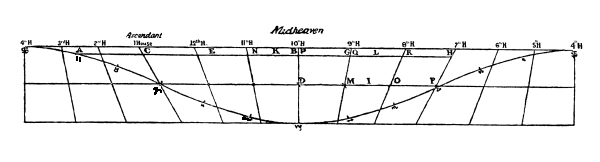
Fig. 2.

Fig. 3.

Footnotes: