Front matter (continued 2)
Reading edition
After a moment's hesitation, Felix said, "1/4840 of an acre."
"Then, 1,875 square yards would be how many 4,84Oths of an acre?"
"Why," replied Felix, after a little further consideration, "1875/4840 of an acre."
"Now let's reduce that fraction as low as we can, by dividing both terms by five, and what does it give us?"
"375/968 of an acre."
"Now, is that about a fourth of an acre, or about a third of an acre?"
Felix looked at the figures a moment, and then said, "It's a good deal more than a quarter of an acre, and—it's more than a third of an acre too."
"Yes, it's a little more than a third of an acre: there's more ground in our house-lot than I thought there was. You know now about how large those boys' farm was,—nearly three times as large as our yard. Now let's see exactly how many roods and rods and yards and feet and inches there are."
"How do you do that?" asked Felix, looking very blank.
"Why, reduce your 1,875 square yards in the garden, to higher denominations."
"Oh, yes!" replied Felix, brightening: "I've done those sums lots of times, and those denominate fractions like 1875/4840, but I never could see any sense to it before. Let's see,—what do you divide by first? Oh! I remember, 30¼."
Felix figured away bravely; but when he gave his result, it differed considerably from Johnny's. After some expressions of impatience, he looked it over, and, with some assistance from Johnny, found his mistake; their answers then agreed; and he read the result aloud, with something of an air of pride in his achievement,—
"1 rood, 21 square rods, 29 square yards, 6 square feet, 108 square inches. And that's the first time I ever saw any sense in square measure, and all those things. I thought arithmetic was just to keep boys busy in school, and I could always find enough to do without it. I tell you, I've played more pranks on the teachers! and I didn't get found out very often neither; and when I did, they didn't dare punish me, for fear my folks would make a fuss; and they would too."
"It is eight o'clock now; and I always read to our children for an hour or so before they go to bed," said Mrs. Le Bras, "or have them read aloud to me."
"Let us all take turns to-night," said Johnny. "You or father begin."
"Very well," said Mrs. Le Bras, taking a book from one of the library-shelves. "We are to begin our new book to-night, which is fortunate on Felix's account."
"It'll be awful stupid, I know," said Felix: "all books are. I wish books had never been invented, and then a fellow would not have to go to school at all."
"You begin, Frank," said Mrs. Le Bras.
Mr. Le Bras put down his paper, and began to read in the book. It was an account of a pedestrian excursion made by two boys in the Alps: they were German boys, and this was the way they spent their summer vacation.
Felix did not intend to listen to the reading: he had begun to draw comic pictures on his sheet of paper; he was trying to represent himself and Clyde, as he was falling from the roof; his attempt, however, was not very artistic. But soon he became very much interested in the story, and sat quite still, listening. Mr. Le Bras, after reading about fifteen minutes, passed the book to Mrs. Le Bras. She read about the same length of time, and then passed the book to Felix. Felix said at first that he did not like to read aloud, and would have passed the book to Johnny. But his uncle said, "No, Felix, I want to hear you read;" and Felix, who stood rather in awe of his uncle Frank, did not like to disobey him. He made so many mistakes, and mixed his words up so badly by reading too fast, that Sue was about to say she could not understand his reading, when her mother shook her head at her.
When Johnny's turn came, he read remarkably well,—so much so, that Felix felt quite ashamed of his own reading, which he knew was not good, although he did not know exactly what was the matter with it, except that he could not pronounce all the words. Sue read exceedingly well for a little girl,—very much better than Felix.
"It is nine o'clock now," said Mrs. Le Bras at length, "and we must put the book aside until to-morrow night."
"Oh, no!" exclaimed Felix: "we are at the most interesting part now."
But Mrs. Le Bras explained that they never read more than an hour in this way; and, as she said this, she replaced the book on the shelf, remarking that it was time for the children to go to bed.
"I never go to bed till I get ready," replied Felix, "and generally I sit up until ten."
"What time do you rise in the morning?" inquired his uncle.
"Most any time,—about eight generally."
"We breakfast at half-past seven," replied his aunt: "so you see you will need to go to bed earlier than you do at home."
Mrs. Le Bras then bathed Felix's ankle again with the arnica, and Mr. Le Bras said he would help him up to his room.
So ended the first day of Felix's visit. The next morning Felix's ankle was so badly swollen that it was evident bicycle-riding was out of the question for the present.
"I wish now," said he, "that I had brought my pony and dog-cart; but I was tired of them at home."
"Where are they?" asked Johnny.
"They're at our summer place, with the other horses and carriages. Oliver has gone down there to take care of the horses and things while father is gone."
"If we go to the cottage, can I ride in your dog-cart?" asked Sue.
"Yes, if you want to; it's just fit for girls: but give me a bicycle or a boat. We've got a sail-boat; but father won't trust me without Oliver goes, and Oliver hates to go sailing with boys. I've got a row-boat of my own."
After breakfast, it was discovered that Clyde was missing. He had been put in the summer kitchen for the night, and the door had been left open. The whole household called him, and searched for him, except Mr. Le Bras; but nothing could be heard or seen of him. A sudden suspicion flashed upon the mind of Mrs. Le Bras; and she said, in a low tone, to her husband, "Do you know where Clyde is?"
"The fewer questions you ask me, the better," he replied; and she said no more.
"If he is not found by to-night," said Felix, "I shall have an advertisement put in the paper."
"That would be of no use," replied Mrs. Le Bras; "since his name, you say, was on his collar, with the words, 'Owned by F. Le Bras.' As your uncle is the only man by the name of Le Bras in town, and F. is his first initial, any one who found him accidentally would bring him here."
"While, if he was taken intentionally from the shed during the night, as I have no doubt he was, the person who took him does not mean to return him," added Mr. Le Bras.
"Then, I must have another dog," replied Felix.
"Very well," said his uncle: "if you do not find Clyde by the time we go to the seaside, you shall have another; but I think, while you are in town, you can get on very well without a dog, provided Clyde does not find his way back."
"He would have woke us all up if the thief had not muzzled him," said Felix.
"I presume he was muzzled," replied Mr. Le Bras. "This is a bad neighborhood for dogs; I have no idea that you could keep a dog safe here a week; there is a great prejudice in this neighborhood against dogs."
Mr. Le Bras then turned the conversation by saying to his wife, "You remember Pierre was to stay here while his folks are away?"
"Yes," replied Mrs. Le Bras: "I am quite willing he should come at any time; he makes scarcely any trouble at all."
"Trouble!" exclaimed Sue: "I think he makes a great deal of pleasure."
"So do I," said Johnny. "When is he coming?"
"Week after next, I believe," replied Mr. Le Bras, taking his hat, and going toward the door. "His father and mother have decided to spend the rest of the summer at the White Mountains, on account of his father's health: he is suffering seriously from malaria."
The next thing was, what was to be done with Felix that day, since he was contented with nothing but lively outdoor amusements. Johnny was too polite and kind-hearted to leave him to his own slender devices, while he was in such a helpless condition; but he thought sadly of the quiet and beauty of the sky-room, which he had not been able to visit since Felix arrived.
CHAPTER V.
COMPROMISES.
"How will you amuse yourself to-day, Felix?" asked Johnny, as they walked aimlessly into the sitting-room. Johnny was thinking to himself, "I wish school was not out, and then there would not be so much time in which I should have to think of being polite to Felix, instead of going about the things I like to do myself, and which he don't care any thing at all about."
"Oh! I don't know, I'm sure," replied Felix, yawning: "can't you think up something? I know it's going to be as stupid as can be. I wish I had insisted on going to Europe."
"I know what I would do, if I was only tall enough," said Sue: "I'd try to ride Felix's bicycle myself. I think it must be great fun."
This made Felix laugh. "It would be good as a play to see you try," he said; "I just wish you could; it would give us some fun to see you wobble about on it, and scream every time you thought it was going to fall over."
"Why don't you have Johnny try?" suggested Sue; "it would be pretty near as much fun; only Johnny wouldn't scream, if he did fall over; he never screams at any thing."
"That's an idea," said Felix. "Yes, Johnny, you try the bicycle: it's great fun to see a beginner."
Now, the truth was, Johnny had for some time been wishing he had a bicycle, although he had not as much as hinted this desire to his father or mother; since he belonged to a society of boys and girls who called themselves "Independents," because they had pledged themselves not to spend any money for amusement, etc., which they had not earned themselves. Johnny wore the badge of the society, and had taken great pleasure in earning the not very large amount of money he needed for his chemicals and other trifling expenses, by carrying papers, and doing various other little odd jobs which came in his way. Indeed, he had got to be the great errand-boy of the neighborhood, because it had come to be understood that he was willing to make himself useful for a very reasonable remuneration. His father and mother had not discouraged this endeavor, because Johnny was inclined to read and study too much, and any thing which would divert his mind out of doors in healthful exercise was beneficial to him. But as for earning enough to buy a bicycle, of course that was beyond Johnny's present abilities as an Independent.
"Would you be willing that I should try it?" replied Johnny.
"Why, of course! You may hurt yourself, but you can't hurt the bicycle; and if you did, I could have it mended or get another before my ankle gets well."
"You must ask mother, Johnny," said Sue, who began to look rather sober over the possibility of Johnny's getting hurt.
Mrs. Le Bras was just entering the room.
"May I try Felix's bicycle, mother?" asked Johnny, with a wistful look.
"Why, yes," she said, "if you can try it in a safe way: you will have to have some one hold it for you."
"I'll hold it, ma'am," said Kate, who was clearing off the table in the dining-room: "I'm very strong in my arms."
"The platform will be a grand good place to mount," said Felix. "You can step up on the railing, and get right on: you can't get on as I do, very well, until you get used to it."
"Come right out now, before I wash my dishes," said Kate.
"But you must promise, Johnny, that if think there is any danger, and ask you to get down, you will obey me at once," said Mrs. Le Bras: "I am almost sorry I said you could try, before your father came home."
They all went out on the platform; and Johnny brought the bicycle out of the shed, and leaned it up against the railing of the platform, near the steps on which Kate was standing. Kate came out, and held the wheel with a firm grip, while Johnny stepped on the railing, and got upon the seat.
"Now, Katie," said Johnny, "just help me wheel it out, where I can balance it."
Kate cautiously pulled the machine away from the platform; while Johnny placed his feet firmly on the pedals, and turned the wheel slowly at first, while Kate was holding it. "Let go now, Katie," he said.
"Shall I?" asked Kate doubtfully, looking at Mrs. Le Bras.
"No, no!" cried Sue: "he'll fall if you do, I know he will!"
"I am afraid so too," said Mrs. Le Bras. "We don't want two boys with sprained ankles, Johnny."
"But I think I can keep my balance," replied Johnny; "and of course I can't learn to ride while Katie is holding the wheel still."
"Oh, let go of it!" said Felix. "I don't believe he would fall; anyway, he can jump off: he'll only waver around a little, but he's got to do that before he learns."
"Move it over gently, Katie," said Mrs. Le Bras.
Kate tried to do this; but in moving her hands to turn the wheel, Johnny, who was working the pedals, eluded her, and sailed off into the garden. After he had gone a little way, the bicycle wavered to the left. Sue shrieked; Kate rushed forward with outstretched arms; and Mrs. Le Bras called out, "Jump off, Johnny!" But Johnny quickly recovered his balance, and went bravely on down the garden-walk.
"I knew he wasn't going to fall off," said Felix. "He's getting on all right."
Johnny experienced a slight difficulty in turning around the walk at the foot of the garden, but performed that feat without falling, and arrived safely at the platform amid hearty congratulations, and loud clapping of hands.
"I knew that boy could do any thing he undertook," said Kate admiringly; for she was very fond of Johnny.
"All that is necessary," said Johnny, "is to preserve the centre of gravity."
Johnny then took a more extensive tour, going around the house, and making another circuit of the yard.
"I guess I can try the street now," he said: "I might as well get really used to it while I am about it. I don't go very straight yet: but there are ever so many beginners who go on the street; I see them almost every day."
"Yes," replied Sue: "you go better than Walter Cross now, and he's been trying ever so long."
So they all went out to the front-door, to see how the novice would succeed there. The sequel was, that Johnny rode out of sight, and left them gazing into vacancy.
"If that boy don't beat all!" said Kate. "Law, ma'am, he'll be on the race-course before we know it."
"That is a good joke!" said Mrs. Le Bras, laughing: "our professor on the race-course! Aren't you afraid you have lost your bicycle, Felix?"
"No," replied Felix: "this is prime! for uncle will have to get Johnny a bicycle now, and then we can ride everywhere together, when my ankle gets well; for by that time he can ride capitally, I'll bet."
Johnny came back in about half an hour, quite flushed with success and exercise, and looking very animated.
"I surprised the boys I met," said he. "I met Alec and Fred walking together, and they said, 'Oh, you've got a bicycle too! Now you must go to ride with us.' They were a good deal disappointed when I said it wasn't my own."
"You've got to have one," said Felix: "I'm going to tell uncle Frank so this noon!"
"No," replied Johnny. "I can't buy one,—they cost too much: but perhaps I can hire one while you are here, sometimes; I know a boy who rents his for so much an hour, when he don't want to use it himself."
The bicycle was put away; and then Johnny, who had enjoyed his success and the ride very much, began to feel grateful to Felix for letting him take it, and for saying he could use it every day until his ankle got well. It no longer seemed such a heavy task to think up some amusement for his cousin. Mrs. Le Bras had sat down at the sitting-room window with her sewing. Johnny stole up to her, while Felix was whittling into the waste-basket, with his back turned that way, and whistling rather drearily. "Mother," said he, "I have a mind to ask Felix to come up and see the sky-room."
"Then," said his mother, in a whisper too low for Felix to notice it, "you must not blame any one if you are not able afterwards to have it to yourself."
"No; but I'll make a bargain with him about it."
"Do as you please, only don't get fretted over the consequences."
Felix was trying to cut out the deck of a boat.
"Where is your boat?" asked Johnny.
"I thought I'd make the deck first: I haven't got the right piece of wood for the boat. Have you any thick blocks of wood?"
"No, but I can get some. Richard Scott is a great friend of the man who has charge of the wood-working room at the brass-works, and the man gives him any odd pieces of wood he wants, and lets him use the machinery too: he could cut out your boat in a very short time, with a circular saw and other machines."
"I wish I could get him to do it, then: I'll pay him for it. What I like to do, is to rig a ship: I can't make the hull very well."
"If you will let me take your bicycle again, this afternoon, I will go down and see Dick about it."
"Of course you can have the bicycle whenever you want it, till my ankle gets well."
"You didn't know I had a room all to myself. I have a room where no one can come in unless I tell them they may: my father gave it to me to read and study in."
"What a dismal place it must be!—I guess I'll keep on with this deck, and then you can take it down and tell Dick I want the hull made of about that size."
"No, it isn't a dismal room at all: it is the pleasantest room in the house, I think."
"Oh! you'd think a room was pleasant if it just had some books and bottles in it, and an old mortar and pestle, and a lot of such trash."
"I was going to say that if you want to come in and see it some time, you can ask me, and I will unlock it for you. I shall be in there a good deal of the time, probably; so, if you miss me, you will know where I am, and can come up if you want to. Of course I will let you in, if I am not very busy indeed."
"So it's up-stairs, is it? Is it what you call 'the spare room'?"
"No: it's an unfinished part of the French roof."
"Ho! It's up in the attic, is it?"
"Yes."
"Well, I guess you won't find me troubling you much up in the attic this hot weather: you must like to read, to go up there to do it! When you get a room down-cellar, let me know, and perhaps I'll pay you a visit once in a while."
So it did not seem very likely that Johnny's generous disclosure would cost him very dear, at present at least. But how to get away from Felix was still a question; although sitting around, and seeing him whittle, and hearing him fret about his ankle, was not very delightful employment. He had proposed, too, that, as soon as he finished the deck, Johnny should assist him in writing an advertisement to have put in the paper, in case Clyde did not appear by the next day. Johnny finally took a book from the bookcase, and sat down to read.
"Bother your book!" said Felix. "Why don't you talk?"
"I don't see as there is any thing in particular to say."
"Who wants you to say any thing in particular? There! I've got that old deck done, I hope! What's your old book about?"
"It's about those boys and their one-acre farm."
"Haven't you read that about a thousand times before?"
"I have read it twice."
"And I don't believe it's fit to read half a time."
"If you want me to, I'll read a little of the first chapter aloud, so that you can see how you like it."
"Fire away, then! Only stop when I tell you to, for I know I can't stand much of it."
Johnny began to read, in a clear, expressive tone, while Felix picked up one of the pine sticks he had laid on the floor, and began to whittle a mast. Pretty soon the shavings began to fall almost anywhere except into the basket; and Sue, who was playing with her dolls in the corner, said, "Look out, Felix! your shavings are falling over everywhere."
"Bother the shavings!" replied Felix, seeming to notice them for the first time, and getting down to pick them up. "I don't believe they ever spaded over a whole acre of ground in any such time as that. Just read that over.—Oh! I thought you said in one hour. I mean to have father let me have an acre of ground by the cottage next season, and go down early, and see what I can do with it."
"But you have all the money you want without earning it," said Sue.
"That's so,—I forgot that; but I just wish my father was a poor man. I'll bet I could do as well as either of those boys. Go on now: let's see what they did next."
The morning had advanced considerably, and yet Felix had not asked Johnny to stop; although the masts were finished, and the shipbuilder was lying on the floor with his head on a hassock, for lack of any further employment. Johnny's throat ached with reading so long, and at last he felt obliged to say,—
"My throat is getting tired: let's put the book up now, until some other time."
"No: go on a little farther; just finish up that chapter, so you'll know where you left off."
"Stop a few moments, and rest, Johnny, and then, if Felix wants you to, you can finish the chapter," suggested Mrs. Le Bras, giving a significant glance towards Felix, which was intended for Johnny's benefit. Johnny looked, and saw that Felix's eyes were closed. Johnny put down the book, and in a few moments it was evident his audience was sound asleep. Johnny immediately rose softly, and left the room: he went into the back entry, and then ran up-stairs with light bounds to the sky-room. He opened all the windows; and the breeze, which was scarcely perceptible below, began to blow in very freshly. Johnny got one of his philosophies, and sat down by one of the front windows to read. He did not lock the door, since Felix had expressed himself as disinclined to pay him any calls. There was no danger of visits from any other source, for Sue understood that Johnny was not to be disturbed without permission. After reading in that book a while, he took down another, still leaving the first open upon the table. After consulting the second book, he took down the dictionary, and consulted that. While he was still in the midst of his researches, he was startled by a loud voice behind him.
"Well! I say! This isn't so bad, is it? Let's call this aboard ship, with the sky for sea; 'cause you can't see any land up here, except off at a distance as you do on the water. But I'd like to know if this is how you lock yourself in?"
"I didn't think of any one's coming up," replied Johnny, looking blankly at the open door. "But that's all right," he added, smiling. "I'm not very busy now: I've got about through with my studying."
"What are you studying?"
"I am studying about heat and light."
"What can you learn about those things, I'd like to know? When it's light, it's light; and when it's hot, it's hot; and when it isn't either of them, it's dark and cold."
"If folks didn't know any more about heat and light than that, you would have to go without a good many things you have now; for instance, there wouldn't be any machine-shops and railroads, and you couldn't have your picture taken."
"Why not?" said Felix.
"I can't tell you very well to begin with, any more than you could learn the back part of the arithmetic before you had studied fractions. But here is a magnifying-glass: we'll use it for a sun-glass."
As Johnny spoke, he placed a piece of white paper on the window-sill where there was a patch of sunshine, and, taking a magnifying-glass from the stand, held it above the paper in such a manner as to bring the rays to a focus.
"That is a regular sun-glass," said Felix: "I have had one many a time. It will burn the paper in a minute."
"It is something like a sun-glass," replied Johnny, "because it is a double convex lens."
"What do you mean by a double convex lens?"
"I'll show you in a moment."
Just then the paper began to burn, and Johnny removed the glass.
"Why didn't you let it go on burning?" said Felix.
"Because, you see, it was blackening the paint on the sill, and might have burned into the wood if I had kept the glass there. Now, what made the paper burn?"
"Why, you held the glass so that it made a focus, and that made the paper burn."
"But why was there what you call a focus? and why did that make the paper burn?"
"I never thought any thing about that," replied Felix, looking a little confused. "Do you know the reason?"
"Oh, yes! I knew that the first time I ever saw a sun-glass: my father told me. Just look at the shape of the glass on both sides; it's convex, you see; that is, it rounds out toward the centre. The rounding of the glass causes the rays of light to strike it obliquely everywhere except in the very centre; and when a ray enters a transparent surface obliquely, or comes out of it obliquely, it is bent out of its course in a particular manner,—it would take too long to tell you exactly in what manner, although I can lend you a book that will show you exactly,—and in passing through this convex lens, the rays are all bent towards a point at a little distance from the glass, and exactly opposite the centre of it; so that, if you hold any thing that will burn easily exactly at that point where the rays all join together, their united heat is sufficient to burn the article. I know exactly why each side is made convex, and why the glass is so much thicker in the middle; but it would take a long time to explain it to you, although you could read about it all in fifteen minutes in one of those volumes of 'Science for the Young,' there on the shelf. Any time you want to look it up, I will show you the place."
"No: I don't want to be bothered with reading it. I guess what you've told me will do."
Johnny then held the glass over the paper again.
"The focus is the gathering together, or concentration, of the rays of light; and as every ray of the sun has heat in it, the concentration of the heat of all the rays at that point makes the paper burn."
"Then, the larger the glass,"—
"The convex lens, you mean," said Johnny.
"Yes: the larger the lens, the more rays of the sun would be brought together at the focus, and the more heat there would be?"
"Of course."
"Then, if I had a real big convex lens in my room, in front of the window, I could sit in the focus of it, in the winter, and keep warm without any fire."
"You could keep too warm, perhaps; for you know a sun-glass will burn your hand: but even if the focus would be just right on a winter day, the light would be too bright for your eyes; and sometimes the sun wouldn't shine in at your window, and you would get very tired of sitting in one place. Besides, a convex lens of that size would cost a great deal more than a very nice stove and ever so much coal. So I guess convex lenses will never take the place of wood and coal, which are the best provisions the sun has made for warming people, that we know of yet, when it is not nearly enough over their heads to warm them itself, or when its rays are shut out by bad weather."
"I don't see what the sun has to do with wood and coal," replied Felix, sitting down by the table, and holding the magnifying-glass over Johnny's books and various other objects on the table.
"Why, the sun has stored up a lot of its heat in wood and coal, and all those things which we call combustibles."
"Come, now! none of your fooling," said Felix, staring at Johnny incredibly: "there isn't one bit of heat in wood or coal till you burn them."
Johnny began to laugh.
"Why, of course they are not hot until they begin to burn; if they were, you couldn't say that the heat was stored up; it would be escaping all the time: and then, wouldn't it be dreadful to have the trees hot instead of making a nice cool shade? and how could the miners get the coal if it were hot? and how could we carry fuel about from place to place? and we should have to be made like salamanders, if every thing around us that the sun had put heat into was hot: we couldn't sit at this table, or in these chairs, or handle these books; and the floor would burn our feet, and our clothes would feel hot."
"My clothes do feel hot," said Felix, beginning to laugh, also, at Johnny's vivid picture of what would be if the sun had not locked its stored heat up so coolly and comfortably for our use.
"It isn't your clothes that are hot, though, unless your body has heated them, or you have been sitting or standing in the sun; it is you who are warm, and your clothes keep the heat that comes from your body from passing freely into the air: your clothes themselves are not any hotter than they would be if they were in an ice-chest; that is, I mean the heat that the sun has stored in your clothes would be every particle there if your clothes were kept next to ice."
"I'd like to know, now, how you make all that nonsense out?"
"Heat is force: in one sense, the heat of the sun is the force of the sun. Now, when things are growing, the force of the sun goes into them in some way, and makes them take carbon out of the air, and hydrogen out of the water in the ground, and from the rain and dew: and just exactly as much heat or force as the sun has put into a tree or plant, or any thing else, can be got out of it by causing it to burn; that is, making the carbon and hydrogen contained in it, unite with the oxygen in the air.
"I don't wonder the boys call you professor," said Felix: "I'd like to know how you ever got to know so much about every thing. What you say is a great deal harder to believe than fairy-stories: I guess I'll go to believing fairy-stories."
Johnny laughed again.
"Because some very strange things are true, that is no reason every thing strange should be true, or why some things should be true that wouldn't be so very strange. Do you like fairy-stories?"
"Yes, I like them as well as any thing: I've never read many stories but fairy-tales. Story-books are all lies; and if I'm going to read lies, I'd rather read some good big ones."
"I don't think story-books are all lies. I don't think that story about the boys and their farm is all a lie."
"Do you suppose there were two just such boys, and that they had just such a farm, and did just as those boys did?"
"No: I think very likely that was not all true, and I don't much care whether it was or not: but I know there might be two such boys, and that they might do just as is described; and that makes the story interesting, and a good deal more so than a story might be about two other boys with every thing told exactly as it was and happened. But I don't like fairy-stories, because they couldn't be true, and so are not like any thing I am interested in. If there ever was a fairy, I should like very much to hear one described, even although this particular fairy was only a made-up one. I should say, 'I have learned how a fairy might look and act, which is a good deal as real fairies do look and act.'"
"I like a good fairy-story, anyhow: only I don't see why the fairies can't be men instead of women; men-fairies could do a great deal more wonderful things than women-fairies."
Johnny thought to himself that Felix was much too large a boy to care for fairy-stories, and to know nothing about books of a more mature description; for Felix was nearly fourteen,—a year older than Johnny, and also taller and broader.
"Suppose you tell us how it is that this glass magnifies these letters so much," said Felix, after a little pause.
At that instant Sue entered the room, saying,—
"Why! you let Felix in the very first time he came up, didn't you? That's funny enough! But dinner is ready, and papa has come, and Katie is going to ring the bell before we come down, if we don't hurry; and you know papa don't like to have us late."
"I'll explain about the magnifying some other time, then, Felix," said Johnny; and they all went down-stairs. Johnny forgot to lock his door when he went out. And when they reached the next floor, Sue reminded him of it.
"Never mind," replied Johnny: "I guess there won't any one go up before I do."
As soon as they entered the dining-room, Felix said to his uncle, who was just sitting down at his place,—
"Uncle Frank, Johnny's got to have a bicycle right off: he's been riding mine around finely this morning, and he likes it ever so much."
"Ah!" replied Mr. Le Bras. "Is that so, Johnny?"
"Part of it is so; it's so that I rode on Felix's bicycle, and that I like it: but I haven't got to have one right off, because, in the first place, I don't suppose you would feel rich enough to buy me one; and in the next place, I couldn't have one if you did; because I am an Independent, and it would be spending money for amusement which I did not earn."
"But it would not be your spending it, if I made you a present of a bicycle; it would be my spending money for my amusement or pleasure or some other reason: I am not an Independent, and even if I were, I have earned my own money."
This was such an entirely different aspect of the case, that Johnny was quite surprised.
"Why, I didn't think of that," he said.
"You see, lawyers can look at matters from a good many aspects," remarked Mrs. Le Bras, who had been inclined to think, as Johnny did, that so expensive and unnecessary an article as a bicycle would interfere with his being an Independent.
"But then," said Johnny, "of course you are not able to buy me a bicycle; and, if you are, you probably won't think it best for me to have one."
"You are wrong in both instances. To be sure, I am not able to buy you a bicycle as a mere amusement; but if a bicycle will save me doctors' bills on your account, or have a tendency to aid in your becoming a strong, able-bodied man, it would be money in my pocket, now and for years to come, to get you one. It would save me considerable worry, too, if you could be diverted from your books, and engaged in open-air exercise, far more than you have heretofore been inclined. Yes, Johnny, if you want a bicycle, go down street with me after dinner, while you are in that mind, and I'll fit you out. But remember, after I have spent so much for the sake of your health, you must not let it become an unnecessary expense to me instead of a great saving of money, by not using the bicycle more or less, every day, when it is reasonably pleasant."
At first, Johnny was so astonished and grateful and happy, that he could not reply; but Felix said,—
"There! I knew he'd do it right straight off, Johnny! That's just the way my father does."
Mr. Le Bras laughed at this.
"Johnny is not so used to having what he wants at the first hint," he said; "but, in this case, he happens to want just what I have been wishing he would ask for, and so it comes easy."
Johnny went down street with his father after dinner, and came back on his own bicycle, almost too happy to express his delight at the acquisition.
After Felix had examined the new bicycle, he remarked,—
"It isn't quite as fancy as mine, but it's exactly as good for riding: yes, it's a real good bicycle, Johnny. How I wish my ankle was well! We'd go right off to ride together."
"I'll go right down now, and see Dick about your boat," said Johnny; "and then you can amuse yourself this afternoon, rigging it. I saw him, and asked him if he should be at the shop this afternoon; and he said, 'Yes, come down,' and I said I would."
CHAPTER VI.
TWO LESSONS FROM NATURE.
After his first terror over the prospect of having Felix with him for three months, Johnny got on very well with his cousin. Although it was evident Felix had been accustomed to be very wilful and disobedient towards his seniors, and overbearing, with his companions, the respect with which his uncle's decided yet friendly manner inspired him, and Mrs. Le Bras' firm though mild manners, held his forwardness and self-will well in check. He soon began to appreciate the advantage, also, of having a boy like Johnny for a companion; he had never before had the benefit of a constant companion; and the boys with whom he had been accustomed to associate were more or less undisciplined, like himself, ready to be offended and quarrel at the first provocation. It would have been very difficult to quarrel with Johnny, because he never gave any ground for offence himself, and was not disposed to find any such ground in the manners of others; the most that he asked was not to be disturbed in his quiet and studious ways; and there was something in his gentle and thoughtful manner which impressed even such a reckless boy as Felix with something like deference and consideration.
About two weeks after Johnny had been presented with his bicycle, and when he had learned to ride it so well that none but an experienced wheelman would have noticed that he was a novice, Mr. Le Bras met the grammar-school teacher who had been Johnny's instructor the past year, preparatory to his entrance to the high school.
"I see Johnny has become a bicyclist," said Mr. Farnsworth.
"Yes," replied Mr. Le Bras: "what do you think of the amusement?"
"A very good thing for Johnny, and a very bad thing for some other boys."
"Ah!" replied Mr. Le Bras. "How is that?"
"Why, there is Harrison Brown, for instance: it would be the best thing for him if he could be wholly deprived of his bicycle for a time, and then allowed to ride it only Saturdays. That boy's education is all going into his legs, and all his vigor is going the same way. He rides his bicycle before school in the morning, at noon, after school at night, and every Saturday. Now, he is a backward scholar, to begin with, and this wheeling has just used him up, so far as learning any thing is concerned: he comes to school all tired out, without enough life and energy left to even give attention to what the teacher says; and as to studying, he hardly knows what lesson he is expected to get from day to day; he sits half asleep and dreaming,—probably dreaming of his bicycle-rides,—and knows almost nothing of what is going on around him: he has been a mere figure-head all this year, and is no nearer to entering the high school than he was a year ago."
"I can see the disadvantage in such a case as that," replied Mr. Le Bras: "in fact, I have a nephew at my house who is wholly given up to outdoor sports, fun, etc.; although he is such a vigorous, wide-awake fellow, that he is not often caught dreaming or asleep: he and Johnny are having very good counter-influences upon each other, I find; he is getting Johnny into outdoor exercise more, and Johnny is beginning to put the idea into Felix's head, that there is some use and interest in books. I think riding a bicycle is a very good thing for Johnny: he is so much inclined to sit down and read and study, that we have apprehended serious danger from it; indeed, the doctor is constantly warning us to put some stop to it. The teachers have been very kind about heeding my request to hold him back as much as possible at school, but we have found it no easy matter at home to keep him from his books. I hope much from his taking to bicycle-riding."
"A very good thing! a very good thing indeed!" replied Mr. Farnsworth. "The quickness with which Johnny learns, and his fondness for books, are extraordinary; considering that, I think we have kept him back pretty well: a good many quite ordinary scholars get into the high school at thirteen, provided they have been to school pretty steadily."
"Oh, yes!" returned Mr. Le Bras. "I began to prepare for college at twelve; but I was very strong and healthy, and exceedingly fond of outdoor sports. I was fully as well balanced physically as I was mentally, and that is what I believe in."
"Just so! just so! you've got the right of it: but I can tell you, there are very few boys who are well balanced nowadays; they are chiefly one thing or the other,—brains or brawn. But I hope you'll bring Johnny out all right."
"You know Pierre Stein?" said Mr. Le Bras.
"Pierre? Oh, yes! he's just right, isn't he?"
"I think so. The Germans understand what education should be better than we do, in some respects. But it is a great pity about his father. I'm afraid he will not be able to go back to teaching for some time: and that is bad for Pierre, too, just as he is ready for college; he don't feel now as though he ought to ask any help from his father. I tell him, if I were he, I would look out for some employment that would pay pretty well without confining me too closely, and be studying up to enter the junior class next year: in that way he will lose no time, and yet have some money to pay for the next year at college."
"That would be a good idea. What does he say to it?"
"He agrees with me, but don't know where to find such a place. I have been looking about for him myself, but nothing suitable seems to offer. I could give him considerable writing in my office, but that would be bad for him: it would soon use him up to write and study constantly, although he is ready enough to undertake it. He has been in my office a good deal, off and on, for several years, out of school-time. You know, he used to be my office-boy when he was a youngster?"
"Yes: he went to school to me then."
"I am some in hopes," continued Mr. Le Bras, "that my nephew will take a fancy to him: and if he does, I shall advise my brother to hire Pierre next year for Felix's tutor; it would be a great thing for Felix, and my brother is able to pay a young man well for bringing his son into the traces; he is what we call a spoiled child at present."
"That would be an excellent arrangement, then."
"Yes; and as Pierre is to stay with us while his father and mother are at the mountains, I hope to bring it about by fall, when my brother gets back from Europe. In fact, Pierre is coming home with me this noon to stay: his parents start this morning. Tell Lester to come over and see him as often as he can."
"I will. Lester and he were always good friends, and Lester will be very much disappointed that they cannot enter college together this fall."
Mr. Le Bras and Mr. Farnsworth had now reached the corner, and bade each other good-morning, as they were going different ways.
Johnny and Felix had gone off on their bicycles after breakfast. They crossed the river on the long, open bridge, which commanded a fine view on both sides, and went up the river-road on the other side, until they came to a hill on the left. The plan had been to go on up the river to the manufacturing-town above, and visit the carpet-mill there; but when they came to the hill, Felix said,—
"Let's get off of this level road, and go up on that hill: I want to show you how to come down hill with your feet in rest."
"I don't believe I should like to try on such a steep hill as that."
"It isn't any thing at all: the hill is just right."
Felix immediately turned, and rode up the hill, which, although quite long, was not very steep. Johnny hesitated a moment, and then followed, saying,—
"If we linger on the way very much, we sha'n't be able to visit the mill and get home before dinner."
"Never mind: all we want is a good time. We can go to the mill some other time; and I don't much care how carpets are made, so they keep on making them all right."
Felix was considerably ahead; and when he reached the top of the hill, he called out,—
"Oh! here's a steeper hill, Johnny! This is just fine! Now I'll show you!"
When Johnny reached the top of the hill, he saw there was a shorter and much steeper hill a little way off, in a nearly opposite direction from the river-road.
"Come, now, Johnny, just try it with me: this is the way."
Felix then told Johnny just how to proceed in going down the hill.
"But I don't like to try, the first time, on such a steep hill," replied Johnny. "I am about certain I shouldn't have confidence enough to do just right, and so should lose my balance, or get a header."
"Nonsense!" replied Felix: "I can go down this hill blindfolded. I'll prove that I can."
Felix immediately alighted from his bicycle, and, taking out his handkerchief, bound it about his eyes.
"Please don't, Felix," said Johnny anxiously. "I'm afraid you'll get badly hurt."
Johnny also alighted from his bicycle, for he was resolved not to go down either of these hills before he had tried some declivity that was not as steep.
"Oh, ho!" said Felix, mounting his bicycle without any apparent difficulty, in spite of the bandage. "I didn't suppose you were quite so much of a coward! Now just see me go down this hill blindfolded."
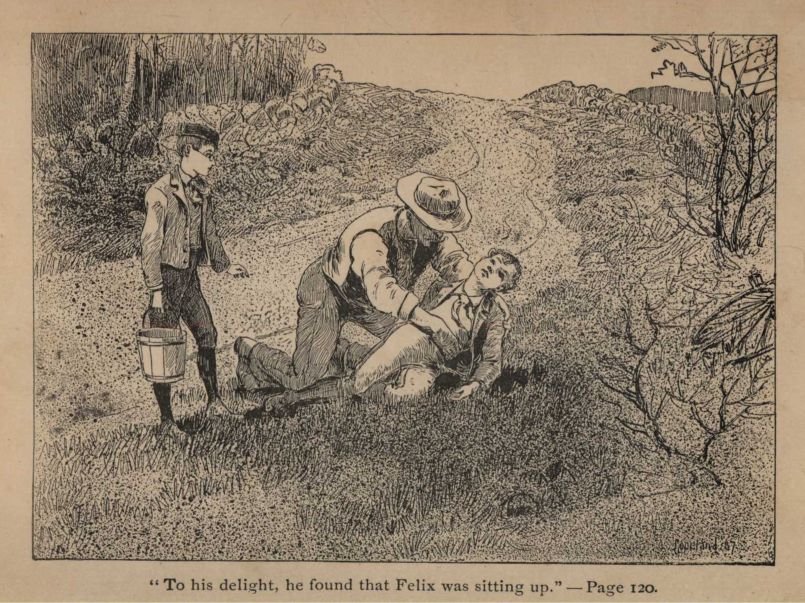
With this, he glided off, while Johnny stood almost holding his breath with suspense. Felix went on all right, and in a perfectly straight course, until he was about half way down the hill. Johnny had begun to breathe more freely at seeing how well Felix kept the middle of the road, which was quite even: but all at once he turned to the right, and the reason was at the same time evident to Johnny; for a heavy team appeared at that moment, around the turn, coming up the hill. Before Johnny had time to wonder how his cousin had dodged this danger so well with the handkerchief over his eyes, Felix was thrown violently forward from his bicycle, upon the rough surface at the side of the road, which was covered with bushes, briers, and stones. Johnny uttered a terrified "Oh!" and, dropping his bicycle, ran down the hill, fearing that Felix was killed. The teamster at the same time alighted, and hurried towards the fallen boy. Felix was lying motionless, half covered by the wild growth about him. As the man had been rather nearer the scene of the disaster than Johnny, and, having longer legs, could run faster, he was just lifting Felix up when Johnny got there.
"Is he killed?" asked Johnny, with whitened, quivering lips.
The man brought Felix out of the bushes, and put him down on a smooth strip of turf by the side of the road: his face was covered with blood. But when Johnny drew off the bandage, he could see that his eyes were open, and that he was moving them about, although in a vacant, languid manner.
"There's a pail in the bottom of my cart," said the man: "go and get it, and then run to the brook down yonder, and bring some water."
"To his delight, he found that Felix was sitting up."
Johnny ran to the cart, and found the pail: then, springing over the rail-fence, he hurried to a little stream that ran through the pasture below, scooped up some water hurriedly, and hastened back. To his delight, he found that Felix was sitting up, although he was supported by the teamster: still better, he was answering a question the teamster had addressed to him. Johnny did not hear the question; but he heard Felix say,—
"I guess I didn't know much at first, but I see where I am now."
The man had wiped off the blood as well as he could with the handkerchief, and then bound it around Felix's head; but his face was smeared with blood, and the stained handkerchief added to the ghastly effect. Johnny pulled out his handkerchief, and, wetting it in the water, handed it to the man, after he had filled a little telescope-cup, which he had brought in his pocket to drink from if they should get thirsty on their excursion. The man told Felix to drink some of the water, and then wiped the blood from his face with Johnny's handkerchief, and asked him how he felt.
"I guess I don't feel so very badly," he replied, in quite a natural manner; "but I wish that blood wouldn't come trickling down my face all the time."
The bandage was by this time saturated, so that it no longer absorbed the blood from the wound: Johnny's handkerchief was wrung out as dry as possible, and substituted for it.
"I'll tell you what we had better do," said the man. "I'll put him in my cart, and carry him right to the doctor: he lives about as near as any one, and he'll know just what ought to be done."
"Yes," said Johnny: "I wish you would."
It was found that Felix could now walk tolerably well. He was helped into the cart; and the bicycle, which had continued on down the hill a little way, and lodged in another clump of bushes at the side of the road, was put in behind. The man then got in and drove up the hill, supporting Felix with one arm; while Johnny walked up, and got upon his bicycle, for the man said the doctor lived on the hill.
They passed one house, and then came to a brown cottage with a piazza running along the side, facing an apple-orchard. A little boy was sitting upon the piazza, with some playthings about him.
"Hallo, Charley!" said the man: "is your father in?"
The boy made no reply, except to jump up and run into the house. The man stopped his team, and Johnny alighted from his bicycle. A moment afterwards, a gentleman came out of the front-door, and approached them with, "Good-morning, Mr. Jenks."
"Good-mornin', doctor. I've got a boy here who took a bad header going down our hill here blindfolded: he's got lesson enough without any remarks of mine, for he's cut a pretty deep gash on his head. I guess you'd better tend to it, if you've a mind to, and send the bill in to his father."
"Never mind the bill," replied the doctor in a hearty, cheery tone, as he helped Felix out of the cart. "I was a foolhardy boy myself once, and I'm willing to help a young fellow out of a little trouble, any time."
"I can pay, myself," replied Felix: "I guess I've got money enough in my pocket; and if I haven't, I can come over some day and bring the rest."
By this time, his face was very bloody again, although he had been wiping it with his handkerchief, which Johnny had rinsed in the pail.
"I'll pay you for your trouble, too," said Felix, as the man began to drive on.
"No, you don't!" replied Mr. Jenks. "That's all right. Hope the doctor can make you as good as new."
Johnny leaned his own bicycle and that of Felix against the fence, and then followed the doctor and his patient into one of the front rooms, which was the doctor's office. The doctor immediately washed Felix's face, and then bound the wound together with strips of court-plaster, after cutting the hair as close as possible in the neighborhood of the gash. It was evident that Felix had struck his head against the sharp edge of one of the stones at the side of the road.
"There, young man," said the doctor, when he had finished: "you'll be all right after a while, and you'll be a little wiser than you were before; so, on the whole, you may be even better off for the accident. But what possessed you to try to go down hill on a bicycle blindfolded?"
"I just did it to make Johnny wonder how it was done: I've tried it before with the boys at home, without their finding out the trick. I didn't put the handkerchief so but what I could see some, just down under; and I should have been all right, because I could see the ground close ahead of me well enough; only when I heard the team coming, I lifted up one side of the handkerchief so as to pass all right, and then I turned out to the side without thinking of its being rocky there; and as I couldn't see off that way, easily, because of the handkerchief, I ran on a stone all of a sudden, and that gave me a header. If the team hadn't come, I should have kept on in the middle of the road all right."
"This going along without the full use of your eyes isn't a good plan, you see, young man; and it's so all through life. Keep your eyes wide open, my boy, keep your eyes wide open. And now about your getting home. I presume you feel pretty weak and faint after losing so much blood, and having something of a fright?"
"No; I'm all right now, I guess; I'll pay you, and then I'll get on my bicycle and ride home."
Felix pulled out his pocket-book, opened it, and took out some bills. "How much will it be?" said he.
"You are quite a capitalist, I see," remarked the doctor; "but put up your money; I don't want any pay; you are perfectly welcome."
"No: I shall pay," replied Felix. "I've got plenty of money."
"In that case, if you think you will feel better for paying, you can give me a dollar, which is the usual fee for such an operation when the patient comes to my office; but you would be quite welcome to the service free of charge."
Felix handed the doctor a dollar, and then said he guessed he had better be going.
"You must not go for an hour, at least," replied the doctor, "or I cannot promise that you will have no unpleasant results from your injury. Sit down in the fresh air a while, on the piazza, with your friend, until you are fully certain that you are equal to the exertion of returning home. At the end of an hour I will feel of your pulse and tell you whether you can go on your bicycle, or had better be sent home in my carriage."
The doctor then felt of Felix's pulse, and continued,—
"No, you can't go yet, my boy: just step out on the piazza, and sit down in that arm-chair, till I see you again."
Although Felix would have preferred to have his own way, there was something in the doctor's manner that made him hesitate about attempting to disregard his advice, the more especially as the doctor took hold of his arm, led him upon the piazza, and sat him down in the large out-of-door rocker, with its wide, comfortable arms. Once set down in front of the cool orchard, Felix felt a consciousness of languor and restfulness that made him quite willing to keep his seat. Johnny seated himself on a settee near; and the little boy, who had gone back to his play, said,—
"Isn't this a good place to stay in?"
"Yes," replied Johnny. "I should like just such a place to sit and read in, of a summer day: it's almost as good as the sky-room, isn't it, Felix?"
"I guess so: only you can't see much of the sky; it's all green whichever way you look, except where the house is."
"That would make it all the better for reading, because green is such a good color for the eyes."
"It's lucky, then, that the grass and leaves are green instead of red: if every thing were red and yellow always, as the trees are in autumn, it would get to be sort of tiresome, I suppose."
"It isn't luck that makes the foliage green," replied Johnny; "somehow or other, Nature does it on purpose; you can tell that because every thing is all right in just the same way: if it was luck, things would happen right only now and then, and sometimes they would happen all wrong and uncomfortable."
"They do happen uncomfortable, lots of times: it's uncomfortable to have the sun hot in the middle of a summer's day. If Nature wants to fix things all right, why don't it have it just about the right warmth all day, summer and winter?"
"There are ever so many things we need to eat that would never ripen in that case, besides a great many other disadvantages. You see, Nature don't always do what is pleasantest for us at the time, but what is best for us in the end. She might make every thing so convenient that nice crops would grow without any care, and we should have our clothes all ready made and fitted for us, like that cow and horse over in the lot; but it is better for us to have to work and contrive to supply our own wants out of the material that Nature has supplied in the rough,—like trees for our fine houses, and cotton, flax, wool, and silk for our hundreds of sorts of clothes."
"She has made some things all ready for us: there are fruits and milk and vegetables and meat for food, and furs for clothing."
"Yes, of course, she supplied some things all ready to eat and wear, so that folks could get along until they became civilized; and then, you see, she is very good-natured, and likes to make it as easy and comfortable for us as she can without spoiling us and making babies of us: there are ever so many pleasant things in the world that we could get along without; but it is intended that it shall be a pleasant world to live in after all, so that we sha'n't want to get out of it before we've learned all we need to learn. I suppose that's why death is made to seem so horrible; for if death seemed pleasant, we shouldn't take such good care of our lives."
"How did you know all that?"
"Some of it I learned myself by studying about Nature from books, and some my father and mother told me ever so long ago, and some I've heard the minister say at church."
"Our minister don't say that Nature looks out for us: he says God does it. I don't pay much attention to what he says; but as he always keeps on saying that, I can't help remembering it."
"He says God takes care of you, and gives you a pleasant home, don't he?"
"Yes."
"But it's your father and mother that do it, too, isn't it?"
"Yes: it always seems to me that the minister don't put it right, and I've wanted to tell him so, sometimes."
"Yes, he puts it right, if you understand what he means: he means that God made the world so that children have parents to take care of them. God don't appear to do things in this world directly himself, but seems to have agents to carry out his plans; and Nature is the greatest of these agents, who appoints all the smaller agents. Of course, God made Nature, and some think he is in Nature; and we can find out a good deal about him by studying her ways."
"What can you find out?"
"We can find out that he is wise and good, and that he doesn't let us know every thing in a minute, even about his wisdom and goodness, and that we've got to wait until we get into another world before we can understand the meaning of some things that happen in this world; so we learn to have faith in him,—that is, to believe he will make every thing right sometime, even though we can't see how."
"Do you suppose we shall ever know just how the trees and grass came to be so green?" said Felix, who was getting sleepy, and looking dreamily into the thick, low boughs of the apple-orchard.
"Why, we know that now; that was explained long ago."
"Was it? Well, I'd like to know how. I never heard any one tell about it."
"Hasn't your teacher at school told you what makes colors?"
"She's talked something about it; but I never saw any sense to what she was saying, and so I didn't pay attention."
"I learned about that in the primary school, but I didn't understand it very well until I read about it in my 'Science for the Young.' I'll see if I can explain it to you."
There was a rubber ball among the little boy's playthings, and Johnny asked him if he might take it a few moments. As the boy was not using the ball, he handed it to Johnny very willingly, saying, "You can play with it as long as you've a mind to."
Johnny threw the ball on the floor of the piazza in a straight line, remarking,—
"You see, Felix, the ball bounds right back to my hand, in just the direction in which I threw it down."
"That's nothing: everybody knows that a ball always does so."
"But that is just the way some of the rays of light bound back whenever they strike any thing which is not transparent; that is, if they strike it directly, or at a right angle. The rays which come back are called reflected rays. Every thing which is not transparent reflects light that shines upon it; that is, the light bounds back. It is just the same with heat: that which is not absorbed by the substance upon which it falls, bounds back, or is reflected."
"If that's so, what of it?"
"Why, that's what makes the grass green, and flowers of different colors, and your suit blue, and your necktie red, and your eyes brown: that's what makes things seem to be colored."
"Seem to be colored? Why, they are colored! my suit was colored with a blue dye, and there's a kind of green dye in grass: I've got it on my stockings and handkerchiefs many a time."
"The juice, or fluid, in the grass looks green, just as the grass does, because its particles are so arranged that they absorb all of the light except the green rays, and those they reflect. The substance of those roses out there in the garden absorbs all except a red part of the light, and reflects that. Your collar reflects all the colors in the light, and that makes it white, which is the mixing of all the colors together in certain proportions. My spectacle-case looks black, because it absorbs the light without reflecting any of it.'"
"I don't believe that," replied Felix: "I shall always believe things are colored in themselves, without any regard to the light. How do you know that there are different colors in light? You can't see any thing but a kind of yellow."
"You can't see yellow, unless it is reflected."
"Why, yes, you can. Look over in that field; it's just as yellow there where the sunshine falls as can be; and where it falls between the trees here in the orchard, the green looks yellowish, while it is just bright green under the trees; and the sun itself is just as yellow as can be."
"The grass has been mowed out in that lot, so the sun has dried it, and changed the substance of it so that it reflects more yellow rays. I suppose that here in the orchard more of the rays striking the parts that are not protected by the trees gives a different reflection. As for the sun being yellow, it isn't always yellow; that is, I mean it doesn't always look yellow; I have seen it look quite red."
"If it isn't yellow, I'd like to know what color it is!" exclaimed Felix, rather impatiently.
"I don't suppose it is any color at all, though it gives the impression of a good many colors to our minds: color is nothing but a sensation produced by the kind of light that is reflected to our eyes. But light that is not separated at all, gives us only a sensation of whiteness. I don't suppose the sun would look yellow to us if we could see it without looking through any air. The air even changes the direction of the sunlight so as to make the sun appear to us to rise a little while before it does rise."
"I don't see how folks found out all that, and I don't believe they have! I'll bet they made it all up!"
"I have a fine prism at home: we'll go up in the sky-room this afternoon, and I will separate some light into its different colors. But look here, Felix! see! When I throw this ball against the floor in a slanting direction, notice how it bounds back the other way in just such a slant line as I threw it in from this way. Light does just like that, and heat too: if a ray of light strikes a plane surface at a slant, it is reflected the other way in exactly the same slant. And it's something so when light passes through any transparent substance: it comes out the other side just as it went in. That is, if it goes in at a slant, it comes out at the same slant it went in at, making an angle; but if it passes in at a right angle, as I throw this ball against the floor, it comes out and goes on the other side, in the same straight line."
"I should think it would make your head ache to try to study about such things," said Felix, with a yawn; "it makes mine ache just to hear about it; it's all so queer and unlikely and mixed up. I think it's ever so much pleasanter to just take things as they are, without trying to make out what makes them so and so. I'm glad the grass is green, and the sky blue, and that there are other pretty colors in the world; but I don't care a cent what makes them so. Though I don't believe the color is just in the sun or our eyes."
"I like to know why things are so and so; in order to see how wise and beautiful the laws of Nature are, and what wisdom and beauty there must be in all the rest of the universe."
"What do I care about the rest of the universe? all I care about is the part of it which I am in."
"But when we see how wonderful this little part of it is, we can get a pleasant idea of what another world might be which we shall go into when we leave this: and that is ever so much pleasanter than having such a common idea about it as some folks have, as a place paved with gold, and built of stones; or to have no idea of it at all, or only to think of just being dead and buried. When we learn how every thing is made for some purpose, and nothing ever really dies, and then remember that our minds and feelings are the very highest part of all creation, and the most delicate and complicated, we feel very certain that there is some great future before us that we can't tell any thing about."
"If you can't tell any thing about it, what's the use of trying?"
"Why, it's enough for us to see that it must be something grand; that's all we want to know now: we've got plenty to enjoy and take up our minds here; all we want to know is, that we shall keep on having enough to busy us, and make us happy always; and Nature tries to tell us that in every way she can, or as much about it as she thinks it best for us to be told of. I am sure I am happier for knowing what little I have learned; and it makes me happy, too, to keep on learning curious things about Nature."
"I'd rather ride 'round on a bicycle, and see what's going on, any time, than study about such things," replied Felix, with another and longer yawn. "I know I feel well enough to ride home now. I'm going to get my bicycle."
Felix immediately rose, and walked around the house to the place where Johnny had placed the bicycles. But Johnny went into the office, and told the doctor Felix was determined to go, and asked him if he would try his pulse. The doctor, who had been sitting near a window of his office, not far from where the boys were conversing, had heard the whole of their conversation. But as the blinds were closed, the boys had not noticed this, and were rather surprised when, after feeling Felix's pulse, and saying it was safe for him to go, he remarked,—
"Well, my boy, you have had two lessons from Nature this morning: she taught you herself that you will get punished if you trifle with her laws,—viz., in this case, if you try to get along without using the eyes she has given you,—and she has taught you, second or third hand, through Johnny, something of the way in which she produces her beautiful and useful effects. So, although this is vacation time, you see a great many things can be learned outside of a schoolroom. Life is a great school, and you have just begun your course in it. Make the most of your advantages; for some folks go through life without learning much of any thing, just as some boys go through school and college, yet come out ignoramuses at last."
The doctor then told the boys he should like to have them stop any time they came that road, and that, if they would come in apple-time, they might take their choice of fruit from the trees in the orchard.
After, they were on their way, Felix asked,—
"What is an ignoramus?"
"It's Latin for an ignorant person," replied Johnny.
Felix looked thoughtful a moment, and then he began to whistle: he was thinking how little he had learned at school, and wondering if he was in danger of going through life, and turning out an ignoramus at last. He wondered, too, if he was so much duller than Johnny, or what the reason was that Johnny knew so much and he so little. As he did not like to take any blame himself, he concluded it was because his father and mother did not try to teach him any thing, and did not seem to know any thing themselves of these things which Johnny had learned about, and part of which he said his father and mother had told him.
When they came to the hill, Johnny got off of his bicycle, and walked down. At first, Felix was inclined to laugh at him; but when he reflected how much smarter Johnny was than himself in some ways, he refrained for once to boast of his superior acquirements.
When they reached home, they found the family at the dinner-table; and at one end of the table, by the side of Sue, sat a young man with auburn hair, which, being closely cut, stood up smartly all about his head. His eyes were hazel, his complexion ruddy, and he had a very bright and good-natured expression of countenance.
"How d'y' do, Pierre?" exclaimed Johnny, apparently very much pleased at seeing the young man. "Have you come to stay?"
"I believe so," replied Pierre, smiling.
Johnny had sat directly down at the table, since he knew his parents did not like to have him late; but Felix remained in the sitting-room with his hat on, looking curiously through the door at Pierre.
"Come, Felix, don't be any later than necessary," called out his uncle. "I do not think Johnny timed himself very well, or you would have been home earlier."
Johnny said nothing in self-defence; but Felix replied promptly,—
"We were late because I had a header, and that's the reason I don't like to come to the table: I've got a lot of court-plaster on my head."
Mr. and Mrs. Le Bras immediately rose from the table, and went into the sitting-room to examine into the extent of Felix's injuries; but when he told them he felt pretty well, and had no objection to eating dinner except concern for his personal appearance, their minds were much relieved. His aunt bound a handkerchief over the wound; and his uncle led him out, and seated him in his usual place, beside Johnny.
"Johnny must entertain us with an account of your adventures," said Mr. Le Bras; "but you had better keep pretty still yourself, this afternoon, Felix."
Felix kept quiet while Johnny was telling the story, but more because Pierre was present, and he was quite busy observing this new member of the family, than from any disinclination to talk. He was a little afraid, too, that his uncle might be displeased with his trying to cheat Johnny about the blindfolding. Johnny did not refer to that deception, however. But when Mr. Le Bras said, "How could you do such a foolish thing, as to attempt riding with a bandage over your eyes?" Felix stated exactly how it was, rather than have it supposed he was so very foolish as appeared.
"Very well: I will not say any thing about the deceptive part of the performance," said Mr. Le Bras; "when one has had the kind of lesson you have, words don't add much to it. But it seems a very astonishing good fortune that there were no bones broken, and no worse bruises or wounds."
"I think that was on account of the bushes," replied Johnny; "he fell right into a whole lot of stout bushes: but there happened to be quite a high stone, and so his head hit against it."
"I hadn't but just got over my lame ankle," said Felix, "and now I was awfully afraid I should be laid up again. But I don't feel badly at all: I guess I'll go up to the carpet-mill with you this afternoon, Johnny."
"No, young man," replied his uncle: "no more bicycling for you to-day. Amuse yourself around home this afternoon, and we will see how you feel to-morrow. In fact, I shall veto more than half a day's riding at a time, either on your part or Johnny's; that is enough for any boy; and always take the cool of the morning for it too."
Felix would have liked to remonstrate, but there was a decision about his uncle's manner which prevented his objecting at that time.
CHAPTER VII.
PIERRE'S STORY.
The evening reading had continued as usual: it was a practice that had been instituted when Johnny was a little boy, and was never omitted unless Mr. and Mrs. Le Bras had company or were away from home at that hour in the evening. Felix had so much trouble in reading distinctly, and pronouncing words, that he had finally declined taking part altogether: he saw that even Sue could read far better than he could, and he began to be ashamed of his own deficiency in this line. But he had become quite interested in hearing the others, and was glad when the reading-hour came.
Mr. Le Bras had insisted upon Felix's going to bed early the evening after the header, and he had obeyed quite willingly: indeed, he owned that his head did not feel quite right. When the time for reading came, Mr. Le Bras said,—
"I feel badly about Felix's poor scholarship. It would be a great thing for him if he could learn to read while he is here. I wonder how my brother could allow him to grow up so deficient as this!"
"He says he never read much in any books except the readers at school, either aloud or to himself," remarked Johnny, "and that no one ever read to him, except his nurse when he was a little boy, and she always read fairy-stories: I suppose that is the reason he says he don't like to read any thing but fairy-stories. He thinks he could get through a fairy-story now, better than any other. I guess that is because the fairy-story books are generally written for young children, and so have easy words in them."
"Very likely," replied Mr. Le Bras. "Pierre, do you think you could contrive any way to get Felix to read to you, and so teach him how to enunciate and pronounce a great deal better than he does?"
"Possibly," replied Pierre; "but I may need a little help to begin with. Suppose you offer him something you think he would like very much, if he will learn to read one story well, I being the teacher, and you the judge, who are to hear the final reading after I pronounce him ready for the test?"
"That is a good idea. Do you know of any thing in particular that Felix would like, Johnny?"
"He has money to buy about every thing he wants; but I did hear him say once he would like to visit Boston, now he is so near, because he never was in Boston."
"That will answer nicely. I am going to Boston on business before we start for the seaside; and if Felix will learn to read the story well, I will take him and you with me."
The next morning, Mr. Le Bras took Felix aside, and told him he was very anxious he should learn to read, as that was the first step toward a good education, and a very essential one, as well as something which could be learned out of school, and could be made a recreation instead of a task; also that by devoting a little time each day to reading aloud from some interesting book, to a person competent to give advice and corrections, the deficiency could be soon remedied. He then made the proposal that Felix should at once make a beginning, by learning to read some short story well, and said Pierre would teach him, and that he himself would offer the trip to Boston as an inducement.
Felix was quite well pleased with the plan: he thought it would be rather fine to have a young man like Pierre to teach him, and he was exceedingly pleased with the idea of going to Boston. He had secretly been wishing he could read as well as Johnny, or at least as well as Sue; but he did not own this.
After the bargain was made, Mr. Le Bras took Felix by the hand, and led him up to Pierre, who was sitting in the piazza, reading the morning paper.
"Here is a scholar for you, Pierre," said he: "you can look him up a story to learn as soon as you please; and the sooner he reads it correctly, the sooner we will visit the famous city of Boston."
Mr. Le Bras then left Felix and Pierre alone together.
"What kind of a story shall we select?" inquired Pierre.
"I don't want any thing very hard. I think fairy-stories are always the easiest to read. I've never read aloud except at school: and the teacher don't say any thing to you, if you only get through a paragraph somehow; at least, she never says any thing to me. My mother told her she didn't want me pushed; she was afraid it would make me sick: and my father said he didn't care how long I was getting my education."
"But you might be so long getting it, that it would be very unpleasant for you: I think it is generally unpleasant for a boy to be in school with children a good deal younger than himself. And then, you won't want to be so long getting an education that you will be a man before you have learned all that is necessary; for a man don't want to keep on going to school, even if he has ever so much money."
"No," said Felix: "you won't catch me going to school when I'm a man."
"So I am to find you a fairy-story?" continued Pierre. "Well, I will be looking up one that I think will suit you. It may take me several days; but, after I've found it, we'll make up for lost time by beginning to learn to read it nicely as soon as possible, in order that your Boston trip may not be unnecessarily delayed."
Since Pierre was helping Mr. Le Bras at his office at present, Felix saw him only at meal-times, and had almost forgotten about the fairy-story, except when the reading-hour came at night, at which time Pierre was usually out calling on some of his friends, until one afternoon several days afterwards, when Pierre came home with a book in his hand.
"Is my story in that book?" inquired Felix.
"No," replied Pierre; "but I think I can have the story ready for you by to-morrow. And now the question is, what time of day will you give to it, and how long will you read each day?"
"I couldn't read more than a half an hour at a time, possibly; and I think I'll have it over right after breakfast before I go off on my bicycle; then it will be off my mind for the rest of the day."
"That is a good plan, and the time will suit me very well. So we will say to-morrow morning, and so on, until you have earned your trip. Should you like to hear the story first to see if you like it?"
"No: I don't believe I care any thing about hearing it."
"Oh, yes!" said Sue. "Do let's hear it. Read it to us all, this evening, Pierre; 'cause we got through with our other story last night, and I do like fairy-tales so much!"
"I don't," said Johnny, "because there isn't ever hardly any kind of truth in them at all."
"Then, the one I have is an exception," remarked Pierre. "I flatter myself that there is considerable truth in the fairy-story I have found."
"I am sure, since Pierre has been so long finding it, it must be an unusually good fairy-tale," remarked Mr. Le Bras, smiling: "I should like to hear it myself very much, and so, I am sure, would Mrs. Le Bras."
"Certainly," replied Mrs. Le Bras: "I want to hear it very much indeed, Pierre. Do read it to us to-night, if you have no engagement out at that hour."
"Very well, then, since you all insist, and I shall be in early this evening, I will read the story to you; but you must not expect any thing wonderful, for you know Felix wanted an easy story to begin with. This is a regular paper-covered one-story book, in large print."
"I am glad it is large print," said Felix: "I can always read that sort of books better."
Pierre came home early, as he had promised; and when the family were all ready for the reading,—even Kate having come in to hear the fairy-story,—Pierre took out of his pocket a large, thin book, in a plain green paper cover, and seated himself in the arm-chair which Johnny had placed near the drop-light on the table. Johnny, upon glancing over Pierre's shoulder, was astonished to see that the story had been printed upon a typewriter, and was about to make some remark regarding that circumstance when his father caught his eye, and shook his head at him. Johnny knew by this, that there was some secret about it, which was not to be divulged, at present at least. Felix also glanced over Pierre's shoulder; but as he had never seen a typewriter, not having yet visited his uncle's office, he supposed the story was printed like any ordinary book. As for Sue, she was sitting by her mother, waiting impatiently for Pierre to begin, which he did, after Mr. Le Bras had said,—
"We are all ready now, Pierre. Go ahead."
RICK AND THE FAIRY.
Rick Lordelle was the only child of a rich man. In the winter he lived in a great city; but in the summer he lived in a famous old castle upon the bank of a river which wound between grand, picturesque mountains.
But although Rick was the son of a rich man, he was in great danger of growing up a dunce: worse than that, he was in danger of growing up regardless of any law except his own will.
His father was so busy, and so much from home, that he saw little of him; and he was so fond of the boy, and so proud of his beauty and high spirits, that he only laughed at his pertness and independence. To be sure, he was very sorry that Rick did not take to his books; but he had not sufficient firmness to insist upon his going to school, or having a tutor at home. Rick boldly declared that he would not go to school; and as for having a tutor, he had had several already, neither of whom he liked, or would obey, or treat with respect. His father kept saying,—
"We will wait a while, and see if some way cannot be found to coax him to be a scholar. Before he is much older, I may come across a tutor who will suit him, and make it pleasant for him to learn."
Rick's mother was so fond of him, that she would not have him crossed in any thing, if she could help it. She, too, wanted him to learn something, and often tried to persuade him to say his lessons to her or Nanette; but his attention could seldom be gained for fifteen minutes at a time. As for persuading him to go to school, it would have been as well for her to try to persuade a young lion to go there.
Nanette had more influence over him than either his father or mother. She was a very bright and sensible young woman, and had helped to take care of Rick ever since he was a baby. Although he would not mind Nanette unless he pleased, he was more willing to obey her than any one else; and as she was a very good story-teller, and had a particular gift at telling fairy-stories, she could often persuade him to do as she wished, by the promise of one of her wonderful tales. The fairies she told about were generally old women who lived in the woods, and could make persons rich and beautiful, or poor and ugly, and tell what would happen to any one, and make every thing turn out to suit themselves.
Rick had sometimes asked Nanette if there were any fairies about the castle, and she had told him she knew of no better place for them than in those wild mountains; but as they never came near houses, that she knew of, and she did not go into the mountains, she had never seen any herself.
One day Rick had a bright idea. Why did he always ride up and down the river-road which he knew so well, instead of striking off across the mountains, at one of the many lanes which he had sometimes followed a little way until he found they led into the forests? What might there not be beyond those hills that was new and strange?
Beyond those mountains must he go, and that right speedily.
He at first told his mother of his intention, not expecting any worse opposition than that she might insist upon his being accompanied by the groom. But his mother, for once, replied "No," with some decision: it was a wild region, she said; there was nothing behind the mountains but other mountains, which ended she knew not where. She never had crossed those mountains herself; his father had never crossed them; no one would think of attempting it. Sometime, when he was older, his father would take him around to the other side of the mountains, by the cars or some other conveyance; but even a grown man would not try to cross them.
Rick made no reply, but simply resolved to investigate for himself. He had sometimes known his mother to represent dangers far worse than he knew them to be, in order to keep him away from them: he thought, as likely as not, it was a far more easy and common thing to cross those mountains than she had represented.
So, what did this venturesome youth do but start off the very next day, ostensibly for a ride up the river, but with the real intention of penetrating into the mountains by one of the mysterious paths, to test the correctness of his mother's statement.
Gayly he rode along the beautiful river-road; and his mother, from the castle-window, watched him until he was out of sight.
"How well he rides!" she said to Nanette. "He looks exactly like a little lord."
Nanette made no reply: she was thinking to herself, "But he can neither read nor write with any decency, and he is not mannerly nor obedient."
On rode the "little lord," over the winding road, until many a turn, and at least two good miles, had separated him from the castle.
There were several narrow roads leading into the wooded district which bordered the river-road. Beyond these woods rose the mountains, some near, some distant, blue and purple against the fleecy sky.
A delightful sense of novelty took possession of Rick as he entered one of these unknown paths. He felt as an explorer feels when he comes into a strange country. How stupid he had been, he thought, always to be riding up and down the river-road. It was a shady forest-lane: little brooks winding down the hills and ledges made a pleasant sound, and sometimes a swollen stream ran directly across the road. The pony, as well as Rick, liked to go splashing through the water.
After riding about a mile through the woods, a narrow path diverged from the lane. The lane itself had been a gradual ascent, but this path evidently led up a much steeper hill. Rick wondered very much where this narrower path would lead: he was inclined to think it was the way to some castle. In that castle, perhaps there was another boy. There were no children living near the Lordelle castle, except the children of the servants and peasants.