LETTERS FROM FRIENDS (continued 2)
Reading edition
On the different effects of the Oxford and Cambridge system on the minds of young men, Wilberforce writes to a friend:—
Mr. Wilberforce to Mr. William Gray. "December 31, 1830.
"It is curious to observe the effects of the Oxford system in producing on the minds of young men a strong propensity to what may be termed Tory principles. From myself and the general tenour of our family and social circle, it might have been supposed that my children, though averse to party, would be inclined to adopt Liberal or, so far as would be consistent with party, Whig principles, but all my three Oxonians are strong friends to High Church and King doctrines. The effects I myself have witnessed would certainly induce me, had I to decide on the University to which any young protegé of mine should go, were he by natural temper or any other causes too prone to excess on the Tory side, I should decidedly send him to Cambridge, Trinity; were the opposite the case he should be fixed at Oriel, Oxford.
"As for the gentleman you mention,[40] his character is not to be expressed in a few words. Of his extraordinary powers no one ever entertained a doubt. There are also very pleasing traits of private character: I have been assured of his incessant and kind attentions to his old mother. On his brother's failing, I believe, in business, he paid his debts to a large amount and took on himself, I am assured, before being in office, the charge of his eight or nine children. Of his own little girl he was excessively fond, and he was always kind in what concerned friends or acquaintances. I cannot also but hope that he has seen so much of religious men as almost to have superior confidence in them. But you suppose me to be more personally acquainted with him than I am."
The next letter, to Mr. Manning, contains an allusion to his son Henry, afterwards Cardinal Manning, of whom it will be noted that Wilberforce "forms sanguine hopes that he will be a blessing to his fellow creatures."
At the time the letter was written, Wilberforce's large fortune had been seriously diminished, though he was far from being, as his letter would lead one to suppose, in the same unfortunate position as Mr. Manning.[41] The effect of his own loss was as he says, "greatly to augment his happiness." Enough was left for his comfort. It is true he gave up his home, and was no longer able to practise indiscriminate hospitality; also his subscriptions had to be curtailed, such as those to the York charities, as to which he "had been reminded in 1831 that they were larger than those of any other subscriber."
Mr. Wilberforce to Mr. Manning. "June 11, 1832.
"I am truly rejoiced, my dear friend, to hear that you are so comfortably circumstanced. I also have abundant cause for thankfulness. The loss of fortune was graciously delayed in my instance until all my children having been educated, and two of them supplied with comfortable residences (Robert, my second son, recently by the perfectly spontaneous kindness of Lord Brougham), so that the effect of my loss of fortune has been greatly to augment Mrs. W.'s and my own happiness. What can be more delightful than to be the daily witness of our children having a large measure of conjugal happiness, the best of this world's goods, while at the same time they are discharging conscientiously and zealously the important duties of the pastoral office. It gave me real pleasure that your son had given up the situation at the Treasury for the Church. I have heard such an account of him from my sons, as gives me reason to form sanguine hopes that he will be a blessing to his fellow creatures."
The next extract refers to the painting of the well-known picture of Wilberforce now in the National Portrait Gallery.
Sir Thomas Lawrence to Mr. Wilberforce.
"You make a too flattering apology for sending me but your name in your own handwriting. I hardly know what other word in our language could boast of equal interest, and you may be assured, my dear sir, that by those the nearest to me it will be equally prized when the person to whom it is written can no longer produce it as evidence of his too fortunate career."
The date of the following lines of Cowper and also of Hayley is not given. They are marked "Verses sent to me by Cowper and Hayley."
To William Wilberforce, Esqre.
SONNET.
Thy country, Wilberforce, with just disdain, Hears thee by cruel men and impious called Fanatic, for thy zeal to loose th' enthralled From exile, public sale, and slav'ry's chain. Friend of the poor, the wronged, the fetter gall'd, Fear not lest labour such as thine be vain. Thou hast achieved a part—hast gained the ear Of Britain's senate to thy glorious cause; Hope smiles, joy springs, and though cold caution pause And weave delay, the better hour is near That shall remunerate thy toils severe By peace for Afric fenced with British laws. Enjoy what thou hast won, esteem and love From all the good on earth, and all the Blest above! William Cowper.
To William Wilberforce, Esqre, on the preceding Sonnet.
When Virtue saw with brave disdain Lucre's infuriate sons profane Her Wilberforce's worth; As she beheld with generous ire, His image fashioned for the fire Of diabolic mirth: "Firm friend of suffering slaves!" she cried, "These frantic outrages deride, While I protect thy name! Soon shall one dear selected hand Richly o'erpay at my command, Indignity with Fame: "Since thou hast won, in Nature's cause, My fondest love, my prime applause, Thy Honour is my care; Now shall my favourite Bard be thine: My Cowper, guard of glory's shine! Shall grave thy merits there."
William Hayley.
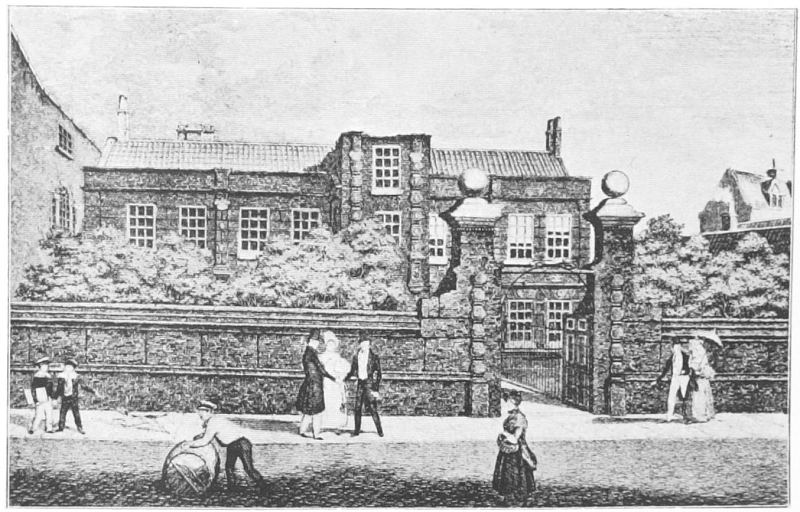
BIRTHPLACE OF WILLIAM WILBERFORCE, AT HULL.