PERSONAL CHARACTERISTICS OF SIR SEYMOUR HADEN, P.R.E.
Reading edition
Part I
By FREDERICK KEPPEL
MANY treatises have been published on Seymour Haden the artist, but not one, as yet, on Seymour Haden the man. This is as it should be; because no one can write freely and frankly on the personality of a famous man while that man is still living, and Sir Seymour lived until the year 1910, when he died at the great age of ninety-three.
I met him often every year for about thirty years, and I first made his acquaintance when he lived in his very handsome house in the aristocratic region known as Mayfair, in the west end of London. His house adjoined the residence of the Lord Chief Justice of England.
The doctrine held by the ancients that the Goddess of Fortune was stone-blind has much to warrant it. Let us take the case of three contemporary nineteenth-century etchers, all three being men of genius. I mean the two French masters, Charles Meryon and Jean-François Millet, and the Englishman Seymour Haden. The two French etchers lived in dire poverty and often had to go hungry because they had not the means to pay for a meal; while, to their English contemporary, “the lines were fallen in pleasant places” and he never knew the wants that pinch the poor.
Born in 1818, in his father’s fine house in Sloane Street, London West, Francis Seymour Haden had the advantage of coming of a good and well-known family, in easy circumstances, and the further advantage of having received an excellent university education, so that he found himself, from the first, the social equal of many of the best in the land, and he never had to invade and overcome that formidable social barrier which in England so sternly divides the “somebodies” from the “nobodies”; and during his long and active life he certainly did nothing to diminish or discredit the high social standing to which he was born and bred.
This being so, he remained to the end of his life an ideal Tory aristocrat, a condition which might be compared to that of the Bourbon kings, who “never forgot anything and never learned anything.” In maintaining any opinion which he had formed, or inherited, he was as immovable as the rock of Gibraltar, and it made no difference to him if later evidence showed that his earlier opinions were wrong.
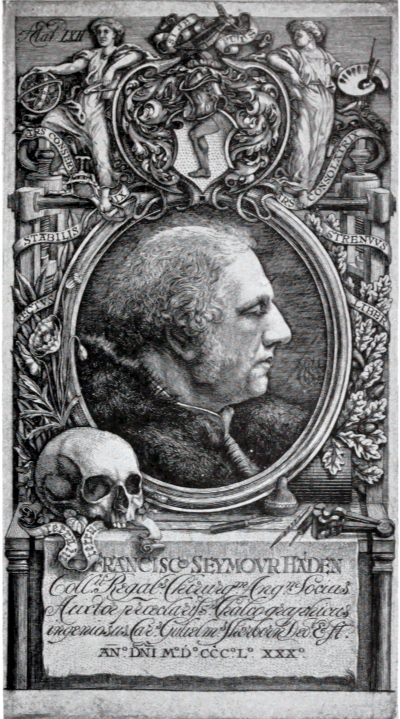
Portrait of Seymour Haden at the age of Sixty-Two
From the engraving by C. W. Sherborn Size of the original engraving, 6 × 3½ inches
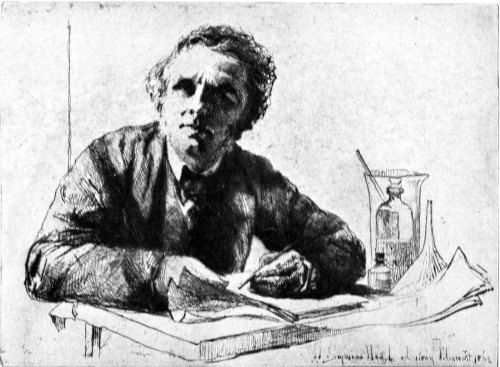
Portrait of Seymour Haden at the Age of Forty-four
From his etching from life, done in 1862 Size of the original print, 7¾ × 10⅝ inches
I well remember hearing that man of genius, Henry Ward Beecher, say in a sermon: “Talk of the sin of Pride—we haven’t half enough of it!” Be that as it may, Seymour Haden was always a proud man, and this innate pride sometimes rendered him intolerant of the opinions of other good men whose ideas were also entitled to due respect. Indeed, I have never known a man who set a higher value on himself. Nothing was too good for him—whether it might be his collection of the best prints by older masters, his house and its appointments great and small, or the instruments which he used when he practised surgery,—everything must be of the very best. This determination of his was, within limits, a noble one, although it sometimes made him intolerant of other men who were unable to rise to his high ideals.
In this ingrained pride and self-esteem of Seymour Haden’s he was far too proud to be vain. I do not think he had any vanity at all. In this respect he differed, “as far as the east is from the west,” from his illustrious brother-in-law, Whistler. The latter’s lifelong habit was to pose and to perform like an actor on the stage—whether his audience consisted of many auditors or of only one; while Haden, though an eminently well-bred gentleman, cared nothing whatever about the impression he might be making on his auditors—so long as his actions were approved by himself. On such occasions all went charmingly until some other person uttered a heterodox opinion on art, or politics, or any other subject; but when that happened Sir Seymour’s indignation would burst forth like a raging volcano.
On one such occasion, while I was a guest in his country house, I infuriated him—though with no evil intention. It was at the time when the patriot Charles Stewart Parnell was making such a brave struggle in the House of Commons on behalf of Home Rule for Ireland, I expressed my admiration for Parnell, when Sir Seymour got very angry and so made all the company uncomfortable. Thus far I did not blame myself; but a year later I certainly was ashamed of my own indiscretion. I had quite forgotten about the outbreak of the former year and I again expressed my warm sympathy with the cause of Irish Home Rule. It was just at the beginning of dinner at Sir Seymour’s hospitable table, but no sooner had I mentioned the subject than he flung down knife and fork, marched out of the dining-room, banged the door behind him, and tramped up-stairs to his bedroom. That sweet woman, Lady Haden, said to me very quietly, “We shall see no more of Sir Seymour to-night,” and next morning, before my host appeared at breakfast, his very tactful wife, laying her hand gently on my arm, said to me, “Mr. Keppel, in conversing with my husband, pray avoid the subject of Home Rule in Ireland.” Most readers would think that the little incident ended here; but it didn’t. Presently Sir Seymour came down to breakfast and carried in his hand a large and handsome book which he presented to me. On the fly-leaf I read a long and most kindly dedication written by himself; and so that was the end of the incident. I remember that when I received this amende honorable my first impulse was to recall a characteristic Irish adage which says: “First cut my head, an’ then give me a plasther!”
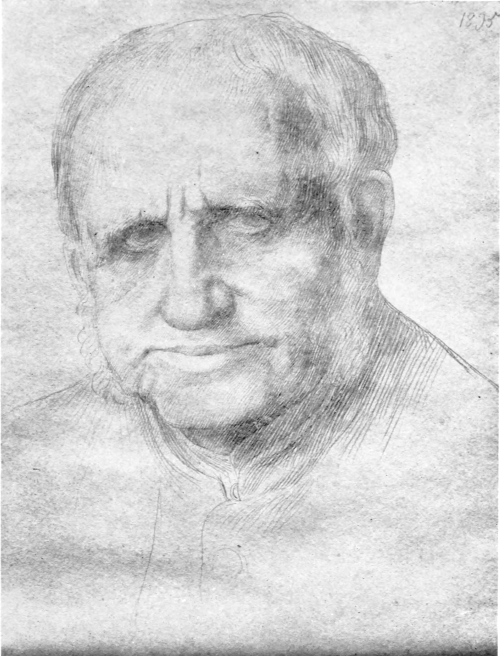
Sir Seymour Haden
From the drawing by Alphonse Legros, done in 1895
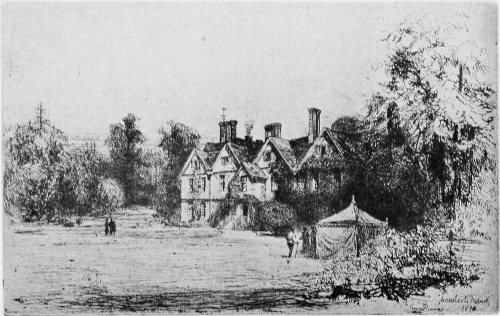
Woodcote Manor (the Home of Sir Seymour Haden)
From the etching by Percy Thomas Size of the original etching, 6⅝ × 10½ inches
Lady Haden was, in a very quiet and refined way, a remarkable woman. She was daughter of an American army officer, Major Whistler, and she bore the Puritan Christian names of Deborah Delano. In more than one of Sir Seymour’s etchings her first name is quieted down to “Dasha.” She was half-sister to the great Whistler, who was the issue of her father’s second marriage, and she clung to her “brother Jimmie” to the end of her life. All the art which was inherent in the Whistler family manifested itself in Lady Haden’s music. She was a marvelous reader of piano music, and when Sir Seymour got possession of the fine old Elizabethan mansion of Woodcote Manor in Hampshire, Lady Haden, perceiving that there was no musical skill among the young men of the neighboring village of Bramdean, organized a band or orchestra for these rustics. To one she taught the violin, to another the flute, to another the trombone, etc. After about two years of drilling I had the opportunity of hearing her band performing in the school-house at Bramdean, and they played respectably well, while the sweet old lady conducted the music with her baton. Toward the end of her life she became totally blind, and after that I never was more affected in my life than when, at Woodcote Manor, I saw her grope her way to her piano and heard her play, superbly, some great compositions by Beethoven and Chopin.
At Woodcote Manor Sir Seymour enjoyed his life thoroughly (except when something went wrong and made him angry). The mansion stood in its own park and there was a beautiful old garden inclosed with high stone walls. One summer when his long hedge of sweet pea was in full bloom he took me to see it and told me that he had thought out a new and interesting botanical fact, on which he had written a paper for the learned Royal Society, and that he intended to send it to them in London and to invite some eminent botanists of the Society to come to Woodcote and see the phenomenon for themselves. His theory was that garden flowers always had a tendency to return to the original color of the same blossoms in the wild plant, especially when the garden plant grew tall, and then he showed me that, in his hedge of sweet pea, the purple blossoms at the top were much more numerous than the flowers of pink or blue or white which were lower down, thus proving that when a garden sweet pea grew tall the blossoms returned to the original purple color of the wild pea.
I had always been somewhat of a horticulturist myself and so I said to him: “It is evident that the plants here bearing purple flowers grow taller than the others; but you must remember that any single plant of sweet pea can give you nothing but one and the same color in its blossoms.” Sir Seymour sent for his pig-headed old Hampshire gardener, put the question to him, and although the old man was greatly in awe of his master he gave his decision on my side and against Sir Seymour. “You are a pair of fools,” was the old gentleman’s angry answer, and he started to leave us. But I overtook him and said: “Now, Sir Seymour, it is not fair to me to leave this little scientific question undecided. Pray come back for a few minutes and let me cut two or three of your plants at the roots, disentangle them from the hedge, and show you that although they mingle when growing close together yet you never get more than one colored bloom from one plant.” To this he consented, and of course my demonstration showed that his theory was wrong; but his anger against me lasted till bedtime, and it was only next morning that he said to me: “Keppel, you made me angry yesterday about those sweet peas,—but, all the same, I am glad you saved me from making a damned fool of myself before the Royal Society.”
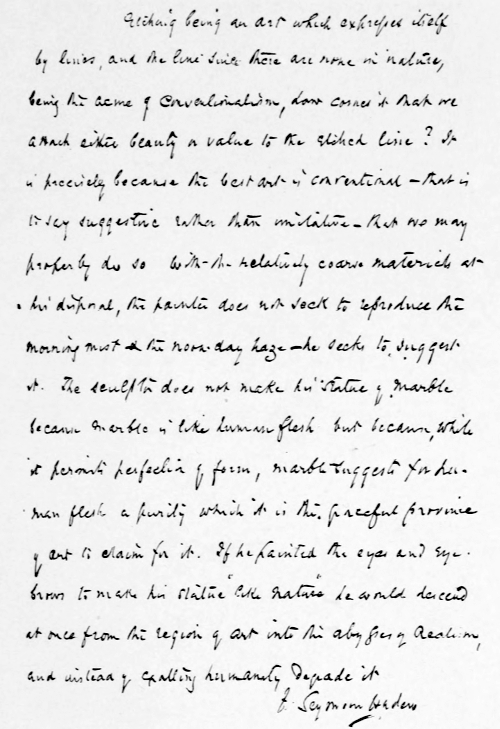
Reproduction, in reduced size, of a page of Manuscript in the Handwriting of Sir Seymour Haden
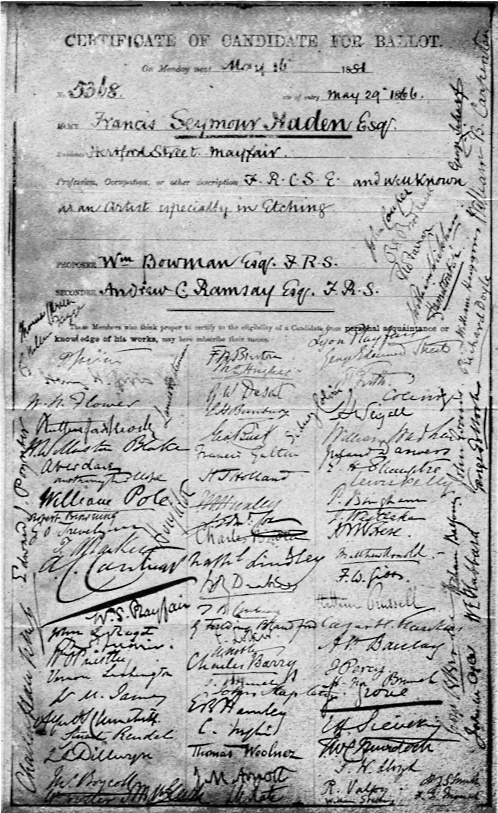
Facsimile, in reduced size, of the Certificate of Seymour Haden’s Candidacy for Membership in the Athenæum Club
Sir Seymour’s anger on this occasion was mild compared with the rage he flew into with his gardener when, after the master had been absent for a day in London, he returned and found that his man had spent a laborious day in scraping off the beautiful green moss which adorned the trunks and larger branches of the old apple-trees in the garden. I was with Sir Seymour when he made the distressing discovery and I heard the furious sound of the vials of wrath which he poured on the stupid old man’s head. After Sir Seymour had gone the poor gardener said to me: “And that’s my thanks for having worked hard to make his old apple-trees look neat and tidy!”
Besides being a fellow of the Royal College of Surgeons, Sir Seymour Haden was a member of the most exclusive club in London—if not in the world—the Athenæum. It generally took from fifteen to twenty years for any candidate to be elected. Sir Seymour had to wait eighteen years. The usage of this club is to hang on the wall a large sheet of paper setting forth the name and the qualities of the candidate, and any member who approved of this candidate would sign this paper. Whether many of these eminent persons had much idea of the quality of a fine etching is quite another matter, but Sir Seymour’s nomination sheet at the club was crammed with signatures of eminent men advocating his election. Among these signatures are those of Robert Browning, Anthony Trollope, Matthew Arnold, Dr. Tait, Archbishop of Canterbury; Huxley, the great scientist; Lord Chief Justice Coleridge, and Sir E. J. Poynter, now President of the Royal Academy of Arts. Besides the signatures of these famous men who had “achieved greatness” other signers of this Athenæum document had been “born great,” including several hereditary peers; and—to finish Shakespeare’s sentence—the gentleman chiefly concerned never waited to have “greatness thrust upon him,” for he was always quite willing to meet greatness half-way.
The Athenæum Club is so desperately exclusive that no member can bring in an outsider except to a little sentry-box inside the main portal, which room is only large enough to accommodate two persons. On one occasion when I was visiting Sir Seymour I did one of the few deliberately wicked things that ever I did in my life. As I stood in the little sentry-box I perceived His Grace the Archbishop of York entering with a friend at the front door of the club. The two walked straight to the glass door of the little sentry-box where I was, and the eminent prelate said to his friend, in a loud authoritative voice: “We can sign the documents here in a moment.” Then it was that “Satan entered into me.” I knew that this was my only chance ever to make a British archbishop wait till I was “good and ready,” and so, although I had finished my business with Sir Seymour, I began talking and talking about his friends in Paris and what they were doing, until I kept the very impatient archbishop striding up and down before the little door for more than ten minutes, and twice when I caught his eye he looked at his watch, glared at me, and exclaimed, “Dear me, how tiresome!” (It will be remembered that in genteel English parlance the word “tiresome” means “annoying” or “provoking.”) At last, when I could talk no more, Sir Seymour rose from his chair, opened the door, and met the raging Dr. Maclagan outside. “Oh, Archbishop,” said he, “I do hope we have not kept you waiting,” and His Grace made answer in a very fretful voice, “Well, in point of fact, Sir Seymour, you have!” I cannot claim that this prank of mine did me any credit, but in my boyhood days in England my family and I had suffered from the pomposity of English prelates.
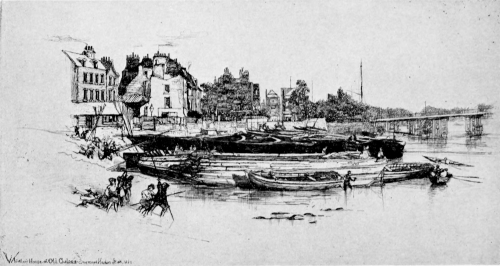
Haden. Whistler’s House, Old Chelsea
Etched in 1863. On the left is Lindsay Row, in which Whistler’s house is indicated by a small stellated mark above the chimney. To the right is old Chelsea Church and Battersea Bridge
Size of the original etching, 6⅞ × 13 inches
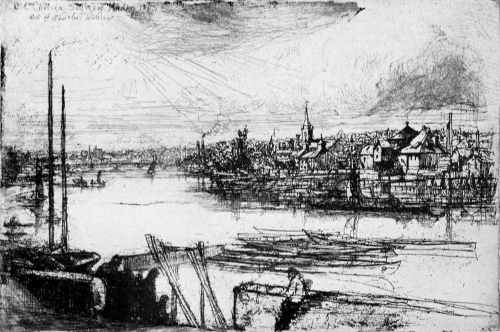
Haden. Battersea Reach
A view of the Thames at Battersea, etched in 1863, looking out of Whistler’s window
Size of the original etching, 5⅞ × 8⅞ inches
The feud between Seymour Haden and Whistler was known throughout Europe. Whistler loathed Haden and Haden detested Whistler. But Sir Seymour drew a distinction between the man whom he abominated and the artist whom he greatly admired. This admiration led him to make a notable collection of Whistler’s prints. On one occasion Sir Seymour said to me that if he were forced to part with his Rembrandt etchings or with his Whistlers he would find it hard to determine which master’s works he must let go. Later on I repeated this saying to Whistler and that modest gentleman calmly remarked: “Why, Haden should first part with his Rembrandts, of course.”
Among the historic questions which can never be definitely determined is the one—whether Seymour Haden was the man who kicked Whistler down-stairs or whether it was Whistler who administered this violent treatment to Haden. I have heard the story from both, and each of these eminent men stoutly maintained that he had been the kicker and his adversary the kicked one.
As president of the Royal Society of Painter-Etchers Sir Seymour did a great work in maintaining sound doctrine in etching. Nothing was admitted which was “commercial” in character, and etchings which were done after paintings by other hands were rigorously ruled out.
The membership comprised foreign as well as British artists, and membership was eagerly sought for,—so much so that many famous etchers never were elected, although they tried hard to be.
The members often had to complain of the masterful ways of their president; he ruled them with a rod of iron, but still the malcontents were forced to endure it,—well knowing that no other man could give to the Society the prestige and authority that Seymour Haden gave to it.
In all other art exhibitions a good thing, done by an outsider, is accepted and welcomed, but the Royal Society of Painter-Etchers exhibits nothing except the work of its own members.
We have seen that Sir Seymour Haden, in spite of his good qualities—and his great qualities—was a man of a domineering and disputatious nature. I know of no figure in dramatic literature whom he resembled so closely as Sheridan’s Sir Anthony Absolute. Both of these Sirs were of a violent and masterful temper, and yet both of them were good men.
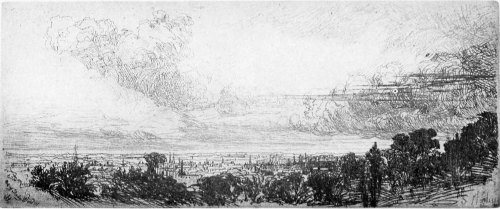
Haden. Out of Study Window
Etched from an upper window in Mr. Haden’s house in Sloane Street. In the mid-distance is the suburb of Brompton
Size of the original etching, 4¼ × 10¼ inches
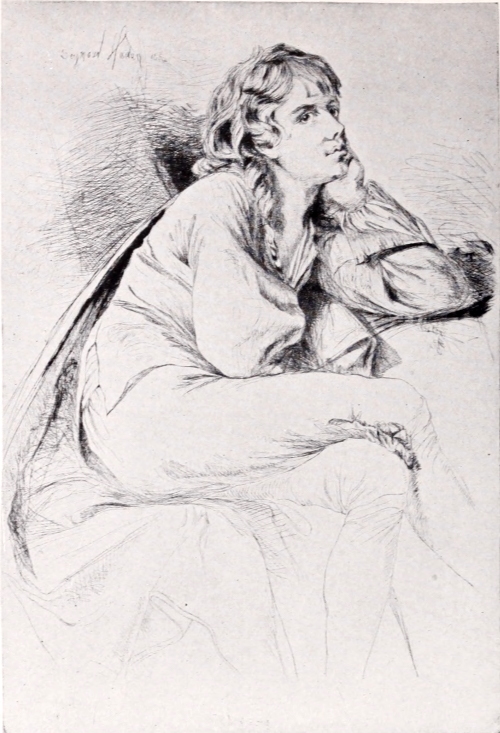
Haden. Thomas Haden of Derby
“Thomas Haden of Derby, my grandfather, was, under a polished exterior, one of the most determined men I have ever known, and one of the bravest. He would have made a hero of romance if he had had the chance. At the age of eighty-five he defended his home against the whole mob of Derby, keeping them at bay all night.” Seymour Haden.
Size of the original etching, 13⅞ × 9⅜ inches
Besides Seymour Haden’s signal achievements as etcher and as surgeon, and his zeal as an angler, he, like some other good men, had a special hobby which he rode for years, and which he often ventilated in the London Times. His theory was that no corpse should be buried in a solid wooden coffin, but that it should be inclosed in a loose wicker case, where the earth could come in direct contact with the dead body. He contended that such contact would very quickly turn “earth to earth.” One of his demonstrations was practised on the dead body of a large old sow that died in his farm-yard. (The animal’s name, I remember, was Mary Jane.) Sir Seymour had Mary Jane buried in the garden, in a shallow grave, and he had a covering of not more than three inches of earth laid over her. Then every visitor to Woodcote Manor had to visit the grave and to use his olfactory organs over it. I myself had to do this on two occasions and I must say that I detected no foul odor whatever.
For more than twenty years I enjoyed a peculiar privilege in connection with Woodcote Manor. The old couple, used to the stir and bustle of London, where they had “troops of friends,” sometimes found themselves somewhat lonely in the solitude of Hampshire, and so it happened that for more than twenty years I was given carte blanche to invite to Woodcote any person I pleased. I was very particular as to the persons whom I thus invited; but the people so invited were charmed with their visit, whether it lasted for three days or for two weeks, and the English know very well how to make a guest comfortable.
In the park at Woodcote Manor there is an etched tablet, nailed to the trunk of an ancient hawthorn-tree. It reads:
A loyal friend through weal and woe, At last, stern death o’ertakes him: Here sleeps my loving, wise old crow, Till Gabriel’s trumpet wakes him.
I wrote this epitaph at Lady Seymour Haden’s request. She gave to my dear old pet crow a resting-place when he died. That crow was more like a friend than a pet. On Atlantic steamers he would fly about among the sea-gulls, and in London I used to open the windows and he flew where he pleased, but I was always sure that he would come back to me.
* * * * *
The present article is already so long that I must not prolong it further; but in a later number of The Print-Collector’s Quarterly I intend to give an account of Sir Seymour Haden’s visit to the United States.
Part II
SEYMOUR HADEN IN AMERICA
The former chapter of my article on Sir Seymour Haden referred entirely to my experiences with him in Europe; this second and concluding portion will contain nothing except an account of his sayings and doings during his visit to the United States in the year 1882. The purpose of his American visit was to expound and vindicate the importance of original etching as a fine art. This he did by delivering a series of lectures on the subject, and these lectures, in the main, were very well received.
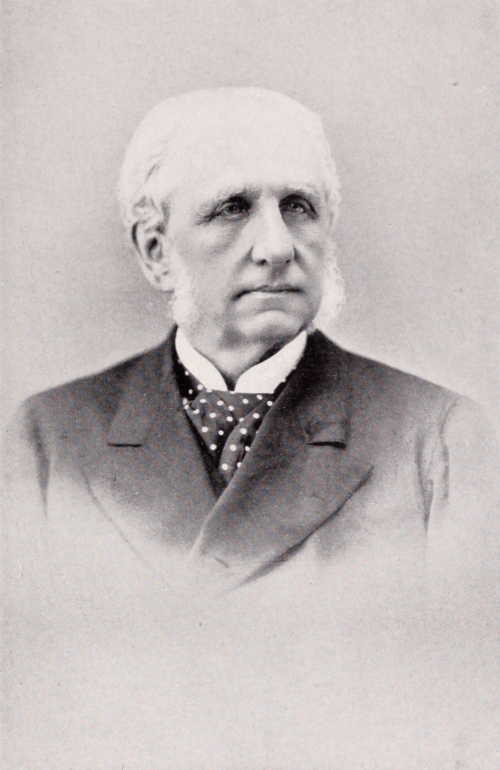
Portrait of Seymour Haden
From a photograph from life: taken in New York in 1882
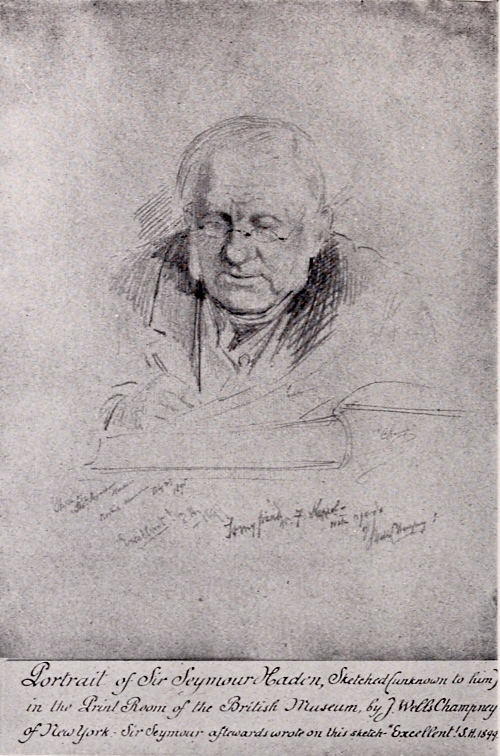
Champney. Portrait of Sir Seymour Haden
Sketched (unknown to him) in the Print Room of the British Museum by J. Wells Champney of New York. Sir Seymour afterward wrote on this sketch. “Excellent! S. H. 1899.”
Size of the original drawing, 9 × 8 inches
Being a born and case-hardened controversialist he soon found out that in America no man’s unproved ipse dixit, however eminent he might be, was dutifully accepted as it would have been in one of the older civilizations of Europe, and so it came about that several unprofitable controversies were hotly waged on both sides. Seymour Haden was by nature pugnacious and “toplofty,” and such an attitude went down badly in America. But, all the same, the man himself was treated with distinguished consideration here, and his lectures did genuine good to the cause of true art. He lectured in all our principal cities from New York to Chicago, and although when he landed here I think he had very few personal acquaintances (except myself), yet when he sailed back to England he took with him the cordial friendship and good will of many Americans of the right sort.
His first lecture was delivered before a distinguished audience in Chickering Hall, Fifth Avenue, New York. He had plenty of voice to make his auditors hear him; but his lecture dragged considerably—for a peculiarly British reason: it is known to some of us that in an Englishman’s public oration he is not genteel or distinguished if he speaks freely and fluently. No, no; he must befog and entangle his words with all sorts of hesitations and amendments. It is the same in the British House of Commons. I do not mean such master orators as Gladstone was, but the public speech of the average British member,—let us call him Sir Huddleston Fuddleston—sounds like this: “The honorable, hum—the honorable and gallant member from—ha—hum—from Hull, has been good enough to—a—um—to say—etc.”
Well, Seymour Haden modeled his oratory on this preposterous but genteel British usage; and yet, in private conversation, I have never known a man who used more elegant and appropriate language than he. On the day following that of the lecture, I received a visit from my kind and valued friend the Right Reverend Monsignor Doane, who was a genuine lover of fine prints, and he said to me: “Well, I heard your English friend last evening humming and hawing through his lecture.” Soon afterward I had the opportunity of bringing these two distinguished men together, and after that, during his yearly visit to England, the monsignor used to be a welcome and honored guest of Sir Seymour and Lady Haden. The artist’s lectures in Boston were listened to with earnest attention and he was the guest of honor at a reception given at the St. Botolph Club; but even there storms and tempests arose. He quarreled with the one eminent American whom, the rest of us would think, nobody could quarrel with,—namely, Oliver Wendell Holmes. It was all about a “fool” difference of opinion on some question of medical ethics and usages in America as compared with England.
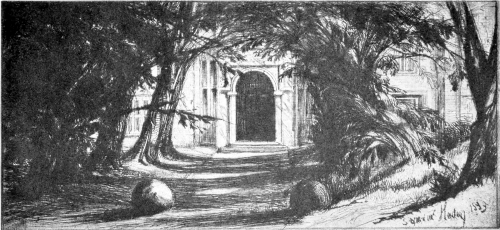
Haden. Mytton Hall
“Mytton Hall is an old Henry the Seventh house which Mr. Haden was in the habit of staying at for the purpose of his salmon fishing in the river Ribble (the Lancashire River) which runs past it.” Seymour Haden.
Size of the original dry-point, 4¾ × 10⅜ inches
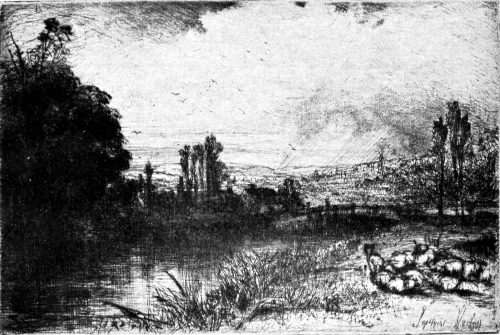
Haden. On the Test
“This plate and A Water Meadow were done on the same day, one at noon, the other very late in the evening. The Test (in Hampshire) is a famous trout stream.” Seymour Haden.
Size of the original dry-point, 6 × 8⅞ inches
Before the evening of his reception at the St. Botolph Club, Seymour Haden procured a list of the principal personages whom he was to meet there. He brought it to me, and said: “Now, what should I know about these people?” I wrote down for him as many notes as I could, and when he met the Bostonians, I was astonished to see how well he had coached himself about them. On his return to New York, he received a great number of letters. He was staying at the old Hotel Brunswick, Fifth Avenue, and every morning I had to go there and tell him “who was who” among the writers of the letters. One day he was called down to the parlor by a message that a lady wished to see him. He went down and when he came back to his room carrying a card in his hand, he said to me, “Well, I certainly am in an extraordinary country. That visitor, whom I never knew, is evidently a lady, and she has invited me to come and spend a week with her husband and herself at Yonkers.” Glancing at the card, I read the name of Mrs. James B. Colgate, and said to Seymour Haden, “I should certainly advise you to accept,” and I went on to say that it was easy enough for a stranger from England to see our public show places, big hotels, etc., but not so easy to get an entrée to the home of a really nice American family. Seymour Haden accepted the invitation and spent a week with Mr. and Mrs. Colgate. In those years, I myself lived in Yonkers, and I called on him at the Colgate house the day after his arrival there. The eminent banker showed us into his library, and leaving us alone he closed the door. The English visitor, first looking around to see that there was no other person present, said to me in a sort of whisper: “I am very comfortable here, with but one serious drawback. I have been in the habit, all my life, of taking wine with my dinner; but last evening, what do you suppose they gave me in the place of wine?—milk!” This was about nine o’clock at night, and when I got home I stated the case to my dear old mother. She laughed a little wickedly, and said, “I think I can help your friend in this case.” We happened to have some very good sherry. The old lady got a large flat bottle, filled it with the wine, corked it and put it into an innocent-looking pasteboard box, telling me to take it to him. Before leaving my home, I wrote a brief note to Seymour Haden saying that the package which I had to deliver to him must be opened only in the privacy of his own chamber. The Colgates were total abstainers of so pronounced a kind that when Mr. Colgate rented any house of his in Yonkers, he made a condition in the lease that no intoxicants of any kind were ever to be received in that house. Further than that, one of his principles was, not only never to drink wine or spirits, but never to touch or carry them. When I got back to Mr. Colgate’s house, it was ten o’clock at night, and all the lights in the big house were extinguished and the doors locked. I rang and rang at the bell, and at last Mr. Colgate himself, wearing trousers and slippers, opened the door. I had to manufacture a small fiction, which recalls Sir Walter Scott’s couplet:
Oh, what a tangled web we weave, When first we practise to deceive.
Mr. Colgate said to me rather fretfully that all the household had retired, and that Mr. Seymour Haden must wait until the morning. I said to him in reply, that he would do me a great favor, if when he was passing his guest’s chamber door, he would knock at it and deliver the package, and this Mr. Colgate consented to do. Some days later a reception was given to Seymour Haden at the Lotos Club, Fifth Avenue, and I accompanied him from Yonkers to New York on that occasion. When Mr. Haden found himself safe in the train, he said to me: “I couldn’t have slept a wink except for that excellent sherry that your mother sent me, but I took deucéd good care to carry away the empty bottle in my bag.” I remember that from the train we saw the gorgeous sight of the sun setting behind the Palisades, and mirrored in the Hudson River, and Mr. Haden said to me, with something like reproach in his voice: “Now, why have I never been told of the beauty of all this?” Later on, he said to me, looking about in the crowded train: “Now, isn’t it melancholy to think that nobody among all these people, except myself (and perhaps you), has the slightest sense of the beauty of this magnificent sunset!” I was tempted to say to him that he had no right to assume such callous insensibility on the part of the Americans, but though I thought it, I did not say it. Seymour Haden’s reception at the Lotos Club was a notable function. I remember that the President, the Hon. Whitelaw Reid, made a very graceful speech in honor of his guest, and I recall vividly the marvelous cleverness of a very young man who had been invited to entertain the company. One of this young man’s monologues represented an intimate talk between three Italian opera singers, the soprano, the tenor, and the basso; the three continually interrupting one another. The speaking of the young man was in “fake” Italian, and the three speaking voices were admirably differentiated. I inquired who this young man was, and was told that he was the son of the famous oratorio singer, Madame Rudersdorf of Boston, that his name was Richard Mansfield, and that he was studying for the stage. I then uttered a prophecy that that young man would be a great actor later on; and so he was.
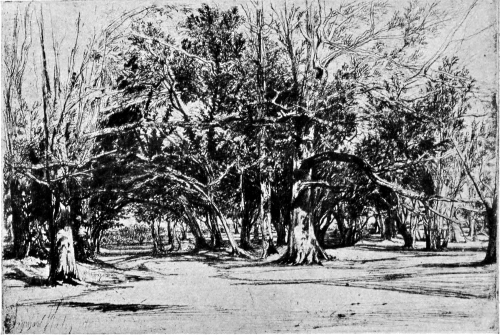
Haden. A By-road in Tipperary
This magnificent plate was etched in 1860, in the park of Viscount Hawarden. All things considered, it is the artist’s finest rendering of tree-forms
Size of the original etching, 7½ × 11¼ inches
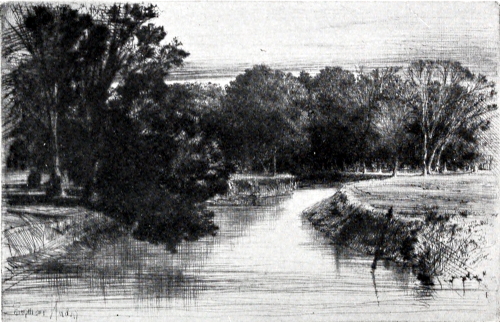
Haden. A Sunset in Ireland
“This plate, and also A By-road in Tipperary, were done in the park of Viscount Hawarden, in the most beautiful part of Tipperary.” Seymour Haden.
Size of the original dry-point, 5½ × 8½ inches
After his return from Boston, the artist spent several weeks in New York, and while he was there, I arranged for him the first public exhibition of his etchings which was ever made in America. The New York press took up the subject with enthusiasm, and every important newspaper printed a long review of the artist and his work. I collected all of these very laudatory articles, and took them to Mr. Haden at the Hotel Brunswick. Next day he said to me, “Do you know that these reviews of the New York press are distinctly abler and more intelligent than if they had been written in London?” He added, “I wish you would pay my particular compliments to the gentleman who wrote the review in the New York World; that article in particular I found to be admirable.” He was surprised when he saw me begin to laugh, but I explained to him that the “gentleman” in question was a lady, and the article which he so greatly admired was from the pen of Mrs. Schuyler van Rensselaer.
One very seldom finds that the imaginative and creative artist is also endowed with a logical and judicial cast of mind. It was so with Seymour Haden. He had brought from England a large collection of excellent lantern-slides to illustrate these lectures by means of a stereopticon, and in the lecturer’s zeal to glorify original etching at the expense of prints done by any other method, he had procured one lantern slide of the beautiful little portrait which Rembrandt had etched of himself, the complete print of which is hardly bigger than a postage stamp. It was the Rembrandt à trois moustaches. Alongside of this, Mr. Haden had printed a morsel of the same size, taken from a crude and unimportant part of the foreground of William Sharp’s famous line-engraving of the Holy Family, after the painting by Sir Joshua Reynolds. Thus this special pleader, Haden, displayed an etching in its entirety, and less than one-hundredth part of a line-engraving of very large size. Wherever, during his lectures, this illustration was exhibited by a stereopticon, there was a universal outcry against the unfairness of it. People all, with one accord, declared that if the artist wanted to confront and contrast etching with line-engraving, fairness would require the lecturer to have chosen two prints of the same size; but there was no “budging” Seymour Haden, when he had formed an opinion.
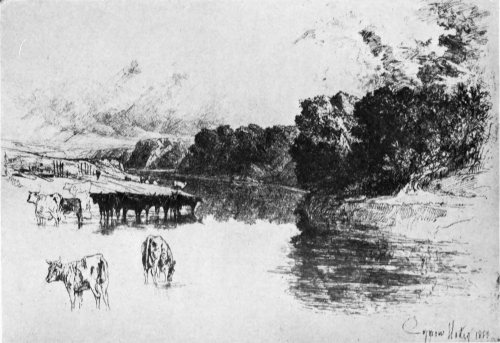
Haden. A Lancashire River.
A well-known salmon pool on the Ribble. In Sir Seymour’s opinion this is one of his very finest plates. It was awarded the Medal of Honor at the Paris Exposition of 1889.
Size of the original etching, 11 × 16 inches
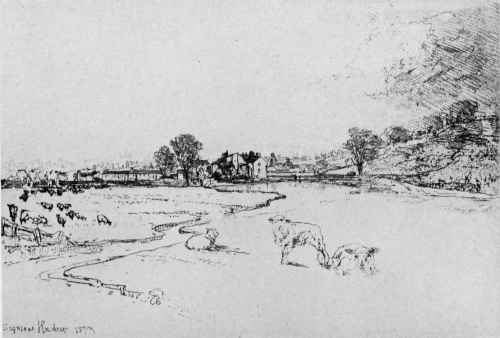
Haden. Sawley Abbey
Sawley Abbey stands by a salmon river, the Ribble, which here is enlarged into a wide pool. Seymour Haden often came here for his salmon fishing.
Size of the original etching, 10 × 14⅞ inches
While in New York, he visited the exhibition of paintings at the National Academy of Design, and was escorted through the galleries by the late James D. Smillie, N.A. When his eye fell upon a certain painting, he suddenly stopped as if he were paralyzed. “Who did that picture?” “It is the work of one of our New York artists, Miss So-and-So.” “Why do you allow such dreadful things on your walls?” “Well,” said Mr. Smillie, “we like to exemplify various phases in art.” “Hum,” rejoined Seymour Haden, while glaring at the picture; “she ought to be disemboweled!”
Of at least one of our well-known American artists, Seymour Haden expressed the strongest admiration. This was the late John Lafarge, N.A., and he also spoke with enthusiasm of the original American etchings of thirty years ago, the work of such men as Stephen Parrish, Charles A. Platt, Peter Moran, and Joseph Pennell. On seeing a very large, intricate plate by Mr. Parrish, Mr. Haden made the remark to me, “That young man does not know what the sense of fatigue in making a picture is.” Even at this period, Seymour Haden was known throughout Europe as being the judge par excellence of a fine print, and he was also recognized as an admirable judge of paintings.
While on this subject of Haden’s learned judgment of pictures, I will record what he remarked to me after he had visited Niagara for the first time. What he said was: “No artist, except Turner, should have ever dared to attempt making a picture of the Falls of Niagara.”
One of Seymour Haden’s exceptionally good days was the Sunday which he spent in visiting that famous art collector and admirable man, James L. Claghorn, of Philadelphia. On that occasion, I myself was included as a sort of “make-weight.” The Englishman, with genuine zeal, went through Mr. Claghorn’s collection of prints, and he wrote with pencil on several of them that they were exceptionally fine.
On another side Mr. Haden excelled as a judge, and that was in the matter of first-class food and first-class cooking. At lunch, our host treated us to a delicious dish of terrapin. Seymour Haden found it wonderfully good and declared that not only had he never tasted terrapin before, but he had never heard of the dish. “Oh, yes,” said I to him; “you certainly have heard of terrapin; don’t you remember at church on Sundays, when they sing the ‘Te Deum,’ they sing, ‘Terrapin and Seraphim.’” “Oh, tut, tut,” said he, “I want to hear no irreverence.”
Seymour Haden had ranked as a very able physician. An incident occurred while we were at Mr. Claghorn’s house which shows how wise he was in this respect: Mr. Claghorn was a huge and corpulent man of about sixty, but he was full of force and energy. While we were in his library he got up and bustled out on some errand, and Seymour Haden said to me: “Your friend will not live long, and when he dies he will go off very suddenly.” I was shocked on hearing such an unexpected prophecy, and I asked Mr. Haden how long Mr. Claghorn was likely to live. In answer he said, “Just about two years.” Two years later, within ten days of the time Haden had designated, Mr. Claghorn suddenly fell dead.
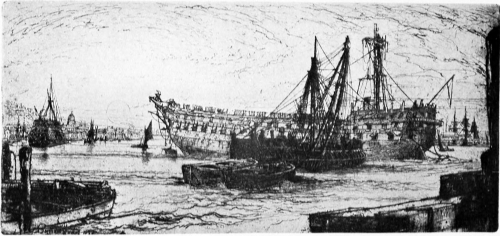
Haden. The breaking-up of the Agamemnon
Perhaps, all things considered, the artist’s masterpiece. Collectors differ as to the relative merits of the various etchings by Seymour Haden, but all are agreed in ranking this as a masterpiece, Moreover, it was the first etching to be treated in this particular manner, and it has become the model for many imitators. This fine plate was etched on the Thames, at Greenwich, in 1870. Sir Seymour devoted the money obtained from the sale of the proofs to the aid of the London Hospital for Incurables.
Size of the original etching, 7¾ × 16¼ inches
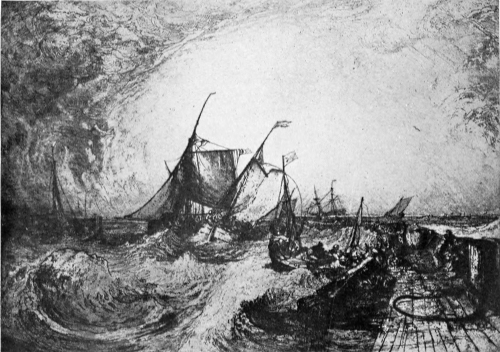
Haden. Calais Pier
Etched by Seymour Haden after the painting by J. M. W. Turner in the National Gallery, London. This superb etching stands alone in the history of the art. The scene could not be more strongly felt nor more vividly presented had the etcher been working from nature instead of from a painting by another hand. When this etching appeared, Seymour Haden received an enthusiastic letter from John Ruskin, in which the latter exhorted him to devote the remainder of his life to etching the paintings of Turner.
Size of the original print, 23½ × 33 inches
Still continuing the subject of Mr. Haden’s critical judgment in dining. I may mention that wherever he went, he would never partake, at a hotel, of a table d’hôte meal. He insisted on selecting particular dishes which he wished for, and he had them specially cooked for him. On his return from Cincinnati, he told me that while there he met my own dear friend, the late Herman Goepper, and he had given him, at a club, the very best, and best-served, dinner that he had ever partaken of.
Seymour Haden’s course of lectures at Chicago was a great success, and a very notable reception was tendered to him. During the course of that reception, a very influential Chicago lady marched up and said in a loud voice: “Why don’t you educate your women in England?” “I know what you mean,” said the Englishman, “but we don’t like to have our English women crammed with a lot of abstruse isms and ologies.” Another lady, who thought the English guest had been rather unfairly attacked, said to him, “Now, Mr. Haden, can’t you attack her in return?” “Well, yes,” said he: “in America, you don’t know how to make tea, and your table knives will not cut anything.” Another little dispute arose in Detroit. Haden had arrived late at night, very much fatigued, at the Russell House. At about eight o’clock in the morning he was awakened from a much-needed sleep by a sound of hammering and grinding in the wall outside his window. He got up, raised the window, and saw two men boring a hole into the front wall of the hotel, for the purpose of inserting an iron bar from which a sign was to be swung. Mr. Haden remonstrated at being disturbed. The two mechanics answered that they were “on that job” and that they were going to do it. Then, as the Detroit Free Press related the incident, the elderly gentleman, dressed in night-clothes and a nightcap, had pushed out both his arms, seized the offending and disturbing crowbar, hauled it into his room and shut down the window. Very soon after, the proprietor of the hotel came, knocked at his guest’s door, and said that the crowbar which had been seized was not his property and that he would get into trouble if it were not given up at once, but Seymour Haden before giving it up stipulated that he was not to be disturbed with any more noise until such time as he was ready to leave his bed.
It will be noticed that, while in my former article I called him Sir Seymour Haden, in the present one I call him plain Mister. This was because it was after his return from America to England that Queen Victoria gave him his title, and although in London he had a large medical practice he never was even Doctor Haden. In England a surgeon, however eminent, is never addressed as Doctor.
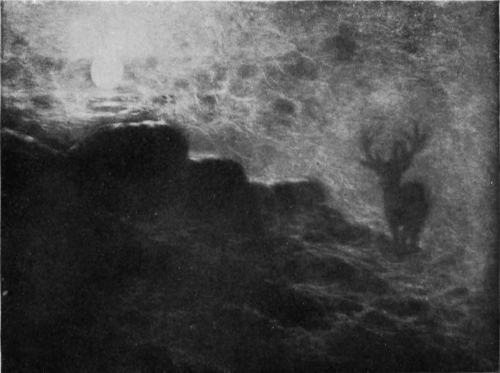
Haden. An Early Riser
Engraved in pure mezzotint in 1897. To this plate and Sir Seymour’s mezzotint Grayling Fishing was awarded the Medal of Honor at the Paris Exposition of 1900.
Size of the original mezzotint, 8⅞ × 11⅞ inches
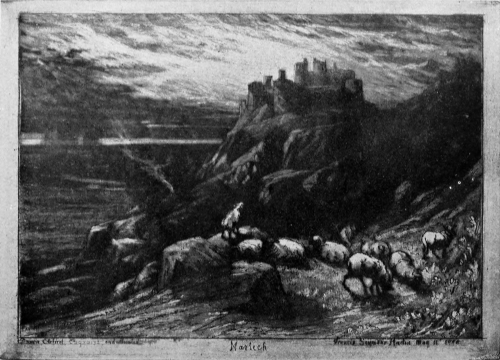
Haden. Harlech
In Harlech the artist has first mezzotinted his composition and has then strengthened and defined the outlines with etched lines. This is the reverse of the method employed by Turner in the “Liber Studiorum.” Turner first etched the main lines of his composition and then finished the plate in mezzotint.
Size of the original engraving, 8⅞ × 12½ inches
This change to a title of nobility reminds me of a couplet in Thackeray’s fine Irish ballad, “Mr. Molony’s Account of the Ball”:
There was Lord Crowhurst, I knew him first When only Misther Pips he was.
During his stay in America he learned to like our people greatly, and it was his intention to make us a second visit and to bring his charming American wife along with him; but this purpose of his was never carried out.
Shortly before leaving our shores, he said to me: “One thing alone would render it impossible for me ever to reside permanently in the United States, and that is the intolerable and brutal insolence of the lower classes.” To this I made answer: “But, Mr. Haden, in America we have no ‘lower classes.’ What you suffered from these people was really your own fault. It is all very well in England for a fine gentleman to bully and denounce the cabman, the railway-porter, and the servants at hotels, but it will not do here, and no American, however eminent, ever does it.”
When Seymour Haden returned to England he took with him the genuine good will of many Americans, and the lasting friendship of not a few.