A Tale from The Arabian Nights Retold by Laurence Housman (continued 2)
Reading edition

Capture of Camaralzaman. 'The captain of the ship goes to capture Camaralzaman at the command of Badoura.' (p. 99)
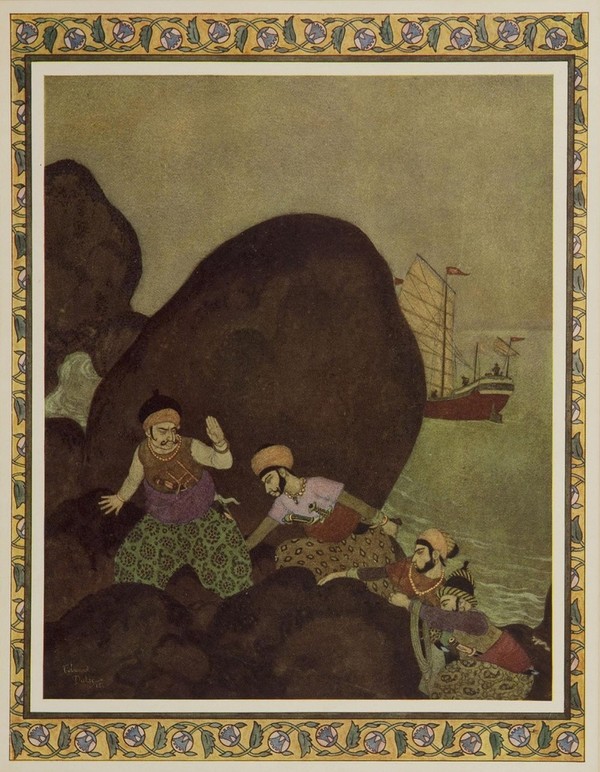
So going down to the shore, accompanied by her emirs and attendants, she caused the master of the vessel to be summoned before her and inquired of him what merchandise he had brought. 'O King,' replied the captain, 'I have spices, drugs, aromatic scents, and sweet ointments; I have also rich fabrics and metal-work; and in addition to all these things I have olives such as are not to be found in any other country, and these, since I came by them fortunately, I can let you have cheap.' On hearing this a desire for the olives took hold of the Princess, and she said, 'What quantity have you brought?' 'Fifty jars,' answered the master; 'that is all I have.' 'Well,' said the Princess, 'I will take fifty.' And she paid him for them the price that he asked—a thousand pieces of silver.
Now presently, when the olives had been conveyed to the palace, there came upon the Princess a strange desire to taste that which she had just purchased, so she gave orders for one of the jars to be opened and the contents to be poured into a dish; and as the attendant poured, first came olives and then a heap of red gold.
Then said Badoura to the Princess Hayatelnefoos, who alone was with her, 'That is gold!' So she examined further and in every jar found gold in equal quantity. Presently as she emptied one of the jars, along with the gold came the talisman which Camaralzaman had concealed there; and no sooner did the Princess Badoura see it than she knew it again; and she showed it to Hayatelnefoos, saying, 'Lo, this is the stone whose loss hath caused our separation; now, finding it again, I know that my beloved will be restored to me.'
Then she sent in haste and caused the master of the vessel to be brought before her, and she said to him, 'Whence had you these olives? Tell me the truth, or you shall die!'
Thereupon the master being smitten in his conscience dropped to earth and lay there, crying, 'Alas, I had them of a poor man who brought them himself to the vessel but did not return at the appointed time; therefore I sailed without him. Be assured, O King, that all the money I got for them shall be honestly paid to him.'
Then said Badoura, 'As to that I care not. But go back straightway to that country from which you came and find the man and bring him to me, for he is a malefactor against the laws of this kingdom, for he hath stolen from me a precious thing dearer than life itself; therefore is his life forfeit. And if you fail to bring him, then all the merchandise which you have now brought I will hold, and no ship or merchandise of yours shall ever enter this port again. But if you bring him safely, I will reward you abundantly.'
The master therefore, being so compelled, left his merchandise in bond and returned with all haste to the port from which he had set out, and there coming with his men to the house of Camaralzaman, he knocked; and no sooner had the Prince opened than, seizing him, they carried him off, and bestowed him on board the vessel as a prisoner.
Camaralzaman said to them, 'Masters, why are you treating me thus?' They answered, 'Thou art an offender and malefactor against the King of the Ebony Isles, son to the King Amanos, and hast stolen his wealth; yea, a precious thing hast thou stolen from him, and now he requires it of thee!'
'Well,' said Camaralzaman, 'this is the first that I have heard of it.'
So they bore him away, and after they had sailed for some while they came again to the city of Ebony, and word was sent to the palace that the master of the vessel had returned bringing the King his prisoner.
Then Badoura gave orders, and Camaralzaman, still in his workman's dress, his body wasted with grief, and his face and hands soiled with the defilements of his long voyage, came and stood before her. As soon as she saw him her heart leapt with joy, but she feared to reveal herself, for how would it appear to her emirs and chamberlains were she before all eyes to throw herself into the arms of a common gardener. Therefore, retaining her disguise, she spoke to him as a King should do to a peasant, and in a man's voice. And Camaralzaman, fearful of the unknown charge which was to be brought against him, stood before her with bowed head and did not look up.
The Princess asked him but a few questions, of the country from which he had come, of the time that he had lived there, and what calling he had followed. Then she said to him, 'Be assured that if thou art innocent of that which is charged against thee, thine honour and integrity shall be made known to all. Even now if thou wilt confess to having taken a thing which is not thine and wilt restore it to me, I am willing to pardon thee, seeing that it was done without thought of evil.' But Camaralzaman hearing these words knew not what they meant, for his thoughts were all astray and he did not dream that it was of himself and of the talisman that she spoke.
Then Badoura ordered an officer of her household to take charge of the prisoner and treat him with all care; and having recompensed the master of the vessel and set free his merchandise, she went in to Hayatelnefoos, and told her of all that had come about. And she said to her, 'O bosom-friend and comforter of my heart, be sure that what brings happiness to me shall bring it to thee also; for no fortune shall Heaven send me, nor any bliss, however great, that I am not ready to share equally with thee.' Then speaking of Camaralzaman she said, 'So great a distance divides in men's eyes what seems his present lot from ours, that it were peril to be sudden in this matter lest the truth of our story should not be believed. Therefore we must wait till of his own natural nobleness he shall have raised himself in the eyes of all.' And to this plan Queen Hayatelnefoos agreed.
So the next day Badoura gave orders to conduct Camaralzaman to the bath; then she caused him to be clad in an emir's robes and brought forth where all might see; and lo! as a willow branch after rain or the planet of love shining at dusk, so seemed he then to the eyes of all.
Then again she caused him to be brought before her in the Hall of Judgment and pronounced him clear of all that had been charged against him. 'For that which was precious to me,' she said, 'has been restored; and other hands held it from me, not thine. Therefore as thou hast been proved true I will appoint thee to high honour.' Then addressing the emirs and councillors who were gathered about her she said, 'My lords, this Camaralzaman whom to-day I admit to my Councils is not unworthy of the high post which I confer on him; for not only have I tested him as ye have seen on an accusation whereof he is innocent, but he is a man of approved valour, of grace, and learning, being also a descendant of kings.'
Great was Camaralzaman's astonishment at finding his name and lineage known to the King of the Ebony Isles; but not daring to question how his good fortune had come about he prostrated himself before the throne, saying, 'O King, only by thy favour have I been raised to this honour, and by that alone can I either deserve or maintain it.' So the Council ended, and Camaralzaman was conducted to a large and sumptuous abode with slaves and attendants to wait upon him, and everything that his heart could desire save only his beloved Princess.
After a few days Badoura, wishing to find occasion for Camaralzaman's more frequent presence, appointed him to the office of Grand Treasurer, and thereafter scarcely a day passed that she did not bestow on him fresh honours; while Camaralzaman, for his part, wondering why such high favours were shown him, served the King diligently, and was greatly respected not only by all the emirs and officials of the Court, but by the common people, who swore by his life, and would have asked no better than for such an one as he to be their ruler.
So time went on, and ever did the wonder of Camaralzaman increase why he alone had been chosen for such great honours. And because this thing seemed to him without reason, he came at last to fear it. Furthermore, for loss of his beloved, restlessness and the desire for travel filled his heart, and in no one place could he find happiness. So one day coming to the King—that is to say to Badoura—he spoke as follows: 'O King of the Age, so great is the favour that thou hast shown me, that I know well it cannot last. Suffer me therefore to depart before I have outstayed my welcome; so shall my gratitude be undiminished and the nature of thy regard for me unchanged.' When Badoura heard these words she smiled on him and said: 'If indeed it is thy will to depart, then must thou take and cast away once more—yea, lose utterly—this stone whose virtue brought thee back to me, and by which, while it is in my possession, our lives are bound.' So saying she reached out and put the talisman in his hand.
When Camaralzaman beheld the stone once more his wonder was beyond words. 'O King,' he cried, 'whence came this to thee? For herein lies the cause of all my afflictions and separation from one whom I loved as my own soul.'
'Surely,' answered Badoura, 'none can part from that talisman without estrangement and separation. And since now I have parted from it to thee, our separation must infallibly begin from this hour. Therefore the King of the Ebony Isles thou shalt see no more.'
So saying she passed out of the chamber, and Camaralzaman stood and wondered, not knowing what to think.
Then Badoura went in haste to a closet, and there she put on the dress and the girdle which she had worn on the day of separation; and taking from her head the man's turban, she spread her hair and put on a head-dress of fine gold delicately wrought. So she returned to him, and when Camaralzaman saw her he uttered a cry and ran into her arms and held her with kisses as if he could never let her go. And when at last he spoke of things other than his joy—'How,' he inquired, 'has the King accomplished this miracle? Surely when he spoke I understood nothing of what he said.'
Badoura smiled as she answered: 'When the King put the talisman into thy hand, then did his kingship cease, and he returned once more to his true form. O my lord, look upon thy king, who is now become thy slave. Surely hadst thou loved me a little more thou wouldst have known me.'
Then she told Camaralzaman of all that had happened to her from first to last; and on the morrow she went to King Amanos, and to him also made her story plain. Nor would she allow that any deception had been used, 'For truly,' she said, 'I and my beloved are one; and I did but come before and prepare for him the place which he was destined to fill. Therefore when I married thy daughter, it was Camaralzaman who married her; and when I accepted of thee the crown, it was Camaralzaman who accepted it. Give me leave, therefore, O King, who hast been to me as a father, to show my beloved to the Queen whom I have won for him, and to the people over whom, in his name, I have ruled.'
Greatly was King Amanos astonished to hear a woman utter such words; and the wonder of Camaralzaman was scarcely less. Yet, as she had brought fortune and happiness to both alike, they consented to do her will; and so it was agreed.
Therefore from that day on did Camaralzaman take up the power and authority which Badoura had attained for him, rejoicing also in the domestic felicity of two wives, the one as beautiful as the other, each without jealousy, and having no wish or thought out of which estrangement could arise. Doubtless it was the perfect happiness in which he thus dwelt which caused Camaralzaman to forget altogether the object for which his journey had been begun. No second dream of his father, the King Shahzaman, ever came to remind him of his neglected purpose, while to the dominions of King Gaiour of China he had no wish to return.