MARIE MADELEINE DE BRINVILLIERS (continued 2)
George Maidment translation
‘It is true,’ adds the good priest, ‘that I was thunderstruck at all this composure, and I shivered when I heard her tell the jailer, so quietly, that the soup was to be stronger that evening than usual, and that two servings were to be kept for her before midnight.
‘I saw in her at this moment much affection for Monsieur de Brinvilliers, and as it was generally believed that she had always had little enough love for him, I was surprised to find that she had so much. Indeed, it appeared to me to verge towards excess, and for half an hour I saw her more distressed for him than for herself.’ And when Pirot, to test her, said that her husband appeared very insensible to her approaching fate, he drew from her a dignified reply: he must not judge things so hastily, she told him, or without intimate knowledge, and that up to that day she had only had to congratulate herself on her husband.
She asked for a pen, and with a rapid hand wrote this astonishing letter to the Marquis de Brinvilliers:—
‘Being as I am on the point of going to give account of my soul to God, I want to assure you of my affection, which will endure to the last moment of my life. I ask your pardon for all that I have done that I ought not to have done. I die an honourable death, brought upon me by my enemies. I forgive them with all my heart, and beseech you to forgive them. I hope that you will also forgive me for the disgrace that may be reflected on you. But remember that we are here only for a time, and perhaps ere long you yourself will have to go and render to God an exact account of all your actions, even your idle words, as I am now preparing to do. Watch over our temporal affairs and our children: bring them up in the fear of the Lord, and yourself set them an example. On this consult Monsieur Marillac and Madame Cousté. Offer up for me as many prayers as you can, and be assured that I die yours devotedly,
d’Aubray.’
Pirot objected that what she said about her death and her enemies was not correct. ‘How so, sir?’ she said. ‘Are not those who have driven me to death my enemies, and is it not a Christian sentiment to forgive them their rancour?’
Pirot’s answer was as might be expected, but it was to her a revelation which plunged her into great astonishment.
Then the confession was resumed.
‘King David was troubled at the sight of his sin,’ said Pirot, ‘his heart pined with grief at the remembrance of his crimes. His flesh was bruised, his bones were broken, his heart quailed, his face, his bread, and his bed were bathed in his tears, his voice became hoarse with the cries he uttered to heaven in imploring mercy. His groaning was like that of the turtle-dove that ceaseth not. That also is the picture of the Magdalene. She watered the feet of Christ with her tears and did not cease to kiss them. Her holy tears which are never spent, her sacred kisses which continue without interruption, are marks of the greatness and constancy of her contrition for her sins, and her love for God. All these words and a thousand others like them,’ adds Pirot, ‘caused her to weep bitterly.’
Twice after dinner the priest was interrupted by the procurator-general, who came to see in what condition the prisoner was, and if she was disposed to confess her crimes before the court, to name her accomplices, and reveal the nature of her poisons. The marchioness replied that she would tell everything, but not till the morrow; that till then she did not wish to be interrupted in her preparation for death; and she persisted in her resolution in spite of the entreaties of Pirot, who would rather the confession had been made at once.
She spoke of her children, displaying a tender affection for them. ‘“Sir,” she said to me, “I have not asked to see them; that would only have upset both them and me. I beseech you to be a mother to them.”’ Pirot replied that it was the Virgin who would serve them as mother, and that the marchioness should pray to her to maintain them in purity and humility all their life long. From the first, Pirot had probed his fair prisoner’s character to the bottom. ‘Ah!’ she said, interrupting him, ‘those are grand virtues! Do you know that, humbled though I be by my hapless present state, yet I do not feel humble enough? I am still attached to this world’s glory, and it is hard to bear the shame with which I am loaded.’ And to the priest’s remarks she replied: ‘I tell myself all that when I reflect, but that does not prevent feelings of pride and glory sometimes passing through my mind, as they are natural to me.’ And she added words that must have terrified the unhappy priest: ‘At this present hour in which I speak to you, there are still moments when I cannot regret having known the man (Sainte-Croix) whose acquaintance has been so fatal to me, or hate his friendship which is so dire to me and has brought upon me so many misfortunes.’
Pirot supped that evening with the prisoner; then, when night had fallen, he withdrew, promising to return in the morning. He was in great agitation, and on reaching his apartment he had recourse to his breviary. ‘The image of the lady I had seen all day so powerfully possessed me that I could hardly attend to what I was reading: it seemed to me that I was for nearly half an hour circling round Domine, labia mea aperies, returning always to where I had begun. At last, seeing that I must get on, I applied myself a little more diligently to my reading, so as to be less distracted by this idea. But in spite of all my close attention, I was quite three hours in reciting my office.’
He has described at length his sleeplessness, the thoughts that crowded upon his mind, the anguish which choked him: ‘I got no sleep at all. Those who know the delicacy of my nature, how sensitive I am to the misery and pain I see in persons who are indifferent to me, will have no difficulty in realising the depth of my sorrow for a lady whom I had seen so afflicted, and who was so near to my heart by reason of the interest I was bound to take in the salvation of the soul intrusted to me.’ Stretching out his clasped hands towards heaven, he cried: ‘O God, I am greatly concerned for her whose salvation is as dear to me as my own; I die every moment for her, and all the reward I ask in the conflict I have to maintain with her before she closes her career is to see her crowned with Thee!’
In the morning Pirot returned to the prisoner. ‘I was taken up the tower, where I found Father de Chevigny in tears as he closed a prayer with the lady, who greeted me with the same courage that I had seen in her on the previous evening.’
Madame de Brinvilliers has slept as peacefully as a child.
One of the first questions she put to her confessor related to a fear which had arisen in her mind, and the thought of which gave her much torture. ‘Sir,’ she said to me, ‘you gave me yesterday some hope that I might be saved, but I cannot have the presumption to promise myself that that will be till after a long time in purgatory. How shall I know whether I am in purgatory or hell?’ Pirot reassured her.
Soon afterwards a message came that Madame de Brinvilliers was to descend to hear her sentence read. ‘She was prepared for death and torture; but she had not thought of the public penance or of the fire. She answered fearlessly, “In a moment, but just now we are finishing our conversation, this gentleman and I.” We shortly finished our talk in great serenity.’
On leaving the prisoner, Pirot betook himself to the chapel of the Conciergerie. ‘I said mass for her, and went into the jailer’s room. I found him there, and he told me that he had accompanied her to the torture-chamber, and that after her sentence had been read, when the executioner approached to seize her, she looked him up and down without saying a word, and seeing a rope in his hand, she offered him her hands already clasped. I learned after dinner from the procurator-general that she had been agitated at the reading of her sentence, and that she got it read a second time.’
The sentence was dated July 16, 1676:—
‘The court has declared and declares the said d’Aubray de Brinvilliers duly accused and convicted of having poisoned Maître Dreux d’Aubray her father, and the said d’Aubray, civil lieutenant and counsellor in the said court, her brothers, and for reparation has condemned and condemns the said d’Aubray de Brinvilliers to do public penance before the principal door of the church of Paris, where she will be taken in a cart, bare-footed, a rope on her neck, holding in her hands a lighted torch of two pounds weight, and there on her knees to say and declare that wickedly, from revenge and to have their property, she has poisoned her father and two brothers, and attempted the life of her late sister, of which she repents, and asks pardon of God, the king, and justice; this done, to be led and conducted in the said cart to the Place de Grève of this city, to have her head cut off there on a scaffold, which will be erected for that purpose on the said place; her body to be burned, and her ashes thrown to the winds: the question ordinary and extraordinary to be first applied in order to obtain revelation of her accomplices.’
She declared in the evening that the part of the sentence which had so startled her at the first reading that she could not hear the rest, was the passage which stated that she was to be put in a cart. Her pride was aroused.
After the sentence had been read, the condemned woman was led into the torture-chamber, and when she saw the apparatus, she said: ‘Gentlemen, it is useless, I will tell everything without torture. Not that I think I can escape it—my sentence orders me to be tortured, and I suppose it will not be dispensed with—but I will declare all beforehand. I have denied everything hitherto, because I imagined I was thus defending myself, and that I was not bound to confess anything. I have been convinced of the contrary, and I will behave in accordance with the instructions given me. And I can assure you that if I had seen three weeks ago the person whom I have had given me the last twenty-four hours, you would three weeks ago have known what you are going to learn now.’ Then raising her voice, she made a clear and complete avowal of the crimes of her life. As to the composition of the poisons she had employed, she knew only arsenic, vitriol, and the poison of toads. The strongest poison was ‘rarefied arsenic.’ The only antidote which she had used herself when poisoned by Sainte-Croix was milk. As to her accomplices, apart from Sainte-Croix and her lackeys she declared that she had never had or known any.
The judges were struck by the frankness of her words. And as we know, she spoke at that moment with entire sincerity.
Madame de Brinvilliers underwent the cruelest torture then applied by the Parlement of Paris: the ordeal of water. Enormous quantities of water were introduced into the stomach of the condemned through a funnel placed between the teeth. This water, rapidly accumulating inside the body, produced the most horrible agonies.
Meanwhile the poor abbé Pirot was suffering as much from the torture as the sufferer herself: ‘I did not see her from half-past seven until two o’clock in the afternoon. I can say that this was the only bad time I had that day; apart from the time I spent without her, the rest cost me nothing. But while she was under torture I was extraordinarily restless, saying to myself at every moment, “They are now giving her torture.”’
He took refuge in a little room where, in spite of the promises of the jailer, he was besieged by importunate visitors. Curious ladies of the court flocked to him. While there some one handed to him a little medal, with a message from the wife of President Lamoignon, saying that she had received it from the pope, with the authority to bestow indulgence on any dying person she chose, and that she gave it to Madame de Brinvilliers.
At last Pirot was told that he would find the marchioness lying on a mattress near the fire. It was a thrilling moment. By his gentle and sympathetic words, and his exhortation to repentance, Pirot had little by little bent this character of iron. He had sent the condemned lady resigned and submissive to the judges. But under the pangs of torture which made strong men yield, under the brutal force she had to suffer, all the pride of her proud nature started up, the worst instincts were awakened. In revenge, she accused Briancourt of false witness; she charged Desgrez, who had arrested her at Liége, with purloining documents. Pirot found her full of hatred and stubbornness, her eyes blazing. ‘She was highly excited, her face red as fire, her eyes gleaming, her mouth distorted. She asked for wine, which I had brought to her at once.’
The rest of the story is really touching. The abbé Pirot watched with the care of an anxious mother over the reputation of the lady about to die. ‘I expressly notice this circumstance,’ he says, ‘to undeceive those who believe that she was too fond of wine and was guilty of taking it to excess, and that she could not refrain from drinking it freely on the day of her death. I saw nothing of the kind. It is true that on Thursday, as on Friday, she had a cup from which at times she tasted as much as a fly might swallow; but this was only to keep up her strength and to refresh herself, at a time when the strain of recalling to mind her whole life, in order to assure herself of any criminality there might have been in it, much exhausted and excited her; and if care was taken to have good wine on the day of her death, it was only to cheer her a little in her natural depression of spirits. It has even been cast up against her, unjustly, that a bottle was provided for her on the way to the scaffold: I am responsible for that. I feared that her heart might fail her, and knowing that at one time it was common to offer criminals strong drink of some kind, to give them courage to suffer death, I thought that, as I had seen her necessity that day of refreshing herself now and then, it would be well to have wine ready; and, to tell the truth, I thought a little of myself. The wine was only used by the executioner, who drank a mouthful immediately after the execution.’
Before setting out for her punishment the marchioness was to be allowed to pray for a few moments in the chapel of the Conciergerie, before the Holy Sacrament exposed for the purpose; but she had to appear there surrounded by other prisoners, who were all admitted to the chapel when the Host was placed on the altar. ‘When we entered the vestry of the Conciergerie, she asked the jailer for a pin to fasten the kerchief she had on her neck, and as he went in all good faith to look for one, she said to him: “You must not be afraid of anything now: the gentleman will be my surety, and will answer for it that I do not want to do myself harm.” “Madam,” he replied, giving her a pin, “I beg pardon, I never mistrusted you, and if anybody ever did so, it was certainly not I.” He fell on his knees before her, and thus kneeling kissed her hands. She begged him to pray to God for her. “Madam,” he replied, his voice choked with sobs, “I will pray for you to-morrow with all my heart.”’
‘Meanwhile,’ says Pirot, ‘she had not yet recovered the penitent spirit which I had seen in her that morning and the night before.’ She spoke of the sentence. The punishment did not terrify her, but she was bitterly indignant at the degrading circumstances introduced into it—the public penance, the scattering of her ashes to the winds. Pirot replied: ‘Madam, it matters nothing to your salvation whether your body be laid in the earth or be cast into the fire. It will rise glorious from the ashes if your soul is in grace.’ And further: ‘Yes, madam, this flesh which men are soon to burn will rise one day, the same but glorified, provided that your soul rejoices in God; it will be born again, bright as the sun, no more to suffer, subtle and quick as a spirit.’
By degrees Pirot regained his hold upon the fair penitent. ‘The cloud of nature was dissolved, her agitation appeared no longer, and, instead of the hard fierce looks, the biting of lips, and the other impetuous manifestations of a shattered pride, there were only tears and sobs, remorse for sin and yearnings for repentance, that would make one’s heart bleed. I could not keep back my tears, and for an hour and a half I wept with her, speaking, nevertheless, with more force than I had yet done. She was still more affected by my tears than by my words, and, pondering on the cause of my tears, she said: “Sir, my distress must be great to compel you to weep so much, or you take a great interest in what concerns me.”’
Then she confessed the calumnies she had been unable to avoid conceiving under torture against Briancourt and Desgrez. Pirot was alarmed, and when he told her that she ought to repair the fresh sin by a fresh declaration she appeared surprised. However, the opportunity was about to be afforded, for about six o’clock the procurator-general sent for the abbé Pirot.
‘Sir,’ he said, ‘this is a most vexatious woman.’
‘How, sir? For my part, I am greatly consoled by the state in which I now see her, and I hope that God will have mercy upon her.’
‘Ah, sir! she confesses her crime, but she does not reveal her accomplices.’
Shortly afterwards the procurator-general returned to the chapel along with some commissaries and Drouet the clerk of the court. Pirot repeated to the marchioness what had just been said to him, adding that she could only hope for pardon if she revealed to the judges all she knew. ‘Sir,’ she said, ‘it is true that you told me that at first and at greater length, and I have followed your instructions and know nothing more than I have declared. I have already testified to these gentlemen that you had well instructed me, and it was through that that I told them everything. I have told everything, sir, and have nothing more to say.’ Monsieur de Palluau at once said, ‘This is more than enough, sir; adieu.’ ‘He went away at once, and we were given only a short time to spend in that place, the day beginning to decline; it might be about a quarter to seven. I have no doubt she was pretty tired of so much questioning; however, I saw not the shadow of a complaint, so great was her courtesy.’ Before the procurator-general and the rest retired, Pirot, with the authority of the prisoner, cleared Briancourt and Desgrez from the accusations brought against them in the torture-chamber.
Madame de Brinvilliers remained a moment longer prostrate before the altar, then went out to meet her doom. At this moment the executioner came up to speak of ‘a saddler to whom she owed the balance of the price of a carriage; she told him shortly that she would see to it, and said that very sweetly, but as she would have spoken to a man much inferior to herself.’
As she left the chapel, she stumbled upon some fifty people of rank—the Countess de Soissons, Mademoiselle de Lendovie, Madame de Roquelaure, the Abbé de Chaluset, all jostling one another to see her. Her pride was offended, and after freely staring at them, she said to her confessor: ‘Sir, what a strange curiosity!’
She went on, barefooted, clothed in the coarse linen shirt of condemned criminals, holding in one hand the penitent’s candle, and in the other a crucifix.
On leaving the Conciergerie she was lifted into the cart. ‘It was one of the smaller carts you see in the streets loaded with rubbish; it was very short and narrow, and I feared there was not room enough for her and me. Yet four of us got in, the executioner’s assistant sitting on the board which closed it in front, with his feet on the shafts on either side of the horse. She and I sat on the straw put down to cover up the wood, and the executioner stood upright at the back. She got in first, and leant her back against the front-board and against the side, slightly at an angle. I was near her, pressing against her to make room for the executioner’s feet, my back against the side of the cart, and my knees doubled up uncomfortably.’
The cart proceeded slowly towards the Place de Grève, which extended from the Hôtel de Ville to the Seine. It was not easy to get through the crowd which pressed around it. The streets were black with people, and the windows crowded with sightseers. At this moment the lady’s features underwent a sudden change of expression: ‘They were dreadfully convulsed, the keenest agony being expressed in the eyes, and the whole countenance wild.’ ‘Sir,’ she said to her confessor, ‘would it be possible, after all that is passing now, for Monsieur de Brinvilliers to have so little feeling as to remain in this world?’
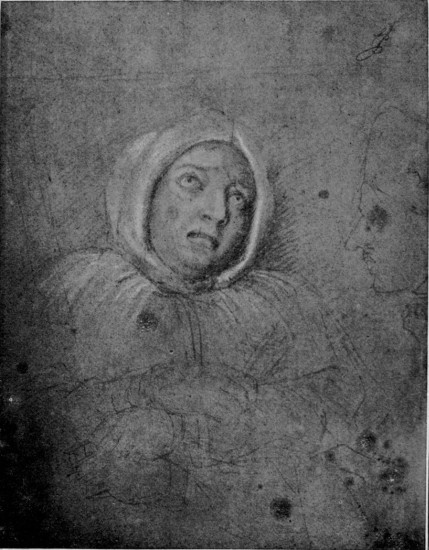
Pirot answered as best he could, endeavouring to ease her mind; but what he said fell on deaf ears, for the marchioness ‘then suffered one of the strongest convulsions of her nature in the vivid apprehension of so much shame. Her face contracted, her brows were knitted, her eyes flashed, her mouth was distorted, and her whole aspect was embittered.’ ‘I do not think,’ adds Pirot, ‘that there was a moment in all the time that I had been with her when her appearance betokened more indignation, and I am not surprised that Monsieur Le Brun, who is said to have seen her at that spot, where he could look close at her for some minutes, made so fiery and terrible a head as he is said to have done in the portrait he took of her.’ Le Brun’s sketch is now No. 853 at the exhibition of the Louvre; it is in red and black chalks. It is an admirable drawing, unquestionably the artist’s masterpiece. Pirot is sketched in silhouette beside the lady.
As the cart passed slowly through the crowd, voices were raised crying out for blood, and heaping curse on curse; but others spoke pitiful words, and she heard prayers for her salvation. There was a sudden revulsion of opinion in her favour, which grew stronger and stronger till the hour of her death.
The shirt in which she was clothed filled her with amazement. ‘Sir,’ she said to her confessor, ‘look; I am dressed all in white.’
All at once a new contraction marked her features. She had just noticed Desgrez riding near her, the man who had arrested her at Liége, and subjected her to some rough treatment. She asked the executioner to move so as to hide this man from her; then she felt remorse for this ‘delicacy,’ and asked the executioner to return to his former position. ‘It was the last time her countenance showed any grimace,’ says Pirot. From that moment she was wholly under the fortifying influence of the priest who assisted her. Hope arose in her soul, more and more clear and radiant, and gave strength to her heart.
She knelt down on the step of the great door of Notre Dame, and there repeated with docility the formula dictated by the executioner, in which she publicly confessed her crimes. ‘Some people say that she hesitated in saying her father’s name,’ observes Pirot; ‘but I noticed nothing of the sort.’
Then they remounted the cart to wend towards the Place de Grève. ‘Not a word of reproach or complaint against any one escaped her; she showed no sign of vulgar fear. If she dreaded death, it was only in anticipation of the judgment of God, and neither the sight of the Grève, the proximity of the scaffold, nor the appearance of all the terrible apparatus used in this kind of execution gave her the least shadow of fright.’
The cart stopped. The executioner said to her: ‘Madam, you must persevere: it is not enough to have come here and to have responded hitherto to what this gentleman has been saying, you must go on to the end as you have begun.’ ‘This he said in a noticeably humane manner,’ observes Pirot, ‘and I was edified by it. It is true that she answered never a word, but she courteously bent her head as though to show that she took well what he had said and that she meant to continue in the temper in which he saw her. He confessed to me that he was surprised at her firmness.’
At this moment a clerk of the Parlement appeared. The commissaries were sitting in the Hôtel de Ville ready to receive any declaration Madame de Brinvilliers might still have to make about her accomplices. ‘Sir,’ she replied, ‘I have no more to say; I have told all I know.’ She renewed the declaration whereby she freed Briancourt and Desgrez from the accusations fabricated against them at her torture.
The executioner placed the ladder against the scaffold. ‘She looked at me,’ says Pirot, ‘with a gentle countenance and an expression full of gratitude and tenderness, and with tears in her eyes. “Sir,” she said to me in a pretty loud tone, which showed how self-possessed she was, but as courteous as it was firm, “we are not yet to separate. You promised not to leave me till my head is off; I hope that you will keep your word.” And as I answered nothing, because the tears and sighs which I could only with difficulty restrain robbed me of all power of speech, she added, “I beseech you, sir, to forgive me and not to regret the time you have given to me. I am sorry, for my part, to have given you so little satisfaction, at least at certain moments; I beg your pardon for it. But I cannot die without asking you to say a De profundis on the scaffold at the moment of my death, and a mass to-morrow. Remember me, sir, and pray for me.”’ Pirot remarks, ‘If I had not been at that moment more deeply moved than I had ever been in my life, I should have had many things to reply to her courtesies, and I should have promised her more than one mass; but I found it impossible to say anything more than “Yes, madam, I will do all that you bid me.”’
Just as she was walking up the steps Madame de Brinvilliers found herself next to Desgrez. She then asked his forgiveness for the trouble she had given him, and begged him to say a few masses and to pray for her. She ended her ‘compliment’ by saying that ‘she was his servant, and so she would die on the scaffold.’ Then she added, ‘Adieu, sir.’
The throng was immense. Madame de Sévigné, who had come to witness the execution from the window of one of the houses on the bridge Notre Dame, writes: ‘Never was such a crowd seen, nor Paris so moved or so eager.’
The marchioness knelt down on the scaffold, her face turned towards the river. ‘It was at that moment,’ says Pirot, ‘that I saw her so intent upon herself, so wholly occupied with what I had said we would do on the scaffold, telling me with such wonderful composure all that was necessary, and making me pass from one thing to another in due order without any prompting from me, wholly absorbed in what I said to her to prepare her for death, without the appearance of any wandering in her thoughts.
‘She was absolutely without fear. She was gentle, courteous, steadfast, and self-forgetful. She had very great patience to endure with extraordinary docility all the executioner’s preparations. He undid her hair while she was on her knees; he cut it behind and at both sides; to do so he made her turn her head several times in different ways, and he even turned it himself sometimes with no great gentleness: that lasted quite half an hour. She felt keenly the shame of the proceeding in the sight of so great a company; but she overcame her grief and submitted to everything even with joy. I fancy that she had never allowed her hair to be done so quietly as she then let it be cut and shaved; the executioner’s hand felt no rougher to her than that of a maid doing her hair; she punctually obeyed his instructions as to turning, lowering, and raising her head when he pleased. He tore off the top of the shirt which he had put over her cloak when she left the Conciergerie, so as to uncover her shoulders. She let him bind her hands as though he were putting on golden bracelets, and knot the rope about her neck as if it had been a necklace of pearls.
MADAME DE BRINVILLIERS ON THE WAY TO EXECUTION. HER DRESS IS COVERED BY THE SHIRT WORN BY CONDEMNED CRIMINALS. ON THE RIGHT IS THE PROFILE OF HER CONFESSOR, THE ABBÉ PIROT (From a Sketch by Charles Le Brun, preserved in the Louvre)

‘“I should like to be burned alive,” she said, “to render my sacrifice more meritorious, if I could have sufficient confidence in my courage to bear that kind of death without falling into despair.”’
The Abbé Pirot chanted the Salve, and the people crowding round the scaffold continued the chant that he began. Then he told the lady that he was about to give her absolution. Thereupon she said, her soul at peace, ‘Sir, you promised me just now to give me a second penitence on the scaffold, when I pleaded that what you gave me was too easy, and now you say nothing about it.’ ‘I asked her to say an Ave and a Sancta est Maria mater gratiae. At the end of which, saying to her, “Madam, renew your contrition,” I gave her absolution, saying only the sacramental words because time was pressing.’
The expression of her face was transformed. It was an expression of hope and joy, of serene faith and love, mingled with the exaltation of the penitent. ‘Never have I seen anything more touching,’ says Pirot, ‘than her eyes appeared to me, and if I had to paint a countenance full of contrition and sorrow of heart and hope of pardon, I could wish for no other features than those I remember still, and shall remember all my life long.’
Guillaume the executioner bandaged the eyes of the condemned woman. She repeated the last prayers along with her confessor. Guillaume with the back of his sleeve wiped away the beads of sweat which covered his brow. Suddenly Pirot heard a dull blow, and ceased to speak. ‘Madame de Brinvilliers held her head very straight. The executioner severed it at a single stroke, which cut so clean that it remained for a moment on the trunk before falling. I was indeed in agony for an instant, fearing that he had missed his aim and that he would have to strike a second time.’
‘Sir,’ said the headsman, ‘isn’t it a fine stroke?’
He added: ‘On these occasions I always commend myself to God, and hitherto he has been with me; five or six days ago this lady was troubling me and I couldn’t get her out of my head: I will have six masses said.’ And, uncorking a bottle, he drank a good draught of wine.
The body was borne to the stake; the flames consumed it, and then the ashes were scattered; but the mob struggled to collect some fragments of the charred bones: all who had been able to get near the scaffold had seen the face of the criminal illumined with a halo, and they departed saying that the dead woman was a saint. Madame de Sévigné writes that Pirot repeated the saying to every one he met.
The children of the Marquis de Brinvilliers took the name of Offémont.
Pennautier was acquitted and left the prison on July 27. He recovered his high position and the repute in which he had been held.
In declaring that she had had no other accomplices than Sainte-Croix and her lackeys Madame de Brinvilliers was speaking the truth. But at that period crimes as great as hers were being committed in Paris, and it was not long before the judges discovered them. There was for instance the celebrated case heard by the ‘Chambre Ardente,’ to which that of Madame de Brinvilliers serves as introduction.