FM Peard (continued 4)
Reading edition
“That is he they call Henry of Doune, and Sir Adam Fortescue is stopping his horse to speak with him. And here comes Peter the shereman, and Nat the cordwainer. They say that. Earl Hugh has been quarrelling with the mayor again, and threatening to stop all the fishing in the Exe. Thy father is very wroth; he says the city bears it too tamely, and should complain to the king.”
“Hugh, tell me about thy corbel. Hast thou thought it out?”
“I am always thinking. I see such beautiful lines and curves in my dreams that I am quite happy—till I wake.”
“Father says in two or three months there will be a beginning, and I don’t know what to wish,” continued Joan. “I want both of you to do the best.”
“There is no fear. I cannot match with the master.”
“There is no other that can match with thee then!” cried Joan, fondling Agrippa. “He first and thou second—that is what it must be.”
Hugh shook his head.
“Franklyn and Roger.”
“They can work but they cannot design like thee,” returned Joan, eagerly. “Roger will be mad to be the best, but—unless he steals a design—there is no chance of that. Oh, thou foolish Hugh, to make me tell thee this over and over again when thou knowest it better than I do!”
Chapter Thirteen.
By Proxy.
All through the autumn and early winter Hugh’s thoughts were busy about the corbel work. He might have been impatient that it was not begun before, but that he knew the delay to have been gained for himself by Elyas, who had met with some opposition from certain canons of the Cathedral. They objected that it was unwise to put a work of such importance into the hands of a young apprentice. Every month gained, therefore, was in his favour, and the bishop remained his friend. The rough blocks were already in their places, ready for ordinary workmen to “boss them out,” and by the end of February, which had been a wet and cheerless month, this was done.
Gervase was very much in the Cathedral superintending; Prothasy complained that she never saw him, and even Joan failed to coax him out. He was like a boy in his longing to begin, saying, and justly, that he was for ever over-seeing and correcting, and got little opportunity of letting his own powers have play. To Hugh, more freely than to any, he talked of his design, discussing its details with him; but one day Wat, looking uncomfortable, pulled Hugh after him as he went down the street.
“Talk a little less loudly with the master of what his surs is to be like,” he said.
“Why?”
“Because there are those who would give their ears to have some notions in their thick brains, and would filch other folks’ without scruple.”
“Roger?”
“Ay, Roger is ever conveniently near when there is aught to be heard, and he is mad because the men say thy work is sure to be the best—after the master’s. So beware, for the master thinks all as honourable as himself. What’s this?”
For by this time they had got near the conduit and the market, and a crowd of people were coming along hooting and jeering some object, which, as they approached, turned out to be a man seated on a horse with his face to the tail, and a loaf hanging round his neck.
“Why, ’tis Edmund the baker!” cried Wat in great excitement. “Look how white he is—as white as his own meal! This comes of adulterating his bread, and now he will be put in the pillory, and his oven destroyed. Which wilt thou go to see, Hugh?”
“Neither. And what will Mistress Thomasin say of thy caring to see a man pilloried?”
“Oh, Mistress Thomasin, she is too dainty and fine! Her sister is more to my mind. Come!”
But Hugh would not. He left Wat, and walked down the High Street, and across the bridge with its houses and its chapel, and out into the country. A high wind was driving grey clouds swiftly across the sky, and now and then a dash of rain came in his face. The year was forward, and already buds were swelling, and the country showing the first signs of spring. Though so many years had passed Hugh could never walk in this direction without remembering his first coming to Exeter. How glad his father would be to know how it was with him! He was in the last year of his apprenticeship, and receiving wages of ten shillings a month, no small sum in those days. That he had got on in his craft and satisfied his master Hugh was aware, and now before him opened such an honourable task as a lad of his age could not have hoped for; what Stephen had longed for was about to come to pass, and Hugh knew that it was possible for him to bring fame and honour to his father’s name.
With such thoughts, too, necessarily was joined very deep gratitude to Master Gervase. He had never faltered in his kindness; had Hugh been his own son he could not have trained him more carefully, or taught him more freely, with no grudging thoughts of possible rivalship. He had given the boy of his best, and Hugh’s heart swelled as he recognised it, wondering whether it would ever be in his power to do something by way of return. Poor Hugh! He little thought how soon the occasion would come!
Then, as ever, he fell to studying the beautiful spring of branch and twig, and shaped and twisted them in his own mind, and saw them fair and perfect in the corbel, as artists see their works before they begin to carry them out, as yet unmarred by failure. Some of these models he bore home to study at leisure, and in the doorway met Elyas.
“I was looking for thee. John Hamlyn and I have had our commission to begin, and we are to hear about thee in two or three days. Have no fear. The bishop and I are strong enough to carry the matter; beshrew me, am I not the one to judge who is the best workman?”
“I may get the block ready for you, sir?” said Hugh eagerly.
“That may’st thou not, for I have already spoken to Ned Parsons, and he is there at this moment. Why, thou silly lad, disappointed? Thinkest thou that seeing thee set to do the rough labour will dispose them to choose thee for the better? Nay, nay, leave it to me, and do thou perfect thy design, remembering that it is a great and holy work to which thou art admitted. And hark ye, Hugh, spare no time in the design, and be not over-bold. Take something simple, such as ivy with the berries. Do that well, and it may be a second will fall to thy share.”
No need to bid him be industrious. Hugh flung himself into it with such intensity of purpose that for the next day or two he could hardly eat or sleep. Wat, whose fate was also in the balance, took it with the utmost philosophy, said he should do his best, hoped that would turn out better than he expected, and snored peacefully the moment he was in his bed. Roger, who was certain to have the work, was as absorbed as Hugh, but silent withal. His nature was moody and suspicious, he gave no confidence, and Wat was not far wrong when he said that he was on the watch for what he could gather as to the designs of the others. Hugh generally drew his fancies on a bit of board with a stick sharpened and burnt. Usually he rubbed them out as soon as he had them to his fancy, but once or twice he had left them about, and was little aware how Roger had made them his own, or what exact copies were stowed away in a box.
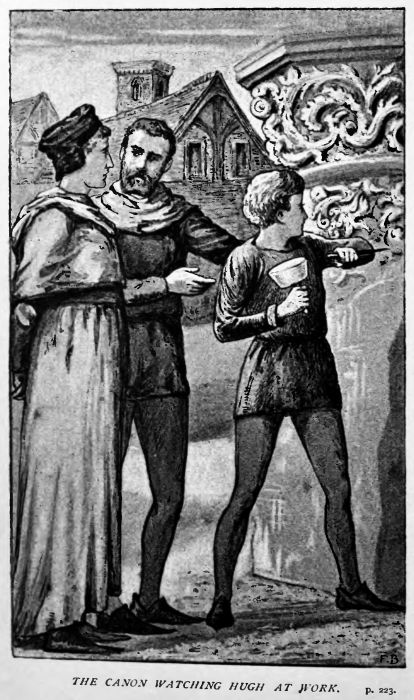
It was a week after Hugh’s walk outside the walls that he saw Elyas come into the yard with Master William Pontington, the canon of St. Peter’s, who a few years before had bought Poltimore of Lord Montacute. Hugh’s heart beat so fast that his hand was scarcely so firm as usual, and he chipped the feather of a bird’s wing. For something in Gervase’s face told him that he brought news. Wat was working in the Cathedral. Presently the master and the canon came and stood behind Hugh. Hugh’s hand trembled no more; he cut with astonishing freedom and power, feeling himself to be in a manner on his trial. Yet the silence seemed to him to last almost beyond endurance. He could not see the proud look on his master’s face, nor watch the change of expression from cold indifference to eager interest on that of the canon. His own work never reached his hopes or his intentions, and he was far more quick to see its faults than its beauties. Suddenly he felt a hand on his shoulder.
“Enough, goodman,” said a voice, “I give in. Since I have seen this young springald of thine at work, I own thou hadst a right to praise him as thou hast done. Give him a corbel and let him fall to at it as if it were this capital he is carving now, for the bird and her nest are as cunning a piece of workmanship as I have ever beheld.”
“Thank his reverence, Hugh,” said Gervase gleefully.
But Hugh turned red and then white, and could scarce stammer out the words.
“Ay, ay,” said the canon good-humouredly, “no need for more; and I am glad thy heart is so set upon it, because now thy heart will go into thy hand, and, to tell thee the truth, that is what I feared might be wanting in such a young worker. Is that truly all thine own design?”
“The other men would be more like to come to Hugh than Hugh to go to them, holy sir,” put in Elyas.
The canon, indeed, could scarcely believe his eyes. He made the young man show more of his carving, heard something of his father’s skill, to all of which he had hitherto turned a deaf ear, and departed, ready to do battle for Hugh against any who spoke a disparaging word.
“There goes thy most persistent opponent,” said Elyas, coming back and rubbing his hands in glee; “’twas all I could do to bring him here, and he grumbled the whole way about putting work into inexperienced hands, and I know not what! Now to-morrow, Hugh, Ned Parsons will have finished his blocking out for me, and I will set him to thine. I shall give thee the first pillar in the choir on the opposite side to mine own. It is not so well in view as some of the others, but that should make no difference in its fairness. And here is Joan to be told the news.”
Joan shook her wise little head over it, and opined that now Hugh would be worse than ever in neither eating nor sleeping. But it was not so. He was very quiet all that day, and when work was over he and Joan set off for the Cathedral that he might look upon his pillar—with what longing eyes!—and picture it again and again to himself as it should be.
“And there is father’s—shaped,” said Joan; “how long and slender it looks! I do hope that his will be the most beautiful of all, because he is older, and because you have all learnt from him, and because—he is father and there is no one like him!”
“No fear!” said Hugh. “I have seen his designs. Not one of us can overpass him.”
“Mother is not easy about him, either,” said Joan, who had sat down and clasped her hands round her knees. “He has pains in his head and dizziness, and he will not have the leech because he says he talks so foolishly about Mars and Venus, and father says he does not believe the planets have aught to do with us. Dost thou think they have?”
“I know not,” said Hugh unheeding. “Joan, hast thou heard where Roger’s is to be?”
“On the same side with father’s, and Wat opposite, and Franklyn between thee and Wat. Tell me once again how thine ivy is to curl.”
From one cause or another there was a slight delay in the preparation of Hugh’s block. Something hindered Ned Parsons, or he was slower in his work, or kept Mid-Lent too jovially; at any rate there was a check which seemed very terrible to Hugh, and Roger and Wat were both at work before him. Wat intended to carry out a bold design of leaf and fruit, but he vowed that something grotesque there must be, and if he might not put Agrippa there, he should have a neighbour’s dog which had shown a great liking for him. It must be owned that Wat was of a somewhat fickle disposition, his fancy for angels and lily-bearing maidens was over, and Mistress Thomasin was betrothed to a rich burgess. It seemed likely that he would lose his heart and find it again many a time before the final losing took place.
Meanwhile it was evident to more than the wife that something was amiss with Elyas. He was at work on his corbel, but heavy-headed and depressed, finding the carving for which he had longed a labour, and not really making good progress. Of this he was fully conscious, so conscious indeed, that a fear evidently oppressed him that his hand might have lost its power, and he spoke of it anxiously to Hugh.
“I wot not why it is,” he said, wearily passing his hand across his face, “but though I know what I have to do, I fail in the doing. Come with me to-day, Hugh, and see for thyself.”
And, indeed, Hugh, when he had mounted the ladder and raised the cloth concealing the carving, was fain to acknowledge that it was as Gervase said. Instead of the firm and powerful strokes which marked his work in all stages, there was a manifest feebleness, hesitation, and blurring which filled Hugh with dismay. It was only the beginning; nothing was there which might not be set right, but what if indeed his skill was failing? He could hardly bear to meet the questioning in Gervase’s eyes.
“Master—it—it—”
“Speak out—speak freely,” said Elyas hoarsely. “It is bad work?”
“It is not as thy work. Thou art ill, and thy hand feeble; wait a little, and let the sickness pass.”
The other shook his head.
“Nay, I dread to wait. Something, some fear of the morrow drives me on. Hugh, this on which I have set my heart—is it to be snatched from me? I see it before me, fair and beautiful, a joy for generations to come. I can do it. I have never failed before, how can I fail now? And yet, and yet—”
He covered his face with his hands. Hugh, inexpressibly moved, laid his hand on his arm.
“Sir, dear sir, it is only a passing malady. In a few days you will look back and smile at your fears. Come home and let Mistress Prothasy make you a cooling drink.”
But Elyas was obstinately determined to work while he could. Haunted by a fear of disabling sickness, unable to believe that the next stroke he made would not show all his old vigour, he toiled, struggled, and went home more disheartened than ever. Yet there were no absolute marks of illness about him, and Prothasy was neither fanciful nor over-anxious, and the next day thought him better. Work over, Hugh went up to his room to perfect his designs, for presently he was to begin. With his board and burnt stick he traced in full the ivy clusters upon which he had decided, carrying out all the smallest details, so that he might have it well in his mind before he put his tool to the stone.
Satisfied he was not, but yet it seemed to him that the lines were fairly good, and it was broad and simple, such as Gervase had suggested. He had finished and was holding it at arm’s length to search for shortcomings when he was startled by a cry, and the next moment heard Joan’s voice calling wildly, “Hugh, Hugh!”
Hugh dashed the board on the ground, and rushed towards the cry. He found Prothasy kneeling on the ground, holding her husband’s head in her lap, while Joan, with a terror-struck face, was unfastening his vest as well as her trembling little hands would allow.
“The leech!” was all Prothasy could say, and Hugh was out of the door the same moment, flying down the street in pursuit of the first apothecary he could find, so that they were back before Prothasy had dared to hope. It appeared that Elyas had but just come in from the Cathedral, when, without warning, he dropped on the ground, cutting his head against a sharp projection. He remained unconscious for many hours, and the leech looked grave, the more so when it was found that all one side was affected, so that his arm and leg were useless.
A heavy sadness hung over the house, even Hal hushing his malapert tongue. The warden was greatly beloved by all; they were, moreover, extremely proud of his genius, and now—was that strong right hand to lie helpless! As the news spread some of the families near sent their serfs to ask tidings; the good bishop came himself, full of grief.
“Truly, goodwife,” he said to Prothasy, “this blow falls heavy on us all. I know not what we can do without him, he has been the very spring of our work, ever cheerful, ever ready, seeing to everything; in good sooth we have had in him a support on which we have leaned more heavily than we knew.”
Prothasy stood up, white and cold, and apparently unmoved. Very few were aware of the tempest which raged in her heart; bitter remorse for many sharp words, passionate love, sickening anxiety. She had often been jealous of the work which seemed to absorb Elyas, and many a time had flouted him for some kind action of which she was secretly proud, and against which she would not have said a word had she not known well that he would not be shaken from it. And the worst was, that so strong had grown the habit, that she was conscious now, in the midst of what was little short of torture, that were he to recover from his sickness it would be the same thing again. Joan little knew with what a weary longing her mother looked at her—to be a child again, to have no chain of habit binding her round and round, to be free!
For a few days the works in the Cathedral were stopped. The bishop ordered this as a mark of respect to Gervase, the most self-denying mark he could pay. There were many things to carry out in the yard, and Franklyn, looking wretched, and perhaps, like Prothasy, bearing a burden of self-reproach, kept strict rule, and would permit no idling. Hugh, however, could be little there. After Gervase recovered his consciousness it was plain enough that he liked Hugh to be with him. They sometimes thought, from the wistful look in his eyes, that he wanted to say something, but as yet his speech was unintelligible. Wat was of no use in the sick-room; it was always impossible for him not to make more noise than two or three others put together, even when he was walking on tip-toe, and painfully holding his breath. But in the house he was invaluable, thought nothing a trouble, would run here and there, fetch the apothecary or the leech, or walk miles on any errands they could devise. When three or four days had passed, and hope had strengthened, Hugh found him one day belabouring Hal Crocker for having ventured to tease Agrippa. Hal took advantage of the newcomer to wriggle himself off and escape, making a face at Wat as he did so.
“That is the most incorrigible varlet in the town,” said Wat, looking after him wrathfully. “Now, is aught wanted?”
“No. He is sleeping.”
“He will soon be himself again,” said the other, joyfully, “and thou wilt set to work.”
They were both young and both hopeful.
“Ay, so I think,” returned Hugh. “And thou, too?”
“Mine will not do the master much credit, though I have got a fancy for my dog. When we are all gone and forgotten, there will Spot be, gazing down on a fresh generation of citizens. Think of that, Hugh! What will they be like, I wonder? New faces and new fashions. Come up the street with me. The itinerant justices came this morning, and I want to know what they have done to the forestaller whom they caught half-way to Brampford Speke, meeting the people on their way to market Roger said he was to have two years in gaol.”
“Wat?”
“Ay.”
“I wanted to ask thee. Thou rememberest the day the master was taken?”
“Ay.”
“I was in our room, and had just drawn out my design on the board.”
“Ay, thy head was full of thy old surs. Well?”
“When I heard them cry I ran down and flung it on the ground, and it is gone.”
“Gone! Oh, that thief Roger!”
“Thou thinkest so?”
“Thinkest? Who else? It was not I—nor Agrippa. Hast thou asked?”
“Ay, and he was very wroth.”
Wat doubled his fists and made several significant movements.
“That is what he has been trying for—to get at thy designs, thine or the master’s. How couldst thou be such an oaf?”
“Who could think of it then?”
“He could, at any rate. He would think how to push himself to the front if he had to do it over all our dead bodies. Say good-bye to thy design, friend Hugh!”
“Nay, I’ll not bear it,” cried the young man, angrily; “if he use my design I’ll proclaim it through the town. And he works fast, and will get the advantage of me, because the master will not spare me while he is so ill. Out on him, what can I do?”
“Change thy design,” advised Wat, sagely. “To whom canst thou complain with the goodman ill? Franklyn ever favours Roger.”
There was truth enough in the words to make Hugh very angry with the feeling of having been treacherously dealt with, and of having no means of righting himself. When, the next day, Roger went off to the Cathedral, rightly or wrongly Wat and Hugh fancied there was an air of triumph about him, which was infuriating. Hugh could not be spared, but Wat vowed he would make out by one means or another what he was intending to carve. He began by coming up to him as he stood at the foot of the ladder choosing his chisel, and asking what was his subject. It took Wat rather aback when Roger stared full in his face and answered, “Ivy.”
“Ivy! What, the same as Hugh?”
“I know naught of Hugh.”
“That thou didst then. Thou hast heard him speak of it a dozen times.”
“I have better things to do than to listen to idle prentice talk.”
“The master can witness that thou heardest.”
“Let him—when he can!” said Roger, with a hard laugh.
“Now, out on thee for a false loon!” cried Wat.
He might have said more but that two of the chapter were close at hand, and he flung himself away with a heart full of rage, and betook himself to his own corbel, on which he vented a good deal of force which he would gladly have employed in pommelling Roger. And this having a calming effect, he came to the conclusion that it would be best for Hugh to take no notice of the older man’s perfidy. There was no proof that Roger had stolen the design, there was nothing except honour to prevent his using the same foliage, and with Gervase ill, an accusation might meet with little attention, and perhaps harm Hugh more than Roger.
Wat groaned, and dug in his tool with a violence which it cost him no little trouble to repair.
Perhaps Hugh was helped to patience by the circumstances of Gervase’s illness. There was something so infinitely sad in this sudden check at the time when all the master’s hopes seemed to be on the point of touching fulfilment, that such a disappointment as Hugh’s must be comparatively trifling. He was young, he could wait. Besides, he would not count it as a disappointment, it was only a delay. Elyas was already better, and probably in another week he would be free. And meanwhile, if his design had been filched, he would work out another—that he could do while in Gervase’s room, and his hopes rose high. He had chosen the ivy because the master had counselled simple forms, but he felt as if now, with this taken from him, he was free to try a higher flight, and he fell hopefully to work with all the glad consciousness of power.
Elyas was better, but his speech remained much affected, and as his strength returned, there were an evident restlessness and anxiety which were alarming. It became, indeed, clear that something weighed on his mind, and the leech showed more common sense than was usual with him when he pronounced that, unless the trouble could be removed, it might go hardly with his patient. Everybody, frightened out of their wits by this prediction, tried their best to find out what was amiss. Prothasy tried—with a patience which no one had seen in her before. Joan tried—laying her pretty head fondly upon the poor useless right hand. Hugh tried—and sometimes they fancied that his efforts came nearest to the hidden trouble, though never quite reaching it. Hugh spoke of the Cathedral works, of how Franklyn, Roger, Wat, and two other men had begun, of how glad all would be when Elyas himself was able to be there again. And then, fancying that perhaps he feared lest another should touch his corbel, he told him that the bishop himself had said it should wait for him even were all the others finished.
A feeble—so feeble as to be almost imperceptible—shake of the head made Hugh impress this the more strongly, and then followed a painful effort to make them understand something, of which they could not gather the right meaning. It was terrible to Prothasy—almost more, indeed, than she could bear.
The bishop heard of this drawback, for the warden’s anxiety and distress had the worst effect upon his strength, and they began very much to fear that if they were not removed they might lead to another attack more serious than the last. He came himself to see Gervase with the hope of fathoming the trouble; and at any rate his visit gave pleasure, for the sick man’s eyes brightened as the bishop stood in the doorway and uttered the words of peace. They could even make out a murmur of “This is kind.”
Bishop Bitton sat on the stool which Prothasy put for him, and set himself to chat about all that was going on in the Cathedral. Then he said—
“We think there is something on thy mind, goodman, which thou canst not explain, and which retards thy recovery. It may be that I can arrive at it, but do not try to speak. Here lies thy left hand. When thou wouldst say Ay, lift thy forefinger so, and for Nay, keep thy hand still. Now, first, is there something thou wouldst say?”
The finger was raised.
The good bishop nodded, proud of his ingenuity.
“Hath it aught to do with thy spiritual condition?”
No sign.
“Or thy worldly matters? Nay. Thy wife? Thy child? Any of thy relations? Nay, to all. Then we will come to municipal matters. Doth anything there weigh on thee? Still nay. Thy guild?”
The bishop persisted in a string of questions which brought no response, before arriving at the subject of the Cathedral, which in his own mind he doubted not was where the trouble lay. Indeed, his first question as to whether it were not so, brought the lifted finger, and a hopeful gleam in the eyes. Only Prothasy was in the room, Hugh having gone down to the yard.
But, try as he might, the bishop found his task very difficult. They narrowed the matter at last to the corbel, but Elyas got restless and irritable with making efforts to speak and explain himself, and the bishop laid his hand finally upon his arm, saying kindly—
“Have patience. We shall reach it in time. Thou dost but fever thyself with vain struggles. Hearken. I have assured thee that we will wait months, ay, years if thou wilt, till God gives back thy strength. Is that what thou desirest?”
No sign.
“Nay?” repeated the bishop, in some surprise. He paused, and then bent forward. “Wouldst thou then have another take the work? Ay? And carry out thy designs? Ay, again. Goodman, were that not a pity? A little patience and thy strength may come back, the leech says—”
But his words died away before the look which the sick man turned on him. He looked away to collect himself.
“If it must be so,” he said at length, hesitatingly. “Goodwife, you understand it as I do? It is no doing of ours.”
“Nay, my lord, it is clearly his wish,” said Prothasy firmly.
“And now,” Bishop Bitton continued, “we must know to whom thou wouldst confide it. The other warden, John Hamlyn, ranks next to thee.” But it was evident that Gervase would have none of John Hamlyn.
“Walter Bennet?”
No.
“Well, it is natural thou wouldst keep it in thine own yard. William Franklyn, thy head man?”
Still no.
The bishop pondered; named two other skilled workmen, and received no assent.
“Thou thinkest well of thy Roger? Nay, again!—Wat?—who remains, goodman? Thy prentice Hugh is too young.”
But to the good bishop’s amazement Elyas, looking eagerly at him, raised, not the finger only, but the whole hand.
“Hugh! Thou wouldst choose Hugh! Bethink thee that he is but a prentice, and when we gave him the work it was thought that thou wouldst advise and help him.”
Still there could be no doubt that this was the master’s desire; Hugh and none but Hugh was to carry out his design, and carve his corbel. The bishop shook his head doubtfully, but he could not gainsay Elyas; there was so much relief apparent in his face, and his lips moved as if in thankfulness.
“It shall be as thou wilt,” he said gravely.
He told Prothasy that she must use her judgment and send Hugh to his work when Elyas could spare him, and went away, doubtful, it must be owned, of his own wisdom in handing over one of the most prominent of the corbels to the youngest of the carvers.
Chapter Fourteen.
Will Roger Succeed?
Hugh’s first feeling was one of bitter and intense disappointment. He cared not one jot about the position of the corbel, what he did care for was the working out his own design, seeing that, as it were, spring into life under his hand. It was a very different thing to carry out another man’s, for, however good the execution might be, that could not equal the joy of creation. He turned quite white when Prothasy told him, thinking the news should give him proud delight, but, curiously enough, Joan, who was in the room, child as she was, understood his feelings better, and the moment her mother left slipped her hand in his.
“Alack, alack, poor Hugh!”
“There go all my hopes,” he groaned.
“But it is for father,” she urged. “Bethink you how grievous it is for him to have no hand in what he longed for.”
“I think of my father, too. I wanted to credit his name.”
“Nay,” said Joan softly, “if he could speak he would say there were nobler things than fame.”
Was not that really what he had said, and was it not strange that she should repeat it? But then Joan ever had strange thoughts for her age, and Hugh’s better nature came to his aid.
“In good sooth, thou art right, Joan,” he said after a pause. “Whatever it cost me, I will remember that I might not be working in the Cathedral at all were it not for the master. I will put aside thought of my own fancies, and carry his out with my might.”
There was something solemn about this promise, and both felt it so, Joan looking up admiringly into Hugh’s face, and more certain than ever that—her father always excepted—there was no one like him in the world.
Gervase gave better signs of mending after the bishop’s visit, and his speech began slowly to clear itself, but they soon found that he was anxious for Hugh to begin work, and that the latter might now leave him to the care of Prothasy and Joan. He made Hugh bring his design to his side, and evidently wished him to go through it there and to show that he fully understood it. It was a conventional design, mixed with foliage, long, slender, and sharply cut, not unlike the lower leaves of the shepherd’s purse greatly magnified, and depending for its beauty upon certain strongly marked curves. It had never seemed to Hugh quite equal to the master’s other designs.
There was much wonder and some jealousy of Hugh when Gervase’s choice became known; but also general satisfaction, there being much competition in the matter, and no one being willing to give up his own chance of distinguishing himself by producing and carrying out a design which should surpass all the others. No one, that is to say, but Wat. He had the lowest opinion of his own powers, and thought it sheer folly to have been chosen for such a task, and he would very gladly have made over his pillar to Hugh, and faithfully carried out the master’s drawings. As, however, this was impossible, he set himself to perpetuate Spot, and at the same time to keep a watchful eye upon Roger.
Roger was the best pleased of all, for, since Hugh could no longer use his own design, it was pretty sure that no one would interfere with him. He was a first-rate workman, only wanting in imagination and invention; he had no fear but that now he had provided himself with the design, his corbel would hold its own with, perhaps surpass, all others. He even managed to smooth certain ruffles in his conscience by assuring it that since Hugh could not have undertaken any independent labour, no harm was done to him; ivy had always been in his mind, and he had but assisted his fancy by a means which had fallen in his way.
Nevertheless, it was remarkable that he took the utmost pains to prevent Wat from getting a sight of his work. The carvings were always covered when left for the night, and there was a sort of tacit understanding that no one need openly display his work, although often one called another to give advice upon some doubtful point. But Roger used unusual precautions to arrange his materials and himself as he worked, so as completely to hide the carving from view. Wat pondered long upon this, and at last, coming home with Hugh one evening, he asked—
“The design which Roger filched, is it yet in thy head?”
“Ay,” briefly answered Hugh.
“Draw it out then again.”
“Where is the use? I shall never have the chance of using it, and if I had, I could not now when that false loon has had all this time to push on with his.”
“Still—do as I bid thee,” returned Wat obstinately.
Nor would he rest until he had the design safely in his keeping. Then he carried it to Prothasy.
“Prithee, goodwife, hast thou any place where thou canst bestow this safely?”
“What for?”
“It is Hugh’s design for the corbel which he was to have carved: one he did before, and has never seen since the day the master was taken ill.”
“There are places in the yard without lumbering the house.”
“Ay, mistress, but I would have thee keep it where none of us, not even Hugh himself, should ever see it. He hath marked the day of the month upon it—see.”
She looked questioningly at him, then took the board without a word, and carried it away with her, while Wat rubbed his hands and pushed back the lathes of the window to whistle to Spot, who, as usual, was basking lazily in the sun on the opposite side of the street.
Hugh worked with all his might. His chief difficulty consisted in the extreme anxiety of bishop and chapter, who were really terror-struck at the idea of so young a workman having so great a responsibility thrust upon him, particularly without the master being there to oversee. Constantly one or another was coming, desiring to speak with him, and urging him if he were in any doubt to seek counsel from the older men. When he answered modestly enough that he would do so if he felt he needed help, but that at present he found no difficulty, they looked the more anxious and uncomfortable, shook their heads, and said it was impossible that he could have the necessary experience. All this was sufficiently depressing, but Hugh found comfort in Gervase’s evident faith in him. He was so far recovered that his speech had come back, and a certain amount of power in the disabled arm; he could get about the house and even listen to Franklyn’s account of the work done; but his supreme pleasure lay in hearing Hugh’s report of his work at what Elyas ever called his corbel, and his chief longing was for the time when he should get down and see it with his own eyes, though that day they feared was far away.
He laughed over Hugh’s description of the fears of the canons, and managed to see the bishop and to assure him so confidently of his prentice’s power to carry through the task entrusted to him, that Bishop Bitton, who had hitherto doubted whether it had not been the fancy of a sick man, was completely reassured, and tried Hugh no more with advice to seek counsel. The chaunter or precentor, however, was not to be persuaded. He was a sour little man, who liked to be in opposition, and one day came bustling up to the foot of the ladder on which Hugh was at work, intimating that he wished to speak to him. Hugh accordingly came down, though not with the best grace in the world, for he knew very well what he was likely to hear.
“Young lad,” said the precentor, pursing his mouth and throwing out his chest, “it appears to me that this task is beyond thy years.”
Hugh was silent, standing gazing down at the precentor. His face was much the same as it had been when he was a child, fair and ruddy, with light hair and honest grey eyes, which looked full in the face of those who talked with him. He was tall and very powerfully made; with promise indeed, in a few years’ time, of unusual strength and size.
“As it has been rashly, over-rashly to my thinking, committed to thee, I say nothing,” the precentor continued; “we must bear the risk. But that should not prevent precaution. I desire, therefore, that thou wilt call upon the older men to counsel thee, and correct thy mistakes. From what I learn, thou hast done naught of this; thou art too self-satisfied, too presumptuous, and we, forsooth, must suffer for thine overweening confidence. See that thou act as I desire.”
Hugh did not immediately answer, perhaps finding some difficulty in keeping back hasty words. When he did speak it was to ask a question.
“Reverend sir,” he said, “who of all our guild would know best what I can or cannot do?”
The precentor hesitated.
“Thy master—in health,” he added, with emphasis on the last word.
“Before aught ailed him, he was set upon my carving a corbel.”
“Ay, but not a forward one, such as this, and not without his being here to overlook thee. This is another matter.”
“It may be so, reverend sir. In good sooth, I found it hard to give up my own work and take his, but since it pleasured him, and since he can trust it in my hands, I must work, if I work at all, without such let or hindrance as you would put on me. You say truly that it is a great task. I cannot carry it out fettered and cramped. If the Lord Bishop and his chapter hold that I have forfeited the trust they committed to me, I would humbly pray to be allowed to resign it. If it is left in my hands, then I must be as the other men, free to work undisturbed.”
Hugh spoke with great modesty, yet so firmly as to amaze the little precentor, who had thought he might meet with a boy’s petulance, which he was determined to put down. He would have liked to take Hugh at his word and dismiss him, but this he could not venture to do, since the bishop, though he had had his fears, thought highly of the lad’s genius, and would have strongly resented any such high-handed act. He found himself in a position for which he was quite unprepared, obliged to withdraw his commands, but he was not the man to do this frankly or fully.
“Thou art a malapert springald to bandy words with me,” he said angrily. “Thou, a mere prentice, to put thyself on a level with other men! This comes of being cockered and made much of, out of thy fit place. But I shall speak with the bishop, and I wot we shall see whether thine insolence is to go unchastised.”
He spoke loud enough for some of the other men to hear, and marched off, leaving Hugh very angry, though he had been able to control all outward signs of wrath. He went up his ladder again, hearing a chuckle of laughter among the others, and feeling sore and bitter with all the world.
“As if it were not enough to have given up what I had thought of so long,” he muttered, looking round at the corbel on the other side, which, somewhat to his surprise, no one had yet been set upon, “but I must be flouted at for failing when I have scarce begun, and set to ask counsel from—whom? Roger, maybe, Roger, who could not do his own task without stealing from my wits! Well, I have finely angered the precentor, and it will be no wonder if it is all stopped, and I am sent off, though I said naught that was unbecoming, or that I should not be forced to say again. I will tell the master, and he shall judge.”
The precentor was indeed very angry, and the first person he met, and to whom he poured out his indignation, was Master William Pontington, the canon, who had been one of the last to admit the possibility of the prentice being allowed to undertake the carving of a corbel.
“This,” said the precentor solemnly, “this comes of the bishop’s weak—hem—over-easiness. If he permitted such a thing, it should have been under control and direction, instead whereof we have a young jackanapes perched up there, and left to amuse himself as he likes, and telling me—telling me to my very face—that he is as good as any other!”
It was well-known among the chapter that the precentor never omitted a chance of saying a word against the bishop, and the canon smiled.
“The dean thinks as well of the lad as doth the bishop,” he said. “My counsel is to leave him alone. If he be trusted with a man’s work, we must trust him as to the manner in which he carries it out, and not fret him with constant restrictions. Beshrew me, but were I in his place I should feel the same!”
So supported, Hugh was left very fairly at peace to toil at his carving, although even his friends among the chapter felt deep anxiety for the result, and tried hard to get peeps at what he had already done. But Hugh, having once suffered, was almost as careful as Roger to keep his work concealed, and as for Wat, he made a complete watch-dog of himself, staying the last of the workmen, and being one of the earliest to arrive. He cared far more for Hugh’s success than for his own, and he was the only one who had seen the corbel. Somehow or other, however, perhaps from words he let drop, perhaps from glimpses caught of its progress, the report went about that it was very beautiful.
Every day Gervase eagerly questioned Hugh as to what progress he had made. Once or twice Hugh told him of changes he had made in the design—told him with some doubt lest it should displease him that his apprentice should dream of bettering his work. But Gervase was of a rarely generous nature, frankly acknowledging the improvement.
“I would I could get to see it; thou art right, thou art right, Hugh, that change takes off a certain stiffness. Do what thou wilt, I trust thee ungrudgingly, in spite of precentor or any of them. And they will have to own that we are in the right when they see it finished. Now, art ready for our game at chess?”
Slowly, but surely, the doubts and anxieties as to the lad’s work died away, and instead of them grew up an impression that when the day came for its uncovering, something of great merit would be displayed. The one most affected by all these rumours was Roger. His own was progressing well, and he was the more eager not to be outdone; moreover, he had injured Hugh, and this very fact made his jealousy and dislike more bitter. If, after all, Hugh should surpass him! Roger gnawed his lip, and meditated day and night upon some possible means of preventing such a catastrophe. He would have given a great deal to see the carving and judge for himself, and he made several attempts in this direction, always baffled by Wat’s vigilance. One day he got hold of Franklyn, and asked him what he heard of Hugh and his work. Franklyn was a narrow-minded man, but honest, and he answered openly, that from a glimpse he had caught, and from what the master had repeated, he doubted whether the lad had ever done anything so good before.
“He hath great power,” added Franklyn musingly.
“Ay, to work at another man’s design!” said Roger, with a sneer. “I call that another matter from working one’s own.”
“Marry amen! and so do I,” said a voice, emphatically.
Roger started as if he had been stung. He had not known that Wat was just behind, and he knew too well the meaning of the words. But it made him the more bitter against Hugh.
Through those summer days work went on briskly in the Cathedral. All were fired with enthusiasm, partly from the bishop’s example, partly from personal longing to distinguish themselves. The choir with its noble vaulting was completed, a splendid monument of Bitton’s episcopate; but the corbels would be a prominent and beautiful feature in the work, and perhaps, with some prevision that his life would not be long, the bishop desired very greatly to see them finished. Hugh worked incessantly; he hoped before the summer was over to have brought his carving to an end. Gervase had been out several times, indeed his recovery was amazing, but now that matters had gone so far, he said that he should keep away from the Cathedral until Hugh’s corbel was a finished work.
Hugh had been so much absorbed that he had thought little of Roger, although he did not relax any of his precautions as to keeping his work hidden, and Wat and Joan were far more watchful guardians than he dreamt of.
He had a great surprise one Sunday when they came in from St. Mary Arches, and he saw a big man standing in the doorway, which was still wreathed with the midsummer greenery, and looked at him at first as if he were a stranger. The man, in his turn, stared from one to the other as if in search of someone; something struck Hugh as familiar, and the next moment he sprang to his side and seized his hand.
“Master Andrew!” he cried in delight, “where have you come from? How long have you been here? Are you well? How is Moll?”
The sailor put his hands on his shoulders, held him at arm’s length, and looked him up and down in amazement, which soon broadened into a laugh.
“I never thought to have found thee grown to this size!” he said; “thou art a man, and a proper one! Where have I come from? From Exmouth, and I would have sailed up in the Queen Maud if your burgesses of Exeter had not been fools enough to let a woman ruin their river for them with her weir. I have had a wish many a time to know how thou fared, and Friar Luke—we are good friends, what thinkest thou of that? I never thought to be friends with a grey friar—gives me no peace because I bring him no tidings. Thy father? Ay, anyone could see it was that way with him, honest man! And Agrippa?”
There was much to hear and tell. The warden took a great fancy to Andrew and would not listen to his going to a hostelry for the night, and Prothasy was pleased to see her husband interested. But the one who took most to Andrew, and who in his turn was greatly liked by the sailor, was Wat. Andrew vowed that Wat should have been a sailor, and Wat was almost ready to renounce everything in favour of the sea. Wat told him all about Hugh, and his work and his genius, and what great things were entrusted to him at the Cathedral, and promised to take him there the next morning as early as the doors were opened, and Joan, Hugh, and Wat must all go forth after the five o’clock supper, and show him the castle and St. Nicolas’ Priory, which he looked at with disfavour in spite of his friendship with Friar Luke, and the alms-houses of Saint Alexius, which pleased him better. All these, but more especially the bridge, made him own that Exeter was a very noble city.
Hugh could not go to the Cathedral as early as the others the next morning, because the master wanted some measurements taken, but he was to follow almost immediately, and there could not have been a prouder showman than Wat. He scarcely let Andrew glance round at the fair beauty of the building before he was off to fetch Hugh’s ladder and to set it up against the pillar. They were, as he intended to be, the first there, and the covering might be safely taken off, but he was so prudent that he darted off to watch, calling to Andrew to go up and unwrap the covering for himself. As he stood in the nave, it struck him that he heard a cry, but he set it down to someone outside, and when some minutes had passed, and he thought time enough had been given, he hurried back, expecting to find the sailor full of admiration. Instead of this he met him coming towards him, looking, as even Wat could not fail to see, rather strangely disturbed. He said at once and roughly—
“Fine traps you set for strangers!”
“How, master?”
“How? In placing a ladder which has been cut through. Nay, I like not such jests.”
“Cut through!” cried Wat, with such genuine amazement that Andrew looked keenly at him.
“Beshrew me, yes! Didst thou not know it? The ladder gave way, and I might have made a fool of myself on the stones below, but that I have been long enough on shipboard to hold on by the very hair of my head. I gave thee a halloo.”
“I never thought it was thou, sir. Cut through! Then that is Roger’s work again; he would have done Hugh a mischief, the false traitor! If only I could wring his neck! Let me see the place.”
He strode off, boiling over with excitement, and Andrew, with a whistle of some amusement, sauntered slowly after him.
It was quite true. One of the rungs of the ladder about half-way up had been so cut where it ran into the upright that it must necessarily have given way under an ordinary weight, and Hugh, who would have gone up encumbered with his tools, could scarcely have avoided a bad fall. He arrived very soon, and the other men dropped in, Wat questioning them all closely, not, it must be owned, with any thought that they could have done such a dastardly deed, but with a hope of getting evidence that Roger had been seen near the ladder. In this he failed. No one had noticed anything, all the ladders lay near each other, and whoever had done it had undoubtedly exercised much caution and ingenuity. The men were angry. Many of them were jealous of Hugh, but not to the extent of committing a crime in order to incapacitate him; such an act, if proved, would be visited by the most severe punishment the guild could inflict. Roger himself came late, he cast a swift glance at the groups of men standing about in unusual idleness, and another, which Wat noted, towards Hugh’s pillar. When he saw Hugh there, engaged on his work as on every other day, the colour left his face, and he glanced uneasily from one to the other, finally pausing before Wat, who had planted himself aggressively in his way.
“Is aught the matter?” he demanded.
“Murder or maiming might have been the matter,” returned Wat grimly. “Now, maybe, there will be naught but the hanging.”
“Hanging?”
“Of the villain who tried this wickedness. Canst thou give a guess who that might be?”
“Thou talkest riddles,” said Roger impatiently. “Let me pass to my work.”
“Ay,” returned Wat, “pass. We others mean to find out who it is among us who filches designs, and cuts through ladders, and brings shame on all our body.”
Flinging a glance of rage at him, Roger pushed by, and Wat went off to meet the other warden, John Hamlyn, and to lay the complaint before him. Andrew’s presence and what he had himself experienced in the matter helped to make it serious, and the crime was sufficiently grave for the warden to promise that there should be a guild meeting to consider it.
“What evidence hast thou against Roger?”
“He hath done Hugh other harm, sir,” answered Wat after a pause. “He hath stolen his designs.”
“Take care, take care,” said the warden warningly, “these be grave charges. How knowest thou? Hast thou seen his work?”
“Nay, sir. Nevertheless I can prove it, if you will.”
“How then?”
“When the master was taken ill, Hugh’s designs were stolen, but I made Hugh draw them out again, and Mistress Prothasy hath them in her keeping.”
“But thou knowest not that there thou hast what Roger is working upon. Tush, man, these are but idle tales. Thou must bring better proofs.”
Wat was far more grave and sober than usual.
“I wot not if we shall get proofs of this last villainy,” he said. “Someone hath done it, and no other bears Hugh a grudge. But the other, thou, sir, may’st prove for thyself if thou wilt.”
“Prithee, how?”
“Come with me, sir, and get the board with the design from the goodwife. Thou wilt see by the date—Saint George’s Day—that the carving was not far enough advanced for Hugh to have drawn his from that. Keep it by thee, Master Hamlyn, and when Roger’s work is uncovered, judge for thyself.”
“Thou hast not seen the corbel, thou sayest, and this is no more than thy fancy.”
“No more. Yet I will stake my fair fame upon it,” said Wat, boldly.
The warden hesitated, finally said the test was a fair one, and promised to come that evening and receive the board from Prothasy. This little arrangement partly compensated Wat for the failure to bring home any evidence connecting Roger with the ladder. At the same time a feeling had risen up against him among the other workmen, who felt that they were in a measure compromised until the offender was discovered, and Roger found himself treated to cold and doubtful looks, while even Franklyn appeared to have his confidence shaken. Hugh was the one who made least of the affair; he was so persuaded of Roger’s ill-will that this fresh proof scarcely affected him, and it was he who induced Andrew—though more, it must be owned, for the credit of the guild than from any charitable feelings—to give up his plan of taking summary vengeance by administering a sound thrashing.
They were all sorry when Andrew departed, carrying not only messages for Moll and Friar Luke, but a scroll for this latter, written in Hugh’s fairest penmanship, and a marvel to the whole household.
Chapter Fifteen.
“Here’s a Coil!”
“Hugh, when will it be finished—truly? I am so weary of to-morrow, and to-morrow, and to-morrow, and it never gets any nearer! Father is longing, too, for all he pretends to be patient.”
“It is finished now,” answered Hugh, gloomily, “only I cannot keep my hands from it.”
“In good sooth! And art not glad?”
“Nay. It is not what I would have it. I had such brave ideas, and they have all come to naught, as ever. Joan, will one ever be satisfied?”
“I have heard father say something about ‘a noble discontent.’ I did not understand it, but maybe this was in his mind. And I don’t think he is ever satisfied with his own work. But thine is sure to be beautiful,” cried Joan, brightening. “Is it really then to be to-morrow?”
“Nay; the bishop has decided that as four or five are nearly ready, they shall wait to be uncovered together on Lammas Day. The best is to have the choice of the other corbels.”
“And which shalt thou choose?” demanded Joan securely.
“There will be no choosing for me. Master Hamlyn has a beautiful design of pears and apples, they say, and Franklyn of vine leaves, and there is that traitor Roger, he can work. I shall grudge it to him, but not to old Wat. Joan, I verily believe that Wat’s will be one of the best.”
“Hath he really stuck Spot up there?”
“Hath he not?” said Hugh, with a laugh. “There he is, to the life, at the base, but ’tis so cleverly done, and he thinks so little of it!”
“Lammas Day!” sighed Joan, “a whole three weeks! I shall get one of your tally sticks, and cut a notch for every day. I shall stitch a new coat for Agrippa, and take him with me under my arm. Where art thou going? To the Cathedral?”
“Nay, I had best keep away from the Cathedral. I am going to speak with the bridge warden, for a mischievous loon has knocked away a bit of the monument to Master Gervase, in his chapel on the bridge, and they have sent up here for some one to repair it.”
Elyas had recovered so marvellously that scarcely any trace of his severe attack was noticeable except to those who knew him best. He did not mount on ladders, but in other respects had resumed work, and had been frequently at the Cathedral in consultation with the bishop, who was delighted to have his right-hand adviser again. Of course he might, had he so pleased, have seen the corbels, finished or unfinished, which were being executed by his own men, but he had determined to wait for the general view, and to give his voice as to the best with the other judges. Meanwhile, his interest was intense, and he could talk of little, so that Prothasy, between husband, child, journeymen, and prentice, had some reason for vowing that she could not get a sensible word on any subject from a creature in the house.
And this excitement increased as Lammas Day drew nearer. Roger said little, but his pale face grew paler, his lips more tightly set, and there was a feverish light in his eyes which spoke of a fire within. Franklyn, who was one of the last, worked stolidly on, very much as he had been used to work in the yard, taking it as a matter of business to be got through fairly and conscientiously, and knowing the value of his work so well that he was not troubled with fear of failure. Wat was wild with conjectures, thinking most of all about Hugh, but also devoured by a wish that he had given more care to the beginning of his work, and ready, if other justice failed, to break Roger’s head sooner than allow him to enjoy the fruit of his wickedness.
The last of Joan’s notches was made at last, and Lammas Day dawned, fair, and hot, and tranquil. Joan was up with the lark, looking very sweet and maidenly in her new blue kirtle, and seeing that the green branches were ready which she had brought in the day before in order to deck the house as soon as either of their own workers was declared to be first.
“Saving Roger,” she announced. “There shall be no decking for Roger.”
Her father rebuked her for her lack of charity, but he himself looked uneasy, for he could not forget that Roger had been one of his family, and treated as a son, and it pained him to the heart to suppose that he could be guilty of such baseness as that of which he was suspected. He hoped with all his heart that his work would prove him innocent.
On all Sundays and holy days the officers of the city, the mayor, the sheriff, the aldermen, the wardens of Exe bridge, and at times the members of the guilds, were bound to attend the bishop to St. Peter’s Church. But this day had in it the promise of an especial ceremony, one in which the bishop took deep interest. The office of nones being ended in the Lady Chapel, the procession was to enter the choir, where six corbels, for the first time uncovered, were to meet the eyes of the spectators. And this being so, the usual number was greatly increased, and presented a splendour of colour which at this time can hardly be realised. The ecclesiastical dress was extremely gorgeous, and here were bishop, dean, and chapter in full robes, the mayor and aldermen not far behind in magnificence, with a great preponderance of blue in the civil dresses, and robes lined with fur (or vair). The guilds added their brilliancy of colour, the craftsmen wearing their distinctive dress, and as the procession swept round into the choir, the sunlight falling brilliantly through the stained glass windows, in themselves one of the wonders of the time, and as all the beauty of the choir revealed itself, the grey Purbeck stone contrasting delicately with the somewhat yellowish tinge of the walls, the scene was one of amazing splendour, and the burst of song which broke forth as the singers raised the psalms of degrees, told that it had touched an answering chord in the hearts of the people. Most of the great families of the county had sent some representative. There were Grenvils and Fitz-Ralffes, Greenways of Brixham, Bartholomew and Joan Giffard of Halsberry, Sir Roger Hale, and numbers of ladies wearing long trains, and gold-embroidered mantles, and on their heads veils; while the black or grey frocks of the friars from the neighbouring priories gave the necessary relief to colour which might otherwise have been too dazzling. Lammas Day, moreover, was the day of Exeter fair, which added to the concourse.
But Joan had no eyes for any of this great assemblage. She could just catch sight of Hugh moving on in his place among the guild apprentices, and she could see that his head was bent, and knew that his hands would be knotted together, as was ever the way with him when he was feeling strong emotion. But even Joan, clasping her mother’s hand, and sending her heart out to him in sympathy, little knew what a storm of feeling was surging up in the young man’s heart. His father had never seemed so near. He understood, as he had never understood before, the wood-carver’s longing to see his name famous; he understood, too, that higher longing which had moved him before his death. In this work of his Hugh had resigned the ambition for his own honour and glory, for he honestly believed that all he had done had been to carry out his master’s design, and was unaware of what his own power had added. Nor was he going in with hope that even this execution would surpass that of the others. He knew his own shortcomings, they often seemed to him to be absolutely destructive, and he imagined all the excellences he had dreamed of distributed among the others. But at this moment it scarcely troubled him; what he felt was the solemnity and beauty of the scene, the glory of the building, the greatness of having been permitted to help in making it beautiful; he raised his head and a light shone in his eyes, for he knew that his father’s deepest yearnings would have been satisfied. There were the six corbels, fair and fresh from the carvers’ hands, the rich stone with its almost golden tints adding the charm of colour to the nobility of the work; there were the clustered columns, massive, yet light, and high up the glorious lines of vaulting. Right on one of the corbels—it was Wat’s—struck a shaft of sunlight, and as the long procession crossed this gleam, all the brilliant colours were intensified, and the upturned faces of the little acolytes looked like those of child-angels. The procession did not pause. It swept through the choir and out of the side gate, still chanting the psalms of degrees, till the voices died away, and the choir was filled by those who had come to see Bishop Bitton’s work thus nobly carried out.
Hugh did not return—he could not, though Franklyn had almost dragged him by force, and told him that Gervase had asked for him. He shook off Wat, who begged him at least to come outside and see the horses and trappings of the Lord of Pomeroy who had come in from his castle of Biry, a castle much renowned in the county, and who was famous for his success in the jousts. Here was his coal-black horse Paladin, whose sire he had brought back from the Crusades, and the noblest mastiff Wat had ever beheld, and such a jester as—
But Hugh was gone.
His heart was too full for speech with anyone. He had always been a self-restrained boy who, when deeply moved, liked to be alone, and sometimes vexed faithful Joan by escaping even her sympathy. And now he felt as if only the woods could shelter him. He loved them deeply, he went to them for inspiration for his work; he went now when he wanted he knew not what, for it was neither comfort nor rejoicing, only an over-fulness of heart. He could not have told whether he had failed or succeeded, for the perception of something higher than success had touched him, and it was this which drove him forth into the solitudes of the woods.
When an hour had passed the throng had left the choir, and the bishop and chapter, together with all the officers of the Guild of Stonemasons, came in once more to pronounce upon the work. Bishop Bitton was strangely moved. He saw before him a work, not yet, it is true, complete, yet, for the length of his episcopate, marvellous; a work in which he had loyally carried out the lines laid down by his predecessor. His health was failing, and the conviction was strong upon him that not many years of life remained to him. He, too, like Hugh, would have thankfully passed these hours alone, but for him it was not possible; he must listen to the kindly congratulations of the dean, the half-veiled spite of the precentor, the unintelligent praise of others. But all the while his heart was sending up its thankful Nunc dimittis.
And Gervase? His thoughts were perhaps the most mingled of any, and the most unselfish. To him the desire of his soul had not been granted. He had been forced to relinquish it to others, yet he could rejoice ungrudgingly, giving full meed of praise and admiration. And, indeed, the corbels were of noble beauty. From one to another the groups passed, pausing to note each characteristic, and so fair was each that it was hard to gather judgment.
With one exception.
Unanimously Hugh’s corbel, or, as it was rather called, Gervase’s, was declared the best both in design and execution. It varied from the others, in which the whole mass was formed of leafage, while this was broken by curved lines round which the foliage grouped itself, and nothing could have been more admirable than the freedom of the lines, and the grace and spontaneousness of the design. The bishop, after standing long to gaze at it, turned and stretched out his hand to Elyas.
“This is a proud day for thee, friend,” he said heartily, “for by common consent thy design is held so far to surpass all the others that there is not one can come near it. And thy prentice hath ably carried out thy views.”
“He hath done more, my lord,” said Elyas, quickly; “the parts of the design which delight you all are his, not mine. Never saw I aught more enriched than my thoughts in his hands. There is none other to equal it, that I allow, but the credit belongs to Hugh Bassett, not to Elyas Gervase.”
The bishop looked incredulously at him, and others who had gathered round shook their heads.
“’Tis impossible,” said the bishop. “Bethink thee, goodman, the lad, though clever in his craft, is youngest of all the workmen. Thou hast ever favoured him, and maybe art scarcely aware how much thy skill hath aided him.”
“My lord, no one knows better than myself how much and how little.”
But Gervase, to his great distress, found that his protestations were disregarded. Some, like the bishop, believed that in his zeal for his apprentice, in whom it was known that he took more than usual interest, he did not remember all the advice he had given; others were perhaps willing to yield the first place to one who as a leading burgess was greatly respected in the city, and whose illness had raised the ready sympathy of all, while ’twould have been another matter to put a lad—younger than any—there. Hardly one was there who would give the credit of more than an excellent execution to Hugh, though Elyas grew hot and fevered with his efforts to persuade them of the truth, and could scarcely keep his usually even temper under the congratulations which poured upon him, and which made him feel like a traitor, though a most unwilling traitor, to Hugh. The master of the guild, who was an old man and deaf, especially pooh-poohed his remonstrances.
“I mind me, goodman, that when thou wast a prentice, and an idle one, I ever maintained that the day would come when thou wouldst do us credit, and thy father, honest man, he cast up his hands, and ‘Alack, Master Garland,’ quoth he, ‘the day is long in coming!’ ‘The day is long in coming,’ those were his very words. What dost thou say? My hearing is not so sharp as it was—thy prentice? Ay, ay, the lad hath done well, very well, but anyone can see whose was the band that directed his.”
“Beshrew me if they will not soon persuade me that I am an old dotard, knowing neither what I say nor what I do!” cried Elyas angrily to his fellow-warden. “I shall hear next that I have carved the surs myself! Hugh shall show them what he can do when he has his next corbel to carry out alone. I will not even look at it.”
“It is said that that he will not have,” replied John Hamlyn drily.
“Not? And wherefore?”
“The judges maintain it should be given to one whose corbel has been solely his own work. I have withdrawn from the competition, having much to execute for my Lord of Pomeroy, and some say it should fall to thy man Wat, whose scratching dog is marvellously well managed, but, unless I am mistaken, the greater part hold to another man of thine—Roger. His design is most delicately intricate.”
Gervase was greatly disturbed.
“I would have had naught to do with the matter had I believed in such unfairness,” he said, with heat. “I would I had never asked the poor lad to give up his own work to do mine, nor hampered him with my design!”
“Take it not so much to heart, goodman.”
“Nay, but I must, I must. ’Tis the injustice that weighs on me, and shame that Hugh should be served so scurvily. Roger! I shall speak presently with the bishop.”
He redoubled his earnestness, speaking, indeed, with so much decision, that the bishop was impressed. But, as he said, the feeling among the judges was very strong, and he did not himself believe that anything could be advanced that would turn them. There was, moreover, a conviction that Hugh was young enough to wait, and therefore, though a doubt might exist, they were opposed to giving him the benefit of the doubt. Nor could anything which Elyas advanced shake their determination. Something, it was true, was whispered as to an ugly story of a ladder, but the thing had never been proved against Roger, and except among the workmen had been forgotten. And the workmen were not the judges.
Ladders were now procured, and the corbels were minutely examined. Nothing, it was freely owned, approached the beauty of Hugh’s, and no other exceeded it in admirable workmanship. If both design and execution had been his, there could have been no question; as it was—
“The obstinate fools!” growled Gervase, under his breath.
Finally the workers were themselves admitted, Wat coming in eager and triumphant, with the certainty that Hugh’s success was assured, and Roger pale, nervous, glancing furtively from side to side, as if trying to read his fate in the faces round. Wat strode joyously to Gervase.
“Where is Hugh?” asked his master.
“Gone off, sir, in one of his solitary moods. But Mistress Prothasy is preparing a rare feast in his honour.” Then, as he noticed Gervase’s grave face, he stopped and stared at him.
“Ay, Wat, it is even so,” said Elyas, bitterly.
“These wise men will have it that the surs is my designing, and that Hugh hath but carved it. Heardest thou ever such injustice? I may talk, and they pay no more heed than if I were—thy dog whom thou hast set up there. And, by the mass,” he added kindly, “thou hast done him marvellous well, and there has been a talk of thy having the other corbel.”
“I would not have taken it,” said Wat hotly.
“I had rather it had been in thy hands than in Roger’s.”
“Roger, goodman!” cried Wat, starting forward. “Not that traitor?”
“Peace, peace! I am as grieved as thou, but we know not that he is a traitor.”
“Ay, by my troth, but I do!” Wat persisted, “and so shall they all. Where is Warden Hamlyn?”
“Nay, I know not. It is not long since he was here,” answered Elyas, surprised. “What hast thou in thy mad head? Bethink thee, Wat, we do Hugh but harm to bring charges which we cannot prove, and though it was a foul act to cut that ladder—”
“It is not the ladder, goodman,” cried Wat, earnestly. “Thou wast ill, and we did not tell thee of the other villainy. Hast thou looked at Roger’s corbel?”
“Ay,” with surprise.
“Is it new to thee?”
“Nay, I seemed to know every twist of the ivy. But I thought—my memory plays me scurvy tricks since my illness—I thought, though I could not call it to mind, that Roger must have brought it to me to ask my counsel. Surely it was so?”
“Nay, goodman, when did Roger ask thy counsel? It was Hugh who brought it to thee, and, knowing Roger’s evil disposition, we were ever on the watch against eavesdropping and prying. But the day thou wast taken with thy sickness Hugh forgot it, and Roger stole the design. And now! But he shall not gain his end,” cried Wat, fiercely. “Goodman, where shall I be most likely to find Master Hamlyn?”
“Go and ask his head man there. But what good can he do thee?”
Wat, however, was already off, blaming himself bitterly that in the excitement of the morning, and his undoubted certainty that Hugh was secure of being first, he had omitted to remind the warden of what he held in trust. To add to his dismay, he could get no tidings of John Hamlyn. Each person he asked said he had been there but now, and must be somewhere close at hand, but he never arrived nearer, though he scoured the Cathedral from end to end, and brought upon himself a severe rating from the precentor. Then in despair he rushed off to Hamlyn’s house, where he met the warden’s wife and daughter setting forth to find out what was going on at the Cathedral. Even in the midst of his anxiety, Wat was suddenly seized with the conviction that Margaret Hamlyn, with her dark eyes and her primrose kirtle, was the sweetest maiden he had ever beheld, and she showed so much desire to help him, and was so very hopeful as to their finding her father, that before ten minutes were over he had not the smallest doubt on the matter.
Nevertheless, nothing could be heard of Hamlyn. Wat met Joan, who had been waiting and watching for Hugh until she could keep away no longer, and was come to seek Elyas with a little bundle tucked under her arm, from which she allowed a quaint wizened face to peep at Wat. Her confidence that all was well for Hugh, and her pretty pleasure in bringing Agrippa to join in his triumph, were so great that Wat had not the heart to damp them by telling her of the untoward turn events had taken; he only said impatiently that things were not yet settled, and that Hugh was an ass to go and bury himself in the green woods instead of coming forward with the others.
“Do they want him?” asked Joan stopping.
“Nay, I know not that they want him,” returned Wat, “but he should be there.”
“Then I shall go back and watch for him,” she said resolutely. “Mother is busy with the supper and might not see him. I know where he is gone, and he must come in by the North Gate, and I will get the keeper to let me sit there and wait. I will bring him, Wat, never fear.”
But as the minutes flew and nothing was seen of John Hamlyn, Wat began to wish that he had done nothing to draw Hugh to a place where he would only find his own just meeds passed over, and evil-doing triumphant. Gervase stood apart from his friends; he was sick at heart, feeling as if he had been the cause of all that had happened to Hugh, from his desire to see his own designs carried out. Perhaps he had not yet regained his usual healthy buoyancy, for all looked black; he felt strangely unable to influence those with whom his word had always carried weight, but most of all he grieved for Roger’s treachery.
Presently there was a little stir among the knot of judges, and Franklyn, who was near them, came over to Elyas, and whispered—
“It is all decided, goodman.”
“For Roger?”
“Ay. It should have been Hugh’s to my thinking, for the lad hath surpassed us all. But they vow it is thy design.”
“Ay, they know better than I do,” said Elyas bitterly. “See they are calling him up.”
Roger, indeed, was moving towards the group with an air which had gained assurance since he first came into the choir. The old master of the guild spoke in his quavering voice.
“Of these carvings which have been placed here to the honour of God and His holy Apostle, it is held that thine, Roger Brewer, is the most complete. Thou art therefore permitted to undertake the carving of another corbel, and to make choice of which thou wilt for thyself.”
Somebody started forward.
“Sir, it is no design of his; he is a false braggart, and stole it from Hugh Bassett.”
A great confusion arose, angry looks were turned on Wat, and the bishop moved forward and raised his hands.
“Methinks, masters, you forget in whose house we be. That is a grave accusation. Hast thou answer to make, Roger Brewer?”
“Ay, my lord,” said Roger, standing boldly forward. “I say it is a foul lie, and that he is ever seeking to do me a mischief, and I demand his proofs.”
“That hast thou a right to require. Where are the proofs?”
“My lord, I have them not, but—”
Roger broke in with a scornful smile.
“Said I not so? You see, my lord.”
In his turn he was interrupted by a grave voice, “My lord, the proofs are here. I but waited to see whether he would have the grace to withdraw his claim;” and John Hamlyn, stepping forward, raised a broad board so that it might be seen of all. “Will the judges say whether this design is the same as that carved by Roger Brewer?”
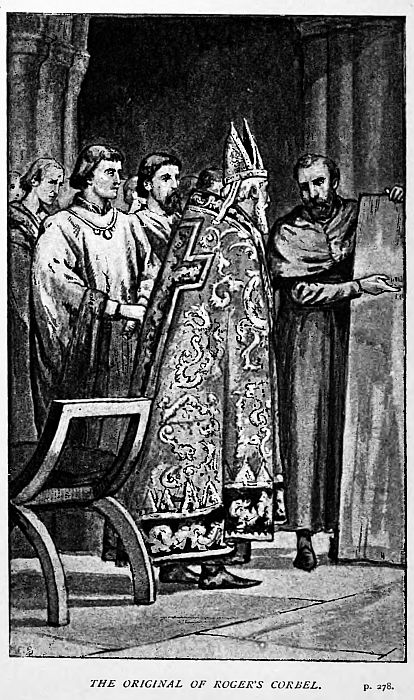
There was a close examination and comparison, at the end of which the master, after consultation with the others, raised his head.
“It is undoubtedly the same.”
“Now,” continued Hamlyn, turning the board, “there is writing here, which you and I, my masters, cannot fathom. Maybe my lord bishop will have the grace to construe it for us.”
The bishop advanced, and in a clear voice read, “Hugh Bassett, Saint George’s Day, A.D. 1303.”
“Wat, repeat thy story,” said Hamlyn quietly. “I have kept thy proof safely, though truly until this day I knew not what it was worth.”
Thus adjured Wat, though finding it hard to keep down his excitement, told what he had to tell straightforwardly and well. He related how, having his suspicions raised, he had warned Hugh to beware of Roger, and how on the day of Gervase’s illness the design had disappeared. That then it had come into his mind to advise Hugh to draw it again, to place a date upon it and give it into Mistress Prothasy’s keeping. That she had held it safely until Master John Hamlyn took it from her, and that from the day of the date Hugh had never had it in his hands nor so much as seen it.
This was all, but with the board before them, it was evidence which could hardly be strengthened, and if more were needed, Roger’s white, fear-stricken face supplied it. There was a significant silence, broken at last by the bishop’s voice.
“Where is Hugh Bassett?” he asked.
“Now, in good sooth, was ever anything so foolish as that he should have hidden himself as he hath done?” whispered the provoked Wat to his neighbour. But at that moment the circle of interested citizens opened, and Hugh, looking flushed and disturbed, came forward, while behind him were Elyas and Joan.
“Hugh Bassett,” said the bishop, pointing to the board, “is that thy work?”
“Ay, my lord,” he answered in a low voice.
Again a pause.
“Thou hast heard the relation of its keeping?”
“Nay, my lord, I have but this moment come into the church.”
“Let us hear what thou hast to say.”
Hugh told his story, which agreed in every respect with that already related. While it was telling the miserable Roger tried to slip away, but at a sign from Hamlyn two members of the guild silently placed themselves on either side. Then Elyas stepped forward.
“I speak with pain, my lord,” he said, “for Roger Brewer is my journeyman and hath been my apprentice, but to keep silence were to sin against this holy place. My sickness hath made me oblivious, but the ivy is strangely familiar to me, and I mind me that Hugh ever brought his designs to show me, while Roger had no such habit. Moreover, although you have refused to listen to what I said as to the corbel carved by Hugh Bassett, I would urge upon you to consider it viewed in the light of what has now passed.”
He was listened to in absolute silence, and presently bishop, chapter, and judges retired to consult, while the others waited, and Elyas, whose kind heart was deeply grieved for Roger, drew off and knelt in prayer.
The consultation was not long, the judges came back, and once again the old master delivered their judgment.
“It having been proved that Hugh Bassett rather than Roger Brewer designed the ivy corbel, it is declared that his work standeth first in merit, and he is granted the carving of another corbel, and the choice of pillar.”
Had it not been church Wat would have leapt high in the air.
No more was said, for it was not the fitting place in which to deal with Roger’s misdoing, which would be the work of the guild, but he was removed by the two men who had him in charge, and those who were left pressed round Hugh to seize his hand. He had known nothing of the first acts of the drama, but his day in the quiet woods was no ill preparation for this moment of success. Elyas came up and laid a broad hand on his shoulder, and Joan slipped hers into Hugh’s.
“Come home and tell mother,” she whispered.
But when they at length got outside the Cathedral door a strange and unexpected sight met them, for Wat, who was a great favourite with the apprentices, had rushed out, and in an incredibly short time had gathered a large number together, and marshalled them at the door to greet Hugh when he came. There was no need to bid them cheer; the tidings that one of their number had gained so great an honour raised them to wild enthusiasm, and made them forget their usual rivalries; they pressed round the Cathedral door, and when he came out, literally flung themselves upon him, shouting at the top of their voices, and waving sticks or anything which came to hand; finally, in spite of all he could do, seizing and bearing him off in their arms, carrying him in triumph through Broad Gate out into the High Street, and joined by fresh boys at every turn of the road. Citizens ran out on hearing the tumult, the watchmen caught up their staves and hurried forth, the Pomeroy and Ralegh retainers cheered them on, all the windows and balconies were quickly filled with women who laughed and waved their hands, and the mayor himself, so far from showing any anger, stood in a balcony and flung down largesse upon the shouting lads. Nothing would suffice, but to carry Hugh all down the steep street to Exe bridge, where, near seven years before, he had come in under such different circumstances, and, hot and shamefaced as he was, he could not but think of this, and scarce knew where he was for the thinking.
Hot he might be, but there was no persuading them, to put him down, and up the street they went again, cheering still, and between the old houses, until they stopped at Gervase’s door, where Elyas himself stood with Prothasy, and Joan clapping her hands with all her might. And there was more shouting and rejoicing when Elyas bid all the prentices to a feast in the meadows on St. Bartholomew’s Day, his own house not having space for such a number.
They separated at last, and reluctantly, after such a shrill burst of cheering as rang through the old city, and Hugh, who felt as if it were all some strange exciting dream, was thankful to find himself alone with those good friends to whom he owed his present fortune. Elyas put his hands on his shoulders, and looked into the clear eyes, now on a level with his own.
“Thy father could not have been more glad than I,” he said simply.
“I would I could thank thee, goodman,” said Hugh, in an unsteady voice, “for all comes from thee.”
“Nay, neither me nor thee, but from One Who gave the gift. And thou—thou hast kept covenant.”
“I looked not for anything like this.”
“Doubtless it hath been a little upsetting,” said Elyas, with a smile, “but it hath made Wat as happy as a king. Never was a more faithful friend, or that had less thought for himself. I verily believe he never cared for his own work; he did his best simply, and there left it. ’Tis a rare nature. Alack, alack, I would poor Roger had been as free from self-seeking!”
“Goodman,” said Hugh, hesitatingly, “hast thou heard aught of Roger?”
“I went to the Guildhall from the Cathedral and saw him. I might have been a stranger and an enemy,” Elyas added, sighing, “for all I could get from him.”
“Might I speak for him? Would they hearken? I love him not, in good sooth,” said Hugh frankly, “and I know not what I might have felt if he had succeeded; but ’tis easy to forgive when he hath done no one harm but himself. Maybe, sir, he might do better if he had another chance?”
“That may not be here,” said the warden, gravely. “Some were for flinging him into gaol, but they hearkened to me so far that he will be but heavily fined, and sent from the city, never to return. Speak not of him. I would rather not grieve on this day. But first, before I hand thee over to Joan, who doth not yet feel she hath had her share, first tell me which corbel thou wilt choose? I counsel the one opposite to that thou hast finished. There is no fairer position for showing the beauty of thy work.”
But Hugh shook his head.
“Nay, I have set my heart upon another.”
“And which is that?”
“It is the first which was allotted to me, that on the left as you enter the choir, where the rood-screen is to stand.”
“That!” said Gervase, disappointed. “Bethink thee, Hugh, it is not so well seen as any of the others.”
“Thou hast ever taught us, goodman, that we should give as good work to the parts which are not seen as to the rest,” said Hugh, mischievously. “But, in truth, I have thought so much of that corbel, and let my fancies play about it so long, that it seems more mine own than any. Let me have it.”
“Nay, thou must choose for thyself, for none of us can gainsay thee.”
“And the other should be kept for thee. I know the guild would have thy work before any man’s.”
Gervase’s eyes brightened.
“With our Lady and the Blessed Babe—I know not, I know not, I would liefer have it in thy hands.”
“I hold to my own.”
“Father, father,” cried Joan, running in, “mother bids me ask whether thou hast told Nicholas Harding to come and help her with the tables? And she saith Hal will drive her demented unless thou find some errand for him to do.”
Such a feast as Prothasy had prepared! And to it came John Hamlyn, his wife, and daughter, and Wat, contriving to sit next to Mistress Margaret, was able to tell her the whole tale, which seemed to her most marvellously interesting. Also she questioned him much about his own corbel, and was amazed to think that it should have been a neighbour’s dog which he had set up, and would fain see for herself the unconscious Spot who had been thus immortalised. And afterwards she spoke very prettily to Wat’s mother, who had come in from her farm, a proud woman to think what her son had done, and gazing at him as if no mother had ever another such.
But the happiest perhaps was Joan. With Agrippa in her arms, she sat next to Hugh, and could whisper to him from time to time, and listen to what was said, and rejoice with all her faithful little heart. Never apprentice had won such honour, and never, said Elyas strongly to John Hamlyn, could one deserve it better. And in the midst of the feast came a messenger bringing Hugh a gift from the bishop, a reliquary of goodly workmanship.
Such a day, as Joan said that evening with a sigh of happiness, had never been before!
Chapter Sixteen.
The Second Corbel.
There is little more to tell. My story is like a web of knitting, and now the point is reached where the stitches have to be cast off, and the work left. It has been no more than a tale of apprenticeship, and Hugh’s man’s life was but just beginning. Yet those years are enough to tell us what the rest was likely to be.
For months he toiled at the second corbel, and in these months passed out of his apprenticeship and became journeyman. Master Gervase was wont to say that the lad was in a fair way to be spoilt, for the story of that Lammas Day got abroad, as stories did in those days, carried back by the Pomeroy retainers to Biry, and by the Raleghs to Street Ralegh, and caught at by the wandering minstrels and story-tellers, who were the great bearers of news about the country, and ever on the watch for some gossip which they might retail at fair or castle, where it travelled from the buttery hatch to my lady’s closet, and lost naught in the telling. The town had been crowded by these strangers at the time of the corbel incident, the annual fair being held on Lammas Day, so that there was fine opportunity for spreading of news; and when the families from the great houses in the county came into the city, they must needs go to the Cathedral to see the carving which had caused so much stir, and those who had work of their own going on would have had Hugh Bassett to carry it out. But nothing would draw him from the corbel.