Front matter (continued 2)
Reading edition
"What a chamber of horrors," he thought, "and one can see he is proud of it." The carpet was soft to the foot, covered with a jungle of flowers and green leaves—the pattern of carpet which fashion leaves behind for disappointed salesmen to mark lower and lower until it shall be pushed into the ranks of shopworn bargains. The cheap paper on the wall was delicately tinted, but this boon came plainly from the designers, and not the taste of the buyer, since there was a simply terrible chair that swung by machinery, and had four brilliant hues of plush to vex the eye, besides a paroxysm of embroidery and lace to which was still attached the red ticket of the county fair. More embroidery figured on the cabinet organ and two tables, and another red ticket peeped coyly from under the ornate frame of a pastel landscape displaying every natural beauty—forest, mountain, sunlit lake, and meadow—at their bluest and greenest. There were three other pictures in the room, two very large colored photographs of a lad of twelve and of a pretty girl who might be sixteen, in a white gown with a roll of parchment in her hand tied with a blue ribbon; and the photograph of a cross of flowers.
The girl's dark, wistful, timid eyes seemed to follow the young artist as he walked about the room. They appealed to him. "Poor little girl," he thought, "to have to live here." Then he heard a dragging footfall, and there entered the mistress of the house. She was a tall woman who stooped. Her hair was gray and scanty, and so ill-arranged on the top of her head that the mournful tonsure of age showed under the false gray braid. She was thin with the gaunt thinness of years and toil, not the poetic, appealing slenderness of youth. She had attired herself for the picture in a black silken gown, sparkling with jet that tinkled as she moved; the harsh, black, bristling line at the neck defined her withered throat brutally. Yet Somer's sneer was transient. He was struck by two things—the woman was blind, and she had once worn a face like that of the pretty girl. With a sensation of pity he recalled Andrew Lang's verses; inaudibly, while she greeted him he was repeating:
"Who watches day by day The dust of time that stains her, The griefs that leave her gray, The flesh that still enchains her, Whose grace has passed away."
Her eyes were closed but she came straight toward him, holding out her hand. It was her left hand that was extended; her right closed over the top of a cane, and this added to the impression of decrepitude conveyed by her whole presence. She spoke in a gentle, monotonous, pleasant voice. "I guess this is Mr. Somers, the artist. I feel—we feel very glad to have the honor of meeting you, sir."
No one had ever felt honored to meet Somers before. He thought how much refinement and sadness were in a blind woman's face. In his most deferential manner he proffered her a chair. "I presume I am to paint you, madam?" he said.
She blushed faintly. "Ain't it rediculous?" she apologized. "But Mr. Gates will have it. He has been at me to have somebody paint a picture of me ever since I had my photograph taken. It was a big picture and most folks said it was real good, though not flattering; but he wouldn't hang it. He took it off and I don't know what he did do to it. 'I want a real artist to paint you, Mother,' he said. I guess if Kitty had lived she'd have suited him, though she was all for landscape; never did much figures. You noticed her work in this room, ain't you—on the table and chair and organ—art needlework? Kitty could do anything. She took six prizes at the county fair; two of 'em come in after she was in her last sickness. She was so pleased that she had the picture—that's the picture right above the sofy; it's a pastel—and the tidy, I mean the art needle work—put on her bed, and she looked at them the longest while. Her paw would never let the tickets be took off." She reached forth her hand to the chair near her and felt the ticket, stroking it absently, her chin quivering a little, while her lips smiled. "Mr. Gates was thinking," she said, "that maybe you'd paint a head of me—pastel like that landscape—that's why he likes pastel so. And he was thinking if—if maybe—my eyes was jest like Kitty's when we were married—if you would put in eyes, he would be awful much obliged and be willing to pay extra if necessary. Would it be hard?"
Somers dissembled a great dismay. "Certainly not," said he, rather dryly; and he was ashamed of himself at the sensitive flutter in the old features.
"Of course I know," she said, in a different tone than she had used before, "I understand how comical it must seem to a young man to have to draw an old woman's picture; but it ain't comical to my husband. He wants it very much. He's the kindest man that ever lived, to me, caring for me all the time. He's got me that organ—me that can't play a note, and never could—just because I love to hear music, and sometimes if we have an instrument, the neighbors will come in, especially Hattie Knight, who used to know Kittie, and is a splendid performer; she comes and plays and sings. It is a comfort to me. And though I guess you young folks can't understand it, it will be a comfort to him to have a picture of me. I mistrusted you'd be thinking it comical, and I hurried to come in and speak to you, lest, not meaning anything, you might, just by chance, let fall something might hurt his feelings—like you thought it queer or some sech thing. And he thinks so much of you, and having you here, that I couldn't bear there'd be any mistake."
"Surely it is the most natural thing in the world that he should want a portrait of you," Somers hastily interrupted.
"Yes, it is," she answered in her mild, even tones, "but it mightn't seem so to young folks. Young folks think they know all there is about loving. And it is very sweet and nice to enjoy things together; and you don't hardly seem to be in the world at all when you're courting, your feet and your head and your heart feel so light. But they don't know what it is to need each other? It's when folks suffer together that they find out what loving is. I never knew what I felt towards my husband till I lost my first baby; and I'd wake up in the night and there'd be no cradle there—and he'd comfort me. Do you see that picture under the photograph of the cross?"
"He's a pretty boy," said Somers.
"Yes, sir. He was drownded in the river. A lot of boys in playing, and one got too far, and Eddy, he swum out to help him. And he clumb up on Eddy and the man on shore didn't get there in time. He was a real good boy and liked to play home with me 'most as well as with the boys. Father was proud as he could be of him, though he wouldn't let on. That cross was what his schoolmates sent; and teacher she cried when she told me how hard Eddy was trying to win the prize to please his pa. Father and I went through that together. And we had to change all the things we used to talk of together, because Eddy was always in them; and we had to try not to let each other see how our hearts were breaking, and not shadder Kitty's life by letting her see how we missed him. Only once father broke down; it was when he give Kitty Eddy's colt." She stopped, for she could not go on.
"Don't—don't distress yourself," Somers begged lamely. His cheeks were very hot.
"It don't distress me," she answered, "only for the minnit; I'm always thinking of Eddy and Kitty too. Sometimes I think it was harder for father when his girl went than anything else. And then my blindness and my rheumatism come; and it seemed he was trying to make up to me for the daughter and the son I'd lost, and be all to once to me. He has been, too. And do you think that two old people that have grown old together, like us, and have been through losses like that—do you think they ain't drawed closer and kinder and tenderer to each other, like the Lord to his church? Why, I'm plain, and old and blind and crooked—but he don't know it. Now, do you understand?"
"Yes," said Somers, "I understand."
"And you'll please excuse me for speaking so free; it was only so father's feelings shouldn't get hurt by noticing maybe a look like you wanted to laugh."
"God knows I don't want to laugh," Somers burst in. "But I'm glad you spoke. It—it will be a better picture. Now may I ask you something? I want you to let me dress you—I mean put something about your neck, soft and white; and then I want to make two sketches of you—one, as Mr. Gates wishes, the head alone; the other of you sitting in the rustic chair outside."
"But—" she looked troubled—"it will be so expensive; and I know it will be foolish. If you'd just the same——"
"But I shouldn't; I want to do it. And it will not cost you anything. A hundred dollars will repay me well enough. I wish—I truly wish I could afford to do it all for nothing."
She gasped. "A hundred dollars! Oh, it ain't right. That was why he wouldn't buy the new buggy. And jest for a picture of me." But suddenly she flushed like a girl and smiled.
At this instant the old man, immaculate in his heavy black suit and glossy white shirt, appeared in the doorway bearing a tray.
"Father," said the old wife, "do you mean to tell me you are going to pay a hundred dollars jest for a picture of me?"
"Well, Mother, you know there's no fool like an old fool," he replied, jocosely; but when the old wife turned her sightless face toward the old husband's voice and he looked at her, Somers bowed his head.
He spent the afternoon over his sketches. Riding away in the twilight, he knew he had done better work than he had ever done before in his life, slight as its form might be; nevertheless he was not thinking of himself at all. He was trying to shape his own vague perception that the show of dainty thinking and the pomp of refinement are in truth amiable and lovely things, yet are they no more than the husks of life; not only under them, but under ungracious and sordid conditions, may be the human semblance of that "beauty most ancient, beauty most new," that the old saint found too late. He felt the elusive presence of something in love higher than his youthful dream; stronger than passion, fairer than delight. To this commonplace man and woman had come the deepest gift of life.
"A dream?" he murmured. "Yes, perhaps he has captured it."
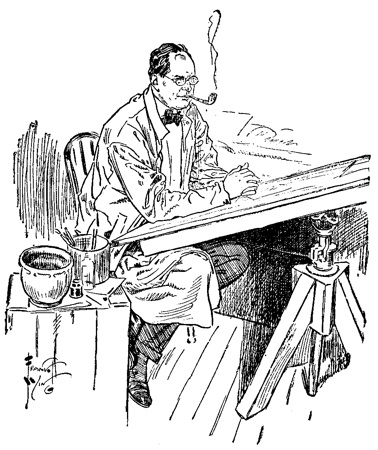
"Ding" by Wing
Truth
By Carrie Moss Hawley
The archives of history contain wonderful revelations of the growth and physical development of man. Going back to the beginning of time, when creation donned its immortal robe of life and nature gave utterance to the thought that nothing perishes, we follow down the aisle of centuries until we find ourselves to-day where we realize that thought has become the most powerful factor in advancement. Gradations are everywhere, yet mental processes and volitions take control of the wheel of progress and guide everything with majestic power.
The mind, as we commonly think of it, is not a safe guide unless directed by wisdom. So we appeal for light to give direction to the ideas or conceptions that filter through the brain from the all-holding universal thought. How to distinguish true from false conceptions is the labor of philosophy.
Truth may be tested by one infallible rule: its power to construct. You may see it forming what may terminate in evil, and doing unmistakable harm. Then you say: How can this be truth if it creates disaster? But all that is created does not act one way. There is the gross and the refined, the blemished and the perfect. All is good in the sense that it comes from a perfect law. It is the direction creation takes that determines the outcome.
The next step is how to direct truth that it may produce only the end desired. There are millions of beings on this sphere, each of whom has the same access to truth. Many of these do not even know of their power in production, and, with sensualized vision which has not been renovated, they keep on bringing forth that which another class, further advanced, is endeavoring to exterminate. This will continue indefinitely, for there will always be growing souls that have to learn. Since what appears as evil must exist, when it has become abhorrent to you in all its forms, your privilege and power is to convert all that comes within your radius into what you desire it to be. Minimize your fear of all effects in the negative, and take firm hold of the actual forces and mold them into whatever you desire.
Were you a sculptor and had a piece of marble before you, you would not feel obliged to chisel out of it a cat, because a cat chanced to be rubbing her head against your leg in a friendly way. While you would be conscious of the cat she would be something outside the realm of your perceptions when you struck your first blow upon the marble. You would build from your perceptions that have been brought to the foreground by your conceptions of the valuable.
Man must reach a certain plane in his development before he realizes there are things worthless and things of worth, and that he may possess which he will. But when the moral milestone is passed he sees the dawn of a new day that will bring him his hopes realized.
Thus, the way to attain truth is first to see it from the vantage-point that comes through illumination; then realize that the cosmic world possesses all the material you need for its development. What surrounds you that does not appeal to you, merely touches and draws attention to its existence, need come into your creation no more than the cat came into the artist's production.
Work
By Irving N. Brant
Let me once more in Druid forest wander, To gain its legacy of ancient lore; Make me its prophet, as I dreamed of yore, A priest, on holy mysteries to ponder. Lead me to realms of quiet, or the fonder Scenes of the rising sea's unruly roar. Or turn my gaze upon the vistaed floor Of quiet valleys, and the blue haze yonder On the opposing hills. Let me traverse The shadows of man's immemorial mind, The haunt of fear, joy, sorrow and despair, God-given wonder and the primal curse. Within the throbbing heart of humankind Give me my work, or let me perish there.
Some Magic and a Moral
By Virginia H. Reichard
Along in the early nineties as I was traveling in the West, selling shoes, I left the train at the little junction of Skywaw and surveyed the town. I found that the proverbial hotel, blacksmith shop, general store and a handful of houses, beside the depot, comprised the town.
After supper at the hotel, where I was waited upon by the landlord's pretty daughter, I asked about the storekeeper across the way and found to my surprise that he carried about a ten or twelve thousand dollar general stock which included everything from a sheepskin to a paper of needles. The farming country being so good, it was no wonder that this man did almost as big a business as many others in much larger towns, so the daughter told me, while the landlord himself chipped in with a question: "Why, don't you know this is just the richest spot in Wahoo County? In fact the ground is too rich. Just think of it—too rich to grow pumpkins."
"Why," I asked, "can't you grow pumpkins?"
With a smile of confidence that his joke was entirely new he replied: "The vines grow so fast it drags them over the ground and wears them out. Go up and see the storekeeper and if you sell him you get your money for the goods sure thing, for he sells for cash only."
I picked up my grips and started to see my man at once; found him standing in the door chewing a quid and spitting out into the street at any stray chicken or dog that chanced to wander by. As he stood there indifferent, expressionless, he looked the typical Westerner, with an air of "do as you darn please" about him; pants tucked into a pair of boots that were run over and worn off at the toe in a peculiar way that would indicate to a shoeologist that he was a sharp, keen trader, very suspicious of strangers, hard to strike a trade with unless he could see a hundred per cent in it for himself. In early days he had been a horse trader and a dealer in buffalo hides, and had never seen the time when he couldn't tell what o'clock it was better by the sun than by a watch; a hard man to approach on the shoe subject as his mind didn't seem to hover around shoes.
There must have been a depression in his skull where his bump of order was supposed to be, as from the general appearance it looked as if the devil had held an auction there the day before. I began my little "spiel" by telling my business—who I was, where I was from—and asked if my conversation would interest him at all if I talked about shoes for awhile, remarking incidentally: "You'll have some business now sure. Trade will get good right away, as I never opened up my samples in a man's store in my life but what customers came dropping in."
"Well, then, for God's sake open them up. I need the business all right enough," quoth he.
Then strange to say, as if to cinch what I had said, up rode six country boys on horseback, and in a minute the big strapping fellows came tramping in. You know the kind that work on a farm all day, ride to town to buy one pound of sugar for family use and ten pounds of chewing tobacco for their own use, and other articles in like proportion while they are having a good time.
Taking seats on the counter opposite, they began a lot of loud talking.
One picked up a turnip and began peeling it, poising it on the tip of his knife-blade, taking large bites, and never for a minute losing sight of what we were doing in the shoe line.
It took a lot of persuading to get the proprietor to look at my samples, but I soon noticed the shrewd gleam of his eyes that told that he had had hold of good leather before and was a much better judge of my line than I expected to find in such a place. But talk about exhorting! How I worked with that fellow. And after keeping it up for two whole hours—from seven until nine, I finally landed him, selling him a little over five hundred dollars' worth of shoes. As I was getting a straight eight per cent commission at that time, the sale made me a little over forty dollars for two hours' work, and I was feeling mighty good. Even my cold-blooded customer had warmed up some from the effects of the deal on which he saw he was bound to make a good thing.
While I was packing up my samples he said, sort of edging around: "Say, can't you sing us a song or dance us a jig or do something to entertain us all? You travelin' fellers allus know somethin' new, and are up to whatever is goin' on over the country, ain't ye?"
I replied: "I can't sing; I am out of voice; but if you can furnish the music I can dance a jig or clog. Oh, by the way, did you ever see any sleight of hand or legerdemain tricks?"
None of them ever had; didn't even know what they were, and solemnly assured me they were something new in that burg.
As I had been practicing coin tricks and other feats of sleight of hand for the last ten years and could do many of the former, making the coins appear and disappear at will in a mysterious manner, I decided to try this form of amusement, thinking I had an easy bunch to work on. So I showed them a silver dollar, giving it to one of them to examine, passing it on to each one of them in succession, just to show them that it was a genuine, everyday piece. Then taking it in my hand, I proceeded to manipulate the coin by picking it out from underneath one fellow's foot as he sat on the counter dangling his long legs; taking it from another fellow's chin; picking it out from the pocket of the jumper one of them had on; finding it in the next man's ear; and finally, coming to the proprietor, I told him to hold his thumb and finger together, pointing up; then took the coin from between his own thumb and finger without his realizing how it got there or how it got away. I caught his startled look—the fellows jumped down off the counter and crowded close together—wonder and amazement written all over them. This was the first time in their lives they had ever seen a sleight of hand trick, where the motion of the hand is so quick the sight cannot follow it.
But presto, chango, begono, magico, came near being too much for them. They were absolutely horror stricken. Some of them were unable to speak; some were afraid to; others couldn't speak above a whisper; and one of these desired to know when I would be back in that country again. He wanted Brother Bill to see it; in fact he would like to bring the whole family in.
The proprietor's face was a study. Doubt, surprise and suspicion passed over his face in succession, but gave way to fresh curiosity when I asked him to bring me two hats and I would do Hermann's parlor trick with two hats and four balls. The method of doing this is to place the four balls in a square about three feet apart on a counter or a table, then place the hats over two of the balls; the object being to find all four balls under one hat, without, of course, anybody seeing how they got there. This I accomplished successfully, and this performance seemed to bring them close to the limit. They had been craning their necks to see, but when it was over they all straightened up, took a step backward in line and looked at one another. Then one of them said solemnly:
"Folks is gettin' geniuser and geniuser every day, boys. Ain't it so?" And Pete nudged Jim to make sure it was no dream, then spat excitedly on the rusty stove.
The proprietor had been eyeing me with suspicion for a good while. I noticed whenever I would pass in front of him he would step back and plant his hands tight on his pockets where he kept his money, as if he thought I might somehow coax it to jump out unless he held it in by main force. Legerdemain had scared him some and made him both suspicious and wary.
Pretty soon I began to realize I had done a little too much; in fact, I had given them a little more than they had been able to digest. But like many another fool who has overstepped, I tried to make up by giving them something in another line.
The proprietor looked up with a distrustful glance. "Is that all you can do?"
"That's all in the trick line, gentlemen. But I have something that I can do that is out of the line of tricks. It's a gift—mind-reading. Only about one in six millions has it. I do the same as Brown, Johnson or Bishop—those big guns you have heard about—in finding any given object. And if you, sir (to the proprietor), will place your mind on any one of the ten thousand articles in this store, concentrating your mind on it, I will get the object you are thinking about and hand it to you."
"You can't do that; it ain't possible," he said.
One of the boys spoke up: "Aw, let him try, Dan. Gosh! Let him try."
After looking around the store and meditating a little he said: "Durn it all, then, go ahead. I've picked out the thing I want you to get and by jigger I'll keep my mind on it all right."
Taking his hand, placing it upon my forehead, and holding it there with one of mine, I started down the store, the other six rubbering after us with all their might. After going about thirty feet with an occasional kick or bump at a basket or barrel that happened to be in the way, I turned to the left; stopping at the show-case, and sliding back the doors, I reached in, picked up a razor—his own razor—that lay in the case and handed it to him.
"Great Scott," he yelled. "The very razor I shave myself with—when I shave; and that's the very thing I had my mind on too, by thunder." The sweat stood out in great drops on his forehead and for a few minutes his emotion seemed to be too much for him. So I said:
"Well, boys, this concludes the evening's performance; meeting's out, boys."
Dazed with wonder, the six riders looked blankly at each other, turned to me grinning foolishly, then filed out, jumped on their horses and galloped away, whooping like Comanche Indians.
Bidding the proprietor good night I started for the door.
"Hold on a minute!" he cried. "I want to see you, young feller." He strode up to within about two feet of me, hands thrust deep in his pockets, looking as if he would like to fight. Then he burst out with:
"Say, you're about the slickest thing I ever saw in my life, ain't you? You're durned slick. You're smooth—a little too smooth; and you hear me, you needn't send them goods I bought to-night. I won't take 'em."
"What!" I cried.
"You hear me; you needn't send 'em. I won't take the goods," he said in a tone there was no mistaking.
I commenced to argue. But no. "You've done killed yourself with me," was all I could get out of him, and nothing I could say or do would make any difference. But I was bound not to lose the forty dollars without a struggle and brought all the arts, arguments and persuasions to bear that I could think of; but without avail. He seemed to be convinced that if I wasn't the devil himself, at least I was a near relation, and he would have none of me.
Then I did what I never had done before: took the dollar and carefully showed him just how I had done the trick, explaining that sight was really slower than motion sometimes and that the whole thing was intended to be harmless and amusing.
"If that's the way you did with the money, how about the four-ball trick?" he asked gruffly.
Still bent upon making the proposition stick, I explained the ball trick too, by going over it and explaining how the eye could be deceived. You see, I was growing more and more anxious all the time to cinch my commission, and felt that my efforts were worth while. When suddenly, dubious and still unconvinced, he turned to me and asked:
"Well, how in time did you find the razor?"
"I was very particular to tell you," I said, "before I went after that razor that it wasn't a trick. It's a gift I can't explain; nobody can; nobody ever did. I can't do it; I don't know how or why. Some call it mind-reading and some people have been kept guessing to give it a name. I am one of the few who can do it, that's all. When I went after the article you had in mind, I didn't know it was a razor; I didn't know what it was; but when I came in contact with what you had in mind I picked it up and handed it to you. This is my explanation—the only one I can give. I call it 'mind-reading,' that's all."
After some more talk I left him mystified and distrustful, in spite of all I had said and done, still refusing to reinstate the order. I left my grips in the store as it was near the station, and went to the hotel to spend a restless night, kicking myself for a fool meanwhile, since my attempts to amuse had lost me the neat little sum of forty dollars.
I slept a couple of hours when I was awakened by the most horrible noise it was ever my fortune to hear: Two car-loads of calves, just a day away from their mothers, were being shipped and their bawling was intolerable. Talk about your quiet country towns for rest and sleep! No more for me that night, I thought. So I dressed, took a smoke, and decided to tackle my man again in the morning and to try to change his mind.
A little after daylight I saw him sweeping the sidewalk in front of the door, handling the broom as a man does a flail on the barn floor. I went over and said: "Good morning." As he looked up I saw that his glance was as surly and suspicious as it had been the night before, but thought I would make a good start by approaching him upon some of his hobbies the landlord had told me about. In his capacity as horse trader he prided himself on his ability to judge a good horse. So I opened up by telling him about a horse I owned, and asked if he had anything to trade for him. This seemed to bring the right twinkle into his eye, and he began to brace up and take notice a little. So I talked on until I saw the smoke of the approaching train away down the valley seven or eight miles along the old Kantopey trail. Then I made a last attempt.
"Now see here, Mister," I said, "I came into your store last night and showed you my samples, showed you the names of some of the best merchants who have bought big bills of me and I sold you a bill of goods in good faith. Then you proposed that I entertain you as you had very little amusement in a place like this. I told you I couldn't sing but would do what I could with such sleight of hand tricks as I knew, and I did exactly what I said I would. It seemed to meet with plenty of approval all around until the mind-reading came up, when you turned me down for no reason whatever. Now, I ask you a question: Is that a square deal to a man on a business proposition?"
He looked at the floor and was silent, though apparently a little uneasy. He shook his head doubtfully, which made me feel that he was perhaps not so unfriendly after all, and might possibly do the right thing yet. Hearing the distant whistle, I said:
"Train's coming; have to go. Wish you good luck, just the same as if you'd treated me square. Wish you good crops and plenty of water for your stock. As long as you live don't turn another fellow down like you have me, just because he's done his best to give you a good time." And I made a rush for the depot to check my baggage.
The train came in; there was the usual hurry and noise. The old fellow stood there, leaning against the weather-boarding of the depot like a picture of Uncle Sam—a queer, awkward figure with his hay-colored whiskers, pipe in the corner of his mouth, and hands still planted firmly in his pockets, his eyes riveted on every move I made.
I boarded the train, said "Howdy" to a friend, and looking back saw old Dan standing where I had left him as if glued to the spot. The engine puffed and snorted; the wheels began to go around. "Good-bye," I shouted from the platform as if answering his steady gaze.
All of a sudden the long, gaunt figure limbered up, like a corpse that had been touched by a galvanic battery. He came chasing down the track after the train, waving his arms like a windmill and yelling like Bedlam let loose: "Hey! Say there, you young feller; hey there! I'll take them goods; send 'em along. I'll take them goods. D'ye hear?"
And I called back to him with great gusto: "All right," as the train rounded a curve.
Moral: When you have sold your goods make your get-away.
Sonny's Wish
By Bertha M. H. Shambaugh
Sometimes before I go to bed I 'member things that Grandpa said When I sat close beside his knee And Grandpa laid his hand on me. I 'member how he'd smile and say, "Well, what did Sonny do to-day?" 'Cause Grandpa always liked to know (I s'pose that's why I miss him so). I never had to coax and plead For things I really didn't need: I'd 'splain it in an off-hand way And Grandpa brought it home next day. When I grow up I'd like to be A grandpa with a boy like me To live with and to bring things to: That's what I'd like the most to do. I'd rummage 'round and hunt about For things the boy could do without, Because you see of course I'd know That's why the boy would like them so. And when I'd bring some brand new toy And someone said, "You'll spoil that boy!" I'd only shake my head and say, "A good boy isn't spoiled that way." When Sonny said he'd like to get A nice wee doggie for a pet, And when the grown-ups one and all Said, "Oh, no, Son! You're much too small," I'd whisper, "Come, don't look so blue 'Cause Grandpa bought a dog for you, A birthday present! Schh! Don't cry! He's black and just about so high." Oh, yes! I'm sure I'd like to be A grandpa with a boy like me To live with and to bring things to: That's what I'd like the most to do.
Dog
By Edwin L. Sabin
The dog we have always with us; if not active in the garden or passive on the best bed, then gracing or disgracing himself in other domestic capacities. For the dog is a curious combination, wherein heredity constantly opposes culture; and therefore though your dog be a woolly dog or a smooth dog, a large dog or a small dog, a house-dog, yard-dog, hunting-dog or farm-dog, he will be ever a delight and a scandal according as he reveals the complexities of his character. Just as soon as you have decided that he is almost human, he will straightway unmistakably indicate that he is still very much dog.
As example, select, if you please, the most pampered and carefully nurtured dog in dog tribe: some lady's dog—beribboned King Charles, bejeweled poodle, befatted pug—and give him the luxury of a half-hour in the nearest genuine alley. Do you think that he turns up his delicate nose at the luscious smells there encountered? Do you think that because of his repeated scented baths he sedulously keeps to the middle of the narrow way? Do you venture to assert that he whose jaded palate has recently declined the breast of chicken is now nauseated by the prodigal waste encountered amidst the garbage cans?
Fie on him, the ingrate! Why, the little rascal fairly revels in the riot of débris, and ten to one he will even proudly return lugging the most unsavoury of bones filched from a particularly odorous repository! His lapse into atavism has been prompt and certain. I agree with Robert Louis Stevenson that every dog is a vagabond at heart; in adapting himself to the companionship of man and woman, and the comforts of board and lodging, he leads a double life.
In this respect the dog is far more servile than the cat, his contemporary. Generations of attempted coercion have little influenced the cat. She (it seems a proper distinction to speak of the cat as "she") steadfastly maintains the distance that shall divide cat life from man life. Without duress, and in spite of duress, she accepts the material favors of civilization and domesticity only to an extent that will not inconvenience her; she has no notion of responsibilities or indebtedness. Having achieved her demands for a warm nap or a full stomach, she then makes no false motions in following her own inclinations entirely. But the dog, occupying a limbo between his natural instincts and his acquired conscience, must always be a master of duplicity.
The dog (as again points out the admirable Stevenson) has become an accomplished actor. Observe his ceremonious approach to other dogs. Mark the mutual dignity, the stiff-leggedness, the self-conscious strut, the rivalrous emulation, all of which plainly says: "I am Mister So-and-So; who in the deuce are you?" No dog so small, and only a few faint-hearts so squalid, that they do not carry a chip on their shoulder. Compare with their progenitors, the wolves in a city park. Here encounters are quick and decisive. The one wolf stands, the other cringes. Rank and character are recognized at once. The pretences of human society have not perverted wolf ethics.
Take a dog at his tricks: not the game of seeking and fetching, which he enjoys when in good humor, but parlor tricks. He has learned through fear of punishment and hope of reward. Having performed, either sheepishly or promptly, with what wrigglings and prancings and waggings, or else with what proud self-appreciation does he court approval. He knows very well that he is assuming not to be a dog, and trusts that you will admit he is smarter than mere dog. On the contrary, the cat tribe, jumping through a hoop, does it with a negligent, spontaneous grace that makes the act a condescension. The cat does not aspire to be human; she is fully content with being cat.
Elevate a dog to a seat in an automobile (any automobile), or even to the box of a rattle-trap farm-wagon. How it affects him, this promotion from walking to riding! It metamorphoses the meekest, humblest of so-called curs into a grandee aristocrat, who by supercilious look and offensive words insults every other dog that he passes. He calls upon the world about to witness that he is of man-kind, not of dog-kind. A dog riding abroad is to me the epitome of satisfied assumption.
It would be interesting to know how much, if any, the dog's brain has been increased by constant efforts to be humanized. The Boston bull is, I should judge, (and of course!) faster in his intellectual activities than is the ordinary English bull. And then I might refer to the truly marvelous feats of the sheep-dog, who will, when told, cut out any one sheep in a thousand; and I might refer to the finely bred setter, or pointer, and his almost human field work; and I can refer to my own dog, whose smartness, both natural and acquired, generally is extraordinary—although at times woefully askew, as when he buries pancakes in the fall expecting, if we may believe that he expects, to dig them up during the winter.
And there are dogs with great souls and dogs with small souls. We are told of dogs noble enough to sit by and let a needy dog gobble the meal from the platter—but I suspect that such dogs are complacent because comfortably fixed. We hear of dogs making valiant defenses of life and property—which perhaps is the development of the animal instinct to guard anything which the animal considers its own. And dogs sometimes effect heroic rescues, by orders or voluntarily—although one may query whether they consider all the consequences.
The dog's brain must be an oddly struggling mass of fact and fancy. We have done our best for him, and as a rule he creditably responds. I love my dog; he appears to love me; and by efforts of me and mine he has been humanized into a very adaptable personage. But I am certain that first principles remain the same with him as when he was a wolf-dog of cave age. He might grab me by the collar and swim ashore with me, but if on the desert island there was only one piece of meat between us and starvation, and he had it, I'd hate to have to risk getting my share without fighting for it.
The Unredeemed
The Ballad of the Lusitania Babes
By Emerson Hough
THE HOLY THREE BEHOLD God the Father leaned out from Heaven, His white beard swept His knee; His eye was sad as He looked far out, Full on the face of the sea. Saith God the Father, "In My Kingdom Never was thing like this; For yonder are sinless unredeemed, And they may not enter Our bliss." And Mary the Mother, She stood near by, Her eyes full sad and grieved. Saith Mary the Mother, "Alas! Alas! That they may not be received. Now never since Heaven began," saith She, "Hath sight like this meseemed, That there be sinless dead below Who may not be redeemed!" And Jesu, the Saviour, He stood also, And aye! His eyes were wet. Saith Jesu the Saviour, "Since Time began, Never was this thing yet! For these be the Children, the Little Ones, Afloat on the icy sea. They are doomed, they are dead, they are perished, And they may not come unto Me!"
THE CHILDREN CRY OUT They float, forever unburied, Their faces turned to the sky; With their little hands uplifted, And their lips forever cry: "Oh, we are the helpless murdered ones, Blown far on the icy tide! No sin was ours, but through all the days, On the northern seas we ride. No cerements ever enshroud us, We know no roof of the sod; We float forever unburied, With our faces turned to God. "So foul the deed that undid us, So damned in its dull disgrace, That even the sea refused us, And would not give us place. Nor ever a place in the sky— We are lost, we are dead, we are perished, Ah, Jesu, tell us why!" * * * * * Now the Three who heard They wept as one, But Their tears they might not cease. Saith God the Father, "While unavenged These may not know Our peace! When the sons of men are men again, And have smitten full with the sword, At last these sinless but unredeemed Shall enter unto their Lord. "But deed like this is a common debt; It lies on the earth-race whole. Till these be avenged they be unredeemed— Each piteous infant soul. We must weep, We must weep, till the debt be paid, Te debt of the sons of men— But well avenged, they are aye redeemed; Ah, how shall We welcome them then!"
THE SONS OF MEN HEARKEN Are ye worth the kiss of a woman? Were ye worth the roof of a womb? Are ye worth the price of your grave-clothes? Are ye worth the name on a tomb? Nay! None of these is your earning, And none of these be your meed, If the deathless wail of their yearning Shall add to your pulse no speed. Never by hand of a warrior, Never by act of a man, Have the Little Ones thus perished, Since ever that Heaven began. Such deed and the beings who wrought it— Ah! deep must the cutting go To cure the world of the memory Of the Little Ones in woe. The Three watch high in Their Heaven, And aye! the Three be grieved; The sword is the key of Their Heaven, If the babes shall be received. Rise then, men of our banner— Speak in our ancient tone— Each of you for his mother, Each of you for his own! Smite full and fell and fearless, Till that these be set free— These, slain of the foulest slaying That ever made red the sea. The sword of the Great Avenger Is now for the sons of men; It must redden in errand holy Till the babes be cradled again.
Copyrighted, 1917, by Emerson Hough
Tinkling Cymbals
By Helen Sherman Griffith
It was in the spring of 1915 that Margaret Durant came back to her home in Greenfield, Iowa, from a visit to friends in the East, and brought with her a clear, shining flame of patriotism, with which she proceeded to fire the town. Margaret had always been a leader, the foremost in civic betterment, in government reform, and in the activities of her church and woman's club. She was a born orator, and loved nothing better than haranguing—and swaying—a crowd.
A fund was started for the purchase of an ambulance, which, Margaret insisted, must be driven by a Greenfield man. And she expressed sorrow on every occasion—particularly in the hearing of the mothers of young men—that she had no son to offer. The Red Cross rooms became the centre of Greenfield social activity, and the young people never dreamed of giving an entertainment for any purpose save to benefit the Red Cross, the British Relief or the Lafayette Fund. This last became presently the object of Margaret's special activities, since her husband, Paul, some four generations previously, had come of French blood. "So that it is almost like working for my own country," Margaret said proudly. And she glowed with gratification whenever the French were praised.
So complete and self-sacrificing was her enthusiasm that she announced, as the spring advanced, her intention of taking no summer vacation, but to dedicate the money thus saved to the Lafayette Fund, and to work for that organization during the entire summer.
Her friends were thrilled with admiration at Margaret's attitude, and some of them emulated her heroic example. To be sure, staying at home that summer was a popular form of self-denial, since a good many families, even in Greenfield, Iowa, were beginning to feel the pinch of war.
One summer afternoon, Margaret strolled home from an animated meeting of the Lafayette Fund, exalted and tingling with emotion. She had addressed the meeting, and her speech had been declared the epitome of all that was splendid and noble. She had moved even herself to tears by her appeal for patriotism. She entered the house, still mentally enshrouded by intoxicating murmurs of "Isn't she wonderful!" "Doesn't she make you wish you were a man, to go yourself!" and so forth.
Softly humming the Marseillaise, she mounted the steps to her own room, to remove her hat. She stopped short on the threshhold with a sudden startled cry. Her husband was there, walking up and down the room, and also humming the Marseillaise. It was half an hour before his usual home-coming time, but that was not why Margaret cried out.
Paul was dressed in khaki! He was walking up and down in front of the cheval glass, taking in the effect from different angles. He looked around foolishly when he heard his wife.
"Just trying it on," he said lightly. "How do you like me?"
"But Paul—what—what does it mean?"
"Just what you have guessed. I've signed up. I'm to drive the Greenfield ambulance," he added with justifiable pride.
Margaret stared, gasped, tottered. She would have fallen if she had not sat down suddenly. Paul stared, too, astonished.
"Why, old girl, I thought it was what you wanted! I—you said——"
"Paul, Paul! You! It can't be! Why—why, you are all I have!"
"That is one reason the more for my going—we have no son to send."
"But Paul—it—I—the war is so far away! It isn't as if—as if we were at war."
"Almost—'France is the land of my ancestors'—your very words, Margaret."
"I know, but——"
"'And the cause is so just.'"
"But, Paul, I did not mean——"
"Did not mean what!" Paul turned and faced her sternly. "Margaret, your eloquence has sent a good many young men to the front. I wonder—" He paused, and a new expression dawned in his eyes; an expression that Margaret could not bear: an accusation, a suspicion.
Margaret cowered in her chair and hid her face.
"Oh, Paul, not that, not that! Leave me a moment, please. I—I want time to—to grasp it."
When she was alone she sat upright and faced the look she had seen in Paul's eyes.
"I am a canting hypocrite. I see it now, plainly. I read it in Paul's eyes. But I will show him he's mistaken. God! is hypocrisy always so cruelly punished? Merciful God, have pity upon me!"
Rising to her feet, Margaret staggered to the door and called. The enthusiasm, the exaltation, had faded from her face, leaving it pinched and gray. But in her eyes a new expression had been born, which lent a soft radiance to her features, the light of complete self-denial. Paul entered, gave one look, then knelt at his wife's feet.
"Forgive me, my love, for misunderstanding you. The fault was mine. You've been afraid I would not make good, and were testing me. Ah, my love."
For one terrible moment Margaret hesitated. Then she whispered:
"No, Paul, you were right at first; but love has conquered. Not our love, but a greater, nobler sentiment: love of Right and Justice. Do you remember the verse: 'Though I speak with the tongues of men and of angels, and have not love, I am become as sounding brass or a tinkling cymbal.' I—I am not a tinkling cymbal, Paul. I—Oh, Paul, take me with you! I can be of some use over there. We will go together."
Paul rose and embraced her.
"My precious one! How Greenfield will honor you!"
Margaret winced and hid her face in his breast.
"No, Paul, no, no. Don't let them know! Let us go away quietly, in the night. Please, please, Paul. I—I could not bear any other way!"
Durant kissed her and said no more. And if he understood, he never let her know that he did.
The First Laugh
By Reuben F. Place
In the life of every baby there is a continuous succession of first impressions and adventures. The first tooth, the first crawl, the first step, the first word, each mark a milestone in the child's career. But more interesting than any of these is the first laugh—the first genuine, sustained, prolonged, whole-hearted laugh. If it is a tinkling, bubbling, echoing laugh, it sends its merry waves in all directions—the kind that brings smiles to sober faces.
What hope springs up in the parents' breasts at the sound of that first laugh! How thoroughly it denotes the future!
A hearty laugh or no laugh in later years may mean the difference between fame and obscurity, fortune and poverty, friends and enemies.
"How much lies in laughter: the cipher key, wherewith we decipher the whole man!" wrote Carlyle.
A good laugh is a charming, invaluable attribute. It saves the day, maintains the health, makes friends, soothes injured feelings, and saves big situations.
Laughter is a distinguishing mark between man and beast. It is the sign of character and the mirror in which is reflected disposition.
To laugh is to live.
The babe's first laugh is a precious family memory. A load of responsibility goes with it. It should be guarded and guided and cultivated until it becomes "Laughter that opens the lips and heart, that shows at the same time pearls and the soul."
The Freighter's Dream
By Ida M. Huntington
"Squeak! Squ-e-a-k! Scr-e-e-ch!" The shrill, monotonous sound rent the hot noontide air like a wail of complaint.
"Thar she goes ag'in, a-cussin' of her driver!" grumbled old Hi, as he walked at the head of his lead oxen, Poly and Bony, with Buck and Berry panting behind them. "Jest listen at her! An' 'twas only day afore yistiddy that I put in a hull half hour a-greasin of her. Wal, she'll hev to fuss till mornin'. We ain't got no time to stop a minute in this hot place. If we make the springs afore the beasteses gin out 'twill be more'n I look fer!"
Old Hi anxiously gazed ahead, trying to see through the shimmering haze of the desert the far-distant little spot of ground where bubbled up the precious spring by which they might halt for rest and refreshment. "G'lang, Poly! That's right, Bony! Keep it up, ol' fellers!" Hi strove to encourage the patient oxen as they plodded wearily along through the fearful heat and the suffocating clouds of fine alkali dust.
For weeks the long train of covered wagons had moved steadily westward over the dim trails. Starting away back in Ohio, loaded with necessities for the prospectors in the far West, they had crossed the fertile prairies, stuck in the muddy sloughs, forded the swollen rivers, rumbled over the plains and wound in and out the mountain passes. Now they were crawling over the desert, man and beast almost exhausted, even the seasoned wagons seeming to protest against the strain put upon them.
All that afternoon Hi walked with his oxen, talking and whistling, as much to keep up his own courage as to quicken their pace. For a few moments at a time they would rest, and then onward again towards the springs indicated on the map by which they traveled.
Half blind and dizzy from the dust and heat, sometimes Hi stumbled and staggered and nearly fell. He dared not turn to see how it fared with the men and teams behind him. Wrecks of wagons and bones of oxen by the side of the trail told an all-too-plain story. Some there were in every train who dropped by the way; men who raved in fever and died calling for water; faithful oxen who were shot to put them out of misery. Wagons were abandoned with their valuable freight when the teams could no longer pull them.
All afternoon they crept forward; the reiterating "Squeak! Squ-e-a-k! Scr-e-e-ch!" of the wagon sounded like a maddened human voice to poor Hi, fevered and half delirious.
At last the sun sank like a ball of fire in the haze. A cool breath of air sighed across the plain. The prairie dogs barked from their burrows. The coyotes yapped in the distance. But not yet could the long train stop, for rest without water meant death.
Far into the night the white-topped wagons crept on like specters. No sound was heard except that of the plodding feet of the oxen, the rumble of the heavy wagons and the "Squeak! Squ-e-a-k! Scr-e-e-ch!" that had troubled Hi since noon. Suddenly the oxen lifted their heads, sniffed the air eagerly, and without urging quickened their pace.
"What is it, ol' fellers?" asked Hi, as hope revived. "Is it the water ye are smellin'? Stiddy, thar! Stiddy!"
A few moments more, and Hi gave a shout of joy that was taken up and sounded down the line. "The spring! The spring!"
A halt was made. Every drop of the precious water was carefully portioned out so that each might have his share. Preparations were made for the night. The wagons were pulled up in a circle. The oxen were carefully secured that they might not wander away. Here and there a flickering little fire was seen as the scanty "grub" was cooked. After Hi had bolted his share he wrapped himself in his blanket and lay down near his wagon. The large white top loomed dimly before him in the darkness.
A little while he stretched and twisted and turned uneasily until his tired muscles relaxed. In his ears yet seemed to sound the "Squeak! Squ-e-a-k! Scr-e-e-ch!" of the complaining wagon as it had bothered him all afternoon. "Darn ye! Won't ye ever shet up?" he muttered as he drifted off to sleep.
"Won't I ever shet up? I won't till I git good and ready!" The sharp, shrill voice made Hi open his eyes with a start. Above him leaned the huge form of an old woman in a white cap drawn close about her wrinkled, seamed face, only partly distinguishable in the darkness. As he lay blinking, trying to see her more plainly, the high falsetto voice continued its plaint.
"Won't I ever shet up? A nice way thet is to talk to me, Hi Smith! Do I iver grumble and snarl when ye treat me right? Hain't I been faithful to ye through thick an' thin? Hain't I made a home fer ye all this hull endurin' trip? Hain't I looked after yer grub and yer blankets and done ever'thin' I could to make ye comfortable? Hain't I kep' the rain offen ye at night? An' thet time the Injuns was after ye, didn't I stand atween ye an' the redskins and pertect ye? Didn't I keep ye from gittin' drownded when ye crossed thet river whar the current swep' the beasteses offen their feet? Didn't I watch over ye and shield ye from the sun when ye lay sick of the fever and hadn't nary wife to look after ye? Hain't I follered after them dumb beasteses through mud and water and over gravel and through clouds of alkali dust thick enough to choke a person, and niver said a word? An' now, jest bekase I'm fair swizzled up with the heat and ye fergit to give me some grease to rub on my achin' j'ints, ye cuss me! Yis, I heerd ye! Ye needn't deny it! A-cussin' of me who has taken the place of home an' mother to ye fer years! I heerd ye! I he-e-rd ye! What d'ye mean, I say!" And the tirade ended in a perfect screech of anger.
Thoroughly aroused, Hi rolled over and jumped hastily to his feet. He looked all around. The old woman had mysteriously vanished. A coyotte sneaked past him. Day was breaking in the east. The first gleam of light fell on the white-topped wagon drawn up beside him.
He rubbed his eyes. "Wal, I swan!" he muttered, as he gazed bewilderedly at the close-drawn white top looming above him. "Glad I woke up airly! I'll hev time ter grease that thar wagon afore we start!"
A Box From Home
By Helen Cowles LeCron
I'll send to you in France, my dear, A box with treasures in it: The patch of sky that meets our hill And changes every minute, The grape-vine that you taught to grow— My pansies young with dew, The plum-tree by the kitchen door— These things I'll send to you. I'll pack with care our fragile dawn— The dawn we laughed to greet; I'll send the comfort of the grass That once caressed your feet. No yearning love of mine I'll send To tear your heart in two— Just earth-peace—home-peace—still and strong— These things I'll send to you. For you must tire of flags, and guns, And courage high, and pain, And long to rest your heart upon The common things again, And so I'll send no prayers, no tears, No longings—only dew And garden-rows, and goldenrod And country roads to you! Since life has given you to know The gentle tenderness Of growing things, I cannot think That death would give you less! Hold fast, hold fast within your heart The earth-sweet hours we knew, And keep, my dear, where'er you are These things I send to you.
The Spirit of Spring
By Laura L. Hinkley
Margaret Hazeltine sat on her porch with the spring wind blowing over her elusive wafts of fragrance—plum-blossom, apple-blossom, young grass, budding wood scents, pure, growing earth-smells.
"It is like breathing poetry," Margaret thought.
She was sewing, but now and then her hands fell in her lap while she lifted her head, catching in some wandering sweetness with a sharp breath, like a sigh.
It was four o'clock in the afternoon. Sunshine mellowed the new greenness of short, tender grass on the lawns. It shone upon all the bare, budded branches up and down the street, seeking, caressing, stimulating. It lay kindly, genially, on the mid-road dust.
Margaret's father was pottering about the garden. He was a very old man, with stooping shoulders, but tall and slender like his daughter. He came up to the porch and stood leaning on his hoe. The wind fluttered his shabby garden-coat and thin, white beard. He rested his wrinkled old hands on the top of his hoe handle, and cast up his faded, sunken eyes to the intense young blue of the sky with its fleecy clouds floating.
Mr. Hazeltine addressed his daughter in the strain of conversational piety habitual with him, and in a voice which age and earnestness made tremulous:
"Seems like every spring I get more certain of my eternal home up yonder!"
Margaret smiled acquiescently. Long since she had silently drifted outside the zone of her father's simple, rigid creed; but to-day its bald egoism did not repel her. It seemed at one with the sweet will to live all about them.
Mr. Hazeltine went back to the garden. A girl appeared on the porch of the house opposite. The Hazeltine house was small and old and not lately painted. The house opposite was large, fresh, trim, and commodious in every visible detail. White cement walks enclosed and divided its neatly kept lawns and parking. Its fruit-trees breathed out of the unfolding whiteness of their bosoms the sweetest of those perfumes that drifted across to Margaret. The girl on the porch pushed the wicker chairs about for a moment, then, disdaining them all, sat down on the cement steps and rested her chin in her palm.
After a quick look and smile Margaret sewed busily, affecting not to see the other. She felt a little sympathetic flutter of pleasure and suspense. "Jean is waiting for Frank," she said to herself.
A piano began to play in a house up the street. Through the open windows rang joyous, vibrant music. White moths fluttered across the street and the lawn and parking opposite, veering vaguely over scattered yellow dandelion heads. Around the house opposite on the cement walk strutted a very young kitten on soft paws, its short tail sticking straight up, its gray coat still rough from its mother's tongue.
"Me-ow!" said the kitten plaintively, appalled at its own daring.
Jean sprang up, laughing, snatched up the kitten and carried it back to her seat, cuddling it under her chin.
Down the street came a young girl wheeling a baby's cab. The girl was but just past childhood, and she had been a homely child. But of late she had bloomed as mysteriously and almost as quickly as the plum-trees. She wore a light summer dress with a leaf-brown design upon it, in which her girlish form still half-confessed the child. Her complexion was clear and bright, the cheeks flushed; and the strongly-marked features seemed ready to melt and fuse to a softer mould. Her brown eyes had grown wistful and winning.
As they advanced, Margaret ran down the rickety wooden walk.
"Oh, is that the new baby?" she cried delightedly. "May I look?"
The girl smiled assent.
Softly Margaret drew back the woolly carriage robe and gazed adoringly. The baby was about six weeks old. Its tiny face was translucent, pinky white, the closed eyelids with their fringe of fine lashes inconceivably delicate. Its wee hands cuddled about its head; the curled, pink fingers, each tipped with its infinitesimal, dainty nail, were perfection in miniature. The formless mouth, pinker than the rest of the face, moved in sleep, betraying the one dream the baby knew.
Margaret drew a long, still breath of rapture, hanging over the little pink pearl of humanity.
"Will he wake if I kiss him?" she pleaded.
The girl smiled doubtfully. "Maybe," she said.
She was equally indifferent to the baby and to Margaret. Her wistful eyes wandered eagerly down the street, watching each sidewalk, and the glow in her cheeks and eyes seemed to kindle and waver momently.
Margaret did not kiss the baby. She only bent her head close over his, close enough to feel his warm, quick breathing, to catch the rhythm of his palpitating little life.
When she came back to her porch, after the girl had gone on, Margaret saw that Jean's caller had come.
The young man sat beside Jean. His head was bare, his black hair brushed stiffly up from his forehead pompadour-fashion, his new spring suit palpably in its original creases. He and Jean talked eagerly, sometimes with shouts of young laughter, at which Margaret smiled sympathetically; sometimes with swift, earnest interchange; sometimes with lazy, contented intervals of silence. Occasionally he put out his hand to pat or tease the kitten which lay in Jean's lap. She defended it. Whenever their fingers chanced to touch they started consciously apart—covertly to tempt the chance again.
Two little girls came skipping down the street, their white dresses tossed about their knees. Their loose hair, of the dusky fairness of brunette children, tossed about their shoulders and an immense white ribbon bow quivered on the top of each little bare head. Their dress and their dancing run gave them the look and the wavering allure of butterflies.
They were on Jean's side of the street. They fluttered past the house unnoticed by the two on the porch, who were in the midst of an especially interesting quarrel about the kitten. The little girls passed over the crossing with traces of conscientious care for their white slippers, and came up on Margaret's side. Opposite her they paused in consultation.
"Won't you come in," she called to them, "and talk to me a minute?"
The two advanced hesitatingly and stood before her at a little distance on the young grass in attitudes clearly tentative. They were shy little misses, and had not lived long on that street.
"Someone told me," said Margaret, "that your names were Enid and Elaine. Which is which?"
The taller one pointed first to her embroidered bosom, then to her sister.
"I'm Enid; she's Elaine."
"I've read about you in a book of poetry," observed Margaret—"it must have been you! I suppose if you had a little sister her name would be Guinevere?"
The large dark eyes of the two exchanged glances of denial. The small Elaine shook her head decidedly.
"We got a little sister!" announced Enid, "but her name ain't that; it's Katherine."
They were both pretty with the adorable prettiness of small girls, half baby's beauty, and half woman's. But Enid's good looks would always depend more or less upon happy accident—her time of life, her flow of spirits, her fortune in costume. Her face was rather long, with chin and forehead a trifle too pronounced. But the little Elaine was nature's darling. Her softly rounded person and countenance were instinct with charm. Even her little brown hands had delicacy and character. Her white-stockinged legs, from the fine ankles to the rounded knees at her skirt's edge, were turned to a sculptor's desire. Beside them, Enid's merely serviceable legs looked like sticks. The white bows in their hair shared the ensemble effect of each: Enid's perched precisely in the middle, its loops and ends vibrantly and decisively erect; Elaine's drooped a little at one side, its crispness at once confessing and defying evanescence and fragility.
Margaret thrilled with the child's loveliness, but for some subtle reason she smiled chiefly on Enid.
That little lady concluded she must be a person worthy of confidence.
"My doll's name is Clara," she imparted. "An' hers is Isabel, only she calls it 'Ithabel'!"
The color deepened in Elaine's dainty cheek. She was stung to protest; which she did with all the grace in the world, hanging her head at one side and speaking low.
"I don't either!" she murmured. "I thay Ithabel!"
"Either way is very nice," Margaret hastened to say.
"We've been to Miss Eaton's Sunday school children's party," Enid informed her. "These are our best dresses, and our white kid slippers. Don't you think they're pretty? Mine tie with ribbons, but hers only button like a baby's."
Elaine looked down grievingly at the offensively infantile slippers, turning her exquisite little foot.
"I'm going to speak a piece for Easter," Enid pursued, "all alone by myself; and she's going to speak one in concert with a class."
"Oh, I hope you will come and speak them for me some time," Margaret invited; "and bring Clara and Isabel."
"Maybe we will," answered Enid. "We must go now. Come on, Elaine."
Margaret watched them until they stopped beside a flowerbed along the sidewalk where the first tulips of the season were unfolding. Elaine bent over to examine them. Margaret reproached herself that, though Elaine had spoken but once, it was her image that lingered uppermost. Why should she add even the weight of her preference to that child in whose favor the dice were already so heavily loaded? For in Margaret's eyes, beauty was always the chief gift of the gods.
As she resumed her sewing, a sudden, fantastic fear shot across her thoughts—the fear that Elaine would die. She recognized it, in a moment, for the heart's old, sad prevision of impermanence in beauty, its rooted unbelief in fortune's constancy.
A quick glance up the street showed Elaine still stooping over the tulip bed, her stiff little skirts sticking out straight behind her. The grotesqueness was somehow reassuring. Margaret smiled, half at the absurd little figure, half at her own absurdly tragic fancy.
On the other porch Frank was taking his leave—a process of some duration. First he stood on the lower steps talking at length with Jean who stood on the top step. Then he raised his cap and started away, only to remember something before he reached the corner and to run back across the lawn. There he stood talking while Jean sat on the porch railing, suggesting a faint Romeo and Juliet effect. The next time, Jean called him back. They met halfway down the cement walk and conversed earnestly and lengthily.
With an exquisite sympathy Margaret watched these maneuvers from under discreet eyelids. She was glad for them both, with a clear-souled, generous joy. And yet she felt a sensitive pleasure that walked on the edge of pain. In the young man especially she took a quick delight—in his supple length of limb, the spread of his shoulders, his close-cropped black hair, his new clothes, the way he thrust his hands deep in his trousers' pockets while he swung on the balls of his feet, the attentive bend of his head toward Jean; she reveled in all his elastic, masculine youth which she knew for the garb of a straight, strong, kindly, honorable soul. But out of the revel grew a trouble, as if some strange spirit prisoned in her own struggled to tear itself free, to fling itself, wailing, in the dust.
"Egotism!" said Margaret to herself, curling her lip, sewing very fast. The fluttering spirit lay tombed and still.
When Frank was finally gone, Jean sauntered across the street to Margaret's porch. She perched on the rail and pulled at the leafless vine-stems beside her, talking idly and desultorily of things she was not interested in.
She was an attractive girl, more wholesome than beautiful. Her bronze-brown hair coiled stylishly about her head, gleamed in the late sun. There were some tiny freckles across her nose. She wore a pale blue summer-dress with short sleeves out of which her young arms emerged, fresh and tender from their winter seclusion.
The two maidens circled warily about the topic they were both longing to talk of. Margaret noted in Jean a new aloofness. Every time she threw Frank's name temptingly into the open Jean purposely let it lie.
At last, with a little gasp of laughter, looking straight before her, Jean exclaimed: "I guess I'm sort of scared!"
"What I like about Frank," said Margaret, "is that he's so true and reliable. He's a fellow you can trust!"
"Yes," assented Jean. "Don't you think he looks—nice in that new suit?"
"Splendid! Frank's a handsome boy."
"Isn't he?" sighed Jean.
"He'll always be constant to anyone he cares for. And, I think—he does care for someone."
"What makes you think so?" demanded Jean, her blue eyes suddenly intent on Margaret.
"What makes you think so?" Margaret parried.
Jean sat up instantly very straight and stiff.
"Who said I thought anything?"
"Oh, no, no!" Margaret disclaimed hastily. "I didn't mean that. I meant anyone would think so!"
Jean lapsed into a placated limpness, resting her lithe young figure in its summer blue against the dingy house-wall.
"Isn't it funny," she mused, "how you can resolve you won't think, and keep yourself from thinking, and really not think, because you've made up your mind you wouldn't—and all the time you know!"
Margaret was searching in her mind for some tenderest phrase of warning when Jean anticipated her.
"Well, it's a good thing I don't care!—I thought at first I didn't like his hair that way, but I do now—better than the other way. He was telling about college."
"He finishes this year, doesn't he?"
"Yes. He's going in with his father next year—unless he makes up his mind to go to Yale. But he doesn't think he will. His father wants him here; and he's about decided that's best."
"Marg'ret," called a thin, querulous, broken voice from within the house; "ain't it time you was gettin' supper?"
Margaret opened the door to call back in a loud, clear voice: "Not yet, Mother."
Jean slipped off the railing. "I must go."
"It really isn't time yet. Mother gets nervous, sitting all day. And she doesn't care to read any more. Stay a little longer."
These snatches of Jean's confidence were delicious to her.
"Oh, I've got to go."
Jean suddenly put both arms around Margaret's waist and clasped her in a swift embrace.
"I wish," she said, "some awfully nice old widower or bachelor would come along and marry you!"
As Jean crossed the street with the lowering sun making a nimbus in her chestnut-golden hair, she began to sing. The words sprang joyous and clear as a bobolink's note—
"What's this dull town to me? Robin's not here!"
But a sudden waft of consciousness smote them to a vague humming that passed swiftly into—
"My Mary's asleep by thy murmuring stream; Flow gently, sweet Afton, disturb not her dream."
In the scented dark of the spring evening, Margaret came to the porch again. A little curved moon sailed the sky—less a light-giver than a shining ornament on the breast of night. A while before children's laughter and skurrying footfalls had echoed down the sidewalks. Boys had played ball in the middle of the street, with running and violent contortions, and shouts and calls rejoicing in the release of their animal energies. But these sounds had ceded to silence as the soft darkness fell. Then young strollers, two and two, had passed; but these also were gone. A gentle wind rustled very softly in the dead vine-stalks. The world was alone with the fragrant wind and the dreaming dusk and the little silver scimitar of moon.
The house opposite was all dark, except for a line of lamplight beside the drawn blind of a side window. Earlier, Jean had turned on the porch lights and sat under them in the most graceful of the wicker chairs, reading, or affecting to read, and Frank, coming down the street, had seen her in all that glow. Then they had turned off the lights and gone away together, and the house had sunk into shadowy repose. Vague lines of wanness betrayed the place of the cement walks. The fruit-trees were dim, withdrawn, half-hinted shapes of whiteness, but their perfume, grown bolder in darkness, wandered the winds with poignant, sweet desire.
Margaret leaned against the weather-worn corner-post of the porch; her hand passed over its cracked, paint-blistered surface with, a soft, absent touch. She felt to her finger-tips the wooing lure of the night. In the spring of her pulses she was aware of Frank and Jean somewhere together in the dusky, fragrant, crescent-clasped folds of it. She seemed to draw in with her breath and gather subtly through the pores of her flesh all the shy, sweet, youthful yearning of the world—and, behind that, wordlessly she knew the driven sap, the life-call, the procreant urge. She sighed and stirred restlessly. The strand of pain that runs in the pleasure of such moods began to ache gently like an old wound touched with foreknowledge of evil weather. She shared the pang that lies at the heart of spring.
Words of poetry pressed into her mind, voices of the great interpreters. She was not a cultivated woman, hardly to be called educated; her horizon, even of books, was chance-formed and narrow; but what circumstance had given her she remembered well. The groping, vain longing that stirred in her fell on speech, and moved among the haunted echoes of the world.
"Bloomy the world, yet a blank all the same— Framework that waits for a picture to frame."
And then, sudden as a cry:
"Never the time and the place, And the loved one all together!"
She drew a long, shivering sigh, and deliberately thrust the lines out of her mind. Best not to remember them—on such a night! Their edges cut like young grass drawn through careless fingers.
The little new moon was rising higher in the deep, soft blue-darkness of the sky. Margaret looked up at its gleaming curve, and other words of poetry came to her, words she had read once in an old magazine—translated from the Persian:
"Quaffing Hadji-Kivam's wine-cup, there I saw by grace of him, On the green sea of the night, the new moon's silver shallop swim!"
They swung on, like a familiar, wistful, passionate tune:
"Oh, my heart is like a tulip, closing up in time of cold! When, at length, shy Bird of Fortune, shall my snare thy wings enfold?"
Footsteps sounded along the walk, the linked steps of two, lingering, yet with the springing fall of youth; then a murmur of voices, girl's and boy's interchanging, lingering, too, and low, weighted, like the footsteps, with the burden of their hour. Margaret drew back a little behind the sapless vine-stems. She knew that she could not be seen in the shadow of the porch, even by a passer far less absorbed than the two who drifted by. She had recognized Frank and Jean at once, and thrilled intimately at the quality of their voices. Both were changed from the careless tones of every day, Frank's husky and strained, Jean's vibrant and tremulous. What they said was quite inaudible—only that betraying timbre, conscious and unconscious, hung on the scented air. A single word in the girl's thrilled voice—a sharpened, quivering note of life at high tension—pierced the shadows of the porch:
"—— you ——"
"'You!'" Margaret leaned forward among her shadows, thrusting her clenched hands downward, then pressed them tight upon her heart. "You!" That little key unlocked the flood-gates. The barriers went down, and the tide of passionate loneliness swept her soul.
"You!" she whispered to the fragrant, shimmering, vitalizing night; and the word mocked her, and returned unto her void. She leaned her bosom against the angled surface of the porch-post; she pressed her face among the dry, unbudded vines. The cry went out from her into the empty spaces of the world—a voiceless, hopeless call: "You! you! you! Oh, you who never came to me!"
Her soul was ravaged by that mocking bitterness of loss which comes only to those who have not possessed. She, crying for a lover in the night, she who had never been sought! If ever her shy and homely girlhood might have attracted a youth, poor Margaret's love of poetry would have frightened him away. If the burdened poverty of her maturity might have admitted a suitor, her acquaintance numbered no man who would not have shunned an earnest-minded old maid. And she knew this utterly. A thousand old aches were in the sudden rush of anguish, and shame fought among them. She was shocked and startled at the drip of salt tears down her cheeks, at the heaving of her shaken breast.
She struggled to rebuild her old barriers against the woe—pride, and dignity, and the decent acceptance of one's lot. But those were for the eyes of men and women; and here were no eyes, only night, and the risen sap and the wild heart in her breast. Duty? She had never swerved in doing it, but she thrust the thought by with passionate rebellion at the waste of her in dull service to the outworn lives which neither asked nor could take from her anything but the daily drudgery. She groped for the old humble consolations, tender appreciations, generous friendships, the joy in others' joy. But there the wall had broken through. "I am nothing to them!" thought Margaret bitterly. "Jean will not care to talk to me after to-night. And I can't always kiss other people's babies! I want one of my own!"
The gauzy veil of dream that wrapped her often had fallen from before her eyes. Rent by the piercing beauty of the night, and soaked in her tears, that fragile fabric of vision served no more. Imagined blisses had betrayed her, naked and tender, to the unpitying lash of truth. The remote, the universal, mocked her sore longing for something near and real, of earth and flesh—oh, as welcome in sorrow as in joy!—to be imperiously her own! The river of life dashed by and would not fill her empty cup. The love she loved so had passed her by.
She faced the hollowest desolation known to humanity. She had committed no sin; she had been true and tender and faithful; she had not failed in the least and humblest dues of love: yet, now she stood wrapped in torment, and saw, across a great gulf fixed, the joys of love's elect. She stood utterly frustrate and alone—a shared frustration were happiness! Her mental life had been so intensely uncompanioned that she was tortured with doubts of her own reality. What warrant of Being had that soul which could not touch in all the blank, black spaces of the void another soul to give it assurance of itself? What if the aching throat and riven breast were but the phantom anguish of a dream Thing, unpurposed, unjustified, a Thing of ashes and emptiness!
There remained God—perhaps! Was God a dream too? Was there any You in all the empty worlds?
She stood quite still, questing the universe for God. She thought of her father's God—the savage Hebrew deity he thought he worshiped, the harsh Puritan formalist who ruled his creed, the hysterical, illogical sentimentalist who swayed his heart. She dropped them all out of her mind. God was not, for her, in the ancient earthquake or fire or whirlwind. But—perhaps—somewhere!
She sank to her knees in the darkness, and, laying her head upon her arms on the railing, sought in her soul for God.
"You are Love," she said. "They say it, but they do not believe it; but I believe it. You are Love that creates, and makes glad—and wounds. You are Love that rises in all creatures in spring, and would make all things beautiful and kind. You are Love that gives—and gives itself. You made me to love love and love's uses, and nothing else in the world! You made my life loveless. Why?"
She waited a moment, then, with a sobbing breath of remembrance, "Oh, one spring they nailed you on a cross because you loved too much!"
After that she was very still, her head bent upon her arms, her heart quiet, waiting for the still, small voice, the answer of God.
It came presently, and she knew it was the answer. She accepted it with comfort, and sad pride, and submission, and a slow, strange, white happiness of consecration. The answer came without any words. If there had been words, they might have been, perhaps, like these:
"Bear the pain patiently, my daughter, for life is wrought in pain, and there is no child born without sharp pangs. I have not shut thee out from my festival of spring. Thy part is thy pang. I have given thee a coronal of pain and made thee rich with loss and desire. I have made thee one of my vestals who guard perpetually the hearth-fire which shall not be lit for them. I have denied thee love that love shall be manifest in thee. Wherever love fails in my world, there shalt thou re-create it in beauty and kindness. The vision thou hast, and the passion, are of me, and I charge thee find some fair and sweet way that they perish not in thee. All ways are mine. Be thou in peace."
Margaret rose at length. The moon was gone from the sky, but out of its deep, tender darkness shone the far, dim light of stars. A cool wind touched her cheek, bearing a faint, ethereal odor of blossoms as from a great distance. And upon her face, if one might have seen for the darkness, shone a fine, ethereal beauty far-brought from that great distance which is nearer than hands and feet.
Against the shadowy front of the house opposite, two figures were vaguely discernible, the taller a little darker than the encompassing space, the other a little lighter. As Margaret looked, they melted together, and were no longer two but one.
She smiled in the darkness, very sweetly, and, holding her head high, turned and went quietly into the dark little house.
Work Is a Blessing
By Lafayette Young
Work is a blessing to the human race.
If this had remained a workless world, it would have been a homeless world. The progress of the human race began when work began. When work began, men began to wear clothes; thus progress commenced.
Industry and happiness go hand in hand.
Men who feel that they are doomed to daily toil, and that there is no so-called emancipation from the daily routine, imagine that happiness would be theirs if they did not have to work. The man whose employment compels him to get up at six o'clock in the morning imagines if he could just get out of that slavery he would ask for no greater happiness. But if he ever does reach that condition he will find out what true misery is.
Some years ago the warden of the Iowa penitentiary told me that he had a prisoner serving a long term, who begged a day off. He wanted to stop the regular routine. He wanted to be set free in the courtyard for one day. He wanted to look straight up at the sky, and to breathe the air of the outdoors. I was at the penitentiary the day the prisoner's request was granted, and at ten o'clock the prisoner had grown tired of idleness. The sky had lost its attraction. There was something missing. And he got word to the warden that he wished to be returned to labor.
There are millions of men toiling in factories and in mines, laying brick on tall buildings, swinging cranes in the great iron mills, tending the machines in cotton or woolen mills, who think that they would be perfectly happy if they were once perfectly idle. But their experience would be like that of the prisoner's.
What a wretched world this would be without work! How many things we have which are indispensable, that we would not have but for somebody's work. Work has built every great bridge, every great cathedral, every home, large or small. It has made every invention. Work found man in a cave, and put him into a good home. Work has made man decent and self-respecting.
The great nations are the working nations; the great peoples are the working peoples. Nations, like individuals, date their prosperity and happiness from the beginning of work. The start was made when man gave attention to the primal curse of the race recorded in the book of Genesis: "By the sweat of thy face shalt thou eat bread, until thou return to the ground." This mandate has never been repealed. Lazy men in all parts of the world have undertaken to nullify it. The ambition for idleness fills jails and penitentiaries. It causes man to commit forgeries and murders. Every man slugged in a dark alley is put out of the way by some other man desiring money without working for it.
There has been a foolish notion in many countries in regard to labor. They do not consider it dignified. In some countries, missionary families learn that they cannot cook their own victuals without losing caste. In other countries a certain number of servants must be kept if the family would be respected. In our own country there is a false pride in regard to labor. Young men avoid the learning of trades because they do not wish to soil their hands. Laboring men themselves have been guilty of not sufficiently estimating their own callings. They demand the rights of their class, but fail to respect it themselves. This causes many young men to seek some employment which will not soil their hands. Many thousands of young men make the mistake of not having some regular calling, some work which they can do better than anybody else. The man who has a regular trade is never found walking the streets looking for a job. Even when he is called old, he can secure employment.
Industry is indispensable to happiness. Idleness destroys the souls of more young men, and leads to more forms of dissipation, than any other influence.
The experienced mechanic knows how rapidly and joyfully time passes when he is interested in his work. He never watches the clock; to him quitting time comes all too soon.
Labor can be made a joy if man wills it so.
An appreciation of what a man earns and the thought that he can do something with his money, ought to be a part of the happiness of labor. Work develops the man. It develops his appreciation of others. He is likely to be unhappy if he works solely for himself. The Indian hunter, returning from the chase, lays the evidence of his prowess at the feet of his squaw. He is glad that he has accomplished something, and in her eyes he is a hero.
Once I was driving in the Allegheny Mountains in the early summer. Unexpectedly I came to a little cottage almost covered with flowers and vines. A brown-faced woman with pruning shears was at her work. Around her bees were humming, and birds were twittering. I sought to buy some flowers. She said she never had sold a flower in her life. I asked her what induced her to work early and late, cultivating, planting and pruning. She said, "I do this work because I enjoy it, and because my husband and two sons will enjoy these flowers when they come home at night." This woman had the whole philosophy of human happiness. If there are women in heaven she will be there.
Work came as a blessing. It remains as a blessing. It makes us tired so that we can enjoy sleep. We awaken in the morning refreshed for a new day. When kings and queens shall be no more, when autocracy shall end, when the voices of intelligent men and women shall govern, then if work shall be universal, thus satisfying the energy, and giving direction to the ambitions of men, there will be no more wars.
To make work enjoyable, men and women must be proud of it; must not pretend that they are above it; must not apologize for it. Once I was in Holland. I saw women with a peculiar headdress as if they belonged to some lodge. They wore smiling faces. I inquired what their regalia meant, and was told that they were working women of the peasant or some other humble class. They were proud of their position. They were content, with plenty to do. They enjoyed the society of their families and friends. But their happiness consisted in being proud of, and satisfied with, the things they were doing. Who can say that they have not chosen the better part?
September
By Esse V. Hathaway
Blaze on blaze of scarlet sumach, Roadsides lined with radiant gold, Purple ironweed, regal, slender, Rasping locust, shrill and bold. Dusty smell in field and upland, Sky of copper mixed with blue, Life intense as is the weather— Let's away, just me and you!
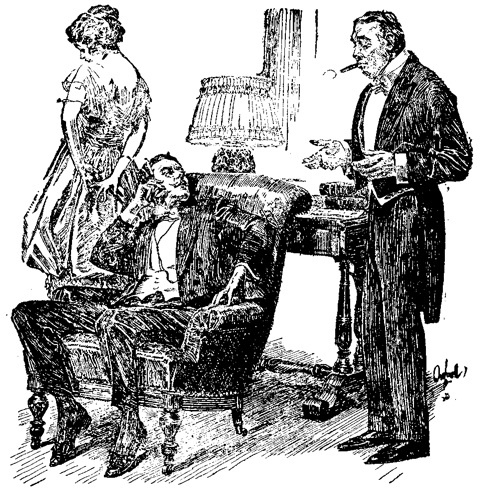
Host and Houseguest
"I say, old top, I wish you wouldn't be continually kissing the wife. I think once when you come and once when you go quite sufficient."
"But, my dear man, I can't wear myself out coming and going all the time just to please you."
—From "Judge." Copyright by Leslie-Judge Co.
The Poet of the Future
By Tacitus Hussey
Oh, the poet of the future. Will he come to us as comes The beauty of the bugle's voice above the roar of drums— The beauty of the bugle's voice above the roar and din Of battle drums that pulse the time the victor marches in? —James Whitcomb Riley.
"Oh, the poet of the future!" Can anybody guess Whether he'll sound his bugle, or she'll wear them on her dress; An' will they kinder get their themes from nature, second hand, An' dish 'em up in language that plain folks can't understand? There's a sight of this 'ere po'try stuff, each year, that goes to waste, Jest a-waitin' fer a poet who has the time and taste To tackle it just as it is, an' weave it into rhyme, With warp and woof of hope and love, in life's swift loom of time. An' mebbe the future poet, if he understands the thing, Won't start the summer katydids to singin' in the spring, Jest like the croakin' frog; but let the critter wait at most, To announce to timid farmers that "it's jest six weeks till frost." The katydid and goldenrod are partners in this way: They sing and bloom where'er there's room, along life's sunny way; So I warn you, future poet, jest let 'em bloom an' lilt Together—don't divorce 'em. That's jest the way they're built. In order to be perfect, the future poet should Know every sound of nature, of river, lake an' wood, Should know each whispered note and every answerin' call— He should never set cock-pheasants to drummin' in the fall. "Under the golden maples!" Not havin' voice to sing They flap their love out on a log quite early in the spring; For burnin' love will allus find expression in some way— That's the style that they've adopted—don't change their natures, pray. I cannot guess just what the future poet's themes may be; Reckon they'll be pretty lofty, fer, as anyone can see, The world of poetry's lookin' up an' poets climbin' higher; With divine afflatus boostin' them, of course they must aspire. The poets of the good old times were cruder with the pen; Their idees weren't the same as ours—these good old-fashioned men— Bet old Homer never writ, even in his palmiest day, Such a soul-upliftin' poem as "Hosses Chawin' Hay." "Hosses" don't know any better out in the Hawkeye State— Down to Boston now, I reckon, they jest simply masticate. The poet of the future'll blow a bugle, like as not— Most all us modern poets had to blow fer what we've got. To keep the pot a-b'ilin' we all have to raise a din To make the public look our way—an' pass the shekels in. The scarcity of bugles seems now the greatest lack Though some of us keep blowin' 'thout a bugle to our back. The poet of the future! When once he takes his theme His pen will slip as smoothly as a canoe glides down stream. He'll sing from overflowin' heart—his music will be free— Would you take up a subscription fer a robin in a tree? He'll never try to drive the Muse, if he doesn't want to go, But will promptly take the harness off—er drive keerfull an' slow— When po'try's forced, like winter pinks, the people's apt to know it An' labor with it jest about as hard as did the poet.