Front matter
Reading edition
Author of “Law Rustlers,” “The Sheriff of Sun-Dog,” etc.
When the Evil Spirit was very young, he desired to live upon the earth. Being an Evil Spirit, the land was too fair for his abode; so he builded himself a land upon a land.
Being very young, his dwelling pleased him for a time, but like a child he soon tired of it, after which he destroyed it with a sweep of his hands. The tale is true. This place was surely made by a spirit, and would the Great Spirit build such a place as this?—Indian Legend.
As proof of this legend they point to the Mauvaises Terres, the Bad Lands of eastern Montana; mute evidences of the one-time devil’s playground. White men call it a freak of nature, this desolate region; peopled with shadow-ghosts, grotesque architecture, not made by human hands, where the blizzards of Winter howl and shriek through cave and column, and where the heat gods dance through the short Summers. Freak of nature, it may be—devil’s playground, it is.
It was the Summer of 1880, nine years before Montana was admitted to the sisterhood of States; a time when the laws of God and man were but vague shadows of the future or of a forgotten past; a time when right and wrong were but an individual point of view.
History does not touch this period of the West, except to tell briefly of troubles with the Cheyenne and Sioux, who merely fought to repel the invader. But this tale is not of the Indian, but of another menace of that day, which is not mentioned in history.
Skirting the border of the Bad Lands came two mounted men, leading a pack-horse. The man in the lead, riding a tall gray horse, drew rein at the top of a small butte. He removed his sombrero and wiped the perspiration from his brow, with the sleeve of his shirt.
“Blaze” Carlin was a striking figure of a man, as he sat his horse with the ease attained by none except men who live their lives atop a horse. His hair was long and as black as the proverbial raven’s wing, except for a strip, at least two inches wide of snow-white hair, which began at the center of his forehead and ended at the crown of his head. From this peculiarity he received his nickname.
His forehead was broad, his cheek-bones prominent, and a generous mouth smiled from beneath a high-arched nose. He was as bronzed as a savage. In fact, at first glance, one would have called him a Sioux, but there was a hint of Celtic blood in his upper lip and mouth, and his eyes, a slaty-gray, did not fit the rest of his features nor coloring. It was as if an artist had used a Sioux model; painting in an Irish smile and blue-gray eyes and finished it off by drawing a full brush of white through the center of the hair.
The other man was small and wiry, bearded to the eyes, which were as black and luminous as jet beads. His nose was hooked, like the beak of an eagle. While Blaze Carlin was dressed in the height of cowboy fashion, this little man, “Frenchy” Ditteau, wore an old, half-fringed buckskin shirt, plaid, blanket pants and short boots. Across the fork of their saddles, both men carried Sharp’s rifles.
Frenchy Ditteau rode up beside Blaze, took out a plug of tobacco and a heavy clasp-knife and began to cut a pipeful of tobacco.
“Bimeby we strike de town, eh, Blaze?”
Blaze Carlin nodded, but continued to stare ahead. He brushed his hand across his eyes and turned his head.
“I reckon so, Frenchy. This heat kinda makes things look queer and this danged country makes yuh see things what ain’t; but I thought I seen seven men riding toward the sun. Maybe they was buffalo, but I don’t think so.”
“You got de good eye,” nodded Frenchy. “I’m mak’ de bet that she’s not be de buffalo.”
Blaze smiled at his companion. He had first met little Frenchy Ditteau in a saloon near Deadwood; a saloon filled with powder-smoke and struggling men. He had seen Frenchy empty his pistol and then fling himself headlong into the muzzles of spouting pistols, slashing with his knife and yelling like a Comanche.
The odds were sadly against Frenchy; therefore Blaze accepted part of the battle. Frenchy had been scored in several places, but Blaze managed to get him to the hitch-rack, where they got mounted and rode out of the town.
“Where yuh headed for?” Blaze had asked.
“Some place,” said Frenchy vaguely. “I’m t’ink dis town she’s not be friend to me and you, pardnair. Where you go?”
“Some place,” grinned Blaze and they galloped out of town, headed north.
Blaze Carlin was a gambler, but an honest one. He had no visions of making a big stake. Gambling to Blaze was an obsession rather than a profession. He knew the cattle business, knew that his riding and roping ability would earn him a job in any cow-country. Money meant nothing to him except a chance to pit his judgment against other men.
He had ridden away with Frenchy Ditteau for the simple reason that he knew the town would be against him for his part in the battle and partly because he admired the heart of a man who would pit his knife against pistols. He did not ask Frenchy the reasons for the fight, because it was none of his affair, and Frenchy did not explain. It was merely an incident. Frenchy was utterly indifferent as to his destination. Blaze suggested Medora.
“Ba gosh, dat’s de place!” declared Frenchy.
“How about headin’ up into Montana where the new railroad is comin’ through?” asked Blaze.
“We go dere sure!” exclaimed Frenchy. “I’m lak’ to see de railroad.”
Blaze laughed.
“Ain’t you got no choice, Frenchy?”
“To go wit’ you,” grinned Frenchy and the partnership pact was sealed.
For miles they had skirted the Bad Lands, seeking to strike into the big cattle-ranges, but as yet they had found no signs of human habitation. Frenchy lighted his pipe and they rode on. About half a mile farther on they came to a brushy coulée, and partly hid away in the brush they could see the half-log, half-mud cabin of a squatter.
“Hittin’ closer to civilization,” observed Blaze pointing at the cabin.
Frenchy drew slowly at his unlighted pipe, his eyes squinted in a steady focus on some object.
“What do yuh see?” asked Blaze.
Frenchy did not reply, but spurred his horse down the edge of the coulée. Blaze, after another look, followed him, driving the pack-horse ahead of him. A trail, hammered hard by cloven hoofs, led straight down through the brush to the rear of the cabin.
Near the side of the cabin grew a stunted cottonwood tree, and hanging to a large branch by a noosed rope was the figure of a man. Blaze and Frenchy dismounted and walked around the tree. The body was tightly bound with ropes, and pinned to the breast of the dead man’s shirt was a square of paper on which was crudely printed—
A WARNIN TO ALL
It was signed with a large V. Frenchy folded his arms and puffed loudly on his pipe while Blaze read it aloud.
“You spik true,” nodded Frenchy. “We are close to de civilize folks, Blaze.”
“That V would be for vigilantes,” mused Blaze. “Did yuh ever hear of them, Frenchy?”
Frenchy shook his head.
“They’re a bunch of fellers who takes the law in their own hands,” explained Blaze. “When the law can’t or won’t do the job right, then the vigilantes steps in.”
“Mm-m-m,” mumbled Frenchy. “She’s hang de bad-man, eh? All de time she’s do no-ting to de good man?”
“I don’t reckon they’re supposed to,” said Blaze.
“When de vigilante she’s hones’ man, she’s only tak’ away de bad-man, eh? Me, I’m mak’ t’ink she’s bad t’ing if de bad-man mak’ himself vigilante. W’at you t’ink, Blaze?”
The crude wisdom of Frenchy had picked out the flaw of the vigilante system—a system which was efficient in bringing terror to outlawry in the old West, but which went beyond its intention and became the weapon of unscrupulous men, who used it to further their own ends.
“I reckon you’re right, Frenchy,” admitted Blaze, after thinking over Frenchy’s words. “Maybe they won’t thank us for buryin’ their victim, bein’ as they kinda leaves ’em hangin’ around as a warnin’; but we’ll take a chance.”
They cut the rope. The man was well past middle-age, his hair and beard almost white. Blaze examined him closely. One of his legs lay in an unnatural position, and Blaze discovered that the man was a cripple. He examined the man’s hands and got to his feet as Frenchy appeared with a shovel and a pick.
“Why you t’ink dey string him up for?” asked Frenchy. “Bad-man, you t’ink?”
“He was a cripple, Frenchy.” Blaze spoke softly, as if afraid the dead man might hear. “His knee is all crooked and his hands are tied in knots from rheumatism. He couldn’t neither run nor hold a gun.”
Frenchy turned away and began digging. Blaze watched him for a time and then picked up the shovel.
“I’m mak’ t’ink,” observed Frenchy leaning on his pick, “I’m t’ink I’m mad like —— for de vigilant. Mebbe she’s de law, but jus’ de same——”
“He couldn’t run nor hold a gun,” said Blaze.
“Me and you t’ink alike, mos’ always,” nodded Frenchy.
Neither of them knew anything of the burial service. The victim of the vigilantes was rolled in an old blanket and buried beside the old cottonwood tree. The interior of the cabin did not disclose the man’s identity. It was crudely furnished and did not show long occupancy. There was no sign of any firearms and the food supply was low. They fastened the door and rode on.
The sun was an hour high when they reached a large stream of water flowing down a small valley. The stream was lined with willow and cottonwood, which cut a green gash through that sun-baked country. Several head of range cattle whirled out of the willows at their approach, wild as partridge.
“We’re into the cow-country at last,” smiled Blaze, as they rode into the willows.
Frenchy nodded. They followed a trail through the brush and drew up at the bank of the stream.
“Somebody mak’ de sign,” observed Frenchy, pointing at a sign on a big cottonwood, which grew near the bank.
Blaze rode in close to the tree and read the notice aloud.
WARNIN THIS LAND BELONG TO BLACK MORA NO BODY ALLOW HERE
Frenchy snorted his disgust.
“Shall we move on?” asked Blaze.
“I’m mak’ de wet camp today,” declared Frenchy. “I’m no want Black Mora’s land—I’m jus’ want to camp. We stay.”
“I’ve heard of him,” said Blaze. “A man in Deadwood told me something about him. Big cattleman, I reckon. Wants to run the country.”
“Mebbe de countree she’s no run,” grinned Frenchy, taking the swing-rope off the pack. “We tak’ chance.”
Both of the men owned camp-broke horses and there was no need of hopple or picket-rope. The three horses moved up the stream, cropping at the green grass, while the men prepared camp. Blaze happened to glance across the creek just in time to see a rider disappearing over a ridge. He was close enough for Blaze to see that the man was looking at their camp.
“One of Black Mora’s spies,” said Blaze pointing him out to Frenchy, but the man disappeared before Frenchy could locate him.
“We’ll give the horses an hour on the grass and then tie ’em up,” stated Blaze. “Yuh never can tell what kind of a hornet this Mora is and we might need a horse under us real quick.”
“Ba gosh, I’m prepare for de night!” Frenchy’s beard and mustache seemed to fuzz out like the whiskers on an angry bobcat.
He patted his pistol butt.
“I’m hard man for mak’ move, but jus’ as you say, Blaze. Mebbe she’s de good idea for have de horse handy, for de reason dat mebbe we have to chase dis Black Mora, eh?”
Blaze laughed, but Frenchy was serious. In anything except a fight the little Frenchman had the heart of a child, but the prospect of trouble seemed to add inches to his height and his black eyes became bead-like in their intensity.
They cooked and ate their supper and then Blaze caught the horses, tying them near camp. Blaze had been keeping a close watch across the creek, expecting trouble to come from that direction, if at all. Suddenly he heard Frenchy grunt softly. Two men had ridden in from the rear, making no sound on the soft trail, and were almost to the fire before Frenchy saw them.
One was a tall, swarthy, black-mustached person, with an arrogant expression. The other was a trifle smaller, with mouse-colored hair, one empty eye-socket and a badly scarred face. Both men carried rifles and wore pistols.
Blaze looked them over carefully. The tall man, after staring hard at Blaze, pointed at the sign, his long, bony forefinger quivering as he seemed to put his soul into the gesture.
“You see that sign?” he grunted.
“Still havin’ my sight,” nodded Blaze.
The man seemed shocked to think that Blaze had seen it and still disregarded its warning. His hand dropped to his side and he frowned at Blaze. Frenchy was standing near the other rider, his legs braced far apart, his unlighted pipe between his lips.
“This here land belongs to Mora,” stated the tall man.
“Who is Mora?” asked Blaze easily.
“Black Mora? You don’t know?”
“Nigger?” asked Frenchy.
The man turned his head and shot a withering glance at Frenchy, but Frenchy’s glare was just as deadly and the man turned back to Blaze.
“You git off this land! Mora don’t allow nobody here. I’ll give you—” he glanced around at the meager outfit and turned back to Blaze—“I’ll give yuh half-hour to git off this ranch.”
Blaze rubbed his chin and considered the order.
“You work for Black Mora?” he asked.
“I shore do.”
“Know him well enough to take a message to him?”
“I shore do.”
“Then tell him that Blaze Carlin told him to go to ——.”
“Mak’ de message from Frenchy Ditteau, too,” added Frenchy. “Mak’ her read de same.”
The tall man’s eyes narrowed for an instant and his shoulder seemed to hunch. Blaze Carlin’s hand crooked at the wrist and his Colt .44 split the stillness of the creek bottom. The tall man’s arm swung forward, seemed to crumple at the elbow and his pistol fell to the ground.
At the first motion of the draw, Frenchy had sprung forward and upward, grasping the other man by the belt and yanking him off his horse. The man drew a gun as Frenchy tore him loose from the saddle, but the gun went spinning into the bushes.
Blaze paid no attention to Frenchy and the other man. The tall man’s rifle slid to the ground, and his frightened horse backed until its rump struck a tree, which made it jerk forward, almost unseating its rider, whose arm seemed to occupy all his attention. Frenchy had flung his man to the ground and pinned his arms.
“Ba gosh, I’m hope for de good fight, but I’m mak’ mistake,” grunted Frenchy.
“You’ll have a chance to use your left arm for a while,” stated Blaze, but the tall man did not reply.
Frenchy let his man get up, but kept a hand twisted in his collar.
“You heard the message we sent to Black Mora, didn’t yuh?” asked Blaze. “Now, maybe you’re tamed enough to carry it to him.”
“You goin’ to turn dem loose?” asked Frenchy. “Ba gosh, you got sof’ heart. Whoa!”
Frenchy yanked his man backward and proceeded to administer the toe of his boot to the spot designated by precedent for such a proceeding and alternately yanked and booted the man all the way to his horse, which the man managed to mount.
“Vamoose!” snapped Blaze.
The men rode away; one of them hugging a shattered right arm, and the other standing high in his stirrups and trying to keep his frightened horse to a comfortable walk.
Frenchy proceeded to shave a pipeful of tobacco, and lighted it from the fire embers. He turned and looked at Blaze who was leaning against a tree, watching in the direction of the disappearing horsemen.
“Blaze,” Frenchy puffed furiously, “Blaze, I’m t’ink dem two feller get sore from us. You mak’ —— good shot for break hees arm. Eh?”
“Good shot! Lucky shot, Frenchy—lucky for him. I never shot at his arm. You had a lot of nerve to yank that other feller plumb off his horse.”
“Nerve—me?” Frenchy laughed heartily. “Why, Blaze, I’m so —— scare dat I’m forget my gun. Ho, ho, ho!”
They both laughed. Frenchy had seen Blaze shoot the heads off sage-hens, and Blaze had seen Frenchy fighting with a knife against roaring pistols, but neither was seeking glory in the other’s eyes.
“We’ll move back a ways as soon as it gets dark,” stated Blaze. “This ain’t the end of it, Frenchy. Maybe we better pack up and pull out.”
“Non!” Frenchy shook his head vehemently. “I’m back up a little, but no pack de horse and run away. We got two rifle an’ two pistol more den we have biffore dey come. Ho, ho, ho!”
Frenchy collected the four guns, which were loaded. The rifles were Sharp’s, the ammunition of which fitted their rifles, but the two pistols would be useless to them after the rounds were fired, as they both used smaller caliber than those carried by Blaze and Frenchy.
Blaze kept a close watch until dark and then they moved their blankets farther back from the creek after throwing more wood on the fire. But there was no further sign of Black Mora or his men that night.
They were up at daylight. Blaze started to get breakfast, while Frenchy climbed up into the branches of a cottonwood where he perched like an owl with his rifle across his lap.
Blaze laughed at Frenchy, but Frenchy was serious.
“I’m mak’ t’ink,” said Frenchy, “I’m mak’——”
He broke off, rose a little higher and swung the heavy rifle to his shoulder. A moment later the big rifle bellowed. Blaze sprang across the fire and picked up his rifle.
“What yuh shootin’ at?” he demanded.
Frenchy extracted the empty cartridge and blew into the breech of his rifle before replying.
“De sonn of a gonn go creep, creep along to git behin’ de big rock. Ho, ho, ho! I’m push de dirt in his face. He turn over lak——”
Frenchy threw up his rifle and fired as it leveled. He waved the cloud of smoke away with a sweep of his hand.
“Dat’s anodder one, Blaze. I miss him pretty close, I tell you dat. Whoa!”
Frenchy shifted excitedly.
“Blaze, you pack de cayuse —— quick! I’m mak’ t’ink dat sonn of a gonn has de army work for him. I hol’ dem off, I tell you.”
Bullets began to whiz through the foliage and thump into the tree trunks. Blaze hurriedly packed the horse and then threw on the two saddles, while Frenchy swore alternately in English and French and punctuated his oaths with lead from his old Sharps.
“All set, Frenchy,” called Blaze, swinging into his saddle.
Frenchy fired again and swung down to the ground.
“Go straight down dis side,” ordered Frenchy. “I’m have dem stopped.”
They rode away as swiftly as possible, keeping in the willows. For a while it looked as if they had thrown off the attackers, but as soon as they crossed the creek and struck into more open country they found that there was a strong possibility of more trouble.
One bunch of horsemen were behind them, while another bunch had circled into the hills to head them off. They pulled up and considered the matter. A long-range bullet dusted the ground at their horses’ feet, fired from the bunch in the hills. They could see the riders across the creek as they checked up at the edge of the stream.
“W’at we do now—fight?” asked Frenchy.
Blaze considered. The horsemen in the hills were still swinging around as if to join forces with those at the creek.
“They’ve headed us off in that direction,” observed Blaze, “and it appears to me that they’re danged awful sure that we want to go thataway. Well, we’ll take a chance and go up the creek instead. We may have to lose our pack-horse.”
“My blanket she’s on de pack, and I stay wit’ my bed,” declared Frenchy. “De pack-horse run lak ——. Come on.”
They turned and spurred into a gallop, traveling parallel to the creek, but in open country. There were six men in the bunch which had circled them, and five more in the crowd at the creek. Now they joined and came racing up the same side of the creek.
Both Blaze and Frenchy were well mounted, but the pack-animal, seeming to sense the need of haste, passed Frenchy, who was leading it.
“Go so fas’ as you like!” yelled Frenchy and threw the rope across the pack, turning the animal loose.
They swung over a knoll and around the side of a steep slope, jumping mesquite and greasewood, and found themselves a short distance from a rambling ranch-house, which stood in the center of a clearing about three acres in extent. A long low stable and a big pole corral were between them and the house, and a pole fence surrounded the house and barn. The center pole of the bars was in place and the pack-animal tried to jump it, but the horse was not built for hurdling and came to grief.
Blaze’s horse cleared the bar and the struggling pack animal, and Frenchy’s horse barely clicked the rail as it went over. The pack-animal struggled to its feet, kicked at a loose rope and galloped after its master. Blaze and Frenchy swung down at the door of the ranch-house, turning the horses loose, and then went straight toward the open stalls of the barn, as if they had lived there all their lives.
Came a whirl of dust and the panting horses, as the pursuers clattered up to the bars. Blaze threw up his rifle and sent a bullet past their heads and they spurred to one side out of sight. Blaze kicked open the door, almost in the face of a fat Indian squaw, who was coming to the door to see what was going on. She stared blankly at the two men.
“Whose place is this?” asked Blaze.
“Black Mora,” replied the stolid aborigine.
“Where is he?”
“I dunno. He ride away with men.” The squaw spoke in halting English.
“This is going to be a hard place to leave,” observed Blaze, but Frenchy was chuckling as he leaned over a rough table.
“Look, Blaze!” he called. “Here’s plenty shell for de rifle. Fill up de belt and use de pocket for de rest. She’s good place to fin’.”
Blaze stepped over to the table and filled his belt from fresh boxes. Frenchy stuffed his pockets full and then put more inside his shirt.
“Ba gosh, she’s goin’ to be wan good fight, I’m tell you, Blaze.”
Blaze stepped to a window and saw a man running to get behind the barn. Another was stooped low, running farther to the left where another old building would give him cover. Blaze looked around the room, which was about twenty by thirty feet in size. There were four doors, two opening outside, and the other two were connected with the rooms at each end. All the doors were fitted with heavy bars.
It was only a moment’s work to throw the bars into place. The squaw watched Blaze, but her fat face expressed no emotion. The strange doings of the white men did not cause any wonder in her one-idea brain. Blaze grinned at her lack of interest.
“You like Black Mora?” he asked.
The squaw glanced at Blaze and then spat disgustedly.
“Either she hates him or she don’t like my question,” grinned Blaze.
The windows, of which there was one at each side of the room, were composed of two small panes of glass set in crude frames. Frenchy dumped the extra cartridges onto a shelf near the rear window, placed his pistol beside them, and calmly knocked one of the panes of glass out. Then he produced his plug of tobacco and clasp-knife and then grinned at Blaze, who was looking at the squaw.
“Blaze, you better knock out de little window and git ready for fight. Plenty time for de love-mak’ after de wil’ man she’s went away. Ho, ho, ho!”
Frenchy chuckled heartily over his crude joke.
Blaze went back to the window and poked out one of the panes, only to have a bullet ricochet off the barrel of his rifle and buzz across the room like an angry bee.
“Ho, ho, ho!” chortled Frenchy. “De dance she is begin, Blaze. I’m hope she don’t all dance from your side, biccause my feet she’s itch for git busy.”
Blaze fired and was rewarded by a yell from the barn.
“Ba gosh, you don’t miss dat feller,” chuckled Frenchy. “I’m can tell de yelp from de ol’ Sharp’s bullet. She’s——”
Thump! A bullet tore through the mud chinking of the cabin near Frenchy’s window, and Blaze turned to see Frenchy with both hands clapped to his face, dancing a circle. He sprang across the room and grasped Frenchy’s arm.
“Where’d it hit yuh?” he asked.
“De —— mud-daubers t’row dirt in my eye! Go back to your own side. Dis feller be-long to me, ba gosh!”
The squaw had sat down on the floor at the end of the room and watched the two men. She glanced at the wall, where a bullet tore into some medicine bottles on a crude shelf, but there was neither wonder nor anxiety in her face. Frenchy crouched flat against the wall, leaning out far enough to fire and then leaning back to reload.
The attack was growing stronger now, as the Black Mora crowd found points of vantage, and they searched the house with lead from every angle. Blaze was shooting methodically, while Frenchy grew voluble with French epithets and drilled his initials on a shed door, where three men had fired at his window from a loop-hole in the logs.
Two men had attempted to reach the door of a small building about sixty yards from Blaze, but both of them failed. Blaze could see no reason for any one sacrificing his life to reach this building. Another man had come in from the rear of this building, which was built on such an angle that Blaze could only see the front and one side, and had sneaked in on the far side to the front.
His hand shot out in an attempt to lift the barred door, in which attempt he had succeeded, but Blaze shot carefully and the man’s hand went out of commission. The heavy door swung open, but no man seemed foolhardy enough to try to reach the shelter of the interior.
Luckily for both Blaze and Frenchy the bullets were all coming from one direction. There was no cover from one side, consequently they were able to stay close to the window without danger of cross-fire. The remaining panes of glass were long since gone and the casing and log-ends on one side of each window had been chewed to a pulp with rifle bullets. Occasionally a bullet would splinter through the doors, but the thick seasoned wood mushroomed the soft lead until it was practically harmless.
“De gun she get —— hot,” observed Frenchy, grinning across at Blaze. “How many you get?”
Blaze shook his head.
“I dunno, Frenchy. I’ve got two down in sight and I put a bullet through one feller’s hand. Couple more I kinda figured to ache up a little, but they seem to keep shootin’.”
“I’m not got none for sure.” Frenchy seemed downhearted over this fact. “I’m got t’ree inside de little house, one behin’ a pile of poles, and anodder one she’s get in hole in de ground. I’m mak’ t’ink Frenchy Ditteau —— poor shot.”
He leveled his rifle and fired again.
“Ho, ho, ho! De sonn of a gonn she try to come out of de hole. I’m mak’ bet she’s change her mind.”
Blaze nodded and grinned. His rifle barrel was so hot he could hardly hold it. Suddenly the squaw got to her feet. She sniffed at the air. Blaze watched her.
“Fire come,” she said slowly. “House afire.”
Blaze sniffed, but the room was hazy with powder smoke.
“I smell,” stated the squaw. “Black Mora set house on fire.”
“The same of which complicates things,” observed Blaze.
“I’m mak’ t’ink we trapped,” said Frenchy. “Mus’ go way pretty soon, Blaze.”
A trickle of smoke began to show under one of the connecting doors and Blaze stepped over to smell of it.
“Wood smoke, Frenchy. They’ve set fire to our little fort.”
Blaze stepped back to his rifle, but there was no one in sight. Frenchy peered out of his window, but there was no sign of his targets. Black Mora had decided to smoke out his quarry. Blaze watched the squaw walk to the farther corner of the room, where she dragged a crude bunk away from the wall. She threw aside a pile of old sacks and skins and lifted a trap-door.
“Cellar?” queried Blaze.
“You come,” ordered the squaw, and started down a short ladder.
Blaze and Frenchy each took a last look from the windows and, as there was no sign of the besiegers, they followed the squaw.
Instead of a cellar they found a narrow low tunnel shored up with small timbers. It was pitch dark and the tunnel was barely wide enough for them to squeeze through; but they followed in single-file behind the fat squaw. It seemed as if they had gone a mile, when the squaw stopped and straightened up. Blaze reached out his hand and felt the rungs of a pole ladder, up which the squaw had started.
Came the creak of boards and the tunnel was flooded with light, as the squaw lifted another trap-door letting them into a small log-room. The open door gave them a view of part of the house they had just left.
“This is where them fellers wanted to get,” whispered Blaze understandingly. “No wonder they took a chance. They could go through the tunnel, open the trap under that old bunk and nail us both.”
“Sure t’ing,” nodded Frenchy. “Gran’ scheme, Blaze. Look at de house burn.”
The ranch-house was composed of three large rooms, and the fire had been started in the north end. Black Mora had taken no chances in trying to smash the connecting door, after seeing the defenders’ shooting ability; so he decided on the Indian method of routing them out.
Blaze and Frenchy crouched near the door, watching the flames eat into the seasoned logs. One end of the house was burning fiercely, and it was only a question of a short time until the whole building would be in flames.
The squaw sat down in a corner, stolidly watching the fire as if having no interest in it whatever. Blaze and Frenchy knew that at least six rifles covered the front and rear doors of the ranch-house, and were also fairly sure that the men behind those rifles believed that their quarry must soon break for liberty.
Blaze examined the walls of their room, but there was no exit except the half-open door. The squaw looked at Blaze and seemed to understand what he was looking for. Flames were soaring from the ranch-house. Came the shrill nicker of a horse; a man’s voice cried an order, but above it all came the splintering crash as the pole and mud roof of one end of the ranch-house collapsed.
The squaw got to her feet and backed into a corner. The two men watched her as she fumbled along the chinking between two logs. Suddenly she shoved with her shoulder, and a section composed of two logs swung outward. The aperture was large enough to allow a man to pass through and through it they could see their three horses near the barn, watching the fire.
The logs had been cut in such a way and so hinged that they could only be opened from the inside. Evidently Black Mora had more need of an exit than an inlet.
“You go,” urged the squaw. “Everybody look fire.”
Blaze held out his hand to her, but she seemed ignorant of a hand-shake. He slipped a large opal ring from his finger and handed it to her. She understood this and smiled happily. It was Blaze Carlin’s mascot, but he gave it willingly. He and Frenchy slipped out the aperture and the logs closed behind them.
By going straight to their horses they could keep the small cabin between them and Mora’s men, unless the men had moved lately. Ducking low, they raced for the horses, but no shot followed them. It was but a moment’s work to lead their horses around the corner of the barn and there they found a huddled group of saddle-horses, snorting from fright of the fire.
Frenchy chortled gleefully and wanted to cut the saddle-cinches, but Blaze stopped him. He was not afraid of Mora’s men catching him once they got away and there was a chance that the gang might believe that they perished in the flames.
Frenchy grumbled at losing the chance of spoiling all possibility of pursuit, but spurred out of the clearing, riding swiftly down the creek, around the first curve and into the hills, while behind them a black cloud of smoke pillared into the sky.
“Ho, ho, ho!” Frenchy threw back his head and whooped gleefully. “Nobody she’s allow on Mora’s lan’, eh? Blaze, you ever hear ’bout Nero?”
Blaze shook his head.
“She’s lak’ to be de boss, too,” explained Frenchy. “She’s fire de town of Rome and den she feedle.”
“She done what?” asked Blaze.
“Feedle, feedle, feedle!” Frenchy imitated the motions of playing a fiddle. “She’s mak’ music for de fire.”
“Must ’a’ been loco, Frenchy.”
“Jus’ so. Mak’ good shepherd, eh, Blaze?”
“Make a good pardner for Black Mora.”
“Ba gosh, dat’s de fac’. Bot’ crazy. No man can run dis countree a-lone. Mebby she mak’ big try, but bimeby somebody she’s come along and no run. Bam! One man no run, anodder man she’s see and she’s quit run. Bimeby everybody quit run. Den de man who run de countree mus’ run fas’ or de countree run over him.”
Blaze laughed at the wisdom of Frenchy Ditteau. Back of Frenchy’s black eyes was a keen mind; a brain capable of doing bigger things than fighting battles in border countries or trapping for furs.
The country needed keen minds, but Frenchy Ditteau loved action too well to live long enough in any one place. Blaze was also a drifter. The clink of poker chips, the lure of the green cloth was in his blood. His long, muscular fingers itched for the feel of playing-cards, but above it all was an indefinite longing to do something worth while.
Blaze was better educated than the majority of cowboys. He did not remember his mother; and his father was but a hazy, unreal sort of a person. Thrown on his own at an early age, he had grown to manhood, unsullied by his environment. He rode hard, drank moderately, and fought ferociously, but something in his soul seemed to cleave a deep line between right and wrong. Men said that Blaze Carlin was too honest to be a gambler—an honor conferred to few gamblers in those wild days.
To the six-shooter has been the glory of winning the West, but it took brains behind the gun to do this. Perhaps the six-shooter did much to hold back the West—the six-shooter plus lax laws, or no law at all.
Very often a sheriff was elected for his pistol ability, regardless of his fitness for the office, and only too often they combined with evil powers to loot behind the mantle of the law.
At times an honest sheriff was elected when the law-abiding element was in the majority; but the majority were unable to give their assistance when the lawless combined against his authority.
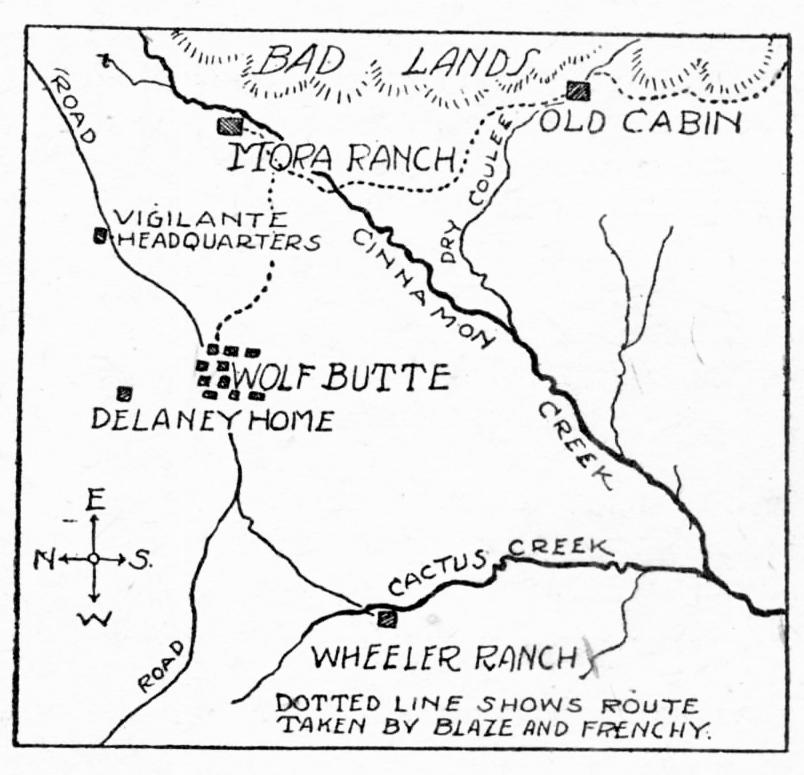
Wolf Butte was a county-seat in a territorial county; a county so vast that a man could ride for a week and never reach a boundary-line. Range cattle mingled with the buffalo. Men were neighbors at fifty miles. Towns were very few and far between, with Wolf Butte the metropolis. Therefore Wolf Butte flourished, roughly speaking and more roughly acting.
It was a town of saloons, dance-halls, gambling-places, where hard-bitted men came to revel in wine, painted women and coarse song; a town, where morals were flung to the winds, like a deck of unlucky playing-cards.
There was a certain moral element; an element composed of hard-riding, Godfearing men, but they were wofully in the minority. Day or night the long hitch-racks of the main street were lined with saddle-horses, standing patiently, often for days at a time, while their masters lounged in the smoke-festooned gambling houses and pitted their weak wisdom against games which did not operate for any one’s health.
Wolf Butte lived fast—living today, for tomorrow might never come.
Into this town rode Blaze Carlin and Frenchy Ditteau; rode past the gambling-halls, where the rattle of poker-chips sang a siren song to Blaze’s ears. To Frenchy it only meant mingling with other men, a drink or two, much useless argument and perhaps trouble; but Frenchy welcomed it all. He liked the drink or two, loved an argument, and fighting only added zest to life.
They went straight to a livery-stable and turned their horses over to the stable-man. On the wall of the grain-room was a prominent, crudely painted sign:
LEAVE YOUR GUNS HERE OR TURN THEM OVER TO THE SHERIFF THIS MEANS YOU
Blaze read it aloud and turned to the stable-man.
“Does that sign mean what she says?”
The man laughed and shook his head.
“I reckon not, pardner. Yuh see, we ain’t got no sheriff. Him and his under-sheriff got run out by the vigilantes.”
“What did they do that for?”
“I dunno.” The man shook his head and turned away. It was evident that he did not care to discuss the matter.
“Lak’ I’m say biffore,” observed Frenchy. “She’s de good t’ing at de right time. I’m hongry inside, Blaze. Mebbe we better find de ham and de egg, eh?”
Blaze agreed readily. Mora’s gang had interrupted their breakfast and they had not made a stop since leaving Mora’s ranch, which was about twelve miles from Wolf Butte. They walked down the dusty street to a restaurant.
Riders came galloping into the street, their horses kicking up clouds of dust. Freight-wagons creaked in, the mules dusty and tired, the drivers bitterly profane. Here were no traffic laws. An empty wagon, with a torn schooner-cover, swerved to the left of a heavy freighter and their front wheels locked.
The freighter screamed an oath and swung his whip at the other driver, while the teams lunged wildly. In the swirl of dust, both riders got to the ground and fought each other like madmen, while a gathering crowd cheered them.
The veil of alkali dust made the fighters appear as an out-of-focus picture. Suddenly the freighter went down. The other driver sprang to his seat, backed his vehicle away from the heavy freighter and drove away, hatless, coatless but triumphant, while willing hands helped the freighter back into his wagon. The street cleared and the fight was forgotten.
At the door of a restaurant Blaze stopped and threw up his head. The gambling fever was upon him again. Directly across the street was a huge sign:
EUREKA SALOON AND GAMBLING PALACE
A violin screeched an old jig-tune; an out-of-tune piano was jangling notes, while above it all came the husky voice of a woman, singing “Suwanee River.” Her voice broke harshly on a high note and a burst of coarse laughter showed that the audience had been amused.
A bouncer propelled a quarrelsome drunk out of the wide door and the unfortunate one sprawled into the street from a well-directed kick. All the saloon doors were double width, wide open so as not to obstruct any rider who was in too much of a hurry to dismount for his drink.
“She’s a —— bad town,” declared Frenchy as they sat down at a greasy table where linen and silverware were unknown.
“Man for breakfast every mornin’, stranger,” smiled a bearded man at the next table. “Everythin’ goes in Wolf Butte. Railroad’s within seventy miles of here now and the stakes sure cuts close to the main street.”
Came a scattered volley of pistol shots from up the street and several men rode swiftly past the restaurant.
“More punchers in for a bust,” observed the stranger. “They sure does salute the town since the sheriff hit for the hills.”
“Vigilantes run him out?” asked Blaze.
“Accordin’ to the notice tacked on his door.”
The stranger attacked his meal and Blaze and Frenchy turned back to their own business of eating. More men drifted in to eat and the place was filled when Blaze and Frenchy paid for their meal and went across the street to the Eureka. The games were running full blast. Blaze waited until a man cashed in his poker-winnings and then slipped into his place, tossing a piece of gold to the dealer, who shoved the chips across the table.
Frenchy leaned against the bar, his keen eyes taking in the place. Painted women, with scarlet lips and painted cheeks, dressed in cheap finery, mingled with the men, their shrill laughter audible above the roar of male conversation.
Two fiddlers added to the general confusion by screeching out a hoe-down. Three bartenders dished out cheap whisky, while rough waiters hurried hither and yon, carrying orders to the games or to those unable to navigate from table to bar.
Frenchy was looking toward the door as three men came in. The man in the lead was inches taller than any man in the room. His neck was so short that it appeared his head was set flush with his shoulders, his long arms swinging even below the bottom of his holstered gun.
His face was like a piece of carved mahogany, carved to a perpetual sneer, and his eyes were black as ink and without depth. A lock of greasy hair curved down over his forehead from under the back-flung brim of his sombrero. He wore a beaded vest, heavy with brass ornaments, and below it flashed the two heavy silver buckles of his ornamented belt. His chaps were heavily ornamented with silver studs and carved rosettes, and the spurs above his high heels were heavy with silver and gold.
He stopped and swept the crowd with his eyes, his glance traveling from man to man. He only gave Frenchy a passing glance and then turned to the bar. The two men stepped in beside him. A bartender hurried to take their order. The big man slopped the liquor on the bar indifferently and then spat out his drink.
“Rotten!” he snapped and flipped the uncorked bottle off the bar under his feet where it gurgled its contents along the rough floor. “Gimme good whisky, —— you!” he roared at the bartender. “None of that pizen!”
The bartender placed another bottle on the bar, along with fresh glasses.
“That’s the best in town, Mora,” said the bartender.
“Don’t tell me what’s the best!” growled Mora. “I’ll do the talkin’.”
Frenchy studied the big man. So this was Black Mora. Frenchy looked at the huge, hairy wrists, the big, powerful hands; the shoulders of an ape. Mora’s forehead was broad and intelligent, but the back of his huge head was almost flat. His hips were narrow and his feet small.
Frenchy noted that Mora’s gun had a beautifully carved handle. In Frenchy’s mind there was not the slightest doubt but that Black Mora was deadly efficient. The two men with him were ordinary cow-puncher types, well trained to follow their master.
Mora turned and saw Frenchy looking at him. There was nothing offensive in Frenchy’s attitude; rather he was admiring this huge piece of fighting machinery. Mora placed his glass on the bar and turned toward Frenchy.
“Whatcha lookin’ at?” he growled, eyes half-closed.
Frenchy feigned not to have heard the question and turned his head slowly toward the poker-table. Blaze Carlin was looking at Mora. He and Frenchy exchanged glances and Frenchy turned back to Mora.
“Didja hear what I said?” growled Mora.
Frenchy smiled and shook his head. “De little question she’s get lost in all dis talk. I’m ver’ sorry.”
“Frog-eater!” rumbled Mora, stepping closer and glowering at Frenchy.
Blaze moved his chair back from the table slowly, watching Mora. As Blaze’s right hand drew back from his chips he touched a heavy glass beer mug. His fingers twined into the handle and he leaned forward in his chair. Frenchy had not moved. Mora’s throat rumbled a curse and his right hand shot out to grasp Frenchy by the throat, but Blaze shot to his feet and flung the beer mug with such unerring aim that it caught Black Mora over his right ear, when the latter’s hand was brushing Frenchy’s chin.
Mora dropped like a log. For a moment nobody spoke nor made a move. Frenchy leaned against the bar, the butt of his pistol braced against his right hip, covering Mora’s two men.
“Ho, ho, ho!” he chuckled. “De beer mug save Mora’s life. I’m to kill him when he touch me, de beeg pig!”
Mora stirred and then sat up, staring vacantly. His eyes fastened on Frenchy and the muzzle of the unwavering pistol. He put his hand to his head and drew it away stained with blood. His eyes traveled around the saloon, as if seeking the man who had hit him. He got to his feet and leaned against the bar, his eyes narrowed to mere slits. Frenchy did not move a muscle.
The room had gone suddenly still. Then a woman laughed harshly and Black Mora’s muscles seemed to jerk from the insult. It was as if some one had laughed when a king fell.
Blaze stepped away from the poker-table and walked half-way to Mora. The two men looked at each other for several moments and then Blaze spoke evenly:
“I throwed that glass. Yuh don’t know it, but I saved your life. ’Pears to me that you ain’t been weaned long, or yuh wouldn’t reach for an armed man.”
Again came the harsh, cackling laugh from the whisky-raw female throat. Mora seemed to quiver with suppressed anger. His tongue passed along his thick, lower lip. Then he spoke——
“You know who I am?”
Blaze smiled and shook his head.
“I am Black Mora.”
It was as if he had said—“I am the king.”
“Never heard of yuh,” replied Blaze, “but you sure have a hard head, pardner. How’s all your folks down on the farm?”
Frenchy chuckled aloud.
“Black Mora, eh? I’m mak’ you acquaint wit’ Blaze Carlin, Black Mora.”
Mora was like a teased tiger, which knew that steel bars kept him from wreaking vengeance on his tormentors. In this case the bars were Frenchy and his big pistol, which had never wavered; the pointed hammer back at full-cock, like the head of a snake about to strike. Mora’s face settled back to its perpetual sneer and he turned on his heel and walked out, followed by his two men. As he went out of the door he was followed by the woman’s derisive laugh.
Frenchy flipped his pistol back into its holster. Blaze turned back to the table, where men were staring at him. The man in the lookout chair spoke:
“Mister, you’ve kinda put yourself in bad. That’s Black Mora and—and——”
“He said that’s who he was,” smiled Blaze. “Is he supposed to be so bad?”
The men around the table shifted uneasily. It was rather a personal question as no man seemed to know who was in Mora’s confidence. Blaze glanced around the circle and then laughed.
“Don’t nobody tell me he’s a bad-man, ’cause I won’t believe it. He’s a big, black bully. Some kid will chase him off the range some day, with a tin can full of rocks hangin’ to his shirt-tail.”
The dealer picked up the cards, glanced at the door uneasily and went on dealing. Frenchy still leaned against the bar, smiling around the room. The place grew animated again, but hilarity was forced. The king had been humiliated, disgraced and none knew when the king might try to wipe out the stain—nor how.
There was a man at the poker-table who did not seem of the same caliber as the rest of the crowd. He was past middle age, slow of movements, soft of voice. He played methodically, unemotional, as if thinking deeply. His hair and mustache were nearly white and his eyes seemed to hold nothing but kindness to all men.
Blaze looked up to see the blue eyes fastened upon him inquiringly. It was as if the man were asking a question. Blaze smiled at him, and for some reason half-nodded as if answering the unspoken question.
After a few more hands the blue-eyed man cashed in his chips and got up from the game. Another was waiting for his chair. He straightened his collar and sauntered toward the door. Blaze felt that his interest in the game was waning; so he also cashed in and let another take his place. The blue-eyed man was standing at the door, looking outside, and Blaze went straight to him, walking slowly. He did not speak directly to the man, but kept his face toward the door as he said—
“I kinda reckon you wants to talk to me, pardner?”
The other shifted his feet and continued to stare at the door.
“Not here. At the west end of town, a quarter of a mile away, is a house, standing alone. Can you be there an hour after dark—you and your pardner?”
“Uh-huh.”
“Look out for Mora.”
“I ain’t a bit sleepy, pardner.”
The man yawned and walked out of the door. Blaze turned slowly and walked up to Frenchy.
“Thirsty?” he asked.
“I’m mak’ t’ink we better off wit’out drink, Blaze.” Frenchy spoke softly. “Whisky ver’ good when everybody she’s happy, but nobody she act happy over de Mora business. Mebbe de sonn of a gonn she’s need more convince, eh?”
“I reckon you’re right, Frenchy. Come on.”
They sauntered out of the door into the street, and once more the Eureka seemed to grow hilarious; as if a weight had been removed from its mind. Blaze told Frenchy of his conversation with the man.
“He no say w’at he want? Ba gosh! Mebbe she’s trap from Black Mora.”
Blaze shook his head.
“No, I reckon not, Frenchy. I’ll take that chance.”
“Sure ’nough. I’m bet Black Mora mak’ t’ink we die in de fire. He not know us. His two men see us close, but one is got busted arm and de oder she’s no set on saddle for week. I’m like dis —— town, Blaze. Ba gosh, nobody’s she get rusty from live her, you bet me my life.”
Several cowboys whirled their horses away from a hitch-rack, and one of them came bucking down the center of the street, its rider swinging sidewise in the saddle, his right spur hooked into the cinch, while he fanned the bronco’s ears with his sombrero.
Another forced his horse to enter the saloon, spurring the frightened beast into a jerky buck as it went inside and a few moments later bucked out again with a big bottle held aloft in his hand. His horse passed Blaze and Frenchy in a whirl of dust as he raced to catch the others.
Across the street was a sign: SHERIFF’S OFFICE. A notice was pinned to the door. Blaze and Frenchy crossed the street and read the notice.
CLOSED BY ORDER OF VIGILANT
Blaze studied the crudely lettered sign.
“The same man wrote both signs—this one and the one we found on that dead man, Frenchy. The letters are made just the same way.”
“What dis wan say?” asked Frenchy.
Blaze read it aloud.
“Ba gosh!” exclaimed Frenchy. “I’m mak’ t’ink de lawyer starve to death in dis countree. De hangman she’s good for do de hang, but she’s —— poor judge, I’m t’ink.”
“Crooked sheriff, I reckon,” observed Blaze. “The vigilantes likely found him out and made him hard to catch.”
They strolled from saloon to saloon, but there was no sign of Black Mora nor his two men. Frenchy watched Blaze walk past game after game without interest, and wondered what had come over his partner. Somehow the games of chance did not attract Blaze now.
No one paid any attention to them, which proved that news of Black Mora’s humiliation had not reached their ears. Every one seemed intent on his own pleasures. Groups of cow-punchers drifted from saloon to saloon, singing, playing like a crowd of overgrown children; their spurs jingling over the rough floors.
Already the huge, shaded oil-lamps had been lighted over the gambling-tables, and their smoky odors mingled with the scent of alcohol and tobacco fumes. Dealers finished their shifts and made way for fresh, clear-eyed men, in shirt sleeves and eyeshades. Blaze and Frenchy sat tilted back against the wall, watching the action of the place, but taking no part in it. Finally, Blaze tilted forward and got to his feet. It was time to go.
He spoke to Frenchy and they threaded their way through the crowd and into the street. They saddled their own horses, paid the small fee and rode away. A pale moon lighted the dusty road while a film of dust cloud seemed to hang above the road, marking the swift passing of some one a short time before.
The house was easy to find, standing alone, bulking black in the dim moonlight. Not a window was lighted; not a horse nor a vehicle was in evidence.
“Must be the right place,” observed Blaze, swinging sidewise in his saddle.
The door opened and the blue-eyed man’s voice spoke—
“Would you mind leaving your horses behind the house where no one could see them from the road?”
“Sure thing,” replied Blaze, and they rode to the rear.
The door was opened for them and they stepped into a dark room. The door was closed behind them. A match flared up and they watched a man light a small oil-lamp. As the glow lighted up the room they glanced around. Sitting in a semi-circle were at least a dozen men. Blaze glanced at the window and saw that it was covered with several thicknesses of blankets. The lamp had likely been extinguished before opening the door.
The blue-eyed man stepped beside Blaze and spoke to the men.
“Gentlemen, these are the two men. One of them knocked Black Mora down in the Eureka this afternoon. His pardner would have killed Mora in another moment. They are strangers in Wolf Butte.”
A tall, rangy man got to his feet and held out his hand to Blaze.
“Pardner, I’d admire to shake your hand.”
Blaze smiled and shook hands with him. Not to be outdone, Frenchy stepped forward and offered his hand.
“Ba gosh, you shake hands wit’ good man, when you shake wit’ Blaze Carlin and Frenchy Ditteau.”
That seemed to break the tension.
“You are wondering why I asked you to come here, aren’t you?” asked the blue-eyed man.
“Feller kinda like to know,” admitted Blaze.
“You do the talkin’, will yuh, judge?” asked one of the men. “You sabe the kinda stuff to say.”
The blue-eyed man nodded and turned to Blaze.
“I am Judge Whalen. These men—” indicating the semicircle of men—“these men and myself compose the vigilance committee.”
“Ba gosh, you be ashamed!” blurted Frenchy. “You hang old crippled man.”
Judge Whalen glanced at the men and back at Frenchy.
“What was that, Ditteau?”
“We buried a victim of the vigilantes yesterday,” replied Blaze. “It was an old man.”
“Another one,” said the judge sadly. “Where was this done, Carlin?”
Blaze tried to describe the place, but was interrupted by one of the men, who got to his feet.
“I know the place, judge, but I don’t know the man. It’s west of Mora’s ranch. This man has only been there a short time. I talked with him, but he had little to say. He acted kinda queer.”
“Their idea seems to be to kill, regardless of who their victim may be,” observed the judge, but turned quickly to Blaze. “I forgot that you did not know. We are the original vigilance committee, but we have not been active for over two months.
“Law and order seemed to have been established by us, after all other means had failed. Our sheriff was unable to handle the situation; so we gave him our assistance and then disbanded.
“Since then another organization has appeared, operating under our name; an organization which has undone all our good work, put us to shame, and are now terrorizing the country. Murder after murder has been done in the name of the vigilantes. Our sheriff has disappeared, perhaps killed, and his office door bears a warning from the vigilantes.
“No man knows where they will strike next. The cripple you found hanging to the tree is only one of the many they have murdered. No doubt you are aware that the law and order crowd are greatly in the minority. We were a power for a while, but that power is gone, it seems. Our investigations are useless as no man seems to want to tell what he knows for fear of vengeance.
“The bank has closed its door after a raid by the same gang, in which the cashier, one of our organization, was killed. Stores have been looted. Things have come to such a state that a decent woman does not dare be seen on the street of Wolf Butte. You have seen the reckless riding, shooting, profanity, the flaunting of morals. Each day it grows worse.”
“She sure is a stem-winder, judge,” admitted Blaze. “What do yuh want us to do?”
“You knocked Black Mora down today. It is the first time that any man has raised his hand against Mora and lived. He is the swiftest, most deadly pistol-shot in the country; a man without a shred of conscience. The men who work for him are the pick of the outlaws. There is no question but what he has spies everywhere. Five of our organization have been killed.
“You will ask why we do not remove Black Mora? He has a larger organization than we have. He knows our every move. Practically every man in our crowd is married. I am not ashamed to admit to you that we are afraid. Honest men can not be on their guard every moment. No man will accept the sheriff’s office. It is suicide. We want a man who is unafraid and who is willing to put his soul, his life into it.”
Judge Whalen’s voice was softly pitched; impassioned as if pleading before a jury of twelve instead of telling plain facts to two men. The shadows of the cattlemen bulked grotesquely on the wall, as they humped forward, listening intently to the one man among them who could tell calmly of their wrongs.
Blaze got to his feet and adjusted his belt. The flickering light accentuated the bronze high-lights of his Indian-like features and seemed to intensify the white strip of hair.
“Can yuh make a sheriff without an election?” he asked.
“By appointment,” nodded the judge. “We have with us the commissioners of this county, who may, in the event of no incumbent, appoint a sheriff to serve the remainder of the unexpired term.”
“A sheriff wouldn’t have a chance in the world,” objected a grizzled cowman. “That’s why nobody wants the job.”
“I wish you’d appoint Frenchy Ditteau for sheriff,” said Blaze. “Frenchy’d make a danged good sheriff.”
“Ba gosh, I’m vote for Blaze Carlin,” declared Frenchy. “I’m——”
“Why not you?” asked the judge.
Blaze shook his head.
“Judge, you need brains in that office. Frenchy has more sabe than I have. If you can make him sheriff, I’ll be his deputy.”
“It wouldn’t be quite legal,” stated the judge. “Neither of you are voters here.”
“Just came into the State,” admitted Blaze.
Another of the group got to his feet.
“Judge, I says to —— with legality! We’re considerin’ right and wrong—not law. I dunno how these two men aims to be of a —— bit of use to us as a sheriff and deputy, but I’m willin’ to help appoint ’em.”
“Have you any ideas of what you are confronting?” asked the judge.
Blaze laughed.
“I’ve been a gambler most of my life, judge. I ain’t never cared much for law and order until I helped cut down an old man who had been hung. He was a cripple in one knee and his old hands was twisted from disease. He couldn’t neither run nor shoot. I don’t reckon I’d ever feel good if I didn’t do somethin’ to pay back the men who done that.”
“De devil do dat job,” added Frenchy, “I’m not ’fraid from any men w’at hang ol’ men. Bimeby I’m be ol’ man, I’m t’ink, an’ I’m no lak’ to stand on wind and look up de rope, ba gosh!”
“Hirin’ Frenchy for sheriff likely won’t be legal,” stated Blaze, “but neither is hangin’ legal, when yuh do it promiscuous-like. It ain’t because we want to be sheriff, gents. Me and Frenchy are just two ordinary men and we ain’t able to do no more than any two ordinary men, but bein’ sheriff and deputy kinda gives us somethin’ to work on. We only asks one favor of yuh, and that is to let us handle it in our own way. Yuh can never do anythin’ by arguin’ with ’em, gents. If we takes this job there won’t be no questions asked nor answered.”
The judge turned to the group.
“Men, I will write out the appointment at once, if you all agree. I think it will be a good night’s work for the country.”
“She be —— bad luck for some-bodee,” grinned Frenchy enthusiastically. “Frenchy Ditteau, sheriff, eh? I’m get scare of myself, Blaze. Ho, ho, ho! Wolf Butte get ’fraid for scare, when she’s see de sheriff. Bimeby I’m hire de cow-punch to ride herd on de outlaw, biccause I’m t’ink de jail too small. Ho, ho, ho!”
The men grouped around the table, while Judge Whalen penciled the appointment and had it signed. He handed it to Frenchy.
“This is your authority, Mr. Ditteau.”
“Meester Ditteau.” Frenchy repeated the title as he grinned down at the document, which he could not read, and then put it in his pocket.
“Ba gosh, Frenchy Ditteau got regular job now. I’m t’ink de wolf and grizzly move in close, biccause dere be plenty feed bimeby. Ho, ho, ho!”
“Please do not underrate Black Mora,” said the judge seriously. “Bully he may be, but I do not think he is a coward. He has a heart as black as his face and he wields a dangerous power. I know you do not fear him, but I ask you to respect his ability.”
“Anybody else need watchin’?” asked Blaze.
“Everybody.” The judge’s gesture even encompassed present company. “Wolf Butte has become the hangout of every outlaw from Wyoming to Canada. This railroad will bring in the scum of the earth and Wolf Butte will be their headquarters. Unless conditions change, this town will be a red hell and we’ll pay for the pitch.”
“Ba gosh, I’m lak’ dis town,” grinned Frenchy. “I’m t’ink I’m stay here and grow up wit’ her.”
Blaze and Frenchy shook hands with the men, the lamp was extinguished and they all filed outside. The moon was hidden by clouds.
“We want to wish you the best of luck,” said the judge softly.
“I—I reckon we’ll need considerable,” smiled Blaze. “It looks kinda stormy.”
“Our horses are over in the coulée,” explained one of the men, and without further conversation they filed away in the dark, while Frenchy and Blaze rode back to the blazing lights of Wolf Butte, where they stabled their horses and went straight to the sheriff’s office. The door was unlocked. Inside they found two small cots and several blankets.
Blaze barred the door and they went to bed. The street echoed with galloping hoofs, the shouts of drunken men and women. From the dance-halls came the raucous notes of an orchestra as Wolf Butte danced. Blaze stared up at the dark ceiling of the office and wondered why he did not want to join the revelry; wondered why the green cloth had no attraction for him now.
From Frenchy’s cot came a stentorian snore. The new sheriff was doing no unnecessary worrying over the morrow. Blaze grinned and stretched his full length. Men had shaken his hand and expressed confidence in him—honest men. He was no longer Blaze Carlin, gambler; he was Blaze Carlin, the right arm of the law. He flexed his supple fingers and wondered how long the arm of the law would last. At least, it would start reaching.
Wolf Butte was a different place in the light of the morning sun. Few men were on the street. Swampers sluiced out the saloons and gambling-houses, sweeping out stacks of torn and stained playing-cards; cleaning up for the day and night to come. Freighters’ wagons, with red-eyed, cursing drivers, creaked away from the stores, headed back to the source of supplies.
Men were packing a bunch of horses in front of a store. A hatless, disheveled person staggered out of a saloon and started across the street. He stopped and looked up at the sky, as if amazed that it should be morning. Perhaps he was ashamed to be seen in the full light of day for he staggered back from whence he came. There was no breeze and the passing of hoof and wheel left a film of alkali dust in the air; a film through which the heat waves began to dance a devil’s jig.
Wolf Butte awoke slowly—painfully. It was useless to try to sleep in that heat.
Men began to drift from the overcrowded hotels to the saloons. Men rolled out of their blankets at the feed corrals. The loft of the livery-stable furnished lodging for those unable to secure a bed. The bare ground furnished lodging for those who were unable to secure rooms, or were physically unable to reach loft, hotel or feed corral.
Dry of throat, bloodshot of eye and silent of voice, they headed for the oases of the town where, after a few crooks of the elbow, they would revive in spirit. Breakfast might or might not be forgotten. It was all according to the degree of thirst and the amount of liquid refreshments taken aboard before the pangs of hunger had a chance to manifest itself. Blaze and Frenchy were the first ones at breakfast.
A frowsy waiter, with one side of his face purpled from temple to nostril and a smear of blood on his collar, took their order. He mumbled something about a big time last night, but Blaze and Frenchy gave him no heed. Two men came in and sat down near them. One of them was explaining that his partner had been too drunk to see.
“I tell yuh that Chuck Sales would ’a’ nailed Mex Free jist like that.” The speaker snapped his fingers. “Jist like that, but he seen that Mex had a busted arm. Chuck and Mex had a argument to settle. Seems that Mex comes in to have Doc Brenton fix up his arm, but doc’s full of morphine and ain’t worth a —— to fix nothin’.”
“Mex would git Sales if he wasn’t hurt,” argued the other. “I’d like to know who got Mex. Must ’a’ been a accident, ’cause Mex is fast as a rattlesnake. He ain’t Mora’s right-hand man for nothin’. Somebody told Chuck that Mora’s ranch-house burned down, and of course Chuck had to make a fool remark about the vigilantes. I sure looked for some of Mora’s gang to git Chuck. Chuck’s always talkin’ funny.”
“What’s Chuck got against Mora?” asked the other.
“Jealous, I reckon. Chuck Sales don’t want nobody he can’t boss and Mora won’t have nobody he can’t boss; so it—say, him and Mora’d make a good fight.”
“Chuck would whip him.” The man spoke with conviction, but the other laughed scornfully.
“Whip him? Mora’s big enough to tie Chuck in a hard knot. If Mora ever got his hands on Chuck he’d jist squash him complete.”
“Big enough,” agreed the other, “but size ain’t everythin’, Jud. Jist between me and you, I think Mora’s shy on guts.”
The one called Jud laughed.
“Don’tcha think it, Ben. Mora’s got the guts of a grizzly, so he has.”
“In size,” grinned Jud. “Only in size. The back of his head’s as flat as that there wall. I ain’t never seen a flat-head yet what ain’t lacked that somethin’ which makes men fight to the last ditch.”
“Sh-h-h!” cautioned Ben. “Yuh don’t need to yell it.”
The two men attacked their meal. More men drifted in, growling over their meals like hungry animals. Many of them bore marks of drunken conflict. Then came a tall man, stumbling in, his arm tied in a dirty sling. He pushed a man aside and sat down heavily.
Blaze and Frenchy glanced at each other and then at this newcomer. It was Mex Free, the man whom Blaze had shot in the arm near Mora’s ranch. He glowered around the room, his left hand rattling his knife on the table-edge nervously. Suddenly he looked straight at Blaze and Frenchy.
His face seemed to set in deep lines, his eyes almost disappeared under this frowning brows. He licked his lips and his hand, still holding the knife, brushed across his brow, as he tried to fathom the mystery. Blaze nudged Frenchy with his knee and whispered without moving his lips——
“He thinks we were burned in that fire.”
Free turned away, staring around the room, but his glance strayed back to Blaze and Frenchy and without a backward glance he got to his feet and stumbled out through the door. No one paid any attention to his going except Blaze and Frenchy.
“I’m mak’ t’ink you’re right,” grinned Frenchy. “She’s t’ink she sees ghos’, ba gosh!”
They left the restaurant and went back to the office. Blaze tore the sign off the door and made another, which read—
OPEN FOR BUSINESS, and signed it FRENCHY DITTEAU, SHERIFF.
A man stopped and watched Blaze tack the sign on the door. Being unable to read and not being ashamed to acknowledge it he asked Blaze to read it aloud to him. The man made no comment, but turned and went across the street into a saloon. A few minutes later a curious crowd came over to prove the rumor that Wolf Butte had a new sheriff. It seemed to amuse them, but they withheld their laughter until they went back to the saloon where they became hilarious. Blaze and Frenchy listened to their mirth, but failed to be infected with the humor of the situation.
Blaze suggested that they replenish their supply of ammunition, and they went up to the general store, where the storekeeper welcomed them with a smile.
“I met yuh last night,” he informed them in a whisper. “Name’s McQuirk, Jim McQuirk.”
“You was with the judge?” asked Blaze and McQuirk nodded.
He furnished them with the required ammunition and refused to accept pay.
“It’s the least I can do,” he stated.
From under the counter he produced a Winchester repeating rifle, 44-40, which he handed to Blaze, along with several boxes of ammunition.
“Take this and try it out. I dunno how she shoots. It was sent to me from Helena and I ain’t never shot it. She’s faster than the Sharp’s.”
Blaze grinned.
“I sabe that gun, pardner. Feller down on the north fork of the Cheyenne had one and I used it on antelope. I’m sure obliged to yuh.”
“You’re welcome, Carlin.”
Other men came in, but paid no attention to Blaze and Frenchy, who went out and back to their office. A crowd was congregated in front of the Square Deal saloon, and several of them laughed aloud as they watched Blaze and Frenchy go down the street.
“What’s our first move?” asked Blaze, after they reached the office.
Frenchy examined the new gun, testing the action, peering through the sights. Finally he laid it down and began filling the empty loops on his belt.
“Blaze, de notice in de livery-stable she’s to be continue.”
“Make ’em give up their guns?” wondered Blaze.
“Sure t’ing.”
“Means that we’ve got to make good a-whoopin’.”
“Jus’ like de sign say,” nodded Frenchy. “I’m be de sheriff or not. I’m say dat no man she’s can pack de gun in town. Whisky, card, female no mix good wit’ de gun. I’m no can stop de whisky, card, female, but I’m stop de gun, ba gosh! I’m go by de stable. You mak’ Frenchy Ditteau on de sign, eh? I’m tak’ de new gun, Blaze. De Sharp’s is good gun, but I’m need more fas’ shoot, mebbe.”
They went back to the stable and Blaze signed the new sheriff’s name to the order.
“Was this order ever enforced?” asked Blaze.
“No, it sure wasn’t.” The stable-man seemed greatly amused at the question. “Yuh can’t do a thing like that, pardner. Wolf Butte won’t stand for nothin’ like that and yuh can cinch your hull to that statement.”
Three men rode into the wide doors of the stable and got off their horses. They were a hard-looking trio, grimy from a long ride. They turned their horses in stalls and started for the door, when Frenchy called to them.
“Tak’ look,” said Frenchy pointing at the sign.
They stopped and glanced at the sign. One of them laughed and swung on his heel.
“Come on, boys; that don’t mean nothin’.”
“She’s mean w’at she say!” snapped Frenchy. “I’m de sheriff and you leave your gun wit’ me.”
The man looked at Frenchy, as if astonished. He looked at the sign again and laughed sneeringly.
“You the sheriff?”
“You leave de gun wit’ me.” Frenchy’s voice was softly pitched, as if asking a favor. His left hand swung out, as if to receive the gun, his fingers working nervously. It was as if he was crumbling something in the palm of his hand.
“Leave—my—gun? With—you?” The man’s words were widely spaced as he stared at Frenchy’s left hand.
Astonishment seemed to grip him, but indignation flashed across his eyes and his hand streaked for his gun. He was a fraction of a second too late. Frenchy fired from his hip and at the crack of the gun Blaze covered the other two.
The man’s hand relaxed from his gun which thudded to the soggy floor. Over his face came an astonished expression. He knitted his brows as if deep in thought and then sank to his knees, after which he slid softly on his face.
“De gun stay wit’ me,” declared Frenchy without emotion, reaching down and picking it up from the floor.
He turned to the astonished men and removed the guns from their holsters. Then he pointed down at the man on the floor.
“You pack de man down to de sheriff office. If you t’ink de doctor do heem any good—you call heem. I’m stay here to collect de gun.”
Without a word the two men picked up their companion and carried him out of the stable followed by Blaze who directed them. Men saw them going down the street and followed to the office, where they clustered around the door. No questions were asked and no information given.
A man came up to Blaze and touched him on the arm. He was collarless and unshaven, wearing a hat which was minus the crown, but there was a certain refinement about his face that hinted of better things.
“Have them take him to my place,” said the man hoarsely. “They know where. I—I am Doc Brenton.”
Blaze spoke to the men and they turned and followed the doctor down the street.
“I wonder what in —— happened to Jim Clell?” said one of the crowd.
Blaze turned and looked at the speaker.
“He refused to obey orders,” said Blaze.
A man laughed.
“Somebody givin’ orders to Jim Clell?”
“The sheriff,” said Blaze.
“It was an even break,” stated the voice of the stable-man who had followed them. “Jim reached for his gun first. I never seen nothin’ like it. Jim was hit before he could grip his gun. I’ve seen guns come out fast, gents; but nothin’ like this new sheriff and his deputy drawed ’em. They could yell ‘draw,’ spit on their hands and still beat Jim Clell.”
The stable-man’s exaggeration was accepted for what it was worth, but Wolf Butte knew that Jim Clell was as good as their best with a gun.
“I don’t sabe this sheriff proposition,” said one of the men.
“My pardner was appointed last night,” explained Blaze. “Wolf Butte is through runnin’ hog-wild. Yuh can pass the word that law and order is comin’ back to this country and she’s comin’ so fast that some of these snake-hunters had better hunt a hole or get run over.”
“Vigilantes failed, did they?” grinned a man.
Blaze ignored the question and went inside. The crowd split up, muttering their individual opinions, which were not at all favorable to such proceedings. Frenchy had started the ball to rolling in the right way. Luckily he had downed one of the well-known outlaws, instead of one of the rank and file. This might make others hesitate to cross him.
Blaze knew that Wolf Butte was shocked. Of course there was a danger of having the whole lawless element against them, but, again there was a chance the different factions might split in their opinions. There were at least three different gangs, who were openly hostile to each other—Mora’s, Sales’ and McKeever’s.
Black Mora had the greatest following, but there was something about Chuck Sales’ crowd which savored of cold efficiency. There was bad blood between Sales and Mora, which is the usual thing between outlaw leaders, both of whom desired supremacy. McKeever had a small following, but was known personally as a hard man to handle. He seemed content to let Sales and Mora fight it out.
Respect for the law is born in all men. There is a psychological something that gives a peace officer a slight edge over the criminal. Perhaps it is psychology of knowing that right will win. The outlaw, regardless of his ability, hides from the law, knowing that sooner or later he will pay the penalty, for down in his heart he fears the law and when fear grips him he is no match for the man who is backed by the right.
Blaze knew this. He knew nothing of psychology, but he knew that he owned this slight edge over the outlaw. The shooting of Jim Clell had affected him no more than if Frenchy had shot at a target. He did not know Jim Clell. He wondered what would have happened had he and Frenchy ridden into Wolf Butte and some one had demanded their guns. Perhaps they would have done as Jim Clell did.
“She’s all in the point of view,” said Blaze aloud.
“Which is whatever,” admitted a voice at the door.
Blaze swung around. The man was hardly past thirty, broad of shoulders and deep of chest. His hair and mustache were bleached to a light-straw color and his eyes were pale blue. His face was burned to a brick-red and his nose had been broken at some distant time, which left the high bridge of the organ in such a position that it appeared to be falling over into one of the eye-sockets. One of his cheeks was filled with tobacco, the cheek on the same side as the falling nose, which gave him a peculiar lopsided expression.
“Howdy,” nodded Blaze. “I forgot I spoke out loud.”
The man came inside and looked around.
“You the sheriff?”
“No, I’m the under-sheriff,” said Blaze. “Name’s Blaze Carlin.”
The man stuck out his hand.
“I’m Chuck Sales. I kinda want to git this sheriff business straight, Carlin.”
Blaze shook hands with him.
“I heard two men talking about you this morning, Sales. You don’t like Black Mora, it seems.”
Sales stared at Blaze.
“Do you like him?”
“I can live without him,” smiled Blaze.
“I hear yuh can,” nodded Sales. “Dad Henderson tells me that yuh hit Mora in the ear with a beer glass and knocked him down. My ——, I wish I could ’a’ seen that. Seems like I never happen to be around when anythin’ pleasant is bein’ done.”
Sales seemed greatly disappointed. He walked back to the door and spat out into the street.
“Somebody told me that yuh nailed Jim Clell today. What’s the idea?”
There was nothing offensive about Sales’ question; only mild interest.
“Wolf Butte needs law and order,” said Blaze, “and we’re goin’ to supply it, Sales.”
Sales nodded and scratched his crooked nose.
“I dunno but you’re right. Wolf Butte is kinda ornery. I don’t like it m’self, Carlin. It brings so —— many crooks here that a honest outlaw don’t have no chance to make a livin’.”
Blaze laughed, but Sales did not lose his serious expression.
“It’s a fact,” insisted Sales. “I don’t like this idea of ——in’ around in the town. I’ve lost two —— good men lately. It’s got so’s I’ve got to watch behind and in front or git leaded.
“Yessir, it’s got so a feller has to gunfight somebody all the time to have anybody respect him. I’m a horse-thief, Carlin. This —— town is spoilin’ my boys, don’tcha know it? I can’t git ’em sober long enough to even steal a jackass.”
Blaze laughed joyously. Here was something different in outlaws—an outlaw who was unafraid to acknowledge his profession to the law; an outlaw with a well-developed idea of humor. Sales, in spite of his crooked face, had a strong personality and Blaze wanted to know him better.
“You sure comes to a strange place to make your complaints,” grinned Blaze.
“No use goin’ to a saloon or grocery store, is there?”
“No-o-o,” drawled Blaze, “but yuh see we’ve kinda made up our minds to chase every outlaw out of the country.”
“Zasso?” Sales shifted his tobacco and squinted at Blaze. “Well, I’m bettin’ that you’ll make one —— of a stagger at it, Carlin. You look to me like the kind of a whipoorwill what will do somethin’ except talk.
“I reckon you classes me with the rest of ’em, which is right and proper, but I ain’t goin’ to run ’til I has to. I’m willin’ to tell yuh that neither me nor none of my men will ever shoot yuh in the back. Mebbe we’ll give yuh a run, face to face—mebbe not. I know the order you’ve put out, but I’m askin’ yuh to let me keep my gun, ’cause yuh might need it.”
Blaze smiled into Sales’ crooked face and nodded.
“I reckon you can hang on to your gun—for a while.”
“Much obliged,” nodded Sales seriously and walked out.
Blaze did not understand what Sales had meant, when he said that Blaze would, or might, have need of his—Sales’—gun. Blaze had no desire to take Sales’ gun, in spite of the fact that Sales was notorious. Sales did not look, act nor talk like a fighter; yet the man in the restaurant had rated him above Black Mora.
Blaze leaned against the doorway, watching the street. Wolf Butte was beginning to warm up to the afternoon round of pleasure. A fist-fight was in progress farther up the street and the closely packed audience were cheering and jostling for a closer view. The creaking of a wagon caused Blaze to turn his head.
Coming up the street was a mismated team of mules, hitched to a wagon, on the seat of which sat a woman and a little girl. The woman’s face was hidden by a sunbonnet, but Blaze could see that the girl was a pretty, tangle-haired thing, frail as a flower. The woman drove the team to the front of a store, where she tied the mules and went into the store.
As she started into the door, two men came out. They looked closely at her, and one of them went back and peered inside. He spoke to his companion and they both laughed as they went back inside. Blaze wondered why they had watched her. He knew that she had not spoken to either of them as she passed.
Blaze shut the office door and walked to the store. The woman was leaning on a counter, talking to the proprietor. The two men were standing near her, looking down at the child, which was clinging to her skirts. Blaze heard enough to know that the woman was crying. The two men looked closely at Blaze, but he gave them only a glance. The proprietor glanced past her, his eyes filled with pity. Then he put his hand on her shoulder and said softly:
“Mrs. Wheeler, go over to my house, will yuh? My old woman will be mighty glad to see yuh and you’re welcome to stay as long as yuh like—you and the little girl.”
The woman made some reply and turned around. She did not look at Blaze, but he could see that she was both young and pretty; but her face was gray from suffering.
“Just tie the team to the gate,” called the storekeeper. “I’ll see that they are taken care of.”
The woman nodded and went on. The two men lounged out behind her and stood in front of the building until she drove away. The storekeeper shook his head wearily and turned to Blaze.
“Carlin, my name’s Delaney. I was out there last night with the judge.”
Blaze held out his hand.
“Glad to meet yuh. What’s the matter with the woman—if it’s any of my business?”
“God knows it is, Carlin. That’s Mrs. Wheeler—Jack Wheeler’s wife. Lives down on Cactus Creek, where they was gettin’ a good start. Honest man was Jack Wheeler and he was one of our organization. Quiet, sober, minded his own business. He—wait a minute.”
Delaney turned away to sell a man some tobacco, but came back to Blaze when the man had gone.
“Last night or this morning the vigilantes took Wheeler out of his home, Carlin. There ain’t a tree within three miles of there. Know what they done? They tied his grindstone around his neck, like you’d rope a stone to a pup’s neck, and drownded him in a deep pool.
“One man was guardin’ Mrs. Wheeler and the kid, but he got interested in the murder and she and the kid got away. They hid in some weeds and heard the guard get cussed for lettin’ ’em get away. The gang hunted until daylight, but gave it up and went away. As soon as she was able she hitched the mules and drove here.”
“Reckon they wanted her?” queried Blaze.
Delaney nodded slowly.
“I reckon so, Carlin. Women—her kind ain’t plentiful.”
“Drowned like a pup,” muttered Blaze slowly. “Delaney, I don’t reckon that —— is fit for the man who would do a thing like that. Don’tcha think the devil’s got a little honor left? Where does the soul of a man like that go to, anyway?”
Delaney shook his head.
“I dunno. Mebbe they’ll come back to Wolf Butte. It’s beginnin’ to——”
Came the dull snap of a pistol shot. Blaze rushed to the door with Delaney right behind him. A scattered bunch of horsemen threw up a dust-cloud in the middle of the street, which prevented Blaze from seeing just what was going on beyond them.
Out of the dust-cloud came a man, running, looking back and swinging a pistol in his hand. Suddenly the running man jerked sidewise, stumbled and fell sprawling, while from beyond him came the crack of a rifle.
The horsemen drew aside. Down the street came Frenchy, running carefully, the Winchester held in both hands. Straight to the fallen man he went. He picked up the man’s pistol, shoved it inside his belt and came straight toward Blaze and Delaney, ignoring the man he had shot.
Men ran into the street and picked up the disabled outlaw, taking him into one of the saloons. Frenchy had a smear of blood across his cheek and blood was running from the back of his right hand.
“De sonn-of-a-gonn, she’s fool me!” he panted. “She’s have anodder gun inside de vest. Ba gosh, I’m get dat gun, jus’ de same. Dis new gun be de good wan, Blaze.”
Frenchy trotted back to the stable, while curious eyes followed him. He had hit a running man—running through a dust cloud, at a hundred and fifty yards, and with one shot. There was something sinister about a man who could shoot like that and then ignore his victim, except to collect his pistol. It savored of an Indian killing for a scalp. Wolf Butte had become serious regarding the new sheriff.
Delaney had been watching the men carry the fallen outlaw away and now he turned to Blaze.
“Carlin, I haven’t a bloodthirsty spot in my soul, but I could do a scalp-dance right now. That was Buck Law, Bill McKeever’s pardner. Buck is part Shoshone. McKeever is one of the worst killers in the territory and he’ll sure be dancing Ditteau’s hair when he hears of this.”
Blaze smiled.
“Frenchy’s hair is on kinda tight, Delaney. He’s got the biggest heart in the world, Frenchy has. If you told him about the Wheeler family he’d be bawlin’ like a calf. Can’t stand sufferin’, somehow—not when it’s women and kids, but he does love a fight. If yuh ever see him goin’ into action, watch him close. He’s fast with a gun—fast as a streak, but it’s the speed of a fox.
“Didja ever see one of them magic fellers—sleight-of-hand? Yuh did? They ain’t so fast, Delaney, but they makes yuh look at somethin’ else while they does the trick. Frenchy is always doin’ somethin’ just ahead of his draw. I saw him do it when he shot Jim Clell.
“He said to Clell—‘You leave your gun with me,’ just like that, and all the time he had his left hand half-closed, shufflin’ his fingers like he was goin’ to crumble up somethin’ and throw it at Clell. Clell kinda talked like a man in his sleep, tryin’ to watch that hand and Frenchy’s other hand too. Clell went for his gun, but it was too late. His motion was made like he had just happened to remember it and Frenchy beat him a mile.”
“They tell me that you sabe the six-gun yourself,” observed Delaney.
Blaze smiled and shook his head.
“Not too well. I need an even break, Delaney. I hate to shoot a man. It always seems to me that it ain’t right to cut a man off. When a feller fights his way up to my age, sufferin’ things and enjoyin’ things and just livin’ along it don’t seem right for a man to cut him short with a pinch of powder and a pellet of lead. I wonder if anybody deserves it.”
Blaze shook his head and continued:
“I reckon it’s got to be done though, and I also reckon that Fate wrote in the big book that me and Frenchy Ditteau was to come here and make a clean-up. I hope the big book has more pages about us after this chore is done.”
“I sure hope so,” nodded Delaney. “I sure do, Carlin. I reckon I’ll get some of the boys to go down there and help me bury Jack Wheeler. His wife dragged him out of the creek and put him in the house.”
“My ——!” exclaimed Blaze, “I—I reckon some men deserve worse than a pellet of lead—and I won’t feel sorry if I have to pull the trigger.”
Blaze turned and walked back to the office. As he walked up to the door a bullet whistled past his face and thudded into the casing. From across the street came the muffled thump of a pistol shot. One of the three front windows of the Eureka’s second story was open, but the cheap, print curtains were drawn together.
Blaze whirled on his heel and went straight toward the saloon, walking swiftly. He was deadly cool, ignoring the chance of another shot. This was no time to back down; no time for anything except swift action.
Blaze had not reached the door, when another pistol shot seemed to jar the building, but no bullet came his way. He walked inside. Men looked at him, but it was evident that none of them in the big room connected his coming in any way with the pistol shots. The room was in an uproar, as two men quarreled over a misplaced bet on a roulette combination, and it is doubtful if any one in the room had heard the two shots fired upstairs.
Blaze walked straight for the stairway, which led to a balcony. The second story of the Eureka was not divided off by a ceiling from the lower floor, but was a rectangle of rooms leading on to a balcony. Blaze trotted up the stairs and had just turned toward the front rooms when a man stepped out of a door on to the balcony. Blaze stopped and his hand dropped to his gun. The man turned his head and slowly closed the door, then turned to face Blaze.
It was Chuck Sales. Had Sales fired the bullet which almost hit him? Blaze touched the butt of his pistol ready to draw, but Sales made no move toward his gun. He glanced over the balcony rail, looking over the crowd. He lifted his head and smiled at Blaze.
In spite of himself Blaze smiled in return. There was something contagious about that humorous smile, the lopsided nose and the face overbalanced with the enormous chew of tobacco. Sales sauntered slowly up to Blaze, turned sidewise and lifted his right elbow, disclosing a heavy Colt gun which was shoved between his belt and body. Blaze lifted it out and glanced at it. One shot had been fired.