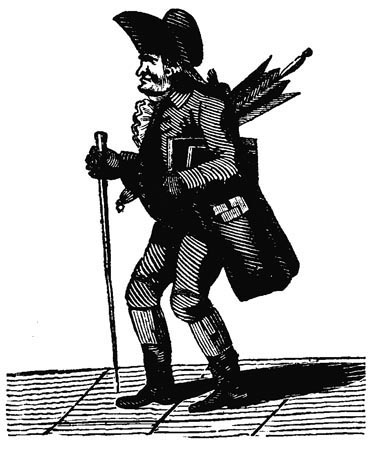
Miss THEODORA DE VERDION, commonly known by the name of CHEVALIER JOHN THEODORA DE VERDION, Who lived in London disguised as a man, a teacher of languages and a walking bookseller.
Reading edition
This singular woman was born in the year 1744, at Leipsic, in Germany, and died at her lodgings in Upper Charles-street, Hatton-Garden, London, July 15, 1802. She was the only daughter of an architect, of the name of Grahn, who erected several edifices in the city of Berlin, particularly the church of St. Peter. She wrote an excellent hand, and had learned the mathematics, the French, Italian, and English languages, and possessed a complete knowledge of her native tongue. Upon her arrival in England, she commenced teacher of the German language, under the name of Dr. John de Verdion. In her exterior, she was extremely grotesque, wearing a bag wig, a large cocked hat, three or four folio books under one arm, and an umbrella under the other, her pockets completely filled with small volumes, and a stick in her right hand.
She had a good knowledge of English books; many persons entertained her for her advice, relative to purchasing them. She obtained a comfortable subsistence from teaching and translating foreign languages, and by selling books chiefly in foreign literature. She taught the Duke of Portland the German language, and was always welcomed to his house; the Prussian Ambassador to our court received from her a knowledge of the English language; and several distinguished noblemen she frequently visited to instruct them in the French tongue; she also taught Edward Gibbon, the celebrated Roman historian, the German language, previous to his visiting that country. This extraordinary female has never been known to have appeared in any other but the male dress since her arrival in England, where she remained upwards of thirty years; and upon occasions she would attend at court, decked in very superb attire; and was well remembered about the streets of London; and particularly frequent in attending book auctions, and would buy to a large amount, sometimes a coach load, &c. Here her singular figure generally made her the jest of the company.
Her general purchase at these sales was odd volumes; which she used to carry to other booksellers, and endeavour to sell, or exchange for other books. She was also a considerable collector of medals and foreign coins of gold and silver; but none of these were found after her decease. She frequented the Furnival's Inn coffee house, in Holborn, dining there almost every day; she would have the first of every thing in season, and was as strenuous for a large quantity, as she was dainty in the quality of what she chose for her table. At times, it is well known, she could dispense with three pounds of solid meat; and, we are sorry to say, she was much inclined to extravagant drinking.
The disorder of a cancer in her breast, occasioned by falling down stairs, she was, after much affliction, at length compelled to make known to a German physician, who prescribed for her; when the disorder turned to a dropsy, defied all cure, and finished the career of so remarkable a lady.
To follow lovers, women there have been Disguis'd as men, who've dar'd the martial scene; Or, in pursuit of an inconstant swain, Experienc'd all the dangers of the main. Not so De Verdion, for some other plan She laid aside the woman for the man. Perhaps she thought, that female garb and looks Ill spoke the gravity of German books; That as a woman she could not pretend To teach, translate, and literature to vend; That as a woman she could never be A Doctor, since 'tis man takes that degree: Who can deny that a bag wig denotes More sense, more consequence, than petticoats? And probably our hero-heroine knew That otherwise her nostrums would not do! But haply Prudence urg'd this strange disguise, (For in concealment modesty oft lies) Assur'd she'd have to deal with wicked men, She might have chose this metamorphose then; And, as poor women always weak are thought, Security from men's appearance sought; Then let not ridicule insult her name, For who can tell but virtue was her aim; That she disclaim'd her sex through pious care, And thus, ye fair ones, left a name that's fair; For, nature's common frailties set aside, She liv'd a Christian, and a Christian died; Nor man nor woman by attire is known, The Proof of all will be the heart alone!