Poor José. (continued 2)
L. Burke translation
José was so much beloved, and possessed so much influence over his companions, that their sport had no longer any interest for them the moment he disapproved of it; so the Angevin was abandoned to his young protector. The nickname alone adhered to him, and it was not long before they discovered in him so much kindness and good-nature, that they soon ceased to have any desire of tormenting him. He obtained the good opinion of all his fellow-students; but José was his friend, and to serve him he would have gone through fire and water.
Solon has, I think, said: "No praise before death;" and he said wisely, for one moment of forgetfulness might tarnish even the most irreproachable life. Who can boast of being infallible, especially in youth? José, the prudent José, learned this to his cost; for, unhappily, these reflections apply to him. It was his first fault; but it was a serious one, as we shall show.
Occasionally, during the summer, José's companions formed themselves into little parties, and spent the day in the country in an inexpensive manner; for they had both good legs and a good appetite, and required only simple fare. They went into the environs of Paris, and returned home in the evening, after spending a pleasant day. But José, though keenly alive to the pleasure of these parties, often refused to join them, as they occasioned a loss of time which to him was very precious. However, the fête of Saint Cloud was approaching, and Francisco proposed going to see the fountains play. This proposition was eagerly acceded to, and José felt a strong desire to accompany them. He had never seen the fountains play, and this sight possesses powerful attractions to a Parisian, and especially to a young man like José, who was ignorant of almost everything foreign to his studies. It was, therefore, decided that they should form a party of twelve, dine at Saint Cloud, and share the expenses between them. José communicated his project to Dame Robert, and this excellent woman loved him too tenderly to oppose what appeared likely to afford him so much pleasure; nevertheless, at the moment of his departure, she followed him to the door, recommending him not to lose his purse in the crowd, and not get into any quarrel with the boothkeepers at the fair. José smiled at her fears, and hastened to rejoin his friends, who were to meet him at the Tuileries.
The young people merrily pursued their way, already amused with the procession of carriages, horses, carts, and pedestrians, like themselves, all taking the same direction. On arriving at Saint Cloud, they commenced with a simple breakfast, the greater part of their little treasure being reserved for their evening meal. They then took a survey of the booths, admired the cascades, listened to the bands, marvelled at the conjurors, and even laughed at Punch's buffoonery, as the numerous spectators of this fête are annually accustomed to do at the same season of the year. They several times fell in with a troop of young men, pupils of a different master, and their rivals in glory and talent. These two studios were jealous and inimical, as well from party spirit as from a sentiment of attachment to their masters; and this animosity had been manifested in more than one encounter of class against class, for there existed between them no individual aversion. On this occasion, they looked at each other with an expression of irony.
"Oh, oh!" cried José's companions, "here are the Princes of Babocheux and Flou-flou."[6]
"Yes, gentlemen," replied the others, "ready to admire your Croûtes aux épinards."[7]
Each made a grimace; but they separated without saying anything more.
Returned to the inn, after having wandered about for a considerable time, José and his companions were prepared to enjoy a repast, dainty to them, from their simple habits; and they contemplated it with a degree of satisfaction, which would have made many young people, spoiled either by fortune or by their parents, shrug their shoulders with contempt. Their table was laid in what was called the garden, a small enclosure surrounded by walls, and covered with a trellis work, ornamented with honey-suckle and vine. This spot was capable of containing five or six tables, separated by partitions, also of trellis work, and though very warm, still there was a little more air there than in the house; besides the circumstances of the guests permitted them no choice, and our young students were therefore very well satisfied at being so comfortably located.
As may be imagined, there was no lack of conversation; this turned at first upon their good cheer, which they had time enough to enjoy, as the waiters were so much occupied, that they allowed full half an hour to intervene between each course.
"Well! Angevin, my friend," said Francisco,—for José's protection had caused him to be received into the party,—"what do you think of this Marinade?[8] something better than your usual fare, hey!"
"I should think so," replied the Angevin, holding out his plate for the third or fourth time. "Plague take the stew, I shan't touch it to-morrow."
"What!" cried the young folks, laughing; "what do you mean by the stew?"
"Oh! nothing, nothing," replied the Angevin, already regretting his indiscretion; but his companions insisting, and José joining in their request, he told them, laughingly, that, finding it impossible to live in Paris in any other than the most economical manner, he had ended, after trying various plans, by purchasing a large stew-pan and an earthen stove. He filled it once a week with turnips, potatoes, and a few slices of bacon, which he boiled altogether, and this ragout, which was hot only for the first time, served him for dinner during the whole week. He was so much accustomed to call it his stew, that the word had inadvertently escaped him in the presence of his companions.
"My poor fellow!" said José, holding out his hand to him. "Poor Angevin!" repeated the others; and, so far from laughing, a momentary silence pervaded the whole party.
"Gentlemen," said Francisco, who blushed at the remembrance of the murmurs which often escaped him on account of what he called his father's unnecessary economy; "I am going to propose a toast: to the success of our worthy comrade! May he gain the prize, even though I should myself have to be left behind him."
The young friends rose, and eagerly touched their glasses, while the Angevin, deeply moved, repeated, in a tone of emotion, "Oh! Berr, Berr, it is to you that I owe all this!"
Their conversation then turned upon painting, and upon the hopes entertained by Francisco and José, who flattered themselves with being this year permitted to compete for the prize, not, however, with the presumptuous hope of obtaining it, for they were both very young, especially José; but the mere fact of being admitted to the competition counted for much, and they might perhaps deserve honourable mention. Francisco had, moreover, an additional motive for desiring, as soon as possible, to distinguish himself. Glory was not the only passion which agitated his breast; for some time past he had grieved at being without fortune or reputation, which prevented him from aspiring to an alliance which would have crowned his fondest wishes. But this prospect was so distant and so uncertain that he had never spoken of it, even to José, except once, and then very vaguely.
Whilst, then, they were conversing upon art, with an enthusiasm worthy of the subject, they were interrupted by a loud noise, which proceeded from a room on the first-floor, immediately above the spot where they were dining. As the window was open, it was easy to overhear what passed, and, by a natural feeling of curiosity, the young guests checked their conversation, in order to listen to their joyous neighbours.
"By the powers!" cried one, "here's a splendid charge[9] it ought to be hung up in Barbe's shop; the veriest rapin[10] would recognise it!"
"Yes," said another, "it is his very self, with his vagabond air! Ah! ah! my gentlemen of the green and yellow school! you fancy you are going to carry off the next prizes from us, do you? We shall see, my lads! we shall see!"
Our young friends looked at each other with indignation, and softly approached the window, in order to hear more, for they recognised their antagonists, who doubtless little imagined they were so near.
"For my part," said one of the rival students, "I fear neither Rivol nor Enguehard, nor even the famous Berr, about whom they make such a fuss; he is ready enough, and up to the tricks of the art, and that's all. Enguehard is an idle dog, who does no good, while Rivol is too well off ever to be anything more than an amateur and a dauber. So down with the Purists, and long life to the Colourists!"
"Long life to the Colourists!" shouted his companions, and they added many other jests so bitter and so personal, that José and his friends, already animated by a few glasses of wine, to which they were unaccustomed, could no longer restrain their indignation, and commenced the attack by throwing into the room plates, knives, and anything else which happened to come in their way. The enemy hastened to the window, and recognising their adversaries, uttered shouts of laughter, which completely exasperated the others. A decanter, thrown by José, struck the forehead of one of the Colourists, who in their turn became furious, and began to make a descent, by means of the trellis-work placed beneath the window, for the purpose of crushing their antagonists. A battle then ensued, amidst bitter insults. Fragments of broken chairs flew about in all directions, the women at the neighbouring tables screamed, the children cried, and the men rushed forward to separate the combatants, without being in the least able to understand the invectives with which they overwhelmed each other, under the names of Purists and Colourists. The landlord of the inn, attracted by the noise, ran towards the scene of action, followed by his waiters, and they succeeded, without much difficulty, in calming those who were only soldiers—for they fought solely for the honour of their corps. But the chiefs did not so readily listen to reason; Enguehard was stretched upon the ground, his arms pinioned by the two stout hands of a Colourist, and José, absolutely out of his senses, was stifling, with the weight of his knee, the young man who had spoken of him with so much contempt, and who had just been conquered by his impetuosity.
These four madmen would listen to nothing, and were at length obliged to be separated by main force; but José, while still struggling, slipped over some pieces of the broken plates, and gave himself so violent a twist that he was unable to rise, and was obliged to remain seated on the ground, suffering excruciating pain.
It being proved by the testimony of eye-witnesses, that the young people in the garden had commenced this memorable battle, by throwing plates into the room, and that the Colourists had only broken the trellis-work in descending, the landlord contented himself with a slight sum as indemnification, and allowed them to depart; but José and his friends had done considerable damage, and had been the first to commence the disturbance; they had only sufficient money to defray the expenses of their dinner, and the innkeeper declared that he would be paid, and that he should send for the police. Francisco increased the man's anger, by the rage into which he put himself; the poor Angevin employed prayers and tears, to soften the innkeeper; while José, ashamed, and in despair, maintained a gloomy silence, abandoning himself to the most melancholy reflections, when his name, pronounced by a severe and well-known voice, made him utter a cry, and hide his face in his hands.
The voice was that of the good and vigilant Gabri, who had been induced by his active friendship for José to follow him to the fête, and to watch over the inexperience which he very justly attributed to him. He had watched the young men from a distance, and determined not to make his appearance, except in case of accident; finally, having been able to find accommodation only at the farther end of the place occupied by them at the inn, he had been the last to arrive at the scene of action.
"Sir," he said coldly to the innkeeper, "estimate the damage done, and make out your account; I will discharge the debts of these madcaps, who are of my acquaintance, and we will afterwards settle matters together."
The host, who was no cheat, and who was, moreover, too happy to be paid without any further trouble, made out a tolerably reasonable account, which Gabri immediately discharged. Then telling Francisco and the Angevin to support José, who was unable to walk, he placed him in a carriage, and drove off with him, after having saluted the troop of students, who were still too much bewildered by what had taken place even to think of thanking him.
Gabri had placed José in the cabriolet in as convenient a position as possible for his injured leg, while he went upon the box himself, and during the whole of their way home never once addressed a single word to the poor sufferer, nor even turned his head towards him, notwithstanding the complaints which the constant jolting of the rude vehicle drew from the culprit. The well-paid coachman took them as far as Dame Robert's door. "There, there he is," said Gabri to the terrified woman, "and now good evening; I will see him again when he has recovered, and grown wiser;" and he turned away without listening to Dame Robert's exclamations, who in her trouble did not perceive that José had almost fainted. He was conveyed to bed, his dislocated ankle set, and his numerous bruises attended to: but the wine which he had taken, and the violent excitement which had followed an excess altogether new to him, brought on a somewhat severe illness, which lasted for several days; and even when it was subdued he was obliged to remain six weeks with his foot resting upon a chair, without being able to move. We may judge of his grief and remorse, which many circumstances contributed to augment. Gabri allowed his heart to be touched by his repentance, and consented to see him; but he was sad, and Dame Robert uneasy; and José was one day deeply grieved to see her, while thinking herself unobserved, lock up a bottle of brandy which was standing near him.
Soon afterwards he had to endure a far more bitter trial. The time for competing for the prizes arrived; Francisco was admitted for the sketches; while José, who was only just beginning to walk, and whose studies had, moreover, been too much interrupted, was obliged to give up all hope for that year, and endure the mortification of finding himself left behind by companions considerably less advanced than himself. Francisco, though sincerely grieved at his friend's misfortune, felt his ardour increased from not having to compete with so formidable a rival. He made astonishing efforts to sustain the honour of the school, but he only obtained the second prize, which did not send its possessor to Rome: the first was carried off by that same chief of the Colourists who had spoken of José with so much contempt: and thus the poor boy remained with the bitter remembrance of two months passed in suffering, of a triumph lost, and of a folly committed.
However, as it is not considered that a young man must necessarily be dishonoured because he has once been intoxicated and beaten, José, after having passed some time in a state of complete apathy, at length took courage. He perceived, that instead of abandoning himself to vain regrets he ought to endeavour to repair his fault, while that intimate consciousness of power, in which even the most modest cannot help believing, told him, that he could repair everything. It usually happens after a first fault, that a young man either turns from the evil path, or pursues it for the rest of his life. José had too much superiority of nature not to profit by experience. Redoubling, therefore, both his assiduity and zeal, he made such marked progress during the course of the current year, that Monsieur G. decided that he also might compete as well as Francisco and Rivol.
The place in which the young people then worked at their prize pictures, was situated at the top of that same Pavilion du Musée, of which we have already spoken. It was divided into several little compartments, or cells, called boxes, in each of which a student was shut up, so as to allow him no communication with his companions, and still less with his master or with strangers. The subject for the picture was chosen by the professors of painting of the Institution; the programme was distributed to the candidates, and when their sketches were made, and received, they were all to commence their pictures at the same time, according to those sketches, without changing anything. Each morning, on arriving, they were rigidly searched, in order to make sure that they brought with them no drawings or engravings which could in any manner aid them. Thus left to their own resources, they passed two months in this manner, en loge, as it is termed; and these pictures, the figures in which were one third the size of life, were publicly exhibited during three days before the prizes were awarded. But although it was strictly forbidden for the pupils to see their respective works, in order, doubtless, to prevent the weak from being aided by the strong, or to take care that a happy idea should remain the sole property of its author—notwithstanding, I say, all these precautions, the students of that time, less sensible perhaps than those of the present day, found means of visiting each other without being perceived. The windows of their cells all looked in the same direction, upon a small, dirty, and almost unfrequented square, in which is now situated one of the gates leading to the quay. These temporary abodes were, as we have already said, situated in the roof, all the windows opening upon wide leads, unprotected by railings. These madcaps, at the imminent risk of breaking their necks by falling from an immense height, glided by this way from one cell to another. The more scrupulous closed their windows, so as to prevent intrusion; but two days before the expiration of the time allowed for the pictures, each student permitted, without difficulty, his work to be inspected by his companions, and the little Areopagus, with remarkable sagacity and impartiality, precisely anticipated the decrees of the greater one, and awarded the first and second prize in such a manner, that there is scarcely an example of their decisions having turned out erroneous.
José, who took the first rank in the sketches, now prepared to submit to this trial, so severe, but, at the same time, so important to him. Monsieur G. had recommended the reputation of his studio to his pupils. Three times had they competed, without any of them obtaining the first prize. It was necessary to repair this disgrace, and be avenged for the late success of the Colourists. In addition to two formidable rivals in the opposition school, José had to contend against his two friends, Francisco and Rivol, who, besides having already competed for the prize, had, also, the advantage of age—José was then only fifteen years and a half old; but these considerations by no means discouraged him; and fired by that enthusiastic and true love of art which overcomes all difficulties, he commenced, though not without emotion, the required picture, the subject of which was the "Death of Hippolytus."
Dame Robert, as may be imagined, was greatly excited, and her mind wholly absorbed by her darling boy's undertaking. Certainly, had she been consulted, José would have had nothing to fear; but neither the good woman's indulgence, nor Gabri's affection, could avail poor José anything—they must wait. "If," said Dame Robert, "I could only see what they are doing, I should soon find out whether José had not left them behind; but they are cloistered up like so many monks, and when the boy comes home at night, he does not even so much as give us a hint as to how things are going on."
Gabri, equally anxious, but more discreet than Dame Robert, did not seek to elicit anything from José; but he watched him carefully, sighed when the poor boy appeared depressed, and rubbed his hands with glee when he seemed happy.
The good-natured Angevin, who was not yet sufficiently advanced to compete for the prize, was deeply interested in the success of his friend; but he felt little uneasiness, for he knew that José was very far superior to his rivals. He too would have liked to have seen his work, but he was obliged to content himself with walking beneath the windows of the young captives, and see their heads pop out and in occasionally, like so many marionettes, with now and then a mahl-stick accompanying them, and serving to complete the resemblance.
Six weeks had passed away, the pictures were advancing, and as, with the exception of José and his companions, the competitors were of different schools, he had seen only the work of his friends; and his own was so far superior to theirs, that a hope which he scarcely dared own, even to himself, made his heart beat high within his breast. He had nothing to fear from the other students, as they were all inferior to Francisco and Rivol. He was standing, therefore, contemplating with a kind of secret pleasure the group of terrified horses which he had just completed, when Francisco tapped at his window, and immediately afterwards leaping into the room, told him, with a countenance expressive of the utmost concern, that he was in despair, and should never succeed with his figure of Aricia, which was in the programme distributed for the picture. Subjects are usually selected with but few female figures, these being more difficult for the young artists, as they cannot have models; and the unfortunate Aricia, which almost all of them had reserved till the last, had completely wrecked both the courage and talent of Francisco. He looked with admiration on José's Aricia, for he had been entirely successful, at least in his sketch. José, anxious to soothe the agitation of his friend, accompanied him across the leads to his cell, in order to examine the figure which so much distressed him: he found it awkward, ill-drawn, and in bad taste, and could not conceal from his friend that he thought it detestable. This, of course, served only to increase Francisco's despair. He dashed his palette to the ground, stamped upon it, broke his brushes, and ended by crying with rage. José embraced and tried to soothe him, and at length, by dint of kindness and encouragement, succeeded in persuading him that all was not yet lost, and that he could still repaint the figure during the week that yet remained to them. He pointed out to him what he had to avoid, and raised his courage by dwelling on the merits of the rest of the picture. At last, after having spent two hours in this manner, he left him, if not entirely consoled, at least sufficiently recovered to resume his work.
The following days Francisco repainted his unfortunate figure, but still without success; he effaced it, recommenced, again effaced it, and at last succeeded in completing it; but in a manner so far inferior to the other parts of the composition, that it formed a blemish which destroyed the general effect. Such was the opinion of his companions, when, according to the rule established among them, they visited each other to judge of the respective merits of their productions. They had still four days to remain at work, and the pictures were not completely finished, but it was easy to judge which would obtain the prize; and José was regarded as the conqueror, provided he completed the figure of Aricia as he had done the group of Hippolytus and his horses. Next to his, came Francisco's picture, then Rivol's, the others were very far from the mark, and need, therefore, cause them no anxiety.
Francisco, deprived of the last ray of hope by the decision of his companions, as well as by that of his own judgment, shut himself up in his cell, and would not allow José to enter, though he entreated for admittance. He gave no reply to these friendly solicitations, and the intensity of his annoyance had rendered him so unjust, that to avoid seeing José, who lay crouched upon the narrow ledge of the window, he took a large piece of linen, which served him for a blind, and fastened it before the window. José listened to him for some time pacing up and down and groaning with despair; but seeing that his perseverance was useless and importunate he retired, deeply grieved at his distress.
He passed a sleepless night, and the next morning no sooner had he reached his own cell than he ran to Francisco's; but he was not there, his picture still rested upon the easel, and for a moment José thought of retouching the figure of Aricia. But this would have been a palpable fraud, and his honour revolted from its commission. Francisco, moreover, would never have consented to triumph by such disgraceful means. José, therefore, laid down the brush which he had taken up, and with a heavy heart returned to his own cell.
Whilst painting the figure which had proved so fatal to poor Francisco, he vainly sought some method of serving him, and his tender friendship made him almost desire that his Aricia might not be better than his companion's. He worked with so little care, that, had any one else been in the case, his wishes would have been accomplished; but, as it often happens with artists, the very thing that he took the least pains with turned out the best; and, to make use of a familiar expression, this figure came so happily, that even an experienced painter would not have been ashamed to own it.
With a mind absorbed in reflection, José painted on almost without heeding what he did, and it was not until he rose up, when all was completed, that he perceived that the last touches seemed to have been given by the hand of a master, rather than by that of a pupil. His first feeling was one of intense joy, but it was soon overshadowed by the thought of Francisco. He felt that the prize was his, but soon one of those noble inspirations which elevated minds alone receive in their happiest moments, presented itself to his imagination, and showed him that the safety of his friend depended solely upon him.
By one of the old rules of the professors, the pupil who presented his picture with a figure completely erased, or otherwise defaced, was on this account excluded from the competition; his picture was exhibited with the others, but was not taken into account in the awarding of the prizes, even though it were a masterpiece in comparison with the rest. This rule, which it was found rarely necessary to apply, was unknown to most of the students. José had become informed of it during his residence at M. Barbe's, but he was quite sure that Francisco knew nothing about it. His friend's picture was the best, after his own; and by having the courage to destroy the figure of Aricia, which alone would have ensured the prize to a work of less merit, Francisco would remain without a rival.
At first José seized upon this idea with all the warmth of generous affection, but, on raising his eyes to his work, he began to think the sacrifice beyond his strength. Pacing his cell with agitation, he thought of the honour of being crowned at the age of sixteen, of the pleasure of going to Italy, and of the advantage his studies would derive from the journey.
"But," said he, turning his back upon his picture, "Francisco needs it almost as much as myself; the means of his parents are almost exhausted by the efforts they have made for his education; his mother's health requires a warmer climate; if Francisco gains the prize his family will follow him,..." and José again approached his easel.
"Francisco is nearly twenty," he continued; "he has already obtained a second prize, and thus cannot have it again; his age will soon exclude him from the competition, while I have still two or three years before me; moreover, he spoke to me of a vague hope which he entertained of a happy marriage, to which his want of fortune might one day be the only obstacle. If a brilliant success were to overcome this obstacle? If the happiness of his future life depended upon what I am about to do?..." José trembled, opened a box, took out his palette knife, and approached the head of the charming Aricia—but again he paused.
"If I were only to injure it a little," he thought, "alas! it would still be better than my poor friend's!"... and he cast a look of approbation upon the canvas. But soon a thought presented itself, which dispelled his irresolution, and strengthened his wavering heroism. He recalled that painful moment when, despised, falsely accused, on the point of being driven from the house by Barbe, and without hope of justification, Francisco did not fear to own the truth, and to re-establish, at his own cost, the honour of the poor little Savoyard. The honourable career which was now before him commenced from that moment; all that he was, all that he hoped to be, sprang, in the first instance, from Francisco's generous confession.... José no longer hesitated, he resumed his knife, and with a firm hand so erased the figure that nothing but the sketch remained—and thus nobly repaid the debt of friendship formerly contracted to his young companion.
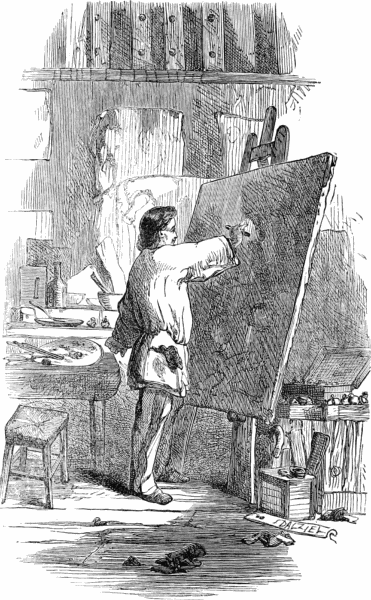
José erasing his Figure of Aricia, p. 301.
Satisfied with himself, and more calm after this trial of strength—an act of high virtue in a young man of sixteen—José gave the last touches to the other parts of his picture, and so cleverly managed the erasure, that nothing more could be inferred from it, than one of those movements of irritability by no means uncommon among students. He kept his secret until the day previous to the one on which the pictures were to be removed. He then called upon Francisco at his father's, and told him that his figure of Aricia was unfinished, and indeed in a great measure effaced, and that there was not time to repaint it. Francisco, recovered from his unjust displeasure, grieved for and blamed his friend; but, being ignorant of the rule of exclusion, he assured him that the prize would still be his, and José did not attempt to remove his impression.
But José had still severe trials to encounter: he foresaw the grief of Dame Robert, Gabri's disappointment, and finally a whole year's work before he could again reach the desired goal, which he had so nearly attained; but the most painful moment was past, and he awaited that in which Francisco should be triumphant, as the only compensation worthy of him.
The exhibition of pictures was held, as usual, in a small room on the basement floor, now appropriated to another use. The artistic crowd arrived, and was constantly renewed during three entire days; and the young students, mingling with it, heard alike the censure and praise unreservedly bestowed, and often even with the knowledge that the young authors of the works were present. The universal opinion was in favour of the pictures of José and Francisco; but the spectators were constantly heard to exclaim, "A figure erased! what a pity! what madness!"
At length, on the fourth day, after a private conference, the professors summoned before them the trembling candidates, and José's sacrifice did not prove unavailing. He heard Francisco Enguehard proclaimed for the first prize, Rivol for the second, and he scarcely heard the honourable mention made of himself, notwithstanding the fatal figure which had excluded him from the competition.
Francisco, surprised and bewildered at such unexpected happiness, scarcely knew what he was about; he did not hear the felicitations of his companions, but allowed himself to be led away by José, who made him run until he reached his father's house.
"He has gained the prize!" cried José, at the foot of the stairs, "Francisco has gained the prize!" and seeing his friend in the arms of his parents, who wept while they blessed him, this noble youth was rewarded by a pleasure more intense and more elevated than any which his own triumph could have afforded him.
Leaving Francisco in the arms of his happy mother, who was never weary of looking at him, and who even thought him handsomer, now that the laurel decked his brow, José bent his steps homeward, and perceived in the distance Dame Robert and Gabri anxiously awaiting his return.
"He walks rapidly," said Dame Robert; "so much the better, he bears us good news."—"He looks happy," continued Gabri: "Oh, if he has gained the prize! at sixteen, too!" and already a smile of joy shone upon the countenance of this excellent man.
"Congratulate me, my friends," cried José, as he approached them; "I am happy in my failure; Francisco has gained the prize!"
"Francisco!" exclaimed Dame Robert, letting fall her arms, already extended to embrace him; "and you? Have you gained nothing? On my word there must be some abominable trickery in the affair."
"No," replied José smiling, "but be comforted, my good mother, I am neither depressed nor discouraged, and next year you shall see the laurels on my brow."
"But," said Gabri, in a tone of vexation, "who obtained the second prize?"
"Rivol," replied José; "and I might perhaps have had it if ..." and he looked timidly at Gabri, "if I had not erased my figure of Aricia."
"Yes!" exclaimed Gabri, as if talking to himself, "I was sure of it, I suspected as much at the exhibition.... José, José, embrace me, my son. Gracious Heaven! this is the first day I have passed without regretting the loss of my own noble boys."
Gabri was too familiar with artistic matters not to have divined the sacrifice which José's friendship had induced him to make, and his heart was capable of appreciating and rejoicing in it; but Dame Robert, who understood nothing of the matter, save that her boy was rejected, gave free vent to her dissatisfaction.
"Indeed, M. Gabri, it is very fine to pet him up after such a failure as that. Who would have thought it? It was well worth while to be shut up for two months without uttering a syllable, to let others walk off with the prize; still your picture was very fine, my boy, though, to tell you the truth, your female figure was too pale. I told you, however, not to spare your colours, but young people will always have their own way."
José smiled, and hastened to tranquillize the good woman. So far as concerned himself he succeeded without much difficulty; but she was for some time out of humour with Gabri, whose triumphant air annoyed her, because she did not understand it. Nor did she gain any information on the subject, for Gabri was discreet, and would not divulge José's secret; he did not even seek an explanation from the lad himself; but his marks of friendship were increased, and he more frequently repeated, "My son José!"
At the annual meeting of the Academy, when the students publicly receive the laurel crown, awarded for the merits of their works, José appeared more pleased than Francisco. He was restless, busying himself with his friend's toilet, &c.; and, placed in a corner of the room during the ceremony, the spectators might have imagined, from his excitement and his looks, when Francisco Enguehard was proclaimed, that he was the happy father of the young laureate, were it not that his almost childish features precluded the supposition.
A month after this great epoch for the two friends, they were separated; Francisco and his parents took the route to Italy; and José having returned to his studies, pursued them with ardour and contentment in thinking of the happiness which he had been the means of securing to three persons.
The year passed, and when again about to compete for the prize, José wrote to his friend, and told him to expect him in three months from that date. He felt confidence in himself, and had acquired so much power, that notwithstanding the merits of seven competitors, all older than himself, his picture was unanimously declared the best. It was even so superior to anything usually seen at these competitions, that it was thought proper to allow the exhibition to remain open several days longer than usual, in order to gratify the crowd of amateurs who flocked to see it. Dame Robert fully enjoyed José's triumph, and the almost equal pleasure of relating its history to her neighbours. Gabri rubbed his hands, and bent his head while listening to the praises of the young artist, and the honest Barbe exultingly boasted of having supplied for this famous picture the finest and the best canvas in his shop.
José, overwhelmed with honours, and full of joy, set out on his way to Rome, where he found Francisco, who had still four years remaining of the five granted by the government. Monsieur and Madame Enguehard received José as a second son; he lived in the same house with them, and enjoyed, in all its fulness, the delights of a life devoted to friendship and the fine arts, in that beautiful land where these arts so naturally flourish.
Many years have passed away since these events took place. Monsieur and Madame Barbe, grown rich and old, have retired, and given up their business to the excellent Gabri. A new generation of artists and students frequents the shop, and pursues pretty nearly the same habits as that which preceded it. But it is not in the same spot; the theatre of José's first exploits no longer exists. The two large posts may still, indeed, be seen; but Barbe's house has been taken down, and in its place monkeys and learned birds, attract by their various tricks, numerous spectators. Francisco Enguehard, steady and talented, is married, as he wished, to the only daughter of a rich antiquary, who desired to have for a son-in-law, a man of genius. Dame Robert has given up her business to her eldest son, and rests her fingers, if not her tongue, for she is never weary of relating to any one who will listen to her, how that José was a poor orphan, how she took him and put him to sleep on her counter, &c., &c. Philip, a worthy fellow, and a passable tailor, is married and settled, as he says, in his wife's native province, that is to say in the Marais. The poor Angevin, still a bad painter, notwithstanding all his efforts and perseverance, has returned to Angers. There, at least, he has talent, and directs in his turn the same school which sent him to Paris. He who was called poor José is now one of our most distinguished artists. He possesses a respectable fortune, acquired by his talents, and, what is far more valuable to him, the universal esteem granted to the most noble character and the most irreproachable conduct. Faithful alike to delicacy and friendship, Francisco never knew the sacrifice which obtained for him his crown. José's laurels are suspended in his magnificent studio, beside his first palette, and his shoeblack's knife. He watches over Gabri, as a son over a father; listens to the long stories of the good old Dame Robert, without the least sign of impatience; and, finally, though young, handsome, and sought after, he always wears clothes made by Philip, and boasting of little elegance, with shoes of the same kind from Dame Robert's shop: and this is not the least remarkable trait in his history.