CUSTOMS OF ANCIENT DAYS.
Reading edition
SANDING THE STEP ON NEW YEAR’S-DAY.
“They say, miracles are past, and we have our philosophical persons, to make modern and familiar things supernatural and causeless. Hence is it that we make trifles of terrors, ensconcing ourselves into seeming knowledge.”—All’s Well that Ends Well—Shakespeare.
In the rural districts of Cornwall, it is thought to be unlucky if a female is the first to enter the house on new-year’s morning. To insure the contrary, it was customary to give boys some small reward for placing sand on the door-steps and in the passage.
In many places, not many years since, droves of boys would march through the towns and villages, collecting their fees for “sanding your step for good luck.”
This custom prevails over most parts of England. I know a lady who, at the commencement of the present year, sent a cabman into her house before her, upon promise of giving him a glass of spirits, so that she might insure the good luck which depends upon “a man’s taking the new year in.”
MAY-DAY.
The first of May is inaugurated with much uproar. As soon as the clock has told of midnight, a loud blast on tin trumpets proclaims the advent of May. This is long continued. At daybreak, with their “tintarrems,” they proceed to the country, and strip the sycamore-trees (called May-trees) of all their young branches, to make whistles. With these shrill musical instruments they return home. Young men and women devote May-day to junketing and pic-nics.
It was a custom at Penzance, and probably at many other Cornish towns, when the author was a boy, for a number of young people to sit up until twelve o’clock, and then to march round the town with violins and fifes, and summon their friends to the Maying.
When all were gathered, they went into the country, and were welcomed at the farmhouses at which they called, with some refreshment in the shape of rum and milk, junket, or something of that sort.
They then gathered the “May,” which included the young branches of any tree in blossom or fresh leaf. The branches of the sycamore were especially cut for the purpose of making the “May music.” This was done by cutting a circle through the bark to the wood a few inches from the end of the branch. The bark was wetted and carefully beaten until it was loosened and could be slid off from the wood. The wood was cut angularly at the end, so as to form a mouth-piece, and a slit was made in both the bark and the wood, so that when the bark was replaced a whistle was formed. Prepared with a sufficient number of May whistles, all the party returned to the town, the band playing, whistles blowing, and the young people singing some appropriate song.
SHROVE TUESDAY AT ST IVES.
Formerly it was customary for the boys to tie stones to cords, and with these parade the town, slinging these stones against the doors, shouting aloud,—
“Give me a pancake, now—now—now, Or I’ll souse in your door with a row—tow—tow.”
A genteel correspondent assures me “this is observed now in the lower parts of the town only.”
“THE FURRY”—HELSTONE.
This ancient custom, which consists in dancing through the streets of the town, and entering the houses of rich and poor alike, is thus well described:—
“On the 8th of May, at Helstone, in Cornwall, is held what is called ‘the Furry.’ The word is supposed by Mr Polwhele to have been derived from the old Cornish word fer, a fair or jubilee. The morning is ushered in by the music of drums and kettles, and other accompaniments of a song, a great part of which is inserted in Mr Polwhele’s history, where this circumstance is noticed. So strict is the observance of this day as a general holiday, that should any person be found at work, he is instantly seized, set astride on a pole, and hurried on men’s shoulders to the river, where he is sentenced to leap over a wide place, which he, of course, fails in attempting, and leaps into the water. A small contribution towards the good cheer of the day easily compounds for the leap. About nine o’clock the revellers appear before the grammar-school, and demand a holiday for the schoolboys, after which they collect contributions from houses. They then fade into the country, (fade being an old English word for go,) and, about the middle of the day, return with flowers and oak-branches in their hats and caps. From this time they dance hand in hand through the streets, to the sound of the fiddle, playing a particular tune, running into every house they pass without opposition. In the afternoon a select party of the ladies and gentlemen make a progress through the street, and very late in the evening repair to the ball-room. A stranger visiting the town on the eighth of May would really think the people mad, so apparently wild and thoughtless is the merriment of the day. There is no doubt of ‘the Furry’ originating from the ‘Floralia,’ anciently observed by the Romans on the fourth of the calends of May.”—Every-Day Book.
MIDSUMMER SUPERSTITIOUS CUSTOMS.
If on midsummer-eve a young woman takes off the shift which she has been wearing, and, having washed it, turns it wrong side out, and hangs it in silence over the back of a chair, near the fire, she will see, about midnight, her future husband, who deliberately turns the garment.
If a young lady will, on midsummer-eve, walk backwards into the garden and gather a rose, she has the means of knowing who is to be her husband. The rose must be cautiously sewn up in a paper bag, and put aside in a dark drawer, there to remain until Christmas-day.
On the morning of the Nativity the bag must be carefully opened in silence, and the rose placed by the lady in her bosom. Thus she must wear it to church. Some young man will either ask for the rose, or take it from her without asking. That young man is destined to become eventually the lady’s husband.
“At eve last midsummer no sleep I sought, But to the field a bag of hemp-seed brought; I scatter’d round the seed on every side, And three times in a trembling accent cried,— ‘This hemp-seed with my virgin hand I sow, Who shall my true love be, the crop shall mow.’ I straight look’d back, and, if my eyes speak truth, With his keen scythe behind me came the youth.” Gay’s Pastorals.
The practice of sowing hemp-seed on midsummer-eve is not especially a Cornish superstition, yet it was at one time a favourite practice with young women to try the experiment. Many a strange story have I been told as to the result of the sowing, and many a trick could I tell of, which has been played off by young men who had become acquainted with the secret intention of some maidens. I believe there is but little difference in the rude rhyme used on the occasion,—
“Hemp-seed I sow, Hemp-seed I hoe,”
(the action of sowing the seed and of hoeing it in, must be deliberately gone through;)—
“And he Who will my true love be, Come after me and mow.”
A phantom of the true lover will now appear, and of course the maid or maidens retire in wild affright.
If a young unmarried woman stands at midnight on midsummer-eve in the porch of the parish church, she will see, passing by in procession, every one who will die in the parish during the year. This is so serious an affair that it is not, I believe, often tried. I have, however, heard of young women who have made the experiment. But every one of the stories relate that, coming last in the procession, they have seen shadows of themselves; that from that day forward they have pined, and ere midsummer has again come round, that they have been laid to rest in the village graveyard.
CRYING THE NECK.
Owing to the uncertain character of the climate of Cornwall, the farmers have adopted the plan of gathering the sheaves of wheat, as speedily as possible, into “arish-mows.” These are solid cones from ten to twelve feet high, the heads of the stalks turned inwards, and the whole capped with a sheaf of corn inverted. Whence the term, I know not; but “arish” is commonly applied to a field of corn recently cut, as, “Turn the geese in upon the ‘arish’”—that is, the short stubble left in the ground.
After the wheat is all cut, on most farms in Cornwall and Devon, the harvest people have a custom of “crying the neck.” I believe that this practice is seldom omitted on any large farm in these counties. It is done in this way. An old man, or some one else well acquainted with the ceremonies used on the occasion, (when the labourers are reaping the last field of wheat,) goes round to the shocks and sheaves, and picks out a little bundle of all the best ears he can find; this bundle he ties up very neat and trim, and plats and arranges the straws very tastefully. This is called “the neck” of wheat, or wheaten-ears. After the field is cut out, and the pitcher once more circulated, the reapers, binders, and the women stand round in a circle. The person with “the neck” stands in the centre, grasping it with both his hands. He first stoops and holds it near the ground, and all the men forming the ring take off their hats, stooping and holding them with both hands towards the ground. They then all begin at once, in a very prolonged and harmonious tone, to cry, “The neck!” at the same time slowly raising themselves upright, and elevating their arms and hats above their heads; the person with the neck also raising it on high. This is done three times. They then change their cry to “We yen! we yen!” which they sound in the same prolonged and slow manner as before, with singular harmony and effect, three times. This last cry is accompanied by the same movements of the body and arms as in crying “the neck.” I know nothing of vocal music, but I think I may convey some idea of the sound by giving you the following notes in gamut:—
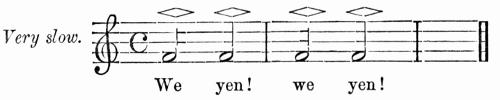
Let these notes be played on a flute with perfect crescendoes and diminuendoes, and perhaps some notion of this wild-sounding cry may be formed. Well, after this they all burst out into a kind of loud joyous laugh, flinging up their hats and caps into the air, capering about, and perhaps kissing the girls. One of them then gets “the neck,” and runs as hard as he can down to the farmhouse, where the dairy-maid, or one of the young female domestics, stands at the door prepared with a pail of water. If he who holds “the neck” can manage to get into the house in any way unseen, or openly by any other way than the door at which the girl stands with the pail of water, then he may lawfully kiss her; but, if otherwise, he is regularly soused with the contents of the bucket. I think this practice is beginning to decline of late, and many farmers and their men do not care about keeping up this old custom. The object of crying “the neck” is to give notice to the surrounding country of the end of the harvest, and the meaning of “we yen” is “we have ended.” It may probably mean “we end,” which the uncouth and provincial pronunciation has corrupted into “we yen.” The “neck” is generally hung up in the farmhouse, where it often remains for three or four years.
DRINKING TO THE APPLE-TREES ON TWELFTH NIGHT EVE.
In the eastern part of Cornwall, and in western Devonshire, it was the custom to take a milk-panful of cider, into which roasted apples had been broken, into the orchard. This was placed as near the centre of the orchard as possible, and each person, taking a “clomben” cup of the drink, goes to different apple-trees, and addresses them as follows:—
“Health to the good apple-tree; Well to bear, pocketfuls, hatfuls, Peckfuls, bushel-bagfuls.”
Drinking part of the contents of the cup, the remainder, with the fragments of the roasted apples, is thrown at the tree, all the company shouting aloud. Another account tells us, “In certain parts of Devonshire, the farmer, attended by his workmen, goes to the orchard this evening; and there, encircling one of the best bearing trees, they drink the following toast three times:—
‘Here’s to thee, old apple-tree; Hence thou mayst bud, and whence thou mayst blow, And whence thou mayst bear apples enow! Hats full! caps full! Bushel, bushel-sacks full! And my pockets full, too! Huzza!’
This done, they return to the house, the doors of which they are sure to find bolted by the females, who, be the weather what it may, are inexorable to all entreaties to open them, till some one has guessed what is on the spit, which is generally some nice little thing difficult to be hit on, and is the reward of him who first names it. The doors are then thrown open, and the lucky clodpole receives the tit-bit as his recompense. Some are so superstitious as to believe that if they neglect this custom, the trees will bear no apples that year.”[54]
Christmas-eve was selected in some parts of England as the occasion for wishing health to the apple-tree. Apples were roasted on a string until they fell into a pan of spiced ale, placed to receive them. This drink was called lamb’s-wool, and with it the trees were wassailed, as in Devonshire and Cornwall.
Herrick alludes to the custom:—
“Wassaile the trees, that they may beare You many a plum, and many a peare; For more or lesse fruits they will bring, And you do give them wassailing.”
May not Shakespeare refer to this?—
“Sometimes lurk I in a gossip’s bowl, In very likeness of a roasted crab; And when she drinks, against her lips I bob, And on her wither’d dew-lap pour the ale.” Midsummer Night’s Dream.
In some localities apples are blessed on St James’s-day, July 25.
ALLHALLOWS-EVE AT ST IVES.
The ancient custom of providing children with a large apple on Allhallows-eve is still observed, to a great extent, at St Ives. “Allan-day,” as it is called, is the day of days to hundreds of children, who would deem it a great misfortune were they to go to bed on “Allan-night” without the time-honoured Allan apple to hide beneath their pillows. A quantity of large apples are thus disposed of, the sale of which is dignified by the term Allan Market.
THE TWELFTH CAKE.
The custom, apparently a very ancient one, of putting certain articles into a rich cake, is still preserved in many districts. Usually, sixpence, a wedding-ring, and a silver thimble are employed. These are mixed up with the dough, and baked in the cake. At night the cake is divided. The person who secures the sixpence will not want money for that year; the one who has the ring will be the first married; and the possessor of the thimble will die an old maid.
“Then also every householder, To his abilitie Doth make a mighty cake, that may Suffice his companie: Herein a pennie doth he put, Before it come to fire; This he divides according as His household doth require, And every peece distributeth As round about they stand, Which in their names unto the poor Is given out of hand. But who so chanceth on the peece Wherein the money lies, Is counted king amongst them all; And is with shoutes and cries Exalted to the heavens up.” Naogeorgus’s Popish Kingdom.
OXEN PRAY ON CHRISTMAS EVE.
I remember, when a child, being told that all the oxen and cows kept at a farm, in the parish of St Germans, at which I was visiting with my aunt, would be found on their knees when the clock struck twelve. This is the only case within my own knowledge of this widespread superstition existing in Cornwall. Brand says, “A superstitious notion prevails in the western parts of Devonshire, that at twelve o’clock at night on Christmas-eve, the oxen in their stalls are always found on their knees, as in an attitude of devotion; and that, (which is still more singular,) since the alteration of the style, they continue to do this only on the eve of old Christmas-day. An honest countryman, living on the edge of St Stephen’s Down, near Launceston, Cornwall, informed me, October 28, 1790, that he once, with some others, made a trial of the truth of the above, and, watching several oxen in their stalls at the above time,—at twelve o’clock at night,—they observed the two oldest oxen only, fall upon their knees and, as he expressed it in the idiom of the country, make ‘a cruel moan, like Christian creatures.’ I could not, but with great difficulty, keep my countenance: he saw, and seemed angry, that I gave so little credit to his tale; and, walking off in a pettish humour, seemed to ‘marvel at my unbelief.’ There is an old print of the Nativity, in which the oxen in the stable, near the Virgin and the Child, are represented upon their knees, as in a suppliant posture. This graphic representation has probably given rise to the above superstitious notion on this head.”
“ST GEORGE”—THE CHRISTMAS PLAYS.
The Christmas play is a very ancient institution in Cornwall. At one time religious subjects were chosen, but those gave way to romantic plays. The arrangements were tolerably complete, and sometimes a considerable amount of dramatic skill was displayed.
“St George, and the other tragic performers, are dressed out somewhat in the style of morris-dancers, in their shirt sleeves and white trousers, much decorated with ribbons and handkerchiefs, each carrying a drawn sword in his hand, if they can be procured, otherwise a cudgel. They wear high caps of pasteboard, adorned with beads, small pieces of looking-glass, coloured paper, &c.; several long strips of pith generally hang down from the top, with small pieces of different coloured cloth strung on them: the whole has a very smart effect.
Father Christmas is personified in a grotesque manner, as an ancient man, wearing a large mask and wig, and a huge club, wherewith he keeps the bystanders in order.
The Doctor, who is generally the merry-andrew of the piece, is dressed in any ridiculous way, with a wig, three-cornered hat, and painted face.
The other comic characters are dressed according to fancy.
The female, where there is one, is usually in the dress worn half a century ago.
The hobby-horse, which is a character sometimes introduced, wears a representation of a horse’s-hide.
Beside the regular drama of “St George,” many parties of mummers go about in fancy dresses of every sort, most commonly the males in female attire, and vice versâ.
Battle of St George.
[One of the party steps in, crying out,—
Room, a room, brave gallant, room, Within this court I do resort, To shew some sport And pastime, Gentlemen and ladies, in the Christmas time.
[After this note of preparation, Old Father Christmas capers into the room, saying,—
Here comes I, Old Father Christmas, Welcome or welcome not; I hope Old Father Christmas Will never be forgot.
I was born in a rocky country, where there was no wood to make me a cradle; I was rocked in a stouring-bowl, which made me round shouldered then, and I am round shouldered still.
[He then frisks about the room, until he thinks he has sufficiently amused the spectators, when he makes his exit, with this speech:—
Who went to the orchard to steal apples to make gooseberry pies against Christmas?
[These prose speeches, you may suppose, depend much upon the imagination of the actor.
Enter Turkish Knight.
Here comes I, a Turkish knight, Come from the Turkish land to fight; And if St George do meet me here, I’ll try his courage without fear.
Enter St George.
Here come I, St George, That worthy champion bold; And, with my sword and spear, I won three crowns of gold. I fought the dragon bold, And brought him to the slaughter; By that I gain’d fair Sabra, The King of Egypt’s daughter. T. K. St George, I pray, be not too bold; If thy blood is hot, I’ll soon make it cold. St G. Thou Turkish knight, I pray, forbear; I’ll make thee dread my sword and spear.
[They fight until the Turkish Knight falls.
St G. I have a little bottle, which goes by the name of Elicumpane; If the man is alive, let him rise and fight again.
[The Knight here rises on one knee, and endeavours to continue the fight, but is again struck down.
T. K. Oh, pardon me, St George; oh, pardon me, I crave; Oh, pardon me this once, and I will be thy slave. St G. I’ll never pardon a Turkish knight; Therefore arise, and try thy might.
[The Knight gets up, and they again fight, till the Knight receives a heavy blow and then drops on the ground as dead.
St G. Is there a doctor to be found, To cure a deep and deadly wound?
Enter Doctor.
Oh yes, there is a doctor to be found, To cure a deep and deadly wound. St G. What can you cure? Doctor. I can cure the itch, the palsy, and gout: If the devil’s in him, I’ll pull him out.
[The Doctor here performs the cure with sundry grimaces, and St George and the Knight again fight, when the latter is knocked down, and left for dead.
[Then another performer enters, and, on seeing the dead body, says,—
Ashes to ashes, dust to dust; If Uncle Tom Pearce won’t have him, Aunt Molly must.
[The hobby-horse here capers in, and takes off the body.
Enter Old Squire.
Here comes I, old, Old Squire, As black as any friar, As ragged as a colt, To leave fine clothes for malt.
Enter Hub Bub.
Here comes I, old Hub Bub Bub Bub; Upon my shoulders I carries a club, And in my hand a frying-pan, So am I not a valiant man?
[These characters serve as a sort of burlesque on St George and the other hero, and may be regarded in the light of an anti-masque.
Enter the Box-holder.
Here comes I, great head and little wit; Put your hand in your pocket, and give what you think fit. Gentlemen and ladies, sitting down at your ease, Put your hands in your pockets, and give me what you please. St G. Gentlemen and ladies, the sport is almost ended; Come pay to the box, it is highly commended. The box it would speak, if it had but a tongue; Come throw in your money, and think it no wrong.
The characters now generally finish with a dance, or sometimes a song or two is introduced. In some of the performances, two or three other tragic heroes are brought forward, as the King of Egypt and his son, &c.; but they are all of them much in the style of that I have just described, varying somewhat in length and number of characters.”—The Every-Day Book.
Of the Cornish mystery plays which were once acted in the famous “Rounds,” it is not necessary, in this place, to say anything. The translations by Mr Norris preserve their characteristics, which indeed differ in few respects from the mystery plays of other parts.
The “Perran Round” is fortunately preserved by the proprietor in its original state. Every one must regret the indifference of the wealthy inhabitants of St Just to their “Round,” which is now a wretched ruin.
GEESE-DANCING—PLOUGH MONDAY.
The first Monday after Twelfth-day is Plough Monday, and it is the ploughman’s holiday.
At this season, in the Islands of Scilly, at St Ives, Penzance, and other places, the young people exercise a sort of gallantry called “geese-dancing.” The maidens are dressed up for young men, and the young men for maidens; and, thus disguised, they visit their neighbours in companies, where they dance, and make jokes upon what has happened during the year, and every one is humorously “told their own,” without offence being taken. By this sort of sport, according to yearly custom and toleration, there is a spirit of wit and drollery kept up among the people. The music and dancing done, they are treated with liquor, and then they go to the next house, and carry on the same sport. A correspondent, writing to the “Table-Book,” insists on calling these revels “goose-dancing.” The true Cornishman never uses the term, which is, as I have elsewhere shewn, derived from dance deguiser,—hence guise-dancing, or geese-dancing, by corruption.
CHRISTMAS AT ST IVES.
“THE GUISE-DANCING.”
“We doubt if there is a spot in ‘merrie England’ where Christmas receives so hearty a welcome, and is ‘made so much of,’ as in the old-fashioned ‘antient borough of beloved St Ives.’ It is often said that ‘extremes meet;’ but as well might we expect the extremities of Britain—John o’Groat’s and Cape Cornwall—to meet, as that the frolic-loving descendants of Albion will ever imitate the cold, mountain-nurtured Caledonians in their observance of Christmas time. For months previous to the merry-making time, preparations are made for the approaching ‘carnival;’ we can assure our readers that never were the real ‘carnivals’ ushered in with greater festivities at Rome or Venice, in the zenith of their glory, than is observed here at Christmas. Were many of the denizens of our large towns to witness the making up of the scores of ‘sugar-loaf,’ ‘three-cocked,’ and indescribable-shaped hats, caps, bonnets, bloomer skirts, leggings, jackets, &c., numberless et ceteras of the most grotesque and pantomimic character, colour, and shape, which goes on in October and November, they would imagine there was to be a bal masque on a large scale, or a pantomime at ‘the theatre,’ of metropolitan proportions. But not so, for there is not even a singing class in the town, if we except the choirs of the various congregations, and all ‘this wilful waste’ of long cloth, scarlet, ringstraked, and speckled, is to do honour to King Christmas during the twelve nights which intervene ’twixt the birth of Christmas common and Christmas proper, which said outward manifestations of honour are known in the neighbourhood as ‘Christmas geezze-daancing,’ or guise-dancing; but of this presently. Not only are the ‘lovers of pleasure’ on the alert, but the choirs of the different places of worship strive to ‘get up’ a piece or two to tickle the ears of their hearers on Christmas-night, and the house that boasts the best ‘singing seat’ is sure to be crammed by persons attracted by the twofold advantage of a short sermon and a good lively tune. A pretty brisk trade is carried on by children in the retailing unquenched lime, in small quantities to suit the convenience of purchasers; and few are the domiciles but have had a lick of the lime brush, either on the wall, window-sill, door-post, or chimney. ‘A slut, indeed,’ is she declared who refuses to have a thorough clean out before Christmas. New shoes and clothes are worn for the first time on the great holiday; and woe betide the unlucky Crispin who, by some unaccountable oversight, has neglected to make Jennifer’s bran new shoes, for her to go and see how smart the church is on Christmas-day. As in other parts of England, a pretty large sum is spent in evergreens, such as holly, or, as it is called here, ‘prickly Christmas,’ bays, and laurels. Of mistletoe and cypress there is very little in the neighbourhood, and the windows of shops and private dwellings, as well as the parish church, are profusely and tastefully decorated. As to provisions there is no lack. Many a flock of geese has been bespoken, and set apart for private customers; whilst the ears of the grocers, who generally do a supplementary trade in swine’s flesh, are so accustomed to receive a month’s notice for ‘a nice bit of flea (spare) rib,’ that they are loth to engage any of the porcine fraternity that are not all rib. The Christmas market is not a mean affair at St Ives; if the butchers cannot boast of many prize oxen or ‘South Downs,’ they generally manage to make the best of their ‘home-raised’ and well-fed cattle, and the stalls are ‘titivated off’ nicely too. This year, however, the inspector of nuisances, who is also market-toll collector and police constable, sergeant, and inspector, actually refused to clean, or allow to be cleaned, the St Ives market on Tuesday for the Christmas-eve market, because there was no extra tolls payable for the Christmas markets, and, as may be expected, the epithets bestowed on him were by no means flattering or complimentary—we did hear of a suggestion to put the ‘gentleman’ policeman in an aldermanic stall on the 5th of next November, or maybe during the guise-dancing. Tradesmen have for the most part ‘cacht their jobs,’ and the good housewife ‘done her churs in season’ on Christmas-eve. In many families, a crock of ‘fish and tatees’ is discussed in West-Cornwall style before the ‘singers’ commence their time-honoured carol, ‘While Shepherds,’ which is invariably sung to ‘the same old tune,’ struck by some novice in u flat. There is usually a host of young men and maidens to accompany the ‘singers;’ these are composed of the choirs of two or three dissenting bodies, who chiefly select the members of their respective congregations for the honour of being disturbed from a sound nap on the eventful morning. The last two or three years the choirs have done their carolling amongst the most respectable of the inhabitants on the evening of Christmas-day, after divine service.
“On Christmas-day the mayor, aldermen, and councillors walk in procession to church from the house of the mayor for the time being. The church is, as we have before remarked, gaily decked with evergreens. Two or three days after the singers make a call ‘for something for singing,’ the proceeds, which are pretty handsome, being spent in a substantial supper for the choir.
“But of the ‘guise-dancing,’ which has found a last retreat at St Ives,—this is the only town in the country where the old Cornish Christmas revelry is kept up with spirit. The guise-dancing time is the twelve nights after Christmas, i.e., from Christmas-day to Twelfth-day. Guise-dancing at St Ives is no more nor less than a pantomimic representation or bal masque on an extensive scale, the performers outnumbering the audience, who in this case take their stand at the corners of the streets, which are but badly lighted with gas, and rendered still more dismal of late years by the closing of the tradesmen’s shops after sunset during this season, on account of the noise and uproar occasioned, the town being literally given up to a lawless mob, who go about yelling and hooting in an unearthly manner, in a tone between a screech and a howl, so as to render their voices as undistinguishable as their buffoon-looking dresses. Here a Chinese is exhibiting ‘vite mishe’ and ‘Dutch dops;’ there a turbaned Indian asks you if you ‘vant a silver vatch.’ A little further on you meet with a Highlander with ‘dops to cure the gout.’ The home-impoverishing packman, or duffer, has also his representative, urging to be allowed just to leave ‘a common low-price dress at an uncommon high price, and a quartern of his 6s. sloe-leaves, of the best quality.’ Faithless swains not unfrequently get served out by the friends of the discarded one at this time, whilst every little peccadillo meets with a just rebuke and exposure. About eighteen years ago, a party of youngsters, to give more variety to the sports, constructed a few nice representations of elephants, horses, and—start not gentle reader—lifelike facsimiles of that proverbially stupid brute, the ass. For several seasons it was quite a treat to witness the antics of the self-constituted elephants, horses, and asses, in the thoroughfares of this little town. On the whole, the character of the guise-dancing has degenerated very much this last twenty years. It was formerly the custom for parties to get up a little play, and go from house to house to recite their droll oddities, and levy contributions on their hearers in the form of cake or plum-pudding. Wassailing, as far as I can learn, never obtained much in this neighbourhood. Old Father Christmas and bold King George were favourite characters. It is not uncommon to see a most odiously-disguised person with a bedroom utensil, asking the blushing bystanders if there is ‘any need of me.’ Some of the dresses are, indeed, very smart, and even costly; but for the most part they consist of old clothes, arranged in the oddest manner, even frightfully ugly. It is dangerous for children, and aged or infirm persons, to venture out after dark, as the roughs generally are armed with a sweeping brush or a shillaly. The uproar at times is so tremendous as to be only equalled in a ‘rale Irish row.’ As may be anticipated, these annual diversions have a very demoralising influence on the young, on account of the licentious nature of the conversation indulged in, though we really wonder that there are not many more instances of annoyance and insult than now take place, when we consider that but for such times as Christmas and St Ives feast, the inhabitants have no place of amusement, recreation, or public instruction; there being no library, reading-room, institution, literary or scientific, or evening class; and unless there is one at the National School-room, not a night school or even a working-men’s institution is in the town.
“We should not omit that one of the old customs still observed is the giving apprentices three clear holidays (not including Sunday) after Christmas-day, though we hear of attempts being made to lessen this treat to the youngsters. If we don’t wish success to these efforts, we do desire those should succeed who will endeavour to impart to our rising population a thorough contempt for guise-dancing and all such unmeaning buffoonery. There is one thing which must not be overlooked—viz., the few drunken brawls that occur at such times. Cases of drunkenness certainly occur, but these are far below the average of towns of its size, the population being in 1861 (parliamentary limits) 10,354.”—St Ives Correspondent.
LADY LOVELL’S COURTSHIP.
By the especial kindness of one who has a more abundant store of old Cornish stories than any man whom I have ever met, I am enabled to give some portion of one of the old Cornish plays, or guise-dances. Many parts are omitted, as they would, in our refined days, be considered coarse; but as preserving a true picture of a peculiar people, as they were a century and a half or two centuries since, I almost regret the omissions.
Scene 1.—The Squire’s Kitchen—Duffy sitting on the chimney-stool—Jane, the housekeeper, half drunk, holding fast by the table.
Jane. Oh, I am very bad, I must go to bed with the wind in my stomach. You can bake the pie, Duffy, and give the Squire his supper. Keep a good waking fire on the pie for an hour or more. Turn the glass again; when the sand is half down, take the fire from the kettle. Mind to have a good blazing fire in the hall, for the Squire will be as wet as a shag. The old fool, to stay out hunting with this flood of rain! Now, I’ll take a cup of still waters, and crawl away to bed.
Duffy. Never fear, I’ll bake the pie as well as if you were under the kettle along with it; so go to bed, Jane.
[As soon as Jane turns her back, Huey Lenine (Lanyon) comes in with,—
Huey. What cheer, Duffy, my dear? how dost aw get on, then?
Duffy. Never the better for thee, I bla, Huey. What do bring thee here this time of night?
Huey. Why, thee art never the worse, nan, I’m sure. Nor thee cussent say that the lanes are longer than the love neither, when I’m come a-courting to thee with this rainy weather.
[Huey places himself on the chimney-stool, at a good distance from Duffy.
D. Why doesn’t aw come a little nearer then, Huey?
H. Near enuff, I bla.
D. Nearer the fire, I mean. Why doesn’t aw speak to me then, Huey?
H. What shall I say, nan?
D. Why, say thee dost love me, to be sure.
H. So I do.
D. That’s a dear. Fine pretty waistcoat on to you, man, Huey.
H. Cost pretty money too.
D. What did it cost, man?
H. Two-and-twenty pence, buttons and all.
D. Take good care of en, man.
H. So I will.
D. That’s a dear.
[The Squire is heard calling the dogs.
D. Dost aw hear? there’s the Squire close to the door. Where shall I put thee? Oh, I’m in such a fright. Wouldn’t for the world that he found thee here this time of night. Get in the wood-corner, quick, out of sight, and I’ll cover thee up with the furze.
H. No.
D. Then jump into the oven. A little more baking will make thee no worse.
[Duffy pushes Huey back into the oven with the fire-prong, till he gets out of sight, when the Squire comes in, calling,—
Squire. Jane, take the hares and rabbits; be sure hang them out of the way of the dogs.
D. Give them to me, master; Jane is gone to bed. The wind from her stomach is got up in her head, at least so she said.
S. Why, who is here, then? I heard thee speaking to some one as I opened the door.
D. I was driving away a great owl, master, that fell out of the ivy-bush on the top of the chimney, and came tumbling down through the smoke, perched hisself there on the end of the chimney-stack; there he kept blinking and peeping, like a thing neither waking nor sleeping, till he heard the dogs barking, when he stopped his winking, cried out, “Hoo! hoo!” flapped his wings, and fled up the chimney the same way he came down.
D. Now, master, you had better go up in the hall; you will find there a good blazing fire.
[The Squire examines his legs by the fire-light.
S. Well, I declare, these are the very best stockings I ever had in my life. I’ve been hunting, since the break of day, through the bogs and the brambles, the furze and the thorns, in all sorts of weather; and my legs,—look, Duffy, look—are still as dry and sound as if they had been bound up in leather.
D. Then take good care of them, master; for I shall soon have a man of my own to knit for. Huey and I are thinking to get married before the next turfey season.
S. You think of having a man! a young girl like you! If I but catch the boy Huey Lenine here, I’ll break his neck I declare. I can never wear old Jane’s stockings any more. Why, thee dust ought to be proud to know that the people from all over the parish, who were never to church before in their lives, come, and from parishes round, that they may see my fine stockings. And don’t I stop outside the church door—ay, sometimes two hours or more—that the women may see thy fine work? Haven’t I stopped at the cross till the parson came out to call the people in, because he and the clerk, he said, wanted to begin?
[The Squire places himself beside Duffy on the chimney-stool. The devil comes out of the wood-corner, and ranges himself behind them. Whenever the Squire is backward, the devil tickles him behind the ear or under the ribs. His infernal highness is supposed to be invisible throughout. Huey shews a wry face now and then, with clenched fist, through the oven door.
The following portion, which is the Squire’s courtship of Duffy with the help of the devil, is a sort of duet in the old play. I don’t remember the whole, yet sufficient, I think, to give some idea of the way it is intended to be carried out:—
S. No; I’ll marry thee myself, rather than Huey Lenine Shall ever wear stockings the equal of mine. Thou shall have the silk gowns, all broider’d in gold, In the old oak chest; besides jewels and rings, With such other fine things, In the old oak chest, as thee didst never behold. D. I’d rather work all the day by any young man’s side, Than sit in the bower, and be an old man’s bride. S. Thou shalt have silver and gold, and riches untold. D. I’ll buy my true love his shirt, rather than your silver and gold, With one like yourself, both feeble and old. S. You must say I’m old; though I’m near sixty, I’m stronger still than many a man of twenty. Thou shalt ride to church behind me, upon a new pillion, As grand as Madam Noy, or Madam Trezillian. D. O master, hold your flattering tongue; I’m very foolish, and very young. But——
[Here the devil tickles the Squire sharply under the ribs, when the Squire attempts to hug and kiss Duffy, who takes the fire-prong and brandishes it in the Squire’s face. The devil tickles them both.
Stand off, keep your distance, and none of your hugging; No man shall kiss me till he takes me to church; I’ll never cry at Michaelmas for Christmas laughing, Like the poor maid left in the lurch. Look, the sand is all down, the pie is burn’d black, And the crust is too hard for your colt’s teeth to crack; Up to the hall now, and take your supper.
[Here Duffy pushes the Squire off the stool. The Squire jumps up and begins to dance, singing the old dancing tune, “Here’s to the devil, with his wooden pick,” &c. Duffy and the devil soon join in the dance, and cut all sorts of capers, till the Squire dances off to the hall, followed by the devil; when Huey crawls out of the oven, Duffy opens the kitchen, drives Huey out, saying,—
Now take thyself outside the door, And never shew thy face here any more; Don’t think I’d have a poor pityack like thee, When I may marry a squire of high degree.
[Then takes up the pie, and dances away. During the old pitch-and-pass dance, they beat time with the fire-prong and hunting-staff.
Scene 2.—The first appearance of Lady Lovell (Duffy) after the wedding. She is seen walking up and down the hall dressed in all sorts of ill-assorted, old-fashioned finery, that might have been forgotten in the old oak chest for many generations of Lovells. The high-heeled shoes, train, fan, ruff, high tete. All sorts of rings on her fingers, and in her ears are de rigeur. Then she sings something like the following:—
Now I have servants to come at my call, As I walk in grand state in the hall, Deck’d in silks and satins fine; But I grieve all the day, and fret the long night away, To think of my true love, young Huey Lenine. Many a weary long hour I sit all alone in my bower, Where I do nothing but pine, Whilst I grieve all the day, and fret the night away, To think of my true love, young Huey Lenine. Would the devil but come at my call, and take the old Squire, silks, satins, and all, With jewels and rings so fine; Then merry and gay I’d work all the day, and pass the night away, Kissing my true love, young Huey Lenine.
Another Cornish “Droll” is preserved, in part, as an example of the kind of doggerel verse in which many of those stories were told.
Bet of the Mill tells the Squire and company that, one Christmas night, all the inmates of Trevider House were gone off to a guise-dance, except Madam Pender and herself, and that they agree to spin for pastime:—
“One Christmas night, from Trevider Hall, They were off in a guise-dance, big and small; Nobody home but Madam Pender and I. So to pass away time we agreed to try Which would spin the finest yarn, The length of the hall, While the holly and bays Deck’d window and wall. “We took the rushes up from the floor, From up by the chimney down to the door. When we had the wool carded, ready to spin, It came into our heads, before we’d begin, We’d have a jug of hot-spiced beer, To put life in our heels, our hearts to cheer. So we drank to the healths of one and all, While the holly and bays Look’d bright on the wall. “The night was dark, the wind roar’d without, And whirl’d the cold snow about and about. But the best part of that night, By the bright fire-light, While the Christmas stock did burn, We danced forth and back as light as a feather, Spinning and keeping good time together, To the music of the ‘turn.’[55] And we never felt weary that night at all, While the holly and bays Hung so gay on the wall. “We pull’d out the yarn as even and fine, As a spinner can spin the best of twine: All the length of the hall, From window to wall, From up by the chimney Down to the door,— Full a dozen good paces and more; And never felt weary at all, While the holly and bays Were so green on the wall. At the turn of the night, Old Nick, out of spite, To see the log burn, And to hear the gay ‘turn,’ Made my yarn to crack; And I fell on my back, Down the steps of the door. I thought I was dead, or, twice as bad, Should never be good any more. If I had broken my bones on the cursed hard stones, ’Twas no wonder. But, worst of all, with the force of the fall, My twadling-string burst asunder. ... Old madam was seized with frights and fears,— She thought the house falling about her ears; And, to save herself, she tore up-stairs, Where they found her next morning under the bed, With the brandy-bottle close to her head.”
Bet is found in a similar plight, and all is attributed to spinning; however, the Squire orders that Madam Pender shall spin no more,—
“And dance, one and all, With the holly and bays so bright on the wall.”
THE GAME OF HURLING.
The game of “Hurling” was, until a recent period, played in the parishes to the west of Penzance on the Sunday afternoon. The game was usually between two parishes, sometimes between Burian and Sancreed, or against St Leven and Sennen, or the higher side of the parish played against the lower side.
The run was from Burian Cross in the Church-town, to the Pipers in Boloeit. All the gentry from the surrounding parishes would meet at Boloeit to see the ball brought in.
“Hurling matches” are peculiar to Cornwall. They are trials of skill between two parties, consisting of a considerable number of men, forty to sixty a side, and often between two parishes. These exercises have their name from “hurling” a wooden ball, about three inches in diameter, covered with a plate of silver, which is sometimes gilt, and has commonly a motto, “Gware wheag yeo gware teag,” “Fair play is good play.” The success depends on catching the ball dexterously when thrown up, or dealt, and carrying it off expeditiously, in spite of all opposition from the adverse party; or, if that be impossible, throwing it into the hands of a partner, who, in his turn, exerts his efforts to convey it to his own goal, which is often three or four miles’ distance. This sport, therefore, requires a nimble hand, a quick eye, a swift foot, and skill in wrestling; as well as strength, good wind, and lungs. Formerly it was practised annually by those who attended corporate bodies in surveying the bounds of parishes; but from the many accidents that usually attended that game, it is now scarcely ever practised. Silver prizes used to be awarded to the victor in the games. A correspondent at St Ives, writes:—
Hurling the Silver Ball.—This old custom is still observed at St Ives. The custom is also kept up at St Columb and St Blazey, on the anniversary of the dedication of the church. St Ives’ feast is governed by the Candlemas-day, it being the nearest Sunday next before that day. On the Monday after, the inhabitants assemble on the beach, when the ball, which is left in the custody of the mayor for the time being, is thrown from the churchyard to the crowd. The sides are formed in this way,—
Toms, Wills, and Jans, Take off all’s on the san’s—
that is, all those of the name of Thomas, John, or William are ranged on one side, those of any other Christian name on the other; of late years the odd names outnumber the Toms, Wills, and Jans. There is a pole erected on the beach, and each side strives to get the oftenest at the “goold,” i.e., the pole; the other side as manfully striving to keep them out, and to send their opponents as great a distance from the pole as possible. The tradition is, that the contest used to be between the parishes of Ludgvan, Lelant, and St Ives,—St Ives then being part of the living of Ludgvan,—and that they used to have a friendly hurling at Ludgvan, and that afterwards the contest was between Lelant and St Ives. A stone near to Captain Perry’s house is shewn, where the two parishes used to meet at the feast, and the struggle was to throw the ball into the parish church, the successful party keeping the ball, the unsuccessful buying a new one. St Ives is said to have outnumbered the Lelant folks, so that they gave up the contest, and the ball was left with St Ives. Thus much is certain—that the feasts of St Ives, Lelant, and Ludgvan fall properly on one Sunday, though a misunderstanding has arisen, Lelant claiming to be governed by the day before Candlemas-day, which will alter the three every seven years.
The game of hurling is now but rarely played, and the Sabbath is never broken by that or by any other game.
SHAM MAYORS.
I.—THE MAYOR OF MYLOR.
There was a curious custom in the town of Penryn in Cornwall, which long outlived all modern innovations. On some particular day in September or October, (I forget the exact date,) about when the hazel-nuts are ripe, the festival of nutting-day is kept. The rabble of the town go into the country to gather nuts, returning in the evening with boughs of hazel in their hands, shouting and making a great noise. In the meantime the journeymen tailors of the town have proceeded to the adjoining village of Mylor, and elected one of their number “Mayor of Mylor,” taking care the selection falls on the wittiest. Seated in a chair shaded with green boughs, and borne on the shoulders of four stalwart men, the worthy mayor proceeds from his “good town of Mylor” to his “ancient borough of Penryn,” the van being led by the “body-guard” of stout fellows well armed with cudgels,—which they do not fail to use should their path be obstructed,—torch-bearers, and two “town serjeants,” clad in official gowns and cocked hats, and carrying each a monstrous cabbage on his shoulder in lieu of a mace. The rear is brought up by the rabble of the “nutters.” About mid-day a band of music meets them, and plays them to Penryn, where they are received by the entire population. The procession proceeds to the town-hall, in front of which the mayor delivers a speech, declaratory of his intended improvements, &c., for the coming year, being generally an excellent sarcastic burlesque on the speeches of parliamentary candidates. The procession then moves on to each public-house door, where the mayor, his council, and officers are liberally supplied with liquor, and the speech is repeated with variations. They then adjourn to the “council-chamber,” in some public-house, and devote the night to drinking. At night the streets are filled with people bearing torches, throwing fireballs, and discharging rockets; and huge bonfires are kindled on the “Green,” and “Old Wall.” The legal mayor once made an effort to put a stop to this Saturnalia, but his new-made brother issued prompt orders to his body-guards, and the posse comitatus had to fly.
The popular opinion is, that there is a clause in the borough charter compelling the legitimate mayor to surrender his power to the “Mayor of Mylor” on the night in question, and to lend the town sergeants’ paraphernalia to the gentlemen of the shears.
II.—THE MAYOR OF ST GERMANS.
One of the first objects that attracts attention on entering the village of St Germans is the large walnut-tree, at the foot of what is called Nut-Tree Hill. In the early part of the present century there was a very ancient dwelling a few yards south-east of this tree, which was supposed to have been the residence of some ecclesiastic of former times. Many a gay May fair has been witnessed by the old tree; in the morning of the 28th of the month splendid fat cattle, from some of the largest and best farms in the county, quietly chewed the cud around its trunk; in the afternoon the basket-swing dangled from its branches, filled with merry laughing boys and girls from every part of the parish. On the following day, the mock mayor, who had been chosen with many formalities, remarkable only for their rude and rough nature, starting from some “bush-house,” where he had been supping too freely of the fair ale, was mounted on wain or cart, and drawn around it, to claim his pretended jurisdiction over the ancient borough, until his successor was chosen at the following fair. Leaving the old nut-tree, which is a real ornament to the town, we pass by a stream of water running into a large trough, in which many a country lad has been drenched for daring to enter the town on the 29th of May without the leaf or branch of oak in his hat.
III.—THE MAYOR OF HALGAVER MOOR.
The people of Bodmin had an old custom of assembling in large numbers on Halgaver Moor in the month of July, and electing a “Mayor of Misrule,” for the punishment of petty offenders. Our old historian gives a quaint description. “The youthlyer sort of Bodmin townsmen use sometimes to sport themselves by playing the box with strangers, whom they summon to Halgaver; the name signifieth the Goats’ Moore, and such a place it is, lying a little without the town, and very full of quagmires. When these mates meet with any raw serving-man or other young master, who may serve and deserve to make pastime, they cause him to be solemnly arrested for his appearance before the Mayor of Halgaver, where he is charged with wearing one spur, or wanting a girdle, or some such like felony, and after he hath been arraigned and tried with all requisite circumstances, judgment is given in formal terms, and executed in some one ungracious prank or other, more to the scorn than hurt of the party condemned. Hence is sprung the proverb, when we see one slovenly apparelled, to say, ‘He shall be presented in Halgaver Court.’”
THE FACTION FIGHT AT CURY GREAT TREE.
On a green knoll in the centre of the intersection of the roads from Helston to the Lizard, and Mawgan to Cury, flourished an ash-tree of magnificent dimensions. The peculiarity of its position, together with its unusual size, in the midst of a district singularly destitute of trees, rendered it famous throughout the surrounding neighbourhood; and in designating a special locality, reference was, and still continues to be, made to “Cury Great Tree,” as a position generally known. During the last fifty years the tree has been gradually decaying, and at present only a portion of the hollow trunk remains, which is rapidly disappearing. It stands about half way up a gentle rise facing the north; and in passing over the road, the country people speak of a dim tradition of a time when the “road ran with blood.” The occasion of this, which is almost forgotten, was a faction fight, on a large scale, between the men of the parishes of Wendron and Breage, happening about a hundred years since. A wreck took place near the Lizard, and the Wendron-men being nearest, were soon upon the spot to appropriate whatever flotsam and jetsam might come in their way. Returning laden with their spoils, they were encountered at the Great Tree by the Wendron-men bound on a similar errand, and a fight, as a matter of course, ensued, which was prolonged till the following day. The contest is said to have been a most terrible one, each party being armed with staves. The savage nature of the fight may be inferred from the following fact:—A Wendron-man named Gluyas, having been disabled, was put upon the top of the roadside hedge, out of the mêlée, when he was seen by a Breage termagant known as “Prudy the Wicked,” and by her quickly dragged into the road, “Prudy” exclaiming, “Ef thee artn’t ded, I make thee,” suiting the action to the word by striking Gluyas with her patten iron until he was dead. There is some account of Prudy’s having been taken before the “Justice,” but she does not appear to have been punished. These fights between parishes were so common in those days that any death occurring in the fray was quietly passed over as a thing of course, and soon forgotten. “So late as thirty years since it was unsafe to venture alone through the streets of the lower part of this town (Helston) after nightfall on a market-day, owing to the frays of the Breage, Wendron, and Sithney men.” So writes a friend residing in Helston.
TOWEDNACK CUCKOO FEAST.
The parish feast takes place on the nearest Sunday to the 28th of April.
It happened in very early times, when winters extended further into the spring than they now do, that one of the old inhabitants resolved to be jovial notwithstanding the inclemency of the season; so he invited all his neighbours, and to warm his house he placed on the burning faggots the stump of a tree. It began to blaze, and, inspired by the warmth and light, they began to sing and drink; when, lo, with a whiz and a whir, out flew a bird from a hollow in the stump, crying, Cuckoo! cuckoo! The bird was caught and kept by the farmer, and he and his friends resolved to renew the festal meeting every year at this date, and to call it their “cuckoo feast.” Previous to this event Towednack had no “feasten Sunday,” which made this parish a singular exception to the rule in Cornwall.
This feast is sometimes called “crowder” feast, because the fiddler formed a procession at the church door, and led the people through the village to some tune on his “crowd.”
THE DUKE OF RESTORMEL.
A very singular custom formerly prevailed at Lostwithiel, in Cornwall, on Easter Sunday. The freeholders of the town and manor having assembled together, either in person or by their deputies, one among them, each in his turn, gaily attired and gallantly mounted, with a sceptre in his hand, a crown on his head, and a sword borne before him, and respectfully attended by all the rest on horseback, rode through the principal street in solemn state to the church. At the churchyard stile, the curate, or other minister, approached to meet him in reverential pomp, and then conducted him to church to hear divine service. On leaving the church, he repaired, with the same pomp and retinue, to a house previously prepared for his reception. Here a feast, suited to the dignity he had assumed, awaited him and his suite; and, being placed at the head of the table, he was served, kneeling, with all the rites and ceremonies that a real prince might expect. This ceremony ended with the dinner; the prince being voluntarily disrobed, and descending from his momentary exaltation, to mix with common mortals. On the origin of this custom but one opinion can be reasonably entertained, though it may be difficult to trace the precise period of its commencement. It seems to have originated in the actual appearance of the prince, who resided at Restormel Castle in former ages; but, on the removal of royalty, this mimic grandeur stepped forth as its shadowy representative, and continued for many generations as a memorial to posterity of the princely magnificence with which Lostwithiel had formerly been honoured.[56]
This custom is now almost forgotten, and Lostwithiel has little to disturb its quiet.