ON THE ORIGIN OF THE PLANETARY SYSTEM.
E. (Edmund) Atkinson translation
Lecture delivered in Heidelberg and in Cologne, in 1871.
It is my intention to bring a subject before you to-day which has been much discussed—that is, the hypothesis of Kant and Laplace as to the formation of the celestial bodies, and more especially of our planetary system. The choice of the subject needs no apology. In popular lectures, like the present, the hearers may reasonably expect from the lecturer, that he shall bring before them well-ascertained facts, and the complete results of investigation, and not unripe suppositions, hypotheses, or dreams.
Of all the subjects to which the thought and imagination of man could turn, the question as to the origin of the world has, since remote antiquity, been the favourite arena of the wildest speculation. Beneficent and malignant deities, giants, Kronos who devours his children, Niflheim, with the ice-giant Ymir, who is killed by the celestial Asas,[23] that out of him the world may be constructed—these are all figures which fill the cosmogonic systems of the more cultivated of the peoples. But the universality of the fact, that each people develops its own cosmogonies, and sometimes in great detail, is an expression of the interest, felt by all, in knowing what is our own origin, what is the ultimate beginning of the things about us. And with the question of the beginning is closely connected that of the end of all things; for that which may be formed, may also pass away. The question about the end of things is perhaps of greater practical interest than that of the beginning.
Now, I must premise that the theory which I intend to discuss to-day was first put forth by a man who is known as the most abstract of philosophical thinkers; the originator of transcendental idealism and of the Categorical Imperative, Immanuel Kant. The work in which he developed this, the General Natural Philosophy and Theory of the Heavens, is one of his first publications, having appeared in his thirty-first year. Looking at the writings of this first period of his scientific activity, which lasted to about his fortieth year, we find that they belong mostly to Natural Philosophy, and are far in advance of their times with a number of the happiest ideas. His philosophical writings at this period are but few, and partly like his introductory lecture, directly originating in some adventitious circumstance; at the same time the matter they contain is comparatively without originality, and they are only important from a destructive and partially sarcastic criticism. It cannot be denied that the Kant of early life was a natural philosopher by instinct and by inclination; and that probably only the power of external circumstances, the want of the means necessary for independent scientific research, and the tone of thought prevalent at the time, kept him to philosophy, in which it was only much later that he produced anything original and important; for the Kritik der reinen Vernunft appeared in his fifty-seventh year. Even in the later periods of his life, between his great philosophical works, he wrote occasional memoirs on natural philosophy, and regularly delivered a course of lectures on physical geography. He was restricted in this to the scanty measure of knowledge and of appliances of his time, and of the out-of-the-way place where he lived; but with a large and intelligent mind he strove after such more general points of view as Alexander von Humboldt afterwards worked out. It is exactly an inversion of the historical connection, when Kant’s name is occasionally misused, to recommend that natural philosophy shall leave the inductive method, by which it has become great, to revert to the windy speculations of a so-called ‘deductive method.’ No one would have attacked such a misuse, more energetically and more incisively, than Kant himself if he were still among us.
The same hypothesis as to the origin of our planetary system was advanced a second time, but apparently quite independently of Kant, by the most celebrated of French astronomers, Simon, Marquis de Laplace. It formed, as it were, the final conclusion of his work on the mechanism of our system, executed with such gigantic industry and great mathematical acuteness. You see from the names of these two men, whom we meet as experienced and tried leaders in our course, that in a view in which they both agree, we have not to deal with a mere random guess, but with a careful and well-considered attempt to deduce conclusions as to the unknown past from known conditions of the present time.
It is in the nature of the case, that a hypothesis as to the origin of the world which we inhabit, and which deals with things in the most distant past, cannot be verified by direct observation. It may, however, receive direct confirmation, if, in the progress of scientific knowledge, new facts accrue to those already known, and like them are explained on the hypothesis; and particularly if survivals of the processes, assumed to have taken place in the formation of the heavenly bodies, can be proved to exist in the present.
Such direct confirmations of various kinds have, in fact, been formed for the view we are about to discuss, and have materially increased its probability.
Partly this fact, and partly the fact that the hypothesis in question has recently been mentioned in popular and scientific books, in connection with philosophical, ethical, and theological questions, have emboldened me to speak of it here. I intend not so much to tell you anything substantially new in reference to it, as to endeavour to give, as connectedly as possible, the reasons which have led to, and have confirmed it.
These apologies which I must premise, only apply to the fact that I treat a theme of this kind as a popular lecture. Science is not only entitled, but is indeed beholden, to make such an investigation. For her it is a definite and important question—the question, namely, as to the existence of limits to the validity of the laws of nature, which rule all that now surrounds us; the question whether they have always held in the past, and whether they will always hold in the future; or whether, on the supposition of an everlasting uniformity of natural laws, our conclusions from present circumstances as to the past, and as to the future, imperatively lead to an impossible state of things; that is, to the necessity of an infraction of natural laws, of a beginning which could not have been due to processes known to us. Hence, to begin such an investigation as to the possible or probable primeval history of our present world, is, considered as a question of science, no idle speculation, but a question as to the limits of its methods, and as to the extent to which existing laws are valid.
It may perhaps appear rash that we, restricted as we are, in the circle of our observations in space, by our position on this little earth, which is but as a grain of dust in our milky way; and limited in time by the short duration of the human race; that we should attempt to apply the laws which we have deduced from the confined circle of facts open to us, to the whole range of infinite space, and of time from everlasting to everlasting. But all our thought and our action, in the greatest as well as in the least, is based on our confidence in the unchangeable order of nature, and this confidence has hitherto been the more justified, the deeper we have penetrated into the interconnections of natural phenomena. And that the general laws, which we have found, also hold for the most distant vistas of space, has acquired strong actual confirmation during the past half-century.
In the front rank of all, then, is the law of gravitation. The celestial bodies, as you all know, float and move in infinite space. Compared with the enormous distances between them, each of us is but as a grain of dust. The nearest fixed stars, viewed even under the most powerful magnification, have no visible diameter; and we may be sure that even our sun, looked at from the nearest fixed stars, would only appear as a single luminous point; seeing that the masses of those stars, in so far as they have been determined, have not been found to be materially different from that of the sun. But, notwithstanding these enormous distances, there is an invisible tie between them which connects them together, and brings them in mutual interdependence. This is the force of gravitation, with which all heavy masses attract each other. We know this force as gravity, when it is operative between an earthly body and the mass of our earth. The force which causes a body to fall to the ground is none other than that which continually compels the moon to accompany the earth in its path round the sun, and which keeps the earth itself from fleeing off into space, away from the sun.
You may realise, by means of a simple mechanical model, the course of planetary motion. Fasten to the branch of a tree, at a sufficient height, or to a rigid bar, fixed horizontally in the wall, a silk cord, and at its end a small heavy body—for instance, a lead ball. If you allow this to hang at rest, it stretches the thread. This is the position of equilibrium of the ball. To indicate this, and keep it visible, put in the place of the ball any other solid body—for instance, a large terrestrial globe on a stand. For this purpose the ball must be pushed aside, but it presses against the globe, and, if taken away, it still tends to come back to it, because gravity impels it towards its position of equilibrium, which is in the centre of the sphere. And upon whatever side it is drawn, the same thing always happens. This force, which drives the ball towards the globe, represents in our model the attraction which the earth exerts on the moon, or the sun on the planets. After you have convinced yourselves of the accuracy of these facts, try to give the ball, when it is a little away from the globe, a slight throw in a lateral direction. If you have accurately hit the strength of the throw, the small ball will move round the large one in a circular path, and may retain this motion for some time; just as the moon persists in its course round the earth, or the planets about the sun. Now, in our model, the circles described by the lead ball will be continually narrower, because the opposing forces, the resistance of the air, the rigidity of the thread, friction, cannot be eliminated, in this case, as they are excluded in the planetary system.
Fig. 5.
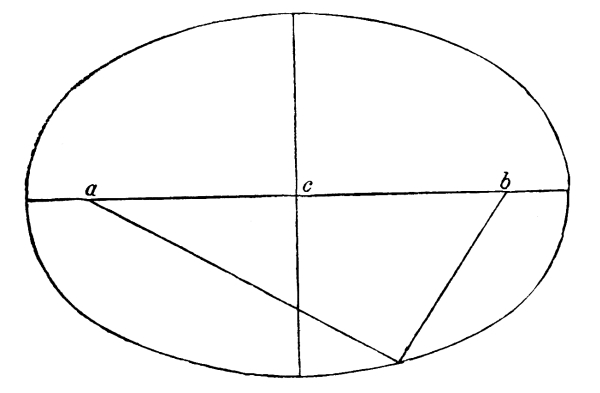
If the path about the attracting centre is exactly circular, the attracting force always acts on the planets, or on the lead sphere, with equal strength. In this case, it is immaterial according to what law the force would increase or diminish at other distances from the centre in which the moving body does not come. If the original impulse has not been of the right strength in both cases, the paths will not be circular but elliptical, of the form of the curved line in Fig. 5. But these ellipses lie in both cases differently as regards the attracting centre. In our model, the attracting force is stronger, the further the lead sphere is removed from its position of equilibrium. Under these circumstances, the ellipse of the path has such a position in reference to the attracting centre, that this is in the centre, c, of the ellipse. For planets, on the contrary, the attracting force is feebler the further it is removed from the attracting body, and this is the reason that an ellipse is described, one of whose foci lies in the centre of attraction. The two foci, a and b, are two points which lie symmetrically towards the ends of the ellipse, and are characterised by the property that the sum of their distances, am + bm, is the same from any given points.
Kepler had found that the paths of the planets are ellipses of this kind; and since, as the above example shows, the form and position of the orbit depend on the law according to which the magnitude of the attracting force alters, Newton could deduce from the form of the planetary orbits the well-known law of the force of gravitation, which attracts the planets to the sun, according to which this force decreases with increase of distance as the square of that distance. Terrestrial gravity must obey this law, and Newton had the wonderful self-denial to refrain from publishing his important discovery until it had acquired a direct confirmation; this followed from the observations, that the force which attracts the moon towards the earth, bears towards the gravity of a terrestrial body the ratio required by the above law.
In the course of the eighteenth century the power of mathematical analysis, and the methods of astronomical observation, increased so far that all the complicated actions, which take place between all the planets, and all their satellites, in consequence of the mutual action of each upon each, and which astronomers call disturbances—disturbance, that is to say, of the simpler elliptical motions about the sun, which each one would produce if the others were absent—that all these could be theoretically predicted from Newton’s law, and be accurately compared with what actually takes place in the heavens. The development of this theory of planetary motion in detail was, as has been said, the merit of Laplace. The agreement between this theory, which was developed from the simple law of gravitation, and the extremely complicated and manifold phenomena which follow therefrom, was so complete and so accurate, as had never previously been attained in any other branch of human knowledge. Emboldened by this agreement, the next step was to conclude that where slight defects were still constantly found, unknown causes must be at work. Thus, from Bessel’s calculation of the discrepancy between the actual and the calculated motion of Uranus, it was inferred that there must be another planet. The position of this planet was calculated by Leverrier and Adams, and thus Neptune, the most distant of all known at that time, was discovered.
But it was not merely in the region of the attraction of our sun that the law of gravitation was found to hold. With regard to the fixed stars, it was found that double stars moved about each other in elliptical paths, and that therefore the same law of gravitation must hold for them as for our planetary system. The distance of some of them could be calculated. The nearest of them, α, in the constellation of the Centaur, is 270,000 times further from the sun than the earth. Light, which has a velocity of 186,000 miles a second, which traverses the distance from the sun to the earth in eight minutes, would take four years to travel from α Centauri to us. The more delicate methods of modern astronomy have made it possible to determine distances which light would take thirty-five years to traverse; as, for instance, the Pole Star; but the law of gravitation is seen to hold, ruling the motion of the double stars, at distances in the heavens, which all the means we possess have hitherto utterly failed to measure.
The knowledge of the law of gravitation has here also led to the discovery of new bodies, as in the case of Neptune. Peters of Altona found, confirming therein a conjecture of Bessel, that Sirius, the most brilliant of the fixed stars, moves in an elliptical path about an invisible centre. This must have been due to an unseen companion, and when the excellent and powerful telescope of the University of Cambridge, in the United States, had been set up, this was discovered. It is not quite dark, but its light is so feeble that it can only be seen by the most perfect instruments. The mass of Sirius is found to be 13·76, and that of its satellite 6·71, times the mass of the sun; their mutual distance is equal to thirty-seven times the radius of the earth’s orbit, and is therefore somewhat larger than the distance of Neptune from the sun.
Another fixed star, Procyon, is in the same case as Sirius, but its satellite has not yet been discovered.
You thus see that in gravitation we have discovered a property common to all matter, which is not confined to bodies in our system, but extends, as far in the celestial space, as our means of observation have hitherto been able to penetrate.
But not merely is this universal property of all mass shared by the most distant celestial bodies, as well as by terrestrial ones; but spectrum analysis has taught us that a number of well-known terrestrial elements are met with in the atmospheres of the fixed stars, and even of the nebulæ.
You all know that a fine bright line of light, seen through a glass prism, appears as a coloured band, red and yellow at one edge, blue and violet at the other, and green in the middle. Such a coloured image is called a spectrum—the rainbow is such a one, produced by the refraction of light, though not exactly by a prism; and it exhibits therefore the series of colours into which white sunlight can thus be decomposed. The formation of the prismatic spectrum depends on the foot that the sun’s light, and that of most ignited bodies, is made up of various kinds of light, which appear of different colours to our eyes, and the rays of which are separated from each other when refracted by a prism.
Now if a solid or a liquid is heated to such an extent that it becomes incandescent, the spectrum which its light gives is, like the rainbow, a broad coloured band without any breaks, with the well-known series of colours, red, yellow, green, blue, and violet, and in no wise characteristic of the nature of the body which emits the light.
The case is different if the light is emitted by an ignited gas, or by an ignited vapour—that is, a substance vaporised by heat. The spectrum of such a body consists, then, of one or more, and sometimes even a great number, of entirely distinct bright lines, whose position and arrangement in the spectrum is characteristic for the substances of which the gas or vapour consists, so that it can be ascertained, by means of spectrum analysis, what is the chemical constitution of the ignited gaseous body. Gaseous spectra of this kind are shown in the heavenly space by many nebulæ; for the most part they are spectra which show the bright line of ignited hydrogen and oxygen, and along with it a line which, as yet, has never been again found in the spectrum of any terrestrial element. Apart from the proof of two well-known terrestrial elements, this discovery was of the utmost importance, since it furnished the first unmistakable proof that the cosmical nebulæ are not, for the most part, small heaps of fine stars, but that the greater part of the light which they emit is really due to gaseous bodies.
The gaseous spectra present a different appearance when the gas is in front of an ignited solid whose temperature is far higher than that of the gas. The observer sees then a continuous spectrum of a solid, but traversed by fine dark lines, which are just visible in the places in which the gas alone, seen in front of a dark background, would show bright lines. The solar spectrum is of this kind, and also that of a great number of fixed stars. The dark lines of the solar spectrum, originally discovered by Wollaston, were first investigated and measured by Fraunhofer, and are hence known as Fraunhofer’s lines.
Fig. 6.
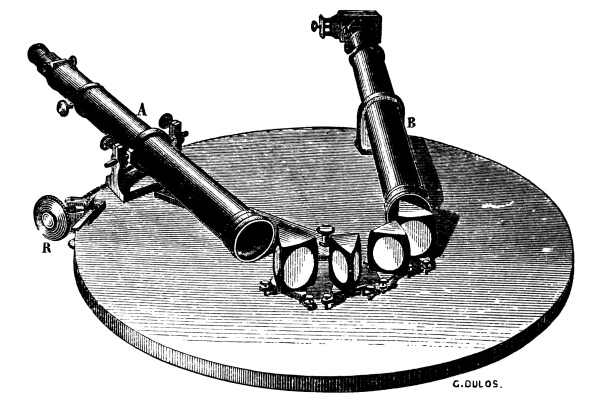
Fig. 7.
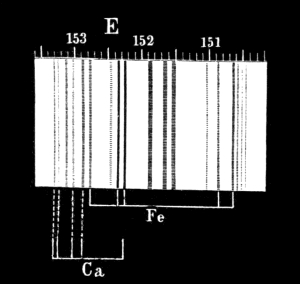
Fig. 8.
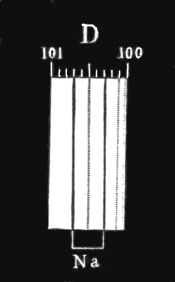
Far more powerful apparatus was afterwards used by Kirchhoff, and then by Angström, to push the decomposition of light as far as possible. Fig. 6 represents an apparatus with four prisms, constructed by Steinheil for Kirchhoff. At the further end of the telescope B is a screen with a fine slit, representing a fine slice of light, which can be narrowed or widened by the small screw, and by which the light under investigation can be allowed to enter. It then passes through the telescope B, afterwards through the four prisms, and finally through the telescope A, from which it reaches the eye of the observer. Figs. 7, 8, and 9 represent small portions of the solar spectrum as mapped by Kirchhoff, taken from the green, yellow, and golden-yellow, in which the chemical symbols below—Fe (iron), Ca (calcium), Na (sodium), Pb (lead)—and the affixed lines, indicate the positions in which the vapours of these metals, when made incandescent, either in the flames or in the electrical spark, would show bright lines. The numbers above them show how far these fractions of Kirchhoff’s map of the whole system are apart from each other. Here, also, we see a predominance of iron lines. In the whole spectrum Kirchhoff found not less than 450.
Fig. 9.
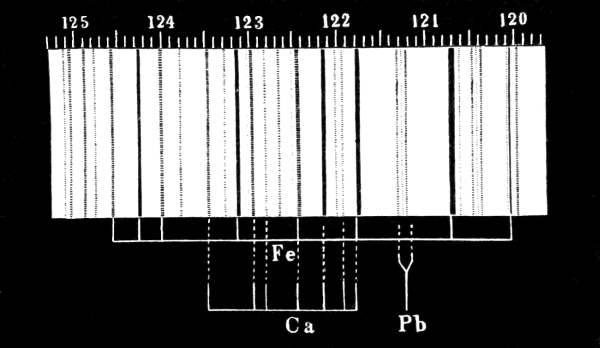
It follows from this, that the solar atmosphere contains an abundance of the vapours of iron, which, by the way, justifies us in concluding what an enormously high temperature must prevail there. It shows, moreover, how our figs. 7, 8, and 9 indicate iron, calcium, and sodium, and also the presence of hydrogen, of zinc, of copper, and of the metals of magnesia, alumina, baryta, and other terrestrial elements. Lead, on the other hand, is wanting, as well as gold, silver, mercury, antimony, arsenic, and some others.
The spectra of several fixed stars are similarly constituted; they show systems of fine lines which can be identified with those of terrestrial elements. In the atmosphere of Aldebaran in Taurus there is, again, hydrogen, iron, magnesium, calcium, sodium, and also mercury, antimony, and bismuth; and, according to H. C. Vogel, there is in α Orionis the rare metal thallium; and so on.
We cannot, indeed, say that we have explained all spectra; many fixed stars exhibit peculiarly banded spectra, probably belonging to gases whose molecules have not been completely resolved into their atoms by the high temperature. In the spectrum of the sun, also, are many lines which we cannot identify with those of terrestrial elements. It is possible that they may be due to substances unknown to us, it is also possible that they are produced by the excessively high temperature of the sun, far transcending anything we can produce. But this is certain, that the known terrestrial substances are widely diffused in space, and especially nitrogen, which constitutes the greater part of our atmosphere, and hydrogen, an element in water, which indeed is formed by its combustion. Both have been found in the irresolvable nebulæ, and, from the inalterability of their shape, these must be masses of enormous dimensions and at an enormous distance. For this reason Sir W. Herschel considered that they did not belong to the system of our fixed stars, but were representatives of the manner in which other systems manifested themselves.
Spectrum analysis has further taught us more about the sun, by which he is brought nearer to us, as it were, than could formerly have seemed possible. You know that the sun is an enormous sphere, whose diameter is 112 times as great as that of the earth. We may consider what we see on its surface as a layer of incandescent vapour, which, to judge from the appearances of the sun-spots, has a depth of about 500 miles. This layer of vapour, which is continually radiating heat on the outside, and is certainly cooler than the inner masses of the sun, is, however, hotter than all our terrestrial flames—hotter even than the incandescent carbon points of the electrical arc, which represent the highest temperature attainable by terrestrial means. This can be deduced with certainty from Kirchhoff’s law of the radiation of opaque bodies, from the greater luminous intensity of the sun. The older assumption, that the sun is a dark cool body, surrounded by a photosphere which only radiates heat and light externally, contains a physical impossibility.
Outside the opaque photosphere, the sun appears surrounded by a layer of transparent gases, which are hot enough to show in the spectrum bright coloured lines, and are hence called the Chromosphere. They show the bright lines of hydrogen, of sodium, of magnesium, and iron. In these layers of gas and of vapour about the sun enormous storms occur, which are as much greater than those of our earth in extent and in velocity as the sun is greater than the earth. Currents of ignited hydrogen burst out several thousands of miles high, like gigantic jets or tongues of flame, with clouds of smoke above them.[24] These structures could formerly only be viewed at the time of a total eclipse of the sun, forming what were called the rose-red protuberances. We now possess a method, devised by MM. Jansen and Lockyer, by which they may at any time be seen by the aid of the spectroscope.
Fig. 10.
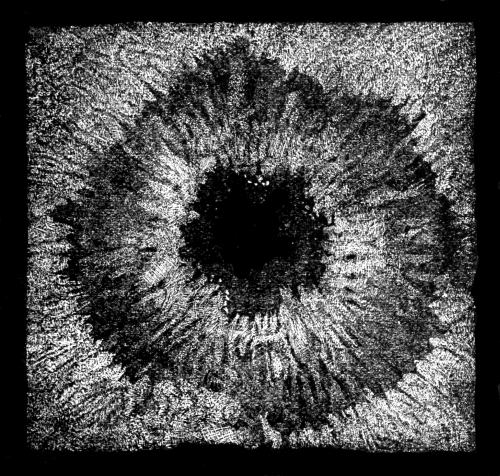
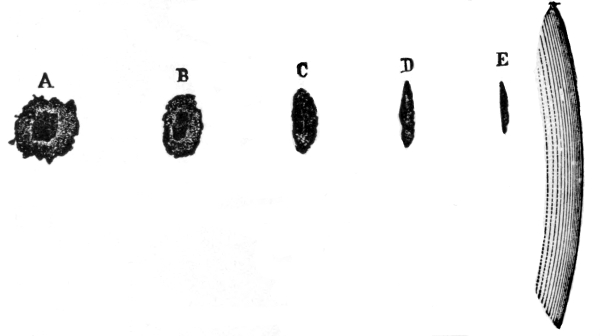
On the other hand, there are individual darker parts on the sun’s surface, what are called sun-spots, which were seen as long ago as by Galileo. They are funnel-shaped, the sides of the funnel are not so dark as the deepest part, the core. Fig. 10 represents such a spot according to Padre Secchi, as seen under powerful magnification. Their diameter is often more than many tens of thousands of miles, so that two or three earths could lie in one of them. These spots may stand for weeks or months, slowly changing, before they are again resolved, and meanwhile several rotations of the sun may take place. Sometimes, however, there are very rapid changes in them. That the core is deeper than the edge of the surrounding penumbra follows from their respective displacements as they come near the edge, and are therefore seen in a very oblique direction. Fig. 11 represents in A to E the different aspects of such a spot as it comes near the edge of the sun.
Fig. 11.
Just on the edge of these spots there are spectroscopic indications of the most violent motion, and in their vicinity there are often large protuberances; they show comparatively often a rotatory motion. They may be considered to be places where the cooler gases from the outer layers of the sun’s atmosphere sink down, and perhaps produce local superficial coolings of the sun’s mass. To understand the origin of these phenomena, it must be remembered that the gases, as they rise from the hot body of the sun, are charged with vapours of difficultly volatile metals, which expand as they ascend, and partly by their expansion, and partly by radiation into space, must become cooled. At the same time, they deposit their more difficultly volatile constituents as fog or cloud. This cooling can only, of course, be regarded as comparative; their temperature is probably, even then, higher than any temperature attainable on the earth. If now the upper layers, freed from the heavier vapours, sink down, there will be a space over the sun’s body which is free from cloud. They appear then as depressions, because about them are layers of ignited vapours as much as 500 miles in height.
Violent storms cannot fail to occur in the sun’s atmosphere, because it is cooled on the outside, and the coolest and comparatively densest and heaviest parts come to lie over the hotter and lighter ones. This is the reason why we have frequent, and at times sudden and violent, movements in the earth’s atmosphere, because this is heated from the ground made hot by the sun and is cooled above. With the far more colossal magnitude and temperature of the sun, its meteorological processes are on a far larger scale, and are far more violent.
We will now pass to the question of the permanence of the present condition of our system. For a long time the view was pretty generally held that, in its chief features at any rate, it was unchangeable. This opinion was based mainly on the conclusions at which Laplace had arrived as the final results of his long and laborious investigations, of the influence of planetary disturbances. By disturbances of the planetary motion astronomers understand, as I have already mentioned, those deviations from the purely elliptical motion which are due to the attraction of various planets and satellites upon each other. The attraction of the sun, as by far the largest body of our system, is indeed the chief and preponderating force which produces the motion of the planets. If it alone were operative, each of the planets would move continuously in a constant ellipse whose axes would retain the same direction and the same magnitude, making the revolutions always in the same length of time. But, in point of fact, in addition to the attraction of the sun there are the attractions of all other planets, which, though small, yet, in long periods of time, do effect slow changes in the plane, the direction, and the magnitude of the axes of its elliptical orbit. It has been asked whether these attractions in the orbit of the planet could go so far as to cause two adjacent planets to encounter each other, so that individual ones fall into the sun. Laplace was able to reply that this could not be the case; that all alterations in the planetary orbits produced by this kind of disturbance must periodically increase and decrease, and again revert to a mean condition. But it must not be forgotten that this result of Laplace’s investigations only applies to disturbances due to the reciprocal attraction of planets upon each other, and on the assumption that no forces of other kinds have any influence on their motions.
On our earth we cannot produce such an everlasting motion as that of the planets seems to be; for resisting forces are continually being opposed to all movements of terrestrial bodies. The best known of these are what we call friction, resistance of the air, and inelastic impact.
Hence the fundamental law of mechanics, according to which every motion of a body on which no force acts goes on in a straight line for ever with unchanged velocity, never holds fully.
Even if we eliminate the influence of gravity in a ball, for example, which rolls on a plane surface, we see it go on for a while, and the further the smoother is the path; but at the same time we hear the rolling ball make a clattering sound—that is, it produces waves of sound in the surrounding bodies; there is friction even on the smoothest surface; this sets the surrounding air in vibration, and imparts to it some of its own motion. Thus it happens that its velocity is continually less and less until it finally ceases. In like manner, even the most carefully constructed wheel which plays upon fine points, once made to turn, goes on for a quarter of an hour, or even more, but then stops. For there is always some friction on the axles, and in addition there is the resistance of the air, which resistance is mainly due to that of the particles of air against each other, due to their friction against the wheel.
If we could once set a body in rotation, and keep it from falling, without its being supported by another body, and if we could transfer the whole arrangement to an absolute vacuum, it would continue to move for ever with undiminished velocity. This case, which cannot be realised on terrestrial bodies, is apparently met with in the planets with their satellites. They appear to move in the perfectly vacuous cosmical space, without contact with any body which could produce friction, and hence their motion seems to be one which never diminishes.
You see, however, that the justification of this conclusion depends on the question whether cosmical space is really quite vacuous. Is there nowhere any friction in the motion of the planets?
From the progress which the knowledge of nature has made since the time of Laplace, we must now answer both questions in the negative.
Celestial space is not absolutely vacuous. In the first place, it is filled by that continuous medium the agitation of which constitutes light and radiant heat, and which physicists know as the luminiferous ether. In the second place, large and small fragments of heavy matter, from the size of huge stones to that of dust, are still everywhere scattered; at any rate, in those parts of space which our earth traverses.
The existence of the luminiferous ether cannot be considered doubtful. That light and radiant heat are due to a motion which spreads in all directions has been sufficiently proved. For the transference of such a motion through space there must be something which can be moved. Indeed, from the magnitude of the action of this motion, or from that which the science of mechanics calls its vis viva, we may indeed assign certain limits for the density of this medium. Such a calculation has been made by Sir W. Thomson, the celebrated Glasgow physicist. He has found that the density may possibly be far less than that of the air in the most perfect exhaustion obtainable by a good air-pump; but that the mass of the ether cannot be absolutely equal to zero. A volume equal to that of the earth cannot contain less than 2,775 pounds of luminiferous ether.[25]
The phenomena in celestial space are in conformity with this. Just as a heavy stone flung through the air shows scarcely any influence of the resistance of the air, while a light feather is appreciably hindered; in like manner the medium which fills space is far too attenuated for any diminution to have been perceived in the motion of the planets since the time in which we possess astronomical observations of their path. It is different with the smaller bodies of our system. Encke in particular has shown, with reference to the well-known small comet which bears his name, that it circulates round the sun in ever-diminishing orbits and in ever shorter periods of revolution. Its motion is similar to that of the circular pendulum which we have mentioned, and which, having its velocity gradually delayed by the resistance of the air, describes circles about its centre of attraction, which continually become smaller and smaller. The reason for this phenomenon is the following: The force which offers a resistance to the attraction of the sun on all comets and planets, and which prevents them from getting continually nearer to the sun, is what is called the centrifugal force—that is, the tendency to continue their motion in a straight line in the direction of their path. As the force of their motion diminishes, they yield by a corresponding amount to the attraction of the sun, and get nearer to it. If the resistance continues, they will continue to get nearer the sun until they fall into it. Encke’s comet is no doubt in this condition. But the resistance whose presence in space is hereby indicated, must act, and has long continued to act, in the same manner on the far larger masses of the planets.
The presence of partly fine and partly coarse heavy masses diffused in cosmical space is more distinctly revealed by the phenomena of asteroids and of meteorites. We know now that these are bodies which ranged about in cosmical space, before they came within the region of our terrestrial atmosphere. In the more strongly resisting medium which this atmosphere offers they are delayed in their motion, and at the same time are heated by the corresponding friction. Many of them may still find an escape from the terrestrial atmosphere, and continue their path through space with an altered and retarded motion. Others fall to the earth; the larger ones as meteorites, while the smaller ones are probably resolved into dust by the heat, and as such fall without being seen. According to Alexander Herschel’s estimate, we may figure shooting-stars as being on an average of the same size as paving-stones. Their incandescence mostly occurs in the higher and most attenuated regions of the atmosphere, eighteen miles and more above the surface of the earth. As they move in space under the influence of the same laws as the planets and comets, they possess a planetary velocity of from eighteen to forty miles in a second. By this, also, we observe that they are in fact stelle cadente, falling stars, as they have long been called by poets.
This enormous velocity with which they enter our atmosphere is undoubtedly the cause of their becoming heated. You all know that friction heats the bodies rubbed. Every match that we ignite, every badly greased coach-wheel, every auger which we work in hard wood, teaches this. The air, like solid bodies, not only becomes heated by friction, but also by the work consumed in its compression. One of the most important results of modern physics, the actual proof of which is mainly due to the Englishman Joule, is that, in such a case, the heat developed is exactly proportional to the work expended. If, like the mechanicians, we measure the work done by the weight which would be necessary to produce it, multiplied by the height from which it must fall, Joule has shown that the work, produced by a given weight of water falling through a height of 425 metres, would be just sufficient to raise the same weight of water through one degree Centigrade. The equivalent in work of a velocity of eighteen to twenty-four miles in a second may be easily calculated from known mechanical laws; and this, transformed into heat, would be sufficient to raise the temperature of a piece of meteoric iron to 900,000 to 2,500,000 degrees Centigrade, provided that all the heat were retained by the iron, and did not, as it undoubtedly does, mainly pass into the air. This calculation shows, at any rate, that the velocity of the shooting-stars is perfectly adequate to raise them to the most violent incandescence. The temperatures attainable by terrestrial means scarcely exceed 2,000 degrees. In fact, the outer crusts of meteoric stones generally show traces of incipient fusion; and in cases in which observers examined with sufficient promptitude the stones which had fallen they found them hot on the surface, while the interior of detached pieces seemed to show the intense cold of cosmical space.
To the individual observer who casually looks towards the starry sky the meteorites appear as a rare and exceptional phenomenon. If, however, they are continuously observed, they are seen with tolerable regularity, especially towards morning, when they usually fall. But a single observer only views but a small part of the atmosphere; and if they are calculated for the entire surface of the earth it results that about seven and a half millions fall every day. In our regions of space, they are somewhat sparse and distant from each other. According to Alexander Herschel’s estimates, each stone is, on an average, at a distance of 450 miles from its neighbours. But the earth moves through 18 miles every second, and has a diameter of 7,820 miles, and therefore sweeps through 876 millions of cubic miles of space every second, and carries with it whatever stones are contained therein.
Many groups are irregularly distributed in space, being probably those which have already undergone disturbances by planets. There are also denser swarms which move in regular elliptical orbits, cutting the earth’s orbit in definite places, and therefore always occur on particular days of the year. Thus the 10th of August of each year is remarkable, and every thirty-three years the splendid fireworks of the 12th to the 14th of November repeats itself for a few years. It is remarkable that certain comets accompany the paths of these swarms, and give rise to the supposition that the comets gradually split up into meteoric swarms.
This is an important process. What the earth does is done by the other planets, and in a far higher degree by the sun, towards which all the smaller bodies of our system must fall; those, therefore, that are more subject to the influence of the resisting medium, and which must fall the more rapidly, the smaller they are. The earth and the planets have for millions of years been sweeping together the loose masses in space, and they hold fast what they have once attracted. But it follows from this that the earth and the planets were once smaller than they are now, and that more mass was diffused in space; and if we follow out this consideration it takes us back to a state of things in which, perhaps, all the mass now accumulated in the sun and in the planets, wandered loosely diffused in space. If we consider, further, that the small masses of meteorites as they now fall, have perhaps been formed by the gradual aggregation of fine dust, we see ourselves led to a primitive condition of fine nebulous masses.
From this point of view, that the fall of shooting-stars and of meteorites is perhaps only a small survival of a process which once built up worlds, it assumes far greater significance.
This would be a supposition of which we might admit the possibility, but which could not perhaps claim any great degree of probability, if we did not find that our predecessors, starting from quite different considerations, had arrived at the same hypothesis.
You know that a considerable number of planets rotate around the sun besides the eight larger ones, Mercury, Venus, the Earth, Mars, Jupiter, Saturn, Uranus, and Neptune; in the interval between Mars and Jupiter there circulate, as far as we know, 156 small planets or planetoids. Moons also rotate about the larger planets—that is, about the Earth and the four most distant ones, Jupiter, Saturn, Uranus, and Neptune; and lastly the Sun, and at any rate the larger planets, rotate about their own axes. Now, in the first place, it is remarkable that all the planes of rotation of the planets and of their satellites, as well as the equatorial planes of these planets, do not vary much from each other, and that in these planes all the rotation is in the same direction. The only considerable exceptions known are the moons of Uranus, whose plane is almost at right angles to the planes of the larger planets. It must at the same time be remarked that the coincidence, in the direction of these planes, is on the whole greater, the longer are the bodies and the larger the paths in question; while in the smaller bodies, and for the smaller paths, especially for the rotations of the planets about their own axes, considerable divergences occur. Thus the planes of all the planets, with the exception of Mercury and of the small ones between Mars and Jupiter, differ at most by three degrees from the path of the Earth. The equatorial plane of the Sun deviates by only seven and a half degrees, that of Jupiter only half as much. The equatorial plane of the Earth deviates, it is true, to the extent of twenty-three and a half degrees, and that of Mars by twenty-eight and a half degrees, and the separate paths of the small planet’s satellites differ still more. But in these paths they all move direct, all in the same direction about the sun, and, as far as can be ascertained, also about their own axes, like the earth—that is, from west to east. If they had originated independently of each other, and had come together, any direction of the planes for each individual one would have been equally probable; a reverse direction of the orbit would have been just as probable as a direct one; decidedly elliptical paths would have been as probable as the almost circular ones which we meet with in all the bodies we have named. There is, in fact, a complete irregularity in the comets and meteoric swarms, which we have much reason for considering to be formations which have only accidentally come within the sphere of the sun’s attraction.
The number of coincidences in the orbits of the planets and their satellites is too great to be ascribed to accident. We must inquire for the reason of this coincidence, and this can only be sought in a primitive connection of the entire mass. Now, we are acquainted with forces and processes which condense an originally diffused mass, but none which could drive into space such large masses, as the planets, in the condition we now find them. Moreover, if they had become detached from the common mass, at a place much nearer the sun, they ought to have a markedly elliptical orbit. We must assume, accordingly, that this mass in its primitive condition extended at least to the orbit of the outermost planets.
These were the essential features of the considerations which led Kant and Laplace to their hypothesis. In their view our system was originally a chaotic ball of nebulous matter, of which originally, when it extended to the path of the most distant planet, many billions of cubic miles could contain scarcely a gramme of mass. This ball, when it had become detached from the nebulous balls of the adjacent fixed stars, possessed a slow movement of rotation. It became condensed under the influence of the reciprocal attraction of its parts; and, in the degree in which it condensed, the rotatory motion increased, and formed it into a flat disk. From time to time masses at the circumference of this disk became detached under the influence of the increasing centrifugal force; that which became detached formed again into a rotating nebulous mass, which either simply condensed and formed a planet, or during this condensation again repelled masses from the periphery, which became satellites, or in one case, that of Saturn, remained as a coherent ring. In another case, the mass which separated from the outside of the chief ball, divided into many parts, detached from each other, and furnished the swarms of small planets between Mars and Jupiter.
Our more recent experience as to the nature of star showers teaches us that this process of the condensation of loosely diffused masses to form larger bodies is by no means complete, but still goes on, though the traces are slight. The form in which it now appears is altered by the fact that meanwhile the gaseous or dust-like mass diffused in space had united under the influence of the force of attraction, and of the force of crystallisation of their constituents, to larger pieces than originally existed.
The showers of stars, as examples now taking place of the process which formed the heavenly bodies, are important from another point of view. They develop light and heat; and that directs us to a third series of considerations, which leads again to the same goal.
All life and all motion on our earth is, with few exceptions, kept up by a single force, that of the sun’s rays, which bring to us light and heat. They warm the air of the hot zones, this becomes lighter and ascends, while the colder air flows towards the poles. Thus is formed the great circulation of the passage-winds. Local differences of temperature over land and sea, plains and mountains, disturb the uniformity of this great motion, and produce for us the capricious change of winds. Warm aqueous vapours ascend with the warm air, become condensed into clouds, and fall in the cooler zones, and upon the snowy tops of the mountains, as rain and as snow. The water collects in brooks, in rivers, moistens the plains, and makes life possible; crumbles the stones, carries their fragments along, and thus works at the geological transformation of the earth’s surface. It is only under the influence of the sun’s rays that the variegated covering of plants of the earth grows; and while they grow, they accumulate in their structure organic matter, which partly serves the whole animal kingdom as food, and serves man more particularly as fuel. Coals and lignites, the sources of power of our steam engines, are remains of primitive plants—the ancient production of the sun’s rays.
Need we wonder if, to our forefathers of the Aryan race in India and Persia, the sun appeared as the fittest symbol of the Deity? They were right in regarding it as the giver of all life—as the ultimate source of almost all that has happened on earth.
But whence does the sun acquire this force? It radiates forth a more intense light than can be attained with any terrestrial means. It yields as much heat as if 1,500 pounds of coal were burned every hour upon each square foot of its surface. Of the heat which thus issues from it, the small fraction which enters our atmosphere furnishes a great mechanical force. Every steam-engine teaches us that heat can produce such force. The sun, in fact, drives on earth a kind of steam-engine whose performances are far greater than those of artificially constructed machines. The circulation of water in the atmosphere raises, as has been said, the water evaporated from the warm tropical seas to the mountain heights; it is, as it were, a water-raising engine of the most magnificent kind, with whose power no artificial machine can be even distantly compared. I have previously explained the mechanical equivalent of heat. Calculated by that standard, the work which the sun produces by its radiation is equal to the constant exertion of 7,000 horse-power for each square foot of the sun’s surface.
For a long time experience had impressed on our mechanicians that a working force cannot be produced from nothing; that it can only be taken from the stores which nature possesses; which are strictly limited and which cannot be increased at pleasure—whether it be taken from the rushing water or from the wind; whether from the layers of coal, or from men and from animals, which cannot work without the consumption of food. Modern physics has attempted to prove the universality of this experience, to show that it applies to the great whole of all natural processes, and is independent of the special interests of man. These have been generalised and comprehended in the all-ruling natural law of the Conservation of Force. No natural process, and no series of natural processes, can be found, however manifold may be the changes which take place among them, by which a motive force can be continuously produced without a corresponding consumption. Just as the human race finds on earth but a limited supply of motive forces, capable of producing work, which it can utilise but not increase, so also must this be the case in the great whole of nature. The universe has its definite store of force, which works in it under ever varying forms; is indestructible, not to be increased, everlasting and unchangeable like matter itself. It seems as if Goethe had an idea of this when he makes the earth-spirit speak of himself as the representative of natural force.
In the currents of life, in the tempests of motion,
In the fervour of art, in the fire, in the storm,
Hither and thither,
Over and under,
Wend I and wander.
Birth and the grave,
Limitless ocean,
Where the restless wave
Undulates ever
Under and over,
Their seething strife
Heaving and weaving
The changes of life.
At the whirling loom of time unawed,
I work the living mantle of God.
Let us return to the special question which concerns us here: Whence does the sun derive this enormous store of force which it sends out?
On earth the processes of combustion are the most abundant source of heat. Does the sun’s heat originate in a process of this kind? To this question we can reply with a complete and decided negative, for we now know that the sun contains the terrestrial elements with which we are acquainted. Let us select from among them the two, which, for the smallest mass, produce the greatest amount of heat when they combine; let us assume that the sun consists of hydrogen and oxygen, mixed in the proportion in which they would unite to form water. The mass of the sun is known, and also the quantity of heat produced by the union of known weights of oxygen and hydrogen. Calculation shows that under the above supposition, the heat resulting from their combustion would be sufficient to keep up the radiation of heat from the sun for 3,021 years. That, it is true, is a long time, but even profane history teaches that the sun has lighted and warmed us for 3,000 years, and geology puts it beyond doubt that this period must be extended to millions of years.
Known chemical forces are thus so completely inadequate, even on the most favourable assumption, to explain the production of heat which takes place in the sun, that we must quite drop this hypothesis.
We must seek for forces of far greater magnitude, and these we can only find in cosmical attraction. We have already seen that the comparatively small masses of shooting-stars and meteorites can produce extraordinarily large amounts of heat when their cosmical velocities are arrested by our atmosphere. Now the force which has produced these great velocities is gravitation. We know of this force as one acting on the surface of our planet when it appears as terrestrial gravity. We know that a weight raised from the earth can drive our clocks, and that in like manner the gravity of the water rushing down from the mountains works our mills.
If a weight falls from a height and strikes the ground its mass loses, indeed, the visible motion which it had as a whole—in fact, however, this motion is not lost; it is transferred to the smallest elementary particles of the mass, and this invisible vibration of the molecules is the motion of heat. Visible motion is transformed by impact, into the motion of heat.
That which holds in this respect for gravity, holds also for gravitation. A heavy mass, of whatever kind, which is suspended in space separated from another heavy mass, represents a force capable of work. For both masses attract each other, and, if unrestrained by centrifugal force, they move towards each other under the influence of this attraction; this takes place with ever-increasing velocity; and if this velocity is finally destroyed, whether this be suddenly, by collision, or gradually, by the friction of movable parts, it develops the corresponding quantity of the motion of heat, the amount of which can be calculated from the equivalence, previously established, between heat and mechanical work.
Now we may assume with great probability that very many more meteors fall upon the sun than upon the earth, and with greater velocity, too, and therefore give more heat. Yet the hypothesis, that the entire amount of the sun’s heat which is continually lost by radiation, is made up by the fall of meteors, a hypothesis which was propounded by Mayer, and has been favourably adopted by several other physicists, is open, according to Sir W. Thomson’s investigations, to objection; for, assuming it to hold, the mass of the sun should increase so rapidly that the consequences would have shown themselves in the accelerated motion of the planets. The entire loss of heat from the sun cannot at all events be produced in this way; at the most a portion, which, however, may not be inconsiderable.
If, now, there is no present manifestation of force sufficient to cover the expenditure of the sun’s heat, the sun must originally have had a store of heat which it gradually gives out. But whence this store? We know that the cosmical forces alone could have produced it. And here the hypothesis, previously discussed as to the origin of the sun, comes to our aid. If the mass of the sun had been once diffused in cosmical space, and had then been condensed—that is, had fallen together under the influence of celestial gravity—if then the resultant motion had been destroyed by friction and impact, with the production of heat, the new world produced by such condensation must have acquired a store of heat not only of considerable, but even of colossal, magnitude.
Calculation shows that, assuming the thermal capacity of the sun to be the same as that of water, the temperature might be raised to 28,000,000 of degrees, if this quantity of heat could ever have been present in the sun at one time. This cannot be assumed, for such an increase of temperature would offer the greatest hindrance to condensation. It is probable rather that a great part of this heat, which was produced by condensation, began to radiate into space before this condensation was complete. But the heat which the sun could have previously developed by its condensation, would have been sufficient to cover its present expenditure for not less than 22,000,000 of years of the past.
And the sun is by no means so dense as it may become. Spectrum analysis demonstrates the presence of large masses of iron and of other known constituents of the rocks. The pressure which endeavours to condense the interior is about 800 times as great as that in the centre of the earth; and yet the density of the sun, owing probably to its enormous temperature, is less than a quarter of the mean density of the earth.
We may therefore assume with great probability that the sun will still continue in its condensation, even if it only attained the density of the earth—though it will probably become far denser in the interior owing to the enormous pressure—this would develop fresh quantities of heat, which would be sufficient to maintain for an additional 17,000,000 of years the same intensity of sunshine as that which is now the source of all terrestrial life.
The smaller bodies of our system might become less hot than the sun, because the attraction of the fresh masses would be feebler. A body like the earth might, if even we put its thermal capacity as high as that of water, become heated to even 9,000 degrees, to more than our flames can produce. The smaller bodies must cool more rapidly as long as they are still liquid. The increase in temperature, with the depth, is shown in bore-holes and in mines. The existence of hot wells and of volcanic eruptions shows that in the interior of the earth there is a very high temperature, which can scarcely be anything than a remnant of the high temperature which prevailed at the time of its production. At any rate, the attempts to discover for the internal heat of the earth a more recent origin in chemical processes, have hitherto rested on very arbitrary assumptions; and, compared with the general uniform distribution of the internal heat, are somewhat insufficient.
On the other hand, considering the huge masses of Jupiter, of Saturn, of Uranus, and of Neptune, their small density, as well as that of the sun, is surprising, while the smaller planets and the moon approximate to the density of the earth. We are here reminded of the higher initial temperature, and the slower cooling, which characterises larger masses.[26] The moon, on the contrary, exhibits formations on its surface which are strikingly suggestive of volcanic craters, and point to a former state of ignition of our satellite. The mode of its rotation, moreover, that it always turns the same side towards the earth, is a peculiarity which might have been produced by the friction of a fluid. At present no trace of such a one can be perceived.
Fig. 12.
You see, thus, by what various paths we are constantly led to the same primitive conditions. The hypothesis of Kant and Laplace is seen to be one of the happiest ideas in science, which at first astounds us, and then connects us in all directions with other discoveries, by which the conclusions are confirmed until we have confidence in them. In this case another circumstance has contributed—that is, the observation that this process of transformation, which the theory in question presupposes, goes on still, though on a smaller scale, seeing that all stages of that process can still be found to exist.
Fig. 13.
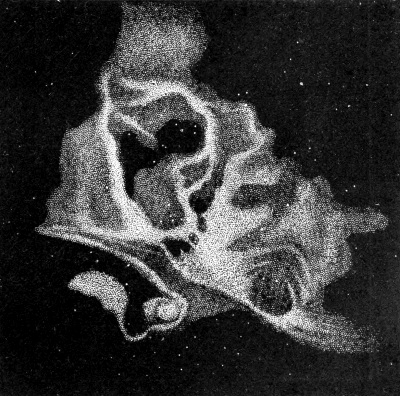
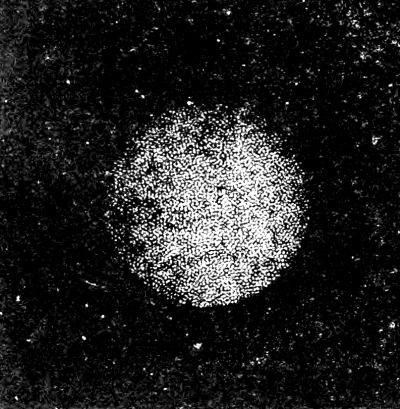
For as we have already seen, the larger bodies which are already formed go on increasing with the development of heat, by the attraction of the meteoric masses already diffused in space. Even now the smaller bodies are slowly drawn towards the sun by the resistance in space. We still find in the firmament of fixed stars, according to Sir J. Herschel’s newest catalogue, over 5,000 nebulous spots, of which those whose light is sufficiently strong give for the most part a coloured spectrum of fine bright lines, as they appear in the spectra of the ignited gases. The nebulæ are partly rounded structures, which are called planetary nebulæ (fig. 12); sometimes wholly irregular in form, as the large nebula in Orion, represented in fig. 13; they are partly annular, as in the figures in fig. 14, from the Canes Venatici. They are for the most part feebly luminous over their whole surface, while the fixed stars only appear as luminous points.
Fig. 14.
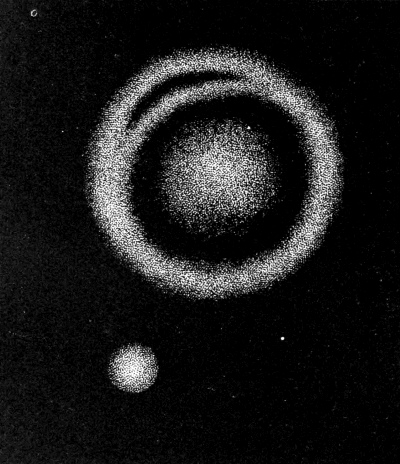
Fig. 15.
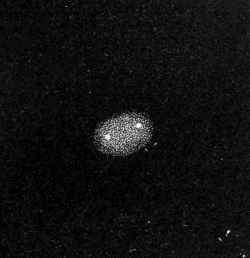
Fig. 16.
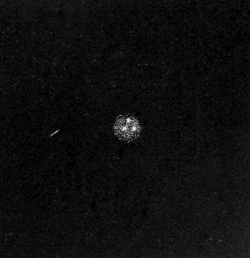
In many nebulæ small stars can be seen, as in figs. 15 and 16, from Sagittarius and Aurigo. More stars are continually being discovered in them, the better are the telescopes used in their analysis. Thus, before the discovery of spectrum analysis, Sir W. Herschel’s former view might be regarded as the most probable, that that which we see to be nebulæ are only heaps of very fine stars, of other Milky Ways. Now, however, spectrum analysis has shown a gas spectrum in many nebulæ which contains stars, while actual heaps of stars show the continuous spectrum of ignited solid bodies. Nebulæ have in general three distinctly recognisable lines, one of which, in the blue, belongs to hydrogen, a second in bluish-green to nitrogen,[27] while the third, between the two, is of unknown origin. Fig. 17 shows such a spectrum of a small but bright nebula in the Dragon. Traces of other bright lines are seen along with them, and sometimes also, as in fig. 17, traces of a continuous spectrum; all of which, however, are too feeble to admit of accurate investigation. It must be observed here that the light of very feeble objects which give a continuous spectrum are distributed by the spectroscope over a large surface, and are therefore greatly enfeebled or even extinguished, while the undecomposable light of bright gas lines remains undecomposed, and hence can still be seen. In any case, the decomposition of the light of the nebulæ shows that by far the greater part of their luminous surface is due to ignited gases, of which hydrogen forms a prominent constituent. In the planetary masses, the spherical or discoidal, it might be supposed that the gaseous mass had attained a condition of equilibrium; but most other nebulæ exhibit highly irregular forms, which by no means correspond to such a condition. As, however, their shape has either not at all altered, or not appreciably, since they have been known and observed, they must either have very little mass, or they must be of colossal size and distance. The former does not appear very probable, because small masses very soon give out their heat, and hence we are left to the second alternative, that they are of huge dimensions and distances. The same conclusion had been originally drawn by Sir W. Herschel, on the assumption that the nebulæ were heaps of stars.
Fig. 17.

With those nebulæ which, besides the lines of gases, also show the continuous spectrum of ignited denser bodies, are connected spots which are partly irresolvable and partly resolvable into heaps of stars, which only show the light of the latter kind.
The countless luminous stars of the heavenly firmament, whose number increases with each newer and more perfect telescope, associate themselves with this primitive condition of the worlds as they are formed. They are like our sun in magnitude, in luminosity, and on the whole also in the chemical condition of their surface, although there may be differences in the quantity of individual elements.
But we find also in space a third stadium, that of extinct suns; and for this also there are actual evidences. In the first place, there are, in the course of history, pretty frequent examples of the appearance of new stars. In 1572 Tycho Brahe observed such a one, which, though gradually burning paler, was visible for two years, stood still like a fixed star, and finally reverted to the darkness from which it had so suddenly emerged. The largest of them all seems to have been that observed by Kepler in the year 1604, which was brighter than a star of the first magnitude, and was observed from September 27, 1604, until March 1606. The reason of its luminosity was probably the collision with a smaller world. In a more recent case, in which on May 12, 1866, a small star of the tenth magnitude in the Corona suddenly burst out to one of the second magnitude, spectrum analysis showed that it was an outburst of ignited hydrogen which produced the light. This was only luminous for twelve days.
In other cases obscure heavenly bodies have discovered themselves by their attraction on adjacent bright stars, and the motions of the latter thereby produced. Such an influence is observed in Sirius and Procyon. By means of a new refracting telescope Messrs. Alvan Clarke and Pond, of Cambridge, U.S., have discovered in the case of Sirius a scarcely visible star, which has but little luminosity, but is almost seven times as heavy as the sun, has about half the mass of Sirius, and whose distance from Sirius is about equal to that of Neptune from the sun. The satellite of Procyon has not yet been seen; it appears to be quite dark.
Thus there are extinct suns. The fact that there are such lends new weight to the reasons which permit us to conclude that our sun also is a body which slowly gives out its store of heat, and thus will some time become extinct.
The term of 17,000,000 years which I have given may perhaps become considerably prolonged by the gradual abatement of radiation, by the new accretion of falling meteors, and by still greater condensation than that which I have assumed in that calculation. But we know of no natural process which could spare our sun the fate which has manifestly fallen upon other suns. This is a thought which we only reluctantly admit; it seems to us an insult to the beneficent Creative Power which we otherwise find at work in organisms and especially in living ones. But we must reconcile ourselves to the thought that, however we may consider ourselves to be the centre and final object of Creation, we are but as dust on the earth; which again is but a speck of dust in the immensity of space; and the previous duration of our race, even if we follow it far beyond our written history, into the era of the lake dwellings or of the mammoth, is but an instant compared with the primeval times of our planet; when living beings existed upon it, whose strange and unearthly remains still gaze at us from their ancient tombs; and far more does the duration of our race sink into insignificance compared with the enormous periods during which worlds have been in process of formation, and will still continue to form when our sun is extinguished, and our earth is either solidified in cold or is united with the ignited central body of our system.
But who knows whether the first living inhabitants of the warm sea on the young world, whom we ought perhaps to honour as our ancestors, would not have regarded our present cooler condition with as much horror as we look on a world without a sun? Considering the wonderful adaptability to the conditions of life which all organisms possess, who knows to what degree of perfection our posterity will have been developed in 17,000,000 of years, and whether our fossilised bones will not perhaps seem to them as monstrous as those of the Ichthyosaurus now do; and whether they, adjusted for a more sensitive state of equilibrium, will not consider the extremes of temperature, within which we now exist, to be just as violent and destructive as those of the older geological times appear to us? Yea, even if sun and earth should solidify and become motionless, who could say what new worlds would not be ready to develop life? Meteoric stones sometimes contain hydrocarbons; the light of the heads of comets exhibits a spectrum which is most like that of the electrical light in gases containing hydrogen and carbon. But carbon is the element, which is characteristic of organic compounds, from which living bodies are built up. Who knows whether these bodies, which everywhere swarm through space, do not scatter germs of life wherever there is a new world, which has become capable of giving a dwelling-place to organic bodies? And this life we might perhaps consider as allied to ours in its primitive germ, however different might be the form which it would assume in adapting itself to its new dwelling-place.
However this may be, that which most arouses our moral feelings at the thought of a future, though possibly very remote, cessation of all living creation on the earth, is more particularly the question whether all this life is not an aimless sport, which will ultimately fall a prey to destruction by brute force? Under the light of Darwin’s great thought we begin to see that not only pleasure and joy, but also pain, struggle, and death, are the powerful means by which nature has built up her finer and more perfect forms of life. And we men know more particularly that in our intelligence, our civic order, and our morality we are living on the inheritance which our forefathers have gained for us, and that which we acquire in the same way, will in like manner ennoble the life of our posterity. Thus the individual, who works for the ideal objects of humanity, even if in a modest position, and in a limited sphere of activity, may bear without fear the thought that the thread of his own consciousness will one day break. But even men of such free and large order of minds as Lessing and David Strauss could not reconcile themselves to the thought of a final destruction of the living race, and with it of all the fruits of all past generations.
As yet we know of no fact, which can be established by scientific observation, which would show that the finer and complex forms of vital motion could exist otherwise than in the dense material of organic life; that it can propagate itself as the sound-movement of a string can leave its originally narrow and fixed home and diffuse itself in the air, keeping all the time its pitch, and the most delicate shade of its colour-tint; and that, when it meets another string attuned to it, starts this again or excites a flame ready to sing to the same tone. The flame even, which, of all processes in inanimate nature, is the closest type of life, may become extinct, but the heat which it produces continues to exist—indestructible, imperishable, as an invisible motion, now agitating the molecules of ponderable matter, and then radiating into boundless space as the vibration of an ether. Even there it retains the characteristic peculiarities of its origin, and it reveals its history to the inquirer who questions it by the spectroscope. United afresh, these rays may ignite a new flame, and thus, as it were, acquire a new bodily existence.
Just as the flame remains the same in appearance, and continues to exist with the same form and structure, although it draws every minute fresh combustible vapour, and fresh oxygen from the air, into the vortex of its ascending current; and just as the wave goes on in unaltered form, and is yet being reconstructed every moment from fresh particles of water, so also in the living being, it is not the definite mass of substance, which now constitutes the body, to which the continuance of the individual is attached. For the material of the body, like that of the flame, is subject to continuous and comparatively rapid change—a change the more rapid, the livelier the activity of the organs in question. Some constituents are renewed from day to day, some from month to month, and others only after years. That which continues to exist as a particular individual is like the flame and the wave—only the form of motion which continually attracts fresh matter into its vortex and expels the old. The observer with a deaf ear only recognises the vibration of sound as long as it is visible and can be felt, bound up with heavy matter. Are our senses, in reference to life, like the deaf ear in this respect?
ADDENDUM.
The sentences on page 193 gave rise to a controversial attack by Mr. J. C. F. Zoellner, in his book ‘On the Nature of the Comets,’ on Sir W. Thomson, on which I took occasion to express myself briefly in the preface to the second part of the German translation of the ‘Handbook of Theoretical Physics,’ by Thomson and Tait. I give here the passage in question:—
‘I will mention here a further objection. It refers to the question as to the possibility that organic germs may occur in meteoric stones, and be conveyed to the celestial bodies which have been cooled. In his opening Address at the Meeting of the British Association in Edinburgh, in August 1871, Sir W. Thomson had described this as “not unscientific.” Here also, if there is an error, I must confess that I also am a culprit. I had mentioned the same view as a possible mode of explaining the transmission of organisms through space, even a little before Sir W. Thomson, in a lecture delivered in the spring of the same year at Heidelberg and Cologne, but not published. I cannot object if anyone considers this hypothesis to be in a high, or even in the highest, degree improbable. But to me it seems a perfectly correct scientific procedure, that when all our attempts fail in producing organisms from inanimate matter, we may inquire whether life has ever originated at all or not, and whether its germs have not been transported from one world to another, and have developed themselves wherever they found a favourable soil.
‘Mr. Zoellner’s so-called physical objections are but of very small weight. He recalls the history of meteoric stone, and adds (p. xxvi.): “If, therefore, that meteoric stones covered with organisms had escaped with a whole skin in the smash-up of its mother-body, and had not shared the general rise of temperature, it must necessarily have first passed through the atmosphere of the earth, before it could deliver itself of its organisms for the purpose of peopling the earth.”
‘Now, in the first place, we know from repeated observations that the larger meteoric stones only become heated in their outside layer during their fall through the atmosphere, while the interior is cold, or even very cold. Hence all germs which there might be in the crevices would be safe from combustion in the earth’s atmosphere. But even those germs which were collected on the surface when they reached the highest and most attenuated layer of the atmosphere would long before have been blown away by the powerful draught of air, before the stone reached the denser parts of the gaseous mass, where the compression would be sufficient to produce an appreciable heat. And, on the other hand, as far as the impact of two bodies is concerned, as Thomson assumes, the first consequences would be powerful mechanical motions, and only in the degree in which this would be destroyed by friction would heat be produced. We do not know whether that would last for hours, for days, or for weeks. The fragments, which at the first moment were scattered with planetary velocity, might escape without any disengagement of heat. I consider it even not improbable, that a stone, or shower of stones, flying through the higher regions of the atmosphere of a celestial body, carries with it a mass of air which contains unburned germs.
‘As I have already remarked I am not inclined to suggest that all these possibilities are probabilities. They are questions the existence and signification of which we must remember, in order that if the case arise they may be solved by actual observations or by conclusions therefrom.’