POPISH BISHOPS AND PRIESTS ABSOLVE ALLEGIANCE TO PROTESTANT GOVERNMENTS. (continued 2)
Reading edition
There were many among them who were not heretics, but, seeing the injustice done to their fellow-citizens, and knowing the purity of their lives, united with them in resisting oppression. Some of the most merciful of the Pope's army, entertaining scruples as to what should be done to those who were not heretics and happened to fall into their hands, deemed it a duty which they owed to holy mother, to consult the Pope's legate upon this occasion; and what, Christian reader, think you was the reply of this representative of the Roman Catholic church? What was the answer of this imbodiment of Popery? It was what it would be this day, under similar circumstances.—"Kill them all; the Lord will know his own!" At this answer, the bells rung, by order of this legate. and never ceased to toll, until fifteen thousand were butchered upon the spot, according to the account given by the legate himself; although a contemporary historian, named Bernard Itier, and much better authority than this blood-thirsty legate, informs us that thirty-eight thousand were slaughtered in cold blood.
During this time, Pope Innocent and the infallible church were not idle in other parts of France. Wherever heresy existed, or heretical blood was to be shed, there were to be found the representatives of the holy church, until not a vestige of the Protestant doctrines of the Albigenses was to be seen. Nearly all its ministers and its followers suffered the most cruel deaths, and their church was drowned in the blood of its defenders. But the man of sin being still apprehensive that some vestige of Protestantism might remain, or that the life of some unfortunate member of the Albigenses might have escaped, the Popish murderers established, in those countries, that accursed tribunal, the Inquisition; some of whose members appeared in the guise and occupation of farmers, to act as spies among that class of people; others as merchants, others as mechanics, &c. To these were added female Jesuits, some of whom were shop-keepers, milliners, servant-maids, &c.; and, suitably educated, whenever necessary, were ready to act their parts well.
Thus no man was safe. No family, no lady, was safe. They dreaded the very air they breathed. They knew not when the officers of the inquisition would call them from their homes, their children, their husbands, and their wives, to be cast into the dungeon of the inquisition, without knowing their offence, or who accused them.
This was Popery in the twelfth century; this was Popery in the fourth century; and this is Popery in the nineteenth century. Americans, are-you aware that there are Jesuit nuns now in this country? Are you aware of the reasons why they are so anxious to get Protestant rather than Catholic scholars into their schools? The reason is this; they are in this country spies upon your actions. Your thoughts, your designs, your influence, the probable amount of your wealth, and your political opinions, are known to your children. These Jesuit nuns worm themselves into your confidence; the young hearts of their pupils are soon laid bare to these artful hypocrites; and before you scarcely notice the absence of your children, your domestic secrets are known to some Popish agent, who makes such use of them as the holy church may direct. This is done daily. I make this statement of my own knowledge, and I warn you, if you value your domestic happiness, or the peace and harmony of your children, never permit one of them, male or female, to enter a school kept by nuns or Jesuits.
From these observations, the reader must have seen that Popery, in its teachings and actions, is, and has been, the same always. What, then, becomes of the assertions, so frequently made by Roman Catholic priests and bishops, that the doctrines of the church, in relation to heretics, have been relaxed? Certain it is, at all events, that there has been no mitigation in the treatment of heretics down to the thirteenth century. Let us come down a little farther, and see if any had taken place during the thirteenth century. We discover none whatever.
It was during this century, that the "Greater Excommunication," as it is called, was pronounced by the Pope, and the whole church, against all who should interfere with the clergy in the exercise of their temporal or spiritual rights. The curse was pronounced, by every parish priest, throughout the Papal world, four times a year,—-Christmas, Easter, Pentecost, and All-Hallows day. The curse is in the following words, and is now repeated on the same days, by the Pope and all the priests and bishops of the Romish church, not publicly,—that they dare not do,—but in private. "Let them be accursed, eating and drinking, walking and sitting, speaking, and holding their peace, waking and sleeping, rowing and riding, laughing and weeping, in house and in field, in water and on land, in all places; cursed be their heads and their thoughts, their eyes and their ears, their tongues and their lips, their teeth and their throats, their shoulders and their breasts, their feet and their legs their thighs and their inward parts; let them remain accursed, from the sole of their foot to the crown of their heads; and just as this candle (the curser has a lighted candle in his hand, which he extinguishes) is deprived of us present light, so let them be deprived of their souls in hell."
Such is the curse which the Pope pronounced against all heretics in the thirteenth century! and however surprised you may be, a similar one is pronounced once a year against all Protestants. There are many Americans who cannot believe that such a curse as the above, has ever been pronounced against a fellow-being. I have conversed with some intelligent Protestants in this city, who doubted whether such an anathema was ever uttered, and seemed struck with horror, as well as surprise, when I informed them that it was pronounced against myself in Philadelphia in presence of, at least, three thousand people. The reader must know, by this, that I am a heretic, and look upon the introduction of Popery into the United States, as the greatest evil which Providence has permitted to fall upon us. Arise, fellow-citizens, in the fulness of your power,—every Protestant in this country is a heretic, as well as myself. We are all annually cursed and damned by a set of Popish agents, bishops, and priests; men who, from my own personal acquaintance with them, I know to be unworthy of your friendship or your support; who walk your streets with apparent sanctimoniousness, but whose lives in private are such as delicacy forbids me to mention.
These men, under pretence of being democrats are attacking your liberties with the club of Hercules. They are acquiring gigantic force. You have recently witnessed the truth of this assertion; they fancied they had strength enough to cut you down as the legate of Pope Innocent did the Albigenses in the twelfth century. They bid defiance to reason, argument, and the lew of your land; and it grieves me to see every thing yielding to their power, as chaff before the wind. But Providence interposed, and these miserable dupes of Romish priests received a check, which, if followed up, will have a salutary effect in future. But, I pray you, be on your guard; watch the movements of Papists among you: have no confidence in them; have as little as possible to do with them. Trust them in nothing which may either directly or indirectly involve their religion. I most solemnly appeal to our national and state legislatures, to exclude them from every office of honor, profit, or trust, while they have any connection whatever, spiritual or temporal, with the Pope of Rome. Believe them not, when they tell you that their allegiance to the Pope is only spiritual. I understand what they mean by spiritual allegiance.
From what has been stated, it is clear that no modification had taken place in Popish pretensions during the thirteenth century, neither had the church relaxed one iota in her persecutions of heretics. On the contrary, her cruelties increased-the declarations of Popish priests to the contrary notwithstanding.
Let us now see what has been the conduct of the Popish church towards heretics, from the latter end of the thirteenth century to the conclusion of the fourteenth.
How was the illustrious John Wickliffe, professor of divinity in Oxford, treated by the church of Rome, during the reign of Boniface IX. But let us first see what the crimes of Wickliffe were, for which he had been so severely punished by the holy Roman church. The illustrious and good Wickliffe, the founder of the Reformation, whose very name every Christian venerates, maintained, 1st, That the Scriptures contain all truths necessary to salvation; 2d, That in the Scriptures only, is to be found, a perfect rule of Christian practice; 3d, He denied the authority of the Pope in temporal matters; 4th, He maintained that the Pope was the Man of Sin, the son of perdition, to which St. Paul alluded, "sitting as God in the temple of God." As soon as the opinions of Wickliffe were ascertained, Gregory XL, the ruling Pope, addressed a Bull to the primate of England, ordering him to have Wickliffe arrested and imprisoned, until he received further instructions.
The popularity of Wickliffe was such, that this step was considered dangerous; and we find that nothing further was done to this eminently pious man, than banishing him from the university of Oxford into private life, where he died in peace, and went to his grave with the blessings of the good and the virtuous. But this did not satisfy the Pope, nor the infallible church. O, no. The holy mother never forgives a heretic, dead or alive. As soon as Wickliffe departed this life, in the sixty-first year of his age, the church and Papists exhibited the wildest symptoms of joy. One of their writers, in giving an account of his death, uses the following language: "On the day of St. Thomas, the martyr, that limb of the devil, enemy of the church, deceiver of the people, idol of heretics, mirror of hypocrites, author of schism, sower of hatred, and inventor of lies, John Wickliffe, was, by the immediate judgment of God, suddenly struck with a palsy, which seized all the members of his body, when he was ready to vomit forth his blasphemies against the blessed St. Thomas, in a sermon which he had prepared to preach that day!"
But holy mother was not yet satisfied. She had not the felicity of hanging Wickliffe; her ears were not delighted with his groans upon the rack; she did not hear his flesh hissing amid the flames of the faggot, nor his bones breaking upon the wheel; she must, however, have all the revenge left to satiate her malice. Thirty years after the death of Wickliffe, the infallible council of Constance, at which the Pope presided, passed an order that the body and bones of John Wickliffe, if they might be known and discerned from the bodies of faithful people—Papists—should be taken from the ground and thrown far away from the burial of any church, according to the canon laws and decrees.
This decree was not put in execution for thirteen years afterwards. His grave was then opened and his body disinterred with great solemnity, and in the presence of the Catholic bishop of Lincoln, it was publicly burned, and the ashes thrown into a neighboring rivulet. But the indignities offered to Wickliffe, while living, and after his death, were not sufficient to appease the malice of Papists. Blood, and blood alone, could satiate their thirst for revenge. His followers were hunted up and mercilessly put to death. Among the first of his followers, who suffered, was Lord Cobham, a nobleman, distinguished for his valor, devotion to his country, and true piety. His character was without blemish, and his morals and patriotism undoubted; but he was a heretic; he was among the followers of Wickliffe; he believed in the Holy Scriptures. This was crime enough, and for this he was excommunicated. Cobham appealed to the Pope, but the appeal was refused: he was cited again; he was offered absolution, if he would sue for it, and submit to the Popish church. This he refused; the consequence was, he was thrown into prison, from which he escaped and was not retaken for nearly four years, he was, however, finally captured after a most heroic resistance.
He might have escaped again, being an overmatch for his captor, had not a pious Roman Catholic woman, while he was nobly defending himself, taken up a stool, and with a desperate blow, broken both his legs. In this condition he was recommitted to prison until he was sentenced to death for his heresy. The sentence was, "that he should be drawn from his place of confinement through the city of London, to Temple Bar, there to be hanged, and burned hanging." The historian Bale gives a most affecting account of his execution.
"On the day appointed," says Bale, "he was brought out of the Tower with his arms bound behind him, having a very cheerful countenance. Then he was laid upon a hurdle as though he had been a most heinous traitor to the crown, and so drawn forth into St. Giles's field, where they had set up a new gallows. When he arrived at the place of execution, and taken from the hurdle, he fell down devoutly on his knees, and prayed God to forgive his enemies. Then he stood up and beheld the multitude, exhorting them, in the most godly manner, to follow the laws of God, written in the Scriptures, and to beware of such teachers as they see contrary to Christ, in their conversation and living, with many other special councils. Then was he hanged up there, by the middle, in chains of iron, and so consumed alive in the fire, praising the name of the Lord, so long as life lasted. In the end he commended his soul into the hands of God, and so, most Christianly, departed home, his body being resolved to ashes."
Thus was a nobleman, and a noble Christian, most barbarously put to death for believing that the Bible contained God's truth; and therein differing from the Roman church, which teaches that the traditions of the fathers, and dreams of monks, are of equal authority.
Followers of Wickliffe,—and there are many of you in this country, who are an honor to his name,—have you ever reflected that there are nearly two millions of Papists in these United States, who entertain the same belief that the murderers of Cobham did; who believe that you are all excommunicated, as he was, and who, if they had the power, would consign yourselves, your wives, and children, to the same fate? and who are taught by their church, that, in so doing, they would be serving God? Romish priests may deny this. They do well. Otherwise, an indignant populace would tear them to pieces, or at least banish them from this land of freedom.
But I tell the priest or bishop, who dares deny it, that they are liars,—wilful and deliberate liars. I too have been a priest, and I solemnly declare to the world, and to my fellow-citizens of the United States in particular, that to keep no faith with heretics, but to destroy them, is one of the most solemn duties of a Catholic; and I go further, and state to you, that if a bishop or priest denies this, upon oath, you are not to believe him; his church requires from him to keep no faith with heretics, but to destroy and extirpate them. It allows him also to deny, under oath, the existence of such an obligation.
Do you, followers of Wickliffe, require any proof of this? It is a serious charge, and should not be lightly made. I therefore refer you to the letters of Martin II., who was Pope in the-year 1417, and considered one of the best Popes the Romish church ever had. This Pope, in one of his letters to the Duke of Lithuania, makes use of the following strong and emphatic language. "Be assured, thou sinnest mortally, if thou keep thy faith with heretics." St. Thomas Aquinas teaches the same doctrine. Innocent VIII., who was Pope in 1484, declares "that all persons who are bound by any con-tract whatever to heretics are at liberty to break it, even though they had sworn an oath to fulfil it." You here see, that I have done no injustice to Roman Catholics, in putting you on your guard against them, and charging them with a willingness to destroy yourselves, your wives and children, as heretics, had they power and opportunity of doing so. I am supported by the authority of Pope Martin V., and Pope Innocent VIII.; and though in your estimation, those blood-thirsty vagabonds may give no weight to my testimony, still it cannot fail to be highly satisfactory to Papists. Some of the Catholics may tell you, that the followers of Wickliffe were a seditious people; that they threatened to overthrow the civil institutions of the country; that all law and order were set at defiance by them; and that this was the cause of their persecution. This is false in fact—it is historically false.
If the followers of Wickliffe, or Lollards, as they were called, were disturbers of the peace; if their lives were seditious, disorderly, and rebellious, why were they not indicted, under some statute of the realm, made and provided to take cognizance of such crimes? Why were they not even accused of such crimes? Was the meek, mild, and learned John Wickliffe, accused or indicted for disturbing the peace? Was it for disturbing the peace, that his venerable bones were disinterred thirty years after being deposited in the cold grave? Was it for disturbing the peace, and for riotous proceedings, his bones were subsequently burned, and their ashes thrown into the next river? Was it for disturbing the peace, the learned and brave Cobham was hung in iron chains, by the middle.
No such accusation has ever been brought against these great and good men, or against thousands who suffered with them. They were accused only of heresy. Papists were their accusers; Papists were their judges; and Papists were their executioners.
But the malice of those blood-thirsty Catholics was not even then satiated. It is as fresh now, as it was then. Papists are not content, that hundreds of years ago, Wickliffe and his followers should be persecuted, and the greater portion of them massacred and burned. Their memories, also, are objects of Popish hatred, even to this day on which I write. They represent them as enemies of the human race. As despisers of chastity and morality. You will probably see these charges advanced against them in the Popish presses throughout the United States. But recollect, Americans, that age does not improve the piety of Papists. The older holy mother gets, the harder becomes her heart, and the more bitter her virulence. I might satisfy you, if necessary, on the testimony of the most respectable Protestant writers, that there lived not in the world, a people more simple, more pious, or virtuous than the Waldenses, or Wickliffites. It may be said of them, with truth, "qualis pater tales filii." But I will not refer to Protestant authority; knavish, lying, Popish priests may question it! I refer you, for the character of this persecuted people, to an early Popish historian, Florimond—. History of Heresy, book vii. ch. 7.
"They"—the Waldenses—says this writer, "have nothing in their mouths but Christ the Saviour—they know nothing else than Jesus Christ. These people read the Bible continually, in such a manner that they know all the books of it by heart." Horrid people these Wickliffites must be, to read the Bible until they know it by heart! And as these Bible-reading and Bible-loving people now constitute a vast majority of our citizens, I call upon them to rise in the full force of their moral power, and ward off from themselves and their children, the curse of Popery, or the fate of Wickliffe and his followers will assuredly be theirs. Many of you, Americans, are followers of Wickliffe. You believe as he believed! You live as he lived! You love peace as he loved it. Do you wish to continue as you are now? Or will you permit a flood of vile priests, monks, and nuns, to overrun your country, and seduce your children from the paths of virtue, in which your own example and the perusal of their Bibles have taught them to walk?
I now call your attention to the belief and practice of the Romish church in the fifteenth century, and you will find that heresy and heretics were still persecuted by her. Witness the conduct of Pope Innocent VIII. toward the Vaudois. He sent one of his Jesuit legates amongst them, with instructions to prevail on Louis XII. to extirpate them from his dominions, without even hearing any deputies which they might send him. The answer of Louis did him much credit—"Though I were at war with a Turk or the devil, I would hear what he had to say for himself." They accordingly made their defence; and, upon this, the good King Louis sent commissioners to examine the state of things among them. The following was their report, as history informs us: "Having made a strict inquiry into their mode of living, we cannot discover the least shadow of the crimes imputed to them. On the contrary, it appears that they piously observe the Sabbath, baptize their children after the manner of the primitive church, and are thoroughly instructed in the doctrine of the apostles' creed, and in the law of God." On hearing this report, the king exclaimed, in a passion, addressing himself to the Pope's legate—"By the holy mother of God, these heretics, whom you and the Pope urge me to destroy, are better men than you or myself." He, however, soon departed this life, and every man acquainted with history knows what their sufferings were from the time of his death down to the days of Cromwell, who, whatever his faults may have been, fired with indignation at the barbarities committed by the Romish church, interposed in behalf of those persecuted people, and called upon Protestant princes and sovereigns to aid him in protecting them.
I will not burden the reader with a history of the sufferings of these people. It is familiar even to our schoolboys. I must, however, repeat the fact, that they were persecuted for no other reason than because they believed the Bible contained all the truths necessary to salvation, and because they did not believe in all the mummeries of Popery. Will Catholic bishops and priests still continue to assert that their church does not teach them to persecute heretics, and to hold no faith with them? Will they continue to assert, that the Pope of Rome does not claim temporal as well as spiritual jurisdiction over the kingdoms of the earth? or if they do, are we compelled to listen to them?
There is scarcely any one who does not recollect the conduct of the holy see, as it is nicknamed, towards Queen Elizabeth, on her ascension to the throne of England. The queen sent a messenger to the court of Rome, to inform the Pope of the event. This was an act of state courtesy; but his holiness had the insolence to reply to the messenger who represented his sovereign: "Tell your mistress that England was held in fief of the apostolic see; that she could not succeed, being illegitimate; nor could she contradict the declarations made in that matter by his predecessors, Clement VII. and Paul III. Tell your mistress," said this insolent ecclesiastic, "that it was great boldness in her to assume the crown without my consent, for which, in reason, she deserves no favor at my hands; yet if she will renounce her pretensions and refer herself wholly to me, I would show a fatherly affection to her, and do every thing for her that could consist with the dignity of the Roman see."
Fellow-citizens, do you want any other proof to satisfy you that the Pope of Rome claims universal jurisdiction over kings, queens, nations, kingdoms, and all mankind? It is only about three hundred years since this occurred; and is there evidence on record that the Pope has resigned the prerogative of universal dominion which he then claimed? You may laugh at the idea of his claiming it over this country; but, mark what I tell you, some successor of the present Pope will not only claim, but exercise it in less than half the time that has elapsed since the days of Elizabeth. Other objects may divert your attention from this subject; you may sleep on in fancied security, but your sleep may be fatal.
"America," as a talented writer (Giustiniani) expresses it, "is the promised land, the land of the Jesuits' operations. To obtain the ascendency, they have no need of a mercenary Swiss guard, or the assistance of the holy alliance, but a majority of votes, which can easily be obtained by an importation of Roman Catholics from Ireland, Bavaria, and Austria. Rome, viewed at a distance, is a colossus; near at hand, its grandeur diminishes, its charm is lost. But the Jesuits are every where the same—cunning, immoral, and sneaking intriguers, until they have obtained the ascendency. Rome feels her weakness at home; she knows herself to be a mere political institution, dressed in the garment of Christianity. She takes good care to uphold that holy militia, the Jesuits, in order to appear what she is not. It is a strife for existence. I am not a politician," says this writer, "but knowing the active spirit of Jesuitism, and the indifference of the generality of Protestants, I have no doubt whatever, that in ten years the Jesuits will have a mighty influence over the ballot-box, and in twenty they will direct it according to their own pleasure. Now they fawn, in ten years they will menace, and in twenty command."
In this city they not only "fawn," but they have proceeded to "menace." Some of the knowing ones among the Catholics now boast that they have the power to govern this city, and they intend to exercise it. This is no idle threat. Even now, though they are actually less in numerical strength in the aggregate, than the Protestants, and pay far less for the support of our free schools, they, nevertheless, have succeeded in depriving Protestant children of the privilege of using the Bible for a school-book, as they have been wont to do. Protestants may sleep on if they will, but they may be assured that they are sleeping on the sides of a burning volcano, and that ere long they will be awakened, but too late, we fear, by the angry thunders of the upheaving fires within, which shall scathe and desolate the fair heritage they now enjoy.
I entreat you, fellow-citizens, never to forget the solemn declaration of the father of your country: "Against the insidious wiles of foreign influence, (I conjure you to believe me, fellow-citizens,) the jealousy of a free people ought to be constantly awake; since history and experience prove, that foreign influence is one of the most baneful foes of a republican government." This is the warning of the immortal Washington, and should not pass unheeded. To the same effect spoke other revolutionary patriots. Jefferson says, "I hope we may find some means in future of shielding ourselves from foreign influence, political, commercial, or in whatever form it may be attempted. I can scarcely withhold myself from joining in the wish of Silas Deane—that there were an ocean of fire between this and the old world." And Madison said, "Foreign influence is truly a Grecian horse to the republic. We cannot be too careful to exclude its entrance."
The cruelty of Papists, the intrigue and craft of Popes, the hypocrisy of Jesuits, the dynasties which they have overthrown, the devastations and carnage which they had occasioned, for centuries back, were matters of historical notoriety, and were well known to our pure-minded and clear-headed forefathers. They dreaded similar occurrences in this happy republic, which they have bequeathed to us as their trustees, to be handed down to posterity; and hence arose their warnings to be on our guard against all foreign interference with our institutions or our country.
Ponder upon those warnings, and let each and every Protestant in the Union pledge himself to guard our liberties, as the apple of his eye. I speak from experience. I am myself a foreigner by birth, though a resident of this country for thirty years. My life has been a checkered one. Born a Roman Catholic in the south of Ireland, educated a Roman Catholic priest, officiating in that capacity for some years, here, as well as in my native country, and for many years a member of the bar in South Carolina and Georgia, I could not fail to acquire a correct knowledge of the doctrines and practices of the Romish church. The result of my experience is, that the doctrines of the Roman Catholic church are fatal to the morals of any people; at variance with sound national policy and pure religion. It is a rank and poisonous weed, which will flourish even in the soil of liberty. Would that I could eradicate it! Would that you would enable me to tear up this Upas, which is spreading its poison, from one end of our land to the other! Would that you could aid me in muzzling those Popish bloodhounds, who are freely coursing over our eastern mountains and western valleys! Already have they scented blood, and I warn you to be on your guard or they will scent more.
I am no sectarian; I am not the tool of any party, either in church or state. I have never asked the countenance or support of any religious denomination, nor has any ever been tendered to me. I have stood alone in my opposition to that hydra-headed monster, Popery. There is no abuse which I have not received; no calumny which has not been heaped upon me; no crime which they have not accused me of; no scurrilous epithet which they have not applied to me. All this I have met single-handed; but I would bear it again, rather than submit to the iniquitous doctrines of Popery. I would bear it again, rather than submit, as native Americans have done, and are doing, to be publicly denounced, as cowards and sons of cowards and pirates.
But, fellow-citizens, they do not consider you cowards and pirates alone; they will, by-and-by, apply to you a term, which you will better deserve. It is sweet, it is a euphonious name, and I trust you will bear it with as much Christian philanthropy, as you have that of cowards, and pirates—Fools. It is the only ignominious term, in the English language, which they have not applied to myself, and I assure my fellow-citizens, natives of this country, that if you are willing to be governed by the Pope of Rome, and his priests, and bishops, I shall never question your paramount claim to this preeminent distinction. Can you bear the following opprobrious language applied to you by the Jesuit, now the Boston Pilot, the organ of the bishop of that city. "How in the name of conscience," says this Popish organ, "can a man have the impudence to find fault with honest emigrants, whose own fathers were emigrant pirates?" You are also complimented by the Literary and Catholic Sentinel, another Popish press, in Philadelphia. That blessed organ of Popery, the Sentinel, in its comments upon a sermon delivered by that eloquent Presbyterian divine, McCalla, thus eulogizes New England. He, Mr. McCalla, knew the character of his New England audience, that their minds were warped by fanaticism, darkened by bigotry, and vitiated by the abhorred, and atrocious principles inculcated by the vile and sanguinary wretches, called the Pilgrim Fathers. He well knew that the mental capacity of the generality of his hearers were chained down by ignorance.
Very flattering this, especially to Bostonians, and their puritan fathers. Their fathers were sanguinary wretches, if we believe Papists, and the people of Boston are an ignorant set of boobies. You, Americans, may bear all this; you know not the designs of Popery, but I do; and while I have liberty to write, I will write for liberty, and in opposition to Popery. Truth may be unpalatable to Papists, but it is my duty to record it.
Among the instructions which I received from my bishop in Ireland, when he sent me out to this country as a Catholic priest, was one to which I beg to call your attention. The same is given to every priest in the United States. "Let it be your first duty to extirpate heretics, but be cautious as to the manner of doing it. Do nothing without consulting the bishop of the diocese, in which you may be located; and if there be no bishop there, advise with the metropolitan bishop. He has his instructions from Rome, and he understands the character of the people. Be sure not to permit the members of our holy church, who may be under your charge, to read the Bible. It is the source of all heresies. Whenever you see an opportunity of building a church, make it known to your bishop. Let the land be purchased for the Pope, and his successors in office. Never yield or give up the divine right, which the head of the church has, by virtue of the Keys, to the government of North America, as well as every other country. The confessional will enable you to know the people by degrees; with the aid of that holy tribunal, and our bishops, who are guided by the spirit of God, we may expect, at no distant day, to bring over North America to the bosom of our holy church."
This needs some explanation. By extirpating heresy, he meant the conversion of heretics to the Romish church, without violence, if possible, if not, by such means as the Romish church has adopted in all ages. You have already seen what these means were—I need not now repeat them; but you shall see them more plainly, when I lay before you, as I intend to do hereafter; the ways and means which the church has adopted, to bring over the Huguenots from the darkness of Protestant error, to the glorious light of Popish truth.
The Bible, as you are aware, is a forbidden book in the Romish church. I remember when acting as Popish priest, in Philadelphia, having ventured to suggest to the very Rev. Mr. De Barth, then acting as vicar-general of that diocese, the advantages of educating the poor, and circulating the Bible among them. He scouted at the idea, as heretical, and lodged a written complaint against me, before the archbishop of Baltimore, then Romish metropolitan. I was reprimanded verbally, through the aforesaid De Barth. He was too crafty to send it in writing; the Papists were not then strong enough to forbid, openly, the reading of the Bible. It was then too soon to seal up the fountain of eternal life in this free country. The most sympathizing Protestants could scarcely believe then, that in less than thirty years, Papists would not only dare forbid it to be read, by their own people, and in their own schools, but cast it out of Protestant schools, as they did the other day in New York. What are we coming to, Americans? Your ancestors have come to this country, with no recommendations but holy lives; with no fortune but their pious hearts and strong arms; with no treasure but the word of God.
Will you now permit Papists to cast those Bibles out of your schools, to burn them on the public streets, as they have done in the state of New York, under the inspection of Popish priests, as proved on the oath of several respectable witnesses? That priest, however, did no more than every priest and bishop would do, did he deem it expedient; and here, fellow-citizens, let me assure you, that same power which authorizes that priest, or any other priest, to burn your Bibles, also authorizes him to burn every heretic or Protestant in the country.
The same power which authorizes them to officiate as priests, empowers them to destroy heretics, whenever it is expedient; and is ready to absolve them from the commission of this foul deed. Saint Thomas Aquinas, in his second book, chapter the 3d, page 58, says: "Heretics, may justly be killed." But you will answer, there is no danger of this. They can never acquire the power to enact any laws in this country which would sanction such a doctrine. How sadly mistaken you are! How lamentably unacquainted with the secret springs or machinery of Popery! I regret that circumstances oblige me so often to introduce my own name, but it cannot be well avoided, for the purpose of explaining certain Popish transactions in the United States. While I was a Romish priest in Philadelphia, and soon after my difference with the archbishop of Baltimore, in relation to the introduction of the Bible, a consultation was held between the Popish priests in the diocese of Philadelphia, and it was secretly resolved by them, that the best mode of checking Hogan's heresy, as they were pleased to term my advocating the reading of the Bible, was to take possession of the church in which I officiated, in the name of the Pope. They accordingly wrote to his holiness, humbly praying this man-god to send them out a bishop, and to give him, and his successors in office, a lease of St. Mary's church, in Philadelphia, and all the appurtenances thereunto belonging. Accordingly his royal holiness the Pope sent them a bishop with the aforesaid lease. I was immediately ordered out of the church; and having refused to depart, unless the trustees thought proper to remove me, this emissary of the Pope, only a few days or weeks in this country, had me indited and imprisoned for disturbing public worship, or in other words, officiating in St. Mary's church, even with the full and undivided consent of the trustees.
But the bishop's legal right was questioned; the case was brought before the supreme court of Pennsylvania, Chief Justice Tighlman presiding. I was discharged from bail and custody, and the rights of the trustees, under their charter from the state, sustained. But the priests and bishops were not content with this decision. They put their heads once more together, and fancied that they discovered another mode by which they could rob the people of their rights, and defeat the intentions of the donors of the property of St. Mary's church; and what was their plan, think you, fellow-citizens?
The bishop called a meeting of all the priests and leading Catholics in the diocese. Every lay member was ordered to bring with him a hickory stick. The meeting was held in the church of St. Joseph; and at the hour of twelve at night, the Romish bishop of the diocese of Pennsylvania, an Irishman, not more than a few months in the country, attended in his pontificals, told the multitude who were there assembled to lay down their sticks in one pile, in order that he might bless them for their use. This was done as a matter of course.
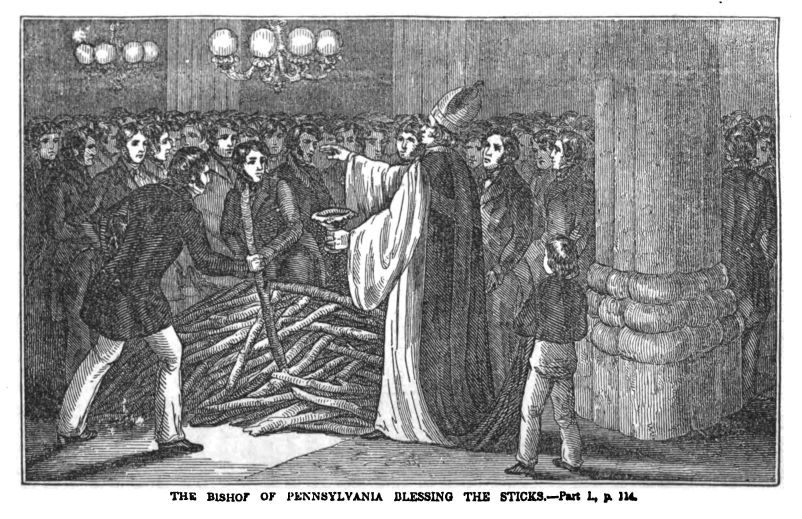
The bishop said mass, sprinkled holy water upon the sticks, blessed them, and this done, the whole party bound themselves by a solemn vow never to cease until they elected a legislature in Pennsylvania that would annul the charter of St. Mary's church; and, as an American citizen, I blush to state the fact, they succeeded. The charter was annulled by an act of the legislature, and property, worth over a million of dollars, would have passed into the hands of the Pope and his agents, were there not a provision in the constitution of that state empowering the supreme court to decide upon the constitutionality of the acts of the legislature.
We brought the question of the constitutionality of the act, which annulled the charter, before the court, Justice Tighlman still presiding. The court decided in the negative, otherwise the trustees and myself would have been defeated; I should have been fined and imprisoned, and they ousted out of their trust.
This, I believe, was the first attempt the Pope has made to establish his temporal power in this country; and it is a source of consolation to me, dearer almost than existence itself, to be the first to meet this holy bull. If I have not strangled him, and trampled him to death, I have, at least, the comfort of seeing his horn so blunted, that his bellowings have been, ever since, comparatively harmless. But there seems a recuperative power in the beast. He is again attempting to plant his foot upon our soil, and establish his temporal power amongst us; and how is he trying to accomplish this, fellow-citizens? The Papists have united themselves together as a body, headed by their priests, and resolved to carry, through the ballot box, what they cannot otherwise accomplish, at least for the present. Popish priests have all become politicians; they publicly preach peace, good order, and obedience to the "powers that be," but they tell the people in the confessional, to disregard those instructions, and stop at nothing which may promote the interests of the church.
They have now, what they call "religious newspapers," under the supervision of their bishops, but in which, not a word of pure religion, or Christian charity, is to be found. They are political presses, whose object is to overthrow our laws, our government, and introduce, in their stead, anarchy and confusion. These people—and here I allude to Irish Catholics and their priests in particular—have no regard for the obligations of an oath. Let the priest only tell them that it is for the good of the church, and they will stop at no crime; no, not even at murder; and they are daily becoming more audacious in consequence of the support which they receive from unprincipled politicians, and the morbid indifference of Protestants.
I have shown you, in a former page, that the increase of Catholics, in this country, will soon give them a majority of voters: and who, think you, will they vote for? A Protestant is it? Any man distinguished for virtue, and for love of republican principles? Assuredly not.
Will they select such a man as the virtuous and pious Frelinghuysen, of New Jersey? Will they choose such a man as the upright and honorable Archer, of Virginia? Will they cast their votes for such a man as the honest John C. Calhoun, of South Carolina; than whom, whatever may be his politics, there is not a greater or a better man of the age.
I might name hundreds, equally good and great men, who are disqualified, by their virtues, from receiving the votes of Popish vassals. None but mercenary demagogues, such as the Pope's tool, Daniel O'Connell, who generously sacrifices five thousand pounds a year to obtain fifty-six thousand, the sum which he received last year in order to ameliorate the condition of the poor Irish. Give the power, and they will elect such a political desperado as this restless O'Connell, a Jesuit by education, an intriguer by nature, and as great a coward as ever drew breath. This is the champion, and his followers—the Irish—are the people, who call Americans cowards, and their "pilgrim fathers," pirates and sanguinary wretches. These are the men, with Daniel O'Connell at their head, numbering nine millions of the "bravest men in the world," who have been for centuries, and are now, on their knees, begging favors from the British government. Americans, too, once asked for favors, or rather their just rights, from that government, but not having obtained them, they drew their swords, threw away their scabbards, and, though the whole population of the United States did not, at that time, amount to two and a half millions, they fought for their rights, and they won them. Yet these Popish braggarts, but wretched slaves, call you cowards, and your fathers pirates. How long will you suffer this?
We know, from history, that Popery and liberty cannot coexist in the same country. A Popish government has never advanced human happiness. It never promotes any object truly great or philanthropic. How deplorable would it be, did this country fall a prey to those who are trying to establish it amongst us. The truth is, Popish glory, the trappings of its court, have been always the silly objects of the Roman church, while the mass of her people has ever been left in the recesses of want, obscurity, and ignorance.
Americans, at present, seem sunk in a sort of political lethargy; and this is taken advantage of, by foreign priests and Jesuits; but I would tell those disturbers of our peace, not to trust too much to this apparent sluggishness; a calm often precedes a storm: the continued insolence, abuses, and threats of Papists, may arouse our young lion, and, if I mistake not—although, appearances are at present against it—his holiness and his minions, who are trying to set up a power in this country unknown to our constitution, and not enumerated in our bill of rights, may have occasion to tremble.
To effect this, however, without the shedding of blood, it is necessary—indispensably necessary—that no Papist should hold office, or even vote, until he ceases to have any connection, or hold any alliance with the Pope, who is a foreign potentate, as well as head of the church. Let them come amongst us, if they will, but let it be with healing on their wings, and not to disturb our peace and tranquillity. Let them prove themselves the friends of liberty, religion, and mankind, and Americans will receive them with open arms, admit them to a full participation in all their own privileges, and extend to them the hand of friendship; but never let this be done, until they forswear expressly and without mental reservation, all allegiance, of whatever kind, and under whatever name, to the Pope of Rome, who is a foreign potentate, and acknowledged as such by the powers of Europe. When a Papist refuses to do this, trust him not. I repeat it, trust him not, Americans. He is a spy amongst you, a traitor to your country, and the sworn enemy of your religion and your liberties.
This, however, they do not. They come amongst you with different motives and far different characters. Though I know them well, it would be impossible for me to express to you the designs which mark their entrance into this country. They cross the Atlantic, under instructions from their priests, and bring nothing with them but their bigotry, intolerance, and ignorance. Their tastes, their passions, and their native hatred of Protestants are wafted over to us, and are already corrupting the morals of our people. In their native country they feel, or pretend to feel, oppressed by British laws and British government. They are taught by their priests to despise their government, at home; that its laws are all penal, and that there is no crime in evading them.
There is not an Irish Catholic, who leaves that country, but feels it his duty to resist the laws of Protestant England, and evade, by perjury or otherwise, their execution. "In no country in the world," says a modern writer, "are the rights of property so recklessly violated: amongst no people on the face of the earth are the obligations of an oath, or the discharge of the moral duties, so utterly disregarded. Any man, the greatest culprit, can find persons to prove an alibi; the most atrocious assassin has but to seek protection, to obtain it. And why is this so? Because the religious instruction of the people has been totally neglected; because their priests have become politicians; because their bishops, pitchforked from the potatoe-basket to the palace, have become drunk with the incense offered to their vanity; and the patronage granted in return for their unprincipled support, instead of checking the misconduct of the subordinates, stimulate them to still further violence, and stop at nothing which can forward their objects. Because the opinions of the people are formed on the statements and advice of mendicant agitators, who have but one object in view—their own aggrandizement. Because a rabid and revolutionary press, concealing its ultimate designs under the motive of affording protection to the weak, seeks to overthrow all law and order, pandering to the worst passions of an ignorant and ferocious populace."
Irish priests and Irish bishops complain of poverty and grievances at home. They complain that men of property leave their homes and spend their incomes abroad; but as this writer, to whom I have alluded expresses it, "What encouragement do they give to such as return from their residences abroad?" Allow me, fellow-citizens, to give you an instance of the treatment which Protestants of fortune receive from Irish Roman priests, when they do return to reside upon their estates in Ireland. I quote from the same author:!!!!!
"The Marquis of Waterford, a sportsman boundless in his charities, frank and cordial in his manners, not obnoxious on account of his politics, and admitted on all hands to be one of the best landlords in Ireland, comes to reside, and spend his eighty thousand sterling per annum, in the country. He gets up a splendid establishment in the county of Tipperary; and how is he treated? His hounds and horses were twice poisoned. There are scarcely any Protestants in the county of Tipperary. His offices were fired, and his servants, with difficulty, saved their lives. Compelled to abandon Tipperary—that sink of Popish iniquity, every nook and corner of which I am acquainted with—this generous and fine-hearted young nobleman retires to his family mansion, in Waterford; and how is he received there? I will not tell you; let his parish priest tell the story. 'Men of Portlan,' says this holy Romish priest, addressing the tenants and neighbors of the Marquis of Waterford, 'you were the leading men who put down Beresford, in '26 (the marquis's father); I call on you now, having put down one set of tyrants, to put down another set of tyrants, the marquis himself.'"
Many of the Romish priests, which we have in this country, are from that very county of Tipperary, and thousands of the poor Irish amongst us have had their education, such as it is, from such worthy apostolic successors as the parish priest of the Marquis of Waterford.
Such are the people to whom you are yielding the destinies of this happy republic, by allowing them to vote at your elections, or to hold any office of honor or trust, while they have any connection with the head of their church, the Pope of Rome. Let the reader pass on from Popish Tipperary to Protestant Ulster, and he will see that the crimes of the Irish, and the miseries which many of them suffer, are to be attributed almost solely to their religion and their priests.
Mr. Kohl, a fair and very impartial writer, at least, upon Ireland, and who is often quoted by the great agitator, O'Connell, says,—in passing from that part of the country, where the majority of the inhabitants profess the Roman Catholic religion to that in which the great bulk of the population are Protestants or Presbyterians,—"On the other side of these miserable hills, whose inhabitants are years before they can afford to get the holes mended in their potatoe kettles, (the most important article of furniture in an Irish cabin,) the territory of Leinster and that of Munster begins. The coach rattled over the boundary line, and all at once we seemed to have entered a new world. I am not in the slightest degree exaggerating when I say, that everything was as suddenly changed as if by an enchanter's wand. The dirty cabins by the road side were succeeded by neat, pretty cottages; well cultivated fields and shady trees met the eye on every side. At first I could scarcely believe my own eyes, and thought the change must be merely local, caused by particular management of that particular state, but the improvement lasted, and continued to show me that I was among a totally different people, the Scottish settlers, and the industrious Presbyterians."
We see, in this country, the same difference of character and habits, between the Irish Protestants and the Irish Catholics. The Irish Protestant, wherever you find him, laboring on his loom in the north of Ireland, working in a factory in New England, keeping a shop in New York, or cultivating a plantation in Carolina, values his home and integrity, as pearls of great price. He is generally temperate, frugal, and industrious. We seldom, or never, hear him accused of disturbing the peace, or fraudulently voting at elections; on the whole, he arrives amongst us a worthy man, and, in time, becomes a useful citizen; and to what is this owing? It is owing to his education. He has been taught the Bible in his youth; from this he learned to love his God, above all things, and his neighbor as himself.
But how is it with the Roman Catholic, who comes amongst you? Scarce does he land on your shores, when he becomes more turbulent, more noisy, and more presumptuous, than when he left his native bogs. As soon as he confesses to his priest, he hurrahs for democracy, by which he means anarchy, confusion, and the downfall of heretics. He must vote; if he cannot do so fairly, his priest tells him how to evade the obligations of an oath. He will swear to support a constitution, which he never read, and never was read to him; he goes again to the confessional, and leaves that sacred tribunal with an oath upon his lips, that "Americans shall not rule him." He soon hears the words, "Pilgrim Fathers;" he goes to his priest, and asks what these words mean; he is told that they were vile wretches, pirates, who came to this country many years ago, and whose sons were all cowards, and thus we see that, as far as it is in their power, they are trying to reduce this country, and its native inhabitants, to a level with that in which their vile religion—Popery—-has placed themselves. If we could cast our eyes over the history of the world, we should be struck with horror at the fatal consequences of Popery.
Wherever its followers have had an ascendency, or wherever they have it now, they appear to be conspirators against the happiness of the human race. What were the means by which Popish kings, emperors, and princes, conducted their governments—with the advice and consent, of the Pope of Rome, the vicegerent of heaven? Craft, extortion, fire, and sword. What are the means by which those governments, which at this day are under the Pope and his priests, are conducted?
The Pope apes the very thunders of heaven, and such are the "imitative powers" of his priests and bishops, that they are equally as destructive as the original. I have alluded to the contrast between the Catholic and Protestant people of Ireland. The one prosperous and happy; the other poor, miserable, and degraded. Heaven's vicegerent, as the bishops call the Pope, and the Papists call the bishops, seldom bestow a thought upon their subjects, except to gull and inveigle them for the aggrandizement of their church; and we now see Ireland, one of the fairest countries upon earth, a country over which God has scattered plenty, and to which nature is peculiarly bountiful, reduced to want by insolent, haughty bishops, and vile, profligate priests.
That beautiful land which nature taught to smile with abundance, they have watered with tears, and with blood, all the result of Popery; and this has been its effect everywhere. It operates like the east wind, causing blasting, barrenness, and desolation, wherever it goes, and nothing but the herculean arm of this young and vigorous republic can check its progress among ourselves.
But I may be told that nothing is to be dreaded in this country from Papists; that they have neither numbers, nor means, to accomplish their designs upon our institutions. Let us see whether this is so. I have stated, in a former page, the number of bishops, priests, seminaries, and Papists, in this country. I have also shown you, to a demonstration, that if the number of emigrant Papists should continue to increase for the next thirty years, as they have for the last eight, they will be a majority of the population of the United States, and the Pope our supreme temporal ruler.
Permit me, now, to give you some idea of what their means are, at least such portion of them as they derive from Europe, and you can judge for yourselves what they are in the United States. I will give you the amount sent from Europe, during the years 1841, 1842, and 1843. I quote from their own books and receipts.
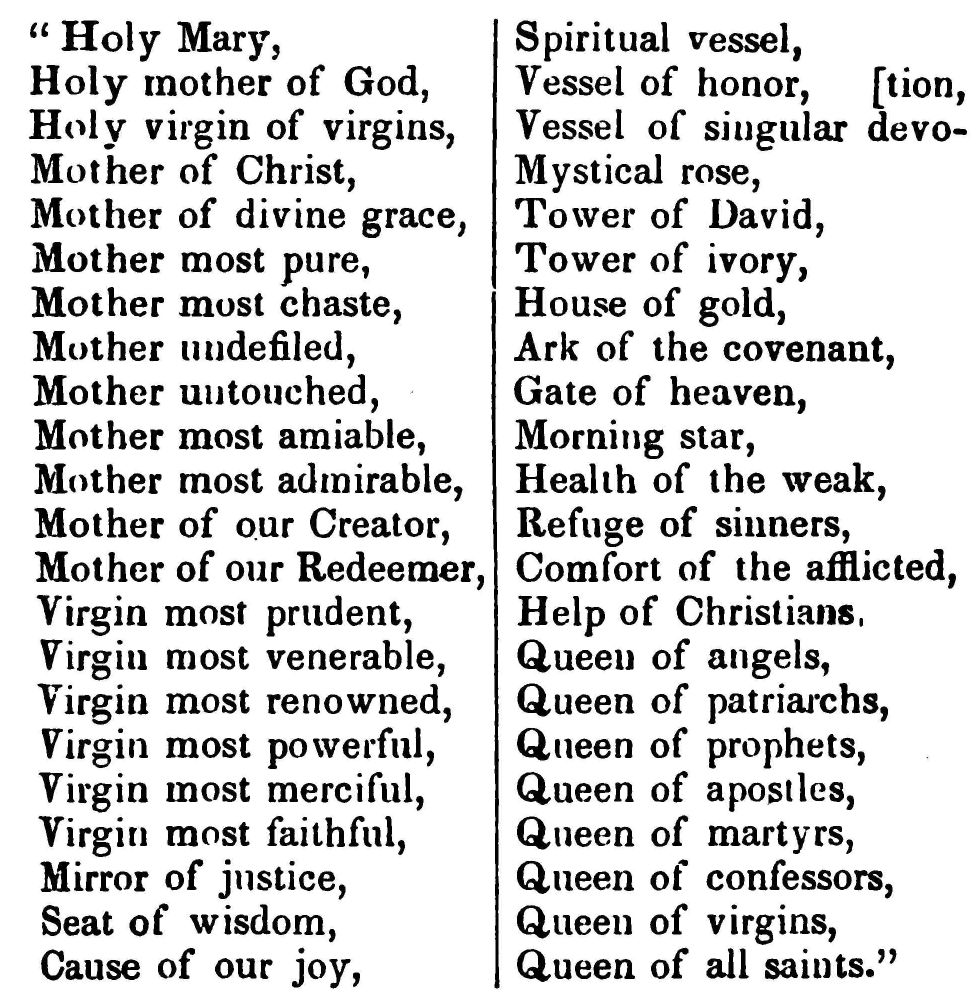
With such an amount of funds annually, from abroad, in the hands of a body of men, who understand how to manage and appropriate them, perhaps better than any other association in the world, with the majority of the population of these United States, and having but one single object in view, namely, the supremacy of their Pope and their church; what have Americans not to fear? They will avail themselves of a corrupt state of representation; they will procure a majority in your national legislature, and then, I say, woe be to your liberties.
Your school-houses, which now ring, at stated hours, with the praises and glories of God on high, wherein children are given to drink of the waters of life, will be converted into monk-houses, and lying-in-hospitals; prayers to God will no longer be heard in them; vagabond saints and wooden images will be the only objects of adoration; ignorance and vice will take the place of intelligence and virtue; idleness will take the place of industry; and the free American who, heretofore, was taught to walk erect before God and man, will shrivel and dwindle into a thing fit only to crouch before a tyrant Pope, and become a hewer of wood and drawer of water, for lazy and gluttonous priests, who, for centuries, have been trying to extinguish the light of reason and science, and who, even at the present moment, aye, at our very doors, are trying to abolish some of the finest productions of genius.
Witness the prohibition, recently, in France, of the publication of the Wandering Jew. Witness the prohibition of its circulation in Cuba; and why is it prohibited? Because it exposes some of the trickery of Jesuitism—because it lays bare some of the intrigues of that hellish association—and because holy mother church knows full well, that no honest or honorable man could see her in her native deformity, without a shudder of disgust—because she knows that herself and her priests are but whited sepulchres, filled not with dead men's bones, but with the living fires of despotism, avarice, lust, and treachery—because she knows that Eugene Sue, who has written the Wandering Jew, is a Roman Catholic, well acquainted with the practices of Jesuits, sanctioned by the church. A continuation of the Wandering Jew, and its circulation, might show the world, even if there were no better authority, that monasteries and nunneries, under the control of Jesuits, were but vast Sodoms and prisons, full of crime and pollution.
Eugene Sue could, and I believe would, show the world, if his health had not failed him, that Roman Catholic priests and bishops, though forbidden, under pain of excommunication, to marry, were allowed to keep concubines. I refer the reader to the memoirs of the Romish bishop, Scipio de Ricci, for the truth of this assertion. I also refer you to another valuable work, Binnii Concillia, first volume, page 737. You will find the same in a work called Corpus Juris Canonici, page 47, to be had in the Philadelphia Library. You will find the same permission sanctioned by the council of Toledo, at which Pope Leo presided. The only restriction put upon the licentiousness of priests, by the council of Toledo, was to forbid them from "keeping more than one concubine at a time, at least in public."
Cardinal Campeggio expressly says, "that a priest who marries commits a more grievous sin than if he kept many concubines." St. Bernard, who died about the beginning of the twelfth century, and who must have been a very charitable man, as all Catholics now pray to him, tells the world that "bishops and priests commit acts in secret, which it would be scandalous to express."
Pope John XII., was convicted by a general council, of fornication, murder, adultery, and incest, but these were not sufficient to depose him. He still believed in holy mother, the church, and his own infallibility. There is not an individual who reads these statements, and is at all acquainted with history, who does not know that Pope Paul III., who convened the council of Trent, had made large sums of money from licenses given to houses of ill fame in that city.
The holy church to this day, in the city of Mexico, to my own knowledge, receives large sums from the same sources, and these are supported principally by monks, friars and priests. No wonder, then, that the publication of the Wandering Jew should be prevented in Catholic countries. The writer, Mr. Sue, is a man of the world, he has read the book of nature with as much attention as he has those in his library. He is a well-read historian, and possesses an admirable faculty of communicating his ideas. He clothes them with a simplicity and beauty, almost peculiar to himself. The man that could depict Rodin, the sanctimonious Jesuit, in his true character, as Mr. Sue has done, must necessarily be silenced in a Catholic country. It must not be known that Jesuits may come among us in the garb of merchants, or in any other disguise which they may please to assume; no intimation must be given, that the poisoned cup, the assassin's dagger, the desperate sea-captain, or the valiant soldier, could be concealed under a Jesuit's cowl, or that he may throw off that cowl, at his pleasure, and exchange it for a pea-jacket, a dancing pump, the violin, the fencing foil, or even the costume of a barber, or tamer of wild beasts.
It will not answer the purposes of the holy church, that a man should live and write, who is capable of raising the curtain which hides its do-signs, and conceals the instruments, which she has ever used, and is now using, for the destruction of liberty. Such a man is the author of the Wandering Jew.
No man can look at the picture which he has drawn of Ignatius Morok, without recognizing, in its every feature, those of a Jesuit and a villain. He travelled about, in the assumed character of a "tamer of wild beasts," but in reality, he was a Jesuit missionary, and sent by that order, with full power to accomplish, by any means within his power, one of the most infamous acts of fraud that over was committed by man.
He was accompanied, (as the reader of Eugene Sue will find,) by a lay Jesuit, named Karl, and I cannot give my readers a better idea of Jesuitism, as it ever has been, and is now, than by requesting of them to observe the course adopted by those two villains in accomplishing the object of their errand. Look at their treatment of the honest and faithful Dagobert. Look at the cruelties which they inflicted on the two innocent orphans, committed to his charge. See the schemes, by which they have made even the wife of Dagobert subservient to their designs. See the arts by which Jesuit priests crept into families, under various disguises, sowing amongst them discord, hatred, and domestic strife. They have put the father against the son, and the son against the father; husband against wife, and wife against husband; brother against sister, and sister against brother. See how they have contrived to filch from the poor and almost starving, the last sou they possessed, to have masses said for the repose of the souls of those who were actually living, to the knowledge of the priest, though represented by him at the confessional, to have been long since dead!
See how one of those vagabond Jesuits, in the assumed character of a physician, aided by one of the sisters of that order, Madam de St. Dizier, imposed upon the heiress, Mademoiselle de Cardoville. He offered his services to accompany her to visit a friend of hers, but had a private understanding with a lay Jesuit in the 'disguise of a hack-driver, to take them to a lunatic asylum, where he deposited the heiress. I will not quote from the "Wandering Jew," it would be depriving my readers of much pleasure; but I would recommend the perusal of it, in order to become acquainted with some of the prominent features of Jesuitism. The work appears as a romance, but it contains many sad and serious facts. It is a compendium of Jesuitism, and should be looked upon as a warning to the citizens of this new world. Americans will scarcely believe that we have any such Jesuits in this country, as are described in the Wandering Jew. I tell them they are mistaken; we have them in every state in the Union, but especially in New York, Maryland, District of Columbia, Pennsylvania, and Massachusetts. I speak from my own knowledge.
"Bred in the harem, all its ways I know."
A word to those who have daughters, and fortunes to give them; and also to those young ladies, who have fortunes in their own right.
Jesuits will leave nothing undone, to form acquaintance with the children of such as are supposed to be wealthy. The Catholic bishops of the United States, in their annual and semiannual despatches to Rome, boast that they are peculiarly fortunate in gaining converts from such families, and I trust a word of caution from me will not prove useless.
The mode which Jesuits have adopted, in approaching such families, are various: but the most general, and hitherto the most successful is, to induce their children to go to their colleges and schools. In these, every male and female teacher is to bend the minds of their scholars towards Popery, and to report progress twice a week to their superiors. But when parents do not send their children to Jesuit schools, the next expedient is to get Roman Catholic servants into the family, who are instructed in the confessional by the priests how to proceed, especially with their young daughters, in prepossessing their minds in favor of the Romish church, and the great beatitudes of a single life.
I have known cases myself, where it was not deemed prudent to go so far as to say one word in favor of the Catholic church, or of a single life. The young ladies may be engaged, and their young hearts pledged. A different course must now be pursued, and the Popish domestic has her instructions accordingly. She must find out to whom the lady is, or is likely to be, engaged; and it must be broken off, not abruptly—that is not the way Jesuits do things—it is to be done gradually. Their young minds must be poisoned, but the poison must be given in small quantities, until finally it produces the desired effect; and then the happiness and the glories of a nun's life are to be the theme of conversation, more or less, according to the instructions received in the confessional.
It is not long since I met with a Protestant friend of mine, and in the course of conversation, some allusion was made to the subject of nunneries. He observed that their schools were excellent; that his daughter had just finished her education there, and had returned home in perfect ecstacy with her school, with the lady abbess who presided over it, and with all the nuns by whom she had been educated. "It is said," observed this gentleman to me, "that nuns try to tamper with the religious opinions of their pupils, and endeavor to make 'nuns of them,' but there is no truth in this; they never interfered with my daughter's religious opinions, nor did they insinuate to her the most remote idea of taking the veil, or becoming a nun."
I made no reply—courtesy forbade it. I might easily have answered my friend, but I feared the answer, which truth compelled me to give, would hurt his feelings. I might have said to him, Sir, your daughter had not a dollar in her own right, neither had you one to give her, and you must know that Jesuits seldom covet penniless applicants for the black or white veil You should have also known that, although your daughter may have seemed very beautiful in your eyes, she was probably devoid of those external charms which would attract the libidinous eye of a Jesuit. When ladies are taken into a convent by Jesuits, they must be possessed of something more than ordinary attractions. These reverend Jesuits, having the liberty of choosing, are rather fastidious. Verbum sat.
Truly, and from my heart, I pity the female, who risks herself in the school of Jesuit nuns. She hazards all that is dear to her. Though she may leave it, single-minded and innocent as she entered,—as I believe they all do who do not become nuns,—still the peril of going there at all is eminently hazardous and dangerous. But woe be to those who become nuns. I have been chaplain to one of those nunneries; and I assure my readers, on the honor of a man, who is entirely disinterested, and whose circumstances place him in an independent position, who wants neither favors nor patronage from any individual, that the very air we breathe, or the very ground upon which we walk, is not made more obedient or more subservient to our use, than a nun, who takes the black veil, is to the use of Popish priests and Jesuits.
The internal economy and abominations of a convent are horrible in the extreme. I dare not mention them, otherwise my book would, and ought to be, thrown out of every respectable house in the city. I will only call my reader's attention to the fact, that, in all Catholic countries, nunneries have foundling hospitals attached to them. This any man can see who goes to France, Spain, Portugal, or Mexico.
It will be seen, even in this country, that they have their private burying places and secret vaults. It is not more than five or six years, since a number of Jesuits, in Baltimore, petitioned the legislature of Maryland for leave to run a subterraneous passage from one of their chapels to a nunnery, distant only about five hundred yards. The object of the petitioners was too plain. It was the most daring outrage ever offered any deliberative body of men; but, much to the credit of the legislature of Maryland, they rejected the petition with undisguised marks of indignant scorn.
These statements will be rather unpalatable to Jesuits, but my only regret is, that decency forbids a full development of the crimes committed, with perfect impunity, in Popish convents. In New York, every effort seems to be making, by the present legislature of that state, to suppress immorality. A bill is now before that body, making adultery a penitentiary offence; yet Popish priests are building nunneries there, and if Roman Catholic ladies think it proper to hold a fair to collect money for the building of those nunneries, these very New Yorkers will contribute their money freely; and thus, this ill-placed liberality, which Americans bestow, not only there but elsewhere, becomes the cause of evils which they seem desirous to crush.
How is it with us in Massachusetts? Look at our statute book, and if we are to judge from that, of the utter detestation with which our people look upon immorality of every kind, we deserve to be considered paragons of propriety. Should there be amongst us a house, even of equivocal fame, our guardians of the night and civil officers are allowed to demand entrance into it at any hour, and if refused, they may use force. Yet we have convents amongst us, nunneries and nuns too. Poor helpless females are confined in them, but not an officer in the state will presume to enter. If admission is asked, it may or may not be given by the mother abbess or one of the reverend bullies of the institution; but no force must be used. The poor imprisoned victims, whether content or not with her station, must bear it without a groan or a murmur.
This should not be in any civilized country; and I will venture the assertion, that it could not continue one hour, at least among the moral and charitable people of Boston, were they not utterly unacquainted with the iniquities of the Romish church.
This fully explains the opposition to the circulation of the Wandering Jew by the infallible church.
I have given the reader but a faint view of the persecutions of Popery, down to the close of the fifteenth century, and revolting as they are, there is no record to be found from which we can even infer, that the church has ever altered her doctrine or practice, on the subject of exterminating heretics, namely, all who are not Roman Catholics. If there were any such record, it could not have escaped my notice. Some Pope or some council would, long since, have given it to the world.
I was, as has been stated, born a Roman Catholic, and educated a priest in that church. I solemnly declare to you, fellow-citizens of my adopted country, that nothing has been more forcibly impressed upon my mind, by my teachers, when a boy—by the priest to whom I confessed when young—by the professors under whom I read Popish theology—or by the bishop who ordained me, and with whom I lived subsequently as chaplain—than the obligation I was under of extirpating heresy, by argument, if possible; and, if not, by any other means, even to the shedding of blood. And there is not now, in this country, an Irish priest nor an Irish Roman Catholic, and true son of the church, who does not believe that, if he could collect all the heretics in the United States, and form them into one pile, he would be serving God in applying a torch to it. And, incredible as it may appear to you, their church teaches them that, in doing so, they would be serving you.
The doctrine is taught now, as it was in past by their priests, that the body must be destroyed, for the good of the soul. "It is a benefit." say the pious Popish priests, "to heretics to be killed; the fewer will be his sins, and the shorter will be his hell!" You naturally shudder at this doctrine, but it is not many years since Leo XII. in one of his bulls of jubilee, or indulgence to the faithful, announces publicly, and without shame, or sorrow, proclaims to Catholics, his beloved subjects, that in order to obtain the indulgence granted by that bull of jubilee, there are two conditions, without which, they can derive no benefit from it, namely, the exaltation of the holy mother church, and the extirpation of heresy. This "blessed bull" was published in 1825, and directed to the archbishop of Baltimore, and all other Popish bishops in the United States, to be made such use of as their lordships may think proper!
Will you believe it, Americans, that this doctrine is taught, this very day, in the college of Maynooth, Ireland. You will find it in De LaHogue's Tract. Theolog. ch. viii. p. 404, of the Dublin edition. No priest or bishop will question the authority of Dr. De La Hogue. He has been professor in that college for nearly half a century. I must, however, add here, for the information of all who are unac-quainted with the doctrine of the pious frauds practised by Romish, priests, that their respective bishops, or in his absence, the vicar-general, can give any of them a dispensation to deny any truth or to tell any falsehood for the "exaltation of holy mother church." I have received such dispensations myself, but, not having the fear of the Pope before my eyes, I took the liberty of disregarding them.
Many will ask me, Why have you not made these things known before now? There were many reasons why I suppressed them.
I knew my motives, however disinterested, might then be questioned; secondly, the public mind was not prepared for the developments which I have made. Thirdly, my love of peace and quietness induced me to withdraw to a part of the country, distant from the scene of my controversy, hoping that the miscreant priests and bishops of the Romish church would permit me to pursue my new profession of the law, without interruption. But in this, as I ought to have known, I was disappointed. Although I have not, since I left Philadelphia, until very recently, even replied to the calumnies which vagabond Irish priests who infest this country, and the still greater vagabond bishops who govern them, together with the tools which they keep in their employment, have heaped upon me; still they have, in the true spirit of their vocation, never ceased to pursue me with their vengeance.
No sooner had I abjured the Pope, disregarded his-bulls, and thereby become a heretic, than they had me burnt in effigy! But much more gratified would they be, had they my person in the place of the effigy. I still remained unmoved. Soon after this, Bishop England, of Charleston, South Carolina, established a press, called the "Catholic Miscellany," whose columns teemed, for months,—almost for years,—with the grossest and vilest abuse against me; yet while this restless demagogue, who is now in his grave, was spewing forth his filthy abuse, I was prospering in my profession, and partially recovering my health, which I thought was radically destroyed by the persecutions I suffered in Philadelphia; and thus, while the Pope in Rome, and the Romish bishops and priests of this country, were cursing me, Heaven was blessing my efforts and gaining me the confidence of the virtuous and good, whom I had the pleasure of meeting in my intercourse with the world.
Strange indeed are the practices of Papists! Previous to my heresy in Philadelphia, there was not in that city a more popular man—not another more respected; I may almost say, that there was no man, of any pursuit or calling, whose friendship was more courted. Yet the moment I committed the unpardonable sin of differing with the Pope of Rome, every one of his faithful children, not only there but throughout the world, was bound by his oath of allegiance to persecute me in every possible way.
Never forget, Americans, that the same oath of allegiance, which binds them to persecute me, is also binding on them to persecute and destroy you. Some of you will say, this cannot be. A church, numbering among her priests such men as Massillon, Fenelon, Chevereux, and Taylor of Boston, cannot entertain, much less command, a spirit of persecution. True, as far as we can judge, these were godly men. They would be an honor to any religion. But in the Popish church, they were like stars that strayed from their homes, and losing their way, fell, by accident, upon the dark firmament of sin and Popery; but even there, their native light could not be obscured; on the contrary, the darker the clouds around them, the more beautiful and brilliant did their light appear. Poor Taylor,—"Peace be to thy memory,—we have been friends together." Methinks I can, even now, feel the warm pressure of thy hand, see the charities of thy soul beaming in thy speaking eye and gentle countenance, yet thou too had been considered almost a heretic in the city of New York, and would have been denounced as such by the rude and vulgar bishop of that diocese, had not the amiable Chevereux interfered.
Often have I regretted that this Mr. Taylor, who was my classmate, and companion of my youth, had not, in addition to his private virtues, more fortitude and decision of character. He was the Erasmus of his day, in the United States. He was born and educated a gentleman; so was the amiable but timid Erasmus. He was educated a Roman Catholic; so was Erasmus. He was a chaste and elegant classical scholar; so was Erasmus. Taylor, knowing full well the corruptions of the Romish church, went from New York to Rome, about the year 1822, in order to induce the Pope to modify such of its doctrines as were objectionable in this country. But he wanted courage, and hastily retreated back, lest he should be consigned to the inquisition. Erasmus, too, wanted courage, a quality as necessary for a reformer as it is to a general in storming a city and hence it is; that those two amiable men, similar in character and disposition, though living in ages widely apart, have lived ostensibly members of a church, whose doctrines they loathed from the very bottom of their souls.
This might have been the temper, the character, and the cause, why such men as Massillon and Fenelon have lived and died Roman Catholics. They felt, probably, as Erasmus did, when he said, "It is dangerous to speak, and dangerous to be silent." "I fear," said he, in another place, "that if a tumult arose, I should be like Peter in his fall." It is not at all strange, that such men as we have spoken of, should have contented themselves with having inculcated virtue, and denounced vice. There were such men in all ages, and, as a modern writer expresses it, "in all great religious movements there are undecided characters." But let it be borne in mind, that even great and good as they seemed to be, and eloquent and pious as they appeared, still they are only exceptions in the great body of the advocates of Popery.
No wonder Americans look back to those lights in the dark and bloody wilderness of Popery. It is refreshing to see them. They are green spots in the deserts made barren and desolate, by Popish iniquities; and long may their memories shine in unclouded lustre.
It is pleasant to the historian, who is wearied and disgusted with contemplating the past and present horrors of Popery, to turn for a moment from the frightful spectacle, and rest in devout contemplation on the lives of those comparatively excellent men. How mistaken are those would-be philanthropists, who, at the present time, teach Americans to infer, that, because those were good and holy men, possessing a pious and forgiving spirit, it follows that the Papist church, her bishops and priests, entertain a similar spirit. This is equivalent to telling them that all history, past and present, is false, a mere romance, the dream of madmen. It is equivalent to telling them that the very history and records of the lives of Fenelon, and Massillon, &c., were entitled to no credit. Who can read, and not see that Rome has spilt oceans of blood to enforce her cruel creed! Who can read, and not see that she has squandered treasures enough to relieve the poor of civilized Europe, in establishing and keeping up a despotism inimical to man and hateful to God!
The Papists, even in this country, do not deny that they intend to eradicate heresy, and to use every means which their church considers legitimate to effect that purpose. This the priests preach from their pulpits; this they tell you to your beards. They admit their determination to bring these United States, if possible, under the spiritual control of the court of Rome. They use the word spiritual, in utter contempt of your understanding, to deceive you, and while using it, they laugh at your credulity. Popish spiritual control, spiritual allegiance! It is almost incredible that any body of men should have the impudence to come forward, in the nineteenth century, and talk of spiritual allegiance to his royal holiness the King of Rome.
They admit their determination to possess this country, and have the modesty to ask you to give them lands and churches, and means to accomplish their object, and effectuate your destruction. Their next step will be to quarter upon you an army of friars, Jesuits, or monks, who will carry at the point of the bayonet what is left undone by duplicity, treachery, and intrigue. This has been the fate of every country where Popery has found a resting place, and America is the only nation which, for the last three centuries, has given them such a footing. They tried what they could do in China. They succeeded in establishing several bishoprics, Jesuit convents, nunneries, monk-houses and churches, among the peaceable and quiet Chinese; but happening to differ among themselves on the subject of their respective temporal rights, they, as in duty bound, referred their differences to the Pope. This movement came to the ears of the emperor of China, whom they had so long and so successfully deceived by the cant words, spiritual allegiance to the Pope. The parties were summoned before his commissioner to ascertain what was meant by spiritual allegiance. They tried to explain it, but all their ingenuity, all their subtilty, could not satisfy the commissioner that spiritual allegiance meant anything else than what it fairly expressed, and as soon as he found that it meant, in the eyes of the Pope and the Romish church, things real and tangible, such as real estate, the conveying it from the rightful owner under the laws of the land, to another under the laws of the Pope, who lived in Rome, he satisfied himself, that the spiritual supremacy of the Pope meant, among other things, the power to govern the kingdoms of the earth; to give away, and take them away, to whom and from whom, his royal holiness pleased. The emperor instantly issued an order, directing that every Roman Catholic bishop, priest, friar, Jesuit, monk, and nun, within his empire, should quit, within a given time, on pain of losing their heads. Many of them disobeyed the order and were executed, and their churches levelled to the ground.
The Chinese had no objection to Papists worshipping God, according to the dictates of their own conscience; but as soon as it was discovered that they owed spiritual allegiance to a foreign power, they deemed it prudent to remove them from the country. But the Chinese are barbarians, and it seems reserved for this new world of ours, to interpret properly the meaning of spiritual allegiance, and in all differences, between our citizens and the agents of the Pope, as to the temporalities of the Romish church, to lay the subject before his royal holiness, and be governed by his decision.
Witness the difference between Bishop Hughes of New York, and the trustees of a Roman Catholic church in Buffalo, only a few weeks ago. Witness that in New Orleans, between the bishop and the trustees of the Roman Catholic church. All these were referred to the Pope, who decided the matter, without any respect or regard to the laws of this government. Call you this spiritual allegiance? Call you this an exercise of spiritual power, on the part of his royal holiness the Pope? Yes, you do; and it would not much surprise me, if the Papists of this very city of Boston should recommend to its legislature, to lay the difficulties between themselves and the state of South Carolina, before the Pope of Rome for adjudication.
Should the day ever arrive, when the Papists have a majority in your legislature, and a difference should occur between these states, the Pope will be called in to decide it. I am at a loss to know how, even in these days of transcendentalism, any other meaning can be given to spiritual allegiance, than that which the Roman Catholic gives it in practice. They consider the Pope, as the spiritual head of the church, has, a fortiori, a divine right to be the head and sovereign of the world. This is the sense in which Catholics understand and act upon it, and swear to support the Pope, as the supreme arbiter of the destinies of the world. The Chinese understood this. The emperor of Russia understands it at the present day; and though a Catholic himself, no priest or bishop, within his vast dominions, dare avow any allegiance, spiritual or temporal, to the king or Pope of Rome.
The holy synod of St. Petersburg, Russia, have notified the Catholic missionaries, who have incited rebellion, and interfered with the civil authorities in Georgia, to renounce their intercourse with the see of Rome, or quit the country. But Americans, in the alembic of their fertile brains, have manufactured a definition for spiritual allegiance, peculiarly their own, for which the Papists are so much obliged to them, that whenever an opportunity of knocking out the aforesaid brains occurs, they will do so. Witness in the Philadelphia riots, &c, &c, strong proofs of the spirituality of that allegiance which Catholics owe to the Pope.
Permit me to give you another evidence of the nature of that allegiance to the Pope of Rome, to which I have heretofore alluded. It is to be found in the massacre of the Huguenots, by Roman Catholics. There is no event in the history of France, with which the world is more familiar, than this. Several historians have related it with great minuteness and much elegance. To these I can add nothing of my own, and the reader is more indebted to them, for the following statement, than to myself.
MASSACRE OF THE HUGUENOTS.
This bloody massacre took place immediately after the conclusion of the treaty of St. Germain, at which the hostilities which had so long existed between the Catholics and Protestants in France, were suspended, or, as the Protestants believed, were entirely terminated. The sufferings of the Protestants, up to the conclusion of that treaty, were truly great. Their property was wasted; their beautiful chateaus were burned and levelled to the ground; their flourishing vineyards were destroyed, and they themselves were left, reduced in property and numbers; but great as were their calamities, the spirit which lived within them was not quenched. Their hearts, though oppressed, 7 were not broken. The love of God bore them up against all their trials and privations. Among those who suffered most in the Protestant cause, was the brave and pious Admiral Coligny, who, after the treaty of St. Germain, and the destruction of his beautiful estates by order of the Popish and bloody Catharine, retired to Rochelle. Even here there was no safety for him. The licentious queen, and her paramours, consisting of priests, determined on his destruction. It is said of this woman, that she occupied twelve years of her life in instructing her son Charles to swear, to blaspheme, to break his word, and to disguise his thoughts as well as face. We are told by contemporary historians, that this blessed daughter of the holy church supplied him with small animals, when a child, and a sharp sword to cut off their heads, and shed their blood by stabbing them; all this to familiarize him with the shedding of blood, and that at some future day he might indulge in the same amusement upon a larger scale, in cutting off the heads and stabbing heretics and Protestants. The persecutions of the Huguenots are known almost to all readers; few there are, who are not familiar with them. The illustrious characters, who headed the Protestant cause in those days, are known to all Protestant Americans, but none of them, perhaps, more intimately than the great Coligny, who was one of the first martyrs to that wretched Popish thing, in the shape of a woman, Catharine de Medicis, regent of France. I trust, therefore, the reader will pardon me for giving a few incidents in the life of this nobleman and martyr, during one of the regencies of this Popish queen Catharine. After the marriage of Henry of Navarre, Coligny, as we are told, suddenly retired from the banquet given upon the occasion at the Louvre. It was remarked that he seemed sad and dejected. He retired to his hotel, which he would have gladly left and returned home, but dreading that he might alarm his wife, he preferred writing to her, explaining matters as far as he could, under existing circumstances. The letter is so interesting, so affectionate, and altogether so worthy of the good man, that I cannot refrain from laying it before my readers. It was as follows:!!!!!
"My very dear and much beloved wife:
"This day, was performed the ceremony of marriage between the king's sister and the king of Navarre. The ensuing three or four days will be spent in amusements, banquets, masks, and sham-fights. The king has assured me that, immediately afterwards, he will give me some days to hear the complaints, made in divers parts of the kingdom, touching the edict of pacification, which is violated there. It is with good reason that I attend to this matter as much as possible; for, though I have a strong wish to see you, still you would be angry with me (as I think) if I were remiss in such an affair, and harm came of it from my neglect to do my duty. At any rate, this delay will not retard my departure from this place so long but that I shall have leave to quit it next week. If I had regard to myself alone, I had much rather be with you than stay longer here, for reasons which I will tell you. But we ought to consider the public welfare as far more important than our private benefit. I have some other things to tell you, as soon as I shall have the means to see you—which I desire, day and night. As for the news that I have to tell you, they are these: This day, at four in the afternoon, the bells were rung, when the mass of the bride was chanted. The king of Navarre walked about the while in an open place near the church, with some gentlemen of our religion who had accompanied him. There are other little particulars which I omit, intending to tell you them when I see you. Whereupon I pray God, my most dear and beloved wife, to have you in his holy keeping. From Paris, this 18th of August, 1572.