Chapter II · COAL By George S. Rice and Frank F. Grout
Reading edition
USES OF COAL
Coal is among the most important of all minerals. It furnishes power and heat, and its distillation yields a great number of useful materials, such as gas for lighting and fuel, explosives, ammonia, aniline dyes, etc. Coke, which is bituminous coal with the more volatile constituents removed by distillation, is used for smelting metallic ores; and thus the contiguity of fields of high-grade coking coal and of iron ore determined the location of the centers of steel industry, which are the very main-springs of our modern machine-made civilization. Near such coal districts, other manufactures of all kinds naturally developed, the coal being cheaply available for power and constituting practically the only source of power in regions where cheap hydro-electric power is not available. About 66 per cent. of the coal mined goes to the production of power, including transportation; about 12 per cent. to coking and the by-products; and about 22 per cent. to the heating of buildings.
Commercial coal is of three varieties: (1) anthracite (Pennsylvania anthracite is popularly termed hard coal), and semi-anthracite containing a high percentage of fixed carbon and a relatively low percentage of the volatile constituents (3 to 12 per cent.); (2) bituminous (ambiguously termed “soft coal” in the United States), containing less fixed carbon and more volatile matter (12 to 40 per cent.); and (3) lignite, containing a still smaller proportion of fixed carbon and a large proportion of water. Of the bituminous coals, some coke satisfactorily, but many do not, so that good coking coals are highly prized. Anthracite, because it makes no smoke, is in great demand for house heating; whereas bituminous coal is chiefly used for power production, including locomotive and steamship firing. Lignites as a rule are used only where the better grades of coal are not available.
Coal was first used for heating before steam power came into use, and iron was smelted with charcoal instead of with coke as at present.
Ship bunkering calls for the best grades of bituminous coal, low in ash and preferably high in fixed carbon, because the use of low-grade coals would require carrying larger amounts, leaving less space for cargo. However, no country that has enough coal to bunker ships, need be dependent on foreign supplies; the low grade of coal would simply reduce efficiency and thus increase expense.
Substitutes.
—The proportion of coal used for power, as distinct from that used for heat and coal products, is increasing, and is now two-thirds of the total. As a source of power there is really no complete substitute for coal. All the great industrial nations, like England, Germany and the United States, have developed their industries on the basis of large coal supplies. Some countries make large use of hydro-electric power, but for most it is an insufficient substitute. Wood and other fuels are rarely sufficient to maintain an industry built up on a supply of coal. Oil is being successfully substituted in some industries, notably in shipping, but the importance of coaling stations will no doubt persist.
CHANGES IN PRACTICE
The technique of coal mining in many districts, and the development of heat, power and coal products are not far advanced. Wasteful methods are used, mostly as a result of competition and lack of co-operation and organization among producers. Economies are being advocated, however. Labor-saving machinery has been installed in many mines. A number of power plants have been erected near the mine mouth and the power distributed electrically, thus eliminating freight charges on coal. Central heating and power plants that can burn coal efficiently will no doubt be more popular and numerous in a few years. Government control and legislation may be expected to hasten the changes. In Europe the technique of coal mining, except in undercutting machinery, is further advanced than in the United States, as regards mining all the coal and in supporting the surface.
Improvements in coking ovens may soon make possible the manufacture of some sort of coke from almost any bituminous coal. While all coke may not be satisfactory for modern blast-furnace practice, any future lack of coke will probably be offset by the development of electric smelting, so the seriousness of the metallurgical need is doubtful. The proportion of by-product coke ovens, which make for cheaper coke by providing for other marketable products, is increasing.
GEOLOGICAL DISTRIBUTION
Coals are found in the sedimentary deposits of several geological eras: Paleozoic, Mesozoic, and Tertiary. The Paleozoic era, embracing the Carboniferous period, is by far the most important as regards quality and availability of its coal resources; but the lower-grade and chiefly lignitic coals of the Mesozoic and Tertiary are of great importance locally, and there are enormous reserves that exceed in quantity the generally higher-grade coals of the earlier periods.
The geologic distribution of coal is described in “The Coal Resources of the World,” the most important and comprehensive compilation on coal reserves ever made, which was undertaken by the Executive Committee of the Twelfth International Geologic Congress, held in Canada in 1913. As the compilation was made with the assistance of geological surveys and mining geologists of the several countries of the world, it is cited in this paper as authoritative on geologic distribution and resources.
The geographic distribution of the chief coal fields of the world is shown in Plate II.
In North America the most important coals in the Central and Eastern part are of Paleozoic age, but in the Rocky Mountain region vast quantities of coal occur in the Cretaceous (Mesozoic) strata. In the Gulf province and in the Northern Great Plains province of the United States, which extends into Canada, are coals of Triassic (Mesozoic) age that are relatively unimportant at present.
In beds of the Eocene period of the Tertiary era are large deposits of brown lignite locally converted by mountain-building forces into bituminous and semi-bituminous coal, and also a little anthracite under difficult mining conditions. Such locally altered beds are found in the State of Washington, in British Columbia, and in Alaska.
The limited coal resources of South America, in those deposits east of the Andes and in southern and eastern Brazil, are of Paleozoic age. Small areas of Tertiary coals are found in southern Argentina and in Chile.
Key to Plate II.
World’s Coal Reserves as of 1916—Coal Fields in Solid Black.
1. Countries possessing coal reserves of the first magnitude (4,000,000 million to 1,000,000 million tons): The United States (3,527,000 million), Canada (1,234,000 million), and China (1,500,000 million).
2. Countries possessing coal reserves of the second degree of magnitude (500,000 million to 100,000 million): The British Isles (189,533 million), Germany (before the war) (423,356 million), Siberia (173,879 million), and Australia (165,572 million).
3. Countries possessing coal reserves of the third degree of magnitude (80,000 million to 16,000 million tons): France (before the war) (17,583 million), Alaska (16,293 million), Colombia (27,000 million), Austria-Hungary (before the war) (55,553 million), Russia in Europe (before the war) (60,106 million), India (79,001 million), Indo-China (20,000 million) and South Africa (56,200 million).
4. Countries possessing coal reserves of the fourth degree of magnitude (16,000 million to 6,000 million tons): Spain (8,768 million), Japan (7,970 million), Belgium (11,000 million), Spitzbergen (8,750 million).
5. Countries possessing coal reserves, but of inferior magnitude (less than 4,000 million tons): Brazil, Argentina, Chile, Peru, Ecuador, Venezuela, Greenland, Holland, Denmark, Sweden, Italy, Bulgaria, Turkey, Greece, Roumania, Asia Minor, Persia, Arabia, various islands of Malaysia and various countries in Africa. Coal fields shown in black—country not shaded.
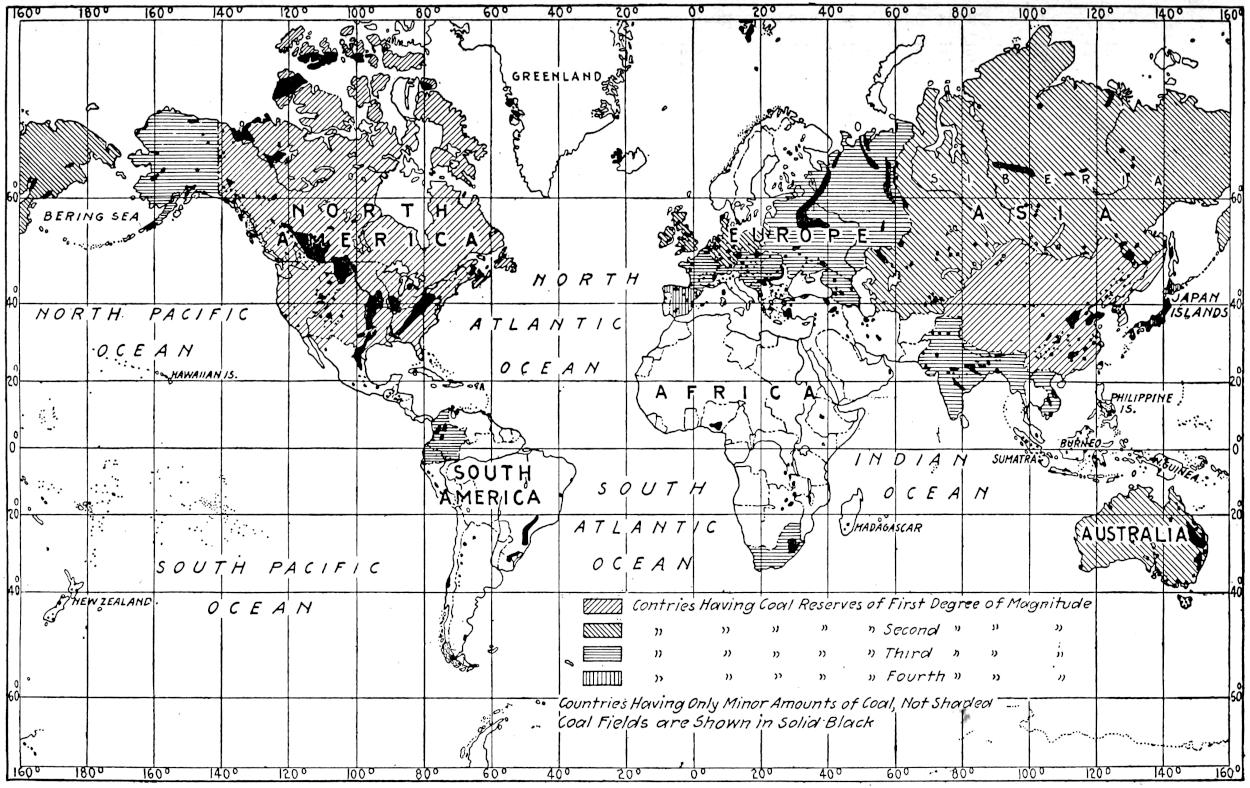
Plate II.—Geographical distribution of the coal deposits of the world, and relative reserves. By F. F. Grout.
In Europe the principal coal deposits occur in the Carboniferous system, either in the upper or the lower part. The Lower Carboniferous is the principal series in which coals occur in Scotland, whereas the most important coals in England and in Wales lie in Upper Carboniferous rocks. In northern France, in Belgium, and in Westphalia, Germany, the middle Carboniferous measures contain the most important reserves. Mesozoic coals are found in northern Australia and in central France. The lignites or brown coals of middle Europe are locally very important in Germany; those of Austria are found in numerous small but thick deposits of the Tertiary age.
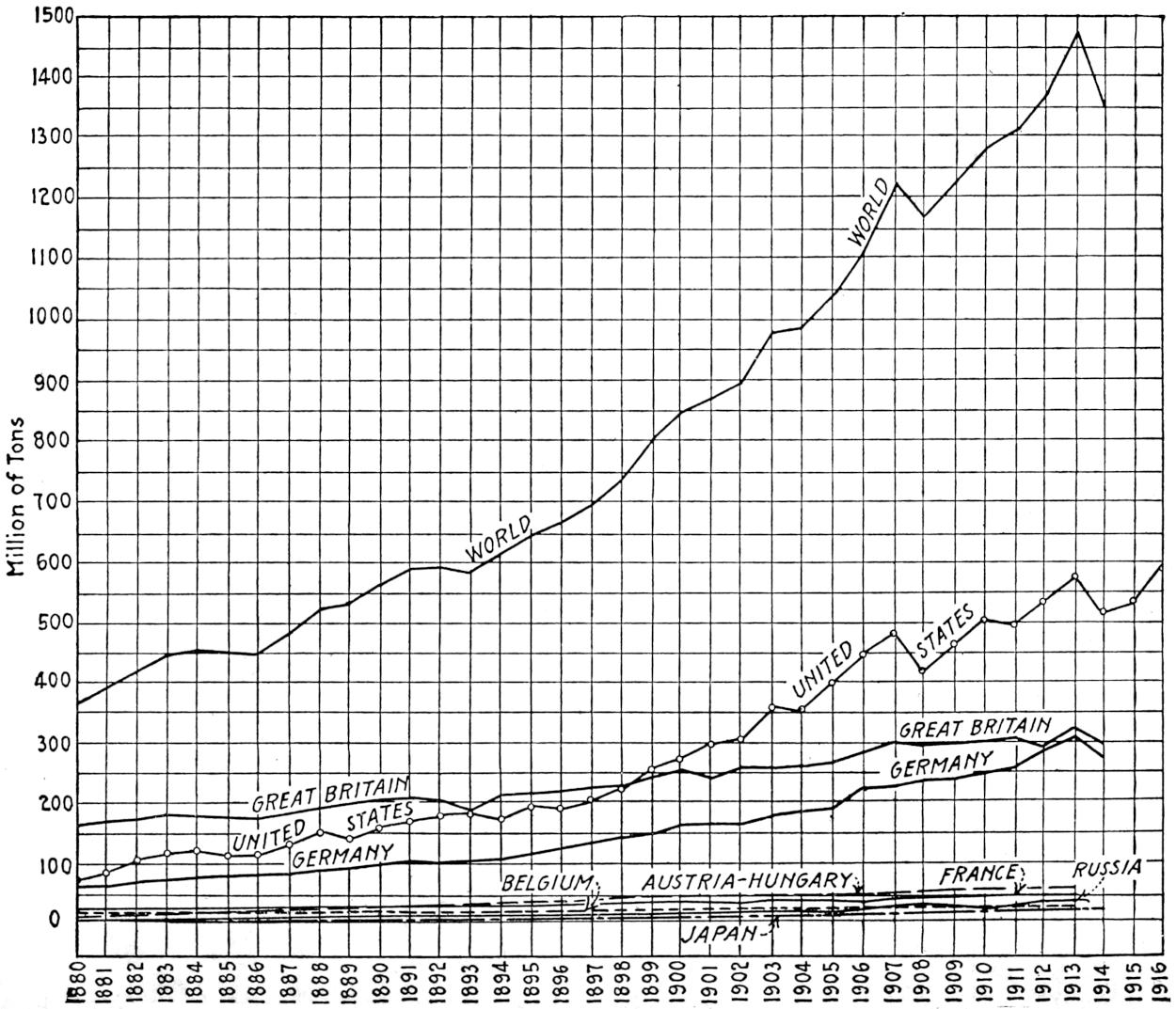
Fig. 3.—Coal output of the chief coal-producing countries, 1880-1916.
The principal coal resources of Africa are in the southern part of the continent and are chiefly in deposits whose ages range from Carboniferous to Triassic.
In Asia the coal fields are not well defined. There are coal basins of note in India and China. In China important coals are found in the Upper Carboniferous. Coals of the Lower Carboniferous are found east of the Urals and also in Turkestan. In Japan the Mesozoic coals are important. Tertiary coals are widely distributed in Asia but are not high-grade nor of importance.
It may be safely stated that geological reconnoissance has covered the world so well that further development is not likely to disclose coal resources of great magnitude not now known with more or less exactitude. Estimates of resources of some regions will undoubtedly be revised many times, especially those of reserves in the middle portion of Africa, in South America, and China.
COAL PRODUCTION OF THE WORLD IN 1913
As the great World War began on July 31, 1914, the last normal production figures were for 1913. The following table of the world’s production of coal for the years 1911-1914 is from “Mineral Resources” of the U. S. Geological Survey, the compilation being credited by Mr. Lesher, of the Survey, to Mr. Wm. G. Gray, statistician of the American Iron and Steel Institute, and Prof. G. A. Roush, editor of “Mineral Industry.”
The output (1880-1916) of the chief coal-producing countries of the world is shown graphically in Figure 3.
Table 4.—The World’s Production of Coal (in Short Tons)
Country 1911 1912 1913 1914
United States 496,371,126 534,466,580 569,960,219 513,525,477
Great Britain 304,518,927 291,666,299 321,922,130 297,698,617
Germany 259,223,763 281,979,467 305,714,664 270,594,952
Austria-Hungary 54,960,298 56,954,579 59,647,957
France 43,242,778 45,534,448 45,108,544
Russia 29,361,764 33,775,754 35,500,674
Belgium 25,411,917 25,322,851 25,196,869
Japan 19,436,536 21,648,902 23,988,292 21,700,572
India 13,494,573 16,471,100 18,163,856
China 16,534,500 16,534,500 15,432,200 [5]
Canada 11,323,388 14,512,829 15,115,089 13,597,982
New South Wales 9,374,596 10,897,134 11,663,865 11,644,476
Transvaal 4,343,680 8,119,288 [6] 5,225,036
Spain 4,316,245 4,559,453 4,731,647
Natal 2,679,551 See note 6 2,898,726
New Zealand 2,315,390 2,438,929 2,115,834
Holland 1,628,097 1,901,902 2,064,608
Chile 1,277,191 1,470,917 1,362,334
Queensland 998,556 1,010,426 1,162,497 1,180,825
Mexico 1,400,000 [5] 982,396
Bosnia and Herzegovina 848,510 940,174 927,244
Turkey 799,168 909,293
Italy 614,132 731,720 772,802
Victoria 732,328 664,334 668,524
Orange Free State (Orange River Colony) 482,690 609,973
Dutch East Indies 600,000 [5] 622,669 453,136
Indo-China 460,000 [5] 471,259
Serbia 335,495 335,000
Sweden 343,707 397,149 401,199
Western Australia 300,000 [5] 330,488 351,687
Peru 300,000 [5] 307,461 301,970
Formosa 280,999 306,941
Bulgaria 270,410 324,511
Rhodesia 212,529 216,140 237,728
Roumania 266,784
Cape Colony (Cape of Good Hope) 89,023 See note 6 67,481
Korea 138,508
Tasmania 70,000 [5] 59,987 61,648 68,130
British Borneo 100,000 [5] 49,762
Spitzbergen 44,092
Brazil 16,535
Portugal 10,000 [5] 16,938 27,053
Switzerland 8,267
Philippine Islands 2,000 [5] 2,998
Unspecified 1,016,947 [5]
Table 5.—Reserves
Total coal reserves in millions of metric tons have been estimated, by continents, as follows:
Continent Millions of tons
North America 5,073,000
Asia 1,280,000
Europe 784,000
Australia and Oceania 170,000
Africa 58,000
South America 32,000
The countries on pre-war basis having the greatest reserves are as follows:
Country Millions of tons
United States (half lignite) 3,527,000
Canada (three-fourths lignite) 1,234,000
China 996,000 to 1,500,000
British Isles 190,000
Siberia (largely lignite) 173,000
Germany (including Upper Silesia and the Saar) 423,000
New South Wales 118,000
India 79,000
Russia including Dombrova field (Poland) 60,000
Austria (chiefly in Bohemia, Silesia and Galicia) 54,000
France 17,600
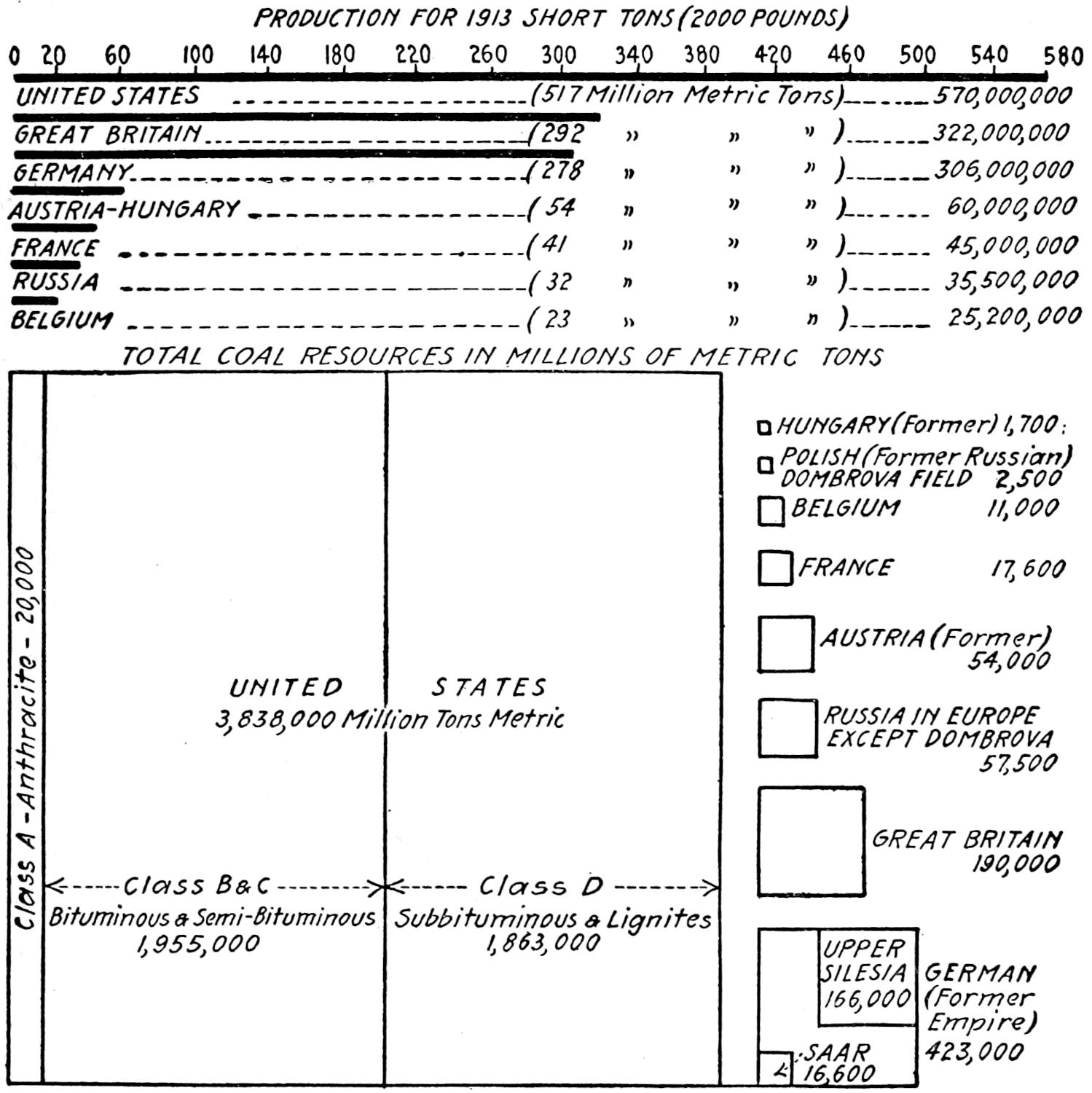
Fig. 4.—Coal reserves of chief producing countries, according to “Coal Resources of the World,” in millions of metric tons. Squares are to scale: lines showing relative production are not on same scale as squares.
The reserves of the principal productive coal fields are graphically shown in Figure 4.
The distribution of the coal deposits of the world and the estimated reserves in these deposits are shown in Plate II.
GENERAL WORLD SITUATION
The districts with coal for export have been chiefly the British Isles, United States and Germany; there might be included also New South Wales, British South Africa, Japan, French Indo-China, Canada, New Zealand and Spitzbergen. China, with her large reserves, may become an exporter in the future; or, if her industries develop, may find use for her coal at home.
Anthracite of good grade is found in large amounts in Pennsylvania and South Wales only. Poorer supplies are known in Germany, France, Italy, Indo-China, and also in the states of Colorado and New Mexico.
Coking coals in large amounts are found in the eastern United States, Germany and the United Kingdom and are coked extensively. Smaller amounts of coke are made in France, Belgium and old Austria. Relatively very small amounts are made in Canada, Chile, New South Wales, Japan and Spain.
The coal reserve of a country bears no direct relation to its present production, for the latter, which has to be developed in competition with other countries, depends upon relative facility of transportation and proximity of iron-ore deposits, which render steel making and other industries economically feasible.
Great Britain is particularly favored through the possession of high-grade coal immediately adjacent to coast ports, as in the North of England, Scotland and Wales. Hence Great Britain became a great exporter of coal. First, coal for heating purposes traveled by sea from Newcastle to London; next coal was carried to European ports, and finally to all parts of the world. The possession of easily worked iron deposits in the north of England and the discovery that iron could be smelted with coke rapidly accelerated the development of the coal industry in Great Britain, so that by the middle of the nineteenth century Great Britain had a commanding lead.
No other country possesses high-grade coal in such quantity immediately adjacent to the coast, and this fact has enabled Great Britain to remain the great exporter. The average length of haul of export coal, from mine to ship, is less than 20 miles. In Germany coal for ocean export must be hauled 118 miles to 168 miles; in the United States from 150 to 375 miles, except for Washington coals, which are within 40 miles of tidewater, but are small in quantity and of indifferent quality.
After the war with France in 1871, when Germany annexed Alsace and Lorraine, the coal industry of the German Empire developed with tremendous rapidity, largely through the discovery—from the investigations of Thomas, of Great Britain—of a method of utilizing the high-phosphorus iron ores of German and French Lorraine, and the nearness of these iron-ore deposits to the high-grade bituminous coals of Westphalia. The coal industry was also developed by fostering the export trade with adjacent countries, which have small coal resources or none, this trade nearly all going by rail.
However, the long rail haul and the correspondingly high cost of mining have retarded the ocean export business of Germany, in spite of the fostering care of the government. With the transfer of practically all its iron deposits and its important Lorraine potash deposits, as well as the ownership of its Saar coal mines, to France, and the possible loss of its Upper Silesian coal and zinc deposits to Poland, the balance of commercial prosperity, as well, may be handed over.
No other countries except the United States, Canada, Australia and China have reserves for extensive export trade. In Canada the coals are mostly inland, and those near the coast, as on Vancouver Island and in Nova Scotia, are limited in quantity and difficult to mine, so that export business is perforce restricted.
One change that seems likely is a rapid increase in output of coal in China. The resources are enormous, the reserves of the higher classes of coal being surpassed by those of no country but the United States. The ambitious and aggressive Japanese, with their strategic neighboring location, have given every indication that they will take advantage of an opportunity to develop such a resource. It may be a question how soon Chinese coal will be developed, but great changes are inevitable when development begins. Some of the coal fields are so near the coast and have coals of such good quality as to permit an extensive development of export business in the Orient.
Australia, particularly in Queensland and New South Wales, has coal resources that are considerable, in comparison with the needs of the small population. In New South Wales the coals are excellent and are adjacent or close to harbors, so that the coal is extensively supplied for bunkerage and export trade to the South Pacific and has become a large factor in the ocean trade of that part of the world.
A large factor in the coal trade of the Pacific Ocean is the carrying of coal as return cargo. This is also important in South American trade. South Africa during the war sent considerable coal to the western Mediterranean, but its coal cannot be a large factor in ocean trade in normal times.
Of all the continents South America is the poorest in coal resources. There is coal in Brazil and Chile and other South American countries, but it is difficult to reach and the fields so far known do not give promise of being able to take care of the needs of the countries in which they occur. The total annual production of South America is less than two million tons, mostly from Chile. It is probable that for the next generation South America will continue to import coal as it has in the past, to the extent of 15 million tons or more per annum, although developments in Brazil are now promising for that country’s future supply. For estimates of reserves, see Table 5.
Summary.
—By way of summary, it may be said that the United States leads the world in coal resources; moreover, its resources are most immediately available, because of their shallow depth and general undisturbed (geologic) condition and their accessibility through railway systems. This is particularly true in the Appalachian region, which contains by far the best coal, is the nearest to the coast, and hence is the most available for ocean trade. On the other hand, the average haul to export points, as already noted, is far greater than that of Great Britain and greater than that of Westphalia; but to offset this the coal has been and can be mined more cheaply than in either Westphalia or Great Britain. The resources of Upper Silesia are large, and the coal is easily mined, but the output will all be needed for central Europe. As regards both quality and quantity, Pennsylvania anthracite is unique; nevertheless, the home needs will continue to be a brake on extensive exports. United States steam and coking coals available for shipment average a little poorer than the corresponding coals of Great Britain, but are superior to the German coals.
The total resources of Great Britain, possible, actual, and probable, are only 190,000 million tons, as contrasted with 423,000 million tons in the old German Empire and 3,838,000 million tons in the United States.
Probable Future Production.
—The possible depletion of coal resources is of course important in considering the future, but it can be safely stated that in none of the principal fields now being mined are the resources so depleted that the output therefrom will be reduced for another generation at least.
Of the great coal-producing countries, Great Britain, with its increasing rate of production, most nearly approaches the point of ultimate depletion, but that point has been variously placed at one hundred to several hundred years in the future, much depending upon whether with better methods of use the output will continue to increase at the same rate as in the past. Meantime, certain areas in Great Britain with shallower coal beds will be depleted much sooner and the remaining coal will become more and more difficult to get, because of the increasing depth of mining, which in turn will cause a continually increasing cost.
Although the exhaustion of coal is a distant prospect, there are clear signs of the approaching exhaustion of certain grades of coal. It has been estimated that the output of American anthracite will seriously decline in 60 to 100 years. Probably this will result in a change in practice, the use of coke, and other methods of house heating. If the rate of production continues to increase, high-grade American steam coal, New River and similar grades, will probably be exhausted in a little over 150 years. American coking coal of the best Connellsville quality is of equally short duration. British coal of similar high grade may last longer than American, as the production rate is less rapid, even though the total American coal should last much longer than the British.
POLITICAL CONTROL
In several countries state ownership of coal mines is established; as, for example, in parts of Prussia, Australia, Chile and Bulgaria. In others the undeveloped coal lands are still largely owned by the government, as in Alaska and the western United States. In some countries the government retains control of all mineral rights, simply leasing the property and granting a mining concession. Many governments have a department or administration of mines. In every country, of course, in an emergency, the sovereign state would exercise control of coal resources as fully as was necessary. Where the state owns mines, and favors organization, as in Germany, the more drastic regulation of war time is easily effected. It is quite possible that coal may in time be generally considered a public utility.
In England a movement toward nationalization of mines, with miners as well as the government having a hand in the control, seems to be making progress.
England’s colonies excel all others in extent of coal resources. There is coal in Australia, Canada, India, New Zealand, South Africa, Rhodesia, Newfoundland, South Nigeria and British North Borneo—the total being many times greater than that in the British Isles. The colonies and possessions of France, Denmark, Portugal, United States and Japan have relatively small amounts of coal.
Coal resources, along with other raw materials, have been influenced by some trade treaties. However, no permanent advantage in commerce has been secured to any nation by a trade treaty. Nearly all such treaties are made for short periods and renewed. If not satisfactory to one party they are soon corrected. Various informal or tacit agreements might be mentioned. When shipping was scarce during the war, England and the United States divided the coal business of South America according to the requirements of ship economy. Germany made agreements to send coal to Austria-Hungary and Switzerland during the period of the war. England had agreements with France, Spain, Portugal and Italy, these agreements changing with conditions, about supplies of English coal.
COMMERCIAL CONTROL
Although the ownership of mines in most countries is nominally open to citizens and aliens alike, exceptions and restrictions tend to keep the control in the hands of citizens. For example, it is impossible for foreigners to control any mining company in Japan. Concessions in Holland and the Dutch colonies are limited to Dutch subjects and in Bolivia to Bolivian citizens. The legislation suggested since the outbreak of the World War may develop a similar condition in the possessions of Great Britain and those of her allies.
In peace the relations of two countries may be largely determined by the ownership of property; owners of property in a foreign country may strongly influence the policy of the two governments toward each other. In emergencies, the political and the commercial control are put to the test, and there results either a deadlock or the victory of one over the other.
An important commercial relation exercising political influence is the incorporation of companies under the laws of different countries. Mining companies in China, like the Kailan Mining Administration, organize at Hong Kong to obtain British protection and are thus subject to British control, in spite of the fact that Belgian money finances the company. Some companies organized in Japan may also own Chinese coal mines.
As relatively few regions of the world have coal in excess of their own needs, the larger number are dependent on imports. If a country with coal controls also steamship lines, it may completely control the coal situation in the importing country. England, with about half the total world’s shipping and a good supply of seaport coal, has been in a position to dominate coal exports, even to handling the excess American coal. During the last three or four years the scarcity of shipping has given increased importance to American and Japanese shipping, but the English still exert a strong influence. Their docks and storage facilities are the best, and their ships are still numerous.
Railroad shipping rights over the National Lines in Mexico give a certain amount of control over the coal industry. The National Lines are state owned and have a special agreement giving trackage rights to two companies, the American Smelting and Refining Co., and the Peñoles Company, of German ownership. Since the Mexican railway service has been disturbed, the German company has been operating with cars and engines of its own. It has many coke ovens and large coal reserves, and has been the chief competitor of the American company in Mexican metallurgy.
No patent is likely to limit coal industries, except as regards the by-products of coke. Before the war, coal-tar products were largely developed by Germans, who patented their processes in many countries, but offered no such protection to foreign inventions by patents in Germany. They limited production chiefly to their German plants, and exported about $50,000,000 worth a year.
During the war, these patents in the United States were taken over by the Alien Property Custodian, and the American industries that sprung up in consequence may be permanently protected. Other allied countries took the same steps to free themselves from German control, which has retarded the development of the by-product coke industry in non-German countries.
In Germany the large mining companies generally own the coal rights. The only government that has mined coal on a commercial scale and for commercial purposes is Germany, and even there the government production covered only a small part of the total output of the German Empire. Mines of the Saar coal field and a group of mines in the Upper Silesian field owned by the Prussian government have been the only extensive state-operated mines of the world, and now, under the terms of the Treaty of Peace, the ownership of the Saar mines will pass to France. (The details are given on p. 39).
On the other hand, the government exercised a quiet but real control over the whole German coal industry. Through its ownership of the Koenigen Louise mines it acted as a member of the Upper Silesian coal syndicate. Formerly, through its ownership of the Saar mines, it was also a member of the Westphalian coal syndicate, but whether a member or not it practically approved the syndicate operations and the fixing of prices in advance; also, it co-operated with the syndicate in hauling the latter’s coal over state-owned railway systems. In certain undeveloped coal fields in Germany, the northern extension of the Westphalian field, the Prussian government retains most of the coal rights.
The Rhenish Westphalian coal syndicate is a classic example of a great interlocking trade combination. Capitalized at $571,000, it covered an enormous capitalization of individual members. The mines have votes in proportion to production, which in turn is limited for certain periods. Prices are fixed and coal is marketed for the syndicate as a unit, but other affairs are left to the companies. The syndicate as a whole is a member of a transporting and exporting combine, and disposes of its product through a combine of coal dealers. The several minor combines interlock and are practically merged in a larger organization, the Kohlen Kontor. Thus the combination had exceptional power to study the various problems of the industry, and became very powerful. It maintains a research department and an explosion testing gallery near Dortmund. In several countries German companies through the control of advertising contracts have been able to influence the editorial policy of the leading newspapers, even during the war. Over half of the German coal mined before and during the war was syndicate coal. All of the 600 other German cartels have not been as moderate in their action and regulations as the coal syndicate. When the coal syndicate, however, at one time, found it could not supply its German market with coal, it is reported to have bought inferior British coal for its customers, so that they would not themselves get good British coal and refuse to return to the German supply.
Efforts were made by the cartel to absorb and control foreign coal trade, where political and financial reasons served to render this advisable, and therefore these efforts were out of all proportion to the intrinsic value of the trade. When it was planned to capture such a trade, the German-invented “dumping” system was used, coal being sold cheaper abroad than it could be sold or produced at home, the difference being met by export bonuses. This German dumping became so serious in some countries, as Canada, New Zealand and South Africa, that special import duties were imposed to counteract it. When desirable, the syndicate purchased collieries abroad, including even a South Yorkshire plant in England, the Heraclea collieries, in Turkey, and many mines in Australia.
In Great Britain is a powerful coal combine, the Cambria, closely allied with great shipping concerns. An important trade asset in this organization, like that in the German cartel, is a banking connection by which the combine can offer long-term credit.
Coal syndicates are mentioned in Belgium. Some sort of central organization interested in coal is known in Italy, Russia, Austria-Hungary, Sweden, Greece, Argentina, Chile, and Ecuador.
THE SITUATION IN FRANCE, ENGLAND, AND THE UNITED STATES
France has a modified form of ownership of coal resources: this was vested formerly in the Crown and now in the Republic. The government gives concessions for mining the mineral and charges a royalty. The mineral is not considered to be owned by the surface owner or by the original surface owner, as is the case in all other important countries. The concessions granted are liberal and for large areas. The royalty or rental is small and is now paid on the basis of so much per superficial unit of area (hectare) in the concession, but the chief returns received by the public are through a percentage of the net earnings, that is, earnings available for dividends. Under the conditions prevailing in France the system seems eminently fair, and the undertakings have been profitable both to the operators and to the country. The books of the company are open to inspection by government officials, and the annual reports are published in detail. The system virtually makes the government a partner in the business.
In Great Britain most of the coal ownership is vested in entailed estates, and the royalties are a shilling a ton and upwards.
Both private and government ownership exist in the United States. Throughout the greater part of the country the large operating companies own the coal rights, although in the anthracite district of Pennsylvania the fortunate owners of the surface, or their assigns, receive large royalties, 25 to 50 cents a ton. In the Middle West most of the operators have bought the coal rights from the surface owners. When leased, the royalty is relatively small, 2 to 6¹⁄₄ cents a ton. Operators in the Rocky Mountains generally own the coal they mine. The government has sold the coal rights, but the state school lands of Colorado and Wyoming have generally been leased at royalties of about 10 cents a ton. In Oklahoma the Five Civilized Tribes have until recently, under government control, leased their lands and coal rights at about 10 cents per ton, but these rights are now being sold.
In the State of Washington a considerable amount of the bituminous coal district now opened is owned by the Northern Pacific Railway, which secured these lands as grants when the railroad was constructed. The royalty is about 15 to 25 cents a ton.
In Alaska in the Matanuska and Bering River bituminous fields, and in the Nenana lignite field, the government has offered the coal for leasing purposes at 2 cents a ton for the first period, under restrictions providing for conservation of coal and reasonable prices to consumers. Some units have been taken up in the Matanuska and Bering River fields, but, as the measures are badly contorted and the coal beds difficult to trace, progress has been slow and production has scarcely begun. Temporarily, the Alaskan Railway Commission is working some mines at Chickaloon and Eska Creek, to obtain a supply of coal pending the development of other mines by lessees. Congress, in opening the coal lands in the Matanuska and Bering River fields for leasing, has reserved tracts of not exceeding 7,680 acres and 5,120 acres respectively for the use of the Navy.
The United States still owns large areas of coal and lignite lands in the western states. Most of these lands are remote from railroads and difficult of access, but they contain enormous reserves. At present, outside of Alaska, only one mine, the Gebo mine, Gebo, Wyoming, is leased by the government, but extension of a leasing system similar to that of Alaska has been recently effected.
In the United States the anthracite industry is well organized, and its railroad connections make it notably efficient and powerful. Bituminous coal, on the other hand, is so widely distributed on both public and private lands that no private organization has attempted to control the industry. Such control has always been opposed by Congress and the general public.
Except during the war, neither Great Britain nor the United States has attempted any control over commercial mining and the sale of coal. Each country created a fuel administration, and the coal was shipped under government instructions and paid for at prices fixed by the fuel administration. In the United States this government control has practically disappeared with the war, but in England the Coal Control has so far been continued, and the tendency is for the government to retain for the present a strong guiding hand on the various “key” industries. Certainly, in the final analysis, coal mining is a public utility and should be supervised and adjusted by the government accordingly, allowing free latitude for private initiative.
Of the important coal-producing countries, only the German Empire, more or less openly, has fostered in peace times the coal industry and to some extent controlled it. In France there was only an indirect control, through the control by the government of the concessions and taxation of revenues and through tacit knowledge of the operations of the French coal syndicate, which ostensibly at least obtains and disseminates information and conducts mine safety investigations. In the United States, Great Britain, and other countries free competition has been permitted. Free competition does not seem serious in countries like France, where the supply of coal is limited, but it has had more or less serious financial effects where the supply of coal has been very large. In Germany before the formation of the syndicates the coal mining industry had periods of overproduction and serious financial depression; and at other, rarer, periods there was great prosperity. In Great Britain there have been similar times of depression and prosperity, but generally the business has been profitable.
In the United States, except in the anthracite district, where for more than twenty years the operations have been in the hands of comparatively few companies, depression and prosperity have alternated rapidly. The statistics obtained by the census show that the average profits of the bituminous industry prior to 1917 were smaller than those of any other great industry, and this has had an unfortunate effect on the best development of the coal resources. The companies generally have had little or no surplus to develop properly in the lean years; hence they have mined only the best or thickest coal, and in short periods of great prosperity many mines not directly owned by the railroads and steel companies have been worked so as to lead to “squeezes” and great loss of coal. Moreover, these conditions have also been unfortunate for labor; in times of prosperity too many new mines were opened, because of the tremendous and easily accessible resources, and in times of depression the number of days the miners worked has been so reduced that their monthly or yearly earnings have been low enough to make their living a hard one. The average number of days worked per year from 1901 to 1915 was 213. Some system of limited control of trade combinations by the government would appear to be highly advantageous for both the operators and the miners, and should insure a steady supply of coal to the consumers and steady prices with reasonable profits.
As regards trade relations between the United States and other countries concerning fuel supplies, except for a possible agreement on non-subsidy of the coal-carrying shipping, any attempt at a general agreement on so vital a necessity as coal seems unwise, except for non-duplication of elaborate coal storage and rehandling plants in ports requiring small tonnages, and preventing ruinous competition by systematic “dumping” of surplus coal to drive a competitor out of business.
Of all the continents, South America has the smallest coal resources. Although there is coal in Brazil and Chile and other South American countries, it is difficult to reach, and the fields so far known do not give promise of being able to take care of the needs of the countries in which they occur.
The Coal Situation as Affected by the War.
—Immediately after the opening of the war in Europe, July 31, 1914, the German military forces attacked and advanced in the east through Russian Poland, promptly securing the important Dombrova field, which is an extension of the Upper Silesian coal fields. The German forces also advanced in the west through the Belgian coal fields and thence through the extension of these fields in northern France, at the same time seizing the important Briey iron-ore deposits north of Verdun.
The economic effect of these advances was of enormous importance in securing all the productive coal mines of Belgium, the most productive coal mines of Russia, and most of the coal fields of northern France. The French coal and iron mines seized produced one-half of the coal output of France (20 million tons out of 40 million tons), and 95 per cent. (20 million tons) of the output of iron ore. Necessarily under these conditions France had to rely upon England and the United States to meet the military and economic need for iron, leaning chiefly upon Great Britain for the necessary supply of coal. Great Britain during the war continued to supply coal to Italy; also to Spain and other neutral nations.
The armistice ended Germany’s occupation of the coal fields of Belgium and northern France. On the other hand, the French took charge of the important Saar coal field, and the Allies occupied German territory reaching to the Rhine and beyond the Rhine at certain bridgeheads, this occupation including the supervision of the mines in the coal and brown lignite basins near Aix-la-Chapelle and Cologne and the western margin of the Westphalian basin on the left bank of the Rhine.
The treaty of peace gives to the French the important iron resources of former German Lorraine, which together with imports from French Lorraine were the chief sources of iron ore for German iron works, and the ownership of the Saar coal mines.
The terms under which the Saar mines are transferred, and the future government of the district, are indicated in the following extracts from the treaty:
“As compensation for the destruction of the coal mines in the north of France, and as part payment towards the total reparation due from Germany for the damages resulting from the war, Germany cedes to France in full and absolute possession, with exclusive rights of exploitation, unencumbered and free from all debts and charges of any kind, the coal mines situated in the Saar basin.”
This is exclusive of that part of the Saar basin in Lorraine which belonged to France prior to 1870, and which now reverts to France with some minor rectifications of boundary. The treaty further specifies, “all the deposits of coal situated within the Saar basin will become the complete and absolute property of the French state. * * * The right of ownership of the French state will apply not only to the deposits which are free and for which concessions have not yet been granted, but also to the deposits for which concessions have already been granted, whoever may be the present proprietors, irrespective of whether they belong to the Prussian state, to the Bavarian state, to other states or bodies, to companies or to individuals. * * * The value of the property thus ceded to the French state will be determined by the Reparation Commission. * * * This value shall be credited to Germany in part payment of the amount due for reparation. It will be for Germany to indemnify the proprietors or parties concerned, whoever they may be.”
As concerns the government of the territory of the Saar, at the termination of a period of fifteen years, the population will be called upon to indicate their desires, and then, “The League of Nations shall decide on the sovereignty under which the territory is to be placed, taking into account the wishes of the inhabitants as expressed by the voting.” In the meantime, the territory will be governed by a commission of five members chosen by the Council of the League of Nations.
In addition to turning over the ownership of the mines and minerals in the Saar basin, Germany accords the following options for the delivery of coal to the undermentioned signatories of the present treaty:
“Germany undertakes to deliver to France seven million tons of coal per year for ten years (it is understood that this is to provide fuel for the Alsace Lorraine territory ceded back to France). In addition, Germany undertakes to deliver to France annually for a period not exceeding ten years, an amount of coal equal to the difference between the annual production before the war of the coal mines of the Nord and Pas de Calais, destroyed as a result of the war, and the production of the mines of the same area during the years in question; such delivery not to exceed twenty million tons in any one year of the first five years, and eight million tons in any one year of the succeeding five years. It is understood that due diligence will be exercised in the restoration of the destroyed mines in the Nord and the Pas de Calais.”
Besides furnishing France with coal, “Germany undertakes to deliver to Belgium eight million tons of coal annually for ten years;” and to Italy from four and one-half to eight and one-half million tons annually; and also to Luxemburg, “a quantity of coal equal to the pre-war annual consumption of German coal in Luxemburg.”
The prices to be paid for coal under these options shall be as follows:
“(a) For overland delivery, including delivery by barge, the German pithead price to German nationals, plus the freight to French, Belgian, Italian or Luxemburg frontiers, provided that the pithead price does not exceed the pithead price of British coal for export. In the case of Belgian bunker coal, the price shall not exceed the Dutch bunker price. Railroad and barge tariffs shall not be higher than the lowest similar rates paid in Germany.
“(b) For sea delivery, the German export price f.o.b. German ports, or the British export price f.o.b. British ports, whichever may be lower.
“The allied and associated governments interested may demand the delivery, in place of coal, of metallurgical coke in the proportion of 3 tons of coke to 4 tons of coal.”
Germany undertakes to deliver to France during each of the three years following the coming into force of this treaty,
Benzol 35,000 tons
Coal tar 50,000 tons
Sulphate of ammonia 30,000 tons
The price paid for coke and for the articles referred to shall be the same as the price paid by German nationals under the same conditions of shipment.
The ownership of the Saar mines is a most welcome addition to the coal resources of France; and the Saar basin, as it is capable of further development, may in the future make France more nearly self-sustaining as regards coal production.
The requirement of furnishing coal to France during the rehabilitation of the French mines wrecked by the Germans is a most equitable arrangement. Germany at first, owing to the drop in the output of the Westphalian fields, claimed not to be able to furnish coal, but this situation will no doubt right itself in time, especially as France holds the whip hand through control of the iron ores necessary for the great iron and steel plants of the Rhine district. In the meantime it is hoped Great Britain, with the assistance of the United States, will be able to supply the deficiency in the coal requirements.
The problems connected with the Russian coal fields are complicated, but at least the Dombrova coal field would seem to be in the hands of the new Poland, and this carries coal resources estimated at 2,525 million tons, with an output before the war probably exceeding 7 million metric tons per annum.
According to the terms of the peace treaty, a plebiscite will determine the political control of the Upper Silesian coal fields.
Probable Changes in Coal Trade.
—In the ocean coal trade of the world the greatest change likely is that the United States will more largely supply South America, its coal being substituted for that of Great Britain. The ocean distance is markedly in favor of the United States, particularly on the west coast of South America by vessels passing through the Canal. With the increased shipping facilities of the United States, there is every reason to believe exports of coal to South America will be equally shared between the United States and Great Britain.
At the present time, it is evident that the British coal-mining industry is in a bad way, and publicists are expressing serious alarm at the possible loss of the greater part of the export trade and the curtailment of home industries through a great decrease in production accompanied by a rapid increase in cost.
In 1913 Great Britain produced 287,000,000 long tons, and exported 77,000,000 long tons of coal. During the war, owing to the large number of miners entering the military service, the output greatly declined, but was expected to recover rapidly with the signing of the armistice and the return of the miners. But labor unrest, resulting in strikes and absenteeism, kept the output down, and on July 16, 1919, the so-called Sankey award went into effect. This award shortened the miners’ working day from eight to seven hours, exclusive of the time taken in hoisting and lowering, but inclusive of the time taken in reaching the working place. Rates were raised so that the miner received more in a day with the seven-hour day than formerly with the eight-hour day, and the Controller raised the price of coal six shillings a ton to offset the increased cost.
Sir Richard Redland, chief inspector of mines, predicted that the output for 1919 would be 230,000,000 tons, and for 1920, 217,000,000 tons, or a reduction of 70,000,000 tons from the output of 1913. Presumably, in the course of time, by using additional shifts, Great Britain may recover its former output, though manifestly at greatly increased cost; so that unless the cost in the United States goes up correspondingly, there is every probability that this country will be able to compete successfully in export business, not only in South America, but also in Mediterranean ports.
At the present time, demands for coal are reaching the United States not only from those parts of the world, but also from Scandinavia, Switzerland, Denmark, and The Netherlands. On account of nearness, however, Great Britain should be able to take care of the fuel requirements of northern Europe.
In the Pacific, it is not probable that either the State of Washington or the Territory of Alaska will produce coal in such quantity and at such a price that the output can be a general factor in the Pacific Coast trade. The demands of Alaska, Washington, and adjoining states will absorb the local production; and California will continue to import in ballast more or less coal from Vancouver Island, British Columbia, China, Japan, New Zealand, and Australia.
The immediate changes in Asia are more likely to be in the development of mines in the interior of China and in India to supply domestic needs rather than extensive exports, although, as before stated, it is possible that China will gradually get into the Pacific Coast markets.
POSITION OF LEADING COMMERCIAL NATIONS
United States.
—The United States has the best coal reserve of any country—about 3,527,000 million out of a total world reserve of 7,900,000 million tons—and good reserves of each of the several classes of coal. For many years there will be no danger of a shortage except for anthracite, good coking coal and the highest grades of steam coal, which are now actively mined. About 600,000,000 tons a year, or nearly 40 per cent. of the annual output of the world, is mined in the United States.
In contrast with the reserves and production, the exports in 1913 were only about 12 per cent. of the exports of coal from all countries; and a large part of the American exports goes to Canada by rail. Of sea-borne coal, the United States sent out only 4 per cent. This small proportion of international trade is due to the distance of our coal from seaports, the lack of organization and related shipping organizations; and, further, to the relative independence of the United States, which, from most countries, requires only a small amount of import as a return cargo for coal-carrying ships. We use our coal at home, but the advantage of exporting a considerable quantity of coal for its effects on increasing trade relationships with other countries is now becoming evident.
Correlated with the large supply and small export of coal is the remarkable development of home industries using our own coal. From the curves of production (shown in Figure 3) it seems that within a century the United States will surpass all Europe in coal production. As our industries have kept pace with coal production, our consumption of coal is indicated roughly by the production curve. Hence it seems that the United States is likely to be a center of manufacturing and wealth; and with this will come an equally certain continual increase in population and power.
The second great world supply of coal is likely to be that of China. To be sure, European production is large, but it will be divided among several powers. The main part of the world’s power and industry for the next century is so definitely located by the coal deposits (and by associated iron in most cases) that the part the United States should take in the world’s program is clear. Every precaution should be observed to have the Chinese resources controlled by powers that will not abuse them to make the world “unsafe for democracy.”
The war opened several foreign markets, especially in South America, to United States coal. Some of these markets may be permanent, but Welsh coal is still likely to dominate sea-borne trade. The United States has coaling stations as far away as Manila and the Samoan Islands, but little coal reaches them from this country. American coal supplies our government coaling stations in Alaska; Hawaii; our home ports, both Atlantic and Pacific; Cuba; Porto Rico; Nicaraguan ports; Panama Canal ports; Mazatlan, Mexico; and some South American ports. No attempt seems to have been made to establish strategic ports around the world, such as may be needed if the present increase in American shipping is to be maintained under the American flag.
No foreign control has been influential in mining or handling coal in the United States. The ownership of coal mines by aliens has been possible, but apparently has not become important.
American coal resources are so great that no single organization, foreign or domestic, has been able to dominate the situation. The lack of a strong trade combination made it possible (in 1916) for a combination of British shippers to fix the price of bunker coal in Atlantic ports, so that the mines got even less for it than for industrial coal. This was the result of competitive bids, and the lack of organization here, but it is expected that organization will develop now.
Since the war began the development of industries based on coal tar has been remarkable. There are signs, however, of an unhealthy competition in this country, and the government should be careful that internal squabbles do not open the door for German control again.
England.
—The British Isles have only one-fortieth of the total world’s supply of coal, but this is of better than average quality. High-grade steam coal is abundant and there is a fair supply of coking coal. The annual production, 300 million tons, is about one-fifth the world’s production, and is second only to that of the United States. England before the war exported about one-fourth of the production, overseas exports from England being six times as much as from any other country in the world. Coal has constituted about three-fourths of all English exports. The coal mines are near seaports, and ocean freight rates are low, because the demand for imports gives return cargoes to England from all parts of the world. There are large supplies of coal also in the colonies, especially India, Australia and South Africa.
The coal business and shipping of Great Britain grew up together. About one-fourth of the coal shipped goes for bunkering. In 1916 England owned 40 per cent. of the world’s shipping and exported nearly 70 per cent. of the world’s sea-borne coal. The maintenance of the shipping requires bunkering ports all around the world. Coal from Wales and British colonies was sufficient to supply them all, and they constitute by far the most strategic system that any country possesses.
England, Gibraltar, Greece, Malta, Suez, Port Said, Aden, Maskat, Colombo, Singapore, Bombay, Hong Kong, Shanghai, Sydney, Fiji Islands, Vancouver, Valparaiso, St. Lucia, Jamaica, Halifax, Newfoundland, St. Helena, Bermuda, Cape Town and Durban, and others encircle the globe. France, Japan, Holland and the United States have each a few stations, but no such comprehensive system. The German proposals of terms of peace (during the war) recognized the importance of these stations by specifying that England should give up Aden, Malta and similar ports.
Trade arrangements between Great Britain and other countries have been such as to grant “most favored nation” treatment to both parties, even with Germany, where no formal treaty was in force. The free-trade policy of England is well established, and on that basis England’s commercial growth has been very great. Studies since the war began show that Germany took advantage of the freedom in British countries and the protection at home. For example, German capital controlled some collieries in South Yorkshire, through Mr. Stinnes, one of the largest components of the German Kohlen Kontor. This organization had branches in Newcastle, Cardiff, Glasgow, Hull, and many foreign ports. The French also had purchased an English colliery before the war, the Stonehall colliery, at Lydden, near Dover.
The Australian colonies and probably others found that German financiers owned and controlled most of the mines when war broke out. It took some time to destroy this influence. Early in the war, British sentiment seemed to call for action against all such German commercial aggression, and at an Allied Economic Conference at Paris in June, 1916, plans were suggested for protection by tariff and exclusion of alien ownership in allied countries. More recently it seems that the British plan is to keep British certain key industries at all hazards and at any expense, but not to abandon free trade or in any way decrease the amount of trading done.
Commercial control of the Welsh steam-coal export trade is largely in the hands of the Cambria Coal Combine, but in the trade there are several other large combinations. The anthracite industry of England is not as well organized as that of America.
Commercial control of coal exported from Wales is largely in the hands of the large combinations of British shippers, in agreement with the Cambria. Even when the war interfered with shipping, it is estimated that two-thirds of the South American coal trade was in British control.
Many instances of British financial control of coal in countries other than British colonies have not been noted. British capital is invested in a few mines in Siberia and there are extensive holdings in China.
Germany.
—The reserves of coal in Germany before the war were greater than those in England, counting possible reserves, and of fair quality. Germany formerly controlled 70 per cent. of the coal on the Continent. Austrian coal was controlled, and the coal of Spitzbergen has been claimed, though now in British and Norwegian control.
Although the most important deposits of coking coal of the Continent are in Westphalia, those of Belgium and northern France are very important to a general control of the coal situation. It cannot be assumed that these important coal fields were seized by the Germans for other reasons, or that the Germans included coal and iron by accident. In 1911 the Rhenish Westphalian Zeitung advised that French Lorraine and Luxemburg should be dominated as thoroughly as Westphalia was. In 1915 the six greatest associations of business men in Germany petitioned the Chancellor to consider the control of the coal (and iron) of northern France as a military as well as economic necessity.
The annual production of coal in Germany before the war was about one-fifth of the world’s total output, closely approaching the production of Great Britain. In the first years of the war the coal output declined somewhat. In coal exports, Germany has been second only to the British Isles, but no country exports by sea one-sixth as much as Great Britain. Before the war Germany had established some fourteen “Kohlen depots” abroad and had a large amount of shipping. These bunkering ports were taken by the Allies.
An example of German industrial penetration is furnished by the case of Kiau Chau, China. In 1899 the Shantung Eisenbahn Gesellschaft was formed in Berlin with headquarters at Tsingtao. It acquired exclusive rights for 5 years to search for minerals in a zone 10 miles each side of the railway and to acquire claims. Chinese mines were not to be allowed to adopt modern methods and compete, unless they bought German material and employed German men. The mines that were developed produced good steamship coal and good enough coke, so that a blast furnace was planned. The Germans lost their control when war broke out, and these rights have passed, under the terms of the peace treaty, to Japan. German capital that had been invested some years ago in the Chung Hsing Coal Co. was bought out in 1908.
France.
—Before the war France was fifth in the list of world’s coal producers, but for many years needed more coal than she produced. Possibly enough coal could have been mined in France by greater developments, but to import it was cheaper. French capital was invested in some foreign coal deposits. A company of French control owned the Stonehall colliery, near Dover. Before the war a French company was one of the largest operators in Turkey and was steadily acquiring new mines. A French company owned an important colliery in the Dombrova field, now part of Poland.
France has maintained government coaling stations for shipping in Indo-China, Tahiti, Society Islands, Martinique, and Madagascar; but no attempt is made to supply them wholly with French coal, or to be independent of other coaling stations.
Italy.
—Italy has a poor supply of low-grade coal, and the normal production is insignificant. Imports have been large, those from Great Britain amounting in 1914 to 10,000,000 tons.
Russia.
—Russia has several important coal fields. The production was 31,000,000 tons in 1915 and 23,000,000 in 1916, so that Russia, including the province of Ukraine, has ranked fifth or sixth among the world’s producers. If the demand for coal develops under the stimulus of industrial stability, the output will all be consumed in Russia. About two-thirds of the production has been raised in the Donetz basin. Half of this is coking coal.
Japan.
—Japan has on the main island, Hondo, enough coal to permit considerable exports. Supplies in Korea and Formosa are less abundant. In all Japan’s coal there is very little of good coking quality.
When the war reduced the amount of British shipping in the North Pacific, Japanese ships supplied Japanese coal to a number of new coaling stations, and the British may find it difficult to regain their former prominence in bunkering there. Japanese coal now gets as far west also as Colombo, Ceylon.
Japanese law specifies Japanese control of the policy of mining companies, though some foreign financial interests are allowed. Japan controls a part of the coal produced in China, and by presenting insistent demands is increasing her control in that country. If given a free hand, Japan is in a position to exercise industrial and military control in Asia almost as thoroughly as the United States can in America. English and Belgian interests have some Chinese coal, and thus are about the only real competition at present with Japanese control.
China.
—Outside the United States, China has the largest coal reserves of any country in the world. The coal varies in quality and grade; some of it is excellent, but the production has reached only about 18,000,000 tons a year. Some districts export and others import coal. The country could easily be independent if there were internal means of distribution. There might even be large exports if production began in advance of other industrial development. Coking coal is available only in certain areas, mostly in the south.
The largest and best-equipped producer is the Kailan Mining Administration, operating British and Chinese properties. The ownership of the company is mostly in Belgian hands, but the incorporation is under Hong Kong law, so that the company is under British control.
The chief producers in China are:
Table 6.—Chief Producers of Coal in China
Company Tons a year Control
Kailan Mining Administration 3,000,000 British and Chinese
Funshun Collieries 2,000,000 Owned by the South Manchuria Railway Co. (Japanese)
Pingshieng Collieries 1,000,000 Chinese
Pekin Syndicate 500,000 British
Pingshihu 300,000 Japanese
Lincheng 800,000 Belgian
The Mining Company of Shantung, producing 400,000 tons a year, formerly owned by the Germans, is now run by the Japanese military organization. Thus only one of the large producers is under Chinese control, though many smaller mines are worked by Chinese. The Chinese law designed to prevent foreign control of this sort is not effective. It requires that the share of a mining industry held by foreigners shall not be over one-half; but if a foreign company owns half the shares and finances the Chinese half by a loan, the foreign control may be complete. There is a further control of mining, through the ownership of railways. All the larger producers must ship coal by rail, and foreign nations are allowed to finance railways. The difficulty of a government exercising adequate political and commercial control when it grants concessions in this way is evident.
General mining affairs in China are supervised by a Bureau of Mining Affairs. Any specific enterprise is controlled by a commissioner of finance in each province. It is questionable, however, whether governmental control will be strong enough to overbalance commercial and financial control, and diplomatic pressure from outside. Those companies incorporated under Hong Kong law can count on British protection. Japanese demands on China have been very insistent, and it is said that about a third of the production of the country is now controlled by Japan.
As a whole, China seems to take a small part in the control of her own coal. The opportunity for other powers to get financial, and, through that, industrial favors may be involved in the problem of financing the central government.
Table 7.—Production, Exports and Imports for 1913[8] Millions of metric tons
Country Kind of coal Production Exports Imports Remarks (1919)
United States Anthracite 85 4.1 ... Resources greater than those of any other country; can easily increase ocean exports with more shipping available. Present exports chiefly to Canada. Value of coal-tar products imported in 1913, $10,962,000.
Bituminous 432 18.0 1.4
Coke 42 1.0 0.1
Bunker coal ... (7.7) ...
Great Britain Anthracite 5 ... ... Chief coal-exporting country; before war had virtual monopoly of ocean exports. Export control imperiled by shortage from labor conditions.
Bituminous 282 73.4 ...
Coke 20.5 1.2 ...
Briquettes ... 2.1 ...
Bunker coal (21.0) ...
German Empire Bituminous 191 34.6 10.5 Coal needed for Central Europe. Exports by rail and canal. Distance from seaports prevents oversea exports. Westphalia has largest coking coal resources in Europe. Ownership of Saar mines transferred to France by Treaty of Peace.
Lignite 87 ... 7
Coke 32 6.4 0.6
Coal Briquettes 5.8 2.3 0.3
Lignite Briquettes 21.4 0.9 0.1
Saar District (Included under German Empire, above) Bituminous 17.0
Coke 2.0
Upper Silesia (Included under German Empire, above) Bituminous 49.1 Nationality of Upper Silesia to be determined by plebiscite; coal production vital to eastern Germany, Poland and Austria.
Lignite 2.3 ... ...
Coke 3.1 ... ...
Austria-Hungary Bituminous 17.6 0.7 13.7 Austria, already deficient in bituminous coal, under the Peace Treaty loses practically all coal fields to Poland and Czecho-Slovakia.
Lignite 36.4 7.0 ...
Austria (Included under Austria-Hungary, above) Bituminous 16.3 ... ... Hungary always lacked enough bituminous coal, and under any political control must continue to import coal from Upper Silesia.
Lignite 27.4 ... ...
Coke 2.6 ... ...
Hungary (Included under Austria-Hungary, above) Bituminous 1.3
Lignite 9.0
Coke 0.2
France Bituminous 40.0 1.3 18.7 France consumed in 1913 (millions of tons) Coal 51.2 Coke 6.9 Briquettes 4.8 62.9 Deficit 21 millions tons in 1913. Addition of Saar production (17,000,000 tons) will not cancel the deficit, as the needs of the local district and those of former German Lorraine will absorb that or more. Mines wrecked by Germany produced 20,000,000 tons; Germany to supply equivalent amount until mines rehabilitated. France must continue indefinitely to import coal and coke.
Lignite 0.8 ... ...
Coke 4.0 0.2 3.0
Briquettes 3.7 0.1 1.1
Russia (Included in above is the Dombrova field of Poland) Bituminous chiefly 32.3 ... 8.1 Russia, with poorly developed fields and great future needs, has imported from Great Britain and Germany; through loss of the Dombrova field (extension of Upper Silesian basin) needs more coal than can produce and is unlikely ever to be an exporting country.
Bituminous (Some brown coal) 7.0
Belgium Bituminous 22.8 4.9 8.9 Belgium has high-grade steam coals and some coking coal; beds are deep and difficult to mine. Its exports to Holland and France probably will in future continue to be exceeded by imports from Westphalia and Great Britain.
Coke 3.5 1.1 0.4
Briquettes 2.6 0.6 1.1
Table 8.—Countries in Europe Largely Dependent on Imports of Fuel. Production and Imports, 1913[9] Millions of metric tons
Country Kind of coal Production Imports Remarks (1919)
Holland Bituminous 2.0 12.0 Holland, in the small Limbourg basin, has an extension of the Aix-la-Chapelle basin of Germany. The output is increasing, but as the basin is small Holland will import from Westphalia, Belgium and Great Britain or America.
Italy Anthracite and Lignite 0.7 10. Italy has insignificant and poor resources in thin anthracite beds and in lignite deposits; has depended on Great Britain for imports, but now the United States is furnishing some coal. Water-power developments are large; opportunity for further development.
Spain Bituminous 4.3 3.6 Spain has a number of small coal basins. It must continue to import.
Sweden Bituminous 0.4 4.8 Sweden has a few thin impure beds, but has relied on imports from Great Britain.
Norway 2.3 Norway has no coal resources and has imported coal from Great Britain.
Switzerland 1.6 Switzerland has no coal worthy of mention; it has relied on imports from Westphalia. Since the armistice, Switzerland has imported coal from the United States, but this movement is abnormal.
Conclusions.
—As regards political control, three great national or race factors loom in the future of the coal industry and in the development of wealth and power: the European, dominated by England; the American, by the United States; and the Asiatic, by Japan. The efforts of England during the war temporarily prostrated her, and diminished the grip of her export coal and bunkering trade, but conditions late in 1919 indicated that recovery might be rapid. The immediate growth in the mining of coal for use at home, with consequent progress in steel and other industries, however, will be greatest in the United States, because of our gigantic resources. In the East, however, are indications of a development of China’s coal and the growth of attendant industries on a scale which may in time outstrip those of any country except America, and transfer the bulk of wealth and power to the two great civilizations, on either side of the Pacific—the newest, that of America, and the oldest, that of China and Japan. The war and the settlements after the war proved an unmixed benefit and opportunity to Japan, and enabled her so to strengthen herself in China and Korea that she is not only the preponderating power in the East, but may claim a sphere of influence and a wide protectorate for Asia, far more effective than the American Monroe Doctrine.
Having regard to national internal economy and external and internal effectiveness, the United States will clearly neglect the main function of government if it fails to exercise an effective supervision and regulation of the coal industry. This industry is national; every citizen has an interest in it, and a right to expect its administration for the highest benefit of all.
Table 9.—Production and Imports of Fuel of South American Countries in 1913[10] Millions of metric tons
Country Production Imports Remarks (1919)
Argentina 4.0 Argentina has no coal resources. Imports chiefly from Great Britain; Cardiff coal.
Brazil 2.2 Brazil has coal, but it is inaccessible for transportation.
Chile 1.23 0.6 Chile has some coal, but does not mine enough high-grade coal for its needs; has imported from Great Britain.
Colombia Colombia has some undeveloped coal resources; has imported a little coal from time to time from the United States.
Peru 0.28 0.02 Peru has small coal resources and mines a little coal, practically enough for its needs.
Uruguay 0.8 Uruguay has no coal resources and imported some in the past, chiefly from Great Britain.
Total South America 1.51 7.6
Table 10.—1913 Production, Exports, and Imports of Coal of Principal Countries of Asia and Australia[11] Millions of metric tons
Country Kind of coal Production Exports Imports Remarks (1919)
Japan Bituminous 21.8 3.5 ... Japan does not have large coal resources and coal is not of high grade, but deposits are advantageously located for exporting.
India ... 16.5 ... ... India has considerable good coal, but this will be needed for domestic purposes and bunkering.
China Bituminous 14.0 ... about 2.0 Coal is imported from Japan, but China has great coal resources, and these are being developed by Japanese, British and American capital. Germany had large interests, which have reverted, it is understood, to Japan.
Indo-China ... 0.4 ... ... Indo-China has some coal, both anthracite and lignite.
Siberia ... ... ... ... Little is known of the coal resources of Siberia. There are many indications of lignite deposits.
New South Wales ... 10.5 6.0 ... New South Wales has large resources of good coal. One-half of the 6 million tons exported goes to other Australian states; the other half to Pacific ports.
New Zealand ... 1.9 ... ... New Zealand has small coal basins, but they are close to the sea, permitting ready export.
Queensland ... 1.1 ... ... Queensland, Victoria, and Western Australia have considerable coal resources, but not of grade or quality to be a factor in export trade.
Victoria ... 0.6 ... ...
Western Australia ... 0.3 ... ...