A Ballad, Shewing how an old Woman rode Double, and who rode before her.
Reading edition
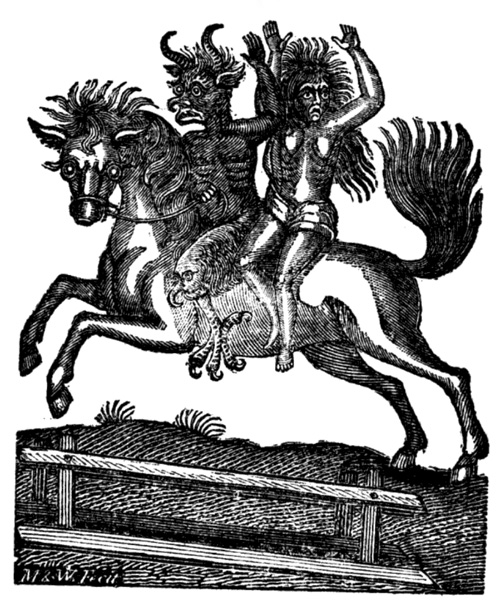
A.D. 852. Circa dies istos, mulier quædam malefica, in villâ quæ Berkeleia dicitur degens, gulæ amatrix ac petulantiæ, flagitiis modum usque in senium et auguriis non ponens, usque ad mortem impudica permansit. Hæc die quadam cum sederet ad prandium, cornicula quam pro delitiis pascebat, nescio quid garrire coepit; quo audito, mulieris cultellus de manu excidit, simul et facies pallescere coepit, et emisso rugitu, hodie, inquit, accipiam grande incommodum, hodieque ad sulcum ultimum meum pervenit aratrum. quo dicto, nuncius doloris intravit; muliere vero percunctatâ ad quid veniret, affero, inquit, tibi filii tui obitum & totius familiæ ejus ex subitâ ruinâ interitum. Hoc quoque dolore mulier permota, lecto protinus decubuit graviter infirmata; sentiensque morbum subrepere ad vitalia, liberos quos habuit superstites, monachum videlicet et monacham, per epistolam invitavit; advenientes autem voce singultiente alloquitur. Ego, inquit, o pueri, meo miserabili fato dæmoniacis semper artibus inservivi; ego omnium vitiorum sentina, ego illecebrarum omnium fui magistra. Erat tamen mihi inter hæc mala, spes vestræ religionis, quæ meam solidaret animam desperatam; vos expctabam propugnatores contra dæmones, tutores contra sævissimos hostes. Nunc igitur quoniam ad finem vitæ perveni, rogo vos per materna ubera, ut mea tentatis alleviare tormenta. Insuite me defunctam in corio cervino, ac deinde in sarcophago lapideo supponite, operculumque ferro et plumbo constringite, ac demum lapidem tribus cathenis ferreis et fortissimis circundantes, clericos quinquaginta psalmorum cantores, et tot per tres dies presbyteros missarum celebratores applicate, qui feroces lenigent adversariorum incursus. Ita si tribus noctibus secura jacuero, quartâ die me infodite humo. Factumque est ut præceperat illis. Sed, proh dolor! nil preces, nil lacrymæ, nil demum valuere catenæ. Primis enim duabus noctibus, cum chori psallentium corpori assistabant, advenientes Dæmones ostium ecclesiæ confregerunt ingenti obice clausum, extremasque cathenas negotio levi dirumpunt: media autem quæ fortior erat, illibata manebat. Tertiâ autem nocte, circa gallicinium, strepitu hostium adventantium, omne monasterium visum est a fundamento moveri. Unus ergo dæmonum, et vultu cæteris terribilior & staturâ eminentior, januas Ecclesiæ; impetu violento concussas in fragmenta dejecit. Divexerunt clerici cum laicis, metu stelerunt omnium capilli, et psalmorum concentus defecit. Dæmon ergo gestu ut videbatur arroganti ad sepulchrum accedens, & nomen mulieris modicum ingeminans, surgere imperavit. Quâ respondente, quod nequiret pro vinculis, jam malo tuo, inquit, solveris; et protinus cathenam quæ cæterorum ferociam dæmonum deluserat, velut stuppeum vinculum rumpebat. Operculum etiam sepulchri pede depellens, mulierem palam omnibus ab ecclesiâ extraxit, ubi præ foribus niger equus superbe hinniens videbatur, uncis ferreis et clavis undique confixus, super quem misera mulier projecta, ab oculis assistentium evanuit. Audiebantur tamen clamores per quatuor fere miliaria horribiles, auxilium postulantes. Ista itaque quæ retuli incredibilia non erunt, si legatur beati Gregorii dialogus, in quo refert, hominem in ecclesiâ sepultam, a dæmonibus foras ejectum. Et apud Francos Carolus Martellus insignis vir fortudinis, qui Saracenos Galliam ingressos, Hispaniam redire compulit, exactis vitæ suæ diebus, in Ecclesiâ beati Dionysii legitur fuisse sepultus. Sed quia patrimonia, cum decimis omnium fere ecclesiarum Galliæ, pro stipendio commilitonum suorum mutilaverat, miserabiliter a malignis spiritibus de sepulchro corporaliter avulsus, usque in hodiernum diem nusquam comparuit. Matthew of Westminster.
This story is also related by Olaus Magnus, and in the Nuremberg Chronicle, from which the wooden cut is taken. A Ballad, Shewing how an old Woman rode Double, and who rode before her.
The Raven croak’d as she sate at her meal, And the Old Woman knew what he said, And she grew pale at the Raven’s tale, And sicken’d and went to her bed. Now fetch me my children, and fetch them with speed, The Old Woman of Berkeley said, The monk my son, and my daughter the nun Bid them hasten or I shall be dead. The monk her son, and her daughter the nun, Their way to Berkeley went, And they have brought with pious thought The holy sacrament. The old Woman shriek’d as they entered her door, ’Twas fearful her shrieks to hear, Now take the sacrament away For mercy, my children dear! Her lip it trembled with agony, The sweat ran down her brow, I have tortures in store for evermore, Oh! spare me my children now! Away they sent the sacrament, The fit it left her weak, She look’d at her children with ghastly eyes And faintly struggled to speak. All kind of sin I have rioted in And the judgment now must be, But I secured my childrens souls, Oh! pray my children for me. I have suck’d the breath of sleeping babes, The fiends have been my slaves, I have nointed myself with infants fat, And feasted on rifled graves. And the fiend will fetch me now in fire My witchcrafts to atone, And I who have rifled the dead man’s grave Shall never have rest in my own. Bless I intreat my winding sheet My children I beg of you! And with holy water sprinkle my shroud And sprinkle my coffin too. And let me be chain’d in my coffin of stone And fasten it strong I implore With iron bars, and let it be chain’d With three chains to the church floor. And bless the chains and sprinkle them, And let fifty priests stand round, Who night and day the mass may say Where I lie on the ground. And let fifty choristers be there The funeral dirge to sing, Who day and night by the taper’s light Their aid to me may bring. Let the church bells all both great and small Be toll’d by night and day, To drive from thence the fiends who come To bear my corpse away. And ever have the church door barr’d After the even song, And I beseech you children dear Let the bars and bolts be strong. And let this be three days and nights My wretched corpse to save, Preserve me so long from the fiendish throng And then I may rest in my grave. The Old Woman of Berkeley laid her down And her eyes grew deadly dim, Short came her breath and the struggle of death Did loosen every limb. They blest the old woman’s winding sheet With rites and prayers as due, With holy water they sprinkled her shroud And they sprinkled her coffin too. And they chain’d her in her coffin of stone And with iron barr’d it down, And in the church with three strong chains They chain’d it to the ground. And they blest the chains and sprinkled them, And fifty priests stood round, By night and day the mass to say Where she lay on the ground. And fifty choristers were there To sing the funeral song, And a hallowed taper blazed in the hand Of all the sacred throng. To see the priests and choristers It was a goodly sight, Each holding, as it were a staff, A taper burning bright. And the church bells all both great and small Did toll so loud and long, And they have barr’d the church door hard After the even song. And the first night the taper’s light Burnt steadily and clear. But they without a hideous rout Of angry fiends could hear; A hideous roar at the church door Like a long thunder peal, And the priests they pray’d and the choristers sung Louder in fearful zeal. Loud toll’d the bell, the priests pray’d well, The tapers they burnt bright, The monk her son, and her daughter the nun They told their beads all night. The cock he crew, away they flew The fiends from the herald of day, And undisturb’d the choristers sing And the fifty priests they pray. The second night the taper’s light Burnt dismally and blue, And every one saw his neighbour’s face Like a dead man’s face to view. And yells and cries without arise That the stoutest heart might shock, And a deafening roaring like a cataract pouring Over a mountain rock. The monk and nun they told their beads As fast as they could tell, And aye as louder grew the noise The faster went the bell. Louder and louder the choristers sung As they trembled more and more, And the fifty priests prayed to heaven for aid, They never had prayed so before. The cock he crew, away they flew The fiends from the herald of day, And undisturb’d the choristers sing And the fifty priests they pray. The third night came and the tapers flame A hideous stench did make, And they burnt as though they had been dipt In the burning brimstone lake. And the loud commotion, like the rushing of ocean, Grew momently more and more, And strokes as of a battering ram Did shake the strong church door. The bellmen they for very fear Could toll the bell no longer, And still as louder grew the strokes Their fear it grew the stronger. The monk and nun forgot their beads, They fell on the ground dismay’d, There was not a single saint in heaven Whom they did not call to aid. And the choristers song that late was so strong Grew a quaver of consternation, For the church did rock as an earthquake shock Uplifted its foundation. And a sound was heard like the trumpet’s blast That shall one day wake the dead, The strong church door could bear no more And the bolts and the bars they fled. And the taper’s light was extinguish’d quite, And the choristers faintly sung, And the priests dismay’d, panted and prayed Till fear froze every tongue. And in He came with eyes of flame The Fiend to fetch the dead, And all the church with his presence glowed Like a fiery furnace red. He laid his hand on the iron chains And like flax they moulder’d asunder, And the coffin lid that was barr’d so firm He burst with his voice of thunder. And he bade the Old Woman of Berkeley rise And come with her master away, And the cold sweat stood on the cold cold corpse, At the voice she was forced to obey. She rose on her feet in her winding sheet, Her dead flesh quivered with fear, And a groan like that which the Old Woman gave Never did mortal hear. She followed the fiend to the church door, There stood a black horse there, His breath was red like furnace smoke, His eyes like a meteor’s glare. The fiendish force flung her on the horse And he leapt up before, And away like the lightning’s speed they went And she was seen no more. They saw her no more, but her cries and shrieks For four miles round they could hear, And children at rest at their mother’s breast, Started and screamed with fear.
The Surgeon’s Warning
The subject of this parody was given me by a friend, to whom also I am indebted for some of the stanzas. Respecting the patent coffins herein mentioned, after the manner of Catholic Poets, who confess the actions they attribute to their Saints and Deity to be but fiction, I hereby declare that it is by no means my design to depreciate that useful invention; and all persons to whom this Ballad shall come are requested to take notice, that nothing here asserted concerning the aforesaid Coffins is true, except that the maker and patentee lives by St. Martin’s Lane.
The Doctor whispered to the Nurse And the Surgeon knew what he said, And he grew pale at the Doctor’s tale And trembled in his sick bed. Now fetch me my brethren and fetch them with speed The Surgeon affrighted said, The Parson and the Undertaker, Let them hasten or I shall be dead. The Parson and the Undertaker They hastily came complying, And the Surgeon’s Prentices ran up stairs When they heard that their master was dying. The Prentices all they entered the room By one, by two, by three, With a sly grin came Joseph in, First of the company. The Surgeon swore as they enter’d his door, ’Twas fearful his oaths to hear,— Now send these scoundrels to the Devil, For God’s sake my brethren dear. He foam’d at the mouth with the rage he felt And he wrinkled his black eye-brow, That rascal Joe would be at me I know, But zounds let him spare me now. Then out they sent the Prentices, The fit it left him weak, He look’d at his brothers with ghastly eyes, And faintly struggled to speak. All kinds of carcasses I have cut up, And the judgment now must be— But brothers I took care of you, So pray take care of me! I have made candles of infants fat The Sextons have been my slaves, I have bottled babes unborn, and dried Hearts and livers from rifled graves. And my Prentices now will surely come And carve me bone from bone, And I who have rifled the dead man’s grave Shall never have rest in my own. Bury me in lead when I am dead, My brethren I intreat, And see the coffin weigh’d I beg Lest the Plumber should be a cheat. And let it be solder’d closely down Strong as strong can be I implore, And put it in a patent coffin, That I may rise no more. If they carry me off in the patent coffin Their labour will be in vain, Let the Undertaker see it bought of the maker Who lives by St. Martin’s lane. And bury me in my brother’s church For that will safer be, And I implore lock the church door And pray take care of the key. And all night long let three stout men The vestry watch within, To each man give a gallon of beer And a keg of Holland’s gin; Powder and ball and blunder-buss To save me if he can, And eke five guineas if he shoot A resurrection man. And let them watch me for three weeks My wretched corpse to save, For then I think that I may stink Enough to rest in my grave. The Surgeon laid him down in his bed, His eyes grew deadly dim, Short came his breath and the struggle of death Distorted every limb. They put him in lead when he was dead And shrouded up so neat, And they the leaden coffin weigh Lest the Plumber should be a cheat. They had it solder’d closely down And examined it o’er and o’er, And they put it in a patent coffin That he might rise no more. For to carry him off in a patent coffin Would they thought be but labour in vain, So the Undertaker saw it bought of the maker Who lives by St. Martin’s lane. In his brother’s church they buried him That safer he might be, They lock’d the door and would not trust The Sexton with the key. And three men in the vestry watch To save him if they can, And should he come there to shoot they swear A resurrection man. And the first night by lanthorn light Thro’ the church-yard as they went, A guinea of gold the sexton shewed That Mister Joseph sent. But conscience was tough, it was not enough And their honesty never swerved, And they bade him go with Mister Joe To the Devil as he deserved. So all night long by the vestry fire They quaff’d their gin and ale, And they did drink as you may think And told full many a tale. The second night by lanthorn light Thro’ the church-yard as they went, He whisper’d anew and shew’d them two That Mister Joseph sent. The guineas were bright and attracted their sight They look’d so heavy and new, And their fingers itch’d as they were bewitch’d And they knew not what to do. But they waver’d not long for conscience was strong And they thought they might get more, And they refused the gold, but not So rudely as before. So all night long by the vestry fire They quaff’d their gin and ale, And they did drink as you may think And told full many a tale. The third night as by lanthorn light Thro’ the church-yard they went, He bade them see and shew’d them three That Mister Joseph sent. They look’d askance with eager glance, The guineas they shone bright, For the Sexton on the yellow gold Let fall his lanthorn light. And he look’d sly with his roguish eye And gave a well-tim’d wink, And they could not stand the sound in his hand For he made the guineas chink. And conscience late that had such weight, All in a moment fails, For well they knew that it was true A dead man told no tales, And they gave all their powder and ball And took the gold so bright, And they drank their beer and made good cheer, Till now it was midnight. Then, tho’ the key of the church door Was left with the Parson his brother, It opened at the Sexton’s touch— Because he had another. And in they go with that villain Joe To fetch the body by night, And all the church look’d dismally By his dark lanthorn light. They laid the pick-axe to the stones And they moved them soon asunder. They shovell’d away the hard-prest clay And came to the coffin under. They burst the patent coffin first And they cut thro’ the lead, And they laugh’d aloud when they saw the shroud Because they had got at the dead. And they allowed the Sexton the shroud And they put the coffin back, And nose and knees they then did squeeze The Surgeon in a sack. The watchmen as they past along Full four yards off could smell, And a curse bestowed upon the load So disagreeable. So they carried the sack a-pick-a-back And they carv’d him bone from bone, But what became of the Surgeon’s soul Was never to mortal known.
The Victory
Hark—how the church-bells thundering harmony Stuns the glad ear! tidings of joy have come, Good tidings of great joy! two gallant ships Met on the element,—they met, they fought A desperate fight!—good tidings of great joy! Old England triumphed! yet another day Of glory for the ruler of the waves! For those who fell, ’twas in their country’s cause, They have their passing paragraphs of praise And are forgotten. There was one who died In that day’s glory, whose obscurer name No proud historian’s page will chronicle. Peace to his honest soul! I read his name, ’Twas in the list of slaughter, and blest God The sound was not familiar to mine ear. But it was told me after that this man Was one whom lawful violence[10] had forced From his own home and wife and little ones, Who by his labour lived; that he was one Whose uncorrupted heart could keenly feel A husband’s love, a father’s anxiousness, That from the wages of his toil he fed The distant dear ones, and would talk of them At midnight when he trod the silent deck With him he valued, talk of them, of joys That he had known—oh God! and of the hour When they should meet again, till his full heart His manly heart at last would overflow Even like a child’s with very tenderness. Peace to his honest spirit! suddenly It came, and merciful the ball of death, For it came suddenly and shattered him, And left no moment’s agonizing thought On those he loved so well. He ocean deep Now lies at rest. Be Thou her comforter Who art the widow’s friend! Man does not know What a cold sickness made her blood run back When first she heard the tidings of the fight; Man does not know with what a dreadful hope She listened to the names of those who died, Man does not know, or knowing will not heed, With what an agony of tenderness She gazed upon her children, and beheld His image who was gone. Oh God! be thou Her comforter who art the widow’s friend!
Henry the Hermit
It was a little island where he dwelt, Or rather a lone rock, barren and bleak, Short scanty herbage spotting with dark spots Its gray stone surface. Never mariner Approach’d that rude and uninviting coast, Nor ever fisherman his lonely bark Anchored beside its shore. It was a place Befitting well a rigid anchoret, Dead to the hopes, and vanities, and joys And purposes of life; and he had dwelt Many long years upon that lonely isle, For in ripe manhood he abandoned arms, Honours and friends and country and the world, And had grown old in solitude. That isle Some solitary man in other times Had made his dwelling-place; and Henry found The little chapel that his toil had built Now by the storms unroofed, his bed of leaves Wind-scattered, and his grave o’ergrown with grass, And thistles, whose white seeds winged in vain Withered on rocks, or in the waves were lost. So he repaired the chapel’s ruined roof, Clear’d the grey lichens from the altar-stone, And underneath a rock that shelter’d him From the sea blasts, he built his hermitage. The peasants from the shore would bring him food And beg his prayers; but human converse else He knew not in that utter solitude, Nor ever visited the haunts of men Save when some sinful wretch on a sick bed Implored his blessing and his aid in death. That summons he delayed not to obey, Tho’ the night tempest or autumnal wind. Maddened the waves, and tho’ the mariner, Albeit relying on his saintly load, Grew pale to see the peril. So he lived A most austere and self-denying man, Till abstinence, and age, and watchfulness Exhausted him, and it was pain at last To rise at midnight from his bed of leaves And bend his knees in prayer. Yet not the less Tho’ with reluctance of infirmity, He rose at midnight from his bed of leaves And bent his knees in prayer; but with more zeal More self-condemning fervour rais’d his voice For pardon for that sin, till that the sin Repented was a joy like a good deed. One night upon the shore his chapel bell Was heard; the air was calm, and its far sounds Over the water came distinct and loud. Alarmed at that unusual hour to hear Its toll irregular, a monk arose. The boatmen bore him willingly across For well the hermit Henry was beloved. He hastened to the chapel, on a stone Henry was sitting there, cold, stiff and dead, The bell-rope in his band, and at his feet The lamp[11] that stream’d a long unsteady light