Part the Second. (continued 9)
Reading edition
“The Dryads laugh when vernal showers return; O’er Autumn’s fading leaves the Dryads mourn.”
Preston, in his translation of Apollonius, makes a Hamadryad plead in vain for her existence, threatened by the destruction of the Oak in which she dwelt:—
“As in the mountain, with repeated stroke, The churlish fellow felled the stubborn Oak; Impious, he scorned the Hamadryad’s prayer, And smote the tree coeval with the fair. With streaming tears she pleads a suppliant strain To that unfeeling churl, but pleads in vain. ‘Oh, rustic, stay, nor wound the hallowed rind, For ages with that stem I live entwined.’”
In Germany, the holes in the trunks of Oaks are thought to be utilised by the elves inhabiting the trees as means of entry and exit; in our own country, Oaks have always been reputed as the trees in whose boughs elves delighted to find shelter. The fairies, too, were fond of dancing around Oaks: thus Tighe, apostrophising the monarch of the forest, exclaims:—
“The fairies from their nightly haunt, In copse, or dell, or round the trunk revered Of Herne’s moon-silvered Oak, shall chase away Each fog, each blight, and dedicate to peace Thy classic shade.”
In these lines allusion is made to a famous tree in Windsor Forest, one of a long series of celebrated Oaks—“lusty trees,” which, as Robert Turner writes, England “did once so flourish with, that it was called Druina by some.” One of these, known as the Cadenham Oak, in the New Forest, is said, like the Glastonbury Thorn, to mark the birthday of our Lord by budding on Christmas Day. Another, renowned as the Royal Oak, is reverenced as having been the hiding-place of Charles II., after the battle of Worcester. In this tree, not far from Boscobel House, the king, and his companion, Col. Careless, or Carless, resorted when they thought it no longer safe to remain in the house—the family giving them victuals on a Nut-hook. From this tree Charles gathered some Acorns, and set them himself in St. James’s Park:—
“Blest Charles then to an Oak his safety owes; The Royal Oak, which now in songs shall live, Until it reach to heaven with its boughs— Boughs that for loyalty shall garlands give.”
In many parts of England, Oak-branches are suspended over doorways, and gilded Oak-leaves and Oak-Apples are worn, on Royal Oak Day (May 29th), in celebration of King Charles’s restoration, and his preservation in the Boscobel Oak, which is still extant.
Seven Oaks have given a name to a village in Kent; and Dean Stanley has described a row of seven Oaks standing at a particular spot in Palestine to which the following curious legend is locally attached:—After Cain had murdered his brother, he was punished by being compelled to carry the dead body of Abel during the lengthened period of five hundred years, and then to bury it in this place. Upon doing so, he planted his staff to mark the grave, and out of this staff grew up the seven Oak trees.
The aged Oaks of Germany excited the wonder and respect of Tacitus, who, speaking of one of the giants of the Hercynian forest, exclaims: “Its majestic grandeur surpasses all belief; no axe has ever touched it; contemporary with the creation of the world, it is a symbol of immortality.” Sacred trees, or pillars formed of living trunks of trees, many of which were Oaks, were to be found in ancient Germany, called Irmenseule. The world-tree of Romowe, the ancient sacred centre of the Prussians, was an evergreen Oak. The Oak of St. Louis at Vincennes, and the Oak of the Partisans at St. Ouen, are trees regarded with reverence by the French.
Evelyn considers that the wood used for our Saviour’s cross was Oak; founding his belief on the statements made by divers learned men who had studied the subject, and “upon accurate examination of the many fragments pretended to be parcels of it.” The same author speaks of “the fatal præadmonition of Oaks bearing strange leaves”; and tells us that sleeping under Oak-trees will cure paralysis, and recover those whom the malign influence of the Walnut-tree has smitten. Paulus, a Danish physician, averred that one or two handfuls of small Oak-buttons mingled with Oats given to black horses will change them in a few days to a fine dapple-grey. Bacon says that there is an old tradition that if boughs of Oak be put into the earth, they will bring forth wild Vines; he also remarks that in his day country people had “a kind of prediction that if the Oake-apple, broken, be full of wormes, it is a signe of a pestilent yeare.” It is said that when the Oak comes out before the Ash, it is a sign that there will be fine weather in harvest. The Kentish people have a saying:—
“Oak, smoke; Ash squash.”
and that if the Oak comes out before the Ash, the summer will be hot; but if after the Ash, that it will be wet. Authorities in dream lore state that it is a very favourable omen to dream of an Oak-tree: if covered with verdure, it signifies a long and happy life; if devoid of foliage or withered, it betokens poverty in old age; to see many young Oaks thriving foretells male children, who will reap distinction by bravery; Oaks bearing Acorns betoken great wealth; and a blasted Oak forebodes sudden death.
Astrologers state that the Oak-tree is under the dominion of Jupiter.
OATS.—Oats did not enjoy a good reputation among the ancient Romans, and Pliny writes of them:—Primum omnium frumenti vitium Avena est. In old English books, the Oat is called Haver or Hafer corn, and to this day in Wales it is still called Hever. In Scandinavian mythology, the “Hafer” of the evil genius Loki is synonymous with Oats of the Devil, a term originally applied to all herbs hurtful to cattle.——The Danes call the plant Polytrichum commune Loki’s Oats; and in the tradition that the diabolic God of the North is wont mischievously to sow weeds among the good seed is probably to be found the origin of the English saying, “He is sowing his wild Oats.”——In the Ukraine, there is a tradition that on one occasion the Devil besought the Almighty to make him a present. God responded: “What is there that I can give you? I cannot part with the Rye, or the Barley, or the Millet: I must give you the Oats.” The Devil, well pleased, withdrew, crying, “Hurrah! the Oats, the Oats, are mine!” Then God inquired of St. Peter and St. Paul: “What can I do, seeing that I have handed them over to him?” “Verily,” said Paul, “I will at once go and get them from him.” “How will you manage that?” “Leave that to me,” replied Paul. “Very well—go!” St. Paul passed the Devil, and hid himself beneath a bridge. Presently the Devil came along shouting “Oats! Oats!” St. Paul commenced to shriek. The Devil stopped short. “Why have you thus frightened me?” he asked. “God has given me a plant, and now you have made me quite forget its name.” “Was it Rye?” “No,” “Wheat?” “No.” “Could it have been the Sow-thistle?” “Ah! that was it, that was it!” exclaimed the Devil, and he ran off shouting, “Sow-thistle, Sow-thistle.”——The contortions of the Animal Oat (Avena sterilis) are very noticeable: the strong beards, after the seeds have fallen off, are so sensible of alteration in the atmosphere, that they maintain an apparently spontaneous motion, resembling that of some grotesque insect. In olden times, conjurors and wizards predicted events and told fortunes by means of the awns of these Oats, which they caused to wriggle about by holding them in a damp hand, or breathing upon them. In these jugglers’ hands the Wild Oat became a magical plant, figuring at their will as the leg of an enchanted spider, Egyptian fly, or some other wonderful insect.——To dream of a field of ripe Oats just ready for the sickle is a most favourable omen, under all circumstances.
Old Man.—See Southernwood.
OLEANDER.—The banks of the Meles, the rivulet sacred to Homer, are in some parts thickly set with Nerium Oleander, a plant which bears a funereal and sinister character, and in Italy is considered as ill-omened and as bringing disgrace and misfortune. In Tuscany and Sicily, it is customary to cover the dead with Oleander-blossoms, and in India chaplets of these flowers are placed on the brows of the departed: the blossoms are also in that country much used in the decoration of temples. The Hindus call the shrub the “Horse-killer,” from a notion that horses inadvertently eating of its foliage are killed by it. The Italians bestow a similar name on the plant—Ammazza l’Asino, Ass-bane. Gerarde remarks that the flowers and leaves prove fatal to many quadrupeds, and that sheep and goats drinking water wherein the leaves have fallen are sure to die. In England, the plant is known as the Rose Bay and Laurel Rose. In Tuscany, it is called Mazza di San Giuseppe (St. Joseph’s Staff), and there is a legend that this staff commenced to blossom directly St. Joseph took it in his hands.
OLIVE.—The legend runs, that in the days of Cecrops, king of Attica, the two rival deities, Neptune and Minerva, strove for the worship of the Athenians. Each claimed priority of right: Neptune, by a salt spring, which his trident had opened in the rock of the Acropolis; Minerva, by pointing to the Olive-tree, which at her command had sprung from the soil. The gods in council decided that the latter was the earlier, as well as the more useful, gift; and so Minerva became the tutelary deity of the city, and the early Athenian rulers endeavoured to turn the attention of the citizens from warlike and seafaring pursuits, to the cultivation of the soil and the peaceful arts. On the coins of Attica, before the time of Pericles, an Olive-branch appeared with the moon and owl. Goats were sacrificed to Minerva, because they were thought to do special injury to the Olive-tree, and the goddess is styled by Virgil Oleæ inventrix. There was a deeper meaning attached to this Attic legend, the realisation of which appears as far off as it was in the days of Cecrops: still the Olive-branch remains the emblem of that period of peace and plenty which the world still hopes for.——The most sacred of the Athenian Olives grew in the temple of Minerva since the time of the dispute between Minerva and Neptune: it was burnt by Xerxes with the temple; but it was stated to have shot up again suddenly, after having been destroyed. The Athenians punished with great severity those who damaged their venerated Olive, which to them appears to have been emblematic of peace. It indicated liberty, hope, chastity, pity, and supplication; and special directions for the mode of planting the sacred tree had place among the institutes of Solon. Pliny asserts that the identical Olive-tree, called up by Minerva, was standing in his time.——The Olive is frequently mentioned in the Bible, both in a literal and figurative manner. The dove sent forth by Noah from the Ark, brought back an Olive-leaf (probably from Assyria, a country famous for Olive-trees), which the bird probably selected because the leaves would continue green beneath the water. As an emblem of peace, a garland of Olive was given to Judith when she restored peace to the Israelites by the death of Holofernes. The tree is still with the Jew the emblem of peace and plenty, with an added significance of holiness; and the association of it with the last days of Christ has made it also sacred to sorrow.——As an emblem of peace and reconciliation, the Olive is figured on the tombs of the early martyrs. As the attribute of peace, it is borne by the angel Gabriel, and St. Agnes, and St. Pantaleon. By Romanists the Olive is deemed a fitting emblem of the Virgin Mary, as the mother of Christ, who brought peace on earth, and who was the Prince of Peace.——In regard to the Olive-trees of the Garden of Gethsemane, eight of which are still stated to exist, Dean Stanley says: “In spite of all the doubts that can be raised against their antiquity, or the genuineness of their site, the eight aged Olive-trees, if only by their manifest difference from all others on the mountain, have always struck even the most indifferent observers. They are now, indeed, less striking in the modern garden enclosure, built round them by the Franciscans, than when they stood free and unprotected on the rough hillside; but they will remain so long as their already protracted life is spared, the most venerable of their race on the surface of the earth. Their gnarled trunks and scanty foliage will always be regarded as the most affecting of the sacred memorials in or about Jerusalem.”——According to the Jewish legend of Abimelech, the trees, once upon a time, desiring a king, addressed themselves first of all to the Olive, who refused the honours of royalty. The trees next in turn invited the Fig, the Vine, and other trees to become their monarch, but they all declined. At last the crown was offered to the Oak, who accepted it.——Grecian mythologists relate that the club of Hercules, which was made of Olive-wood, took root, and became a tree. In the Olympic games, instituted by Hercules, the victor was rewarded with a crown of Olive. The club of Polyphemus was the green trunk of an Olive-tree.——The caps of the priests of Jupiter were surmounted with a twig of Olive. The Olympian Jove is represented as wearing a wreath of Olives. Herodotus recounts that Xerxes, before his Grecian expedition, dreamed that he was crowned with an Olive wreath, the sprays of which turned towards the sun; but that a moment afterwards, this crown had disappeared.——The Athenians went to consult the Delphic oracle, holding in their hands branches of Olive, and asking for a favourable response in the name and through the favour of the Olive-trees; and Tigranes, when before Xerxes, reproached Mardonius with having carried on a war against a people who, in their Olympian games, were content with a crown of Olives as the reward of victory, and who fought not for plunder and riches, but for love of country and glory.——There stood in the Forum of Megara a wild Olive, on which it became the custom to hang the arms of local heroes. In course of time the bark of the Olive grew over these arms, and they were forgotten. An oracle, however, had declared that when the tree had brought forth arms, its destruction would take place. When the tree was cut down, the arms and helmets alluded to were discovered; and it was seen that the oracle had been fulfilled.——The Provençaux, at harvest time, sing a curious song, called the Reapers’ Grace, the first part of which narrates how Adam and Eve were put into the Garden of Eden; Adam is forbidden to eat of the fruit of life; he eats thereof, and the day of his death is foretold him. He will be buried under a Palm, Cypress, and Olive, and out of the wood of the Olive the cross was made.——According to a German tradition, from the tomb of Adam, the father of the human race, sprang an Olive: from this Olive was plucked the branch that the dove from the ark carried to Noah, the regenerator of the human race; and from the same Olive was made the cross of the Redeemer—the spiritual redeemer of the human race.——A tradition very general relates that the cross was formed of the Olive, Palm, Cedar, and Cypress, representing the four quarters of the globe.——In Central Europe, the Olive is everywhere regarded as the emblem of peace. It is planted in the midst of fields to ensure a good harvest and to protect the crops from hail: and in Venetia a branch is placed on the chimney-piece during thunder-storms as a preservative from lightning—a prayer being offered up at the same time to St. Barbara and St. Simon.——In some parts of Italy, young girls employ an Olive-branch as a means of divination. Having moistened a spray of Olive with their lips, they throw it in the fire; if the leaf jumps three times or darts out of the fire, they will find a husband; but if it burns without moving, it is a sure sign of celibacy. In Rome and Tuscany, the superstitious peasants imagine that no witch or sorcerer will enter a house where an Olive-branch that has been blessed is kept, and in order to ascertain whether they are suffering from the dire effects of an Evil Eye, they drop some Olive-oil in water, and from the appearance satisfy themselves on the point.——To dream of Olive-trees or Olives is considered a good omen, denoting happiness, prosperity, and success, and a speedy marriage to the lover; but to dream of plucking Olives is unpropitious, announcing trouble and vexation. To dream of Olive-trees bearing Olives denotes peace, delight, concord, liberty, dignity, and fruition of your desires. To dream that you beat the Olives down is lucky for all but servants.
ONION.—By the ancient Egyptians the Onion was regarded as a plant partaking of a sacred character and as a symbol of the Universe. With them it was a common object of worship, and their veneration for this and other vegetable products is ridiculed by the satirist Juvenal—
“How Egypt, mad with superstition grown, Makes gods of monsters, but too well is known: ’Tis mortal sin an Onion to devour, Each clove of Garlic hath a sacred power; Religious nation sure, and blest abodes, When every garden is o’errun with gods!”
The Onions of Egypt, which were of large size and exquisite flavour, were remembered with regretful longings by the discontented Israelites in the wilderness; and although the priests of ancient Egypt were forbidden to partake of them, yet they were admitted among the offerings placed on the altars of the gods.——Mythologists relate that the goddess Latona, having, during an indisposition, lost her appetite, regained it by eating an Onion, and thenceforth adopted this vegetable, which was accordingly consecrated to her.——The disciples of Pythagoras abstained from eating Onions, ostensibly because they grew during the falling moon, but probably because, like Beans, they were considered too stimulating in their effects. Among the Greeks, it would seem that the Onion was considered symbolic of generation, since we find that at the nuptials of Iphicrates with the daughter of King Cotys, he received, among other presents, a jar of snow, a jar of Lentils, and a jar of Onions.——It is thought that, as with the Egyptians, or with the English Druids, the Onion was an emblem of the deity, and to this day it is a custom in some parts of England for girls to divine by it. Barnaby Googe, in ‘Ye Popish Kingdome,’ tells us:—
“In these same days young wanton gyrles that meet for marriage be Doe search to know the names of them that shall their husbands be; Four Onyons, five, or eight they take, and make in every one Such names as they do fancie most, and best to think upon. Then nere the chimney them they set, and that same Onyon then That firste doth sproute doth surely bear the name of their good man.”
In olden times, country lasses used to resort to a method of divination with an Onion named after St. Thomas: this they peeled and wrapped in a clean kerchief; then, placing it under their heads, they repeated the following lines:—
“Good St. Thomas, do me right, And let my true-love come to-night, That I may see him in the face, And him in my fond arms embrace.”
In the South of England this species of divination is still extant, but the procedure is different. When the Onions are bought, the purchaser must take care to go in by one door of the shop and come out by another—a shop being selected that has two doors. These Onions, placed under your pillow on St. Thomas’s Eve, are sure to bring visions of your true-love, your future husband.——According to astrologers, the Onion is under the dominion of Mars.——To dream of Onions is considered of evil augury, portending sickness and misfortune.
“To dream of eating Onions means Much strife in thy domestic scenes; Secrets found out or else betrayed, And many falsehoods made and said.”
ORANGE.—Both Spenser and Milton held the opinion that the Orange is the veritable “golden Apple” presented by Juno to Jupiter on the day of their nuptials; hence, perhaps, the association of the Orange with marriage rites. This golden fruit grew only in the garden of the Hesperides, situated near Mount Atlas in Africa, where they were carefully tended by the three daughters of Hesperus—Ægle, Arethusa, and Erythia—and guarded by an ever-sleeping dragon. It was one of the labours of Hercules, to obtain some of these golden Apples. After slaying the dragon, he succeeded in plucking the auriferous fruit, and took them to Eurystheus, but they were afterwards carried back to the garden of the Hesperides by Minerva, as they could not be preserved elsewhere. Milton alludes to the Orange as a tree
“Whose fruit, burnished with golden rind, Hung amiable, Hesperian fables true, If true, here only, and of delicious taste.”
These, again, were the golden Apples given by Venus to the subtle Hippomenes, and by means of which he cunningly contrived to wrest victory in his race with the swift-footed Atalanta. Perhaps, also, Spenser’s opinion is correct, and the Orange may be the fruit, the bestowal of which upon Venus was the origin of the Trojan war. Spenser states his opinion in the following stanzas of his ‘Faërie Queene’:—
“Next thereunto did grow a goodly tree, With branches broad dispread and body great, Clothèd with leaves, that none the wood might see, And laden all with fruit, as thick as thick might be. “The fruit were golden Apples glistering bright, That goodly was their glory to behold; On earth no better grew, nor living wight E’er better saw, but they from hence[17] were sold; For those which Hercules, with conquest bold, Got from great Atlas’ daughters, hence began, And planted there, did bring forth fruit of gold, And those with which th’ Eubœan young man wan [won] Swift Atalanta, when, through craft, he her outran. “Here also sprang that goodly golden fruit With which Acontius got his lover true, Whom he had long time sought with fruitless suit; Here eke that famous golden Apple grew, The which among the gods false Até threw, For which th’ Idæan ladies disagreed, Till partial Paris deem’d it Venus’ due, And had of her fair Helen for his meed, That many noble Greeks and Trojans made to bleed.”
At Brighton, there exists a curious custom of bowling or throwing Oranges along the high-road on Boxing-day. He whose Orange is hit by that of another, forfeits the fruit to the successful hitter.——An Andalusian tradition, given by De Gubernatis, relates that the Virgin Mary, journeying with the infant Jesus and with Joseph, came to the Orange-tree, which was guarded by an eagle, and begged of it one of the Oranges for the holy child. The eagle miraculously fell asleep, and the Virgin thereupon plucked not one but three Oranges, one of which she gave to the infant Jesus, another to Joseph, and the third she kept for herself. Then, and not till then, the eagle that guarded the Orange-tree awoke.——According to Evelyn, the first China Orange-tree which reached Europe was sent as a present to the old Conde Mellor, then Prime Minister to the King of Portugal. Writing in 1697, the Jesuit Le Comte states that “the first and unique Orange-tree, from which it is said all others have sprung, is still preserved at Lisbon, in the house of Count St. Laurent.”——In Sicily, statues of the Madonna are decorated with branches of the Orange; at Avola, in Sicily, on Easter Sunday, two posts are set up, and decorated with Orange-boughs.——The Orange is one of those rare trees which produce at the same time fruit, flowers, and foliage; hence it is in some countries considered as typifying great fulness, and has thus become connected with wedding ceremonies. The practice of wearing Orange-blossoms and wreaths by brides has been derived from the Saracens, amongst whom the Orange-flower was regarded as emblematic of a happy and prosperous marriage. In Crete, the bride and bridegroom are sprinkled with Orange-flower-water. In Sardinia, it is customary to attach Oranges to the horns of oxen which draw the nuptial carriage.——To dream of Oranges would appear to be at all times a very unfavourable omen.
ORCHIS.—From mythology we learn that the Orchis owes its origin to the wanton son of the satyr Patellanus and the nymph Acolasia, who presided at the feasts celebrated in honour of Priapus. The headstrong Orchis, being present at the celebration of the feast of Bacchus, laid violent hands on one of the priestesses of that god; and this sacrilegious conduct so incensed the Bacchanals against the youth, that they forthwith set upon him, and in their fury literally tore him in pieces. His father adjured the gods, but the only remedy he could obtain was that his son’s mangled corpse should be transformed into a flower, which should ever after bear the name of Orchis, as a blot upon his memory.——Among the early Romans, the Orchis was often called Satyrion, because it was believed to be the food of the satyrs, and as such excited them to those excesses which were characteristic of the attendants of Bacchus. Hence, the Orchis-root not unnaturally became famous as a powerful stimulating medicine, and is so described by all herbalists from the time of Dioscorides.——A very old tradition exists that Orchids sprang from the seed of the thrush and the blackbird.——Bishop Fleetwood writes of these curious flowers that they represent apes, birds, wasps, bees, flies, butterflies, gnats, spiders, grasshoppers, and other insects; “but the most curious sort is that which is called Anthropophora, because it represents a man or a woman very exactly.” He further tells us “this flower, resembling a man, appears in the beginning of Autumn; but that which represents women comes in May. These two Orchids were, in 1671, engraved by order of the Academia Curiosorum Naturæ, and were described as Orchis Anthropophorus Mas., and O. A. Fœmina.”——A tradition is attached to the English species, Orchis mascula, which usually has its leaves marked with deep purple spots. It is said that these spots are the stains of the precious blood which flowed from our Lord’s wounded body on the cross at Calvary, as this species of Orchis is reported to have grown there. In Cheshire, the plant is called Gethsemane.——The sweet-scented Orchis, Gymnadenia conopsea, is the Northern goddess Frigg’s Grass.
ORPINE.—On Midsummer Eve, Orpine (Sedum Telephium), Fennel, Lilies, and Hypericum used formerly to be hung over doors and windows. The plant is commonly called ‘Midsummer Men’ and ‘Livelong,’ from a custom of country lasses to try their lovers’ fidelity with it on Midsummer Eve: this they do by setting up two plants of Orpine—one representing themselves, and another their lovers—upon a slate or trencher, and afterwards judging of the state of their lover’s affections by his plant living and turning to their own, or not. Wives, also, place over their heads the Orpine-plant, and by the bending of the leaves to the right or to the left divine whether husbands are true or false. (See Livelong.)
OSMUND ROYAL.—The stately flowering Fern Osmunda Regalis is said to derive its name from the following legend:—A waterman, named Osmund, once dwelt on the banks of Loch Fyne, with his wife and daughter. One day a band of fugitives, bursting into his cottage, warned Osmund that the cruel Danes were fast approaching the ferry. Osmund heard them with fear; he trembled for those he held dearer than life. Suddenly the shouts of furious men roused him to action. Snatching up his oars, he rowed his trembling wife and child to a small island covered with this beautiful Fern; and helping them to land, he bade them lie down beneath the shady foliage for protection. Scarcely had the ferryman returned to his cottage, ere a company of fierce Danes rushed in, but knowing that he could be of service to them, they did him no harm. During the day and night, Osmund was occupied in ferrying the troops across the lake. When the last company had landed, Osmund kneeled beside the bank, and returned thanks to Heaven for the preservation of his wife and child. Often in after years did he speak of that day’s peril; and his daughter called the Fern by her father’s name. Gerarde, in describing the stem of the Osmunda, which, on being cut, exhibits a white centre, calls this portion of the Fern the “heart of Osmund, the waterman,” probably in allusion to the above tradition.
Our Lady’s Plants.—See Lady’s Plants.
Ox-Eye.—See Moon Daisy.
PALASA.—Palasa is a Sanscrit word, meaning “leaf,” but in course of time it became applied to the Butea frondosa as well as the name Parna, which also signifies a leaf. The modern Indian name of the tree is Dhak. The Palasa is in India a sacred tree, and has a special cultus; as such, it is held to be imbued with the immortalising Soma, the beverage of the gods. According to the Vedas, it owed its origin to a feather dropped by a falcon who, when the gods were pining for the precious Soma fluid, succeeded in stealing some from the demons who had charge of it. In flying off with its prize, the falcon was wounded by an arrow shot by one of the demons, which wounded it and caused a feather impregnated with the divine fluid to fall to earth, where it took root and became a Palasa-tree (called also Parna), which has a red sap and scarlet blossoms—emblems of the sacred fire. The falcon was a transformed god—some say Indra—hence the tree which sprang from the god-bird’s feather was in its nature divine.——The Palasa was much employed by the Hindus in religious ceremonies, particularly in one connected with the blessing of calves to ensure them proving good milkers. To this end, at the time of the sacrifice offered in the new moon (the season of increase), the priest, on behalf of the Hindu farmer, selected a Palasa-branch that grew on the north-east, north, or east side of the tree, and cut it off, saying, “For strength cut I thee.” Then, having stripped off the leaves, he struck both calves and dams with it, blessing the latter and bidding them be good milkers and breeders, and profitable animals to their masters. This done, he stuck up the Palasa rod eastward of the holy fire, and bade it protect the cattle. The object in thus touching the cattle was that the divine Soma contained in the rod might pass into and enrich the udders of the beasts. The Palasa is triple-leaved, and hence was deemed to typify, like the trident, the forked lightning, an appropriate attribute, inasmuch as it originally sprang from a god of the lightning. In this respect, it resembled the rod of Mercury (a fire-god), the Sami, and the Rowan rod.——The staff of the Brahman ought to be made of Palasa wood. (See Dhak.)
PALM.—The Palm-tree is symbolic of victory, of riches, and of generation. It was considered by the ancients also an emblem of light, and was held sacred to Apollo. The Palm of Delos was supposed to have existed from the time of the god Apollo himself. Among the Greeks, there existed a legend that the Palm, like the Olive, was brought into Greece by Hercules, on his return from the infernal regions. The Orphics venerated the Palm as an immortal tree, which never grew old; hence, as a symbol of immortality, and especially of the immortality of glory, it was associated with the goddess Victoria, called also Dea Palmaris.——In India, as amongst the Arabs, the Palm is considered a sacred tree.——According to an Indian legend, the Palm of the Lake of Taroba, in Central India, was only visible during the day; in the evening it re-entered the earth. It is related that a rash pilgrim climbed one morning to the top of the Palm, but the tree grew to such a height above the earth’s surface, that the pilgrim was scorched to death by the sun’s rays, and the Palm itself was reduced to tinder. On the spot where the miraculous Palm is said to have once grown stands the idol of the Geni of the Lake, called Taroba.——Christian legend has associated the Palm with the history of Jesus. According to the Apocryphal Gospel, the Virgin Mary, whilst journeying, became fatigued and oppressed with the great heat; in passing by a great desert, she saw a large and beautiful Palm-tree, beneath which she wished to seek rest and shelter; so she asked Joseph to drive the ass upon which she was seated towards the tree. When she reached the foot of the tree, she dismounted, and, looking up, noticed that the tree was laden with fruit. Then she said to Joseph: “I wish to have some of the fruit of this tree, for I am hungry.” To this, Joseph replied: “Mary, I marvel that you should desire to eat of this fruit.” Then Jesus Christ, who was seated in his mother’s lap, ordered the Palm to bend down, so that his mother might partake of its fruit at pleasure. And forthwith the tree bent down to the Virgin Mary, and she partook of its fruit, and still the Palm remained bent downwards. Then, Jesus perceiving this, ordered the Palm to resume its natural position, and it immediately did so. This legend has been widely diffused in Italy and elsewhere, sometimes with the following addendum: “Jesus, after this act of devotion on the part of the Palm, gave the tree his benediction, chose it as the symbol of eternal salvation for the dying, and declared that he would make his triumphant entry into Jerusalem with a Palm in his hand.”——The Palm was early assumed by the Christian Church as the universal symbol of martyrdom, in accordance with Revelation vii., 9: “And after this I beheld, and lo, a great multitude stood before the throne, clothed with white robes, and with Palms in their hands.... And he said to me, These are they which came out of great tribulation.” Hence, in early Italian paintings of the saints, as well as on the sculptured effigies of Christian heroes, the Palm is represented as borne by those who suffered martyrdom; and, in some instances, by those conspicuous for their victory over pain and temptation.——In old religious paintings, St. Christopher (who lived in the middle of the fourth century) is represented as a man of Herculean proportions, who uses, as a supporting staff, an entire Palm-tree with leaves and branches. The legend is, that having, when still unconverted, entreated a hermit to show him Christ, the holy man admonished him that he must do some good and acceptable work, and recommended him to go to the banks of a deep and swollen river, and by his great strength assist travellers to cross over it. Christopher readily undertook the task, and went and dwelt by the side of the river. Having rooted up a Palm-tree, he used it as a staff to guide and support his steps, and aided all who were overcome by the stream, and carried the weak on his shoulders across it. After he had spent many days at this toil, he, one night, whilst lying resting in his hut, heard a voice calling him from the shore. He arose and looked out, but saw nothing. So he lay down again, and the same thing occurred to him a second and third time. Then he took his lantern and searched about the river bank, and at last discovered a little child, who plaintively said to him: “Christopher, carry me over this night.” Thereupon the stalwart young man lifted the little child on his shoulders, and grasping his Palm-staff, entered the stream. As he struggled across, the waters kept rising higher and higher; the waves roared, and beat against him, and the winds blew. The infant on his shoulder became heavier and still heavier, till Christopher felt that he must sink under the excessive weight, and began to feel afraid: nevertheless, taking fresh courage, and staying his tottering steps with his Palm-staff, he at length reached the opposite bank. Gently placing the child down, he looked at him with astonishment, and asked, “Who art thou, child, that hast placed me in such extreme peril? Had I carried the whole world on my shoulders, the burthen had not been heavier.” Then the child replied: “Wonder not, Christopher, for thou hast not only borne the world, but Him who made the world, upon thy shoulders. Me wouldst thou serve in this thy work of charity; and, behold, I have accepted thy service; and in testimony that I have accepted thy service and thee, plant thy staff in the ground, and it shall put forth leaves and fruit.” Christopher did so, and the dry Palm-staff flourished as a Palm-tree in the season, and was covered with clusters of Dates. But the miraculous child had vanished. Then Christopher fell on his face, and confessed and worshipped Christ.——According to the legend of the death of the Virgin Mary, she was, one day, filled with an inexpressible longing to behold her Son again, and whilst weeping, an angel suddenly appeared, and said: “Hail, O Mary! I bring thee here a branch of Palm, gathered in Paradise; command that it be carried before thy bier in the day of thy death; for in three days thy soul shall leave thy body, and thou shalt enter into Paradise, where thy Son awaits thy coming.” After conversing with the Holy Mother, the angel departed into heaven, and the Palm-branch which he had left behind him shed light from every leaf, and sparkled as the stars of the morning. At the same instant, the apostles, who were dispersed in various parts of the world, were miraculously caught up and deposited at Mary’s door. Then, having thanked the Lord, she placed in the hands of St. John the shining Palm, and desired him to bear it before her at the time of the burial—an office which he faithfully discharged.——Some authorities mention the Palm as one of the four trees which furnished the wood of which the Redeemer’s Cross was composed; this notion is derived from Canticles vii., 8: “I will go up to the Palm-tree,” &c. Hence the old rhyme:—
“Nailed were His feet to Cedar, to Palm His hands— Cypress His body bore, title on Olive stands.”
The praises of the Palm have been sung by Hebrew, Indian, Persian, and Arabian poets of all ages. According to Strabo, a Persian hymn, but according to Plutarch a Babylonian hymn, records the three hundred and sixty benefits conferred on mankind by this noble tree; whilst a poem in the Tamil language, although enumerating eight hundred and one uses of the Palmyra Palm, does not exhaust the catalogue.——In the Indian Vishnu Purâna, the fruitfulness of the Date Palm is alluded to. The youthful Bala Râma slays the monster Dhenuka, and casts the carcase at the foot of a Date Palm: then the Dates fell upon him just as rain, beaten by the winds, patters down on the earth.——In India, the Palm has given rise to a proverb on account of the facility with which it takes root: the natives say of a vile and despised enemy, that he takes root as a Palm.——To dream of a Palm-tree is a very good omen, particularly if it is in full blossom, in which case it predicts much success and good fortune.
PANSY.—The Pansy (Viola tricolor) derives its name from a corruption of the French word pensées, thoughts: thus poor Ophelia says:—
“Pray you love, remember, And there’s Pansies,—that’s for thoughts.”—Shakspeare.
Spenser designated the flower “the pretty Pawnce;” Milton spoke of it as the “Pansy freak’d with jet;” and Drayton sings:—
“The pretty Pansy then I’ll tye, Like stones some chain enchasing; The next to them, their near ally, The purple Violet placing.”
Rapin writes of the flower as Flos Jovis—the flower of Jove:—
“With all the beauties in the valleys bred, Spearmint, that’s born with Myrtle crowns to wed. And Jove’s own flower, in which three colours meet, To rival Violets, though without their sweet.”
In addition to this grandiose title, the little flower rejoices in a multiplicity of epithets bestowed on it by rural admirers. It is Heart’s-ease, Forget-me-not, Herb Trinity, Three-Faces-under-a-Hood, Love-and-Idle, Love-in-idleness, Live-in-Idleness, Call-me-to-you, Cuddle-me-to-you, Jump-up-and-kiss-me, Kiss-me-ere-I-Rise, Kiss-me-at-the-Garden-Gate, Tittle-my-Fancy, Pink-of-my-John, and Flamy, because its colours are seen in the flame of wood. In the North-east of Scotland, and in Scandinavia, the flower is with a spice of irony called Step-mother. In ‘A Midsummer Night’s Dream,’ Shakspeare gives the Heart’s-ease magical qualities. Oberon bids Puck procure for him “a little western flower” on which Cupid’s dart had fallen, and which maidens called “Love-in-Idleness.” Says the fairy king:—
“Fetch me that flower—the herb I showed thee once; The juice of it, on sleeping eyelids laid, Will make or man or woman madly dote Upon the next live creature that it sees.”
The poet Herrick tells us, in regard to the origin of these favourite flowers, that—
“Frolick virgins once there were, Over-loving, living here. Being here their ends denied, Ran for sweethearts mad, and died. Love, in pity of their tears, And their loss in blooming years, For their restless here-spent hours, Gave them Heart’s-ease turned to flowers.”
The Pansy was the accidental cause of Bertram, the first American botanist, devoting himself to the study of botany. The stamens and pistil of this flower have something grotesque in their appearance when disclosed, resembling to a fanciful mind an animal with arms, and a head projecting and stooping forward. Bertram, who was originally a farmer, while superintending his servants in the field, and giving them directions, gathered a Pansy that was growing at his feet, and thoughtlessly pulled off its petals one after another. Struck with the stamens and pistil, Bertram conveyed it home, that he might examine it more carefully. Its examination created in him that thirst for the knowledge of the construction and habits of plants which afterwards rendered him so famous, and won for him the friendship of Linnæus.——The Heart’s-ease is said to be sacred to St. Valentine. As the Herba Trinitatis, or Herb Trinity, it is the special flower of Trinity Sunday.——It is considered to be a herb of Saturn.
PAPYRUS.—Plutarch tells us that the vessel on which the Egyptian goddess Isis embarked on her voyage to search for the remains of Osiris, was constructed of the Reeds of the Papyrus (Papyrus antiquorum), and that the crocodiles, out of respect and fear of the goddess, dared not approach the bark.——The Papyrus is the Rush described in the Hebrew Scriptures by the word Gôme, and in an ark of Gôme the mother of the infant Moses put her babe, and laid it in the Flags by the brink of the river Nile. The ancient Egyptians plaited the stems of the Papyrus not only into little boats, but into sails, mats, and sandals. The fabrication in particular of little boats appears to have been practised by them to an immense extent, and to have commenced in the very earliest days of the nation. M. de Castelnau says that the Reed-boats still in use amongst the Peruvians exactly resemble the pictured representations of the Egyptian ones, as preserved on the walls of the tomb of Rameses III. at Thebes. Bundles of Papyrus-stems furnished models for the shafts of some of the pillars of the ancient Egyptian temples, and the bases of these were ornamented with representations of the sheaths that encircle the foot of the flower-stalk. The Papyrus-plant supplied the material of which the famous paper, both rough and fine, was manufactured in ancient times. Papyrus paper made 2000 years B.C., or anterior to the time of Abraham, is still in existence. It was an article of commerce long before the time of Herodotus, and it remained in use till the seventh century. This Papyrus paper was prepared from the white pith of the stoutest stems of the Reeds which grew in great abundance in the pools caused by the overflowing of the Nile.——Plutarch relates, that when Agesilaus visited Egypt, he was so delighted with the chaplets of Papyrus sent him by the king, that he took some home when he returned to Sparta.
PARSLEY.—Hercules is said to have selected Parsley to form the first garlands he wore. The Greeks held Parsley (Petroselinum) in great reputation. A crown of dried and withered Parsley was given to the victor at the Isthmian games; and one of green Parsley to the conqueror at the Nemean games, in memory of the death of Archemorus, the infant son of Lycurgus, who, laid down by his nurse on a sprig of Parsley, was killed by a serpent.——A branch of Laurel and a crown of Parsley were given to the god of banquets. At Greek banquets the guests wore crowns of Parsley, under the belief that the herb created quiet and promoted an appetite.——Greek gardens were often bordered by Parsley and Rue; hence arose the saying, when an undertaking was in contemplation, but not really commenced: “Oh, we are only at the Parsley and Rue!” Parsley, again, was in great request for the purpose of decorating graves; and the Greeks were fond of strewing sprigs of the herb over the bodies of the dead. A despairing lover cries:—
“Garlands that o’er thy doors I hung, Hang withered now and crumble fast; Whilst Parsley on thy fair form flung, Now tells my heart that all is past!”
From these funereal associations the herb acquired an ominous significance; and “to be in need of Parsley” was a proverbial expression meaning to be on the point of death. Plutarch tells of a panic created in a Greek force marching against the enemy by their suddenly meeting some mules laden with Parsley, which the soldiery looked upon as an ill omen. In our own country, to this day, there is an old saying among the people of Surrey and Middlesex, that “Where Parsley’s grown in the garden, there’ll be a death before the year’s out.”——There are several other English superstitions connected with Parsley. Children are often told that newly-born infants have been found in a Parsley bed. The seed of this herb is apt to come up only partially, according as the Devil takes his tithe of it. If, after having bruised some sprigs of Parsley in her hands, the housewife should attempt to raise her glasses, they will generally snap, and suddenly break. In some parts of Devonshire, the belief is widely spread that to transplant Parsley is an offence to the spirit who is supposed to preside over Parsley beds, entailing sure punishment either on the offender himself or some members of his family within a year. The peasants of South Hampshire will on no account give away Parsley, for fear of misfortune befalling them; and in Suffolk there is an old belief that to ensure the herb coming up “double,” Parsley-seed must be sown on Good Friday.——In the Southern States of America, the negroes consider it unlucky to transplant Parsley from an old home to a new one.——To dream of cutting Parsley is said to indicate a cross in love; to dream of eating it foretels good news.——The herb is held to be under Mercury.
PASQUE-FLOWER.—The Anemone Pulsatilla is the Paschal or Pasque-flower, especially dedicated to the Church’s Easter festival, The petals of the flower yield a rich green colour, which in olden times was used for the purpose of staining the eggs to be presented, according to custom, as Easter gifts. (See Anemone.)
PASSION-FLOWER.—The Passion-flower (Passiflora cœrulea) is a wild flower of the South American forests, and it is said that the Spaniards, when they first saw the lovely bloom of this plant, as it hung in rich festoons from the branches of the forest trees, regarded the magnificent blossom as a token that the Indians should be converted to Christianity, as they saw in its several parts the emblems of the Passion of our Lord.——In the year 1610, Jacomo Bosio, the author of an exhaustive treatise on the Cross of Calvary, was busily engaged on this work when there arrived in Rome an Augustinian friar, named Emmanuel de Villegas, a Mexican by birth. He brought with him, and showed to Bosio, the drawing of a flower so “stupendously marvellous,” that he hesitated making any mention of it in his book. However, some other drawings and descriptions were sent to him by inhabitants of New Spain, and certain Mexican Jesuits, sojourning at Rome, confirmed all the astonishing reports of this floral marvel; moreover, some Dominicans at Bologna engraved and published a drawing of it, accompanied by poems and descriptive essays. Bosio therefore conceived it to be his duty to present the Flos Passionis to the world as the most wondrous example of the Croce trionfante discovered in forest or field. The flower represents, he tells us, not so directly the Cross of our Lord, as the past mysteries of the Passion. It is a native of the Indies, of Peru, and of New Spain, where the Spaniards call it “the Flower of the Five Wounds,” and it had clearly been designed by the great Creator that it might, in due time, assist in the conversion of the heathen among whom it grows. Alluding to the bell-like shape assumed by the flower during the greater part of its existence (i.e., whilst it is expanding and fading), Bosio remarks: “And it may well be that, in His infinite wisdom, it pleased him to create it thus shut up and protected, as though to indicate that the wonderful mysteries of the Cross and of his Passion were to remain hidden from the heathen people of those countries until the time preordained by His Highest Majesty.”——The figure given of the Passion-flower in Bosio’s work shows the crown of thorns twisted and plaited, the three nails, and the column of the flagellation just as they appear on ecclesiastical banners, &c. “The upper petals,” writes Bosio in his description, “are tawny in Peru, but in New Spain they are white, tinged with rose. The filaments above resemble a blood-coloured fringe, as though suggesting the scourge with which our blessed Lord was tormented. The column rises in the middle. The nails are above it; the crown of thorns encircles the column; and close in the centre of the flower from which the column rises is a portion of a yellow colour, about the size of a reale, in which are five spots or stains of the hue of blood, evidently setting forth the five wounds received by our Lord on the Cross. The colour of the column, the crown, and the nails is a clear green. The crown itself is surrounded by a kind of veil, or very fine hair, of a violet colour, the filaments of which number seventy-two, answering to the number of thorns with which, according to tradition, our Lord’s crown was set; and the leaves of the plant, abundant and beautiful, are shaped like the head of a lance or pike, referring, no doubt, to that which pierced the side of our Saviour, whilst they are marked beneath with round spots, signifying the thirty pieces of silver.” Such is Bosio’s description of what he designates the “stupendous flower,” and the stir which his writings caused among the botanists and theologians of Italy soon brought about the introduction of the plant itself, which, before the year 1625, had established itself and blossomed in the garden of Cardinal Odoardo Farnese, at Rome. Aldinus, who was both the Cardinal’s physician and the controller of his garden, has left his description of the Passion-flower, and says of it:—“This is the famous plant sung by poets and celebrated by orators, the plant reasoned about by philosophers with the utmost subtlety, praised by physicians for its marvellous virtues, sought for eagerly by the sick, wondered at by theologians, and venerated by all pious Christians.” In his description of the flower Aldinus sets forth “what theologians may really find in it.” He says: “The nails on the top are represented so exactly, that nothing more perfect can be imagined.... In the open flower they are twisted and marked with dark blood-like spots, as if they had been already removed from the Cross. The small undeveloped seed-vessels may be compared to the sponge full of vinegar offered to our Lord. The star-form of the half-opened flower may represent the star of the Wise Men; but the five petals, fully opened, the five wounds. The base of the ovary is the column of the flagellation. The filaments represent the scourges spotted with blood, and the purple circle on them is the crown of thorns, blood covered. The white petals symbolise the purity and brightness of Our Lord, and His white robe. The corniculata folia, the sub-petals, white inside and green without, figure hope and purity, and are sharply pointed, as if to indicate the ready eagerness with which each one of the faithful should embrace and consider the mysteries of the Passion. The leaves of the whole plant are set on singly, for there is one God, but are triply divided, for there are Three Persons. The plant itself would climb toward heaven, but cannot do so without support. So the Christian, whose nature is to climb, demands constant assistance. Cut down, it readily springs up again; and whoever holds the mysteries of the Passion in his heart cannot be hurt by the evil world. Its fruit is sweet and delicate, and the Passion of our Lord brings sweet and delectable fruit to us.” In his ‘Paradisus Terrestris,’ John Parkinson, writing in 1629, speaks of the “Virgin Climer,” as “a brave and too-much-desired plant,” with flowers which “make a tripartite shew of colours most delightfull,” and are “of a comfortable sweet sent, very acceptable.”——The plant’s native Indian name was Maracot; from the likeness of the fruit to a small Pomegranate, it was sometimes called Granadilla; the Mexican Jesuits named it Flor de las cinca llagas; but in Italy, it was usually known as Fior della Passione, the name which it has retained throughout Europe.
[enlarge]
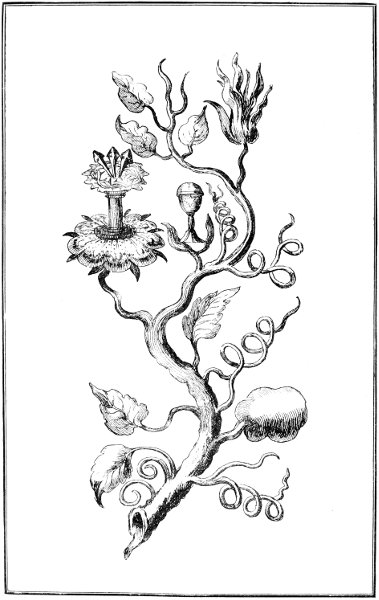
TO FACE PAGE 487.]
The Granadilla, or Passion Flower. From Zahn’s ‘Speculæ Physico-Mathematico-Historicæ.’
PAULOWNIA.—The noble hardy tree, Paulownia imperialis, was so named in 1840 in honour of the Hereditary Princess of the Netherlands, a daughter of the Emperor of Russia. The Paulownias are famous throughout Japan for the hardness and beauty of their wood: they attain a height of about thirty feet, and produce dark lilac flowers, which are borne in three spikes upon a tri-lobed sinuous leaf. These flowers, which resemble the blossom of the Catalpa, constitute one of the crests of the Mikado of Japan.
PAVETTA INDICA.—A race of Malays, called the Aruans, when burying their dead, carry the body into the forest, and hoist it upon the summit of four posts. A tree, usually the Pavetta Indica, is then planted near it, and at this final ceremony none but nude females are allowed to be present.
PEA.—The priests of ancient Egypt were not allowed to partake of Peas.——The Pea, like most trailing and climbing plants, has always traditionally been connected with celestial fire. According to a mediæval legend, the ancient Midsummer or St. John’s Day fires were kindled at the season of the Summer solstice for the purpose of scaring away pestilential dragons; and these dragons carried Peas in their flight, which they cast down in such quantities as to fill up the wells, and their smell was so foul that the cattle refused to eat them: these Peas represent lightning, and their smell is the sulphurous fume that clings to everything struck by it. The ancient German Zwergs, who are dwarfs closely connected with the thunder-god Thor, and who forged for him his lightning hammer, are exceedingly fond of Peas, and often plunder the Pea-fields. Peas were consecrated to Thor himself, and to this day in Berlin Peas with Saurkraut are a standing dish on Thor’s Day (Thursday). The Pea was the favourite vegetable of Thor himself, and St. Nicholas, who in some countries has replaced him, is sometimes represented as being clad in Peas-straws. In the North of England, if a lass’s lover has proved unfaithful to her, she is, by way of consolation, rubbed with Peas-straw by neighbouring lads. A Scottish ballad says:—
“If you meet a bonnie lassie Gie her a kiss, and let her gae; If you meet a dirty hussey, Fie, gae rub her o’er wi’ strae!”
Similarly when a Cambrian youth has been jilted, and his sweetheart marries a rival, the same operation is performed upon him, as a solace, by the village lasses. In the North of England, Carling Sunday (the fourth in Lent) is universally celebrated by feasts of Peas and butter. The use of Peas in divination concerning love affairs probably arises from the fact that they are sacred to the patron of marriage. In Bohemia, the girls go into a Pea-field, and there make a garland of five or seven kinds of flowers, all of different hues. This garland they use as a pillow, lying down with their right ear upon it, and then they hear a voice from underground, which tells them what manner of man they will have for a husband. A curious custom, known as “Peascod wooing,” was formerly extant in many country places; it was performed, according to Brand, by selecting one growing on the stem, snatching it away quickly, and if the good omen of the Peas remaining in the husk was preserved, then presenting it to the chosen lady. A girl shelling Peas will, if she should chance to find a pod containing nine, place it on the lintel of the kitchen door, and the first single man who enters is considered to be marked out for her future husband. Gay alludes to this custom in the following lines:—
“As Peascod once I plucked, I chanced to see One that was closely filled with three times three; Which, when I cropped, I safely home conveyed, And o’er the door the spell in secret laid. The latch moved up, when who should first come in, But in his proper person—Lubberkin.”
The village girls in Hertfordshire lay the pod with nine Peas under a gate, and believe they will have for husband the man who first passes through, or, at any rate, one whose Christian name and surname have the same initials as his.——It is always considered a good augury to dream of Peas.——In Suffolk, there is a legend that the Lathyrus Maritimus, or Everlasting Pea of the sea-side, sprang up on the coast there for the first time in a season when greatly needed; and Fuller says of this particular Pea that “in a general dearth all over England, plenty of Peas did grow on the sea-shore, near Dunmow, in Suffolk, never set or sown by human industry, which, being gathered in a full ripeness, much abated the high price in the markets, and preserved many hungry families from perishing.”
PEACH.—There is an old tradition that the falling of the leaves of a Peach-tree betoken a murrain.——There is a superstitious belief in Sicily, that anyone afflicted with goître, who on the night of St. John, or of the Ascension, eats a Peach, will be cured, provided only that the Peach-tree dies at the same time; the idea being that the tree, in dying, takes the goître away with it, and so delivers the sufferer from the affliction. In Italy, as a charm to cure warts, Peach-leaves are carefully buried in the earth, so that as they perish the wart may disappear.——To dream of Peaches in season denotes content, health, and pleasure.
PEAR.—Among the ancients, the Pear was specially consecrated to Venus. Columella knew a species called Pyrus Venerea, the Pear of Love. The Scots claim that “fair Avalon,” the Celtic “Isle of the Blest,” is an island in Loch Awe, Argyleshire; and the Gaelic legend changes the mystical Apples into the berries of the Pyrus cordata, a species of wild Pear, found both in the island of Loch Awe, and in Aiguilon.——On the Continent, there is a belief that orchards are infested by malignant spirits, which attack the fruit-trees, and in the Département de l’Orne, to drive away the demons which attack Pears and Apples, the peasants burn the Moss on the trunk and branches, singing the while an appropriate rhyme or incantation. In Aargau, Switzerland, when a boy is born, they plant an Apple-tree; when a girl, a Pear.——To dream of ripe Pears betokens riches and happiness; if unripe, adversity; if baked, great success in business; to a woman a dream of Pears denotes that she will marry above her in rank.
PEEPUL.—The Ficus religiosa, the Asvattha or Pippala of the Hindus, is a tree held in the highest sanctity by the Buddhists, near whose temples it is always found. It is this tree—the Bodhidruma, the Tree of Wisdom—under which Buddha sat absorbed in a species of intellectual ecstacy, and which his followers regard as the tree of creation, life, wisdom, and preparation for Paradise, as well as the yielder of ambrosia and rain. From ancient Vedic tradition the Buddhists have inherited the worship of this sacred tree: they say that at the hour of Buddha’s nativity, whilst around Kapilavastu suddenly arose magnificent woods, an enormous Asvattha, or Bo-tree, sprang from the very centre of the universe.——Hiouen-thsang, the Chinese pilgrim, professed to have found the Bodhidruma, or some tree that passed for it, twelve hundred years after Buddha’s death, at a spot near Gaya Proper, in Bahar, where still may be seen an old temple and ruins.——De Gubernatis tells us that there is represented in the Kâthaka Upanishad a heavenly cosmogonic Asvattha under precisely the same form as the Indian Bo-tree. “The eternal Asvattha, it is said, has its roots above, its branches below; it is called the Germ, Brahma, Ambrosia; beneath it all the worlds repose, above it nothing exists.” With its wood and that of the Acacia Suma (Sami) the sacred fire is lighted—the Asvattha representing the male, the Sami the female. The Asvattha, in rubbing the Sami, engenders the fire, and thus becomes an emblem of generation. From its heavenly origin and from its maintaining the fire of purification, the Bo-tree is credited with marvellous medicinal properties. Into a vase made of Asvattha-wood the priests pour the divine drink Soma.——In the Atharvaveda, says De Gubernatis, we are told that the Asvattha grows in the third heaven, and produces the Ambrosia under the name of Kushtha, or flower of the Amrita. He who eats the ambrosial food becomes intelligent. The cosmogonic tree of the Vedas is also the Tree of Intelligence, hence Buddha, the apostle of intelligence, sought refuge beneath its shade.——In a book of travels by two Chinese Buddhist pilgrims, translated by Mr. Beal, we find it stated that the only spot indicated by the gods as propitious to the acquirement of supreme wisdom is beneath the tree Peito, which the translator identifies with the Peepul, Bo-Tree, or Ficus religiosa. In the same narrative we learn that the gods constructed from the tree Sal (Shorea robusta) to the tree Bo a splendid road, three thousand cubits wide. The young Prince Buddha traverses the road during the night, surrounded by the Devas, the Nâgas, and other divine beings. Under the tree Peito Buddha walked from east to west, and was worshipped by the gods for the space of seven days; after that the gods constructed, north-west of the tree, a palace of gold, where Buddha stayed for seven days. Then he repaired to the lake Mukhalinda, where he sought the shadow of the tree Midella. Then the rain fell for seven days, and so the Nâga Mukhalinda came forth from the lake and sheltered Buddha with his hood. As showing the extreme fondness of Buddha for the Bo-tree, it is related by the Chinese that at the commencement of his conversion, he withdrew habitually beneath the tree Peito to meditate and fast. The Queen became exceedingly uneasy, and, in the hope of bringing back Buddha to his home, she gave orders for the Peito to be cut down. But at the sight of his beloved Bo-tree razed to the earth, so bitter became the grief of the seer, that he fell in a swoon to the ground. They sprinkled him with water, and when, after considerable trouble, he was restored to consciousness, he sprinkled on the roots one hundred jars full of milk; then prostrating himself with his face to the earth, he pronounced this vow:—“If the tree does not revive, I shall never arise again.” The tree at the same moment shot forth branches, and little by little raised itself until it attained its present height, which is about 120 feet. The number of Bo-trees which have become objects of veneration among the Hindus, and especially the Buddhists, is infinite, and the worship of the sacred Bodhidruma is still extant in India.——The Bo-tree is also specially consecrated to Vishnu, who is often portrayed as seated on its heart-shaped and pointed leaves. It is represented in the Vedas as being frequented by various birds, who eat its sweet Figs.——In the sacred city of Anurâdhapura, in Ceylon, is a Bo-tree, which is supposed to be one of the oldest trees in existence, and its age is not merely legendary, but substantiated by authentic records. Kings have dedicated their dominions to it, in testimony of their belief that it sprang from a branch of the identical tree under which Buddha reclined for seven years whilst undergoing his apotheosis. The precious branch was taken to Ceylon by the king Asoka, and the tree of which it was the parent was planted by the king Tissa, in the year 288 B.C. When planting it Tissa prophesied that it should flourish eternally, and that it should be an evergreen. It is too sacred to be touched by a knife, but the leaves, as they fall, are eagerly gathered and treasured by Buddhist pilgrims.——In Java, the Bo-tree is also held sacred, and a species of Mistletoe which grows on its branches is supposed to afford much gratification to the shades of the departed which revisit earth. The Buddhists of Thibet call the sacred Bo-tree the bridge of safety—the bridge by which mortals pass from the shores of the world to the shores of the immortal land.
PENNYROYAL.—The Pennyroyal (Mentha Pulegium) used formerly to be called Puliol Royal, and derived its name from the Latin word pulices, fleas—insects it was thought to be specially efficacious in destroying. In most of the Western Counties the plant is known as Organ-herb, and is much prized by old-women herbalists as a blood purifier. According to an ancient recipe, Organ broth was used in witchcraft to make people see double.——In Sicily, children put Pennyroyal in their cots on Christmas Day, under the belief that at the exact hour and minute when the infant Jesus was born this plant puts forth its blossom. The same wonder is repeated on Midsummer Night. In Sicily, also, Pennyroyal is given to husbands and wives who quarrel.——According to astrologers, Pennyroyal is a herb of Venus.
PEONY.—The Peony, or healing plant (Pæonia), commemorates the Homeric god Pæon, the first physician of the gods, who healed the divinities Ares and Hades of their wounds. Tradition asserts that the Peony is the floral descendant of Pæon, who was a pupil of the great Æsculapius. Pæon first received the flower on Mount Olympus, from the hands of the mother of Apollo, and by its means he cured Pluto of a wound he had received from Hercules; but this cure created so much jealousy in the breast of Æsculapius, that he secretly caused the death of Pæon. Pluto, however, retained a grateful sense of his service, and so transformed his body into the flower which to-day bears his name.——Rapin has a totally different tale to tell as to the origin of the blooming Peony, although from what source he derived his information we are unable to discover. According to the French poet, Pæonia is a nymph whose crimson hue is not the blush of modesty, but the tell-tale witness of the sin of a shepherdess of Alcinous, King of Phæacia, who seems to have been unable to withstand the amorous advances of the Sun-god.——In the emblematic language of flowers, the Peony is the representative of bashful shame.——Speaking of the Peony, Rapin says:—
“Erect in all her crimson pomp you’ll see With bushy leaves the graceful Piony, Whose blushes might the praise of virtue claim, But her vile scent betrays they rise from shame. Happy her form, and innocent her red, If, while Alcinous’ bleating flock she fed, An heavenly lover had not sought her bed; ’Twas Phœbus’ crime, who to his arms allured A maid from all mankind by pride secured.”
The ancient Greeks held the Peony in great repute, believing its origin to have been divine. It was thought to have been an emanation from the moon, and that the flower shone during the night, chased away evil spirits, and protected the dwellings of those who cultivated it. Hence, in later days, it came to be ranked as a miraculous plant; and it was thought that evil spirits would shun the spot where it was planted, and that even a small piece of the root, worn round the neck as an amulet, would protect the wearer from all kinds of enchantment. To this day, in Sussex, necklaces of beads turned from the Peony-root are worn by young children, to prevent convulsions and assist them in teething. Apuleius states that the Peony is a powerful remedy for insanity. Lord Bacon tells us, in his ‘Natural History,’ that “it hath beene long received, and confirmed by divers trialls, that the root of the male Piony dried, tied to the necke, doth help the falling sicknesse, and likewise the incubus, which we call the Mare. The cause of both these diseases, and especially of the epilepsie from the stomach, is the grossenesse of the vapours, which rise and enter into the cells of the braine; and therefore the working is by extreme and subtill alternation, which that simple hath.”——In Germany, the Peony is the Pentecostal Rose.——Astrologers say that both male and female Peonies are herbs of the Sun, and under the Lion.
PERIWINKLE.—In France, the Periwinkle is considered the emblem of the pleasures of memory and sincere friendship, probably in allusion to Rousseau’s recollection of his friend Madame de Warens, occasioned, after a lapse of thirty years, by the sight of the Periwinkle in flower, which they had once admired together.——In Italy, garlands of Periwinkle are placed upon the biers of deceased children, for which reason the plant has acquired the name of the Flower of Death; but in Germany it becomes the symbol of immortality.——Culpeper, in his ‘Herbal,’ says that the Periwinkle is owned by Venus, and that the leaves eaten together by man and wife, cause love between them.
PESTILENCE WEED.—The Butterbur Coltsfoot (Tussilago Petasites) obtained the name of Pestilence Weed from its having in olden times been held in great repute as a sovereign remedy for the plague and pestilent fever.
PHYTOLACCA.—A species of Phytolacca found by M. Lévy in Nicaragua in 1876, and named by him P. electrica, may well be called the electrifying plant. The discoverer, when gathering a branch, experienced a veritable electric shock. Experimenting with a compass, he found the needle was agitated at a distance of eight paces, and became more so the nearer he approached; the action changing to a rapid gyratory motion when he finally placed the compass in the midst of the shrub. There was nothing in the soil to account for what may be termed the “shocking” proclivities of the shrub, which are slight in the night-time, becoming gradually intensified until about two o’clock p.m. In stormy weather, the intensity of action is increased, and the plant presents a withered appearance until the fall of rain. Neither insect nor bird was seen by M. Lévy to approach this terrible shrub.
Pick-purse, or Pick-pocket.—(See Shepherd’s Purse).
PIMPERNEL.—The scarlet Pimpernel (Anagallis arvensis) is well known as the Poor Man’s Weather-glass, or Shepherd’s Barometer; both names having been given on account of the plant invariably closing its petals before and during rain. Darwin alludes to this peculiarity of the Pimpernel in the following lines:—
“Closed is the pink-eyed Pimpernel; In fiery red the sun doth rise, Then wades through clouds to mount the skies; ’Twill surely rain—we see’t with sorrow, No working in the fields to-morrow.”
Besides being a barometrical, the Pimpernel is a horological, plant, opening its petals about 7 a.m., and closing them about 2 p.m. The plant was also considered a surgical plant, inasmuch as the old herbalists ascribed to it the power of drawing out arrows which were embedded in the flesh, as well as thorns and splinters, or “other such like things.” The bruised leaves were believed to cure persons bitten by mad dogs, and the juices of the plant were considered efficacious in complaints of the eyes, and in hypochondriacal cases. Its manifold virtues have passed into a proverb:—
“No ear hath heard, no tongue can tell, The virtues of the Pimpernell.”
Pliny records that sheep avoided the blue, and ate the scarlet, Pimpernel, and that if, by mistake, they ate the blue, they immediately sought for a plant which is now unknown. In Dyer’s ‘English Folk Lore,’ it is stated that, according to a MS. on magic, preserved in the Chetham Library, Manchester, “the herb Pimpernell is good to prevent witchcraft, as Mother Bumby doth affirme.” The following lines may be used when it is gathered:—
“Herbe Pimpernell, I have thee found, Growing upon Christ Jesus’ ground: The same guift the Lord Jesus gave unto thee, When He shed His blood on the tree. Arise up, Pimpernel, and goe with me, And God blesse me, And all that shall were thee. Amen.”
“Saying this fifteen dayes together, twice a day, morning earlye fasting, and in the evening full.”——Pimpernel is considered to be a herb of the Sun.
PINE.—The Pine was called the tree of Cybele (or Rhea), the mother of the gods. She was passionately fond of Atys, a Phrygian shepherd, and entrusted him with the care of her temple, under a vow that he should always live in celibacy. This vow, however, Atys violated by an amour with the nymph Sangaris, upon which he became delirious, and mutilated himself with a sharp stone. Then, as he was about to lay violent hands upon himself, Cybele transformed him into a Pine-tree. Ovid records that—
“To Rhea grateful still the Pine remains, For Atys still some favour she retains; He once in human shape her breast had warmed, And now is cherished to a tree transformed.”
Rapin considers the Pine to have been regarded by the ancients as a sacred tree. He says—
“Old Cybele changed her Atys to a Pine, Which, sacred there to her, was held divine.”
After the metamorphosis of Atys into the Pine, Cybele sought refuge beneath the tree’s branches, and sat mourning there the loss of her faithless lover, until Jupiter promised that the Pine should remain ever green. It was tied to a Pine-tree, that Marsyas, the Phrygian flute-player, met his death. He became enamoured of Cybele, and journeyed with her as far as Nysa. Here
“He Phœbus’ self, the harmonious god, defied, And urged to have their skill in music tried. Phœbus accepts the challenge, but decreed, The boaster vanquished should alive be flayed; And Marsyas vanquished (so the poet sung) Was flayed alive, and on a Pine-tree hung.”—Rapin.
The Pine was dedicated to Bacchus, and at the Dionysian festivals the votaries sometimes wore garlands of its foliage: its cone is frequently represented surmounting the god’s thyrsus, possibly as being symbolic of fecundity and reproduction. The connection of the Pine with Bacchus is still maintained by the Greeks, who place the cones in their wine vats, to preserve and flavour the wine by means of the resin. The Pine-cone was considered a symbol of the heart of Zagræus, who was destroyed by the Titans, and whose ashes were given to Semele, the mother of Bacchus.——We find the Pine also dedicated to Pan, because Pitys, one of the many nymphs whom he loved, was changed into that tree, to escape the importunities of Boreas.——The wood of the Pine was employed in the construction of the first boats: hence the tree was also sacred to the sea-god Neptune.——Ovid introduces Pan as “crowned with a pointed leaf of Pine-leaf,” in reference to the sharpness of its narrow leaves. The length and straightness of its trunk, and freedom from branches, rendered it a suitable walking staff for the giant Polyphemus (Æn. iii.); and Turnus (from the resinous nature of this tree) is represented as raising a flaming brand of Pine-wood to set on fire the ships of the Trojans.——In Assyrian monuments, we find the Pine-cone offered to the god guarding life.——According to a Roman legend, two lovers who had died of love and were buried in the same cemetery, were changed, the one into a Pine, the other into a Vine, and were thus enabled to continue their fond embraces.——Prof. De Gubernatis remarks that, despite the legend of St. Martin, written by Sulpicius, who represented the Pine as a diabolic tree, Christianity itself has consecrated it. The town of Augsburg, which has for its badge a Pine-cone, is under the protection of St. Afra. In Sicily, they believe that the form of a hand is to be seen in the interior of the fruit—the hand of Jesus blessing the Pine which had saved Him during the flight into Egypt by screening Him and His mother from Herod’s soldiers.——At Ahorn, near Coburg, a frightful wind sent by a sorceress had bent the church steeple, which thus became an object of derision to the inhabitants of the surrounding villages. A shepherd, to save his village from such a standing reproach, attached a short rope to a Pine, which the inhabitants still pointed out in Nork’s time, and by dint of invocations and magical imprecations succeeded in straightening the steeple. Nork adds that in the year 1300, at Krain, near a convent, a statue of the Madonna, concealed in the trunk of a Pine, miraculously made itself heard by a priest: on that account a church has been erected in honour of the Virgin, in the immediate vicinity.——King Crœsus threatened the inhabitants of Lampsacus that the destruction of their town should be as complete as a felled Pine, which, once cut down, never sprouts out again. The comparison was particularly apt, inasmuch as the town of Lampsachus was reputed to have been formerly called Pityusa—“the place planted with Pines.”——In a Pompeian design, we find a rural Cupid with a crown of Pine. Ovid crowns the Fauns with Pine. Virgil calls the Pine Pronuba, because the torches used at weddings were made of Pine-wood.——In the hymn of Callimachus to Diana, virgins are represented as wearing chaplets of Pine.——The Pine-cone unopened symbolised virginity.——In Podolia, in Little Russia, the bride-cake is ornamented with sprigs of Pine.——In Japan, the Pine has become a symbol of constancy and conjugal fidelity, because it is always verdant, even beneath the snow.——The Pine is a funereal tree, and, as is the case with all others of its class, it symbolises immortality and generation. Like the Cypress and the Fir, on account of the durability of its wood and its evergreen foliage, it represents the perpetuity of life,—a symbol that appears singularly in keeping with the funereal rites of a people who believed in the immortality of the soul.——In Russia, when the coffin is being carried to the cemetery, it is covered with branches of Pine or Fir.——The Fijian believes that, after death, the spirit, with his war-club and a whale’s tooth, journeys to the world’s end: there grows the sacred Pine, and at it the spirit hurls his whale’s tooth. If he strikes it, he proceeds on his way rejoicing, but if he misses his mark, his further progress is stopped.——Crowns of Pine were worn by victors at the Isthmian games.——The Pine was one of the trees ordered to be used by the Jews in erecting their tents at the Feast of the Tabernacles.——According to tradition, the Pine seen in a dream portends dissolution.
PINK.—The Pink (Dianthus) has been said to derive its name from the Dutch word Pinkster—Whitsuntide—the season at which a species called of old the Whitsuntide Gilliflower, is in flower. In Bologna, however, the flower is held sacred to St. Peter, who is believed to have been partial to it above all others; the 29th of June is there considered to be the day of Pinks.——In an old work quoted by Alphonse Karr, the author recommends the water distilled from Pinks as an excellent remedy against epilepsy, and adds: “but if a conserve be composed of it, it is the life and delight of the human race.” A vinegar made of Pinks was formerly prized for its efficacy against the plague.
Pixie-stool.—See Toadstool.
PLANE.—The Plane-tree (Platanus orientalis) was specially venerated in Greece. In the school of Plato, the philosophers used to walk and converse under the shadow of these delightful trees.——Pausanias mentions a Plane tree of extraordinary size and beauty in Arcadia, supposed to have been planted by Menelaus thirteen hundred years before.——The Plane was held sacred to Helen, the wife of Menelaus.——Evelyn gives an account of the passion conceived by Xerxes for a Plane-tree. Whilst marching through Lydia, he is said to have stopped his vast army of 1,700,000 soldiers, that he might admire the beauty of one of these trees, and became so enamoured of it, that, spoiling both himself, his concubines, and great persons, of all their jewels, he covered it with gold, gems, necklaces, scarfs, bracelets, and infinite riches. For some days, neither the concerns of his portentous army, nor the objects of his expedition, could divert his thoughts from the stately tree, and when at length he was forced to leave it, he caused the figure of it to be stamped on a medal of gold, which he continually wore about him.——In Greece, when lovers are obliged to separate, they exchange, as a gage of fidelity, the halves of a leaf of the Plane. When they meet again, each one produces the half-leaf, and they then fit them together.
PLANTAIN.—According to Grimm, the Plantain or Waybread (like the Endive or Succory—the German Wegewarte) is said to have been once a maiden, who, worn out with constantly watching the roadway for her lover, was changed into a plant, that still clings to a position by the wayside. In Devonshire, they say that once in seven years it becomes a bird—either the cuckoo or its helpmate, known as the “dinnick,” which is said to follow the cuckoo wherever it goes.——In Aargau, the Plantain is called Irrwurzel, and the peasantry there ascribe to it the power of disordering the wits.——The Greeks called the plant “Lamb’s-tongue,” and no less a personage than Alexander the Great ascribed to it magical properties, and asserted that its root was marvellously potent in the cure of headaches. According to Macer Floridus, a root suspended round the neck prevented scrofula; and Dioscorides affirmed that the water derived from three roots cured the tertian, and from four the quartan ague.——In England, the Plantain or Waybread has always had a high reputation as a vulnerary. Chaucer notices it as an application to wounds, and Shakspeare makes Romeo, when referring to a broken shin, say, “Your Plantain-leaf is excellent for that.” Clare, in his ‘Shepherd’s Calendar,’ recounts the following rustic divination common among the Midland country-folk:—
“Or, trying simple charms and spells, Which rural superstition tells, They pull the little blossom threads From out the Knotweed’s button heads, And put the husk, with many a smile, In their white bosoms for awhile. Then, if they guess aright the swain, Their love’s sweet fancies try to gain, ’Tis said that ere it lies an hour, ’Twill blossom with a second flower, And from the bosom’s handkerchief, Bloom as it ne’er had lost a leaf.”
In Henderson’s ‘Folk Lore of the Northern Counties’ is an account of a curious rustic divination practised in Berwickshire by means of kemps or spikes of the Ribwort Plantain. Two spikes—one to represent the lad, the other the lass—are plucked when in full bloom, and after all the blossom has been carefully removed, the kemps should be wrapped in a Dock-leaf and laid under a stone. If the spikes shall have again blossomed when visited the next morning, the popular belief is that there will be “Aye love between them twae.”——Plantain is held by astrologers to be under the rule of Venus.
PLUM.—The Japanese, once a year, hold a popular festival in honour of the Plum-tree.——To dream of Plums is said to augur but little good to the dreamer: they are the forerunners of ill-health, and prognosticate losses, infidelity, and sickness, and much vexation in the married state.
POLYPODIUM.—According to a German tradition, the Polypodium vulgare sprang from the milk that the goddess Freyja, and after her the Virgin Mary, let fall on the earth.
POMEGRANATE.—The fruit of the Pomegranate has always been highly prized in the East. Rapin says of it:—
“Succeeding fruit attend the blossoms’ fall, Each represents a crown upon a ball; A thousand seeds with Tyrian scarlet dyed, And ranged by nature’s art in cells they hide.”
The Pomegranate was one of the plants assigned to Bacchus, and the origin of the tree is said to be due to a nameless nymph, beloved by Bacchus, to whom a priest had foretold that she should wear a crown. Bacchus kept the letter, but not the spirit of this prophecy, for, instead of espousing the betrayed maiden, he transformed her into a Pomegranate-tree, and twisted up the calyx of the blossom into the crown-like form it has ever since retained. Rapin relates the story as follows:—
“The story’s short how first this fruit obtained A graceful crown, and was with purple stained. A royal nymph there was of Tyrian race, A Moor, indeed, but formed with every grace, Her native colour knew; yet fate denied Indulgence equal to her beauty’s pride. Filled with ambitious thoughts she pressed to know What gifts the gods would on her charms bestow. Ravished she heard the ambiguous priest declare She should a crown and purple garments wear; Fancied that hence a kingdom must arise, Deceived by words and flattering prophecies. For when the god of wine in triumph came, Laden with Indian spoils to court the dame, He soon beguiled her with a husband’s name. Baulked of her hopes, her virgin honour stained, By favour of her god at last she gained To be transformed to this imperial plant— The only honour which the prophet meant.”
Oppian gives another legend as to the origin of the Pomegranate, according to which, a man having lost his first wife, became enamoured of his daughter Side (Greek for Pomegranate-tree): to escape his cruel persecution, the unfortunate young girl killed herself; but the gods, compassionating her, metamorphosed Side into the Pomegranate-tree, and her unnatural father into a sparrow-hawk: so, according to Oppian, the sparrow-hawk will never alight upon the Pomegranate, but always persistently shuns the tree.——According to M. Lenormant, the Pomegranate sprang from the blood of Adgestis. The name Rimmon (Pomegranate) was that given in certain parts of Syria, near Damascus, to the young god, who died but to spring into a new life—reminding one of the story of Adonis.——The great number of seeds which the fruit of the Pomegranate contains has caused it to become the symbol of fecundity, generation, and wealth. Probably on this account the plant was sacred to Juno, the patroness of marriage and riches. In the Isle of Eubœa, there was formerly a statue of this goddess, holding in one hand a sceptre, and in the other a Pomegranate. Prof. De Gubernatis suggests that the uterine form of the opened Pomegranate is the reason why Pausanias, after having said that Juno held a Pomegranate in her hand, adds, that she did not wish to divulge the mystery which appertained to this symbolic fruit. This is also the reason why (according to Cicero) Proserpine did not wish to leave the infernal regions without having eaten the Pomegranate which she plucked from a tree growing in the Elysian Fields. Ceres, inconsolable for the loss of her daughter, had begged Jupiter to release her from the power of Pluto. Jupiter decreed that if Proserpine had not tasted any food in the infernal regions, she might be restored to her mother; but, as Ovid tells us, by an unfortunate mischance,
“As in the garden’s shady walk she strayed, A fair Pomegranate charmed the simple maid, Hung in her way, and tempting her to taste, She plucked the fruit and took a short repast. Seven times, a seed at once, she eat the food: The fact Asculaphus had only viewed. He saw what passed, and, by discovering all, Detained the ravished nymph in cruel thrall.”
Ceres, enraged, would not permit the earth to yield any fruits till her daughter was restored to her, and Jupiter at last decided that Proserpine should spend six months of the year with her mother, but as she had partaken of the Stygian Pomegranate, she was to stay the other six months with Pluto.——A legend states that from having been planted on the grave of King Eteocles, the fruit of the Pomegranate has ever since exuded blood. Another account relates that the blood of the Pomegranate had its origin in the life-blood of the suicide Menœceus. On account of this blood which seems to flow from its fruit, the Pomegranate has acquired a somewhat sinister signification. As a rule, however, the sanguineous juice and innumerable seeds of the Pomegranate are considered a happy augury of fecundity and abundance.——There is a tradition that the fruit of the Tree of Life presented by Eve to Adam was the Pomegranate. It is also the opinion of some, that Paris adjudged a Pomegranate to Venus, and not an Apple; and that nearly always where the latter fruit is alluded to in legends or popular customs relating to marriage, the Pomegranate is meant.——In Turkey, the bride throws a Pomegranate on the ground, and from the number of seeds which exude from the broken fruit judges of the extent of her future family.——In Dalmatia, it is the custom for a young man, when asking the hand of his bride from her parents, to speak figuratively, and so he vows to transplant into his own garden the beautiful red flowers of the Pomegranate which are then flourishing in the paternal parterre.——In Sicily, they use a branch of the Pomegranate-tree as a divining-rod to discover hidden treasures: it is reported to be unfailing provided that it is manipulated by an expert or by some one who knows the mystical formulary.——Many references to the Pomegranate are to be found in the Bible, where it is usually associated with the idea of fruitfulness. Moses described the promised land as a land of Wheat and Barley, and Vines, and Fig-trees, and Pomegranates; a land of oil-Olive and honey. Solomon speaks of “an orchard of Pomegranates with pleasant fruits.” It was used to flavour wine and meats, and a wine was made from its juice: “I would cause thee to drink of spiced wine of the juice of my Pomegranate” (Canticles viii., 2). The Jews employed the fruit in their religious ceremonials. The capitals of the pillars in the Temple of Jerusalem were covered with carved Pomegranates. On the hem of Aaron’s sacred robe were embroidered, in blue, in purple, and in scarlet, Pomegranates, alternating with golden bells. A similar adornment of the fringes of their robes was affected by the ancient Kings of Persia, who united in their own person the regal and sacerdotal offices.——In Christian art, the Pomegranate depicted as bursting open, and the seeds visible, was an emblem of the future—of hope in immortality. St. Catherine, as the mystical Sposa of Christ, is sometimes represented with a Pomegranate in her hand; and the infant Saviour is often depicted holding this fruit and presenting it to the Virgin.——Moore speaks of the “charmed leaf of pure Pomegranate,” in allusion to the Persian idea as to its purifying attributes. In the ceremonies of the Ghebers (fire-worshippers) round their sacred fire, the Darvo gives them water to drink and Pomegranate-leaf to chew in their mouth, to cleanse them from inward uncleanness.——The Pomegranate was the device of Henry IV., who took it from the Moorish kings of Grenada, with the motto, “Sour, yet sweet.” The crown-like shape of its calyx probably induced Anne of Austria to adopt it, with the motto, “My worth is not in my crown.” The Pomegranate was the emblem of Katherine of Arragon, and in one of the masques held in honour of her marriage with our Henry VIII., a bank of Roses and Pomegranates typified the union of England and Spain. Her daughter, Queen Mary, took the Pomegranate and white and red Roses.——Parkinson tells us that from the rind of the Pomegranate is made writing-ink “which is durable to the world’s end.”——The Athenian matrons, during the Thesmophoria (festivals in honour of Ceres), were expressly forbidden to eat Pomegranates.——To dream of Pomegranates is a fortunate augury, foretelling good fortune and success; to the lover such a dream implies a faithful and accomplished sweetheart, and to the married an increase of riches and children, and great success in trade.
Poor Man’s Parmacetty.—See Shepherd’s Purse.
POPLAR.—In allusion to the reputed origin of this tree, René Rapin, in his poem on Gardens, says:—
“Nor must the Heliads’ fate in silence pass, Whose sorrow first produced the Poplar race; Their tears, while at a brother’s grave they mourn, To golden drops of fragrant Amber turn.”
The Heliades, sisters of the rash Phaëthon (who had yoked the horses to the chariot of the Sun before his fatal drive), on finding his tomb upon the banks of the river Po, became distracted with grief, and for four days and nights kept mournful watch with their disconsolate mother around the grave. Tired out with their exhausting vigil, they endeavoured at length to obtain some repose for their weary limbs, when to their dismay they found them rooted to the ground. The gods, pitying their intense grief, had changed the seven sisters into Poplars, and their tears into Amber. Ovid thus narrates the incident:—
“Each nymph in wild affliction, as she grieves, Would rend her hair, but fills her hand with leaves; One sees her limbs transformed, another views Her arms shot out and branching into boughs, And now their legs, and breasts, and bodies stood Crusted with bark and hardening into wood. * * * * * * * * Then the bark increased, Closed in their faces, and their words suppressed. The new-made trees in tears of Amber run, Which, hardened into value by the sun, Distil for ever on the streams below; The limpid streams their radiant treasure show, Mixed in the sand; whence the rich drops conveyed Shine in the dress of the bright Latian maid.”—Addison.