PIONEER SATURN
Reading edition
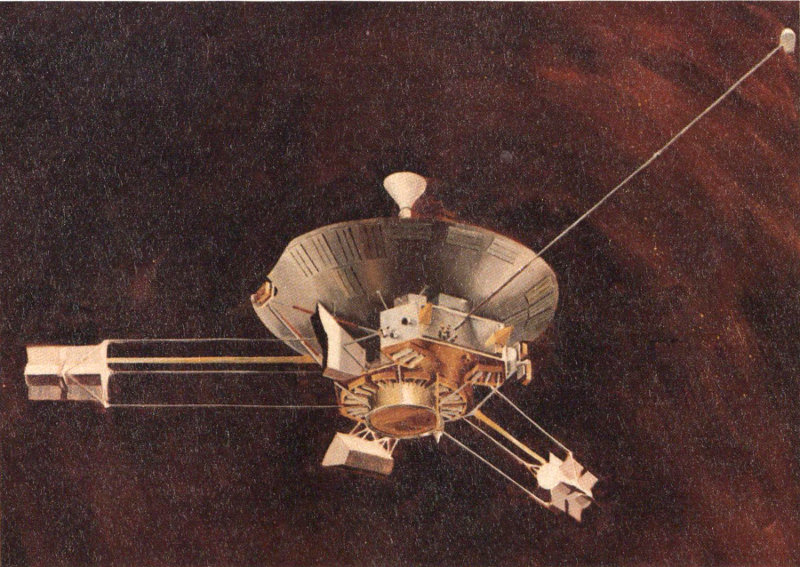
Pioneer Saturn spacecraft.
Pioneer Saturn has given us our first close view of the spectacular ringed planet Saturn and its system of moons. The spacecraft began its journey to the giant planets Jupiter and Saturn on April 5, 1973, as Pioneer 11. It reached Jupiter on December 2, 1974, passing within 42,760 km of the Jovian cloud tops and taking the only existing pictures of Jupiter’s polar regions. Jupiter’s massive gravitational field was used to swing Pioneer 11 back across the solar system toward Saturn. Additional maneuvers were executed in 1975 and 1976 to place the spacecraft on a suitable trajectory, with the final aimpoint selected in 1977.
From the many possible targeting options for the first Saturn flyby, two aimpoints were considered, both of which would result in a near-equatorial flyby that would give the best mapping of the high-energy particles and the magnetic field near the planet. The difference between these two aimpoints, which came to be known as the “inside” and “outside” options, was their relationship to Saturn’s unique ring system first discovered by Galileo in 1610. The “outside” option was finally selected because it was considered to be of less risk to the spacecraft and more valuable in planning the subsequent encounter of Saturn by Voyager 2, which will reach Saturn in 5 1981. Final targeting was completed during early 1978, when a series of timed rocket thrusts locked Pioneer into the desired trajectory.
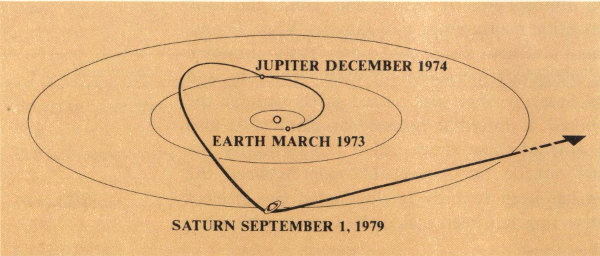
Pioneer Saturn voyage.
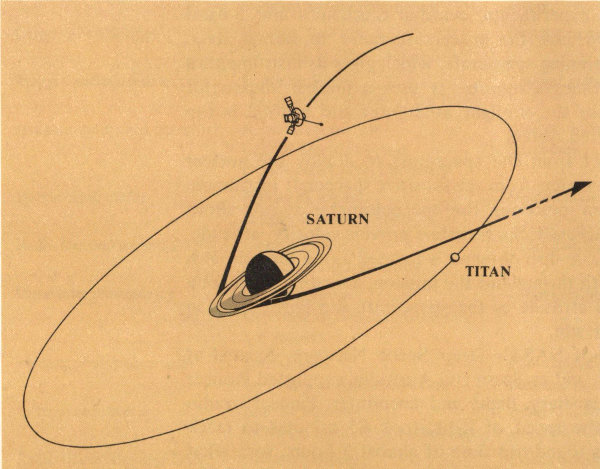
Encounter trajectory.
On September 1, 1979, the spacecraft, now designated Pioneer Saturn, reached Saturn after 6 years in flight. It passed through the ring plane outside the edge of Saturn’s A-ring and then swung in under the rings from 2,000 to 10,000 km below them. At the point of closest approach, it attained a speed of 114,100 km/h (71,900 mi/h) and came within 21,400 km of the planet’s cloud tops. While it was approaching, encountering, and leaving Saturn, the spacecraft took the first closeup pictures of the planet, showing 6 20 to 30 times more detail than the best pictures taken from Earth, and made the first close measurements of its rings and several of its moons, including the largest moon, the planet-sized Titan. Titan, along with Mars, has been considered by many scientists to be the most likely place to find life in the solar system.
Pioneer Saturn unraveled many mysteries. It determined that Saturn has a magnetic field and trapped radiation belts, measured the mass of Saturn and some of its moons, and studied the character of Saturn’s interior. It confirmed the presence and determined the magnitude of an internal heat source for Saturn. Its instruments studied the temperature distribution, composition, and other properties of the clouds and atmospheres of Saturn and Titan, and took photometric and polarization measurements of Iapetus, Rhea, Dione, and Tethys. Pioneer may also have discovered a previously unknown moon of Saturn. The spacecraft measured the mass, structure, and other characteristics of Saturn’s rings, and passed safely through the outer E-ring, which posed a potential hazard for Pioneer. It also discovered new rings. One of these rings, called the F-ring by the Pioneer team, lies just outside the A-ring. The gap between the F-ring and the A-ring has been tentatively designated the Pioneer Division. The other new ring has been called the G-ring, which lies well outside the F-ring.
Pioneer carries a scientific payload of 11 operating instruments; another instrument, the asteroid/meteoroid detector, was turned off in 1975. Two other experiments, celestial mechanics and S-band occultation of Saturn, use the spacecraft radio to obtain data. Pioneer Saturn is a spinning spacecraft, which gives its instruments a full-circle scan 7.8 times a minute. It uses a nuclear source for electric power because the sunlight at Jupiter and beyond is too weak for a solar-powered system.
Two booms project from the spacecraft to deploy the nuclear power source about 3 meters from the sensitive spacecraft instrumentation. A third boom positions the magnetometer sensor about 6 meters from the spacecraft. Six thrusters provide velocity, attitude, and spin-rate control. A dish antenna is located along the spin axis and looks back at Earth throughout the mission, adjusting its view by changes in spacecraft attitude as the spacecraft and Earth move in their orbits around the sun.
Tracking facilities of NASA’s Deep Space Network, located at Goldstone, California, and in Spain and Australia, supported Pioneer Saturn during interplanetary flight and encounter. Pioneer’s radio signals, traveling at the speed of light, took 85 minutes to reach Earth from Saturn, a round-trip time of almost 3 hours, somewhat complicating ground control of the spacecraft. Almost 10,000 commands were sent to the spacecraft in the 2-week period before 7 closest approach. Continued communications should be possible through at least the mid 1980’s.
After the spacecraft passed Saturn, it headed out of the solar system, traveling in the direction the solar system moves with respect to the local stars in our galaxy and in approximately an opposite direction from its sister spacecraft, Pioneer 10. Both spacecraft have plaques attached to them which contain a message from Earth for any intelligent species that may intercept the spacecraft during their endless journeys through interstellar space.
Pioneer Saturn Scientific Instruments
Instrument Principal Investigator Experiment Objective
Helium vector magnetometer Edward J. Smith Jet Propulsion Laboratory Magnetic fields
Fluxgate magnetometer Mario Acuña Goddard Space Flight Center Magnetic fields
Plasma analyzer John H. Wolfe Ames Research Center Solar plasma
Charged particle John A. Simpson University of Chicago Charged particle composition
Cosmic ray telescope Frank B. McDonald Goddard Space Flight Center Cosmic ray energy spectra
Geiger tube telescope James A. Van Allen University of Iowa Charged particles
Trapped radiation detector R. Walker Fillius University of California, San Diego Trapped radiation
Asteroid/meteoroid detector[1] Robert K. Soberman General Electric Co. and Philadelphia Drexel University Asteroid/meteoroid astronomy
Meteoroid detector William H. Kinard Langley Research Center Meteoroid detection
Radio transmitter and DSN John D. Anderson Jet Propulsion Laboratory Celestial mechanics
Ultraviolet photometer Darrell L. Judge University of Southern California Los Angeles Ultraviolet photometry
Imaging photopolarimeter Tom Gehrels University of Arizona, Tucson Photo imaging and polarimetry
Infrared radiometer Andrew Ingersoll California Institute of Technology Infrared thermal structure
Radio transmitter and DSN Arvydas J. Kliore Jet Propulsion Laboratory S-band occultation
8