BATTLE OF PITTSBURG LANDING.
Reading edition
April 6–7, 1862.
When the surrender of Forts Henry and Donelson reached Washington and Richmond there was depression among the secessionists and great rejoicing at the North. The news of these events was followed directly by the capture of Nashville and New Madrid, and it became certain to the Confederate leaders that Island No. 10 must soon surrender. Under these untoward events it became imperative that a new strategic point should be at once established beyond reach of the gunboats, that had already produced so much mischief. Beauregard, then in command, selected Corinth as the most promising point for his operations, and a position which would render any attempt of the Federals to cut him off from western Tennessee, or the eastern and southern States, extremely difficult of success. He called on the Governors of Tennessee, Mississippi and Alabama for help, and a prompt response was made. First came Polk from Columbus, then Bragg from Mobile and Pensacola, followed by General A. S. Johnston from Murfreesborough, who took command. After selecting their new line of defence, they commenced fortifying it and diligently concentrated their forces. Generals Hardee, Breckinridge, Sterling Price and Hindman soon came in, and the fortifications made rapid progress.
Corinth is a very important strategical point. It is situated in a branch of the Apalachian range, which diverges from the Alleghany mountains, and forms the uplands and gold-bearing regions of Georgia and Alabama. The village is nearly surrounded by an irregular circle of hills, rising in the north, about four miles distant, with the State line between Tennessee and Mississippi crossing their summit. The Mobile and Ohio railway intersects this ridge through a cut seventy-five feet in depth. Similar cuts, of lesser depth, penetrate the hills on the east, west and south, where the railways enter. Beyond these hills, in the direction of Pittsburg and Savannah, the ground becomes more level, and is generally low and swampy. The topography of the region renders Corinth susceptible of strong defences. The village was formerly called Farmington, and is so mentioned in the gazetteers. It is a post village of Tishomingo county, Mississippi, distant two hundred and sixty-two miles north-east from Jackson, the capital of the State. There were not half a dozen stores in the village, and its population was relatively small. Tishomingo county forms the north-eastern extremity of Mississippi, bordering on Tennessee and Alabama. The Tombigbee river rises in the county; the Tennessee flows along the north-east border, and it is drained by Tuscumbia creek. A large 368portion of the county is covered with forests of oak, hickory, walnut and pine.
The principal military value of this place consists in the fact that the railroads from Memphis on the west, Columbus, on the north, and Mobile on the south, cross at this point.
About the middle of March Grant’s victorious army at Nashville was sent by Halleck to occupy first Savannah, and then Pittsburg Landing, preparatory to the arrival of Buell’s Kentucky army, when Halleck intended himself to take the field and move on Corinth.
Pittsburg Landing is situated in Hardin county, Tenn., on the west side of the Tennessee river. It is in itself of little importance, being close to Savannah, which is a flourishing post village of Hardin county, situated on the eastern side of the river. The Landing is about one hundred and twenty miles from Nashville; nearly one hundred miles from Columbia, on the Nashville and Decatur railroad; by a turnpike road, crossing the river at a ferry, about twenty-five miles from Corinth. The country is very wild, the surface rising on both sides of the river in a gradual ascent.
Savannah is the capital of Hardin county. Previous to the rebellion it had been a place of considerable business note. The population in 1853 was only eight hundred, but it had been greatly increased. The area of the county is about six hundred and fifty miles. The Tennessee river flows through it, dividing it into nearly equal parts. The river is navigable for steamboats through the entire county, which has a population of over ten thousand persons, nine-tenths of whom are free.
General Grant proceeded at once to Savannah, where his headquarters were established. The divisions of his army were sent gradually to Pittsburg, and had not all arrived when the assault was made. No defences had been erected, and the possibility of an attack from the Confederates had not been for a moment entertained. On the 5th of April Buell left Nashville and arrived at Savannah the same day. The division of his army under Nelson was on the battle field on the sixth, at five P. M.
The Confederates had for some time intended to attack Grant before Buell could join him, and on hearing of his near approach they hastened the action, without waiting for their own reinforcements. This bold movement was made just one day too late.
POSITION OF THE FEDERAL TROOPS.
Pittsburg Landing is simply a narrow ravine, down which a road passes to the river bank, between high bluffs on either side. There is no town whatever. Two log huts comprise all the signs of habitation visible. Back from the river is a rolling country, cut up with numerous 369ravines, partially under cultivation, but the greater portion is thickly wooded with large patches of underbrush. From the Landing a road leads directly to Corinth, twenty miles distant. A mile or two out, this road forks; one branch is known as the lower Corinth road; the other, the Corinth ridge road. A short distance out, another road curves off to the left, crosses Lick Creek, and leads back to the river at Hamburg, some miles up the stream. On the right, two separate roads lead off to Purdy, and another, a new one, runs across Snake Creek to Crump’s Landing on the river below. Besides these, the whole country that composed the battle-field was cut up with roads leading to different camps.
On and between these roads, at distances of from two to five miles from Pittsburg Landing, lay several divisions of Major-General Grant’s army on Sunday morning. The advance line was formed by three divisions—Brigadier-General Sherman’s, Brigadier-General Prentiss’ and Major-General McClernand’s. Between these and the Landing lay the forces of Brigadier-General Hurlbut and Major-General Smith, who, being absent from severe illness, left his command to Brigadier-General W. H. L. Wallace.
The Union advance line, beginning at the extreme left, was thus formed:—On the Hamburg road, just north of the crossing of Lick creek, and under bluffs on the opposite bank that commanded the position, lay Colonel D. Stuart’s brigade of General Sherman’s division. Some three or four miles distant from this brigade, on the lower Corinth road, between that and the road to Purdy, lay the remaining brigades of Sherman’s division, McDowell’s forming the extreme right of the whole advance line. Hildebrand’s came next to it, and Buckland’s following. Next to Buckland’s brigade, though rather behind a portion of Sherman’s, lay Major-General McClernand’s division, and between it and Stuart’s brigade, already mentioned as forming the extreme left, Brigadier-General Prentiss’ division completed the line.
Back of this line, within a mile of the Landing, lay Hurlbut’s division, stretching across the Corinth road, with W. H. L. Wallace’s to his right. Such was the position of the Union troops at Pittsburg Landing at daybreak on Sunday morning. Major-General Lew. Wallace’s division arrived at about half-past seven o’clock that day.
Nearly four miles intervened between the different parts of Sherman’s division. McClernand’s lay partially behind Sherman, and there was a gap between him and Prentiss, which the rebels did not fail speedily to find. The extreme left was commanded by unguarded heights, easily approached from Corinth.
The secession army was commanded by General Johnston; Beauregard was second in command. The three army corps were led by Hardee, Polk, and Bragg. Breckinridge commanded the reserve.
370On the evening of Friday, April 4, there had been a preliminary skirmish with the enemy’s advance. Rumors reached the Union camp that some officers had been taken prisoners by a considerable rebel force, near the lines, and that pickets had been firing. A brigade, the Seventieth, Seventy-second and Forty-eighth Ohio regiments, was sent out to ascertain the facts. They came upon a party of rebels, perhaps a thousand strong, and after a sharp action drove them off, losing Major Crocket, of the Seventy-second Ohio, and two lieutenants from the Seventieth were taken prisoners. In return the Union party took sixteen prisoners, and drove the rebels back to a battery which they had placed undiscovered at no great distance from the Federal lines. General Lew. Wallace’s troops, at Crump’s Landing, were ordered out under arms; they marched to Adamsville, half way between the river and Purdy, to hold position there and resist any attack in that direction. The long rainy night passed drearily and uncomfortably, but no further hostile demonstrations were made, and it was generally supposed that the affair had been an ordinary picket fight, presaging nothing more. On Saturday there was more skirmishing along the advanced lines.
The secession leaders at Corinth knew that they largely outnumbered Grant, and that no measures had been taken to strengthen the position at Pittsburg Landing; they knew equally well, that when Buell’s entire Kentucky army was added to Grant’s forces, they could not possibly expect to hold their important position at Corinth. Their only hope lay in attacking Grant before Buell arrived, and defeating his troops in detail.
During Friday and Saturday the enemy had marched out of Corinth, about seventy thousand strong, in three lines of battle; the first and second extending from Owl Creek on the left to Lick Creek on the right—a distance of about three miles, supported by the third and the reserve. The first line, under Major-General Hardee, was constituted of his corps, augmented on his right by Gladden’s brigade, of Major-General Bragg’s corps, deployed in line of battle, with their respective artillery, following immediately by the main road to Pittsburg, and the cavalry in rear of the wings. The second line, composed of the other troop of Bragg’s corps, followed Hardee at a distance of five hundred yards, in the same order as the first. The army corps under General Polk followed the second line, at the distance of about eight hundred yards, in lines of brigades, deployed with their batteries in rear of each brigade, moving by the Pittsburg road, the left wing supported by cavalry. The reserve, under Brigadier-General Breckinridge, followed closely the third line, in the same order, its right wing supported by cavalry.
371
THE BATTLE ON SUNDAY.
As if in beautiful contrast with the terrible scenes that were soon to follow, the holy Sabbath-day which dawned on the sixth of April was one of unusual loveliness. The soft spring sunshine lay upon the green slopes, breaking up their delicate green with a thousand fleeting shadows flung downward by the young leaves. A gentle, pleasant wind shook the budding branches, and happy birds were singing their love-tunes in the underbrush, a touching prelude to the stern battle music that soon put them to flight. A few fleecy clouds wreathed themselves along the serene blue of the sky, and floated idly over the battle field, casting transparent shadows now in some green hollow, then upon a hill slope, till the whole field smiled like an Eden—smiled even after the cannon belched their thunders over it. While the morning dew was yet on the grass, the enemy began pouring the fire and smoke of a most deadly strife over this lovely scene.
The attack commenced so suddenly and with such bitter violence, that the enemy’s artillery was brought to bear on the outer camps almost simultaneously with the arrival of the pickets they had driven in.
The divisions of Sherman and Prentiss, composed in a great part of inexperienced troops, were selected and compelled to meet the first shock of the enemy’s onset. Much confusion and panic was occasioned by the sudden and unexpected attack, from which neither corps was able fully to recover during the day. Both commanders exerted themselves with bravery and skill in the trying crisis, and were soon enabled to bring the greater part of their troops into line of battle, and check the advance of the Confederate forces, which were then devastating the Federal camps.
It is impossible to describe the fearful scenes that followed the first wild onset of the enemy. Many of the sick and wounded, and the more tardy officers and men were shot in their tents and left for dead, lying through the whole of this fearful struggle, gasping in their agony. On Monday evening some of these poor fellows were found in the riddled tents, scarcely able to ask for the drink for which they were perishing.
But the Union forces were not long held at this terrible disadvantage. As the enemy advanced in force on Sherman’s centre, and a battery opened fire in the woods, shelling the Federal camp, the Unionists were in a condition to respond with emphasis. Taylor’s and Waterhouse’s batteries met this first regular attack.
Under cover of their artillery, the rebel advance, by heavy battalions of infantry, was made obliquely to the left, across the open field in front of the Fifty-third Ohio, while solid columns came in, direct upon 372Sherman’s front. Immediately the entire line opened fire, and the battle became general. The enemy’s design was to left-flank Sherman. To this end he flung himself with terrific force upon Prentiss. Directly the sound of musketry and artillery announced that Prentiss was engaged, and at nine A. M. he was falling back. About this time Appler’s regiment broke, followed by Munger’s regiment, and the enemy pressed forward on Waterhouse’s battery, exposed by the disordered retreat. The three Illinois regiments in immediate support of this battery stood for some time, but the enemy’s advance was so impetuous and his fire so terrific that they began to waver. While the Forty-third Illinois was in the thickest of the iron storm, Colonel Raith received a severe wound and fell from his horse. This threw his regiment into some disorder, and the enemy got possession of three guns of Waterhouse’s battery.
Although the left was thus turned, and the enemy pressing the whole line, Colonels McDowell and Buckland held their ground until ten o’clock, A. M., when the enemy had got his artillery to the rear of the Union left flank, and some changes became absolutely necessary. Two regiments of Hildebrand’s brigade—Appler’s and Munger’s—had already disappeared to the rear, and Hildebrand’s own regiment was in disorder. Taylor’s battery—still at Shiloh—received orders to fall back as far as the Purdy and Hamburg road; and McDowell and Buckland were directed to adopt that road as their new line. Behr’s battery at the cross-roads, was ordered immediately to come into battery action right. As Captain Behr gave the order, he was shot from his horse, when the drivers and gunners fled in confusion, carrying off the caissons, and abandoning five out of the six guns. The enemy pressed on after gaining this battery, and the Unionists were again forced to choose a line of defence. Hildebrand’s brigade had substantially disappeared from the field, though he himself bravely remained. McDowell’s and Buckland’s brigades still maintained their organizations, and joined McClernand’s right, thus abandoning the original camps and line.
General Prentiss, too, brave, eager, and resolute to retrieve lost ground, reformed his lines under the hot fire of the enemy, without a choice of position, and in the full raking fire of the foe, hid in the scrub oak jungles, which gave them secure covert. If his troops had cowered at first, the remainder of his division held their position and braved the galling fire it was impossible to return with the heroism of old veterans. Hildebrand and McDowell were compelled to withdraw their brigades from their camps to a ravine behind them, but they made a gallant defence, while Buckland’s men fell back, and McClernand threw forward his left, supporting them.
It is hardly to be wondered that the raw regiments broke under this 373appalling fire, before which veteran troops were powerless to stand. Yet it must be said that Hildebrand’s brigade gave way with unreasonable panic. Colonel Hildebrand himself was cool and self-possessed as any man that ever led a hostile force. He made a powerful effort to keep his troops in place when he saw them giving way; but the power of a single man is unavailing when panic seizes the masses. Still this brave hero kept his individual regiment in force a full hour after Appler’s and Munger’s regiments had retired from their proper field of action, and thus a larger portion of his forces were scattered and drifted away from the contest.
Prentiss still fought valiantly, but down on either flank came the enemy in an overwhelming rush, and a wall of bayonets closed him in on either side. It was an appalling situation. The enemy made vigorous use of his advantage. They had driven two divisions from their camps and nearly opened a passage to the river. Here it was, between nine and ten o’clock, that McArthur’s brigade of W. H. L. Wallace’s division came up to give assistance to Stuart’s brigade, of Sherman’s division, now in imminent danger of being cut off. Mistaking the way, McArthur marched far to the right, and instead of reaching Stuart, came in on the other side of the rebels, now closely pushing Prentiss. His men at once opened vigorously on the enemy, and for a time they seemed likely to save the imperilled division. But coming unawares upon the enemy, their positions were not well chosen, and the whole force was compelled to fall back together.
HURLBUT’S DIVISION.
Hurlbut’s division, in reserve, saved the first repulse from proving an absolute defeat, by offering a line behind which the discomfited divisions of Sherman and Prentiss could reform, while his solid ranks were a wall of steel against which the enemy could not prevail. The General, in his report, says of their five hours’ service:
“Receiving from General Prentiss a pressing request for aid, I took command in person of the first and third brigades, respectively commanded by Colonel N. G. Williams, of the Third Iowa, and Brigadier-General Lauman. The first brigade consisted of the Third Iowa, Forty-first Illinois, Twenty-eighth Illinois and Thirty-second Illinois. The third brigade was composed of the Thirty-first and Forty-fourth Indiana, the Seventeenth and Twenty-fifth Kentucky.
“In addition, I took with me the first and second battalions of the Fifth Ohio cavalry; Mann’s light battery of four pieces commanded by first Lieutenant E. Brotzmann; Ross’ battery of the Second Michigan; and Meyer’s battery of the Thirteenth Ohio.
“I formed my line of battle—the first brigade thrown to the front 374on the southerly side of a large open field—the third brigade continuing the line with an obtuse angle around the other side of the field, and extending some distance into the brush and timber. Mann’s battery was placed in the angle of the lines, Ross’ battery some distance to the left, and the Thirteenth Ohio battery on the right, and somewhat advanced in cover of the timber, so as to concentrate the fire upon the open ground in front, and waited for the attack.”
At half-past seven o’clock, when Brigadier-General Sherman was attacked in force and heavily upon his left, Colonel I. C. Veatch, commanding the second brigade of General Hurlbut’s division, was ordered to proceed to the left of General Sherman. This brigade, consisting of the Twenty-fifth Indiana, Fourteenth, Fifteenth, and Forty-sixth Illinois, was in march in ten minutes, arrived on General Sherman’s left and went into action rapidly. In a few minutes they were in line of battle, and moving forward to the attack. But the brigade had hardly left the camp before it found the roads full of flying Unionists, and the route for two miles was strewn with guns, knapsacks, and blankets. The front had been completely surprised; nearly a whole division was scattered and retreating in utter confusion, and the enemy in force was already a mile within the Federal camps. The brigade, under command of Colonel Veatch, was drawn up in line of battle in a skirt of timber, bordering a large field, on the outer edge of which the Federal troops were engaging the enemy. But the enemy pressed on in overwhelming force, and just as the troops in front began to waver, they discovered that he had flanked Veatch on the right and was rapidly advancing to attack the brigade on the right and rear.
The Fifteenth Illinois was on the right, the Fourteenth Illinois in the centre, and the Twenty-fifth Indiana on the left—the other regiment, the Forty-sixth Illinois, by the rapid flanking of the enemy became detached from the brigade, and was not with it again during the action. This brought the first fire upon the Fifteenth Illinois, which stood it nobly, but was soon overpowered; the Fourteenth followed with a like result. In the mean time the troops in front and on the left were completely routed by the enemy, and came pell mell through the Union lines, causing some little confusion. Hardly had they passed through to the rear before the enemy came rushing on, and the fire of musketry became terrific. There was no resisting this fiery onset short of annihilation; so with a few well-directed volleys the brigade left the field. The loss was very heavy. All the field officers of the Twenty-fifth Illinois were killed instantly; two lieutenants were killed and three wounded.
M’CLERNAND’S DIVISION.
McClernand’s division lay a short distance in the rear, and with one 375brigade stretching out to the left of Sherman’s line. Properly speaking, merely from the location of the camp, he did not belong to the front line. Two-thirds of his division were entirely behind Sherman. But as the latter fell back, McClernand was compelled to bear the shock of battle.
His division was composed as follows:—First brigade, Colonel Hare commanding, Eighth and Eighteenth Illinois, Eleventh and Thirteenth Iowa; Second brigade, Colonel C. C. Marsh commanding, Eleventh, Twentieth, Forty-eighth and Forty-fifth Illinois, Colonels Ransom, Marsh, Haynie and Smith (the latter was the “Lead Mine regiment”); Third brigade, Colonel Raith commanding, Seventeenth, Twenty-ninth and Forty-ninth Illinois, Lieutenant-Colonels Wood, Farrell and Pease, and Forty-third Illinois, Colonel Marsh. Besides this fine show of experienced troops, they had Schwartz’s, Dresser’s, McAllister’s and Waterhouse’s batteries.
McClernand was at once in the hottest of the fight. As Buckner’s brigade fell back, the protecting woods grew thinner and storms of grape swept over them like the blasts of a tornado. Lieutenant-Colonel Canfield, commanding the Seventy-second Ohio, was mortally wounded, and borne dying from the field. Colonel Sullivan, of the Forty-eighth Ohio, was wounded, but continued at the head of his men. Company officers fell in numbers and were carried away from the field. The rebels, by a sudden dash, had taken part of Waterhouse’s battery, which McClernand had sent over. Behr’s battery, too, was taken, and Taylor’s Chicago Light Artillery was terribly exposed, and compelled to retire with heavy loss. As the troops gave way they came out from the open woods into old fields, completely raked by the enemy’s fire. For them all was lost, and away went Buckner’s and Hildebrand’s brigades, Ohioans and Illinoisans together, to the rear and right.
McDowell’s brigade had fallen back less slowly than its two companions of the same division. It was now left entirely alone. Having formed the extreme right, it had no support there; its supporting brigades on the left had gone; and through the space they had occupied the rebels were pouring furiously. In imminent danger of being entirely cut off, they fell back among the ravines that border Snake creek.
Sherman was indefatigable in collecting and reorganizing his men, and a contest was kept up along portions of his new lines. The General bore with him one token of the danger to which he had so recklessly exposed himself—a musket ball through the hand. It was a miracle that he escaped so slightly, for his courage had been conspicuous. He had dared death fifty times since the attack was made on his raw division that memorable Sunday morning.
Now the great force of the enemy fell on McClernand’s right. As 376Sherman fell back, McClernand was compelled to bring in his brigades to protect his left against the onset of the rebels, who, seeing how he had weakened himself, hurled themselves against him with tremendous force. A couple of new regiments, the Fifteenth and Sixteenth Iowa, were brought up; but taking utterly raw troops on the field, under heavy fire, was too severe a trial, and they gave way in confusion. Then the whole division made a change of front, and faced along the Corinth road. Here the batteries were placed in position, and till ten o’clock the rebels were foiled in every attempt to gain the road.
But Sherman having now fallen back there was nothing to prevent the enemy from coming in further out on the road, and turning McClernand’s right. Prompt to seize the advantage, a rebel brigade dashed audaciously through the abandoned camp of the division, pushing up the road in order to come in above McClernand. Where Sherman had been, a battery of rifled guns was turned upon them, hurling fearful slaughter in their midst and driving them back.
But the enemy managed his reserves with great skill. A constant advance of fresh regiments proved overwhelming, and the storm of death swept many a brave Union officer away. Death after death was proclaimed, disaster followed disaster with disheartening quickness.
This was about half-past ten A. M., at which time the enemy had made a furious attack on General McClernand’s whole front. He struggled determinedly; but finding him severely pressed, Sherman moved McDowell’s brigade directly against the left flank of the enemy, forced him back some distance, and then directed the men to avail themselves of every cover—trees, fallen timber, and a wooded valley to the right. The brigade held this position for four long hours, sometimes gaining and at others losing ground, Generals McClernand and Sherman acting in perfect concert, and struggling to maintain this line.
By eleven o’clock, many of the commanders of regiments had fallen, and in some cases not a single field officer remained; yet the fighting continued with desperate earnestness—the fearful contest on both sides was for death or victory. The almost deafening sound of artillery, and the rattle of the musketry, were all that could be heard. The men stood and bravely delivered their fire, regardless of the thunders of artillery and the storm of iron missiles that raked through them. Foot by foot the ground was contested. The wounded fell in heaps on the battle field. There was no easy transportation at hand, but such means as the soldiers could invent were adopted, and their wounded comrades carried to the rear. Many who were hurt fell back without help, while others fought in the ranks until they were actually forced back by their company officers.
Major Eaton, commanding the Eighteenth Illinois, was killed; Colonel 377Haynie was severely wounded; Colonel Raith, commanding a brigade, had his leg so shattered that amputation was necessary; Major Nevins, of the Eleventh Illinois, was wounded; Lieutenant-Colonel Ransom, of the same regiment, was wounded; three of General McClernand’s staff—Major Schwartz, Major Stewart and Lieutenant Freeman—were wounded, and carried from the field. Line officers had suffered heavily. The batteries were broken up—Schwartz had lost half his guns and sixteen horses. Dresser had lost several of his rifled pieces, three caissons and eighteen horses. McAllister had lost half his twenty-four pound howitzers.
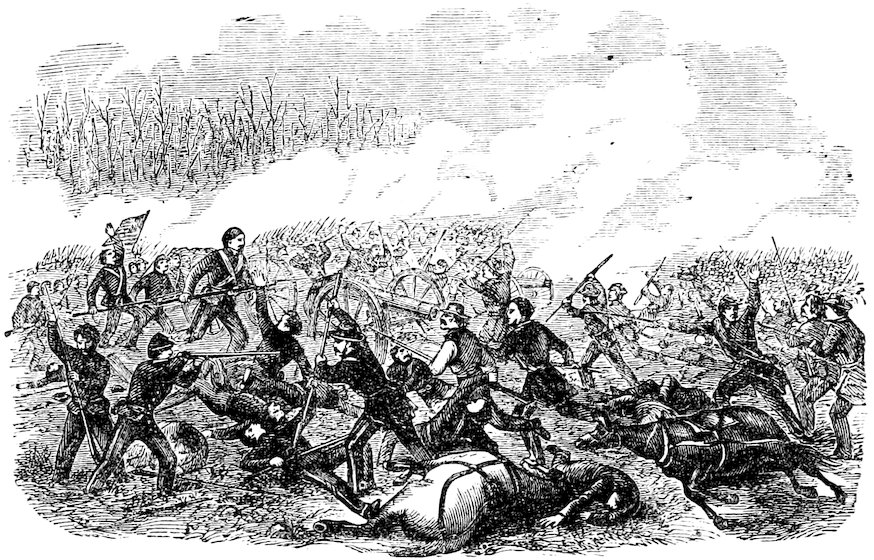
DESPERATE HAND-TO-HAND FIGHT OVER SCHWARTZ’S BATTERY.
The soldiers fought bravely to the last—bravely as ever men fought—but they were at a terrible disadvantage. Gradually they began falling back, making a determined resistance; occasionally they rallied and repulsed the enemy for a hundred yards, then were beaten back again, renewing the retreat to some new position for fresh defence.
By eleven o’clock the division was back in a line with Hurlbut’s. It still did some gallant fighting; once its right swept round and drove the enemy before it for a considerable distance, but again fell back; at last it brought up near the position of W. H. L. Wallace’s division.
Now Prentiss, Sherman and McClernand were driven back, and their camps were all in the hands of the enemy. The whole front line, for which Hurlbut and Wallace were but the reserves, was gone.
Sherman’s brigade, on the extreme left, was doubly left alone by the 378Generals. General Grant did not arrive on the field until each division General had been in action, and the respective Generals had in the best manner they could, carried on the battle; but this brigade was even left by its division General, who was four miles away, doing his utmost to rally his panic-stricken regiments there.
It was commanded by Colonel David Stuart, and was composed of the Fifty-fifth Illinois, Lieutenant-Colonel Malmbourg, commanding; Seventy-first Ohio, Colonel Rodney Mason; the Fifty-fourth Ohio (Zouaves), Colonel T. K. Smith. It was posted along the circuitous road from Pittsburg Landing, up the river to Hamburg, some two miles from the Landing, and near the crossing of Lick Creek, the bluffs on the opposite side of which commanded the position, and stretching on down to join Prentiss’ division on its right.
When the rebels marched out from Corinth, a couple of brigades (rumored to be under the command of Breckinridge), had without molestation reached the bluffs of Lick Creek, commanding Stuart’s position.
During the attack on Prentiss, Stuart’s brigade was formed along the road, the left resting near the Lick Creek ford, the right, Seventy-first Ohio, Colonel Rodney Mason, being nearest Prentiss. The first intimation they had of disaster to their right was the partial cessation of firing. An instant afterwards, muskets were seen glimmering among the leaves, and presently a rebel column emerged from a bend in the road, with banners flying, and moving at double-quick toward them. Their supports to the left were more remote than the rebels, and it was evident that, with but one piece of artillery, a single regiment could do nothing there. They accordingly fell back toward the ford, and were reinforced in an orchard near the other regiments.
The rebel column veered on further to the right, and for a brief space, though utterly isolated, they remained unmolested.
Before ten, however, the brigade, which stood listening to the wild roar of battle on the left, was startled by a shell that hurtled directly over their heads. In an instant the rebel batteries that had gained the commanding bluffs opposite, by approaching on the Corinth and Hamburg road, were in fiery play. The orchards and open fields in which they were posted, looking only for an attack in the opposite direction, were swept with the exploding shells and a hail-storm of grape.
Under cover of this fire from the bluffs, the rebels rushed down, crossed the ford, and in a moment were seen forming on the creek, in open fields, and within close musket range. Their color-bearers stepped defiantly to the front, as the engagement opened. The storm came in sharp and quick volleys of musketry, the batteries above supporting them with a destructive fire. The Union sharpshooters panted to pick off the audacious rebel color-bearers, but Colonel Stuart interposed,—crying 379out, “No, no, they are too brave fellows to be killed.” Almost at the first fire, Lieutenant-Colonel Barton S. Kyle, of the Seventy-first, was shot through the breast. The brigade stood firmly at least ten minutes, when it became evident that its position was untenable, and it fell rapidly back, perhaps a quarter of a mile, to the next ridge; a few of Stuart’s men, at great personal risk, carrying Lieutenant-Colonel Kyle, in a dying condition, from the field they were abandoning. Ohio lost no braver, truer man that day.
When they reached the next woody ridge, rebel cavalry, that had crossed the creek lower down, were seen coming up on the left; and the line of battle was formed fronting in that direction, to resist this new attack. For three-quarters of an hour the brigade kept this position. The cavalry, finding it prepared, did not come within range. In front they were hard pressed, and the rebels began to come in on their right. Colonel Stuart had sent across to Brigadier-General W. H. L. Wallace, then not engaged, for support. Brigadier-General McArthur’s brigade was promptly started across, but mistaking the way, and bearing too much to the right, found itself in the midst of the rebel forces. He vigorously engaged the rebels to his front and flanks, fell back to a good position and held these troops in bay till the rest of his division came up. General McArthur was himself disabled by a wound in the foot, but he rode to a hospital, had it dressed, and returned to the brigade, which meantime held its position stoutly.
But this brought Stuart’s isolated brigade little assistance. They were soon forced to fall back to another ridge, then to another, and, finally, about twelve o’clock, shattered and broken, they retreated to the right and rear, falling in behind General McArthur’s brigade to reorganize. Colonel Stuart was himself wounded by a ball through his right shoulder, and the loss of field and company officers greatly disheartened the troops.
DESPERATE CONDITION OF THE NATIONAL TROOPS.
Now the entire front was cleared. The enemy had full possession of Sherman’s, Prentiss’ and McClernand’s camps. By ten o’clock the whole front, except Stuart’s brigade, had given way, and the burden of the fight was resting on Hurlbut and W. H. L. Wallace. Before twelve, Stuart, too, had come back, and for the time, those two divisions stood absolutely alone between the Union army and destruction.
But truly brave men are bravest when driven to extremities. Hurlbut and Wallace made a most gallant stand; and most of the troops from the three scattered divisions were still to some extent available. Many of them had wandered down the river, some to Crump’s Landing, and others even to Savannah, to be brought back on transports. Brigades 380could not be collected again, much less divisions, but the regiments were gathered together from the loose squads wandering about, and officered, often by men who could find scarcely a soldier of their own commands. These were hurried to the front, and many of them did good service.
According to general understanding, in the event of an attack at Pittsburg Landing, Major-General Lew. Wallace was to come in on the Union right, and flank the rebels by marching across from Crump’s Landing below.
But, as has been stated, Wallace, with his division, though all drawn up and ready to march anywhere at a moment’s notice, was not ordered to Pittsburg Landing till nearly twelve o’clock. Then, by mistake, he got on the new road, four miles of marching were lost, and the circuitous route made it a march of twelve miles before he could reach the scene of battle. Meantime the right was almost wholly unprotected.
Fortunately, however, the rebels did not seem to have discovered the full extent of this weakness, and their heaviest fighting was done on the centre and left, where the Union lines were still preserved.
HURLBUT’S DIVISION.
Hurlbut’s division stretched across the Corinth road, facing to the left. W. H. L. Wallace’s other brigades had gone over to assist McArthur, and the divisions thus reunited, steadily closed the line. To Hurlbut’s right the lines were united by the reorganized regiments that had been resent to the field. McClernand and Sherman were both there.
Hurlbut had been encamped in the edge of a stretch of open fields, backed with heavy timber, which lay nearest the river.
Three times during those long hours the heavy rebel passes on the left charged upon the division, and three times were they repulsed with terrible slaughter. Close, sharp, continuous musketry filled the air with fire and smoke—whole lines belched their furious fire on the rebels, and a leaden storm swept the fields over which they attempted to advance with terrible fury. No troops could have withstood this deadly fire. Rebel discipline gave way under it, though dead bodies left scattered over the field, even on Monday evening, bore ghastly testimony to the daring with which they had been precipitated towards the Federal lines.
The rebel generals handled their forces with a skill that extorted admiration even from their enemies. Repulse was nothing to them; if a rush on the Union lines failed, they took their disordered troops to the rear, and sent up fresh forces, who ignorant of the deadly reception that awaited them, were ready to make a new trial. Hurlbut’s jaded division 381was compelled to yield at last, and after six hours’ magnificent fighting, it fell back of its camps to a point within half a mile of the landing.
WALLACE’S DIVISION.
Hurlbut’s companion division—that of Brigadier-General W. H. L. Wallace, included the Second and Seventh Iowa, Ninth and Twenty-eighth Illinois, and several of the other regiments composing Major-General Smith’s old division. Wallace had also three excellent batteries—Stone’s, Richardson’s and Weber’s, all from Missouri.
With him, too, the fight began about ten o’clock, as already described. From that time till four in the afternoon his troops bore up manfully. The musketry fire was absolutely continuous; there was scarcely a moment that some part of the line was not pouring in their rattling volleys, and the artillery sent forth its death-thunders with but little intermission through the entire time.
Once or twice the infantry advanced, attempting to drive back the continually increasing enemy; but though they could hold their own ground, their numbers were unequal to the task of conquering more.
Four separate times in turn the rebels attempted to charge on them. Each time the infantry poured in its quickest volleys, the artillery redoubled its exertions, and the rebels retreated with heavy slaughter. The division was eager to remain, even when Hurlbut fell back, and the noble fellows serving the guns were particularly indignant when compelled to silence their own batteries. But their supports were gone on both sides. It was madness to remain in isolated advance. Just as the necessity for retreating was becoming apparent, General Wallace, whose cool, collected bravery had commanded universal admiration, was, as it was believed, mortally wounded, and borne away from the field. At last the division fell back. Its soldiers claim the proud distinction of being the last to yield, in the general breaking up of the lines that gloomy Sunday afternoon.
Captain Stone could not resist the temptation of stopping, as he passed what had been Hurlbut’s headquarters, to try a few parting shots. He did fine execution, but his wheel horses were shot down, and he narrowly escaped losing his guns.
With the first dash of the enemy on the left wing, it became evident that a stupendous effort would be put forth to break through it. For two hours sheets of fire blazed from both columns, and clouds of smoke surged up between them with the rush and stifling effect of a prairie fire. The Mississippi riflemen in the enemy’s ranks fought with terrible valor, which was met with steady heroism by those who stood firmly under their unerring fire. Three different times the enemy seemed on the verge of a victory. They drove the Union forces slowly before 382them until they came in sight of the river, but up to three o’clock the desperate attempt to break the Federal lines proved unavailing. Having failed to drive in the main columns, they had turned with furious strength on the right wing; baffled there, they made another onset on the left wing, fighting more desperately than ever. But the Union lines were prepared for the assault, fierce as it was, and met it with wonderful steadiness.
The whole army was crowded into Wallace’s camps, and confined in a circuit of from half to two-thirds of a mile around the Landing. The Union army fighting bravely, had been falling back inch by inch all day. The next repulse threatened to drive them into the river.
Brigadier-General Prentiss and three regiments with him—the Twenty-third Missouri, of his own division, and the Twelfth and Fourteenth Iowa, of those that had come to his assistance—delayed their retreat too long, having relied too confidently on their supporting division to check a flank movement of the enemy. Almost before they saw their danger, the flanking forces rushed in from either side behind them, and they stood, perhaps two thousand strong, in the midst of thrice their number. Hedged in with battalions, with a forest of steel bristling on every side, these brave men yielded to the force of numbers, and were taken prisoners, after fighting bravely till further contest would have been self-murder.
Meantime Sherman’s brigades had maintained a confused fight. Buckland’s were almost gone, Hildebrand’s and McDowell’s were holding their ground more tenaciously.
General Hurlbut gives a clear statement of the retreat and final position of the Federal forces on Sunday afternoon:
“When, about three o’clock, Colonel Stewart, on my left, sent me word that he was driven in, and that I would be flanked in a few moments, it was necessary for me to decide at once to abandon either the right or left. I considered that General Prentiss could, with the left of General McClernand’s troops, probably hold the right, and sent him notice to reach out toward the right, and drop back steadily parallel with my first brigade, while I rapidly moved General Lauman from the right to the left, and called up two twenty-pound pieces of Major Cavender’s battalion to check the advance of the enemy upon the first brigade. These pieces were taken into action by Dr. Corvine, the surgeon of the battalion, and Lieutenant Edwards, and effectually checked the enemy for half an hour, giving me time to draw off my crippled artillery, and to form a new front with the third brigade. In a few minutes, two Texas regiments crossed the ridge separating my line from Stuart’s former one, while other troops also advanced.
“Willard’s battery was thrown into position, under command of 383Lieutenant Wood, and opened with great effect on the Lone Star flags, until their line of fire was obstructed by the charge of the third brigade, which, after delivering its fire with great steadiness, charged up the hill, and drove the enemy back three or four hundred yards. Perceiving that a heavy force was closing on the left, between my line and the river, while heavy firing continued on the right and front, I ordered the line to fall back. The retreat was made steadily, and in good order. I had hoped to make a stand on the line of my camp, but masses of the enemy were pressing on each flank, while their light artillery was closing rapidly in the rear. On reaching the twenty-four-pounder siege guns in battery, near the river, I again succeeded in forming line of battle in rear of the guns, and, by direction of Major-General Grant, I assumed command of all troops that came up. Broken regiments and disordered battalions came into line gradually upon my division.
“Major Cavender posted six of his twenty-pound pieces on my right, and I sent my aid to establish the light artillery, all that could be found, on my left. Many officers and men, unknown to me, fled in confusion through the line. Many gallant soldiers and brave officers rallied steadily on the new line. I passed to the right and found myself in communication with General Sherman, and received his instructions. In a short time the enemy appeared on the crest of the ridge, led by the Thirteenth Louisiana, but were cut to pieces by the steady and murderous fire of our artillery.”
The enemy were in possession of nearly all the Union camps and camp equipage. Half the field artillery had fallen into his hands; a division general had been captured—many officers had followed him, and more than one regiment of soldiers had been made prisoners. The battle field was cumbered at every step with killed and wounded; the hospital tents were overflowing and crowded with human agony. A long ridge bluff set apart for surgical purposes swarmed with the maimed, the dead and the dying, whose cries and groans broke fearfully through the pauses of the artillery. A dogged, stubborn resolution took possession of the men; regiments had lost their favorite officers; companies had been bereft of their captains. Still they continued to fight desperately, but with little hope.
At three o’clock the gunboat Tyler opened fire on the enemy, and at four the Lexington came up, taking position half a mile above the landing, and opened fire, striking terror into the ranks of the enemy.
General Grant was confident that his troops could hold the enemy off till morning, and said this while standing with his staff in a group by the old log post-office on the landing, which was then crowded with surgeons and the wounded; but still the men fought with a despairing light in their eyes.
384In a time like this, minutes count for years. General Grant used them to a golden purpose. Colonel Webster, chief of staff, and an artillery officer of ability, had arranged all the guns he could collect in a sort of semi-circle, protecting the Landing, and bearing chiefly on the Union centre and left, by which the rebels were pretty sure to advance. Corps of artillerists to man them were improvised from all the batteries that could be found. Twenty-two guns in all were placed in position. Two of them were very heavy siege guns, long thirty-two’s. Where they came from, what battery they belonged to, no man questioned. It was quite unimportant. Enough that they were there, in the right place, half a mile back from the bluff, sweeping the approaches by the left, and by the ridge Corinth road, but with few to work them. Dr. Corvine, surgeon of Frank Blair’s First Missouri Artillery, proffered his services, which were gladly accepted, and he worked them with terrible effect.
It was half-past four o’clock—perhaps later still. Every division of the Union army on the field had been repulsed. The enemy occupied almost all their camps. The struggling remnant of Federal troops had been driven to within little over half a mile of the Landing. Behind was a deep, rapid river. In front was a victorious enemy. Still there was an hour for fighting. O, that night or Lew. Wallace would come! Nelson’s division of Buell’s army evidently could not cross in time to save the day. No one could tell why Lew. Wallace was not on the ground. In the justice of a righteous cause, and in that semi-circle of twenty-two guns in position, lay all the hope these beleagured men could see.
At five o’clock the artillery which had been thundering so stormily, held its fire a little; the flash of muskets from the enemy’s lines died away, and his columns fell back on the centre for nearly a mile. With a sudden swoop they wheeled and again threw their entire force on the left wing, determined to end the fearful contest of the day then and there.
Suddenly a broad, sulphurous flash of light leaped out from the darkening woods, and through the glare and smoke came whistling leaden hail. The rebels were making their crowning effort for the day, and as was expected, they came from the left and centre. They had wasted their fire at one thousand yards. Instantaneously a new tempest from the black-mouthed Union guns flung out its thunderous response. The rebel artillery opened, and shell and round shot came tearing across the open space back of the bluff. The Union infantry poured in a glorious response from their broken battalions, invigorated by the announcement that the advance of Buell’s army was in sight. Just then a body of cavalry appeared across the Tennessee river, waiting transportation. 385In their extremity the soldiers turned their eyes anxiously that way. Was it Buell—was it Nelson coming to the rescue?
ARRIVAL OF GENERAL BUELL.
The eyes of those weary soldiers brighten. Their courage revived. Help was near. Even in that lurid atmosphere they could see the gleaming of the gun-barrels amid the leaves and undergrowth down the opposite side of the river. They caught hopeful glimpses of the steady, swinging tramp of trained soldiers. A division of Buell’s army was coming up.
Then came a boat across with a lieutenant and two or three privates of the Signal Corps. Some orders were given the officer, and as instantly telegraphed to the other side by the mysterious wavings and raisings and droppings of the flags. A steamer came up with pontoons on board, with which a bridge could be speedily thrown across the river.
She quietly reconnoitered a few moments, and steamed back again. Perhaps, after all, it was better to have no bridge there. It made escape impossible, and left nothing but victory or death to the struggling Union troops. Preparations were rapidly made for crossing General Nelson’s division, (for he had the advance of Buell’s army,) on the dozen transports that had been tied up along the bank.
The division of W. H. L. Wallace held the enemy at bay in his last desperate effort to break the Union lines. While forcing through a cross-fire, General Wallace fell mortally wounded. Brigadier-General McArthur took the command, but he too was wounded, and Colonel Tuttle, as senior in rank, rallied the shattered brigades. He was joined by the Thirteenth Iowa, Colonel Crooker; Ninth Illinois, Colonel Mersy; Twelfth Illinois, Lieutenant-Colonel Chatlain, and several other fragments of regiments, and forming them in line on the road, held the enemy in check until that noble line was formed that breasted that last desperate charge.
At this critical moment a long, loud shout from the Union forces welcomed in the reinforcements. Eight thousand strong had at length crossed the river, and swept down upon the battle-field. Buell and Nelson, by forced marches, made within sound of the booming thunders of artillery, reached the battle-field just as the fate of war trembled in the balance. There was no pause for rest or council. So eager were they for the strife, they scarcely paused for breath before a line of battle was formed which decided that stormy day’s fight.
The men, weary from the long march, and panting from the speed which had marked its last stages, ranged themselves in advance of the exhausted, but unfaltering troops of Sherman, McClernand, Hurlbut 386and of W. H. L. Wallace, who lay dying on the battle-field, while Colonel Tuttle led his brigades to their noble work.
The gunboats Tyler, Lieutenant Gwinn commanding, and Lexington, James W. Shirk commanding, now steamed up to the mouth of the little creek, near which Stuart’s brigade had lain in the morning, and where the rebels were attacking the Union left. When they reached the mouth of the stream the boats rounded to, commanding a ravine cut through the bluff, as if for the passage of their shells, which poured destruction into the ranks of the enemy. This movement was made under the direction of General Hurlbut, and it soon swept the enemy’s ranks, carrying terror with every burst of deadly iron the guns belched forth.
Eager to avenge the death of their commanding General (now known to have been killed a couple of hours before), and to complete the victory they believed to be within their grasp, the rebels had incautiously ventured within reach of their most dreaded antagonists, as broadside after broadside of seven-inch shells and sixty-four-pound shot soon taught them. This was a foe they had hardly counted on, and the unexpected fire in flank and rear produced a startling effect. The boats fired admirably, and with a rapidity that was astonishing. The twenty-two land guns kept up their stormy thunder; and thus, amid the crash and roar, the scream of shells and demon-like hiss of minie balls, that Sabbath evening wore away.
Startled by the accumulated force, and disheartened by the fearful combinations against them, the rebels fell slowly back, fighting as they went, until they reached an advantageous position, somewhat in the rear, yet occupying the main road to Corinth. The gunboats kept pouring a storm of shell on their track, until they retired completely out of reach, and the battle of the first day ended.
As the sounds of battle died away, and division generals drew off their men, a council of war was held, and it was decided that as soon as possible after daybreak the enemy should be attacked and driven from their snug quarters in the Union camps. Lew. Wallace, who was coming in on the new road from Crump’s Landing, and crossing Snake Creek just above the Illinois Wallace’s (W. H. L.) camps, was to take the right and sweep back toward the position from which Sherman had been driven on Sunday morning. Nelson was to take the extreme left. Buell promised to place Crittenden next to Nelson, and McCook next to him, by a seasonable hour in the morning. The gap between McCook and Lew. Wallace was to be filled with the reorganized divisions of Grant’s army; Hurlbut coming next to McCook, then McClernand, and Sherman closing the gap between McClernand and Lew. Wallace.
387
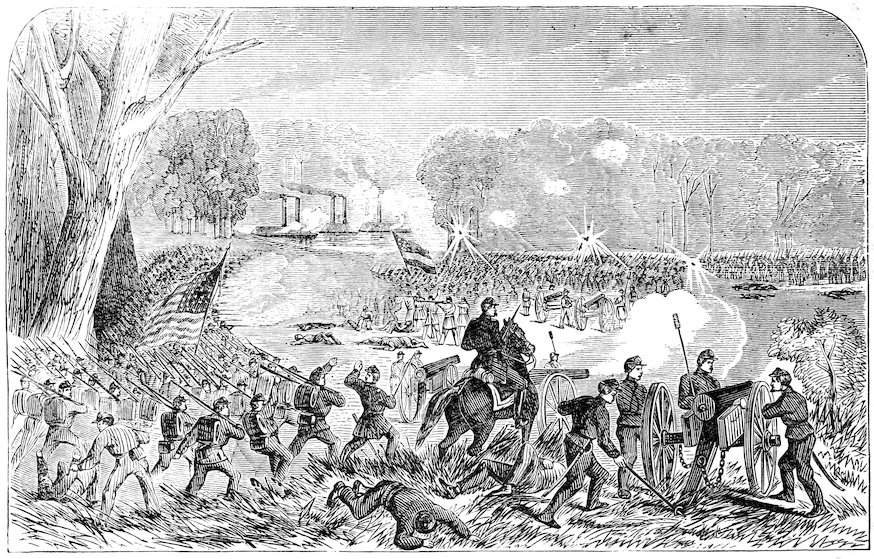
BATTLE OF PITTSBURG LANDING, APRIL 6, 1862.
389From the first fearful onslaught upon Buckland’s brigade, which, gathering up its shattered regiments, and firing as they ran, to form in the heavy woods, leaving winrows of slain on their track, to the last outburst of shot and shell from the gunboats, the contest of that day had been a fearful one. Most of the troops which received the first shock of battle were raw recruits, just from the camp of instruction. Hundred and hundreds of them had never seen a gun fired save in sport in their lives. With officers equally inexperienced, admitting brilliant exceptions, it is not wonderful that the ranks were broken and driven back when the terrific roar of cannon burst in their midst, and bombshells scattered fire and death among the tents, in which they were quietly sleeping but an hour before. Springing to arms, half prepared only to rush through the blinding smoke to meet the serried columns of the rebels’ impetuous advance—truly it is not strange that they fell into confusion, fighting blindly and at random. But it was a grand sight when Sherman dashed along the lines, shouting encouragement to the men, exposing his own life a hundred times, and rallying his forces with a wonderful power of voice and action. The herculean exertions of this brave man no doubt saved the division from utter destruction.
From the first tranquil opening of that beautiful day to its lurid and bloody close more desperate bravery has seldom been exhibited. When Americans meet Americans, all that is heroic and daring in the national character springs to action, and deeds are done on both sides that thrill the nation as it stands breathlessly listening, North and South, to know how her sons have fought.
NIGHT BETWEEN THE TWO BATTLES.
In dead silence the troops took their new position, and lay down on their arms in line of battle. All night long the remainder of Buell’s men were marching up from Savannah to a point opposite Pittsburg Landing, whence they were brought over in transports. An hour after dark Wallace came in with his division. There had been delay in getting the right road, which made him late on the field. But once there he fell to work with energy. He ascertained the position of certain rebel batteries which lay in front of him on the right, and threatened to bar his advance in the morning, and selected positions for a couple of his batteries from which they could silence the enemy. In placing his guns and arranging his brigades for support, he was occupied till one o’clock in the morning. His wearied men had lain down to snatch a few hours of sleep, with the shadows of death all around them.
At nine o’clock all was hushed near the landing. Men still panting from the hot contest of the day, threw themselves on the earth to sleep or die as they chanced to be unhurt or wounded unto death. The bright stars looked down upon the ranks of sleeping, dying and dead men, with sweet Sabbath-like calm, and never did the stars of heaven 390brood over a spectacle more appalling. The sound of marching troops from the far distance alone broke the solemn stillness, save when the moans of the wounded, and the agonizing cries for water thrilled the night with sounds of anguish. Now a flash shed a flood of sheet-lightning over the river, turning its waters to lurid fire, and the roar of heavy naval guns reverberated on the bluffs, breaking up the sublime silence of the night. Again and again the guns boomed great volumes of sound. By the flashes, the gunboats could be seen receding back into the fiery blue of the waters with each graceful recoil produced by the discharge. A thin veil of smoke settled around them, floating drowsily between their black hulls and the beautiful stars. Far away in the distant woods came the muffled explosion of shells thus let loose on the tranquil air.
Thus the night wore on. The soldiers, far too weary for the boom of cannon to awake them, slept quietly almost as the dead were sleeping. The wounded answered back the dismal sound with more dismal groans. At midnight a thunder storm broke over the battle field, and the artillery of heaven swept its fires through the sky, while the guns from the river boomed a sullen answer. Torrents of rain fell, drenching the sleepers, but falling cool as balm on the parched lips of the wounded, assuaging their burning thirst and moistening their wounds.
The vigilant officers knew that half a mile off lay a victorious army, commanded by splendid Generals, rendered ardent by a half-won conquest which might be a victory on the morrow. For them there was little rest. When the day broke it found these men watching. When the brain is active men do not sleep, and the General who has divisions to command and protect must earn success by vigilance.
THE BATTLE ON MONDAY.
The line of battle agreed upon for the Union forces on Monday was this:—Right wing, Major-General Lew. Wallace; left wing, Brigadier-General Nelson. Between these, beginning at the left, Brigadier-Generals T. Crittenden, A. McD. McCook, Hurlbut, McClernand and W. T. Sherman. In the divisions of the three latter were to be included also the remains of Prentiss’ and W. H. L. Wallace’s commands—shattered and left without commanders, through the capture of one, and the mortal wound of the other.
Buell’s three divisions were not full when the battle opened on Monday morning, but the lacking regiments were gradually brought into the rear. The different divisions were composed of the following forces:
Brigadier-General Nelson’s Division.—First Brigade—Col. Ammon, 24th Ohio, commanding; 36th Indiana, Col. Gross; 6th Ohio, Lieut.-Col. Anderson; 24th Ohio, Lieut.-Col. Fred. C. Jones. Second Brigade—Saunders D. Bruce, 20th Kentucky, commanding; 1st Kentucky, 391Col. Enyard; 2d Kentucky, Col. Sedgwick; 20th Kentucky, Lieut.-Col. ——, commanding. Third Brigade—Col. Hazen, 41st Ohio, commanding; 41st Ohio, 6th Kentucky and 9th Indiana.
Brigadier-General T. Crittenden’s Division.—First Brigade—Gen. Boyle; 19th Ohio, Col. Beatty; 59th Ohio, Col. Pfyffe; 13th Kentucky, Col. Hobson; 9th Kentucky, Col. Grider. Second Brigade—Col. Wm. S. Smith, 13th Ohio, commanding; 13th Ohio, Lieut.-Col. Hawkins; 26th Kentucky, Lieut.-Col. Maxwell; 11th Kentucky, Col. P. P. Hawkins; with Mendenhall’s regular and Bartlett’s Ohio batteries.
Brigadier-General McCook’s Division.—First Brigade—Brig.-Gen. Lovell H. Rousseau; 1st Ohio, Col. Ed. A. Parrott; 6th Indiana, Col. Crittenden; 3d Kentucky (Louisville Legion); battalions 15th, 16th and 19th regulars. Second Brigade—Brig.-Gen. Johnston; 32d Indiana, Col. Willich; 39th Indiana, Col. Harrison; 49th Ohio, Col. Gibson. Third Brigade—Colonel Kirk, 34th Illinois, commanding; 34th Illinois, Lieut.-Col. Badsworth; 29th Indiana, Lieut.-Col. Drum; 30th Indiana, Col. Bass; 77th Pennsylvania, Col. Stambaugh.
Major-General Lew. Wallace’s Division—Right of Army.—First Brigade—Col. Morgan L. Smith, commanding; 8th Missouri, Col. Morgan L. Smith, Lieut.-Col. James Peckham, commanding; 11th Indiana, Col. George F. McGinnis; 24th Indiana, Col. Alvin P. Hovey; Thurber’s Missouri battery. Second Brigade—Col. Thayer (1st Nebraska) commanding; 1st Nebraska, Lieut.-Col. McCord, commanding; 23d Indiana, Col. Sanderson; 58th Ohio, Col. Bausenwein; 68th Ohio, Col. Steadman; Thompson’s Indiana battery. Third Brigade—Col. Chas. Whittlesey (20th Ohio) commanding; 20th Ohio, Lieut.-Col. —— commanding; 56th Ohio, Col. Peter Kinney; 76th Ohio, Col. Chas. R. Woods; 78th Ohio, Col. Leggett.
At daylight it became evident that the gunboat bombardment through the night had not been without a most important effect. It had changed the position of the rebel army. The sun had gone down with the enemy’s lines encircling the Union forces closely on the centre and left, pushing them to the river, and leaving them little over half a mile of all the broad space they had held in the morning. The gunboats had cut the coils and loosened the anaconda-like constriction. Their shells had made the old position on the extreme Union left, which the rebels had been occupying, utterly untenable. Instead of stealing upon their foe in the night, which was doubtless their intention, they were compelled to fall back from point to point out of range of the shells which came dropping in; go where they would within range, the troublesome visitors would find them out, and they fell back beyond the inner Union camps, and thus lost more than half the ground they had gained the afternoon before.
392Less easily accounted for was a movement of theirs on the right. Here they had held a steep bluff, covered with underbrush, as their advanced line. Through the night they abandoned this, the best possible position for opposing Lew. Wallace, and had fallen back across some open fields to the scrub oak woods beyond.
To those who had looked despairingly at the prospects on Sunday evening, it seemed unaccountable that the rebels did not open the contest by daybreak. Their retreat before the bombshells of the gunboats, however, explained the delay. The Union divisions were put in motion almost simultaneously. By seven o’clock Lew. Wallace opened the day by shelling the rebel battery, of which mention has been made, from the positions he had selected the night before. A brisk artillery duel was followed by a rapid movement of infantry across a shallow ravine, as if to storm; and the rebels, enfiladed and menaced in front, limbered up and made the opening of their Monday’s retreating.
NELSON’S ADVANCE.
Nelson, who was assigned the left wing, moved his division about the same time Wallace opened on the rebel battery, forming in line of battle, Ammon’s brigade on the extreme left, Bruce’s in the centre, and Hazen’s to the right. Skirmishers were thrown out, and for nearly a mile the division thus swept the country, pushing a few outlying rebels before it, till it came upon them in force. Then a general engagement broke out along the line, and again the rattle of musketry and thunder of artillery echoed over the late silent fields. There was no straggling this morning. These men were well drilled, and strict measures were taken to prevent miscellaneous thronging back out of harm’s way. They stood up to their work and did their duty manfully.
It soon became evident that, whether from change of commanders or some other cause, the rebels were pursuing a new policy in massing their forces. On Sunday the heaviest fighting had been done on the left. In the morning they seemed to make a less determined resistance here, while toward the centre and right the ground was more obstinately contested, and the struggle fiercely prolonged.
Until half-past ten o’clock Nelson advanced slowly but steadily, sweeping his long lines over the ground of defeat on Sunday morning, moving over scores of dead rebels, and resistlessly pressing back the jaded and wearied enemy. The rebels had received but few reinforcements during the night. Their men were exhausted with the desperate contest of the day before, and manifestly dispirited by the fact that they were fighting Grant and Buell combined.
Gradually, as Nelson pushed forward his lines under heavy musketry, the enemy fell back, till about half-past ten, when, under cover of the 393heavy timber and a furious cannonading, they made a general rally. The Union forces, flushed with their easy success, were scarcely prepared for the sudden onset, when the rebel masses were hurled against them with tremendous force. The men halted, wavered, and were driven back. At this critical juncture Captain Terry’s regular battery came dashing up. Scarcely taking time to unlimber, he was loading and sighting his pieces before the caissons had turned, and in an instant was tossing in shell from twenty-four-pound howitzers in to the compact and advancing rebel ranks.
Here was the turning point of the battle on the left. The rebels were checked, not halted. On they came. Horse after horse from the batteries was picked off. Every private at one of the howitzers was shot down, and the gun was worked by Captain Terry himself and a corporal. A regiment dashed up from the Union line, and saved the disabled piece. Then for two hours artillery and musketry raged at close range. At last the enemy began to waver. The Federals pressed on, pouring in deadly volleys. Just then Buell, who assumed the general direction of his troops in the field, came up. At a glance he saw the position of things, and gave a prompt order. “Forward at double-quick by brigades.” The men leaped forward with the eagerness of unleashed hounds. For a quarter of a mile the rebels fell back. Faster and faster they ran; less and less resistance was made to the advance. At last the front camps on the left were reached, and by half-past two that point was cleared. The rebels had been steadily swept back over the ground they had won, with heavy loss, and fell into confusion. The Unionists had retaken all their own guns lost here the day before, and one or two from the rebels were left to attest how bravely that great victory in Tennessee was won.
ADVANCE OF CRITTENDEN’S DIVISION.
Next to Nelson came Crittenden. He, too, swept forward over his ground to the front some distance before finding the foe. Between eight and nine o’clock, however, while keeping Smith’s brigade on his left even with Nelson’s flank, and joining Boyle’s brigade to McCook on the right, in the grand advance, he came upon the enemy with a battery in position, and, well supported, Smith dashed his brigade forward. There was sharp, close work with musketry, and the rebels fled. He took three pieces—a twelve-pound howitzer and two brass six-pounders. But they cost the gallant Thirteenth Ohio dear. Major Ben. Piatt Runkle fell, mortally wounded.
For half an hour, perhaps, the storm raged around these captured guns. Then came the recoiling rebel wave that had hurled Nelson back. Crittenden, too, caught its full force. The rebels swept up to the batteries—around 394them, and down after the retreating Union column. But the two brigades, like those of Nelson’s to their left, took a fresh position, faced the foe, and held their ground. Mendenhall’s and Bartlett’s batteries now began shelling the infantry that alone opposed them. Before abandoning the guns so briefly held, they had spiked them with mud, and this novel expedient was perfectly successful. From that time till after one o’clock, while the fight raged back and forth over the same ground, the rebels did not succeed in firing a shot from their mud-spiked artillery.
At last the Union brigades began to gain the advantage. Crittenden drove the enemy steadily forward. Captain Mendenhall, with First-Lieutenant Parsons, a Western Reserve West Pointer, with Bartlett, poured in their shell. A rush for the contested battery, and it was taken again. The rebels retreated towards the left. Smith and Boyle holding the infantry well in hand, Mendenhall again got their range and poured in shell on the new position. The fortune of the day was against them, as against their comrades in Nelson’s front, and they were soon in full retreat.
Just then Brigadier-General Thomas J. Woods’ advance brigade from his approaching division came up. It was too late for the fight, but it relieved Crittenden’s weary fellows, and pushed on after the rebels until they were found to have left the most advanced Union camps.
M’COOK’S ADVANCE.
Thus the left was saved. Meanwhile McCook, with his magnificent regiments, was doing equally well toward the centre. His division was handled in a way to save great effusion of blood, while equally important results were attained. The reserves were kept as much as possible from under fire, while the troops in front were engaged. Thus the lists of killed and wounded will show that while as heavy fighting was done here as any where on the right or centre, the casualties were remarkably few.
An Illinois battery, serving in the division, was in imminent danger. The Sixth Indiana was ordered to its relief. A rapid rush, close musketry firing—no need of bayonets here—the battery was safe. The enemy were to the front and right. Advancing and firing the Sixth pushed on. The rebel colors dropped. Another volley; yet once more the fated colors fell. Was there fatality in this? The rebels seemed to think so, for they wheeled and disappeared.
Rousseau’s brigade was drawn off in splendid style. The rebel General saw the brigade filing back, and pushed his forces onward again. Kirk’s brigade advanced to meet him, coming out of the woods into an open field. It was met by a tremendous fire, which threw a battalion 395of regulars in its front into some confusion. They retired to reform, and meanwhile down dropped the brigade on the ground. As the front was cleared the men sprang up and charged across the open field, straight to the woods, under cover, driving the enemy back with their impetuous advance. He rallied promptly. Fierce musketry firing swept the woods. They advanced thirty rods, perhaps, when the Twenty-ninth Indiana got into a marsh and fell partially to the rear. Heavier came the leaden hail. The Twenty-ninth and Thirtieth both fell back fifteen or twenty rods; they rallied and advanced again. They were repulsed, started impetuously forward, and this time came in on the vulnerable points. Colonel Waggoner’s Fifteenth Indiana came up to the support and the enemy disappeared. Fresh troops took their places, and for them the fight ended.
Beginning at the left the waves of success swept forward from point to point over the lost fields of Sunday. Pæans of victory, and the wild cheers of successful soldiers sounded the requiem of the fallen rebels, who had atoned for their treason by the brave man’s death. Nelson, Crittenden, McCook, Hurlbut, McClernand, led their divisions bravely through the fray. The contest lasted longer on the right, and was even more fiercely contested.
LEW. WALLACE’S MOVEMENTS.
When Major-General Lew. Wallace opened the battle at seven o’clock by shelling with enfilading fires a rebel battery, a few shots demonstrated to the rebels that their position was untenable. The instant Sherman came in to protect his left, Wallace advanced his infantry. The rebel battery at once limbered up and got out of the way. The advance had withdrawn the division from Sherman, making a left half wheel, to get back into the neighborhood of the Federal line; they advanced some two hundred yards, which brought them to a little elevation, with a broad open stretch to the front. As the division halted on the crest of the swell, through the edge of the timber, skirting the fields, the head of a rebel column appeared, marching past in splendid style on the double-quick. Banner after banner flashed out through the foliage; the “Stars and Bars” forming a long line, stretching parallel with Wallace’s line of battle. Regiment after regiment swept forward, the line lengthened, and doubled and trebled; the head of the column was out of sight and still they came. Twenty regiments were counted passing through the woods. Their design was plain. The rebels had abandoned the idea of forcing their way through the Union left, and the manifest attempt was to turn the right.
Thompson’s and Thurber’s batteries were now ordered up, and the whole column was shelled as it passed. The rebels threw their artillery into 396position rapidly, and a brisk cannonading began. After a time, while the fight still rested with the artillery, the rebels opened a new and destructive battery to the right, which the Union men soon ascertained was “Watson’s Louisiana battery,” from the marks on the ammunition boxes the enemy were forced from time to time to leave behind.
Batteries, with a brigade of supporting infantry, were now moved forward over open fields, under heavy fire, to contend against this new assailant. The batteries opened, the sharpshooters were thrown out to the front to pick off the rebel artillerists, and the brigade was ordered down on its face to protect it from the flying shell and grape. For an hour and a half the contest lasted, while the body of the division was still delayed, waiting for Sherman.
SHERMAN’S DIVISION.
Sherman had received orders from Grant to advance and recapture his camps. His division was composed of odds and ends, as it came out of the conflict on Sunday evening.
His command was of a mixed character. Buckland’s brigade was the only one that retained its organization. Colonel Hildebrand was personally there, but his brigade was not. Colonel McDowell had been severely injured by a fall of his horse, had gone to the river, and the regiments of his brigade were not in line. The Thirteenth Missouri, Colonel Crafts J. Wright, had reported itself on the field, and fought well, retaining its regimental organization, and it formed a part of Sherman’s line during Sunday night and all Monday. Other fragments of regiments and companies had also fallen into his division, and acted with it during the remainder of the battle.
This was not a very promising host with which to “advance and recapture his camps.” Sherman, full of ardor, moved forward and reoccupied the ground on the extreme right of General McClernand’s camp, where he attracted the fire of a battery located near Colonel McDowell’s headquarters. Here he remained, patiently awaiting the sound of General Buell’s advance upon the main Corinth road. It was this independent action of Sherman which caused Wallace to halt—he evidently not understanding that General’s design.
By ten o’clock Sherman’s right, under Colonel Marsh, came up. He started to move across the field, but the storm of musketry and grape was too much for him, and he fell back in good order. Again he started on the double-quick and gained the woods. The Louisiana battery was turned; Marsh’s position left it subject to fire in flank and in front, and it then fled. The other rebel batteries at once followed, and Wallace’s division, in an instant, now that a master move had swept the board, 397pushed forward. Before them were broad fallow fields, then a woody little ravine, succeeded by cornfields and woods.
The left brigade was sent forward. It crossed the fallow fields, under fire, gained the ravine, and was rushing across the cornfields, when the same Louisiana steel rifled guns opened on them. Dashing forward they reached a little ground swell, behind which they dropped like dead men, while skirmishers were sent forward to silence the troublesome battery. The skirmishers crept forward till they gained a little knoll, not more than seventy-five yards from the battery. Of course the guns opened on them. They replied to some purpose. In a few minutes the battery was driven off, the artillerists killed, the horses shot down, and badly crippled every way. But the affair cost the Union cause a brave man—Lieutenant-Colonel Garber, who could not control his enthusiasm at the conduct of the skirmishers, and in his excitement incautiously exposed himself. All this time rebel regiments were pouring on to attack the audacious brigade that was supporting the skirmishers, but fresh regiments from Wallace’s division came up in time to defeat their purpose.
The battery was silenced. “Forward” was the division order. Rushing across the cornfields under a heavy fire, they now met the rebels face to face in the woods. The contest was quick and decisive. Close, sharp, continuous musketry drove the rebels back.
Here unfortunately Sherman’s right gave way. Wallace’s flank was exposed. He instantly formed Colonel Wood’s Seventy-sixth Ohio in a new line of battle, in right angles with the real one, with orders to protect the flank. The Eleventh Indiana was likewise contesting a sharp engagement with the enemy, who made a desperate attempt to flank it, and for a time the contest waxed furious. But Sherman soon filled the place of his broken regiments. Wallace’s division came forward, and again the enemy gave way.
By two o’clock the division was in the woods again, and for three-quarters of a mile it advanced under a murderous storm of shot. Then another contest, and another with the batteries, always met with skirmishers and sharpshooting—then by four o’clock, two hours later than on the right, a general rebel retreat—a sharp pursuit—from which the triumphant Union soldiers were recalled to encamp on the old ground of Sherman’s division, in the very tents from which those regiments were driven that hapless Sunday morning.
With great thanksgiving and shouts of triumph the Union army took possession of the camps. They had repulsed the enemy in one of the most hardly contested battles of the war, under many disadvantages, and with a heroism that fills a glorious page in the history of nations. The enemy was near, yet retreating—his columns broken and altogether defeated. 398His cavalry still hovered within half a mile of the camps, but it was allowed to depart, and the battle of Pittsburg Landing, written by more than a hundred thousand bayonets, was at an end.
AFTER THE BATTLE.
The sight of that battle field was horrible. The first approaches, occupying the further range of the enemy’s guns, bore fearful witness of the wild devastation made by the ball and shell which had over-shot the mark. Large trees were entirely splintered off within ten feet of the ground; heavy branches lay in every direction, and pieces of exploded missiles were scattered over the forest sward. The carcasses of horses and the wrecks of wagons strewed all the woods and marked every step of the way.
Half a mile further on, and the most terrible results of the struggle were brought to view. Lifeless bodies lay thickly in the woods; the dead and dying lay close together in the fields, some in heaps on their backs, some with clenched hands half raised in air—others with their guns held in a fixed grip, as if in the act of loading when the fatal shaft struck them dead. Others still had crawled away from further danger, and, sheltering themselves behind old logs, had sunk into an eternal sleep. Here were the bodies of men who had fallen the day before, mingled with those from whose wounds the blood was yet warmly trickling.
Around the open space known as “The battalion drill ground,” the scene was still more appalling. This spot had been desperately contested on both sides; but the dead on the rebel side were four to one compared to the Union losses. It was horrible to see in what wild attitudes they had fallen. Here a poor creature appeared in a sitting posture, propped up by logs, on which the green moss had been drenched with blood, and with his hands rigidly locked over his knees, sat still as marble, with his ashen face drooping on his breast. One poor wretch had crept away to the woods, and ensconcing himself between two logs, spread his blanket above him as a shield from the rain of the previous night. He was a wounded rebel, and asked pitifully of those who searched among the dead if nothing could be done for him.
In the track of the larger guns terrible havoc had been made, and scenes of revolting mutilation presented themselves. The field of battle extended over a distance of five miles in length, and three-quarters of a mile in width. This space was fought over twice in regular battle array, and many times in the charges and retreats of the different divisions of the two armies. Every tree and sapling in that whole space was pierced through and through with cannon-shot and musketballs, 399and it is reported that there was scarcely a rod of ground on the five miles which did not have a dead or wounded man upon it.
On Sunday, especially, several portions of the ground were fought over three and four times, and the two lines swayed backward and forward like advancing and retreating waves. In repeated instances, rebel and Union soldiers, protected by the trees, were within thirty feet of each other. Many of the camps, as they were lost and retaken, received showers of balls. At the close of the fight, General McClernand’s tent contained twenty-seven bullet-holes, and his Adjutant’s thirty-two. In the Adjutant’s tent, when the Union forces recaptured it, the body of a rebel was found in a sitting position. He had evidently stopped for a moment’s rest, when a ball struck and killed him. A tree, not more than eighteen inches in diameter, which was in front of General Lew. Wallace’s division, bore the marks of more than ninety balls within ten feet of the ground.
THE ARTILLERY AND REGIMENTS ENGAGED.
A record of the dead, wounded and missing in that fearful battle, bears sure evidence of the almost superhuman bravery with which it was contested.
The Illinois men, already famous at Donelson, fought like tigers to sustain their well-earned reputation. Missouri, Ohio, Indiana, Wisconsin, and some of the Iowa regiments, won imperishable laurels. The First and Second Kentucky were gloriously brave in the fight. They, as well as the Sixth, were under fire more than five hours, yet when the enemy turned their faces toward Mississippi, they were ready and eager to follow. The Ohio Fifty-fourth, Zouave regiment, were at their post in the thickest of the fight. Also the Fifty-seventh, who remembered well that Ohio expected her buckeye sons to do their duty.
Taylor’s and Waterhouse’s batteries were first in the fight. Two regiments that should have supported the last broke and ran. Waterhouse was wounded in the thigh by a minie ball. Taylor’s battery continued to fight, supported splendidly by the Twenty-third Illinois, until he and his support were outflanked on both sides.
Waterhouse, with his three guns, took up a second position, supported by the second brigade of McClernand’s division, Colonel Marsh commanding. During the forenoon they were compelled to retire through their own encampment, with heavy loss, into the woods. There a second line of battle was formed, when McClernand ordered an advance. A hundred rods brought the solid columns within sight of the rebels, and then followed one of the most fiercely contested and sanguinary engagements of that desperate field. It resulted in the repulse of the rebels, who were driven back through the Union encampments. Then 400the enemy was reinforced, and Colonel Marsh, finding his ammunition nearly expended, was compelled to retreat before the overwhelming forces of the enemy.
On Monday a fine Michigan battery, captured by the enemy the day before, was retaken by the Sixteenth Wisconsin, at the point of the bayonet. The fight, after taking this battery, was conducted by General Beauregard in person. In his efforts to recover it he was wounded in the arm. He was successful in taking it, but it was again wrested from him. This battery was retaken and recaptured no less than six times.
Company A of the Chicago Light Artillery, so severely handled on the first day, was only able to man three guns on Monday; but with these, after a desperate contest, they succeeded in silencing and capturing a rebel battery of six guns. They were, however, compelled to abandon it from want of horses.
The report of General Lew. Wallace especially commended the Nebraska First, the Twentieth, Fifty-eighth, Seventy-sixth and Seventy-eighth Ohio, and the Twenty-third Indiana. The Indiana Twenty-fifth literally covered itself with glory. The Indiana Sixth, Ninth, Eleventh, Thirty-first, Thirty-second, Twenty-fourth, Forty-third and Fifty-seventh all performed most honorable parts in the terrible drama.
Of the United States regulars, there was a fine representation. They were used at those points where the utmost steadiness was demanded, and fought with consummate skill and determination.
The losses of the Illinois regiments in McClernand’s division were very heavy, in officers and men. On Sunday, company A, of the Forty-ninth Illinois, lost from one volley twenty-nine men, including three officers; and on Monday morning the company appeared on the ground commanded by a second sergeant. General McClernand’s third brigade, which was led by Colonel Raith until he was mortally wounded, changed commanders three times during the battle. On Monday morning, one of General Hurlbut’s regiments (the Third Iowa) was commanded by a first lieutenant.
General Grant is an illustration of the fortune through which some men, in the thickest showers of bullets, always escape. He has participated in skirmishes and fourteen pitched battles, and is universally pronounced, by those who have seen him on the field, daring even to rashness; but he has never received a scratch. At four o’clock on Sunday evening, he was sitting upon his horse, just in the rear of the Union line of batteries, when Carson, the scout, who had reported to him a moment before, had fallen back, and was holding his horse by the bridle, about seven feet behind him. A six-pound shot, which flew very near General Grant, carried away Carson’s head, passed just behind Lieutenant 401Graves, volunteer aid to General Wilson, tearing away the cantle of his saddle and cutting his clothing, but leaving him uninjured. It then took off the legs of a soldier in one of General Nelson’s regiments, which was just ascending the bluff.
About the same hour, further up to the right, General Sherman, who had been standing for a moment, while Major Hammond, his chief of staff, was holding his bridle, remounted. By the prancing of his horse, General Sherman’s reins were thrown over his neck, and he was leaning forward in the saddle, with his head lowered, while Major Hammond was bringing them back over his head, when a rifle ball struck the line in Major Hammond’s hand, severing it within two inches of his fingers, and passed through the top and back of General Sherman’s hat. Had he been sitting upright it would have struck his head. At another time a ball struck General Sherman on the shoulder, but his metallic shoulder-strap warded it off. With a third ball he was less fortunate, for it passed through his hand. General Sherman had three horses shot under him, and ranks high among the heroes of that nobly won battle.
General Hurlbut had a six-pound shot pass between his horse’s head and his arm; a bullet hurtled through the animal’s mane, and one of his horses was killed under him.
The statement has gone forth that General Prentiss was made prisoner at the first early onslaught of the enemy, when his division was driven in upon Sherman’s lines. But this is an error. Prentiss’ men fought well even in retiring. They retired to reform, and pursued the conflict up to late in the afternoon, under Prentiss’ personal lead. They maintained a stand on McClernand’s left and Hurlbut’s right. In the thick underbrush where they made their last stand, almost every shrub and bush was struck by bullets; no spot on the entire field evidenced more desperate fighting. The last time General Prentiss met General Hurlbut, he asked him: “Can you hold your line?” General Hurlbut replied, “I think I can.” Not long after he sent a messenger to General Prentiss, to inform him that he was forced back, but the man was probably killed, as he never returned or delivered the message. About the same time, McClernand was forced back on his right, and Prentiss, without knowing that his supports on each side were gone, held his line. The enemy, both on his right and left, was half a mile in his rear before he discovered it, and his capture was inevitable.
Of General Buell’s conduct in battle, one of his men wrote, “I wish you could have seen the gallantry, the bravery, the dauntless daring, the coolness of General Buell. He seemed to be omnipresent. If ever man was qualified to command an army, it is he. He is a great, a very great General, and has proved himself so; not only in organizing and disciplining 402an army, but in handling it. He had his horse shot under him.”
LOSSES.
The official reports of losses are given in the following tabular statement:
GRANT’S ARMY.
DIVISIONS. KILLED. WOUNDED. MISSING. TOTAL.
1—General McClernand, 251 1,351 236 1,848
2—General W. H. L. Wallace, 228 1,033 1,163 2,424
3—General Lew. Wallace, 43 257 5 305
4—General Hurlbut, 313 1,449 223 1,985
5—General Sherman, 318 1,275 441 2,034
6—General Prentiss, 196 562 1,802 2,760
Total, 1,349 5,927 3,870 11,356
BUELL’S ARMY.
2—General McCook, 95 793 8 896
4—General Nelson, 90 591 58 739
5—General Crittenden, 80 410 27 517
Total, 265 1,794 93 2,152
Grand Total, 1,614 7,721 3,963 13,508
The official report of General Beauregard states the rebel loss to be 1,728 killed, 8,012 wounded, and 959 missing; which is far below the estimated losses of the enemy given by the Federal officers, who buried the dead on the field.
Bravely was that battle contested on both sides. We have described the way in which the Federal Generals fought and won a victory. But the South was gallantly represented—so gallantly, that a victory over such men was worth a double conquest over a meaner foe.
Beauregard seemed omnipresent along his lines throughout that memorable day, striving by expostulation, entreaties, command, exposure of his own person, to stem the tide of defeat; but it was in vain. The steady flank advances of the Federal wings—the solidity of their centre, rendered it necessary to “retreat,” if he would not be cut off entirely. His baffled and somewhat dispirited brigades fell back slowly upon the Corinth road, which, in all the fortunes of the two days’ fight, had been carefully guarded from any approach of the Unionists. The retreat was neither a panic nor a rout. Some regiments threw away their arms, blankets, etc., from exhaustion; great numbers of killed and wounded crowded the army wagons, and much camp equipage was necessarily left behind.
The pursuit was kept up with but little energy. The nature of the woods rendered cavalry movements extremely difficult, and though three thousand splendidly mounted fellows had waited two days for an 403order to ride into the fray, it came too late for much service. The infantry pushed onward only a mile or two, for being unacquainted with the topography of the country, General Buell considered it dangerous to pursue his advantages any farther.
In giving a record of this contest, one thing is assured—the Union victory was won by the heroic fortitude of men, many of whom never before had been under fire; and the field is written all over with the records of soldiers whose unfaltering heroism gave the name of Pittsburg Landing to the hardest fought and noblest won battle of the American continent.