PIANO QUESTIONS
Reading edition
TECHNIQUE
1. GENERAL
What Does "Technique" Mean?
What are the different techniques, and which one is most generally used? What is the difference between them?
Technique is a generic term, comprising scales, arpeggios, chords, double notes, octaves, legato, and the various staccato touches as well as the dynamic shadings. They are all necessary to make up a complete technique.
The More Technique the More Practice
Why do pianists who have more technique than many others practise more than these others?
Why have the Rothschilds more secretaries than I have? Because the administration of a large fortune entails more work than that of a small one. A pianist's technique is the material portion of his artistic possessions; it is his capital. To keep a great technique in fine working trim is in itself a considerable and time-absorbing task. And, besides, you know that the more we have the more we want. This trait is not only human; it is also pianistic.
How to Improve the Technique
Should I endeavour to improve my technique by trying difficult pieces?
You should not confine yourself to pieces that come easy to you, for that would prevent all further technical progress. But beware of pieces that are so difficult that you could not play them—in a slower tempo—with absolute correctness. For this would lead to the ruin of your technique and kill the joy in your studies. Play pieces that are always a trifle harder than those you have completely mastered. Do not emulate those who say: "I play already this or that," without asking themselves "how" they play. Artistry depends ever upon the "how."
2. POSITION OF THE BODY
Do Not Raise the Piano-Stool Too High
Are the best results at the piano attained by sitting high or low?
As a general rule, I do not recommend a high seat at the piano, because this induces the employment of the arm and shoulders rather than of the fingers, and is, of course, very harmful to the technique. As to the exact height of the seat, you will have to experiment for yourself and find out at which height you can play longest with the least fatigue.
The Height of the Piano Seat
Is my seat at the piano to be at the same height when I practise as when I play for people?
Yes! Height and distance (from the keyboard) of your chair—which should never have arms—you should decide for yourself and once for all time; for only then can you acquire a normal hand position, which, in its turn, is a condition sine qua non for the development of your technique. See also to it that both feet are in touch with their respective pedals so as to be in place when their action is required. If they stray away and you must grope for the pedals when you need them it will lead to a break in your concentration, and this will cause you to play less well than you really can. To let the feet stray from the pedals easily affects your entire position. It is a bad habit. Alas, that bad habits are so much easier acquired than good ones!
3. POSITION OF THE HAND
The Tilt of The Hand in Playing Scales
Should my hand in playing scales be tilted toward the thumb or toward the little finger? I find that in the scales with black keys it is much easier to play the latter way.
I quite share your opinion, and extend it also to the scales without black keys. I think the natural tendency of the hands is to lean toward the little finger, and as soon as you have passed the stage of preliminary training, as soon as you feel fairly certain that your fingers act evenly, you may yield to their natural tendency, especially when you strive more for speed than force; for speed does not suffer tension, while force craves it.
4. POSITION OF THE FINGERS
The Results Count, Not the Methods
Does it make any difference if my fingers are held very much curved or only a little? I was told that Rubenstein used his fingers almost flat.
Since you mention Rubinstein I may quote his saying: "Play with your nose, if you will, but produce euphony (Wohlklang) and I will recognize you as a master of your instrument." It is ever a question of the result, whether you play this way or that way. If you should play with very much curved fingers and the result should sound uneven and pieced, change the curving little by little until you find out what degree of curvature suits your hand best. Experiment for yourself. Generally speaking, I recommend a free and easy position of hand and fingers, for it is only in a position of greatest freedom that their elasticity can be preserved, and elasticity is the chief point. By a free and easy position I mean that natural position of hand and fingers into which they fall when you drop your hand somewhat leisurely upon the keyboard.
Cantabile Passages
Should a cantabile passage be played with a high finger-stroke or by using the weight of the arm?
Certain characteristic moments in some pieces require the high finger-stroke. It may be used also in working up a climax, in which case the raising of the fingers should increase proportionately to the rise of the climax. Where, however, the strength of the fingers is sufficient to obtain the climacteric result by pressure, instead of the stroke, it is always preferable to use pressure. As a general principle, I believe in the free-hanging, limp arm and recommend using its weight in cantabile playing.
An Incorrect Position of the Fingers
Pray how can I correct the fault of bending out the first joints of the fingers when their cushions are pressed down upon the keys?
Your trouble comes under the head of faulty touch, which nothing will correct but the constant supervision by a good teacher, assisted by a strong exertion of your own will power and strictest attention whenever you play. This bending out of the first joint is one of the hardest pianistic ailments to cure, but it is curable. Do not be discouraged if the cure is slow. The habit of years cannot be thrown off in a day.
5. ACTION OF THE WRIST
Don't Stiffen the Hands in Playing Scales
Should the hands be kept perfectly still in playing scales and arpeggios? Or, to lessen fatigue, is an occasional rise and fall of the wrist permissible in a long passage of scale or arpeggio?
The hands should, indeed, be kept still, but not stiff. Protracted passages of scales or arpeggios easily induce a stiffening of the wrist. Hence, an occasional motion of the wrist, upward and downward, will do much to counteract this tendency. It will, besides, be a good test of the looseness of the wrist.
The Loose Wrist
Is it not impossible to preserve a complete looseness of the wrist in piano-playing because of the muscles that connect the forearm with the hand?
By no means. You should only see to it that you do not stiffen the wrist unconsciously, as most players do. The arm should be held so that the wrist is on a line with it, not bent, and by concentrated thinking you should endeavour to transfer the display of force to the finger-tips instead of holding the tension in your arm. For this produces fatigue, while the way I suggest will lead you to develop considerable force through the hand and fingers alone and leave the arm practically limp and loose. It takes months of study under closest attention, however, to acquire this looseness of the arm.
The Position of the Wrist
Do you favour a low or high position of the wrist for average type of work?
For average work, I recommend an average position; neither high nor low. Changes, upward or downward, must be made to meet the requirements of special occasions.
Do Not Allow the Wrist to Get Stiff
If one's wrist is stiff is there any set of exercises especially adapted to acquiring a freer movement? Or is there any special method of exercise?
It depends on whether your wrist is stiff from non-use or from wrong use. Assuming the latter, I should recommend studies in wrist octaves, but you must watch your wrist while playing and rest at the slightest indication of its stiffening.
6. ACTION OF THE ARM
When Tremolo Proves Unduly Fatiguing
I cannot play tremolo in the left hand for any length of time without great fatigue. I have tried changing the position of the hand from high to low, the sidewise motion, and the quiet hand. What is the correct method, and may the difficulty be overcome by slow practice?
The tremolo cannot be practised slowly, nor with a stiff or quiet hand. The action must be distributed over the hand, wrist, underarm and, if necessary, the elbow. The shoulder forms the pivot whence a vibratory motion must proceed and engage all the points on the road to the fingers. The division of labour cannot be done consciously, but should better proceed from a feeling as if the whole arm was subjected to an electric current while engaged in playing a tremolo.
Play Chords With a Loose Arm
Should octave chords be played with rigid arms, the wrists and fingers thereby increasing the tone volume, or should the arms be loose? My teachers differ in their methods; so I turn to you for advice.
With few exceptions, dictated by certain characterizations, chords should always be played with a loose arm. Let the arm pull the hand above the keys and then let both fall heavily upon them, preparing the fingers for their appropriate notes while still in the air and not, as many do, after falling down. This mode of touch produces greater tone-volume, is least fatiguing, and will have no bad after-effects.
7. STRETCHING
Fatiguing the Hand by Stretching
I stretch between my fingers—taking the second and third, for instance, and trying to see how many keys I can get between them. It has helped me, but shall I be doing wrong to continue?
If, as you say, you feel benefited by your stretching exercises you may continue them. But in your place I should beware of fatigue, for while the hand may show an improvement in its stretch while you are practising these exercises, if it is fatigued it will afterward contract so that its stretch is liable to become narrower than it was before.
Do Not Injure the Hand by Stretching It
Is there any way to increase the stretch of my very small hand?
Any modern teacher, acquainted with stretching your hand, can devise certain exercises that will be applicable to your particular hand. As the lack of stretch, however, may be due to a number of different causes I should advise you to desist from any stretch exercise that might be recommended to you without a close examination of your hand, since the wrong kind of exercise is not only apt, but bound, to injure it, perhaps permanently.
A Safe Way of Stretching the Small Hand
Is there any exercise, on the piano or otherwise, that would tend to stretch my hand so as to enable me to play octaves? My fingers are short and stubby. My teacher has not given me anything definite on this score.
The attempts to widen the natural stretch of the hand by artificial means lead easily to disastrous results. It was by just such attempts that Schumann rendered his hand useless for piano-playing. The best I can recommend is that before playing you soak your hands in rather hot water for several minutes and then—while still in the water—stretch the fingers of one hand with the other. By doing this daily you will gain in stretch, provided you refrain from forcing matters, and provided also that you are still young, and your hands are flexible.
8. THE THUMB
"What is the Matter With My Scales?"
What is the matter with my scales? I cannot play them without a perceptible jerk when I use my thumb. How can I overcome the unevenness?
In answering this question I am in the position of a physician who is expected to prescribe a treatment for a patient whom he has neither examined nor even seen. I can therefore advise only in a very general way—as I have done with many questions to avoid the eventuality of being confronted by an exceptional case. The cause of the hand's unrest in the passing of the thumb lies usually in transferring the thumb too late. The thumb waits usually until the very moment when it is needed and then quickly jumps upon the proper key, instead of moving toward it as soon as the last key it touched can be released. This belatedness causes a jerky motion of the arm and imparts it to the hand. Another cause lies in a fault no less grave than the first. Since the hand has only five fingers while the scale numbers many notes (according to its length), the player must replenish his fingers by passing the thumb under the hand so as to form a conjunction between the notes played and those to be played. This passing of the thumb conditions a change or shifting of the hand toward the keys to follow, but the shifting of the hand must not coincide with the passing of the thumb or the result will be a jerk. The position of the hand in relation to the keyboard must not change. It must remain the same until the thumb has struck its new key. Not until then must the shifting of the hand take place. In this way the jumpiness or jerkiness of the scale can be avoided, provided one can follow this precept punctiliously—which is not an easy matter, especially in great speed. Alas, why are those pesky scales so difficult, in fact, the most difficult thing to do on the piano?
How to Hold the Thumb
What is the correct position for the thumb? Should it be curved well under the hand while playing?
In scale-playing the thumb should be slightly curved and kept near the index finger in order to be ready when needed. In pieces this position of the thumb cannot, of course, always be observed.
Which Fingers Demand Most Attention?
Should one pay special attention to the training of the thumb?
It may be said that the thumb and the middle finger are the two arch-conspirators against a precise finger technique. They crave your greatest attention. Above all, you must see to it that, in touching the keys with these fingers, you do not move the whole hand, still less the arm.
9. THE OTHER FINGERS
The Fourth and Fifth Fingers
What exercise would you recommend for the training of the fourth and the fifth fingers?
Any collection of Etudes is sure to contain some that are devoted to the training of those two fingers. In the Cramer Etudes (Bulow's selection) you will find Nos. 9, 10, 11, 14, 19, 20 adapted to your case, but do not pin your faith to the print! In all matters of art the "how" is of far more consequence than the "what." Play what you will, but bear your weak points in mind while you play. This is the real remedy. Keep hand and arm as loose as you can while training the fourth and fifth fingers.
The Action of the Little Finger
In making wide skips in which the little finger strikes a single note, as, for instance, in left-hand waltz accompaniments, should one strike on the end of the little finger or on its side; and should the finger be curved or held more or less flat?
The little finger should never strike with its side. It should always be held in its normally curved condition, and straighten at the stroke only on such occasions when its own force proves insufficient and requires the assistance of the wrist and arm muscles.
10. WEAK FINGERS, ETC.
To Strengthen the Weak Finger Use It
How can I strengthen the little finger of my right hand? I avoid it in playing, using the next finger instead.
By employing your little finger as much as possible and at once quitting the habit of substituting another finger for it.
The Weak Fingers of the Left Hand
What exercise would you recommend for the training of the fourth and fifth fingers of the left hand?
Slow trill with various touches, with highly lifted fingers producing strength through their fall and with a lesser lift of the fingers combined with pressure touch, watching closely that the little finger strikes with the tip and not with the side. Rhythmic evenness should also be punctiliously observed.
When the Fingers Seem Weak
What kind of technical work would you advise me to take to make my fingers strong in the shortest time consistent with good work?
If your fingers are unusually weak it may be assumed that your muscular constitution in general is not strong. The training of the fingers alone will, in that case, lead to no decisive results. You will have to strive for a general strengthening of your muscular fibre. At this point, however, begins the province of your physician and mine ends. If you consider your constitution normal, four or five hours' daily work at the piano will develop the necessary digital force, if that time is judiciously used.
No Necessity to Watch the Fingers
Is it always necessary to watch the fingers with the eye?
In places where the fingers slide, and do not jump from one note to another at a distance, there is no need of keeping the eye on them.
Biting the Finger-Nails Spoils the Touch
Is biting the finger-nails injurious to the piano touch?
Certainly; biting the nails or any other injury to the finger-tips and hand will spoil your touch. Extreme cleanliness and care in cutting the nails the proper length are necessary to keep your hands in condition for playing the piano.
To Prevent Sore Finger-Tips After Playing
How can I prevent my finger-tips, after prolonged playing, from feeling sore the next day?
Experience teaches that in such cases, as in many others, cleanliness is the best remedy. After playing wash your fingers at once in warm water, with soap and brush, and then rub them well with either cold cream or some similar fatty substance. In the development of speed on the piano, the rigidity of the skin on the fingers is a great hindrance; it makes us feel as if we played with gloves on the fingers.
Broad-Tipped Fingers Not a Disadvantage
Are broad-tipped fingers considered a detriment to a man student of piano; for instance, if the finger grazes the black keys on each side when playing between them?
Unless broad-tipped fingers are of an unusual thickness I do not consider them an obstacle in the way of good piano-playing; the less so, as the white keys—whatever shape the fingers may have—should never be struck between the black ones, but only in the midst of the open space. Altogether, I hold that the shape of the hand is of far greater importance to the pianist than the shape of his fingers; for it furnishes the fingers with a base of operations and with a source of strength, besides holding the entire control over them. Studying the hands and fingers of celebrated pianists you will find a great variety of finger shapes, while their hands are usually broad and muscular.
What to do With the Unemployed Hand
When playing a piece in which a rest of a measure and a half or two measures occurs should I drop my hand in my lap or keep it on the keyboard?
If the temporarily unemployed hand is tired it will rest better in the lap, because this position favours the blood circulation, which, in its turn, tends to renew the strength. I should, however, not put it away from the keyboard too often, for this might easily be taken for a mannerism.
11. STACCATO
Wrist Staccato at a High Tempo
What can I do to enable me to play wrist staccato very fast without fatiguing the arm?
Change your wrist staccato for a little while to a finger or arm staccato, thus giving the wrist muscles a chance to rest and regain their strength.
The Difference Between "Finger Staccato" and Other Kinds
What does "finger staccato" mean? Is not staccato always done with the fingers?
By no means! There is a well-defined arm staccato, a wrist staccato, and a finger staccato. The latter is produced by a touch similar to the rapid repetition touch—that is, by not allowing the fingers to fall perpendicularly upon the keys, but rather let them make a motion as if you were wiping a spot off the keys with the finger-tips, without the use of the arm, and rapidly pulling them toward the inner hand. The arm should take no part in it whatever.
12. LEGATO
The Advantage of Legato Over Staccato
Is it better for me to practise more staccato or more legato?
Give the preference to legato, for it produces the genuine piano tone, and it develops the technique of the fingers; while the staccato touch always tends to draw the arm into action. If you play from the arm you cannot expect any benefit for the fingers. For the acquisition of a legitimate legato Chopin's works cannot be highly enough recommended, even in the transcriptions by Godowsky, which become impossible when tried with any touch other than legato. He wrote them, so to speak, out of his own hand, and his legato is so perfect that it may well be taken as a model by anybody.
To Produce Good Legato
Should you advise me to make use of a high finger-stroke? My teacher makes me use it exclusively, but I notice that my playing is neither legato nor quiet. It is almost humpy.
Your manner of putting the question expressed your own—and correct—judgment in the matter. This playing "in the air" is lost energy, and will not lead to a good legato. The most beautiful tone in legato style is ever produced by a "clinging and singing" gliding of the fingers over the keys. Of course, you have to watch your touch in order that your "clinging" does not deteriorate into "blurring," and that your "gliding" may not turn into "smearing." If you apprehend any such calamity you must for a while increase the raising of your fingers and use more force in their falling upon the keys. Under constant self-observation and keen listening you may, after a while, return to the gliding manner. This much in general; of course, there are places and passages where just the opposite of my advice could be said, but still I think that the high finger-stroke should rather be employed for some special characteristic effects than as a general principle.
The Firm and Crisp Legato Touch
I am confused by the terms "firm legato touch" and "crisp legato touch." Wherein lies the difference?
Legato means "bound together," for which we substitute the word "connected." Two tones are either connected or they are not connected. The idea of various kinds of legato is purely a sophism, a product of non-musical hyper-analysis. By "legato" I understand the connecting of tones with each other through the agency of the fingers (on the piano). The finger that evoked a tone should not leave its key until the tone generated by the next finger has been perceived by the ear. This rule governs the playing of melodies and slow passages. In rapid passages, where the control through the ear is lessened, the legato is produced by more strictly mechanical means, but there should, nevertheless, always be two fingers simultaneously occupied. Do not take the over-smart differentiations of legato seriously. There is no plural to the word "legato."
13. PRECISION
Not Playing the Two Hands at Once
My teachers have always scolded me for playing my left hand a little before my right. It is probably a very bad habit, but I do not hear it when I do it How can I cure it?
This "limping," as it is called, is the worst habit you can have in piano playing, and you are fortunate in having a teacher who persists in his efforts to combat it. There is only one way to rid yourself of this habit, namely, by constant attention and closest, keenest listening to your own playing. You are probably misstating it when you say that you do not "hear" it when you "limp"; it seems more likely to me that you do not listen. Hearing is a purely physical function which you cannot prevent while awake, while listening is an act of your willpower—it means to give direction to your hearing.
14. PIANO TOUCH vs. ORGAN TOUCH
How Organ-Playing Affects the Pianist
Is alternate organ and piano playing detrimental to the "pianistic touch"?
Inasmuch as the force of touch and its various gradations are entirely irrelevant on the organ, the pianist who plays much on the organ is more than liable to lose the delicacy of feeling for tone-production through the fingers, and this must, naturally, lessen his power of expression.
Organ-Playing and the Piano Touch
Is it true that a child beginning music lessons on an organ gets much better tone than one beginning on a piano, and does the side study of pipe-organ, after two years of extensive piano work, impair the piano touch?
It is only natural that a child can get better tone out of an organ than on a piano, because it is not the child but the organ that produces the tone. If the child's purpose, however, is to learn piano-playing it would not be wise to let him begin on an organ, because this would leave the essential element—the art of touch—entirely undeveloped. And if his piano touch has been formed it can easily be undone again by letting him play on the organ.
15. FINGERING
The Universal System of Marking Fingering
In what respect does American fingering differ from foreign fingering, and which offers the greater advantages?
There is no "American" fingering. Many years ago the "English" fingering (which counts only four fingers and a thumb, and indicates the latter by a plus mark: +) was adopted by a few of the less prominent publishers in America; but it was soon abandoned. If you have a piece of sheet music with English fingering you may be certain that it is not of a recent edition, and I would advise you to obtain a more modern one. The advantage of the universal fingering lies in its greater simplicity, and in the circumstance that it is universally adopted.
The C-Scale Fingering for All Scales?
Do you advise the use of the C-scale fingering for all the scales? Is it practicable?
The C-scale fingering is not applicable to scales reposing on black keys because it creates unnecessary difficulties, the mastering of which would be a matter rather of mere sport than of art.
Fingering the Chromatic Scale
Which fingering of the chromatic scale the is most conducive to speed and accuracy?
The right thumb always upon E and B, the left one upon F and C. Between times use three or four consecutive fingers as often as convenient. At the beginning of a long chromatic scale select such fingers as will most naturally bring you to one of the stations just mentioned.
The Fingers Needed to Play a Mordent
When executing the mordent, is not the use of three fingers preferable to two?
The selection of the fingers for the execution of a mordent depends always upon the preceding notes or keys which lead up to it. Since we cannot lift the hand just before a mordent for the purpose of changing fingers (for this would mean a rude interruption) we have to use whatever fingers happen to be "on hand." An exchange of fingers in a mordent is seldom of any advantage, for it hampers precision and evenness, since, after all, each finger has its own tone-characteristics.
16. THE GLISSANDO
To Play a Glissando Passage
Will you describe the best method of holding the hand when playing glissando? Which is preferable to use, the thumb or the forefinger?
In playing glissando in the right hand use the index finger when going upward, the thumb when going downward. In the left hand—where it hardly ever occurs—use the middle finger in either direction, or, if you should find it easier, the index finger downward. The production of so great a volume of tone, as is possible on our modern piano, has necessitated a deeper fall of the keys than former pianos possessed, and this deeper dip has banished the glissando almost entirely from modern piano literature.
17. OCTAVES
How Best to Play the Octaves
Should I play octaves using the "hinge" stroke from the wrist or by using the arm? I find I can get more tone by using the arm stroke, but cannot play so rapidly.
The character of the octaves must govern the selection of means to produce them. For light octaves use the wrist, for heavier ones draw more upon the arm. Rapidity requires that you avoid fatigue. If you feel fatigue approaching from too constant use of one joint, change to the other, and in doing this change also the position of the hand from high to low, and vice versa. For wrist octaves I recommend the low position of the hand, for arm octaves the high one.
Rapid Octaves
Please suggest some method of playing octaves rapidly to one who finds this the most difficult part of piano-playing. Would be grateful also for naming some octave études that could be used in the repertoire.
If rapid octaves seem to be "the most difficult part of piano-playing" to you, take it as an indication that they do not suit your nature. A "method" will never change your nature. This need not discourage you, however; it is only to prevent you from trying to make a specialty of something for which you are not especially qualified and to save you a needless disappointment. Hold arms and hands in but a slight tension, and at the slightest fatigue change the position of the hand from high to low and vice versa. Your seat at the piano should not be too low. Study the first book of Kullak's Octave School, and, later on, the second book.
When Playing Octaves
When should I use the arm to play octaves as I have seen some concert players do? As I was watching them there did not seem to be the slightest motion from the wrist.
Most concert players play their octaves more from the arm than from the wrist, but their wrist is nevertheless not so inactive as it seems to have appeared to you. They have probably distributed the work over the wrist, the elbow, and the shoulder in such a way that each had to do only a part of it. Light octaves can come only from the wrist, while heavier ones put the elbow and shoulder into action. To make this distribution consciously is hardly possible. A striving for economy of force and the least possible fatigue will produce this "division of labour" unconsciously.
Wrist Stroke in Long Octave Passages
When playing extended octave passages, such as the Liszt arrangement of "The Erlking," should the endeavour be to play all from the pure wrist stroke; or is it well to relieve the strain by an occasional impulse (a sort of vibration) from the forearm? Is there any advantage in varying the height of the wrist?
In extended octave playing it is well to vary the position of the wrist, now high and then low. The low position brings the forearm into action, while the whole arm coöperates when the wrist is held high. From the wrist alone such pieces as "The Erlking" cannot be played, because the wrist alone gives us neither the power nor the speed that such pieces require. Besides, the octaves, when all played from the wrist, would sound "cottony." The wrist alone is to be used only in light, graceful places.
Stiff Wrists in Playing Octaves
In playing octaves or other double notes my wrist seems to stiffen. How can I remedy this?
Stiffness in the wrist results from an unmindful use of it. When practising octaves or double notes think always of holding the arm and its joints in a loose, limber condition, and when you feel fatigued do not fail to stop until the muscular contraction is relieved. In a little while you will see your conscientious practising rewarded by acquiring an elasticity commensurate with your general physical status.
Premature Fatigue in the Arms
Why does it tire my arms when I play octaves and a continuation of little runs? How can I avoid it, so that they will feel free and easy?
Premature fatigue is usually caused by undue muscular contraction. Keep your arms and wrists loose and you will find that the fatigue disappears. For your sensation of fatigue may be due, not to exhaustion of muscular power, but to a stoppage of circulation caused by an unconscious stiffening of the wrist. Change the position of the wrist from high to low and vice versa whenever you feel the "fatigue" coming on.
Kullak's "Method of Octaves" Still Good
Is Kullak's "Method of Octaves" still one of the best in its line? or can you recommend something better?
Since the days when Kullak's "School of Octaves" was printed, experience has taught us some things which might be added to it, but nothing that would contradict it. Nor, so far as I know, has anything better appeared in print than the first volume of that work especially.
18. REPETITION TECHNIQUE
The Difficulty of Playing Repetition Notes
Please help me about my repetition notes. When I wish to play them rapidly it seems that the key does not always produce a sound? Is it because of my touch?
First, examine the action of your piano. It occurs not infrequently that the fingers do their work well, but fail in the results because of an inert or lazy piano action. If, however, the fault does not lie in the instrument, it must lie in a certain stiffness of the fingers. To eliminate this you need, first of all, a loose wrist. Furthermore, you should not, in repetition technique, let the fingers fall perpendicularly upon the keys, but with a motion as if you were wiping the keys with the finger-tips and then pull them quickly toward the palm of the hand, bending every joint of them rapidly.
19. DOUBLE NOTES
The Playing of Double Thirds
Please tell me something about the general practice of thirds, both diatonic and chromatic; also, about those in the first movement of the Grieg Concerto.
As the playing of passages in single notes requires a close single legato, to do double thirds requires an equally close double legato. As to the exact details of legato playing I may refer you to my book, "Piano Playing," where you will find the matter discussed at length in the chapter on "Touch and Technic."
THE INSTRUMENT
The Kind of Piano Upon Which to Practise
Is it irrelevant whether I practise upon a good or a bad piano?
For practice you should never use any but the very best available instrument. Far, rather, may the piano be bad when you play for people. This will not hurt you nearly so much as will the constant and habitual use of a piano with a mechanism in which every key demands a different kind of touch, and which is possibly out of tune. Such conditions impair the development of your musical ear as well as of your fingers. It cannot be otherwise. As I said once before, learning means the acquiring of habits: habits of thinking and of doing. With a bad instrument you cannot develop any good qualities, even if you should possess them by nature; much less can you acquire them. Hence, I recommend a good piano, clean keyboard—for your æsthetic perceptions should be developed all around—a correct seat and concentration of mind. But these recommendations presuppose on the part of the student some talent and a good teacher.
Do Not Use a Piano Extreme in "Action"
Is it not better for a student in the advanced stage of study, who is preparing for concert work, to practise on a piano with a heavy action in order to develop the finger and hand muscles, and to use an instrument with a light action for obtaining an artistic finish to the lighter passages occurring so often, for instance, in Chopin's music?
All extremes are harmful in their effects upon study and practice. A too heavy action stiffens and overtires the fingers, while too light an action tends to impair your control. Try to obtain for your practice a piano the action of which approximates as nearly as possible that of the piano on which you have to play in the concert, in order to avoid unpleasant surprises, such as premature fatigue or a running away of the fingers.
How Tight to Keep the Piano's Action
Should I keep the action of my piano tight?
Keep it tight enough to preserve the "feeling" of the keys under the fingers, but to make it more so would endanger your finger action and it may injure your hand.
The Action of a Beginner's Piano
Do you think it wise for a beginner to practise on a piano that has a heavy action?
That depends upon the age and physical development of the beginner. "Heavy" and "light" action are not absolute but relative terms, which comprise in their meaning the power of resistance in the player's hand. The action should be so adjusted that the player can—even in the softest touch—always feel the key under his finger. A too heavy action leads necessarily to an employment of the shoulder muscles (which should be reserved for brief, special uses) and may permanently injure the hand.
Playing On a Dumb Piano
Are mechanical appliances, such as a dumb keyboard, of advantage to the student of the piano? Should its use be restricted to a particular stage in the course of study?
Music is a language. Schumann said: "From the dumb we cannot learn to talk!" The totally dumb or mute piano should, therefore, not be used, or very little, if we aim at a "musical" technique—that is, a live, multicoloured technique qualified to express musical thought and feeling. Personally I have never used a dumb piano.
THE PEDALS
A General Rule About the Pedal
Should I use the pedal with each melody note? Should like a general rule.
The treading upon the pedal should always follow immediately after the striking of the note for which it is intended, or else there will be discords arising from the mingling of that note with the one preceding it. This is the general rule. Exceptions there are, of course, but they occur only in certain moments when a mingling of tones is purposed for some special effect.
The Use of the Pedal for Colouring
What is the use of the damper pedal?
Primarily it serves to prolong such tones as we cannot hold with the fingers. But it is also one of the greatest means for colouring. The employment of it should always be governed by the ear.
How to Use the Pedal
Please tell me how to use the pedal. I find that in some pieces there is no mark under the measures to show me when it should be used. Is there any rule which you can give me?
Assuming that you have in mind the artistic use of the pedal, I regret to say that there is no more a rule for this than for the mixing of colours upon the palette of a painter who strives for some particular shade or tint. He knows that blue and yellow make green, that red and blue make purple; but those are ground colours which he can rarely use. For the finer shades he has to experiment, to consult his eye and his judgment. The relation between the pedal and the player's ear is exactly"ALPHABETICAL_INDEX_OF" similar to that of the palette and the painter's eye. Generally speaking (from sad experience) it is far more important to know when not to use the pedal than when to use it. We must refrain from its use whenever there is the slightest danger of unintentional mingling of tones. This is best avoided by taking the pedal after striking the tone upon which it is to act, and to release it promptly and simultaneously with the striking of the next tone. It may be at once taken again, and this alternation must be kept up where there is either a change of harmony or a succession of "passing notes." This is the only positive rule I can give, but even this is often violated. Let your ear be the guardian of your right foot. Accustom your ear to harmonic and melodic clarity, and—listen closely. To teach the use of the pedal independent of the action of your own ear is impossible.
Let Your Ear Guide Your Pedalling
In Weber's "Storm" should the pedal be held down throughout the entire piece, as directed? It produces quite a discord.
Without knowing this piece, even by name, I may say that the pianos of Weber's time had a tone of such short duration and volume that the discords resulting from a continuous use of the pedal were not so noticeable, as they are now upon the modern piano with its magnificent volume and duration of tone. Hence, the pedal must now be used with the utmost caution. Generally speaking, I say—again—that the ear is the "sole" guide of the foot upon the pedal.
Use Pedal With Caution in Playing Bach
Is Bach's music ever played with the pedal?
There is no piano-music that forbids in playing the use of the pedal. Even where the texture of a piece does not require the pedal—which happens very rarely—the player might employ it as an aid where the reach of his hand proves insufficient to hold all the parts of a harmony together. With Bach the pedal is often very important; for, by judicious use—as, for instance, in the cases of organ-point—it accumulates harmonic tones, holds the fundamental tone and thus produces effects not dissimilar to the organ. Qualitatively speaking, the pedal is as necessary in Bach's music as in any other; quantitatively, I recommend the utmost caution in its use, so as not to blur the fine texture of his polyphony.
The Student with a Fondness for the Pedal
I always want to use the pedal as soon as I take a new piece, but my teacher insists that I should get a good singing tone first. Is she right?
You "want" to use the pedal? In the face of your teacher's advice to the contrary? Then why did you apply for a teacher? People who consider their own pleasure while engaged in any kind of study need no teacher. They need discipline. Learn obedience! If by following your teacher's advice you should fail to progress, even then you have no right to do anything else than go to another teacher. But he will in all probability not be very different from the first one in his precepts. Hence, I say again: You should learn obedience!
Using the Two Pedals at Once
May the damper pedal and the soft pedal be used simultaneously, or would this be detrimental to the piano?
Since the mechanisms of the two pedals are entirely separate and independent of each other you may use them simultaneously, provided that the character of a particular place in your piece justifies it.
To Produce a Softer Tone
Should the expression "p" be executed by the aid of the soft pedal or through the fingers?
The soft pedal serves to change the quality of tone, not the quantity. It should therefore never be used to hide a faulty piano (or soft) touch. Mere softness of tone should always be produced by a decrease of finger-force and a lessening of the raising of the fingers. The soft pedal should be employed only when the softness of tone is coupled with a change of colouring, such as lies within its range of action.
Do Not Over-Use the Soft Pedal
Should the Gavotte in A, of Gluck-Brahms, be played without the soft pedal? Does a liberal use of the soft pedal tend to make the student lazy in using a light touch?
Your first question is too general, as there is no piece of music that should be played entirely with or without the soft pedal; it is used only when a certain change of colouring is proposed. A too frequent use of the soft pedal does tend to a neglect of the pianissimo touch, and it should, therefore, be discouraged.
Once More the "Soft" Pedal
My piano has a rather loud tone to which my people object, and urge me to play with the soft pedal. I use it most of the time, but am afraid now to play without it. What would you advise?
If a soft touch and sound are liked, have the mechanism of your piano changed at the factory. I found myself in the bad condition at one time that I could not play certain passages independently of the position of my foot on the soft pedal. Such is the strength of association that very soon a constant use of the soft pedal produces physical inability to play unless the foot is pressing the pedal.
PRACTICE
The Morning Practice On the Piano
In resuming my studies in the morning what should I play first?
Begin with your technical work. Scales in all tonalities, each at least twice well rendered. First slowly, one after another, then somewhat quicker, but never very quickly as long as you are not absolutely sure that both hands are perfectly even, and that neither false notes nor wrong fingerings occur. To play the scales wrong is just as much a matter of habit as to play them right—only easier. You can get very firmly settled in the habit of striking a certain note wrong every time it occurs unless you take the trouble of counteracting the formation of such a habit. After these scales play them in octaves from the wrist, slowly and without tiring it by lifting the hand to a needless height. After this play either Czerny or Cramer, then Bach, and finally Mozart, Beethoven, Chopin, and so on. If you have the time to do it, play one hour in the morning on technical studies and use one hour for the difficult places in the works you are studying. In the afternoon play another hour, and this hour you devote to interpretation. I mean by this that you should now apply æsthetically what you have technically gained in the morning by uniting your mechanical advantages with the ideal conception which you have formed in your mind of the work you are studying.
Morning Is the Best Time to Practise
How much time should I spend on clearly technical study? I am practising three hours a day; how long should I practise at a time?
Purely technical work—that is, work of the fingers without the participation of mind and heart—you should do little or none, for it kills your musical spirit. If, as you say, you practise three hours a day I should recommend two hours in succession in the morning and one hour in the afternoon. The morning is always the best time for work. Make no long pauses in your work, for they would break your contact with the piano and it would take considerable time to reëstablish it. In the afternoon, after the major portion of your daily task is done, you may move with greater freedom, though even this freedom should be kept within proper bounds.
Time to Devote to Technical Exercises
Should I practise studies in general for my progress or should I confine myself strictly to my technical exercises?
Your strictly technical exercises should occupy one-quarter of the entire time you can give to your work. Two quarters you should use for the technical preparation of the difficult passages you encounter in the pieces you are studying, and during the last quarter these passages which have been thus prepared should be ranged into their proper places in the pieces, in order that you may not lose your view of the totality of the pieces while studying or practising details.
The Only Kind of Practice Worth While
In purely technical, i. e., mechanical, practice may I have a book or a magazine on the music-stand and read?
This question will appear grotesque to any one who has not thought of it, yet it is legitimate; for I know positively that this crime upon themselves has been committed by many. I cannot warn students too strongly against this pernicious habit. It is far better to practise only half as long, but with concentrated attention. Even purely mechanical matter must be transmitted to the motor-centres of the brain through the agencies of the ear and eye in order to bring beneficial technical results. If the brain is otherwise occupied it becomes insensible to the impression of the work in hand, and practise thus done is a complete waste of time. Not only should we not read, but also not think of anything else but the work before us, if we expect results. Concentration is the first letter in the alphabet of success.
Practising Eight Hours Instead of Four
Will I advance quicker by practising eight hours instead of four, as I do now?
Playing too much in one day has often a deteriorating effect upon one's studies, because work is profitable, after all, only if done with full mental concentration, which can be sustained only for a certain length of time. Some exhaust their power of concentration quicker than others; but, however long it may have lasted, once it is exhausted all further work is like unrolling a scroll which we have laboriously rolled up. Practise self-examination, and if you notice that your interest is waning—stop. Remember that in studying the matter of quantity is of moment only when coupled with quality. Attention, concentration, devotion, will make unnecessary any inquiries as to how much you ought to practise.
Playing With Cold Hands
Shall I, when my hands are cold and stiff, play at once difficult and fatiguing things in order to limber them up?
In forcing things with cold hands you always run the danger of overstraining, while with a gradual limbering you may safely try the same tasks with impunity. Handle the piano lightly while the hands are cold, and increase both force and speed only when the hands have gained their normal temperature and elasticity. This may take half or even three-quarters of an hour. It may be accelerated by putting the hands in hot water before playing, but this should not be done too often, because it is apt to weaken the nerves of the hands.
Counting Out Loud
Is counting aloud injurious to a pupil's playing—that is, does not the sound of the voice confuse the pupil in getting the correct tone of the note struck?
Loud counting can hardly ever be injurious—especially not while the pupil is dealing with time and rhythm. This part mastered or fully understood, the audible counting may be lessened and finally abandoned. During practice loud counting is of inestimable value, for it develops and strengthens rhythmic feeling better than anything else will, and, besides, it is an infallible guide to find the points of stress in a phrase.
The Study of Scales Is very Important
Must all study of the piano absolutely begin with the study of scales?
Scales should not be attempted until a good finger-touch has been formed and the very important action of the thumb in the scale has been fully prepared. After that, however, I consider the practising of scales important, not only for the fingers, but also for the discipline of the ear with regard to the feeling of tonality (key), understanding of intervals, and the comprehension of the total compass of the piano.
The Study of the Scales
Do you approve of the study of all the fifteen major scales by piano students, or is the practice of the enharmonic ones unnecessary?
One should learn everything in that line in order to select from one's store of learning that which the occasion calls for. Study or practise all scales as they are written, and later also in thirds, sixths, and octaves.
When Reading Over a New Piece
When studying a new composition, which is preferable: to practise first with separate hands or together?
When first looking over a new composition both hands should be employed, if possible, for this is necessary to obtain, approximately, at least, a mental picture of it. If the player's technique is too insufficient for this the deciphering must, of course, be done for each hand separately.
Practising the Two Parts Separately
When I am learning a new piece should the hands practise their parts separately?
Provided you have formed a general idea of the piece, it is well to practise the hands separately, because you can, in this way, concentrate your attention upon the work of each hand. As soon, however, as each hand knows its work the hands should play together in order now to pursue the musical purpose for which the separate practice was only a technical preparation.
Four Ways to Study a Piano Piece
Should a composition be studied away from the piano?
There are four ways to study a composition:
1. On the piano with the music. 2. Away from the piano with the music. 3. On the piano without the music. 4. Away from the piano without the music
2 and 4 are mentally the most taxing and fatiguing ways, no doubt; but they also serve best to develop the memory and what we mean by "scope," which is a faculty of great importance.
The Conditions Which Dictate Speed in Playing
How fast or slow should Schubert-Liszt's "Auf dem Wasser zu singen" be played? What modern parlour pieces would you recommend after Bendel's "Zephyr"?
Even if I did believe in metronomes, as I do not, I could not indicate speed for you or for anybody, because it will always depend upon the state of your technique and the quality of your tone. For modern parlour pieces I suggest the two volumes of Russian piano music published by G. Schirmer, New York. You will find pieces of various degrees of difficulty there from which you may select what suits you best.
To Work Up a Fast Tempo
Which is the best way to work up a fast tempo?
The best help is to hear the piece or part which you have in mind played quickly by another person, for this aids you in forming the mental concept of it, which is the principal condition to which all ability is subject. There are, however, other ways which each one of us must find for himself: either by a gradual increase of speed until you reach your individual maximum or by starting at once at full tilt, even though some notes should drop under the piano and then be picked up in subsequent repetitions. Which of these two or any other ways is best for you no one can tell; your musical instinct will guide you if you follow it cautiously.
The Best Way to Work Up a Quick Tempo
Is it ever a waste of time to practise a piece over and over again for months as slowly as a beginner and with utmost concentration? After having done so and gradually working up a tempo, I then find I cannot play so fast as I want to. Is it not wise to begin all over again as slowly as possible? I prefer to work this way, but have been told that one gets "stale," studying the same music for a long time.
Do you advise practising with or without the pedal?
Slow practice is undoubtedly the basis for quick playing; but quick playing is not an immediate result of slow practice. Quick playing must be tried from time to time, with increasing frequency and heightened speed, even at a temporary loss of clearness. This loss is easily regained by subsequent returns to slow practice. After all, we must first learn to think quickly through the course of a piece before we can play it quickly, and this mental endeavour, too, will be greatly aided by occasional trials in a quicker tempo. As for getting "stale," a variety of pieces is necessary to preserve the freshness of each one.
Regarding the pedal, I suggest that you use it judiciously from the very beginning of the study of a new piece; though never in finger exercises.
Watch Your Breathing
What is the purpose of associating breathing with piano playing, and to what extent should it be practised?
Breathing is as important in piano playing as in all physical exertion, and more so when we speak of pieces that entail the use of great muscular force; for this causes a quickening in the action of the heart; respiration naturally keeps step with it, and the result is often a forcible breathing through the mouth. Players resort to open-mouth breathing in such cases because they cannot help themselves. If, at the last spurt of a bicycle race, we should call to the wheelmen, "Breathe through the nose!" we could not wonder if our advice remains unheeded. This open-mouth breathing, however, need not be learned; it is the self-help of nature. I recommend breathing through the nose as long as possible. It is more wholesome than mouth-breathing, and it refreshes the head more. When physical exertion becomes too great then you will neither need nor heed my advice or anybody's; your nature will find its own line of least resistance.
Take a Month's Rest Every Year
Must I keep up my practice during my Christmas holidays of a month?
If you have worked well on your development during the spring, summer, and autumn it will be to your advantage to stop your practising entirely for a month. Such a pause renews your forces as well as the love for your work, and you will, upon resuming it, not only catch up quickly with what you may think to have missed, but you will also make a quick leap forward because the quality of your work will be better than it could be if you had persisted in it with a fatigued mind. In a tired condition of mind and body we are very apt not to notice the formation of bad habits, and since "to learn means to form correct habits of thinking and doing" we must beware of anything that might impair our watchfulness as to bad habits. The greatest persistence cannot turn a bad habit into a virtue.
MARKS AND NOMENCLATURE
The Metronome Markings
What is the meaning of M. M. = 72 printed over a piece of music?
The M stands for "metronome," the other for the name of its inventor, Maelzl. The figures indicate the number of beats a minute and the note shows what each beat represents—in this case a quarter note. The whole annotation says that the average speed of the piece should admit of seventy-two quarter notes being played in a minute. I advise you, however, rather to consult the state of your technique and your own feeling for what is musically right in deciding upon the speed of the piece.
The Personal Element and the Metronome
In Chopin's Prelude No. 15 is the movement in C-sharp minor to be played in the same tempo as the opening movements, or much faster? How should the 6-8 and 9-8 movements of Liszt's Dance of the Gnomes be metronomized?
The C-sharp minor movement should not increase in speed, or only very little, because it rises to a considerable height dynamically, and this seems to counteract an increase of speed. As to the metronoming, I would not bother about it. The possibilities of your technique must ever regulate the speed question in a large degree. Tempo is so intimately related with touch and dynamics that it is in a large measure an individual matter. This does not mean that one may play andante where an allegro is prescribed, but that one person's allegro differs slightly from that of another person. Touch, tone, and conception influence the tempo. The metronome indications are to be accepted only with the utmost caution.
Metronome Markings May Better Be Ignored
How fast, by metronome, should the minuetto of Beethoven's Sonatina, opus 49, Number 2, be played?
If you possess an edition of Beethoven that has no metronome marks you have been singularly fortunate, and I would not for the world interfere with such rare good luck. Consult your technique, your feelings, and have confidence in your good sense.
There are Dangers in Using a Metronome
How should one use the metronome for practising? I have been warned against it, as my teacher tells me one is liable to become very stiff and mechanical by the persistent use of it.
Your teacher is eminently right. You should not play with the metronome for any length of time, for it lames the musical pulse and kills the vital expression in your playing. The metronome may well be used as a controlling device first, to find the approximate average speed of a piece, and, second, to convince yourself that, after playing for a while without it, your feelings have not caused you to drift too far away from the average tempo.
The Real Meaning of Speed Terms
What is the meaning of the words Adagio, Andante, and Allegro? Are they just indications of speed?
They serve as such; though our musical ancestors probably selected these terms because of their indefiniteness, which leaves a certain margin to our individuality. Literally, Adagio (ad agio) means "at leisure." Andante means "going" in contradistinction to "running," going apace, also walking. Allegro (a contraction of al leg-gie-ro) means with "lightness, cheerful." Primarily these terms are, as you see, indications of mood; but they have come to be regarded as speed annotations.
A Rule For Selecting the Speed
As the words "largo," "allegro," etc., are supposed to indicate a certain rate of speed, can you give a rule so that a student who cannot have the aid of a teacher will be able to understand in what time he should play a composition?
If the metronome is not indicated you have to consult your own good taste. Take the most rapid notes of your piece, play them rapidly as the general trend of the piece will æsthetically permit, and adjust the general tempo accordingly.
How Grace Notes Are Played
How are the grace notes played in these measures from Chopin's Valse, opus 42, and when are grace notes not struck simultaneously with the base?
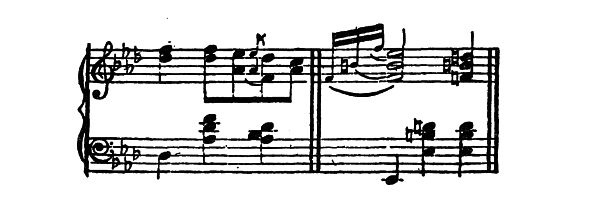
Grace notes and their chiefs—that is, those notes to which the grace notes are attached—should ever be played with one and the same muscular impulse. The time occupied by the grace notes should be so minimal that it should not be discernible whether they appear simultaneously with the base note or slightly before it. In modern music it is usually meant to precede the bass note, though the good taste of the player may occasionally prefer it otherwise.
Rests Used Under or Over Notes
What is the meaning of a rest above or below the notes of the treble clef?
The rests you speak of can occur only when more than one voice (or part) is written in the same staff, and they indicate how long the entrance of the other voice is to be delayed.
What a Double Dot Means
What does it mean when a note is double-dotted like I thought first it was a misprint, but it seems to occur too frequently for that.

As the first dot prolongs the note by one-half of its own value, so does the second dot add one-half of the value of the first dot. A half-note with one dot lasts three-quarters, with two dots it lasts seven-eighths.
The Playing of Slurred Notes
Should I accent the first note under a slur thus or should I lift my hand at the end of the slur thus


Slurs and accents have nothing to do with each other, because accents relate to rhythm, while slurs concern the touch. The last note under a slur will usually be slightly curtailed in order to create that small pause which separates one phrase from another. Generally speaking, the slur in piano music represents the breathing periods of the vocalist.
How a Tie and a Slur Differ
What difference is there between a slur and a tie?
None in appearance, but much in effect. A tie continues the sound of the note struck at its beginning as long as the note-value at its end indicates. It can be placed only upon two notes of similar name in the same octave which follow each other. As soon as another note intervenes the tie becomes a slur and indicates a legato touch.
Slurs and Accents Not Related
How should the beginning of slurs be accented?
Slurs and accents have nothing to do with each other. Slurs indicate either a legato touch or the grouping of the notes. Which one of the notes thus grouped is to be accented depends upon its rhythmical position in the measure. The strong and weak beat (or positive and negative beat) govern the accent always, unless there is an annotation to the contrary, and such an annotation must be carried out with great judiciousness, seldom literally.
How Long an Accidental Affects a Note
Where there is an accidental on the last beat of a measure does not that note resume its signature beyond the bar unless tied? The case I speak of was in a key of two flats, common time. The fourth beat, E, was naturalized and the first note of the next measure was E with the flat sign. I maintain that the flat sign is superfluous, and I should like to know if this is right?
You are quite right, theoretically. Nevertheless, the proper tonality signature of a note that was changed is very frequently restated when the same note recurs beyond the bar. Though this special marking is not necessary theoretically, practical experience has shown that it is not an unwise precaution.
"E-Sharp and B-Sharp" and the Double Flat
What is the meaning of the sharps on the E and B line, and of a double-flat? Are they merely theoretical?
They are not theoretical, but orthographical. You confound the note C with the key on the keyboard by that name. B-sharp is played upon the key called C, but its musical bearing is very remote from the note C. The same applies to double-flats (and double-sharps), for D with a double-flat is played upon the key called C, but it has no relation to the note C. This corresponds precisely with the homonym in language: "sow"—"sew"—"so"—sound alike, but are spelled in various ways according to the meaning they are to convey.
The Effect of Double Flats
How is an octave, written thus, to be played?

As the single-flat lowers a note by a half-tone, so a double-flat lowers it by two half-tones or a full tone.
Double Sharp Misprinted for Double Flat
In playing an operetta recently I found the double-sharp sign [X] used for double-flats as well. Is this correct?
The sign may be a misprint. But if it should occur repeatedly I advise you to make quite sure, before taking the misprint for granted, that the sign is not, after all, meant for a double-sharp.
When an Accidental Is in Parentheses
Please tell me how a chord or an interval marked thus, is executed.

What does an accidental in parentheses mean?
Chords marked as above are slightly rolled in the same manner as if marked by a serpentine line, unless the sign denotes a linking with the other hand. Which of the two meanings is intended you will easily infer from the context. Accidentals in parentheses are mere warnings given by some composers wherever there is a possibility of doubt as to the correct reading caused by a momentary harmonic ambiguity. I have found these accidentals in parentheses so far only in the works of French composers.
The Staffs Are Independent of Each Other
Does an accidental in the right hand influence the left?
Inasmuch as piano music is written in score form, the two staffs are as independent of each other as are the staffs in an orchestral score. We may, in cases of suspected misprints, draw certain inferences from one staff to the other, provided that they are justified by the prevailing harmony. As a rule, the two staffs are independent of each other in regard to accidental chromatic signs.
Why Two Names for the "Same" Key?
I am often asked why there must be fifteen keys in music instead of twelve—that is, why not always write in B instead of C-flat, in F-sharp instead of G-flat, in D-flat instead of C-sharp, or vice versa? I can only say that the circle of fifths would not be complete without the seven scales in sharps and the seven in flats: but Bach does not use all the fifteen keys in his Forty-eight Preludes and Fugues, omitting entirely, in the major keys, G-flat, D-flat, and C-flat, and, in the minor keys, A-sharp and A-flat. Are compositions in sharps considered more brilliant than those in flats? Do composers consider modulation in selecting their key?
The answer to your question hinges upon whether you recognize in music mere tone-play or whether you concede a mental and psychic side to it. In the former case the mode of spelling a tone C-sharp or D-flat would be, indeed, irrelevant. But in the latter case you must admit the necessity of a musical orthography qualified to convey distinct tonal meanings and musical thoughts to the reader and to the player. Though there is in the tempered scale no difference between C-sharp and D-flat, the musical reader will conceive them as different from one another, partly because of their connection with other related harmonies. These determine usually the composer's selection in cases of enharmonic identities. In the script of human language you will find an analogy than which none could be more perfect. In English there are, for instance, "to," "too," and "two"; words in which the spelling alone, and not the sound of pronunciation, conveys the different meanings of the words.
The Meaning and Use of "Motif"
What is the meaning of a "motif"? What does a dash mean over a note? What is the best book of instruction for a beginner, a child of ten?
A motif is the germ of a theme. A theme may be composed of reiterations of a motif, or by grouping several motifs together; it may also combine both modes of procedure. The most glorious exemplification of construction by reiteration of a motif you will find in the opening theme of Beethoven's Fifth Symphony. A dash over a note enjoins the player to hold that note with the finger until it has received its full value. The best "instruction book" for a child is a good teacher who uses no instruction book, but imparts his knowledge to the child from out of his own inner consciousness.
Tied Staccato Notes
In playing notes written thus, is it permissible to slide the fingers from the keys or should there be only a clinging touch?

Notes marked as above are to be played in such a manner that each note is slightly separated from the next. The best touch for this is from the arm, so that the fingers are not lifted from their joints, nor from the wrist, but that the arm pulls the finger upward from the key.
The "Tenuto" Dash and Its Effect
What do short lines below or above a note or chord mean in contradistinction to a staccato or an accent? And does it affect the whole chord?
The dash under or above a note is a substitute for the word "tenuto" (usually abbreviated into "ten."), which means "held," or, in other words, be particular about giving this note its full sound-duration. This substitute is usually employed when the holding concerns a single note or a single chord.
A Rolled Chord Marked "Secco"
How should I execute a chord that is written with a spread and also marked "secco"?—as in Chaminade's "Air de Ballet, No. 1."
Roll the chord as evenly as possible in all its parts; but use no pedal and do not hold it, but play it briskly and short.
Small Notes Under Large Ones
What is the meaning of small notes printed under large ones?
Usually the small notes are an indication that they may be omitted by players who have not the stretch of hand necessary to play them.
Accenting a Mordent in a Sonata
How should one play and accent the mordent occurring in the forty-seventh measure of the first movement—allegro di molto—of Beethoven's Sonata Pathétique, Opus 13?
The accent ought to lie upon the first note of the mordent, but you should not make a triplet of it by occupying the whole quarter with its execution. The mordent must be played fast enough to preserve the rhythmic integrity of the melody-note.
The Position of the Turn Over a Note
The turn stands sometimes directly over the note and sometimes farther to the right of it. Does this difference indicate different executions and, if so, how would the two turns have to be played?

The turn always begins with its uppermost note. When it stands directly over a note it takes the place of this note; when more to the right the note is struck first and the turn, judiciously distributed at the time of its disposal, follows.
How Are Syncopated Notes to be Played?
How are syncopated notes to be played?
Notes occurring an entire beat of the prescribed time are, when syncopated, to be played between the beats. If the syncopated notes occupy only a fraction of the beats they are played between the fractional beats.
A Trill Begins on the Melodic Note
In modern compositions should all trills begin upon the note which is written, presuming there is no appoggiatura before the note? Is the alternation of the thumb and the second finger desirable in the playing of a trill?
Where not expressly otherwise stated (by appoggiatura) trills usually begin upon the melodic tone (the note which is written). Change fingers when those employed get tired. For extended trills the use of three fingers is advantageous, while in shorter trills two fingers will preserve more clarity.
Position of Auxiliary Note in a Trill
In the accompanying example of the trill should the auxiliary note be a tone or a half-tone above the principal note? If the half-tone, what would be the name of the auxiliary note?
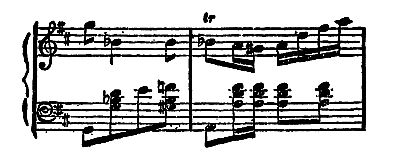
The episode you quote moves evidently in the tonality of G minor. The trill stands on B-flat. As the auxiliary note of a trill is ever the diatonic sequel of a stated note it must, in this case, be a whole tone above B-flat, namely C. Since the piece is written in D major there should have been a "natural" marked under the sign of the trill.
Speed and Smoothness in Trilling
Will you kindly suggest a good method of gaining speed and smoothness in trilling?
While there are no "methods" for trilling there are certain means by which sluggish muscles may be assisted. Yet, even these means cannot be suggested without knowing the seat and cause of your trouble. The causes differ with the individual, but they are, in the majority of cases, purely mental, not manual. To trill quickly we must think quickly; for if we trill only with the fingers they will soon stick, lose their rhythmic succession, and finish in a cramped condition. Hence, there is no direct way to learn trilling; it will develop with your general mental-musical advancement. The main thing is, of course, always to listen to your own playing, actually and physically, to perceive every tone you play; for only then can you form an estimate as to how quickly you can "hear." And, of course, you do not expect to play anything more quickly than your own ear can follow.
Difference in Playing Trills
What is the difference in the manner of playing the trill in measure 25, and those in measures 37 and 38, of the Chopin Polonaise, Opus 53?
The significance of the trill in measure 25 is melodic, while that of the trills in measures 37 and 38 is purely rhythmic, somewhat in the nature of a snare-drum effect. The first trill requires greater stress on the melodic note, while in the other two you may throw your hand, so to speak, on both notes and roll the trill until it lands upon the next eighth-note.
The Meaning of Solfeggio
What is meant by "spelling" in music?
Unless it means the variety of ways in which most chords can be written it refers to an oral reciting of notes, properly called solfeggio.
ABOUT CERTAIN PIECES AND COMPOSERS
Some Pieces for a Girl of Fourteen
Please tell me some pieces of the classics which are not too difficult for my daughter of fourteen to play. She has a great deal of talent but not much technique. The Kuhlau Sonatinas she can play very well.
If your daughter is fourteen years old and has—as you say—much talent but little technique, it is high time to think of developing her technique, for a pianist without technique is like a pleasure traveller without money. At any rate, I should prefer the easier sonatas by Haydn and Mozart to those of Kuhlau, because of their greater intrinsic merit. Any good teacher will assist you in selecting them to fit your daughter's case.
In Playing a Sonata
In playing sonatas my teacher tells me it is a great fault if I neglect to observe the repeat marks. I have heard it said by others that the repetition is not necessary, though it may be desirable. Will you please give me your opinion?
In a sonata it is of serious importance to repeat the first part (exposition) of the first movement in order that the two principal themes, as well as their tributaries, may well impress themselves upon the mind and memory of your auditor. For, unless this is accomplished, he cannot possibly understand and follow their development in the next part. That the exposition part is not the only one to be repeated you will find frequently indicated; for instance, in the last movement of the "Appassionata," where the repetition is needful, not for the reason stated before, but for the sake of formal balance or proportion. Generally speaking, I am in favour of following the composer's indications punctiliously, hence, also, his repeat marks, which serve æsthetic purposes that you will perhaps not understand until later, when the sonata has, in your hands, outgrown the stage of being learned.
A Point in Playing the "Moonlight Sonata"
Should not the notes of the triplet figure in Beethoven's "Moonlight Sonata" be so blended into each other that you do not hear them in separate notes, but as a background, so to speak, for the notes in the melody?
The truth lies midway between two extremes. While the accompaniment should be sufficiently subdued to form, as you say, a harmonic background, it ought, nevertheless, not to be blended to such a degree as to obliterate entirely the undercurrent of a triplet motion. The accumulation of each chord should be produced through the pedal, not through an excessive legato touch.
Playing the "Spring Song" too Fast
Should Mendelssohn's "Spring Song" be played in slow or fast time?
It is marked "Allegretto grazioso." The latter term (graceful, in English) precludes a too-quick movement.
What a Dot May Mean
This is the seventh measure of Chopin's Polonaise, Opus 26, No. 1. What is the meaning of the dot placed after the D in the bass? Whenever this measure is repeated the dot occurs, or I should have thought it a misprint.
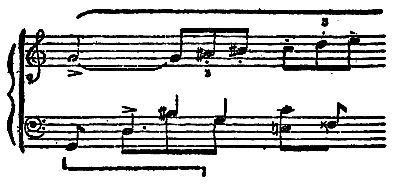
The left-hand notes follow each other as eighth-notes. Their respective duration, however, is indicated by the upward stems and the dot. It is intended here that a complete chord should be built up by accumulation, as in illustration a:
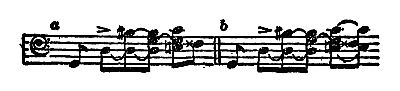
and I would also hold the fifth eighth as in illustration b.
Where the Accent Should be Placed
In playing Chopin's Impromptu in A-flat, Opus 29, should the first or the last note of the mordent receive the accent? I have heard the mordent sound like a triplet? Is this the correct accent?
The last note of the mordent should be accented in this case.
A Disputed Chopin Reading
In Chopin's Nocturne in F-sharp, after the Doppio Movement, when returning to Tempo I, and counting five measures, should the right hand in the fifth measure play this melody?
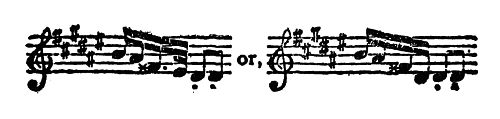
The various editions differ from one another in this measure. Peters's edition, generally considered the best edition of Chopin's works, has the second version, which commends itself by its greater naturalness.
Playing the "Melody in F"
In Rubinstein's "Melody in F" should the melody be played in the left hand or be divided between the two hands?
Where there is no valid reason for doing otherwise it is always best to follow the composer's prescription; for, in most cases—and with great composers in all cases—the author knows what he meant to say. In the aforesaid piece, too, I advise you to adhere to this principle, since it is written with a view to teach the division of the melody between the right and left hand. Any other execution would ruin this purposed design.
When Two Fingers Have the Same Note
In Schumann's "Blumenstück," third number, the uppermost notes of the left hand are identical with the lowest of the right hand. Should the thumbs of both hands strike the same keys at the same time all the way through or should the left hand omit them?
The left hand should omit them, but be careful to omit only those that are really duplicates. There are a few places toward the end of each section where the left-hand notes differ from those in the right. In those cases you must be careful to play all the notes that are written.
BACH
The Beginner in Bach Music
Can you give me a few helpful suggestions in a preliminary study of Bach?
A totality consists of many parts. If you cannot master the totality of a work by Bach try each part by itself. Take one part of the right hand, one part of the left, add a third part, and so on until you have all the parts together. But be sure to follow out the line of each separate part (or "voice," as the Continentals say). Do not lose patience. Remember that Rome was not built in a day.
Bach's Music Necessary to Good Technique
Do you think the study of Bach is necessary to the development of one's technique, or should one let his music alone until a later day when one's technique is in good condition? Some of his music seems so dry.
Bach's music is not the only music that develops the technique. There is, for instance, the music of Czerny and Clementi to be considered. But Bach's music is particularly qualified to develop the fingers in conjunction with musical expression and thematic characterization. You may start with Czerny and Clementi, but you ought soon to turn to Bach. That some of his music seems dry to you may be due to your mental attitude by which you possibly expect from ecclesiastical music what only the opera can give you. Think yourself into his style and you will find a mine of never-dreamed-of enjoyment.
Always Keep in Touch with Bach
Do you think that the playing of Bach's works will keep one's hands in good technical condition? And which is the best edition of Bach's piano works?
Bach is good for the soul as well as for the body, and I recommend that you never lose touch with him. Which is the best edition would be hard to say, but I have found the Peters edition to be very good.
Bach's Preludes and Fugues
What is the plan of a "Fugue," how does it differ from an "Invention" and "Prelude," and what is the purpose of studying the pieces so named by Bach?
The explanation of the plan of a Fugue would exceed by far the limits of the space at my disposal. It would require a text-book, of which there are many to be found in every good music store. The Fugue is the most legitimate representation of true polyphony. Its difference from an Invention is expressed in the two names. A Fugue (fuga, flight) is the flight of one musical thought through many voices or parts, subject to strict rules, while an Invention is an accumulation of thoughts moving with absolute freedom. The definition of Prelude, as something which intentionally precedes and fittingly introduces a main action, fits the musical Prelude perfectly; especially in the case of Bach. The purpose of all these forms is that of all good music-making, namely, the purification and development of good taste in music.
As to the Bach Fugues
Of the Bach fugues do you consider the C sharp major difficult to memorize, or do you advise the use of the D flat arrangement instead?
Such little differences have never bothered me, and I can therefore hardly answer your question definitely. It has been frequently observed—though never explained—that to many people it comes easier to read music in D flat than in C sharp. Hence, if you prefer the D flat edition it will reduce the difficulty for you. Possibly this more accessible version may aid you optically or visually in your work of memorizing.
BEETHOVEN
Order of Studying Beethoven's Sonatas
I am just beginning to reach an intelligent interpretation of Beethoven's music. Now, in what order should the Sonatas be studied?
If you should really have the laudable intention to study all the Sonatas of Beethoven for your repertory I should think that you may safely take them up very much in the order in which they are printed, with the exception of Opus 53 and the Appassionata, which—spiritually as well as technically—rank with the last five. The Steingräber edition, however, furnishes a very fair order of difficulty in the index to the Sonatas.
The Beethoven Sonata with a Pastoral Character
My teacher calls the Sonata opus 28, by Beethoven, the "Pastoral" Sonata. I have not found anything "pastoral" in any of the movements. Is it because I do not understand it, or is the name a mere amateurish invention?
The name "Pastoral Sonata" could, no doubt, be traced to an arbitrary invention, perhaps of some over-smart publisher endeavouring to heighten the attractiveness of the Sonata to the general public by the addition of a suggestive title. Yet it seems to fit the Sonata pretty well, because, really, its main characteristic is a rural sort of peaceful repose. Especially the first movement is of a tranquillity which, surely, does not suggest the life of a metropolis. But in the other movements, too, there are many episodes which by their naïveté and good-natured boisterousness indicate the life of the village.
A Few, Well Played, Are Enough
Must I play all the Sonatas of Beethoven's in order to become a good player, or is a certain number of them sufficient, and, if so, how many would you advise?
Since the playing of all the Sonatas does not necessarily prove that they were all well played, I think it is better to play one Sonata well than to play many of them badly. Nor should Beethoven's Sonatas be regarded as a musical drilling-ground, but rather as musical revelations. As they are not all on precisely the same high plane of thought, it is not necessary to play them all. To familiarize yourself with Beethoven's style and grandeur of thought it is sufficient to have mastered six or eight of his Sonatas; though that number, at least, should be mastered.
MENDELSSOHN
The Study of Mendelssohn
In a complete course for a piano student should the study of Mendelssohn be included? Which of his compositions are the most useful?
Mendelssohn is surely a composer who is not to be omitted. His melody alone, besides other virtues, entitles him to be included, for melody seems to grow scarce nowadays. To develop a fine cantilena his "Songs Without Words" of slower motion, for instance, are just the thing.
CHOPIN
What Is the Best of Chopin?
Which are the best compositions of Chopin to study by one who really desires to know him?
All the Etudes, all the Preludes, the Ballades in A flat, G minor and F minor, the Berceuse and the Barcarolle. The Mazurkas, Nocturnes, Waltzes, and Polonaises you are probably familiar with; hence, I mention the aforesaid other works. Generally speaking, of Chopin a pianist should know everything.
The Charm of Chopin's Touch
What kind of touch did Chopin have?
Since a description of his touch would require too much space I refer you to the book from which I gathered the most explicit information on this point. It is "The Life of Chopin," by Frederick Niecks (London and New York, Novello, Ewer & Co.), and in the second volume, from page 94 to about 104, you will find what you wish to know, as far as it is possible to convey the charm of one art through the medium of another. Since you seem interested in Chopin I would recommend that you closely study both volumes of this masterly biographical work.
Mood and Tempo in the A-Flat Impromptu
What is the tempo (by metronome) of Chopin's Impromptu in A-flat, and what idea did the composer embody in it?
The editions vary in their metronome markings and I believe none of them. Your tempo will largely depend upon the state of your technique. To the second question my reply is that Chopin has composed "music" which—as you know—represents thoughts only in a musical sense, otherwise it deals with purely psychic processes, moods, etc. The humour of this Impromptu is mainly an amiable, ingratiating one, here and there slightly tinged with a sweet melancholy. It should not be played too fast, for it easily loses this latter attribute and then sounds like a Czerny exercise. A moderate tempo will also tend to bring out the many charming harmonic turns which, in too quick a tempo, are likely to be lost.
Chopin's Barcarolle
In Chopin's Barcarolle there is a number of trills preceded by grace notes. Are they to be executed according to Philipp Emmanuel Bach's rule, so that the grace notes take their time from the note that follows them?
Philipp Emmanuel Bach's rule is a safe one to follow, but do not confound a rule with a law. If you have reached that plane on which an attempt at the Barcarolle by Chopin is rational, you must feel that your individual taste will not lead you too far astray even if it should prompt you occasionally to depart from the rule.
Chopin's Works for a Popular Concert
What works of Chopin would you suggest for a popular concert programme?
Nocturne, Opus 27, No. 2; Fantasy Impromptu, Opus 66; Scherzo, Opus 31; Berceuse, Opus 57; Valse, Opus 64, No. 2; Polonaise, Opus 26, No. 1; Chants Polonais (in Liszt's transcription).
Taking Liberties with the Tempo
In playing Chopin may one take liberties with the tempo and play different parts of the same mazurka or nocturne in various degrees of tempo?
Undoubtedly. But the extent of such liberties depends upon your æsthetic training. In principle your question admits of an affirmative reply, but a specific answer is impossible without an acquaintance with your musical status. I recommend that you be very cautious about "taking liberties"; without, however, ceasing altogether to follow the promptings of your good taste here and there. There is such a thing as "artistic conscience"; consult it always before taking a liberty with the tempo.
Omitting One Note in a Chord
In the beginning of the Waltz in E minor by Chopin the left hand has to play this chord a number of times. I can stretch any three of the four notes, but not all four. Can one of them be omitted, and which one?
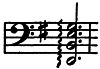
You may omit the upper E, the second note from the top, but you may do so only so long as it is physically impossible for you to strike all the four notes. For, by omitting this note you do alter the tone colour of the chord as well as its sonority. As soon as you have acquired the requisite stretch—and anybody who does possess it—I would advise that the note be not unnecessarily omitted. Chopin evidently meant to have that note played.
Masters Cannot be Studied in Order
Will you give me your views as to the order in which the masters of piano composition should be studied?
To classify composers, without specifying their works, is never advisable. Beethoven's first and last sonatas differ so fundamentally from each other in every particular that one may play the first one very well and yet be for many years (perhaps forever) unable to play the last one. And still, it is the same Beethoven that wrote both works. We can, therefore, hardly speak of an "order of composers." So long as we are dealing with masters the question should not be: Which master?—but, Which composition does your stage of mental and technical development call for? If you will defer the study of any other composer until you have fully mastered the works of Beethoven—only the principal ones, at that—you will need a life of more length than the Bible allots to the average man.
The Greatest Composers as Pianists
Is it true that nearly all the great composers have been pianists?
If by pianists you mean musicians whose sole medium of audible musical utterance was the piano, your question admits of no other than an affirmative reply. The only exception I can think of just now was Berlioz; there were, no doubt, others, but none who belongs to the truly great ones. The reason for this is, perhaps, the circumstance that the pianist throughout his education is brought into touch with greater polyphony than the players of other instruments, and that polyphony is a basic principle in music.
The Study of Operatic Transcriptions
Is the study of Thalberg's operatic transcriptions of any value to the piano student?
Operatic transcriptions begin with Liszt. What was written before him in that line (and in some degree contemporary with him, hence it includes Thalberg) is hardly of any significance. If you feel a special inclination toward the transcriptions of Thalberg you may play them; they will not harm you so very much. But if you ask me whether they are of any musical value I must frankly say, no.