Part 2 — CXII. Observations upon the Corona Solis Marina Americana; The American Sea-Sun-Crown. By John Andrew Peyssonel, M.D. F.R.S. Translated from the French.
Reading edition
Read Dec. 14, 1758.
I Shall call this insect by this name, because of the resemblance it bears to the flower called Corona Solis; since it is, like this, open and spread.
This insect adheres to the rocks by its basis, which is flat and round; and tho’ this roundness is sometimes mis-shapen, it is only occasioned by the inequalities of the rocks, to which it sticks. Its diameter is about two or three inches, bearing, from the center, certain rays, like white nerves, upon a moist flesh, of a livid violet colour. These rays or nerves pass from the centre to the circumference; they, too, consist of a soft fleshy substance, which resembles bowels or intestines; the whole length of which is covered with glandulous bodies of a dirty grey colour; and all these glands filled up the middle of the fish, making the flowrets, or petals, that form the disk of the flowers. There is an infinite number of these glands attached to those filets or nerves, all very distinct from one another: these filets are well ranged when viewed downwards; but the upper part is covered by these glands, which are placed in a confused manner. These filets pass to the circumference, forming an edge full of rugosities, which leaves the body of the animal full of flaws. These hard bodies, upon which it lives, are not always permanent in the same place, but capable of changing their places from this edge or circumference; like a skin or texture of fibres or flesh, such as the body of the sea snail I have already described; of the same thickness, of a greenish colour, and sometimes of a greenish spotted grey, without shell, bone, or stay. The body or muscular fleshy skin raises itself up perpendicularly to three inches; rounds itself at the top, when it is touched; but it leaves a hole like a sphincter, formed by the reunion of the fleshy body, which enlarges itself again. The base opens to the whole extent of the bottom, makes a reversed prepuce, and immediately brings to view three rows of papillæ, which are of a conical figure, of one or two lines long, resembling the glands under the tongues of oxen, and which may here be compared to the demi-flowers or radiated flowers of the Corona Solis.
After this threefold ray of conical pointed papillæ, there appears a body of a livid violet colour; I took it for a particular substance or body; but having examined it, I observed it was only a pellicle, or membrane, that covered a part of the papillæ I mentioned. This membrane has sixteen separations, which form kinds of purses, and yet leave, in the center of the animal, an empty space, wherein several glands are brought in view. I do not know, whether, in the natural state, these membranes do not retire to the circumference, in order to discover the glands within, which they usually hide, and which fill up all the middle of the crown; but when the fleshy body is gone up again, it covers all the interior parts, closes them in, and preserves them from the touch of any extraneous body. I cannot tell how these fishes live, or what is their mechanism; for I could not distinguish either a mouth, or any viscera, nor any other organ serving to their nourishment.
Philos. Trans. Vol. L. Tab. XXXIV. p. 845.
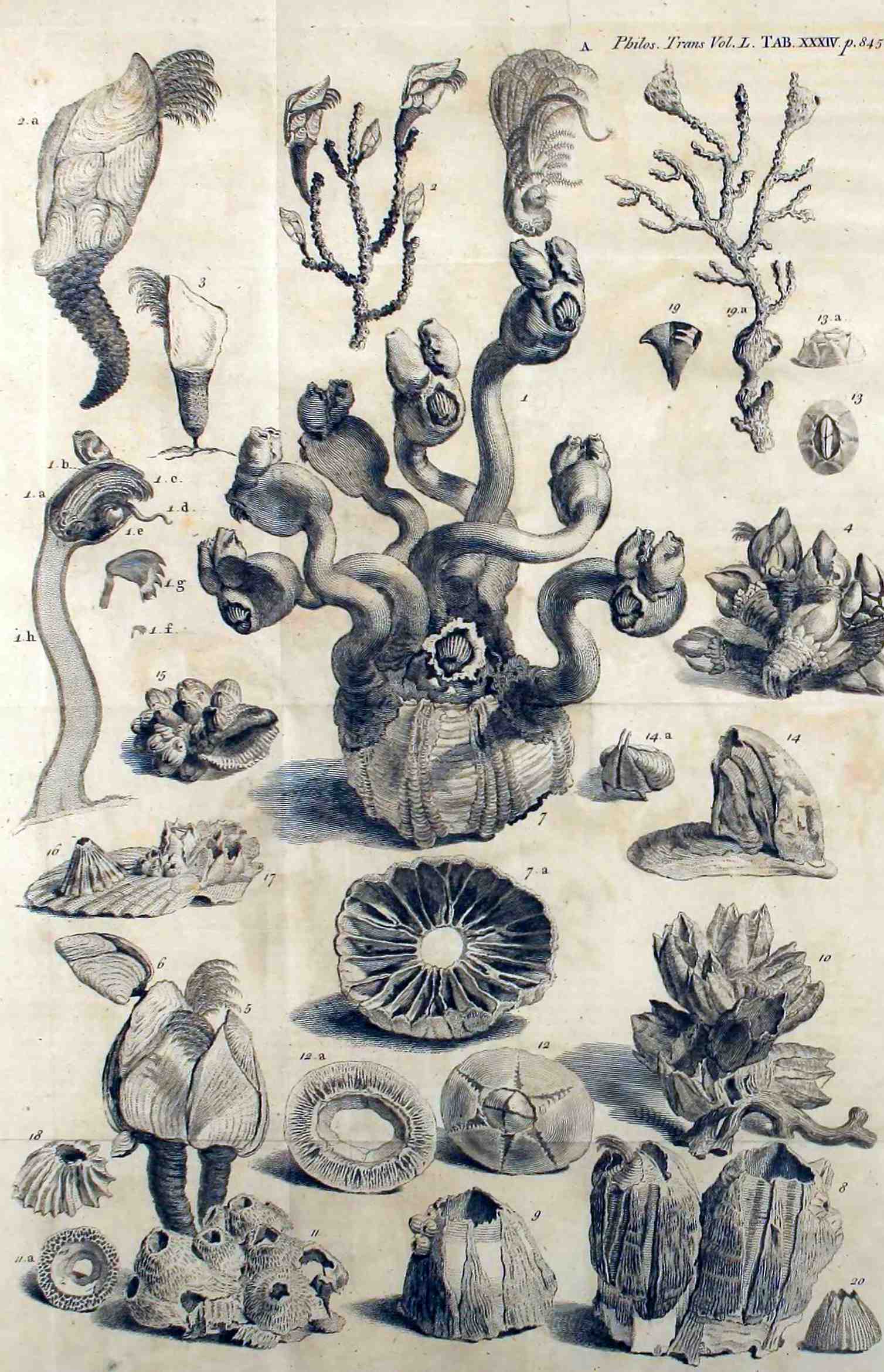
Lepades Pedatæ.
1. Lepas nuda carnosa aurita
1 a. Ejusdem pars superior interna
1 b Foramen auris internum
1 c Currhi (1.d) Proboscis et (1.c) Os
1 f Dens terratus quorum octo sunt
1 g. Idem per. Microscopium visus
1 h. Scapus longitudinatiter dessectus
2 Scalpellum Norwegicum Keratophytium
2 a. Idem per. Microscopium visum
3 Scalpellum ex mare Britannico
4. Cornu copia Poussepieda Gallorum
5. Concha Anatifera vulgaris
6. Concha Anatifera prolifera
A. Animal Lepadis sen Triton Linnæi
Barnicles with Stems.
1. Naked fleshy Barnicle with Ears
1 a. The inside of the upper part of the same
1 b. The internal opening of the Ear
1 c. The Plumes (e. d) trunck (e. e) and mouth
1 f. A saw edg’d tooth of which there are 8
1 g. The same magnified
1 h. The Stem cut in two lengthways
2. The Norway Seafan Penknife.
2 a. The same magnified.
3. The British Channel Penknife.
4. The Horn of plenty or French Poussepieds
5. The common Duckbearing Barnicle
6. The branch’d Duckbearing Barnicle
A. Animal of the Barnicle or Linnaeus’s Triton
Lepades Sessiles Balani dictæ.
7. Pediculus Ceti (7.a). Idem reversus
8. Calyciformis Orientalis
9. Tintinabuliformis.
10. Tulipiformis ex Corallio rubro
11. Fistulosa conica (11.a) eadem reversa
12. Verrum Testudinaria (12.a) eadem reversa
13. Verrum Canesti Americani (13.a) eisdem statere
14. Lapensis ore obliquo (14.a) cum opserastis cornutis
15. Subovatis crassa ore minore
16. Cornulacensis conicas ore minores
17. Anglica vulgaris ore patulo
18. Aretica Patelliformis
19. Calceolus (19.a) Idem. hierophylis involutus
20. Diadema Persarum
Barnicles adhering by the base of these Shells.
7. The Whales. Louse (7.a) The underside
8. The East India cup shap’d Barnicle
9. The Bell shap’d Barnicle
10. The Red Coral Tulip Barnicle
11. The pipy conical Barnicle (11.a) The underside
12. The Tortoise Wart (12. a) The underside
13. The American Crabs Wart (13.a) The same sideways
14. The Cape sidemouth Barnicle (14.a) with oblique edge
15. The Eggshap’d thick Barnicle with a small mouth
16. The Cornish cone Barnicle with a small edge
17. The common English Barnicle with a wide mouth
18. The Greenland Limpet shap’d Barnicle
19. The Slipper (19.a) The same cover’d with hierophylis
20. The Persian Crown