Part 4 — THE GEOGRAPHY OF AN IRISH OATH.
Reading edition
No pen can do justice to the extravagance and frolic inseparable from the character of of the Irish people; nor has any system of philosophy been discovered that can with moral fitness be applied to them. Phrenology fails to explain it; for, so far as the craniums of Irishmen are concerned, according to the most capital surveys hitherto made and reported on, it appears that, inasmuch as their moral and intellectual organs predominate over the physical and sensual, the people ought, therefore, to be ranked at the very tip-top of morality. We would warn the phrenologists, however, not to be too sanguine in drawing inferences from an examination of Paddy's head. Heaven only knows the scenes in which it is engaged, and the protuberances created by a long life of hard fighting. Many an organ and development is brought out on it by the cudgel, that never would have appeared had Nature been left to herself.
Drinking, fighting, and swearing, are the three great characteristics of every people. Paddy's love of fighting and of whiskey has been long proverbial; and of his tact in swearing much has also been said. But there is one department of oath-making in which he stands unrivalled and unapproachable; I mean the alibi. There is where he shines, where his oath, instead of being a mere matter of fact or opinion, rises up into the dignity of epic narrative, containing within itself, all the complexity of machinery, harmony of parts, and fertility of invention, by which your true epic should be characterized.
The Englishman, whom we will call the historian in swearing, will depose to the truth of this or that fact, but there the line is drawn; he swears his oath so far as he knows, and stands still. “I'm sure, for my part, I don't know; I've said all I knows about it,” and beyond this his besotted intellect goeth not.
The Scotchman, on the other hand, who is the metaphysician in swearing, sometimes borders on equivocation. He decidedly goes farther than the Englisman, not because he has less honesty, but more prudence. He will assent to, or deny a proposition; for the Englishman's “I don't know,” and the Scotchman's “I dinna ken,” are two very distinct assertions when properly understood. The former stands out a monument of dulness, an insuperable barrier against inquiry, ingenuity, and fancy; but the latter frequently stretches itself so as to embrace hypothetically a particular opinion.
But Paddy! Put him forward to prove an alibi for his fourteenth or fifteenth cousin, and you will be gratified by the pomp, pride, and circumstance of true swearing. Every oath with him is an epic—pure poetry, abounding with humor, pathos, and the highest order of invention and talent. He is not at ease, it is true, under facts; there is something too commonplace in dealing with them, which his genius scorns. But his flights—his flights are beautiful; and his episodes admirable and happy. In fact, he is an improvisatore at oath-taking; with this difference, that his extempore oaths possess all the ease and correctness of labor and design.
He is not, however, altogether averse to facts: but, like your true poet, he veils, changes, and modifies them with such skill, that they possess all the merit and graces of fiction. If he happen to make an assertion incompatible with the plan of the piece, his genius acquires fresh energy, enables him to widen the design, and to create new machinery, with such happiness of adaptation, that what appeared out of proportion of character is made, in his hands, to contribute to the general strength and beauty of the oath.
'Tis true, there is nothing perfect under the sun; but if there were, it would certainly be Paddy at an alibi. Some flaws, no doubt, occur; some slight inaccuracies may be noticed by a critical eye; an occasional anachronism stands out, and a mistake or so in geography; but let it be recollected that Paddy's alibi is but a human production; let us not judge him by harsher rules than those which we apply to Homer, Virgil, or Shakspeare.
“Aliquando bonus dormitat Homerus,” is allowed on all hands. Virgil made Dido and AEneas contemporary, though they were not so; and Shakspeare, by the creative power of his genius, changed an inland town into a seaport. Come, come, have bowels. Let epic swearing be treated with the same courtesy shown to epic poetry, that is, if both are the production of a rare genius. I maintain, that when Paddy commits a blemish he is too harshly admonished for it. When he soars out of sight here, as occasionally happens, does he not frequently alight somewhere about Sydney Bay, much against his own inclination? And if he puts forth a hasty production, is he not compelled, for the space of seven or fourteen years, to revise his oath? But, indeed, few words of fiction are properly encouraged in Ireland.
It would be unpardonable in us, however, to overlook the beneficial effects of Paddy's peculiar genius in swearing alibis. Some persons, who display their own egregious ignorance of morality, may be disposed to think that it tends to lessen the obligation of an oath, by inducing a habit among the people of swearing to what is not true. We look upon such persons as very dangerous to Ireland and to the repeal of the Union; and we request them not to push their principles too far in the disturbed parts of the country. Could society hold together a single day, if nothing but truth were spoken, would not law and lawyers soon become obsolete, if nothing but truth were sworn what would become of parliament if truth alone were uttered there? Its annual proceedings might be dispatched in a month. Fiction is the basis of society, the bond of commercial prosperity, the channel of communication between nation and nation, and not unfrequently the interpreter between a man and his own conscience.
For these, and many other reasons which we could adduce, we say with Paddy, “Long life to fiction!” When associated with swearing, it shines in its brightest colors. What, for instance, is calculated to produce the best and purest of the moral virtues so beautifully, as the swearing an alibi? Here are fortitude and a love of freedom resisting oppression; for it is well known that all law is oppression in Ireland.
There is compassion for the peculiar state of the poor boy, who, perhaps, only burned a family in their beds; benevolence to prompt the generous effort in his behalf; disinterestedness to run the risk of becoming an involuntary absentee; fortitude in encountering a host of brazen-faced lawyers; patience under the unsparing gripe of a cross-examiner; perseverance in conducting the oath to its close against a host of difficulties; and friendship, which bottoms and crowns them all.
Paddy's merits, however, touching the alibi, rest not here. Fiction on these occasions only teaches him how to perform a duty. It may be, that he is under the obligation of a previous oath not to give evidence against certain of his friends and associates. Now, could anything in the whole circle of religion or ethics be conceived that renders the epic style of swearing so incumbent upon Paddy? There is a kind of moral fitness in all things; for where the necessity of invention exists, it is consolatory to reflect that the ability to invent is bestowed along with it.
Next to the alibi comes Paddy's powers in sustaining a cross-examination. Many person thinks that this is his forte; but we cannot yield to such an opinion, nor compromise his originality of conception in the scope and plan of an alibi. It is marked by a minuteness of touch, and a peculiarity of expression which give it every appearance of real life. The circumstances are so well imagined, the groups so naturally disposed, the coloring so finished, and the background in such fine perspective, that the whole picture presents you with such keeping and vraisemblance, as could be accomplished only by the genius of a master.
In point of interest, however, we must admit that his ability in a cross-examination ranks next to his skill in planning an alibi. There is, in the former, a versatility of talent that keeps him always ready; a happiness of retort, generally disastrous to the wit of the most established cross-examiner; an apparent simplicity, which is quite as impenetrable as the lawyer's assurance; a vis comica, which puts the court in tears; and an originality of sorrow, that often convulses it with laughter. His resources, when he is pressed, are inexhaustible; and the address, with which he contrives to gain time, that he may suit his reply to the object of his evidence, is beyond all praise. And yet his appearance when he mounts the table is anything but prepossessing; a sheepish look, and a loose-jointed frame of body, wrapped in a frieze great-coat, do not promise much. Nay, there is often a rueful blank expression in his visage, which might lead a stranger to anticipate nothing but blunders and dulness. This, however, is hypocrisy of the first water. Just observe the tact with which he places his caubeen upon the table, his kippeen across it, and the experienced air with which he pulls up the waistbands of his breeches, absolutely girding his loins for battle. 'Tis true his blue eye has at present nothing remarkable in it, except a drop or to of the native; but that is not remarkable.
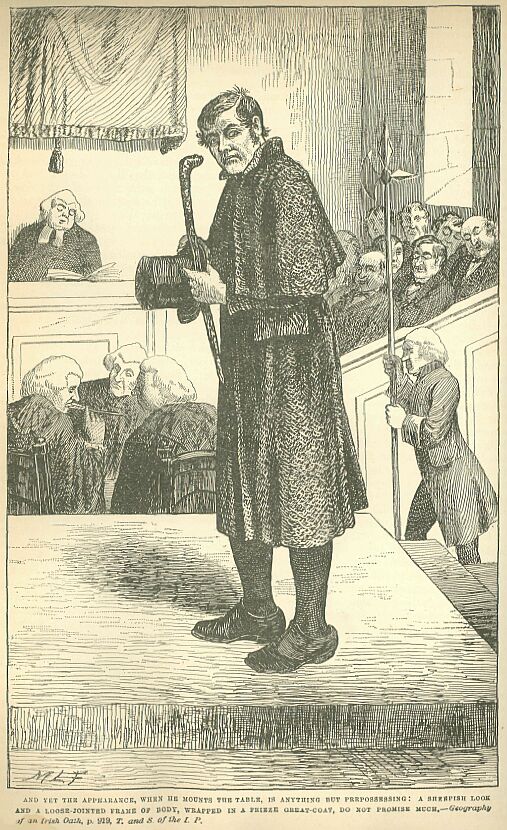
When the direct examination has been concluded, nothing can be finer than the simplicity with which he turns round to the lawyer who is to cross-examine him. Yet, as if conscious that firmness and caution are his main guards, he again pulls up his waistbands with a more vigorous hitch, looks shyly into the very eyes of his opponent, and awaits the first blow.
The question at length comes; and Paddy, after having raised the collar of his big coat on his shoulder, and twisted up the shoulder along with it, directly puts the query back to the lawyer, without altering a syllable of it, for the purpose of ascertaining more accurately whether that is the precise question that has been put to him; for Paddy is conscientious. Then is the science displayed on both sides. The one, a veteran, trained in all the technicalities of legal puzzles, irony, blarney, sarcasm, impudence, stock jokes, quirks, rigmarolery, brow-beating, ridicule, and subtlety; the other a poor peasant, relying only upon the justice of a good cause and the gifts of nature; without either experience, or learning, and with nothing but his native modesty to meet the forensic effrontery of his antagonist.
Our readers will perceive that the odds are a thousand to one against Paddy; yet, when he replies to a hackneyed genius at cross-examination, how does it happen that he uniformly elicits those roars of laughter which rise in the court, and convulse it from the judge to the crier? In this laugh, which is usually at the expense of the cross-examiner, Paddy himself always joins, so that the counsel has the double satisfaction of being made not only the jest of the judge and his brother lawyers, but of the ragged witness whom he attempted to make ridiculous.
It is not impossible that this merry mode of dispensing justice may somewhat encourage Paddy in that independence of mind which relishes not the idea of being altogether bound by oaths that are too often administered with a jocular spirit. To most of the Irish in general an oath is a solemn, to some, an awful thing. Of this wholesome reverence for its sanction, two or three testimonies given in a court of justice usually cured them. The indifferent, business-like manner in which the oaths are put, the sing-song tone of voice, the rapid utterance of the words, give to this solemn act an appearance of excellent burlesque, which ultimately renders the whole proceedings remarkable for the absence of truth and reality; but, at the same time, gives them unquestionable merit as a dramatic representation, abounding with fiction, well related and ably acted.
Thumb-kissing is another feature in Paddy's adroitness too important to be passed over in silence. Here his tact shines out again! It would be impossible for him, in many cases, to meet the perplexities of a cross-examination so cleverly as he does, if he did not believe that he had, by kissing his thumb instead of the book, actually taken no oath, and consequently given to himself a wider range of action. We must admit, however, that this very circumstance involves him in difficulties which are sometimes peculiarly embarrassing. Taking everything into consideration, the prospect of freedom for his sixth cousin, the consciousness of having kissed his thumb, or the consoling reflection that he swore only on a Law Bible, it must be granted that the opportunities presented by a cross-examination are well calculated to display his wit, humor, and fertility of invention. He is accordingly great in it; but still we maintain that his execution of an alibi is his ablest performance, comprising, as it does, both the conception and construction of the work.
Both the oaths and imprecations of the Irish display, like those who use them, indications of great cruelty and great humor. Many of the former exhibit that ingenuity which comes out when Paddy is on his cross-examination in a court of justice. Every people, it is true, have resorted to the habit of mutilating or changing in their oaths the letters which form the Creator's name; but we question if any have surpassed the Irish in the cleverness with which they accomplish it. Mock oaths are habitual to Irishmen in ordinary conversation; but the use of any or all of them is not considered to constitute an oath: on the contrary, they are in the mouths of many who would not, except upon a very solemn occasion indeed, swear by the name of the Deity in its proper form.
The ingenuity of their mock oaths is sufficient to occasion much perplexity to any one disposed to consider it in connection with the character and moral feelings of the people. Whether to note it as a reluctance on their part to incur the guilt of an oath, or as a proof of habitual tact in evading it by artifice, is manifestly a difficulty hard to be overcome. We are decidedly inclined to the former; for although there is much laxity of principle among Irishmen, naturally to be expected from men whose moral state has been neglected by the legislature, and deteriorated by political and religious asperity, acting upon quick passions and badly regulated minds—yet we know that they possess, after all, a strong, but vague undirected sense of devotional feeling and reverence, which are associated with great crimes and awfully dark shades of character. This explains one chief cause of the sympathy which is felt in Ireland for criminals from whom the law exacts the fatal penalty of death; and it also accounts, independently of the existence of any illegal association, for the terrible retribution inflicted upon those who come forward to prosecute them. It is not in Ireland with criminals as in other countries, where the character of a murderer or incendiary is notoriously bad, as resulting from a life of gradual profligacy and villany. Far from it. In Ireland you will find those crimes perpetrated by men who are good fathers, good husbands, good sons, and good neighbors—by men who would share their last morsel or their last shilling with a fellow-creature in distress—who would generously lose their lives for a man who had obliged them, provided he had not incurred their enmity—and who would protect a defenseless stranger as far as lay in their power. There are some mock oaths among Irishmen which must have had their origin amongst those whose habits of thought were much more elevated than could be supposed to characterize the lower orders. “By the powers of death” is never now used as we have written it; but the ludicrous travestie of it, “by the powdhors o' delf,” is quite common. Of this and other mock oaths it may be right to observe, that those who swear by them are in general ignorant of their proper origin. There are some, however, of this description whose original form is well known. One of these Paddy displays considerable ingenuity in using. “By the cross” can scarcely be classed under the mock oaths, but the manner in which it is pressed into asseverations is amusing. When Paddy is affirming a truth he swears “by the crass” simply, and this with him is an oath of considerable obligation. He generally, in order to render it more impressive, accompanies it with suitable action, that is, he places the forefinger of each hand across, that he may assail you through two senses instead of one. On the contrary, when he intends to hoax you by asserting what is not true, he ingeniously multiplies the oath, and swears “by the five crashes,” that is by his own five fingers, placing at the same time his four fingers and his thumbs across each other in a most impressive and vehement manner. Don't believe him then—the knave is lying as fast as possible, and with no remorse. “By the crass o' Christ” is an oath of much solemnity, and seldom used in a falsehood. Paddy also often places two bits of straws across, and sometimes two sticks, upon which he swears with an appearance of great heat and sincerity—sed caveto!
Irishmen generally consider iron as a sacred metal. In the interior of the country, the thieves (but few in number) are frequently averse to stealing it. Why it possesses this hold upon their affections it is difficult to say, but it is certain that they rank it among their sacred things, consider that to find it is lucky, and nail it over their doors when found in the convenient shape of a horse-shoe. It is also used as a medium of asserting truth. We believe, however, that the sanction it imposes is not very strong. “By this blessed iron!”—“by this blessed an' holy iron!” are oaths of an inferior grade; but if the circumstance on which they are founded be a matter of indifference, they seldom depart from truth in using them.
We have said that Paddy, when engaged in a fight, is never at a loss for a weapon, and we may also affirm that he is never at a loss for an oath. When relating a narrative, or some other circumstance of his own invention, if contradicted, he will corroborate it, in order to sustain his credit or produce the proper impression, by an abrupt oath upon the first object he can seize. “Arrah, nonsense! by this pipe in my hand, it's as thrue as”—and then, before he completes the illustration, he goes on with a fine specimen of equivocation—“By the stool I'm sittin' an, it is; an' what more would, you have from me barrin' I take my book oath of it?” Thus does he, under the mask of an insinuation, induce you to believe that he has actually sworn it, whereas the oath is always left undefined and incomplete.
Sometimes he is exceedingly comprehensive in his adjurations, and swears upon a magnificent scale; as, for instance,—“By the contints of all the books that ever wor opened an' shut, it's as thrue as the sun to the dial.” This certainly leaves “the five crasses” immeasurably behind. However, be cautious, and not too confident in taking so sweeping and learned an oath upon trust, notwithstanding its imposing effect. We grant, indeed, that an oath which comprehends within its scope all the learned libraries of Europe, including even the Alexandrian of old, is not only an erudite one, but establishes in a high degree the taste of the swearer, and displays on his part an uncommon grasp of intellect. Still we recommend you, whenever you hear an alleged fact substantiated by it, to set your ear as sharply as possible; for, after all, it is more than probable that every book by which he has sworn might be contained in a nutshell. The secret may be briefly explained:—Paddy is in the habit of substituting the word never for ever. “By all the books that never wor opened or shut,” the reader perceives, is only a nourish of trumpets—a mere delusion of the enemy.
In fact, Paddy has oaths rising gradually from the lying ludicrous to the superstitious solemn, each of which finely illustrates the nature of the subject to which it is applied. When he swears “By the contints o' Moll Kelly's Primer,” or “By the piper that played afore Moses,” you are, perhaps, as strongly inclined to believe him as when he draws upon a more serious oath; that is, you almost regret the thing is not the gospel that Paddy asserts it to be. In the former sense, the humorous narrative which calls forth the laughable burlesque of “By the piper o' Moses,” is usually the richest lie in the whole range of fiction.
Paddy is, in his ejaculatory, as well as in all his other mock oaths, a kind, of smuggler in morality, imposing as often as he can upon his own conscience, and upon those who exercise spiritual authority over him. Perhaps more of his oaths are blood-stained than would be found among the inhabitants of all Christendom put together.
Paddy's oaths in his amours are generally rich specimens of humorous knavery and cunning. It occasionally happens—but for the honor of our virtuous countrywomen, we say but rarely—that by the honey of his flattering and delusive tongue, he succeeds in placing some unsuspecting girl's reputation in rather a hazardous predicament. When the priest comes to investigate the affair, and to cause him to make compensation to the innocent creature who suffered by his blandishments, it is almost uniformly ascertained that, in order to satisfy her scruples as to the honesty of his promises, he had sworn marriage to her on a book of ballads!!! In other cases blank books have been used for the same purpose.
If, however, you wish to pin Paddy up in a corner, get him a Relic, a Catholic prayer-book, or a Douay Bible to swear upon. Here is where the fox—notwithstanding all his turnings and windings upon heretic Bibles, books, or ballads, or mock oaths—is caught at last. The strongest principle in him is superstition. It may be found as the prime mover in his best and worst actions. An atrocious man, who is superstitious, will perform many good and charitable actions, with a hope that their merit in the sight of God may cancel the guilt of his crimes. On the other hand, a good man, who is superstitiously the slave of his religious opinions, will lend himself to those illegal combinations, whose object is, by keeping ready a system of organized opposition to an heretical government, to fulfil, if a political crisis should render it practicable, the absurd prophecies of Pastorini and Columbkil. Although the prophecies of the former would appear to be out of date to a rational reader, yet Paddy, who can see farther into prophecy than any rational reader, honestly believes that Pastorini has left for those who are superstitiously given, sufficient range of expectation in several parts of his work.
We might enumerate many other oaths in frequent use among the peasantry; but as our object is not to detail them at full length, we trust that those already specified may be considered sufficient to enable our readers to get a fuller insight into their character, and their moral influence upon the people.
The next thing which occurs to us in connection with the present subject, is cursing; and here again Paddy holds the first place. His imprecations are often full, bitter, and intense. Indeed, there is more poetry and epigrammatic point in them than in those of any other country in the world.
We find it a difficult thing to enumerate the Irish curses, so as to do justice to a subject so varied and so liable to be shifted and improved by the fertile genius of those who send them abroad. Indeed, to reduce them into order and method would be a task of considerable difficulty. Every occasion, and every fit of passion, frequently produce a new curse, perhaps equal in bitterness to any that has gone before it.
Many of the Irish imprecations are difficult to be understood, having their origin in some historical event, or in poetical metaphors that require a considerable process of reasoning to explain them. Of this twofold class is that general one, “The curse of Cromwell on you!” which means, may you suffer all that a tyrant like Cromwell would inflict! and “The curse o'the crows upon you!” which is probably an allusion to the Danish invasion—a raven being the symbol of Denmark; or it may be tantamount to “May you rot on the hills, that the crows may feed upon your carcass!” Perhaps it may thus be understood to imprecate death upon you or some member of your house—alluding to the superstition of rooks hovering over the habitations of the sick, when the malady with which they are afflicted is known to be fatal. Indeed, the latter must certainly be the meaning of it, as is evident from the proverb of “Die, an' give the crow a puddin'.”
“Hell's cure to you!—the devil's luck to you!—high hanging to you!—hard feeling to you!—a short coorse to you!” are all pretty intense, and generally used under provocation and passion. In these cases the curses just mentioned are directed immediately to the offensive object, and there certainly is no want of the malus animus to give them energy. It would be easy to multiply the imprecations belonging to this class among the peasantry, but the task is rather unpleasant. There are a few, however, which, in consequence of their ingenuity, we cannot pass over: they are, in sooth, studies for the swearer. “May you never die till you see your own funeral!” is a very beautiful specimen of the periphrasis: it simply means, may you be hanged; for he who is hanged is humorously said to be favored with a view of that sombre spectacle, by which they mean the crowd that attends an execution. To the same purpose is, “May you die wid a caper in your heel!”—“May you die in your pumps!”—“May your last dance be a hornpipe on the air!” These are all emblematic of hanging, and are uttered sometimes in jest, and occasionally in earnest. “May the grass grow before your door!” is highly imaginative and poetical. Nothing, indeed, can present the mind with a stronger or more picturesque emblem of desolation and ruin. Its malignity is terrible.
There are also mock imprecations as well as mock oaths. Of this character are, “The devil go with you an' sixpence, an' thin you'll want neither money nor company!” This humorous and considerate curse is generally confined to the female sex. When Paddy happens to be in a romping mood, and teases his sweetheart too much, she usually utters it with a countenance combating with smiles and frowns, while she stands in the act of pinning up her dishevelled hair; her cheeks, particularly the one next Paddy, deepened into a becoming blush.
“Bad scran to you!” is another form seldom used in anger: it is the same as “Hard feeding to you!” “Bad win' to you!” is “Ill health to you!” it is nearly the same as “Consumin' (consumption) to you!” Two other imprecations come under this head, which we will class together, because they are counterparts of each other, with this difference, that one of them is the most subtilely and intensely withering in its purport that can well be conceived. The one is that common curse, “Bad 'cess to you!” that is, bad success to you: we may identify it with “Hard fortune to you!” The other is a keen one, indeed—“Sweet bad luck to you!” Now, whether we consider the epithet sweet as bitterly ironical, or deem it as a wish that prosperity may harden the heart to the accomplishment of future damnation, as in the case of Dives, we must in either sense grant that it is an oath of powerful hatred and venom. Occasionally the curse of “Bad luck to you!” produces an admirable retort, which is pretty common. When one man applies it to another, he is answered with “Good luck to you, thin; but may neither of thim ever happen.”
“Six eggs to you, an' half-a-dozen o' them rotten!”—like “The devil go with you an' sixpence!” is another of those pleasantries which mostly occur in the good-humored badinage between the sexes. It implies disappointment.
There is a species of imprecation prevalent among Irishmen which we may term neutral. It is ended by the word bit, and merely results from a habit of swearing where there is no malignity of purpose. An Irishman, when corroborating an assertion, however true or false, will often say, “Bad luck to the bit but it is;”—“Divil fire the bit but it's thruth!”—“Damn the bit but it is!” and so on. In this form the mind is not moved, nor the passions excited: it is therefore probably the most insipid of all their imprecations.
Some of the most dreadful maledictions are to be heard among the confirmed mendicants of Ireland. The wit, the gall, and the poetry of these are uncommon. “May you melt off the earth like snow off the ditch!” is one of a high order and intense malignity; but it is not exclusively confined to mendicants, although they form that class among which it is most prevalent. Nearly related to this is, “May you melt like butther before a summer sun!” These are, indeed, essentially poetical; they present the mind with appropriate imagery, and exhibit a comparison perfectly just and striking. The former we think unrivalled.
Some of the Irish imprecations would appear to have come down to us from the Ordeals. Of this class, probably, are the following: “May this be poison to me!”—“May I be roasted on red hot iron!” Others of them, from their boldness of metaphor, seem to be of Oriental descent. One expression, indeed, is strikingly so. When a deep offence is offered to an Irishman, under such peculiar circumstances that he cannot immediately retaliate, he usually replies to his enemy—“You'll sup sorrow for this!”—“You'll curse the day it happened!”—“I'll make you rub your heels together!” All those figurative denunciations are used for the purpose of intimating the pain and agony he will compel his enemy to suffer.
We cannot omit a form of imprecation for good, which is also habitual among the peasantry of Ireland. It is certainly harmless, and argues benevolence of heart. We mean such expressions as the following: “Salvation to me!—May I never do harm!—May I never do an ill turn!—May I never sin!” These are generally used by men who are blameless and peaceable in their lives—simple and well-disposed in their intercourse with the world.
At the head of those Irish imprecations which are dreaded by the people, the Excommunication, of course, holds the first and most formidable place. In the eyes of men of sense it is as absurd as it is illiberal: but to the ignorant and superstitious, who look upon it as anything but a brutum fulmen, it is terrible indeed.
Next in order are the curses of priests in their private capacity, pilgrims, mendicants, and idiots. Of those also Paddy entertains a wholesome dread; a circumstance which the pilgrim and mendicant turn with great judgment to their own account. Many a legend and anecdote do such chroniclers relate, when the family, with whom they rest for the night, are all seated around the winter hearth. These are often illustrative of the baneful effects of the poor man's curse. Of course they produce a proper impression; and, accordingly, Paddy avoids offending such persons in any way that might bring him under their displeasure.
A certain class of cursers much dreaded in Ireland are those of the widow and the orphan. There is, however, something touching and beautiful in this fear of injuring the sorrowful and unprotected. It is, we are happy to say, a becoming and prominent feature in Paddy's character; for, to do him justice in his virtues as well as in his vices, we repeat that he cannot be surpassed in his humanity to the lonely widow and her helpless orphans. He will collect a number of his friends, and proceed with them in a body to plant her bit of potato ground, to reap her oats, to draw home her turf, or secure her hay. Nay, he will beguile her of her sorrows with a natural sympathy and delicacy that do him honor; his heart is open to her complaints, and his hand ever extended to assist her.
There is a strange opinion to be found in Ireland upon the subject of curses. The peasantry think that a curse, no matter how uttered, will fall on something; but that it depends upon the person against whom it is directed, whether or not it will descend on him. A curse, we have heard them say, will rest for seven years in the air, ready to alight upon the head of the person who provoked the malediction. It hovers over him, like a kite over its prey, watching the moment when he may be abandoned by his guardian angel: if this occurs, it shoots with the rapidity of a meteor on his head, and clings to him in the shape of illness, temptation, or some other calamity.
They think, however, that the blessing of one person may cancel the curse of another; but this opinion does not affect the theory we have just mentioned. When a man experiences an unpleasant accident, they will say, “He has had some poor body's curse;” and, on the contrary, when he narrowly escapes it, they say, “He has had some poor body's blessing.”
There is no country in which the phrases of good-will and affection are so strong as in Ireland. The Irish language actually flows with the milk and honey of love and friendship. Sweet and palatable is it to the other sex, and sweetly can Paddy, with his deluding ways, administer it to them from the top of his mellifluous tongue, as a dove feeds her young, or as a kind mother her babe, shaping with her own pretty mouth every morse of the delicate viands before it goes into that of the infant. In this manner does Paddy, seated behind a ditch, of a bright Sunday, when he ought to be at Mass, feed up some innocent girl, not with “false music,” but with sweet words; for nothing more musical or melting than his brogue ever dissolved a female heart. Indeed, it is of the danger to be apprehended from the melody of his voice, that the admirable and appropriate proverb speaks; for when he addresses his sweetheart, under circumstances that justify suspicion, it is generally said—“Paddy's feedin' her up wid false music.”
What language has a phrase equal in beauty and tenderness to cushla machree—pulse of my heart? Can it be paralleled in the whole range of all that are, ever were, or ever will be spoken, for music, sweetness, and a knowledge of anatomy? If Paddy is unrivalled at swearing, he fairly throws the world behind him at the blarney. In professing friendship, and making love, give him but a taste of the native, and he is a walking honey-comb, that every woman who sees him wishes to have a lick at; and Heaven knows, that frequently, at all times, and in all places, does he get himself licked on their account.
Another expression of peculiar force is vick machree—or, son of my heart. This is not only elegant, but affectionate, beyond almost any other phrase except the foregoing. It is, in a sense, somewhat different from that in which the philosophical poet has used it, a beautiful comment upon the sentiment of “the child's the father of the man,” uttered by the great, we might almost say, the glorious, Wordsworth.
We have seen many a youth, on more occasions than one, standing in profound affliction over the dead body of his aged father, exclaiming, “Ahir, vick machree—vick machree—wuil thu marra wo'um? Wuil thu marra wo'um? Father, son of my heart, son of my heart, art thou dead from me—art thou dead from me?” An expression, we think, under any circumstances, not to be surpassed in the intensity of domestic affection which it expresses; but under those alluded to, we consider it altogether elevated in exquisite and poetic beauty above the most powerful symbols of Oriental imagery.
A third phrase peculiar to love and affection, is “Manim asthee hu—or, My soul's within you.” Every person acquainted with languages knows how much an idiom suffers by a literal translation. How beautiful, then, how tender and powerful, must those short expressions be, uttered, too, with a fervor of manner peculiar to a deeply feeling people, when, even after a literal translation, they carry so much of their tenderness and energy into a language whose genius is cold when compared to the glowing beauty of the Irish.
Mauourneen dheelish, too, is only a short phrase, but, coming warm and mellowed from Paddy's lips into the ear of his colleen dhas, it is a perfect spell—a sweet murmur, to which the lenis susurrus of the Hybla bees is, with all their honey, jarring discord. How tame is “My sweet darling,” its literal translation, compared to its soft and lulling intonations. There is a dissolving, entrancing, beguiling, deluding, flattering, insinuating, coaxing, winning, inveigling, roguish, palavering, come-overing, comedhering, consenting, blarneying, killing, willing, charm in it, worth all the philters that ever the gross knavery of a withered alchemist imposed upon the credulity of those who inhabit the other nations of the earth—for we don't read that these shrivelled philter-mongers ever prospered in Ireland.
No, no—let Paddy alone. If he hates intensely and effectually, he loves intensely, comprehensively, and gallantly. To love with power is a proof of a large soul, and to hate well is, according to the great moralist, a thing in itself to be loved. Ireland is, therefore, through all its sects, parties, and religions, an amicable nation. Their affections are, indeed, so vivid, that they scruple not sometimes to kill each other with kindness: but we hope that the march of love and friendship will not only keep pace with, but outstrip, the march of intellect.
Peter Cornell was for many years of his life a pattern and proverb for industry and sobriety. He first began the world as keeper of a shebeen-house at the cross-roads, about four miles from the town of Ballypoteen. He was decidedly an honest man to his neighbors, but a knave to excisemen, whom he hated by a kind of instinct that he had, which prompted him, in order to satisfy his conscience, to render them every practicable injury within the compass of his ingenuity. Shebeen-house keepers and excisemen have been, time out of mind, destructive of each other; the exciseman pouncing like a beast or bird of prey upon the shebeen man and his illicit spirits; the shebeen man staving in the exciseman, like a barrel of doublings, by a knock from behind a hedge, which sometimes sent him to that world which is emphatically the world of spirits. For this, it some happened that the shebeen man was hanged; but as his death only multiplied that of the excisemen in a geometrical ratio, the sharp-scented fraternity resolved, if possible, not to risk their lives, either by exposing themselves to the necessity of travelling by night, or prosecuting by day. In this they acted wisely and prudently: fewer of the unfortunate peasantry were shot in their rencounters with the yeomanry or military on such occasions, and the retaliations became by degrees less frequent, until, at length, the murder of a gauger became a rare occurrence in the country.
Peter, before his marriage, had wrought as laboring servant to a man who kept two or three private stills in those caverns among the remote mountains, to which the gauger never thought of penetrating, because he supposed that no human enterprise would have ever dreamt of advancing farther into them than appeared to him to be practicable. In this he was frequently mistaken: for though the still-house was in many cases inaccessible to horses, yet by the contrivance of slipes—a kind of sledge—a dozen men could draw a couple of sacks of barley with less trouble, and at a quicker pace, than if horses only had been employed. By this, and many other similar contrivances, the peasantry were often able to carry on the work of private distillation in places so distant, that few persons could suspect them as likely to be chosen for such purposes. The uncommon personal strength, the daring spirit, and great adroitness of Peter Connell, rendered him a very valuable acquisition to his master in the course of his illicit occupations. Peter was, in addition to his other qualities, sober and ready-witted, so that whenever the gauger made his appearance, his expedients to baffle him were often inimitable. Those expedients did not, however, always arise from the exigency of the moment; they were often deliberately, and with much exertion of ingenuity, planned by the proprietors and friends of such establishments, perhaps for weeks before the gauger's visit occurred. But, on the other hand, as the gauger's object was to take them, if possible, by surprise, it frequently happened that his appearance was as unexpected as it was unwelcome. It was then that the prompt ingenuity of the people was fully seen, felt, and understood by the baffled exciseman, who too often had just grounds for bitterly cursing their talent at outwitting him.
Peter served his master as a kind of superintendent in such places, until he gained the full knowledge of distilling, according to the processes used by the most popular adepts in the art. Having acquired this, he set up as a professor, and had excellent business. In the meantime, he had put together by degrees a small purse of money, to the amount of about twenty guineas—no inconsiderable sum for a young Irishman who intends to begin the world on his own account. He accordingly married, and, as the influence of a wife is usually not to be controlled during the honey-moon, Mrs. Connell prevailed on Peter to relinquish his trade of distiller, and to embrace some other mode of life that might not render their living so much asunder necessary. Peter suffered himself to be prevailed upon, and promised to have nothing more to do with private distillation, as a distiller. One of the greatest curses attending this lawless business, is the idle and irregular habit of life which it gradually induces. Peter could not now relish the labor of an agriculturist, to which he had been bred, and yet he was too prudent to sit down and draw his own and his wife's support from so exhaustible a source as twenty guineas. Two or three days passed, during which “he cudgelled his brains,” to use his own expression, in plans for future subsistence; two or three consultations were held with Ellish, in which their heads were laid together, and, as it was still the honey-moon, the subject-matter of the consultation, of course, was completely forgotten. Before the expiration of a second month, however, they were able to think of many other things, in addition to the fondlings and endearments of a new-married couple. Peter was every day becoming more his own man, and Ellish by degrees more her own woman. “The purple light of love,” which had changed Peter's red head into a rich auburn, and his swivel eye into a knowing wink, exceedingly irresistible in his bachelorship, as he made her believe, to the country girls, had passed away, taking the aforesaid auburn along with it and leaving nothing but the genuine carrot behind. Peter, too, on opening his eyes one morning about the beginning of the third month, perceived that his wife was, after all, nothing more than a thumping red-cheeked wench, with good eyes, a mouth rather large, and a nose very much resembling, in its curve, the seat of a saddle, allowing the top to correspond with the pummel.
“Pether,” said she, “it's like a dhrame to me that you're neglectin' your business, alanna.”
“Is it you, beauty? but, maybe, you'd first point out to me what business, barrin' buttherin' up yourself, I have to mind, you phanix bright?”
“Quit yourself, Pether! it's time for you to give up your ould ways; you caught one bird wid them, an' that's enough. What do you intind to do! It's full time for you to be lookin' about you.”
“Lookin' about me! What do you mane Ellish?”
“The dickens a bit o' me thought of it,” replied the wife, laughing at the unintentional allusion to the circumspect character of Peter's eyes,—“upon my faix, I didn't—ha, ha, ha!”
“Why, thin, but you're full o'your fun, sure enough, if that's what you're at. Maybe, avourneen, if I had looked right afore me, as I ought to do, it's Katty Murray an' her snug farm I'd have, instead of”—
Peter hesitated. The rapid feelings of a woman, and an Irishwoman, quick and tender, had come forth and subdued him. She had not voluntarily alluded to his eyes; but on seeing Peter offended, she immediately expressed that sorrow and submission which are most powerful when accompanied by innocence, and when meekly assumed, to pacify rather than to convince. A tear started to her eye, and with a voice melted into unaffected tenderness, she addressed him, but he scarcely gave her time to speak.
“No, avourneen, no, I won't say what I was goin' to mintion. I won't indeed, Ellish, dear; an' forgive me for woundin' your feelin's alanna dhas. (* My pretty child.) Hell resave her an' her farm! I dunna what put her into my head at all; but I thought you wor jokin' me about my eyes: an' sure if you war, acushla, that's no rason that I'd not allow you to do that an' more wid your own Pether. Give me a slewsther, (* a kiss of fondness) agrah—a sweet one, now!”
He then laid his mouth to hers, and immediately a sound, nearly resembling a pistol-shot, was heard through every part of the house. It was, in fact, a kiss upon a scale of such magnitude, that the Emperor of Morocco might not blush to be charged with it. A reconciliation took place, and in due time it was determined that Peter, as he understood poteen, should open a shebeen house. The moment this resolution was made, the wife kept coaxing him, until he took a small house at the cross-roads before alluded to, where, in the course of a short time, he was established, if not in his own line, yet in a mode of life approximating to it as nearly as the inclination of Ellish would permit. The cabin which they occupied had a kitchen in the middle, and a room at each end of it, in one of which was their own humble chaff bed, with its blue quilted drugget cover; in the other stood a couple of small tables, some stools, a short form, and one chair, being a present from his father-in-law. These constituted Peter's whole establishment, so far +as it defied the gauger. To this we must add! a five-gallon keg of spirits hid in the garden, and a roll of smuggled tobacco. From the former he bottled, over night, as much as was usually drank the following day; and from the tobacco, which was also kept under ground, he cut, with the same caution, as much as to-morrow's exigencies might require. This he kept in his coat-pocket, a place where the gauger would never think of searching for it, divided into halfpenny and pennyworths, ounces or half-ounces, according as it might be required; and as he had it without duty, the liberal spirit in which he dealt it out to his neighbors soon brought him a large increase of custom.
Peter's wife was an excellent manager, and he himself a pleasant, good-humored man, full of whim and inoffensive mirth. His powers of amusement were of a high order, considering his station in life and his want of education. These qualities contributed, in a great degree, to bring both the young and old to his house during the long winter nights, in order to hear the fine racy humor with which he related his frequent adventures and battles with excisemen. In the summer evenings, he usually engaged a piper or a fiddler, and had a dance, a contrivance by which he not only rendered himself popular, but increased his business.
In this mode of life, the greatest source of anxiety to Peter and Ellish was the difficulty of not offending their friends by refusing to give them credit. Many plans, were, with great skill and forethought, devised to obviate this evil; but all failed. A short board was first procured, on which they got written with chalk—
“No credit giv'n—barrin' a thrifle to Pether's friends.”
Before a week passed, after this intimation, the number of “Pether's friends” increased so rapidly, that neither he nor Ellish knew the half of them. Every scamp in the parish was hand and glove with him: the drinking tribe, particularly, became desperately attached to him and Ellish. Peter was naturally kind-hearted, and found that his firmest resolutions too often gave way before the open flattery with which he was assailed. He then changed his hand, and left Ellish to bear the brunt of their blarney. Whenever any person or persons were seen approaching the house, Peter, if he had reason to suspect an attack upon his indulgence, prepared himself for a retreat. He kept his eye to the window, and if they turned from the direct line of the road, he immediately slipped into bed, and lay close in order to escape them. In the meantime they enter.
“God save all here. Ellish, agra machree, how are you?”
“God save you kindly! Faix, I'm mid-dim', I thank you, Condy: how is yourself, an' all at home?”
“Devil a heartier, barrin' my father, that's touched wid a loss of appetite afther his meals—ha, ha, ha!”
“Musha, the dickens be an you, Condy, but you're your father's son, any way; the best company in Europe is the same man. Throth, whether you're jokin' or not, I'd be sarry to hear of anything to his disadvantage, dacent man. Boys, won't you go down to the other room?”
“Go way wid yez, boys, till I spake to Ellish here about the affairs o' the nation. Why, Ellish, you stand the cut all to pieces. By the contints o' the book, you do; Pether doesn't stand it half so well. How is he, the thief?”
“Throth, he's not well, to-day, in regard of a smotherin' about the heart he tuck this mornin' afther his breakfast. He jist laid himself on the bed a while, to see if it would go off of him—God be praised for all his marcies!”
“Thin, upon my solevation, I'm sarry to hear it, and so will all at home, for there's not in the parish we're sittin' in a couple that our family has a greater regard an' friendship for, than him and yourself. Faix, my modher, no longer ago than Friday night last, argued down Bartle Meegan's throath, that you and Biddy Martin wor the two portliest weemen that comes into the chapel. God forgive myself, I was near quarrelin' wid Bartle on the head of it, bekase I tuck my modher's part, as I had a good right to do.”
“Thrath, I'm thankful to you both, Condy, for your kindness.”
“Oh, the sarra taste o' kindness was in it at all, Ellish, 'twas only the truth; an' as long as I live, I'll stand up for that.”
“Arrah, how is your aunt down at Carntall?”
“Indeed, thin, but middlin', not gettin' her health: she'll soon give the crow a puddin', any way; thin, Ellish, you thief, I'm in for the yallow boys. Do you know thim that came in wid me?”
“Why, thin, I can't say I do. Who are they, Condy?”
“Why one o' them's a bachelor to my sisther Norah, a very dacent boy, indeed—him wid the frieze jock upon him, an' the buckskin breeches. The other three's from Teernabraighera beyant. They're related to my brother-in-law, Mick Dillon, by his first wife's brother-in-law's uncle. They're come to this neighborhood till the 'Sizes, bad luck to them, goes over; for you see, they're in a little throuble.”
“The Lord grant them safe out of it, poor boys!”
“I brought them up here to treat them, poor fellows; an', Ellish, avourneen, you must credit me for whatsomever we may have. The thruth is, you see, that when we left home, none of us had any notion of drinkin' or I'd a put somethin' in my pocket, so that I'm taken at an average.—Bud-an'-age! how is little Dan? Sowl, Ellish, that goorsoon, when he grows up, will be a credit to you. I don't think there's a finer child in Europe of his age, so there isn't.”
“Indeed, he's a good child, Condy. But Condy, avick, about givin' credit:—by thim five crasses, if I could give score to any boy in the parish, it 'ud be to yourself. It was only last night that I made a promise against doin' such a thing for man or mortual. We're a'most broken an' harrish'd out o' house an' home by it; an' what's more, Condy, we intend to give up the business. The landlord's at us every day for his rint, an' we owe for the two last kegs we got, but hasn't a rap to meet aither o' thim; an' enough due to us if we could get it together: an' whisper, Condy, atween ourselves, that's what ails Pettier, although he doesn't wish to let an to any one about it.”
“Well, but you know I'm safe, Ellish?”
“I know you are, avourneen, as the bank itself; an' should have what you want wid a heart an' a half, only for the promise I made an my two knees last night, aginst givin' credit to man or woman. Why the dickens didn't you come yistherday?”
“Didn't I tell you, woman alive, that it was by accident, an' that I wished to sarve the house, that we came at all. Come, come, Ellish; don't disgrace me afore my sisther's bachelor an' the sthrange boys that's to the fore. By this staff in my hand, I wouldn't for the best cow in our byre be put to the blush afore thim; an' besides, there's a cleeveen (* a kind of indirect relationship) atween your family an' ours.”
“Condy, avourneen, say no more: if you were fed from the same breast wid me, I couldn't, nor wouldn't break my promise. I wouldn't have the sin of it an me for the wealth o' the three kingdoms.”
“Beclad, you're a quare woman; an' only that my regard for you is great entirely, we would be two, Ellish; but I know you're dacent still.”
He then left her and joined his friends in the little room that was appropriated for drinking, where, with a great deal of mirth, he related the failure of the plan they had formed for outwitting Peter and Ellish.
“Boys,” said he, “she's too many for us! St. Pettier himself wouldn't make a hand of her. Faix, she's a cute one. I palavered her at the rate of a hunt, an' she ped me back in my own coin, with dacent intherest—but no whiskey!—Now to take a rise out o' Pettier. Jist sit where ye are, till I come back.”
He left them enjoying the intended “spree,” and went back to Ellish.
“Well, I'm sure, Ellish, if any one had tuck their book oath that you'd refuse my father's son such a thrifle, I wouldn't believe them. It's not wid Pettier's knowledge you do it, I'll be bound. But bad as you thrated us, sure we must see how the poor fellow is, at an rate.”
As he spoke, and before Ellish had time to prevent him, he pressed into the room where Peter lay.
“Why, tare alive, Pether, is it in bed you are at this hour of the day?”
“Eh? Who's that—who's that? oh!”
“Why thin, the sarra lie undher you, is that the way wid you?”
“Oh!—oh! Eh? Is that Condy?”
“All that's to the fore of him. What's asthray wid you man alive?”
“Throth, Condy, I don't know, rightly. I went out, wantin' my coat, about a week ago, an' got cowld in the small o' the back; I've a pain in it ever since. Be sittin'.”
“Is your heart safe? You have no smotherin' or anything upon it?”
“Why thin, thank goodness, no; it's all about my back an' my inches.”
“Divil a thing it is but a complaint they call an alloverness ails you, you shkaimer o' the world wide. 'Tis the oil o' the hazel, or a rubbin' down wid an oak towel you want. Get up, I say, or, by this an' by that, I'll flail you widin an inch o' your life.”
“Is it beside yourself you are, Condy?”
“No, no, faix; I've found you out: Ellish is afther tellin' me that it was a smotherin' on the heart; but it's a pain in the small o' the back wid yourself. Oh, you born desaver! Get up, I say agin, afore I take the stick to you!”
“Why, thin, all sorts o' fortune to you, Condy—ha, ha, ha!—but you're the sarra's pet, for there's no escapin' you. What was that I hard atween you an' Ellish?” said Peter, getting up.
“The sarra matther to you. If you behave yourself, we may let you into the wrong side o' the sacret afore you die. Go an' get us a pint of what you know,” replied Condy, as he and Peter entered the kitchen.
“Ellish,” said Peter, “I suppose we must give it to thim. Give it—give it, avourneen. Now, Condy, whin 'ill you pay me for this?”
“Never fret yourself about that; you'll be ped. Honor bright, as the black said whin he stole the boots.”
“Now Pettier,” said the wife, “sure it's no use axin' me to give it, afther the promise I made last night. Give it yourself; for me, I'll have no hand in such things good or bad. I hope we'll soon get out of it altogether, for myselfs sick an' sore of it, dear knows!”
Pettier accordingly furnished them with the liquor, and got a promise that Condy would certainly pay him at mass on the following Sunday, which was only three days distant. The fun of the boys was exuberant at Condy's success: they drank, and laughed, and sang, until pint after pint followed in rapid succession.
Every additional inroad upon the keg brought a fresh groan from Ellish; and even Peter himself began to look blank as their potations deepened. When the night was far advanced they departed, after having first overwhelmed Ellish with professions of the warmest friendship, promising that in future she exclusively should reap whatever benefit was to be derived from their patronage.
In the meantime, Condy forgot to perform his promise. The next Sunday passed, but Peter was not paid, nor was his clever debtor seen at mass, or in the vicinity of the shebeen-house, for many a month afterwards—an instance of ingratitude which mortified his creditor extremely. The latter, who felt that it was a take in, resolved to cut short all hopes of obtaining credit from them in future. In about a week after the foregoing hoax, he got up a board, presenting a more vigorous refusal of score than the former. His friends, who were more in number than he could have possibly imagined, on this occasion, were altogether wiped out of the exception. The notice ran to the following effect:—
“Notice to the Public, and to Pether Connell's friends in particular.—Divil resave the morsel of credit will be got or given in this house, while there is stick or stone of it together, barrin' them that axes it has the ready money.
“Pettier X his mark Connell, “Ellish X her mark Connell.”
This regulation, considering everything, was a very proper one. It occasioned much mirth among Peter's customers; but Peter cared little about that, provided he made the money.
The progress of his prosperity, dating it from so small a beginning, was decidedly slow. He owed it principally to the careful habits of Ellish, and his own sobriety. He was prudent enough to avoid placing any sign in his window, by which his house could be known as a shebeen; for he was not ignorant that there is no class of men more learned in this species of hieroglyphics than excisemen. At all events, he was prepared for them, had they come to examine his premises. Nothing that could bring him within the law was ever kept visible. The cask that contained the poteen was seldom a week in the same place of concealment, which was mostly, as we have said, under ground. The tobacco was weighed and subdivided into small quantities, which, in addition to what he carried in his pocket, were distributed in various crevices and crannies of the house; sometimes under the thatch; sometimes under a dish on the dresser, but generally in a damp place.
When they had been about two or three years thus employed, Peter, at the solicitation of the wife, took a small farm.
“You're stout an' able,” said she; “an' as I can manage the house widout you, wouldn't it be a good plan to take a bit o' ground—nine or ten acres, suppose—an' thry your hand at it? Sure you wor wanst the greatest man in the parish about a farm. Surely that 'ud be dacenter nor to be slungein' about, invintin' truth and lies for other people, whin they're at their work, to make thim laugh, an you doin' nothin' but standin' over thim, wid your hands down to the bottom o' your pockets? Do, Pether, thry it, avick, an' you'll see it 'ill prosper wid us, plase God?'
“Faix I'm ladin' an asier life, Ellish.”
“But are you ladin' a dacenter or a more becominer life?”
“Why, I think, widout doubt, that it's more becominer to walk about like a gintleman, nor to be workin' like a slave.”
“Gintleman! Musha, is it to the fair you're bringin' yourself? Why, you great big bosthoon, isn't it both a sin an' a shame to see you sailin' about among the neighbors, like a sthray turkey, widout a hand's turn to do? But, any way, take my advice, avillish,—will you, aroon?—an' faix you'll see how rich we'll get, wid a blessin'?”
“Ellish, you're a deludher!”
“Well, an' what suppose? To be sure I am. Usen't you be followin' me like a calf afther the finger?—ha, ha, ha!—Will you do my biddin', Pether darlin'?”
Peter gave her a shrewd, significant wink, in contradiction to what he considered the degrading comparison she had just made.
“Ellish, you're beside the mark, you beauty; always put the saddle on the right horse, woman alive! Didn't you often an' I often swear to me, upon two green ribbons, acrass one another, that you liked a red head best, an' that the redder it was you liked it the betther?”
“An' it was thruth, too; an' sure, by the same a token, whore could I get one half so red as your own? Faix, I knew what I was about! I wouldn't give you yet for e'er a young man in the parish, if I was a widow to-morrow. Will you take the land?”
“So thin, afther all, if the head hadn't been an me, I wouldn't be a favorite wid you?—ha, ha, ha!”
“Get out wid you, and spake sinse. Throth, if you don't say aither ay or no, I'll give myself no more bother about it, There we are now wid some guineas together, an'—Faix, Pettier, you're vexin' me!”
“Do you want an answer?”
“Why, if it's plasin' to your honor, I'd have no objection.”
“Well, will you have my new big coat made agin Shraft?” (* Shrovetide)
“Ay, will I, in case you do what I say; but if you don't the sarra stitch of it 'll go to your back this twelvemonth, maybe, if you vex me. Now!”
“Well, I'll tell you what: my mind's made up—I will take the land; an' I'll show the neighbors what Pether Connell can do yit.”
“Augh! augh! mavoumeen, that you wor! Throth I'll fry a bit o' the bacon for our dinner to-day, on the head o' that, although I didn't intind to touch it till Sunday. Ay, faix, an' a pair o' stockins, too, along wid the coat; an' somethin' else, that you didn't hear of yit.”
Ellish, in fact, was a perfect mistress of the science of wheedling; but as it appears instinctive in the sex, this is not to be wondered at. Peter himself was easy, or rather indolent, till properly excited by the influence of adequate motives; but no sooner were the energies that slumbered in him called into activity, than he displayed a firmness of purpose, and a perseverance in action, that amply repaid his exertions.
The first thing he did, after taking, his little farm, was to prepare for its proper cultivation, and to stock it. His funds were not, however, sufficient for this at the time. A horse was to be bought, but the last guinea they could spare had been already expended, and this purchase was, therefore, out of the question. The usages of the small farmers, however, enabled him to remedy this inconvenience. Peter made a bargain with a neighbor, in which he undertook to repay him by an exchange of labor, for the use of his plough and horses in getting down his crop. He engaged to give him, for a stated period in the slack season, so many days' mowing as would cover the expenses of ploughing and harrowing his land. There was, however, a considerable portion of his holding potato-ground; this Peter himself dug with his spade, breaking it as he went along into fine mould. He then planted the seed—got a hatchet, and selecting the best thorn-bush he could find, cut it down, tied a rope to the trunk, seized the rope, and in this manner harrowed his potato-ground. Thus did he proceed, struggling to overcome difficulties by skill, and substituting for the more efficient modes of husbandry, such rude artificial resources as his want of capital compelled him to adopt.
In the meantime, Ellish, seeing Peter acquitting himself in his undertaking with such credit, determined not to be outdone in her own department. She accordingly conceived the design of extending her business, and widening the sphere of her exertions. This intention, however, she kept secret from Peter, until by putting penny to penny, and shilling to shilling, she was able to purchase a load of crockery. Here was a new source of profit opened exclusively by her own address. Peter was astonished when he saw the car unloaded, and the crockery piled in proud array by Ellish's own hands.
“I knew,” said she, “I'd take a start out o' you. Faix, Pether, you'll see how I'll do, never fear, wid the help o' Heaven! I'll be off to the market in the mornin', plase God, where I'll sell rings around me * o' them crocks and pitchers. An' now, Pether, the sarra one o' me would do this, good or bad, only bekase your managin' the farm so cleverly. Tady Gormley's goin' to bring home his meal from the mill, and has promised to lave these in the market for me, an' never fear but I'll get some o' the neighbors to bring them home, so that there's car-hire saved. Faix, Pether, there's nothin' like givin' the people sweet words, any way; sure they come chape.”
* This is a kind of hyperbole for selling a grout quantity.
“Faith, an' I'll back you for the sweet words agin any woman in the three kingdoms, Ellish, you darlin'. But don't you know the proverb, 'sweet words butther no parsnips.'”
“In throth, the same proverb's a lyin' one, and ever was; but it's not parsnips I'll butther wid 'em, you gommoch.”
“Sowl, you butthered me wid 'em long enough, you deludher—devil a lie in it; but thin, as you say, sure enough, I was no parsnip—not so soft as that either, you phanix.”
“No? Thin I seldom seen your beautiful head without thinkin' of a carrot, an' it's well known they're related—ha, ha, ha!—Behave, Pether—behave, I say—Pether, Pether—ha, ha, ha!—let me alone! Katty Hacket, take him away from me—ha, ha, ha!”
“Will ever you, you shaver wid the tongue that you are? Will ever you, I say? Will ever you make delusion to my head again—eh?”
“Oh, never, never—but let me go, an' me go full o' tickles! Oh, Pether, avourneen, don't, you'll hurt me, an' the way I'm in—quit, avillish!”
“Bedad, if you don't let my head alone, I'll—will ever you?”
“Never, never. There now—ha, ha, ha!—oh, but I'm as wake as wather wid what I laughed. Well now, Pether, didn't I manage bravely—didn't I?”
“Wait till we see the profits first, Ellish—crockery's very tindher goods.”
“Ay!—just wait, an'I'll engage I'll turn the penny. The family's risin' wid us.”—
“Very thrue,” replied Peter, giving a sly wink at the wife—“no doubt of it.”
“—Kisin' wid us—I tell you to have sinse, Pether; an' it's our duty to have something for the crathurs when they grow up.”
“Well, that's a thruth—sure I'm not sayin' against it.”
“I know that; but what I say is, if we hould an, we may make money. Everything, for so far, has thruv wid us, God be praised for it. There's another thing in my mind, that I'll be tellin' you some o' these days.”
“I believe, Ellish, you dhrame about makin' money.”
“Well, an' I might do worse; when I'm dhramin' about it, I'm doin' no sin to any one. But, listen, you must keep the house to-morrow while I'm at the market. Won't you, Pether?”
“An' who's to open the dhrain in the bottom below?”
“That can be done the day afther. Won't you, abouchal?”
“Ellish, you're a deludher, I tell you. Sweet words;—sowl, you'd smooth a furze bush wid sweet words. How-an-ever, I will keep the house to-morrow, till we see the great things you'll do wid your crockery.”
Ellish's success was, to say the least of it, quite equal to, her expectations. She was certainly an excellent wife, full of acuteness, industry, and enterprise. Had Peter been married to a woman of a disposition resembling his own, it is probable that he would have sunk into indolence, filth, and poverty, these miseries might have soured their tempers, and driven them into all the low excesses and crimes attendant upon pauperism. Ellish, however, had sufficient spirit to act upon Peter's natural indolence, so as to excite it to the proper pitch. Her mode of operation was judiciously suited to his temper. Playfulness and kindness were the instruments by which she managed him. She knew that violence, or the assumption of authority, would cause a man who, like him, was stern when provoked, to react, and meet her with an assertion of his rights and authority not to be trifled with. This she consequently avoided, not entirely from any train of reasoning on the subject; but from that intuitive penetration which taught her to know that the plan she had resorted to was best calculated to make him subservient to her own purposes, without causing him to feel that he was governed.
Indeed, every day brought out her natural cleverness more clearly. Her intercourse with the world afforded her that facility of understanding the tempers and dispositions of others, which can never be acquired when it has not been bestowed as a natural gift. In her hands it was a valuable one. By degrees her house improved in its appearance, both inside and outside. From crockery she proceeded to herrings, then to salt, in each of which she dealt with surprising success. There was, too, such an air of bustle, activity, and good-humor about her that people loved to deal with her. Her appearance was striking, if not grotesque. She was tall and strong, walked rapidly, and when engaged in fair or market disposing of her coarse merchandise, was dressed in a short red petticoat, blue stockings, strong brogues, wore a blue cloak, with the hood turned up, over her head, on the top of which was a man's hat, fastened by a, ribbon under her chin. As she thus stirred about, with a kind word and a joke for every one, her healthy cheek in full bloom, and her blue-gray eye beaming with an expression of fun and good-nature, it would be difficult to conceive a character more adapted for intercourse with, a laughter-loving people. In fact, she soon became a favorite, and this not the less that she was as ready to meet her rivals in business with a blow as with a joke. Peter witnessed her success with unfeigned pleasure; and although every feasible speculation was proposed by her, yet he never felt that he was a mere nonentity when compared to his wife. 'Tis true, he was perfectly capable of executing her agricultural plans when she proposed them, but his own capacity for making a lucky hit was very limited. Of the two, she was certainly the better farmer; and scarcely an improvement took place in his little holding which might not be traced to Ellish.
In the course of a couple of years she bought him a horse, and Peter was enabled, to join with a neighbor, who had another. Each had a plough and tackle, so that here was a little team made up, the half of which belonged to Peter. By this means they ploughed week about, until their crops were got down. Peter finding his farm doing well, began to feel a kind of rivalship with his wife—that is to say, she first suggested the principle, and afterwards contrived to make him imagine that it was originally his own.
“The sarra one o' you, Pettier,” she exclaimed to him one day, “but's batin' me out an' out. Why, you're the very dickins at the farmin', so you are. Faix, I suppose, if you go an this way much longer, that you'll be thinkin' of another farm, in regard that we have some guineas together. Pettier, did you ever think of it, abouchal?”
“To be sure, I did, you beauty; an' amn't I in fifty notions to take Harry Neal's land, that jist lies alongside of our own.”
“Faix, an' you're right, maybe; but if it's strivin' again me you are, you may give it over: I tell you, I'll have more money made afore this time twelvemonth than you will.”
“Arrah, is it jokin' you are? More money? Would you advise me to take Harry's land? Tell me that first, you phanix, an' thin I'm your man!”
“Faix, take your own coorse, avourneen. If you get a lase of it at a fair rint, I'll buy another horse, any how. Isn't that doin' the thing dacent'?”
“More power to you, Ellish! I'll hold you a crown, I pay you the price o' the horse afore this time twelvemonth.”
“Done! The sarra be off me but done!—an' here's Barny Dillon an' Katty Hacket to bear witness.”
“Sure enough we will,” said Barny, the servant.
“I'll back the misthress any money,” replied the maid.
“Two to one on the masther,” said the man. “Whoo! our side o' the house for ever! Come, Pether, hould up your head, there's money bid for you!”
“Ellish, I'll fight for you ankle deep,” said Katty—“depind your life an me.”
“In the name o' goodness, thin, it's a bargain,” said Ellish; “an' at the end o' the year, if we're spared, we'll see what we'll see. We'll have among ourselves a little sup o' tay, plase goodness, an' we'll be comfortable. Now, Barny, go an' draw home thim phaties from the pits while the day's fine; and Katty, a colleen, bring in some wather, till we get the pig killed and scalded—it'll hardly have time to be good bacon for the big markets at Christmas. I don't wish,” she continued, “to keep it back from them that we have a thrifle o' money. One always does betther when it's known that they're not strugglin'. There's Nelly Cummins, an' her customers is lavin' her, an' dalin' wid me, bekase she's goin' down in business. Ay an', Pether, ahagur, it's the way o' the world.”
“Well but, Ellish, don't you be givin' Nelly Cummins the harsh word, or lanin' too heavily upon her, the crathur, merely in regard that she is goin' down. Do you hear, acolleen?”
“Indeed I don't do it, Pether; but you know she has a tongue like a razor at times, and whin it gets loose she'd provoke St. Pether himself. Thin she's takin' to the dhrink, too, the poor misfortunate vagabone!”
“Well, well, that's no affair o' yours, or mine aither—only don't be risin' ructions and norrations wid her. You threwn a jug at her the last day you war out, an' hot the poor ould Potticary as he was passin'. You see I hard that, though you kept it close from me!—ha, ha, ha!”
“Ha, ha, ha!—why you'd split if you had seen the crathur whin he fell into Pether White's brogue-creels, wid his heels up. But what right had she to be sthrivin' to bring away my customers afore my face? Ailey Dogherty was buying a crock wid me, and Nelly shouts over to her from where she sot like a queen on her stool, 'Ailey,' says she, 'here's a betther one for three fardens less, an' another farden 'ill get you a pennorth o' salt.' An', indeed, Ailey walks over, manely enough, an' tuck her at her word. Why, flesh an' blood couldn't bear it.”
“Indeed, an' you're raal flesh and blood, Ellish, if that's thrue.”
“Well, but consarnin' what I mintioned awhile agone—hut! the poor mad crathur, let us have no more discoorse about her—I say, that no one ever thrives so well as when the world sees that they are gettin' an, an' prosperin'; but if there's not an appearance, how will any one know whether we are prosperin' or not, barrin' they see some sign of it about us; I mane, in a quiet rasonable way, widout show or extravagance. In the name o' goodness, thin, let us get the house brushed up, an' the outhouses dashed. A bushel or two of lime 'ill make this as white as an egg widin, an' a very small expinse will get it plastered, and whitewashed widowt. Wouldn't you like it, avourneen? Eh, Pether?”
“To be sure I'd like it. It'll give a respectful look to the house and place.”
“Ay, an' it'll bring customers, that's the main thing. People always like to come to a snug, comfortable place. An', plase God, I'm thinkin' of another plan that I'll soon mintion.”
“An' what may that be, you skamer? Why, Ellish, you've ever and always some skam'e or other in that head o' yours. For my part, I don't know how you get at them.”
“Well, no matter, acushla, do you only back me; just show me how I ought to go on wid them, for nobody can outdo you at such things, an' I'll engage we'll thrive yit, always wid a blessin' an us.”
“Why, to tell God's thruth, I'd bate the devil himself at plannin' out, an' bringin' a thing to a conclusion—eh, you deludher?”
“The sarra doubt of it; but takin' the other farm was the brightest thought I seen wid you yit. Will you do it, avillish?”
“To be sure. Don't I say it? An' it'll be up wid the lark wid me. Hut, woman, you don't see the half o' what's in me, yet.”
“I'll buy you a hat and a pair o' stockins at Christmas.”
“Will you, Ellish? Then, by the book, I'll work like a horse.”
“I didn't intind to tell you, but I had it laid out for you.”
“Faith, you're a beauty, Ellish. What'll we call this young chap that's comin', acushla?”
“Now, Pether, none o' your capers. It's time enough when the thing happens to be thinkin' o' that, Glory be to God!”
“Well, you may talk as you plase, but I'll call him Pether.”
“An' how do you know but he'll be a girl, you omadhawn?”
“Murdher alive, ay, sure enough! Faith, I didn't think o' that!”
“Well, go up now an' spake to Misther Eccles about the land; maybe somebody else 'ud slip in afore us, an' that wouldn't be pleasant. Here's your brave big coat, put it an; faix, it makes a man of you—gives you a bodagh* look entirely; but that's little to what you'll be yet, wid a blessin'—a Half-Sir, any way.”
* This word is used in Ireland sometimes in a good and sometimes in a bad sense. For instance, the peasantry will often say in allusion to some individual who may happen to be talked of, “Hut! he's a dirty bodagh;” but again, you may hear them use it in a sense directly the reverse of this; for instance, “He's a very dacent man, and looks the bodagh entirely.” As to the “Half sir,” he stands about half-way between the bodagh and the gentleman, Bodagh—signifying churl—was applied originally as a term of reproach to the English settlers.
In fact, Ellish's industry had already gained a character for both herself and her husband. He got credit for the assiduity and activity to which she trained him: and both were respected for their cleverness in advancing themselves from so poor a beginning to the humble state of independence they had then reached. The farm which Ellish was so anxious to secure was the property of the gentleman from whom they held the other. Being a man of sense and penetration, he fortunately saw—what, indeed, was generally well known—that Peter and Ellish were rising in the world, and that their elevation was the consequence of their own unceasing efforts to become independent, so that industry is in every possible point of view its own reward. So long as the farm was open to competition the offers for it multiplied prodigiously, and rose in equal proportion. Persons not worth twenty shillings in the world offered double the rent which the utmost stretch of ingenuity, even with suitable capital, could pay. New-married couples, with nothing but the strong imaginative hopes peculiar to their country, proposed for it in a most liberal spirit. Men who had been ejected out of their late farms for non-payment of rent, were ready to cultivate this at a rent much above that which, on better land, they were unable to pay. Others, who had been ejected from farm after farm—each of which they undertook as a mere speculation, to furnish them with present subsistence, but without any ultimate expectation of being able to meet their engagements—came forward with the most laudable efforts. This gentleman, however, was none of those landlords who are so besotted and ignorant of their own interests, as to let their lands simply to the highest bidders, without taking into consideration their capital, moral character, and habits of industry. He resided at home, knew his tenants personally, took an interest in their successes and difficulties, and instructed them in the best modes of improving their farms.
Peter's first interview with him was not quite satisfactory on either side. The honest man was like a ship without her rudder, when transacting business in the absence of his wife. The fact was, that on seeing the high proposals which were sent in, he became alarmed lest, as he flattered himself, that the credit of the transaction should be all his own, the farm might go into the hands of another, and his character for cleverness suffer with Ellish. The landlord was somewhat astounded at the rent which a man who bore so high a name for prudence offered him. He knew it was considerably beyond what the land was worth, and he did not wish that any tenant coming upon his estate should have no other prospect than that of gradually receding into insolvency.
“I cannot give you any answer now,” said he to Peter; “but if you will call in a day or two I shall let you know my final determination.”
Peter, on coming home, rendered an account of his interview with the landlord to his wife, who no sooner heard of the extravagant proposal he made, than she raised her hands and eyes, exclaiming—
“Why, thin, Pether, alanna, was it beside yourself you wor, to go for to offer a rint that no one could honestly pay! Why, man alive, it 'ud lave us widout house or home in do time, all out! Sure Pettier, acushla, where 'ud be the use of us or any one takin' land, barrin' they could make somethin' by it? Faix, if the gintleman had sinse, he wouldn't give the same farm to anybody at sich a rint; an' for good rasons too—bekase they could never pay it, an' himself 'ud be the sufferer in the long run.”
“Dang me, but you're the long-headedest woman alive this day, Ellish. Why, I never wanst wint into the rason o' the thing, at all. But you don't know the offers he got.”
“Don't I? Why do you think he'd let the Mullins, or the Conlans, or the O'Donog-hoes, or the Duffys, upon his land, widout a shillin' in one o' their pockets to stock it, or to begin workin' it properly wid. Hand me my cloak from the pin there, an' get your hat. Katty, avourneen, have an eye to the house till we come back; an' if Dick Murphy comes here to get tobaccy on score, tell him I can't afford it, till he pays up what he got. Come, Pether, in the name o' goodness—come, abouchal.”
Ellish, during their short journey to the landlord's, commenced, in her own way, a lecture upon agricultural economy, which, though plain and unvarnished, contained excellent and practical sense. She also pointed out to him when to speak and when to be silent; told him what rent to offer, and in what manner he should offer it; but she did all this so dexterously and sweetly, that honest Peter thought the new and corrected views which she furnished him with, were altogether the result of his own penetration. The landlord was at home when they arrived, and ordered them into the parlor, where he soon made his appearance.
“Well, Connell,” said he, smiling, “are you come to make me a higher offer?”
“Why thin no, plase your honor,” replied Peter, looking for confidence to Ellish: “instead o' that, sir, Ellish here—”
“Never heed me, alanna; tell his honor what you've to say, out o' the face. Go an acushla.”
“Why, your honor, to tell the blessed thruth, the dickens a bit o' myself but had a sup in my head when I was wid your honor to-day before.”
Ellish was thunderstruck at this most unexpected apology from Peter; but the fact was, that the instructions which she had given him on their way had completely evaporated from his brain, and he felt himself thrown altogether upon his own powers of invention. Here, however, he was at home; for it was well known among all his acquaintances, that, however he might be deficient in the management of a family when compared to his wife, he was capable, notwithstanding, of exerting a certain imaginative faculty in a very high degree. Ellish felt that to contradict him on the spot must lessen both him and herself in the opinion of the landlord, a circumstance that would have given her much pain.
“I'm sorry to hear that, Connell,” said Mr. Eccles; “you bear the character of being strictly sober in your habits. You must have been early at the bottle, too, which makes your apology rather unhappy. Of all tipplers, he who drinks early is the worst and most incurable.”
“Thrue for you, sir, but this only happens me wanst a year, your honor.”
“Once a year! But, by the by, you had no appearance of being tipsy, Peter.”
“Tipsy! Bud-a'-age, your honor, I was never seen tipsy in all my life,” said Peter,—“That's a horse of another color, sir, plase your honor.”
The reader must at once perceive that Peter here was only recovering himself from the effects of the injurious impression which his first admission was calculated to produce against him in the mind of his landlord. “Tipsy! No, no, sir; but the rason of it, sir, was this: it bein' my birthday, sir, I merely tuck a sup in the mornin', in honor o' the day. It's altogether a lucky day to me, sir!”
“Why, to be sure, every man's birthday may, probably, be called such—the gift of existence being, I fear, too much undervalued.”
“Bedad, your honor, I don't mane that, at all.”
“Then what do you mean, Peter?”
“Why, sir, you see, it's not that I was entirely born on this day, but partly, sir; I was marrid to Ellish here into the bargain,—one o' the best wives, sir—however, I'll say no more, as she's to the fore herself. But, death alive, sir, sure when we put both conclusions together—myself bein' sich a worthy man, and Ellish such a tip-top wife, who could blame me for smellin' the bottle?—for divil a much more I did—about two glasses, sir—an' so it got up into my head a little when I was wid your honor to-day before.”
“But what is the amount of all this, Peter?”
“Why, sir, you see only I was as I said, Sir—not tipsy, your honor, any way, but seein' things double or so; an' that was, I suppose, what made me offer for the farm double what I intinded. Every body knows, sir, that the 'crathur' gives the big heart to us, any how, your honor.”
“But you know, Peter, we entered into no terms about it. I, therefore, have neither power nor inclination to hold you to the offer you made.”
“Faith, sir, you're not the gintleman to do a shabby turn, nor ever was, nor one o' your family. There's not in all Europe”—
Ellish, who was a point blank dealer, could endure Peter's mode of transacting business no longer. She knew that if he once got into the true spirit of applying the oil of flattery to the landlord, he would have rubbed him into a perfect froth ere he quitted him. She, therefore, took up the thread of the discourse, and finished the compliment with much more delicacy than honest Peter could have displayed.
“Thrue for you, Pether,” she added; “there is not a kinder family to the poor, nor betther landlords in the country they live in. Pether an' myself, your honor, on layin' both our 'heads together, found that he offered more rint for the land nor any! tenant could honestly pay. So, sir, where's the use of keepin' back God's truth—Pether, sir”—
Peter here trembled from an apprehension that the wife, in accomplishing some object of her own in reference to the land, was about to undeceive the landlord, touching the lie which he had so barefacedly palmed upon that worthy gentleman for truth. In fact, his anxiety overcame his prudence, and he resolved to anticipate her.
“I'd advise you, sir,” said he, with a smile of significant good-humor, “to be a little suspicious of her, for, to tell the truth, she draws the”—here he illustrated the simile with his staff—“the long bow of an odd time; faith she does. I'd kiss the book on the head of what I tould you, sir, plase your honor. For the sacret of it is, that I tuck the moistare afore she left her bed.”
“Why, Peter, alanna,” said Ellish, soothingly, “what's comin' over you, at all, an' me; goin' to explain to his honor the outs and ins I of our opinion about the land? Faix, man, we're not thinkin' about you, good or bad.”
“I believe the drop has scarcely left your head yet, Peter,” said the landlord.
“Bud-an'-age, your honor, sure we must have our joke, any how—doesn't she deserve it for takin' the word out o' my mouth?”
“Whisht, avillish; you're too cute for us all, Pether. There's no use, sir, as I was sayin', for any one to deny that when they take a farm they do it to make by it, or at the laste to live comfortably an it. That's the thruth, your honor, an' it's no use to keep it back from you, sir.”
“I perfectly agree with you,” said the landlord. “It is with these motives that a tenant should wish to occupy land; and it is the duty of every landlord who has his own interest truly at heart, to see that his land be not let at such a rent as will preclude the possibility of comfort or independence on the part of his tenantry. He who lets his land above its value, merely because people are foolish enough to offer more for it than it is worth, is as great an enemy to himself as he is to the tenant.”
“It's God's thruth, sir, an' it's nothin' else but a comfort to hear sich words comin' from the lips of a gintleman that's a landlord himself.”
“Ay, an' a good one, too,” said Peter; “an' kind father for his honor to be what he is. Divil resave the family in all Europe”—
“Thrue for you, avourneen, an' even' one knows that. We wor talkin' it over, sir, betuxt ourselves, Pether an' me, an' he says very cutely, that, upon second thoughts, he offered more nor we could honestly pay out o' the land: so”—
“Faith, it's a thrue as gospel, your honor. Says I, 'Ellish, you beauty'”—
“I thought,” observed Mr. Eccles, “that she sometimes drew the long bow, Peter.”
“Oh, murdher alive, sir, it was only in regard of her crassin' in an' whippin' the word out o' my mouth, that I wanted to take a rise out of her. Oh, bedad, sir, no; the crathur's thruth to the backbone, an' farther if I'd say it.”
“So, your honor, considherin' everything, we're willin' to offer thirty shillin's an acre for the farm. That rint, sir, we'll be able to pay, wid the help o' God, for sure we can do nothin' widout his assistance, glory be to his name! You'll get many that'll offer you more, your honor; but if it 'ud be plasin' to you to considher what manes they have to pay it, I think, sir, you'd see, out o' your own sinse, that it's not likely people who is gone to the bad, an' has nothin' could stand it out long.”