A sad chapter in my life. (continued 4)
Reading edition
Chapter Seventeen.
Rounding Cape Horn.
For well-nigh six weeks we were endeavouring to get round Cape Horn, when the weather moderated, making way to the westward, but again being driven back often over more ground than we had gained.
The captain was constantly on deck, exhibiting on all occasions his splendid seamanship. He was ever on the look-out to take advantage of the least change of wind which would enable us to lay our course. Day and night were alike to him; he seemed indifferent to the piercing wind and tremendous storms of sleet and hail we encountered. Twice we sighted Cape Horn, but each time, before many hours had passed, were again to the eastward of it. The captain thought he could endure anything, and certainly did not expose others more than he did himself. We saw numerous sea birds—albatrosses, Cape pigeons, stormy-petrels (or Mother Carey’s chickens, as they are called), and many more. The albatross appeared to me a truly noble bird when on the wing; no matter how rough the weather or how heavy the sea, he sat on the water perfectly at ease, seeming to defy the very elements.
One of the mates having got a strong line with a large hook at the end of it, a piece of meat as bait, and a cork to float it, let it drop astern. In an instant a huge albatross pounced down on the tempting bait, and was hooked. It required two men, however, to draw him on board over the taffrail. Even when brought on deck he attacked everyone who came near him. The doctor advised us to stand clear of his wings and beak, but Horner thoughtlessly held out his hat, when the bird, seizing hold of it, bit the crown clean out in a moment. Not until he had had several blows on the head with a handspike did he drop dead. He measured seventeen feet from tip to tip of the wings. The feathers under his wings and breast were as white as snow, and as they glanced in the sunlight, shone like silver.
In contrast with the albatross was the stormy-petrel, a black bird scarcely larger than a sparrow, and, of course, web-footed. Vast numbers flew about the ship, but they were more difficult to catch than the albatrosses.
Again we sighted Cape Horn, standing out solitary and grand into the Southern Ocean. The wind had moderated and become more in our favour, although the vast billows rolled on like moving mountains of water. Now the ship forced her way to the summit of one, the next instant to glide down rapidly into the vale below, performing the same course again and again.
At length even the billows subsided, and we began to look forward to having fine weather. About noon one day the look-out from the masthead shouted—
“There she spouts! There she spouts!”
A school of whales was in sight.
“Lower two boats,” cried the captain.
No sooner was the order given than their crews, hurrying aft, jumped into them, and very few minutes were sufficient to place all their gear in readiness and to lower them into the water.
The captain himself went in one as harpooner, the second mate in the other. I should have liked to go, but I knew that it was useless to ask leave of the captain.
Away the boats pulled at a rapid rate to windward, the direction in which the whales had been seen, and that we might keep as near them as possible the ship was hauled close up. They were soon not discernible from the deck, and on they went increasing their distance till even the look-out from the masthead could no longer distinguish them. Still the first mate had carefully noted the direction they had taken, and seemed to have no doubt about picking them up. The weather, however, which had been fine all day, now gave signs of changing, and in a short time the wind began to blow in strong gusts, creating a nasty sea, but still it was not worse than whale-boats have often to encounter.
Whether or not they had succeeded in striking a fish we could not tell, for the days were very short, and evening drew on.
Fresh look-outs were sent to each of the mastheads, and we waited with anxiety for their reports. They soon hailed that they could see neither of the boats. At length, the darkness increasing, they were called down, and lanterns were got ready to show the position of the ship.
“Shouldn’t be surprised if we were to lose our skipper and the boats’ crews,” said Horner to me. “I’ve heard that such accidents have happened before now.”
“I hope not,” I answered, “for although our captain is a severe man, it would be dreadful to have him and the other poor fellows lost out in this stormy ocean, with no land for hundreds of miles where they could find food and shelter, even were they to reach it.”
While we were speaking a heavy squall struck the ship, and the remaining hands were ordered aloft to take two reefs in the topsails. Jim and I were on the fore-yardarm. We had just finished our task, when Jim declared that he saw a light away to windward.
On coming on deck we told Mr Griffiths. He at once ordered a gun to be fired as a signal. A blue light was then burnt, the glare of which, as it fell on our figures, gave us all so ghastly an appearance that Horner, who had never seen one before, cried out, “What has come over you fellows? Is anything dreadful going to happen?”
As the firework died out we looked in the direction Jim had seen the light, and in a little time we caught sight of it from the deck. The men on this gave a hearty cheer to show their satisfaction. Now the light disappeared, now it came in sight again, as the boat rose on the summit of a sea.
The ship was hove-to. Presently a faint hail was heard. We answered it with a shout from our united voices. At length one boat could be distinguished. Where was the other?
The captain’s voice assured us that he was in the first. He was soon on deck, and the boat was hoisted up. He looked pale and haggard, and much annoyed at not having killed a whale. The other boat he said was not far off.
We kept hove-to for her, fearing that if she did not soon appear she might be swamped before she could be hoisted in, for as the wind and sea were now rapidly rising every moment was of importance. At length she came alongside, but it was with the greatest difficulty that the men got out of her. They looked thoroughly worn out with their long pull. We had scarcely made sail again and were standing on our course when the gale came down on us, more furiously than before, blowing right in our teeth. It was now evident that had a whale been killed we should have been compelled to abandon it.
In spite of his fatigue the captain remained on deck, swearing fearfully at his ill-luck. Those who had been away with the boats were allowed to turn in, but the rest of us were kept on deck, for at any moment all our strength might be required.
Suddenly, while I was aft, the captain uttered a loud cry, or shriek it seemed to me.
“What’s the matter, sir?” asked the mate.
“I cannot see!” groaned the captain. “Where am I? What has happened?”
The mate went to him and took his arm. “It may be but for a moment,” he said.
There had been no lightning; nothing, as far as we could discover, to produce blindness. Still the captain refused to leave the deck, declaring that it would pass over. The doctor, who had turned in, was called up, and came to him.
The increasing gale compelled the mate to attend to the duties of the ship. The doctor summoned me to assist in leading the captain below. I took his arm; he was trembling like an aspen. We led him to his berth, and assisted him to undress.
“Shall I be better in the morning, think you, doctor?” he asked, in an agitated tone.
“I cannot say, Captain Hawkins. I believe that this blindness has come on in consequence of your having overtaxed your physical powers. In course of time, with rest and a warmer climate, I trust that you will recover your sight.”
“Oh that it may be so!” cried the captain, as he laid his head on the pillow.
We had a heavier gale that night than we had before encountered. The seas again and again washed over the deck. It seemed wonderful that more of the men did not knock up.
The first mate looked thin and haggard, and so did most of the other officers and men. The bulwarks on both sides had been carried away, two of the boats had been injured, and the ship had suffered various other damages.
Still we kept at it; the wind shifted; Cape Horn was actually weathered, and at length a joyous cheer burst from the throats of the crew as the ship’s head was directed to the north-west. It was some days, however, before we felt any sensible change of climate, but after that it grew warmer and warmer, for we were now fairly in the Pacific.
The captain was disappointed in his expectations of recovering his sight. He came daily on deck and stood turning his head round in every direction, and I observed a painful expression on his countenance.
“I’ll tell you what, Peter, I’ve a notion how the captain came to lose his sight,” said Horner to me in a confidential tone. “It’s a punishment to him for the way he treated Esdale, and you, and Jim.”
“We have no right to think that,” I answered; “even if he had treated me ten times worse than he has done, I should not wish him to suffer what must be to a man of his nature so terrible a misfortune.”
“Well, then, I suppose I must keep my opinion to myself,” answered Horner.
In a few days we reached the island of Juan Fernandez, and hove-to off it that the boats might go in close to the shore to catch some fish. Mr Griffiths gave Jim and me leave to go in one of them. We were provided with hooks and lines. The water was so clear that we could see the fish take the bait, which they did so ravenously, that in a short time we had as many rock cod and other fish as we required. We afterwards landed and brought off a quantity of wild mint, which grows in profusion over the island. We made it into tea, which we enjoyed very much after drinking pea-coffee so long.
While we were collecting the mint we saw a number of goats bounding among the rocks, some standing still and looking down on us. They were descendants of those which inhabited the island in the days of Alexander Selkirk, who was taken off by Dampier during his last voyage to the Pacific.
At first we thought that there were no inhabitants, but just as we were shoving off we heard a shout, and a white man and negro were seen rushing down towards us, shouting and gesticulating furiously.
They were both dressed in skins, with high fur caps, and had long sticks in their hands to help themselves as they ran.
“Why, I do believe that must be Robinson Crusoe and his man Friday,” cried Horner, at which all hands laughed.
“He got home long ago, or he never could have written his history, stupid,” said the mate, “but whoever they are we’ll wait for them.”
Still Horner had not got his first idea out of his head. He had not read much, but he had read Robinson Crusoe, and believed in it as a veracious history.
The strangers soon reached the boat.
“Now, I say, ain’t you Robinson Crusoe?” cried Horner, as the white man got up to the boat.
“No, my name is Miles Soper, and I know nothing of the chap you speak of,” answered the stranger.
“I say, mister,” he continued, turning to the mate, “will you take us poor fellows off? We were cast ashore some six months ago or more, and are the only people out of our ship, which went down off there, who saved their lives, as far as I can tell. Sam Cole here and I came ashore on a bit of a raft, and we have had a hard time of it since then.”
“Why, as to that, my man, if you’re willing to enter and serve aboard our ship, I daresay the captain will take you, but he doesn’t want idlers.”
“Beggars can’t be choosers,” answered Miles Soper. “If you are willing to take us we shall be glad to go, and both Sam and I are able seamen.”
“Well, jump in, my lads,” said the mate; “but haven’t you anything at the place where you have lived so long to bring away?”
“No, we’ve nothing but the clothes we stand up in, except it may be a few wooden bowls and such like things,” answered the stranger, who looked hard at the mate as he spoke, probably suspecting that we might pull off, and that he and his chum might be left behind. Both the men seemed in tolerably good condition. They told us that they had had abundance of goat’s flesh and vegetables, as well as fruit, but that they had got tired of the life, and had had a quarrel with four mongrel Spaniards, who lived on another part of the island, whom they thought might some day try to murder them.
They both asked to take an oar, and, by the way they pulled, they showed that they were likely to be useful hands. When we got on board the Intrepid, Mr Griffiths spoke very kindly to them, and as they at once said that they would be glad to enter, their names were put down as belonging to the crew.
I took a liking from the first to Miles Soper, though he was perfectly uneducated, and could neither read nor write. Sam also seemed an honest merry fellow. He and the other Africans soon became friends.
The crew had been employed on the passage, whenever the weather permitted, in preparing what is called the “cutting-in gear,” which consists of the various tackles and ropes for securing the whales alongside when caught and taking off the blubber. Then there was the gear of the various boats, and it would astonish anyone to see the enormous number of articles stowed away in a whale-boat when she starts after a whale.
Everything was now got ready, as we were in expectation every day of falling in with whales, and the men were on the look-out from the mastheads from dawn until dark, in the hopes of seeing them. I longed to see a whale caught, for as yet the voyage had been profitless, and every one was out of spirits. The captain, who still remained perfectly blind, notwithstanding the assurances of Dr Cockle that he would recover, was so especially. He seemed like a heartbroken man; his countenance gloomy, as if troubled with melancholy thoughts, and his whole manner and appearance were changed. It was sad to see him come on deck and stand, sometimes for an hour together, turning his face round, as if he were picturing to himself the sparkling ocean, the blue sky overhead, and the busy scene which the deck of his ship presented.
I observed that Mr Griffiths never gave an order if he could help it while the blind captain was on deck. The health of the latter, however, by degrees improved, the colour returned to his cheeks, and his voice, when he spoke, again had the ring in it which I had from the first remarked.
Day after day, however, we sailed on without seeing a whale. At length one day, soon after noon, the first mate having just taken an observation, and the captain being in his cabin, we were cheered by the cry from the masthead of—
“There she spouts! There she spouts!”
The loud tramping of the men on deck roused those below, who quickly sprang up, eager to engage in the expected chase.
Among the first who appeared was the captain, who ran up the companion-ladder with as much agility as he had ever displayed.
“Where away—where away?” he asked.
The men pointed to windward, and to our surprise the captain turned his eyes in the same direction.
“Lower three boats,” he shouted. “I’ll go in one of them.”
Presently I saw a low, bush-like spout of white mist rise from the surface of the sea, not two miles off.
“There she spouts! There she spouts!” shouted the captain, showing that he saw too.
With wonderful rapidity, as everything was prepared, the boats were lowered. The doctor had come on deck.
“Where are you going, Captain Hawkins?” he asked, in an astonished tone.
“In chase of those whales out there,” answered the captain; “for, doctor, I can see them as well as you do.”
Of this there could be no doubt. Several at that instant appeared at various distances.
The excitement of the moment had given the required stimulus to the captain’s nerves, and he was restored to sight.
I remembered the fruitless chase off Cape Horn, when the captain and those with him so nearly lost their lives, but this promised to be successful. The captain’s boat took the lead. His aim was to get up to one of the monsters of the deep just as it returned to the surface for breathing, as it would be some time before it could go down again, and before that interval many a harpoon and lance might be plunged into its body.
The captain soon took the lead; the men pulled as if their lives depended on it. Before they were half a mile away a whale rose just ahead of the captain’s boat. Springing into the bows, he stood, harpoon in hand, ready to strike.
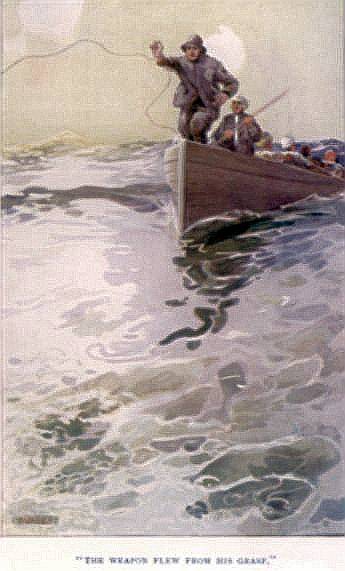
Presently he was close up to the monster; the weapon flew from his grasp, followed by three lances hurled in rapid succession. The whale, feeling the pain, darted off. Another boat came up, and a second harpoon was made fast, while several more lances were plunged into its side.
Presently its enormous flukes rose in the air.
“He has sounded! He has sounded!” cried those on board.
The whale had dived, and the lines coiled away in the tubs ran rapidly out. The monster, however, had not finished its breathing, and soon after a second line had been secured to the first it came again to the surface. The boats pulled rapidly towards it, and the harpooners plied it with their lances. Presently we saw them pull away as if for their lives. The whale rose nearly out of the water, and began turning round and lashing the surface with its flukes, each blow being sufficient to destroy any boat and her crew within its reach.
“The monster is in its flurry,” I heard the doctor say. “It is ours to a certainty.”
He was right. After lashing the water into a mass of blood-tinged foam, it lay perfectly still.
Those on board raised a shout as they saw a little flag fixed on the body.
The boats now made chase after another whale, which gave them more trouble than the first; but they attacked it bravely, now pulling up and hurling harpoons and lances into it, and now pulling away to avoid being attacked in return.
Presently we saw one boat again dash forward, almost the next instant its fragments rose in the air, and the crew were scattered far and wide around. Which boat it was we could not tell. Some fancied it was the captain’s, others that it was the second mate’s.
“He regained his sight to-day,” said an old Orkneyman. “It’s a question whether it wasn’t that he might have a last look on his fellow-creatures and the mighty sea.”
Chapter Eighteen.
Our first whales caught—I hear news of Jack.
The moment the accident was perceived Mr Griffiths ordered the only remaining boat away, and jumped into her, for the carpenter had not yet finished the two building to replace those lost off Cape Horn. I asked to go.
“No! You stay on board and help to work the ship up to us,” he answered.
I accordingly went to the helm, as I steered better than most of those remaining on board, while the doctor and steward lent a hand to the rest in pulling and hauling, as we had continually to go about; but the wind was light, and it was not very hard work. I kept an eye constantly towards the boats, and soon saw a whift planted on the back of the last whale attacked, which showed that it was dead.
Our anxiety was relieved when, instead of returning, they made chase after another whale. It proved that although the boat had been destroyed, the men had escaped with their lives.
“I do believe we shan’t have the skipper aboard again,” observed Horner.
“I hope so,” I said.
“Ahem!” was his answer, as he walked away.
At length, shortening sail, we ran up alongside the first whale that had been killed. The men descended to its back with ropes round their waists to hook on the tackles to its head and flukes. We had then to wait until the boats towed the other whale up to the opposite side. We eagerly watched their proceedings.
The third whale was attacked. After sounding twice and carrying out, apparently, three, if not four lines, we saw it suddenly come to the surface and leap completely out of the water. This is called breaching. It then began rolling round and round, endeavouring in its agony to get rid of the weapon sticking in it. The boats for some time kept at a distance. Then once more they approached, again to pull off as the whale commenced lashing the water with its huge flukes.
“It’s in its flurry,” observed the doctor, who was looking through his telescope, which he handed to me.
At last we saw the three boats approaching, towing the whale by the nose. The wind having fallen, and having a whale alongside, we were unable to near them to save them their long pull. On they came, towing the monster at the rate of a mile and a half an hour. It was thus upwards of that period of time before they got alongside.
The first man handed up was Miles Soper—or Robinson Crusoe, as we called him—whose leg had been broken by the second whale attack. He had willingly endured the suffering, lying at the bottom of the boat, rather than give up the chase. No one else had been injured, though all had run a great risk of being drowned; but a whaler’s crew know that such may be their fate at any moment. The doctor at once took the man under his charge. No time was lost in hooking on the other whale, and commencing the operation of “cutting-in.” This I may briefly describe as taking off the blubber with large spades, the handles of which are twenty feet long. The whale is turned round and round by means of tackles brought to the windlass, the blanket-piece, or blubber covering, being thus gradually stripped off till it reaches the tail, which is hove on board with the last piece. The blubber is lowered down the main hatchway and cut up into small pieces, called “horse pieces.” These are afterwards piled up on deck to be minced into thin slices for boiling in the pots. The operation of “cutting-in” is a very dangerous one when there is any sea on to make the ship roll. The first and second mates stand on stages lowered over the side, cutting the blubber from the whale as the crew heave it round with the windlass. The four boat-steerers are on the gang-ways attending to the guys and tackles, the captain superintending the whole process, while the carpenter grinds the spades.
All round the sea swarms with sharks attracted by the oil and blubber. When not otherwise employed, Tom and I and Horner attacked them with the spades and killed great numbers. We worked away until night, but did not finish even then, as it takes twelve hours to strip the blubber off a large whale. We commenced again at daylight, and it was dark before we began to cut into the second whale. We had still a third to operate on, but as each was worth nearly a thousand pounds, no one complained.
Fortunately the weather remained fine, and we got the blubber of the third whale on board by the end of the next day. We had also boiled the spermaceti oil out of the head, with small buckets at the ends of long poles. This is the most valuable production of the whale, and is used for making candles.
For night work the ship’s company was divided into two watches, from six to one, and from one to six. The instant the last piece of blubber was on board, the carcasses were cast loose to be devoured by fish and fowl.
We began the operation of trying-out, as boiling the blubber is called, by first putting some wood under the try-pots. As soon as the blubber was boiled, the scraps which rose to the surface were skimmed off with a large ladle, and after being thrown into a pot with holes in the bottom to drain off the oil remaining in them, were used as fuel for boiling the remainder of the blubber.
The appearance our decks presented, with huge fires blazing away under our pots, and the men with the ladles skimming off the scraps, or baling out the oil into the coolers, was strange and weird in the extreme. Had I been suddenly introduced among them, I should not have recognised them as my shipmates, begrimed as they were with smoke and oil. I was, however, much in the same condition. Dr Cockle had become accustomed to it, but I cannot fancy that it was very pleasant to him.
The doctor told me that he should be glad, whenever I could, if I would go below and talk to poor Miles Soper.
I willingly did so. He was suffering occasionally great pain, but in the intervals it cheered him to have some one to speak to. I found that he was even more ready to talk than listen, and I accordingly got him to tell me about himself. He happened to ask my name. I told him.
“Peter Trawl!” he exclaimed. “Trawl! That’s curious. I remember a chap of your name aboard the Lapwing brig-of-war.”
I at once was deeply interested.
“He must have been my brother Jack,” I exclaimed. “Do tell me what has become of him, for I heard he was lost out in the Indian seas.”
“That’s just where he and I were nearly lost. We were coming home when a boat was sent away, and we, with six more men and an officer, went in her, to visit an island on some business or other, I forget what, and I didn’t know it’s name.
“There are wild sorts of chaps out in those parts, who go pirating in their proas, as they call them. While we were just shoving off, a dozen or more of these proas came round us. We knew if the pirates got hold of us we should all be knocked on the head, so we began blazing away to keep them at a distance. We kept on at it till we hadn’t a charge left for our muskets. Two of our men were killed, and our officer badly wounded. The pirates then came nearer and fired their gingalls into us. Just then one of their proas caught fire, and sent up such clouds of smoke that for some time, as we were near her, we could not be seen.
“‘Now, lads,’ said the officer, ‘those among you who are not wounded try and swim to shore. It’s your only chance. The rest of us must die like men.’
“Our oars, you see, were shattered, and by this time all hands except Jack and me were more or less hurt. We followed our brave officer’s advice, and leaping overboard reached the beach before we were seen by the pirates. Some gingalls were fired at us, but we got away among the bushes, and ran as hard as our legs could carry us in shore. We did not know where we were going, or what sort of people we should meet. Whether the pirates landed or not we did not stop to learn, but as we ran for three or four hours there was not much chance of being overtaken.
“We saw at last a river before us, and as it was too broad to cross, and we were afraid, should we attempt to swim over, that we might be picked off by one of those big scaly beasts they call crocodiles, we kept down along the bank, as we knew that it must lead us to the opposite side of the island to where we had landed.
“‘Cheer up,’ said Jack to me. ‘Maybe our ship will come round there and take us off. Our fellows are sure to be searching round the coast on the chance of finding us.’
“‘I hope you’re right, Jack,’ said I, ‘for it will be a bad job for us if we can’t get away, as how we are to find food is more than I can tell, and it’s very clear we can’t live without it.’
“There were plenty of trees growing on the bank, though not so thickly but that we could manage to make our way between them.
“Says Jack to me, ‘If those cut-throat fellows come after us, we must climb up one of these and hide ourselves among the branches.’
“‘I don’t think they will take the trouble to follow us so far,’ I answered. ‘But it’s a good idea of yours, and it will give us a chance of saving our lives.’
“We of course could not run as fast as we had been going in the open country. Sometimes we came across fallen trees, over which we had to climb, and at others we had to go round thick bushes which we could not get through. Still, what stopped us would stop our enemies. On and on we went, till just as we got out of a wood we saw before us a village of curious-looking houses, built on stout piles, many of them right in the water.
“‘Hadn’t we better go back?’ I said to Jack; ‘the people who live there may be the same sort of cut-throats as those we have got away from. They’ll be for knocking us on the head when they see us.’
“Jack agreed with me that it would be better to stay in the wood till it was dark, and we might then make our way clear of the village down to the sea. We were just going back, when a woman came out on a sort of verandah in front of the house nearest to us, and we knew by the way she was looking that we were seen. Then she turned round and called to another woman, who also came out.
“‘Come,’ said Jack, ‘we had better go on boldly and ask those dark-skinned ladies to give us their protection. They are sure to do that if we look humble enough, and show them that we want to be friends, for to my mind women are alike all the world over.’
“So we moved on, kissing our hands, and then holding them up clasped before us. The women did not run away, or seem a bit frightened; and as we got nearer one of them came down the ladder and held out both her hands, which we took and put on our heads. She then beckoned us up the steps, and made signs to us to sit down on mats inside the house. As we were both very hungry by this time, we pointed to our mouths to show that we wanted something to eat and drink. The younger girl went to another part of the house and brought back some fish and yams, and a bowl with some liquor in it. There was not much to be said for the taste, but we were too thirsty after our long run to be particular. We tried to make the women understand that there were enemies coming after us, and that we wanted to hide away, so when we had finished our meal they beckoned us to come into another room, and, placing some mats on the ground, they told us that we might sleep there safely—at least, that’s what we made out.
“Night came on, and Jack and I, agreeing that we had got into good quarters, went to sleep. There was no bell striking, and no bo’sun’s mate to rouse us up, and so we slept on till it was broad daylight. We got up and looked out from the verandah, or platform, which went round the house, when we saw three men talking together. As soon as they caught sight of us they came towards the house, and one of them mounted the ladder. He looked at us with surprise, and seemed to be asking who we were. We told him as well as we could by signs that we had come across from the other side of the island, and wanted to get off to our ship, which would soon be round to take us aboard. This did not seem to satisfy him. Presently in came the women, and they had a talk about the matter, but what they said we could not make out. The first man then called the other two, and after more palavering they began to look savage, and gave us to understand that we were to be their slaves, and work for them.
“‘Well,’ says Jack to me, ‘all we’ve got to do is to grin and bear it. Maybe, as we are near the sea, we shall have a chance of making our escape.’
“This was one comfort; so we nodded, as much as to say we were ready to do what they bid us, for, you see, we were in their power and couldn’t help ourselves. After we had gone into the house and sat down, waiting to see what would next happen, the women—bless them for their kindness!—brought us some more food for breakfast, and a capital one we made. Bad as was our lot, yet it was better than being knocked on the head or having our throats cut. A number of people now came out of their houses, and there was great rejoicing among them to think that they had got two white men as slaves. We found that we had plenty of work to do to cut wood and fetch water, and to hoe in their fields, which were some way from the village, or to go out fishing with them.
“This we liked better than anything else. If it had not been for the women our lot would have been worse, for they took care to give us food every day, which I don’t think the men would have troubled themselves about doing, for they were regular savages.
“Day after day went by; we were getting accustomed to our life, and as yet had had no chance of escaping. A precious sharp look-out was at all times kept over us, and I don’t think even the women would have wished us to go, for we had to do a good deal of the work which would have otherwise fallen to their lot. Though we were, as I was saying, used to the life we led, we both wanted to get away.
“I’ve an old father down in Dorsetshire, and there’s a bright young girl who lives with him whom I would give something to see again; and Jack sighed to go home, as he said, to see his father and mother, and a young brother and sister. He used to talk much to me about you all, and it seemed to me as if I knew you long before we ever met.
“We found that we were much farther from the sea than we had at first supposed, for although we went a good way down the river we never reached its mouth.
“The people in the village didn’t lead quiet lives, for they were always on the watch, fearing that they might be attacked by enemies. At night they made fast their boats under their houses, and had their goods all ready for a start into the woods, while they had men on the look-out night and day to give notice should any strange vessels come up the river.
“Jack and I agreed that if any enemies should come in the night we might have a good chance of escaping, but from what we had seen of the fellows who had attacked our boat we had no wish to fall into the hands of such characters. We thought that we might manage to slip into a boat and pull up the river and hide ourselves until the pirates had gone away.
“You must know that we did not wish any ill to our masters, for though we were their slaves we had taken a liking to them, as they did not ill-treat us, and gave us a good deal of time to ourselves.
“Weeks and months went by. We began to think that no enemy would come, and that we must try to get off by some other means than that we had first thought of. At last we saw the men sharpening their long knives and polishing their spears, and new painting their shields.
“‘Depend upon it there’s something in the wind,’ said Jack to me. ‘They are going on a war expedition.’
“‘No doubt about the matter,’ I said, ‘and they’ll want us to go with them.’
“‘Then we must take care not to go,’ said Jack. ‘I for one won’t be for killing men, women, and children, as these fellows are likely to do. We must pretend to be sick, or that we do not understand what they want of us, and get off somehow or other.’
“Whether or not it was talking about being sick I don’t know, but the very next night I was struck down with fever. Our masters saw that I was not shamming. The women also stood our friends, and declared that I was not fit to get up and work, while Jack was allowed to stay at home and nurse me. I was very bad, and I believe he thought that I should die.
“If he had been my own mother’s son he couldn’t have looked after me better than he did; night and day he was always by my side, ready to give me what I wanted. One day I heard a loud shouting and singing, and Jack, who had gone out, came back and said that the men had all started with their spears and shields. They had wanted to make him go, but the women said he must stop behind, though he had a hard matter to escape from the men. I was already getting better, and this news made me feel better still.
“‘It will be a bad return to run off with one of their boats,’ said Jack, ‘but there seems no help for it, and it may be our only chance, for the men will be back again in a day or two.’
“That very night, while Jack and I were sitting up talking, we heard shrieks and cries in the distance; and presently, looking out, Jack said he saw the houses lower down the river burning.
“Then depend upon it the pirates have taken the place, I said.
“‘No doubt about it,’ exclaimed Jack, ‘and now is our chance. If we could defend the poor women and children we would, but we cannot do that. They’ll know where to fly to, and so, I hope, escape.’
“Suddenly I felt my strength come back, and I was able to follow Jack down the ladder, at the bottom of which the boat was kept moored. To cut the painter by which she was made fast didn’t take us a moment, and springing into her we paddled across the stream. As we looked down the river we could see all the houses in a blaze, and here and there people running off into the woods, while we made out half a score or more of the dark proas stealing up along the shore.”
Just as Miles Soper had got thus far in his history I was summoned on deck, and eager as I was to hear how he and Jack had fared, I was obliged to attend to my duty.
Chapter Nineteen.
Miles Soper’s narrative concluded.
“I’ve heard news of my brother Jack!” I exclaimed, as I met Jim directly after I sprang on deck.
“What! Is he alive?” asked Jim.
“Miles Soper, who was his shipmate, thinks so,” I answered. “At all events, he wasn’t killed when we thought he was.”
“Then, Peter, we’ll find him if we search the world round!” cried Jim, giving me a warm grip of the hand. “I am glad; that I am!”
It takes a whole day to “try out”—that is, to boil down the blubber of each whale. I found that the cooper and his mate had just finished filling up the casks from the coolers, and I was wanted, with others, to assist in rolling them aft.
Here they were chocked and lashed and left to cool for several days before they were in a condition to be stowed away in the hold. In the meantime we had to get up all the empty casks on deck so that we might lay the ground-tier with the full casks. As the casks were piled up, one upon another, the ship was in consequence almost topheavy, and I saw the captain and Mr Griffiths frequently casting glances round the horizon, to watch for an indication of any change in the weather, for should a sudden squall strike the ship she might, while in this condition, be sent over in an instant. Every possible exertion was therefore made to get the task accomplished, and all hands were employed. Anxious as I was to hear what had become of my brother, I consequently had no opportunity for a long time of listening to a continuance of Miles Soper’s narrative. I should have said that though the oil casks were stowed away empty and filled by means of the hose from the deck, the greatest care was required in bedding them, as they might have to remain three years or more in the hold. The blubber from the three whales was at length tryed out and secured in the casks, and the decks being washed down, the ship once more resumed her ordinary appearance, we meantime continuing our course northward. The first moment I was at liberty I went down to see Miles Soper. He said that he felt much better, though still unable to do duty.
“And what about Jack?” I asked; “you and he were just pulling away across the river at night to escape from the Dyack pirates.”
“Yes; I have been thinking much about it since I told you. I would not have to go through that time again for a good deal if I could help it. We could hear the shrieks and cries of the old men, women, and children as the cruel pirates caught them and cut off their heads, and we could see the flames burst out from the houses all along the banks of the river. We were afraid that the light would be thrown upon our boat, so that we dare not venture down the river, but pulled up along the southern bank close under the bushes. We thought that we were safe, at all events, till daylight, when we caught sight of two boats coming out from among the pirate fleet and steering up stream. I gave up all for lost, as I knew that they would whip our heads off in a moment should they come up with us.
“‘Don’t give in!’ cried Jack; ‘perhaps it isn’t us that they’re after.’
“We ceased pulling lest the light should fall on our oar-blades, for we should have had no chance if they had made chase.
“‘Let’s paddle in under these bushes,’ whispered Jack; ‘they’re very thick, and we can lie hid here, while maybe they’ll pass us.’
“We did as he proposed. As the boughs overhung the water and almost touched it with their ends, we hoped that the pirates would not discover us. We could just look out across the river, and saw the boats still coming towards us. We both lay down in the bottom of our boat and remained as quiet as mice, scarcely daring to look up above the gunwale for fear of being seen. We could hear the voices of the pirates and the splash of their oars as they drew nearer. If they had before seen us they might have observed the spot where we had disappeared, and I expected every moment to have my head whipped off my shoulders. Just putting my eyes above the gunwale, I saw the two boats, broadside on, pulling along. They hadn’t found us out. On and on they went, right up the stream. They must have thought that we were still ahead. We, of course, didn’t dare to move, hoping that they would give up the chase and go back again.
“‘We must not be too sure that they won’t look for us when they do come back,’ said Jack. ‘Howsomdever, there’s no use crying out till we’re caught. I’ll tell you what; the best thing we can do is to get on shore and make our way inland; then, though they may find the boat, they won’t catch us.’ I agreed; so, shoving the boat farther in till we reached the bank, we sprang on shore, and having secured her by the painter, set off directly away from the river. As it was very dark, we had to grope our way amongst the trees and bushes, though the glare in the sky from the burning houses enabled us to steer a right course. We half expected that a snake or a wild beast might pounce down upon us, and we had no arms to defend ourselves. But anything was better than to be caught by the pirates. At last, when our clothes were torn nearly off our backs, we reached some open ground, and set off running till we got to a wood on the opposite side. ‘Now,’ says Jack, ‘we won’t go farther, but hide here till the morning; then maybe, if we can climb to the top of a tree, we shall be able to catch sight of the river and find out what the pirates are doing.’ I thought his idea a good one, so we sat down on the ground and waited. We could hear no sounds, so we concluded that all the poor people had been killed. We hoped, however, that the warriors might come back and beat the pirates off. Not that we wished to fall into the power of our old masters again, for they would have kept us prisoners if they didn’t lake it into their heads to kill us.
“At last the light returned, and seeing a tall tree near: Jack and I climbed up to the top. Jack went first. ‘Hurrah!’ he shouted; ‘there go the pirates down the river, pulling away with all their oars out!’ Sure enough I saw them also. ‘But I say, Jack, perhaps the warriors have come back and put them to flight; if so, we must take care not to be caught by them.’ I said, ‘I can see where the village stood, but I don’t see any people moving about.’ ‘It’s a long way, to be sure, so we must be careful,’ answered Jack. We soon got down the tree and returned to our boat. The pirates hadn’t discovered her, so we got on board, and cautiously shoved out to the edge of the bushes, stopping just inside them. We then took a look-out, but could discover no one moving on the opposite shore, so we pulled across to the village. It was a fearful sight we saw there. Bodies of old men, women, and children were scattered about, but the heads were gone.
“We were in a hurry, you may be sure, to get away, but, says Jack, ‘It won’t do to put to sea without food or water.’ So we hunted about, and found in the bushes several baskets which the poor people had been trying to carry off with food of all sorts, and some calabashes, which we quickly filled at the spring where we were accustomed to get water. We hurried with them back to the boat, and once more shoved off. We then paddled away down the river. The current was running out, so that we made good way, and were soon out of sight of the burnt village. Our craft was not very well suited for a voyage, but anything was better than stopping to be killed on shore. We pulled on until nearly noon before we came in sight of the mouth of the river. There was no bar, and the sea was smooth, so we resolved to pull out at once, in the hope of being picked up by some passing vessel. We were still not certain even now that our masters would not make chase after us, so we didn’t stop a moment, except just to look round, but pulled right away to sea. Just as we got outside we caught sight of the pirate fleet under sail, standing to the nor’ard. We therefore pulled south, not that there was much chance of their coming back, but we thought that if we went in their wake we should not fall in with any merchant vessel, for at any rate if they should have met one they would to a certainty have robbed and scuttled her.
“We supposed that there were other islands away to the westward, but then they might be inhabited by the same cut-throat sort of fellows as those from whom we had escaped, and we didn’t want to fall into their hands. Our chief hope was to be picked up by some passing vessel or other, perhaps by our own ship, but Jack said he thought she would not have remained at the station, and would have long ago given up searching for us. It was hot work paddling away all day, and we would have given much for a sail, but the boat was not fitted for one, and she was not fitted either for a heavy sea—not that there was much chance of that getting up at such time of the year. We had plenty of food and water, so we kept up our spirits. Where we were going to neither of us could tell; all we knew was that we were our own masters. We were queer characters to look at, with our clothes all torn to shreds, our hair long, and our faces as brown as berries. No one would have taken us for Englishmen, but we had English tongues and English hearts, and we made up our minds to stick at it and not be downcast. We wanted to get away as far as we could from the shore, for fear any of the natives might come after us—not that there was much chance of that. We paddled and paddled till our arms ached, and we were well-nigh roasted with the hot sun. We were thankful when night came on, and we were able to rest and take some food.
“We had agreed to keep watch and watch, but it was of no use trying to keep awake, so we both lay down in the bottom of the boat and went fast asleep. When we awoke it was broad daylight, and presently up came the sun and beat down on our heads as hot as the day before. There we were floating on the sea with the water calm as a mill-pond, and not a sail in sight. There was no chance either of a vessel coming near us while the calm continued. We took our breakfasts, however, and talked of what we should do. Far away to the east we could see the blue outline of the island we had left, but what part to steer for we could not make up our minds. There was only one thing we determined—come what might, not to go back and be made slaves of. It seemed useless to be paddling away and yet not to know where we were going to; but we still hoped that we might fall in with some merchant vessel, it mattered not of what country, though we wished she might be English, and so we might find our way home.
“‘Come, let’s be moving,’ said Jack, at last. ‘I’ve heard say that there are Dutch and Spanish settlements out in these parts, and maybe we shall fall in with one of them, and both the mynheers and dons are good sort of people, and will treat us kindly.’
“So we took to our paddles and made our way to the westward. All day we paddled on, but no land appeared in sight, and now and then we stopped to take some food and a drink of water, but it was tiring work. We were thankful when night came at last. We didn’t sleep so long, and were at our paddles before daybreak, for we knew by the stars how to steer.
“Next day we did just the same, and the next after that.
“‘I say, Miles,’ said Jack, ‘we must soon manage to come to land or we shall be starving. We have not got food nor water for more than one day longer, and without them we shall not be able to hold out.’
“That was very true; still neither of us thought of giving in. A light breeze from the eastward had sprung up, so that we made good way, but there was no land to be seen ahead. We didn’t talk much, for we had said all we could say about our prospects, and they were bad enough. But they became worse when we had drunk up all the water and eaten every bit of food we had in the boat. I had heard of people going three or four days without eating, but the want of water was the worst. We would have given a heap of gold if we had had it for a cupful. The wind now shifted to the southward, and blew much stronger than before, knocking up a sea which threatened every moment to swamp our boat, which was not fitted for rough water. We now began to think that it was all up with us, and that all we could do was just to keep the boat’s head to the seas to prevent her from capsizing.
“At last Jack sang out, ‘A sail! A sail to the southward!’
“There she was, coming up before the wind. A strange-looking, outlandish craft she seemed as she drew nearer.
“‘I wonder whether she’s one of those Dyack or Malay pirates,’ I said. ‘If so, we may as well let the boat turn over.’
“‘No, no; let us trust God, and hope for the best,’ said Jack. ‘Cheer up, Miles! She’s sent for our relief.’
“I was not so sure of that, for it was easy to see from her outlandish rig that she was one of the craft of those seas. Presently, as she got near us, she lowered her sails and came close up. Ropes were hove to us, and hands were stretched out over the side to haul us on board, for we had scarcely strength enough left to help ourselves. They tried to secure the boat, but she drifted off and was swamped. We just saw that the people were Chinamen, pig-eyed, with turned-up noses and yellow skins. We both fainted away. They brought us some water, and in a short time we got better. They then carried us into a small cabin aft out of the hot sun. Presently they brought us some food—rice, and some stuff minced with it. We were not particular, for we were desperately hungry.
“We now found that the people who had picked us up were honest traders bound northward with a cargo of sea-slugs, birds’-nests, and other things from these seas. We tried to talk to them, but could not manage it, as none of them understood English, and we couldn’t speak their lingo. But as soon as we got stronger we made ourselves useful, pulling and hauling, and doing whatever came to hand. Where we were going to we could not make out, but we hoped that it was to some place at which the English ships touched, and that we might get home some day. As Jack said, we had reason to be thankful that we had been picked up, for the weather came on very bad, and our boat could not have lived through it. The Chinamen kept a bright look-out, and seemed terribly afraid of the pirates. We tried to make them understand that we had seen the fleet sail to nor’ard a short time before, and we ourselves didn’t like the thoughts of falling in with them. We told them also that we would fight to the death sooner than yield. They understood us, and seemed to think that we were very fine fellows. We had been sailing on for three or four days, and we began to hope that we were free of the pirates, when just as we passed a headland we caught sight of a number of craft coming out from under it. On seeing them the Chinamen looked very much frightened, hoisted all sail, and brought their arms on deck. We watched the strangers, who, it was very clear, were making chase after us. We should have a hard fight for it, even if we should manage to get off. Presently, however, we saw their sails flapping against their masts as they came under the headland, whilst we still had a breeze and went away dancing merrily over the water. I never felt so pleased in my life, and the Chinamen seemed highly delighted, chattering and jabbering away like so many monkeys. It was pleasant to see the pirates’ sails sink below the horizon, and pleasanter still to lose sight of them altogether.
“We ran on day after day. The breeze held fair and we by degrees got accustomed to our new friends, and could make ourselves understood in a fashion. We sometimes were sailing between islands, and sometimes on the open sea. Whereabouts we were we had no idea, though we supposed that we were approaching the Chinamen’s country.
“We had been a fortnight or more on board when dark clouds rose up from the south-west, and it came on to blow very hard. The sails were lowered and we ran before the gale. I saw by the looks of the crew that they didn’t like it, nor did we, for it seemed as if at any moment the clumsy craft might be capsized. We, however, pumped and baled, and tried to keep her clear of water. It all seemed, however, of no use, for the seas washed into her and she was leaking terribly.
“We had been driven a long way out of our course. We did our best to cheer up our shipmates, and set them the example by working harder than any of them.
“At last the gale ceased, and we once more made sail, but, do all we could, the water gained on us and the crew began to heave the cargo overboard to keep the junk afloat. The boats had been washed away, and we knew that if she went down we should all be drowned. Jack and I talked of what we could do to save our lives, but we agreed that we should have to share the fate of the rest. It seemed to us that the craft would not swim another night, when we made out a sail to the westward.
“The Chinamen by this time were so knocked up that they were scarcely able to exert themselves. Jack and I sprang here and there, now pumping, now baling, now trying to make our companions do the same. It seemed to us that they would let the craft go down in sight of help. The stranger we judged by the cut of her sails to be a whaler. The junk was settling lower and lower in the water. Jack found a flag, an odd-looking piece of stuff it was. He ran it up half-mast high as a signal of distress. The stranger came on slowly, for the wind was light. It seemed even now that she would not be in time to save us. At last she got near enough to see our condition, and hove-to. Four boats were lowered, which came pulling towards us.
“By this time the water was almost up to the lower deck. Jack and I stood ready to spring on board the first boat which came up. The brave crew came on, and were in time to haul the greater number of the Chinamen on board before the junk sunk beneath their feet. Several went down in her, too much knocked up to exert themselves. With us and those saved, the boats returned on board. We found that we had been picked up by the Helen, whaler. She had been cruising off the coast of Japan, and was going to Macao for fresh provisions. As she was short of hands Jack and I at once entered on board her. Having landed the unfortunate Chinamen and taken in the stores we wanted, we stood away into the Pacific. We found ourselves among a somewhat rough lot, but we were better off than we had been as slaves, though Jack and I agreed that we would much rather serve on board a man-o’-war. We had been cruising for some time, and had caught and stowed away about a dozen whales or more, when one night there was a cry of ‘Breakers ahead!’
“The captain, who was on deck in a moment, gave the order to put up the helm and veer ship, but before she could be got round she struck heavily. We sounded round her and found the water deep on the starboard side. But all our efforts proving useless, the order was given to lower the boats. We had five fit for service, and they were got safely into the water. Jack went in one of them, I in another. We were ordered to keep off at a safe distance from the ship till daylight. When morning broke we found that the ship was a complete wreck, and that there was no chance of saving her. The captain then ordered the boats to come alongside one at a time and embark the rest of the crew, with such provisions as could be collected. We now saw land away to the nor’ard, and, having left the ship, pulled towards it. Our great want was water, and to obtain it the captain divided us into two parties to look into any bays we might discover and try and find a spring. I was in the second mate’s boat. We were just pulling into a bay, when a dozen canoes full of black savages, with bows and spears, darted out and made chase after us, so we pulled away out to sea. What had become of the other boats we could not tell. Your brother Jack had gone in the captain’s, and that was the last I saw of him.”
“Do you think they could have escaped from the savages?” I asked, anxiously.
“I have no reason to suppose they didn’t, just as we managed to escape,” answered Miles, “but we didn’t catch sight of them again. We had sails in our boat, and plenty of provisions, and the mate told us he intended to steer for the Sandwich Islands, the nearest civilised place he knew of, but that it was a long way off, and we should be a long time about it. He might have been right, but we were still many days’ sail from it when we ran short of provisions and drank up all our water. I believe that we should have died if we hadn’t fallen in with another whaler, which picked us up. I entered on board her, as did some of the men, but the mate and others preferred landing at Honolulu. I served on board her for some time. We had gone southward, having got a full ship, when we struck on a coral reef. Though we did all we could to keep her afloat, she went down with all hands, except the black and me, and we managed to get ashore on Robinson Crusoe’s Island, from which you took us off.”
“But can’t you give me any idea as to what has become of Jack?” I again asked.
“Not more than I have told you,” answered Miles; “but my idea is that some if not all the boats got off, though in what direction they steered I’ve no notion.”
I was prevented from talking more on the subject just then by being summoned on deck, and when I told Jim he repeated what he had before said—
“We’ll find him, Peter. We’ll find him.”
Chapter Twenty.
A mutiny and its consequences.
I told Dr Cockle all I had heard about my brother Jack from Miles Soper. He seemed greatly interested, and said that he sincerely hoped we might find Jack or hear of him, though he confessed that it was very much like looking for a needle in a bundle of hay. Jim and I talked of little else. We neither of us any longer thought of going home, but I got a letter ready to send, by the first ship bound for England, to my sister Mary, and another to Mr Troil, telling them that I had got tidings of Jack, and much as I wished to get back, should stay out in those seas till I found him.
My great wish now was to fall in with other whalers, that I might make inquiries about my brother. The captain—though, I suppose, Dr Cockle and Mr Griffiths told him what I had heard—seemed to take no interest in the matter, nor did he show me any more attention than before.
We had left Juan Fernandez more than a month, when a cry came from the masthead of “Land ho!” It proved to be Chatham Island, one of the Galapagos, a group of volcanic islands almost under the line, some hundred miles away from the coast of Peru. We brought up in a fine bay, but the shore as far as we could see looked black and barren. There were, however, thick, low bushes of a peculiar kind, covering the ground at some distance from the beach. As Dr Cockle was going on shore with one of the mates and a party of the men, he to botanise and they to obtain fresh provisions, I went up to the captain and asked leave to accompany him.
“I understand you have made up your mind not to run away,” he observed, in his usual sarcastic tone.
“Yes, sir,” I answered; “I’m content to remain on board your ship, though I know that I would until lately have done anything to get back to England.”
“Take care you don’t change your mind,” he said, in the same tone as before. “If the doctor will be answerable for you, you can go.”
I told the doctor what the captain said.
“I know that I can trust you. Peter, and I’ll tell the captain that I’ll undertake to bring you back,” he answered.
I was glad to find that Jim was to form one of the party. Horner also got leave to go. Though he and I were on good terms, I can’t say I looked upon him as a friend, but I was well pleased that he should have a run on shore, as I hoped that it would put him in good humour, for of late he had become one of the most constant grumblers on board. I even now recollect the pleasure I felt on thus once more treading the firm ground, as, except for the short time I had landed on Juan Fernandez, I hadn’t set foot on shore since I left Shetland. The rest of the seamen seemed greatly to enjoy their freedom.
As soon as we had secured the boat we all set off together, running over the rough black ground, startling a number of strange-looking creatures like lizards, some of which slid off into the water, others hid themselves in holes and crevices of the rocks.
Jim and I, however, went back to join the doctor, as we knew that he would want us to carry anything he might chance to pick up. The mate, after the men had had a good run, called them to him, and we proceeded more leisurely. The shrubs we had seen we found to be prickly pears. We had gone some distance when we caught sight of some enormous creatures like tortoises. The doctor called them terrapins. They had been feeding on the prickly pears, and were now leisurely making their way towards the hills which rose in the distance. We were all suffering from thirst, and the sun beat down on our heads with a great heat. We had in vain been looking for water.
“I’d give anything for a mugful!” cried Jim.
“So would I,” “And I!” echoed several more of the men.
“You needn’t have long to wait if you can catch those creatures,” said the doctor. “They’ll yield as much cool water as we want.”
We all set off running after the terrapins, which, as they didn’t move fast, we soon overtook. As we got close to them they drew their heads into their shells, and remained quiet.
Horner had become unusually lively, and on seeing the creatures stop jumped on the back of one of them, when immediately on it went carrying him along with it. At first he thought it very good fun, and began snapping his fingers and pretending to dance, but whilst he was looking round at us the terrapin carried him against a prickly pear-bush, and over he went sprawling on the ground, to the great amusement of the men.
“Oh, save me! Save me!” he shouted out, scarcely knowing what had happened, and believing that the creatures were going to turn upon him and run their bills into his body.
Jim and I helped him up, and found that he was bleeding from a cut hand and a wound inflicted in his side by the point of one of the leaves. The doctor, however, on arriving at the spot, examined his hurts and comforted him by the assurance that there was not much the matter, and that if he didn’t think about it he could go on as well as the rest of us.
We soon again overtook the terrapins, when the men who were armed with spears ran them in under the creatures’ necks and quickly killed them. We turned them over, and under the doctor’s directions, found, as he said we should, plenty of perfectly cool water in their insides. It was fresh as if just out of the spring. Leaving the terrapins to carry back with us on our return, we pushed on in the hope of falling in with some more. We were not disappointed. We in a short time killed four, as many as we could manage to carry on board the boat, and sufficient to give us fresh meat for several days. I was in hopes of meeting with inhabitants, as I wanted, wherever I went, to make inquiries for Jack, not knowing where I might find him. As Miles had come to the east, I thought he might have found his way in the same direction. None of the islands are, however, inhabited, and only one of them, Charles Island, has a spring of water, though people might otherwise exist in them for years. We saw a vast number of birds, which were very tame, but not a single four-legged creature besides the terrapins and lizards. We had to make several trips to carry the meat to the boat. As we shoved off we saw the sea literally swarming with fish, and the next morning the captain sent in two boats, which, in a short time, caught as many as we could eat.
In the evening we sailed and cruised in the neighbourhood of the islands, during which time we added the oil of four whales to our cargo. We also met several other whalers, from all of whom I made inquiries for Jack, but none of the people I spoke to had even heard of the wreck of the Helen, and could give me no information. At length the crew began to grumble at being kept so long at sea, and we sailed for Tumbez, on the mainland, where we took in wood and water.
When this task was accomplished the captain gave leave to half of the crew to go ashore, and to remain away three days. On their return the other half had liberty granted them for the same time.
I accompanied the doctor. We went up the river some distance, and then landing walked to a town surrounded by sand, far from having a pleasant look. With the assistance of the doctor, I made inquiries for Jack, thinking that if he belonged to a whaler he might have visited the place; but I could gain no intelligence of him. The night before we sailed it was my middle watch, and when it was over I tumbled into my bunk.
I had been asleep for some time when I was awakened by hearing Horner’s voice, exclaiming, “You are here, then? Rouse up and come on deck. The captain is in a great taking. He has found that a boat is missing and some of the hands, and he declares that you have gone with them.”
Slipping into my clothes, I hurried on deck. It was just daylight; the captain was standing aft, looking in a fearful rage, while the second mate was forward, shouting to the men to come up and show themselves.
“Do you want me, sir?” I asked.
“So you and Jim Pulley have not taken yourselves off?” he exclaimed.
“No, sir; we never thought of doing so, and I gave you my word that I wouldn’t desert.”
He made no reply, but ordered Mr Griffiths to call over the names of the men. Four were found missing.
“Take a boat and six men, well armed, and see you bring the rascals back, alive or dead!” he exclaimed, turning to the mate.
In a couple of minutes the boat was in the water and the men were ready, and Mr Griffiths pulled away.
He was absent for some hours. At last we saw his boat coming back, but without the runaways. On reaching the deck Mr Griffiths reported that he had gone up the river and examined the coast on either side of it, but could find no traces of the boat or men.
As soon as Captain Hawkins had abandoned all hopes of recovering the runaways he ordered Mr Griffiths to go again on shore to try and pick up some fresh hands in their place, and I was sent to look after the boat. On either side of the river as we pulled up it we saw numbers of alligators sunning themselves on the sandy banks. As we got near them they plunged into the water, and at first I thought they were about to attack the boat.
As we got higher up, the river narrowed and the trees bent over our heads. In the branches we could see numbers of monkeys leaping from bough to bough and chattering at us. At last, after going six miles, we reached a landing-place, near which was an orange-grove coming close down to the water. Mr Griffiths, taking two men with him, ordered the rest of us to remain in the boat, and on no account to quit her. Scarcely, however, was he out of sight than the men declared that they must have some oranges. When I reminded them of the orders I had received they laughed at me, and one of them, springing ashore, ran off to the grove. He soon again appeared, with a handkerchief in his hands full of oranges, and sucking one as he came along. He was followed by an old gentleman, whom I at once guessed to be the owner of the orange-grove, and who came on till he reached the boat. He then stopped and said something in his native language, which none of us understood. When he found this he made signs to us that we had no business to take his oranges without leave. I tried to explain by pointing to the men’s mouths that they were very thirsty, and that I couldn’t prevent the sailor from taking the fruit. Whether it was from my manner or looks I can’t say, but the old gentleman appeared to be pleased, and going back to an orange-tree picked off a quantity of the fruit, which he brought to me in his own handkerchief, patting me on the back at the same time, as if he was satisfied with my explanations.
While sucking away at the oranges the men were kept quiet. All the time the monkeys chattered away at us from the neighbouring trees, and an ugly alligator would now and then poke his snout out of the water to have a look at us, but the shouts we raised made him swim off. At last Mr Griffiths appeared with four fresh hands, each man carrying a bundle containing all his worldly possessions. As soon as they stepped into the boat we shoved off, and gave way down the river. I was surprised to find all the men talk in a way far superior to that of common sailors, and soon found that they had deserted from American whalers, and had been, before they came to sea, in good positions, which they had lost by misconduct. The moment we got on board, though it was now late in the evening, the captain ordered the anchor to be hove up, and as the wind was off shore, we stood out to sea.
We proceeded at once to our old cruising ground in the neighbourhood of the Galapagos. While we were on our way the new hands seemed perfectly contented, having little or nothing to do. I, of course, inquired of them if they had heard of anyone who had escaped from the Helen, but they could give me no information. To my surprise, I found that, though they had entered in different names, three of them were brothers, and the fourth an old friend. One of the brothers appeared to be a quiet, well-disposed man. As far as I could make out, he had come to sea to look after the others, and to try and keep them out of mischief, though he didn’t appear to have been very successful, as time after time they had got into all sorts of scrapes, and it was a wonder that they had escaped with their lives. On reaching the old ground we fell in with a number of whales, and had very hard work, for scarcely had we stowed away the oil of one than we were in chase of another. The new hands grumbled, and so did some of the others. Of course they couldn’t complain of our success in catching whales, that brought them the work to do. The mates knew of their grumbling, but took no notice of it. At last, one morning, when I came on deck, I found a letter lying on the companion-hatch, addressed to Captain Hawkins. I, of course, took it to him.
“Who sent this?” he asked, in an angry tone.
I told him where I had found it, and that I knew nothing more about the matter.
Tearing it open, as he read it a frown gathered on his brow. “The mutinous rascals! I’ll not yield to them,” he exclaimed. “Say nothing about this till I come on deck,” he said to me. “Send Mr Griffiths here.”
When the mate came the captain read the letter to him. They then armed themselves and went on deck, when the second mate was ordered to muster all hands aft.
“Who wrote this letter?” asked the captain, in a firm tone.
No one answered, and there was silence for some time, until the captain repeated the question.
“It was Muggins,” at last said one of the men.
Muggins was one of the last hands shipped, and though a man of some education, he always seemed to me utterly worthless. He was a friend of the three brothers, who went by the names of Washington, Crampton, and Clifford.
“But in this precious letter I have the names of all the crew,” exclaimed the captain.
Several of the men on this protested that they knew nothing about the letter, and had not put their names to any paper.
“Well, then, let those who have agreed to it walk over to the port side, and those who wish to stick to their duty and remain in the ship go to the starboard side.”
Eight only walked over, including those I have mentioned.
On this Miles Soper, stepping aft and touching his hat, said, “I never like to peach on shipmates, but, as an honest man, I can’t hold my tongue. On two different nights I saw Muggins get up and change the meat and throw dirt in among the bread. One night he carried up some of the best pieces and hove them overboard.
“It’s clear to me that he did it to make the rest of us discontented with our victuals. I had made up my mind to speak about it, but I couldn’t catch him at it again, though I’m certain he played the same trick more than once afterwards.”
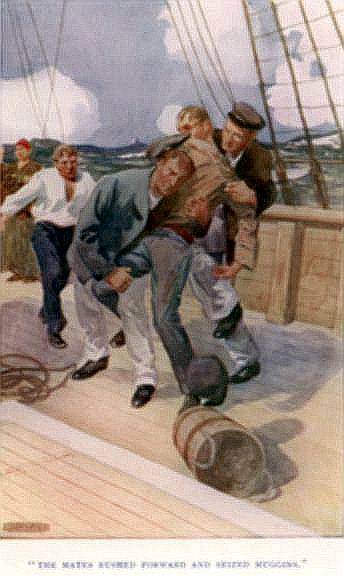
“I believe you, Soper,” said the captain, and at a signal from him the mates rushed forward and seized Muggins, whom they dragged aft, none of the others interfering. The captain then produced a pair of handcuffs which he had got ready, and fixed them on the wrists of the man. He then called to Horner, Jim, and me to assist the mates, and together we carried the man down below and shut him up in the cabin store-room, the captain meantime remaining by himself on deck. When we returned we found that the crew hadn’t moved.
“Now, lads!” he said; “you who have made up your minds to remain in the ship return to your duty.”
On this the men on the starboard side went forward, but the remaining seven mutineers stood where they were with their arms folded. I was in hopes that, as they were no longer under the influence of Muggins, they would yield, but they would make no promises. At length, tired of standing where they were, they moved lazily along forward. Dr Cockle told me that the captain intended to put into the Marquesas, where he could get rid of the men and obtain others.
I found the next day that we were steering in that direction. After this not one of them would do any work, though they were allowed to remain at liberty. I fully expected that they would try to rescue their companion, but the captain and mates kept an eye on them, as did Jim and I.
It was tantalising to us to see whales every day and yet not to go in chase of them, but the captain wouldn’t send any boats away with the good men in them for fear of what the others might do in their absence.
At length we reached Witahoo, one of the Marquesas, and brought up in a beautifully sheltered bay. Had there been any English authorities in the place the men would have been imprisoned, but as it was all the captain could do was to release Muggins from his handcuffs, and to send him and the other men ashore. The second mate went in one boat, and I had command of the other. The mutineers were ordered to get into them, and we pulled for the beach. Though they had only their clothes and a few articles put up in bundles, they stepped on shore with as jaunty an air as if they were going among friends, and having walked a little distance they turned round and jeered and laughed at us.
“I pity you poor fellows who have to toil away on board that filthy whaler,” cried Muggins. “It’s a shame that you haven’t spirit enough to lead the happy easy lives we are going to enjoy.”
Before we shoved off several natives came down to the beach, with whom the mutineers shook hands, as if they were old friends. Presently a huge fellow appeared, who, judging from the way the rest treated him, we supposed to be a chief. Though the others were of a gigantic size and magnificent proportions, he was taller than any of them. Every part of his body that we could see was tattooed over a deep blue colour, from the crown of his head to his feet. His head was shaven, and every hair, even to the eyelashes, was plucked out.
He introduced himself to the mate, who was standing up in the boat, as Utatee, the chief of the island. He spoke a little English, and from him we made out that a missionary resided a short distance off up the bay. In a short time a number of other people came down, with several women and children. Nearly all the latter appeared to me to be very handsome, their good looks not being spoilt by tattooing. I have never seen so many fine-looking people together in any part of the world. The chief told us that we should be welcome to as much wood and water as we required, and offered to supply us with fresh provisions at a cheap rate.
Next day the missionary came on board, and warned us to beware of the people. He had made but little progress with them, owing very much to the misconduct of the runaway sailors who lived on shore and set them a bad example. Still he had some converts, and he hoped, in time, to make more. I told him about my brother Jack, and how anxious I was to find him. I got Miles Soper to describe him minutely, and the missionary kindly promised to make inquiries for him.
The captain returned with him on shore to look for men, and came back in the evening with eight he had picked up. One of them was a runaway sailor, who had been living on the island several years (such being termed a beachcomber), a Portuguese, and six Kanakas, as the natives are called.
Meantime the blacks and the Sandwich Islanders, with a few of the white men, were employed in bringing off the fresh provisions we required. As Dr Cockle wished to visit a part of the bay a little distance off, he borrowed one of the boats manned with two natives, Jim Horner, and me. We visited two or three spots, where the doctor collected some plants and some shells from the shore. We were about to return when he proposed that we should look into a little bay a short distance farther on. The natives seemed disinclined to go there, and as far as we could make out advised us to return to the shore, saying that there were bad people in that neighbourhood.
The doctor, however, who supposed that they only wished to save themselves from the longer pull, persisted in going on. As we got up towards the head of the bay we saw several natives, who ran off as we approached, and hid themselves behind the trees.
“We must be cautious, for perhaps our men here didn’t warn us without reason,” observed the doctor as we pulled slowly in. Directly after he exclaimed, “There are two men lying on the beach. Who can they be? We must, at all events, go in and ascertain.”
He had brought his fowling-piece, and we had besides two muskets. He told Jim and me to stand up, with the muskets in our hands, for he didn’t like to trust Horner, while he stepped on shore. Just as the boat reached the beach, and Jim, who was in the bows, was about to jump out, he exclaimed, “Why I do believe those two fellows are Muggins and Jones.”
The doctor leaped on shore, looking carefully round to ascertain that no natives were near. A cry of horror escaped him. The two men were dead, with their skulls fractured, the brains lying about.
Their “free and happy” life on shore had come speedily to an end. Why they had been killed it was difficult to say. The doctor, stooping down, felt the bodies.
“They are perfectly cold, and must have been dead some time,” he observed. “They probably had a quarrel with some of the natives, and were trying to escape to the beach to cry for help, when they were overtaken.”
As we could do nothing we returned to the ship, thankful that we had escaped the treachery of the natives, though, as the doctor observed, the men who had suffered had evidently brought it all upon themselves.
Chapter Twenty One.
A cruise across the Pacific and the adventures I met with.
On reaching the ship we found that the captain, the English missionary, and the big old chief, Utatee, had arrived on board just before us. The doctor at once told them what had occurred.
“The fellows probably brought their fate upon themselves,” said the captain. “They must have provoked the savages and got killed in consequence.”
“I’m afraid that such was the case,” observed the missionary; “but I will ask the chief to inquire into the matter.”
Utatee said he would do so, but if the white men were guilty he could not undertake to punish their murderers.
While we were talking some of the crew cried out, “A shark! A shark!” and sure enough there was a huge creature swimming up close under the counter, with his fin just above the water, his wicked eye glancing up at the ship. The chief said something to one of the natives who had come aboard with him, a fine athletic fellow, who, like the chief, appeared to be fully dressed in a tightly-fitting dark blue silk dress, but who, in reality, had only a loincloth round his waist, fastened by a girdle, in which were stuck a couple of knives, the rest of his body being perfectly tattooed from head to foot.
The man looked at the shark, and waiting until it had gone a little ahead, overboard he went, and swam rapidly up after it. Presently he dived, and we saw the shark floundering in the water. I thought that he had turned to seize the man, and that the blood which tinged the waves was issuing from his body; but no, it was the shark which was wounded. The man rose, and again plunged his knife into the monster’s side. He did the same several times, and then towing it up by the tail to the ship, made signs for the bight of a rope to be hove to him. He passed it over the shark’s head, and another rope being secured near the tail, the monster was hoisted up, while the native, with wonderful agility, climbed on deck, apparently not in the slightest degree exhausted by his exertions.
Immediately after this we saw a prodigious commotion near the entrance of the bay, while a loud sound like that of stones knocked together reached our ears. We soon made out a number of people, men, women, and children, who had come off from the extreme point forming one side of the entrance of the bay, and were swimming across it, shouting and striking together a couple of big stones, which they held in their hands. Having formed in a line across the bay, they turned and swam up it, and we saw that they were driving before them a shoal of porpoises. On they kept in perfect order, till the porpoises were driven right ashore at the head of the bay. Here a number of other natives met them. Together they attacked the creatures, which they quickly killed. The missionary told us that their object was to extract the teeth, through which they make holes for the purpose of forming necklaces.
“You’ll not forget, sir, I hope, to look out for my brother Jack,” I said, as the missionary was going.
“You may trust me for that, my young friend,” he answered, kindly; “but I shall not be long on these islands, I fear, as the French are coming to take possession of them, and they’ll allow no Protestant missionaries to live here.”
The captain had no wish to remain for the purpose of inquiring into the death of the two seamen, as they didn’t belong to his ship, and we therefore sailed at daybreak the next morning for Dominica, the largest island of the group, where we understood that we could obtain a larger supply of pork than we had obtained at Witahoo.
We quickly came off that island, but could discover only one bay into which we could safely enter.
As soon as we brought up, two of the boats were sent ashore under charge of Mr Griffiths, he going in one, and I, with Jim and Horner, in another.
As we got near the beach we saw that a heavy surf was breaking on it. Mr Griffiths, however, thought that we could land safely, and waiting till the wave had burst, we dashed on.
Though we shipped a good deal of water, the boats got in safely. The natives being accustomed to supply whalers, guessing what we wanted, had come down with a number of hogs to sell. The price for one was a bottle of powder, and five could be purchased for an old musket.