A few Words about the Egyptians, ANCIENT AND MODERN.
Reading edition
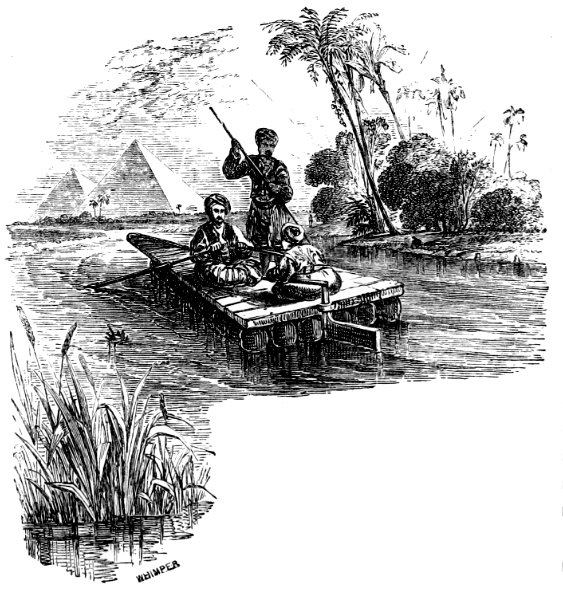
In many respects Egypt is one of the most interesting countries on the face of the earth. It was the cradle of infant science—and the first seat of regular government; and if we go back into the darkness of bye-gone ages, we shall find in Egypt the first dawn of social intelligence. The land of the Pharoahs was an old country in the infant age of Greece. The earliest writers of Europe describe its grandeur as having already reached its consummation, and even as beginning to pass away. In the days of Homer, the capital of the Thebaid, with its hundred gates, and its vast population, was a subject of wonder, and what that poet relates of it, as illustrated by the recondite criticism of a Mitford, would scarcely be believed, were it not that the remains which, even after a lapse of three thousand years, continue to resist the injuries of the atmosphere and of barbarism, bear evidence to a still greater magnificence than is recorded in the pages of the Odyssey. Keet, the antiquarian and traveller, whose Asiatic researches do him so much honor, spent a considerable time in Egypt under the patronage of Ali Pacha, and made it his business to search into the past and present state of that wonderful people. Rich in the intelligence of modern science, he bears testimony to the improving capabilities of the modern Egyptians. In examining the monuments of that ancient people, he formed conclusions as to their former manners and customs, by no means uninteresting. He discourses to us of the “Dead, and of their Burial.” “In ancient times,” he tells us that, “a talent of silver, four-hundred-and-fifty pounds, was often employed in a funeral. The relations of the deceased” says he, “announced to the judges that a ‘dead’ is about to pass the canal, and of the place to which he belonged. Two-and-forty judges are then collected and arranged on a semicircular bench, which is situated on the bank of the canal, the boat is prepared, and the pilot, who is called by the Egyptians, ‘Charon,’ is ready at his post. But before the body is put into the boat, the authorities assemble, and one, who is called the accuser, or sateen, brings forward against the deceased all his crimes. The judges deliberate—an advocate replies to the accuser—if the accuser makes out his case against the advocate, the deceased is denied honourable interment, and may be cast into Tophet to be consumed; but if his conduct has been good, he is ferried over the lake, and his soul is supposed to enter the realms of eternal bliss, prepared for the righteous from all eternity.”
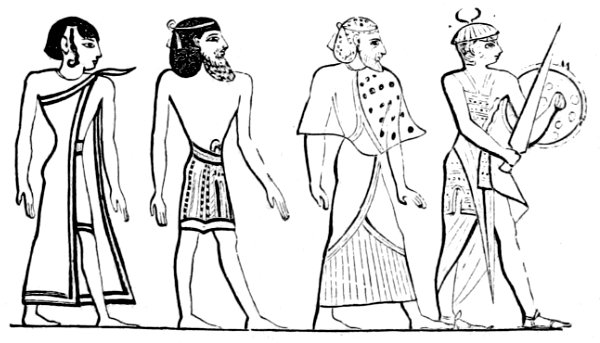
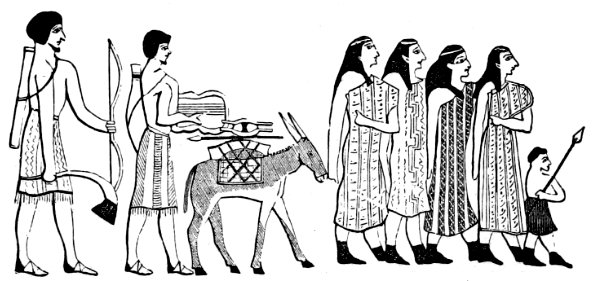
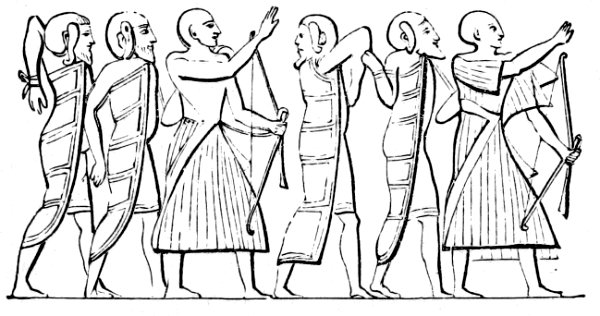
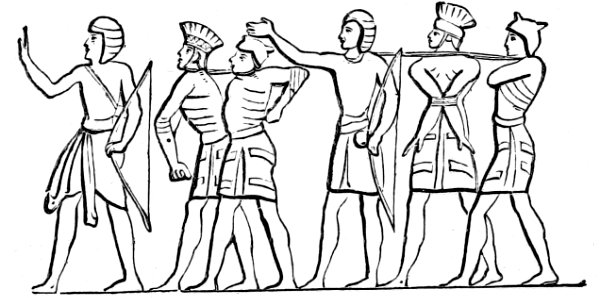
The Egyptians had many curious manners and customs. Unlike the other Oriental nations, the Egyptians, like the English, since the times of Shakspeare, Sir Philip Sydney, Raleigh, and other beard-wearers, did not wear beards. They were the only people that practised shaving from remote antiquity, and they held it as the sign of civilization, as it was also considered by the Normans. We invariably find the captives from barbarous tribes depicted with rough beards and shaggy locks, as if no more striking marks could be given of their inferiority to the highly cultivated nation which was subjected to the sway of the Pharoahs. In the engraving, we behold two captive Jews, with an Egyptian warrior before and an Egyptian attendant behind. The Jews have their beards, the Egyptians have not; and in the engraving following, we have two warriors, each leading two captives: the warriors have the bow-and-arrow—the bow being not a stick bent in a rounded form, but a piece of wood bent at a very wide angle. The captives are bound and bearded, and their costume consists of a long cloak, which falls nearly to the ancles, leaving their front dresses exposed, while that of the Egyptians are like petticoats.
Leaving beards for awhile, we may remark upon the law processes of the Egyptians. In civil suits, the number of judges—or, rather, the jury—was thirty; and it is worthy of notice, that their president wore a breast-plate adorned with jewels, upon which the word Truth appeared strongly emblazoned. The eight books of the laws were spread open in court; the pleadings of the advocates were in writing, in order that the feelings of the judges might not be improperly biased by the eloquence of the orator. The president delivered the sentence of his colleagues by touching the successful party with the mysterious symbol of truth and justice, which adorned his person.
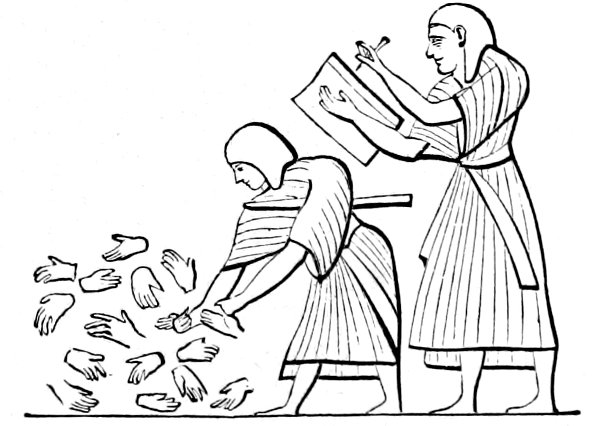
In their battles, the Egyptians were very ferocious, and after they were over, exercised many barbarities, by the immolation of their prisoners. An admirable representation of a battle-field is found on the walls of the great Temple of Medinet Habou. The South, and part of the East wall is covered with a battle scene, where the cruel punishment of the vanquished, by cutting off their hands and maiming their bodies, is performed in the presence of the Chief, who has seated himself in repose, on the back part of his chariot, to witness the execution of this horrid sentence. Heaps of amputated hands are counted over before him, and an equal number of scribes, with scrolls in their hands, are writing down the account: as many rows of prisoners stand behind, to undergo a similar mutilation in their turns. Their hands are bound behind their backs, or lashed over their heads, or thrust into eye-shaped manacles. Some of their heads are twisted completely round; and some of them are turned back to back, and their arms lashed together round the elbows, and thus they are marched up to punishment.
In ancient times, the Egyptian system, as now, was one of the most cruel tyranny. Large masses of men were ordered, at the will of a despot, to “labour, in the sweat of their brow,” to their death. The slavery of the lower orders gave birth to the Pyramids. What masses were employed, and how human life was wasted, is evinced by the manner in which Necho made his canal, connecting the Nile with the Red Sea. Things are now much the same in that country. Mehemet Ali, the Pacha of Egypt, obliged 150,000 men—chiefly Arabs from Upper Egypt—to work on his canal, connecting the Nile with the Sea at Alexandria; 20,000 of that number perished during the execution of the work. The construction of the railroad from Cairo to Alexandria is not, however, conducted on this wicked principle; and things are beginning to wear the appearance of humanity.
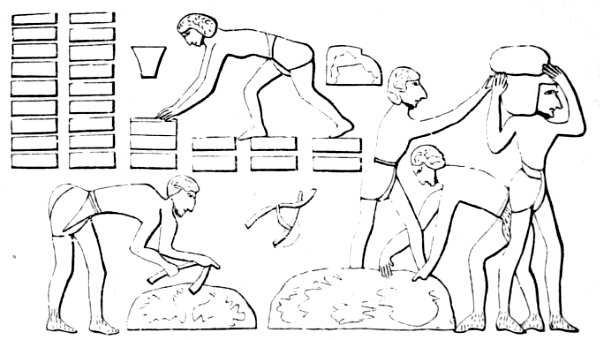
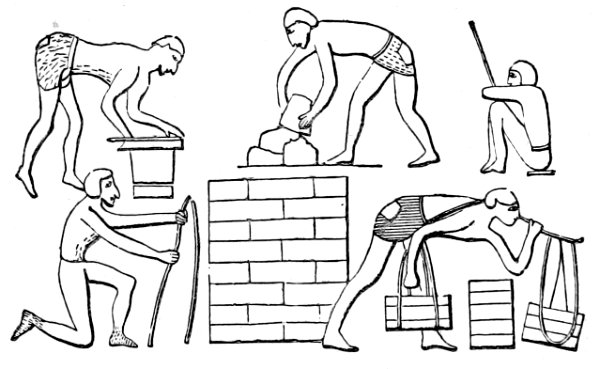
One of the great labours of the ancient Egyptians was brick-making. The bricks were made of the clay of the district, or mud of the Nile; and in the Egyptian monuments, we have many representations, not only of the manner in which brick-making was carried on, but also of the application of bricks in the construction of houses. When Moses commenced his mission, the Hebrews were chiefly occupied in making these large bricks, dried in the sun, and compacted with straw, such as may be seen in the Nimroud ruins. These bricks were often made use of in the upper parts of houses, and in process of time, the weather, and the heat of the sun, destroyed the more fragile part of a building, and buried the strong foundations of it beneath their ruins. In the engraving I have here introduced, the mode of making the brick is delineated; some of the brick-makers are cutting the clay—others are moulding it into parallelepipedom forms, and placing the bricks in a row for drying. In the drawing, the bricks appear to be one above another, but this appearance is given in consequence of the Egyptians using no perspective in their drawings. The mode of arranging them was in rows, flat upon the ground; they were then baked by the heat of the sun, and the long dry weather, which lasts for months in this part of the world.
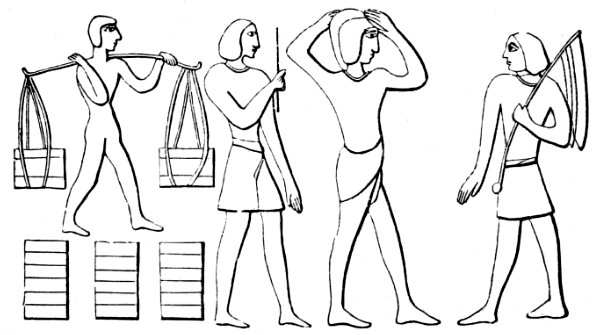
In building their houses, the Egyptians arranged the bricks much after the same manner as we do at present, and had a kind bitumenous cement for mortar. In the engraving, copied from one of the Egyptian tombs, we have, first the taskmaster, sitting in the usual Egyptian custom, with a long rod or stick in his hand; below him is a slave, who has just brought some bricks to be used on the building; before him is another slave, with masses of cement or bitumen, and below this figure are others, building up a wall, or side of a house.
The Pyramids, of which I have so often spoken, are, above all things, the most wonderful of the Egyptian antiquities, and exhibit the science of early times graphically. Nor were their temples less majestic. That erected at Sais had in it a sanctuary, which consisted of a single stone. The carriage of this employed two thousand men for the whole period of three years. The length of this hallowed stone was twenty-one cubits, the width fourteen, and the height eight—and allowing the cubit to be one foot seven inches, you will have an idea of its diminsions. The practice of erecting monolithic (single stone) temples was very general in Egypt, some striking specimens having been preserved in various parts of the country. Pilgrimages and sacrifices were a part of the system of religion. The latter were employed for the expiation of sins. The worshipper placed his hand on the head of the victim, loaded it with imprecations, and its last gasp was the seal of his pardon. Till the reign of Amasis, even human victims were offered. Besides the heavenly bodies, some kinds of animals, also, were worshipped. These were not regarded as mere symbols, but adored as actual gods, like the Apis and Mnevis; this worship arose from the hieroglyphics of the Egyptians. In one of their places of worship, the painting below was found, which represents offerings, attended by priestesses, coming to the temple. And with this, I shall conclude my notes upon Egypt.