Chapter VII · (continued 2)
Reading edition
When he had first secured this position, Logan ordered one of his batteries, commanded by Captain De Gress, to take position on the knob I have mentioned, and open upon the bridge and fort. The order was obeyed with alacrity. Courage is a sort of magnet which attracts its like; it surrounded Logan with men of his own stamp, among whom were Major Charles J. Stolbrand and Captain Francis De Gress, and it was not long before these two had the battery posted and ready to open at Logan's command. I was at the time on this knob, and anticipated seeing some handsome artillery practice and a great scattering among the rebels, very plainly visible below, crossing the river and moving about in the fort, not much over a mile distant. But it was destined that the scattering should be among our own forces supporting De Gress's battery and lying along the ridge, and particularly was there to be "much scattering" on my part. I had noticed, as had others, the peculiar appearance of the hill on which the battery was posted and on which I stood, but had not suspected why the change had been wrought. The trees, with the exception of a single tall, straight oak left standing in the centre and on the very summit of the knob, had been carefully felled, and the tops thrown down the sides and slope of the hill, forming a sort of abatis, and making the approach to the summit rather difficult. Several persons had made inquiries and suggestions as to the purpose of the rebels in clearing the hill and forming the abatis around it, but it was not until De Gress had opened fire on Resaca that the mystery was solved. Then it suddenly flashed on the minds of all simultaneously with the flash of the first rebel gun in the fort in Resaca. The first round of De Gress came very near being his last, for the ten guns in the rebel fort beyond the river opened simultaneously on him, and every shot fell among the guns and troops supporting them. It was then discovered that the hill on which De Gress had posted his guns had been cleared by the rebels and one tree left standing as a target for artillery practice. For at least a year the gunners in the fort in Resaca had been practicing by firing at this tree, and they had the range of the hill to such accuracy that every shot fell in our midst. The first broadside sent me to cover, and I hastily dropped behind a huge oak stump left standing, and which afforded ample protection. Here I could see the rebels at their guns, watch De Gress and Stolbrand at theirs, and, by turning half around, see the troops which lay near me supporting the battery. The first shells thrown by the rebels had wounded several of these, and their cries of pain, as they were carried to the rear, could be plainly heard, and did not in any great measure add to my comfort, or increase my confidence in the invulnerability of my position, and I began to conclude it was not bomb proof. Meantime the rebels were firing vigorously, and after two or three shots De Gress was silenced—not that his guns were disabled, but that the men could not work them. The place was literally too hot to allow of a man exposing himself, and all but Logan, Stolbrand, and De Gress sought cover, and clung as closely as possible to the ground. These three, however, stood their ground, very foolishly I thought at the time, and how they escaped being struck I can not conceive. The fire of the rebels was singularly accurate, and from the cries of our wounded it was apparent that it was also very effective. I had been lying behind the stump whose protection I had sought for twenty minutes, looking with interest at the firing of the rebels, when a shell from one of their guns struck directly in front of the stump, entered and plowed up the ground for a distance of ten feet, sending the soil high in the air like spray, and then, striking the stump, bounded high above it, and fell about five feet behind me with a heavy thug! The soil which had been thrown up by it descended about me, and, as I crouched low, making myself as small as possible, and wishing myself even smaller, literally buried me alive. I thought every piece of the soil which struck me was going through me. At last, when the shell descended near me, my demoralization was complete. Fearing that it would explode, I sprang up from my recumbent position and ran with all my speed to the left of the line. As I did so I came to the abatis of timber, heaped at least four feet high. I never stopped to consider, but, without hesitation, made a tremendous leap, and cleared the obstructions at a bound, amid the loud laughter of a whole brigade, which, looking on, actually rose up to laugh at and applaud my hasty retreat. When I reached a place of safety out of range of the rebels, and beyond reach of the particular shell which I had so much dreaded, I found that the confounded thing had not exploded. I was too much demoralized, however, to contemplate going back while the rebels held the range of that hill, and so sat down, carefully getting behind another stump, to receive the congratulations of the colonel and adjutant of one of the supporting regiments on the gymnastic abilities which I had just displayed.
It was not until sundown and after the cessation of the firing that I ventured to return to the hill. Here Logan and Stolbrand still remained, and Sherman, Thomas, and others had also come up. While the others consulted together Logan sat aside, leaning against my stump, and looking exceedingly glum and disgusted. When I approached him he looked up and laughed, evidently at the recollection of my demoralization and flight. I sat down beside him and said,
"Well, general, you see I was right last night. Some body was asleep."
"Yes," said he, in answer, "but you was mistaken in the person. It was not Joe Johnston who was napping."
There was good reason to be morose over this affair. The failure of McPherson on the 9th of May made the campaign of Atlanta a necessity. Had Logan, instead of Dodge, been in advance of McPherson's army on the 9th of May, there would have been no Hope Church affair, no Kenesaw Mountain sacrifice, no battles on the Chattahoochee, or before Atlanta, or at Jonesborough, for the campaign would have been ended, and Atlanta captured at Resaca in the dispersion of Joe Johnston's army.
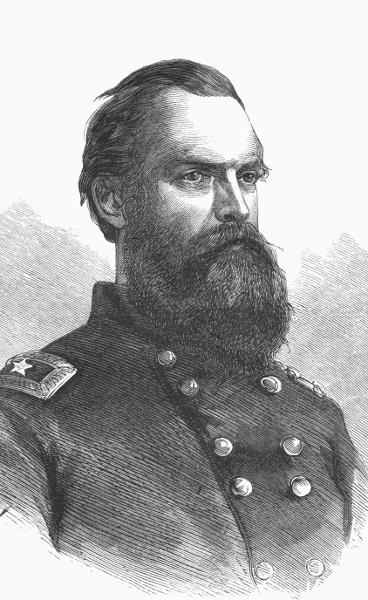
JOHN W. GEARY.
Something of this same ability in execution which was developed in Logan and the others to whom I have alluded characterized General John W. Geary, of Pennsylvania, and few officers labored more zealously or more effectively than he did. His adventurous disposition, developed early in life, and leading him to a remarkably varied career, could not be other than the result of a bold and daring nature, which led him early to seek activity when he might have chosen a more passive but less glorious life. His enthusiastic ardor for military life rendered him in his youth an adept in all military matters, and led him naturally into the military service of the country. He was built, too, for a soldier, possessing a rare physique, his tall, burly figure reminding one of Rousseau or Steedman. His adventurous career began in Mexico, where, as colonel of the Second Pennsylvania, he served with distinction under Scott, from Vera Cruz to the capital, suffering wounds at Chepultepec and at the assault of the city of Mexico. After the war, sighing, like Hooker, for the excitements of California, he went to San Francisco, and was soon after appointed postmaster, and subsequently elected mayor. President Pierce appointed him Governor of Kansas, but Buchanan decapitated him on account of his adherence to the person and principles of Douglas. He early entered the war for the Union as Colonel of the Twenty-eighth Pennsylvania Infantry, and fought through each grade to the position of major general, winning a bright reputation as a bold and unflinching fighter.
The most remarkable of Geary's exploits was the famous "midnight battle of Wauhatchie," a sort of companion picture to Joe Hooker's "battle above the clouds." It took place, too, at the foot of the mountain on which Hooker fought, and was, in a measure, preliminary to that struggle. It was fought for position, but a position of vital importance to both the rebels and Union forces, and consequently it was fought for with great desperation. The movement which brought it about was the first of those looking to the relief of the starving army at Chattanooga, and the purpose was to occupy a position which would cover a road by which provisions could be brought from the railroad terminus at Bridgeport. The occupation of this position was absolutely necessary, and Geary was fully impressed with the importance of quickly seizing and desperately holding on to it. By the success of the movement the route to Bridgeport would be shortened by many miles; on its being thus shortened depended the provisioning of Chattanooga; on this contingency depended the holding of that position, and on the retention of that position the safety of the army and its immense and valuable material.
Geary seized the position with great alacrity, and much to the astonishment of the rebel Longstreet, who watched him from the summit of Lookout Mountain. From his position on "Signal Rock"—an overarching rock on the western side of the mountain—Longstreet had before his eyes the whole country as on a map, and when, in the dusk of evening, the camp-fires of Geary and Howard's troops located the positions which Hooker had seized and was fortifying, the importance of the success attained flashed upon Longstreet's mind in an instant, and he saw, in the seizure of Wauhatchie by Geary, the virtual relief of the besieged garrison of Chattanooga. He at once communicated with Bragg, and on explaining the altered situation to that officer, the latter at once directed Longstreet to attack Geary and Howard, and drive them back at all hazards. Longstreet returned to his position on "Signal Rock," and soon had his troops in readiness to descend from their position on the mountain, and assault Geary at Wauhatchie. From his position on "Signal Rock" Longstreet directed the assault by signals, and to this circumstance, singularly enough, he owed his defeat. Geary's force was totally inadequate to contend with the superior forces of the enemy. General Schurz, who was sent by Hooker to re-enforce him, never reached the position, and but from the fact that Geary's signal-officers could read the rebel signals, he must have been overwhelmed and driven from the position. For some months previous to this battle our signal-officers had been in possession of the rebel signal code, and hence the flaming torches of Longstreet's signal-officers on "Signal Rock" revealed to Geary every order given to the rebel troops advancing against him. He was thus made aware of Longstreet's plan of attack, was enabled to anticipate and meet every movement of the rebels, and, thus forewarned, so to employ his small force by concentration in the critical part of the field at the critical moment of attack as to repulse every assault which was made, either by counter-charges or rapid flank movements. After repeatedly throwing themselves against Geary's force in vain, the rebels at length drew off discomfited. During the whole battle the flaming torch of Longstreet flashed orders that showed, after each repulse, his increased desperation, and finally, much to Geary's gratification, he saw it signal the recall. All the while the figure of Longstreet on "Signal Rock," standing out boldly against the dark sky, was plainly visible, and, as Geary once remarked, forcibly reminded him of a picture which he had once seen of Satan on the mountain pointing out the riches of the world to the Tempted, save that only the figure of the Tempter was visible.