ABBREVIATIONS. (continued 3)
Reading edition
Saturday, Aug. 13, 1864.
Well, were it natural for me to be despondent, I should say that things looked rather gloomy for our cause. I do not doubt but what General Grant is doing all in his power to prosecute the war. Apparently, however, there is little doubt but what there are those under him who fail to perform their whole duty. If there were only more fighting generals and fewer get-along-easy fellows, what a splendid thing it would be for the country. But Grant will weed 'em out in time—see if he don't! We arrived at Cedar Creek and went about a mile when we again found Early in our front; have remained here all day.
Sunday, Aug 14, 1864.
Have remained idle all day; enemy occupy the other side of Strasburg. Our pickets are just this side of town; very warm and sultry; are in the shade. Captain Merritt Barber and Lieut. J. M. Read have gone on picket; no skirmishing to-day; rations and mail expected to-night.
Monday, Aug. 15, 1864.
Have remained quietly in camp to-day; skirmishing and artillery firing along the line this afternoon; warm, but cooler than yesterday; army moved back across Cedar Creek about 9 o'clock a. m. to our old position; wagons have come, but have got to make three days' rations last four, as Mosby captured some of our train; all's quiet to-night.
Tuesday, Aug. 16, 1864.
Such trifling! I'm tired of it! Must be we are waiting for something—aren't ready. I am glad to lay quiet, but such suspense keeps us from resting. We can't depend on quiet. It's rumored we are to fall back this evening. Quite a game of chess seems to be going on between the armies.[13] It has been very dull since we left Harper's Ferry. We have done nothing but march without mail and time drags; are nearly out of rations.
Wednesday, Aug. 17, 1864.
We were ordered to commence our retrograde movement at 8.30 o'clock, but didn't till about 10 o'clock a. m. As usual our division goes as train guard. We passed through Middletown about midnight; didn't stop to do much foraging; arrived at Newtown about 2 o'clock a. m., and passing through, the men nearly stripping the place of everything; got breakfast at Winchester and stopped near Clifton farm. Foraging is allowed, owing to the levies made for money on places by the enemy, which if not paid have been burnt, in Maryland and Pennsylvania, such as Williamsport, Chambersburg, etc. It is desired, too, to strip the Shenandoah Valley of all supplies in order to keep the enemy out of it.
Thursday, Aug. 18, 1864.
The enemy followed us and overtook our rear guard at Winchester where Generals Torbert and Wilson and the New Jersey brigade of the Sixth Corps had a sharp little fight last night losing it's said, one hundred and eighty in killed, wounded and prisoners. We were aroused to form line of battle this morning at 4 o'clock. We got breakfast and marched about 6 o'clock a. m. It rained constantly all forenoon and was lowering this afternoon; dined at Clifton farm; marched to Charlestown and bivouacked at 9 o'clock p. m. We have got to make three days' rations last five.
Friday, Aug. 19, 1864.
Arose at a late hour this morning, but not in the best of spirits; have been in camp all day; haven't made preparations to stay long; don't now-a-days; can't tell what we are to do; rained early, but broke away by noon; have been quite indisposed since 3 o'clock p. m.; fear I'm going to be ill; got a letter from Pert this evening; first mail received in a week; all's quiet on the line to-night.
Saturday, Aug. 20, 1864.
Arose early this morning and am feeling better; over-tired yesterday from hard marching and fatigue, I reckon, was all; took an early breakfast and soon learned my baggage was close at hand; put up my tent and got ready for work to-morrow provided we stay here; put in a requisition for clothing. Lieut. C. H. Reynolds, R. Q. M. has come from City Point; have written to Dr. J. H. Jones this evening; all's quiet.
Sunday, Aug. 21, 1864.
Well, a soldier's life is a strange one to lead! I got up about 8 o'clock a. m. received an order for inspection at 9 o'clock a. m. got nearly ready when it commenced raining and inspection was delayed. Then before we had inspection about 10 o'clock a. m. a lively fusilade commenced on the pike in our front with the skirmishers; looks to me like a surprise; everybody acts so, too; have been hustling all day to throw up rifle pits and to-night finds us in line behind a formidable breastwork; skirmishing still continues briskly. The Vermont brigade reestablished the skirmish line. Our brigade has lost two men killed and eleven wounded.
Monday, Aug. 22, 1864.
Am not feeling well; marched nearly all night; arrived at Halltown heights at daylight; went into our old position; am now on picket on the right of our line; enemy followed us up and skirmished with our rear guard "right smart" all day. About 11 o'clock a. m. the First Division was sent out on the pike; rumored it's driven the enemy back; hard thunderstorm from 3 o'clock to 4 o'clock p. m.; quite cool this evening.
Tuesday, Aug. 23, 1864.
It was chilly and foggy this morning, but it cleared about 9 o'clock a. m. Skirmishing still continues on the pike and on the left of the line. It's rumored the Nineteenth Corps charged the enemy this morning driving it back in confusion. The Tenth Vermont moved to the right this forenoon giving room for a battery on our left. Our forces have thrown up breastworks, but I don't anticipate any attack.
Wednesday, Aug. 24, 1864.
This is my twenty-second birthday; enemy still in front; skirmishing still on the left; don't think it amounts to much; heavy cannonading in front of the Nineteenth Corps from 2 o'clock to 3 o'clock p. m. Dr. Almon Clark and Lieutenant E. P. Farr returned to the regiment to-day. I have been busy on clothing rolls and Company books and wrote to James Burnham this evening; not feeling well to-day; very warm; all's quiet.
Thursday, Aug. 25, 1864.
Well, another birthday has passed and with it another year has gone, and one of great military experience, and I trust it has been profitably spent; very warm till about 3 o'clock p. m. when it showered; had monthly inspection at 4 o'clock p. m. General Wilson's division of cavalry started this morning on a reconnoissance towards Martinsburg; heard heavy cannonading about 3 o'clock p. m.; can't learn any particulars.
Friday, Aug. 26, 1864.
As usual we were ordered to be under arms at 4 o'clock a. m. but the enemy has not yet appeared on our right, nor do I think they will; have had charge of a fatigue party nearly all day policing in front of the rifle pits. Captain L. T. Hunt of Company H returned to the regiment this afternoon looking well; has been absent wounded. Captains C. D. Bogue and A. W. Chilton's commissions came by to-day's mail; no skirmishing all day.
Saturday, Aug. 27, 1864.
Were under arms again early this morning. Colonel Foster visited the Tenth this forenoon; is truly a fine-looking man. I have been very busy making out final statements. The heavy musketry heard yesterday on our left about 3 o'clock p. m. was occasioned by the enemy's making a charge on the Nineteenth Corps. The Johnnies were repulsed with considerable loss. Rumor says we captured one entire regiment and two stand of colors, etc. It's child's play, though, compared to the fighting from the Rapidan to the James. I don't believe there will be any more such fighting; it's more than human beings can stand without one side or the other collapsing. As I look back upon it, I marvel.
Sunday, Aug. 28, 1864.
Received marching orders for to-morrow morning at 10 o'clock last evening. We were up at 3 o'clock a. m. and ready to march at daylight, but did not until near 8 o'clock. The Nineteenth Corps marched on our left in three different columns and the Sixth Corps moved on the right in the same order. We took dinner about two miles from Charlestown, and marched again about 1 o'clock p. m.; went through Charlestown about 3 o'clock p. m., with the bands playing "Old John Brown" to the accompanying chorus of the entire column. It was grand! We camped on our old ground just outside the city; no signs of any enemy yet.[14]
Monday, Aug. 29, 1864.
A cool comfortable day; laid out Company streets this forenoon and everything looks as though we were to remain in camp several days. Torbet's cavalry has been engaged all day, but was driven back about 4 o'clock when our Division was sent out to support it. The enemy fell back as soon as they discovered our infantry. We followed the rebs about five miles, returned about half way to camp, and bivouacked. There's good news from Grant's army to-night. We await anxiously for the returns from the Chicago convention.
Tuesday, Aug. 30, 1864.
We were under arms at 3 o'clock a. m., but no signs of an enemy. It's a beautiful cool morning. Some think Early has gone to reinforce Lee; guess not; at any rate, an enemy is in front. The Third Division hasn't moved back to its original position as anticipated last night. Time hangs heavily and were it not for the bands I should be almost homesick; got a mail but no news from home.
Wednesday, Aug. 31, 1864.
Pleasant and warm; got our muster and pay rolls this morning; completed two; not much skirmishing to-day; paper states that probably General McClellan will be the Democratic nominee for president; got a mail but no letter for me.
Thursday, Sept. 1, 1864.
This is the anniversary of our muster into the U. S. service at Brattleboro, Vt., 1862. Thus far, as a regiment, we have been prospered. God grant that we may continue to be, and that as many as is consistent with His will, may be allowed to pass one more year if necessary in the service, and then be returned home happy, feeling that we have endeavored to do our duty as soldiers faithfully to our country and our God; have completed two more rolls; shall try and finish the other in the morning; all's quiet in front.
Friday, Sept. 2, 1864.
Cloudy and cool; think it will rain in a day or so; have completed my roll. Lieutenant George P. Welch returned from Vermont this afternoon; has been absent sick since we left City Point. We moved back to our old camp at 5 o'clock p. m.; arrived about dark; shall probably stay here several days; are laying out camp.
Saturday, Sept. 3, 1864.
Got an order at 10 o'clock last night to be in readiness to move at 4 o'clock a. m.; didn't start until about 6.30 o'clock a. m.; marched up the valley towards Clifton Farm; did not rest until about three miles of it, and probably shouldn't then had we not run onto the enemy and had a brush; don't know the result; heard to-day Atlanta had fallen. It's glorious news! I was detailed for picket to-night. It looks like rain.
Sunday, Sept. 4, 1864.
Got our line established about 10 o'clock last night; rained hard; got very wet; day has passed quietly; moved our skirmish line about fifty yards to the front this forenoon. The enemy appeared on the left of our division about dark and commenced skirmishing, but all's quiet at 9 o'clock p. m. Dr. Clark has been down to see us this afternoon. He's always welcome. It's cloudy and cool; will probably rain before morning.
Monday, Sept. 5, 1864.
Was aroused this morning at 4 o'clock by the Vermont brigade. It moved round on to our right in the night and built works to protect our right flank; rained hard last night; got very wet; was relieved from picket by the Fourteenth New Jersey; no skirmishing to-day. The enemy has evidently fallen back to Winchester. It's quite cloudy.
Tuesday, Sept. 6, 1864.
O, such a terrible day! Rain, wind, sleet and everything to make it gloomy. The Vermont troops have voted to-day as directed by the Governor. My Company (E) cast seven votes for the Republican candidate. The other men didn't know who the Democratic candidate was and so didn't vote. Nothing has disgusted me so since I left Vermont. I'm sadly disappointed politically, in my Company, but the men are good fighters and I like them. They seem devoted to me. It is disappointing, though, to have to send such a report to Vermont! It's mortifying! But I mustn't let the men know how I feel for it can't be helped now. It makes me feel queer, though, for my Republicanism is as staunch as the granite hill (the Barre granite quarries) on which I was born. I am dazed at the result of the vote in Company E! I guess I'm in the wrong pew politically; very few democrats in Barre.
Wednesday, Sept. 7, 1864.
Was happily surprised to find it pleasant this morning; has turned out the finest day of the fall. Lieutenant H. W. Kingsley came up with the day's rations; ate supper with us. The moonlight, band music and charm of the night has killed the monotony.
Thursday, Sept. 8, 1864.
Such freaky weather; cool and rainy nearly all day. Chaplain Roberts of the Sixth Vermont, has called this afternoon. He's a fine man. I have been reading East Lynne. It's very dull in camp. I've written to Aunt Thompson this evening. The papers state the North is jubilant over our recent victories, and well they may be.
Friday, Sept. 9, 1864.
A fair day. Lieutenant H. W. Kingsley ate supper with us. He brought up three days' rations. Pert writes she is having a fine time in East Boylston, Mass. teaching. She sent me a letter from Cousin Byron Bradley. Cousin Abby Pierce is coming East this fall. I have finished reading East Lynne; it's a fine story.
Saturday, Sept. 10, 1864.
It's a cool day. Company and battalion drill was ordered this afternoon but we didn't drill as the Major is on picket. Lieutenant G. E. Davis came out of the Division hospital this afternoon. He's had a boil. I have made my election returns. It's very pleasant this evening in camp, but dull. I have written Pert.
Sunday, Sept. 11, 1864.
A very quiet dull day; am looking for news from the Army of the Potomac; nothing has occurred since we left; those armies watch each other, while we do what little fighting there is done. So much constant chasing of the enemy night and day, frequent brushes, laying on our arms from 3 o'clock till daylight, etc., is very wearing and I shall be glad when Early is licked, as he surely will be for Sheridan fights like a tornado—he does things. He's getting a good ready, and we'll be heard from soon. Ta, ta, Early! Run back to Petersburg! The peace party seems to be dissatisfied with McClellan. In my opinion his stock's below par, at the same time if his party nominate a new man it will be the best thing that can happen for us; wonder if most of Company E don't sympathize with the peace party? Hope my men are not fickle politically—like Jacob's coat of many colors. It takes a strong man in these times, though, to stand up to the rack when there isn't much in it but ammunition, and it's grimly give and take with no white feather mix, and neither army will give up. Wonder if we won't be abused for all this bye and bye by other than copperheads?
Monday, Sept. 12, 1864.
We are having a nice long time in camp, but will probably make up for it when Grant and Sheridan get this little army fixed to suit them. I have been in fights thus far with Companies B, D, and K, having commanded the two latter in a number of hot places, and now I am First Lieutenant Commanding Company E. I don't stay with a Company long enough to learn all the men's names, but they impress me with the idea that they are not dissatisfied with me even if I only know them by sight. Company B is from Barre, Montpelier and Waterbury. D from Burlington, E from Bennington, and K from Derby Line, and the men are splendid fighters, at any rate with me. I don't try to drive them into a fight but am lucky to keep up with the intrepid leaders and most of the rest follow. Except the bravest of them, the others are not apt to go where their Commander won't, and I get better work out of them by keeping ahead of them if I only can. Some of them are so dauntlessly courageous they inspire me.
Tuesday, Sept. 13, 1864.
Well, the papers begin to speak encouragingly, and reinforcements are rapidly being sent Grant and Thomas. We have got but few yet, but rumor says that six hundred left Vermont on the seventh of September for our regiment. It's cloudy and there's a chilly south wind. It threatens rain. McClellan's party is demanding a new candidate. Well, let it have one, it will be all the better for Mr. Lincoln. All's quiet to-night.
Wednesday, Sept. 14, 1864.
Rather a gloomy day. It rained hard from 9 o'clock a. m. until about noon. Lieutenants Davis, Welch and Wheeler have gone on picket with a hundred men from our regiment. There was Company drill this afternoon. It rained so this forenoon that battalion drill was suspended; rained hard this evening, too. Election returns from Maine this evening show that State to be strongly Republican.
Thursday, Sept. 15, 1864.
It was fair until 5 o'clock p. m. when it sprinkled slightly and prevented dress parade. We had battalion drill this forenoon and Company drill this afternoon. The Commissary came up this forenoon, too, with rations. We have received a large mail. All well at home. The Second Division of the Sixth Corps and a brigade of cavalry made a reconnoissance to-day toward Opequan Creek where the Vermont Brigade skirmishers located the enemy just beyond Opequan Creek with its line facing east, its right flank resting on the Berryville pike and its left on the Martinsburg pike with Winchester in its rear. Our armies are about six miles apart.
Friday, Sept. 16, 1864.
It's a delightful evening; has been pleasant all day. There was battalion and company drill this forenoon and afternoon respectively. Extracts from the Richmond Examiner and other Southern journals state that Lee's army about Richmond is in terrible condition, is living on half rations, clothes worn out and no prospect of getting more. It has got so they have to use negroes to transport supplies, etc. I wouldn't blame that army for changing its politics or anything else to get out of the scrape it's in.
Saturday, Sept. 17, 1864.
Warm and pleasant: gentle south breeze; looks like a southern storm. General Grant came to-day, but has gone. It looks like a move. Fifty men from our regiment went on picket this afternoon. We have been moving camp, another indication of a move. Let it come. Orry Blanchard and Nate Harrington have been over this evening.
Sunday, Sept. 18, 1864.
It's cloudy with a gentle south breeze. We had company inspection at 9 o'clock this forenoon and monthly at 4 o'clock this afternoon. The supply train came at 8 o'clock a. m. with four days' rations. We got orders at 3 o'clock p. m. to strike tents which we did, and march at once, but the order was countermanded. We shall probably move early in the morning. There's a high south wind this evening, but it doesn't look like rain. Sheridan's army now consists of three infantry corps, three divisions of cavalry and the usual complement of artillery, in all about 30,000 men, as follows; The Sixth Corps, Major General H. G. Wright, U. S. V. commanding; the Eighth Corps, Major-General George Crook, U. S. V. commanding; the Nineteenth Corps, Brevet Major-General W. H. Emery commanding; Brevet Major-General A. T. A. Torbert, U. S. V., Chief of Cavalry; the First Division of Cavalry, Brigadier-General Wesley Merritt, U. S. V. commanding; the Second Division of Cavalry, Brigadier-General W. W. Averell, U. S. A. commanding; and of the Third Division of Cavalry, Brigadier-General James H. Wilson, U. S. V. commanding. Lieutenant-General Jubal A. Early commands the Confederate army with about the same force.
Monday, Sept. 19, 1864.
We received orders at 10 o'clock last night to march at 2 o'clock this morning which we did. Daylight brought us up near Opequan Creek on the Winchester-Berryville pike. Wilson's Cavalry had charged and carried the enemy's picket line and earthworks protecting the pike near both the East and West entrance of the gorge through which this road runs, taken a goodly number of prisoners, and it looked like business again. A large number of troops moved in two or more columns across the Opequan for about a mile and then up the narrow winding pike in one column through a little valley or gorge, known as the Berryville canyon to us, but as Ash Hollow locally, with second growth or scrub oak and ash trees and underbrush coming close down its scraggy abrupt banks two hundred feet high more or less in places after crossing Abraham Creek, to the road and rivulet winding along the gorge for nearly three miles—the source of which stream is wrongly given on all maps pertaining to this battle—on past General Sheridan near the west end of the canyon towards Winchester sitting on his horse a little off the road to the right in the open field on slightly ascending ground watching the column our brigade was in which, owing to its plucky fight under great disadvantages at the Battle of the Monocacy which largely saved the city of Washington barely nine weeks before, he had selected for the most important point in his line of battle at the head of the gorge on the pike to Winchester with our valiant regiment and the Fourteenth New Jersey planted across it even the colors of each which were in the centre of the regiments, being in the center of the pike and the rest of the army ordered to guide on us. Surely this was the place of honor in the battle that day for the Sixth Corps followed the pike in all the assaults of the day which was quite crooked including the first one until the enemy was driven completely routed through the city of Winchester when night put an end to the fighting Sheridan restlessly urged the men across a small ravine opposite where he sat, his eyes wandering occasionally everywhere over the large open space which gradually rose to the vast comparatively level but slightly rolling battlefield in our front, as the men looked curiously at him so near I could touch him as we marched, little dreaming that three years after I should be honored for my work that day, which he saw, by being a member of his staff, or that he would be instrumental in saving my life when ill with malignant yellow fever and threatened with fatal black vomit in New Orleans, La. in 1867, by sending his cook, a faithful old colored woman, who was an expert nurse of yellow fever patients, to care for me. It was the nearest we had ever been to him, and as our regiment passed slowly by fours, the line being congested ahead, the men took a good look at him for he was already famous and every soldier's ideal hero; and as they did so they unconsciously slackened their sauntering pace a little which was what caused Sheridan to urge them on.
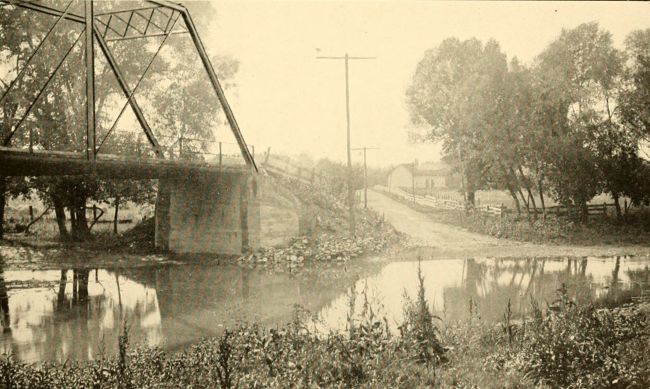
No. 1.
Where Sheridan's army crossed Opequan Creek, Va., Sept. 19, 1864; steel bridge built 1907; view of Winchester-Berryville pike looking west towards Wood's Mill and Winchester, taken from the spring June 29, 1908.
We were on the eve of the most brilliant spectacular battle of the war, at any rate that I had seen, and my ideal genius developed by the great Civil War—Sheridan was to lead us; and the valor of the renowned Sixth Corps, his pet of all the splendid corps of as grand and valiant an army as ever existed—the Army of the Potomac—was about being placed by him at the most important point in line of battle ready to do and die for him, the Vermont troops or "Green Mountain Boys," as we were called through every city we passed, and especially our regiment being one of two to occupy the keystone position or place of honor on the famous historic Berryville and Winchester pike in the great assaulting line on a battlefield slightly rolling but level in places as a house floor when once fairly on it, to take another stitch out of rebellion, and to help immortalize our hero, and we did both. Aye! we shall glorify Sheridan continually as a military genius, even as he has honored us as his ideal soldiers and fighters heretofore, now and probably will evermore, the grand old Sixth Army Corps which fights everything everywhere, and rarely gives up fighting till called off, but, alas! which will soon only be a hallowed, glorified memory; and—still—I like to think of it in reflective moments as in a celebrated painting of a bivouacked army at night asleep watched over by an army of hovering angels in midair; that it as a hallowed spiritual body finally at peace in a heavenly paradise, will go marching on throughout the boundless everlasting realms of eternity ever to hover approvingly when occasion shall require over other mortal armies of dauntless valor and constancy such as it has been in the great Civil War—one of God's instruments for the betterment of humanity and civil liberty—the most admired, honored, trusted and beloved by military geniuses of its period.
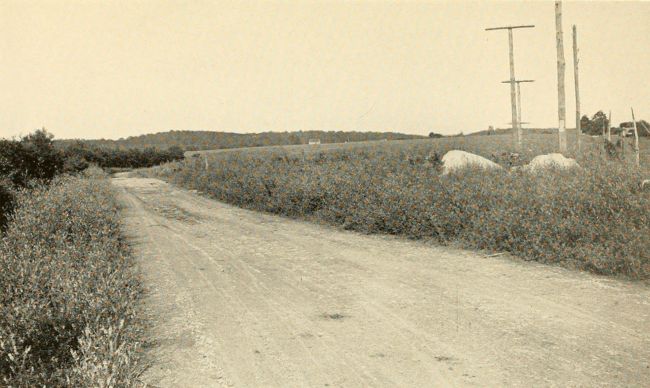
No. 2.
Straight view of about 800 yards of the pike looking easterly towards Opequan Creek from the top of the divide about midway to the enemy's line of battle in the ravine, from where Sheridan formed line of battle. The narrow belt of timber has been cut away behind which we formed.
After passing Sheridan about two hundred yards we arrived at the height of the land westerly from Opequan Creek where the Sixth and Nineteenth Corps were finally formed in lines of battle running about North and South behind a narrow belt of timber, except a little in front of the reserve, facing nearly west toward Winchester about two miles away. The formation of the ground at this point occupied by the Tenth Vermont and Second Brigade was unusually peculiar.[15] The turnpike from this place virtually runs along the divide westerly towards Winchester between the nameless Creek we came up after crossing the Opequan and Abraham Creek, now on our right and north and the latter on our left to the south for a goodly distance the reason for which is obvious as in all such cases where streams have abrupt banks, while at the point where we debouched from the gulch we came up and formed line of battle was another little divide running north and south the east slope of which is partially an easterly watershed for Opequan Creek, and the west slope for the ravine or nameless rivulet running south about two hundred and fifty yards in front of where we first formed line of battle in which was the enemy's infantry in strong force—probably two divisions or more—in front of our Third Division but not shown on any map of this battlefield I have ever seen, not even the official government one used in Haynes' "History of the Tenth Vermont Volunteer Infantry." (See No. 3, 6, 7 and 8 illustrations). It is the ravine through which the little short rivulet runs shown on said map just in front of our "First position" running southerly into a tributary of Abraham Creek. I am emphatic in this statement as having been on the battlefield twice since the fight occurred within a year (1908) for the purpose of trying to correct false history and maps, I know whereof I write. I desire to impress this on all historians for I know of no one living who, owing to my elevated advanced position on the battlefield knows more of it. These two small divides before mentioned meet each other at right angles forming a letter T. The pike crosses the horizontal part of the T on leaving the gulch we came up from the Opequan in, and virtually runs along the first mentioned divide slightly to the left of all rivulet sources running southerly, forming the perpendicular part of the T towards Winchester.
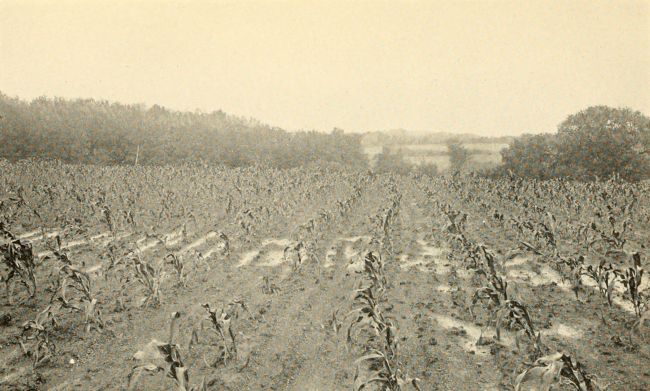
No. 3.
Sheridan's Sept. 19, 1864, Winchester, Va. battle-field looking southerly from the hill just north of the pike running along the east side of the ravine occupied by the enemy's infantry. The sunk pike borders the edge of the wood from left to right. The foreground was assaulted over by the Tenth Vermont. The distant open field through the gap in the trees was charged over by the Vermont Brigade and Second Division, Sixth Corps.
About a half mile to the right or north of the pike and about two hundred and fifty yards in front of our line of battle before advancing, a little to my right, the rivulet before mentioned, where the enemy was, heads, running in a partial semicircle the slightly convex side towards the right half of the Tenth Vermont and the concave side caused by a bend in the rivulet virtually at its source was largely in front of the Second brigade; (See No. 8 illustration) the stream runs southerly and drops rapidly after crossing the pike thus forming a gulch similar to the one we came up from the Opequan in, but apparently deeper and narrower near the left front of the Second Division. This sudden drop to the left of the turnpike made the divide here running north and south quite decided being fully ninety feet high or more which will probably partly account for the enemy's mostly being to the right of the pike there being no protection immediately west from the divide running North and South. In my front on the right of the pike this divide was about fifty feet high running out rapidly on to almost level ground in front of the right of the Second Brigade of our division to my right,[16] which made its position untenable as the ground was swept by both the enemy's artillery and infantry.
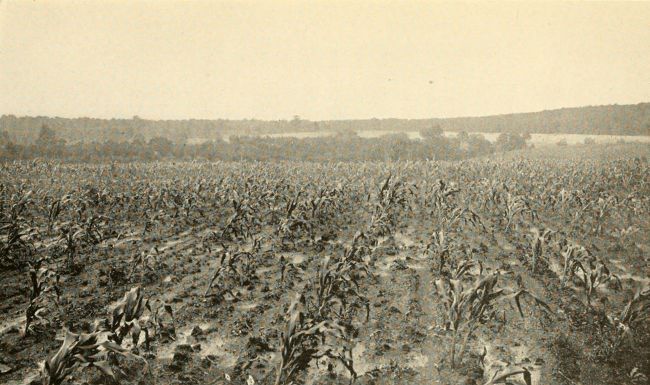
No. 4.
Sheridan's Winchester, Va. battle-field looking northerly from near the pike showing the height of the divide running east and west: also the infantry and artillery swept flat ground in front of the Tenth Vermont and Second Brigade, Third Division, Sixth Corps; also the open distant ground over which the Nineteenth Corps charged with virtually no enemy's infantry in its front, but a little artillery in its distant front. Its unbroken advance over the open distant field was a beautiful sight. Numbers 3 and 4 illustrations show the ground over which our entire infantry line of battle swept in the first assault. The Nineteenth Corps was beyond the first timber on the ravine running centrally across the picture its left resting about on the extreme right of the ravine. Russell assaulted largely over the foreground in No. 4.
The formation in front of the Nineteenth Corps which was our infantry right in the noon or first assault of the day was entirely different. (See Nos. 4 and 5 illustrations). Its whole front after about three hundred yards down a gentle slope was broad and comparatively level with slight breaks several hundred yards across, but not probably impassable for infantry at any point, where three or more small rivulets apparently headed with banks so undefined and flat as to give no defensive protection in a military sense so the enemy had no men or infantry there so far as I could see, but did have at least a small showing of artillery which I could see far across the breaks. These rivulets run northerly probably into the rivulet we came up from the Opequan or the Red Bud, but I do not know this. They help to form a morass it is said, probably about a mile more or less from where I was about fifty feet wide in front of where Crook's Corps was later in the day and it was probably here that Colonel R. B. Hayes (Nineteenth President, U. S. A.) later in the day, at the head of his brigade plunged in on his horse which at once mired when he dismounted and waded across alone under fire followed as soon as he waved his hat to them to join him, by about forty of his men to try and capture a battery which, led by him, they did after a hand-to-hand fight with the gunners, the enemy having deemed the battery so secure that no infantry support had been placed near it,[17] which indicates that in this assault the bulk of the enemy's infantry force confronting our infantry was at first largely in front of our division on the pike. The trees in number 4 illustration along the breaks in 1864 were not there then. The open foreground is the divide running east and west in this illustration so it can be easily seen why the Nineteenth Corps had no considerable fighting to do here.
The left of the enemy's line of infantry in the ravine in my front, so far as I could see, ended about nine hundred yards to my right at the head of the ravine as there was no cover further north except beyond the divide running east and west a good distance away to the north in front of the Nineteenth Corps, and its line was bent to conform to the ravine's direction in my right front; (See No. 8 illustration) the head of the rivulet had quite flat banks the convex side of the creek and its near and most abrupt bank being toward us in my front, but the reverse at the head of the ravine. This was the point in the enemy's line where the gap in our lines occurred mentioned further on which owing to the flat artillery and musketry-swept ground was untenable for the Second Brigade or any force except large enough to drive the enemy's infantry from its cover as was Russell's. (See Nos. 4 and 5 illustrations). If the historian hereafter accuses the Third Division of breaking in this assault, it will be but fair to state extenuating circumstances, for a portion of the First Brigade was similarly situated and we got no direct effective flank help from our critics on either flank during the fight. The pike from our line of battle ran in an air line about nine hundred yards directly towards Winchester (See Nos. 2 and 9 illustrations) and was practically level except where it crossed the divide and little rivulet near my front where in the ravine the enemy had such a strong force in front of us about a regiment of which moved there across the pike from in front of the left of our First Brigade, (See No. 6 illustration) the Second Division having nothing in its immediate front in the ravine and the Vermont Brigade only a weak force in its distant left front beyond, but what a regiment could probably have easily handled and probably less than that did; but, nevertheless, that part of the Second Division next to us obliqued to the left to attack it which was what caused that Division to pull away from the Third Division's left at the same time the Nineteenth Corps pulled away from our right causing wide gaps—as the position which should have been occupied by the Second Brigade was vacant, too—thus leaving our brigade and especially our regiment, alone at a critical time when the gallant General Russell with his magnificent Division so grandly marched in and filled the gap on my right and lost his life in the act. (See No. 5 illustration). Our colors were on the pike thus bringing the right half of our regiment to the north or right side of it on open ground (See Nos. 3 and 5 illustrations) and leaving only about three regiments of our Division to the left of it on the wooded side hill (as shown in Nos. 3 and 7 illustrations) soon sloping abruptly towards the ravine in front which gave all our troops to the left of our colors on the pike some welcome cover but the right of our regiment and the Second Brigade, none. (See Nos. 3, 4, 5 and 6 illustrations).
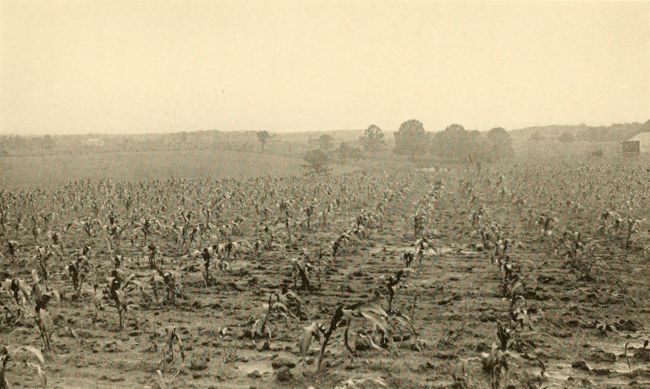
No. 5.
Sheridan's Sept. 19, 1864, Winchester, Va. battle-field looking westerly showing the source of the ravine in which was the enemy's infantry in front of the right of the Tenth Vermont and the Second Brigade, Third Division, Sixth Corps. The enemy's artillery was on the further side of the smooth mid-ground to the left beyond the corn-field and ravine; also on the left mid-ground not shown in the illustration. It was opposite the barn, pool and trees on the right where the Second Brigade collapsed but 200 yards before reaching where they now are. Who wonders! Still the Tenth Vermont didn't collapse, nor did it when it advanced over the ground where the corn-field now is in the illustration. We preferred death instead, many of whom accepted it, including Gen. Russell, Majors Dillingham, Vredenburg, and Lieut. Hill. Russell's command assaulted over the ground where the barn, pool and trees now are.
The distance locally from where we crossed the Opequan to Winchester is called five miles; and to where we formed line of battle three miles, and from thence to Winchester two miles. The local distance from Winchester to Stephenson's Station by the railroad is six miles and to Summit Station twelve miles. There is no map in existence known to me giving the correct position of the enemy's infantry in the ravine in front of the Third Division, Sixth Corps; it is placed nearly a half mile too far back or west, and nearer where the second assault of the day was. The illustrations which of course must be correct herein place the enemy right in front of the Third Division and I can make oath to it, in the first assault when I was twice wounded. But I will now return a little and endeavor to describe this brilliant battle.
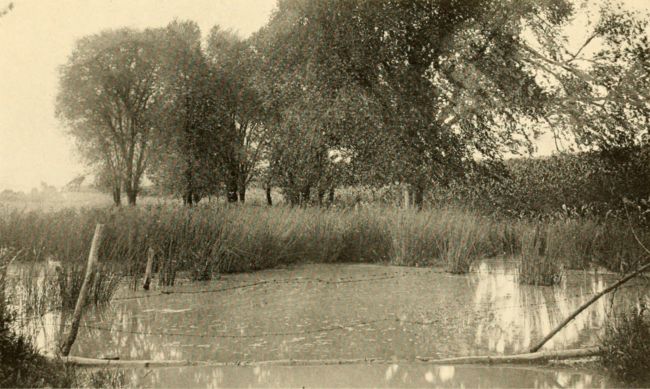
No. 6.
View of the ravine occupied by the enemy's infantry looking north from the pike where it crosses the ravine. Maj. Abbott was twice wounded at the top of the hill looking under the long limb of the first tree where the horizon shows so plainly. On the brow of the hill was a line of rebel rail breast-works. The ravine was alive with the enemy, to its head confronted by the Third Division, Sixth Corps. The enemy's artillery stationed on higher ground in rear of its infantry, firing over it together with its rapid firing literally swept, singed and scalped, the flat ground over which we charged; it was practically untenable. The continuation of this ravine south is shown in No. 7 illustration.
We were drawn up as before stated, in two lines of battle at the west entrance of the canyon facing west on an open field about midway between Abraham Creek on the south and Red Bud Creek on the north just in rear of a long narrow strip of woods which served as a great curtain to a grand, broad, slightly rolling plain several miles in extent in every direction in our front, which was to be the stage that day with the city of Winchester in the background, of one of the most dashing, picturesque battles probably ever fought in ancient or modern times at first with beautiful, silent nature about the only witness. The Third Division, Sixth Corps, was in the left and most important center of the line in two lines, the Tenth Vermont on the Berryville-Winchester pike, the most important, dangerous and stubbornly contested point in the whole line; the Nineteenth Corps was on our right in two lines; the intrepid Second Division, Sixth Corps in which was the gallant First Vermont Brigade, was on our left, one of the easiest places in the line; General Russell's valiant First Division, Sixth Corps, as reserve was stationed en masse a short distance in rear of where the right flank of the Third Division, Sixth Corps, and the left flank of the Nineteenth Corps joined, which was within a short distance and in plain sight of where I was, and our three Divisions of dashing, picturesque cavalry—including Wilson on our left along Abraham Creek running south of Winchester and Senseny Road, and Merritt and Averill on our right along the railroad and the Martinsburg pike—was massed on either flank for assault at the right moment on the enemy's flanks or as occasion might demand, while Crook's Eighth Corps was about a quarter of a mile en masse about in rear of the right flank of the Nineteenth Corps.
At noon in the midst of a perfect bedlam caused by the roar of artillery, shrieking, bursting, hurtling shells, and the voices of many officers pitched high so as to be heard above the din, giving orders, the assault was made through the thin strip of timber in our front toward Winchester when we briefly halted and laid on the ground, and then across an open field beyond the woods in all about two hundred and fifty yards where I was, midst a perfect storm of solid shot and shell, rattling musketry on my right and front, and whizzing minie balls without being able to fire a rifle at first so well was the enemy in my front protected by the lay of the ground and its rail breast-works. We persistently advanced, though, but it took a great deal of nerve and will power to do it in an open field without the slightest cover, all the time midst a perfect storm of iron and leaden hail and the cries of the wounded and dying which were disconcerting, until we drove the enemy back pell mell from its works in my front in the utmost confusion—yes, in a perfect stampede for they were old soldiers and knew when they were whipped, and when it was necessary to run with all their might to save themselves from slaughter and ignominious capture. (See Nos. 3 foreground and Nos. 5 and 6 illustrations).
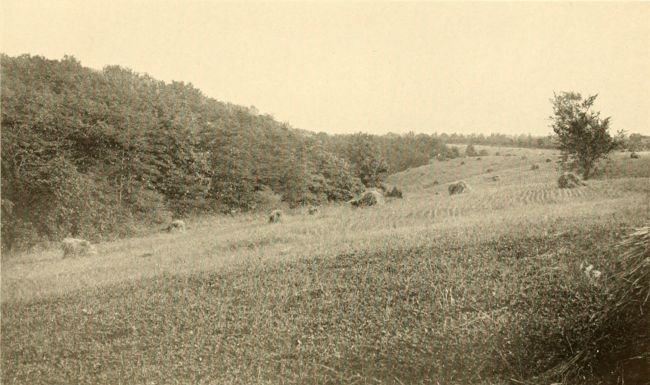
No. 7.
Ravine looking southerly from where the pike crosses it in front of most of the First Brigade, Third Division, and the right of the Second Division, Sixth Corps, mentioned by Col. A. F. Walker. Only about a regiment of the enemy was here which crossed the pike to the front of the right of the Tenth Vermont, early.
The Tenth Vermont, Fourteenth New Jersey and the rest of our brigade as usual, not only proudly led the Division at first by a good deal in the advance through the woods but in this instance the whole army. It was therefore not only the most aggressive and conspicuous part of—being on high ground where I could see our line of battle each way—but the most important point in the line; was first seen when through the wood and the most dreaded by the enemy being on the pike, and in consequence its artillery fire within reach was concentrated on us, and it was a hot place. But soon, after recovering from the collapse of the Second Brigade on my right which wholly disappeared and nothing more was seen of it by me, with the valor of the old-time "Green Mountain Boys" on we went undaunted until, after we had advanced about seventy-five yards beyond the woods now extinct behind which we had formed in the open field where I was, being then on a high point where I could see the whole battlefield, I glanced to my right and left and was appalled to see that the troops on both flanks of my Brigade were obliquing rapidly away from us, the whole Nineteenth Corps in perfect lines of battle by an oblique movement to the right having pulled away from the right of our Division until there was a gap big enough including that made by the Second Brigade, to more than admit a Brigade line of battle although it is said that Corps had been directed to guide on our Division and that a similar state of affairs existed on our left flank where the Vermont brigade was.[18] (See No. 3 through opening in woods showing No. 7; also see No. 5 where I was in the foreground). With a feeling of dismay I slackened my pace and nearly halted for I saw that through the gap in the very center and most vital point in our line on my right towards the Nineteenth Corps opposite which point was a strong force of the enemy's infantry awaiting us behind its works on the near edge of a little valley which protected it from our fire until right on it, it would throw its force so situated opposite the gap on our right and left flanks caused by the gap and have us completely at its mercy; but glancing almost immediately again to my right and rear, hearing loud military commands there, my spirits rose as I saw the gallant Russell leading his splendid Division en masse through the opening in the timber in his front, magnificently forward as though at drill to fill the gap. The appearance of his column greatly relieved us, as it drew the concentrated artillery fire from our column by the enemy largely to his. The whole battle scene at this moment at this point was one of appalling grandeur, one which no beholders could ever forget, provided they could keep their nerve well enough to preserve their presence of mind sufficiently to take in the situation midst the screeching shells and appalling musketry fire. The splendid appearance of General Russell's Division elicited a cry of admiration from all who saw it. It was the supreme moment or turning point in the great tide of battle, and as Russell's men rapidly deployed latterly under a galling fire on the march either way in perfect order enough to fill the gap, it was magnificent—beyond description—the grandest, best and most welcome sight I ever saw in a tight place in battle, and so inspired me—seeing the danger of a flank movement had passed—I again pushed forward to be in front and was there when the intrepid General Russell, one of the best fighters in the army, was twice shot and soon died a short distance to my right rear just about the time I was also twice hit; (see Nos. 5 and 6 illustrations) but when the enemy in my front and all along the little valley caught sight of our reserve coming at them so majestically and in such solid phalanx and splendid order, it seemed to me the rebs couldn't run fast enough apparently to get away. It was the most sudden transformation on a battlefield I ever saw, as well as the most perfect stampede and rout; and it was the enemy's last volley when it saw our reserve coming at them so determinedly that put a stop to my fighting for several months; and but for our reserve coming on the field just as it did I would have been worse riddled than I was by the enemy and killed even lying on the ground wounded, as I was wholly exposed where I lay close on their works not a rod away, the ground sloping towards them.
General Sheridan's plan of battle was perfect and I shall never cease to admire him as the greatest military genius I have ever seen on a battlefield, for by this and his pluck and dash, I see the secret of his great successes. The plan of battle was fully developed by the time I fell twice badly wounded—at first I supposed mortally—only a few feet in front of the enemy's works, and as I arose partially recovered from the shock of being twice hit, quivering and bleeding profusely, one of the first things my eye caught was Sheridan all alone without a staff officer or even an orderly near him, about forty yards in my rear, sitting his splendid thoroughbred horse like a centaur looking—all animation his very pose suggesting it—intently through his field glass toward the fleeing routed enemy and later after the third and last assault of the day all in a jumble with our undaunted dashing cavalry in perfect order sweeping across the great comparatively level plain bordering Winchester, like a tornado, with banners, arms, brasses, etc., brightly gleaming in the blazing autumn sunlight—a battle scene, as badly as I was wounded, the forepart of which held me entranced. As I again soon turned after the first assault, Sheridan put spurs to his horse and off he dashed all animation to another part of the field to reform his line and so on, going finally like the wind into the very midst of the great congested jumble, the enemy trying like a frightened flock of sheep to force itself through the streets of Winchester all at one time, the men literally piling themselves at the main street entrances on top of each other in order to do so. No battle scene will remain photographed so vividly on my memory as the first part of this for I could see nearly the whole field from where I long remained.
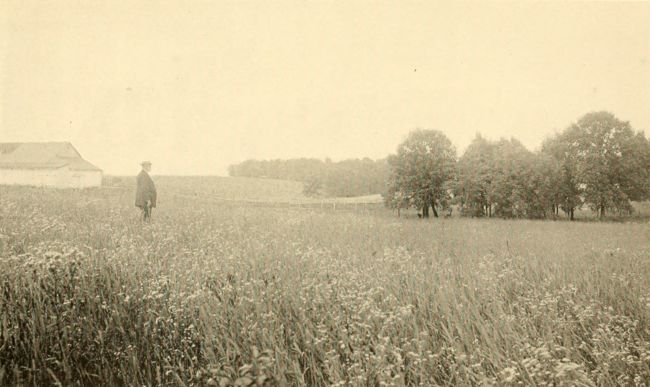
No. 8.
View from near the head of the ravine occupied by the enemy's infantry looking southerly towards the pike running along the edge of the distant forest. This is now (1908) a fine farm: its building on the left and those dimly seen in the edge of the distant wood along which the sunken pike runs have been built since the Civil War. Observe the perfect cover next to the pike for the enemy; it was here the Tenth Vermont assaulted, and the Second Brigade, this side as far north as the figure (Maj. Abbott), while the enemy's infantry behind rail breast-works and its artillery several hundred yards in rear to the right on higher ground swept the flat open field over which we charged in their front. It was almost a forlorn hope. Who would wish to criticise troops unfairly under such circumstances? The divide running east and west was about a hundred yards to Maj. Abbott's right. On its opposite or north side the Nineteenth Corps charged.
The fatal wounding in my sight near enough to hear his cry of anguish of my old Captain—Major Dillingham—and the killing of Major Vredenburg of the Fourteenth New Jersey from his horse by having his heart torn out, and others; General Russell's brilliant debouch with his dauntless division marching proudly on the battlefield en masse with all its enchanting glitter and precision to take a hand at the sacrifice of his life—unfortunate, gallant, dashing Russell—Merritt, Averill and Custer's brilliant spirited final charges on the fleeing enemy, its disorder and worst possible rout all beggar description, our retreat at the battle of Monocacy, July 9, 1864, being one of order and dignity comparatively speaking. I felt revenged for my wound and at having to run so in retreat at the Monocacy, and for my two wounds that day even if I did totteringly tarry, maimed and speechless with paralyzed tongue, chin and blanched face to look at such a brilliant battle scene until I became so faint from loss of blood, shock and partial reaction, I could hardly go steadily and finally did accept help, having declined at first, from two faithful men of my Company who, when I fell instead of stampeding stayed by me in one of the hottest places I have ever been in on a battlefield, one of whom was Corporal Joel Walker of Pownal, Vt. My first wound was from the butt end of an exploding shell in the breast which maimed and knocked me down and simultaneously as I fell a minie ball fired but a rod away in my front just grazed my forehead, torn through my upper lip crushing both jaws and carrying away eleven teeth, the most painless dentistry I ever had done; but, Oh! the shock it gave my system and the misery I suffered that night!
As I entered the long broad avenue running between the great tents at the field hospital later in the day where there were hundreds of wounded, dead and dying, Dillingham, Hill and others of my regiment, among the number, Dr. J. C. Rutherford, one of my regimental surgeons, seeing me with a man on either side—for here in sight of others I wouldn't let them support me—close to and keenly watching my unsteady carriage, came running, hastily examined my wounds, bade me sit on the ground, ran for his instrument case, placed my head upturned between his knees, sewed in place a triangular piece of flesh extending from the right corner of my nose down hanging at the lower right corner by a slight shred of flesh, which I had held in place from the battlefield with my fingers, and that job for the time being was done; but oh! my aching head, jaws and chest, as well as the extreme feeling of lassitude for the balance of the day. My face was like a puff ball, so quickly had it swollen, my chest at the point of the wishbone—so to speak—was mangled black and blue and resembled a pounded piece of steak ready to be cooked, and I was so nauseated, lame and sore all over, I dreaded to move. I guess the rebs came pretty near winging me—but Glory! Early was licked. To add to my feeling of depression, I was told Major Dillingham was mortally wounded and that he would soon pass away. He had been a good friend, a brave man, faultlessly courageous, was an elegant gentleman and good fellow, and was much beloved. A solid shot severed a leg going through the woods; his cry of anguish was distressing, and I shrink from thinking of it whenever it comes into my mind.
I fell just in front of the enemy's hastily thrown up breastworks of fence rails in the vanguard after advancing under a murderous fire about a hundred yards or more, in the open field after passing through the woods. I saw no other line officer with his men anywhere in my vicinity so far in front, and there was no other officer there in the open field except Adjutant Wyllys Lyman who was lauded for it, but I, being a boy, got nothing but my two wounds as compliments for my steadfastness, and they will stay with me through life. I wonder if when across the Great River and in another world I will be remembered any better for my faithfulness when so many others failed at such an important moment?[19]
I found the men of Company E good fighters, Corporal Walker and another big man of my Company whose name I can't recall, being so short a time with the Company—but believe it was one of the Brownells, also of Pownal, Vt.—who helped me occasionally going to the ambulance as I felt faint and weak, were brave fellows. They followed me closely all through the assault as though they expected me to be hit, fighting like heroes as they were at the same time, and when I fell wounded they dropped close by me, Corporal Walker, a giant, coolly saying: "Don't get up Lieutenant, they'll riddle you if you do!" but I thought they already had. However, the nervous shock of both wounds was too great to think of rising at once, and almost immediately the rebs were running for dear life all branches of the service mixed together in confusion—a perfect jumble. We had licked them in a square stand up open field fight of their own choice—and a very poor one, too, for them in case of defeat, as it proved—and it was clean cut, the worst stampede and rout I ever saw.
Sheridan was as brave as a lion, and unlike some commanders who hunt cover when their commands are fighting, went seemingly fearlessly anywhere he wanted to in order to see what was going on and what if any part of the line needed reinforcing. As before stated, my position on the battlefield was sufficiently high to see nearly all of it. It being a beautiful sunny Fall day with a clear atmosphere, it was the most spectacular, and before the Infantry broke, the most beautiful battlefield sight seen, and better yet, the most snappy, brilliant fighting witnessed during the war. Sheridan hovered near the centre in the neighborhood of the high ground where I was twice wounded, and dashed back and forth the line on horseback like a restless lion, an ideally alert fighter, almost as unmindful of shot and shell as though both deaf and blind. It was here that I formed my opinion that he was not only the ideal fighter, but the second, if not the greatest military genius developed by the Civil War, and I have never changed my opinion. Honest, alert, aggressive, dashing and brave with splendid judgment, his equal will be hard to find, and probably rarely surpassed. He was generally conceded a brilliant cavalry fighter, but if the world has ever produced a better planned, executed, dashing, brilliant, spectacular, snappy battle or commander than he and this Battle of Winchester, where the different branches of the service were combined, take it from first to last during the day, it would be interesting to know on what occasion. It was so unlike any battle ever seen by me that all others sink into insignificance as dull affairs. Language or words even with the most gifted talkers or writers can never describe this battle; no pen picture, or ever so gifted talker can do it justice; it would have to be seen by an expert to be fully appreciated. Ever afterwards the Sixth Corps of all others was Sheridan's favorite. Said he later: "Give me the Sixth Corps and I will charge anywhere."
Among the most admirable pictures of the fight—barring the orderly, majestic advance to battle of the whole army in unbroken lines—except after a little our division being unmercifully shelled from the start on the pike it could not withstand it, nor could any other have done so—as a whole after through the wood resembling an immense gracefully waving blue ribbon along the surface of the ground, caused by that enchantingly swinging, billowy motion characteristic of regulars when marching in large bodies, its fluttering banners, glittering arms, equipments and its blue uniforms looking prettier than ever in the bright September sunlight under a bright blue sky specked with fleecy white clouds making a picture beautiful with perfect harmony of color,—was the beauty, grandeur and majesty of both Russell and Custer's splendid debouch on the battlefield with their valiant, intrepid commands, the former's proudly and majestically en masse in perfect order and cadence, line and bearing, coolly confident as though at parade, and the latter's also in perfect lines and order, as well as dashing, intrepid, spirited and assured bearing even the horses as though vieing with each other in speed to run down the unfortunate enemy, entering into the spirit of the occasion and sweeping rapidly like an avalanche down on the demoralized, fleeing and awe-stricken enemy with the fury and apparently almost certain destruction of a tornado. These were pictures comprising awe, beauty, power, grandeur, order and disorder, dash, magnificence, valor, terror, confusion, inspiration and majesty to such an extent as to defy the pen picture of any writer however gifted. This battle was different from any other I ever saw. It was Sheridan's way of doing things—a revelation in warfare.
So far as this first assault is concerned it can be summed up quite briefly. The only considerable amount of the enemy's infantry in the immediate front of the Union infantry line of battle was in the ravine in front of our division, and it was about two hundred and fifty yards away from where we formed line behind the woods; it was a very strong force. If the troops to our right and left instead of instinctively obliquing away from us veteran like to an easier place in their right and left fronts respectively, had guided on our division as it is claimed they were directed to do, they would have had an enfilading fire on the enemy on our front, the same as General Russell's division would have had when it filled the gap to my right which the enemy knew would make their position untenable and so instantaneously retreated in a rout when it saw him coming dangerously near, his right flank overlapping their left. When Russell's movement was executed the Nineteenth Corps' lines of battle hadn't even broken. There was no considerable number of the enemy before it within striking distance so far as I could see, and therefore nothing to break its lines so far as the enemy was concerned until it reached the breaks in its front.
The Vermont Brigade could have easily advanced at any time of the assault or any other part of the Second Division, as there was nothing to speak of—as virtually acknowledged by Colonel Aldace F. Walker of that brigade in his "History of the Vermont Brigade in the Shenandoah Valley, 1864"—in its immediate front except about a regiment of the enemy which crossed the pike from his right and the left of our Brigade to my front.[20] (See No. 7 illustration). Had the Vermont Brigade borne to its right instead of its left it would have done much more effective service, as it would have been on high ground overlooking the enemy in my front when out of the ravine. In this instance the credit given this excellent brigade in at least one Civil War history is erroneous, without the Third Division was expected to whip at once and alone a considerable part of the infantry and artillery of Early's army in its immediate front, no small part of which was in our regimental front and its immediate right. In proof that there was no considerable rebel force in front of the Second Division to the left of the pike until Early's second stand, the reader is invited to examine the official War Department map of this battle and note the fact; but aside from this I know there was none. What, therefore, was to prevent the Second Division or Vermont Brigade from advancing? Unlike our front, where the strip of timber was narrow, with the enemy strongly posted just beyond, the scrub or second growth oak, etc., in front of a part of the Second Division next to us, extended from the top of the ridge or divide which ran several hundred yards southerly, down to the bottom of the ravine a hundred yards more or less, which covered here the Second Division's advance and the cleared ground beyond, after emerging from the wooded side hill and ravine towards Winchester, contained no force of the enemy, as there was no immediate protection for it, sufficient to prevent its or even the Vermont Brigade's advancing, or the enemy would have done so. (See Nos. 3, 7 and 8 illustrations.) I mention this here because I know the facts in the premises, and because this Division is complimented—unfortunately, but probably unwittingly so—in one or more histories for advancing, in unpleasant contrast to our Division, which was up against the real thing, and its advancing depended largely on the help or enfilading fire along our front, we had a right to expect from the troops which should have guided on us from both flanks, but which we never got, as they pulled away from us. It was useless to try to take such a place as confronted the right of our regiment and Division by assaulting from its immediate front (see Nos. 5 and 6 illustrations), as the enemy had to be flanked out of its position, which is what Russell's men would have done on the rebel left in case the enemy hadn't seen them in season to get away and thereby saved many casualties on both sides, and probably largely there the enemy's capture.
There were none of the Second Brigade of our Division on my right after advancing through the woods, nor had there been up to the time General Russell's command filled the gap occasioned by the Second Brigade's absence, together with the space caused by the Nineteenth Corps obliquing to its right. It being level, shell and bullet swept, it was untenable until a force came large enough to drive the enemy's infantry from cover, as Russell did. (See No. 5 illustration). I was the only officer except Adjutant Wyllys Lyman, who is deceased, so far ahead at that time on my part of the battlefield, and I can make affidavit to this statement. We and a goodly number of scattering men who generally led in most assaults were within a rod of the enemy's strongest manned works, which no map in existence shows that I have seen, where I was twice almost instantaneously wounded when the enemy ran as it saw General Russell's Division coming, as though their lives depended upon it, and I know whereof I am writing.
General Sheridan made no mistake when he selected the First Brigade for the centre and most important point of his line of battle, nor was it a mistake to place our regiment and the Fourteenth New Jersey—with direction for the rest of the army to guide on our Division in the first assault, for the road was practically straight—squarely across the pike, with their colors on it, with such men as Corporals Alexander Scott, F. H. Hoadley, Tenth Vermont, and other of the color guard like them, to keep them there, for such men would go wherever told to, if into the very jaws of death. The leaving off from the official map of this battle of the enemy's infantry in the ravine in front of the Third Division (see Nos. 6 and 8 illustrations), is a great injustice to our regiment, which never wholly fell back, but the usual per cent. of men under such circumstances stubbornly pressed forward under the most trying circumstances at any rate where I was. The leaving off of the enemy's infantry in my front, where it was strongest, is misleading and is doubtless what has caused so many wrong descriptions of this fight. No one can give a correct description of it where I was except at that point during the fight. The enemy contested this point more stubbornly than any other during the day and it was here the most intrepid of our men assaulted; it was the doorway to the great battlefield, and if the enemy couldn't hold this point it couldn't hope to any other, and didn't. Although our division was smaller than either of the other divisions of our Corps, its loss was much heavier. General Grant had one hundred shotted guns fired on his lines in front of Petersburg in honor of this day's victory by Sheridan. A citizen of Winchester told me that one of the saddest things he saw during the day was a horse going through the streets of the city with two badly wounded and one dead Confederate soldiers on it—probably chums—the latter thrown over the horse's back with his head and arms hanging on one side and his feet on the other; but war is a cruel teacher and produces the most shocking sights imaginable. It is not pleasant to record and much less dwell on them.
No. 9.
Straight view of about a half mile of the pike looking westerly towards Winchester, Va., from the divide on Sheridan's battle-field, Sept. 19, 1864. Observe the cut through the divide for the road.
The following pertaining to Sheridan's battle of Winchester has been discovered since writing the foregoing. It will be answered in detail. Says Col. Aldace F. Walker in his "History of the Vermont Brigade in the Shenandoah Valley, 1864," pp. 91-100:
"Our movement commenced at 3 o'clock Monday morning, September 19th, Getty's Division having the advance, the Vermont Brigade being the last in the Division. Striking directly across the country, at first in the darkness, we presently reached the main road from Berryville to Winchester, and moved down it to the crossing of the Opequan. This stream is considerably below the level of the adjoining country, and the road on its further side keeps the low level of the stream for a mile or more, winding through a long, tortuous wooded ravine, our unobstructed passage whereof was for the time a mystery. It seems that Wilson's Division of cavalry had already cleared the way and was then holding desperately a position that it had gained with considerable loss, but which proved a most admirable one in which to deploy our line of battle.
"As we filed out of the ravine which toward the last was lined with wounded cavalrymen, we found Sheridan, his headquarters fixed on a conspicuous elevation, personally superintending from the commencement the operations of the day. It was to be our first battle under his command, as well as his first independent battle; the troops were hitherto destitute of all enthusiasm for him; fortunately, however, no impression save a favorable one had as yet been received, it being universally conceded that he had so far handled his army handsomely. And it was with great satisfaction that we found him in this early twilight at the very front, and under the fire of the enemy, carefully attending to details which we had been accustomed to see more celebrated commanders entrust to their staff.
"Our Division promptly relieved the cavalry and formed its line facing west, the Third Brigade which was in advance going to what was to be the extreme left of the infantry line, resting on Abraham Creek; the First Brigade following, took up its position on the right of the Third, and our own Brigade filled the remaining distance between the First and the road on which we had reached the battlefield. It had been intended to place us in two lines, but the unexpected extent of the ground we had to cover forbade that formation. We were just on the hither edge of a narrow fringe of wood that concealed us from the enemy; the Sixth Vermont was thrown forward as a skirmish line perhaps one hundred yards to the further side of the little forest, and at once engaged the enemy's skirmishers."
About three regiments, I believe, of the First Brigade, Third Division, Sixth Corps, were to the left or south of the road, so the Vermont Brigade didn't reach to the pike.
"Near us in the road at our right was a rebel field work, taken by Wilson in the night. The hill on which it was situated commanded the country in both directions, and it was already occupied by a battery engaged in feeling the enemy, which was answered vigorously, many of the rebel shell plunging over into the troops as they successively came up the road.
"Our Division thus formed in a single line was the only Division on the south or left of the road. The Third Division, Ricketts', followed us and prolonged the line across and on the north of the road, placing its two Brigades in two lines. The First Division, Russell's, came next, and was drawn up behind the Third as a third line or reserve, also somewhat overlapping the right of our Brigade."
About three regiments or more of the Third Division, Sixth Corps, I believe, were south of the road, on the right of the Second Division. When General Russell's Division charged it was about two hundred yards to the right of the Tenth Vermont, or about seven hundred yards or more to the right of Col. Walker's brigade.
"Then to our surprise no more troops appeared, and our Corps was alone confronting the enemy. There were two or three anxious hours, but Early was engaged in hurrying up his detachment from Bunker Hill, which this delay gave him ample time to do, and made no assault. It was said that the Nineteenth Corps, being ordered to follow the Sixth, had filed into the road behind our wagon train, instead of keeping closed up on our column. It is certain that with this loss of time, from whatever reason it occurred, we lost the opportunity of attacking the enemy in detail, and gave him time to prepare for our reception. It was noon before the Nineteenth Corps had reached its place and was formed in three or four lines on the right of the Sixth."
The Nineteenth Corps was formed in two lines on the right of the Sixth.
"Our men during the forenoon had been resting, sitting or lying on the ground. When at last the disposition was completed and the signal gun was fired, they sprang to the ranks, and the line advanced. Particular instructions had been received to the effect that the road was to give the direction of attack, and that the guiding regiment was to be the left regiment of the Third Division, just across the road from our right."
The guiding regiments were the Tenth Vermont and Fourteenth New Jersey, on the right of the First Brigade, about the center of the Third Division.
"In passing through the bit of trees in our front, which was filled with underbrush, our line was necessarily thrown somewhat into confusion. When we emerged from the wood and the ground over which we must make our attack was developed, the prospect was appalling. The hill gradually sloped away before us, for a quarter of a mile, to a long ravine, irregular in its course, but its windings extending either way as far as we could see. The ascent beyond it was in most places sharp, and the enemy held its crest in force, perfectly commanding with musketry and artillery the long slope down which we must pass, though the acclivity on the further side of the hollow was so steep as to actually present a cover from their fire—if it could once be reached.
"When this fearful prospect opened the line involuntarily halted, and the men threw themselves on the ground as was their wont when under fire. Our own Brigade was properly waiting for the movement of the guiding regiment which lay across the road a little to our rear, and which could not be prevailed upon to stir. To add to the peril of the situation, the road, instead of continuing straight on, as seems to have been expected, here made a bend to the left so that our original orders could not be obeyed without an amount of obliquing that would have resulted in demoralization; from this cause our own Brigade was soon afterwards thrown into temporary confusion, and the Third Division was presently so disorganized as to be unable to resist a counter-charge made against it by the enemy."
The whole line in front of the enemy's infantry in the ravine in front of the Third Division halted after through the narrow belt of timber behind which we had formed, as the trees, brush and terrible shelling had broken the lines and the advanced men where I was laid down to avoid the storm of shells which filled the air till the men got together, which they soon largely did. It was here found the Second Brigade on my right had excusably gone to pieces, the ground in its front being untenable, which caused some delay; but soon we advanced alone without that Brigade, as did the Nineteenth Corps. This was why the Tenth Vermont or guiding regiment, at this time where I was, didn't move forward sooner. The bend to the left in the road is largely a myth. The line of battle wasn't formed at right angles with it which, as the line advanced led to some confusion, as our colors had to be kept on the pike. There was no counter charge in front of where I was in the Tenth Vermont or disorganization, except in the Second Brigade, but what was soon remedied. The enemy could do more effective work by remaining in cover with little loss, which it did.
"At length the commander of the Brigade at our right crossed to our side of the road and urged us to set his men the example. Col. Warner took the responsibility, brought the Brigade to its feet, corrected the alignment, and gave the command to advance, which was promptly obeyed. The Third Division followed and the line was again in motion. But our point of direction was lost, for we were in advance of our guides, and when it was seen that owing to a curve in the ravine before us the cover on its further side could be reached much sooner by obliquing sharply to the left, we took that direction almost by common consent, and left the road-side."
Why shouldn't Col. Warner with virtually no enemy in his immediate front be able to set an example of advancing his line when the Third Division was up against the real thing, it being confronted with overwhelming numbers of the enemy's infantry in the ravine and artillery back of it in our immediate front pretty much all that confronted the army in that midday assault? The situation in front of our lines is fully explained in this work elsewhere, and an alleged "bend" in the road or a "curve" in the ravine will not suffice to excuse the troops on our immediate left for not at once helping to flank the enemy's infantry from in front of us in the ravine, at once when on high ground across the ravine instead of running off on the field on a comparatively useless easy task and then have to come back. Where was there any infantry of any amount except in the ravine in front of the Third Division? Why not give the Third Division its due? The killed and wounded tell the story. Didn't our Division have about as many killed and wounded as both the First and Second Divisions together, although smaller than either? No fair-minded soldier or person can study the illustrations even, in this work, and fail to see the facts.
"Our whole Brigade, every man at the top of his speed, making for the coveted protection of the hill beyond us, plunged pell mell into the hollow. The troops at our right and left were lost sight of. The ravine was of some considerable width and its bottom was marshy, being the head waters of a little branch of Abraham Creek. The steep slope on its further side was covered with evergreens six or eight feet high. To our intense consternation, as we reached its swampy bottom, we saw at our right, at short pistol range, at least a full regiment of the enemy drawn up in line near the point where the road crosses the hollow, in anticipation of our taking precisely the course we did, and firing coolly, as rapidly as they could load, directly along our line, thus enfilading us completely. Its position is indicated on the plan. The slaughter was for a few moments murderous. We could not retreat, for we should again enter the fire that had been mowing us down in the charge, now cut off by the hill before us. We therefore floundered on, our coherence entirely lost, entered the clusters of evergreens through which the cruel bullets whistled fearfully, and at last, a confused mass at best, those of us who escaped unhurt reached comparative safety under the very crest of the hill, and high above the deadly hollow."
The probabilities are that old soldier-like seeing or suspecting the true situation, the men intuitively or purposely obliqued away to an easier place of attack; at any rate they did it. Yes, the rebel regiment which was seen in the ravine was in front of the left of our brigade, but crossed to the north side of the pike to my front early in the fight leaving no rebel force in the ravine south of the pike in front of the Second Division on the left of ours.
"We now opened fire for the first time during the day, in the direction of the regiment or brigade that had so frightfully thinned our ranks, but they were almost out of reach from us, as well as we from them. At this moment, however, the Third Division approached them and they filed away."
It is difficult to conceive why if the enemy could fire at the union forces here they could not return the compliment, at any rate to one who has so recently studied the ground. It was a good thing the Third Division was 'round to drive the rebs away, otherwise they might have more "frightfully thinned" Col. Walker's ranks. It would be interesting to know exactly how many men Col. Walker lost here.
"When this was discovered, and after gaining breath, our own advance was resumed, but with little pretense at order. Emerging upon the plain before us at the summit of the hill we had climbed, we again turned obliquely towards the road and charged upon a long breastwork filled with rebels, in our immediate front. The retreat of their comrades from the ravine apparently demoralized them; many fled, many more were captured; in fact as we clambered over the parapet it seemed as if the prisoners who then surrendered exceeded in number our entire Brigade."
I saw this movement when the men advanced seemingly to me in an undeployed skirmish line over the open flat ground beyond the ravine not shown in No. 7 illustration, but further to the right. It was a weak force and could not have met any determined resistance from any considerable body; indeed there was but a small force of the enemy's infantry on that part of the field.
"But we did not stop to count them or to care for them. The principal position of the enemy in this portion of the field had now been gained, and we rushed onward toward the distant spires of Winchester, with shouts and cheers, now thoroughly excited by our unexpected success. A battery of the enemy was before us, but it limbered up and retired as we advanced. Several times it turned, fired a round of canister, and resumed its flight. At our left the other Brigades of our Division were seen moving on in our support. At our right an unfortunate ridge now rose, parallel with our line of advance, along the top of which ran the road so often referred to, and which hid our friends from view; we could only hope that they were equally successful, and push wildly forward. A point was reached probably three-fourths of a mile beyond the entrenchments where we had captured the prisoners, when luckily a ditch running across our path suggested cover and a pause. This ditch was reached only by the colors of the Fifth, with perhaps two hundred men from the various regiments. Exhausted with running, they opened fire as vigorously as they could, but a line of rebels was seen gradually collecting in their front, as the fugitives were rallied, and the position held by our troops was presently dangerously threatened. And now to their dismay, the Brigade on the higher ground to their left saw reason for retiring and called for them to follow. What it could mean they did not know, but it seemed prudent to withdraw, if only for the purpose of keeping up the connection. An officer sent to investigate soon reported that at least a Division of the enemy were far behind their right in an orchard, which they supposed had been carried by the Third Division. Orders were given therefore to fall back to the line of the army, following the low ground on the left, thus keeping under cover of the hill at the right, the enemy meantime being absorbed in their movement against Ricketts; and thus the detachment successfully escaped from its dangerous position and re-formed with the balance of the Brigade near the works we had carried, being as before on the right of the other Brigades of our Division, connecting with and at first even in front of the support which was put in to meet the emergency."
Having watched this whole proceeding, which Sheridan saw, too, through his field glass just behind me, after I was wounded and the enemy from the ravine in my front and its artillery were in full retreat, it reads absurdly. The action of the enemy in Col. Walker's front largely depended on that of the enemy in ours, which had been routed and was in full pell mell retreat when Col. Walker's men were advancing in small irregular groups away from the before-mentioned ravine (see No. 7 illustration) they were so seemingly anxious to leave. As a matter of fact if they had swung to the right in and on the high ground west of the ravine, together with the left of our brigade, they would have done much more effective service. The retreating battery mentioned—and others further north not mentioned—retreated because its infantry in the ravine in my front was routed. As a matter of fact these Second Division men were operating comparatively uselessly far on the enemy's rear right flank and were in a dangerous situation as soon as the bulk of the enemy's infantry in my front should reach that neighborhood. I saw this, as did Sheridan, and it was one thing that caused him to put spurs to his horse and dash away to send a staff officer to recall these forces. The five succeeding quoted paragraphs are disingenuously conceived and misleading. They are worse than worthless for historical purposes because mischievous. The Vermont Brigade was too grand a body of men to be mortified by exaggerations and overdrawn situations. The truth is glorious enough, and to write on such a basis is dignified and fair.
"We afterwards learned that a break had taken place on the right which for a time seemed likely to result in complete disaster. The report in our Corps was, that the Nineteenth, advancing through a long stretch of forest and at first successful, had afterwards been repulsed, and fled in disorder, many of the fugitives even going back to the Creek, and that our Third Division had been checked soon after we lost sight of it, presently becoming more or less involved in the flight of the Nineteenth Corps. On the other hand Gen. Emory, commanding the Nineteenth Corps, in a letter published in the World, which was fortified with affidavits, insisted that the break began at the right of our Third Division, which led to the turning of his left and the consequent retiring of his Corps. The official reports disagree as much as the letters of the correspondents, who of course reflected the opinions of the several headquarters to which they were attached, and who created considerable ill-feeling by the discrepancies in their accounts, and by their insinuations; the truth is probably between the claims of both, and the real cause of the enemy's temporary success seems to have been the unfortunate bend in the road above mentioned, which interfered with and destroyed the symmetry of our first advance. Our Third Division obliqued to the left as it moved against the enemy, following the order to guide on the road, (there were few or no fences in that vicinity) and so left an interval between its right and the Nineteenth Corps, which appears to have gone in impetuously and with little order; the enemy presently made a counter-charge, and, luckily for them, struck the gap with a heavy force, crumbling off the troops on either side of it, and causing the troops on each side of the interval to think that the others had let the enemy through. The front line of the Nineteenth Corps was almost entirely disorganized, and was replaced by the second line, while only the right of our Third Division was broken up, its left with our own Division merely retiring a short distance under orders, as was necessary in order to keep a continuous front."
This is widely erroneous; Emery's left was somewhat broken at first by the terrific shelling from our front, but it was only in the edge of the shell storm at first when going through the wood. His alleged collapse virtually of the right of our Third Division, or Second Brigade, going through the narrow belt of timber behind which we formed, is correct as before stated, for it was immediately on my right, and I know it; it was largely what we halted and laid down for after getting through the timber. We feared being flanked; but the delay was short, for I almost immediately moved forward with my men and others alone over that flat, unsheltered ground, then being unmercifully swept by artillery and musketry till it was virtually untenable. The Nineteenth Corps instead of obliquing to the left towards us to shorten the interval and help us, intuitively obliqued the other way; but fortunately there was no road or bend in it to blame it to. In my opinion it was as clear a case of shirk as to the left of the Third Division, or a desire to find an easier point to attack. Emery's corps didn't retire that I know of, and our brigade I know didn't. The marching of his troops in two long lines was one of the spectacular sights of the day; it was a beautiful feature. It assaulted to the north of the slight divide running east and west, where I saw no infantry nor artillery except a little of the latter far across the breaks. The enfilading infantry and artillery fire from our front at first was about all Emery had to fear, but his Corps soon obliqued away from it. There was no counter charge by the enemy in my front or to either side, and in this I am emphatic, as well as in the fact that general officers were not where they could see as well as I. There has been more fiction written about this fight than any I was ever in.
"At the critical moment General Wright, who was for the day in command of the Sixth and Nineteenth Corps, though (as he says) 'it was too early in the battle to choose to put in the reserves, still, seeing that the fate of the day depended on the employment of this force,' promptly ordered in the First Division with two batteries; it marched gallantly down, with its full Division front, to the very face of the enemy, relieving the Third Division, which, reforming, presently took up its position still further to the right, where the interval had before been left. Sheridan held back General Upton's Brigade of the First Division until it could strike the flank of the charging column of the rebels, when it made the most remarkable and successful charge of the day, completely breaking up the rebel assault, and permitting our shattered line again to knit itself into coherence. General Upton was there wounded and the brave unostentatious Russell, the idol of the Division he commanded, was shot dead, while personally employed restoring the broken line.
"The two hours following were spent in re-arranging the troops, issuing ammunition, and making dispositions for another advance." * * *
General Russell's Division started to march on the field en masse and deployed en route; it was one of the grandest sights of the day or entire war. I never saw such splendid discipline under fire in a large body of men. It didn't relieve our brigade in the sense taken above, but did in partially drawing the enemy's musketry and artillery fire from us, which was appalling and effective. Our Brigade didn't reform. I was close on the enemy's rail breastworks in the ravine with my men leading the assault. There was no chance to reform: it was give and take. Russell's men didn't even get the opportunity of getting near enough the rebels to get satisfaction, for they ran when my men and I were within a rod of their works directly in front. There was no considerable bend in the road or anything else that obliqued my men either way to any great extent. The enemy ran before Russell was within effective striking or flanking distance. The enemy didn't charge. If General Upton assaulted its flank it wasn't here. I am emphatic in this, for not twenty seconds after I was twice almost simultaneously wounded during the enemy's last volley, it was running for dear life and Sheridan thirty seconds later was on his horse on the high ground close in my rear looking through his field glass to see where the enemy was going to make a second stand, and at other things evidently displeasing to him on his left, where Colonel Walker and the Second Division were. The whole field of active fighting could be seen from here. Five of the battlefield views herein were taken from this point. Colonel Walker is such a graceful, fluent writer it is a pity he couldn't know the whole facts about the battles the Vermont troops were in. His works would doubtless then be charmingly interesting and entertaining.
As several eminent persons, mistakenly as I think, in recent years, in a moment of weakness and gush have classed General R. E. Lee as one of the greatest of modern field marshals, and as the battles of Opequan Creek or Winchester, Va., Sept. 19, 1864, and Gettysburg, Pa., July 1-3, 1863, both of which I have carefully studied, furnish an excellent opportunity for a few pertinent questions as to the ability of Generals Grant, Sheridan and Lee to plan and manage successfully great battles, I cannot refrain from taking up the matter at this point, and I defy any honest man of expert judgment to successfully controvert my stand.
It might as well be said of Sheridan or of Grant, as it has already been of Lee by partial and incompetent judges, that either of the former were the equal of Marlborough or Wellington, and far more truthfully so than of Lee. Had the fortunes of war placed Sheridan in command of the Army of the Potomac at any period of the Civil War, there is no doubt but what that war would have developed in him a field marshal exceeding in dash, ability and brilliancy any military genius of either ancient or modern times. He was a born soldier, unspoilt by training, success or anything else, and was blessed with splendid common sense. He was a genius, for, says a popular poet: