Chapter XII · Will Perpetual Motion Ever Be Accomplished? (continued 2)
Reading edition
Demonstration
Because the orifice of the tube F is occupied by a filter (by Constr.) which separates the lighter fluid from the heavier; it follows, that if the tube be immersed to the bottom of the vessel, the fluid lighter by itself, which is mixed with the heavier fluid, must ascend in the tube, and as it will ascend above the surface of the surrounding fluid as A C : E F = 2 L : G + L : which is (by Const.) A C : E F > 2 L : G + L, it necessarily follows (by Hyp. 3) that the lighter liquid, through the orifice E, will fall in the vessel below; there it again mixes with the heavier (by Hyp. 4); and then, penetrating the filter, ascends again into the tube, and escapes by the upper orifice. So, therefore, the flow is continued perpetually.—Q. E. D.
Corollary
Hence a reason may easily be given, why water from the depths of the ocean, ascending into the summits of the mountains, bursts from them in the form of rivers and flows again into the ocean; so does Nature offer to us the spectacle of perpetual motion.
Hence I say, they do not well explain who allege that the water ascends to these heights through the pores of the earth, as a fluid ascends in narrow tubes above the surface of the fluid surrounding; for if such were the explanation of the thing, they would never be able to demonstrate it; for the water so raised to a height from the bosom of the earth, falls again, whereas we see that the fluid in these narrow tubes, although slightly elevated above the surrounding surface, never issues from their orifices and falls into the fluid below. The following is then the more feasible explanation. It is known that water in which much salt is held in solution is heavier than fresh water; now sea-water, as is sufficiently evident from the taste, contains many saline particles; consequently it is heavier than spring or river water; so that it is credible that the earth acts like a filter through the pores of which only fresh water can pass, the saline particles being left behind, and this increases the weight of the water; the fresh water must ascend much higher on account of the immense profundity of the ocean, as it is forced to the highest peaks of the mountains by the presence of the sea-water; and thence, not being able to ascend any higher, it falls in rivers.
P. Christopher Scheiner
That an earnest belief in the possibility of Perpetual Motion has not been confined entirely to scientific tyros and enthusiastic dreamers, is sufficiently attested by the fact that a respectable number of eminent scientists, many of whom had done great service in their scientific labors, have believed in such possibility.
Among these is to be mentioned P. Christopher Scheiner, a German, born 1575, and died 1650. He was a mechanic of note; in his day made valuable additions to what was known of light and optics, invented the Pantagraph, discovered solar spots, besides benefiting mankind by many other distinguished fruits of his genius.
The subject of Perpetual Motion claimed some of his attention. He wrote in defense of its possibility. The substance of what he said, translated into English, is as follows:
Let the centre of the universe then, or of gravity, be A, and the gnomon A B C, of which the extremity A is pierced and traversed by an axis going through the centre of the world, so that it may turn and revolve freely and easily around the said centre; to the other extremity of the gnomon, C, let a phial full of water be attached.
The weight C will turn around the centre A and will first come to D, thence to E, thence to F and G; then it will return to C, having described a complete circle, C D E F G; then it will again move to D, E, F, etc., and so perpetually, since there is no reason for its stopping in any point of the circle rather than in another.
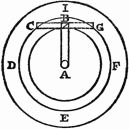
That indeed the weight C affixed to the gnomon will move from C to D, is proved by daily experience, by which it is established that a gnomon so contrived and placed erect on any flat space, will not be able to stand, but the arm B C, C preponderating, will move towards D.
It may in the second place be proved, that if, on the other hand, another arm B G be added to the gnomon, equal in weight and similar to the other, the whole G B C A will remain motionless in equilibrium; therefore the arm B G being taken away and equilibrium being destroyed, the arm B C must move in the opposite direction.
The above, from Scheiner, called forth the following from Schott, who was also an eminent mathematician:
Whether there could be a perpetual artificial motion around the centre of the earth?
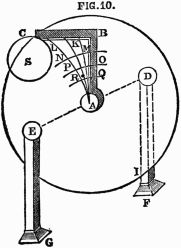
We have treated this question in our Hydraulico-pneumatic Mechanics, Part 2, Class 2, Machine 13, not however universally, but only in one particular case, that of the Gnomon of Scheiner. For P. Christopher Scheiner, in "Mathematical Disquisitions," in Number XV., Corollary 4, asserts Perpetual Artificial Motion not to be repugnant to Nature, and attempts to prove it in the following manner. Let a gnomon of a certain weight A B C be suspended around A, the centre of the universe, and bound to the beam D F, which is supported by the columns D F and E G and turns at the pole D or E; or let it be fixed at the poles, but the gnomon revolving at A.
These being the conditions, I say that the gnomon A B C will revolve from C to H and towards I, thence will return to C, thence to H as before, and so on perpetually. The cause of this continual motion is the forcible suspension; for the whole gnomon preponderates in C on account of the perpendicular tangent B A; which effect becomes more marked if a globe of iron S be supposed suspended at C. As therefore the whole of this mass, as well from the supports of the balance as from the momentary diameter, hangs suspended at C, and the vertex A, on account of the firm beam D E, cannot fall from the centre of the universe; it comes to pass that all points as well of the globe S, as of the gnomon A B C, with a continual motion turn round A; but because, by the line B A in the fixed point A, they are held from falling to the centre; therefore the greatest force of that tendency is exerted in the line B, and induces it to inclination; which inclination on account of the continuous solidity of the gnomon cannot be at all abated, so that the whole impetus is exerted either at the point A about the movable beam or at the movable poles of the beam D and E; which poles being free in their sockets D and E, abandon themselves to the motion of Nature, and thus do not in any wise hinder a perpetual circular motion. What indeed is self-evident in this, reason confirms, and daily experience in statics manifests. For if a short gnomon stand either on the terrestrial superficies M N, O P, or Q R; it will always fall towards the part C, or N, by the preponderating portion M K C; which is manifested in daily experiments.
Thence it is evident that if the gnomon were entire, the force which it exerts at N would pass into the line B A still hanging over the centre. And this is one argument. The other is from the contrary. For if an equal and similar gnomon were attached towards the part D, then the whole mass hanging on its centre would remain in equilibrium and there would be no motion; consequently the one half being taken away, the other would necessarily move according to the laws and experience of statics. If the shortened gnomon M B C N were bound only to the point M, the rest being left free, it would certainly revolve, and in the same case, the point C would describe almost a semicircular arc till, coming down to a perpendicular position, it would there remain.
Now as the force of the entire gnomon falls in the vertex A, there would be an entire and perpetual revolution around A. Much more would this be the case if on the centre C stood either the small curve A C L A or the larger one A K C, or finally the globe S alone, hanging from two iron rods A B and B C, or from one arc, A N C. From this, therefore, it may be demonstrated that a perpetual circular motion is possible.
In 1825, the following was contributed to and published in "Mechanics' Magazine." We are unable to give the name of the contributor, but he writes in encouragement of Perpetual Motion. The gist of his article is as follows:
We can now, however, soar above the clouds, explore the depths of the ocean, and skim over its surface. * * * And be it remembered that we owe these and many other advantages to a few persevering individuals who were, in all probability, stigmatized as chimerical visionaries by those who seem to have an unconquerable propensity to condemn everything above the level of their own understanding.
If by perpetual motion nothing more is meant than the putting in motion some of the most durable substances with which we are acquainted, in such a manner as to ensure a continuance of motion as long as those substances will resist the effects of time and friction, I do not despair of seeing it accomplished. * * * [He thinks there is] reasonable ground to hope that the time is not far distant when even this impossibility must yield to persevering ingenuity. In the present state of public opinion with regard to its practicability, it would be looked upon as an empty boast, were I to assert that the discovery is already made.
T. H. Pasley
T. H. Pasley in 1824, contributed an article to "Mechanics' Magazine," asserting the possibility of Perpetual Motion. The following excerpts give the substance of his article:
I feel no hesitation in standing up in support of this grand desideratum,—this almost forsaken friend of science,—whether the thing be practicable or not.
On the contrary, "Persevere" should be every one's advice; to do so, or discontinue, every one's own pleasure. And why should the impossibility of anything be pronounced unless it be established wherein the limits of possibility consist?
It is puerile in the extreme to be foretelling defeat when so many other objects may be gained by the highly laudable pursuit, perhaps of greater advantage to society at large than the discovery in question. * * * In a word, were the perpetual motion discovered tomorrow, it would be wise of all the governments of the world to offer a very high reward for some species of discovery that would be universally sought after, although it might never be found out. * * * The effects of industry are—enlargement of the mind, accumulation of knowledge, and rendering ourselves ignorant of the torments which idleness and dulness always engender. * * * In the next place, there are no solid grounds for the assertion that the discovery of a perpetual motion is an impossibility. In the present state of human knowledge respecting the powers of nature, it is not demonstrable one way or another. * * * The study of what relates to the perpetual motion has this great advantage, that it directs to the discovery of error as well as of truth; whereas, what are they which are called truths of science at present but vacillating human opinions, or erroneous assumptions of what we call natural causes? What are they but such as consist in mere assumption, sanctioned by time, and admitted by existing authorities in science, and of course generally acquiesced in, without previous investigation?
So far, then, from being guided in our decision respecting what is possible by the "unerring laws of nature," by "mathematical demonstration," and by "experimental proofs," we are continually misled by an erroneous faith in the nonentity, attraction.
On such an imperfect knowledge of the causes of phenomena, who should say he knows what can or what cannot be discovered?
Article From Pamphleteer
In the "Pamphleteer," published in London, the following by a correspondent whose name we cannot give was published in March of 1822:
"A few words inducing towards the discovery of Perpetual Motion, perhaps the actual discovery thereof:"
London, March, 1822.
What is meant by the term "Perpetual Motion?" Is it supposed that there is an undiscovered substance in the world, that will of itself perpetually move, with as little apparent cause as that which actuates the needle in becoming motionless in one particular position? Or, is it to be found in the combined reaction of mechanical powers?
The first idea is stamped with a degree of probability, by the mystery of the needle; yet I imagine the latter is relied on with the greater confidence of mankind, and is the pith of the following few words:
It is well known that the weight of a pendulum will almost regain the level from which it descended, losing a little space at every vibration, until it becomes motionless; if of itself it could exceed or even regain the level, doubtless it would become a perpetual motion.
To find a power that will aid the motion of the pendulum, and in conjunction renew its strength, is what is wanted to create perpetual motion.
What I shall endeavor to explain will at least induce towards the discovery of this power.
The principal parts of the machinery about to be shown are in number three:
A vibrating pendulum.
A revolving pendulum, and
A tubular lever.
A vibrating pendulum in motion describes a segment of a circle, and returns on the same segment, and at every vibration its described segment decreases.
A revolving pendulum is composed of two or more pendulums, united at their lighter extremities, there revolving on an axis, the heavier extremities being placed at equal distances in the outer circle: this, I believe, is what is termed a fly-wheel when affixed to hand-mills, etc.
The tubular lever is the chief instigator of the whole, and must contain a weight apportioned to the weights of the two pendulums.
Fix the lever on a cross axis; thus, on an axis within a circle, the circle on an axis at opposite angles, thereby is given to each extremity of the lever a revolving power of motion; attach one extremity of the lever to the outer circle of a revolving pendulum, the other extremity confine within the bar of the vibrating pendulum; thus combined, the effect to be produced when put in motion will be this:
The two pendulums will guide the motion of the lever, which then partakes of the power of a pendulum, giving fresh impulse at every vibration of the pendulum, and every half revolution of the revolving pendulum; for, as each extremity of the lever rises, the weight within falls to the opposite extremity, and gives fresh impulse to the whole: thus (if my idea is correct) will be produced motion perpetual—that is to say, perpetual so long as the materials of which it is made will hold together. I have given this short description merely by way of example, as I believe there are several ways of combining these three powers, so as to produce perpetual motion, if my idea on the subject is correct.
The lever may contain mercury or a solid orb of heavy substance; and if the tube be exhausted of air the weight will pass more freely, and certainly increase the power of the lever.
J. Welch
In 1825 the following article was published in "Mechanics' Magazine," having been contributed by J. Welch:
Those who condemn the notion altogether seem to have taken but a very confined view of the subject. What they say about mere matter is right enough; but they seem to forget that there are other active agents in nature which possess wonderful powers, that have nothing to do with either bulk, weight, or form. Such are electricity, magnetic attraction, capillary attraction, and the irregular pressure of the atmosphere. The powers of electricity are great, and, indeed, it seems to be the primum mobile that gives life and motion to the animated part of the creation. Dr. Franklin shows us how to give a circular coated plate, revolving on an axle, sufficient power to roast a chicken, merely by once changing (charging?) it. Could not a plate of this kind be made to turn a small electrical apparatus, so situated as to keep the charge in the plate always at its maximum? The whole might be kept dry by having it enclosed in a glass case.
It has often been attempted to give motion to a wheel by the power of a loadstone, but hitherto without effect; no substance in nature being found to have the power, by interposition, of cutting off its attractive property. Still I think it should be further investigated. Is a small piece of steel in the form of a wedge as strongly attracted at the smaller end as at the thicker? And would not twenty or thirty pieces of steel, of that form, placed round the circumference of a circle, the point of one towards the head of the other, cause a magnet placed in the centre, to revolve in the direction in which their points lie? I think, perhaps not; but still such experiments should be tried.
In capillary attraction we have a power that at once raises fluids above their level. It is this which carries the oil up the wick of a lamp as fast as the flame consumes it. Water and other fluids rise through cotton even quicker than oil; and he who can contrive to collect them as they arrive at the top will discover perpetual motion. Would not water run constantly through a siphon, one leg of which was made of a collection of capillary tubes, and the other in the usual way? or would the water above and below the tubes neutralize and destroy their power?
I now come to the pressure of the atmosphere, a thing easily understood. * * * Make a cast-iron barometrical tube, with a top sufficiently large to contain 2 cwt. of mercury; invert it in a basin large enough to contain 2 or 3 cwt. more, and let a piece of iron of 10 or 12 stones weight float on the mercury in this basin, so as to rise and fall along with it at every change of the weather. We have here both motion and power. The motion, indeed, will sometimes stand still, but then it can easily be regulated, and made a constant quantity in the machine to be attached. I have no doubt but clocks, etc., may be made to derive their chiming principle from a contrivance of this nature.
Article From Mechanics' Magazine
In 1831, the following article was contributed by an unknown correspondent to, and published in "Mechanics' Magazine":
"Yes; we shall conquer! All those dangers past Will serve to enrich the future story."
The application to the subject, on my part, has been accompanied by continual experimental elucidations of the subjects considered, and comparisons of these with the axioms, theorems, and demonstrations of one of the best authorities, if I may be allowed so to call my favorite author, Emerson, whose I says are generally correct.
I disagree with Mr. B., and do trust that even a perpetual motion seeker might deserve encouragement, if it be found that such a character may exist in a person who is not so ignorant of first principles as Mr. B. supposes all are who have this bias; especially if it be found that the person's researches have been connected with subjects of a more tangible nature, relating to the improvement of the useful arts, and particularly to some modern inventions of high importance that are not perfectly correct in their construction.
In this article, Mr. B. advises those who are misspending their time in this pursuit, to consider the question in its most simple form, divested of more complicated operations, which simple form is that of a pulley accurately constructed so as to reduce the resistance to motion as much as possible. He says, "it will be found, as long as the weights are equal," there will be no motion produced, but wherever the weights are placed they will remain; and to produce vertical motion in the smallest degree, it will be necessary to add a weight to one of the former to create a preponderancy. This weight he calls the mechanical loss, and an insurmountable bar to perpetual motion, etc. We need not follow Mr. B. to his conclusion, as I think this insurmountable bar can be easily removed; and I shall be able to show that this equilibrium, for such it merely is, can be destroyed without adding to one of the weights, or absolutely taking from the other; though this may virtually be considered to be the case, inasmuch as we can at least produce an effect on the system as if the weight were reduced. Mr. B. says, under this arrangement, "wherever the weights are placed they will remain, unless an addition is made to one of them." We will therefore suppose the following diagram to represent the arrangement on a small scale, delicately constructed.
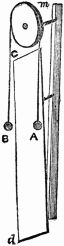
A B are the two weights connected to each other by the string passing over the pulley, and being nicely equalized in their weight, here would, of course, be an equilibrium on the principle of the lever. But take a flat piece of wood, such as a ruler, and place it obliquely in a way so as not to interfere with the pulley m in the direction d, and then bring the weight to impinge upon it in a way so as not to move the weight A m, C d, the least, or alter its position. What will be the consequence? Some would say, why, the weight A would then descend, and cause the weight B to ascend. But I should rather say, the reaction of the plane when acted on by the weight B, having destroyed the equilibrium of the forces, motion takes place. Now, if we attribute this motion to the reaction of the plane on the weight, though we will not go so far as to say motion is generated, yet if we say, by this simple arrangement the equilibrium is destroyed and motion takes place, the least we can admit is, that motion is communicated to the system, and that by the agency of part of the machine itself, the apparatus employed being considered as such. Then, why so much objection to the term self-moving machine in limited sense? But I will not dispute about words, which are but the images of things, and images may be strangely distorted by the medium through which they are received—of which distorting mediums, there is none equal to that of prejudice in favor of abstract notions—which notions perhaps, if rigidly examined, would be found to have no foundation in facts or in common sense.
Another demonstrator of the impossibility of perpetual motion, is Mr. Mackinnon (see "Mechanical Magazine," Vol. 1, Page 363). As no doubt the different attempts to produce, or communicate, continued and perpetual motion, at least, such as are often brought forward by persons unacquainted with the science of mechanics, are generally to those who are acquainted with that science, if not absolutely ridiculous, yet of a nature to excite a smile at their futility: still there are a few (perhaps a very few) who entertain an opinion that such a thing is not impracticable, and who have, from practical experience as well as study, acquired a tolerable insight into the laws of nature (so far as relate to this subject); who in their turn cannot help smiling at the weak reasoning of some other would-be philosophers, who gravely give their dictum in the case. In this class I include Mr. Mackinnon, who very gravely goes to work to prove, etc., and flatters himself he shall, if rightly understood, help to prevent much future waste of time on the subject. He then goes on to give us his definition of inertia, by which he informs us that a body in a state of rest will remain so until it is moved (wonderful!)—that it cannot move itself—that it has not that power—and that no mechanical contrivance can give it that power. (How profound!)