Chapter VII · THE EXTRACTION OF ODORS.
Isidor Furst translation
Excepting the articles made in Turkey and India (especially oil of rose), most aromatic substances are manufactured in southern France and the adjoining regions of Italy, while a few (oils of peppermint and lavender) are produced in England; a few also (oils of peppermint, spearmint, wintergreen, sassafras, etc.) in the United States. However, as we have stated above, it is possible to cultivate some plants from which odors are extracted in the warm sections of this country, and to obtain the most expensive perfumes from them. Among these plants our experience leads us to suggest violets, roses, reseda, lavender, mints, syringa, lilac, and several others to which the climate is adapted.
The methods by which the odors can be extracted from the plants differ according to the physical properties of the raw material and the chemical composition of the aromatic substance. We shall here briefly describe the methods thus far known, and at the same time add our own experience in this most important part of the art of perfumery. The aromatic substances are obtained by pressure, by distillation, by maceration (infusion), by absorption (enfleurage) through air or through carbonic acid, and by extraction.
Pressure.
Certain aromatic substances that occur in large amounts in some parts of plants, are best obtained by pressure. The rinds of certain fruits contain an essential oil in considerable quantities inclosed in receptacles easily distinguished under the microscope. When these vegetable substances are subjected to strong pressure, the oil receptacles burst and the essential oil escapes. The force is usually applied through a screw press with a stout iron spindle; the vegetable substances being inclosed in strong linen or horse-hair cloths, placed between iron plates, and subjected to a gradually increasing pressure. Comparative experiments have shown us that even with the most powerful presses a considerable, amount of oil is lost owing to the fact that a large number of oil receptacles remain intact. For this reason, when oil is to be extracted by pressure, a hydraulic press is preferable, as it develops greater power than any other press. In the hydraulic presses used for this purpose the piston fits exactly into a hollow iron cylinder with sieve-like openings in its circumference. The vegetable substances are filled into this cylinder; when the pressure is applied, the fluids escape through the perforations, and the residue forms a compact woody cake which is then free from oil.
Besides the essential oil, watery fluid is expressed, the whole appearing as a milky liquid, owing to the admixture of vegetable fibres, mucilage, etc. It is collected in a tall glass cylinder which is set in a place free from any vibration. After remaining at rest for several hours the liquid separates into two layers, the lower being watery and mixed with mucilage, that floating on top being almost pure oil. The latter is separated, and finally purified by filtration through a double paper cone in a funnel covered with a glass plate.
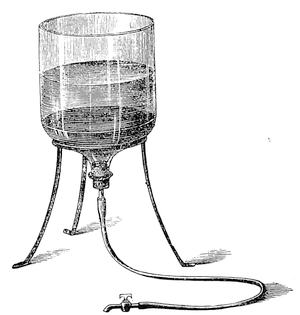
Fig. 4.
It is best to separate the water and oil in a regular separatory funnel, or in a simple apparatus illustrated in Fig. 4. It is made by cutting the bottom from a tall flask, and fitting into the neck by means of a cork a glass tube having a diameter of one-fourth to one-half inch. A rubber tube with stop-cock is fastened to the glass tube. By careful opening of the stop-cock, the watery fluid can be drained off to the last drop.
To the perfumer this method is of little importance, since it is applicable only to a few substances which, moreover, give cheap odors. Still, the possession of a hydraulic press is advisable to every manufacturer who works on a large scale, as it is useful also in the preparation of several fixed oils frequently employed in perfumery, for instance, oils of almonds, nuts, etc.
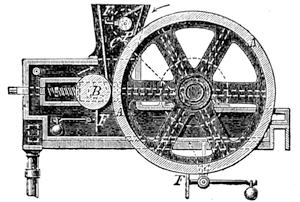
Fig. 5.
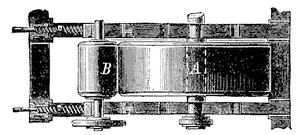
Fig. 6.
Fixed oils are best extracted in so-called drop presses, the material having first been comminuted between rollers. These are arranged as shown in section in Fig. 5, and in ground plan in Fig. 6. The apparatus consists of two smooth or slightly grooved iron cylinders A and B, respectively four feet and one foot in diameter, which can be approximated or separated by means of set screws. The material is placed into the trough F containing a feeding roller moved by the belt P. The scrapers FF, pressed against the cylinders by means of weighted levers, free the rollers from adhering pieces.
The drop presses Figs. 7 and 8 consist of a hydraulic press with cylinders A and piston B; the troughs E are movable by means of rings between two vertical columns and every trough has a circular gutter d for the reception of the expressed oil. The iron pots G have double walls, the inner of which has a series of openings at its upper part; these pots are filled with the bruised material to be pressed and after this has been covered with a plate of horse-hair tissue are set in the press.
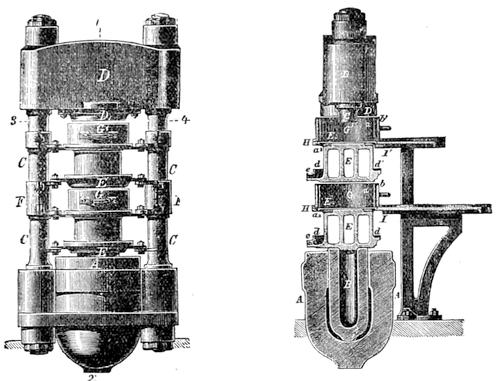
Fig. 7. Fig. 8.
As the piston rises, the troughs E sink into the pots, the escaping oil collects in the gutters d and thence passes into a receptacle. After pressing, the piston is allowed to sink back, the pots G are drawn aside (Fig. 8) to tabular surfaces, and other pots are substituted for the exhausted ones. These drop presses are suitable for the extraction of all fixed oils and also volatile oils present in orange and lemon peel, etc.
Distillation.
Many odors or essential oils possess the remarkable property that their vapors pass so largely with that of boiling water that they can be extracted in this way (by “distillation”) from vegetable substances, though the essential oils have a boiling-point far above that of water. Distillation can be employed for a large number of substances; for instance, the essential oils present in cumin, anise, lavender, fennel, mace, nutmeg, etc., are extracted exclusively in this manner.
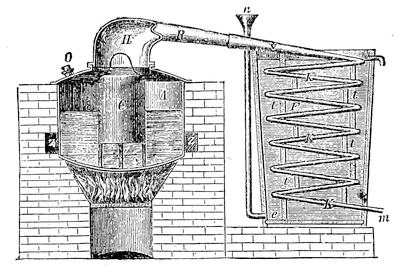
Fig. 9.
For the extraction of odors in this way, according to the quantities of material to be worked, different apparatuses are used, some of the most important of which will be here described.
For manufacturers who run without steam and are obliged to use a naked flame, the adjoining apparatus (Fig. 9) will be advantageous.
It consists of a copper boiler A, the still, set in a brick furnace. The latter is so constructed that the incandescent gases strike not only the curved bottom of the still, but also its sides through the flues Z left in the brickwork. The still, whose upper part projects from the furnace, has an opening O on the left side, closed air-tight with a screw, which serves for refilling with water during distillation when necessary. To the margin of the still is fitted steam-tight the helm H, made of copper or tinned iron, having a prolongation, the tube R. The latter is joined to the conical projection v which terminates in the worm K. In some apparatuses this projection is omitted and the tube immediately joins the worm. The latter is made of tinned iron and, as the cut shows, is arranged in coils and supported by props t in the wooden or metal condenser F. The condenser bears above a short bent tube b, and below, immediately over the bottom, an elbow tube e, long enough to reach above the edge of the condenser, as indicated in the cut.
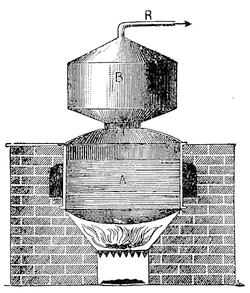
Fig. 10.
The vegetable substances to be distilled can be put immediately into the still and covered with water; but in this case it is advisable to use a stirrer which must be kept moving until the water boils, otherwise the material might burn at the bottom. But this accident can also be prevented by applying a perforated false bottom to the still above the flues, or by inclosing the material in a wire-sieve basket C.
In place of the basket C the apparatus can also be provided with an additional vessel containing the material to be distilled. In the still A (Fig. 10) the water is brought to boiling, the steam rises through the second still B in which the material is spread on a perforated bottom. The steam laden with the vapors of the essential oil passes through the tube R into the condenser.
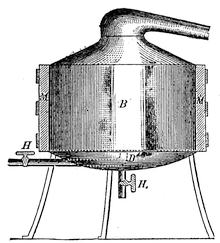
Fig. 11.
It is very advantageous, and in large establishments altogether indispensable, to use steam in the distillation of essential oils. Fig. 11 represents the arrangement of such an apparatus. The still B (which in this case may be made of stout tinned iron) stands free and is provided with a wooden jacket M for the purpose of retaining the heat. Immediately above the curved bottom is a perforated plate on which the material rests. The tube D which enters the bottom of the still is connected with the boiler which furnishes steam at moderate tension. H is the faucet for the admission of steam; H. is the faucet by which the water escapes from the still at the end of the operation. After the still is filled with the material, the faucet H is opened gradually and a continuous stream of steam is allowed to pass through the still until the operation is finished.
When working with an open fire, as soon as vapors appear at the lower end of the worm (Fig. 9), cold water is admitted through the tube ne; as the cold water abstracts heat from the vapors and condenses them, it becomes warm, rises to the surface, and escapes through b, so that the worm is continually surrounded with cold water. If for any reason the saving of cold water is an object, its flow may be so regulated that the vapors are just condensed, the warm distillate being allowed to cool in the air. When working with steam, the cold water must be admitted the moment the steam-cock is opened, and the flow of cold water should be ample during the distillation, which in this case is much shorter.
The large apparatuses here described are generally used, especially for the extraction from vegetable substances of odors present in considerable quantity, for instance, mace, nutmeg, cloves, cinnamon, etc., or from bulky material as the various flowers. For very expensive odors, smaller apparatuses are often employed, the construction of which resembles that of the ones described. For this purpose small glass apparatuses are very suitable; they are illustrated in Fig. 12.
The still, a retort A, consists of a spherical vessel with a bottle neck t which is either closed with a cork or carries a thermometer or glass tube, and with a lateral tube, the neck of the retort, connected with the adapter r. The latter passes into the condenser C. At the lower end of R is the bent adapter v under which is placed the receptacle for the distillate. The tube C is closed with corks, at its lower end is the ascending tube h, and at its upper end the descending tube g. During the distillation cold water flows in through h which cools the tube r and escapes at g. The tube C, as will be readily understood, acts like the condenser in the larger apparatuses above described. In order to prevent the breaking of the retort, it is not heated over a flame, but is set in a tin vessel B filled with water. The comminuted vegetable material is inserted with water through the up-turned neck of the retort into the latter; the vessel B is filled with water which is raised to the boiling-point.
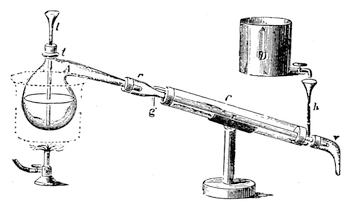
Fig. 12.
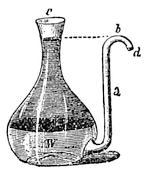
Fig. 13.
During distillation we obtain at the lower end of the condenser pure water and essential oil. When larger quantities are to be distilled it is advisable to use a Florentine flask as a receptacle for the separation of the oil and water (Fig. 13). It consists of a glass bottle from the bottom of which ascends a tube curved above; the latter rises high enough to bring the curvature slightly below the neck of the flask. During the distillation the flask becomes filled with water W, on which floats a layer of oil O; the excess of water escapes through a at d until the flask finally contains more oil and very little water.
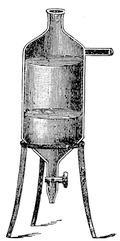
Fig. 14.
When producing essential oils on a large scale, instead of the frail Florentine flasks it is advisable to use separators, the construction of which is illustrated in Fig. 14. They consist of glass cylinders, conical above and below, supported on a suitable frame. The water accumulating under the oil is allowed to escape by opening the stop-cock; when the first separator is filled with oil, the succeeding distillate passes through the horizontal tube into the next separator, etc.
When the distillation is carried on in an ordinary still, we obtain, besides the essential oil, a considerable quantity of aromatic water, that is, a solution of the oil in water.
An apparatus which obviates the losses caused thereby is that of Schimmel described below, which is well adapted to the manufacture on a large scale. The apparatus is patented.
The nearly spherical still D (Fig. 15) is surrounded by a jacket M; the inlet steam tube R is connected with a branch r which enters the interior of the still as a spiral tube with numerous perforations, while R opens into the space M. When r is opened, distillation takes place by direct steam; when R is opened, by indirect steam; when both faucets are opened, the still is heated at the same time with direct and indirect steam.
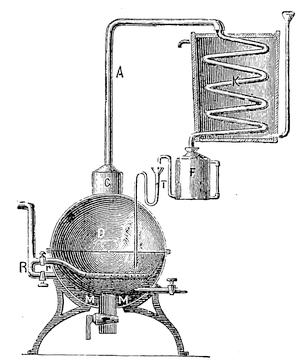
Fig. 15.
The vapors rising from the still D pass through the helm C and the tube A into the worm K; the fluid condensed in the latter drops into the tin Florentine flask F, the aromatic water flowing from the latter passes back into the still D through the Welter funnel T and is distilled over again, so that the entire distillation can be effected with very little water, and it is continued until the water escaping from the Florentine flask is freed from oil and odorless.
When working with superheated steam, it is necessary to set under the funnel tube T a vessel twice the size of the Florentine flask, which is provided with a stop-cock above and below. The lower cock is closed, the vessel is allowed to fill with water from F, then the upper cock is closed, the contents being allowed to escape into D by opening, when the cocks are again reversed.
The use of superheated steam is important especially with material which gives up the contained oil with difficulty, such as woods.
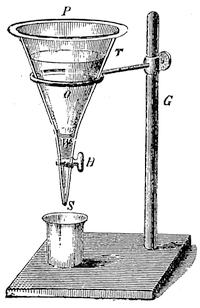
Fig. 16.
For freeing the essential oil completely from water we use a so-called separating funnel (Fig. 16). This consists of a glass funnel T resting on a suitable support G, which is closed above with a glass plate ground to fit, drawn out below into a fine point S, and provided with a glass stop-cock H. The contents of the Florentine flask are poured into the funnel which is covered with the glass plate and allowed to stand at rest until the layer of oil O is clearly separated from the water W. By careful opening of the stop-cock the water is allowed to escape and the oil is immediately filled into bottles which are closed air tight and preserved in a cool and dark place.
Maceration (Infusion).
Some odors, like those of cassie, rose, reseda, syringa, jasmine, violets, and many other fragrant blossoms, cannot be obtained by distillation as completely or as sweet-scented as by the process of maceration which is in general use among the large perfumers in southern France. This process is based on the property of fats to absorb odorous substances with avidity and to yield them almost entirely to strong alcohol. According to the fat employed for the maceration of the flowers—a solid fat like lard or a liquid like olive oil—odorous products are obtained which are known either as pomades or as perfumed oils (huiles antiques). By repeatedly treating fresh flowers with the same fat the manufacturer is able to perfume the pomade or oil at will, and in the factories these varying strengths are designated by numbers; the higher numbers indicating the stronger products.
The process of maceration is very simple. The fat is put into porcelain or enamelled iron pots which are heated, in a shallow vessel filled with water, to 40 or at most 50° C. (104-122° F.); the flowers are inclosed in small bags of fine linen and hung into the fat, where they are allowed to remain for from one-half to two days. At the end of that time the bags are removed, drained, expressed, refilled with fresh flowers, and replaced in the fat. This procedure is repeated twelve to sixteen times or oftener, thus producing pomades or oils of varying fragrance.
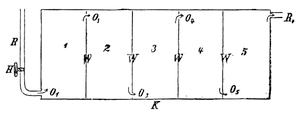
Fig. 17.
As the odors are much superior when the flowers are only a short time in contact with the fat, it is better to use an apparatus for continuous operation (Fig. 17). It consists of a box K made of tin plate, which is divided into from five to ten compartments by vertical septa and can be closed water tight by a lid to be screwed on. The septa have alternate upper and lower openings. The compartments contain each a basket of tinned wire filled with the flowers for maceration, then the lid is closed and the box heated in a water bath to 40 or 50° C. (104-122° F.). The stop-cock H in tube R is now opened. This admits melted fat or oil from a vessel above to the first compartment in which it rises through the basket filled with flowers whose odor it abstracts. The additional fat coming from above drives it over through the opening O2 into compartment 2, where it comes in contact with fresh flowers, passes through O3 into the third compartment, and so on through 4 and 5, until it finally escapes through R1 well charged with odor. According to requirements a larger number of compartments may be employed.
When all the fat has passed through the apparatus, it is opened, the basket is removed from compartment 1, the basket from No. 2 is placed in 1, that from 3 in 2, etc.; basket 1 is emptied, filled with fresh flowers, and placed in compartment 5, so that every basket gradually passes through all compartments to No. 1. In this way the fat rapidly absorbs all the odor.
The odorous substances are abstracted from the pomades or huiles antiques by treatment with strong alcohol (90-95%) which dissolves the essential oils but not the fats. The huiles antiques with the alcohol are placed in large glass bottles and frequently shaken. In order to abstract the odors from pomades, the latter are allowed to congeal and are divided into small pieces which are inserted into the bottles of alcohol. A better plan is to fill the pomades into a tin cylinder with a narrow opening in front and to express the pomades, by a well-fitting piston, in the shape of a thin thread which thus presents a large surface to the action of the alcohol, thus hastening the absorption of the odor. The alcoholic solution obtained after some weeks is then distilled off at a low temperature. We shall recur to this hereafter.
No matter how long the fats are left in contact with alcohol, they do not yield up to it all the odor, but retain a small portion of it and hence have a very fragrant smell. They are, therefore, brought into commerce as perfumed oils or pomades bearing the name of the odorous substance they contain: orange flower, reseda pomade or oil, etc.; they are highly prized and are sometimes used again for the extraction of the same odor.
Some odors cannot bear even the slight rise of temperature necessary for their extraction by the method of maceration or infusion. For these delicate odors one of the following methods may be employed.
Absorption or Enfleurage.
In this method the absorbing power of fat is likewise used for retaining the odors, but the flowers are treated with the fat at ordinary temperatures. This procedure which is employed especially in southern France is carried out as follows. The fat (lard) is spread to a thickness of about one-quarter inch on glass plates G one yard long and two feet wide, which are inserted in wooden frames R and sprinkled with flowers F (Fig. 18). The frames are superimposed (the cut shows two of the frames) and left for from one to three days, when fresh flowers are substituted for the wilted ones, and so on until the pomade has attained the desired strength.
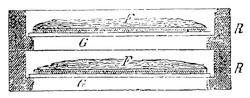
Fig. 18.
This procedure is very cumbrous and tedious and therefore had better be modified thus: In an air-tight box K (Fig. 19) we place a larger number of glass plates g covered with lard drawn into fine threads by means of a syringe. This box is connected with a smaller one K1 which is filled with fresh flowers and provided with openings below and above, O and O1. The latter, O1 communicates by a tube with box K, at whose upper end is a tube e terminating in an exhaust fan so that the air must pass through the apparatus in the direction indicated by the arrows. A small fan V driven by clockwork will answer. The air drawn from K1 is laden with odors and in passing over the fat as shown by the arrows gives them up completely to the fat. The use of this apparatus has very important advantages: the absorption is effected rapidly, requires little power, and the flowers do not come at all into contact with the fat which therefore can take up nothing but the odors present in the air.
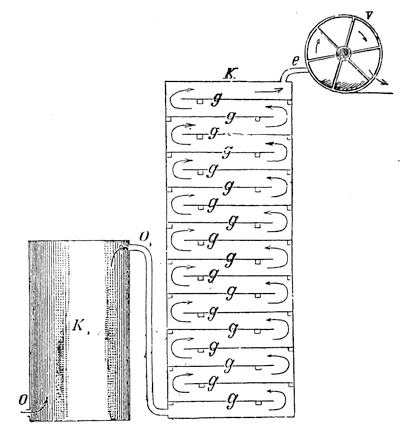
Fig. 19.
Instead of charging the fat with odors by either one of the methods here described, carbonic acid can also be employed with advantage, by means of the apparatus illustrated in Fig. 20. The large glass vessel G contains pieces of white marble M upon which hydrochloric acid is poured at intervals through the funnel tube R. A current of carbonic acid is thus developed, which passes through a wash bottle W filled with water, then through the tin vessel B containing fresh flowers, and finally into a bottle A filled with strong alcohol and set in cold water, after which it escapes through the tube e. The carbonic acid absorbs the aromatic vapors from B and leaves them in the alcohol which absorbs them. (G, R, W are made of glass, B of tin.)
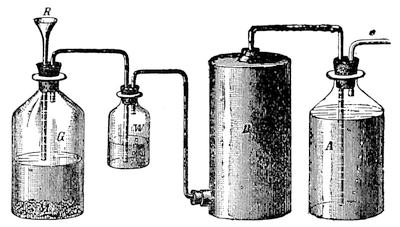
Fig. 20.
Extraction.
This method is based on the fact that some volatile liquids such as ether, chloroform, petroleum ether, or bisulphide of carbon possess the property of rapidly extracting the aromatic substances from flowers; when they are evaporated at a gentle heat they leave the pure odors behind. In our opinion this process is the best of all for the perfumer and it is to be regretted that it is not more generally used.
As a rule we employ either petroleum ether or bisulphide of carbon (see above, pp. 65, 66) because these products are cheaper than ether or chloroform.
The apparatus we use for this purpose is illustrated in Fig. 21. It consists of a cylinder C made of tinned iron, which is provided above with a circular gutter R terminating in a stop-cock h and which can be closed by a lid D bearing a stop-cock o. A tube b with a stop-cock a enters the bottom of the cylinder. The latter is filled with the flowers, the volatile liquid (petroleum ether, bisulphide of carbon, etc.) is poured over them, the lid is put on, and the gutter R filled with water, thereby sealing the contents of the vessel hermetically.
After the extraction, which requires about thirty to forty minutes, stop-cock o is opened first, then stop-cock a, and the liquid is allowed to escape into the retort of the still (Fig. 12). If the extraction is to be repeated, the water is allowed to escape from the gutter through h, the lid is opened, and the solvent is again poured over the flowers.
For operation on a larger scale the glass retorts are too small and should be replaced by tin vessels (Fig. 22) having the form of a wide-mouthed bottle F; they are closed by a lid D which is rendered air tight by being clamped upon the flange of the vessel (R) with iron screws S, a pasteboard washer being interposed; a curved glass tube connects the apparatus with the condenser of Fig. 12.
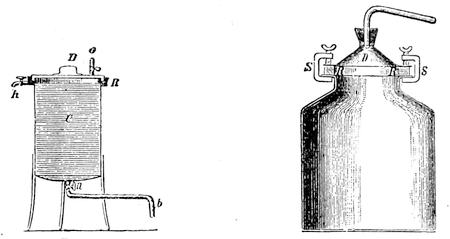
Fig. 21. Fig. 22.
The solutions of the aromatic substances are evaporated in these apparatuses at the lowest possible temperature, the solvent being condensed and used over again. The heat required is for ether about 36° C. (97° F.), for chloroform about 65° C. (149° F.), for petroleum ether about 56° C. (133° F.), and for bisulphide of carbon about 45° C. (113° F.). If it is desired to obtain the aromatic substances pure from an alcoholic extract of the pomades made by one of the above-described processes—which is rarely done since these solutions are generally used as such for perfumes—a heat of 75 to 80 C. (167 to 176° F.) is required.
Another extraction apparatus illustrated in Fig. 23 is well adapted to operations on a large scale. Its main parts are the extractor E and the still B. The former is set in a vat W continually supplied with cold water. The still B is surrounded with hot water in the boiler K.
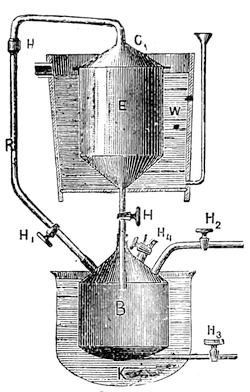
Fig. 23.
To start the apparatus the cone C is removed, the vessel E is filled with the material to be extracted, and C is replaced. The faucets H2 and H4 are opened, the solvent is poured into the still through the latter, when these faucets are closed and those marked H and H1 are opened.
The water in K is heated until the contents of B are in brisk ebullition; the vapor rises through RH, is condensed on entering E and falls in small drops on the material. This fine rain of the solvent dissolves the aromatic substances and flows back into B, where it is again evaporated, and so on.
At the end of the extraction the faucets H and H1 are closed and H2, is opened. The vapors of the solvent pass through it into a worm where they are condensed; the essential oil remaining in B is drained off by opening H3.
For still larger operations more perfect apparatuses are employed, such as those of Seiffert and Vohl. Seiffert’s apparatus (Fig. 24) consists of a battery of jacketed cylinders; steam circulates in the space between the cylinders and the jackets. Each cylinder contains a plate covered with a wire net on which the flowers to be extracted are placed. All the cylinders having been filled and closed, the solvent is admitted from a container above, through S and a into C2; when this is filled the liquid flows through a2b3cn into C. The solution saturated with essential oil leaves the apparatus through dn and p and enters a reservoir. The course of the liquid is aided by the suction of an air-pump acting on p.
When the reservoir contains an amount of fluid equal to that in Cn, dn is closed, an is opened, and C connected with C1 through bn and c1. That the contents of C2 are completely extracted is shown by the fact that the liquid appears colorless in the glass tube inserted in b2; a1 and C2 are closed; a2 and C3 are opened, thereby excluding C2 from the current of bisulphide of carbon which then flows through C3CnC1. In order to permit the free flow of the bisulphide of carbon through S despite the exclusion of C2, the faucets a1a2a3an must be two-way cocks; in one position they connect S with b; in the other they close b and leave the passage through S open.
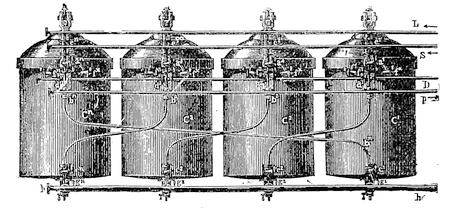
Fig. 24.
In order to collect the bisulphide of carbon present in the extracted residue in C2, faucet g2 is opened and the bisulphide of carbon allowed to escape through h. The faucet e2 in tube L on being opened admits compressed air to C2, thus hastening the outflow. If nothing escapes below, faucets f2 and fx are opened, steam enters through tube D between jacket and cylinder; the bisulphide of carbon vapor passes through g2 and h into the worm. After the expulsion of the bisulphide of carbon, C3 is emptied, refilled, connected with C1, and bisulphide of carbon admitted from C3 in the manner above described.
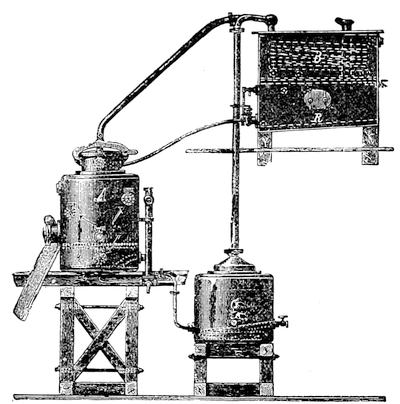
Fig. 25.
An extraction apparatus which has been much recommended of late is the so-called “Excelsior Apparatus” made by Wegelin and Huebner, Halle a. S., which can be worked with any desired solvent. The construction of the apparatus (Figs. 25 and 26) is as follows.
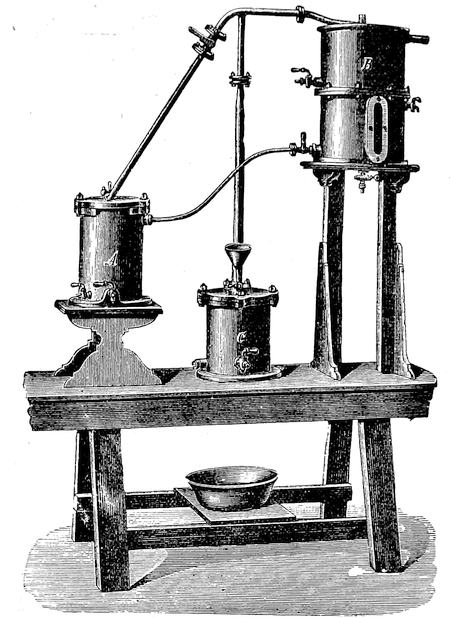
Fig. 26.
The solvent is admitted to the reservoir R in the lower part of the condenser B through the tube indicated in the figure. The material to be extracted having been filled into the cylinder A through the manhole, the apparatus is closed. The cold water is admitted to the condenser by opening a faucet. The three-way cock shown in Fig. 25 is so placed as to open a communication of the overflow tube with A. The faucet at the lower end of the reservoir R is now opened sufficiently and the solvent passes into A from above, and as it descends takes up more and more oil, flows through the sieve-plate, and escapes through the tube at the bottom of A through the three-way cock, the overflow tube, and the drain tube into the accumulator C. The opening of a faucet now admits steam to the heating coil, when the solvent evaporates, leaving the oil or fat behind. It is condensed in B, again returns to R, whence it passes once more through the faucet into the extractor A. The vessel C and the tubes leading to A and C are surrounded with felt to prevent loss of heat. A sample taken from the small cock at the foot of A (it has a small plate in the interior of the tube) will show when the extraction in A may be looked upon as finished. The solvent is distilled off or recovered from the residue in A in the following manner. First the faucet in R is closed. The three-way cock A is set to establish direct communication between A and C, thus cutting off the overflow tube. Hence all the solvent in A flows into C for distillation, while the oil is left behind. Steam being admitted to the residue, the solvent rises as vapor through the upper tube from A to B and collects in a liquid state in R. To drive off the last traces of the solvent from the fat or oil obtained, steam is blown into C by opening the valve. Besides the solvent, watery vapor enters B and forms a layer of water in R under the solvent. By taking a sample from the test-cock of the reservoir C which has an internal small plate, the termination of the process is ascertained. The gauge tube at the reservoir shows the level of the solvent and water. The water is drawn off by opening the faucet at the lower end of the reservoir. A is emptied through the manhole and by draining the oil from C through the discharge cock. The tube R is closed by a light valve so as to prevent evaporation of the solvent. All the apparatuses work without pressure so that there is no danger from overstrain.
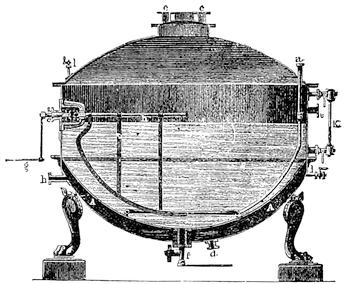
Fig. 27.
The solutions of the essential oils in bisulphide of carbon are distilled off in the steam still illustrated in Fig. 27; the steam enters at h, the water of condensation escapes at d, the liquid to be distilled enters at e from a container at a higher level. The boiling is kept uniform by the stirring arrangement hg. After the bisulphide of carbon is distilled off, air is passed through the oil by the curved tube a which has fine perforations, so as to evaporate the last traces of the solvent.
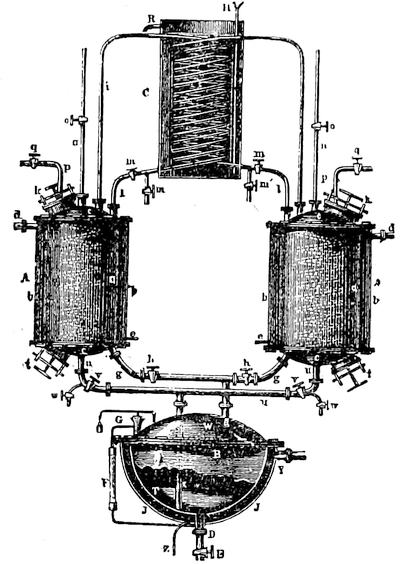
Fig. 28.
In Vohl’s apparatus (Fig. 28), arranged for petroleum ether, the extraction is effected with the boiling fluid; hence this apparatus is better adapted for the cheaper oils than for the finest oils from flowers. The apparatus consists of two extractors A A, the accumulator B, and the condenser C. Petroleum ether is allowed to flow over the substances to be extracted, by opening the faucets mm, vh, closing ogwE, and opening o, the course being through ux to B. When B is two-thirds full, the flow of petroleum ether is cut off, steam is admitted through y and the contents of B are brought to the boiling-point. The vapors pass through g and are condensed in f until the contents of A reach the boiling-point of the solvent, when the vapors pass through i into C, and after closing m´ the liquid passes through ml into the inner cylinder of the extraction apparatus and returns through uxx.
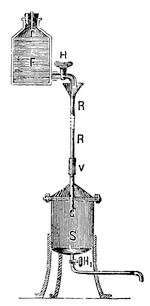
Fig. 29.
After the contents of A are extracted, m´ is opened, m closed, and steam is admitted through d into the jacket of A; the vapors of the solvent force the liquid part of the contents through ux into B. Overfilling of B is prevented by allowing the vapors of the solvent to escape at the proper time into the condenser through p by opening q. Then v is closed, q opened, and the steam present in A drawn off by an exhaust applied to p; as soon as p begins to cool, all the petroleum ether is distilled off, the steam is cut off at d, and the extract evacuated through t. The contents of B are brought into a still through D and E.
By employing greater pressure the extraction can also be effected by what is called displacement; the material to be extracted is placed in a stout-walled vessel S (Fig. 29) which is connected by a narrow tube at least ten yards long with the vessel F containing the solvent. Stopcock H is first opened, then stop-cock H1 which is closed as soon as fluid begins to flow from it. After the liquid has remained in contact with the material for from thirty to sixty minutes, H1 is opened very slowly, the liquid is allowed to escape and is displaced with water which is made to pass out of F in the same way as the solvent, until the latter is completely displaced from S.
After the solvent has been distilled off, the less volatile essential oil remains in the still almost pure, containing only traces of wax, vegetable fat or coloring matter which are of no consequence for our purposes. The last remnants of the solvent cannot be expelled by distillation, but by forcing through the essential oil a current of pure air for fifteen or twenty minutes. The essential oils then are of the purest, unexceptionable quality.
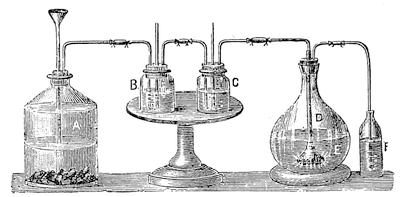
Fig. 30.
In the case of delicate oils it is better to use carbonic acid in place of air for expelling the last traces of the solvent, as the oxygen may impair the delicacy of the fragrance. For this purpose we use the apparatus illustrated in Fig. 30. In the large bottle A carbonic acid is generated by pouring hydrochloric acid over fragments of white marble. The carbonic acid passes into the vessel B filled with water which frees it from any adhering drops of hydrochloric acid; then into C filled with sulphuric acid to which it yields its water so that only pure carbonic acid escapes through the fine rose at the end of tube D which is made of pure tin, and as it passes through the oil in E it carries off the last traces of the volatile solvent. In its final passage through the water in F it leaves behind any oil that may have been carried with it.
As all the aromatic substances change in air by the gradual absorption of oxygen, and lose their odor—become resinified—these costly substances must be put into small bottles which they completely fill, and be preserved in a cool dark place, as light and heat favor resinification. The bottles must be closed with well-fitting glass stoppers.
Aromatic waters or eaux aromatisées, such as jasmine water (eau de jasmin), orange-flower water (eau de fleurs d’oranges, eau triple de Néroli, aqua naphæ triplex), etc., are made by distillation of these flowers with water and show a faint but very fine odor. When they contain, besides, dilute alcohol they are called spirituous waters or esprits. Those brought into commerce from southern France are of excellent quality.
The Yield of Essential Oils.
The quantities of essential oil obtainable from the vegetable substances vary with the amount present in each. The following table shows the average quantities of oil to be obtained from 100 parts of material.
Material. Name of Plant. Mean Yield per 100 Parts.
Ajowan seed Ptychotis Ajowan 3·000
Alant root Inula Helenium 0·600
Allspice Myrtus Pimenta 3·500
Almonds, bitter Amygdala amara 0·400-0·700
Angelica seed Archangelica officinalis 1·150
Angelica root, Thuring. Archangelica officinalis 0·750
Angelica root, Saxon Archangelica officinalis 1·000
Anise seed, Russian Pimpinella Anisum 2·800
Anise seed, Thuring. Pimpinella Anisum 2·400
Anise seed, Morav. Pimpinella Anisum 2·600
Anise seed, Chili Pimpinella Anisum 2·400
Anise seed, Spanish Pimpinella Anisum 3·000
Anise seed, Levant Pimpinella Anisum 1·300
Anise chaff Pimpinella Anisum 0·666
Arnica flowers Arnica montana 0·040
Arnica root Arnica montana 1·100
Asafœtida Ferula Asafœtida 3·250
Avens root Geum urbanum 0·040
Basilicum herb, fresh Ocymum basilicum 0·040
Bay leaves Pimenta acris 2·300-2·600
Bear’s berry Uva ursi 1·010
Beech tar Betula alba 20·000
Bergamots ab. 3·400
Betel leaves Piper Betle 0·550
Bitter almond meal Amygdala amara 0·950
Buchu leaves Barosma crenulata 2·600
Butter-bur oil Tussilago Petasites 0·056
Calamus root Acorus Calamus 2·800
Camomile, German Matricaria Chamomilla 4·000-6·000
Camomile, Roman Anthemis nobilis 3·000
Caraway seed,
Cult. German Carum Carvi 4·000
Cult. Dutch Carum Carvi 5·500
Cult. East Prussian Carum Carvi 5·000
Cult. Moravian Carum Carvi 5·000
Wild German Carum Carvi 6·000-7·000
Wild Norwegian Carum Carvi 6·000-6·500
Wild Russian Carum Carvi 3·000
Cardamoms, Ceylon Elettaria Cardamomum 4·250
Cardamoms, Madras Elettaria Cardamomum 4·300
Cardamoms, Malabar Elettaria Cardamomum 1·750
Cardamoms, Siam Elettaria Cardamomum 1·350
Carrot seed Daucus Carota 1·650
Cascarilla bark Croton Eluteria 1·500
Cassia flowers Cinnamomum Cassia 3·500
Cassia wood Cinnamomum Cassia 0·285
Cedar wood Juniperus virginianus 0·700-1·000
Celery herb Apium graveolens 0·200
Celery seed Apium graveolens 0·300
Chekan leaves Myrtus Chekan 1·000
Cinnamon, Ceylon Cinnamomum zeylanicum 0·900-1·250
Cinnamon, white Canella alba 1·000
Cloves, Amboina Caryophyllus aromaticus 19·000
Cloves, Bourbon Caryophyllus aromaticus 18·000
Cloves, Zanzibar Caryophyllus aromaticus 17·500
Cloves, stems Caryophyllus aromaticus 6·000
Common wormwood herb Artemisia Abrotanum 0.040
Common wormwood root Artemisia Abrotanum 0·100
Copaiva balsam, Para Copaifera officinalis 45·000
Copaiva balsam, East Ind. Dipterocarpus turbinatus 65·000
Coriander seed,
Thuringian Coriandrum sativum 0·800
Russian Coriandrum sativum 0·900
Dutch Coriandrum sativum 0·600
East Indian Coriandrum sativum 0·150
Italian Coriandrum sativum 0·700
Mogadore Coriandrum sativum 0·600
Crisp mint herb Mentha crispa 1·000
Cubebs Piper Cubeba 12·000-16·000
Culilaban bark Laurus Culilavan 3·400
Cumin seed, Mogadore Cuminum Cyminum 3·000
Cumin seed, Maltese Cuminum Cyminum 3·900
Cumin seed, Syrian Cuminum Cyminum 4·200
Cumin seed, East Indian Cuminum Cyminum 2·250
Curcuma root Curcuma longa 5·200
Dill seed, German Anethum graveolens 3·800
Dill seed, Russian Anethum graveolens 4·000
Dill seed, East Indian Anethum Sowa 2·000
Elder flowers Sambucus niger 0·025
Elemi resin Icica Abilo 17·000
Eucalyptus leaves, dry Eucalyptus globulus 3·000
Fennel seed,
Saxon Foeniculum vulgare 5·000-5·600
Galician Foeniculum vulgare 6·000
East Indian Foeniculum Panmorium 2·200
Galanga root Alpinia Galanga 0·750
Galbanum resin Galbanum officinale 6·500
Geranium Pelargonium odoratissimum 0·115
Ginger root,
African Zingiber officinale 2·600
Bengal Zingiber officinale 2·000
Japan Zingiber officinale 1·800
Cochin China Zingiber officinale 1·900
Hazel root Asarum europæum 1·100
Heracleum seed Heracleum Sphondylium 1·000
Hop flowers Humulus Lupulus 0·700
Hop meal, lupulin Humulus Lupulus 2·250
Hyssop herb Hyssopa officinalis 0·400
Iva herb Iva moschata 0·400
Juniper berries,
German Juniperus communis 0·500-0·700
Italian Juniperus communis 1·100-1·200
Hungarian Juniperus communis 1·000-1·100
Laurel berries Laurus nobilis 1·000
Laurel leaves Laurus nobilis 2·400
Laurel, Californian Oreodaphne californica 7·600
Lavender flowers,
German Lavandula vera 2·900
Linaloe wood Elaphrium graveolens 5·000
Lovage root Levisticum officinale 0·600
Mace Myristica fragrans 11·000-16·000
Marjoram herb, fresh Origanum Majorana 0·350
Marjoram herb, dry Origanum Majorana 0·900
Marsh-rosemary oil Ledum palustre 0·350
Massoy bark Massoia aromatica
Masterwort root Imperatoria Ostruthium 0·800
Matico leaves Piper angustifolium 2·400
Matricaria herb Matricaria Parthenium 0·030
Melissa herb Melissa officinalis 0·100
Michelia bark Michelia nilagirica 0·300
Milfoil herb Achillea Millefolium 0·080
Musk seed Hibiscus Abelmoschus 0·200
Mustard seed,
Dutch Sinapis nigra 0·850
German Sinapis nigra 0·750
East Indian Sinapis nigra 0·590
Pugliese Sinapis nigra 0·750
Russian Sinapis juncea 0·500
Myrrh Balsamodendron Myrrha 2·500-6·500
Myrtle Myrtus communis 0·275
Nigella seed Nigella sativa 0·300
Nutmegs Myristica fragrans 8·000-10·000
Olibanum resin Boswellia, var. spec 6·300
Opoponax resin Pastinaca Opoponax 6·500
Orange peel, sweet Citrus Aurantium 2·500
Orris root Iris florentina 0·200
Parsley herb Apium Petroselinum 0·300
Parsley seed Apium Petroselinum 3·000
Parsnip seed Pastinaca sativa 2·400
Patchouly herb Pogostemon Patchouly 1·500-4·000
Peach kernels Amygdalus persica 0·800-1·000
Pellitory root Valeriana celtia 1·000
Pepper, black Piper nigrum 2·200
Peppermint, fresh Mentha piperita 0·300
Peppermint, dry Mentha piperita 1·000-1·250
Peru balsam Toluifera Pereiræ 0·400
Pimpernel root Pimpinella saxifraga 0·025
Poplar sprouts Populus niger 0·500
Rhodium wood Convolvulus Scoparius 0·050
Rose flowers, fresh Rosa centifolia 0·050
Rosemary Rosmarinus officinalis 1·550
Rue herb Ruta graveolens 0·180
Sage herb, German Salvia officinalis 1·400
Sage herb, Italian Salvia officinalis 1·700
Santal wood,
East Indian Santalum album 4·500
Macassar Santalum album 2·500
West Indian Unknown 2·700
Sassafras wood Sassafras officinalis 2·600
Savin herb Juniperus Sabina 3·750
Snakeroot, Canadian Asarum canadense 2·800-3·250
Snakeroot, Virginian Aristolochia Serpentaria 2·000
Star-anise, Chinese Illicium anisatum 5·000
Star-anise, Japanese Illicium religiosum 1·000
Storax Liquidambar orientalis 1·000
Sumbul root Ferula Sumbul 0·300
Tansy herb Tanacetum vulgare 0·150
Thyme Thymus Serpyllum 0·200
Thyme dry Thymus Serpyllum 0·100
Valerian root, German Valeriana officinalis 0·950
Valerian root, Dutch Valeriana officinalis 1·000
Valerian root, Japan Patrinia scabiosæfolia
Vetiver root Andropogon muricatus 0·200-0·350
Violet flowers Viola odorata 0·030
Water-yarrow seed Phellandrium aquaticum 1·300
Wintersweet marjoram Origanum creticum 3·500
Worm seed Artemisia maritima 2·000
Wormwood herb Artemisia Absinthium 0·300-0·400
Zedoary root Curcuma Zedoaria 1·300
Fresh flowers as a rule contain more aromatic material than wilted ones; the yield of dried herbs, leaves, etc., is usually greater than that of the fresh, because the latter contain much water which is lost in drying. When such vegetable materials cannot be worked fresh, which is best, they should be completely dried, spread on boards, at a moderate temperature in the shade and preserved in dry airy rooms, special care being had to guard against mould.