PART II (continued 2)
Reading edition
I picked up a Tientsin paper a few days ago, and was interested to read an "Ordonnance" promulgated by the French consul-general at Tientsin. By the terms of this decree every Chinese employed in the French concession is obliged to have a little book containing his name, age, place of birth, and so on, together with his photograph and finger-prints. A duplicate carnet is on file at the French police bureau in Tientsin, and no Chinese can find employment in the concession, as cook, groom, clerk, chauffeur, or in any other capacity, unless he is first registered with the police. The idea of having one's finger-prints recorded, like a common criminal, seems somehow humiliating. I imagine there would be some comment if the Japanese enforced such regulations in their concessions in China.
XIII MEETING THE PRESIDENT OF CHINA
Ever since we came to Peking we have been anxious to meet the President of China, Li Yuan Hung. Dr. Reinsch said he would arrange it for us "at the first opportune moment." Opportune moments are scarce in Peking, as you can well imagine; consequently we have been waiting for weeks for such a moment to arrive, for a pause longer than usual between impeachments and betrayals and plots of various kinds. We had waited so long, in fact, that we had quite forgotten about it, until we came in one day just before tiffin time, rather late, and found the whole hotel in a blaze of excitement: we were to meet the President that afternoon!
And, what's more, best clothes were required! Really, I had not foreseen that contingency, and therefore felt uncomfortable and self-conscious when arrayed in my other hat, with the feather, the hat which has been reposing in the hat-box for eight long months, waiting for just such an emergency! Every one else, however, was in the same state of excitement as to dress; that is, all those who like ourselves had been long in the Orient, and whose clothes had fallen off a bit in appearance. In sharp contrast were the newly arrived tourists with their smart new outfits, beautiful as only Americans can be beautiful. But never mind: we reflected that the President would never know the difference; he would consider us all alike and all outlandish. There were others in the party who had lived so long in Peking that they were reduced to Gillard's best,—Gillard's, the one "department store" of the city, about on a plane with the general store of a country village or a frontier town, only worse. Sooner or later every one in Peking is reduced to Gillard's Emporium, where the stocks are old-fashioned and musty, and the thing you want has just been sold out. And if you can't get it at Gillard's, there is nowhere else to go. Up-stairs Mrs. Gillard makes Paris gowns on the latest models, which look all right, too, till tourist season comes round and you see the difference. Well, finally we were all ready, and assembled at the front door of the hotel,—the smart and beautiful Americans; those clad in Gillard's best, and ourselves, something intermediate. The men were upset, too: several of them had been obliged to borrow top hats. And at the last moment a rumor spread that ceremonial bows were required. That created such consternation that several of us considered backing out.
We were all to meet at the Pei Hei Gate at two o'clock, so we started early, for we had a long distance to travel. The smart Americans went in motors, as was fitting, but the rest of us made a long procession of rickshaws, and jogged happily along the dusty streets, out through the gates of the legation quarter, past the North Glacis, through the gates of the Imperial City, and finally, after half an hour's run, reached the Pei Hei Gate, leading into the old and abandoned Winter Palace. It then transpired that a visit to this old palace was part of the program, and we were to wander for two hours through its beautiful and extensive grounds, until four o'clock, when the President would receive us. Now March is March the world over, but March in Peking is excessive. No one who has not passed a spring in North China can know the meaning of dust. On this clear, bright March afternoon a classic dust-storm was in progress and in this, dressed in our best clothes, we were to wander for two hours through the closed grounds of the Winter Palace, which had been thrown open to us by special courtesy of the President!
They say one never realizes the meaning of the word decay until one has seen Peking. And the climax of decay is reached here, in this former abode of the old empress dowager, where everything remains as she left it, or as the Boxers left it, or as the European looters left it after the Boxer troubles. Scattered through the beautiful grounds are magnificent buildings, all fallen into ruin. The roofs of the palaces and temples, blazing with the imperial yellow tiles, are dropping to pieces, and rank grass is replacing the fallen tiles and dislodging those that are left. In one of the temples we walked through littered débris of rich carvings, kicked against the broken heads and hands of gilded gods fallen from the altars, and brushed against the loosened shreds of old paintings swaying in tatters from the walls. One building contained the remains of a once beautiful fountain, painted and lacquered, now moldering and fallen into dust. At the four corners of the room the old gods, life-size, had been gathered into piles and covered with matting, and from beneath this dusty covering protruded dirty, battered heads and gilded bodies, ludicrous and pathetic.
In the grounds it was no better. Weeds grew shoulder high, springing from between the stones of the great courtyards and open spaces connecting the temples and palaces, and we pushed ourselves through this brush, and stumbled over rolling stones, all the while enveloped by the whirling dust, the everlasting Peking dust, straight from the Gobi Desert. All this was very disastrous to our personal appearance, and at the end of two hours we were all reduced to pretty much the same level: really, there wasn't much difference between the beautiful Americans, those attired in Gillard's best, and ourselves, when we took to our rickshaws (and motors) again and set off for the President's palace, in the Forbidden City.
The grounds of this palace presented a much better appearance than anything we had seen in Peking. The roads were newly swept, and everything was very neat and clean and orderly, though bare. The lawns, if such they could be called, were as arid and grassless as the great plains of Chili. We arrived a few minutes before four, and descended from our vehicles, grand and otherwise, and then a cleaning-up process took place. Dusty shoes were brushed off with handkerchiefs, dusty coats slapped and patted, wind-blown hair rearranged, dust cleaned out from the corners of eyes, and powder-papers passed from hand to hand among the women. One lady remarked cheerfully, "Well, we surely don't look very nifty to meet the President," but we made ourselves as "nifty" as we could, in the circumstances, standing together in a laughing group on the lee side of the palace, and asking one another if we'd do. I remember that once, years ago, when I was living in the Latin Quarter, some of us went over to a tea on "the other side," and before pulling the door-bell, we stood first on one foot and then on the other, polishing our dusty shoes on our stockings. Well, here we were doing the same thing, before meeting the President of China!
We got clean at last, and then soberly marched round the corner of the building and presented ourselves in the anteroom of the palace, leading to the President's apartments. Here we found Dr. Reinsch waiting for us, and he sorted us into groups of eight, and left us waiting till the summons came. In former times the mandarins used to wait in this anteroom, before an audience with the empress dowager, and we tried to imagine the big bare room of to-day filled with these high officials in their gorgeous robes. Nothing remains of the old glories of the palace save the elaborate carving on wall and ceiling, and a few pieces of magnificent old furniture. The ceiling is now disfigured with a gaudy, cheap European chandelier, while standing here and there on beautiful ebony tables are hideous modern vases, straight from the five-and-ten-cent store. The floor was covered with ugly oilcloth. Such is China modernized, imbued with Western culture.
Our group of eight was the first to be called, and Dr. Reinsch led the way with an interpreter. We passed out of the antechamber and along an open marble corridor, lined with Chinese soldiers in their padded gray cotton uniforms, who stood at salute as the American minister passed. Immediately we found ourselves in another room, also plainly furnished, and the next moment were shaking hands with an unassuming little man clad in a frock-coat, the President, Li Yuan Hung. Through the interpreter the President explained that he would like us to pass into the room beyond, where he could speak with us one by one, personally. He waved his hand toward the other room, and my recollection is that we led the way! It all happened so quickly, I can't remember; but somehow our group seemed to be waiting in the other room when the President and Dr. Reinsch arrived at our heels, a second later. However, you can't expect people not brought up in courts to know much about such things, and we were probably flustered, anyway.
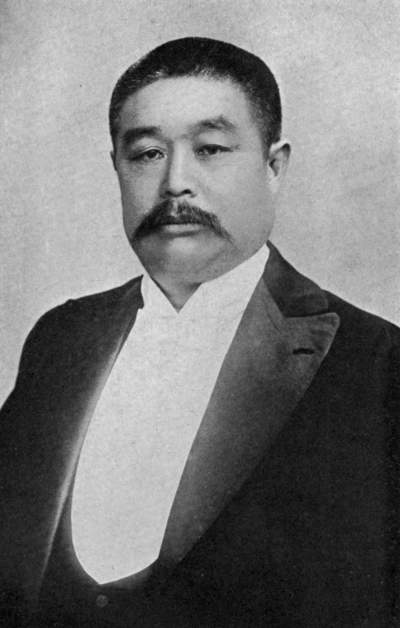
Courtesy of Press Illustrating Service
President Li Yuan-Hung
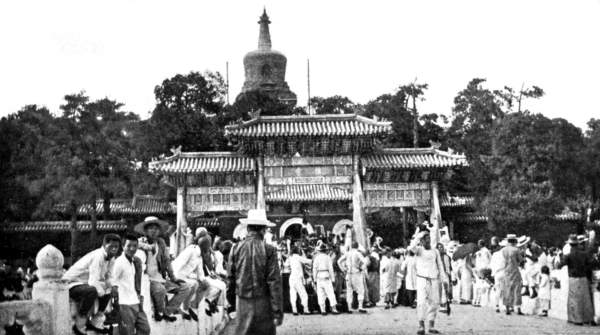
Entrance to Winter Palace
President Li, Dr. Reinsch, and the interpreter stood together, while we arranged ourselves in a semicircle round them, and then Dr. Reinsch presented each one of us in turn, explained who each one was, or what he or she represented or had been doing. He began with the Allens,—told who Mr. Allen was, what big American interests he represented, why he had come out to China, and all about it. Then the interpreter repeated all this to the President, who meanwhile stood looking inquiringly at the Allens, as did the rest of us. When the translation was finished, Li replied in Chinese; they say he can speak English, but imperfectly, and he did not attempt it. "When quality meets, compliments pass." Dr. Reinsch said all manner of nice things about the Allens and China, and the President said all sorts of nice things about the Allens and America, and it all took some time, just disposing of the first two of our party. Meanwhile, two servants came in with a tray of champagne and plates of cakes, and we all stood with a glass in one hand and a cake in the other, waiting to see what Mr. Allen would do when the President finished telling him how glad he was he had come to China. Mr. Allen rose to it, however, in a happy little speech, saying that it was a privilege, and so on.
Then came our turn. We were anxiously wondering what Dr. Reinsch could find to say about us two, having committed himself by introducing the whole group at one swoop as "representative Americans." However, we were both exceedingly pleased at what he did say, and the President was pleased, too, apparently, for he replied that he was glad we were like that. So it continued all round the circle, and we felt exactly as if it were the Day of Judgment, and the secrets of all hearts were being revealed: we thought we knew our friends pretty well, and all about them; yet we hung with bated breath upon Dr. Reinsch's introduction or send-off! And we had never understood the meaning of "true Oriental politeness" until we heard the President's gracious, courteous welcome in reply. We stood directly opposite him, and had a good opportunity to observe him closely,—a short, thick-set man with a small mustache, much darker than the usual Chinese type, owing to his heritage of Siamese blood. Many people say he has no Siamese blood at all, but it is always like that in China: whatever any one tells you is always flatly contradicted by the next person you meet.
Then we committed a great gaffe! When the Allens and E—— and I had been safely disposed of, and the introductions and interpretations were being directed toward the other four members of the party, we drank our champagne—we four, the Allens and ourselves! I think it was because we did not know what else to do with it, having stood stiffly at attention for some twenty minutes, trying to balance a very full glass in one hand, and conscious that the sugary cake in the other was fast melting. Anyway, we emptied our glasses, and set them down on a table behind us, and ate the cakes as well. Then, to our horror, Dr. Reinsch summed us all up again, collectively, in a graceful little speech, and the President raised his glass, and bowing, drank our health. I heard E—— whisper, "The glasses, quick!" and the Allens and she and I hastily groped backward for the empty glasses on the table behind us, and drained the few remaining drops with what manners we could muster. After which we all shook hands with the President again, and filed out of the room.
In the anteroom the rest of the party crowded round us, asking for tips. We had two big ones to offer: Don't lead the way for the President of China, and don't touch your glasses till he raises his!
XIV GREAT BRITAIN'S TWELVE DEMANDS
The scaffolding is being put up for more trouble. China has got to declare war, and to do it soon. It took five weeks' manœuvering to make her break diplomatic relations and will probably take much longer to induce her to take this next step, opposition to which is growing stronger and more intense every day. The President is obstinately opposed to it, and he has considerable backing. There is free talk about a revolution occurring if the break takes place, so determined are certain leaders not to be dominated by "foreign influence." Many Chinese can be bribed, but the Chinese in general cannot be fooled, and no glowing compliments about China's "masculine" attitude can deceive them as to the yoke they must wear should they decide to surrender themselves and place their nation at the disposal of European interests.
On the morning of March 26 one of the papers contained this significant article, under the caption of Tibetan Affairs:
Reported British Demands. Indignation of Chinese M. P.'s. Mr. Ho Sheng-Ping and other Senators have addressed the following interpellation to the Government: "According to the reports of the Japanese newspapers, the British Government has sent Twelve Demands to the Chinese Government in connection with Tibetan affairs, and these demands, being so cruel and unreasonable, tend to provoke the anger and indignation of any people. Why did we address a protest to the German Government against its submarine warfare? And why did we declare diplomatic severance with Germany? Was it not to render assistance to the Entente Powers, and was it not to render direct help to Great Britain? We are, indeed, surprised at these British Demands appearing in the newspapers. In accordance with the provisions laid down in Article 19 of the Provisional Constitution, we hereby demand that a reply be given within five days as to the true nature of the reported Demands, and the attitude of the Government towards them."
The Demands from Great Britain as reported in the Japanese newspapers are as follows:
1Great Britain shall have the right to construct railways between India and Tibet.
2The Chinese Government shall contract loans from the British Government for the improvement of the administration of Tibet.
3The treaty obligations between Tibet and Great Britain shall be considered valid as heretofore.
4British experts shall be engaged for the industrial enterprises of Tibet.
5China shall secure the redemption of loans contracted from the British people by the Tibetans.
6Neither China nor Great Britain shall send troops to Tibet without reason.
7The Chinese Government shall not appoint or dismiss officials in Tibet on its own responsibility.
8The British Government shall be allowed to establish telegraph lines in Lhassa, Chiangchu, Chamutao, etc.
9British postal service shall be introduced in Lhassa and other places.
10China shall not interfere with the actions of the British Government in Tibet.
11No privileges or interests in Tibet shall be granted to other nations.
12All mines in Tibet shall be jointly worked by the British and Chinese Governments.
These Twelve Demands, which the Chinese M. P.'s resent so hotly, which they quaintly term "cruel and unreasonable," virtually amount to the annexation of Tibet by the British Government. It is amusing to think that it was the Japanese press which first gave them publicity. We are so accustomed to hearing of the famous Twenty-one Demands of Japan that we fail to realize that other nations make demands equally sweeping and equally arbitrary. Of course, these British demands will not receive the world-wide attention accorded those of Japan. Remember, over here it is not customary to think of or speak of anything but "Japanese aggression." Japan, you see, offers the only stumbling-block to the complete domination of the Orient by Europe. But for Japan—China might possibly become another India. And the Japanese, facing race discrimination and exclusion from most of the European countries, and many of their colonies, as well as America, cannot afford to have China under European control. It is a question of self-preservation.
We were dining the other evening with a Chinese gentleman, of high position, who invited us to dinner at an old and very famous restaurant outside the palace gates. It was at this restaurant, in the days of the dowager empress, that the Mandarins used to assemble every night while waiting for the imperial edicts to be issued from the palace. And as the edicts frequently did not appear until two or three in the morning, they comforted themselves, during this long wait, with much fine and delicate food cooked in the fine and delicate manner that even French cooks cannot excel. And if the cooking in those days was as delicious as at present, they passed the time very pleasantly, and did very well by themselves, those old officials.
It was a bitterly cold night, and the dark street in front of the restaurant was crowded with a motley array of rickshaws, Peking carts, and motors, through which we made our way by the light of a bobbing lantern. We entered a crowded, noisy kitchen, filled with rushing waiters and shouting cooks bending over charcoal fires. In contrast to the freezing wind outside the air was deliciously warm, redolent with the fumes of charcoal and the aroma of savory exotic food. Our table was waiting for us in a private dining-room; the whole place consists of private dining-rooms, separated by good thick stone walls, so that one can't hear the plots and intrigues being hatched next door, though the din in the open courtyard caused by the scrambling, yelling waiters would make that impossible, in any event. The room had a stone floor, and was unheated, only a little less cold than outdoors. Inadvertently, we took off our wraps,—not all, only two or three; for we are becoming quite Chinese in our manner of putting one coat on over another. We put them all on again, however, at the end of the second course, for the draughty windows and the door constantly swinging open into the courtyard made all our warm things indispensable.
Our Chinese gentleman gave us a "number-one" dinner, and a number-one dinner always begins with bird's-nest soup, the greatest delicacy a Chinese can offer; also, the most expensive. Well, we began with it, and truly it is "number-one"—gelatinous, delicate, with an exquisite flavor altogether indescribable. Then followed the other courses. As this dinner was given to foreigners, we had only twelve courses, whereas the usual Chinese dinners run up into the dozens; "forty curses" they are sometimes called by unwary foreigners who have tried to eat their way through a whole meal. The courses come on and on, endlessly; but the proper Chinese custom is that you leave when you have had enough, say four or five. You aren't supposed to sit through an entire meal. Our host told us that he had been to three dinners that evening, before this one, and was expecting to go to one or two more. We felt rather uneasy when he told us this, and thought we ought to be going, ourselves; but he hastily explained that this dinner, given in our honor, was not long and that we must go through all of it. Very easy going, I must say!
After the bird's-nest soup came shark fins, another delicacy and also delicious. Then fish, then soup of another kind, then powdered chicken, then duck and rice, then cake, then shell-fish, then more duck, then lotus-flower soup, and finally fruit and coffee. As each wonderful dish succeeded the other our host apologized profusely, deprecating its poor quality and miserable manner of preparation. We protested vehemently, with enthusiasm. This also is Chinese etiquette, it seems, for the host to denounce each dish, while the guests eat themselves to a standstill. It all took a long time, for we managed our chop-sticks badly; nevertheless, in spite of this handicap, we finished every marvelous course placed before us. A tea-pot of hot sake did something to keep the creeping chill out of our bones, but very little: the thimble-like sake cups contained only a few drops, and one doesn't like to ask for the tea-pot more than seventeen times! During the meal. Mr. Y—— entertained us with many side-lights on the political situation, and we finally asked him to explain the meaning of the Twelve British Demands. He replied promptly, emphatically.
"They are a threat," he said, "a form of coercion, to make us take the next step, to declare war. If we declare war, they will be withdrawn. We are familiar with them. They have appeared before, when it was necessary."
XV CONCLUSION
On the first of April we are going to leave Peking, to leave China alone to her fate! We have had enough of it, and are just about worn out with the strain on our sympathies. Opposition to a declaration of war is growing daily, and so are rumors of a revolution. But a revolution is just what is needed,—a revolution which will unseat those who are opposed to the war, and which will place in power a group of officials submissive and subservient to European influence. A revolution will offer the grand, final excuse for the "protection" of China, by Europe. You will see; mark my words. Only, of course, Japan will not be the power that sets in order this disturbed country. Never Japan, the great commercial competitor. For by this time you must surely understand that Japanese aggression is immoral and reprehensible, whereas European aggression or "civilization" is the fate to which the Orient is predestined. The world contains a double standard of international justice, for the East and the West.
At least we are glad to have been in China during these distressful days, just to see how they do it. With the attention of the world centered on Europe, things are taking place out here which could not possibly occur were the world free to know of them, and judge. But in the safe seclusion of Oriental isolation all things are now possible. Back of the war, behind the war, ugly things are going on, which will be all finished and done with and safely accomplished by the time the war is over. This war for civilization is all that "civilization" requires in the way of opportunity in the Orient.
So we are going to leave Peking, gorgeous, barbaric Peking, with its whirling clouds of gossip and its whirling clouds of dust. We are stifled by them both. We are going to Japan to see cherry-blossoms.