Front matter (continued 2)
Reading edition
At the palace itself the outer halls are filled with the nobles and chiefs who owe allegiance to the Prince. They are armed and equipped like their followers without, but in more splendid fashion. Jewels glitter and glow on great silken turbans; robes are stiff with gold and costly embroidery; girdles are heavy with weapons, whose handles are richly chased and set with diamonds and rubies; pearls and emeralds and sapphires flash from necklet or armlet.
Through these the visitors pass on to inner halls, where they are received by members of the reigning family and escorted to the hall of audience.
Here, in a noble chamber, the Prince will be seated in state on a splendid throne. On either side stand attendants, waving fans made of feathers or of horsehair. The latter are only used to fan a Prince, and are the emblems of sovereignty.
The English guests are seated on chairs, and the nobles and chiefs, who have followed them into the room, seat themselves on the beautiful carpets spread over the floor. All except the guests are barefooted, for the native company have left their gilded slippers outside the chamber.
The Prince and his guests converse, and very often presents are given and offered—shawls, silks, brocade, or jewels. Perhaps nautch-girls will come in and dance. They wear robes of shining gauze from head to foot, and they dance with slow, graceful movements, often singing as they move.
At last the Prince calls for essence of roses with the leaf of the betel-nut, and this is the signal that the interview is over. Now the guests will be conducted over the palace, to see the public rooms and courts; but the zenana, the women's apartments, are never shown; nor is the visitor supposed even to glance towards the lattices and trellised windows, behind which the native ladies are probably having a good look at him. The evening will close with a grand illumination and display of fireworks, managed with the utmost skill. From a terrace, so placed that the dark smooth mirror of a lake lies between himself and the illuminations, the visitor looks upon a fairy scene. The pavilions, the courts, the balconies, the lines of the palace itself, will be picked out in points of fire, and the whole is mirrored in the water. Then the fireworks leap into the sky—rockets, great globes of many colours, fountains spouting golden fire, and pictures of forts outlined in flame and firing heavy broadsides from mimic cannon. Finally the visitor climbs the ladder set against the side of his elephant, while the band blares out, "God Save the King," and goes home to dream of the wonderful things he has seen, and to try to disentangle the host of pictures which dance before his eyes when he reflects upon his visit to a native Court.
CHAPTER XV
THE RELIGIOUS MENDICANTS
India is the land of religious mendicants. They swarm in every part of it; they are seen moving along the country roads and in the streets of villages and towns; they flock around every shrine.
Some are simply wanderers; they have abandoned all earthly goods, have left their homes, and taken their place among the poorest. Smearing themselves with ashes, their only garment a wisp of rag—and this they wear simply because the police will not let them go without it—they ramble from holy place to holy place. "Naked, homeless, he eats only when food is offered to him, drinks only from the cup of cold water which is given in the name of the Lord."
Many of these men have been rich and powerful members of the society in which they moved. Then a day came when they laid aside their robes of muslin and silk embroidered with gold; they left their great houses filled with troops of servants; without a word they slipped away from wife, from children, from friends, and the place they had filled knew them no more. They had gone to wander far and wide through the vast plains, the mighty hills of India—strange, naked, wild-looking figures, unwashed, unshorn, looking the veriest outcasts of the earth.
Why is this done? For this reason. They feel deeply the vanity of earthly things; they believe that the more one can get rid of the needs and the wants of the body, the nearer he will get to the Divine. So they cast aside everything which pampers the body and makes this life sweet, and forsake all things of this world in favour of prayer and meditation.
It is not uncommon to meet a man who has the air of a naked, half-crazy savage, and to find that man capable of arguing in the most able manner on the highest topics. Mrs. Steel remarks: "They are often extremely well educated. They will knock a false argument into a cocked hat with easy ability. Some of them—these naked savages—will astonish you by quoting Herbert Spencer; for even nowadays they are recruited from all classes, and they belong by rights to the most thoughtful of each class." Such men as these belong, of course, to the highest order of the religious mendicants. The majority of their fellows are of a much lower order, but one and all they practise poverty and live only upon alms.
Many of them, of the fakir class, practise all kinds of self-torture upon themselves. One, perhaps, has held up his arm above his head for so many years that it is now immovable, and stands straight up from his shoulder, thin and shrunken, and as stiff as a piece of wood. Another has held his fingers close shut in his palm until the nails have grown through the flesh and stand out at the back of the hand. A third has lain for many years on a bed of spikes, until his skin, hard as horn, renders so uneasy a bed no discomfort. There are fakirs who have not stood upright once in forty years. They travel by crawling, and as their cry rings along the village street, the pious hasten to bring them a handful of rice or a cup of water. It would be useless to offer them better fare; they would refuse it. An account is given of one fakir who sat so long without moving at the foot of a tree that the roots grew around him and fettered him to his place.
Many observers have been extremely puzzled by certain powers which these fakirs possess. Fakirs have been seen to walk across a row of upturned knife-blades, each blade sharpened to the keenest edge, yet no sign of injury could be perceived on the naked foot. Another will climb a ladder formed of a single pole, from the sides of which well-sharpened sickles stand out to form the rungs. The fakir climbs to the top and descends. He rests his naked hands and feet upon the keen edges, and no cut, no mark can be seen; or he walks, still barefoot, over stones raised to white heat in a furnace. These feats have been performed in the presence of English gentlemen of high standing in the official world—men who have taken such precautions that they were perfectly certain that the feats were genuine—but they have been utterly unable to explain how the things were done. And, finally, the fakir has obtained such mastery of himself that he can be buried alive, being left for a time in his living grave, and restored to life again.
CHAPTER XVI
IN THE BAZAAR
What is a bazaar in India? It is, first of all, the quarter where the shopkeepers are gathered together, where the tiny shops stand in close-packed rows on either side of the narrow ways, and whither all who have money flock to spend it. But it is more than that. It is the place to which those who have no money resort just as freely, for here ebbs and flows in one unending flood the news, the rumours, the gossip of the town and country.
All day long an Indian bazaar is filled with throngs of buyers, sellers, newsmongers, idle loungers, merchants, sightseers—all the flotsam and jetsam of the city. It is always a scene of wonderful colour and movement. The sun strikes into the dusty ways on turbans of red, green, and orange; on robes of white, pink and blue; on petticoats of rose and saffron; on the bronze bodies of almost naked coolies who march along beneath their loads. People of every colour—white, brown, black, yellow—jostle each other in the crowded ways, and there is a bewildering variety of tint and form in the striking and picturesque scene.
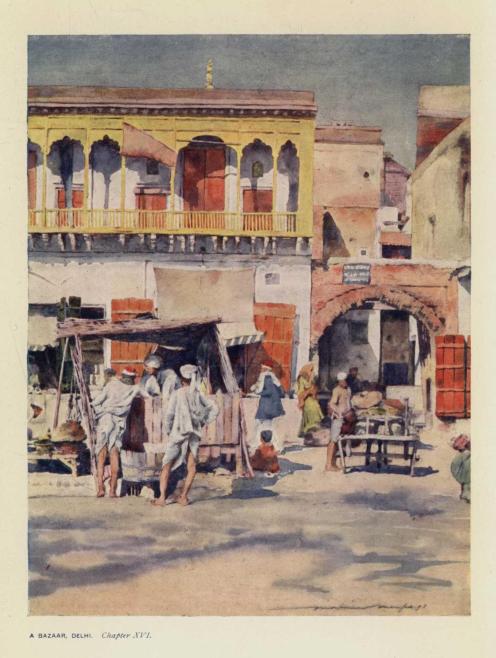
A BAZAAR, DELHI. Chapter XVI.
The shops are, as a rule, of the simplest nature in form—an archway, a booth, a hole in a wall. Upon a low platform the trader spreads his wares, squats beside them, and waits for customers. Let us stroll along a row of shops and see what they have for sale. The first shop has a crowd of customers, for it is a confectioner's, and the Hindoo, big or little, old or young, has a very sweet tooth. The confectioner spreads his wares on tiers of shelves or on a counter made of dried mud and rising in steps, and at the back of his shop is a sugar-boiling furnace, where he is busy on fresh supplies, pulling candy or making cakes of batter fried in butter. He sells toffee covered with silver-leaf, candy flavoured with spices, and many kinds of a sweet called luddu, made of sugar and curded milk. This stall is not only a great attraction to the children who have a pie (about one-third of an English farthing) to spend, but to the flies also. The latter come in myriads to settle on the sweet stuff, and though a boy is always at work with a whisk trying to drive them away, he can never keep the place clear.
Opposite the confectioner's is the flour-seller, and he, too, is a very busy man, for from his stall the everyday wants of the people are supplied. Great numbers of the Hindoos never touch meat, and the bunniah (the grain-seller) furnishes the whole of their food. He has a great number of baskets, and these are piled high with barley, wheat, lentils, flour, sugar, peas, rice, potatoes, nuts, dried fruits, and the like. He also sells ghee (clarified butter) and sour milk. He has a big pair of scales to weigh out his flour, sugar, peas, or whatever may be called for, but no bags to pack them in: he leaves that to the customers. One brings a cloth, another a basin, another a brass ewer for milk. Many have nothing, and they carry away their purchases in their hands, or, if that be impossible, flour is poured into the corner of a shawl or the fold of a robe. One man unwraps his turban and knots his purchases into various corners of it, twists it into shape again, and goes off with his day's supply on his head. Butter and milk are carried away in a green leaf dexterously twisted into the form of a cup.
The next shop is one which finds the grain-seller a very convenient neighbour, for it is a shop which sells parched grain—a bhunja's shop. At first glance there seems nothing in the place, then you notice a large shallow pan set on a mud platform. Under the pan a fire burns, and a woman steadily feeds the fire with dry leaves and husks. A second woman is stirring the corn in the pan, and as the grain parches and crackles a delicious smell fills the place, and passers-by sniff it, and stop and throw down a small copper coin on the mud platform, which is also the counter. Then they hold out their hands or a fold of a robe, and receive the sweet-smelling parched wheat or maize, and go on, munching as they walk.
Next comes a goldsmith's. Here is no glittering shop with ornaments and precious vessels in the window, as in a London street, but an archway or a booth of mud exactly like his neighbours'. The goldsmith himself is at work with his blowpipe at a little brazier, softening and shaping a piece of gold into a bangle for a customer. He is a busy man, for the country women bring him their silver to be made up into the ornaments they love, and he has always a store of ear-rings and bracelets to sell.
He sells his goods by weight, and weighs them in a most delicate pair of scales, which he keeps in a sandalwood box. His weights are the oddest things in the world—"tiny scraps of glass, a bean perhaps, an irregular chunk of some metal, a bit of stick, a red and black seed, an odd morsel of turquoise, and a thin leaf of mother-o'-pearl." His customers thus have to take the weight on his word; and they do not always care about that, for, as the saying goes, a goldsmith would cheat his own mother on the scales. So that hot words often fly to and fro across the mud floor of his little shop, and passers-by pause to listen to the fierce dispute.
Beyond the goldsmith's stands the shop of a cloth merchant, and this is a very fine shop, one of the grandest in the bazaar. So large is the merchant's stock that his booth is really big, or he fills three or four archways with his piles of calico and woollen. Here you may buy the strong woollen and cotton cloths of the country, made well and dyed in quiet, tasteful colours—goods which will wash and wear for year after year. But, alas! you may also buy from an even greater store of the poorest and cheapest goods which Manchester can turn out—cottons which will be of the flimsiest as soon as the dressing is washed out of them, cheap gaudy woollens made of shoddy, and silks of no greater strength than the paper which enwraps them. For the craze for cheapness has invaded the Indian bazaar as elsewhere, and the splendid old silk muslins, the brocade which would last for a century, the woollen shawl that was handed down from mother to daughter, find few or no buyers nowadays.
The druggist (the pansari-ji) contents himself with one small room, but it is packed from floor to ceiling with a thousand odds and ends—drugs, medicines, spices, one can hardly tell what. He wraps his more precious wares in scraps of paper, and stows them away in baskets, boxes, pots, and pigeon-holes in the wall. He prides himself on keeping everything in stock in his line, and one writer speaks of testing a pansari-ji by asking for cuttle-fish bone, "and lo! there it was—just two or three small broken pieces in a paper screw." The druggist may be the doctor of his quarter as well, and a favourite method of cure will be to write a mysterious talisman on a scrap of paper or a betel-leaf. This is rolled into a pill and swallowed by the patient. Opium he sells largely, and at evening he dispenses the sleep-compelling drug to knot after knot of customers.
The fruit-dealer's shop makes a beautiful patch of colour in the bazaar, with its heaps of golden oranges, of purple plums, of speckled pomegranates, of jackfruits and guavas, and many other kinds. But, as a rule, the fruit-dealers and greengrocers like a stall in a more open place, where they can pile their big melons up in a heap, and spread their wares in the lee of a wall, and throw an awning over to keep the sun off.
Now comes the cookshop, where rows of turbaned customers are squatted on the floor with bowls before them, and the busy cook is at work over a fireplace fed with dried leaves. He fries cakes of rice in oil, he spits half a dozen scraps of meat on a wooden skewer, and roasts them over charcoal. Then a big pot simmers over the fire of leaves, and the smell of a "double-onioned" stew is wafted across the place to mingle with a thousand other queer smells of the bazaar. He sells vegetables done up into all kinds of shapes, and made hot to the taste with plenty of curry; he pickles carrots; he has sweetmeats and great stores of pillau, a dish of meat cooked in rice. He has plenty of customers, for his prices are very low.
Then there is the kobariya, the marine-store dealer of the bazaar, whose shop is heaped with second-hand clothes, scrap-iron, and odds and ends. Mrs. Steel gives a vivid description of the wares of the kobariya:
"Old things, and still older things, upside down, higgledy-piggledy, hang on the top of each other: a patent rat-trap shouldering a broken lamp, an officer's tunic sheltering a pile of tent-pegs, a bazaar pipkin on top of some priceless old plate, a parrot's cage filled with French novels, a moth-eaten saddle keeping company with an old sword, and over all, sufficient scrap-iron to furnish forth a foundry; and in an old caldron, incense spoons, little brass gods, prayer measures, sacred fire-holders, all mixed up with battered electro-plated forks, hot-water jug lids, and every conceivable kind of rubbish."
CHAPTER XVII
IN THE JUNGLE
The jungle, the Indian forest, is the home of many wild creatures, and the sportsman who goes into it in search of them often has to take his life in his hands. This is true, above all, if he is pursuing the tiger, the most ferocious beast that India knows, the king of the jungle. It is true, there are lions in India, but not many, and the Indian lion is of no great importance: the tiger is the beast of beasts.
The tiger is a terrible scourge to the Indian herdsman: a big brute will often take up his quarters near a village, and levy a regular toll on the village herds, killing cow after cow, and buffalo after buffalo. He is often perfectly well known, and the villagers see him about the roads, or crossing their fields, or gliding through the jungle without a sound on his soft pads. If a dozen of them are together they do not fear him: they march right through his haunts, shouting and singing, rattling sticks on the bamboo-trunks, and beating drums, and he gets out of the way and stops there. This is if he be an ordinary tiger, a cattle-killer; but if a man-eater haunts the neighbourhood, then the ryot's soul is filled with fear. He dares scarcely leave his house: to leave the village is to face a terrible danger; he knows not when the monster may steal upon him.
The man-eater goes about his work in dreadful silence. The ordinary tiger will often make the jungle ring again with his hoarse, deep roar; not so the man-eater. The latter glides without a sound, and under cover of a patch of bamboos or a clump of reeds, up to the wood-cutter felling a tree, or up to the peasant in his rice-field, or up to a woman fetching water from the well. Silent as death, he bounds upon his victims and fells them with a single stunning blow of that huge paw driven by muscles of steel. The great white fangs are buried for an instant in the throat, then the body is lifted in the mouth as a dog lifts a rat, and is carried away to the lair, where he makes his dreadful meal.
Most remarkable stories are told of the ferocity and daring of man-eating tigers. They have been known to venture boldly into a village by night and carry off sleepers who had sought a cool couch out of doors in the summer heats, and by day they have made fields and roads quite impossible places to venture into. Villages and whole tracts of country have at times been deserted by their inhabitants owing to the ravages of these ferocious creatures, and when an English sportsman arrives to tackle the savage beast he is hailed as a deliverer.
There are two favourite ways of hunting a tiger. The first depends on the fact that he must drink. The sportsman, by means of native watchers, discovers the pool or water-hole where the tiger quenches his thirst. Then in a field near at hand is built a machan, a little platform where the hunter may watch and wait for his prey. He climbs into the machan at sunset, and waits till the tiger comes to drink at some time between the dark and the dawn, when a fortunate shot will put an end to the marauder.
The other way—a far more exciting and picturesque fashion—is to pursue the tiger upon elephants. The sportsmen are in open howdahs, and the elephants crash their way through the long grass, the reeds, the young bamboos, in search of the tiger. At last the tiger is driven into the open, and bullet after bullet is poured into his body by the marksmen. He is rarely killed at once, and in his agony he will often turn upon his pursuers with terrible fury. This is the moment of danger. With the horrible coughing roar of a charging tiger, he hurls himself with tremendous bounds upon his foes. His eyes blaze like green emeralds, his great fangs glitter like ivory. At springing distance he leaves the ground and shoots through the air like a thunderbolt, full upon the nearest elephant. Now is the time to try the sportsman's nerve and steadiness of aim. Unless the tiger be struck down by the heavy bullet, he will land with teeth and claws upon the flank of the elephant, striking and tearing with terrible effect at his foes.
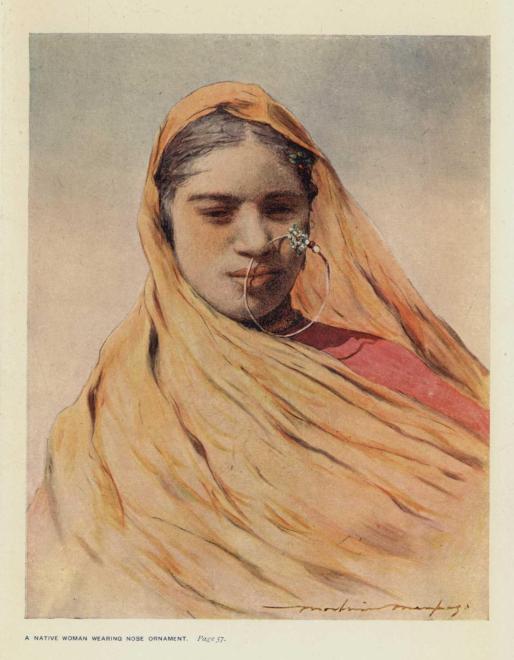
A NATIVE WOMAN WEARING NOSE ORNAMENT. Page 57.
More lives have been lost, however, by sportsmen following up a wounded tiger on foot. The tiger lies apparently stiff and still, as if already dead. The hunter comes too near, and finds that there is a flicker of life left. Before he can retreat, the wounded beast puts forth its last strength to spring upon him and take a terrible revenge for its injuries.
We said that the tiger is the king of the Indian jungle. There are some observers who dispute this; they award the palm to the elephant. Certainly there can be no more majestic sight than a herd of wild elephants in their native jungle. They move slowly along, staying now and again to crop the young shoots or to spout water over themselves at a pool or river. The huge grey bodies, on the round, pillar-like legs; the great flapping ears; the swinging, curling trunks; the rolling, lumbering walk, present a scene of great interest, heightened by the antics of the baby elephants, the calves, who trot along by their mothers and frisk around the herd.
The Indian elephant is rarely pursued and shot—it is far too valuable; but the capture and taming of these mighty creatures is very exciting and interesting work. In Central India, especially in Mysore, their capture is usually carried out by means of a kheddah, a kind of pound. Two huge fences are built in the forest in the shape of a mighty V. The wide end of the V is often a mile or more across, and into this end a herd of wild elephants will be driven by great numbers of beaters. The elephants are urged forward to a large enclosure, into which the narrow end of the V opens. Once they are in this, a great gate is dropped behind them, and they are imprisoned.
Now the work of taming them begins. Tame elephants take a great share in this, and show much cleverness in bringing their wild brethren into captivity. Two or three tame elephants, each with a driver on its back, will surround a wild one, and hustle and push it towards a strong tree. Now a man slips down from the back of a tame elephant, and slips a noose of strong rope round the leg of the wild one. This is dangerous work, and the man has to be very quick and skilful. The rope is now thrown round the tree, and drawn tight. Other ropes are soon fastened, and the huge wild creature is made a prisoner.
The task of taming him at once begins. From the first the men move about the captive and talk to him, to accustom him to their sight and presence. They give him plenty of nice things to eat, and from the first he does not refuse food, except in very rare cases. Very often within a couple of days the elephant is taking pieces of sugar-cane and fruit from the hands of his keepers. Now the friendship grows rapidly. The men begin to pat and caress the huge captive as they sing and talk to him, and within a couple of weeks his bonds are loosened, and he is led away between two tame companions to complete his education.
There is one elephant that no one tries, or dares to try, to capture. This is the "rogue," and he is pursued and shot at once, if possible. A rogue elephant is a savage, vicious brute who has left the herd and taken to a solitary life. They are very dangerous, and many of them will attack either man or beast that may come in their way. Their great size and vast strength render them easy conquerors over all they meet, and a rogue elephant is the dread of the neighbourhood where he roams. To hunt him is a very dangerous sport. He is very wary, very cunning, and quite fearless. If fired upon he charges full upon his foes, and, unless a well-directed bullet brings him down, the death of the hunter is certain. The rogue hurls him down and tramples upon him, smashing the body beneath his huge feet.
CHAPTER XVIII
IN THE JUNGLE (continued)
Through the jungle bound also the swift deer and the graceful antelopes, who so often have to fly before the pursuit of their fierce neighbours the tiger and the panther. The panther, when wounded, is actually more feared by the hunter than is the tiger. The panther is much smaller than the tiger, and his grey skin, dotted with black spots, enables him to hide himself easily among the tangle of the forest undergrowth, for he resembles a patch of shade. His limbs are long and powerful, and he is the nimblest of all the jungle dwellers. He can run like a leopard and climb like a monkey.
He often lies in wait for his prey on a broad, low-hanging branch; then, as the deer passes below, he springs full upon it, and bears it to the ground. He is very savage, and always full of fight, and his ferocity is employed with wonderful cunning. Two men have been known to fire upon a panther and hit it. They were apparently safe, each in a machan set in a tall tree. The wounded brute has darted up one tree and clawed the man there in fearful fashion; then, quick as lightning, it has descended, climbed into the second tree, and attacked its second assailant. No other animal does this. As a rule, a wounded beast makes a blind rush; but the panther seems to reason, to calculate.
The bear is just the opposite. The natives consider him the most stupid of animals. They say he is so stupid that he does not know enough to get out of the way. He will stretch himself in the warm dust of a jungle path, and lie there until, in the dusk, the passer-by stumbles over him. Then he is angry. He rises and strikes out with his long claws, and often deals terrible wounds, for he strikes at the head. One writer speaks of seeing a man whose face was torn away—every feature gone—with a single stroke of a bear's paw. But it is easy to avoid this. On such a path a native sings or shouts as he walks along. The bear is aroused by the noise, and moves away into the jungle.
The wild boar gives great sport over the plains and among the hills of India. He is hunted on horseback, just as the fox is hunted in England, save that each rider has a spear with which to strike at the big, savage beast. When he turns at bay he is a very dangerous animal. First he "squats"—that is, he turns round and sits on his haunches—thrusting out his snout, armed with great sharp tusks, towards his pursuers. Then he picks out a horseman, and charges him furiously. A fine hand with a spear will now stop him with a thrust in a vital part; but if the thrust fails, the boar will often fetch down horse and rider.
Then comes a time of great danger, for the boar will rip up both horse and man with swift turns of his keen tusks unless his attention be drawn aside by other attacks. In the end he falls under many spear-thrusts.
A walk through an open piece of jungle is very beautiful. The bamboos with their feathery crowns, the many trees covered with beautiful flowers, the merry bands of monkeys which skip from branch to branch, all draw the eye and the attention; but, at the same time, it is best to watch where you are going. All of a sudden your native guide stops you and tells you to step carefully. You look, and see something in the path among the sand looking like a dirty little stick. But do not tread on it. It is the deadliest snake in India, and its bite means certain death. Or you think you would like to sit down on a fallen tree to rest. Well, do not sit on that log which seems to have a bright patch of fungus growing about the middle of it. Throw a stick at the patch first. Ah! it uncoils, and a venomous reptile slides into the grass with angry hiss.
Look out, too, for the hooded cobra, who will sometimes dispute the way with you, rearing himself on his lower coils, and erecting his swelling hood, and "meaning venom." But the most wonderful snake of all is the huge python, the boa-constrictor, 20 to 25 feet long, and with a body as thick as a man's thigh. This huge snake destroys its prey by pressure, winding its coils round the creature's body, and crushing it to death. Then it swallows the body entire.
Another creature greatly dreaded by the natives belongs partly to the land and partly to the water. This is the alligator—a hideous grey brute, with huge jaws, furnished with long rows of teeth, and a long tail of immense power. On land the natives trouble little about this great reptile, for his legs are short and his powers of pursuit are small; but in the water or on the sandy margin it is a very different affair. Be careful where you bathe or draw water. A single sweep of that powerful tail will hurl you into the stream, and the alligator, lurking in the shallows, has seized you for his prey. Above all, it is necessary to be careful when walking along the pleasant sandy bank which often borders a river. Here and there grey logs seem to be lying on the sand. They may be logs or they may be alligators sunning themselves. In the latter case, if the walker be on the land side, well and good; but if he incautiously ventures between the alligator and the river, it is at the peril of his life. With the aid of his powerful tail, the frightful reptile hurls himself across the sand for a short distance at wonderful speed, then his mighty jaws open and close upon his victim, and the latter is dragged under water in the twinkling of an eye.
The tiger himself, unmatched in combat with any other beast of the jungle, sometimes falls a prey to the alligator. Coming to drink at the river, the king of the jungle is seized by the waiting reptile. A terrific struggle follows. Unable to wrench himself from those mighty jaws, the tiger uses his terrible fangs and claws on the alligator's back. Here for once they fail on that coat of horny scales. The tiger does not know that the alligator is soft beneath, and there could be ripped up by his claws of steel, and he continues to spend his strength in vain. Inch by inch he is dragged into the river, and once under water, he is lost. He swiftly drowns, and the alligators feast on his body.
CHAPTER XIX
IN AN INDIAN VILLAGE
We have spoken of temples and palaces and the magnificence of Kings and nobles, but now we must turn to the homes of the common people, and see how they live and work. Anyone who adopted the idea that India is a land of general riches and splendour would be making a very great mistake. The vast mass of the people live, not merely in the simplest fashion, but also in the poorest fashion, for the land can scarce produce enough food to satisfy the wants of its teeming millions. If the rains should fail and a crop go wrong, there is famine at once over wide districts, and vast numbers perish.
An Indian village is a collection of small huts, with walls of mud and roof of thatch. At break of day the men, the ryots, go out to labour in the fields which surround the place, putting their bullocks into the light wooden plough, which scarcely does more than scratch the soil. In the shallow furrow thus formed they sow the grain, and then with hoe and mattock they clean the weeds from a crop which is already springing up. These few simple tools serve all the purposes of the husbandman, just as they served his forefathers a thousand years ago.
The women of the village go to the well to draw water, passing on their way the village temple, where they offer fruits and flowers to the stone image of the Hindoo god, in whose honour the temple was built. When they have drawn their water, they return home to cook food and to work in the small compound which surrounds each mud hut. Here they grow trees, which yield the mango, plantain, guava, and other fruits.
As they go back to their homes they cast looks of deep interest at the door of a house where a figure is seated. It is a Brahmin sitting in dharna, for this is an out-of-the-way village where old customs cling fast.
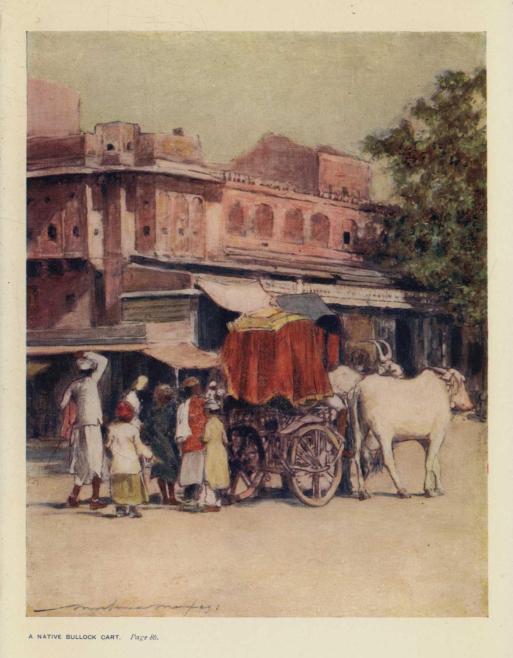
A NATIVE BULLOCK CART. Page 86.
What is dharna? It is really a form of intimidation. Some one has a quarrel with the owner of that house, and he has hired a Brahmin, a member of the priestly caste, to sit on his enemy's doorstep without food or drink, until the latter will do justice. The Brahmin, having undertaken the task, is certain to carry it through. He will starve until the person at whose door he sits has given way. The latter always happens. If the holy man were to starve to death, the sin would lie upon the head of the owner of the house for ever, and his fate in the next world would be dreadful. So, before long, some arrangement is made, and the dispute is settled.
The house before which the Brahmin is performing dharna is that of the money-lender, by far the most powerful man in the village. When a ryot cannot make both ends meet, and he is in trouble either about his rent or his taxes, it is to the money-lender that he flies for assistance. From that powerful personage he borrows a few rupees to tide him over the time of need till his crops shall be ready for sale, and he has to pay a very heavy rate of interest for the loan.
The money-lender is one of the oldest features of Indian village life. From the earliest times his trade has been in great vogue, and the Indian peasant is to-day as dependent upon him as ever. Broadly speaking, the ryot is always in debt. He is so careless, and thinks so little of the future that he always lives from hand to mouth, and a failure of his crop brings him within touch of famine at once. Then he resorts to the money-lender to borrow money to buy food or pay his rent, and to raise the money he often agrees to sell his next crop to the money-lender at a price which the money-lender himself will fix.
The price is very low, and the money is at once swallowed up to pay rent or the interest on the last loan, and so the peasant is driven to apply to the money-lender once more to obtain funds to carry him on to the next harvest. In this way the ryot falls completely into the hands of the money-lender, and, in order that the unlucky husbandman may not escape his clutches, the creditor employs men to watch the farmer's crops day and night, and the latter has to pay all these expenses.
Just beyond the money-lender's house is the dwelling of the baid, the doctor. He is sitting on his veranda, busily reading a very ancient book on medicine. It is from the instructions in this book that he treats all his patients. He has a store of herbs and roots, which he uses to make pills and potions. He looks with the greatest contempt on the European doctors and their medicines, and declares that they do not know how to treat Hindoo patients.
As a rule, the baid is a very poor hand at curing his patients. If they get well he takes all the credit; if they die he says that the hour of their death had come, and who can resist fate? But here and there are to be found men who have so great a knowledge of herbs and simples that they can effect wonderful cures. "A curious cure of asthma is recorded of a European who derived little benefit from the treatment of his own countrymen. A baid offered to cure him when his case had become almost hopeless. The European laughed. However, getting quite desperate, he submitted to the treatment of the Hindoo doctor, and the few sweet black pills which the latter administered wrought a complete cure. The grateful patient begged the doctor to name his own reward; but he would listen to nothing of the kind, nor would he tell of what ingredients the pills were composed. Indeed, this the baids will never do."
CHAPTER XX
IN AN INDIAN VILLAGE (continued)
Now there comes up to the veranda a quiet-looking man with a little bundle under his arm, and the baid lays aside his book. The village barber has come to shave him. The Hindoo barber is a very important man. Not only has he under his care the shaven crowns, the smooth chins, and the close-cropped hair of his neighbours, but he is the village surgeon also, for the baid knows nothing of surgery. It is the barber who bores the ears and noses of the little girls to put in rings and ornaments.
He squats down beside the doctor and unrolls his little bundle and spreads out its contents. He has a razor, a pair of scissors, a small steel instrument for cutting nails, a leather strop, a little brass cup, a scrap of looking-glass, and a towel. He uses neither brush nor soap for shaving, but puts cold water in the cup and dips his fingers into it. With these fingers he wets and rubs the chin, and then sweeps his razor over it with light and skilful hand, doing his work like a master. When he has finished he rolls up his little bundle and goes on to the next house, for he has a fixed round of customers, and no Hindoo, whether rich or poor, ever shaves himself.
Going thus from house to house the barber knows every one, and is often employed as a match-maker. In India parents always arrange the marriages of their children, and the wishes of the latter are not consulted in the affair. Indeed, marriages are often settled at so early an age that the children do not understand what it means. A girl is fetched from her play and married to a boy not much older than herself. She goes back to her dolls, and he goes back to school, and perhaps neither sees the other again for years.
In arranging these affairs there is often much coming and going of the family barber. He has to find out how much dowry the parents of the girl will give with their daughter, or, on the other hand, he is sent to see what examinations the young man has passed. This is an important point. The Hindoos think a great deal of such distinctions, and a young man who has passed a University examination can get a much richer wife than he who has not.
At the wedding the barber is a very busy man. Before the day he goes round to the friends and relatives of the family inviting them to come to the wedding-feast, and begging them not to fail in attendance. On the day of the wedding he has to dress the bridegroom, and when the guests are assembled he hands round betels to chew or hookahs to smoke. He helps to serve the wedding-feast, and when it is over he distributes the fragments among the beggars.
The barber's wife is as important a personage as himself. She is just as busy among the women as he is among the men. She enters the zenana, the women's portion of the house, to dress the ladies and adorn them. At weddings she dresses the hair of the bride, trims her nails, and arrays her in the richest robes. Both the barber and his wife belong to the barber caste. In India trades are handed down from father to son, from mother to daughter. The children of the barber and his wife are taught from their earliest years the duties of their business: they, too, will become barbers in due time.
As the barber goes away the water-carrier comes up. This is another important personage; for, in the burning climate of India, fresh, pure water is of the greatest importance. This water-carrier has not filled his vessels at the village well, but has been to a spring at some distance, where the water is very good. He carries it in two large vessels of brass, and these are slung from the ends of a pole which he carries across one of his shoulders, one vessel in front and one behind.
If there are Mohammedans in the village you will also see the bhistee, the Mohammedan water-carrier. He bears his load in a skin on his shoulders, or in a pair of skins which he slings across the back of a bullock. He sells water only to people of his own faith, for no Hindoo will use for any purpose water which a Mohammedan has handled.
The larger houses have flat roofs, and from the roofs of two standing near each other a couple of boys are having a battle with fighting kites. Flying kites is a very favourite amusement in India, and in some villages old and young, rich and poor, spend much time on this sport. The kites are square in shape, but of all sizes, and in the case of fighting kites the string or thread is passed through a mixture of pounded glass and starch and then dried. The thread has now a keen, cutting edge, and if brought sharply across the string of another kite will cut it through, and he who succeeds in setting his opponent's kite adrift is the victor.
At the farther end of our village there is a large native inn. This is by no means a common thing to find in such a place; but, as it happens, a well-travelled road passes through the country at this point. To see this inn at its busiest we must go on some evening when a fair is to be held in the neighbouring town, and a throng of travellers pause in it for the night.
The inn itself, as we approach it, shows a square of four flat naked walls. There are neither doors nor windows to be seen, and the place is entered by a wide opening, which can be closed by massive gates. Near the gate are some small shops where one can buy rice, flour, salt, and ghee to eat, or earthen pots for cooking.
Upon entering, we find ourselves in a big courtyard, the middle of which is packed with the bullock waggons and carts, from which the ponies and bullocks have just been released and turned out to graze. Round the walls inside is a wide veranda, and behind this veranda are rooms wherein the wayfarers may sleep. The scene is one of the greatest uproar and confusion. Men and women are bustling to and fro, shouting and calling to each other as they draw water, light fires, cook food, feed their animals, spread their beds, and generally make ready for the night.
Every inch of the veranda is taken up, and in front of each room burns the fire of the party who intend to occupy it. A wealthy traveller will engage a number of rooms for himself and his family or servants; but poor men club together, and five or six engage a single room and stow themselves away in it. The cost to them will then be about one farthing per head.
The inn is under the charge of a number of inn-keepers, each of whom has a certain part of the inn-yard under his care and a certain number of rooms to let. These people crowd about the traveller on his arrival, each clamouring that his rooms are the best, and begging for his custom. They are a thievish and quarrelsome crew, and are looked down upon as a very low and degraded class. In a native inn the traveller has to keep a very sharp eye on his belongings. He takes care to keep his money in a safe place, and he never accepts tobacco or any eatable from a stranger. There may be a drug in it which will throw him into a deep sleep, from which he will awake to find all his valuables gone.
When supper is dispatched the traveller prepares for sleep. If poor, he stretches himself on the floor; if better off, he hires a wooden frame from the inn-keeper, and spreads upon it his quilts and blankets. Now the great gates are swung to and locked, and the inn is securely shut up for the night. This is very necessary, or some of the animals would be missing in the morning. There are also men who keep watch all night, and the merchant with a stock of valuable goods gives one of these a small sum to take particular care of his bales and animals.
BILLING AND SONS, LTD., PRINTERS, GUILDFORD.