Chapter VII
Reading edition
ANIMAL CHARGES (continued)
(A mastiff with short ears was termed an alant.)
The Carricks and Burgoynes bear one talbot on their shield, whilst the Talbot family have three talbots passant.
The Earl of Perth has a "sleuthhound, collared and leashed" for his crest; that of the Biscoe family is a greyhound seizing a hare. A dog chasing another animal must be blazoned either "in full course" or "in full chase." A foxhound nosing the ground is described as "a hound on scent."
The fox rarely figures in heraldry. One Kadrod-Hard of Wales bore two "reynards counter salient," and "the Wylies do bear that wylie beast, the fox"; whilst three foxes' heads erased are borne respectively by the Foxes of Middlesex and one Stephen Fox, of Wilts.
A fox's face is blazoned a "mask."
Cats occur fairly often in heraldry. "Roger Adams and John Hills, both of the City of London," we are told, "bear cats"; Sir Jonathan Keats charges three "cats-a-mountain"—wild cats—upon his shield, as also do the Schives of Scotland; the Dawson-Damer's crest is a tabby cat with a rat in her mouth. She would be blazoned as preying.
The dog, fox, and cat have each their typical meaning in heraldry. The dog symbolizes courage, fidelity, affection, and sagacity; the fox, great wit and cunning; the cat, boldness, daring, and extraordinary foresight, so that whatever happens she always falls on her feet. She was formerly the emblem of liberty, and was borne on the banners of the ancient Alans and Burgundians to show that they brooked no servitude.
The squirrel is rather a favourite charge, notably in the arms of landed gentry—such as the Holts, Woods, Warrens—because the little nut-cracker is typical of parks and woodland property. It occurs either singly or in pairs or trios. It is always represented sejant, and usually cracking nuts, as seen in the arms of the Nuthall family.
A hedgehog usually figures in the arms of the Harris, Harrison, Herries, and Herrison families, and is undoubtedly borne in allusion to their surname, hérisson being the French for hedgehog. Lord Malmesbury—family name Harris—bears a hedgehog in his coat of arms. It is generally blazoned as an "urcheon" in heraldry. The hare occurs but rarely in English arms; the Clelands bear one as a single charge, and the Trussleys charge their shield with three little hares playing bagpipes, probably in allusion to the hare's traditional love of music. The rabbit—known to heralds as a coney—is oftener met with in armorial bearings; the Strodes of Devon bear three conies couchant; the Conesbies, three conies sejant; the Cunliffes, three conies courant.
PLATE 5.
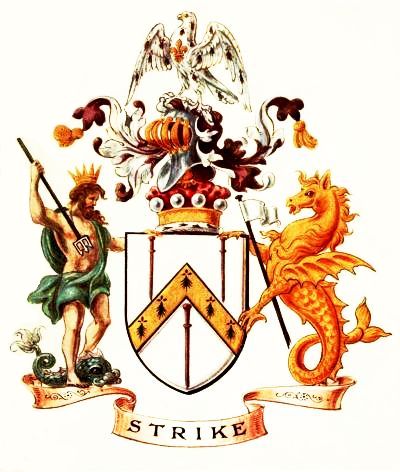
BARON HAWKE.
Arms.—A chevron erminois between three pilgrim's staves purpure. Crest.—A hawk, wings displayed and inverted ppr. belled and charged on the breast with a fleur de lys or. Supporters.—Dexter, Neptune, Sinister, a Sea-horse. Motto.—Strike.
Three moles are borne by Sir John Twistledon, of Dartford, Kent—a mole was sometimes blazoned "moldiwarp"—whilst the Rattons very aptly bear a rat.
The Gandys of Suffolk bear a single tortoise passant, and a tortoise erected occurs on the Coopers' coat of arms.
Serpents are blazoned in terms peculiar to themselves. Thus, a serpent coiled, is said to be nowed—knotted—from the French nœud, a knot; when upright on its tail, it is erect; gliding, it is glissant also from the French; when biting its tail, it is blazoned embowed. The Falconers bear a "serpent embowed"; one Natterley has an "adder nowed"—natter is the German for adder—and Sir Thomas Couch of London charges an adder "curling and erect" upon his shield.
To the Greek, the grasshopper signified nobility; hence amongst the Athenians a golden grasshopper worn in the hair was the badge of high lineage. In later days the heralds considered the grasshopper a type of patriotism, "because in whatever soil a grasshopper is bred, in that will he live and die."
One family of Shelleys bears three "house-snails" so termed in heraldry to imply that they carry their shells. A type of deliberation in business matters and perseverance is supposed to be furnished by the common snail.
The "creatures that live above the earth"—i.e., having wings—come next.
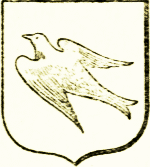
Fig. 42.
Various heraldic terms are in use for blazoning bird charges—viz.:
Falcons are blazoned "armed, jessed and belled." A falcon is usually called "goshawk" in heraldry.
Swans, geese, ducks, and other web-footed birds occur rarely in heraldry. The Moore family bear one swan, the Mellishes two, and three swans' necks are charged upon the Lacys' shield. One, John Langford, bears a single wild goose. Three wild duck volant appear in the arms of the Woolrich family. Three drakes—a very favourite charge—are borne by the Yeos. The Starkeys bear one stork, the Gibsons three.
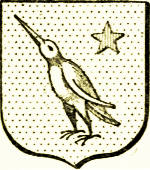
Fig. 43.
Three herons occur in the arms of Heron, one kingfisher in those of one, Christopher Fisher (Fig. 43). Viscount Cullen, whose family name is Cockayne, bears three cocks; three capons are borne by the Caponhursts; whilst, drolly enough, three cocks are borne by the Crow family. The Alcocks bear three cocks' heads.
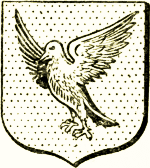
Fig. 44.
Three hawks are borne by the Hawksworths; the Corbets bear a raven as a single charge, whilst Dr. Raven, Queen Anne's physician, bears a raven rising (Fig. 44). The swallow, which is the heraldic martlet (see No. 4, Fig. 36), occurs repeatedly as a charge in coats of arms, very often in threes; six is also a favourite number. The Wardes and Temples bear five; the Chadwicks and Brownlows charge the orle of their shield with eight martlets. The Pawne family bear three peacocks "in their pride" (see Fig. 45), and this same charge occurs in the arms of the Peacocks of Durham. A phœnix is borne by the Fenwicks. The dove occurs occasionally in heraldry. A dove with an olive branch in its beak was added as an augmentation of honour to his paternal arms by one Walker, when he married the only child of Sir David Gam. This charge was granted to Sir David after the Battle of Agincourt, where he took the Duc de Nevers prisoner. It was this same Sir David who, on being sent by the king to view the French Army before the battle, brought word to his royal master that "there were men enough to kill, enough to run away, and enough to make prisoners."
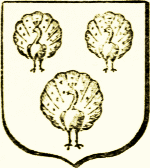
Fig. 45.
Besides the birds already mentioned, the parrot, turkey, owl, chough, pheasant, woodcock, and several others occur in heraldry.
"The calf, the goose, and the bee, The world is ruled by these three."
The Burninghills bear three gadbees—horseflies—and the Papillons, very properly, have three butterflies charged on their shield (Fig. 46).
In concluding this chapter let us explain the term augmentation used above.
By augmentation is meant any addition granted for some special reason, to a coat of arms. Thus to one, William Compton, who was about Henry VIII. and in great favour with him, the King actually granted permission to add a lion passant guardant, taken out of his own royal device, to his paternal arms, as an "honourable augmentation." "In rememberance whereof," says Sir William Dugdale, "the said Compton at his death bequeathed to the king a little chest of ivory, whereof the lock was gilt, with a chessboard under, and a pair of tables upon it."
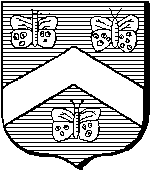
Fig. 46.
The arms of Sir Atwel-King Lake show a curious augmentation—viz., a dexter arm embowed—bent—issuing from the sinister side of the shield, holding in the hand a sword erect, thereto affixed a banner, bearing a cross between sixteen escutcheons, etc. These sixteen escutcheons were given to the original bearer of these arms, Dr. Edward Lake, a devoted adherent of Charles I., to commemorate the sixteen wounds that Lake received at the Battle of Naseby.
Lord Nelson was granted a very pictorial augmentation of honour. "Waves or the sea, from which a palm-tree issues between a disabled ship on the dexter and a battery in ruins on the sinister." Nelson had also a crest of an "honourable augmentation," which he bore in addition to that of his family. A naval crown with the chelengk, or plume of triumph, presented to him by the Grand Sultan, Selim III.
The augmentation of honour granted to the great Duke of Wellington took the shape of the Union Jack charged upon an inescutcheon, which was superimposed upon his own shield.