PECK’S COMPENDIUM OF FUN. (continued 4)
Reading edition
“Well, you are a cruel, bad boy,” said the grocery man, as he went to the book and charged the six shillings.
“O, I don’t know. I think Pa is cruel. A man who will take a poor kitty by the neck, that hasn’t done any harm, and tries to chastise the poor thing with a trunk strap, ought to be looked after by the humane society. And if it is cruel to take a cat by the neck, how much more cruel is it to take a boy by the neck, that had diphtheria only a few years ago, and whose throat is tender? Say, I guess I will accept your invitation to take breakfast with you,” and the boy cut off a piece of bologna and helped himself to the crackers, and while the grocery man was out shoveling off the snow from the sidewalk, the boy filled his pockets with raisins and loaf sugar, and then went out to watch the man carry in his kindling wood.
SPURIOUS TRIPE.
Return to Table of Contents
Another thing that is being largely counterfeited is tripe. Parties who buy tripe cannot be too careful. There is a manufactory that can make tripe so natural that no person on earth can detect the deception. They take a large sheet of rubber about a sixteenth of an inch thick for a background, and by a process only known to themselves veneer it with a Turkish towel, and put it in brine to soak. The unsuspecting boarding house keeper, or restaurant man buys it and cooks it, and the boarder or transient guest calls for tripe. A piece is cut off the damnable tripe with a pair of shears used in a tin shop for cutting sheet iron, and it is handed to the victim. He tries to cut it, and fails; he tries to gnaw it off, and if he succeeds in getting a mouthful, that settles him. He leaves his tripe on his plate, and it is gathered up and sewed on the original piece, and is kept for another banquet.
“CASH.”
Return to Table of Contents
On circus day W.H.H. Cash, the great railroad monopolist of New Lisbon, was in the city. He had just made a few hundred thousand dollars on a railroad contract, and he decided to expend large sums of money in buying dry goods. He went into one of our stores and was passing along up the floor, when a black-eyed girl with a dimple in her chin, pearly teeth, red pouting lips, who was behind the counter, shouted, “cash, here!” Mr. Cash turned to her, a smile illuminating his face as big as a horse collar. He is one of the most modest men in the world, and as he extended his great big horny hand to the girl, a blush covered his face, and the perspiration stood in great beads on his forehead. “How do yeu dew?” said Cash, as she seemed to shrink back in a frightened manner. They gazed at each other a moment, in astonishment, when another girl, perhaps a little better looking, further on, said, “Here, Cash, quick!” He at once made up his mind that she was the one that had spoken to him the first time, so he said, “Beg your pardon, miss,” to the black-eyed girl, and went on to where the other girl was wrapping up a corset in a base ball undershirt. As he approached her she smiled, supposing he wanted to buy something. He thought she knew him, and he sat down on a stool and put out his hand and said, “How have you been?” She didn’t seem to shake very much, but asked him if there was anything she could show him. He thought may be it was against the rules for the clerks to speak to anybody, unless they were buying something, so he said, “Yes, of course. Show me corsets, stockings, anything, gaul dumbed if I care what.” She was just beginning to look upon him as though she thought he had escaped, when a little blonde on the other side of the store, as sweet as honey, shouted, “Cash, Cash, I need thee every hour. Come a running.” To say that Cash was astonished, is drawing it mild. He knew that they all wanted him, but he couldn’t make out how they seemed to know his name. He looked at the little blonde a minute, trying to think where he had met her, when he decided to go over and ask her. On the way over he thought she resembled a girl that used to live in Portage. He went up to her, and with a smile that was childlike and bland, he said, “Why, how are you, Samantha?” The little blonde looked daggers at him. “Didn’t you use to wait on tables there at the Fox House, at Portage?” The girl picked up a roll of paper cambric, and was about to brain him, when the floor walker came along, and asked what was the matter. Cash explained that since he came into the store, three or four girls had yelled to him, and he couldn’t place them. “There,” says he, as another girl yelled “Cash,” “there’s another of ‘em wants me,” and he was going to where she was, when the floor walker asked him if his name was Cash. “You bet your liver it is,” said Cash. It was then explained to him that the girls were calling cash boys. He thought it over a minute and said, “Sold, by the great baldheaded Elijah. Won’t you go down and take something? Invite all of them. The girls can take soda. I’ll be gaul blasted if I ever had such a rig played on me.” And he went out into the glare of the sunlight, with his hat pulled down over his eyes, and just then the circus procession came along, and he followed off the elephants. There are lots of worse men than Cash.
TO WHAT VILE USES MAY WE COME.
Return to Table of Contents
A dispatch from Chicago, says that three men were shot on “a boat used for the vilest purposes.” We never knew that the newspapers were printed on boats there in Chicago.
THE ADVENT PREACHER AND THE BALLOON.
Return to Table of Contents
There occasionally occurs an accident in this world that will make a person laugh though the laughing may border on the sacrilegious. For instance, there is not a Christian but will smile at the ignorance of the Advent preacher up in Jackson county who, when he saw the balloon of King, the balloonist, going through the air, thought it was the second coming of Christ, and got down on his knees and shouted to King, who was throwing out a sand bag, while his companion was opening a bottle of export beer, “O, Jesus, do not pass me by.”
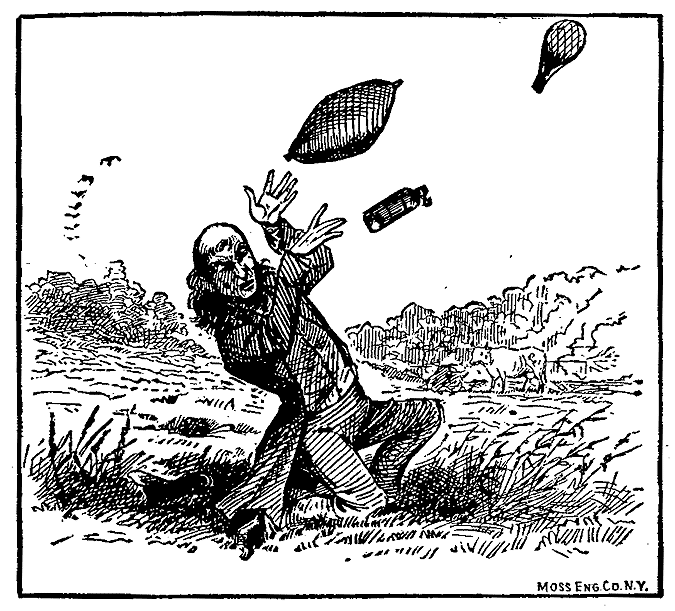
“DO NOT PASS ME BY!”
And yet it is wrong to laugh at the poor man, who took an advertising agent for a Chicago clothing store for the Savior, who he supposed was making his second farewell tour. The minister had been preaching the second coming of Christ until he looked for him every minute. He would have been as apt to think, living as he did in the back woods, that a fellow riding a bicycle, with his hair and legs parted in the middle, along the country road, was the object of his search.
We should pity the poor man for his ignorance, we who believe that when Christ does come he will come in the old-fashioned way, and not in a palace car, or straddle of the basket of a balloon. But we can’t help wondering what the Adventist must have thought, when he appealed to his Savior, as he supposed, and the balloonist shied a sand bag at him and the other fellow in the basket threw out a beer bottle and asked, “Where in —— are we?”
The Adventist must have thought that the Savior of mankind was traveling in mighty queer company, or that he had taken the other fellow along as a frightful example. And what could the Adventist have thought when he saw a message thrown out of the balloon, and went with trembling limbs and beating heart to pick it up, believing that it was a command from on high to sinners, and found that it was nothing but a hand bill for a Chicago hand-me-down clothing store.
He must have come to the conclusion that the Son of Man had got pretty low down to take a job of bill posting for a reversible ulster and paper collar bazar. It must have been food for reflection for the Advent preacher, as he picked up the empty beer bottle, shied at him from the chariot that he supposed carried to earth the Redeemer of man. He must have wondered if some Milwaukee brewer had not gone to heaven and opened a brewery.
Of course we who are intelligent, and would know a balloon if we saw it, would not have had any such thoughts, but we must remember that this poor Advent preacher thought that the day had come that had been promised so long, and that Christ was going to make a landing in a strong Republican county. We may laugh at the Adventist’s disappointment that the balloon did not tie up to a stump and take him on board, but it was a serious matter to him.
He had been waiting for the wagon, full of hope, and when it came, and he saw the helmet on King’s head and thought it was a crown of glory, his heart beat with joy, and he plead in piteous accents not to be passed by, and the confounded gas bag went on and landed in a cranberry marsh, and the poor, foolish, weak, short-sighted man had to get in his work mighty lively to dodge the sand bags, beer bottles, and rolls of clothing store posters.
The Adventist would have been justified in renouncing his religion and joining the Democratic party. It is sad, indeed.
MR. PECK’S SUNDAY LECTURE.
Return to Table of Contents
The papers all around here are saying that I have a new Sunday Lecture, with a bad title. The way of it was this. A man in a neighboring city telegraphed me to know if I would deliver a “Sunday Lecture,” and telling me to choose my subject, and answer by telegraph. I thought it was some joke of the boys. The idea of me delivering a Sunday lecture was ridiculous, so, in a moment of thoughtlessness I telegraphed back, “What in the d—— do you take me for?” I supposed that that would be enough to inform the man that I was not in the business. What do you suppose he did? He telegraphed back to me as follows: “All right. We have advertised you for Sunday. Subject, ‘What the d—— do you take me for.’” You can judge something of my surprise and indignation.
That is how it was.
RELIGION AND FISH.
Return to Table of Contents
Newspaper reports of the proceedings of the Sunday School Association encamped on Lake Monona, at Madison, give about as many particulars of big catches of fish as of sinners. The delegates divide their time catching sinners on spoon-hooks and bringing pickerel to repentance. Some of the good men hurry up their prayers, and while the “Amen” is leaving their lips they snatch a fish-pole in one hand and a baking-powder box full of angle worms in the other, and light out for the Beautiful Beyond, where the rock bass turn up sideways, and the wicked cease from troubling.
Discussions on how to bring up children in the the way they should go are broken into by a deacon with his nose peeled coining up the bank with a string of perch in one hand, a broken fish-pole in the other, and a pair of dropsical pantaloons dripping dirty water into his shoes.
It is said to be a beautiful sight to see a truly good man offering up supplications from under a wide-brimmed fishing hat, and as he talks of the worm that never, or hardly ever dies, red angle worms that have dug out of the piece of paper in which they were rolled up are crawling out of his vest pocket. The good brothers compare notes of good places to do missionary work, where sinners are so thick you can knock them down with a club, and then they get boats and row to some place on the lake where a local liar has told them the fish are just sitting around on their haunches waiting for some one to throw in a hook.
This mixing religion with fishing for black bass and pickerel is a good thing for religion, and not a bad thing for the fish. Let these Christian statesmen get “mashed” on the sport of catching fish, and they will have more charity for the poor man who, after working hard twelve hours a day for six days, goes out on a lake Sunday and soaks a worm in the water and appeases the appetite of a few of God’s hungry pike, and gets dinner for himself in the bargain. While arguing that it is wrong to fish on Sunday, they will be brought right close to the fish, and can see better than before, that if a poor man is rowing a boat across a lake on Sunday, and his hook hangs over the stern, with a piece of liver on, and a fish that nature has made hungry tries to steal his line and pole and liver, it is a duty he owes to society to take that fish by the gills, put it in the boat and reason with it, and try to show it that in leaving its devotions on a Sunday and snapping at a poor man’s only hook, it was setting a bad example.
These Sunday school people will have a nice time, and do a great amount of good, if the fish continue to bite, and they can go home with their hearts full of the grace of God, their stomachs full of fish, their teeth full of bones; and if they fall out of the boats, and their suspenders hold out, they may catch a basin full of eels in the basement of their pantaloons. But we trust they will not try to compete with the local sports in telling fish stories. That would break up a whole Sunday school system.
THE POLITICAL OUTLOOK.
Return to Table of Contents
When you see an article in the editorial columns of a paper headed, “The Political Outlook,” look at the bottom line, and if it says “sold by all druggists,” don’t read it. There is such an article going the rounds, which is an advertisement of a patent medicine. It is a counterfeit well calculated to deceive. Don’t read a political article unless the owner’s name is blown in the bottle.
ROPE LADDERS.
Return to Table of Contents
The law to compel hotel keepers to provide rope ladders for every room above the second floor, is said not to be enforced, though it should be by all means. The law ought to be amended so as to compel guests to get up once or twice during the night and run up or down the rope ladder, outside the window, in their night clothes, so as to be in practice in case of fire. When every room is provided with rope ladders there will be lots of fun. Those men who invariably blow out the gas, will probably think they have got to come down stairs on the rope ladder in the morning, and it will take an extra clerk to stand in the alleys around a hotel, with a shot gun, to keep impecunious guests from going away from the tavern via rope ladder. And then imagine an Oshkosh man in a Milwaukee hotel, his head full of big schemes, and his skin full of beer. He has been on a “bum,” and is nervous, and on being shown to his room he sees the rope ladder coiled up under the window, ready to spring upon him. He stares at it, and the cold sweat stands all over him. The rope ladder returns his gaze, and seems to move and to crawl towards his feet. For a moment he is powerless to move. His hair stands on end, his heart ceases to beat, cold and warm chills follow each other down his trousers legs and he clutches at the air, his eyes start from their sockets, and just as the rope ladder is about to wind around him, and crush his life out, he regains strength enough to rush down stairs head over appetite, and tell the clerk about the menagerie up stairs. O, there is going to be fun with these rope ladders, sure.
A DOCTOR OF LAWS.
Return to Table of Contents
A doctor at Ashland is also a Justice of the Peace, and when he is called to visit a house he don’t know whether he is to physic or to marry. Several times he has been called out in the night, to the country, and he supposed some one must be awful sick, and he took a cart load of medicines, only to find somebody wanted marrying. He has been fooled so much that when he is called out now he carries a pill-bag and a copy of the statutes, and tells them to take their choice.
He was called to one house and found a girl who seemed feverish. She was sitting up in a chair, dressed nicely, but he saw at once that the fatal flush was on her cheek, and her eyes looked peculiar. He felt of her pulse, and it was beating at the rate of two hundred a minute. He asked her to run out her tongue, and she run out eight or nine inches of the lower end of it. It was covered with a black coating, and he shook his head and looked sad. She had never been married any before, and supposed that it was necessary for a Justice who was going to marry a couple to know all about their physical condition, so she kept quiet and answered questions.
She did not tell him that she had been eating huckleberry pie, so he laid the coating on her tongue to some disease that was undermining her constitution. He put his ear on her chest and listened to the beating of her heart, and shook his head again. He asked her if she had been exposed to any contagious disease. She didn’t know what a contagious disease was, but on the hypothesis that he had reference to sparking, she blushed and said she had, but only two evenings, because John had only just got back from the woods where he had been chopping, and she had to sit up with him.
The doctor got out his pill bags and made some quinine powders, and gave her some medicine in two tumblers, to be taken alternately, and told her to soak her feet and go to bed, and put a hot mustard plaster on her chest, and some onions around her neck.
She was mad, and flared right up, and said she wasn’t very well posted, and lived in the country, but if she knew her own heart she would not play such a trick as that on a new husband.
The doctor got mad, and asked her if she thought he didn’t understand his business; and he was about to go and let her die, when the bridegroom came in and told him to go ahead with the marrying. The doc. said that altered the case. He said next time he came he should know what to bring, and then she blushed, and told him he was an old fool anyway, but he pronounced them man and wife, and said the prescription would be five dollars, the same as though there had been somebody sick.
But the doc. had cheek. Just as he was leaving he asked the bridegroom if he didn’t want to ride up to Ashland with him, it was only eighteen miles, and the ride would be lonesome, but the bride said not if the court knew herself, and the bridegroom said now he was there he guessed he would stay. He said he didn’t care much about going to Ashland anyway.
COMFORTING COMPENSATIONS.
Return to Table of Contents
If a farmer’s wheat is killed by rain, he is consoled by the fact that rain is just what his corn needs. If his cattle die of disease, his consolation lies in the hope that pork will bring a good price. If boys steal his watermelons, he knows by experience that they will have the cholera morbus. So everything that is unpleasant has its compensation.
LAY UP APPLES IN HEAVEN.
Return to Table of Contents
They tell a good story at Portage City, at the expense of Senator Barden, or a minister, we don’t know which. Barden had a lot of apples sent him last fall, and he was anxious to sell them, before winter set in. One day he thought of a new minister that had settled in Portage, so he made up his mind to take him up a couple of barrels, supposing that when he went to heaven and saw the big ledger opened, there would be a credit about as follows:
L.W. BARDEN, in acc't with Providence,
1876.
Oct. 21. By two bbls. apples, @ $3 $6.00
" " " drayage .30
Total $6.30
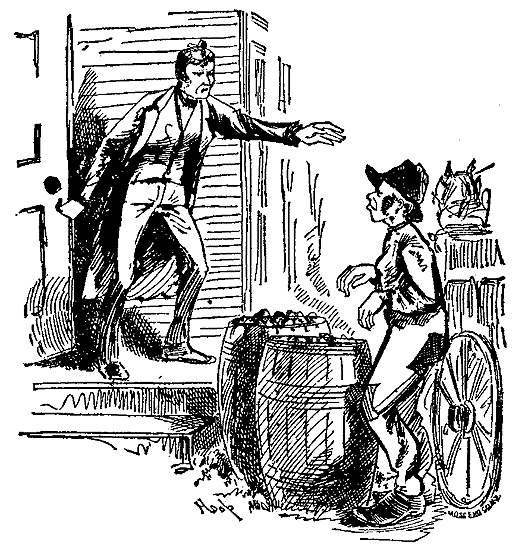
NO MORE APPLES FOR THE MINISTER.
Barden loaded them on a dray, and got on it, with his pants in his boots, and went up to deliver them himself. He stopped at the minister’s gate, and hurried the apples off and rolled them inside the gate, and tried to get away before the minister had time to thank him. Just as he was about to drive away the door opened and the man of God came out, and says he:
“Look here! You put them apples in the cellar!”
Barden told him he was in something of a hurry, and really he could not spare the time. The minister raised his voice to a sort of “auction pitch,” and said:
“Here, now. You don’t know your business, Mr. Drayman. You roll them apples into the cellar, or I won’t accept them.”
The senator was by this time as mad as senators usually get. He jumped off the dray, threw the two barrels of apples on, and drove off, saying he didn’t care a continental dam if the minister eat dried apples all winter. And he took them back to his store, and it is safe to say that he will not give many more apples to that minister.
MORAL:—Never despise a man because he wears a ragged coat, for he may be a senatorial granger angel in the disguise of a drayman. And you may have to fill up on turnips instead of apples.
ONE OF BEECHER’S CONVERTS.
Return to Table of Contents
Since Beecher, the great revivalist, was here, and spoke so eloquently on the fall of man, and the need of making arrangements for the future, I have become a changed man. It hurts me to lie now, and when anything hurts, then I quit. It is wrong to lie, and a man who follows it up will come to some bad end.
BUYING A STONE CRUSHER.
Return to Table of Contents
The proceedings of the council of the city of Milwaukee shows that the aldermen are about to buy a stone crusher, to be run by steam, for the purpose of crushing stones to be used on the streets. If the city has never indulged in the luxury of a stone crusher, it should interview some city that has owned one, before it closes a contract with any party that wants to sell one. Every party that owns one does want to sell it. Statistics show that. The first city in Wisconsin that bought one was Madison. The city owned it for a year or two, and after that no man that was in the council when it was bought could ever get in it again. The mayor that winked at the purchase of the stone crusher was defeated, and there was trouble. No person would ever say what was the matter, but you say “stone crusher” to a citizen of Madison, and he would reach his right hand around to his pistol pocket, and the conversation would cease.
La Crosse heard that Madison had a stone crusher, and so she wanted one. La Crosse is bound to have anything that any other town has, whether it is a railroad, an insane asylum, or a speckled hen. La Crosse could have bought Madison’s stone crusher at a discount, but she wanted one new, with the paint all on, fresh. Second-hand stone crusher? Not any for La Crosse. So the city ordered a brand new one, right from the mint, at an expense of about $5,000.
The idea was that it would be about as big as a straw cutter, or a job press, and people were anxious to see it work.
Finally the city was notified that one train of cars loaded with the stone crusher had arrived, with red flags on, betokening extra trains running wild behind, and the city was told to come down to the depot and pay the first installment of freight, and take the stone crusher away—that part of it that had arrived. The aldermen went down and took an inventory of the hardware, and some of them went and jumped in the river. At a cent a pound one can buy a good deal of cast iron for five thousand dollars. The city bonded itself, and paid the freight, and during the spring all of the trains loaded with the stone crusher arrived. It was argued that the only way to get the stone crusher up to the city building would be to give the railroad the right of way up town, right through Main street.
Some were in favor of letting the railroad company keep it for freight, but the company threatened to get out an injunction on the city. Finally a man who took contracts to move brick buildings agreed to move it up town on shares, and during the summer the most of it was got up there and corded up on some vacant lots. If all the cast iron in it came out of one mine it must have been an immense mine. People would look at it and weep. Every alderman swore he voted against buying it. Occasionally some one in the council would suggest that the stone crusher be taken out to the bluffs, a couple of miles, and set to work, when another one would move, to amend by inserting a clause that the bluffs be moved into the city to be crushed, as it would save expense. Then the matter would drop. For three years that stone crusher stood there, and it never crushed a pebble. New mayors and aldermen were elected, and every day they passed that crusher, but they never spoke to it. Finally a job was put up to get rid of it. There was a man there who owned a stone quarry, and it occurred to somebody to sell it to him. He was a truly good man, and did not believe there were any bad men in the world, who would kanoodle him with a stone crusher. A committee was appointed to sell it to him. The committee was composed of men who had traded horses, sold lightning rods, and been insurance agents, and when they told the poor man that the city had noticed that he was a deserving man, that they had decided to help him along, and would sell him that stone crusher, and he could pay for it in crushed stone, and the city would pay him in cash half a dollar more than the stone was worth, he said he would take it. They got it on to him by buying crushed stone of him and paying cash for it.
We have never heard whether the man lived or not, and have never heard whether the city bought any stone of him, but the city got rid of it, and then had a celebration. Why, they figured it up, and the thing could crush enough stone in twenty-four hours to pave the streets a foot thick all over town and thirteen miles in the country. To run it a week would bankrupt the State of Wisconsin, It could go up to the stone quarry and tunnel a hole right through the hill. It was the biggest elephant that ever a city drew in a legalized lottery. Milwaukee will make money if she does not buy a stone crusher, not as long as it can buy stone in the rough, and have it crushed by tramps, at nothing a day.
MERRIE CHRISTMAS.
Return to Table of Contents
What proportion of the people who wish each other merry Christmas, do you suppose think of the reason that the day is a holiday? Not one in a thousand. Do the young fellows who put on a clean shirt and go down town and play pool all day, and drink yellow stuff out of a shaving cup, and get chalk on their fingers, and eat liver sausage, think that Christ died to save them? No! All they think of is the prospect of sticking some other fellow for the game. Do the hundreds of thousands of people who get up a big feed, and gormandize, think of Christ, or the poor all about them who have little to eat to-day, and little prospect of more to eat to-morrow? Many of them do not think of the poor, or of anything else except to prospect upon how much they will hold and not get sick.
THE DIFFERENCE IN HORSES.
Return to Table of Contents
There has been a great change in livery horses within the last twenty years. Years ago, if a young fellow wanted to take his girl out riding, and expected to enjoy himself, he had to hire an old horse, the worst in the livery stable, that would drive itself, or he never could get his arm around his girl to save him. If he took a decent looking team, to put on style, he had to hang on to the lines with both hands, and if he even took his eyes off the team to look at the suffering girl beside him, with his mouth, the chances were that the team would jump over a ditch, or run away, at the concussion. Riding out with girls was shorn of much of its pleasure in those days.
We knew a young man that was going to put one arm around his girl if he did not lay up a cent, and it cost him over three hundred dollars. The team ran away, the buggy was wrecked, one horse was killed, the girl had her hind leg broken, and the girl’s father kicked the young man all over the orchard, and broke the mainspring of his watch.
It got so that the livery rig a young man drove was an index to his thoughts. If he had a stylish team that was right up on the bit, and full of vinegar, and he braced himself and pulled for all that was out, and the girl sat back in the corner of the buggy, looking as though she should faint away if a horse got his tail over a line, then people said that couple was all right, and there was no danger that they would be on familiar terms.
But if they started out with a slow old horse that looked as though all he wanted was to be left alone, however innocent the party might look, people knew just as well as though they had seen it, that when they got out on the road, or when night came on, that fellow’s arm would steal around her waist, and she would snug up to him, and—Oh, pshaw, you have heard it before.
Well, late years the livery men have “got onto the racket,” as they say at the church sociables, They have found that horses that know their business are in demand, and so horses are trained for this purpose. They are trained on purpose for out-door sparking. It is not an uncommon thing to see a young fellow drive up to the house where his girl lives with a team that is just tearing things. They prance, and champ the bit, and the young man seems to pull on them as though his liver was coming out. The horses will hardly stand still long enough for the girl to get in, and then they start off and seem to split the air wide open, and the neighbors say, “Them children will get all smashed up one of these days.”
The girl’s mother and father see the team start, and their minds experience a relief as they reflect that “as long as John drives that frisky team there can’t be no hugging a going on.” The girl’s older sister sighs and says, “That’s so,” and goes to her room and laughs right out loud.
It would be instructive to the scientists to watch that team for a few miles. The horses fairly foam, before they get out of town, but striking the country road, the fiery steeds come down to a walk, and they mope along as though they had always worked on a hearse. The shady woods are reached, and the carriage scarcely moves, and the horses seem to be walking in their sleep. The lines are loose on the dash board, and the left arm of the driver is around the pretty girl, and they are talking low. It is not necessary to talk loud, as they are so near each other that the faintest whisper can be heard.
But a change comes over them. A carriage appears in front, coming towards them. It may be someone that knows them. The young man picks up the lines, and the horses are in the air, and as they pass the other carriage it almost seems as though the team is running away, and the girl that was in sweet repose a moment before acts as though she wanted to get out. After passing the intruder the walk and conversation are continued.
If you meet the party on the Whitefish Bay road at 10 o’clock at night, the horses are walking as quietly as oxen, and they never wake up until coming into town, and then he pulls up the team and drives through the town like a cyclone, and when he drives up to the house the old man is on the steps, and he thinks John must be awful tired trying to hold that team. And he is.
It is thought by some that horses have no intelligence, but a team that knows enough to take in a sporadic case of buggy sparking has got sense. These teams come high, but the boys have to have them.
BASE INGRATITUDE.
Return to Table of Contents
I remember once of offering a lady from Eau Claire a slice of bread and a half of a red onion in a railroad car. She looked hungry, and yet she said she didn’t care to eat. Thinking she had a delicacy about accepting food at the hands of one who was almost a stranger to her, I turned the bread and onion into her lap, and said she was entirely welcome to it. What did she do? Instead of eating it, and thanking me, she threw it out of the window, and went and sat by the stove. I was never so offended in my life. That woman may see the time she will want that onion, and I would see her almost perish of starvation before she could have any more of my onion.
THE DIFFERENCE.
Return to Table of Contents
One of the great female writers on dress reform, in trying to illustrate how terrible the female dress is, says:
“Take a man and pin three or four table cloths about him, fastened back with elastic, and looped up with ribbons, draw all his hair to the middle of his head and tie it tight, and hairpin on five pounds of other hair and a big bow of ribbon. Keep the front locks on pins all night, and let them tickle his eyes all day, pinch his waist into a corset, and give him gloves a size too small, and shoes the same, and a hat that will not stay on without torturing elastic, and a little lace veil to blind his eyes whenever he goes out to walk, and he will know what a woman’s dress is.”
Now you think you have done it, don’t you sis? Why, bless you, that toggery would be heaven compared to what a man has to contend with. Take a woman and put a pair of men’s four shilling drawers on her that are so tight that when they get damp, from perspiration, sis, they stick so you can’t cross your legs without an abrasion of the skin, the buckle in the back turning a somersault and sticking its points into your spinal meningitis; put on an undershirt that draws across the chest so you feel as though you must cut a hole in it, or two, and which is so short that it works up under your arms, and allows the starched upper shirt to sand paper around and file off the skin until you wish it was night, the tail of which will not stay tucked more than half a block, though you tuck, and tuck, and tuck; and then fasten a collar made of sheet zinc, two sizes too small for you, around your neck, put on vest and coat, and liver pad and lung pad and stomach pad, and a porous plaster, and a chemise shirt between the two others, and rub on some liniment, and put a bunch of keys and a jack-knife and a button hook, and a pocket-book and a pistol and a plug of tobacco in your pockets, so they will chafe your person, and then go and drink a few whiskey cocktails, and walk around in the sun with tight boots on, sis, and then you will know what a man’s dress is.
Come to figure it up, it is about an even thing, sis,—isn’t it?
THOSE STEP LADDERS!
Return to Table of Contents
There has got to be a law passed to punish the hardware dealers for selling those step ladders that shut up like a jack-knife. A Ninth Street woman got onto one the other afternoon when it looked as though there was going to be a frost, to take her ivies down and carry them in the house. We don’t care how handsome a woman is naturally, you put a towel around her head and put her up on a step ladder about seven feet high, with a tomahawk in her left hand, trying to draw a big nail out of a post on a veranda, and she looks like thunder. This woman did. Her husband tried to get her to let him do the work, but she said a man never knew how to do anything, anyway. So he sat down on the steps to see how it would turn out. She said afterwards that he kicked the ladder, but however that may be, there was an earthquake, and when he looked up the air was filled with calico, toweling, striped stockings, polonaise, trailing arbutus, red petticoats, store hair and step ladder. He said the step ladder struck the veranda last, but as he picked her off of it, it seemed as though it must have lit first. He said the step ladder must have kicked up. In coming down she run one leg through the baby wagon, and the other through some flower pots, and a boy who was passing along said he guess she had been to the turning school.
WONDERS OF THE STAGE.
Return to Table of Contents
There is no person in the world who is easier to overlook the inconsistencies that show themselves on the stage at theatres than we are, but once in a while there is something so glaring that it pains us. We have seen actors fight a duel in a piece of woods far away from any town, on the stage, and when one of them fell, pierced to the heart with a sword, we have noticed that he fell on a Brussels carpet. That is all wrong, but we have stood it manfully.
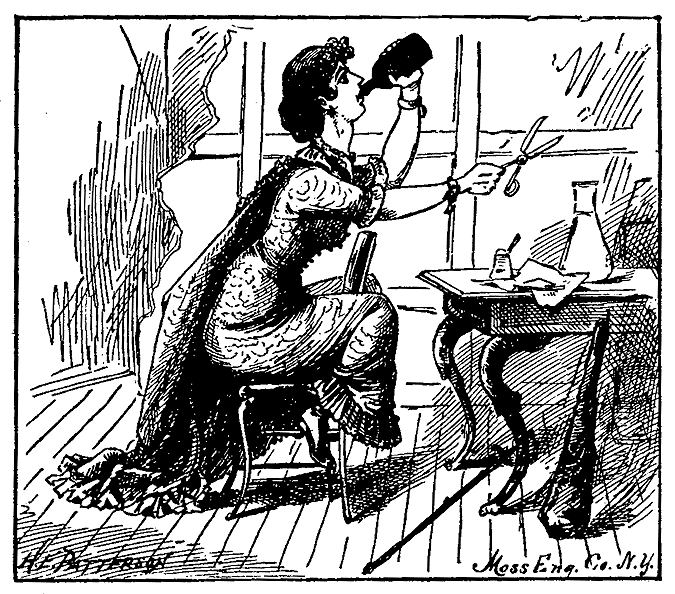
BEHIND THE SCENES.
We have seen a woman on the stage who was so beautiful that we could be easily mashed if we had any heart left to spare. Her eyes were of that heavenly color that has been written about heretofore, and her smile as sweet as ever was seen, but behind the scenes, through the wings, we have seen her trying to dig the cork out of a beer bottle with a pair of shears, and ask a supe, in harsh tones, where the cork-screw was, while she spread mustard on a piece of cheese, and finally drank the beer from the bottle, and spit the pieces of cork out on the floor, sitting astride of a stage chair, and her boot heels up on the top round, her trail rolled up into a ball, wrong side out, showing dirt from forty different stage floors.
These things hurt. But the worst thing that has ever occurred to knock the romance out of us, was to see a girl in the second act, after “twelve years is supposed to elapse,” with the same pair of red stockings on that she wore in the first act, twelve years before. Now, what kind of a way is that? It does not stand to reason that a girl would wear the same pair of stockings twelve years. Even if she had them washed once in six months, they would be worn out. People notice these things.
What the actresses of this country need is to change their stockings. To wear them twelve years even in their minds, shows an inattention to the details and probabilities, of a play, that must do the actresses an injury, if not give them corns. Let theatre-goers insist that the stockings be changed oftener, in these plays that sometimes cover half a century, and the stockings will not become moth-eaten. Girls, look to the little details. Look to the stockings, as your audiences do, and you will see how it is yourselves.
HOW FARMERS MAY GET RICH.
Return to Table of Contents
The artificial propagation of fish has attracted much attention of late years, and the success of experiments has shown that every farmer that has a stream of water on his land can raise fish enough to get rich in five years, four months and twenty-one days.
A CASE OF PARALYSIS.
Return to Table of Contents
About as mean a trick as we ever heard of was perpetrated by a doctor at Hudson last Sunday. The victim was a justice of the peace named Evans. Mr. Evans is a man who has the alfiredest biggest feet east of St. Paul, and when he gets a new pair of shoes it is an event that has its effect on the leather market.
Last winter he advertised for sealed proposals to erect a pair of shoes for him, and when the bids were opened it was found that a local architect in leather had secured the contract, and after mortgaging his house to a Milwaukee tannery, and borrowing some money on his diamonds of his “uncle,” John Comstock, who keeps a pawnbrokery there, he broke ground for the shoes.
Owing to the snow blockade and the freshets, and the trouble to get hands who would work on the dome, there were several delays, and Judge Evans was at one time inclined to cancel the contract, and put some strings in box cars and wear them in place of shoes, but sympathy for the contractor, who had his little awl invested in the material and labor, induced him to put up with the delay.
On Saturday the shoes were completed, all except laying the floor and putting on a couple of bay windows for corns and conservatories for bunions, and the judge concluded to wear them on Sunday. He put them on, but got the right one on the left foot, and the left one on the right foot. As he walked down town the right foot was continually getting on the left side, and he stumbled over himself, and he felt pains in his feet. The judge was frightened in a minute. He is afraid of paralysis, all the boys know it, and when he told a wicked Republican named Spencer how his feet felt, that degraded man told the judge that it was one of the surest symptoms of paralysis in the world, and advised him to hunt a doctor.
The judge pranced off, interfering at every step, skinning his shins, and found Dr. Hoyt. The doctor is one of the worst men in the world, and when he saw how the shoes were put on he told the judge that his case was hopeless unless something was done immediately. The judge turned pale, the sweat poured out of him, and taking out his purse he gave the doctor five dollars and asked him what he should do. The doctor felt his pulse, looked at his tongue, listened at his heart, shook his head, and then told the judge that he would be a dead man in less than sixty years if he didn’t change his shoes.
The judge looked down at the vast expanse of leather, both sections pointing inwardly, and said, “Well, dam a fool,” and “changed cars” at the junction. As he got them on the right feet, and hired a raftsman to tie them up for him, he said he would get even with the doctor if he had to catch the small pox. O, we suppose they have more fun in some of these country towns than you can shake a stick at.
WE WILL CELEBRATE.
Return to Table of Contents
With so many new holidays, and so many new people, it is hardly to be wondered at that the day of all days, the day that should be dearest to the heart of every American, is in danger of being passed over in silence, and were it not for the fire cracker, that begins to get in its work about the first of June, in many instances this Anniversary of American Independence would be passed without the customary mouth shootzen-fest from alleged orators, but when the small boy begins to stir around and clandestinely look down the muzzle of the always loaded fire cracker, the patriotism of the boys still begins to assert itself, the old man’s eyes begin to snap, and he talks to his neighbor about how they used to celebrate when he was a boy, the stuff begins to work over the neighborhood, the village catches it, the country begins.
DOGS AND HUMAN BEINGS!
Return to Table of Contents
Lorillard, the New York tobacco man, had a poodle dog stolen, and has offered a reward of five hundred dollars for the arrest of the thief, and he informs a reporter that he will spend $10,000, if necessary, for the capture and conviction of the thief. [Applause.]
The applause marked in there will be from human skye terriers, who have forgotten that only a few weeks ago several hundred girls, who had been working in Lorillard’s factory, went on a strike because as they allege, they were treated like dogs. We doubt if they were treated as well as this poodle was treated. We doubt, in case one of these poor, virtuous girls was kidnapped, if the great Lorillard would have offered as big a reward for the conviction of the human thief, as he has for the conviction of the person who has eloped with his poodle.
We hope that the aristocracy of this country will never get to valuing a dog higher than it does a human being. When it gets so that a rich person would not permit a poodle to do the work in a tobacco factory that a poor girl does to support a sick mother, hell had better be opened for summer boarders. When girls work ten hours a day stripping nasty tobacco, and find at the end of the week that the fines for speaking are larger than the wages, and the fines go for the conviction of thieves who steal the girl’s master’s dog, no one need come around here lecturing at a dollar a head and telling us there is no hell.
When a poor girl, who has gone creeping to her work at daylight, looks out of the window at noon to see her master’s carriage go by, in which there is a five hundred dollar dog with a hundred dollar blanket on, and a collar set with diamonds, lolling on satin cushions, and the girl is fined ten cents for looking out of, the window, you don’t want to fool away any time trying to get us to go to a heaven where such heartless employers are expected.
It is seldom the Sun gets on its ear, but it can say with great fervency, “Damn a man that will work poor girls like slaves, and pay them next to nothing, and spend ten thousand dollars to catch a dog-thief!” If these sentiments are sinful, and for expressing them we are a candidate for fire and brimstone, it is all right, and the devil can stoke up and make up our bunk when he hears that we are on the through train.
It seems now—though we may change our mind the first day at the fire—as though we had rather be in hades with a hundred million people who have always done the square thing, than to be in any heaven that will pass a man in who has starved the poor and paid ten thousand dollars to catch a dog-thief. We could have a confounded sight better time, even if we had our ulster all burned off. It would be worth the price of admission to stand with our back to the fire, and as we began to smell woolen burning near the pistol pocket, to make up faces at the ten-thousand-dollar-dog millionaires that were putting on style at the other place.
AN ODOROUS BOHEMIAN.
Return to Table of Contents
A Bohemian on the train last night had some cheese in his vest pocket that was too ripe, and the conductor had to disinfect the car, and order the Bohemian to be quarantined before the train would be allowed to enter the city. Cheese is all right in its place, but it don’t want to be allowed to lay above ground too long after it has departed this life. If farmers will pay a little attention to cheese in its different stages, much trouble can be avoided. In union there is strength. So there is in a smoking car.
TRAGEDY ON THE STAGE.
Return to Table of Contents
The tendency of the stage is to present practical, everyday affairs in plays, and those are the most successful which are the most natural. The shoeing of a horse on the stage in a play attracts the attention of the audience wonderfully, and draws well. The inner workings of a brewery, or a mill, is a big card, but there is hardly enough tragedy about it. If they could run a man or two through the wheel, and have them cut up into hash, or have them drowned in a beer vat, audiences could applaud as they do when eight or nine persons are stabbed, poisoned or beheaded in the Hamlets and Three Richards, where corpses are piled up on top of each other.
What the people want is a compromise between old tragedy and new comedy. Now, if some manager could have a love play, where the heroine goes into a slaughter house to talk love to the butcher, instead of a blacksmith shop or a brewery, it would take. A scene could be set for a slaughter house, with all the paraphernalia for killing cattle, and supe butchers to stand around the star butcher with cleavers and knives.
The star butcher could sit on a barrel of pigs’ feet, or a pile of heads and horns, and soliloquize over his unrequitted love, as he sharpened a butcher knife on his boot. The hour for slaughtering having arrived, cattle could be driven upon the stage, the star could knock down a steer and cut its throat, and hang it up by the hind legs and skin it, with the audience looking on breathlessly.
As he was about to cut open the body of the dead animal, the orchestra could suddenly break the stillness, and the heroine could waltz out from behind a lot of dried meat hanging up at one side, dressed in a lavender satin princess dress, en train, with a white reception hat with ostrich feathers, and, wading through the blood of the steer on the carpet, shout, “Stay your hand, Reginald!”
The star butcher could stop, wipe his knife on his apron, motion to the supe butchers to leave, and he would take three strides through the blood and hair, to the side of the heroine, take her by the wrist with his bloody hand, and shout, “What wiltest thou, Mary Anderson de Montmorence?” Then they could sit down on a box of intestines and liver and things and talk it over, and the curtain could go down with the heroine swooning in the arms of the butcher.
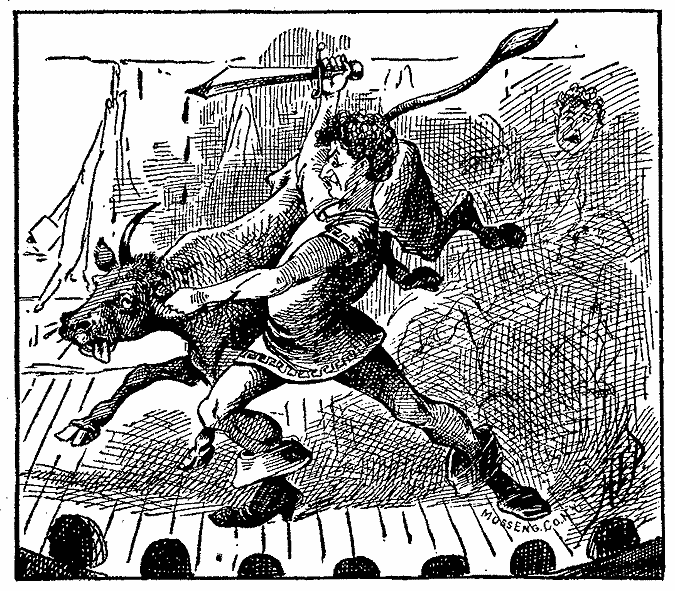
JOHN MCCULLOUGH KILLING A TEXAS STEER.
Seven years could elapse between that act and the next, and a scene could be laid in a boarding house, and some of the same beef could be on the table, and all that. Of course we do not desire to go into details. We are no play writer, but we know what takes. People have got tired of imitation blood on the stage. They kick on seeing a man killed in one act, and come out as good as new in the next. Any good play writer can take the cue from this article and give the country a play that will take the biscuit.
Imagine John McCullough, or Barrett, instead of killing Roman supes with night gowns on, and bare legs, killing a Texas steer. There’s where you would get the worth of your money. It would make them show the metal within them, and they would have to dance around to keep from getting a horn in their trousers. It does not require any pluck to go out behind the scenes with a sword and kill enough supes for a mess.
GRANITE HEAD CHEESE.
Return to Table of Contents
A few years ago there was some excitement at Grand Rapids over the discovery of a bed or quarry of granite. Some of it was taken out, from the top of the quarry, and polished, and proved to be as fine as any that is imported. Further working of the quarry, however, has developed a strange thing. The further they go down the softer it is, and it has been learned that the quarry is all head cheese, such as is sold by butchers. On top it is petrified, and polishes very nicely, but a little below it is nice and fresh, and can be cut out with a knife, all ready for the table. A friend in Milwaukee, who has an uncle living at Grand Rapids, has furnished us with a quantity of it, some of which we have eaten, and were it not for the fact that we know it came from the quarry, it would be hard to convince us that it was not concocted out of the remains of a butcher shop. The people up there talk of running Hon. J.N. Brundage for Congress, on the head cheese ticket, in order that he may use his influence to get head cheese adopted as an army ration, and also as currency with which to wipe out the national debt.
PECK’S BAD BOY AND HIS PA.
HIS PA AN INVENTOR.
Return to Table of Contents
“Ha! Ha! Now I have got you,” said the grocery man to the had boy, the other morning, as he came in and jumped upon the counter and tied the end of a ball of twine to the tail of a dog, and “sicked” the dog on another dog that was following a passing sleigh, causing the twine to pay out until the whole ball was scattered along the block. “Condemn you, I’ve a notion to choke the liver out of you. Who tied that twine to the dog’s tail?”
The boy choked up with emotion, and the tears came into his eyes, and he said he didn’t know anything about the twine or the dog. He said he noticed the dog come in, and wag his tail around the twine, but he supposed the dog was a friend of the family, and did not disturb him. “Everybody lays everything that is done to me,” said the boy, as he put his handkerchief to his nose, “and, they will be sorry for it when I die. I have a good notion to poison myself by eating some of your glucose sugar.”
“Yes, and you do about everything that is mean. The other day a lady came in and told me to send up to her house, some of my country sausage, done up in muslin bags, and while she was examining it she noticed something hard inside the bags, and asked me what it was, and I opened it, and I hope to die if there wasn’t a little brass padlock and a piece of red morocco dog collar imbedded in the sausage. Now how do you suppose that got in there?” and the grocery man looked savage.
The boy looked interested, and put on an expression as though in deep thought, and finally said, “I suppose the farmer that put up the sausage did not strain the dog meat. Sausage meat ought to be strained.”
The grocery man pulled in about half a block of twine, after the dog had run against a fence and broke it, and told the boy he knew perfectly well how the brass padlock came to be in the sausage, but thinking it was safer to have the good will of the boy than the ill will, he offered him a handful of prunes.
“No,” said the boy, “I have swore off on mouldy prunes. I am no kinder-garden any more. For years I have eaten rotten peaches around this store, and everything you couldn’t sell, but I have turned over a new leaf now, and after this nothing is too good for me. Since Pa has got to be an inventor, we are going to live high.”
“What’s your Pa invented? I saw a hearse and three hacks go up on your street the other day and I thought may be you had killed your Pa.”
“Not much. There will be more than three hacks when I kill Pa, and don’t you forget it. Well, sir, Pa has struck a fortune, if he can make the thing work. He has got an idea about coal stoves that will bring him several million dollars, if he gets a royalty of five dollars on every cook stove in the world. His idea is to have a coal stove on castors with the pipe made to telescope out and in, and rubber hose for one joint, so you can pull the stove all around the room and warm any particular place. Well, sir, to hear Pa tell about it, you would think it would revolutionize the country, and maybe it will when he gets it perfected, but he came near burning the house up, and scared us half to death this morning, and burned his shirt off, and he is all covered with cotton with sweet oil on, and he smells like salad dressing.
“You see Pa had a pipe made and some castors put on our coal stove, and he tied a rope to the hearth of the stove, and had me put in some kindling wood and coal last night, so he could draw the stove up to the bed and light the fire without getting up. Ma told him he would put his foot in it, and he told her to dry up, and let him run the stove business. He said it took a man with brain to run a patent right, and Ma she pulled the clothes over her head and let Pa do the fire act. She has been building the fires for twenty years, and thought she would let Pa see how good it was. Well, Pa pulled the stove to the bed, and touched off the kindling wood. I guess maybe I got a bundle of kindling wood that the hired girl had put kerosene on, cause it blazed up awful and smoked, and the blaze bursted out the doors and windows of the stove, and Pa yelled fire, and I jumped out of bed and rushed in and he was the scartest man you ever see, and you’d a dide to see how he kicked when I threw a pail of water on his legs and put his shirt out. Ma did not get burned, but she was pretty wet, and she told Pa she would pay five dollars royalty on that stove and take the castors off and let it remain stationary. Pa says he will make it work if he burns the house down. I think it was real mean in Pa to get mad at me because I threw cold water on him instead of warm water, to put his shirt out. If I had waited till I could heat water to the right temperature I would have been an orphan and Pa would have been a burnt offering. But some men always kick at everything. Pa has given up business entirely and says he shall devote the remainder of his life curing himself of the different troubles that I get him into. He has retained a doctor by the year, and he buys liniment by the gallon.
“What was it about your folks getting up in the middle of the night to eat? The hired girl was over here after some soap the other morning, and she said she was going to leave your house.”
“Well, that was a picnic. Pa said he wanted breakfast earlier than we was in the habit of having it, and he said I might see to it that the house was awake early enough. The other night I awoke with the awfulest pain you ever heard of. It was that night that you give me and my chum the bottle of pickled oysters that had begun to work. Well, I could’t sleep, and I thought I would call the hired girls, and they got up and got breakfast to going, and then I rapped on Pa’s and Ma’s door and told them the breakfast was getting cold, and they got up and came down. We ate breakfast by gas light, and Pa yawned and said it made a man feel good to get up and get ready for work before daylight, the way he used to on the farm, and Ma she yawned and agreed with Pa, ’cause she has to, or have a row. After breakfast we sat around for an hour, and Pa said it was a long time getting daylight, and bimeby Pa looked at his watch. When he began to pull out his watch I lit out and hid in the storeroom, and pretty soon I heard Pa and Ma come up stairs and go to bed, and then the hired girls, they went to bed, and when it was all still, and the pain had stopped inside of my clothes, I went to bed, and I looked to see what time it was and it was two o’clock in the morning. We got dinner at eight o’clock in the morning, and Pa said he guessed he would call up the house after this, so I have lost another job, and it was all on account of that bottle of pickled oysters you gave me. My chum says he had colic too, but he didn’t call up his folks. It was all he could do to get up himself. Why don’t you give away something that is not spiled?”
The groceryman said he guessed he knew what to give away, and the boy went out and hung up a sign in front of the grocery, that he had made on wrapping paper with red chalk, which read, “Rotten eggs, good enough for custard pies, for 18 cents a dozen.”
A GOOD LAND ENOUGH.
Return to Table of Contents
This land of the free is good enough, if we make it good, and if we make it bad, it is just as bad as any country under the sun. It all depends on how the people act.
THE WOODCOCK.
Return to Table of Contents
It is a rainy day, and nothing has occurred of a local nature, that is, nothing of a hair standing nature, so we will just spoil a few sheets of paper relating, in a Sunday School book style, the circumstances of an excursion after woodcock, the other day, indulged in by W.C. Root, the Wisconsin amateur Bogardus, Jennings McDonald, Captain of a breech-loading steamboat, and the subscriber. In the first place, it may be well to state that the woodcock, or “Timber Doodle,” as Prof. Agassiz calls it, is a game bird. We know it is a game bird, because they charge a dollar apiece for them in New York. The meat is about as sweet as deceased cow’s liver, but they are worth a dollar apiece. The “Timber Doodle” is a patriotic bird, because he gets ripe on the 4th of July. He is about the size of a doughnut, with a long bill, like a lawyer.
We took passage per skiff at twelve o’clock. If there was one drawback, it was the fact that the oar-locks of the boat had been mislaid. After consuming an hour in not finding them, Frank Hatch became discouraged at seeing us lay around the levee, so he tied the oars on with tarred rope and we got off, three of us besides the other dogs. The water was so high that we crossed Barron’s island, only having to get out and pull the boat over two or three sand-bars and a raft or two. Every time we got out to pull the boat, the dogs would get out to look for woodcock, around the stumps, and when they got in the boat would be full of water and mud, and of course we had our best clothes on. Did it ever occur to you how much water a dog could carry in his hair? A dog is worse than a sponge. An ordinary dog, with luck, can fill a skiff with water at two jumps. Not, however, with us in the boat to bail out the water. The woodcock’s tail sticks up like a sore thumb. We are thus particular to describe the woodcock, so if you ever see one you can go right away from him. Woodcock and mosquitoes are in “cahoots.” While the woodcock bores in the ground for snakes and other feed that makes him fat and worth a dollar in New York, the mosquito stands on the ramparts and talks to the boys.
Well, speaking about woodcock, after riding five miles, through bushes, brambles and things, we got out of the boat and only had to walk a couple of miles to get where the birds were. Right here we wish to state that we shouldn’t have gone after the woodcock at all, only everybody said it was such fun. Root showed us a picture of a woodcock in a book, and if that didn’t convince us, the fact that a small boy came in town and sold three dozen, did. Then we wanted to go. There never has been a year when woodcock were so plenty at places we didn’t visit. The most fun was at a ditch which was about a foot wider than any of us could jump. Root gave his gun to McDonald and plunged in. Then McDonald threw a gun to Root. It hit him on the thumb-nail and dropped in the ditch out of sight. Mc. thought it was Root’s gun, and he apologized to Root for throwing it so carelessly. Root supposed it was Mc.’s gun, and he apologized for not catching it. We never saw men more polite in the world. Mc. started to jump across, when a dog got between his legs, and both went in up to their knees. You never can jump as well with a dog tangled up amongst your legs. The dog looked at Jennings as though he wanted to swear. We waded through the ditch and only got two feet wet. The rest of them had more than that wet.
But about the woodcock. This is, kind reader, purely a woodcock story, and more or less must be said about the dollar bird. But this is neither here nor there. It was over in the Root river bottoms. Finally we got on the woodcock ground and went to work. Talk about mosquitoes! There was no end to them. We ought not to say that, either, because there are spots on our person that just fit the end of a mosquito. There was an end to them. If you never saw mosquitoes in convention, you want to go over there. And right here we will give a recipe for keeping mosquitoes from biting. You take some cedar oil and put on your coat collar, if you are a man, and if you are a woman put it on that gingerbread work around your neck, and a mosquito will come up and sing to you and get all ready to take toll, when she will smell that oil. She is the sickest mosquito you ever saw. She turns over on her back and sends her husband for the nearest doctor. We had a bottle of cedar oil, and if Jennings hadn’t left it hanging up in Hogan’s store in his coat, we should have made those mosquitoes sick. As it was they did it to us. There isn’t a spot on us as big as a billiard table but what you can find artesian wells made by mosquitoes.
Woodcock sell higher in the market than any other bird. Lots of people that never saw them eat snakes, eat them. When they get up to fly they talk Bohemian, and get behind a bush. You shoot right into the bush, and if you kill one you think you are a good shot. Talk about getting tired. You walk around in the woods several miles, with mosquitoes getting acquainted with you, and all the time your nerves strung up in anticipation of seeing a dollar bill fly up, and if you don’t sleep without rocking, we are no prophet. The sport, however, is exhilerating, and we are glad we went. We are glad because it learned us one thing, and that is, if we ever want a woodcock real bad, it will be cheaper, easier, and better to buy it. It will be inferred that we did not see a woodcock. Such is the case.
But we made the blackbirds sick.
A BALD-HEADED MAN MOST CRAZY.
Return to Table of Contents
Last Wednesday the bell to our telephone rung violently at 8 o’clock in the morning, and when we put our ear to the earaphone, and our mouth to the mouthaphone, and asked what was the matter, a still small voice, evidently that of a lady, said, “Julia has got worms, doctor.”
We were somewhat taken back, but supposing Julia was going fishing, we were just going to tell her not to forget to spit on her bait, when a male voice said, “O, go to the devil, will you?” We couldn’t tell whose voice it was, but it sounded like the clerk at the Plankinton House, and we sat down.
There is no man who will go further to accommodate a friend than we will, but by the great ethereal there are some things we will not do to please anybody. As we sat and meditated, the bell rang once more, and then we knew the wires had got tangled, and that we were going to have trouble all day. It was a busy day, too, and to have a bell ringing beside one’s ear all day is no fun.
The telephone is a blessed thing when it is healthy, but when its liver is out of order it is the worst nuisance on record. When it is out of order that way you can hear lots of conversation that you are not entitled to. For instance, we answered the bell after it had rung several times, and a sweet little female voice said, “Are you going to receive to-morrow?” We answered that we were going to receive all the time. Then she asked what made us so hoarse? We told her that we had sat in a draft from the bank, and it made the cold chills run over us to pay it. That seemed to be satisfactory, and then she began to tell us what she was going to wear, and asked if we thought it was going to be too cold to wear a low neck dress and elbow sleeves. We told her that was what we were going to wear, and then she began to complain that her new dress was too tight in various places that she mentioned, and when the boys picked us up off the floor and bathed our temples, and we told them to take her away, they thought we were crazy.
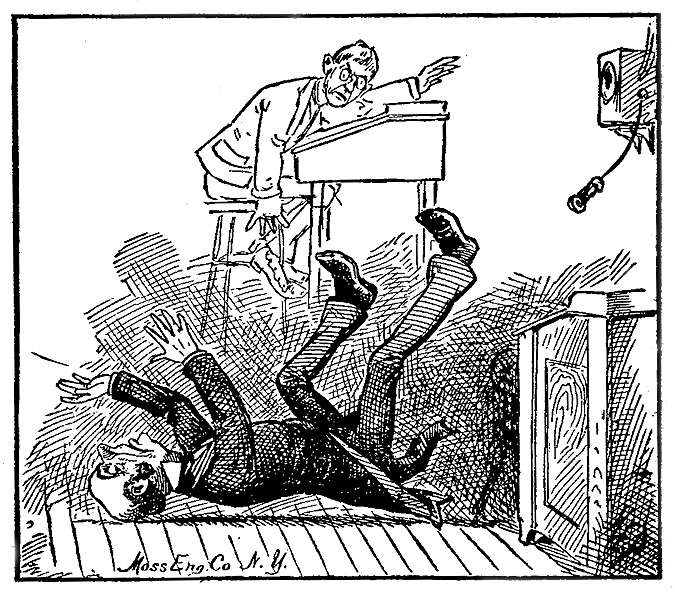
AT THE TELEPHONE.
If we have done wrong in talking with a total strangers who took us for a lady friend, we are willing to die. We couldn’t help it. For an hour we would not answer the constant ringing of the bell, but finally the bell fluttered as though a tiny bird had lit upon the wire and was shaking its plumage. It was not a ring, but it was a tune, as though an angel, about eighteen years old, a blonde angel, was handling the other end of the transmitter, and we felt as though it was wrong for us to sit and keep her in suspense, when she was evidently dying to pour into our auricular appendage remarks that we ought to hear.
And still the bell did flut. We went to the cornucopia, put our ear to the toddy stick and said, “What ailest thou darling, why dost thy hand tremble? Whisper all thou feelest to thine old baldy.” Then there came over the wire and into our mansard by a side window the following touching remarks: “Matter enough. I have been ringing here till I have blistered my hands. We have got to have ten car loads of hogs by day after to-morrow or shut down.” Then there was a stuttering, and then another voice said, “Go over to Loomis’ pawn shop. A man shot in”—and another voice broke in singing, “The sweet by and by, we shall meet on that beautiful”—and another voice said—“girl I ever saw. She was riding with a duffer, and wiped her nose as I drove by in the street car, and I think she is struck after me.”
It was evident that the telephone was drunk, and we went out in the hall and wrote on a barrel all the afternoon, and gave it full possession of the office.
CONVENIENT CURRENCY.
Return to Table of Contents
What we want is a currency that every farmer can issue for himself. A law should be passed making the products of the farm a legal tender for all debts, public and private, including duties on imports, interest on the public debt, and contributions for charitable purposes. Then we shall have a new money table about as follows:
Ten ears of corn make one cent. Ten cucumbers make one dime. Ten watermelons make one dollar. Ten bushels of wheat make one eagle.
THE GOSPEL CAR.
Return to Table of Contents
Because there are cars for the luxurious, and smoking cars for those who delight in tobacco, some of the religious people of Connecticut are petitioning the railroad companies to fit up “Gospel cars.” Instead of the card tables, they want an organ and piano, they want the seats arranged facing the centre of the car, so they can have a full view of whoever may conduct the services; instead of spittoons they will have a carpet, and instead of cards they want Bibles and Gospel song books.—Chicago News.
There is an idea for you. Let some railroad company; fit up a Gospel car according to the above prescription, and run it, and the porter on that car would be the most lonesome individual on the train. The Gospel hymn books would in a year appear as new as do now the Bibles that are put up in all cars. Of the millions of people who ride in the trains, many of them pious Christians, who has ever seen a man or woman take a Bible off the iron rack and read it a single minute? And yet you can often see ministers and other professing Christians in the smoking car, puffing a cigar and reading a daily paper.
Why, it is all they can do to get a congregation in a church on Sunday; and does any one suppose that when men and women are traveling for business or pleasure—and they do not travel for anything else—that they are going into a “Gospel car” to listen to some sky pirate who has been picked up for the purpose, talk about the prospects of landing the cargo in heaven?
Not much!
The women are too much engaged looking after their baggage, and keeping the cinders out of their eyes, and keeping the children’s heads out of the window, and keeping their fingers from being jammed, to look out for their immortal souls. And the men are too much absorbed in the object of their trip to listen to gospel truths. They are thinking about whether they will be able to get a room at the hotel, or whether they will have to sleep on a cot.
Nobody can sing gospel songs on a car, with their throats full of cinders, and their eyes full of dust, and the chances are if anybody should strike up, “A charge to keep I have,” some pious sinner who was trying to take a nap in the corner of the gospel car would say:
“O, go and hire a hall!”
It would be necessary to make an extra charge of half a dollar to those who occupied the gospel car, the same as is charged on the parlor car, and you wouldn’t get two persons on an average train full that would put up a nickel.
Why, we know a Wisconsin Christian, worth a million dollars, who, when he comes up from Chicago to the place where he lives, hangs up his overcoat in the parlor car, and then goes into the forward car and rides till the whistle blows for his town, when he goes in and gets his coat and never says thirty-five cents to the conductor, or ten cents to the porter. Do you think a gospel car would catch him for half a dollar? He would see you in Hades first.
The best way is to take a little eighteen-carat religion along into the smoking car, or any other car you may happen to be in.
A man—as we understand religion from those who have had it—does not have to howl to the accompaniment of an asthmatic organ, pumped by a female with a cinder in her eye and smut on her nose, in order to enjoy religion, and he does not have to be in the exclusive company of other pious people to get the worth of his money. There is a great deal of religion in sitting in a smoking car, smoking dog-leg tobacco in a briar-wood pipe, and seeing happy faces in the smoke that curls up—faces of those you have made happy by kind words, good deeds, or half a dollar put where it will drive away hunger, instead of paying it out for a reserved seat in a gospel car. Take the half dollar you would pay for a seat in a gospel car and go into the smoker, and find some poor emigrant that is going west to grow up with the country, after having been beaten out of his money at Castle Garden, and give it to him, and see if the look of thankfulness and joy does not make you feel better than to listen to a discussion in the gospel car, as to wheiher the children of Israel went through the Red Sea with life-preservers, or wore rubber hunting boots.
Take your gospel-car half dollar and buy a vegetable ivory rattle of the train boy, and give it to the sick emigrant mother’s pale baby, and you make four persons happy—the baby, the mother, the train boy and yourself.
We know a man who gave a dollar to a prisoner on the way to State prison, to buy tobacco with, who has enjoyed more good square religion over it than he could get out of all the chin music and saw-filing singing he could hear in a gospel car in ten years. The prisoner was a bad man from Oshkosh, who was in a caboose in charge of the sheriff, on the way to Waupun. The attention of the citizen was called to the prisoner by his repulsive appearance, and his general don’t-care-a-damative appearance. The citizen asked the prisoner how he was fixed for money to buy tobacco with in prison. He said he hadn’t a cent, and he knew it would be the worst punishment he could have to go without tobacco. The citizen gave him the dollar and said:
“Now, every time you take a chew of tobacco in prison, just make up your mind to be square when you get out.”
The prisoner reached out his hand-cuffed hands to take the dollar, the hands trembling so that the chains rattled and a great tear as big as a shirt-button appeared in one eye—the other eye had been gouged out while “having some fun with the boys” at Oshkosh—and his lips trembled as he said:
“So help me God, I will!”
That man has been boss of a gang of hands in the pinery for two winters, and has a farm paid for on the Central Railroad, and is “square.”
That is the kind of practical religion a worldly man can occasionally practice without having a gospel car.
BANKS AND BANKING.
Return to Table of Contents
The subject of banking has engrossed the attention of your excellent Governor for, lo! these many weeks, and he is constrained to say that some radical changes must be made in the method of receiving deposits by banks, where an equivalent is not rendered, of His Excellency will be compelled to emerge from his present aristocratic quarters and take up his abode in the poor-house. I would call your attention to the practice certain banks have of issuing checks in lieu of cash. If these checks were available at the groceries it would be better than it is. Banks have got in a habit of issuing a species of ivory button in receipt for the green coin of the realm which is only good at the counter of the bank. These checks are not issued by the National Banks, but by the State Banks, denominated “Keno” and “Faro.” I would not charge that there is “skullduggery” or “shenanagen” going on in these institutions, as the president of one of them informed me, confidentially, that he dealt on the “square,” but it is a noticeable fact that the dividends received by those who do business with the banks, are almost, as it were, imperceptible. I trust that you will cause this branch of industry to be thoroughly investigated, and report by bill or otherwise. Our finances should be beyond suspicion of dishonesty.
LARGE MOUTHS ABE FASHIONABLE.
Return to Table of Contents
The fashion papers, which are authority on the styles, claim that ladies with large mouths are all the fashion now, and that those whose mouths are small and rosebud like are all out of style. It is singular the freaks that are taken by fashion. Years ago a red-headed girl, with a mouth like a slice cut out of a muskmelon, would have been laughed at, and now such a girl is worth going miles to see.
It is easier to color the hair red, and be in fashion, than it is to enlarge the mouth, though a mouth that has any give to it can be helped by the constant application of a glove stretcher during the day, and by holding the cover to a tin blacking box while sleeping. What in the world the leaders of fashion wanted to declare large mouths the style for, the heavens only can tell.
Take a pretty face and mortise about a third of it for mouth, and it seems to us as though it is a great waste of raw material. There is no use that a large mouth can be put to that a small mouth would not do better, unless it is used for a pigeon hole to file away old sets of false teeth. They can’t certainly, be any better for kissing.
You all remember the traveling man who attended the church fair at Kalamazoo, where one of the sisters would give a kiss for ten cents. He went up and paid his ten cents, and was about to kiss her when he noticed that her mouth was one of those large, open face, cylinder escapement, to be continued mouths. It commenced at the chin and went about four chains and three links in a northwesterly direction, then around by her ear, across under the nose and back by the other ear to the place of beginning, and containing twelve acres, more or less.
The traveling man said he was only a poor orphan, and had a family to support, and if he never came out alive it would be a great hardship upon those dependent upon him for support, and he asked her as a special favor that she take her hand and take a reef in one side of the mouth so it would be smaller. She consented, and puckered in a handful of what would have been cheek, had it not been mouth. He looked at her again and found that the mouth had become a very one-sided affair, and he said he had just one more favor to ask.
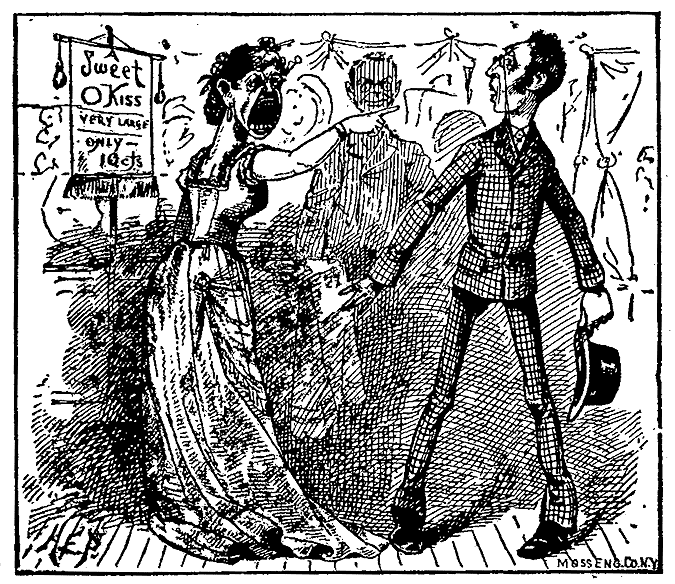
“GET THEE TO A NUNNERY!”
He was not a man that was counted hard to suit when he was at home in Chicago, but he would always feel as though he had got his money’s worth, and go away with pleasanter recollections of Kalamazoo, if she would kindly take her other hand and draw the other side of her mouth together, and he would be content to take his ten cents’ worth out of what was left unemployed.
This was too much, and she gave him a terrible look, and returned him his ten cents, saying, “Do you think, sir, because you are a Chicago drummer, that for ten cents you can take a kiss right out of the best part of it? Go! Get thee to a nunnery,” and he went and bought a lemonade with the money.
We would not advise any lady whose mouth is small to worry about this new fashion, and try to enlarge the one nature has given her. Large mouths will have their run in a few brief months and will be much sought after by the followers of fashion, but in a short time the little ones that pout, and look cunning, will come to the front and the large ones will be for rent. The best kind of a mouth to have is a middling sized one, that has a dimple by its sides, which is always in style.
INTERNAL IMPROVEMENTS.
Return to Table of Contents
Under this heading I can think of nothing that appears more appropriate than the subject of the artificial propagation of fish. It is a subject that has arrested the attention of many of the ablest minds of the country, and the results of experiments have been thus far so satisfactory that it is almost safe to predict that within the next ten centuries every man, however poor, may pick bull-heads off of his crab apple vines and gather his winter supply of fresh shad from his sweet potato trees at less than fifty cents a pound. The experiments that have been made in our own state warrant us in going largely into the fish business. A year ago a quantity of fish seeds were sub soil plowed into the ice of Lake Mendota, and to-day I am informed that boarders at the hotels there have all the fish to eat that any reasonable man could desire. The expense is small and the returns are enormous. It is estimated that from the six quarts of fish seeds that were planted in the lake there are now ready for the market at least 11,000,000 car loads of brain-producing food, if you spit on your bait when you go fishing.
PECK’S BAD BOY AND HIS PA.
HIS PA GETS BOXED.
Return to Table of Contents
“You don’t want to buy a good parrot, do you?” said the bad boy to the grocery man as he put his wet mittens on the top of the stove to dry, and kept his back to the stove so he could watch the grocery man, and be prepared for a kick, if the man should remember the rotten egg sign that the boy put up in front of the grocery last week.
“Naw, I don’t want no parrot. I had rather have a fool boy around than a parrot. But what’s the matter with your Ma’s parrot? I thought she wouldn’t part with him for anything.”
“Well, she wouldn’t until Wednesday night, but now she says she will not have him around, and I may have half I can get for him. She told me to go to some saloon or some disreputable place and sell him, and I thought maybe he would about suit you,” and the boy broke into a bunch of celery, and took out a few tender stalks and rubbed them on a codfish to salt them, and began to bite the stalks, while he held the sole of one wet boot up against the stove to dry it, making a smell of burned leather that came near turning the stomach of the cigar sign.
“Look-a-here boy, don’t you call this a disreputable place. Some of the best people in this town come here,” said the grocery man as he held up the cheese knife and grated his teeth as though he would like to jab it into the youth.
“O, that’s all right, they come here ’cause you trust; but you make up what you lose by charging it to other people. Pa will make it hot for you the last of the week. He has been looking over your bill, and comparing it with the hired girl, and she says we haven’t ever had a prune, or a dried apple, or a raisin, or any cinnamon, or crackers and cheese out of your store, and he says you are worse than the James brothers, and that you used to be a three card monte man, and he will have you arrested for highway robbery, but you can settle that with Pa. I like you, because you are no ordinary sneak thief, you are a high-toned, gentlemanly sort of a bilk, and wouldn’t take anything you couldn’t lift. O, keep your seat, and don’t get excited. It does a man good to hear the truth from one who has got the nerve to tell it.
“But about the parrot. Ma has been away from home for a week, having a high old time in Chicago, going to theatres and things, and while she was gone, I guess the hired girl or somebody learned the parrot some new things to say. A parrot that can only say ‘Polly wants a cracker,’ don’t amount to anything—what we need is new style parrots that can converse on the topics of the day, and say things original. Well, when Ma got back I guess her conscience hurt her for the way she had been carrying on in Chicago, and so when she heard the basement of the church was being frescoed, she invited the committee to hold the Wednesday evening prayer meeting at our house. First, there were four people came, and Ma asked Pa to stay to make up a quorum, and Pa said seeing he had two pair, he guessed he would stay in, and if Ma would deal him a queen he would have a full hand. I don’t know what Pa meant, but he plays draw poker sometimes. Anyway there was eleven people came including the minister, and after they had talked about the neighbors a spell, and Ma had showed the women a new tidy she had worked for the heathen, with a motto on it which Pa had taught her: ‘A contrite heart beats a bob-tailed flush,’—and Pa had talked to the men about a religious silver mine he was selling stock in, which he advised them as a friend to buy for the glory of the church, they all went in the back parlor and the minister lead in prayer. He got down on his knees right under the parrot’s cage, and you’d a dide to see Polly hang on to the wires of the cage with one foot, and drop an apple core on the minister’s head. Ma shook her handkerchief at Polly, and looked sassy, and Polly got up on the perch, and as the minister got warmed up and began to raise the roof, Polly said, ‘O, dry up.’ The minister had his eyes shut, but he opened one of them a little and looked at Pa. Pa was tickled at the parrot, but when the minister looked at Pa as though it was him that was making irreverent remarks, Pa was mad.