Pecan Diseases and Their Control
Reading edition
The diseases which affect the pecan are of four different types: namely fungus, bacterial, virus and physiological. The fungus diseases, the most numerous and widespread, are caused by small microscopic molds. Approximately 12 different fungus organisms cause harmful diseases of the pecan.
The bacterial disease organisms, unlike the disease producing fungi, are single celled and can be seen only under a microscope. Bacterial diseases are fewer and of less economic importance than fungus diseases.
Virus diseases are caused by extremely small agents which can be seen only under special ultra-microscopes such as the electron microscope. Plant viruses are protein substances, but their exact nature is unknown.
Physiological disorders (sometimes called physiological diseases) are caused by a variety of environmental conditions. A physiological disorder in a pecan tree may result from infertile soil, excessive moisture, or the absence or degree of available nutritional mineral elements to the growing tree. These various environmental factors have special adverse effects, manifested by specific symptoms caused by insufficient levels of a given nutritional mineral element or elements, which are easily corrected by supplying the tree the necessary mineral elements either through soil application or foliage sprays.
SCAB
Pecan scab, caused by the fungus Cladosporium effusum (Wint.) Demaree, is the most destructive disease of pecans in Texas. The fungus invades the young rapidly growing shoots and leaves and later the developing nuts. Severely infected nuts on highly scab-susceptible varieties fall or fail to develop, resulting in a total nut crop loss. Early season defoliation often occurs in seasons of frequent rains and high humidity which facilitate the rapid development and spread of the scab fungus.
The scab fungus overwinters in infected shoots and in old shucks and leaves in the trees. In the spring when temperature and moisture conditions become favorable, the fungus begins to grow in the shoot lesions, old leaves and shucks, and within a few days produces great numbers of spores. These spores are spread by wind and rain to newly developed leaves where they germinate and invade the tender tissues, initiating primary infection. The fungus produces a great abundance of spores on the surface of these primary infection sites and spreads throughout the tree and infects young shoots, leaves and nuts.
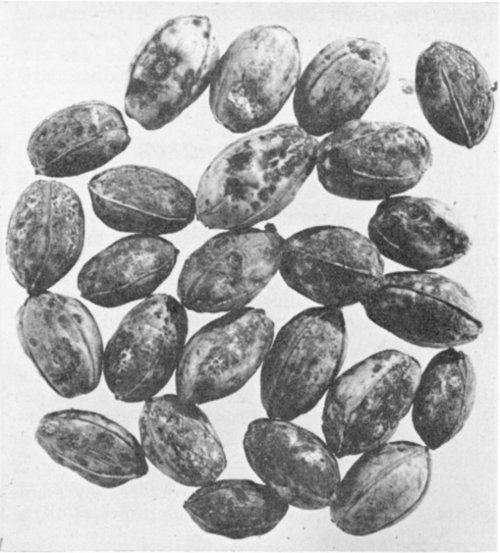
On the leaves, primary infection lesions occur on the lower leaf surfaces and are characteristically olive brown, somewhat elongated in shape and vary in size from a barely discernible dot to lesions one-fourth inch or more in diameter. Frequently, adjacent lesions coalesce, forming large very dark lesions. Primary scab lesions commonly occur on or along the leaflet veins but often may be found between the veins on the underleaf surface. On the nuts, scab lesions appear as small black dots, which are elevated or sunken 6 in older infections. Adjacent lesions on the nuts may coalesce forming large sunken black lesions, Figure 1. When infection is severe, the entire nut surface is black in appearance, development is arrested and the nuts drop prematurely.
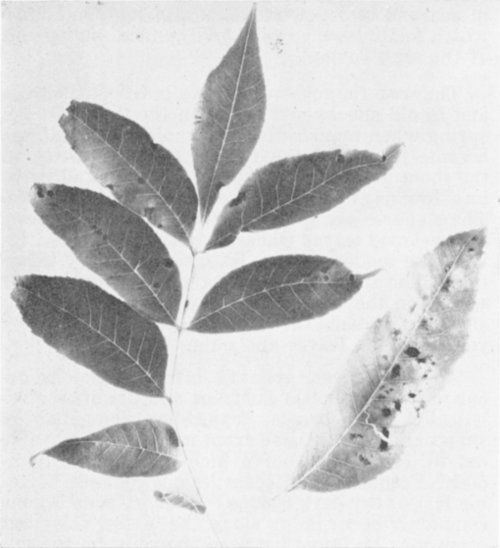
Figure 1. Scab lesions on leaves and nuts of Delmas variety. Note concave lesions and overall scabby appearance of severely infected nuts.
Pecan varieties vary in their susceptibility to scab disease. Among the highly susceptible varieties are: Burkett, Delmas, Schley, Moore, Halbert and most western varieties. Moneymaker, Success and Curtis are moderately resistant. Mahan, Stuart and Desirable varieties are highly resistant to the scab fungus. However, this character of resistance varies, depending on the area of the state, local environmental conditions and the particular strain of the scab fungus present.
Scab disease development is favored by rainy periods and cloudy days when the humidity remains high and leaf surfaces are wet. Under these conditions, spores of the fungus in contact with the wet leaf surface of a pecan leaflet or nut germinate rapidly, invade the tender tissues and initiate infection within 6 hours. Lesions resulting from these infection sites, become visible to the naked eye within 7 to 14 days, depending on environmental conditions. A period of warm dry weather after infection occurs may retard lesion development.
Control.—The control of pecan scab disease depends primarily on the protection of tender leaf, nut and shoot surfaces with proper application of an effective fungicide. A protective film of fungicide chemical prevents scab fungus infections by killing the spores immediately after their germination, thereby preventing invasion of susceptible tissues. Unfortunately, once the fungus has invaded the tissues it becomes protected from chemical attack and produces spores in great abundance. Therefore, thorough coverage of leaf, nut and shoot surfaces with a fungicide chemical must be maintained to prevent secondary infections, ([6], [10], [11]).
Sanitation measures, such as removal of old attached shucks and leaf stems in trees and plowing or disk harrowing under fallen leaves and shucks help reduce primary infections. See spray schedule, page 4, for scab disease control.
BROWN LEAF SPOT
The brown leaf spot disease fungus Cercospora fusca (Heald and Walf) Rand affects only mature leaves and usually does not appear until the latter part of May or mid-June. Primary lesions develop on the lower leaf surfaces as small dots, which gradually enlarge and become reddish brown with a grayish cast. The shape of the lesions may be circular or irregular, especially where two or more lesions develop adjacent to one another, Figure 2. In seasons favorable for brown leaf spot development pecan trees may be completely defoliated within 3 to 4 months if the disease is not controlled. Most pecan varieties which are maintained in a vigorous state of growth are resistant to brown spot disease.
Control.—See spray schedule, page 4.
VEIN SPOT
Vein spot disease is caused by the fungus Gnomonia nerviseda. The symptoms of the disease are similar to the leaf lesion symptoms of scab disease, but vein spot disease, unlike scab 7 disease, affects only the leaves. Lesions of vein spot disease develop on the veins or stems of leaflets and leaves, are usually less than one-fourth inch in diameter and are characteristically dark brown to black. Leaflets and leaf stems which are severely affected drop, resulting in premature defoliation.
The fungus lives in fallen leaves over the winter. The following spring when temperature and moisture conditions are favorable, spores formed in special structures called perithecia are forcibly discharged into the air and carried by wind currents to the newly formed spring foliage, initiating primary infections.
Control.—See spray schedule, page 4.
LEAF BLOTCH
Leaf blotch disease is caused by the fungus Mycosphaerella dendroides (Cke.) Demaree and Cole. The disease occurs mainly in trees of poor vigor, which may be due to neglect, infertile soil, rosette or overcrowding. Nursery trees are particularly susceptible to the disease.
The fungus overwinters in fallen leaves. In the early spring, large numbers of spores produced in the old leaves on the ground are carried by wind currents to the young leaves in the tree, where they germinate and rapidly invade the tender leaf tissue.
The disease symptoms first appear on the undersurface of mature leaves in early summer, as small olive-green velvety spots. By midsummer black pimplelike dots become especially noticeable in the leaf spots after the surface spore masses have been removed by wind and rain, giving the diseased areas of the leaves a black, shiny appearance. When the disease is severe, infected leaflets are killed, which causes defoliation of the trees in late summer or early fall and results in reduced tree vigor and increased susceptibility to disease and insect attack.
Control.—Leaf blotch disease can be controlled effectively in the early spring by disking under old fallen leaves that harbor the fungus pathogen.
In areas where a spray program for the control of scab disease is carried out, leaf blotch usually is not a damaging disease. In localities where leaf blotch disease occurs in the absence of other pecan diseases, two applications of fungicide will control the disease effectively. The first spray should be applied after pollination when the tips of the nutlets have turned brown and the second spray application should be made 3 to 4 weeks later. See spray schedule, page 4.
CROWN GALL
Crown gall disease, caused by the bacterium Agrobacterium tumefaciens (E. F. and Town.) Conn., often is damaging to pecan trees. Nursery trees as well as trees in bearing pecan orchards are susceptible to the disease.
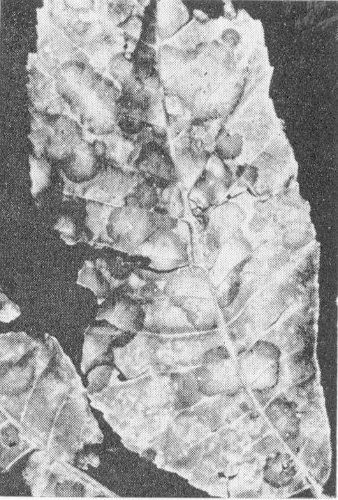
Figure 2. Brown leaf spot diseased pecan leaflet showing typical symptoms. Lesions are circular to irregular in shape.
The development of galls is confined primarily to larger roots near the base of the tree trunk, although small roots may become infected and galls develop on them. The smaller galls are under the soil surface and cannot be detected unless the soil is carefully removed from around the roots, Figure 3. Large galls, often 10 to 18 inches in diameter, develop on larger roots and may protrude well above the surface of the soil.
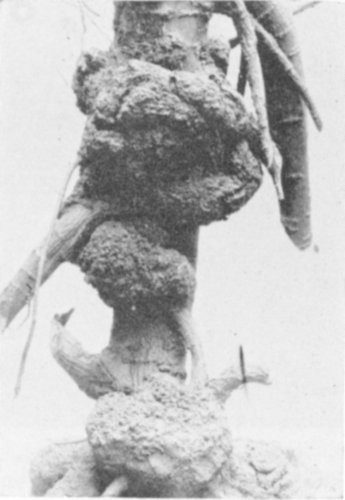
Figure 3. Crown gall disease symptoms on young infected pecan tree.
Galls on nursery trees develop at or below the soil surface on the taproot and larger secondary roots.
Control.—All infected nursery trees should be dug and immediately burned. Crown gall-diseased orchard trees sometimes can be saved by digging the soil from around large roots and removing the exposed galls. Where galls were removed, the damaged root surfaces should be painted with a creosote-coal tar mixture (one part creosote to three parts coal tar) to prevent spread of the disease[9]. Cultivation of the soil around the trunk base of infected trees should be avoided to prevent root wounds and spreading of the crown gall pathogen.
DOWNY SPOT
Downy spot disease, caused by the fungus Mycosphaerella caryigena (Ell. and Ev.) Damaree and Cole, attacks all pecan varieties. Only 8 leaves are susceptible to the disease. Primary infection of new leaves in the spring occurs from spores produced in specialized fruiting bodies in old overwintered leaves. The downy spots appear usually during the summer months on the lower surfaces of leaflets. The downy character of the lesions is due to the production by the fungus of thousands of minute spores on the surface of each spot. The spores are spread by wind and rain to adjacent leaves and to neighboring trees. After spore dissemination is complete, the lesions visible from both leaf surfaces are one-eighth to one-fourth inch in diameter and greenish yellow. Later in the season the lesions turn brown due to the death of the leaf cells in the diseased area.
Moneymaker and Stuart varieties are most susceptible to downy spot disease although all pecan varieties are moderately to slightly susceptible.
Control.—Disk under old fallen leaves in the early spring before the leafbuds begin to swell. This practice covers the leaves with soil and prevents the discharge of spores into the air, thereby controlling primary infection of new leaves. In seasons when heavy rains make early spring disking impossible, downy spot disease can be controlled by spraying the trees as indicated in the spray schedule on page 4.
BUNCH DISEASE
Although the cause of bunch disease is not known, evidence indicates it is an infectious disease, which suggests that the causal agent may be a virus.
Trees affected with bunch disease show the bunching symptom, which is due to excessive growth of slender succulent twigs from lateral buds that normally remain dormant. In moderately affected trees one or several branches will show the “bunch” growth symptom. Bunching in severely affected trees may involve all main branches which produce thick masses of sucker-like growth and few, if any, nuts.
Observations indicate that the Stuart variety is the most resistant to bunch disease.
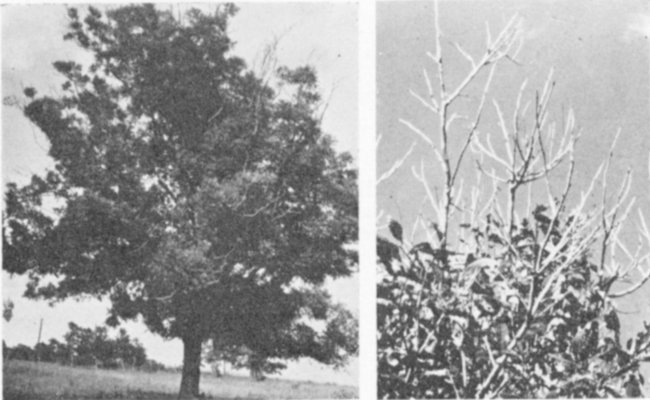
Figure 4. Rosette die-back symptoms of pecan tree showing severe zinc deficiency.
Control.—There is no known effective control for bunch disease. Early detection of the first symptom of bunch and pruning out of the affected branch may prevent spread of the disease throughout the tree. When the tree is severely affected, and limbs are involved, the tree should be destroyed to protect nearby healthy trees from infection.
For propagation purposes, all bud or scion wood should be taken only from bunch disease-free trees.
ROSETTE
Rosette is a nutritional deficiency disease caused by certain soil conditions which make zinc unavailable to the pecan tree. All pecan trees require zinc for growth.
Trees showing the first symptom of zinc deficiency have yellowed tops. The individual leaflets when examined are yellowish and mottled. The next season the foliage may be yellowish and the leaflets narrowed and crinkled. More severely affected trees produce foliage which is a yellowish to reddish-brown overall color, and the leaflets are very narrow with reddish-brown spots and may be perforated. Shoots are much shortened and the leaves are produced in compact bunches of dense foliage.
Trees affected by rosette for several seasons have many dead shoots and small branches from the dying-back of each season’s growth, Figure 4. Such trees are greatly stunted, of poor vigor and produce few, if any, nuts.
Control.—Rosette is controlled readily by applying zinc sulfate to the tree either as a foliage spray or in the dry form as a soil application. Where a disease and insect spray control program is being carried out, zinc sulfate may be added to the spray mixture.
Foliage spray. Two pounds zinc sulfate (36 percent) per 100 gallons of water.
First application: after pollination when tips of nutlets turn brown.
Second application: 3 to 4 weeks later.
Third application: 3 to 4 weeks later.
Soil application. Application of zinc sulfate to the soil, particularly in a large orchard is a more expensive operation, but it provides longer protection against rosette.
In highly alkaline soils, or soils that readily fix zinc and make it unavailable to the tree, foliage spray applications of zinc sulfate are more economical because of the excessive rates required to supply available zinc through the soil.
Rate of application of zinc sulfate: Mildly rosetted trees—apply 5 pounds zinc sulfate (36 percent) annually for 2 to 3 years. Severely rosetted trees—apply 5 to 10 pounds zinc sulfate (36 percent) annually until rosette symptoms disappear.
9
Time and method of application: Apply zinc sulfate to the soil around trees in late February or early March. Broadcast zinc sulfate under the tree from the trunk to several feet beyond the limb canopy. Disking, harrowing, or any operation that mixes the zinc sulfate with the soil, is desirable to prevent washing away and surface soil fixing of zinc.
LICHENS
Lichens commonly are found growing on the branches and trunks of pecan trees, especially in humid areas and river bottom orchards having poor air drainage.
Lichens are nonparasitic to the pecan tree, but merely attach themselves to the bark surfaces. Lichens grow equally well on rocks, fence posts, bricks and other objects. There are several types of lichens that occur on pecan trees, none of which are damaging except perhaps in appearance to the trees in cases of extremely heavy infestations, Figure 5.
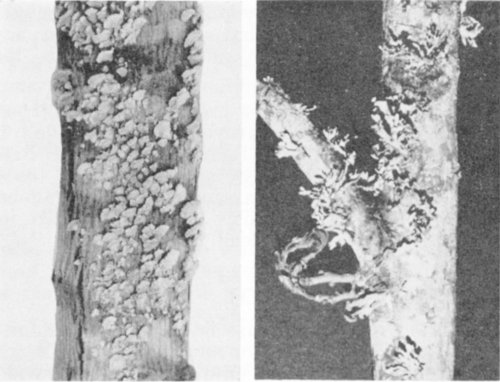
Figure 5. Lichens commonly found on the bark of pecan trees. Left, a fan-shaped type. Right, an erect-branched type.
Control.—The occurrence of lichens in trees regularly sprayed with copper-containing fungicides is rare.
ARTICULARIA LEAF MOLD
Articularia leaf mold caused by the fungus Articularia quercina (PK) Hoehn is a disease of minor occurrence and importance. The disease occurs most commonly following rainy periods and in areas of high relative humidity in the leaves of trees of poor vigor.
The fungus produces on the lower surfaces of the leaves a conspicuous growth of white tufts which contain masses of spores, Figure 6.
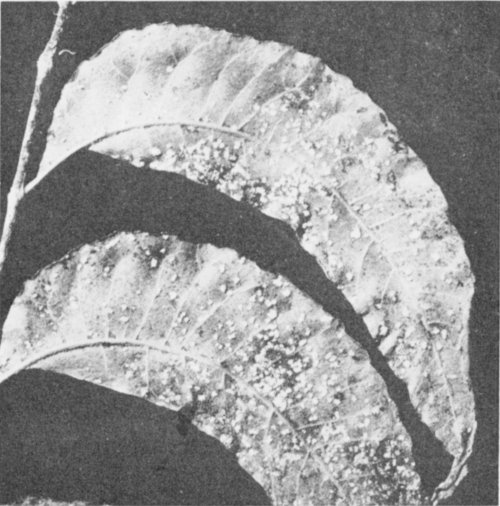
Figure 6. Articularia leaf mold fungus, showing white tufts on lower leaf surfaces of pecan leaflets.
Control.—Articularia leaf mold does not occur in trees or in orchards which have been sprayed for disease control.
A single application of fungicide such as zineb at 2 pounds per 100 gallons of water when the disease is first detected is usually sufficient to control Articularia leaf mold disease.
PINK MOLD
Pink mold, Cephalothecium roseum Corda, usually occurs on nuts infected with the scab fungus. The pink mold fungus apparently enters the nuts through scab lesions on the shucks and continues to produce masses of pink spores on shuck surfaces until late fall. The fungus sometimes invades the kernel of thin-shelled pecan varieties causing “pink rot” which is characterized by an oily appearance of the nut shell and a rancid odor.
Control.—Pink mold rarely occurs on the shucks of nuts in the absence of scab disease. In areas where scab disease control is regularly practiced pink mold is not a problem.
SPANISH AND BALL MOSS
Spanish moss, Tillandsia usneoides, and Ball moss, Tillandsia recurvata L., are not parasitic to the pecan tree and are similar to lichens in that they both derive their food from the air, rain or atmospheric moisture.
Neglected orchards in areas of high humidity or poor air drainage are most troubled with Spanish moss and Ball moss. When large and excessive growths of Spanish moss develop in pecan trees, the shading effect to the leaves is detrimental to tree vigor, bearing and growth, Figure 7.
Control.—The Spanish moss plant like the pecan tree requires sunlight for vigorous growth. 10 A pecan tree kept in a vigorous state of growth produces dense foliage that effectively shades accumulations of Spanish moss and retards its growth.
Spanish moss is not a problem in pecan trees in orchards which are sprayed with fungicide for disease control. Both Spanish moss and Ball moss can be controlled by spraying pecan trees with 6 pounds of lead arsenate per 100 gallons of water[3]. Do not allow livestock to graze in orchards sprayed with lead arsenate.
COTTON ROOT ROT
Cotton root rot disease is caused by the fungus Phymatotrichum omnivorum (Shear) Dvgg., a soil-inhabiting pathogen that attacks a wide range of host plants including the pecan.
The roots of the pecan tree are invaded during the summer when growth of the fungus in the soil is most active. The infected roots are killed, disrupting the transportation of water to the leaves, Figure 8. Trees diseased by cotton root rot produce yellow foliage, and shedding of leaflets occurs during dry periods. Diseased trees usually die 1 to 3 years after becoming infected.
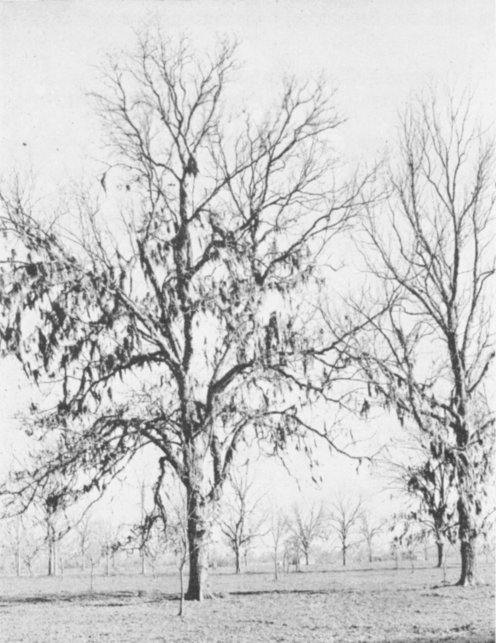
Figure 7. Spanish moss accumulation in pecan trees reduces vigor from excessive shading.
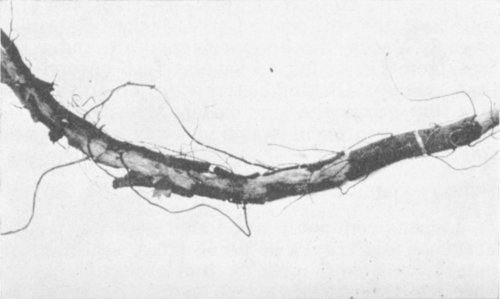
Figure 8. Cotton root infected with cotton root rot fungus. Note the splitting and general deterioration of the root.
Control.—An effective control for cotton root rot disease has not been developed.
New orchards should not be planted in soil having a history of cotton root rot disease.