Front matter
Reading edition
Author of “Tramps of the Range,” “Sticky Ropes,” etc.
It was late Spring in the valley of the Chinook. The hills were already covered with luxuriant bunch-grass, and the clumps of cottonwood along the Chinook River had leafed to a sparkling green against the dark blue and green of the balsam, fir and pine.
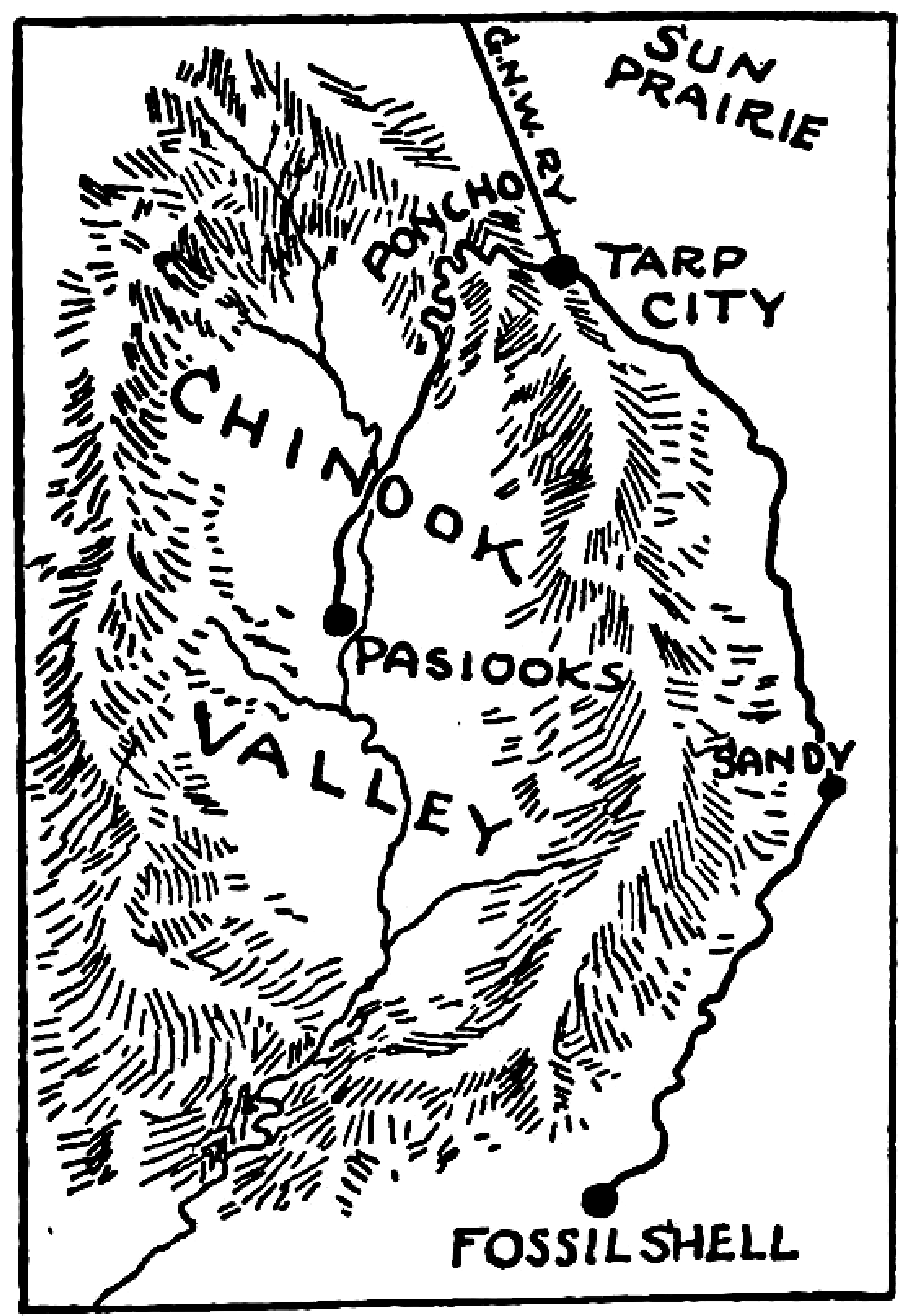
Winding through a V-notched gash in the mountains was the road which led from the town of Pasiooks, through Poncho Pass to Tarp City. This road was barely wide enough for one wagon, and its builders had followed the lines of least resistance in its making.
Chinook Valley was a cattleman’s paradise. Thirty miles in length and averaging seven miles in width, its grazing-land was unexcelled. It had plenty of feed, streams of cold water and an encircling range of mountains which held the herds within its boundaries. Poncho Pass was the only outlet, and this was guarded by a fence and a gate at its narrowest point.
At the lower end of the valley the Chinook River—which was not really a river, but a large stream—gurgled its way through a box-cañon, and twisted and turned in its narrow bed, giving it the title of Crazy Snake Cañon. It was impassable for man or beast.
Pasiooks was the only town in the valley, consisting of a general store, a saloon and a post-office on one side of the street; a blacksmith shop and barber shop on the other side. At one time it had been the location of a French trading-post, and the Indians had called it Pasiooks, which in the Chinook jargon, or trade-language, means French or Frenchmen.
Thirty miles to the north, across Poncho Pass was the town of Tarp City, the terminus of the branch of the C. N. & W. Railroad. South and east of Tarp City stretched the Fossilshell Range along the Fossilshell River. North of Tarp City was Sun Prairie, the sheep country, despised of cow-men.
Cowboys patrolled the Fossilshell Range lines to see that no sheep invaded their domain from Sun Prairie; but the cow-men of Chinook worked secure in the fact that no woolie would or could ever come through Poncho Pass.
Here the ranch-owners ruled with as great a power as any of the feudal barons of old; and wo unto the man or men who broke their word or tried underhanded work on that range.
Nestling down in this snug little valley was the rambling ranch-house of the Cross L—the castle of “Cross L” Marshall, whose word was considered law in Chinook.
Down a long, grassy slope above the ranch-house rode a man and a girl, coming slowly toward the ranch-house. The girl was Jess Marshall, a tall, willowy girl, easy of movement and sitting her horse like a cowboy. Her brown eyes were troubled as she tucked a vagrant strand of brown hair under the brim of her sombrero and looked up at the man beside her.
Clell Danert was handsome—by certain standards. He was tall and well proportioned, regular of feature, with a certain ease and grace seldom found in cow-land. His gray eyes were a trifle small and set a little too close together, and a smile showed a tilt to one side of his mouth—a sign not cared for by those who love an open smile.
His clothes were perhaps a trifle too well tailored and inclined to gaudiness. Just now he leaned closer to the girl and watched the curve of her cheek as he propounded a question.
Jess Marshall’s eyes scanned the country for a moment, and a tiny crease appeared between her eyes as she turned to him.
“I—I think so, Clell.”
Danert imprisoned the hand on the saddle-horn—
“Then you will marry me, Jess?”
“I said, ‘I think so,’ Clell,” she repeated wearily. “I really don’t know what dad will have to say about it.”
Danert laughed softly:
“I’ll fix that all up, Jess. When will we be married?”
“Some time,” enigmatically, “I——”
She stopped and listened. From the ranch-house floated the musical dinner-call, as the cook beat a tattoo on a suspended triangle of steel.
“Some time is hardly definite,” reminded Danert sourly.
“Nothing is definite in this world.” Jess smiled sadly at him as she released her hand and gathered up her reins. “Let us go to the ranch or we’ll be late for dinner, Clell.”
“My heart is bothering me more than my stomach,” replied Danert, “but I bow to your wishes—forever.”
“Well,” replied Jess, “I suppose you are not the first man who has said that before marriage, and very likely it is not the first time you have said that to a girl, Clell.”
She laughed at him and spurred down the slope.
Bart Farley, the foreman of the ranch, met them as they rode in past the corrals, and walked beside Jess’ horse to the house. Farley was a grizzled cowboy, who lived only for the interests of the Cross L and Jess Marshall. He did not speak to Danert, who gave Farley only a glance. When they dismounted Farley led Jess’ horse away, leaving Danert’s horse to its owner.
Danert looked after Farley, but said nothing as he tied his animal to a ring at the corner of the porch. Cross L Marshall had come on to the porch as they came up the steps, and he put his arm around Jess’ shoulders.
Marshall was of the old type of cow-men. He was between fifty and sixty years of age, tough and wiry as a steel cable, his features as harsh as if chipped from flint. He had fought his way through the early gold rushes, battled the Indians and outlaws and was now enjoying the fruits of his labors in peace.
He nodded to Danert and kissed Jess. Danert had been a frequent visitor to the Cross L, and frequent visitors always made themselves at home.
“Better get yoreself ready for chuck, Jess,” smiled Marshall, and as she turned into the house Danert spoke—
“Marshall, I want to talk to you for a minute or two.”
“Yeah?” Marshall looked at him curiously. “Well, I reckon I’ll listen—at least.”
Danert twisted his gloves for a moment and slapped himself on the knee.
“Marshall, I want to marry Jess.”
Marshall’s mouth twisted to say “Oh!” but no sound came. He squinted at Danert for a moment, and then—
“Well, that ain’t nothin’ against yuh, is it?”
Danert looked up quickly.
“And she wants to marry me.”
Marshall glanced back at the door and seemed to let this statement percolate through his mind for a while.
“Say she does? When?”
“She would not say.”
“Oh!” shortly; Marshall rubbed his chin. “Well, yuh likely ain’t got nothin’ to worry about then, Danert. Plenty of time to worry about it when she sets a date.”
“Then you do not object?”
“Yeah,” drawled Marshall seriously. “But Jess is twenty-five years old, and I don’t reckon it’s any of my —— business. Yuh must remember—I ain’t marryin’ yuh, Danert.”
Danert laughed.
“I never know when you are joking, Marshall.”
“No-o-o?” Marshall squinted his eyes and looked across the hills thoughtfully. “That’s what a hoss-thief said once—and he was fool enough to take a chance.”
Danert looked quickly at Marshall, but the old man was still gazing at the rolling hills. Finally he turned as if having dismissed the subject and said—
“Reckon we better eat before the grub gets cold.”
There was little conversation at the table. Marshall was silently thoughtful. Farley and the two cowboys, Jim Horne and Bert Hart, ate with the family, but were strangely silent. Farley glanced often toward Danert, but Danert confined himself to Jess and her wants.
After the meal Farley and Marshall drifted out to the porch, where they lighted their pipes and settled down against the porch posts. It was an after-supper ceremonial with them.
“Jess goin’ to marry him?” asked Farley, jerking his head back toward the living-room.
Marshall drew slowly on his pipe for a while and glanced sidewise at Farley.
“He says she is, Bart.”
“What does she say?”
“I dunno.” Marshall shook his head slowly. “Wommen is queer cattle. Her mother married me.”
“I don’t like him,” declared Farley savagely.
“You ain’t marryin’ him, are yuh? I don’t like him; but—that ain’t none of my business.”
“I always thought,” mused Farley slowly, “that she was kinda waitin’ and——”
“Now I reckon that ain’t none of our business either, Bart. Jess wouldn’t never marry a—a——”
“Mebbe not,” interrupted Farley, “but ‘Peace’ Parker, even if he was a cow-thief, is a —— sight better than Clell Danert.”
Marshall nodded slowly:
“Lord knows yo’re right, at that. But he’s a-wearin’ stripes, Bart; and no woman would marry——”
Marshall spat angrily and resumed his smoking.
Peace River Parker had been Farley’s bunkie and a favorite with Cross L Marshall. He was engaged to marry Jess Marshall. Then came rumors of the misbranding of cattle. The men of Chinook Valley investigated, and guilt pointed toward Peace Parker.
The bulk of the evidence was furnished by Jefferson Crane, who owned the Five Dot brand; although other outfits suffered from the misbranding. Chinook Valley did not take it to law—not then. They brought their proofs to Peace Parker, and he could not disprove them. Chinook Valley did not cry to high Heaven for punishment; but rode away, back to their homes.
Peace knew that they were giving him a chance to prove his innocence—which he could not prove. The work had been cleverly done. In a cold rage Peace rode to the Five Dot ranch-house, where he met Jefferson Crane and two of his cowboys. There was no arbitration, no argument. When Peace rode away, Crane and his two cowboys were temporary cripples, and Peace was drilled with bullets in several places. He rode straight to Tarp City and gave himself up.
Jim Horne sauntered out on the porch and sat down with them. Horne was a long, lean cowboy, with a melancholy cast of countenance.
“Heard tell that Jeff Crane done sold out down on Sandy,” he volunteered. “Heard it in Tarp City yestiday.”
“Likely had to sell,” grunted Farley. “Wonder where he’ll head for now.”
“Not for Chinook,” stated Marshall. Farley grinned and shook his head.
“No, I reckon Crane’s had enough of Chinook. He likely got too crooked for the Fossilshell and they made him sell out. Wonder somebody don’t kill him.”
“Shippin’ a lot of sheep from Sun Prairie now,” drawled Horne. “Train-load went out yestiday, and there’s about twenty thousand held at the loadin’ corrals. They tells me that cars are scarce. The feed’s all gone in Sun Prairie and they’ve got to move.”
“—— good thing,” grunted Farley. “I can smell ’em for fifty miles.”
Jess and Danert came out on the porch, and Danert untied his horse.
“I’ll be back in a day or two,” he stated as he swung into the saddle. “I’ve got to make a trip into the Fossilshell to buy a few car-loads of feeders. Good night.”
He turned his horse, smiled up at Jess and rode down toward the main road. Jess watched him for a moment and went back into the house.
“He used to work fer Crane, didn’t he?” asked Horne.
Farley nodded.
Horne got to his feet and stretched.
“I wonder why he quit workin’ fer Crane.”
“Took a job buyin’ cattle,” grunted Marshall.
“He ain’t bought none in Chinook, has he?” asked Farley. “Why don’t he buy them few cars of feeders from us instead of goin’ ’way down on the Fossilshell?”
“He’s a purty son-of-a-gun, anyway,” grinned Horne. “I feel like takin’ off m’ hat every time I meet him.”
“Sh-h-h!” cautioned Marshall. “Jess is goin’ to marry him.”
Horne opened his mouth, held it open for a moment and closed it slowly.
“Oh, m’ ——! M’ ——! That’s the first teetotal e-clipse I ever seen.”
Marshall got slowly to his feet and went into the house. He wanted to argue in favor of his daughter’s choice, but he felt as did Farley and Horne. He had nothing personal against Danert, except that he did not like him.
Danert had come into that country three years previously and had worked as a cowboy for several of the outfits in Chinook and Fossilshell. He worked for Jefferson Crane on Sandy Fork, after Crane and his outfit had been run out of Chinook Valley. Now Danert was buying cattle, so he said, for a Chicago packing-house. He was a good spender, a plunging gambler; and the cowboys of the Fossilshell said he was almost too fast with a six-shooter.
Jess was sitting in the living-room, half-curled up in a big rocking-chair as her father came in, and did not look up at him. He studied her for a moment.
“Jess,” he said softly, “yo’re old enough to know what yuh want to do; but yore old dad would kinda like to know if yuh really wants to marry Clell Danert.”
“I don’t know, Dad.” Jess did not look at him as she shook her head. “When I am with him, I do.”
“And when yuh ain’t, yuh don’t, eh? Kinda like seein’ a purty flower on the ground, I reckon. When it’s there yuh want it; but if it ain’t there yuh never give it a thought.”
“Something like that, Dad.”
Marshall nodded and crossed the room, where he parted the curtains and peered off across the hills. Suddenly he turned.
“Jess, I been thinkin’ a lot lately about Peace Parker.”
Jess did not reply and he continued:
“His time’s about up. Wonder where he’ll go. ——, I’d give a lot to see his homely old face again. Didn’t he have the dangdest biggest mouth yuh ever seen? And when he smiled——”
Jess Marshall got to her feet without a word and looked at him. He squirmed under her gaze and started to speak, but she stopped him with a weary gesture.
“Dad, don’t talk about him—please. He—he wasn’t—homely.”
She turned away and left the room. Cross L Marshall grinned softly and slapped himself on the thigh.
“Branded a thief, a gun-fighter, and homely as ——,” he muttered to himself. “Five years in the penitentiary and we helped send him there. Jess ain’t mentioned his name in all these years; but she ain’t forgot him. He ain’t like a —— purty flower—Peace Parker ain’t.”
Cross L Marshall eased himself into a soft chair and took out his old pipe, chuckling to himself—
“Clell Danert, yore cake is goin’ to be a lot of gobby dough, or I don’t know women—our kind of women.”
Tarp City was a metropolis of at least a thousand population, huddled away in a nook of the foot-hills; a metropolis of false-fronted buildings, unpainted and weather-beaten. It was a supply center for Fossilshell, Chinook Valley and Sun Prairie, which made it of vast importance to the world.
To Tarp City came the cow-men, the sheep-men, the prospector. Freighters’ wagons creaked up and down the dusty street. From the big loading corrals at the edge of town came the bawling of cattle, the rattle of stock trains. At times there came dust-gray, bleating bands of sheep from Sun Prairie to fill the stock trains.
At night Tarp City celebrated. Of saloons there were many, and gambling was wide open, with the sky for a limit. The Poncho saloon and gambling house was the main attraction. It was a place where wine, women and coarse song might be found, seen and heard; where high-heeled boots and spurs were not barred from the dance floor.
At the outskirts of the town, facing the rear of a huddle of small saloons and restaurants, stood a warped-appearing shanty. This was the temporary home of Jefferson Crane. The interior was as unattractive as the exterior; but Jefferson Crane had little taste in home decoration.
Just now he sat at a rough table, figuring on a torn piece of paper with the stub of a lead pencil. Three bunks were built into the rear of the shanty, and on one of them a man was sleeping, snoring deeply. This was Pete Perez, a half-breed Mexican and Indian.
Tilted against the wall on a backless chair sat Gus Sinks, a hard-faced type of cowboy, half asleep, an unlighted cigaret glued to his underlip.
Crane was a peculiar type of cow-man. He was below medium height, thin of feature and hawk-eyed. A scraggly blond mustache, frayed at the ends from much chewing, draped over a crooked mouth, and surmounting his narrow head was a faded, nondescript hat, which at one time had been a derby. Seasons of heat and cold had obliterated its color until it was neutral in shade as well as shape.
Crane was narrow of soul and very close with his money. He asked much and told little, but demanded detailed obedience from all who worked for him. He was deadly with a gun and had the reputation of always shooting at an unlooked-for moment.
Came a knock at the door. Crane dropped the pencil and his right hand reached inside his unbuttoned vest, where a Colt automatic pistol reposed in a shoulder-holster.
Sinks tilted forward in his chair, wide awake, one hand hanging loosely beside the holstered gun on his hip. At Crane’s call the door opened and Clell Danert stepped inside, followed by Rance Wylie, a tall, rangy cowboy, who tossed his hat into a corner and sat down on the floor with his back against the wall.
“Well?” said Danert, eying Crane closely.
“Got ’em,” stated Crane. “Twenty thousand head.”
“Wool and bones, eh?”
“Well, they ain’t fit for market,” admitted Crane, “but yuh got to figure we got ’em cheap. They’ll stand another drive.”
Danert drew a box up to the table and sat down. Crane shoved the sheet of paper across to him, and he studied the mass of figures for a while.
“That’s what you paid for them, Crane?”
“I paid half of it down—cash. They was —— willin’ to take it. Sun Prairie is sheeped out, and them twenty thousand head of sheep wouldn’t pay for shipping. Where would they go? No, they was glad to sell at my price, Danert. We’ll make money.”
“Looks like it, Crane,” Danert nodded, and then he leaned across the table. “We’ll make money if we can put the sheep into that valley. There is always an ‘if.’”
Crane removed his hat and rubbed his head slowly.
“I’ll put ’em in there, Danert. Here’s the scheme.”
Crane talked rapidly and softly, while Danert watched him closely. When Crane finished, Danert half-smiled and nodded.
“Sounds good; but who will take the first bunch through the pass?”
“Not me,” interrupted Sinks. “I wouldn’t go into Chinook with a woolen shirt on my back.”
Crane grinned and shook his head.
“Don’t worry, Gus—” and then to Danert—“I told Jim Holman to pick up a sheepherder for me. Lot of drifters pass through Fossilshell, and he can pick one for me. I told him to promise a hundred a month, and that much money will bring one a-whoopin’.”
“He won’t live to collect anythin’——” This from Wylie, with a short laugh.
“I told Jim to pay him a month in advance,” explained Crane. “I reckon we can afford to bet a hundred dollars on this deal.”
Danert smiled slowly:
“I guess we can, Crane. But there’s one thing we must do, and that is to see that this shepherd don’t talk. Close-herd him all the time. One word in the wrong place and the scheme is busted.”
“By ——, I’ll see to that!” snapped Crane. “I’ve got every cent I own tied up in this deal, Danert. Chinook Valley run me out, —— em! They shook a rope in front of me!” Crane got to his feet and struck the table-top a resounding whack.
“I’m goin’ to make Chinook pay —— big for that deal! I’m goin’ to sheep out their tight little hole in the hills, do yuh hear me? That’s goin’ to be Crane’s Valley after I get through with it. Crane’s goin’ to be the big man in there.”
Perez sat up on the bunk and glared around.
“W’y you yell? I’m ride all de way from Fossilshell and I’m sleep.”
“Perez packed my note to Holman,” said Crane.
“Why not let Perez drive the first bunch in?” suggested Danert.
Perez stared at Danert. As his meaning grew clear, his hand slid to the pistol on the blanket beside him. Perez knew what would happen to the first man over that pass with sheep, and he was going to defend his position.
Danert laughed easily and shook his head.
“No, we can’t use any of our own men, Perez. I was joking.”
Perez’s white teeth flashed in a grin.
“Bueno! It ees no job for friends, eh? We send de stranger. Ha, ha, ha.”
“That’s right,” agreed Danert, and then to Crane—
“When do the sheep arrive here?”
“In the morning. We’ll have to let people think we can’t get any cars. Maybe we’ll have to hold ’em a few days. We’ll pass the word that the sheep belong to Jim Holman. Jud Evers will be in charge of them. Whatever happens, don’t let anyone know I’m in on this deal, Danert. Holman will send this herder to you; sabe? I don’t want any one to suspect me.”
Danert squinted at the table-top. This move did not exactly fit into his plans; but he could not buck Crane and his men. Danert intended to marry Jess Marshall; but he knew that this sheep move would kill all chances, unless he was able to cover up his end of the deal.
“You watch for our man,” ordered Crane. “I dunno when Holman will find the right one, but I hope it will be soon. Them sheep won’t stand much delay.”
“One outfeet try to go into Fossilshell range,” volunteered Perez. “One herder die, two t’ousand sheep go to feed de buzzard. Cowboy act fas’.”
“Likely lookin’ for ’em to cross the line,” observed Sinks.
Crane nodded quickly.
“Sure they was lookin’ for ’em. Chinook won’t be lookin’ for us. We’ll fill the place with wool, fight ’em to a finish and make the law decide. Sheep have the same right as cattle, according to law; but you’ve got to have part possession. All we want is an even break in court and the sheep will get it all, because the cattle can’t live on the same range.”
“You was over in Chinook yesterday, wasn’t you, Danert?” asked Wylie.
Danert nodded.
“Yes, I was in there. Had supper at the Cross L.”
“Yuh was in there two days before that, too,” said Crane slowly.
“Suppose I was—what about it?” queried Danert.
“Buyin’ cattle?” laughed Wylie.
Danert smiled and shook his head.
“No. I was just looking around.”
“Didja find her?” Sinks asked.
Danert turned and his eyes narrowed as he looked at Sinks, but Sinks only smiled. Danert looked quickly at Crane.
“More of your spying, eh?”
“If yuh want to put it thataway, Danert.”
“By——, I’ll have no man following me!”
Danert’s face was white with rage, but Crane’s face was an impassive mask as he replied softly—
“Then you keep away from the Cross L ranch.”
Danert stared at Crane for a moment in wonder—then remembered. Crane had tried to make love to Jess Marshall. It was ridiculous even to think of Jess Marshall and Crane in the same breath; but Crane was a human being, in spite of his crooked nature; and human beings are all capable of love or hate.
Jess had ignored his love, and Crane, like the dog in the manger, was going to see that no one else won her love. Danert was angry at Crane for spying on him, but was wise enough to conceal it now.
“I don’t want anybody dogging my tracks, Crane. I’m as deep in this as you are and I don’t see why you can’t trust me.”
Crane was looking down at the floor as Danert finished. He glanced at Danert, but did not reply. Finally he got to his feet.
“You know what I want yuh to do, Danert. Keep an eye out for the man Holman will send in. Thassall, I reckon.”
Danert got up and went out of the door. He resented the domineering voice of Jefferson Crane, and cursed softly to himself as he went back to the street. So he had been followed and spied upon, had he? Jeff Crane did not trust him. The lack of trust did not hurt Danert’s feelings. As far as that was concerned, he did not trust anybody; so why should he be trusted?
Danert looked up and down the street, wondering if Crane would trust him, now that he—Danert—knew he was shadowed. Finally he turned and went into a restaurant and sat down at a table. A waitress, a pretty little thing, came from the kitchen and went straight to him.
“Clell, is it true that you are going to marry that Marshall girl?”
Danert frowned. It was rather embarrassing, as he was engaged to marry this pretty waitress, Dora Frazer. He shook his head and smiled up at her.
“Not a thing to it, Dora.”
She bit her lip and looked away.
“Why do they say it, Clell—if there is nothing to it?”
Danert squirmed in his chair. He liked Dora, and he knew that she could cause him a lot of trouble if she wanted to. A woman of her type likes to be confided in, and Danert rapidly sketched his plans regarding Chinook Valley and the Marshall family.
“I’m the inside man,” he explained. “This love affair is only a blind, don’t you see. It gives me a fine chance to know just what is going on.”
“Is it fair to the Marshall girl?” she asked after a moment’s thought.
Danert looked away. There was no accounting for a woman’s mind. Here he had gone to the trouble of explaining his reasons for his seeming unfaithfulness, thinking that Dora would be satisfied; but now she sympathized with the other girl.
“Well, perhaps not,” he agreed, “but I am not going in to see her again; so it doesn’t matter.”
Dora took his order and went to the kitchen, while Danert smiled to himself. He had no intention of marrying Dora. He did intend to marry Jess Marshall; but it was a long trip to the Cross L ranch, and Danert craved amusement.
“Willing to do anything, eh?”
Peace River Parker nodded slowly, his blue eyes looking past the man who had questioned him—looking out across the sage-covered hills. The questioner was a middle-aged, businesslike man, whom Peace had accosted in hopes that the man might know of some outfit in need of a man.
“I ain’t particular,” said Peace softly. “I’m plumb broke.”
“Mind herding sheep?”
Peace smiled and pursed his lips.
“No, I don’t reckon so—if the sheep don’t.”
“I’ve got a job,” the man half smiled. “Friend of mine asked me to get him a man who—who could take care of himself.”
“I reckon I can, but I ain’t been carin’ for myself much durin’ the past five years.” Peace smiled grimly and held out his open hands, palms up. “Eight-pound sledgehammer and no limit to the rocks. I’ve worried a heap of rocks in the last five years. Warden said I was the king-pin rock-buster of the zebra university.”
The man studied him closely, and did not wonder that Peace had come unbroken from the prison grind. Peace was six feet three inches tall, with long sloping shoulders, long arms and a massive head. Peace was homely. His nose was thin and sensitive, his chin jutted belligerently, and the lines of his face appeared as if carved deeply in bronze. His mouth was abnormally wide and full of large white teeth. His eyes were set in a mass of tiny wrinkles, which cross-hatched each other and faded out over his high cheek-bones.
“I think you are the man for the job,” stated the man. “Hundred a month and grub.”
“Hundred a month?” Peace rubbed his chin and squinted wonderingly at the man. “Things has kinda changed in five years, ain’t they? When I left——”
“I know,” quickly. “Punchers got forty a month and sheepherders thirty. Will you take the job and how soon can you go to work?”
“I’ll take the job, and go to work right now. I want—” Peace turned and stared out across the hills—“I want to get out there, pardner—into—them—hills.”
Peace turned again slowly and looked at the man.
“You don’t know what I mean. Mebbe yuh think yuh do, pardner; but yuh don’t. You ain’t never been penned up for five years, where you can’t see no hills, no birds—nothin’ but plain men all around yuh—men who ain’t got nothin’ on their minds but a certain date. Yuh can’t talk to them.
“Get herded out in the mornin’ like animals, bust rock, march back and hear the lock click shut. Every time it clicks yuh say, ‘That’s one click off.’ Then yuh set there and figure out how many more times it’s goin’ to click behind yuh. The first time I was locked in I says to myself:
“‘That’s got to click for eighteen hundred and twenty-five night-locks before you see them hills again.’ Pardner, can yuh imagine what that means? No, yuh can’t. They said I was a good prisoner—if that’s any satisfaction. When do I start work?”
“Come over to my office and I’ll give you the details.”
They crossed the street and went into an office, on the window of which was the firm name, “Holman & Keller, Investments and Insurance.”
An oldish man was writing in a ledger and merely glanced at them as they came in.
“I’ll give you a month’s salary in advance,” said Peace’s companion, as he sat down at his desk.
He wrote rapidly for a minute, sealed the note in an envelop and handed it to Peace, together with several bills.
“You take the stage right away to Tarp City, where you will find a man by the name of Clell Danert. Give him this note and he will arrange the rest of it for you. He will furnish you with a Winchester and six-gun. If you lose the note, tell him that Holman sent you.”
Peace nodded.
“Much obliged, pardner. Mebbe I’ll make a good shepherd.” He nodded to the oldish man, who was staring at him, and held out his hand to Holman.
“So-long. If yuh ever want to ask about me—my name’s Parker.”
Peace walked out of the office and hurried down the street, where the stage was loading in front of the post-office.
The oldish man stared out of the window for a moment and then crossed over to Holman, who was writing in a note-book.
“Know who that is, Holman?”
“Said his name was Parker,” looking up at his partner’s curious tone.
“Parker—yes. That’s Peace River Parker.”
“Peace River—oh, the gunman, who——”
“And you sent him to Tarp City. My——, that’s his home country, Holman!”
Holman started to his feet, but from down the street came the rattle of wheels as the stage started on its journey to Tarp City. Holman sank in his chair and picked up his pipe.
“Well, what if it is, Keller? Has he any love for Chinook Valley?”
“Perhaps not, but it is a very sure thing that he has no love for Crane.”
“No, that’s all true, but Crane isn’t going to show in this. Crane wanted me to find a man who was willing to take a chance—a cat’s-paw, Keller. The man who takes the job will never enjoy his hundred a month.”
Keller stared out of the open doorway and turned back to his desk.
“I never did like Crane; but we’re handling his business and I suppose we’ve got to help him out at times. Perhaps Parker will take the job and see it through. He’s got the nerve of the ——, but—Holman, wasn’t there something about him being engaged to marry a girl in Chinook Valley?”
“Marshall’s daughter,” grunted Holman. “She’s going to marry Danert.”
Keller ran a hand through his thin hair and turned back to his work.
“Going to marry a girl is like putting off until tomorrow what you can do today. I’ll believe it when the knot is tied.”
“It is all settled, I believe.”
“If it isn’t, it will be,” smiled Keller.
Five years had made little difference in the Fossilshell country, as far as Peace Parker was able to see. Progress had not touched the cattle country in the 90’s to any great extent. Peace had known few people in Fossilshell, and he saw no familiar faces as he wended his way to the stage office, where he paid his passage to Tarp City, forty miles away.
Peace smiled grimly to himself as he perched up on the stage seat. He had never intended going back to Tarp City. In fact, he had decided, before leaving prison, to go North. He had dreamed of Alaska, Northern British Columbia, but at times he pondered deeply over the purple sage-covered hills of the Fossilshell; of the hazy, lazy range of the Chinook, where the moon silvered the impassable ranges on either side.
In his dreams he had seen the shadowy figures of riders, heard the muffled footfalls of horses, the creak of saddle-leather, as they faded out over the silvered road through Poncho Pass. He could see Tarp City, where hard-bitted men brought great herds to the terminus of the branch railroad; where they shook off the dust of the range and made merry in their own way.
But there was a harsh note in these dreams, a note which caused Peace to scowl in his sleep. A man’s face—grinning. This man had the eyes of a hawk, a scraggly blond mustache, which draped a crooked mouth, and surmounting this grinning face was a faded, green derby hat.
The memory of this face came to Peace, as the prison gate clanged behind him, and he stood in the middle of the dusty road which led to town. It was late Spring. Overhead a belated flock of wild brant, a glittering V in the sky, gabbled as they headed for the northern lakes. Peace watched them, fascinated. They were going his way. Were they? He turned and looked south. It was Spring, and he was free. He shook his head slowly and headed for the town. Plenty of time to go North. The Fossilshell and the valley of the Chinook were calling.
Now he was going blindly into the country which knew him for a thief and a gunman, going back to face honest men, after they had banished him for the good of society.
The driver was a surly individual, crabbed from much jolting over rough roads. Beside him he carried a small box full of rocks, one of which he ever and anon threw at his lead team, punctuating each throw with profanity.
“Yo’re liable to make a bad throw and hurt one of them broncs,” remonstrated Peace, after they had traveled into the hills.
The driver gave Peace a malevolent look, but did not reply. Peace filled his lungs with sage-laden air and bared his head to the breeze. The stage split through a herd of beef cattle, and the cowboys yelped and waved their hats at the driver of the stage.
Peace itched for a chance to swing into a saddle again, wanted to talk about it, but the driver’s sour visage precluded all chances for a pleasant conversation. Finally Peace asked—
“What do they pay punchers around here?”
“Forty a month!” grunted the driver without turning his head.
“Oh, yeah. Same old price all over the West, I reckon. What do they pay sheepherders?”
“Sheepherders?” The driver spat disgustedly. “I dunno. Ain’t none. Over in the Sun Prairie country they pay ’em thirty a month. That’s the nearest sheep country. Lookin’ for that kind of a job?”
Peace did not answer. He wondered why Holman was paying him a hundred dollars a month—sixty more than the cowboys were paid and seventy more than the sheepherders were getting. What was the idea? Peace knew the Sun Prairie country and had no desire to go into that sheep-ridden land.
He remembered the time he had ridden the length of the prairie—sixty miles of sheep odors, where frowsy sheepherders bleated like sheep. The buttes were as bare of foliage as a dirt road. In fact the whole country was a barren waste, for sheep leave nothing in their wake.
What their teeth do not devour their sharp hoofs destroy. There were dead-lines to this land of dust and sheep, and Peace smiled as he remembered the cowboy patrol, which watched that no woolie might pass into the cow-land. Suddenly he remembered that he had hired out to herd sheep. He had accepted a month’s pay in advance. Well, he could stand it for a month.
His musings were broken when the stage gave a violent lurch. One of the lead team floundered into its mate, shaking its head madly. The driver cursed wickedly and threw another rock. He struck one of the leaders just behind the ear with a sharp chunk of granite as the animal was striving desperately to keep its feet.
The driver wrapped the slack lines around his hands, braced his heels, and threw the four horses rearing backward. Before he could slacken his grip he felt the lines torn from his grasp. An instant later he was jerked to his feet and thrown bodily off the stage seat and down the embankment of the grade, where he lodged in the embrace of a wild rose-bush.
He wiped the dust out of his eyes and looked back up the grade, where Peace River was leaning over the side of the stage seat, looking down at him.
The driver tore his way loose from the briers and drew his gun, mouthing curses. Peace’s right hand flipped downward and a hunk of granite crashed into the driver’s elbow, paralyzing his gun hand temporarily.
Then Peace kicked off the brake, chirped to the nervous team and rattled around a curve, while the driver clawed his way to the road, spouting curses and raving.
Peace River knew the stage route—knew every inch of the road. It was good to be alive and free and to hold a set of lines again. A coyote crossed the road ahead of the team, and Peace yelled a greeting at it. Jack-rabbits flashed away into the sage, followed by a mighty whoop of joy. He was like a kid out of school. Ordinarily a quiet man, he whooped and sang with joy of it all, and the four horses needed no stinging lash to make them cover the road.
The fact that he had knocked the driver off the seat and taken charge of the stage did not worry Peace. The driver would have a twelve-mile walk back to Fossilshell; but Peace considered this small punishment for hitting a horse in the head with a rock.
He scanned the sage-covered hills, where drifting herds picked at the new covering of bunch-grass; the deep-rutted hill trails, where for years the cattle had come down to drink from the Fossilshell.
The past five years were wiped out in a day. Nothing had changed. Barbed-wire had not yet arrived in the country, and the homes of the nester were few and far between. The white alkali dust eddied up from the horses’ hoofs, a blinding, choking mist; but Peace drank deep of it all. Even alkali dust tasted good to his tongue.
It was late that evening when he drove into Tarp City. It was the same old town. He drove the team up to the stage office and looked down at the crowd who congregated to wait for their mail; but there were no familiar faces.
No one questioned him, and he decided that the Fossilshell stage-line was in the habit of changing drivers often. Two men began unloading. Peace lifted the mailsack from between his feet and tossed it to a man near the doorway.
“Where’s the stable?” asked Peace, and one of the bystanders pointed out the stage-stable. Peace climbed back to the seat, swung the four horses in a wide arc, drove into the open stable doors and helped the hostler unhitch.
“First time this team ever came in on the jump,” observed the hostler, slapping one of the horses on the rump. “Not a hair laid on ’em and fifteen minutes ahead of time.”
“I never hurried a-tall,” grinned Peace.
“There’s drivers and drivers,” stated the hostler. “Some fellers has to heave the rawhide all the way, which plumb ruins good hawses; other fellers are drivers. Lots of difference between a driver and a herder. Goin’ to be with us for a while?”
Peace shook his head.
“No, I don’t reckon so. Where can I find a feller named Clell Danert?”
The hostler squinted at Peace.
“Danert? Oh, yeah. Well, sir, I dunno where you’ll find him, but most likely in a poker game. Friend of yours?”
“No-o-o, I can’t say he is, ’cause I don’t know him.”
“Then he ain’t,” replied the hostler enigmatically. “You ain’t his kind, I’m bettin’. Know Tarp City very well?”
“Mebbe not.”
The hostler walked to the door with Peace and pointed out the possible places where Danert might be found.
“If yuh find him,” stated the hostler, “you’ll likely see that he’s in a poker game, settin’ in a chair which is against the wall.”
Peace smiled.
“Scared?”
“Per-tick-ler,” corrected the hostler. “Ever’ once in a while yuh find one like that. Hope yuh find him. I’ve heard folks say that Clell Danert’s handsome. If yore eyes treat yuh thataway, pardner, look for beauty.”
Peace thanked him and wended his way to the nearest saloon. Oil lamps were already shedding their yellow glow through the windows, and Tarp City’s night life was ready to crawl out and start where it left off the night before.
Peace looked at the games in the first saloon, but did not see any one answering Danert’s description. Remembering that he had not eaten any supper he crossed the street to a restaurant. The place was partly filled with diners, and Peace took a seat near the rear of the room.
“Five years makes a lot of changes in faces,” mused Peace. “None of the old gang around here. Mebbe they’re changed so much I don’t know ’em.”
Dora Frazer came to take his order and Peace caught her looking intently at him. When she came back with his order he looked up and smiled at her. For a moment she stared at him, and then, with a slight intake of breath—
“I—I thought you was homely!”
The frank innocence of the remark both amused and pleased Peace and he laughed boyishly.
“Ma’am, I don’t reckon yuh made a mistake the first time.”
“I was just thinking of the difference when you smiled.”
“That’s my mouth,” said Peace seriously. “Ain’t it awful for a human bein’ to have his face gashed up thataway?”
They were both laughing, when the door opened and Clell Danert came in. He looked at Peace and Dora and then came toward them. Dora turned and looked at Danert, and Peace knew she was afraid.
Peace had never seen Danert in his life, but he instinctively disliked him. The white silk shirt, tailored broadcloth suit, fancy boots and the large Southwest type of Stetson did not please Peace Parker, who mentally classed him as a tin-horn gambler.
Danert’s cold glance swept from the girl to Peace, accusingly. Peace got slowly to his feet, feeling that trouble was imminent. The girl stepped back and looked appealingly at Danert, who was watching Peace closely. Peace’s eyes never wavered from Danert’s face.
Part of a stamped-leather belt and ornate buckle showed at Danert’s waistline, and a slight bulge low on his hip told Peace that this man was wearing a holstered gun.
Peace was unarmed and he knew that his only chance was at close quarters. Their glances clashed as Peace got to his feet. The man was evidently not sure whether Peace was anticipating trouble or whether he had finished his meal.
A noise at the door caused them both to look that way. A man had come in and was looking over the diners. Peace knew at a glance that it was the stage-driver whom he had thrown off the Fossilshell stage that morning.
The man’s glance swept the diners; then he saw Peace. There was nothing cautious nor delicate in the man’s actions when he sighted the man who had set him afoot. With a bellow of rage he whipped out a gun and strode down among the tables, heading for Peace Parker.
Peace flung himself into Danert, tripping him and tearing his coat away from his hip, and as the astonished Danert plunged to the floor, Peace sprang away from the frightened waitress, with a pearl-handled Colt pistol in his hand. Diners upset their chairs getting out of the danger zone, and there was a general stampede to the sides of the restaurant.
A bullet ripped through Peace’s shirt, burning its way between his upper arm and side, but he did not flinch nor waver the muzzle of the fire-belching gun which was held tense at his right hip.
Another bullet burned its way across his thigh, but the cursing stage-driver was falling as he fired and his last shot powder-burned the floor.
Peace leaned forward and watched him, but the man did not move. The crowd merely stared at Peace. The handsome stranger got slowly to his feet and Peace handed him the gun.
“I owe yuh for six cartridges,” said Peace calmly.
Danert took the gun, looked from Peace to the driver and shook his head.
“You’re welcome, stranger.”
Then he turned and faced the crowd, which was moving in closer to the fallen man.
“You saw how this was done, didn’t you? Can’t make nothing out of it except self-defense.”
A grizzled man stepped out of the crowd and Peace saw the flash of a star on the lapel of his vest. He nodded and said:
“I seen it. I dunno why it was done, but the big stranger only done what he had to do. I seen him take yore gun, Clell; which cinches the fact that he wasn’t lookin’ for trouble.” Then he turned to Peace—
“There won’t be no investigation, stranger.”
“Much obliged,” nodded Peace and turned.
“Yore name Clell Danert?”
“Yes.”
Peace handed him the letter from Holman, and Danert read it slowly. He squinted at Peace for a moment and put the letter inside his coat.
Men were removing the wounded driver, and a man in a white apron was busily cleaning up the stains of conflict. The place buzzed with conversation and nervous laughter. Tarp City was used to scenes of violence.
“No use trying to eat in here,” said Danert. “Let’s go down the street where nobody will bother us.”
As they started down the sidewalk Peace said—
“You was kinda on the prod yoreself, wasn’t yuh, Danert?”
“When I came in?” Danert laughed coldly. “Well, I thought you was getting fresh with the little lady.”
“Shucks!” Peace’s tone was sorrowful. “I never got fresh with no lady, Danert. You goin’ to marry her?”
Danert laughed and shook his head.
“No, I haven’t any use for a wife—not yet.”
“Pshaw!” breathed Peace. “I never thought about a man havin’ use for a wife. Kinda sounds like a man packin’ an ax to cut wood with. Say, Danert, I don’t want to criticize any man’s notions, but—do you like them pearl-handled six-guns, or do yuh pack one ’cause it’s pretty?”
Danert hesitated for a moment and slowed his walk.
“I do not care to have any one tell me what I should wear. My business is my business and concerns no one except myself. I hope you understand what I mean.”
“Sure,” grinned Peace. “Go ahead and pack one of those pretty guns if yuh want to; but some day she’ll slip in yore hand——”
Danert turned and went into a small restaurant, and Peace followed him to a booth in the rear. They sat down and gave their order to a Chinaman. Danert took out the letter and read it again.
“Holman does not give your name,” he remarked meaningly.
“That’s all right,” said Peace slowly. “Just call me Peace.”
“What’s your first name?”
“First name?” Peace pondered solemnly over it for a while and smiled at Danert. “Ma told me once that they used to call me Little Sunshine, on account of me havin’ red hair at that time. I reckon that was my first name. After that they——”
“Oh ——!” Danert exploded his disgust, but Peace’s face broke into a wide smile.
“You know anything about Chinook Valley?” growled Danert.
Peace’s eyes narrowed and he studied Danert.
Was the man trying to probe into his past?
“Chinook Valley? What about it, Danert?”
“That’s where you’re going to herd sheep.”
Peace was thankful that the Chinaman came in at that moment with their orders, which gave him a chance to prepare for anything Danert might say. When he went out Danert continued—
“I’ll tell you something about Chinook Valley, if you care to hear it.”
Peace cut slowly into a juicy steak and nodded without raising his eyes.
“Go ahead, Danert.”
“Chinook Valley is East of here, across the range,” said Danert. “The only way to get in and out is by Poncho Pass, which is a pretty stiff climb out of here. There are about ten cattle outfits in this valley. These ten outfits have controlled the valley for years, although they do not own more than a few hundred acres apiece.
“The biggest cattle owner in the valley is a man named Marshall, who owns the Cross L brand. They call him ‘Cross L Marshall.’ The rest of the brands own about the same amount of stock.
“A little northeast of here is Sun Prairie. Sheep have used that locality for years, but it is worn out now. It is a case of a new range or sell out. Some of the sheep-men have sold out—sold out cheap. Those are the sheep you are going to herd—into—Chinook—Valley.”
Peace ate slowly while Danert talked, and did not look up when Danert stopped.
“We told Holman to get a man with plenty of nerve and to pay him well,” continued Danert. “You’ve got the nerve. Holman says he paid you a month’s salary in advance.”
Peace nodded and cleared his throat.
“You goin’ to only send in what one man can drive?”
“No,” hastily. “It’s like this: You will take a thousand through the pass at night and have them well down into the valley by daytime. Get them as far as possible, you understand. Scatter them as much as possible. If no one stops you at daylight, keep them drifting. Our idea is to follow up the next day with twenty thousand head. We’ll flood the valley with sheep.
“We’ll have at least twenty men in there the day after you get in. What we want to do is to get the first bunch so far down into the valley that it will take all their time to round ’em up.
“Your small bunch will travel faster at night, whereas a large bunch would move slowly, and we’re using you to drive a wedge into the place. The big herd is held just outside of here now. Everybody thinks we are waiting for cars to ship ’em out. Several train-loads have already been shipped East.”
“When do yuh aim to send in the first bunch?” asked Peace.
“Tomorrow night. Don’t mention it to a soul, because if a hint of it was heard by the men from Chinook Valley you couldn’t drive a sheep through that pass in a covered wagon. We’ve got every cent we own invested in those sheep and we’re going to graze them in that valley in spite of ——. Sun Prairie is a land of dust, the Fossilshell is an impossibility, because they patrol a dead-line, which means a battle before we can get started. Chinook has both feed and water, and they’re never looking for any one to attempt to herd sheep into their tight little place.
“You put that herd through the pass and into the valley, and we’ll do the rest.” Danert got to his feet. “That hundred a month won’t look very big to you, if you obey orders, and if you don’t—you won’t need it.”
Peace got to his feet, smiling. Danert stepped to one side and removed a chair to let Peace outside. Like a flash Peace grabbed him by both arms and crashed him against the wall of the booth, where he held Danert helpless.
“What do you mean?” snarled Danert, glaring at Peace.
“This much.” Peace spoke slowly and without effort.
“I’ve accepted a month’s pay and I’m willin’ to obey orders, but no —— man can threaten me, Danert.”
Loosening one hand, Peace lifted Danert’s gun from its holster and then proceeded to take a handful of cartridges from Danert’s belt-loops.
“I’m doin’ this, ’cause I don’t trust yuh—not because I want this pretty gun. Holman said you’d give me a Winchester and a six-gun, which listens good; but I’m goin’ to be heeled until yuh do. Sabe?”
Peace released Danert and stepped back, loading the gun. Danert rubbed his cramped arm and arranged his rumpled clothes. He was boiling, inwardly, but outwardly cool.
Danert was a large man, but Peace had handled him easily, and it hurt Danert’s vanity. He knew he was a fighter, knew he was stronger than the average man, but Peace had made him feel that he was in the grip of a machine rather than the grip of human muscles.
“Did I hurt yuh?” asked Peace quietly, a bit humorously. “I done it as easy as I could. Hope you don’t begrudge me the use of the pretty gun.”
“That’s all right,” said Danert, forcing a smile. “You caught me when I wasn’t looking.”
“Are yuh lookin’ now?” queried Peace meaningly.
“You and I can get along without any trouble,” said Danert hastily. “We’ll let things go as they lay. Maybe we better not be seen together after this. We can’t do anything before tomorrow evening. Suppose you meet me in front of the Palace saloon at seven o’clock tomorrow evening, and we’ll leave from there. I’ll have the guns for you at the herd, and we’ll give you all your instructions at that time.”
“I’ll take orders,” nodded Peace. “Adios.”
Peace walked to the door and watched Danert disappear up the street. Across the street in front of the stage-station was a watering-trough, a huge log hollowed and set up on log foundation. Peace crossed the street and sat down on one end of this, while he tried to think.
From down the street came the tin-panny tinkle of a piano, blended with the uncertain notes of a worn-out music-box. Wagons creaked into the light of the oil lamps, men called greetings to each other as they passed. Riders swung past, melting into the shadows at the saloon hitch-racks.
Peace gave no heed to the passing night life of Tarp City. It was what his soul had longed for, dreamed over for five years; but the one sentence, “Sheep in Chinook,” drove all other thoughts from his mind. He could see the gray bands sweeping the valley from Poncho Pass to the Crazy Snake, to the utter ruination of the most wonderful cattle range in the world.
Peace shook his head slowly. He would not be a party to this.
“Sheep!” he muttered to himself. “I’ve hated the —— things all my life, and here I am throwin’ in with ’em.”
He mused over it for a while, and it suddenly came to him: Why should he protect Chinook Valley? What had Chinook Valley done for him? Nine of the twelve jurors had been from Chinook Valley. The witnesses for the prosecution were from Chinook. He was innocent; but they convicted him. Why not let the sheep clean out the place? Sheep were going to supplant cattle. It was only a question of time; so why not make it now?
Peace rubbed the palm of his hand over the butt of Danert’s pistol and stared down at the ground. He had left there, branded as a dangerous gunman; his homecoming had unfortunately sustained this reputation.
Jefferson Crane was humped on the bunk, spelling out the words of an old newspaper when Clell Danert rapped at the door. With a flip of the paper Crane extinguished the lamp, and picked up a Colt pistol, which was beside him on the worn blanket.
“Come in!” he grunted.
Danert opened the door and peered into the dark interior.
“Danert?” snapped Crane.
“Yes.”
“Come in!”
Danert shut the door behind him and Crane lighted the lamp, cursing at the hot chimney. He turned and peered at Danert, who sat down on a rough stool.
“Holman sent us a man,” volunteered Danert, handing the letter to Crane, who made no move to take it.
“Talk about him,” ordered Crane.
Danert started to describe Peace River Parker, but Crane stopped him.
“Tell me that again, Danert. Yuh say he’s over six feet tall, and kinda stooped? Homely son of a gun?”
“Holman didn’t say what his name was,” said Danert, ignoring Crane’s anxious questions. “I asked him what his name was an’ he said it was Peace.”
“The —— he did!” Crane’s teeth fairly snapped. “Peace, eh? Danert, you —— fool; that’s Peace River Parker!”
“The guy who shot up you and your outfit?”
Crane trembled with anger, and he nodded violently. “I forgot that his five years were up. What in —— did he come back here for?”
“Why ask me?” growled Danert. “Not for his health, that’s a cinch. He filled the Fossilshell stage-driver full of lead in Davey’s restaurant tonight—with my gun. I took him down to Louie’s place where we could talk business, and he took my gun away from me again and held me against the wall while he loaded it from my own belt. Said he would keep it until I gave him a better one.”
Crane stared at Danert for a moment and broke into a cackling laugh, which grated on Danert’s nerves.
“Took your gun, eh? He, he, he! Held yuh against the wall. He, he, he!”
“Stop your —— cackling!” snapped Danert.
Crane stopped his unholy glee and wiped his eyes. It was not often that Jefferson Crane laughed and the effort was almost too much for his vocal cords.
“I’m not working for you and I don’t have to take your —— orders; so—” Danert was angry.
“Don’t let that itch yuh any,” advised Crane. “I got along before your handsome carcass hove into view, Danert; and I can do it again.”
For several moments there was silence. Danert realized that the argument was getting too warm for him, especially as he had no gun, and Crane’s gun was on his lap. He knew that Crane would not hesitate to kill him if it came to a show-down, and Clell Danert had no desire to die. Finally he said slowly—
“Shall we let him take the herd in?”
“I dunno.” Crane fondled his gun. “Peace Parker is a wolf when he hates; but the —— fool comin’ back here kinda makes me wonder. Did the penitentiary make him scared of trouble?”
“You can bury that kind of talk,” said Danert. “He is not afraid of trouble, Crane; and five years in the pen hasn’t spoiled his six-gun ability. He never lifted that gun from his hip, and I’ll bet that every shot hit the target.”
Crane stared blankly at the wall, and his lips twitched for a moment. Down deep in his narrow soul was a great fear—not exactly a fear of death; and his soul cried out a “Why” for the coming of Peace Parker. Then a crafty grin came to his lips, and he turned to Danert, who was watching him closely.
“Clell, I reckon we’ll let him take the sheep in—if he’ll do it; and if he won’t——”
Danert nodded. He knew what Crane meant.
“He knows what he’s goin’ up against,” said Crane. “It’s almost a cinch that the first sheepherder into Chinook Valley will get filled so full of lead that they’ll take him to the smelter instead of to the undertakers.”
Danert nodded, and Crane continued:
“We’ve got to see that he goes in with them sheep. Post the boys to trail him and watch every move. If he gets an idea that I’m behind this deal he will yell it from the street. Tell the boys to stick to him, Danert; and if he makes a break—kill him. Don’t let him talk to anybody. Sabe what I mean?”
Danert nodded quickly. “Leave that to me, Crane. I don’t think that Holman knew who he was hiring. He paid Parker the hundred dollars.”
“I told him to pick a man who looked like he didn’t care what happened to him,” said Crane, “and —— bad luck sent Parker to him. Don’t let on that you suspect him, Clell, and for ——’s sake don’t mention my name to him. If he knowed I was behind this——”
“He’d give Holman back his money and kill you,” finished Danert.
“That’s none of your —— business!” exploded Crane. “What’s between me and Peace Parker is no affair of yours, Danert!”
“For which I give thanks,” grinned Danert. He turned back toward the door, where he stopped. “I’ll be at Pasiooks when the sheep start into the pass.”
“What for, Clell?”
“Well, I may be able to hinder some action.”
“Yeah?” drawled Crane sarcastically. “You ain’t afraid of Jess Marshall hinderin’ us, are yuh?”
Clell Danert’s eyes narrowed, and he took a half-step back towards Crane.
“My personal business is nothing to you, Crane. What I do in Pasiooks is none of your —— business, do you understand? You found that you couldn’t get that girl; so yuh might as well get used to it.”
Crane’s evil face contorted with anger, and his skinny hands gripped the heavy gun.
“What about that restaurant girl, Danert? You goin’ to turn her down?”
“None of your —— business, Crane! I haven’t done her any harm. You take care of your own morals.”
Crane glared at Danert, but made no reply.
“Marshall ran you out of Chinook Valley,” continued Danert tauntingly. “I’ve heard it all. You was willing to sell your outfit for about half what it was worth; so you must have valued your hide pretty highly. Maybe that’s what Peace River Parker came back for.”
“Danert—” Crane slipped off the bunk and walked half way to him before he continued—“Danert, we’re into this sheep deal together—pardners, if yuh feel thataway—but—but your —— tongue wags too much. You’re nothin’ but a crook in dude clothes. Yes, I know you’ve got a rep as a gunman, but that don’t scare me none a-tall. We’ll put our sheep in Chinook Valley and then we’ll talk business. Sabe?”
“Any time,” nodded Danert, but added, “in the mean time I’m goin’ to Pasiooks, Crane. Adios.”
Crane did not reply, but he stared at the closed door for several minutes after Clell Danert had gone into the night. Then he dropped the heavy gun into his holster, snapping it out—back—in—out—in—out until the draw was too swift to follow with the eye, and each time the gun came level with the hammer at full cock. Then he tossed the belt and gun on the bunk and sat down to think of Peace Parker.
Crane did not fear Clell Danert. He knew that he could shade Clell with a gun, and that with an even break he would win. He would see that it was an even break, if he had to start it himself.
Peace Parker was a different proposition. Peace had beat him on the draw—beat him in a fair fight, and not only that but had whirled and downed two of Crane’s cowboys, who were not rated as slow gunmen.
Peace had not gone unscratched, but was able to mount his horse and ride to the sheriff at Tarp City and surrender himself to the law. Crane had been the chief witness against Peace Parker—lying while under oath to tell the truth.
Danert’s taunts had bitten deep into Crane’s narrow soul. He had planned to win Jess Marshall for a wife, after Peace Parker’s exit, but the wooing had been a dismal failure. He knew that the people of Chinook Valley were laughing at him, and it had steeped his soul in bitterness.
He had set his plans to control the valley. Some one had likened him to Napoleon. Discreet questioning had brought him the information that Napoleon had aspired to rule the world. Considering Napoleon’s ultimate failure, Crane decided to cover less territory and play safe, but a delegation of hard-eyed, sober cattlemen persuaded him that Chinook Valley was a very poor place to attempt to start an absolute monarchy.
Exhibit A was a half-inch, hard-twist rope. The jury requested that Mr. Crane sign his name on a dotted line, accept a fair price for his holdings in Chinook Valley and go some place where the people hankered for a monarch. Mr. Crane signed, and he and his four cowboys—Gus Sinks, Pete Perez, Jud Evers and Rance Wylie—were escorted to Poncho Pass and ordered to stay away.
Crane’s brand had been a Five Dot. Barr Severn owned the Three Dot outfit, whose brand is three dots in triangle form. The added two dots changed it to Crane’s ownership. Such things, while not easy to prove, are a violation of range etiquette.
Chris Sorensen owned the Bar X Bar. Chris was absolutely honest, and when he found a Three Dot animal, which had been made over into Bar X Bar, with four strokes of a running-iron, he took up the matter with Barr Severn. Some one was trying to start trouble between neighbors. At any rate Jefferson Crane left Chinook Valley and bought a brand far out on the Fossilshell range, but he still remained Napoleonic in his desires.
Peace Parker did not know that Crane was no longer a cattleman in Chinook Valley, as news of this kind does not penetrate the walls of a prison. He realized what sheep would mean to the valley, and he knew how the cattlemen would greet the first man who drove in a band of sheep.
The men who were going to invade Chinook Valley were determined, and he knew that they would see that he either obey their orders or never live to tell what their plans were.
His head was in a noose, especially as soon as they found out who he was. He slept late and went to Davey’s restaurant for breakfast. The same girl waited on his table, but she seemed nervous and glanced often towards the door, as if expecting someone. Finally two men came in and sat down near the door.
One was a swarthy man, whose features bespoke Mexican parentage. The other was thin almost to the point of emaciation, with a weak, blond mustache. Peace studied them for a moment and a half-smile moved his thin lips.
It was Pete Perez and Gus Sinks, two cowboys who worked for Crane, when Peace was with the Cross L outfit. Peace did not know either of them personally, as they had joined Crane’s outfit shortly before Peace’s conviction. Crane hired them to replace the cripples caused by Peace’s gun. Peace remembered seeing them in the court-room.
Neither of the men gave Peace more than a passing glance, but he felt that both of them recognized him. He looked up at the girl as she placed a cup of coffee on the table, and he noticed that her hands shook, spilling the coffee.
“What’s the matter, miss?”
Peace’s question was very abrupt, but scarcely above a whisper. The girl’s hand went to her forehead and she flinched slightly, a look of pain in her eyes; but she quickly recovered and tried to smile.
“Why—why, it is nothing,” and hurried back to the kitchen.
Peace wondered why the waitress was nervous; but decided that the events of the night before had made her afraid that his presence meant more trouble. He busied himself with his food, but studied the two men at the other end of the room.
He knew the type. Perez, with his scarlet muffler and beaded vest, was dangerous in his own way—a type which always strikes from behind. Sinks was the opposite—an unemotional, cold-blooded killer, who does not fear death, because his imagination pictures nothing beyond the bare word. Neither of the men was paying any attention to Peace; but he felt that they were there because of him. He switched his eyes to the door, where more people were coming in.
It was Jess Marshall and Bart Farley. They were laughing as they went to a table, on an angle between the table occupied by Perez and Sinks, and Peace’s table. They had just sat down when the door swung open again and Cross L Marshall came in. He was talking with some one just outside the door, but turned and went straight to Jess and Farley, and sat down beside Jess, facing Peace.
Peace watched them closely, hungrily. He watched the play of emotions across Jess Marshall’s face as she listened to something her father was telling Farley. Peace’s mind flashed back to a night in Spring, five years before, when he and Jess had halted at the top of the pass and watched the moon come up above the jagged skyline. That was the night when he had talked haltingly, groping for words; while Jess had looked up at him and supplied both the question and answer.
He had told Cross L Marshall of it all later on, and the old cattleman had wrung his hand and said—
“Peace, I was afraid yuh wasn’t never goin’ to get up the nerve to ask her.”
Peace watched them now as they talked. He wanted to get up and go outside; but it seemed miles to the door, and he must pass them as he went out. For the first time in his life, Peace Parker knew fear. He glanced back and saw the waitress near the door to the kitchen, one hand against the wall. She was looking past him at Perez and Sinks.
Marshall’s voice boomed out in a laugh as he leaned across the table, talking earnestly with Farley, but suddenly he looked straight at Peace Parker. Neither man showed surprize in his face. It was more the sharp scrutiny that strangers often direct at each other.
Marshall turned back to Farley and continued their conversation. Peace continued to eat slowly, at the same time watching Perez and Sinks, who were paying no attention to the Marshall party.
Suddenly Peace glanced at Jess Marshall and found her looking straight at him, a look of wonderment in her face. Her eyes shifted to her father, but he was engaged with his food. Peace flashed a glance at Perez and Sinks and caught them both watching the girl. Their eyes shot a glance at him and both men began eating again.
Peace glanced up as the waitress came between himself and the Marshall party and began removing the dishes. Without seeming to move her lips the waitress said softly:
“Be careful. They are waiting for you to meet that girl and her father and if they are kind to you, you’ll never leave here alive.”
Peace had begun eating as the girl spoke and did not look up until after she had taken the dishes and gone away. He could see it now. If Jess Marshall or her father shook hands with him, either Perez or Sinks would try to kill him.
The powers that be were taking no chances on having their sheep venture blocked. Danert had likely told the girl, and she feared gun-play.
Peace smiled at their caution. There was not the remotest chance in the world that any of the Marshalls would recognize him—an ex-convict. Hadn’t the jury declared him guilty? The judge had censured him severely for the shooting at Crane’s ranch, believing that Peace had done it out of revenge.
Peace wondered who was really behind the sheep deal. Some one who knew him, that was certain. He felt that Clell Danert was merely one of the pawns of the game. Jess and her father were not looking at him now, and Perez and Sinks seemed interested solely in their food.
Peace got to his feet and walked slowly to the counter, where he settled for his meal, paying no attention to any one.
Farley looked up at him as he passed and started to get to his feet, but Marshall spoke quickly, and he sat down again. Farley had been a stanch defender of Peace Parker, and a prison record would not interfere in any way with his friendship for a man.
A grin passed between Perez and Sinks. Jess Marshall stared down at her plate until she heard the door shut behind Peace Parker. She looked at her father as if about to speak, but her glance took in Perez and Sinks beyond and she shut her lips tightly.
“Five years—” muttered Marshall, staring down at his plate—“five years is a short time.”
Farley glanced at Jess. He knew it had been a long five years to her, although she had never mentioned Peace Parker’s name since the day of his conviction. Other men had paid court to her; but she would have none of them until Clell Danert came. She was not the kind to mope in memories; but Farley knew that she had not forgotten Peace Parker.
Perez and Sinks got up, paid for their meal and went outside. Farley scowled at them as they went out. Jess and her father were both intent on their own thoughts as Farley turned and said:
“I heard that Crane sold out his outfit on Sandy Fork, and I’m wonderin’ what his cow-rustlin’ punchers are goin’ to do for a livin’. It’s a cinch that nobody will hire ’em.”
Marshall shook his head.
“I dunno, Bart. Crane is a bad hombre, I reckon. Danert told me a lot of things about him.”
“Danert did, eh?” Farley slowly stirred his coffee. “Clell Danert worked for him long enough to know a few things, I guess. If Clell is so —— upright, why did he work for Crane all this time? If yuh asks me I’d say that Crane can likely tell a few things about Danert.”
“Don’t say that, Bart,” begged Jess. “You are prejudiced.”
“Yeah, by ——, I am!” Farley snapped his reply. “Clell is educated and he’s slick enough to make yuh think the moon is a hunk of cheese. Yeah, sure he can talk the handle off a pump and make it believe it’s a windmill. He’s got a pretty face and nice hair and don’t wait for Saturday night to take a bath; but there’s only one difference between him and a rattlesnake—the snake is honest enough to rattle.”
“Quit it!” snapped Marshall. “If Jess says he’s all right, he’s all right. If Bart says he’s a bad hombre, he’s a bad hombre.”
“What is your opinion, Dad?” asked Jess.
“Mine?” Marshall put on his hat and pulled the brim low over his eyes. “My opinion is that I’d be a —— fool to throw in with either one of yuh.”
“Dad plays safe,” said Jess seriously.
“Y’betcha he does,” returned Marshall. “But that don’t mean I’m goin’ to give three cheers for Clell Danert. Bart is right when he says——”
“Dad, are you going to be a —— fool?”
“Excuse me.” Marshall got to his feet. “It’s kinda hard to keep neutral. Mebbe Jess is right, Bart—I dunno. But there’s one thing I do know—” Marshall placed one hand on Jess’ shoulder and looked down at the table, speaking softly—“I know it hurt like —— to have Peace Parker walk past us thataway.”
Jess looked at her father. He had sworn by Peace Parker. His hard old face was curiously twisted now. Jess looked at Bart Farley, who had been Peace Parker’s bunkie. Farley did not look at her as he rubbed his hand across his stubbled chin and said softly—
“As if he thought that bein’ in the pen made any difference.”
Jess put her hand on his arm, and he looked straight into her eyes.
“Jess, I don’t reckon that Gawd A’mighty himself could convince me that Peace Parker was a thief.”
Jess did not speak, but turned away as her father went over to the counter to pay for their meals.
Peace Parker did not ignore the Marshalls and Farley because he did not want to speak to them, but he felt that they might speak to him out of sympathy and old friendship, masking their true feelings against him.
After the warning from the waitress he knew that if he talked with them it would mean a bullet in the back. He sauntered up the street to the front of the Diamond Flush saloon. Looking back he could see Perez and Sinks leave the restaurant, but they went in the opposite direction. Their work was done.
Peace concluded that they knew Marshall was leaving Tarp City immediately and would have no further chance to meet him again that day. As he started into the saloon a familiar figure, wearing a faded green derby hat, met him at the door. For a moment they stared at each other, and Jefferson Crane tried to smile, but only succeeded in twisting his face into a painful contortion.
“Huh—howdy, Peace River,” he stammered, holding out his hand.
Peace looked him over carefully. Jefferson Crane had ruined his life—branded him a thief, caused him to be placed behind prison walls for five years, cheated him out of the happiness with the girl he loved—and now he wanted to shake hands. Jefferson Crane swallowed hard and wished himself many miles away from that spot. Finally Peace spoke:
“Crane, I ain’t goin’ to curse and swear at yuh and I ain’t goin’ to shake hands. Yo’re a pizen little sidewinder, Crane.” Peace pointed at the gun in Crane’s holster. “You’ve got a gun right handy, and you’ve got a rep for bein’ sudden with it.”
Peace smiled softly and hooked his thumbs over his belt.
“Crane, I reckon I’m goin’ to kill you right away.”
“No!” breathed Crane. “No! Peace River, you can’t——”
“I ain’t got nothin’ to lose,” interrupted Peace. “You put a brand on me, Crane—the brand of a convict. —— knows it’s a hard brand to change. You lied before a judge; but yuh won’t lie before the one I’m goin’ to send yuh to. No, yuh won’t lie to Him.”
Crane’s hands opened and shut spasmodically and his eyes flashed sidewise, like the eyes of a trapped animal. He was cold-blooded, hard as flint, but he knew Peace River was going to kill him.
His gun-hand was nerveless and his stomach was nauseated, as his mind flashed back to the day when Peace River had dared him to draw and then downed him before his gun left its holster. Crane wet his lips.
“Peace, they’ll hang yuh,” he whispered thickly. “Think of it, Peace.”
“You dirty little coward,” said Peace coldly. “It won’t hurt yuh—much. I’ll try not to cripple yuh, Crane. Put up a fight and it won’t hurt yuh as much as though you stood and took it.”
“——!” Crane’s face contorted with agony as he looked at Peace. “Gimme a chance, Peace—gimme a chance. Yuh can’t shoot a man down like that. It—ain’t—human.”
Crane’s nerve was broken, and he whimpered like a child. Peace laughed aloud, and Crane shrank back; but instead of drawing his gun, Peace’s arm flashed out and he caught Crane by the collar. Crane’s knees buckled under him, but Peace yanked him up. For a moment he glared into Crane’s frightened eyes; then he removed the faded green derby and proceeded to smash it to shreds over Crane’s head.
The job was very thorough. Crane staggered into the wall, covering his head with his arms, but Peace jerked them down and only quit when his hand held nothing but a wisp of the old hat-brim. Peace threw this aside and stepped to the saloon door, where men were crowding out to see what was causing the noise. Crane, white-faced, stared at Peace, his lips moving as though talking to himself.
“That was the only way to ever make yuh get a new hat,” explained Peace.
The crowd laughed nervously, wondering why Crane did not resist Peace’s act. Crane stared at Peace, amazed. His gaze shifted to the crowd, and he swallowed painfully. Then without a backward glance, he half-ran, half-staggered down the street.
“Thank ——!” said a man piously. “I’ve hated the sight of that old hat.”
Peace smiled and walked on up the street. He had fully intended to kill Crane—the smashing of the hat was an afterthought. Crane’s whining cowardice had saved him, but from now on he would be a marked man.
He had shielded his face with his hands, while a man beat him over the head with his own hat—had made no move toward the gun at his hip, and went away like a whipped puppy.
Clell Danert had seen everything that happened from where he stood just inside a store across the street, and he grinned joyfully, as he went outside and followed Peace to the upper end of town. Danert felt that he had a good argument to put up to Peace regarding the sheep—an argument which would help, in case Peace suspected Crane.
He crossed the street and caught up with Peace. Danert was in a jovial mood and did not seem to harbor any ill feelings for what had happened the night before.
“I saw you having a run-in with Jefferson Crane,” smiled Danert.
“Yeah?” Peace River seemed indifferent.
“Peculiar character, that man Crane. You didn’t mention anything about sheep, did you?”
Peace shook his head.
“No, we didn’t talk about sheep—” and then as an afterthought—“Crane still have a ranch in Chinook Valley?”
Danert smiled, but evaded the question by saying:
“I’m glad you did not mention sheep to him. You know how the cattlemen feel about sheep?”
“Yeah, I know. I understand that Perez and Gus Sinks are still working for Crane.”
“Yes,” replied Danert, and immediately wondered why Peace grinned so widely. He had a sudden suspicion that Peace had a deep reason for that question; so he said quickly:
“I’m not sure of that either. Come to think of it, I remember hearing that they left Crane some time ago.”
“This here country,” said Peace softly, “ain’t rid of all its liars yet, Danert.”
“What do you mean?” demanded Danert nettled.
“I mean that you’re a liar, Danert.”
Peace did not raise his voice above a low conversational tone, and he smiled as he spoke.
“Why should I lie?” Danert’s voice carried no resentment.
“Mebbe Crane told yuh to.”
“Crane! For Heaven’s sake, why would Crane ask me to lie?”
“I dunno.” Peace shook his head slowly. “I dunno, but I think I’m goin’ to find out pretty soon.”
Danert reflected. He knew what the trouble was between Crane and Peace, and he was afraid that Peace already knew too much about the sheep. A word of warning in Tarp City and they would never be able to invade Chinook Valley with their bands of sheep.
Danert knew there was no use antagonizing Peace, and he also knew that diplomacy was apt to fail. Peace must be appeased at any cost; so Danert grew confidential.
“I want you to understand that Crane is no friend of mine. He’d love to block that sheep deal, and he will do it if he suspicions us for a moment.”
“Yeah?” Peace was skeptical. He studied Danert for a moment and then—
“Who owns the sheep?”
Danert smiled and shook his head.
“I can’t tell you; if I could you’d be surprized.”
“Yeah?”
Danert knitted his brows as if deep in thought.
“Peace, I think perhaps I had better tell you, after all. I know that you are Peace River Parker.”
If Danert expected Peace to be surprized over the statement he was disappointed, because Peace merely nodded seriously.
“And you know Chinook Valley,” added Danert after a pause. “The price of hides and beef has dropped since you lived here, and there is little profit in the business. In fact the cattle business is no longer a paying proposition. Now, suppose a big cattleman had foresight enough to see that wool is going to be a money maker.”
“Somebody in Chinook Valley?” queried Peace.
Danert nodded slowly, and said—
“The biggest cattle raiser.”
“Cross L Marshall?”
Danert started to speak, but a man walked in behind them and they both turned. It was the sheriff, who had been in the restaurant when Peace and the stage-driver had battled with their guns. Danert spoke to him and turned to face Peace.
“See you later, old man.”
Peace nodded and turned back to the sheriff.
“Sent the driver to Fossilshell today,” volunteered the sheriff. “He was kinda bad off, and we ain’t got much of a surgeon around here.”
“Shucks! I’m sorry he acted thataway, sheriff.”
“I ain’t blamin’ you for the shootin’. He got what was comin’ to him. What I want to talk to you about is the reasons for it. He tells me that you stole his stage and kicked him off half-way between Fossilshell and Sandy Fork. He got a horse from a ranch and came on.”
“He ain’t no liar,” smiled Peace. “I just about done that. He was drivin’ his team with rocks and almost knocked an ear off one of his leaders. He ain’t fit to drive a nail, sheriff.”
The sheriff nodded.
“I reckoned there was a good excuse. Too danged bad we shipped him out. Yo’re a stranger, ain’t yuh?”
“Name’s Peace River Parker.”
“Peace River? You the feller that—” the sheriff hesitated.
“And that’s whatever,” agreed Peace.
The sheriff studied Peace. His term of office began long after Peace had left the country, and he only knew Peace from hearsay.
“Goin’ to work around here, Parker?”
“Mebbe,” softly.
“Well, I reckon yuh can take care of yoreself,” drawled the sheriff appraisingly. “I ain’t preachin’, yuh understand; but—I’m tryin’ to stop folks from throwin’ lead around here.”
Peace glanced behind him and saw Jud Evers standing looking in a window. He was only a few feet away, apparently interested in what was going on inside the building; but Peace knew that his ears were tuned to catch every word that was said between himself and the sheriff. Peace turned to the sheriff and said—
“You know Jeff Crane?”
“Y-e-s, I know him. Owns the Double Circle ranch down on Sandy Fork—did own it, rather. Just sold it.”
“Ain’t he runnin’ cows in Chinook Valley no more?”
“No-o-o, not for a long time. Heard that he had a run-in with Cross L Marshall and sold out.”
“That so?” Peace was interested. “Ain’t no money in cows nowdays, anyway, is there?”
“There ain’t? Buyers in here most every day, Parker. Meat and hides are worth more right on the range now than they used to be laid down in the eastern markets. No money! Man, them Chinook cattlemen are gettin’ rich as——”
“Cross L Marshall sellin’ a lot of stock nowdays?”
“I dunno, Parker. I know he drove two thousand head of feeders through the pass a week ago and added ’em to his range. Bought ’em from the TF outfit. That Chinook is one hy-iu range, y’betcha. I seen Marshall a while ago—him and his daughter. Hear she’s goin’ to marry Clell Danert pretty soon.”
“Is that so?” asked Peace softly. “What is Danert’s business?”
“He punched cows for Crane for a while and then for Marshall, but I hear he’s buyin’ stock for some Chicago outfit now.”
“Any sheep botherin’ around here?”
“No-o-o, not much. The Sun Prairie country is sheeped out. Lots of woolies have been shipped out of here lately, and a big bunch are waitin’ for trains. I’m —— glad to see ’em go.”
“I’ve just been wonderin’,” said Peace, “is there any law that keeps sheep off the range which ain’t actually owned by cattlemen?”
“That is somethin’ for the undertaker to handle—not the law. Pers’nally, that ain’t in my jurisdiction, and if it was I’d be there too late to arrest any one.”
Peace grinned and nodded.
“Yeah, I reckon yo’re right, sheriff. I just wondered, that’s all. Too bad about that stage-driver.”
“Like —— it was!” snorted the sheriff. He nodded and went on down the street.
Peace watched him for a moment. He knew the sheriff had not lied to him, and he knew that Jefferson Crane was the man behind the sheep deal. Danert was a party to the deal, and Danert was going to marry Jess Marshall. He was the cat’s-paw. Holman had innocently hired him, and Crane was more than willing to let him go ahead and drive the sheep-wedge into Chinook.
Peace knew there were just three things left for him to do—obey orders, escape from town or fight. He thought of going straight to Pasiooks and warning the cattlemen, but it was almost a certainty that some of Crane’s men would be on the watch for just such a move and ambush him. No, it would be suicide to try to move. He knew that there were at least four of Crane’s men in town, not including Danert.
He turned slowly and saw Rance Wylie cross the street near him and join Evers in earnest conversation. Evers and Wylie were the two cowboys he had crippled in the fight at Crane’s ranch five years ago, and he knew that they were dangerous. With Perez and Sinks, both gunmen, it made the odds badly against him.
The fact that Jess Marshall intended to marry Danert did not seem to annoy him, for the simple reason that he couldn’t believe it. He did not hate Danert for this, but he did detest him for what he was doing against her father. The old saying that all is fair in love or war did not connect with Peace Parker’s philosophy of life.
He would neither love nor fight unfair, because he did not believe in anything except a square deal. If Jess Marshall wanted to marry Danert—all well and good; but he was going to see that Danert won her fair—if they didn’t kill him off before he got the chance. It was plain to see that the Chinook Valley cattlemen were going to have trouble.
Sheep travel slowly at night, especially in large bands. The small band could get well into the valley by morning. This would be discovered and cause much excitement. While they were rounding up this bunch the valley entrance to the pass would be spewing its woolly horde uninterrupted. Once inside and scattered it would be more than the cattlemen could handle, especially as there would be well-armed men with them.
This would end in the courts, which, according to law, would give the sheep man an equal right with the cattlemen. The only hope for Chinook Valley would be to stop them in the pass.
Peace’s impulse was to seek out Crane and Danert. He went up the street in the direction taken by Danert, but he was nowhere in evidence.
Gus Sinks and Jud Evers were drinking at the bar, Perez was in a poker game and Rance Wylie was apparently half-asleep, tilted back against the wall in a chair.
“Four to one,” mused Peace. “They’ll kill me and the sheep game goes merrily on. I reckon I’m the poor guesser. They’ve kinda got a tail-holt on yuh, Peace Parker.”
He turned and walked slowly down the street, watching behind him. Wylie and Evers came out of the saloon and sauntered down the sidewalk behind him. Sinks came out a moment later, but crossed the street and walked slowly down the other side.
“Kinda taggin’ me around,” mused Peace to himself. “Goin’ to see that I don’t open my heart to anybody. Mebbe them jaspers think that five years of rock-bustin’ has ruined my gun-hand.”
Peace had approached the corner of a general store, and as he turned, the door opened and Jess Marshall and Clell Danert stepped out. Peace dropped his head and quickened his pace, as if to walk past them; but Jess caught him by the sleeve and he looked straight into her face.
“Peace Parker, won’t you speak to me?” she asked wistfully.
Peace blinked his eyes and swallowed hard.
“Yeah, I—uh—Jess, I didn’t reckon yuh—uh——”
“I didn’t think you would turn down an old friend, Peace.”
Peace had not expected this and it shackled his tongue for a moment. Danert seemed uncomfortable.
“I didn’t want to turn yuh down,” said Peace softly. “I thought that mebbe—after what happened——”
“That is only the past, Peace,” softly, “and the past is all forgotten as far as I am concerned. I feel that it was all a terrible mistake, and—won’t you come to see us? Come out to the old ranch, Peace. I know dad and Bart would be mighty glad to see you again.”
Peace turned away and glanced across the street. Evers was standing on the sidewalk, looking across at them. Just beyond them, Perez and Wylie had stopped and were looking in a window.
Peace turned back to Jess:
“That’s a’mighty nice of yuh, Jess—that is. I’d sure like to talk with ’em again. I hear that yore dad is goin’ in for sheep.”
“Sheep?” Jess’ brown eyes snapped wide in amazement. “Where on earth did you ever hear such a thing, Peace?”
Peace shifted his eyes to Danert, whose face had flamed scarlet and then turned gray with anger. He knew that Parker was ruining their scheme, and he had no way to stop him.
“I heard he was,” said Peace slowly. “Seems a shame to sheep out old Chinook.”
Jess glanced at Danert and back to Peace.
“Why, Peace—such a thing is ridiculous. I don’t understand why——”
“It is foolish to talk of such a thing,” said Danert. There was a world of meaning in his words and Peace understood.
“Is yore dad in town, Jess?” asked Peace.
“No. Dad and Bart went home a little while ago.”
“I think we had better be going, Jess,” stated Danert impatiently.
Peace smiled at Danert’s eagerness to get away from him, and said to Jess—
“Where’s yore horse?”
She pointed down the street, where two horses were tied to a hitch-rack.
“Down there. Mr. Danert is going to ride home with me.”
“Yeah?” Peace smiled widely. He knew that this was his one chance to spoil the sheep deal—the only one. It was a long shot—four-to-one, to be exact; but Peace Parker liked odds, and he was banking on Jess Marshall’s ability to grasp the situation.