THEODORE AYRAULT DODGE
Reading edition
BREVET LIEUTENANT-COLONEL UNITED STATES ARMY, RETIRED LIST; AUTHOR OF "THE CAMPAIGN OF CHANCELLORSVILLE," "A BIRD'S-EYE VIEW OF OUR CIVIL WAR," ETC., ETC.
BOSTON HOUGHTON, MIFFLIN AND COMPANY New York: 11 East Seventeenth Street The Riverside Press, Cambridge 1885
Copyright, 1885, By THEODORE AYRAULT DODGE.
All rights reserved.
The Riverside Press, Cambridge: Electrotyped and Printed by H. O. Houghton and Company.
To THE COUNTRY CLUB OF BOSTON, WHICH HAS FOSTERED A TRUE APPRECIATION OF GOOD HORSEMANSHIP IN OUR CITY OF BEAUTIFUL ENVIRONMENTS, AND WHOSE GENEROUS AND ABLE ADMINISTRATION HAS AFFORDED THE LOVERS OF THE SADDLE SO MANY OCCASIONS OF RARE ENTERTAINMENT, These Pages are Inscribed BY A MEMBER.
Since—as it has been our fortune to be long engaged about horses—we consider that we have acquired some knowledge of horsemanship, we desire also to intimate to the younger part of our friends how we think that they may bestow their attention on horses to the best advantage.
Xenophon on Horsemanship, I. I.
Transcriber's Note: The Contents have been moved from the end of the book to the beginning.
CONTENTS.
PAGE
I. Patroclus and I 19
II. Saddles and Seats 22
III. Patroclus on a Rack 28
IV. The Rack and Single-Foot 29
V. Patroclus Trotting 32
VI. Thoroughbred or Half-Bred 33
VII. The Saddle Mania 35
VIII. Park-Riding 37
IX. A Fine Horse not necessarily a Good Hack 39
X. Soldiers have Stout Seats 41
XI. A Gate and a Brook 44
XII. The Old Trooper 48
XIII. Instruction in Riding 49
XIV. Chilly Fox-Hunting 51
XV. Is Soldier or Fox-Hunter the Better Rider? 55
XVI. The School-Rider 56
XVII. Patroclus happy 59
XVIII. Photography versus Art 61
XIX. A One-Man Horse 69
XX. Baucher's Favorite Saddle Horse 70
XXI. Patroclus sniffs a Friend 73
XXII. Riding-Schools and School-Riding 74
XXIII. Is Schooling of Value? 76
XXIV. Manuals of Training 82
XXV. Result of Training 83
XXVI. Qualities of the Horse 86
XXVII. Dress, Saddles, and Bridles 87
XXVIII. Mounting 89
XXIX. How to hold the Reins 92
XXX. How to begin Training 94
XXXI. Penelope's Unrestrained Courage 97
XXXII. Hints before beginning to train a Horse 98
XXXIII. Guiding by the Neck 104
XXXIV. What an Arched Neck means 109
XXXV. Flexions of the Neck 113
XXXVI. Flexions of the Croup 116
XXXVII. The Canter 121
XXXVIII. Leading with either Shoulder 125
XXXIX. The Horse's Natural Lead 131
XL. The Best Way to teach the Lead 135
XLI. Change of Lead in Motion 138
XLII. Suggestions 141
XLIII. How to begin Jumping 143
XLIV. The Reins in the Jump 148
XLV. Odds and Ends of Leaping 152
XLVI. Hunting and Road-Riding 155
XLVII. Advantages of True Rack 157
XLVIII. Who is the Best Rider? 160
XLIX. Vale! 166
LIST OF ILLUSTRATIONS.
1. Patroclus Frontispiece.
2. A Quiet Amble 12
3. The Rack or Running Walk 24
4. A Sharp Single-Foot 36
5. An Easy Canter 48
6. A Ten-Mile Trot 60
7. Rising to a Hurdle 72
8. Flying a Hurdle 84
9. Clean above it 96
10. Taking off at Water 108
11. Doing it Handily 120
12. A Twenty-Foot Jump 132
13. About to Land 144
14. Landing 156
BEFORE MOUNTING.
But a few months since, the author, whose thirty odd years in the saddle in many parts of the world have, he trusts, taught him that modesty which should always be bred of usage, was showing some of the instantaneous photographs of his horse Patroclus to a group of Club men. Most of the gentlemen were old friends, but one of the photographs having been passed to a by-stander, whose attire marked him as belonging to the most recently developed Boston type of horsemen, elicited, much to his listeners' entertainment, the remark that "naw man can wide in a saddle like that, ye know, not weally wide, ye know! naw fawm, ye know! wouldn't be tolewated in our school, ye know!" The author was informed by a mutual acquaintance that the gentleman was taking a course of lessons at the swellest riding academy of the city, and had recently imported an English gelding. In deference to such excellent authority, whose not unkindly meant, if somewhat brusquely uttered, criticism may be said to have inspired these pages, otherwise perhaps without a suitable motif, an explanation appears to be called for, lest by some other youthful equestrian critics the physician be advised to heal himself.
The exclusive use of the English hunting-rig and crop for all kinds and conditions of men at all times and in all places is well understood by old horsemen to be but a matter of fashion which time may displace in favor of some other novelty. For their proper purpose they are undeniably the best. But to the newly fledged equestrian who makes them his shibboleth, and who discards as "bad form" any variation upon the road from what is eminently in place after hounds, the author, with an admiration for the excellencies of the English seat derived from half a dozen years' residence in the Old Country and many a sharp run in the flying-counties, and with the consciousness that, if tried in the balance of to-day's Anglomania, his own seat, as shown in some of the illustrations, may chance to be found wanting, desires to explain that, during the Civil War, outrageous fortune, among other slings and arrows, sent him to the rear with the loss of a leg; but that far from giving up a habit thus become all the more essential because he could no longer safely sit a flat saddle, he concluded to supplement his lack of grip (as the Marquis of Anglesea for a similar reason had done before him) by the artificial support which is afforded in the rolls and pads of a somerset or demi-pique, as well as to adopt the seat best suited to his disability. And it was such a saddle, of a pattern perhaps too pronounced to suit even the author's eye, however comfortable and safe,—particularly so in leaping, which provoked the censure, perhaps quite justifiable according to the light of the critic, which has been quoted above. This variation, however, by no means conflicts with the author's belief in, and constant advocacy of, the flat English saddle in its place. But he has seen so many accomplished riders in quite different saddles, that he became long ago convinced that the English tree by no means affords the only perfect seat. In fact, the saddle best suited to universal use, that is, the one which might best serve a man under any conditions, approaches, in his opinion, more nearly the modified military saddle of to-day than the hunting type.
Nor because a local fashion, set but yesterday, prescribes strict adherence to a style he cannot follow, is the author less ready to venture upon giving a friendly word of advice to many of our young and aspiring riders. There are not a few gentlemen in Boston, whose months in the saddle number far less than the author's years, to whose courage and discretion as horsemen he yields his very honest admiration, and whose stanch hunters he is happy to follow across country, nor ashamed if he finds he has lost them from sight. He regrets to say that he has also seen not a few who affect to sneer at a padded saddle or a horse with a long tail, who seem incapable of throwing their heart across a thirty inch stone wall in a burst after hounds, although upon the road they seek to impress one as constantly riding to cover.
It is unnecessary, however, to say that the author has too long been a lover of equestrianism per se not to admire the good and be tolerant of the bad for the total sum of gain which the horseback mania of to-day affords. He is old enough to remember that human nature remains the same, however fast the world may move, and is firm in the belief that we shall soon grow to be a nation of excellent horsemen.
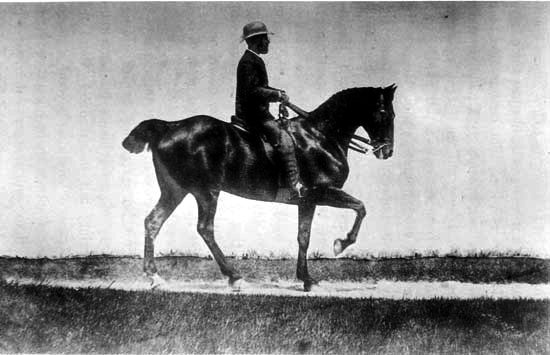
Plate II. A QUIET AMBLE.
There is no pretense to make these pages a new manual for horse-training or for riding. There are plenty of good books on horsemanship now in print; but unfortunately there are few riders who care for anything beyond a superficial education of either their horses or themselves. More than rudimentary—if viewed in the light of the High School—the hints in this volume can scarcely be considered. If any incentive to the study of the real art and to the better training of saddle beasts is given, all that these pages deserve will have been gained.
The plates are phototype reproductions from photographs of Patroclus, taken in action by Baldwin Coolidge. Their origin lay in the belief that a fine-gaited horse could be instantaneously photographed, and still show the agreeable action which all horse-lovers admire, and have been habituated to see drawn by artists, instead of the ungainly positions usually resulting from the instantaneous process. The object aimed at—to show an anatomically correct and artistically acceptable horse in each case—has, it is thought, been gained, so far, at least, as motion arrested can ever give the idea of motion.
Out of thirty photographs taken, the fourteen herein given, and one or two others, much resembling some of these, showed an agreeable action. The best positions of the horse were often the poorest photographs. In enlarging them by solar prints for the phototype process, the shadows of the horse have been darkened, or in some instances, where a negative has been blurred or injured, an indistinct line has been strengthened. In some plates the photograph was so clear (as Plates IV. and V.) that no darkening of the shadows was necessary. In others (as Plates VII. and VIII.) the negative, though showing excellent position, was so weak as to require a good deal of treatment. But in even the most indistinct ones the outline and crude shadows were clearly shown by the negatives, and followed absolutely in treating the solar prints. The plates are thus obtained intact from the original instantaneous negatives, and faithfully represent the action and spirit of the horse. The jumping pictures were taken against the natural background, the others against a screen or building. In the latter, the entire background has been made white, for greater distinctness. The water-jump was in reality a dry ditch of eleven feet wide from bar to bank. But being hidden in the original negatives by the heaps of earth thrown up in digging it, and several of the negatives being blurred in the foreground, the water was added in the solar prints. To preserve anatomical accuracy, the finer results of both photography and of the phototype process have had to be sacrificed.
To state that the author has often witnessed the prize leaping at the Agricultural Hall Horse Show in London, as well as watched the contest of many a noted English steeple-chase, will absolve him from any suspicion of parading these photographs as examples of excellent performance. They were all taken in cold blood on one occasion, and Patroclus was ridden alone over the obstacles at least a dozen times for each good picture secured. Every horseman knows that this is a pretty sound test of a willing jumper, if not a crack one. Moreover, the author has been acquainted with too many masters of equitation, at home as well as abroad, to harbor any but a very modest opinion of his own equestrian ability. He would be much more sensitive to criticism of Patroclus than of himself, for he knows the horse to be an exceptionally good one within his limitations, while always conscious that his own seat lacks the firmness of ante-bellum days. It used to be said in the Old Country that an Englishman keeps his seat to manage his horse, and that a Frenchman manages his horse to keep his seat. The author is obliged to confess that to-day he is often reduced to the latter practice.
The hurdles were somewhat over four feet high; behind each was a bar just four feet from the ground. The water-jumps were from fifteen to eighteen feet from taking-off to landing. On a number of occasions (as in Plate XII.) Patroclus covered over twenty measured feet in this jump.
As is manifest from a few of the plates, it was the action of the horse, and not the "form" of the rider, which it was aimed to secure. It is easy to make engravings in which the seat of the rider shall be perfect; but in all the wood-cut illustrations of books on equitation the horse is usually anatomically incorrect, however artistically suggestive. One never sees the photograph of a horse clearing an obstacle in which the rider's form is as perfect as it is apt to be depicted in engravings or paintings. And in some of the within illustrations of road gaits there is apparent a carelessness in both seat and reins which would scarcely do in the accomplishment of the high airs of the manège, but into which a rider is sometimes apt unconsciously to lapse. No one is probably better aware of what is good and bad alike in these plates than the author himself. He appreciates "form" at its exact value, but is constrained to believe that the true article comes from sources far removed from, and of vastly more solid worth than the pigskin which covers a rider's saddle, or the shears which bang his horse's tail. The searching power of photography, however, is no respecter of form or person.
A word of thanks should not be omitted to Mr. Coolidge, whose excellent judgment and keen eye in taking these pictures, without other apparatus than his lens, is well shown by the result, nor to the Lewis Engraving Company for their careful reproductions from material by no means perfect.
Perhaps it should be said that Master Tom and Penelope, who figure in these pages, are as really in the flesh as Patroclus, and by no means mere fictions of the imagination.
There is no instruction pretended to be conveyed by these plates, as there is in the similarly obtained illustrations of Anderson's excellent "Modern Horsemanship." Their purpose is less to point a moral than to adorn a tale. But an apology to all is perhaps due for the very chatty manner in which the author has taken his friend, the reader, into his confidence, and to experienced horsemen for the very elementary hints sometimes given. The pages devoted to Penelope are meant for young riders who, like Master Tom, really want to learn.
THEODORE AYRAULT DODGE.
Brookline, Mass., April, 1885.
PATROCLUS AND PENELOPE.
A CHAT IN THE SADDLE.
I.
We are fast friends, Patroclus, and many's the hour since, five years ago, I bought you, an impetuous but good-tempered and intelligent three-year-old colt, whom every one thought too flighty to be of much account, that you and I have spent in each other's company upon the pretty suburban roads of Boston. And many's the scamper and frolic that we've had across the fields, and many's the quiet stroll through the shady woods! For you and I, Patroclus, can go where it takes a goodish horse to follow in our wake. I wonder, as I look into your broad and handsome face, whether you know and love me as well as I do you. Indeed, when you whinny at my distant step, or rub your inquisitive old nose against my hands or towards my pocket, begging for another handful of oats or for a taste of salt or sugar; or when you confidingly lower your head to have me rub your ears, with so much restful intelligence beaming from your soft, brown eyes, and such evident liking for my company, I think you know how warm my heart beats for you. And how generous the blood which courses through your own tense veins your master knows full well. If I had to flee for my life, Patroclus, I should wish that your mighty back, tough thews, and noble courage could bear me through the struggle. For I never called upon you yet, but what there came the response which only the truest of your race can give.
No, Pat! you've got all the sugar you can have to-day. My pockets are not a grocer's shop. Stand quiet while I mount, and you and I will take our usual stroll.
Patroclus is said to have been sired in the Old Country out of a cavalry mare brought over by an English officer to Quebec, and there foaled in Her Majesty's service. Even this much I had on hearsay. But he has the instincts of the charger in every fibre,—and perhaps the most intelligent and best saddle beasts among civilized nations belong to mounted troops. As old Hiram Woodruff used to say, Patroclus makes his own pedigree. I know what he is; I care not whence he came.
No need to extol your points. Though there be those of higher lineage, and many a speedier horse upon the turf, or perchance a grander performer after hounds, thrice your value to whoso will find fault or blemish upon you, my Patroclus! You are blood-bay and glossy as a satin kerchief. You are near sixteen hands; short coupled enough to carry weight, and long enough below to take an ample stride. You tread as light as a steel watch-spring quivers. A woman's face has rarely a sweeter or more trusting look than yours in repose; a falcon's eye is no keener when aroused. You will follow me like a dog, and your little mistresses can fondle you in stall or paddock. You have all the life and endurance of the thoroughbred, the intelligence of the Arab, the perfect manners of the park, and the power and discretion of a Midland Counties hunter. Like the old song, you have
"A head like a snake, and a skin like a mouse, An eye like a woman, bright, gentle, and brown; With loins and a back that would carry a house, And quarters to lift you smack over a town."
May it be many a year yet, Patroclus, before I must pension you off for good!
You stand for me to mount as steady as a rock. And you know your crippled master's needs so well that you would do it in the whirl of a stampede. I will leave the reins upon your neck and let you walk whither your own fancy dictates, for I am lazily inclined; though indeed I know from your tossing head that you fain would go a livelier gait. So long as you can walk your four full miles an hour, you will have to curb your ardor for many a long stretch, while your master chews the cud of sweet and bitter fancies.
As we saunter along, the reflections bred of thirty odd years in the saddle come crowding up. From a Shelty with a scratch-pack in Surrey a generation since, to many a cavalry charge with bugle-clash and thundering tread on Old Dominion soil now twenty years ago, the daily life with that best of friends,—save always one,—the perfect saddle horse, brings many thoughts to mind. What if we jot them down?
II.
The most common delusion under which the average equestrian is apt to labor in every part of the world is that his own style of riding is the one par excellence. Whether the steeple-chaser on his thoroughbred, or the Indian on his mustang is the better rider, cannot well be decided. The peculiar horsemanship of every country has its manifest advantages, and is the natural outgrowth of, as well as peculiarly adapted to, the climate, roads, and uses to which the horse is put. The cowboy who can defy the bucking broncho will be unseated by a two-year-old which any racing-stable boy can stick to, while this same boy would hardly sit the third stiff boost of the ragged, grass-fed pony. The best horseman of the desert would be nowhere in the hunting-field. The cavalry-man who, with a few of his fellows, can carve his way through a column of infantry, may not be able to compete at polo with a Newport swell. The jockey who will ride over five and a half feet of timber or twenty feet of water would make sorry work in pulling down a lassoed steer. Each one in his element is by far the superior of the other, but none of these is just the type of horseman whom the denizen of our busy cities, for his daily enjoyment, cares to make his pattern.
The original barbarian, no doubt, clasped his undersized mount with all the legs he had, as every natural rider does to-day. When saddle and stirrups came into use, followed anon by spurs, discretion soon taught the grip with knee and thigh alone, the heels being kept for other purposes than support. It must, however, be set down to the credit of the original barbarian that he probably did not ride in the style known as "tongs on a wall." This certainly not admirable seat originated with the knight in heavy armor, and has since been adhered to by many nations, and, through the Spaniards, has found its way to every part of the Americas. But as a rule, wild riders have the bent knee which gives the firmest bareback seat. The long stirrup and high cantle must not be condemned for certain purposes. When not carried to the furthest extreme they have decided advantages. It is by no means sure that any other seat would be equally easy on the cantering mustang for so many scores of miles a day as many men on the plains customarily cover. And though for our city purposes and mounts it is distinctly unavailable, one must be cautious in depreciating a seat which is clung to so tenaciously by so many splendid riders. It is a mistake to suppose that the Southerners and Mexicans, as well as soldiers, all ride with straight leg. While you often see this fault carried to an extreme among all these, the best horsemen I have generally observed riding with a naturally bent knee. And it takes a great deal to convince a good rider of any of these classes that a man who will lean and rise to a trot knows the A B C of equestrianism.
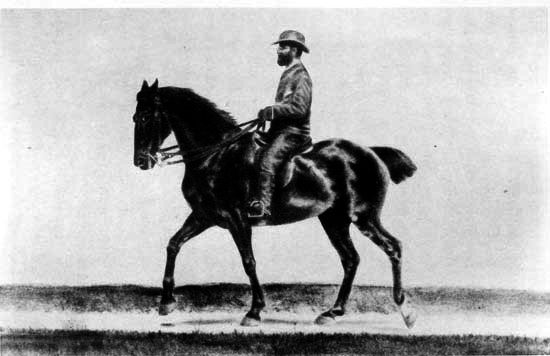
Plate III. THE RACK OR RUNNING WALK.
Whether the first saddle had a short seat and long stirrups, à la militaire, or a long seat with short ones, à l'Anglaise, matters little. Though the original home of the horse boasts to-day the shortest of stirrups (and even in Xenophon's time this appears to have been the Asiatic habit), a reasonably long one would seem to have been the most natural first step from the bareback seat. If so, what is it that has gradually lengthened the seat of the Englishman, who represents for us to-day the favorite type of civilized horsemanship, and if not the best, perhaps nearest that which is best suited to our Eastern wants?
No doubt, in early days, horses were mainly ridden on a canter or a gallop. If perchance a trot, it was a mere shog, comfortable enough with a short seat and high cantle. The early horse was a short-gaited creature. But two things came gradually about. Dirt roads grew into turnpikes; and the pony-gaited nag began, about the days of the Byerly Turk, nearly two hundred years ago, to develop into the long-striding thoroughbred. The paved pike speedily proved that a canter sooner injures the fetlock joints of the forelegs and strains the sinews of the hind than a trot, and men merciful unto their beasts or careful of their pockets began to ride the latter gait. But when the step in the trot became longer and speedier as the saddle horse became better bred, riders were not long in finding out that to rise in the stirrups was easier for both man and beast, and as shorter stirrups materially aid the rise, the seat began to grow in length. It has been proved satisfactorily to the French, who have always been "close" riders, that to rise in the trot saves the horse to a very great percentage, put by some good authorities at as high a figure as one sixth. Moreover, it was not a strange step forward. That it is natural to rise in the trot is shown by there being to-day many savage or semi-civilized tribes which practice the habit in entire unconsciousness of its utility being a disputed point anywhere.
Another reason for shortening the leathers no doubt prevailed. The English found the most secure seat for vigorous leaping to be the long one. Of course a little obstacle can be cleared in any saddle; but with the long seat, the violent exertion of the horse in a high jump does not loosen the grip with knees and calves, but at most only throws one's buckskin from the saddle, as indeed it should not even do that. For the knees being well in front of, instead of hanging below, the seat of honor, enables a man to lean back and sustain the jar of landing without parting company with his mount, while a big jump with stirrups too long, if it unseats you at all, loosens your entire grip, or may throw you against the pommel in a highly dangerous manner.
Moreover, with short stirrups, the horse is able on occasion to run and jump "well away from under you," while, except during the leap itself, the weight for considerable distances may be sustained by the stirrups alone, and thus be better distributed for the horse over ground where the footing is unsteady, as it is in ridge and furrow.
No better illustration of the uses of these several seats than an English cavalry officer. On parade he will ride with the longest of stirrups compatible with not sitting on his crotch. To rise in the saddle is a forbidden luxury to the soldier. Despite some recent experiments in foreign service, and the fact that on the march the cavalry-man may be permitted to rise, nay, encouraged to do so, what more ridiculous than a troop of cavalry on parade, each man bobbing up and down at his own sweet will? The horse suitable for a trooper is a short, quick-gaited, handy animal, chosen largely for this quality, and made still more so by being taught to work in a collected manner by the manège. You can very comfortably sit him with a military saddle at a pretty sharp parade trot. Now, suppose our cavalry officer is going for a canter in Rotten Row,—he will at once shorten his stirrup-leathers a couple of holes; and if he were going to ride cross-country, he would shorten them still a couple more. Experience has taught him the peculiar uses of each position.
Some writers claim that one seat ought to suffice for all occasions. And so it can be made to do. This one seat may, however, not always be the best adapted to the work immediately in hand, or to the animal ridden. A slight change is often a gain. Every one has noticed that different horses, as well as different ground ridden over, vary the rider's seat in the same saddle.
But excellent as is the long hunting-seat in its place, one can conceive no more ridiculous sight than the English swell I once saw in Colorado, who had brought his own pigskin with him, and started out for a ten days' ride across the prairie on an Indian pony, the only available mount. The pony's short gait was admirable for a long day's jaunt in a peaked saddle, but so little suited to a cross-country rig, that the swell's condition at the end of the first fifty miles must have been pitiable. This unusual "tenderfoot" exhibition elicited a deal of very natural laughter, and its butt, who was an excellent but narrow-minded horseman, though he stuck with square-toed British pluck to his rig for a few days, came back to Denver equipped à la cowboy. His Piccadilly saddle had been abandoned to the prairie-dogs.
III.
Patroclus watches his rider's mood. He has become contemplative too, and has taken kindly to our sober pace. But you shall have your turn, my glossy pet. Let us get off this macadamized road where we can find some cantering ground.
As I shorten the reins, 'tis indeed a pleasure to see your head come up, neck arched, eye brightening, alternate ears moving back to catch your master's word, feet at once gathered under you, and nerves and muscles on keenest tension. Every motion is springy, elastic, bold, and free, as full of power as it is of ease. No wonder, Patroclus, that eyes so often turn to watch you. No wonder that you seem conscious that they do. For though we both know that the first test of the horse is performance, yet having that, there is pleasure to us both in your graceful gaits.
To give the reins the least possible shake will send you into the most ecstatic of running walks, as fast as one needs to go, and so easy that it is a constant wonder how you do it. This is no common amble or bumping pace, but the true four beat rack. And as you toss your head and champ your bit, Patroclus, with the pleasure of your accelerated motion, how well you seem to know the comfort of your rider.
IV.
This running walk or rack, by the way, is one of the most delightful of gaits. Its universal adoption in the South by every one who can buy a racker is due to the roads, which, for many months of the year, are so utterly impassable that you have to pick your way in and out of the woods and fields on either side, and rarely meet a stretch where you can start into a swinging trot. But a horse will fall from a walk into a rack, or vice versa, with the greatest of ease to himself and rider, and if the stretch is but a hundred yards will gain some distance in that short bit of ground. If you have a fifty mile ride over good roads in comfortable weather, perhaps a smart trot, if easy, of course alternating with the walk, is as good a single gait as you can ride. But you need to trot or canter a goodly stretch, not to shorten rein at every dozen rods, for the transition from a walk to either of these gaits or back again, though slight, is still an exertion; while from the walk to the rack and back the change is so imperceptible that one is made conscious of it only by the patter of the horse's feet. Here again, the country's need, roads, and climate have bred a most acceptable gait. But it has made the Southerner forget what an inspiriting thing a swinging twelve-mile trot can be along a smooth and pretty road; and you cannot give away a trotting horse for use in the saddle south of Mason and Dixon. The rack soon grows into the single-foot, which only differs from it in being faster, and the latter is substituted for the trot. To go a six or eight mile gait, holding a full glass of water in the hand, and not to spill a drop, is the test of perfection in the racker. And for a lazy feeling day, or for hot weather, anywhere, it is the acme of comfort. Or it is, indeed, a useful gait in winter, when it is too cold for a clipped horse to walk and your nag has yet not stretched his legs enough to want to go at sharper speed. It must, however, be acknowledged that it is very rare that a horse will rack perfectly as well as trot. He is apt to get the gaits mixed.
A rack is half way between a pace and a trot. In the pace, the two feet of each side move and come down together; in the trot, the two alternate feet do so. In the running walk, or in the single-foot, each hind foot follows its leader at the half interval, no two feet coming to the ground together, but in regular succession, so as to produce just twice as many foot-falls as a trot or a pace. Hence the one, two, three, four, patter of the horse gives to the ear the impression of very great rapidity, when really moving at only half the apparent speed. The result of the step is a swaying, easy back, which you can sit with as much ease as a walk. Rackers will go a six-mile gait, single-footers much faster. I once owned a single-footing mare, who came from Alexander's farm and was sired by Norman, who could single-foot a full mile in three minutes. As a rule, the speed is not much more than half that rate. And either a rack or single-foot is apt to spoil the square trot; or if you break a horse to trot, you will lose the other gaits. A perfect all-day racker or a speedy single-footer can scarcely be aught else.
V.
I did not mean to apply that rule to you, Patroclus! We both of us know better. For the exceptional horse can learn to rack or single-foot without detriment to his other paces, if he be not kept upon these gaits too long at any time.
Half a mile ahead of us is the little grass-grown lane, where we can indulge in a canter or a frolicsome gallop. Shall we quicken our speed a trifle? Simply a "Trot, Pat!" and on the second step you fall into as square and level a trot as ever horse could boast. I know how quickly you obey my voice, old boy, and but one step from my word I am ready to catch the first rise, and without the semblance of a jar we are in a full sharp trot. How I love to look over your shoulder, Patroclus, and see your broad, flat knee come swinging up, and showing at every step its bony angles beyond the point of your shoulder; though, indeed, your shoulder is so slanting that the saddle sits well back, and your rider is too old a soldier to lean much to his trot. And you will go six to—I had almost said sixteen—miles an hour at this gait, nor vary an ounce of pressure on your velvety mouth. How is it, Patroclus, that you catch the meaning of my hands so readily?
VI.
The fancy of to-day is for the daisy-clipping thoroughbred. And when they do not run to the knife-blade pattern, they may be the finest mounts a man can throw his leg across. But my fancy for the road has always been for the higher stepping half-bred. Granted that on the turf or across a flying country blood will tell. Granted that brilliant knee action is mainly ornamental. Still, in America, the half-bred will average much better in looks, and vastly more satisfactory in hardy service. Where shall we again find the equivalent of the Morgan breed, now all but lost in the desire to get the typical running horse? For saddle work, and the very best of its kind, there was never a finer pattern than the Morgan. Alas, that we have allowed him to disappear! His worth would soon come to the fore in these days of saddle pleasures. The thoroughbred's characteristic is ability to perform prodigies of speed and endurance at exceptional times. But the strong, every-day-in-the-year good performer is usually no more than half-bred, if even that. Moreover, you can find a hundred daisy-clippers for one proud stepper, be he thoroughbred or galloway. There is such a thing as waste of action. No one wants to straddle a black Hanoverian out of a hearse. But the horse who steps high may be as good a stayer as the one who does not, and high action is a beauty which delights men's eyes and opens their purses. Because the long stride of the turf is better for being low, it is not safe to apply this rule to the road.
There are many more worthless brutes among thoroughbreds than among the common herd. While it is easy to acknowledge that the perfect thoroughbred excels all other horses, the fact must also be noted that he is of extremest rarity, and even when found is infrequently up to weight. If we use the word advisedly, only the horse registered in the Stud Book is a thoroughbred. These have no early training whatever, except to allow themselves to be mounted, and to run their best. If they stand the initial test of speed, they are reserved for the turf, and there wholly spoiled for the saddle or for any other purpose of pleasure. If they do not, they are turned adrift, half spoiled in mouth and manners by tricky stable-boys, and may or may not fall into good hands. For one thoroughbred with perfect manners, sound, and up to weight, there are a score of really good half-breds, as near perfection as their owners choose or are able to make them.
What we in America are apt colloquially to call a thoroughbred is only a horse which, in his looks, shows some decided infusion of good blood, or is sired by a well-bred horse. But it is to be remembered that of two horses with an equal strain of pure blood, one may have reverted to a coarse physical type, and the other to the finer. And the one who has inherited the undeniable stamp of the common-bred ancestor may also have inherited from the other side those qualities of constitution, courage, intelligence, and speed, which sum up the value of high English blood. Not one fine-bred horse in one hundred—I speak from the ownership of, and daily personal intimacy for considerable periods with, over fifty good saddle beasts,—has as many of the admirable qualities of pure blood as Patroclus. And yet (absit omen), he has a wave in his tail, and though his feet and legs are perfect in shape, and as clean as a colt's, they are far beyond the thoroughbred's in size. He shows that his ancestry runs back both to the desert and the plough. In America, surely, handsome is that handsome does. Let us value good blood for its qualities, not looks, and ride serviceable half-breds, instead of sporting worthless weeds because they approach to the clothes-horse pattern, or have necks like camels.
VII.
One of the most distinctly promising features of the athletic tendencies of to-day is the mania for the saddle. Fifteen years ago, the boys along the Boston streets used to hoot at your master, Patroclus. Not, indeed, that he had a poor seat or needed to "get inside and pull down the blinds," as the London cad might phrase it, for a good or bad seat was all alike to them; rather at the wholly unusual sight of a man on horseback—outside of politics.
But the number of good horsemen, and horsewomen too, is growing every day. Here comes a couple at a brisk round trot. How can we notice the lad, Patroclus, when the lassie looks so sweetly? In her neat habit, with dainty protruding foot and ankle, sitting her trappy-gaited mount with ease and grace, the bloom of health fairly dazzling you as she rushes by, so that you doubt whether it be her pretty eye and white teeth or her ruddy skin and happy face which has set even your ancient heart a-throbbing, how can a woman look more attractive?
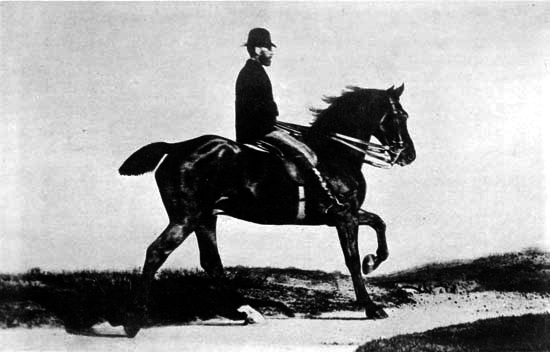
Plate IV. A SHARP SINGLE-FOOT.
But the alluring sight is not long-lived. Following hard upon them comes, not the first rider who has chased a petticoat, a young Anglomaniac. He fancies that his hunting-crop, his immaculate rig, and his elbows out-Britishing the worst of British snobs, as he leans far over his pommel, make him a pattern rider. You can see the daylight under his knees. A sudden plunge would send him, Lord knows where! Haply his dock-tailed plug remembers the shafts full well and steadily plods ahead. But bless his little dudish heart! he will learn better. As his months in the saddle increase, he will find his seat as well as his place. We Americans are the making of an excellent race of horsemen. It is a pleasure to see the increase in the number of promising riders who seek the western suburbs every day. We shall all ride, as we manage to do everything, well,—after a while. There is of course a lot of rubbish and imported—rot, shall we call it? But what odds? so there is in art, music, politics, religion.
VIII.
You see the corner of the lane, Patroclus, while I have been thus musing, and your lively ear and instinctively quickened gait rouse my half-dazed thoughts. Here we are. Shall we take our accustomed canter? You always wait the word, though you are eagerness itself, for you do not yet know when I want you to start, or which foot I may ask you to lead with. Though, indeed, you will sometimes prance a bit, and change step in the alternate graceful bounds of the passage, to invite and urge my choice. The least pressure of one leg, and off you go, leading with the opposite shoulder. And you will keep this foot by the mile, Patroclus, or change at every second step, should I ask you so to do. You need but the slightest monition of my leg, and instantly your other shoulder takes the lead. I see you want to gallop, boy! But not quite yet. You must not forget that you have been taught, as they say in Kentucky, to canter all day long in the shade of an apple tree, if so be it your master wishes. You shall have your gallop anon. But you must never forget that a horse who can only walk or go a twelve-mile trot or hand-gallop, though he may lead the hunt cross-country, is an unmitigated nuisance on the road. Slow and easy gaits are as valuable to the park-hack as long wind and speed to the racer. And although Boston, as yet, boasts no Rotten Row, are not the daily rides through its exquisite environments the equivalent of the canter in that justly celebrated resort, rather than the mere country tramp upon a handy roadster or the ride to cover on a rapid covert-hack? And yet our imitation of our British cousins has approximated less to the pleasure ride than to the cross-country style. Perhaps, in our eagerness to convince ourselves that we have learned all there is worth knowing in the art, we have aped what is confessedly the finest of horseback sports, and forgotten the more moderate fashion of Hyde Park. Let us remember that we can saunter on the road every day, while riding to hounds is for most of us a rarish luxury.
IX.
Because a horse can go well to hounds, it does not follow that he is fit for park or road work any more than the three-year-old who wins the Derby or St. Leger is fitted for a palfrey. A horse whose business it is to run and jump must have his head; while a horse, to be a clever and agreeable hack, should learn that the bit is a limitation of his action, and that the slightest movement of the hand or leg of the rider has its meaning. What is impossible in galloping over ploughed fields is essential to comfort on the road. In the field, everything must be subservient to saving the horse; the rider's comfort is the rule of the park. It is every day that we may see a rider who deems his excellent hunter a good saddle beast, when, however clever cross-country, he is absolutely ignorant of the first elements of the manège. He forgets that each is perfect in his own place and may be useless in the other's.
I am the owner of a fine-bred mare, whom I have as yet had no opportunity to school. She is the perfect type of a twelve-stone hunter. After hounds she will attract the eye of the whole field for distinguished beauty, and ridden up to her capacity, can always be in the first flight. She has speed, endurance, and fine disposition, is as sound and hardy as a hickory stick, and in her place unsurpassed. Almost any of the horsemen of to-day's Modern Athens would select this mare in preference to Patroclus. And yet, a four-in-hand of her type, as she now is, Tantivy coach thrown in for make-weight, are not worth one Patroclus for real saddle work, because she has no conception of moderate gaits. She is bound to go twelve miles an hour if you let her out of a walk, or fret at the restraint. I can ride Patroclus twenty-five miles without fatigue. If I ride the mare ten miles, I come in tired, drenched with heat, and probably with my temper somewhat ruffled, while she has fretted to a lather more than once, and we have both been so hot during the entire ride that, if the day is raw, it has been dangerous to ease into a walk. If I ride Patroclus over the same ground in the same time, we shall both come in fresh as a daisy, dry, and each well-pleased with the other. While this mare can gallop fast and is easy and kind, a man must work his passage to make her canter a six-mile gait. She has no more ambition than Patroclus, but she does not curb it to the will of her rider. With a knowledge of all which, however, most of our young swells would select the mare for simple road-riding, because she looks so like a thoroughbred hunter, and rather suggests the impression that they habitually ride to hounds. As well saunter in the park in a pink coat and with "tops carefully dressed to the color of Old Cheddar."
X.
The manège need not mean all the little refinements of training which, however delightful to the initiated, are unnecessary to comfort or safety. But no horse can be called a good saddle beast whose forehand and croup will not yield at once to the lightest pressure of rein or leg. Most horses will swing their forehands with some readiness, if not in a well-balanced manner. But not many are taught to swing the croup at all; very few can do so handily. The perfect saddle horse should be able to swing his croup about in a complete circle, of which one fore foot is the immovable centre, or his forehand about the proper hind foot, in either direction at will. He should come "in hand," that is, gather his legs well under him, so as to be on a perfect balance the moment you take up the reins and close your legs upon him. He should in the canter or gallop start with either foot leading, or instantly change foot in motion at the will of his rider. He should have easy, handy gaits, the more the better, if he can keep them distinct and true. These accomplishments, added to a light mouth and a temper of equal courage and moderation, or, in short, "manners," make that rare creature,—the perfect saddle horse.
It is in this that the English err. In their perfect development of the hunter and the racer they neglect the training of the hack. Though it be heresy to the mania of the day to say so, it is none the less true that while you seek your bold as well as discreet and experienced cross-country rider in England, you must go to the Continent, or among the British cavalry, to find your accomplished horseman.
It is the general impression among men who ride to hounds, and still more among men who pretend to do so, that leaping is the ultima thule of equestrianism; and that a man who can sit a horse over a four-foot hurdle has graduated in the art of horsemanship. The corollary to this error is also an article of faith among men who hunt, that is, that no other class of riders can leap their horses boldly and well. But both ideas are as strange as they are mistaken.
The cavalry of Prussia, Austria, and Italy show the finest of horsemanship. More than a quarter century ago, the author spent three years in Berlin under the tuition of a retired major-general of the Prussian army, and saw a great deal of the daily inside life, as well as the exceptional parade life, of the army. He has often seen a column of cavalry, with sabres drawn, ride across water which would bring half the Myopia Hunt to a stand-still on an ordinary run after hounds. Why should not men whose business it is to ride, do so well?
Think you there was not good horsemanship at Vionville, when von Bredow (one of the author's old school friends, by the way) with his six squadrons, to enable Bruddenbrock to hold his position till the reinforcements of the Tenth Corps could reach him, rode into the centre of the Sixth French Corps d'Armée? In slender line, he and his men, three squadrons of the Seventh Cuirassiers, and three of the Sixteenth Uhlans, charged over the French artillery in the first line, the French infantry in line of battle, and reached the mitrailleuses and reserves in the rear, where they sabred the gunners at their guns. What though but thirteen officers and one hundred and fifty men out of near a thousand returned from that gallant ride? Though no Tennyson has sung their glorious deed, though we forget the willing courage with which they faced a certain sacrifice for the sake of duty to the Fatherland, think you those men rode not well, as a mere act of horsemanship?
Think you that the handful of men of the Eighth Pennsylvania, at Chancellorsville, when they charged down upon Stonewall Jackson's victorious and elated legions, riding in column through the chapparal and over the fallen timber of the Wilderness, carving their path through thousands of the best troops who ever followed gallant leader, sat not firmly in their saddles? Think you that the men who followed Sheridan in many a gallant charge, or Fitz Hugh Lee, forsooth, could not ride as well as the best of us across a bit of turf, with a modest wall now and then to lend its zest to the pleasure? Neither we nor our British cousins can monopolize all the virtue of the world, even in the art equestrian.
As there is no doubt that fox-hunting is one of the most inspiriting and manly of occupations, or that the English are preëminent in their knowledge of the art, so there is likewise no doubt that equally stout riders sit in foreign saddles. And though each would have to learn the other's trade, I fancy you could sooner teach a score or a hundred average cavalry officers of any nation to ride well across country, than an equal number of clever, fox-hunting Englishmen to do the mere saddle work of any well-drilled troops. Leaping is uniformly practiced and well-taught, in all regular cavalry regiments of every army with which I have been familiar in all parts of the world.
XI.
Well, Patroclus, you have earned your gallop. I loosen in the least my hold upon the reins, and shaking your head from very delight, off you go like the wind. Never could charger plunge into a mad gallop more quickly than you, Patroclus. Your stride is long, your gather quick, and the reserve power in your well-balanced movements so inspiring, that I would almost ride you at the Charles River, in the expectation that you would clear it. But the lane is all too short. Steady, sir, steady! and down you come in a dozen bounds to a gait from which you can fall into a walk at word.
But what is that? A rustling in the woods beside us! That sounds indeed frightsome enough to make you start and falter. You are not devoid of fear, Patroclus. No high-couraged horse can ever be. But though you may tremble in every limb, if I speak to you, I may safely throw the reins upon your neck. So, boy! To face danger oftener insures safety than to run from it. To the right about, and let us see what it means. Steady, again! Now stand, and let it come. There, Patroclus, despite your snort of fear, it is only a couple of stray calves cutting their ungainly capers as they make their way towards home. Their bustle, like that of so many of the rest of us, far exceeds their importance. Was not this much better seen than avoided? You would have hardly liked this pleasant lane again had we not seen the matter through.
I have never kept you in condition, Patroclus, to stand heavy bursts after hounds, or indeed any exceptionally long or sharp run. That means too much deprivation of your daily company. Nor indeed, be it confessed, is your master himself often in the condition requisite to do the sharpest work. It will generally be noticed that the clear eye and firm muscle of the rider is a factor in the problem of how to be in at the death, as well as the lungs and courage of the hunter. And yet, Patroclus, you are, within your limits, a model jumper, and always seem to have a spare leg. No horse delights more in being headed at a wall or ditch than you, even in cold blood. For any horse worthy the name will jump after a fashion in company. At the end of our lane we can take the short cut towards the great highway, over the gate and the little brook and hedge. As I talk to you, I can see that you catch my purpose, for as we draw near the place, the might of conscious strength seems to course through all your veins. Perhaps I have unwittingly settled into my seat as I thought of the four-foot gate. Here we are, and there is just enough bend in the road to ride at the gate with comfort. Head up, ears erect, eyes starting from out their sockets, no need to guide you towards it, my Patroclus! No excitement, no uncertainty, no flurry. You and I know how surely we are going over. A quiet canter, but full of elastic power, to within about fifty feet of the jump, and then a short burst, measuring every stride, till with a "Now boy!" as you approach the proper gather, I give you your head, and you go into the air like a swallow. Just a fraction of a second—how much longer it seems!—and we land cleverly, well together, and in three strides more you have fallen into a jog again. And now you look back, lest, perchance, the lump of sugar or Seckel pear which used to reward you when you were learning your lesson should be forthcoming now. But no, Patroclus, my good word and a kindly pat for your docility and strength must be your meed to-day. Canter along on the soft turf till we come to the little brook. We will call it a brook, and think of it as a big one, though it is barely eight feet wide. But never mind. We can jump thrice its width just as well as across it. Remember, Patroclus, water requires speed and well-set purpose, as height does clean discretion. At it, my boy! Take your own stride. There's lots of room this side and more on the other bank.
"Harden your heart, and catch hold of the bridle, Steady him! Rouse him! Over he goes!"
In the air again; this time it seems like a minute almost. There, Patroclus, if it had been twenty feet of water, you would not have known the odds. Now for the road and company.
XII.
The same reasoning may be applied to saddles as to gaits. To pull down a bull, the Texan must be furnished with a horn-pommel, which would have been highly dangerous to his rider if Patroclus had happened to come down over the gate just leaped. Indeed, nothing but the flattest of saddles is safe to the steeple-chaser. On the contrary, the soldier rides a trot, or uses his sabre to much better advantage with a cantle sufficiently high to lean against. And any man is liable to have some physical conformation requiring a peculiar saddle.
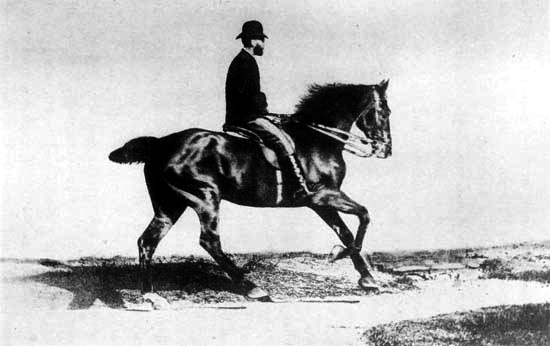
Plate V. AN EASY CANTER.
The present generation of new-fledged riders would fain tie us down to the English hunting-seat by laws like the Medes and Persians. This is a good pattern for our Eastern needs, but let us not call it the only one. It is, of course, well when in Rome to do as the Romans do, or at least so nearly like them as not to provoke remark. But every one cannot do this, and the old trooper is not apt to ride this way. And yet, there are thousands of ancient cavalry soldiers all over this country, North and South, who, naked weapon in hand, have done such feats of horsemanship as would shame most of the stoutest of to-day's fox-hunting, polo-playing riders. I do not refer to the obstacles they used to ride at,—which meant a vast deal more than merely an ugly tumble over a three-foot stone wall; I refer to their stout seats in the saddle, and the rough ground they were wont to cover when they rode down upon and over a belching wall of fire. For all which, whenever we see one of these old troopers out for a ride, modestly (for he is always modest) airing his army saddle, strong curb, and long and hooded stirrups, we may, perchance, notice the jeer of the stripling, whose faultless dress and bang-tailed screw are but a sham which hides his lack of heart. It always gives one's soul a glow of pride to see the well-known seat, and one is fain tempted to ride up to the old comrade and grasp him by the hand. A thorough rider will recognize his equal under any garb. It is pretense alone which merits a rebuke. You cannot make a poor rider a good one by mounting him in a fashionable saddle, any more than you can make a worthless brute a good horse by giving his tail the latest dock.
XIII.
Until within no great time the modified military seat has been the one which formed the basis of instruction. The riding-master, I presume, still insists, with civilian and recruit alike, on feet parallel with the horse, heels down, toes in, knee grip, and a hold of reins utterly unknown in the hunting-field. And with a certain reason, though indeed the old whip's rule of "'eels and 'ands down, 'ead and 'eart 'igh," is the whole of the story, after all. For the man who begins with a knee grip will never forget what his knees are for, and will not, like the good little dude we passed a while ago, show daylight between them and the saddle-flap at every rise. But the knee grip alone will not suffice for all occasions, despite our military or riding-school friends. A madly plunging horse or a big leap will instinctively call out a grip with all the legs a man can spare. Moreover, the closer you keep your legs to the horse without clasping him, the better. Go into the hunting-field or over a steeple-chase course, and you will find that the inside of your boot-tops—and not only yours, but every other jockey's as well—have been rubbed hard and constantly against the saddle. There lies the proof. At West Point, and in fact at every military school, the cadets are sometimes practiced to ride with a scrap of paper held to the saddle by the knee while they leap a bar, and at the same time thrust or cut with the sabre at a convenient dummy foe. I have seen a silver dollar so held between the knee and saddle. But the bar is not a succession of high stone walls, nor is the cadet riding a burst of several miles. And with a longer stirrup it is more natural to keep the foot parallel with the horse's side. To-day, the best riders do not so hold their feet. Cross-country a man certainly does not. The proof is forthcoming at the Country Club on any race-day, or at every meet here or in England, that a man riding over an obstacle of any size will use all the legs he can without digging his spurs into his horse's flanks, in a way he could not do with the feet parallel to the horse's sides.
The modern dispensation differs from the old one in not being tied to the military seat. The Rev. Sydney Smith objected to clergymen riding, but modified his disapproval in those cases when they "rode very badly and turned out their toes." A generation ago, a man was always thinking of the position of his feet, as he cares not to do to-day, if he sits firmly in the saddle, and boasts light hands.
XIV.
While on this subject, one cannot refrain from indulging in a friendly laugh at the attempt to bend our unreasonable Eastern weather to the conditions of a fox-hunting climate. The hunting season is that time of the year when the crops are out of the ground. In England, during the winter months, the weather is open and moist, and the soft ground makes falling "delightfully easy," as dear old John Leech has it. And the little hedges and ditches of some of the good hunting counties, or indeed the ox-fences and grassy fields of Leicestershire, are such as to make a day out a positive pound of pleasure, with scarce an ounce of danger to spice it, if you choose to ride with moderation. For the best rider in the Old Country is not the hare-brained cockney who risks both his horse's and his own less valuable neck in the field; it is he who chooses discreetly his course, and makes headway with the least exertion to his hunter compatible with his keeping a good place in the field. The man who appreciates how jumping takes strength out of a horse, or who is any judge of pace, is apt to save, not risk him. Few men willingly jump an obstacle which they can readily avoid without too much delay. Read the legends of the famous hunting-men of England, and you will find discretion always outranking valor. Any fool can ride at a dangerous obstacle. Courage of that kind is a common virtue. But it takes a make-up of quite a different nature to be in, as a rule, at the death. How many five-barred gates will a man jump when he can open them? How much water will he face when there is a bridge near by? Does not every one dismount in hilly countries to ease his horse? A good rider must be ready to throw his heart over any obstacle possible to himself and his horse, when he cannot get round it. But a discreet horseman puts his horse only at such leaps as he must take, or which will win him a distinct advantage.
England is naturally a hunting country. But here, Lord save the mark! there are no foxes to speak of. Scent won't lie, as a general thing, with the thermometer below thirty (though scent is one of those mysterious things which only averages according to rules, and every now and then shows an unaccountable exception), and the obstacles are snake fences or stone walls with lumpy, frozen ground to land on, or, belike, a pile of bowlders or a sheet of ice. A bad fall means potentially broken bones or a ruined horse, and while you are beating cover for the fox who won't be found, you are shaking with the cold, and your clipped or over-heated beast is sowing the seeds of lung-fever.
You, Patroclus, were once laid up five months by landing on a snag the further side of a most harmless-looking stone wall, and tearing out some of the coronal arteries.
There are plenty of good horseback sports without a resort to what is clearly out of the latitude. If you wait for good hunting weather, the crops interfere with your sport, and our farmers have not the English inducement to welcome the hunt across the fields, tilled at the sweat of their brow. In the South, both weather and much waste land make fox-hunting more easy to carry on. But even there it does not thrive. Here in the East it will not be made indigenous.
Not but what, on a bright sunny day, a meet at which equine admirers can show their neat turn-outs and glossy steeds and discuss horseflesh in the general and the particular is a delightful experience. And indeed, wherever crops and covers do not monopolize the country, a good drag-hunt may often be had before cold weather mars the sport. Perchance, in time, Reynard may take up his abode with us, when vulpicide shall be punished by real ostracism. For has not the Ettrick Shepherd proven conclusively that Reynard loves the chase? But far from underrating the caged fox or anise-seed bag, hare and hounds would seem to afford the better sport. For the hares, an they will, can carry you across a country where each one can choose his own course, instead of being obliged to follow a leader through wood-paths, and through second growth which is all but jungle, where, if one happens to blunder at an obstacle, your follower will come riding down atop of you, and where you are bound to be "nowhere" unless you get away with the first half-dozen men.
But spite of all its drawbacks, Patroclus, you and I enjoy in equal measure a run under fair conditions as much as the best of them. And let us hope the hunting fever will be kept up in healthy fashion, for we two can select our weather, and we are not afraid of our reputation if we drop out before the finish. This kind of work soon shakes our novices into the saddle, and its many excellencies far outweigh its few absurdities. Let him who runs it down try rather a run with the pack some sunny day. If he does not find it manly sport, and stout hearts in the van of the field, he can tell us why thereafter. The outcome of to-day's riding mania is well ahead of the young men's billiard-playing and bar-drinking of twenty years ago.
XV.
There are good riders in every land and in every species of saddle. Facts are the best arguments. The North American Indian and the follower of the Prophet each performs his prodigies of horsemanship, the one bareback with hanging leg, the other in a peaked saddle with knee all but rubbing his nose. Whoso has laughed over Leech's sketches of Mossoo, who makes a promenade à cheval, or indeed has watched him in the Bois, is fain to doubt that a Frenchman can ride well. And yet he does. Was not Baucher the father of fine horsemanship? A rough and tumble, plucky rider, or one who is experienced and discreet after hounds as well, is more frequently found in Great Britain; a highly skilled equestrian (is the author nearing a hornet's nest?) in France, or elsewhere across the Channel. But we naturally must seek the Continental rider in the camp, for is not the Continent itself one vast camp? It is perhaps hard to decide whether the cavalry officer who is master of the intricacies of the manège or the country gentleman who has won a reputation with the Pytchley or the Belvoir may be properly called the more accomplished horseman. Each in his place is unequaled. But is it not true, that the former can more quickly adapt himself to the habits of hunting than the latter to those of the Haute Ecole? And do not the methods of the School give us more capacity for enjoying our daily horseback exercise, than any amount of experience with hounds?
XVI.
It is sometimes said in England that a School-rider reining in his steed never looks as if he were having a thoroughly good time, as does the man who lets his horse go his own inspiriting gait along the road. But why not? Is inspiration only found in excess of physical motion? If so, to use an exaggerated comparison, why does not Paddy at Donnybrook Fair, trailing his coat and daring some one to tread on the tail of it, enjoy himself more thoroughly than the man who quietly plays a game of chess or whist? Or to use a more nearly equal simile, may not a man find as great enjoyment in a skilled game of tennis, as in the violent rushes of foot-ball, where two hundred and twenty pounds of mere blubber will assuredly bear down all the prowess and aptness of his own say one hundred and forty? It is as certain that the pleasure of riding a trained horse is greater than that of merely sitting a vigorously moving untrained one, as that the delight of intellectual study exceeds the excitement of trashy reading. Omne ignotum pro magnifico seems not to be uniformly true, for riders unfamiliar with the training of the High School almost as invariably run down its methods, as self-made business men are apt to discountenance a college education as a preliminary discipline for the struggles of life.
It is a fact that no man who has once been a School-rider ever abandons either the knowledge he has gained or its constant practice. No one can underrate the pleasure of simple motion upon a vigorous horse. But the School-rider has this in equal degree with the uneducated horseman, coupled with a feeling of control and power and ability to perform which the mere man on horseback never attains. Moreover, all the powers of the School-rider's horse are within the grasp of his hand; and that the powers of the high-strung steed of the average equestrian are all too often resident mainly in the animal itself is shown by the chapter of accidents daily reiterated in the news-columns. The School-man is apt to ride more moderately, and to indulge in a bracing gallop less frequently, because to him the pleasure of slow and rhythmic movement on a fleet and able horse is far greater than mere rapidity can ever be; the untrained rider resorts to speed because this is the one exhilaration within the bounds of his own or his horse's knowledge.
I do not wish to be understood as advocating the School habit of always keeping a horse collected. However much for some purposes I admire it, I do not practice it. I often saunter off a half-dozen miles without lifting the rein, while Patroclus wanders at his own sweet will. I often trot or gallop at my nag's quite unrestrained gait. But if I want to collect him, if I want that obedience which the School teaches him to yield, he must, to be to me a perfect horse, at my slightest intimation give himself absolutely to my control, and take all his art from me. I feel that I am a good judge of either habit of riding, as I have well tried both, and absolutely adhere to neither. I pretend by no means, in School-riding, to have carried my art so far as to be even within hail of the great masters of equitation; but I have not for many years been without one or more horses educated in all the School airs which are applicable to road-riding, and I know their value and appreciate it.
Because, then, the cowboy is nowhere in the hunting-field; or because the hard-riding squire and M. F. H. cannot drop to the further side of his horse while he shoots at his galloping enemy, or pick up a kerchief from the ground at a smart gallop; or because the Frenchman has to learn his racing trade from an English jockey, it will not do to say that each is not among the best of horsemen, or that either is better than the other. The style of riding is always the outgrowth of certain conditions of necessity or pleasure, and invariably fits those conditions well. With us in the East the English habit is no doubt the most available; but it can only be made the test of our own needs or fashions, not of general equestrianism.
XVII.
While all this has been buzzing through your master's brain, you, Patroclus, knowing full well that the loosely hanging rein has meant liberty within reason to yourself, have wandered away to the nearest thicket, and begun to crop the tender leaves and shoots as peacefully as you please. To look at your quiet demeanor at this moment one would scarcely think that you were such a bundle of nerves. You can be as sedate as Rosinante till called upon. But when the bit plays in your mouth, you are as full of life and action as the steeds of Diomed with flowing manes. Your eye and ear are an index to your mood, and you reflect your rider's wish in every step. No man ever bestrode a more generous beast than you. Do you remember, Patroclus, the days when you carried your little twelve-year-old mistress, and how her first lessons in fine equitation were taken in your company? And cleverly did she learn indeed. Do you remember how we used to put you on your honor, though you were only a five-year-old and dearly loved to romp and play? Ay, Patroclus, and fairly did you answer the appeal! With the gentle burden on your broad, strong back, her golden-red hair streaming behind her in the breeze from under her jaunty hat, you would have ridden through fire, my beauty, rather than betray your trust. However tempted to a bound, or however startled at some fearsome thing, one word—a "Quiet, Pat!"—from that soft girlish voice, now hushed for both of us, would never fail to keep you kind and steady. And you were ever willing, with even more than your accustomed alacrity, to perform your airs at the slightest encouragement of the soft hands and gentle voice; and having done so would lay back your ears and shake your head with very pleasure at the rippling laughter in which your pretty rider's thanks were wont to be expressed. I knew, Patroclus, that in your care the little maid was quite as safe as with her doll at home.
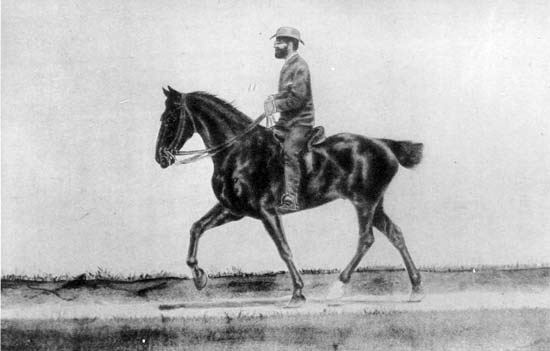
Plate VI. A TEN-MILE TROT.
XVIII.
And now a word about the horse in action, as shown by instantaneous photography, and about the war waged between artists and photographers. Some disciples of Muybridge would fain have the artist depict an animal in an ungainly attitude, because the lens is apt to catch him at a point in his stride which looks ungainly, there being many more such points than handsome ones. It is the moving creature which we admire. The poetry of motion is rarely better seen than in a proudly stepping horse. But arrest that motion and you are apt to have that which the human eye can neither recognize nor delight itself withal. Arrested motion rarely suggests the actual motion we aim to depict. The lens will show you every spoke of a rapidly revolving wheel, as if at rest. The eye, or the artist, shows you a blur of motion. And so with other objects. The lens works in the hundredth part of a second; the eye is slower far.
To a certain extent photography, quoad art, is wrong and the limner is right. There are some horses which possess a very elegant carriage. In their action there are certain periods—generally those at which one fore and one hind leg are slowing up at the limit of their forward stride—when the eye catches an agreeable impression which is capable of being reduced to canvas,—though it is after all the proud motion itself which pleases, and this can only be suggested. Now, photography robs you of almost all the suggestiveness of the horse's action, unless you select only those photographs which approach the action caught by the human eye. Even after long study of the Muybridge silhouettes, the artistic lover of the horse feels that he must reject all but a small percentage of these wonderful anatomical studies. If there are periods in the horse's stride which are agreeable to the eye, why should the artist not select these for delineation? Why indeed does his art not bind him to do so?
You, Patroclus, are peculiarly elegant in motion. It is difficult to pick a flaw in the symmetry of your gaits. Slow or fast, fresh or tired, your motion is always proud and graceful. And yet out of many photographs, few suggest your action at all, fewer still even passably; none convey to its full extent what all your intimates well know.
To photograph well, a horse must have a good deal, but not an excessive amount of action, and with unquestioned grace of curves. The reason why horses in very rapid motion photograph illy is to be found in the too extreme curves described by their legs in the powerful strides of great speed, any position in which, arrested by the lens, looks exaggerated,—sprawling. The reason why, on the other hand, the photograph of a daisy-clipper moving slowly looks tame is the lack of action to suggest the motion which the eye follows in real life. Many of the best performers are plain in action. Some of the most faultless movers, so far as results or form are concerned, even when agreeable to the eye, will show unsightly photographs. Let any one who desires to test this matter have a half-dozen instantaneous photographs of his pet saddle beast taken. He will surely be convinced that a horse must be extremely handsome in motion to give even a passable portrait. If he gets one picture in four which shows acceptably, he may be sure that he owns a good-looking nag. Among the silhouettes in the Stanford Book, scarcely one in twenty shows a handsome outline. This seems to be owing, as above explained, to the speed exhibited in almost all the performances; and in the slow gaits, to the want of action in the subjects. Still, if the pictures had shown the light and shade which instantaneous photography is now able to give, many of the plates would have made artistic pictures.
There are certainly many minutiæ in which the artist can learn from the photograph. To give an instance: before reaching the ground, the leg in every gait must be stiffened, and the bottom of the foot brought parallel to the surface traveled over, or a stumble will ensue. This, at first blush, may look awkward; but it is not really so. The artist often forgets that a horse must sustain his weight on stiff legs, and that these straighten from their graceful curves to the supporting position in regular gradation, and reach this position just before the foot comes down. Some in other respects most attractive sketches fail in this. Often one sees the picture of an otherwise handsomely moving horse whose fetlock joint of the foot just being planted is so bent forward as to make a drop inevitable. This is certainly without the domain of true art.
The origin of such drawing lies probably in the fact that the eye catches the bent rather than the straight position of the fetlock, because the former occurs when the foot is higher above the ground, while the latter position is not so noticeable as being more out of the line of sight. But such stumbling pictures are as much a worry to the horseman's eye as the ugliest of the Muybridge gallopers is to the artist's; and they are wholly unnecessary.
There are many such minor points of criticism of the usual artistic work, which the artists should not deem beyond consideration. It is quite possible to make the truthful and the artistic go hand in hand.
Except, perhaps, in the gallop. This most disheartening gait will not be reduced to what we have been taught to like. There is but one of the five "times" of the gallop which suggests even tolerable speed,—the one when all four feet are in the air and gathered well under the horse. At the instant when one of the hind legs is reaching forward to land, there is sometimes a suggestion of great speed and vigor. But the successive stilted strides when the straightened legs in turn assume the body's weight oppress the very soul of the lover of the Racing Plates. It must fain be left to the wisest heads, and perhaps better to time, to bring daylight from this darkness.
The late John Leech, as far back as the forties, essayed to draw running horses as his very keen eye showed him that they really looked; but he was laughed out of the idea, and thenceforth stuck to the artist's quadruped, though he had been, in his new departure, much more nearly approaching anatomy than any one was then aware. And thirty years ago, on Epsom Downs, it was revealed to the author, as it has no doubt been to thousands of others, that it is the gathered and not the spread position of the racer which is impressed upon the eye. This is most clearly shown by watching the distant horses through a glass. But still we stick to the anatomically impossible spread-eagle stride of the turf, and feel that it conveys the idea of speed which is not compassed by the set fac-similes of photography.
It has been alleged that a horse never does, nor can take the spread position of the typical racer of the artist. This is true enough, for he never does extend himself to so great a degree. But at one part of the leap he may do this very thing, though by no means to the extent usually depicted (see Plate XI.). It is, however, certain that he cannot do so at all in the gallop. At the only time when all his feet are off the ground in this gait, they are all close together under his girths. At all other times there are one or more feet on the ground, with legs straight, and at greater or less inclination to the body. From front to rear the legs move almost like the spokes of a wheel. What the pictures of the turf in the future may be it is hard indeed to say.
And yet, the longer one examines the many hundred silhouettes of running horses, so well grouped for anatomical study in the Stanford Book, the more reconciled to what there is of truth in them one may become. Many years ago, I sat during the forenoon in the Turner Room of the National Gallery in London, in the company of a friend, herself no mean artist, and of decidedly strong artistic taste and correct judgment, whose ideas of Turner had been founded solely on what she had read, or seen and heard in America, and whose prejudice against his apparently overwrought work was excessive. For a full hour few words were passed. Then, rising to go: "If I sit here any longer, I shall end by liking the man!" quoth she.
It seems to me that the power in these Muybridge photographs grows upon you. It is universally acknowledged that one does not see the running horse as he is usually drawn; in other words, that the artist's run is incorrect. Now, if the retina has anything impressed upon it, it must assuredly be either one of the positions actually taken by the galloping animal, or else a mere blur of motion. The artist draws a blurred wheel because he sees it blurred, and it suggests rapid motion. But he will not draw blurred legs, because such drawing will not suggest what he desires to convey in his picture. And yet, if he is true to what his eye has seen, he must draw some of the positions the horse has been in, and not positions which he cannot by any possibility have passed through in this gait. I take it for granted that the eye catches the gathered positions, and these are the ones in which the horse is entirely in the air, with his legs under his girths, and with hind feet reaching forward to land. Why should not the artist draw these positions, in their thousand variations, in lieu of the one single impossible position now universally in vogue? Without alleging that he should do so, will the artist tell me why he should not? For unless it be assumed that the usually drawn position is a sort of geometrical resultant of the rapid series of positions passed through, and is hence adopted because the eye mathematically and unconsciously reduces these positions to the resultant, where is the truth which the artist aims to produce? For I understand art to be the reproduction of what the eye can see, or at least its close suggestion. And though there may be room to doubt what the eye may see, there is no room to doubt what the horse actually does in the gallop.
It is probable that the spread-eagle position is a mere outgrowth of the canter, which in a slight degree approximates to the action of the artist's run, and that the latter has been exaggerated as a means of conveying the idea of increased speed. I have yet heard no allegation that the eye catches any but the gathering positions of the horse's gallop. Now, given this, given an artist equal to and interested in the task, and the anatomical results of photography, and it would seem as if a sincere desire to reconcile the eye with positions which the retina must certainly catch as the horse bounds by might evoke more satisfactory results. Here is a life-work worthy of the best of animal painters. Who will take it up? I plead for "more light."
XIX.
To return to our muttons, it is not too much to aver that any well-trained horse knows much more than the average good equestrian. It requires a light and practiced hand to evoke Patroclus' highest powers. He has never refused an obstacle with his master, or failed to clear what he fairly went at. But the least uncertainty betrayed in the hand, and Patroclus knows something is wrong, and acts accordingly.
I learned a good lesson about spoiling him for my own comfort not long ago, when asked the privilege of riding him over a few hurdles on my lawn by a friend who had an excellent seat in the saddle, but liked, and had been used to a horse who seized hold of the bridle. Patroclus took the first, but to my own and my friend's surprise quite refused the second, and could by no means be persuaded to face it. On my friend's yielding me the saddle, I mounted, and walked Patroclus up to the hurdle with a firm word of encouragement; and though he wavered, he took it on a standing jump. The slight reward of a tuft of grass and a pat made him do better on the second trial, but for weeks afterwards he was nervous at that particular hurdle, though at anything else he went with his accustomed nerve. My friend and I were both unaware of how his hands had erred, but the horse's fine mouth had felt it.
Patroclus is essentially a one-man horse. He will always serve well for the wage of kindness, but it would take a hard taskmaster but a short week to transform him into the semblance of the Biblical wild ass's colt. He will change his gaits at will from any one to any other. But his rider's hands must be steady and as skilled as his own soft mouth, or how can the lesser mind comprehend? He may, at the bidding of uncertain reins, change from gait to gait and foot to foot, seeking to satisfy his ignorant rider, who, meanwhile, unable to catch his meaning, will dub him a stupid, restless brute. A well-trained horse needs an equally well-trained rider.
XX.
There are two kinds of "perfectly trained" saddle horses. One is the well-drilled cow of the riding-schools, fit only to give instruction to class after class of beginners, and who is safe because worked beyond his courage and endurance. The other is the School-horse, of perfect vigor and fine manners, who is obedient to the slightest whim of the clever rider, but who is so entire an enigma to the untrained one, that he is unable to ride him at even his quiet gaits.
One of my friends in Touraine used in his youth to be a pupil of the famous Baucher. He once told me how, at the instigation of his classmates, he begged hard for many days to be allowed to ride the master's favorite horse, with whom he was apt to join his higher classes. My friend flattered himself that he could manage any horse, as he had long ridden under Baucher's instruction. As an example to the class, the master finally gave way. But the experiment was short. My friend soon found that he was so much less accomplished than the high-strung beast that he was utterly unable to manage or control him, much less to perform any of the School airs, and he was by no means sorry when his feat of equitation was terminated by so dangerous a rear that Baucher deemed it wise to come to the rescue. My friend's hands, though well-drilled, were so much less delicate than the horse's mouth, that the latter had at first mistaken some peculiar unsteadiness as the indication for a pirouette, to which he had obediently risen; but then, on feeling some additional unsteadiness of the reins, he had, in his uncertainty and confusion, reared quite beyond control. Yet under the master this horse's habit of obedience was so confirmed that he was apparently as moderate as any courageous horse should be, though actually of a hyper-nervous character.
Nothing but time will make a thorough horseman; but a few months will make a tolerable horseman of any man who has strength, courage, intelligence, and good temper. If a man confines his ambition to a horse whom he can walk, trot, and canter on the road in an unbalanced manner, and who will jump an ordinary obstacle, so as to follow the hounds over easy country, it needs but little time and patience to break in both man and beast to this simple work. If a man wants what the High School calls a saddle beast, a full half year's daily training is essential for the horse, and to give this the man must have had quite thrice as much himself. Fix the standard at an 'alf and 'alf 'unter and your requirements are soon met. Raise the standard of education to a horse well-balanced, who is always ready to be collected and always alert to his rider's wants and moods, and who can do any work well, and you need much more in both teacher, pupil, and rider. No horse can be alike perfect in the field and in the park. But the well-trained road horse can always hunt within the bounds prescribed by his condition, speed, and jumping ability; the finest hunter is apt to be either a nuisance on the road or too valuable for such daily work. It will not do to quote this as an invariable rule. But it certainly has few exceptions.
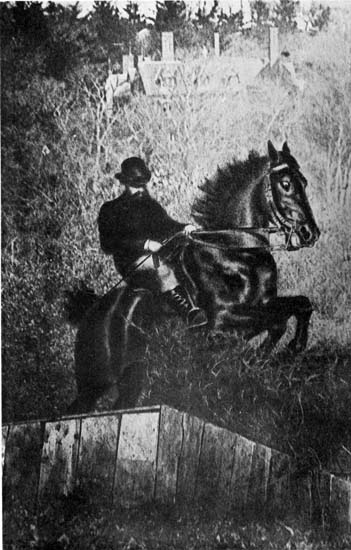
Plate VII. RISING AT A HURDLE.
Moreover, a hunter requires many weeks to be got into fine condition, and can then perform well not exceeding half a dozen days a month, and needs a long rest after the season. And it is not the average man who is happy enough to own a stable so full or to boast such ample leisure as to tax his horseflesh to so very slight an extent.
XXI.
But what is that, Patroclus? Up goes your head, your lively ears pricked out, with an inquisitive low-voiced whinny. What is it you sniff upon the softly-moving air? Well, well, I know. That neigh and again a neigh betrays you. As sure as fate it is one of your stable-mates coming along the road. Perhaps our young friend Tom, upon his new purchase, Penelope. We will go and see, at all events. I never found you wrong, and I never knew your delicate nose to fail to sniff a friend before the eye could catch him, or your pleasant whinny fail to speak what you had guessed as well. Sure enough, there he comes and Nell has heard you too. Both Tom and she are out for the lesson which either gives the other. Now for a sociable tramp and chat in the company you like so well. And you and I will try to give Penelope and Master Tom a few hints which he has often asked, and of which all young horses and riders are apt to stand in need.
XXII.
Good-morrow, Tom, and how are you, sleek Nelly? A fine day this for a tramp. Patroclus sniffed you a long way off, and now is happy to rub his nose on Nelly's neck, while she, forsooth, much as she likes the delicate attention, lays back her ears with a touch-me-not expression characteristic of the high-bred of her sex. A lucky dog are you to throw your leg across such a dainty bit of blood!
You, Tom, are one of numberless young men who want to learn that which they have not the patience to study out of technical books and will hardly acquire in a riding-school; who, in other words, rather than learn on tan-bark, have preferred to purchase a horse and teach themselves. A man may do well in a school or on a horse hired in a school, and yet not know how to begin the training of a horse which has been only broken in to drive, as most of our American colts are, however eager to improve him for the saddle. Let us compare notes as we saunter along the road.
Do not understand me to depreciate the value of riding-schools, nor the training which they inculcate. On the contrary, School-training carried far enough and properly given is just what I do advocate. But between the riding-school and School-riding, there is a great gulf fixed. The capital letter is advisedly used. A horse which has been given a good mouth, and has been taught as far as the volte and demi-volte, simple and reversed (though indeed the riding-school volte and the volte of the Haute Ecole are different things), certainly knows a fairish amount, and may be able to teach his rider much of what he knows. But riding in a school is not road-riding, although a school-horse may have profited well by his education. Leaping a school hurdle is not riding to hounds. A thoroughly good riding-school horse may be a very brute when in the park. Perfect manners within four walls may disappear so soon as the horse gets a clear mile ahead of him. Assuredly, it is well enough to learn the rudiments at a good riding-school. But if you ever want to become a thorough horseman and have equally good horses, study the art for yourself,—there is no mystery about it,—and learn what a horse should know and how to teach him. When you have done this, you will have a satisfactory saddle beast. If you expect a groom or a riding-school master to train your horses for you, you will not have a perfect mouth or good manners once in a hundred times. If the master is expert, he will be too busy to do your horses full justice short of an exorbitant honorarium. The groom is, as a rule, both ignorant and impatient, if not brutal.