Volume 1 / Book 9 — APPENDICES
Jessie L. (Jessie Laidlay) Weston translation
APPENDIX A THE ANGEVIN ALLUSIONS OF THE 'PARZIVAL'
One of the most striking peculiarities of this version of the Perceval legend consists in the fact that the writer closely connects his hero with a contemporary princely house, and exercises considerable ingenuity in constructing a genealogy which shall establish a relationship alike with the legendary British race of Pendragon, and with the hereditary House of Anjou. Now, that Parzival should be represented as connected with Arthur is not surprising, taking into consideration the great popularity of the Arthurian legends; the English 'Sir Percyvelle' makes the relationship even closer; there, Percyvelle is Arthur's nephew, his sister's son; but it is far more difficult to account for the Angevin connection. It has been suggested that the writer of Wolfram's French source was Walter Mapes, to whom another of the Grail romances the Queste is generally ascribed; and who, as is well known, was closely attached to the Court of Henry Fitz-Empress, Count of Anjou, and King of England. Setting on one side the great difference, in style and treatment, between the Parzival and the Queste, which render it impossible to believe that the same man could have treated the same legend from two such practically opposite points of view, a close examination of the Angevin allusions found in the Parzival reveals a correspondence between the characters and incidents of the poem, and the facts, real and traditional, of Angevin history, which seems to point to a familiarity with the subject scarcely likely to be possessed by a foreigner.
The following parallels will show that this Angevin element, though strongest in the first two books (those peculiar to Wolfram's version), is to be clearly traced even in the presentment of what we know to be traditional features of the story.
THE ORIGIN OF THE HOUSE OF ANJOU
Wolfram Angevin Tradition
In Book I. the origin of the Angevin family is traced to the marriage of Mazadan with the fairy Terre-de-la-schoie. The fairy origin of the race is referred to again in Books II. and VIII., the later allusion being in connection with Vergulacht, son of Gamuret's sister, and cousin to hero. Ascribes their origin to the marriage of one of the early Counts with a lady of surpassing beauty, whose demon origin was discovered by her inability to remain in church during Mass. It was to the influence of this ancestress that the uncontrollable temper of the Angevin princes was ascribed. Richard Cur-de-lion is reported to have frequently said, 'We came from the Devil, and we go back to the Devil.' (In each instance it will be noted that the supernatural element is introduced by the wife.)
Gamuret Fulk V. OF Anjou
Younger son of the King of Anjou; brought up at the court of French queen; goes to the East where he marries a Moorish queen, and becomes king of an Eastern kingdom. Son of Fulk IV. (Rechin), and Bertalda de Montfort. His mother eloped with, and married, Philip, king of France. She remained on good terms with her former husband, and, Fulk, having already an heir by a previous wife, was allowed to bring up her son at her own court. The elder brother dying, Fulk became his father's heir, and finally succeeded him. In 1129, after the marriage of his son, Geoffrey, with the Empress Maud, Fulk was invited by Baldwin, king of Jerusalem, to become his son-in-law and successor. Accordingly he resigned Anjou to Geoffrey, went to Jerusalem, where he married Melesinda, daughter and heiress to Baldwin, and, after the death of the latter, succeeded him as king, and reigned till his death in 1142. (Here again we note that, in each instance, the Eastern kingdom is won through the wife.)
Gamuret's first recorded deed of valour is the conquest, in single combat, of Heuteger, the Scotchman, who appears every morning before the gates of Patelamunt, to challenge the besieged knights. A similar incident is recorded of Geoffrey I. (Grisegonelle) who, during the siege of Paris by the Danes in 978, overthrew a gigantic Northman named Ethelwulf, who daily challenged the besieged in the manner recounted in the poem. Later historians cast doubts on the truth of this story, but it appears in all the old chronicles, and was undoubtedly firmly believed in by the writers of the twelfth century.
Herzeleide The Empress Maude
Widow, queen of two kingdoms, and marries Prince of Anjou. Widow, Empress, Lady of two Lands, England and Normandy, marries Count of Anjou.
Her son is subsequently deprived of these kingdoms by the action of one knight, Book III. p. 73, two brothers, Ibid. p. 80. This loss of two kingdoms by the action of Lähelein is insisted on throughout the poem, and the reader should note the manner in which Lähelein, though only appearing in the Second Book, is constantly referred to; which seems to indicate that the writer attached a special importance to this character, cf. Book III. pp. 86 and 87; V. pp. 150, 154; VI. pp. 171, 188; VII. p. 196; IX. p. 272. (It may be noted that in no other version of the legend is a previous marriage of the hero's mother recorded.) Her son is deprived of these two kingdoms by the action of two brothers Theobald and Stephen of Blois. Though Stephen was the principal aggressor, it must not be forgotten that Theobald, the elder brother, was invited by the Normans to become their Duke on the death of Henry I.; but on arriving in Normandy, and finding that Stephen had already seized the crown of England, Theobald resigned his claim to the Duchy and threw in his lot with that of Stephen. An English writer (such as Mapes) would probably have overlooked the part played by Theobald. An Angevin, knowing the Counts of Blois to be the hereditary foes of the House of Anjou, would hardly fail to record the fact that both brothers were concerned in the usurpation of the rights of Henry Fitz-Empress.
The Red Knight The Red Knight
The Red Knight as represented in the poem, mounted before the gates of Nantes, in red armour, with red hair. This character is of course traditional, but the special presentment of it in the Parzival seems to be owing to Angevin influence. In 1048 William of Normandy, being at war with, Geoffrey II. of Anjou and besieging Domfront, sent him the following curious challenge: 'If the Count of Anjou attempts to bring victuals into Domfront he will find me awaiting him without the gates armed and mounted, bearing a red shield, and having a pennon on my spear wherewith to wipe his face.'
Red hair was a distinguishing characteristic of the Angevin Counts. Fulk I. derived his name of Rufus from this peculiarity, which was inherited by many of his descendants, among them Fulk V., his son Geoffrey Plantagenet, and his grandson Henry Fitz-Empress. The writer of the Parzival strongly insists on Ither's red hair.
Nantes Nantes
Nantes, throughout the poem, is always treated as Arthur's chief city. Karidöl is scarcely referred to, the Round Table is kept at Nantes, and in Book X. we are told that Arthur's palace was there. This is not the case in other versions of the story. The possession of the city of Nantes was a constant source of quarrel between the Counts of Anjou and their neighbours of Brittany. Time after time the former claimed the over-lordship of Nantes, which stood just beyond their frontier, and more than once they succeeded in making themselves masters of the coveted territory. To represent Nantes as Arthur's chief city, and Ither as claiming it, would be an alteration of the legend most natural in an Angevin writer.
Book IX. relates that Kiot sought for records of the Grail race in the chronicles of Britain, France, and Ireland, and found the history at last in the chronicle of Anjou. Britain, France, and Ireland were all brought into close connection under Henry Fitz-Empress, Count of Anjou, Duke of Normandy, and King of England, the husband of Eleanor of Provence and Aquitaine, who conquered Ireland in 1172.
The peculiar presentment of the Knights of the Grail as Templars (Templeisen), having their residence in a castle surrounded by a forest, recalls the fact that a close connection between the Order of Templars and the House of Anjou had existed for some time previous to the date of this poem, a tax for the benefit of the Order having been imposed on all his dominions by Fulk V. on his return from his first pilgrimage to Jerusalem in 1120. A community of Knights Templars was founded by Henry Fitz-Empress fifty years later at Vaubourg, in the forest of Roumare which became very famous. (The location of Monsalväsch in the Pyrenees hardly seems to accord with the indications of the poem, which make it only thirty-six hours' ride from Nantes.)
Finally, the name of the poet claimed by Wolfram as his authority, Kiot=Guiot=Guy, is distinctly Angevin, the hereditary Angevin princely names being Fulk, Geoffrey, and Guy.
GENEALOGICAL TABLE.
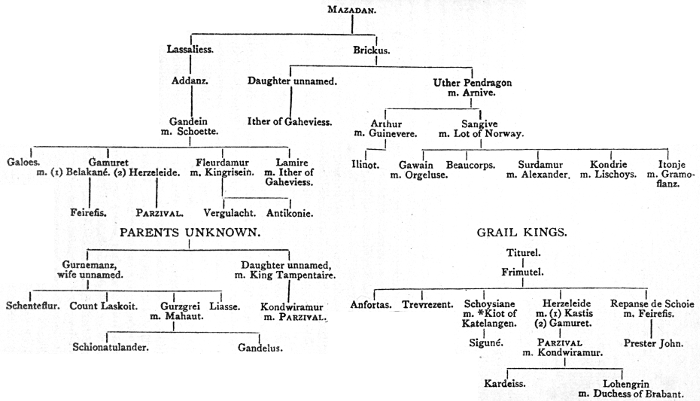
Mazadan. Lassalies. Addanz. Gandein m. Schoettè. Galoes. Gamuret m. (1) Belakané. Feirefis. Gamuret m. (2) Herzeleide. Parzival. Fleurdamur m. Kingrisein. Vergulacht. Antikonie. Lamire m. Ither of Gaheviess. Brickus. Daughter unnamed. Ither of Gaheviess. Uther Pendragon m. Arnivè. Arthur m. Guinevere. Ilinot. Sangivè m. Lot of Norway. Gawain m. Orgeluse. Beaucorps. Surdamour m. Alexander. Kondrie m. Lischois. Itonjè m. Gramoflanz. PARENTS UNKNOWN. Gurnemanz, wife unnamed. Schenteflur. Count Laskoit. Gurzgrei m. Mahaut. Schionatulander. Gandelus. Liassé. Daughter unnamed, m. King Tampentaire. Kondwiramur m. Parzival. GRAIL KINGS. Titurel. Frimutel. Anfortas. Trevrezent. Schoysiane m. [A]Kiot of Katelangen. Siguné. Herzeleide m. (1) Kastis. Herzeleide m. (2) Gamuret. Parzival m. Kondwiramur. Kardeiss. Lohengrin m. Duchess of Brabant. Repanse de Schoie m. Feirefis. Prester John.
APPENDIX B THE PROPER NAMES IN 'PARZIVAL'
One of the marked peculiarities of Wolfram's poem is the number of proper names with which it abounds, there being scarcely a character, however insignificant the rôle assigned, that is left unnamed. In the other versions of the Perceval legend this is not the case, consequently there are a vast number of names occurring in the Parzival to which no parallel can be found elsewhere, and which are no unimportant factor in determining the problem of the source from which Wolfram drew his poem. It would be impossible in a short Appendix to discuss the question in all its bearings, but the following classification, based on Herr Bartsch's article on Die Eigen-namen in Wolfram's Parzival, will give some idea of the wide ground they cover:—
I. Names belonging to the original legend, and met with, with but little variation, in all versions. To this class belong the names of Pendragon, Arthur, Guinivere, Perceval, Gawain, Kay, Segramor; and the names of such places as Karidöl=Carduel=Carlisle, Cumberland, Waleis, Norgals, Dianasdron.
II. Names derived from a French version of the story, which may be divided into two classes:
(a) Names of which we find an equivalent in existing French sources, notably Chrêtien, whose poem offers so close a parallel to the Parzival; examples of this class are Gurnemanz=French, Gornemant; Peirapär=Beau-repaire; Klamidé=Clamadex; Kingron=Aguigrenon; Trebuchet; Meljanz de Lys; Lippaut=Tiebaut; Gramoflanz=Guiromelans or Guiremelanz.
(b) Names formed by a misunderstanding of a French original: such are Soltane, from forest soutaine=solitary; Orilus de Lalande, from Li orgueillous de la lande; and similarly, Orgeluse of Logrois, from La orguelleuse de Logres; Gringuljet, the name of Gawain's horse, from Li gringalet, which is explained as meaning cheval maigre et alerte. Ligweiz-prelljus, is Li guez perellous, the Ford Perilous; and a notable instance of this class is the curious name Schionatulander, which is either 'Li joenet de la lande,' 'The youth of the meadow,' or 'Li joenet à l'alant,' 'The youth with the dog,' in allusion to the cause of the knight's death. Whence Wolfram took this name is unknown.
III. Names borrowed or quoted from other romances of the time, of those to which Wolfram alludes most frequently we know the Erec and Iwein of Hartmann von Aue; Eilhart's Tristan; Heinrich von Veldeck's Æneid, Chrêtien de Troye's Cligès, and Le Chevalier de la Charrette; and the Niebelungenlied and Dietrich Sage. He also refers to other romances which have not come down to us, such are the allusions to adventures connected with Gawain in Book VI.; and to the death of Ilinot, son of King Arthur, of whom we know nothing. (The names derived from these romances are all noted, and their source given as they occur in the text.) Book I. contains some distinctly German names, such as Eisenhart, Hernant, and Herlindè, Friedebrand of Scotland and Heuteger, the source of these is doubtful, some occur in the Gudrun cycle, but it seems probable that in both instances they were derived from a common source, and, belonging as they do to a North Sea cycle, they may have reached the poem either through a French or a German medium.
IV. Names of places and people connected with Wolfram himself, such as Abenberg, Wildberg, Erfurt, the Count of Wertheim, Herman of Thuringia, etc. These were, of course, introduced by Wolfram, and could not have existed in his French source.
V. Classical and mythological names such as Antikonie=Antigone, Ekuba, Secundilla, Plato and the Sibyls, Pythagoras, etc., Jupiter, Juno, Venus, Amor, Cupid, Lucifer, Ashtaroth, and other of the fallen angels.
VI. Oriental names. In Book IV. we have the Arabic names of the seven planets, a curious coincidence, in view of the alleged Arabic source of the Grail-myth as given in Books VIII. and IX. Names of cities such as Alexandria, Bagdad, Askalon. This latter is of course equivalent to Escavalon in the French versions, and the real name is doubtless Avalon, but it is by no means improbable that the change was made not by a misunderstanding, but by one who knew the Eastern city, and it falls in with the various other indications of crusading influence to be traced throughout the poem. We may add to these the names of Oriental materials such as Pfellel and Sendal. But when all these have been classified, there still remains a vast number of names undoubtedly French in origin, yet which cannot be referred to any known source, and many of which bear distinct traces of Romance or Provençal influence. Such names are Anfortas, French, enfertez=the sick man, with Prov. ending as; Trevrezent, Prov. Treu=peace, rezems=redeemed. Schoysiane, Prov. Jauziana, her husband is Kiot of Katelangen, Guiot=Guy of Catalonia. The son of Gurnemanz, Schenteflur, is Prov. gente-flors, fair flower. The name of Parzival's wife, Kondwiramur, Bartsch derives from Coin de voire amour, Ideal of true love; an interpretation which admirably expresses the union between the two. Itonjè, Gawain's sister, is the French Idonie, in Chrêtien she is Clarissant. The knight slain by Lähelein at Brimbane is Libbèals of Prienlaskors, Libbèals being simply the old French Li-beals—le bel, and probably no more a proper name than Orilus, whilst his country seems derived from Prov. priendre las cortz, to seek the court. The long lists of conquered kings given in Book XV. contain many names of Greek or Latin origin, which have passed through a French source, and many others of distinctly Romance form. It is impossible to suppose that a German poet invented these names, and the only reasonable explanation seems to be that Wolfram drew largely, if not exclusively, from a French poem now lost, and that the language in which that poem was written partook strongly of a Provençal character, the term Provençal being applied, as Bartsch points out, not only to Provençal proper, but to the varying forms of the Langue-d'oc.