WALTER HAMILTON, (continued 5)
Reading edition
The Fine Young English Gentleman. I’ll sing you a prime new song, That was made by a young chap’s pate, Of a fine young English gentleman, Who’d come to an estate; Who kept his hunters and his hounds At a d——d expensive rate. With servants gay, to drive away The poor folks from his gate; Like a fine young English gentleman, Born in the modern times. His study it was strew’d around With what?—Lord only knows! Foils, boxing-gloves, and pistols, Which he us’d with friends and foes: ’Twas there “the squire” took his wine And cigar whene’er he chose; Perusing the Court Journal, Or Blackwood’s tedious prose. Like a fine, &c. He was, when merry winter came, The gayest of them all; At five-and-twenty he was seen At ev’ry fancy ball. At each theatre—masquerade— This gentleman would call; And while he feasted with the great, He quite forgot the small. Like a fine, &c. But cash, alas! too soon takes flight, And sov’reigns roll away; And creditors, who have long bills, At last will call for “pay;” They came upon him tranquilly, And caught him out one day; “My cash is gone,” he cried, “so I Must in the Queen’s Bench lay.” Like a fine, &c. Now this he thought was better far Than all the old parade— Of taking tea in peace at home, Along with some old maid. It must be economical,— The bills were all unpaid; You cannot show me one, I know, Who does so much for trade As a fine, &c. Anonymous.
The Fast Young Undergraduate. I’ll sing you a modern song, that was writ by a man of late, Of an independent gentleman who had a small estate, And kept up his rooms in Trinity at a d——d expensive rate, And was always on the books of the porter at the gate, Like a fast young Undergraduate, all of the modern time. (Chorus)—Like a fast, &c. These rooms so fine were hung about with boxing-gloves and sticks, Wherewith when Town and Gown was cried, he floored the snobs like bricks; And there he often used to sit, and his gin-and-water mix, For he was also partial to the flooring of his lips. (Chorus)—Like a fast, &c. His custom was, when drunk, to go to Barnwell in a fly, With Poll and Kate to joke and flirt, and that continually. He was always getting into rows with the dons of Trinity. For he never went to chapel but of necessity. (Chorus)—Like a fast, &c. But terms and seasons roll along: an idle man was he— Examination came at last—he was plucked for his degree; And when he mounted on the coach to leave the ’Varsity, His creditors stood round about, a mournful sight to see. (Chorus)—For this fast, &c. But though this Undergraduate hath eloped and cut away, But though other Undergraduates have got no cash to pay, But though our credit may not be so boundless as before, We’ve tradesmen left who’ll credit give as they were wont of yore. (Chorus)—To other fast young Undergraduates, All of the modern time. From The Individual. Cambridge, November 29, 1836.
The Raal Ould Irish Gintleman, the Boy of the Olden Time. I’ll sing you a dacent song, that was made by a Paddy’s pate, 92 Of a raal ould Irish Gintleman who had a fine estate, Whose mansion, it was made of mud, wid thatch and all complate, With a hole at top thro’ which the smoke so graceful did retrate; Hurrah for the Irish Gintleman, the boy of the oulden time. His walls so cold were cover’d with the divil a thing for show, Except an ould shilaleh, which had knock’d down many a foe, And there ould Barney sits at ease, without a shoes or hose, And quaffs his noggin of potteen to warm his big red nose, Like a fine ould Irish Gintleman, the boy of the oulden time. At Donnybrook his custom was, to be at every fair, For tho’ he’d seen a threescore years, he still was young when there; And while the rich they feasted him, he oft among the poor, Would sing, and dance, and hurl, and fight, and make the spalpeens roar, Like a raal ould Irish Gintleman—the boy of the oulden time. But och! mavrone! once at a row, ould Barney got a knock, And one that kilt him—’case he couldn’t overget the shock; They laid him out so beautiful, and then set up a groan, Och! Barney, darlint, jewel dear, why did ye die? och hone! Then they wak’d this Irish Gintleman, the boy of the oulden time. Tho’ all things in their course must change, and seasons pass away, Yet Irish hearts of oulden time, were just as at this day. Each Irish boy he took a pride to prove himself a man— To serve a friend, and bate a foe, it always was the plan Of a raal ould Irish Gintleman, the boy of the oulden time.
The Old and New Cantab. There’s a fine old song for fine old gents, with fine old wine elate, Of a fine old, etcetera—the rest I needn’t state; And Punch unto that fine old air new-fashioned words would mate, Of the fine old Cantab as he was before this change of late— The fine old Cantab as he was, all in the olden time! His rooms their range of ballet-girls and running-horses showed, And a fox-brush, meant to indicate that up to hounds he rode; There at vingt-un or loo he’d sit, until the cocks they crowed, Nor ever thought of how to pay the various ticks he owed— This fine old Cantab as he was, all in the olden time! From Eton or from Harrow he came cramm’d with longs and shorts, An ambition to drive tandem, and a taste for fruity Ports; And his hardest work was playing, till he deafened half the Courts, Concertos on the cornet, in keys of different sorts— This fine old Cantab as he was, all in the olden time. As a Freshman he wore sober ties, and gave a Don the wall, But came out, his second year, in short coat and fancy shawl, And treated the authorities with no respect at all. Was seldom seen at lectures, and never dined in Hall— This fine old Cantab as he was, all in the olden time. So he managed to forget the trifling all he once did know, And by a very narrow shave got through his little-go, And then he took “a coach” with cram what brains he’d left to stow— Arithmetic to the Rule of Three, and some Algebra, also— This fine old Cantab as he was, all in the olden time. Thus, loo, larks, liquor, and late hours, made time and money fly, Till when three years brought on the Poll, he was plucked disgracefully, And his disgusted gov’rnor came and paid off, with a sigh, Ticks to a tune which nearly sucked the poor old pump quite dry, For his fine old Cantab of a son, one of the olden time. But times are changed henceforth, we know; for, from eighteen-forty-nine, The sons of Alma Mater must choose a different line; And if you try the Muses round, not a lady of the nine Out of whom he won’t be qualified with ease to take the shine— Our fine young Cantab that’s to be, all in the future time. For reading and not racing he’ll have to keep his book, He’ll blush at his own pink, and hang his tops upon the hook; And if e’er he use a cue, ’twill be for motion’s laws to look; And for milk punch he’ll drink his toast—and water from the brook— Our fine young Cantab that’s to be, all in the future time. He’ll put off the old Adam for the new one—Adam Smith; Political Economy will bring private, p’r’aps, therewith: At Ge— or else The—ology he’ll spend his pluck and pith, Tea and Theorems ousting loo and lush, which will be all a myth To our new Cantab that’s to be, all in the future time. Save for studying the pendulum, he’ll never try a tick; A novel definition he’ll invent for the word “brick;” Not one who braves the Proctor, or bargee can slang or lick, But who digs up Hebrew roots like beans, and knocks off Morals slick— Such our new Cantab is to be, all in the future time. Old Dons will shake their heads, no doubt, and the good old days deplore, When reading men were voted slow, and lectures all a bore; But still let’s hope that Cambridge will furnish, as of yore, All the wisdom of our ancestors, and perhaps a leetle more, To the fine new Cantab that’s to be, all in the future time! Punch. November 25, 1848.
93
The Fine Rich Jewish Nobleman. I’ll sing you a fine new song, that was penned by a Christian hand, Of a fine new Jewish Baron with a foreign name so grand, Whose money heaped around him was as plentiful as sand, So he said, “By the beard of my forefathers, for the City I will stand, Like a fine rich Jewish nobleman, One of a wealthy kind.” The Common-hall was crowded then with all the Christian’s foes, And the Lord Mayor came forward there the Baron to propose, Loud shouted many a Hebrew voice; and many a Hebrew nose It’s hook up-raised and Rothschild praised, the man the Hebrews chose. He was such a fine Jewish autocrat, One of a wealthy kind! When Manners came (a man whose name we all have heard before) And raised his voice, the Hebrew choice to negative once more, The Baron showed a wondrous zeal to help the voters poor, None seeking his Committee-room unpitied left the door, Of this fine rich Jewish millionaire, One of a wealthy kind. But gold, tho’ much, can’t all things do, and money’s power will fly— An English House of Lords again the Baron’s seat deny! He won’t resign quite tranquilly, and still again will try, But tho’ his City friends may howl, they know it’s “all my eye,” About this fine rich Jewish nobleman, One of a wealthy kind. But tho’ Free-trade our land may crush (to Cotton Lords the prey), Still Christian is the Commons House that doth old England sway; Tho’ Rome may thrive, and rank Dissent our Church assail to-day, Our Christian test no Jewish gold shall ever thrust away.[14] Not for this fine rich Jewish nobleman, One of a wealthy kind. From Protectionist Parodies, by a Tory. Oxford: J. Vincent. 1850.
The Fine Old English Innkeeper. I’ll sing you a new song on a theme much stirred of late, Of a fine old English Innkeeper, grown rather out of date, Who keeps up his establishment in almost princely state, And don’t forget to charge you there at quite a princely rate, Like a fine old English Innkeeper, one of the olden time. His house, you’re told, is fitted up “regardless of expense,” Although one half is obsolete, and t’other make pretence; Exploded old four-posters, built in George the Second’s reign, Mock plate to serve mock-turtle in, sham ice-pails for champagne; At this fine old English Innkeeper’s, one of the olden time. The swipes he draws is sour enough to turn a navvy pale, Tho’ by a bitter raillery he calls it bitter ale; And tho’ perhaps you don’t see half a waiter all the day, For “attendance” quite as much as for a lawyer’s you must pay To this fine old English Innkeeper, one of the olden time. Then if to wine your tastes incline some home-made Cape you’ll get, Served up in a decanter like a vinegar-cruet, As a “bottle of Madeira” this will in the bill be set, And however nasty it may be a nice sum you’re in debt, To the fine old English Innkeeper, one of the olden time. And if your wife be with you, you must have a private room, And use a pair “of wax-lights” (with a muttony perfume), For which you’ll pay a crown a day, and ’tis a burning shame That whether they be lit or not, they’re charged for just the same, By this rare old English Innkeeper, one of the olden time. But soon these fine old Innkeepers will find their race is run, For men are up and doing, and no longer will be done: And shortly we may hope to see a really good hotel Where we may be admitted, and not taken in as well, As we were by our old Innkeeper, one of the fleecing time. Punch. October 29, 1853.
The Fine Old Standard Tragedy. I’ll sing you a fine new song, tho’ it’s subject’s out of date, Of a fine old standard tragedy that was once pronounced first-rate, To which our great-great-grandmothers would go in all their state, And drag their time out drearily, for ’twas “legitimate,” Was this fine old standard tragedy, all of the olden time. This play so old was writ throughout in blank verse ’stead of prose, 94 And in blank terms the characters detailed their loves and woes; And there the audience sat it out, or took a quiet doze, And roused themselves up vig’rously to see the dismal close Of this fine old standard tragedy, all of the olden time. When winter brought the theatres that open’d house to all, Although one score and ten its scenes, through each they yet would bawl: Nor was the slightest interest e’er given to enthral, And, until five dull acts were o’er, the curtain would not fall, On this fine old standard tragedy, all of the olden time. But better taste must come at last, and such plays be put by, And empty houses soon proclaimed this tragedy must die; They gave it up right grudgingly, and not without a sigh, And found they must at last look round for sterling novelty, Instead of standard tragedies, all of the olden time. And surely this is better far when managers are made To shelve these tragedies that have of interest not a shade; And much more economical—for actors then are paid— Exchequers filled, and houses cramm’d, to see the dramas play’d, In place of standard tragedies, all of the olden time.
From Motley, by Cuthbert Bede. London: James Blackwood, 1855. (This Parody had previously appeared in Albert Smith’s Town and Country Miscellany.)
The Fine Old English Omnibus. I’ll sing you a new song at once, before it is too late, Of a fine old public vehicle, grown sadly out of date, Which, though a perfect nuisance in more ways than I can state, Is suffered in our thoroughfares still to perambulate. A fine old English Omnibus, one of the present time. Its windows old let in the cold whene’er the east wind blows, And drip by drip the wet admit, whene’er it rains or snows; But how to get them open without breaking no one knows, When with “12 inside” the atmosphere a little “stuffy” grows, In this fine old fusty Omnibus, one of the present time. Its cushions, when inspected in the light of other days, With the richest (cotton) velvet of a crimson hue did blaze; But now their threadbare covering’s a dingy brickdust red, And what was horsehair stuffing once now feels like lumps of lead, In this rare old English Omnibus one that is past its prime. Its seats so close together bring the sitters nose to nose, And everybody’s forced to tread on everybody’s toes, Whence cheerful conversation springs, especially from those Who’ve corns or gout, and glare about as though you’re mortal foes, In this nice old City Omnibus, just to beguile the time. Then if outside for air you’d ride, the clambering to your seat Would, if performed at Astley’s, be pronounced a “daring feat;” For ere you’re half-way up you hear them coolly cry “All right!” And then the “knife-board” cramps you so, with pain you can alight From this height of inconvenience, the subject of my rhyme. And then the cad who tends the ’bus—his virtues who may tell? How with his every breath there comes a fragrant beery smell: How when he’s bound for Brompton he’ll engage to put you down Within a “heasy walk” of any part of Camden Town, By his fine old English Omnibus, one of the present time. Nor should our praises be withheld from him who holds the reins, Who constantly is pulling up for furtive “little drains:” And ’specially on muddy days is rarely found to fail Of stopping in mid street to pick up passengers who hail This fine old English Omnibus: fun of the present time. Now months have rolled since we were told this fine old ’bus must die, That another and a cleanlier its place was to supply: Yet for that “good ’bus coming, boys,” all vainly still we sigh, And when we take our walks abroad that nuisance we espy— The fine old English Omnibus: blot on the present time. Punch. November 22, 1856.
The Fine Old British Subaltern. I’ll sing you a right good song, made by an honest pate, Of a fine old British Subaltern, whose pay was his estate, And who grumbled at the service at a beautiful rate, Because for his promotion he was made so long to wait, This fine old British Subaltern, born in the olden time. His room, so small, was hung around with many a map and plan, Of sieges, storms, and battles, he had fought both boy and man, And every regulation sword worn since the world began, And dresses of the nations of Bengal and Astracan. This fine old, &c. His room was open to a few each night when mess was o’er. To those who’d laugh at his old jokes he’d never close his door, And none of his old favourites e’er voted him a bore, But kindly laughed at tales they’d heard a thousand times before, From this fine old, &c. And every year to town he went to state his wretched case, And to Lord Fitzroy’s lévee never failed to show his face; And though he gets some promises, and time wears on apace, Still, still his name’s reposing in it’s old accustomed place, This fine old, &c. 95 Then let us hope this fine old sub will be promoted yet, Though in these days a company’s no easy thing to get; Yet we will hope that by ill-luck he’ll cease to be beset, And look for his promotion in the very next Gazette, This fine old, &c. From Wiseheart’s New Comic Songster. Dublin. No date.
The Fine Young English Officer, (As he is to be,) I sing of one whom now that we’ve begun to educate, The House of Commons lately made the subject of debate: Whose qualities each Member vied with each to numerate, And what their fancy painted him I’ll now proceed to state; ’Tis the fine young English Officer, as he is to be—in time. His head so old on shoulders young with knowledge overflows, Acquaintance with all sciences and arts its stores disclose, All books and in all languages by heart almost he knows, And he’s able to write legibly, and what is more, compose: Like a wise young English Officer, the reason of my rhyme. Italian, French, and Spanish, and Dutch, high or low, he’ll speak, Count Troy-weight like a Trojan, tell the time of day in Greek; And if to serve in India he be a chosen man, he Will astonish all the natives in the choicest Hindostanee; Like a polyglot young officer, fit for the future time. Nor are his powers of body less than are those of his mind; Quick eye, strong arm, and foot so fleet as ne’er to lag behind; Good lungs, and constitution such as no fatigue can feel, With iron nerves and sinews, and a heart as true as steel, Has this brave young English Officer, to serve us in his prime. A Centaur in his horsemanship, an Angelo to fence, In every manly pastime he makes way, nor makes pretence; From battle-fight to fisticuffs good generalship he proves. In glory’s race a winner, and a “wunner” with the gloves, Like the plucky British Officer, of past and present time. He can draw with equal credit an earthwork or a cheque, Keeps a spotless reputation, and accounts without a speck, Knows staff-duties and horseflesh, can out-bargain Greek or Jew, Has ready wit at his command, and ready money too: This accomplished English Officer, one of the coming time. Punch. August 22, 1857.
A Fytte of the Blues. Of woman’s rights and woman’s wrongs we’ve heard much talk of late, The first seem most extensive, and the latter very great; And Mrs. Ellis warns men, not themselves to agitate, For ’neath petticoats and pinafores is hid the future fate Of this wondrous nineteenth century, the youngest child of Time! The Turks they had a notion, fit alone for Turks and fools, That womankind has no more mind than horses or than mules; But this idea’s exploded quite, as to your cost you’ll find, If you intend to change or bend some stalwart female mind, In this Amazonian century, precocious child of Time. If by external signs you seek this strength of mind to trace, You’ll observe a very “powerful” expression in her face; The lady’s stockings will be blue, and inky be her hand, And her head quite full of something hard she doesn’t understand, Like a puzzle-pated Bluestocking, one of the modern time. And her dress will be peculiar both in fabric and in make, An artistic classic tragic highly-talented mistake; Which is what she calls “effective,” though I’d rather not express The effect produced on thoughtless minds by such a style of dress, When worn by some awful Bluestocking, one of the modern time. She’ll talk about statistics, and ask if you’re inclined To join the progress movement for development of mind. If you enquire what that means, she’ll frown and say ’tis best Such matter should be understood, but never be express’d, By a stern suggestive Bluestocking in this mystic modern time. She’ll converse upon aesthetics, and then refer to figures, And turn from angels bright and fair to sympathise with niggers, Whom she’ll style “our sable brethren,” and pretend are martyrs quite; And with Mrs. Harriet Beecher Stowe, she’ll swear that black is white, Like a trans-Atlantic Bluestocking, one of the modern time. She never makes a pudding, and she never makes a shirt, And if she’s got some little ones, they’re black and blue with dirt; When the wretched man her husband comes, though tired he may be, She’ll regenerate society instead of making tea, Like a real strong-minded Bluestocking, The plague of the modern time. Moral. The moral of my song is this, just leave all “ics” and “ologies” For men to exercise their brains, on platforms and in colleges; Let woman’s proud and honour’d place be still the fireside, And still man’s household deities, his mother and his bride, In this our nineteenth century, The favour’d child of Time. Frank E. Smedley. Gathered Leaves. London, Virtue Brothers, 1865.
(This parody originally appeared in Mirth and Metre.)
96
The Fine Old English Gentleman of the Present Time. I’ll sing you a fine old song, improved by a modern pate, Of a fine Old English Gentleman, who owns a large estate, But pays the labourers on it at a very shabby rate. Some seven shillings each a week for early work and late, Gives this fine Old English Gentleman, one of the present time. His hall so brave is hung around with pictures, all in rows, Of oxen that have gained the prize at agricultural shows, And pigs so fat that they can’t see an inch before their nose; For the whole of his attention on his cattle he bestows, Like a fine Old English Gentleman, one of the present time. In winter’s cold, when poor and old, for some assistance call, And come to beg a trifle at the portals of his hall, He refers them to the workhouse, that stands open wide for all; For this is how the parish great relieve the parish small, Like this fine Old English Gentleman, one of the present time. When any of his working men are bold enough to press For a trifle more of wages in a season of distress, He answers like a thorough-going man of business:— “Must I pay this or that for work which I could get for less?” Says the fine Old English Gentleman, one of the present time. But rolling years will onwards flow, and Time, alas! will fly, And one of these fine days this fine Old Gentleman will die! Ah! will he then bethink him as he heaves life’s last sigh, That he has done to others quite as he would be done by? As the true Old Englishman did all in the olden time. Anonymous.
The Fine Young London Gentleman. I’ll sing you a fine new song all about a fine young spark, Who’s a fine Young London Gentleman quite up to any lark; Who takes supper very early, and breakfasts in the dark; Who’s a real “dear old chappie,” as I needn’t p’raps remark, Of a fine Young London Gentleman, Quite of the present style. He’ll bet in “monkeys,” “ponies,” though he has seldom ready cash; If his Tailor isn’t paid, yet he has rings and pins to flash; At his fav’rite burlesque theatre he’s known as “such a Mash,” When to a fifth-rate Actress he bouquets down will dash, Like a fine Young London Gentleman, Quite of the present style. He round the corner hurries when the sparkling piece is o’er, To see his favourite Beauties coming out by the stage-door; He will jostle with his fellows to obtain a smile—nay, more, To simply stare at her he’s seen some hundred times before, Like a fine Young London Gentleman, Quite of the present style. He will hie him off to Hurlingham to join the dove battue; He will “plank his pieces” down to join in battle with the Jew; He will seek the same antagonist his “paper” to renew, When he’s had the bank at baccarat, or “lost the quids” at loo, Like a fine Young London Gentleman, Quite of the present style. He will say that port and sherry his nice palate always cloy; He’ll drink nothing but “B. and S.” and big magnums of “the Boy;” He’s the darling of the Barmaid, and the honest Waiter’s joy, As he quaffs his Pommery “extra sec,” his “Giesler;” or “Irroy,” Like a fine Young London Gentleman, Quite of the present style. On a Racecourse he imagines that he knows what he is at, He talks so scornfully of “mugs,” and says he knows a “flat;” So wisely speaks of “roping,” and he always “smells a rat,” But it very often happens that he’s put “into a hat,” Is this fine Young London Gentleman, Quite of the present style. But there comes a time when barmaids and when theatres are no go, When the “Boy” is voted nasty, and burlesques considered slow, When ev’rything too stale is, and when life has lost its flow, And the spirits once so high become dull, sluggish, bad, and low, Of the fine Young London Gentleman, Quite of the present style. Then he recognises sadly there are others come, like he, To make merry with the “fizz,” and likewise quaff the “S. and B.” He is growing old and weary, having just turned twenty-three, Existence is so tedious, all “life” a vast ennui To the fine young London gentleman, Quite of the present style. Punch. February 11, 1882.
A Fine Old English General. I’ll sing you a good old song, That was made by a good old pate, Of a fine old English General, Of a very modern date, Who helped to keep his country In a fit defensive state, And every quarter drew his pay At a bountiful old rate— Like a fine old English General, One of the modern time! How Horatio kept the bridge In the good old times you’ve read; But this fine old English General He kept, as a rule, his bed; For he suffered from obeseness. And had swimming in his head; Whilst the gout, like an active foeman, About his body fled— This fine old English General, &c. 97 But like a brave old warrior, Prepared to do and dare, This fine old English General, Kept ready his Bath-chair; That if the foe should threaten, He to the front might fare, And with limbs swathed in flannel, The victory he might share— This brave old English General, &c. He’d never been in actual fight, But had in fun fought hard; And right through many a desperate night At the Bank had he kept guard; Whilst many a day had he “relieved” In St. James’s Palace Yard; And once on duty in the streets Was wounded by a shard— This brave old English General, &c. But though in no campaign he’s been, Of medals he’s a score; And every year that he can live His honours will be more; And should he reach four score and ten Still higher he will soar; For he will be Field-Marshal then, Before his life is o’er— This fine old English General, &c. Nor let the country mourn that she But one such General owns; She has a hundred at the least, That scarce can move their bones; A hundred gouty sons of Mars, Who, gulping down their groans, May from their beds command their troops Through patent Telephones— These fine old English Generals, &c. From Finis.
The Fine Old Atom-Molecule. (To be sung at all gatherings of advanced Sciolists and “Scientists”). We’ll sing you a grand new song, evolved from a ’cute young pate, Of a fine old Atom-Molecule of pre-historic date, In size infinitesimal in potencies though great, And self-formed for developing at a prodigious rate— Like a fine old Atom-Molecule, Of the young World’s proto-prime! In it slept all the forces in our cosmos that run rife, To stir Creation’s giants or its microscopic life; Harmonious in discord, and coöperant in strife, To this small cell committed, the World lived with his Wife— In this fine old Atom-Molecule, Of the young World’s proto-prime! In this autoplastic archetype of Protean protem lay All the humans Space has room for, or for whom Time makes a day, From the Sage whose words of wisdom Prince or Parliament obey, To the Parrots who but prattle, and the asses who but bray— So full was this Atom-Molecule, Of the young World’s proto-prime! All brute-life, from Lamb to Lion, from the Serpent to the Dove, All that pains the sense or pleases, all the heart can loathe or love, All instincts that drag downwards, all desires that upwards move, Were caged a “happy family” cheek-by-jowl and hand in glove, In this fine old Atom-Molecule, Of the young World’s proto-prime! In it Order grew from Chaos, Light out of Darkness shined, Design sprang up by Accident, Law’s rule from Hazard blind, The Soul-less Soul evolving—against, not after, kind— As the Life-less Life developed, and the Mind-less ripened Mind, In this fine old Atom-Molecule, Of the young World’s proto-prime! Then bow down, Mind, to Matter; from brain-fibre, Will, withdraw; Fall Man’s heart to cell Ascidian, sink Man’s hand to Monkey’s paw; And bend the knee to Protoplast in philosophic awe— Both Creator and Created, at once work and source of Law, And our Lord be the Atom-Molecule, Of the young World’s proto-prime! Anonymous.
On Sir Stafford Northcote. Yes, I’ll sing you a good old song that, alas, seems out of date, Of a fine old English statesman who for long had served the State, And a sterling reputation had been able to create For his courtesy and honour and strict fairness in debate, Like a fine Old English Gentleman, One of the good old kind. He never stooped to treachery, nor can he comprehend, How politicians can to tricks and throwing mud descend. Nor will he principle forsake nor sacrifice a friend, Though he is ready to the last his party to defend, Like a fine Old English Statesman, One of the good old times! Truth Christmas Number, 1885.
The Grand Old Man. I’ll sing to you a brave new song, about the Grand Old Man, Whose tongue and pen are ever found to forward freedom’s plan, Who in the march of liberty has always led the van, And ever stretched his strong right hand to help his fellow man This brave, true-hearted, Grand Old Man, Who stands up for the right. This Grand Old Man wears on his brow no coronet of gold, He does not claim a long descent from titled rogues of old, He owns no broad domains for which he hath his country sold, But looks the whole world in the face, for honour makes him bold— This brave, true-hearted, Grand Old Man, Plain Gladstone is his name. 98 In times gone by this Grand Old Man the cause of Free Trade led, With Bright and Cobden he has helped to give the poor man bread, And in dark homes of poverty, the light of plenty shed, And little children bless his name, for he their lips hath fed— This brave, true-hearted, Grand Old Man, Who pleads the people’s cause. The page of knowledge to the poor had never been unrolled, And poor men’s papers all were taxed to spare the rich man’s gold. But the Grand Old Man removed the ban with purpose brave and bold, And now we’ve schools—and papers too—and what we have we’ll hold— Thanks to the brave and Grand Old Man, Who is the poor man’s friend. The Grand Old Man with tongue of fire St. Stephen’s echoes woke, And wrong and cruelty stood ashamed whenever Gladstone spoke, And as his strong and brave right hand could fell the noble oak, So cowards and tyrants toppled down beneath the sturdy stroke Of this brave, true-hearted Grand Old Man, Who fights in Freedom’s cause. With vision clear the Grand Old Man looked on Fair Erin’s Isle, And saw the land lie desolate for many a barren mile; He vowed he would our Sister save from force and fraud and guile, And Ireland’s hills and fertile vales should wear their ancient smile— So said the brave and Grand Old Man, Who is Green Ireland’s friend. Then weeping Ireland dried her tears, and took him at his word, She knew his cry of Justice! is far mightier than the sword; His plan it shall not fade and shrink like Prophet Jonah’s gourd, But triumph still till Briton’s sons are all of one accord With the bold and faithful Grand Old Man, Who’ll triumph in the end. Then Britons rally round his flag and aid him in the fight, Though foes and traitors show their teeth he does not fear their bite, For tyrant lords must hide their heads before the people’s might: Then vote for the good old Liberal cause, for Justice and the right, And for that brave and Grand Old Man Who pleads in Ireland’s name. J. F. B.
Published by the National Liberal Printing and Publishing Association, Limited. 1886.
An Oxford Parody. I’ll sing you a sporting song, for you all love well the chase, Of a gallant pack, and huntsman too, who go the fastest pace, He rides right bravely to his hounds, whatever be his steed And says “Let scent be ne’er so bad, this day the fox shall bleed,” Like a first-rate English fox-hunter, One of the present time. His room at home is hung around with emblems of his pride, With sporting prints and fox’s heads, which in good runs have died: Th’ Oxonians on hacks, in “teams,” do gladly gather here To view his hounds and horses, and to taste the hearty cheer, Of this first rate, &c. And when at break of early day he sallies to “the meet,” How well appointed! ain’t it, boys? how sportsmanlike! how neat! In Heythrop’s grassy avenue, a goodly sight, I ween, Is Redesdale’s lordly turn out, and the lads in Lincoln green! They’re first-rate English fox-hunters, Men of the present time. “The silent system” Jim forswears: how to his voice they run! See now they’re in the covert: look out, my boys, for fun! “The varmint” trembles as he hears the foe approaching nigh And hopes it is the ——[15] or else he sure must die For this first-rate, &c. List! list! Old Vanguard challenges: the pack in turn reply; And Jim’s “Hark forward!” now is heard as on they quickly fly: He leads the van on Spangle: next Jack[16] upon his mare; There’s neither wall nor water shall stop the gallant pair Of first-rate, &c. A check! a check! now freshman bold, “hold hard, Sir, if you please:” Just watch Jim’s clever casts, Sir, just watch his “busy bees:[17] He has it now! Right merrily “that sweetest music” rang; So press your steeds, my gallant lads, and catch him if you can— This first-rate English fox-hunter. One of the present time. And now the pace doth tell a tale: press on, ye happy few; ’Tis forty minutes racing speed—we run him now in view; His tongue hangs out, his brush lies low, whoop! he’s down, indeed! Dismount, ye joyous ones, dismount! and light the soothing weed, Ye first-rate English fox-hunters, Men of the present time. Thus, thus this gallant huntsman keeps up the merry game; His head, his heart, his hand, my boys, for ever are the same And a parting toast I’ll give you, with a ringing three times three, May Jim long hunt “the Heythrop” and we be there to see This first-rate English fox-hunter, One of the present time. From Hints to Freshmen in the University of Oxford. Oxford. J. Vincent. No date.
99
The Special Correspondent. I’ll sing you a good old song of the powerful Fourth Estate, Of a bold and reckless Special of the very latest date, Who is able countless horrors to in print accumulate, And will wire false news from anywhere at the usual cable rate. Chorus.—Like a Special Correspondent, all of the modern time! When on the war-path he proceeds and takes his daily rides, The enemy sends shots at him, and then in terror hides, As he clears whole batteries at once with the steed that he bestrides, And from a hissing shell a light for his cigarette provides. Chorus.—Does this Special Correspondent, all of the modern time! He knows not fear—’tis grand to see how he his nerves controls, As midst the grape and canister, he calmly caracoles, Whilst bullets in his pocket-book make inconvenient holes; And a well-pitched ball from out his hands the pencil often bowls. Chorus.—Of the Special Correspondent, all of the modern time! When incidents are dull or few, he’ll reckless lies invent, Or he’ll date his telegrams from towns to which he never went; To vilify a famous man he’ll readily consent, And will act on orders sent from home to any base extent. Chorus.—Will this Special Correspondent, all of the modern time! He loves to don a uniform and swagger with the best, And when no English are about wears medals on his chest; And for the news he cables home attention to arrest, That British troops are cowardly curs he glibly will suggest. Chorus.—Will this Special Correspondent, all of the modern time! He has an altogether strange and wondrous sense of sight, For he can see a brilliant moon upon a moonless night; And has been known the lowest types of passion to excite, By writing of a fabulous “Baboon and Potboy” fight.[18] Chorus.—Has this Special Correspondent, all of the modern time! “Untamed and ancient Savages” he also can espy, And many other curious sights—if no one else be nigh! But, if he should have company, why, then, his magic eye No longer non-existent moons and mortals can descry. Chorus.—For this Special Correspondent, all of the modern time! When brought to mix with gentlemen, he acts in such a way, That they are bound to rid themselves of him without delay; For he toadies to gain confidence, which straightway he’ll betray; And there’s no trick too mean for him to readily essay. Chorus.—This Special Correspondent, one of the modern time! In short, he’s arrogant and false; he gushes to excess, He makes his facts to suit the views his master may express; His self-conceit’s contemptible, so are his style and dress, And he’s brought already quite enough dishonour on the Press. Chorus.—Has the Special Correspondent, all of the modern time! Truth Christmas Number. 1882.
The Fine Young Agriculturist. The winter comes, as winter came some fifty years ago— Sometimes muggy, warm, and wet, and sometimes frost and snow; And, weather notwithstanding, comes the Christmas Cattle Show; But the modern English farmer our forefathers wouldn’t know, In the fine Young Agriculturist—one of the modern time. He don’t take days to travel up by daily coach and mail, And stop at roadside posting-houses, drinking rum and ale. Or waste his time to dine, and hear the landlord’s oft-told tale, But speeds at forty miles an hour to town express by rail. This fine Young Agriculturist, &c. In former days his dress was baggy sandy-coloured suits, A great top-coat, with pockets deep, knee-breeches and top-boots, And all his thoughts were how to grow the finest crops and roots, And all his talk of ripening corn and rearing Christmas brutes. Not the fine Young Agriculturist, &c. But now the modern farmer is a transformation quite— His coat made small, and cutaway—his trousers fitting tight. His Balmoralish patent leather button boots are light, A Champagne Charley glossy hat, curl’d brim, and small in height, On this fine Young Agriculturist, &c. The past young English farmer was so vulgar and ill-bred— A gross, fat, clumsy lump of human nature over-fed; His goggle-eyes were lustreless—his bacon chops all red, His hair hung coarse and shaggy all about his pumpkin-head. Not the fine Young Agriculturist, &c. But the modern English farmer, now, ’tis pretty well agreed, Is a very different person—of a very different breed; He comes up to the Cattle Show a gentleman indeed, And doesn’t lounge about the town, and drink, and overfeed. Not the fine Young Agriculturist, &c. He’s quite a genteel fellow, nothing “fast,” and nothing “flash”; Can very soon distinguish good amusements from the trash; His nature full of spirits, and his pocket full of cash, And he cultivates your friendship—and a very large moustache. Does this fine Young Agriculturist, &c. He talks to you of chemical manures—salts and phosphates, Discusses freely politics of home or foreign states; In science, too, is well read up to hold out long debates; Can play the “fancy” science, too, for punishing rogue’s pates. This fine Young Agriculturist, &c. 100 He’s not a Tony Lumpkin now, to muddle time away In public-house, or skittle-ground, and smoke the vulgar clay. But, having more refinement, can the game of billiards play, Or join the ladies on the lawn at love-making croquet. Can this nice Young Agriculturist, &c. Look round, too, at his Christmas stock—the same improvement own; No longer for a tallow show the Christmas cattle grown: No more beneath oppressive fat shall porkers lie and moan, But well-developed form and flesh, and very little bone. By this fine Young Agriculturist, &c. Now, isn’t this much better that the live-stock should be so, Than as seen by our grandfathers some fifty years ago? And may the price of butchers’ meat a great deal cheaper grow; Then success attend exhibitors, and the Christmas Cattle Show! And the fine Young Agriculturist, one of the modern time. From Banter, Edited by G. A. Sala. December 9, 1867.
The Romance of Kelly’s Post-office Directory. We hear of days long passed away, and glorious times of old, And how Young England’s sons affirm we’re getting dull and cold; But yet romance is not quite dead—in common daily life She still exists; of which great fact you’ll find examples rife In the Post-office Directory, all of the present year. The mighty minds of every age you’ll meet therein combined, John Milton, as a tea dealer, in Mary’bone you’ll find; And Isaac Walton in the East, has stores of pens and quills; And Hogarth trades in ham and beef, and Butler deals in pills, In the Post-office Directory, &c. (The Author continues to string notable names together in this style for six more verses.) In fact, there’s nought or nobody the keen compilers spare, And all we have immortalised are bona fide, there; Just turn to the last copy, and you’ll find them all forthwith, Unless you chance to lose yourself amongst the tribes of Smith, In Kelly’s last Directory, all of the present year. From A Pottle of Strawberries, by Albert Smith. 1848.
In the following notes, extracts are given from a few parodies which are not sufficiently amusing to be quoted in full.
An uninteresting political parody of the “The fine old English Gentleman” in eight verses, is contained in a small pamphlet entitled Blasts from Bradlaugh’s own Trumpet, published by Houlston and Sons, London, about 1883.
It commences thus:—
I sing a brand new song which may old faiths eradicate, About the B. whose buzzing has been heard so much of late, Whose craze it is to scheme to be Protector of the State, And thinks that being bulky is the same as being great, A much mistaken demagogue, Of the self-anointed line.
The Christmas number of The World for 1885 had a parody commencing,
“A good old English gentleman, all of the olden school, Is a person who our sympathy commands”
which dealt with political topics; whilst the very unpoetical subject of the Irish Land Acts was considered at great length, and in a rather heavy style, in a parody which appeared in Kottabos for 1881, over the signature M.
The Indefeasible Title. I’ll sing you all a song that was made by an honest pate, Of a fine old Irish gentleman, who mortgaged his estate To a bluff old English mortgagee, who swore he couldn’t wait, But would sell the lands at any price and at an early date, Like a business-like old Englishman, all of the olden time. * * * * * (Nine verses omitted.)
Kottabos was a small magazine issued from Trinity College, Dublin, and published by William McGee.
——:o:——
A PARODY BY CHARLES DICKENS.
The following parody, written by Charles Dickens, appeared in The Examiner for Saturday, August 7, 1841. Mr. Forster thus refers to it in his Life of Charles Dickens: “The last of these rhymes I will give entire. This has no touch of personal satire in it, and he would himself, for that reason, have least objected to its revival.” Thereupon Mr. Forster quotes seven only out of the eight stanzas he professes to give in full, omitting one which quite destroys his assertion that there was no personal satire in the parody. Mr. Forster was once described by a cabman as “that ’ere harbitrary cove;” to give a garbled quotation, and state that it is the entire poem is indeed an arbitrary act. The following is a complete reproduction of Mr. Dickens’s parody:—
The Fine Old English Gentleman. New version (to be said or sung at all Conservative Dinners.) I’ll sing you a new ballad, and I’ll warrant it first-rate, Of the days of that old gentleman who had that old estate; When they spent the public money at a bountiful old rate, On ev’ry mistress, pimp, and scamp, at ev’ry noble gate, In the fine old English Tory times; Soon may they come again! The good old laws were garnished well with gibbets, whips, and chains, With fine old English penalties, and fine old English pains, With rebel heads, and seas of blood, once hot in rebel veins; For all these things were requisite to guard the rich old gains, Of the fine old English Tory times; Soon may they come again! 101 This brave old code, like Argus, had a hundred watchful eyes, And ev’ry English peasant had his good old English spies, To tempt his starving discontent with fine old English lies, Then call the good old Yeomanry to stop his peevish cries, In the fine old English Tory times; Soon may they come again! The good old times for cutting throats, that cried out in their need, The good old times for hunting men who held their father’s creed, The good old times when William Pitt, as all good men agreed, Came down direct from Paradise at more than railroad speed. Oh, the fine old English Tory times; When will they come again? In those rare days, the press was seldom known to snarl or bark, But sweetly sang of men in power like any tuneful lark; Grave judges, too, to all their evil deeds were in the dark; And not a man in twenty score knew how to make his mark. Oh, the fine old English Tory times; Soon may they come again! (The following stanza was omitted by Mr. Forster.) Those were the days for taxes, and for war’s infernal din; For scarcity of bread, that fine old dowagers might win; For shutting men of letters up, through iron bars to grin, Because they didn’t think the Prince was altogether thin, In the fine old English Tory times; Soon may they come again! But Tolerance, though slow in flight, is strong-wing’d in the main; That night must come on these fine days, in course of time was plain; The pure old spirit struggled, but its struggles were in vain; A nation’s grip was on it, and it died in choking pain, With the fine old English Tory days, All of the olden time. The bright old day now dawns again; the cry runs through the land, In England there shall be—dear bread! in Ireland—sword and brand, And poverty and ignorance, shall swell the rich and grand, So, rally round the rulers with the gentle iron hand, Of the fine old English Tory days; Hail to the coming time!
The allusions contained in the sixth stanza require some explanation. In 1813 Leigh Hunt and his brother, as proprietors of The Examiner, were sentenced to undergo two years imprisonment, and each to pay a fine of five hundred pounds, for publishing an article in that paper containing the following remarks on the Prince Regent:—
“What person would imagine in reading these astounding eulogies in The Morning Post, that this ‘Glory of the people’ was the subject of millions of shrugs and reproaches! That this ‘Conqueror of Hearts’ was the disappointer of hopes! That this ‘Exciter of Desire’ (Bravo, Morning Post!), this ‘Adonis in Loveliness,’ was a corpulent man of fifty! In short, this delightful, blissful, wise, pleasureable, honourable, virtuous, true and immortal Prince was a violator of his word, a libertine over head and ears in disgrace, a despiser of domestic ties, the companion of gamblers and demireps, a man who has just closed half a century without one single claim on the gratitude of his country, or the respect of posterity.” The Hunts were informed that if they would undertake to abstain from commenting on the actions of the Prince Regent for the future the sentence would be remitted. They declined to give the required undertaking, but paid their fines, and went to prison. The severity of the sentence caused great delight to the friends of the Prince Regent, and Theodore Hook wrote the following apropos parody of Cowper’s poem on Alexander Selkirk:—
Verses. (Supposed to be written by the Editor of the Examiner, whilst in prison.) I am tenant of nine feet by four, My title no lawyer denies, From the ceiling quite down to the floor, I am lord of the spiders and flies. Oh, Justice! how awkward it is To be griped by thy terrible squad! I did but indulge in a quiz, And the Quorum have sent me to quod. Dear scandal is out of my reach, I must pass my dull mornings alone. Never hear Mr. Brougham make a speech, Nor get audience for one of my own! The people, provokingly quiet, My fate with indifference see: They are so unaccustomed to riot, Their tameness is shocking to me. Personality, libel, and lie, Ye supports of our Jacobite train, If I had but the courage to try, How soon I would sport you again! My ranklings I then might assuage By renewing my efforts to vex, By profaning the rev’rence of age, And attacking the weakness of sex. A libel! what treasure untold Resides in that dear little word, More rich than the silver and gold Which the Bank is reported to hoard! But the Bench have no bowels for pity, No stomach for high-season’d leaven, And though we be never so witty, They trim us when judgment is given. O ye, who were present in Court, In pity convey to me here Some well-manufactured report, Of a lady, a prince, or a peer. Do my writings continue to tell? Does the public attend to my lines? O say that my Newspapers sell Though the money must go for my fines! How fleet is the growth of a fib! The astonishing speed of its flight Outstrips the less mischievous squib Let off on a holiday night. Then who would not vamp up a fudge, “When he knows how it helps off his papers Were it not—that the thought of the judge Overcasts him, and gives him the vapours? 102 But Cobbett has got his discharge— The beast is let loose from his cover: Like him I shall yet be at large, When a couple of years shall be over. For law must our liberty give, Though Law for a while may retard it Even I shall obtain it, who live By sapping the bulwarks that guard it.
Severe as was the punishment inflicted on the Hunts it did not have a deterrent effect; indeed the trial was a political blunder, it gave enormous publicity to a libel which would otherwise have been seen by few, and have soon been forgotten; it offended many, who whilst having no sympathy with the Hunts, were still in favour of a free Press; and finally it encouraged the publication and sale of many other attacks upon the Prince Regent, and his friends. The most active and zealous purveyor of this kind of literature was William Hone, of Ludgate Hill, who published numerous pamphlets, leaflets, parodies and squibs; most of these were written by Hone himself, and illustrated by George Cruikshank. The Prince Regent’s personal appearance, his intemperance, his vanity, and his conduct towards his wife, were mercilessly exposed and ridiculed; whilst the actions of the ministry were also held up to public scorn and contempt.
Eventually the government took legal proceedings against Hone for publishing political parodies, namely, John Wilkes’s Catechism, the Political Litany, and the Sinecurist’s Creed.
There were three separate trials held in the Guildhall, London, on December 18, 19 and 20, 1817, and in each trial the Jury found a verdict of Not Guilty. Here, again, the government prosecutions defeated their own ends. Hone became the hero of the day, the martyr in the cause of the liberty of the Press; a large sum of money was raised for him by public subscription, and what was worse, the parodies were republished, and, owing to the publicity given to them by the trials, the sales were enormous. Even now these little pamphlets are eagerly sought after by collectors of literary curiosities, and of Cruikshankiana, especially those relating to the Prince Regent and his illtreated wife. The most successful example of Hone’s skill was a parody entitled “The House that Jack built,” of which more than fifty editions were rapidly sold off. A few extracts will show the bitter tone of this parody; and Cruikshank’s portrait of the Dandy of Sixty was scarcely more complimentary than Leigh Hunt’s written description of the “fat Adonis of fifty.” The subjects of Cruikshank’s illustrations are given within parenthesis.
This is the House that Jack Built. (A Temple of Liberty.) This is the Wealth that lay in the House that Jack built. (Magna Charta, Habeas Corpus, Bill of Rights.) These are the Vermin that plunder the Wealth, that lay in the House that Jack built. (Court Official, Bishops, Lawyers, Army, Tax-collectors.) This is the Thing, that in spite of new Acts, And attempts to restrain it by Soldiers or Tax, Will poison the Vermin, that plunder the Wealth, That lay in the House, that Jack built. (A Printing Press.) This is the Public Informer, Who would put down the Thing, That in spite of new Acts, And attempts to restrain it by Soldiers or Tax, Will poison the Vermin, that plunder the Wealth, That lay in the House, that Jack built. (The Attorney General.) These are the Reasons of Lawless Power, That back the Public Informer, Who would put down the Thing, That in spite of new Acts, &c., &c. (A Gaoler, an Artilleryman, a Horse Guard, and a Grenadier.) This is The Man—all shaven and shorn, All cover’d with Orders—and all forlorn; The Dandy of Sixty, Who bows with a grace, And has taste in wigs, collars, cuirasses, and lace; Who, to tricksters and fools, leaves the State and its treasure, And, when Britain’s in tears, sails about at his pleasure, Who spurn’d from his presence the Friends of his youth, And now has not one who will tell him the truth; Who took to his counsels, in evil hour, The Friends to the Reasons of Lawless Power; That back the Public Informer Who would put down the Thing, That, in spite of New Acts, And attempts to restrain it, by Soldiers or Tax, Will poison the Vermin, That plunder the Wealth, That lay in the House that Jack Built. (A crowd of starving people.) These are the People All tattered and torn, Who curse the day wherein they were born, On account of taxation too great to be borne, And pray for relief, from night to morn: Who, in vain, Petition in every form, Who, peaceably meeting to ask for Reform, Were sabred by Yeomanry Cavalry, Who were thanked by The Man, All shaven and shorn, all covered with Orders And all forlorn; The Dandy of Sixty, Who bows with a grace, &c., &c. * * * * *
The Report of Hone’s three Trials is an interesting work, full of curious parodies, of which a detailed account will be given in the Bibliographical Volume of this Collection. But for the present Leigh Hunt, William Hone, George Cruikshank, and George, Regent, and King, must be dismissed, and Thackeray’s burlesque Epitaph will fitly close this chapter.
103
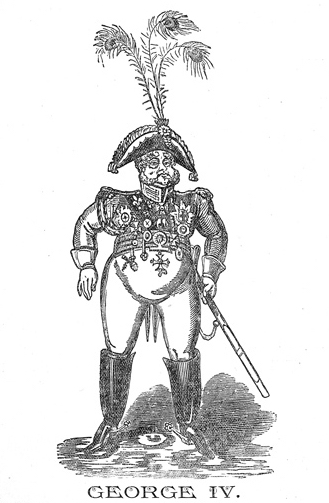
GEORGE IV. He never acted well, by man or woman. And was as false to his mistress as to his wife. He deserted his friends and his principles. He was so ignorant he could scarcely spell; But he had skill in cutting out coats, And an undeniable taste for cookery. He built the palaces of Brighton And of Buckingham, And for these qualities and proofs of genius, An admiring aristocracy Christened him the “First Gentleman in Europe.” Friends, respect the King whose statue is here, And the generous aristocracy who admired him. W. M. THACKERAY.
104
THE ROAST BEEF OF OLD ENGLAND.
When mighty Roast Beef was the Englishman’s food, It ennobled our hearts, and enriched our blood; Our soldiers were brave, and our courtiers were good. Oh! the Roast Beef of Old England, And, oh! for Old England’s Roast Beef! Then, Britons, from all nice dainties refrain, Which effeminate Italy, France, and Spain; And mighty roast beef shall command on the main. Oh! the Roast Beef, &c. But since we have learnt from effeminate France, To eat their ragouts, as well as to dance; We are fed up with nothing but vain complaisance, Oh! the Roast Beef, &c. Our fathers of old were robust, stout and strong, And kept open house, with good cheer all day long, Which made their plump tenants rejoice in this song,— Oh! the Roast Beef, &c. When good Queen Elizabeth sat on the throne, Ere coffee and tea and such slipslops were known; The world was in terror if e’en she did frown, Oh! the Roast Beef, &c. In those days, if fleets did presume on the main, They seldom or never returned back again, As witness the vaunting Armada of Spain. Oh! the Roast Beef, &c. Oh! then we had stomachs to eat and to fight. And when wrongs were cooking, to set ourselves right,— But now, we’re a—hum!—I could, but Good night, Oh! the Roast Beef, &c.
This song was first printed complete in Walsh’s “British Miscellany” about 1740. It was written and composed by Richard Leveridge, with the exception of the first two verses which were written by Henry Fielding, for a comedy entitled “Don Quixote in England.” This piece was acted at the New-Theatre in the Haymarket, 1733.
Kail-Brose o’ Auld Scotland. When our ancient forefathers agreed wi’ the laird For a piece o’gude ground to be a kail-yard, It was to the brose that they paid their regard: O! the kail-brose o’ auld Scotland, And O! the Scottish kail-brose. When Fergus, the first of our Kings, I suppose. At the head of his nobles, had vanquished our foes, Just before they began, they’d been feasting on brose, O! the Kail-brose, &c. Our sodgers were drest in their kilts and short hose, Wi’ their bonnets and belts, which their dress did compose, And a bag of oatmeal on their backs to be brose, O! the Kail-brose, &c. But now since the thistle is joined to the rose, And the English nae longer are counted our foes, We’ve lost a great deal o’our relish for brose. O! the Kail-brose &c. Yet each true-hearted Scotsman, by nature jocose, Likes always to feed on a cog o’ gude brose, And, thanks be to heaven, we’ve yet plenty of those. O! the Kail-brose, &c. Anonymous.
The Grocer’s Delight, or a Sugar Plum for Master Billy. When good George the Second did sit on the throne, A Pitt we could boast, and a Pitt of our own, A true Whig was he to the very back-bone. Oh, the true Whigs of old England, And oh, the Old English true Whigs. He went to the city to dine with the mayor, The King and the Queen, and the courtiers were there, The people huzza’d him, which made the King stare. Oh, the true Whigs, &c. The feast of the Grocers is not the same thing, His son, Master Billy, is all for the King, And therefore a different song we must sing Oh, the back-stairs of St. James’s, And oh, the St. James’s back-stairs. Billy bluster’d and vapour’d, and gave himself airs, He spoke for the people, and swore he was theirs, Till Jenkinson usher’d him up the back stairs. Oh, the back stairs, &c. Dundas is his counsel, and Thurlow his guide, The lords of the bed-chamber with him divide, The bishops, God mend’em, are all of his side. Oh, the back stairs, &c. He holds his head high and he talks very big, For the Commons of England he don’t care a fig; But the House of Lords swear he’s an excellent Whig. Oh, the poor Whigs of Old England! And oh, the poor Old English Whigs. Since the fortunate days of King William the Third, When Nassau to Stuart was wisely prefer’d, Such doctrines as these are, sure never were heard, By the staunch Whigs of Old England, By the Old English staunch Whigs. Then as Billy[19] stands up for Prerogative strong, If the Father was right, sure the Son must be wrong, So let every Englishman join in my song, Success to the Whigs of Old England! Success to the Old English Whigs! From The History of the Westminster Election, 1784.
Oh! the White Vests of Young England! Oh! the vests of Young England are perfectly white, And they’re cut very neatly and sit very tight; And they serve to distinguish our Young Englishmen From the juvenile Manners to Coningsby Ben; Sing, “Oh! the white vests of Young England, And Oh! the Young English white vests!” Now the Old English vest was some two yards about, For Old England was rather inclined to be stout; But the Young English waist is extremely compress’d, By the very close fit of the Young English vest. Sing, “Oh! &c.” 105 The Young English white vest, upon one little score, May perhaps be considered a bit of a bore, For it makes the resemblance exceedingly near ’Twixt the Young English Waiter and Young English Peer. Sing, “Oh! &c.” But what are the odds as concerning the vest, So long as felicity reigns in the breast? And Young England to wear what it pleases may claim, Let us hope all its tailors are paid for the same. Sing, “Oh! &c.” Punch 1844.
O! The Brown Beer of Old England. When humming brown beer was the Englishman’s taste, Our wives they were merry, our daughters were chaste; Their breath smelt like roses whenever embraced; O! the brown beer of old England, And, O! the Old English brown beer. Ere coffee and tea found their way to the town, Our ancestors by their own fire-sides sat down, Their bread it was white, and their beer it was brown. O! the brown beer &c. Our heroes of old, of whose conquests we boast, Could make a good meal of a pot and a toast; O! did we so now, we should soon rule the roast. O! the brown beer &c. When the great Spanish fleet on our coast did appear, Our sailors, each one, drank a jorum of beer And sent them away with a flea in their ear. O! the brown beer, &c. Our clergymen then took a cup of good beer; Ere they mounted the rostrum, their spirits to cheer; Then preached against vice, though courtiers were near. O! the brown beer, &c. Their doctrines were then authentic and bold, Well grounded on scripture and fathers of old But now they preach nothing but what they are told. O! the brown beer, &c. For since the geneva and strong ratafee, We are dwindled to nothing,—but stay—let me see Faith, nothing at all but mere fiddle-de-dee. O! the brown beer, &c. Anonymous. From The Universal Songster. Vol. III.
The Frog and the Bull. As once on a time a young frog, pert and vain, Beheld a large ox grazing on the wide plain, He boasted his size he could quickly attain. Oh, the Roast Beef of Old England, And O for Old England’s Roast Beef. Then eagerly stretching his weak little frame; Mamma, who stood by, like a cunning old dame. Cried, “Son, to attempt it you’re surely to blame,” Oh, the Roast Beef, &c. But, deaf to advice, he for glory did thirst, An effort he ventured more strong than the first, Till swelling and straining too hard made him burst. Oh, the Roast Beef, &c. Then Britons, be careful, the moral is clear; The ox is Old England, the frog is Monsieur, Whose threats and bravadoes we never need fear, While we have Roast Beef in Old England. Sing O for Old England’s Roast Beef. Anonymous.
The Boiled Beef of Old England. That mighty Roast Beef was the Englishman’s food, And spoon-meat the Frenchman’s was once understood, And mess-bugles at dinner-time still stir the blood, With “Oh, the Roast Beef of Old England, And Oh, for Old English Roast Beef.” Yes, “Oh, for Roast Beef,” well our soldiers may sigh, They may sniff it down areas, in cook-shops may eye; But save in that music, bid life-long good bye, To the famous Roast Beef of Old England, The mighty Old English Roast Beef. For as if we’d ta’en lesson from soup-stewing France, In our barracks Roast Beef is a dream of romance, And the man who enlists is condemned in advance, To sing, “Blow the Boiled Beef of Old England,” And “Blow that Old English Boiled Beef!” If against civil broils barrack-rules still must preach, And our troops rule the roast, but in figure of speech, Then surely we’re bound our mess-bugles to teach To play “Blow the Boiled Beef of Old England,” And “Blow the Old English Boiled Beef!” What’s the odds if at Bouilli the soldier looks blue? ’Tis the rule of the service, and can’t be broke through. Against roast, fry, or bake Colonel North in a stew Would cry, “Where’s the Boiled Beef of Old England, Oh, where’s the Old English Boiled Beef?” What with those leather collars, their throttles that lock, And those weary camp-kettles, their hunger that mock, Our poor British soldiers must surely hate stock, And sing, “Blow the Boiled Beef of Old England, Oh, Blow the Old English Boiled Beef!” With the shako that lets the rain into his neck, And the pack, pouch, and cross-belts, his breathing that check, And the barrack-room reeking like any slave-deck, Keep up the Boiled Beef of Old England. Keep up the Old English Boiled Beef. At huge cost let recruits still be drilled, dressed, and taught, To have them die off twice as fast as they ought, Let General Routine still set reason at nought, And sing, “Oh, the Boiled Beef of Old England,” And “Oh, the Old English Boiled Beef!” By all means let our soldiers be served, in the way, That famed Dr. Kitch’ner said cucumbers may, First dress ’em with care, and then throw them away, And sing, “Oh, the Boiled Beef of Old England,” And “Oh, the Old English Boiled Beef!” Punch. March 6, 1858.
106
The Pauper’s Chaunt.[20] O we’re very well fed, so we must not repine, Though turkey we’ve cut, and likewise the chine But, oh! once a year we should just like to dine On the Roast Beef of Old England, Oh, the Old English Roast-Beef. O, the gruel’s delicious, the taters divine— And our very small beer is uncommonly fine; But with us we think you would not like to dine, Without the Roast-Beef of Old England, Oh, the Old English Roast-Beef! Our soup’s very good, we really must own. But of what it is made arn’t very well-known; So, without any soup we would much rather dine On the Roast-Beef of Old England, Oh, the Old English Roast-Beef! Mince-pies they are nice, and plum-pudding is fine, But we’d give up them both for “ribs” or “Sir Line,” If for once in the year we could but just dine On the Roast-Beef of Old England, Oh, the Old English Roast-Beef! “Roast Beef and plum-pudding” is true Christmas fare, But they think that our morals such dainties won’t bear. Oh, oh! it is plain ne’er more shall we share In the Roast-Beef of Old England, Oh, the Old English Roast-Beef! From George Cruikshank’s Omnibus.
The Sirloin Superseded. Once mighty roast beef was the Englishman’s food. It has now grown so dear that ’tis nearly tabooed. But Australian beef, potted, is cheap and is good. O, the Boiled Beef of Australia! And O, the Australian Boiled Beef! It is capital cold; it is excellent hot; And, if a large number of children you’ve got, ’Twill greatly assist you in boiling the pot. O, the Boiled Beef, &c. First-rate is Australian mutton, likewise, For curries, and rissoles and puddings, and pies. The thrifty good housewife no butcher’s meat buys. O, the Boiled Beef, &c. It will make you a hash that is fit for a king. And the young ones all like it, and that’s a great thing. So Paterfamilias it causes to sing, O, the Boiled Beef, &c. For the small boys and girls eat the fat with the lean, Don’t leave underdone, but their plates nicely clean— Where pigs are not kept which helps make all serene. O, the Boiled Beef, &c. Australian meat from the bone being free, The more economical needs must it be. As there are no joints there’s no carving you see. O, the Boiled Beef, &c. The fleshpots of Egypt were once in high fame; Australian fleshpots have more than the same, Old England’s roast beef is now rivalled in name. O, the Boiled Beef, &c. The privileged victims who Income-tax pay, Whose earnings precarious are taken away, While ceasing to deal with a Butcher, can say O, the Boiled Beef, &c. ’Tis true that your servants, fastidious and fine, Australian meat in their folly decline. On skilligolee they hereafter may dine. O, the Boiled Beef, &c. Now pour out the wine which we could not afford Except for Antipodes’ meat on the board. Its inventors’ good health!—whilst my helping’s encored. O, the Boiled Beef, &c. Punch. August 24, 1872.
Stirring the Pudding, A Song for the Christmas Season. The National Padding all parties protest By themselves is best planned, and compounded the best, And each eager spoon wielder will stoutly aver All would turn out quite well had himself but a stir. At the glorious Plum-Padding of England, Old England’s unequalled Plum-Pudding! The Stirrers-in-Chief, who’ve their spoons in the pan, Have been stirring away on their own special plan For a tidy long time, and triumphantly say That no Season has shown, for this many a day, Such a splendid Plum-Pudding for England, Such a genuine English Plum-Padding! Well we know the old Saw about too many cooks; But a Saw is not always so sage as it looks; And a Pudding so big as John Bull’s may require All the hands and the spoons that toil on and ne’er tire Of stirring the Pudding of England, The mighty old English Plum-Pudding! The proof of the Pudding’s in eating, they say; And John Bull, who must eat it has likewise to pay; And so, at this season, let’s wish them success, And hope that among them they won’t make a mess Of the rare old Plum-Pudding of England, The old English Christmas Plum-Pudding! (Four verses omitted.) Punch. Dec. 27, 1879.
——:o:——
THE RED, WHITE, AND BLUE.
Oh, Britannia, the pride of the ocean, The home of the brave and the free, It is time that with zealous devotion, We saw to the Navy for thee. If tyrants thou still wouldst make tremble, Thou needest some armour-clads new, 107 Or else—it is vain to dissemble— It’s all up with the Red, White, and Blue. It’s all up with the Red, White, and Blue, It’s all up with the Red, White, and Blue; It is useless to longer dissemble, ’Tis all up with the Red, White, and Blue. Truth Christmas Number. 1884.
The Election. Great, great is the task set before us— Once more ’tis for us to decide The men who shall freely rule o’er us, And still by our bidding abide. Then choose we the leaders whose story Will ever bear telling anew, Whose work in the past is their glory, And stamps them as honest and true. Chorus. Then choose we the tried, wise, and true, Then seek we the tried, wise, and true; Let truth and consistency rule us, And choose we the tried, wise, and true. We know what the task is whose splendour Our country will light on its way, When Justice and Progress attend her, And class has forgotten its sway; When hope for the thousands who labour Is real in their toil-weary view— When right for each man and his neighbour Shall end in a union that’s true! J. Pratt. The Weekly Dispatch. October 25, 1885.
An American Imitation. Oh, Columbia, the gem of the ocean, The home of the brave and the free; The shrine of each patriot’s devotion, A world offers homage to thee. Thy mandates make heroes assemble, When liberty’s form stands in view; Thy banners make tyranny tremble, When borne by the red, white and blue. When borne by the red, white and blue. When borne by the red, white and blue, Thy banners make tyranny tremble, When borne by the red, white and blue. When war waged its wide desolation, And threatened our land to deform, The ark then of freedom’s foundation, Columbia rode safe through the storm. With her garland of victory o’er her, When so proudly she bore her bold crew, With her flag proudly floating before her, The boast of the red, white and blue. The wine cup, the wine cup bring hither, And fill you it up to the brim, May the memory of Washington ne’er wither, Nor the star of his glory grow dim. May the service united ne’er sever And each to our colors prove true: The army and navy forever, Three cheers for the red, white and blue. Three cheers for the red, white and blue, Three cheers for the red, white and blue, The army and navy forever, Three cheers for the red, white and blue.
——:o:——
THE ENGLISHMAN.
There’s a paper bears a well-known name, Though it is but a sorry lot; On the English journals’ scroll of fame It seems but a dirty blot. On the scribbling ones who by it live I’ll not waste word of song; Nor for all the ex-Q.C.[21] could give To that paper would I belong. It’s a scurrilous journal, deny it who can— A disgrace to the name of Englishman. From Faust and ’Phisto. 1876.
The Jingo-Englishman. (New Version of an old Song, adapted to the tastes of the Patriot of the Period.) There’s a Land that’s Cock of Creation’s walk, Though it is but a tiny isle, And to hear its brag, and its tall tall talk, Might make e’en Bombastes smile. It holds itself holiest, first in fight, Most brave, most wise, most strong, And will ne’er admit what it fancies right Can by any chance be wrong. ’Tis the pink of perfection, deny it who can, The Home of the Jingo Englishman! There’s a Flag that floats o’er every sea, And claims to control the brine; And if any dare hint that it makes too free, The result is a deuce of a shine. For the bouncing boys who walk the deck Deem the Ocean their own little lot, And if foreign fools at their pride should check, They will catch it exceedingly hot. Right-divine’s in its bunting, deny it who can, Is the Flag of the Jingo-Englishman! There’s a Heart that leaps with a generous glow A paying cause to defend, Lets interest rule it in fixing a foe, And profit in choosing a friend. It nurtures a deep and abiding love For possession of power and pelf, And deems that the duty all others above Is enshrined in that sweet word “self.” ’Tis a rare tough organ, deny it who can, The Heart of your Jingo-Englishman! The Briton may traverse the Pole or the Zone, And annex on sea or shore; He calls an immense domain his own, But he means going in for more. 108 Let the wandering stranger seek to know To what charter such “rights” are owed, And a flush will rise to the Briton’s brow As he answers—“You be blowed!” There’s no end of a pull, deny it who can, In the words, “I’m a Jingo-Englishman!” Punch. November 9, 1878.
The Chancery Court. There’s a place that bears a well-known name, Tho’ ’tis but a seedy spot; ’Tis the first in the blazing scroll of shame, And who dare say it is not? Of the big-wigged ones who shine and live On laws, on “Flats” and fees, The choicest the Devil to earth can give In this little spot one sees; For a gem in its way, as we’ve always been taught, Is that grand Institution—a Chancery Court. There’s a thing that’s a terror to every tongue, No matter when or where, And to treat that thing as a mere old song Is more than the richest dare. For the foolish spirits, who seek that Court, To its Vultures once fallen a prey, May struggle in vain to’ escape what they sought— They never can get away. ’Tis a gem in its way, spite of evil repute, No friend sticks so close as a Chancery suit. The Briton may traverse each legal port And pay, yet have something to spare; He may pass the “Insolvent Debtors’ Court,” And merge at the most nearly bare. But if once in a Chancery suit he’s caught, Though the world be all his own, In those hungry clutches, ’twill be as nought, And they’ll fight for his skin and bone. For a gem in its way, spite of evil report, Is the sacred shade of a Chancery Court. From Grins and Groans, Social and Political, (London, W. Swan Sonnenschein & Co.)
——:o:——
RULE BRITANNIA.
Robert Southey calls this “the political hymn of our Country,” and it may certainly be regarded as the British National Song. There has been some controversy as to its authorship, it is generally ascribed to James Thomson, author of “The Seasons,” whilst others have assigned it to David Mallet. The arguments are too lengthy to be reproduced here, but the chief points of the discussion are to be found in letters from Mr. William Chappell, and Mr. Julian Marshall, published in “Notes and Queries,” August 14, November 20, and December 18, 1886. Possibly both Thomson and Mallet joined in the composition of the ode (as they styled it), but this question can now never be authoritatively settled. No doubt exists however that the music was composed by Dr. Thomas Arne, and by it, and the chorus, Rule Britannia is known all the world over.
On the 1st August, 1740, a Masque styled Alfred, written by James Thomson and David Mallet, was performed in the gardens of Cliefdon House, in commemoration of the accession of George I., before the Prince and Princess of Wales. The plot of the Masque was based on the gallant struggles of King Alfred with the Danes, it abounded with patriotic allusions, and Rule Britannia was thus introduced in scene 5, Act 2.
“Here is seen the Ocean in prospect, and ships sailing along. Two boats land their crews. One Sailor sings the following ode; after which the rest join in a lively Dance.”
When Britain first, at Heaven’s command, Arose from out the azure main; This was the charter, the charter of the land, And guardian angels sung the strain; Rule, Britannia! Britannia rules the waves! Britons never will be slaves. The nations, not so blest as thee, Must in their turns to tyrants fall; While thou shalt flourish great and free, The dread and envy of them all. Rule, Britannia! &c. Still more majestic shalt thou rise, More dreadful from each foreign stroke; As the loud blast that rends the skies, Serves but to root thy native oak. Rule, Britannia! &c. Thee haughty tyrants ne’er shall tame: All their attempts to bend thee down Will but arouse thy generous flame— And work their woe, and thy renown. Rule, Britannia! &c. To thee belongs the rural reign: Thy cities shall with commerce shine; All thine shall be the subject main, And ev’ry shore it circles thine. Rule Britannia! &c. The Muses, still with freedom found, Shall to thy happy coasts repair, Blest isle! with matchless beauty crown’d, And manly hearts to guard the fair. Rule, Britannia! Britannia rule the waves! Britons never will be slaves.
Latin Version. Jubente cum primum Deo Britannia Pelagi cavis recessibus caput extulit, Ei in manus hæc charta magna tradita est, Cælestiumque omnis melos cæcinit chorus; Fluctus regas, domina regas Britannia; Nunquam Britannus imperanti serviet. Sua quamque gentium minus felicium Manet vicissim sors, jugum hostile: interim Tu, Nostra, pulcra, tu vigebis libera, Gens invidenda, gens timendaque omnibus. Fluctus, &c. 109 Per damna tu cædesque surges celsior, Ferrumque opes dabit peregrinum tibi: Procella ceu, quæ miscet æthera et salum, Novas tuis vires ministrat quercubus. Fluctus, &c. Non te tyrannus perdomabit insolens, Ut sæviat thronoque te dejectum eat: Virtus tua, acriore calcare incita, Illi ruinam, gloriam tibi pariet. Fluctus, &c. Ruris colonos imperia beant tua; Cives beant in urbibus commercia; Tibi æquor omne obtemperabit subditum, Et omne, cujus alluit litus, solum. Fluctus, &c. Camæna, Libertatis usque hæc est comes, Viset tuam, visamque amabit insulam; Felix nimis! nam filias armat Venus, Et filias qui protegant, Mars filios. Fluctus regas, domina regas Brittania; Nunquam Brittanus imperanti serviet. From Blackwood’s Magazine. April, 1819.
Election Song. When Canning’s name was first proclaim’d, Resounding Mersey’s strand along; A man for worth and talents fam’d, This was the Freemen’s fav’rite song: Hail great Statesman! the Statesman of our choice! We bid thee welcome and rejoice! The Candidates opposing thee, Must daily find their ardour cool; Whilst thou our pride shall surely be, Declar’d triumphant at the poll. Hail &c. Still as their friends assemble round, With energy our cause to gain; Thy foes shall sicken at the sound, To hear the Freeman’s fav’rite strain. Hail &c. Our commerce round the world shall flow, Surpassing any former time; To thee our native town shall owe, The right to trade to every clime. Hail, &c.
From An Impartial Collection of Addresses, Songs, Squibs, &c., published during the Liverpool Election, October 1812.
Rule Britannia. When Britain first, impell’d by pride, Usurp’d dominion o’er the main, Blest peace she vainly threw aside, And gave her sons the galling chain. View, Britannia, Britannia view the waves, On which thy darling sons are slaves. The nations now more blest than thee Shall see their haughty Despots fall, What time thy hapless fate shall be The scorn and pity of them all. View, Britannia, &c. Thy haughty Tyrants ne’er shall bend The glorious cause of Freedom down; Their rage shall fan the sacred flame, And work their woes and her renown. View, Britannia, &c. Thee best becomes the contrite strain, For cities drench’d with human gore, For crimes which tinge the orient main, And banish peace from Afric’s shore View, Britannia, &c. The Muses still with Freedom found, Shall from thy venal court repair, To sing on Gallia’s freer ground, Or breathe Columbia’s purer air. View, Britannia, &c.
From The Wreath of Freedom, or Patriot’s Song Book. Newcastle 1820.
A Corn Law Rhyme. When Freedom’s foes mock’d labours’ groan, And, drunk with power, contemn’d the throne, God bade great William rule the waves; And William scorn’d to govern slaves. Rule, great William, rule the free! William Britain’s shield will be! On their hard hearts they ground their words, And made them sharp as traitors’ swords, But cower’d, like dogs, beneath his eye, When millions shouted to the sky, Rule, great William, rule the free! William Freedom’s shield shall be! He broke his bonds o’er Rapine’s head; “Free men! Free bread!” great William said, And like a second Alfred stood, King of the happy and the good; While the free, from sea to sea, Sang, Great William rules the free! Ebenezer Elliott.
In this, Elliott’s wish was father to the thought, for William IV., did not live to see the repeal of the Corn Laws. Another long imitation of Rule Britannia, entitled “The Triumph of Reform,” also appears amongst the Corn Law Rhymes, which were collected and published by Benjamin Steill, London, in 1844.
Rule Slaveownia. (The National Hymn of the Confederate States.) When first the South, to fury fanned, Arose and broke the Union’s chain, This was the Charter, the Charter of the land, And Mr. Davis sang the strain: Rule Slaveownia, Slaveownia rules, and raves “Christians ever, ever, ever have had slaves.” The Northerns, not so blest as thee, At Aby Lincoln’s foot may fall, 110 While thou shalt flourish, shalt flourish fierce and free, The whip, that makes the Nigger bawl, Rule Slaveownia, Slaveownia rules, and raves “Christians ever, ever, ever should have slaves.” Thou, dully savage, shalt despise Each freeman’s argument, or joke: Each law that Congress, that Congress thought so wise, Serves but to light thy pipes for smoke. Rule Slaveownia, Slaveownia rules, and raves “Christians ever, ever, ever must have slaves.” And Trade, that knows no God but gold, Shall to thy pirate ports repair: Blest land, where flesh—where human flesh is sold, And manly arms may flog that air, Rule Slaveownia, Slaveownia rules, and raves “Christians ever, ever, ever shall have slaves.” Shirley Brooks, 1861.
Home-Rule Hibernia! When Faction at the De’il’s command Arose within the Em’rald Isle, This was the chorus through the land, And traitors sang it in this style: Home Rule, Hibernia! Britannia her rule waives! Britons ne’er shall make us slaves. The Scotchmen not so blest as thee, Put up with Richmond at Whitehall, Whilst thou, with flourish fierce and free, Wilt have Home Rule, or none at all. Home Rule, Hibernia! Britannia her rule waives! Britons ne’er shall make us slaves. Still more cantank’rous shalt thou rise More dreadful from each Parnell stroke, Till Commerce from the country flies, And all thy native banks are broke. Home Rule, Hibernia! Britannia her rule waives! Britons ne’er shall make us slaves. Thee haughty Viceroys ne’er shall tame, All their attempts to rub thee down Will but arouse the “pathriot’s” flame, And work their woe, but thy renown. Home Rule, Hibernia! Britannia her rule waives! Britons ne’er shall make us slaves. To thee belongs red Terror’s reign; Thy cities shall with arson shine; All thine be the shillelah’s bane, And every head it circles thine. Home Rule, Hibernia! Britannia her rule waives! Britons ne’er shall make us slaves. Thee Furies, oft in Erin found, To thy unhappy coast repair; Green Isle, with matchless folly crown’d. And hearts that blackguard all that’s fair. Home Rule, Hibernia! Britannia her rule waives! Britons ne’er shall make us slaves. Moonshine. January 2, 1886.
Imperium et Libertas. Competition Parodies in The World. First Prize. When Beaconsfield, at civic board, Uprose ’mid fellow-guests’ acclaim, This was the welcome London roared, Filling a bumper to his name— Hail, Imperial, Imperial Statesman, hail! Thy majority shall never, never fail! Let Gladstone boast of silver axe, And prate of upas-trees cut down; Thine be the care of income-tax, And thine be Turnerelli’s crown. So hail, &c. ‘Great Gladstone, less astute than we, From place and power defeated fell; I taught an Empire to be free, And grow Conservative as well. Then hail, Imperial freedom, hail! My majority shall never fail. Me dissolution ne’er shall shock, Midlothian voters ne’er dismay; The epigrams I have in stock Will serve me in the coming fray. Then hail, &c. “Libertas et Imperium,” My watchword and my battle-call, Will silence, when the elections come, The loudest varlet of them all. Then hail, &c. Still more secure shall be my lease Of Downing-street and county votes, Whilst licensed victuallers increase, And borough members turn their coats. So hail, &c. Here, when November days come round, Is happiness enough for me: Blest halls, where every bowl is crowned With calipash and calipee! Then hail, &c. So Truscott,[22] when the circling year Has withered all thy civic bays, Again I’ll sip my turtle here, And sing again an Empire’s praise. Then hail, &c.’ Common Pleas.
Second Prize. When on us burst, at thy command, A party legend once again, This was the cry throughout the land— At least the Liberals sang the strain— Fools! how can ye, how can ye trust such shaves? Jingoes ever will be knaves! The motto duly blessed by thee, Great Earl, and by thy Tory class, Runs ‘Government and Liberty’ (Imperium et Libertas). Fools, &c. * * * * * (Six stanzas omitted). Lindenfield. The World. December 3, 1879.
A so-called comic song, entitled “Brickbats never will be Slates,” was brought out about two years ago, but it possesses no literary interest as a parody.
111
GOD SAVE THE KING.
The most remarkable feature about “God save the King,” (or Queen) is the great uncertainty which exists as to its origin. There seems little doubt that the melody is German, but it is not known when, or by whom, it was imported, whilst the words have been handed down, with slight verbal alterations, since the days when James the First was congratulated on his escape from the Gunpowder Plot.
The words as they were then sung were written by Dr. John Bull, to whom some also ascribe the melody; Germans assert that it was imported into England by Handel, whilst others state that either Lulli, or Purcell, was the composer.
George Saville Carey claimed both the words and the melody as the productions of his father, Henry Carey (the author of “Sally in our Alley,”) and one hypothesis is, that no other song writer could have been guilty of such atrocious rhymes as are to be found in the anthem:
Victorious.| Laws.
Glorious.| Cause.
Over us.| Voice.
There is no doubt that Henry Carey had some part in settling the words, as they are now known, whilst as to the melody the most likely supposition is that he adopted German music in honour of the House of Brunswick, for the same air was at once the Royal Hymn for Prussia, Saxony, Weimar, Brunswick and Hanover; the German version known as “Heil Dir im Sieger Kranz” is still the official anthem of the German Empire. This theory is far more probable than are the various other conjectures as to its origin, such as that it was either a Scotch, French, or Jacobite Song. The grand simplicity of the air is almost sufficient proof of its German origin, and it is far more probable that it was introduced here with the Hanoverian dynasty than that an English melody should have been adopted as the Royal Hymn by nearly all the states of central Europe.
A good many years ago it was stated in Edinburgh that the manuscript memoirs of the Duchess of Perth contained an account of the establishment of St. Cyr, in which she stated that—“When the most Christian king Louis XIV entered the chapel, all the choir of noble damsels sung each time the following words, to a very fine air by the Sieur de Sully:—
Grand Dieu, sauvez le Roy! Grand Dieu, vengez le Roy Vive le Roy! Que toujours glorieux, Louis victorieux! Voye ses ennemis, Toujours soumis! Grand Dieu, sauvez le Roy! Grand Dieu, vengez le Roy! Vive le Roy!
The tradition is, that the composer Handel, obtained leave to copy the air and words, which he submitted to George the First as his own composition.”
The importation of the air of “God save the King,” appears undeniable, but it certainly did not come from France, neither is there anything to show that Handel passed it off as his own composition. Indeed in a court mainly composed of Germans, and before a German King, to whom the air must have been familiar from early childhood, such an attempt would have been ridiculous.
Many interesting facts bearing on these disputed questions will be found in an account of the National Anthem, entitled, “God save the King,” by Richard Clarke; London, W. Wright, Fleet Street, 1822; also in “Old National Airs,” by W. Chappell; “The Music of the Church,” by Thomas Hirst; and “An Introduction to the study of National Music,” by Carl Engel, London, 1866.
These authorities are not agreed as to the origin of the melody, but they all assert that words, somewhat similar to those now in use, were written to congratulate James the First on his escape from the Gunpowder Plot, and were sung for the first time at an entertainment given to that King in July 1607 in the Hall of the Merchant Tailors’ Company, in the City of London.