LXXVIII.
Reading edition
After Bergeret came Cluseret; after Cluseret, Rossel. But Rossel has just sent in his resignation. My idea is, that we take back Cluseret, that we may have Bergeret, and so on, unless we prefer to throw ourselves into the open arms of General Lullier. The choice of another general for the defence of Paris is however no business of mine; and the Commune, a sultan without a favourite, may throw his handkerchief if he pleases, to the tender Delescluze, as some say he has the intention—I have not the least objection. Why should not Delescluze[81] be an excellent general? He is a journalist, and what journalist does not know more about military matters than Napoleon I., or Von Moltke himself? In the meantime we are in mourning for our third War Delegate, and we shall no longer see Rossel on his dark bay, galloping between the Place Vendôme and the Fort Montrouge. He has just written the following letter to the members of the Commune:—
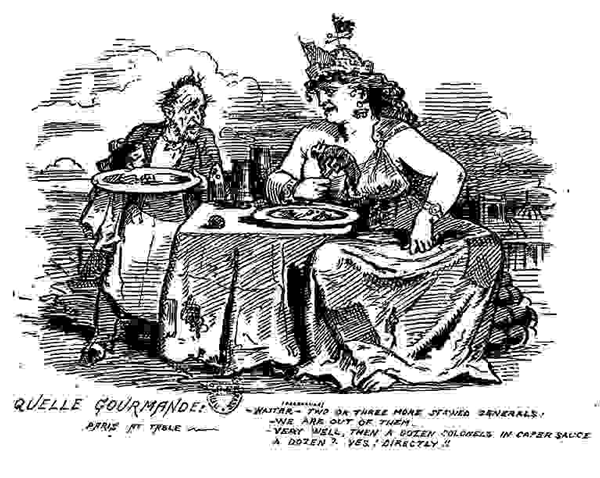
Quelle Gourmande! Paris at Table.
Waiter, two or three more stewed generals. —We are out of them. —Very well, then a dozen colonels in caper sauce. —A dozen? —Yes: directly!!
“CITIZENS, MEMBERS OF THE COMMUNE,—Having been charged by you with the War Department, I feel myself no longer capable of bearing the responsibility of a command wherein every one deliberates, and no one obeys. “When it was necessary to organise the artillery, the Central Committee of Artillery deliberated, but nothing was done. After a month’s revolution, that service is only carried on, thanks to the energy of a very small number of volunteers. “On my nomination to the Ministry, I wanted to further the search for arms, the requisition of horses, and the pursuit of refractory citizens; I asked help of the Commune. “The Commune deliberated, but passed no resolutions. “Later, the Central Committee came and offered its services to the War Department; I accepted them in the most decisive manner, and delivered up to its members all the documents I had concerning its organisation. Since then the Central Committee has been deliberating, and has done nothing. During this time the enemy multiplied its venturesome attacks on Fort Issy; had I had the smallest military force at my command, I would have punished them for it. “The garrison, badly commanded, took flight; the officers deliberated, and sent away from the fort Captain Dumont, an energetic man, who had been ordered to command them. Still deliberating, they evacuated the fort, after having stupidly talked of blowing it up,—as difficult a thing for them to do as to defend it. “Even that was not enough. Yesterday, when every one ought to have been at work or fighting, the chiefs were deliberating upon another system of organisation from that which I had adopted, so as to make up for their want of forethought and authority. The results of their council were a project, when we want men, and a declaration of principles, when we wanted acts. “My indignation brought them back to other thoughts, and they promised me for to-day the largest force they could possibly muster,—an organised one of not more than 12,000 men. With these I undertook to march on the enemy. These men were to muster at eleven o’clock: it is now one, and they are not ready, and the promised 12,000 has dwindled to about 7,000, which is not at all the same thing. “Thus, the utter uselessness of the artillery committee prevented the organization of the artillery; the hesitation of the Central Committee stopped all arrangements; the petty discussions of the officers, paralyses the concentration of the troops. “I am not a man to mind having recourse to violence. Yesterday, while the chiefs discussed, a company of men with loaded rifles awaited in the court. But I did not want to take upon myself the initiative of so energetic a measure, or draw upon myself the odium of such executions as would have been necessary to extricate obedience and victory from such a chaos. Even if I had been protected by the publicity of my acts, I need not have given up my position. “But the Commune has not had the courage to confront publicity. Twice I wished to give some necessary explanations, and twice, in spite of me, it insisted on a secret council. “My predecessor was wrong to remain in so absurd a position. “Enlightened by his example, and knowing that the strength of a revolutionary, only consists in the clearness of his position, I have only two alternatives, either to break the chains which impede my actions, or to retire. “I will not break the chains, because those chains are you, and your weakness,—I will not touch the sovereignty of the people. “I retire; and have the honour to beg for a cell at Mazas.
“ROSSEL.”[82]
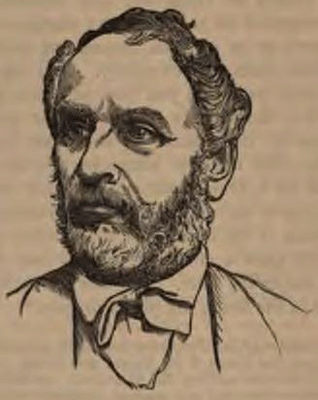
Delescluze, Delegate of War.[83]
Most certainly I do not like the Paris Commune, such as the men of the Hôtel de Ville understand it. Deceived at first by my own delusive hopes, I now am sure that we have nothing to expect from it but follies upon follies, crimes upon crimes. I hate it on account of the suppressed newspapers, of the imprisoned journalists, of the priests shut up at Mazas like assassins, of the nuns shut up at Saint-Lazare like courtesans; I hate it because it incites to the crime of civil war those who would have been ready to fight against the Prussians, but who do not wish to fight against Frenchmen; I hate it on account of the fathers of families sent to battle and to death; on account of our ruined ramparts, our dismantled forts, each stone of which as it falls wounds or destroys; on account of the widowed women and the orphaned children, all of whom they can never pension in spite of their decrees; I cannot pardon them the robbing of the banks, nor the money extorted from the railway companies, nor the loan-shares sold to a money-changer at Liège; I hate it on account of Clémence the spy, and Allix the madman. I am sorry to think that two or three intelligent men should be mixed up with it, and have to share in its fall. I hate it particularly on account of the just principles it at one time represented, and of the admirable and fruitful ideas of municipal independence, which it, was not able to carry out honestly, and which, because of the excesses that have been committed in their name, will have lost for ever, perhaps, all chance of triumphing. Still, great as is my horror of this parody of a government to which we have had to submit for nearly two months, I could not forbear a feeling of repulsion on reading the letter of Citizen Rossel. It is a capitally written letter, firm, concise, conclusive, differing entirely from the bombastic, unintelligible documents to which the Commune has accustomed us; and besides, it brings to light several details at which I rejoice, because it permits me to hope that the reign of our tyrants is nearly at an end. I am glad to hear that the Commune, if it possesses artillery, is short of artillerymen. It delights me to learn that they can only dispose of seven thousand combatants. I had feared that it would be enabled to kill a great many more; and as to what Citizen Rossel says of the committees and officers who deliberate but do not act, it is most pleasant news, for it convinces me, that the Commune has not the power to continue much longer a war, which can but result in the death of Paris; and yet I highly disapprove of the letter of Citizen Rossel, because it is on his part an act of treachery, and it is not for the friends and servants of the Commune to reveal its faults and to show up its weaknesses. Who obliged Rossel, commander of the staff, to take the place of his general, disgraced and imprisoned? Did he not accept willingly a position, the difficulties of which he had already recognised? He says himself that his predecessor was wrong to have stayed in so absurd a position, and why did he voluntarily put himself there, where he blamed another for remaining? If the new delegate hoped by his own cleverness to modify the position, he ought not, the position remaining the same, accuse anything but his own incapacity. In a word, the conclusion at which we arrive is, that he only accepted power to be able to throw it off with effect, like Cato, who only went to the public theatres for the purpose of fussily leaving the place, at the moment when the audience called the actors before the curtain. Not being able or perhaps willing to save the Commune, M. Rossel desired to save himself at its expense. There is something ungentlemanly in this. Do not, however, imagine for a moment that I believe in M. Rossel having been bought by M. Thiers. All those ridiculous stories of sums of money having been offered to the members of the Commune, are merely absurd inventions.[84] What do you think they say of Cluseret? That he was in the habit of taking his breakfast at the Café d’Orsay, and afterwards playing a game of dominoes. One day his adversary is reported to have said to him, “If you will deliver the fort of Montrouge to the Versaillais, I will give you two millions.” What fools people must be to believe such absurdities! Rossel has not sold himself, for the very good reason that nobody ever thought of buying him. It was his own idea to do what he did. For the pleasure of being insolent and showing his boldness, he has pulled down from its pedestal what he adored, consequently the most criminal among the members of the Commune, once a swindler, now a pilferer, is free to say to M. Rossel, who is, I am told, a man of intelligence and honesty, “You are worse than I am, for you have betrayed us!”
NOTES: