Front matter (continued 2)
Reading edition
Well, the next question was, how to get the gifts to her. Every boy and girl wanted to go and see her, and take his and her offering; but frail little Gertie was too weak for that; so they finally thought out the queerest plan. All the light, soft presents that could stand a bumping, and not make much noise, they resolved upon throwing down that basement window, one after another, as softly and quietly as it could be done! And the rest of the things? Oh, that is the nice part of the story! It was Celia Winters who said,—
"After all, girls, what good will the nice things do her, if she has to live in that dark old basement?"
"Yes, and if her father doesn't get some work to do?" chimed in Charlie Webster. He always agreed with Celia.
After that, the two had their heads together, talking a good deal, and no one could find out what they were going to throw down at Gertie, until at last they owned that, besides flowers from their own greenhouses, they were not going to give her anything but two pieces of paper!
But the papers! Celia's read that a cunning little house on Simmons street, with three rooms and a kitchen, had been rented for a year, and the Winters' carriage would be all ready to take her to her new home on Thanksgiving morning. (I forgot to say that it had been planned to give the shower the day before Thanksgiving, so that Gertie could have the whole of that day in which to be thankful.)
Charlie's paper was for Gertie to give to her father; it contained an invitation from his father to be foreman of a machine shop, at good wages, which were to commence on Thanksgiving morning; and pasted in a corner of the paper, folded down and bearing Gertie's name, was a gold dollar of Charlie's own.
What fun they had, those boys and girls! They talked it over afterwards, trying to decide whether they didn't have even a better time than Gertie. It was so nice to go softly to that basement window, one by one, and drop down a bundle right before Gertie's amazed eyes. At first they sent flowers, white ones, and they nearly spoiled the silence by a shout when they heard Gertie say,—
"Why, mother, it snows, right in here!" And then in the next breath, "Oh, mother, it snows 'flowers!'"
"Let it snow wool now!" said Rob Holden, and he popped down a great blanket at Gertie's feet.
It took a long time, and was the funniest frolic the young people ever had. Of course, it would have been much easier to have sent the things all to the nice new house, the rent of which Celia's mother had paid, and which the seventy other mothers had furnished; but then it wouldn't have been near so funny.
There is no use in my trying to tell you what Gertie and her mother said or did that afternoon. They were too astonished to do much besides look at one another and laugh; and as the great, soft, comfortable bundles kept dropping down, they looked at each other and cried. No, of course you can't see what there was to cry about; but if you had had such a hard time to get enough to eat and wear as this family had, you might have cried for joy.
But what could they do or say when Celia's and Charlie's papers dropped down on them, and were read and understood? Dear little Gertie! Let me tell you what she said. She clasped her two thin hands together, and looked up, not at the basement window, but above it, and murmured, "I think we must all have died, and gone to heaven!"
There ought to be a picture of that cunning little house into which they moved next day, to show you; everything that a neat little family of three could need, the seventy mothers—helped much by the seventy fathers—had put into it. Oh, I think you would like a picture of the handsome carriage and horses and coachman who came for Gertie on Thanksgiving morning, and took her to the little new house; or maybe a picture of the dray that followed her, piled high with the things that were showered down the window the night before; or maybe a picture of Gertie, in an easy-chair in front of the stove, in their bit of a dining-room, with a carpet on the floor, she with her feet on soft cushions, and soft cushions at her back, and a soft, bright shawl around her, eating a bit of Thanksgiving turkey.
Ah, I know you would like a picture of all the scholars of Room 42 who set this ball a rolling; but there were over seventy of them, and how could I show you their photographs? You must just imagine it all.
══════════
THE OTHER SINGER.
NO bracelets, nor necklaces had she; no white silk dress had she ever seen, and a common white muslin, even, she had never worn; she was barefooted, and though the morning was warm, she had wrapped an old shawl around her to hide the holes in her dress. A neat little girl was Mandy, or at least she would have been, if she had known how; she always washed her feet in the fast-running gutter puddles, after a hard rain, just because she liked to see them look clean; but she had no needle and thread at home, nor patches; and her work among the barrels, picking for rags, was not the cleanest in the world.
Yet on this afternoon, the very afternoon in which Miss Cecilia was getting ready for the concert, and frowning over her white silk, because the trail did not hang quite as she liked, did this little girl, Mandy give a concert. Her audience was an organ-grinder who stopped to rest a bit,—an old woman who was going by with a baby, and a little boy with a load of chips. The words she sang were:
"There is a fountain filled with blood, Drawn from Immanuel's veins."
And the chorus repeated as many times as did Miss Cecilia's. "I've been redeemed, I've been redeemed, I've been redeemed;" don't know "how" many times over; but what different words from Miss Cecilia's!
"Where did you get that?" asked the organ-grinder.
"What?" said Mandy, startled, and turning quickly.
"'That;' that you're singing."
"Oh, I got it to Sunday-school." And she rolled out the wonderful news, "I've been redeemed, I've been redeemed; been washed in the blood of the Lamb."
"I don't s'pose you understand what you're singing about?" said the organ-grinder.
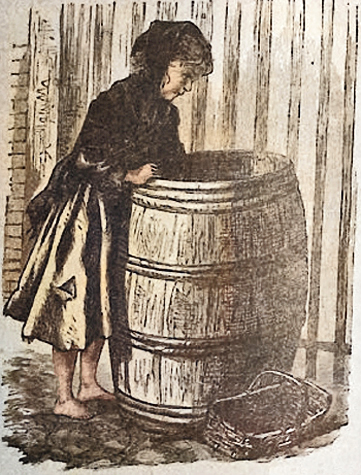
"Don't I, though," said Mandy, with an emphatic little nod of her head. "I know all about it, and it's all true. I belong to Him; he is going to make me clean inside, and dress me in white some day, to stay with him forever and ever. 'I've been redeemed, I've been redeemed,—been washed in the blood of the Lamb.'"
Away down the street, as far as the organ-grinder could hear, as he trudged on, there came back to him the faint sound of that chorus, "I've been redeemed."
Nobody threw bouquets to Mandy; nobody said she had a sweet voice.
But the organ-grinder kept saying the words over and over to himself; they were not new words to him. Years ago, his old mother used to sing those first ones, "There is a fountain." He had never heard the chorus before, but he knew it fitted; he knew all about it; his mother had taught him; and away back, when he was a little boy, a minister had said to him once, "My boy, you must be sure to find the fountain and get washed."
He never had. He was almost an old man; and it was years since he had thought about it; but Mandy's song brought it all back. Was that the end of it? Oh, no. The organ-grinder kept thinking, and thinking, and "thinking," until by-and-by, he resolved to do. He sought the fountain, and found it, and now, if he knew the tune, could sing, "I've been redeemed." Many a time he says the words over and over.
Is "that" the end? Oh dear, no. It will never end.
When Mandy and the organ-grinder stand up yonder, and she hears all about the song that she sung as she picked over rags, it will not, even then, be the end. Nothing ever ends.
NAILS.
BY REV. C. M. LIVINGSTON.
THEY drove nails through his hands, those very hands that had been so tenderly laid upon the heads of little children and left them a blessing; those dear hands that broke the bread which he had made for the thousand hungry people; those gentle hands that touched and opened the blind man's eyes; hands that were always spread in blessing upon some one.
Just think how much hard work those loving hands had done, and all for others. They never had been idle. They never had stolen one penny from any one; never had hurled a stone at any one, though bad people were often catching up stones to throw at him. They never had struck any one, though he was so tormented and insulted; and once shamefully struck in the face. Blessed, patient hands, yet there were people wicked enough to drive iron spikes through them.
What if they had been your own mother's hands, after she had carried you about so long, and fed you when you could not feed yourself; had done for you what a mother only can do for a helpless child; and her hands were "so" weary, and she was trying to get a little rest; then, what if a band of rough soldiers had come and seized her and put hand-cuffs upon her, and led her away to prison, and condemned her to die, and driven nails through the same hands that had given them bread to eat when they came to her door almost starved to death! But they nailed Jesus to a tree, and let him hang there till he suffered, and groaned, and died. No one pitied him, and took him down, and bound up the wounds.
They drove nails through his feet also. And what had those feet done to deserve such treatment? Had they carried him into a house to rob and kill? "The feet of the wicked are swift to shed innocent blood."
Not long ago, a man walked right up behind his neighbor, and shot him dead, because he hated him. Think you the feet of Jesus ever carried him on such an errand? Think you he ever trod upon a worm if he could help it? Why, he was walking about day and night, over the rough country of Judea, hunting up the sick and those in trouble, to comfort them. Yet they nailed his weary feet to the tree just as they had nailed his hands.
What if it had been said that Mary, who once bathed his feet with tears, and wiped them with her hair, and kissed them again and again; that this very Mary treated him like the others, striking him in the face and spitting upon him! Ah, you couldn't have believed it of her! She loved him too greatly for the wonderful love and mercy of Jesus to her. Ah, what great difference there was among the people in those times! Some loving the Redeemer so tenderly they were ready to die for him; while others could most cruelly put him to death on the cross.
And did you never think what one thing makes some people so cruel, whether they have ever so handsome a face, or ever so much money, or high a place in the world? What makes some fathers so cruel to their families, sometimes swearing fiercely at the little children, or striking the sick mother; sometimes even killing them all, and themselves too? May be you would hardly believe it if I should tell you what happened only a little way from here, some months ago; but dear me, you have only to read the papers to find just such things going on daily.
I hope you love the blessed Redeemer too tenderly ever to drive one painful nail into him. Know what I mean?
══════════
THE SPARROW IN THE SNOW.
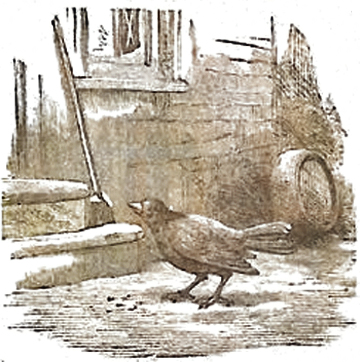
HE hopped down cheerily into the snow, Brave little barefoot Brownie— As if snow were the warmest thing below And as cosy as it is downy! And his brown, little, knowing, saucy head, In a way that was cutely funny, He jerked to one side, as though he said, "'I' don't care if it 'isn't' sunny. "I don't care! I don't care! I don't!" he said, And he winked with his eye so cheery, For somebody's left some crumbs of bread, So my prospects are not all dreary. "And what's a cold toe, when I've got a whole suit Of the cunningest warm, brown feathers? I don't care if I haven't a shoe to my foot; I am the bird, sir, for all sorts of weathers. "'I' don't fly away at the first touch of frost, Like some of your fine-tongued birdies; I 'don't' think everything's ruined and lost When the wind mutters threatening wordies. "I 'don't' care!" he chirped; "I don't care! I don't care! It might be a great deal colder: But I'm a fellow that knows no fear— Old Winter but makes me bolder!" Ah, plain, little, hardy, brown-coat bird! Through life I'll try to remember To meet its winters with cheerful word, Like thee to brave my December.—Youth's Companions.
TOT HIMSELF
THE BOY WHO WANTED TO BE A HERO.
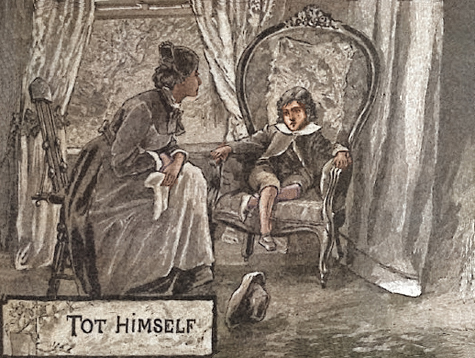
A VERY small hero, you think, I suppose? Yes, and weak and pale, and with feet that would not carry even his little body but a very few steps at a time. Perhaps that was one reason why he was so fond of reading about brave, daring boys. When his mother came in from her kitchen, or her garden, or her dairy, to have a little talk with him, he nearly always had a story to tell her about a hero.
"I've been reading about Robert Fulton," he said to her one day, his eyes shining. "Wasn't he splendid?"
"Was he?"
"Oh, yes, indeed! A queer boy, though, in school; he didn't like to study, and was real dull. Isn't that queer, mother, when he knew so much afterwards?"
"Rather," said mother. "I think he must have learned, like other people, to do some things that he didn't like; for he certainly studied hard when he was a man."
"Well, he didn't when he was a little fellow; and his teacher got real vexed at him one day, he was so dull, and gave him a knock on his hand with the ruler, saying he was determined to make him do something.
"And Robert said, 'Look here, I came to school to have something beat into my brains, and not into my hands.' Wasn't that sharp?"
"And saucy," said mother, laughing.
"Well, it's real fun to read about him. He began to invent when he was a little bit of a boy. Once he made a lead pencil, and it was such a good one that all the boys liked it; so he made one for each.
"But, O, mother, wouldn't you have liked to have seen that strange-looking little steamboat when it sailed up the Hudson? You see, nobody believed she would go! They laughed at Robert, and made fun of him, and said all sorts of sharp things about him. But one day in September a crowd came down to the wharf, and waited and watched. I can't help thinking, what if it hadn't moved when the right time came! I wonder what he would have done? Seems to me it would have killed me. But, you see, it did! O, then how they shouted! 'He' wasn't afraid; he knew it would go. Why, when he was only fourteen years old, he invented a way of paddling a boat instead of rowing it.
"He could do ever so many things. Did you know he was an artist? This book says his pictures were splendid, and he earned money by selling them,—lots of money. When he was only twenty-one, he had earned enough to buy a farm, and he bought it and gave it to his mother!
"I'll tell you another thing he did. Once there came a man to New York with a wonderful machine that he said would go of itself,—perpetual motion, you know, mother. Everybody who went to see it had to pay a dollar,—and hundreds and thousands went. For a long time Robert Fulton wouldn't go, though people coaxed him to; he said it was a humbug. At last he went, and he hadn't been standing by the strange machine but a few minutes when he said,—
"'Why this is a crank motion; somebody is turning a crank to make this machine go, and you are an impostor.'
"Then the man was angry; but all the people joined in, and begged Robert Fulton to find out about it, and the man didn't know how to refuse to let him examine it; so he knocked off a few pieces of lath, and found a string around a wheel, and that went back to another part of the machine that was all shut up, and inside of it was an old man turning a crank! Oh, mother, he was a genius and a hero! He was brave, and wise, and did so many grand things! Mother, if your poor little boy could do one 'little' thing to show that he was brave, wouldn't it be nice?"
"Very," said mother, with cheerful voice, pretending not to see the tears in her sick little boy's eyes. "I like heroes very much; I should like one fur a son. I was thinking about it last night. Suppose you make up your mind to be one?"
The little lame boy rubbed his eyes with the back of his hand, and looked eagerly at his mother. She never made sport of him, therefore she meant something. What was it?
"Do you see a way for me to be one?" he asked her, and he was so much in earnest that his voice trembled with excitement.
"Yes, indeed I do; I read about a way last night, and I thought it was so good that I copied it for you. The wisest man who ever lived gave this receipt." And mother took from her pocket a bit of paper on which was written these words:
"He that is slow to anger is better than the mighty; and he that ruleth his spirit than he that taketh a city."
══════════
RUFUS MAKES A POCKET MEASURE.
"NOW what is it all for? That is what 'I' should like to know. Here you have been working over that wonderful box every evening for a week. I believe you are a miser, and that box is to hoard up your treasures in."
Pretty Eva Trumbull fixed her roguish eyes on Rufus, the farmer boy, and waited to see what he would say.
They were very unlike,—those two. Eva was a city-bred young miss of thirteen. She had never been in the country before in her life, and here she was at her farmer uncle's, to spend the whole summer. She liked it all; everything was "great fun." One of the things which she like the best, was to dance around Rufus, the good, faithful boy, who worked for wages in the summer, and for his board and schooling in the winter, and whom everybody liked, because he was honest and earnest and faithful. And Eva liked to tease him, or to try to; he had too much good sense to be easily teased.
It was as she said. For several evenings he had been at work over a mysterious box. It was made of black walnut, carefully polished, and had ten compartments in it, divided by neat-fitting, thin highly-polished boards. It amused Eva very much to see how particular he was about the fit of each little board.
"Just tell me what it is for, before you go any farther; I'm almost dying of curiosity."
"If I were going to die of my own free will, I'd try to do it in a better cause," Rufus said, gravely. He was not so fashionable as Eva, and he did not understand many of the rules of etiquette, but his mother had brought him up not to use slang expressions which meant nothing.
"Why, I just as soon tell you about this box," he said, after a minute. "You'll laugh, of course; but I don't suppose that will hurt me."
"I won't laugh a bit, unless it is something funny."
"Well, it's a money box."
"A money box! I told you, you were going to be a miser."
"Well, I'm not," said Rufus, laughing. "I'm planning to spend it, not to keep it; but I like to be sort of systematic about things. You see, I know just about what I'm worth, now-a-days. There's about six months in the year that I am earning money; and, take it off and on, in one way and another I earn about sixty dollars, besides my hoard. Now it happens that there are ten things for which I need to spend that money, and as nearly as I can calculate, it might be equally divided between them. So thinking it all over, I concluded that the systematic way would be to have a box with ten compartments, all labelled, you know, and drop the money in a dollar at a time maybe, or ten cents at a time, just as I happen to be paid."
"That's a real nice idea," said Eva, admiringly; "but I can't imagine how you can have ten different things, for which you need to spend money regularly. Now I have a hundred different ways of spending money, but hardly any of them are regular." Here she gave one of her merriest laughs.
"Oh, well, it is different with me," explained Rufus. "You see, I don't know much about spending money for things I might happen to like to buy. I have to spend mine for the things that 'must' be bought anyhow; and so it's easier to calculate."
"Still," persisted Eva, "I don't know how you make ten."
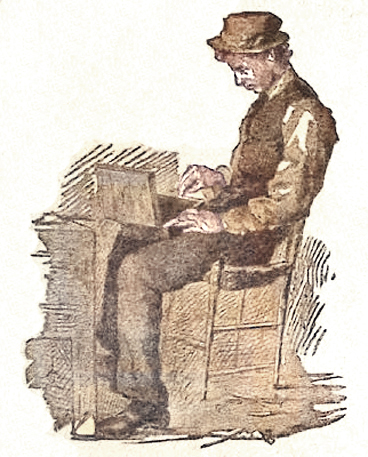
"Well, I'll tell you." There was a little flush on Rufus's face, but Eva looked so sober, and so interested, that he determined to trust her. "In the first place, there's mother; I shall paint her name on this first department, and one-tenth of everything I ever earn is to pop in there. Then there's clothes for me, they will take another tenth."
"A tenth for clothes! That will be only six dollars a year, Rufus Briggs! Do you mean to dress in birch bark, that you think you can make six dollars a year do it?"
"Well," said Rufus, in a determined tone, "when a fellow 'has' to, you know, why he 'has' to; besides, that's only for general clothes, I've got a department here for boots and shoes, and another for shirts, and if I have to borrow from one of those departments for the other, why it will do no harm."
But still Eva laughed; she knew that six, or twelve, or eighteen dollars in a year were of no account so far as clothes were concerned. Didn't 'she' wear clothes? She knew what they cost.
"They can't cost more than you've got to buy them with," Rufus said, firmly, and went on with his plan. "There are Mamie and Fannie, my two little sisters, I've given them each a department; of course mother will spend the money for them, but I kind of like to put it in their own names. Then here's the corner for books, I need school books, and paper, and pens, and all such things you know, but they must all come out of this general fund.
"Then here's the housekeeping; I have a corner for that, because mother must be helped, you know; that place where her name is, means for her own private use, and here's the rent corner; mother has hard times bringing that in every month; now you see, I've got nine, and I haven't looked out for sickness at all; that troubled me at first, but then I concluded that if any of us were sick, we shouldn't need so many clothes, nor books, and that it would even itself out; so here's my last corner."
And very carefully Rufus printed the word, "BENEVOLENCE" over this compartment.
"Be—nev—o—lence," spelled out Eva, and now she was too much astonished to laugh. "Why Rufus Briggs! Just as though you could afford to give six dollars a year to benevolence!"
"Why it's only a tenth," said Rufus stoutly; "and it's got to be divided up more than any of the others, there are so many things to give for."
"The idea!" said Eva.
Just then her aunt called her, and she went away thinking about the wonderful box with its many compartments, and only sixty dollars to put into them all.
"And six of them to give away!" she said again, and she thought of the dollar and a half a week that her father gave her for "pin money" out of which she had never given a cent for benevolence in her life. This story is true, and it grew; some day I'll tell you the rest of it.
══════════
TWO WAYS OF LOOKING AT IT.
OF all the teachers in the great school, I think the children thought the most of Miss Carley. She was "so sweet!" they said and "so nice!" and "so good!" and all the other words that young people like to use, with "so" before them.
It was when the flowers were getting scarce, that some wise brain whose father kept a conservatory, proposed that they make Miss Carley a floral offering on the very next morning. "Let's every single one of us bring a bouquet in a vase," said the eager little planner, "and set them on her table, and in the windows, and all around the platform. It is her birthday, you know, and she loves flowers 'so' much! Won't the room look too lovely for anything?"
Every child of the seventy-five was delighted, except Trudie Briggs. She went home, sober not to say cross.
"Won't it be pretty?" said little Kate, hopping along by her side. "What flowers are you going to take, Trudie?"
"Cabbages," said Trudie crossly; and her mouth being thus snappishly opened, she talked on. "It is just a plan of Susie Martin's, so that she can show off her father's greenhouse flowers, and her mother's beautiful vases! 'I' shan't take a single thing. What have we got to take? Not even a sweet pea, nor nothing; nothing but weeds, and an old cracked tumbler to put them in. They may just bring their grand flowers. I won't have nothing to do with it."
Trudie studied grammar, but when very much excited, she forgot to use it.
Poor little Kate looked sorrowful; she loved Miss Carley, and wanted to take her some flowers.
The next morning, when she went to call her father to breakfast, she saw the south field, all a-bloom with red clover. She thought it looked lovely; and then and there her resolve was taken. Not a word said she to Trudie, feeling sure that nine-year-old sister would call the red blossoms "nothing but weeds." She slipped out just at school time, and gathered a bunch of the freshest and sweetest, and using her chubby-brown hand for a vase, started in breathless haste for school.
Trudie, being still cross, had waited for her about two minutes, then gone on ahead.
It was just a trifle late when little Kate reached the door, the children were all seated, and Miss Carley's hand was on the bell. How lovely the schoolroom looked! Everywhere that a vase could be made to stand there was one, holding the brightest of fall flowers. In the centre of the table was a wonderful wreath of fine, sweet blossoms, which Miss Carley had promised to wear at recess.
She looked very happy; every child in the room except Trudie had remembered her with flowers, and it pleased her. She turned a smiling face on little Kate, as she came down the aisle, and waited for her, and bent down to receive the red clovers from the chubby, brown hand, while Trudie's face was redder than the clovers. She was actually ashamed of her little sister!
What would Miss Carley say to a bunch of weeds from that hot brown hand!
What she said, was, "You dear child! How sweet they are."
Then she stooped down, and kissed the sweet face of the little giver, and placed every clover carefully in her belt, where she could "smell them all the time," she said brightly. And there did little Kate's gift stay all day, "They were the only flowers she wore," said Susie Martin. "The little darling! Wasn't it sweet of her?" And Susie meant the middle of the sentence for little Kate, and the last part for Miss Carley.
══════════
THEIR FAITH.
"FATHER looks so sad," said Hattie to her older sister Bertha. "I wonder what makes him look so downcast. Is he sick, Bertie, do you think, or has he heard some bad news, or is it that same old headache? I couldn't 'think' of sleeping last night. After kissing him, and looking back, I thought I saw a great tear in his eye, though he quickly brushed it away and tried to appear cheery. But all night long I kept seeing that tear, and wondering if you and I couldn't in some way keep dear, sad papa, from suffering so. O, what can be the matter? What can we do?"
"Pray," was the calm, assured answer of the sister. "'Ask what ye will,' said the last Sunday lesson. His promises are all yea and amen. They are as true as—as—the sun, dear Hattie. Don't you know it? I am sure He'll never let one of them fail."
Side by side, with clasped hands, they knelt, and silently, but earnestly, they asked, "O, Heavenly Father, 'do,'—O, DO bless our own sad father. Help him out of all his trouble. Show us what we can do to help him and cheer him. For Jesus' sake, Amen."
So they prayed, not once only, as too many do, and forget all about it. They prayed "without ceasing." Their sympathy for their father was so great that they thought of little else except how they might help him and comfort him. They lost all wish for dress and gay society. Their pastor and Sunday-school teacher observed that something was greatly troubling them; but though they tried to learn the cause of their sad countenances, the sisters kept the matter locked up in their own breasts.
Meanwhile, however, they were coming nearer to Jesus. It was not long after Hattie noticed that "tear," that both had become converted, and became very earnest Christians.
"I am almost discouraged, Hattie," said her sister, one day, as she still noticed her father's sad look. "I'm afraid He isn't going to do what we want him to. You know it is just three weeks to-day since we agreed together to ask our Heavenly Father to help. But where's the help? O, I'm almost in despair." And Bertha could keep back the tears no longer.
"But I'm not discouraged yet," said Hattie. "Will not God 'avenge his own elect, which cry day and night unto Him, though he bear long?' He will, he will, and it won't be long either. Don't cry, Bertie; maybe, before the week is done he will answer."
He did. Very soon that sad-faced father began to smile and rejoice, not simply because he got into good business, and was greatly prospered, and all this through the prayers of faith and loving help of those two dear daughters, but because he gave his own heart to God, and was now a very happy Christian.
HOW SIDNEY GOT THE PLACE.
HE stood on the shore and looked down longingly at the smooth sheet of ice. How it sparkled and glowed in the morning sunshine! He could skim across like a bird; he had his skates strung over his shoulder. What hindered him from crossing the ice? Why, just as he reached the front gate, his mother had put her head out of the window and called:
"Sidney?"
"Yes 'm."
"You won't go on the ice, will you?"
Then he had stopped, and looked back at her appealingly.
"Why, mother, the ice is strong enough to bear a four-horse team, and it cuts off a good mile of walk."
"Can't help it, my son. You won't cross it, will you?"
"No 'm," he had said, sadly.
But the window closed instantly, and his mother went about her work with a quiet face. She knew that when Sidney said no, he meant it.
So the boy, though he looked at the ice, had not the least idea of trying it: he merely told it that he wished he had left his skates at home, instead of lugging them along; and he didn't see why he hadn't.
A dozen or more boys appeared presently from different directions.
"Going across?" asked Sidney.
And half a dozen voices answered that they just were. The skating was prime. The most of them had school books.
"Come on," they said to Sidney.
But he shook his head. "Can't."
"Aren't you going across the lake?"
"No, I'm going 'around' the lake. Mother didn't want me to cross on the ice."
"Ho! Ho!" "Ha! Ha!" "He! He!" These were only a few of the answers. "Why man, the ice is two feet thick!"
"I didn't say it wasn't," he answered good-humoredly. "I only said mother didn't want me to go on it. Good morning!"
Off he went, amid shouts and laughter. You know what ill-bred boys shout at each other at such times:
"Tied to his mother's apron-string!" "Coward!" "Baby!" and all those things.
He whistled, to drown their voices, and tramped on.
He was not going to school. The fact was, he hoped to get a place as office boy that morning. He was on his way to see about it. If he could only have crossed the lake, it would have saved so much time! He quickened his steps into almost a run as he thought of it, and arrived, somewhat out of breath, at the place advertised, to see two of the boys who had shouted after him at the lake, sitting comfortably in two office chairs, chatting.
"You here!" he said in dismay; and wondered how many more wanted the place.
Yes, they assured him they were there; and they didn't cut through into the lake, either. They hoped he had a nice walk this cold morning. But there wasn't much fun in teasing Sidney; he was so good-natured.
"I should have liked to skate across," he said, swinging, his skates to the floor, "but mother worries about it, and she asked me not to go on the ice this morning. So of course I didn't."
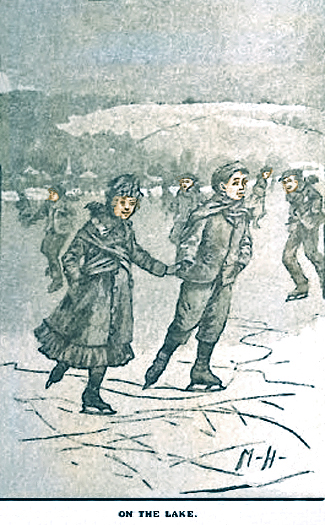
ON THE LAKE.
"Of course I would!" said the larger boy. "My mother is just such a moolly. She tried to make me keep off, but I told her 'No sir!' Catch me going around, with the thermometer below zero."
"It's queer what ails the mothers," said the third boy, laughing. "There's three of them it seems, only mine is my grandmother. 'Now, Tommy dear, 'don't' skate across,' she said." And he mimicked the feeble voice.
"What did you say?" inquired his giggling friend.
"Oh, I said—
"'Of course not, grandma. I wouldn't "think" of such a thing.'
"I meant, you know, that I wouldn't think of such a thing as walking around."
Then there was more laughing. Presently they began to talk about their chances for the place, in the midst of which the door to the inner office opened, and the man who wanted a boy called one of them to him.
The other boys waited until in turn each had been to talk with the lawyer. He took their names and ages, and asked for specimens of their handwriting, and gave them a chance to show how rapidly and correctly they could add a column of figures, then he left them all to themselves, and they discussed their hopes.
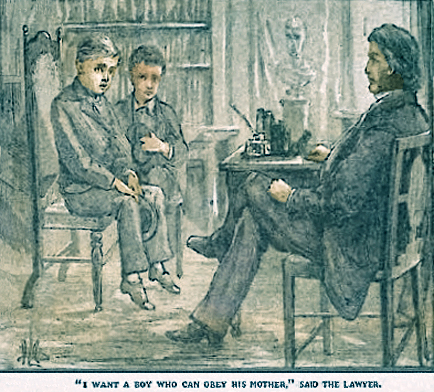
"I WANT A BOY WHO CAN OBEY HIS MOTHER," SAID THE LAWYER.
At last the door opened again, and the gentleman said:
"Sidney Martin, I have decided that you are the boy I want. If the terms suit, you may consider yourself engaged. It is only fair to explain to these others what decided me. Thomas is a trifle more rapid at figures than you, and Henry's writing is rather better; but, the truth is, you all talked pretty loud while you were alone here, and that partition is thin. I want a boy who can obey is mother, even when he thinks her rules are unnecessary. And I want one who is neither disrespectful nor deceitful, which, by your own stories, you two were this morning. Remember, my lads, that a boy who respects his mother, is very apt to be trustworthy."
————————————
THE LITTLE YELLOW DOG.
BY MRS. C. M. LIVINGSTON.
MAMIE was a dear little bit of a girl, pretty and bright and loving, with such a sunshiny face that it cured the blues just to look at her.
She had a great many names. She would answer to "Dantie," "Pussy," "Sunshine" and "Polly," quite as well as to Mamie. "Polly" was grandpa's name for her.
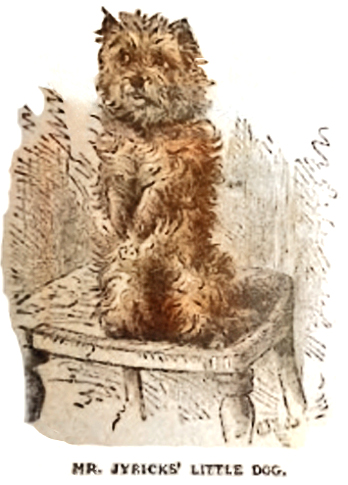
MR. JYRICKS' LITTLE DOG.
Polly had one fault; that does not mean that she had but one, but that this one was so very great it was noticed more than all the others.
The fault was this: she was never quite ready to do anything the very minute she was asked to; she always had something of her own to attend to first.
If papa said, "Dantie, please get my slippers," he was sure to hear "Yes, in just a minute, papa; Dollie is most asleep." When grandpa said, "Come, little Polly, can't you run up-stairs and get my glasses?" She was sure to take just three more turns round the room—if she happened to be playing with kitty—before she started. Or if she were reading a story and was asked to do an errand, she would get slowly up, and creep along with her eyes on the book, stop at the foot of the stairs and read, and then call out, "Mamma, did you say you wanted a spool of white or black thread?"
It was very trying indeed, and grandpa said the ugly weed ought to be rooted out before it grew any bigger. Sometimes he tried to make her ashamed of it. When she was gone for a long time for the newspaper that he sent her for, she would find grandpa busily writing when she came with it, and he would take no notice of her until she said, "Here is your paper, grandpa."
"My paper!" he would say then, looking over his glasses at her. "Sure enough, I did send for a paper some minutes ago, didn't I? But the time has gone by now, I have turned my attention to other subjects; no paper for me, Miss Polly, thank you."
Then Mamie would hang her head and blush; but by the next time grandpa asked her to do an errand for him, she had forgotten all about it.
One day grandpa called Mamie to take a walk with him. She ran for her hat and sack, for she was always glad of the chance to go with him. They always had nice times together; he explained everything to her that she did not know about, and let her chatter off long stories. And if they came along to any shop or place where anything curious was going on, grandpa took her right in.
"MAY I PICK THEM?"
"Where are we going to-day, grandpa?" said Mamie, holding fast to his hand, and giving a happy little hop.
"Going to see a dog," said grandpa, "that can do what a girl can't."
Mamie, of course, was eager to know what a dog "could" do that a girl could not, and she asked a great many questions; but grandpa stopped them all by beginning to tell a long story about the St. Bernard dogs that save a great any people from freezing. The story lasted until they got to the shop where grandpa had his boots mended.
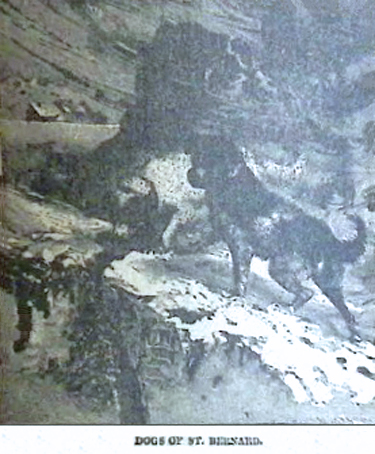
DOGS OF ST. BERNARD.
The shoemaker was a little old man, and he had a nice little shop, and a good little old wife, and a funny little yellow dog.
Very soon grandpa said: "Mr. Jyricks, I want my little girl to see what wonderful things your dog can do."
Then the little man twinkled a smile from his mouth and eyes, and called:
"Here, Jip, you!"
And then the little dog in the net room came scampering into that room so fast that he almost went heels over head, and seated himself in a little yellow ball at his master's feet, his bright eyes turned to his, as much as to say: "Now sir, what will you have?"
"Jip, shut that door!" said Mr. Jyricks.
And at the door Jip flew, and with his two fore paws pushed and pushed with all his might, until it shut.
"Now, Jip, bring my slippers," his master said.
And Jip scampered into the other room and out again as quick as a wink with a slipper in his mouth, laid it down, and then ran back and brought the other one. And so he brought his master's glasses and the newspaper without waiting an instant after he was told.
Mamie laughed until she almost cried to seethe funny little fellow perform. She was so taken up with his tricks, seeing him stand on his hind feet and offer one of his fore paws, when she said: "How do you do, Jip?" that she forgot all about asking her grandfather what he meant by saying Jip could do what a girl couldn't, until they were almost home.
Then grandpa said, "I'll tell you when we have our talk to-night."
"Now, grandpa," Mamie said as she nestled into her grandfather's arms after tea, when he and she were all alone in his room, "now tell me what the little dog could do that I can't. I'm sure I can shut doors, and bring your slippers, and newspapers, and glasses."
"Polly," said grandpa, taking her round face between his hands and looking into her eyes, "the little dog can do it 'right away' the minute he is spoken to. O, Polly, Polly! To think a poor little yellow dog can do what you cannot."
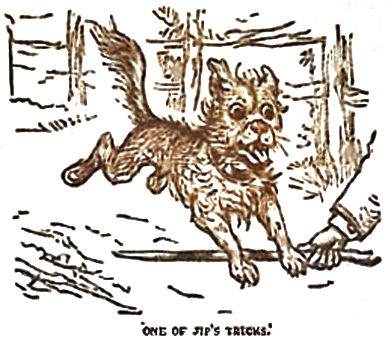
ONE OF JIP'S TRICKS.
The little head went down then on grandpa's bosom, and neither of them spoke for a few minutes, then grandpa said:
"Polly, I suppose I can buy that little dog to wait upon me, then you need not take the time from your kitty and dolly to run errands for an old grandpa."
"Grandpa," said poor little Polly, sitting up and wiping off the tears, with her handkerchief done into a hard ball, and struggling with her sobs, "I—I—shall just DIE if you do; it—it 'll break my heart right in two. Just try me once more, grandpa! I truly will do every single thing the very minute you tell me. I do want to stop being so naughty. I will remember, sure as I live and breathe."
Then the gray head and the golden head went together, and there was a great hugging time, and grandpa took the sorrowful little bundle to his bosom, and said: "There, there, little one, don't cry anymore. Grandpa 'll help you remember, won't he?"
"Yes;" said Mamie, sitting up straight. "You'll say 'little yellow dog' to me every time you see me going to forget, won't you?"
Then grandpa laughed loud and long, and he hugged his pet again, and took off his glasses and wiped away tears, or something, from them.
————————————
WHERE I WENT, AND WHAT I SAW.
DEAR PANSIES: Wherever I go, and whatever pleasant sight I see, I find myself saying: I will tell the Pansies about that. But someway I never seem to get to it. Now I have resolved that whatever of interest I find as I go through the world, you shall share. Therefore I shall begin with this year a series of papers with the above heading. Let me tell you first about Long Branch.
"Where 'is' the branch?" said a little bit of a boy, leaning out of the carriage and looking about him eagerly. "I don't see anything of a 'branch.'"
We found, on questioning him, that he had expected to see a long gnarled branch of some grand old tree, with perhaps a nest or two built in it, and a few birds keeping house. To find that it was simply a town, with one long and rather narrow street, built up with hotels and cottages on one side, and with old ocean rolling and tumbling along the other side, was a disappointment to the little boy.
Oh, but the street is lovely! On a summer afternoon, with a bright blue sky overhead, and a brisk sea-breeze rolling in, to be seated in an easy carriage behind two handsome horses, and be wheeled along over the hard road, watching the surf break on the shore by your side, is about as pleasant a thing as one can have in this world. Where is Long Branch? Only about two hours' ride, by rail, from that great bustling dirty city—New York. The cottages I cannot attempt to describe; no two are in the least alike. Most of them, however, are painted very dark, with bright red trimmings; the lawns leading to the doors are kept beautifully green and smooth shaven.
The afternoon in which I last rode through Long Branch was simply perfect: cool and bright; sky and sea were all in their glory, and nothing smoother or cleaner than the road over which we rolled, can be imagined. There is a wonderful public garden, which we visited. I have forgotten the owner's name, but we enjoyed the tens of thousands of dollars that he had spread out for our benefit, quite as much as "he" could have done. There we saw plants and flowers in every possible variety; names spelled with flowers, mottoes in flowers, lawns covering acres of ground bordered with flowers.
"Oh!" we said; and "Oh!" and "Oh!" was re-echoed in the carriage from every side. That was all we could think of to say; and I find, in trying to describe it, "Oh!" is the only word at command.
But there was one object of special interest to us all. Flowers might grow and wave, the ocean might roll in all its grandeur, beautiful houses by the dozens might invite attention, we gave only passing thought to them all, and looked at, and talked about, and thought of one plain cottage, on the roof of which waved our country's flag, and around which stood a guard of soldiers. Oh, you know who lay in one of the rooms under that cottage roof, about whom all the world was thinking that day.
"What is the news!" we said, leaning forward and speaking to a man, a stranger.
How did he know what we meant? There may have been news of great importance somewhere else in the world.
But he shook his head, and said: "No news since twelve o'clock."
And we knew just what he meant.
A little further on we met a little girl, and she was crying.
We stopped again and said: "What news?"
How did we know but she was crying about a lost kitten, or because her mother would not let her go to the beach, or the lake?
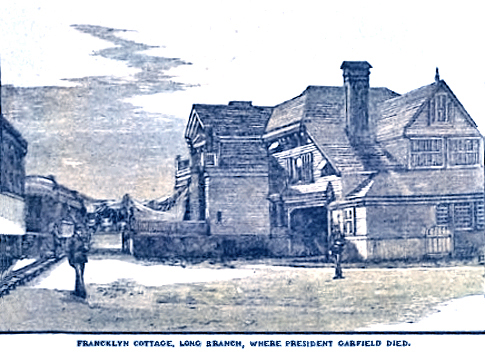
FRANKLYN COTTAGE, LONG BRANCH, WHERE PRESIDENT GARFIELD DIED.
No; she shook her head, and said: "We are afraid he is worse!" And she cried harder.
We knew what she meant. It was Saturday afternoon, and the President of the United States lay dying in that cottage close at hand! We stopped our horses just before the lawn leading to the door. We looked at the narrow railroad track which had sprung up in the night to carry him to what we had hoped would be the life-giving sea, and we wondered if the car would soon roll over this same track to take away only his body!
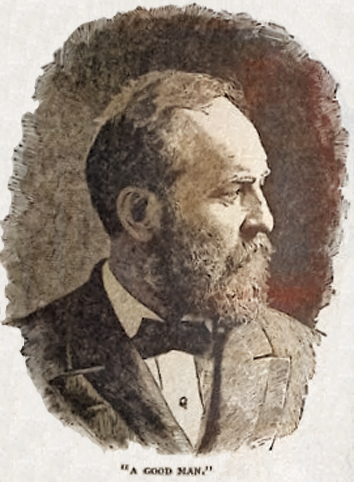
"A GOOD MAN."
The gentlemen in our carriage lifted their hats as they stood opposite the cottage where the President lay. For a few minutes none of us spoke.
Then Dr. Nelson of Geneva, New York, said slowly: "A good man."
I thought about it all the way home. President though he was, with all true men and women watching in such anxious sorrow for news of him, the utmost that could be said of him, or of any human being, was covered up in that one word—"good."
Less than thirty-six hours from that time, the bells tolled out sadly and solemnly, and when we looked out of our windows in the gray dawn of the morning, all the flags were at half-mast. The "good man" was gone. You know all about it, dear Pansies, how the Nation mourned for its dead President.
Let me tell you of two verses which that same dear Dr. Nelson wrote to us from his distant home. No, I will tell you where they are to be found, and you may read them for yourselves. Psalms 46:1, 2. Meantime, boys, have you begun such lives, that, when you are men, those speaking of you can say: "A good man?"
A HAPPY NEW YEAR.
STORIES FOR BOYS AND GIRLS
HAPPY NEW YEAR!
IS it possible! What has become of 1881? Whoever knew a year to fly away so fast before? Well, we start out together for 1882. We have many new friends, and new plans and hopes.
We hope to have all your names enrolled as members of the "PANSY SOCIETY" (for particulars look in another column). We hope to have many letters from you during the year.
In the column entitled "Where I Went and What I Saw," we mean to tell you about a good many places and people which we think will please you. In the story entitled "Side by Side," we expect you to become specially interested, for it is a very important story. As for "Reuben Stone," the "Man of the House," I have had so many letters from you during the year, expressing pleasure in the story, that I know you will like to follow my boy's fortunes through another year.
For the rest, I will not make any promises, only this: If the "PANSY" is not a much better paper during the year 1882, I shall be very much astonished, and sadly disappointed.
Now I hope that every true Pansy will set to work for his and her paper. How many boys and girls do you know who do not take it? How many have you asked to do so? How many will you ask again? How many prizes for new subscribers do you intend to earn?
How I am pouring out the questions on you! Never mind, you are capable of answering them all.
Just one more, the most important of all. Bend your ear and let me whisper it: Do you begin this New Year with Jesus? Please write to me and answer that question. Yours lovingly, PANSY.
————————————
WHO DID IT?—A STORY IN TWO CHAPTERS.
CHAPTER I.
HESTER opened her eyes in the gray dawn of the New Year's morning, and gave a little chuckle of delight.
There was nothing very cheering about her. The attic in which she slept was decent, it is true, in fact, was comfortable; but it was dark and rather cold, and there was just as little furniture as one could get along with. Yet Hester hugged the big red and brown comfortable, and lay still a few minutes to enjoy her thoughts. There was no bright stocking hung up for her as she knew there was down-stairs for the children of the family. She did not expect a single present of any sort; in fact, she never had New Year's presents, or presents of any kind. But oh, how happy she was!
She had never been to a party in her life, and to-day she was going. Mrs. Neilson, her Sabbath-school teacher, had made a New Year's party for her class. A great many whispers had buzzed through the class last Sunday about the wonders that would be seen in her beautiful home; and Hester's hopes and expectations ran high. Besides, she had a brand new dress to wear. To be sure it was only a bright calico of pretty figure and neat make. But Hester was not used to anything better, and she thought the new calico with a lace ruffle in the neck was beautiful. So with her heart all full of happiness, she presently hopped out of her warm nest and began to dress. It was less than two hours afterwards that Hester's morning clouded.
"Hester!" came in an unusually loud sharp voice from Mrs. Denton's room. Mrs. Denton was the woman with whom Hester lived; a pretty good woman generally. Hester dropped the cloth she was polishing the knives with and ran in haste; the tone was so unusually sharp.
Loud, excited voices sounded down to her from the room above, as she ran up the stairs. Miss Cora was there, and Miss Emeline, and she could hear Miss Cora's voice saying: "Of course she did it, mother, who else would?"
Then Hester knocked timidly at the door.
"Hester, look here!"
Mrs. Denton's voice was positively awful. No wonder. She held, thrown over her arm, Miss Cora's blue silk dress which always reminded Hester of the sky in a winter day, or the sea getting ready for a storm. Across the front breadth were great bright drops of blood. At least, that was what they looked like to the horrified Hester. After awhile she discovered that they were blotches of red ink: enough of them to ruin the dress.
"Now," said Mrs. Denton, still in that awful voice, "suppose you give us an account of this business!"
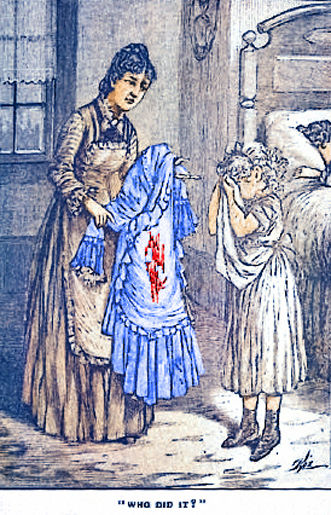
"WHO DID IT?"
She give an account of that business! What did she know about it? How could they think that she knew anything about those wonderful blue silk waves?
"Me, ma'am?" she said, catching up the hem of her work-apron and rolling it around her finger as she always did when she was startled, her face growing red and white by turns.
"Yes, you! How came you to put those ink-stains on this dress? What could have been your object, you wicked child? After all that we have done for you, too. I cannot think it possible that it was an accident, for you have no business near the dress. The least you can do is to give an account of yourself."
"Why, ma'am," said Hester, her cheeks ablaze now, "why ma'am, how can you think—I don't know—I never touched or saw—"
"Mamma," said Cora, "how can you stand there and hear her tell stories? The deceitful, spiteful little thing! My best dress utterly ruined, and I have nothing fit to wear to-day." And the young lady crumpled herself into a heap on the foot of her mother's bed and sobbed aloud.
"Hester," said Mrs. Denton, "there is no use in your trying to deceive us in this way. It would be a great deal better for you to confess your sin and explain what object you could have had. I am perfectly astonished. I knew you were a high-tempered little girl, but I couldn't have believed you guilty of such wickedness. When did you do it?"
"I never did! I never did!" almost screamed poor Hester, and her tears rolled faster than Miss Cora's.
"Stop!" said the awful voice of Mrs. Denton. "How dare you stand there and tell me what is false? Don't you know, you wicked child, that Miss Cora had the dress on only last evening? That at tea time it was in perfect order? That you were missing with colored inks all the afternoon—foolish woman that I was to allow it!—and that when Miss Cora changed the dress in my room at dusk, for her street one, she sent you up-stairs with it, and here it is this morning lying across the sofa where yen were told to put it, utterly ruined with the ink that you, and you only, put on it? Naughty, wicked girl! I wouldn't have believed that you could be so vindictive. Miss Cora says you slammed the door as hard as you could last night, just because she reproved you for brushing past Mr. Stuart's chair instead of going behind it as you ought; and to think that you should have taken such a horrid revenge!"
Poor, red-faced Hester! What could she say or do? There was just one part of this dreadful story that was true. She had felt cross at Miss Cora for reproving her before Mr. Stuart, and she had slammed the door. She remembered it well. The thought of it made her cheeks burn with shame. But oh, to think that she was accused of inking that beautiful silk dress, on purpose, too, and for revenge! What should she do? It seemed of no use to say again that she didn't do it; for she could hardly expect them to believe her. She had been amusing herself for a whole bright hour with those lovely colored inks, and she was the only one who had touched the silk dress after tea. How could the ink have got on it? She didn't know. All that she could do was to cry. This she did. She covered her face with her apron, and with one long, loud wail, that, if Miss Cora's face had not been buried in the bedclothes, might have gone to her heart, fled away to that attic room, there to throw herself on the foot of the bed, and cry as though her heart would break. And truly Hester thought that it would.
She did not know how many hours afterwards it was that she heard her name called at the foot of the stairs.
"Hester!" There was nothing for it but to take her tear-stained face and sore little heart down-stairs.
TO BE CONTINUED. ————————————
A DAY THAT JOHNNY NEVER FORGOT.
BY MRS. C. M. LIVINGSTON.
IT was a bright winter morning, and it was Saturday. It was early yet—only half-past six—but Johnny Blynn was up and dressed.
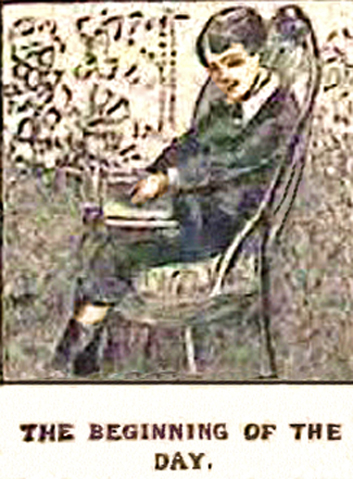
THE BEGINNING OF THE DAY.
He got up early now mostly—ever since he had a room to himself. He was in a hurry to use his pretty blue washbowl and his new stiff hair brush, and look about his beautiful room and think how nice it was to be in there alone like any gentleman making his toilet, the door locked, and even mamma not coming in without knocking.
It was a nice room. It had pea-green furniture, because that was Johnny's favorite color. There were a pretty gray carpet with a green border, and white muslin curtains at the window, and pictures on the walls.
He did his work nicely. He was careful not to spill water, nor spatter the drops about, although he washed himself till his face looked like a pink and white morning-glory dripping with dew, then he brushed his yellow curls, and dressed himself in his navy-blue suit. How like a gentleman he looked when it was all done, his collar white as snow, his necktie in a neat bow, everything all right, even his finger-nails clean and white as any lady's.
He had one thing more to do before he went down-stairs. He drew his rocking-chair near the register, and took his Bible and read a few verses, then he knelt down and prayed. This part of his duties was not so well done as the other had been. The Bible verses were gabbled off as fast as he could make his tongue go. As to the prayer, the words were all right. He asked God to bless him and make him a good boy—obedient and kind, and keep him from being naughty to anybody, but he was so busy thinking whether it was likely the creek was frozen hard enough to skate on, that he scarcely knew what he was saying. He hurried through the prayer and went down-stairs as fast as he could go.
In the dining-room was sister Nellie, standing by the grate warming her hands. Johnny seized hold of one of her long braids and gave it such a twitch that the blue ribbon that tied it came near falling into the fire.
Then Johnny laughed, and Nellie said impatiently, as she twitched at the knot in the ribbon:
"It's too bad! When I had my hair all ready for breakfast."
"Hair for breakfast! Ho! Ho!" shouted Johnny, dancing teasingly about her. "Whoever heard tell of such a thing?"
Then did Nellie's patience vanish entirely, and she sprang up to give Johnny a good shake, but he darted away and ran out-of-doors, appearing soon in the kitchen, much to the dismay of Bridget who was flurrying about trying to dish up breakfast. If there was anybody in the world that Bridget didn't want to see in the kitchen, it was Johnny; so as soon as he bounced in, she said:
"Now get out of this, Johnny Blynn, this very minute!"
But Johnny seized the spoon that was in the batter-cakes, shouting, "I'll bake cakes for you."
Then he tried to put a cake on the griddle. He plunged the spoon deep into the batter and carried it dripping across the table, and floor, and stove, and splashed it on to the griddle.
Then Bridget seized both the spoon and the boy, put the spoon in the dish and the boy through the open door, then shut and locked it, saying wrathfully, as she put him out, "You're the very worst boy in this world!"
This was a specimen of that whole day. He could not go out to skate, because his mother said he was too hoarse to play out-of-doors such a cold day, and such a day as they had of it! If Johnny's business had been to torment everybody, make them lose their tempers and upset nerves generally, he would have been a master-hand at business, for he went from one thing to another as fast as possible, never once stopping to rest himself.
He dropped papa's watch, and spilt the ink, and tipped over mamma's work-basket, and quarreled with Nellie, played pranks on Bridget, worried the cat, and teased the dog, till about four o'clock in the afternoon; and then something happened.
From the window he saw two ladies coming to call upon his mother, and immediately he ran into the parlor and hid behind the folding-doors, when, as they stood open, were nice little corners behind them. "It will be such fun," he said to himself, "to hear what they say when they think they are all alone."
So, while they waited for his mother to come down, they talked. They were friends of her school-girl days, and one of them had not seen her for several years. They talked in low tones, but Johnny could hear every word they said. One lady said to the other:
"Cornelia has a pleasant home."
"Yes," the other answered; "and Mr. Blynn is a very fine man."
"She has two children, you said. Are they nice children?"
"Why, yes, they are very smart and handsome. Nellie is a sweet child, but Johnny is a perfect little torment. His mother spent the day with me when I lived out at Riverdale, and she brought him along. He kept my nerves on the stretch all day. There wasn't a thing on the mantel or table but he must have hold of. I expected everything would go to shivers that he touched, he was so rough. He brought mud on my carpet, and trod on the lace curtains, and put his feet on the sofa, and his mother kept saying, 'Johnny, don't! Johnny, stop!' And Johnny never obeyed until he was spoken to three times. I guess his mother was glad when night came; and I'm sure I was. I thought Cornelia would succeed better in training children; she certainly has made a great failure in this case."
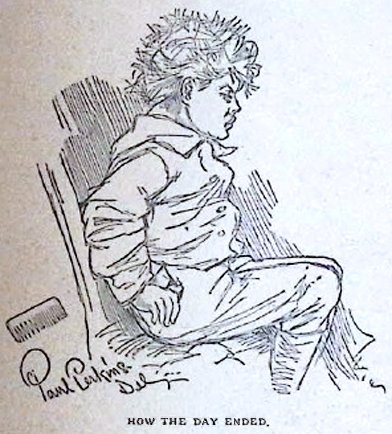
HOW THE DAY ENDED.
"What a pity that she should have such a burden to carry; you said her health was frail."
"Yes, very; I should not be surprised if she did not live very long."
Just then the door opened, and Mrs. Blynn came into the room. Johnny peeped through the crack at her—his sweet, beautiful mother; how pretty she looked, dressed in white, with pink cheeks and bright eyes! What dreadful thing was this he had just heard; his mamma die!—How could it be? He had never thought of such a thing in his life. How he wished he could get out of that place and go up to his room. He wanted to cry out loud.
To think, too, that anybody should speak of him in that way—"a perfect little torment!" Oh, it was too dreadful! Had he really done all those awful things when he was at Mrs. Graham's last summer? He rolled over on the floor and had hard work to keep from screaming outright.
Just then what did Mrs. Blynn say but:
"Is not this draught too strong for you, Mrs. Graham?" And arising, closed the folding-doors, when behold! curled in a heap in the corner was Johnny.
"Why!" said mamma.
But Johnny waited to hear no more. A dart and a bound took him through the door, and on he went up to his own room, where he cried himself almost sick; but while he cried, he did more thinking than ever he had in his short life before.
"Nobody shall ever call me a torment again," he said with a long-drawn sob. "I'll show 'em my mother does know how to bring up children; I will!"
Don't suppose that Johnny grew to be a wonderfully good boy all at once after that big resolve. He tried to keep it, but he kept forgetting and doing the same naughty things day after day. He told it all to mamma one night—how it was of no use for him to try and be good; he "just couldn't!"
And then mamma said:
"Johnny, dear, don't you know you must pray just as you play, with all your heart, and your heart must run to Jesus when you feel that you are tempted to be naughty, just as you call after me when you are in any danger?"
That made the way plainer, and everybody began soon to say, "Johnny is certainly growing to be a better boy."
————————————
THREE LITTLE M'S.—A THREE-PART STORY.
BY MARGARET SIDNEY.
MATILDA, Martha, and Mary. That's what folks called them.
As to their looks, they were as alike as three peas in a pod. Even their father, good fat old Mr. Poser, who kept the small shop where the cross-roads met, said, "'Tain't in natur' to know which is the other, unless you see 'em a-workin'."
And this is the way they worked—these three little M's. "Two," I should say, for alas! one of these dear little girls was never a worker at all. Although Matilda, the eldest, skipped around the small shop, busy as a bee, helping father every day, and Martha, the next one, minded the house, little Mary, the youngest of the bunch, let them work alone while she tried to have a good time in her own naughty little way. For she didn't believe in making life beautiful in the way God has intended for all children as well as great folks, by cheerful, faithful labor, that makes play-time when it comes just twice as jolly because earned. Not she! She wanted high holiday "all" the time, and so she made her father very unhappy, and the tears to trail down from the little sister's big brown eyes very often, all because she "would" have her own way, and spend every day in running and racing here, there, and everywhere, for something new to look at.
Was she happy? Can a little child be, who turns her back on duty? And didn't she ever stop that bad, bad habit? Well, we'll see. Stay! I'll whisper it to you beforehand—my answer. Yes, she "did" stop, and all because of—and here's my story!
"Oh, dear, dear, 'dear!'"
Fat Mr. Poser sat right down on the cover of a butter-tub, although it was the busiest day in the week—Saturday—and just wrung his hands, which were like two small pincushions.
"What's the matter, pa?" cried Matilda, taking, by a violent effort, her eyes from off the jar of pink and white peppermint sticks. "Oh, what 'is' the matter?" And she ran over to his side.
But the fat shop-keeper only groaned, and unclasped the two pincushions enough to disclose in their centre a bright silver quarter of a dollar.
"'There!'" at last he said.
"Oh, my!" exclaimed Matilda, her eyes as big as good-sized cups; "that's Mrs. Smith's change."
"I know it," said Mr. Poser. Then he groaned again; and getting up from the butter-tub, he waddled to the door.
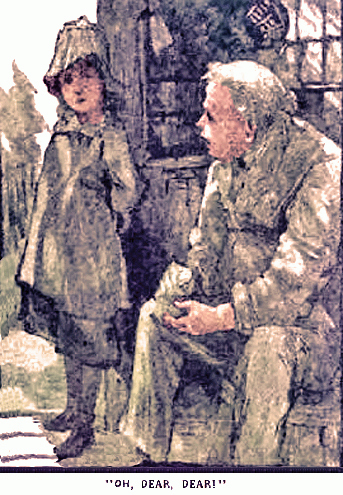
"OH, DEAR, DEAR!"
"'Ma-a-ry!'" he called, as loud as he could scream.
A small blue gown, and a little red hood, that were flying past, came to a full stop.
"Now you trot right straight off to Mrs. Smith's house in Crow Hollow as fast as you can trot, an' tell her she left this quarter, after buying that chopping-bowl this morning."
At that, there came such a whine from the little red hood, that Mr. Poser cried sternly, "You might as well stretch your legs for somethin'. Start now, an' don't you stop anywheres! 'Mind!'"
The whine ceased suddenly, as the blue gown and little red hood took themselves slowly out of the big gate. For the first half-mile or more, Mary went on quite steadily. Then she began to sigh—a sigh that soon broke out into a dismal cry—a cry that only half made itself heard, for the very good reason that Mary stopped to wink her eyes so violently, she had no time to attend to anything else.
"Why—why—ee!" she cried to herself and the birds. "'Folks have moved into the dungeon!'"
The "dungeon" was an old rambling stone mansion down on the edge of the wood, unoccupied since the old squire had died, and given up to the crows and the bats. Mary grasped her silver quarter tightly in her little fist, while her two naughty feet began to carry her up to the big green door.
"I'll take 'one' look," she whispered to her conscience; "only 'one;' then I'll run all the faster to Mrs. Smith's."
But that "one look" showed her a pair of cunning little rabbits just inside the barn-door, nibbling a cabbage-leaf.
"I wish 'I' had rabbits," she said, wistfully gazing at them. "I'm going to ask the folks in there to let me play with 'em sometime. Maybe there's a girl as big as me lives here. I mean to see."
So Mary stepped up a steep flight of short stairs leading into the house, and was just going in, when a big black dog running suddenly out, met her at the top, and coming to a full stop, showed all his teeth and gave "such" a bark, that the little girl turned around in a twinkling, and began to scuttle down the stairs with all her might.
The dog came tumbling after, barking violently at every step. Frightened almost to death, Mary flew along the barn floor, out into a dirty little court-yard, and, just in time to keep the little blue gown from a sharp snip of the white, gleaming teeth, she plunged against a door that stood conveniently open, threw herself on its other side, slammed it to, and tumbled down in a small heap on a pile of potatoes, to draw a long breath.
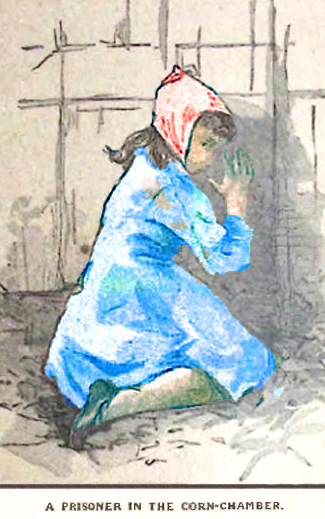
A PRISONER IN THE CORN-CHAMBER.
It was a little room, all filled with corn piled up in small bins with heaps of cobs thrown down just where children's busy fingers had been shelling; bags of meal fresh from the mill, and everywhere else that anything could be stowed, were heaps and heaps of potatoes. All this while the dog was howling away smartly outside.
"Hum—hum—'hum!'" said Mary, trying to catch her breath. "Oh, me, ain't I tired, though! Now when that dog goes away, I'll go right straight off to Mrs. Smith's. I don't want to see any more of these folks. 'Why! Where's—my—quarter!'"
For her fat little palm was empty.
Just then a loud voice struck up, outside the old door:
"Come off, Bose! 'Sharp,' sir."
"Er-r-'oof!'" Patter, patter, patter, went the dog's feet, as he unwillingly obeyed, leaving Mary to wriggle in delight at her escape.
"Now, then," she was just going to say, when, "click—'snap!'" went the key in the lock, and before she quite knew it, she was fast a prisoner in the old corn-chamber.
TO BE CONTINUED. ————————————
TWENTY-FOUR HOURS.
"FIZZ! Sizzle!" said the mixture in the big pot on the stove. Miss Penelope stirred it, looking meantime so grim that it might almost have soured the mixture, whatever it was.
The kitchen was in after-dinner order; the stove shone brightly—the only bright thing to be seen, for the sun could not look in, and furniture was very scarce.
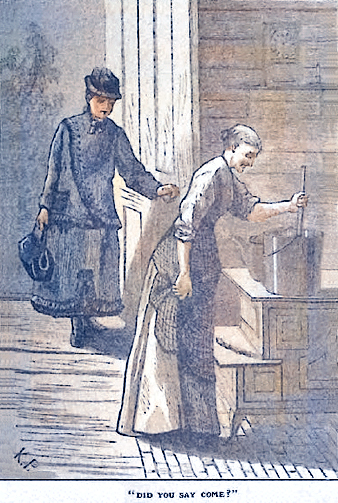
Suddenly the door opened, and a rush of cold air came in, with a few flakes of snow, and a pretty girl, in a green flannel suit, with a green velvet hat to match.
"Did you say come?" she asked in a cheery voice. "The wind blows so I couldn't tell. Miss Penelope, mamma wants to know if I may come and stay twenty-four hours with you? She was called away very suddenly, and she didn't know what to do with me."
"DID YOU SAY COME?"
"'Well,'" said Miss Penelope, after standing up straight, and looking at her visitor in amazed silence for a minute, "I should think you 'had' come!"
The pretty girl laughed a silvery laugh. "That is true," she said, stepping in, and closing the heavy door. "Mamma didn't know what else to do; she was in 'such' a flurry. The telegram never came until about an hour before the last train; it was from my uncle in the city. Mamma doesn't know him very much, and I never saw him in my life; but it seems he is 'very' sick, and wants to see mamma. She thought she ought to go, but of course she couldn't take me, and she said she knew you would take care of me until the four o'clock train to-morrow, when she would come back: she didn't like to trust me anywhere else. So I have my brush and comb, and all my night things in this bag."
"Humph!" said Miss Penelope. "Sit down, and take off your things."
Her face was, if possible, grimmer than before. If there was any one thing that she disliked more than flies, and dogs, and tramps, it was visitors. She never had them if she could possibly help it. The green-dressed maiden's mother, who had known her all her life, and took more liberties with her than anybody else, never ventured to come to tea; yet here she had sent her daughter to stay twenty-four hours.
"Whatever shall I do with her, or say to her?" said Miss Penelope, dashing around her kitchen like a great frightened fly.
But the first thing to do was to get her some supper, as the old-fashioned clock in the corner said "almost five o'clock." Miss Penelope never was known to have supper one minute after five o'clock.
The new-comer, whose name was Helena, did not seem uncomfortable in the least. She hung up her own hat and sack, then hovered around Miss Penelope.
"Let me set the table, please," she said eagerly; "I always do for mamma. It will seem so funny to eat supper without her."
She did not wait for permission, but helped herself to two old-fashioned blue and white plates, two cups and saucers, and the quaint little sugar-bowl, exclaiming as she did so over the pretty pictures on them.
Miss Penelope seemed too much astonished to speak. When had her table ever been set "for" her before! In fact, she could not remember the time. But she could remember the time when it was always set for two. Not very long ago, her old mother sat at the foot of the table.
It was in the evening, when the kitchen was trim and proper again, and the old-fashioned lamp was lighted, and Miss Penelope sewed on a "very" dark calico apron, large enough to cover her all up, that Helena said: "I brought my Bible among my night things; shall I get it and read my verses aloud, as I do to mamma?"
What could Miss Penelope do but give a sort of grunt for assent; of course, being a decent woman, she couldn't very well refuse to have a chapter in the Bible read to her, though the old mother had been the only one who had ever done it.
So the clear voice of the young reader commenced: "And there came a leper to him, beseeching him, and kneeling down to him, and saying unto him: If thou wilt thou canst make me clean. And Jesus, moved with compassion, put forth his hand, and touched him, and saith unto him, I will, be thou clean. And as soon as he had spoken, immediately the leprosy departed from him, and he was cleansed."
"Only think how quick!" said Helena, looking up with shining eyes. "Just for the 'asking!' Oh, Miss Penelope, don't you wish Jesus was on earth now? Then uncle might have asked Him to make 'him' well, and mamma need not have gone away; but that is silly, I know; He can hear us just as well, and do just as much for us; only the trouble people is, people won't 'ask.' Uncle never asks Him for anything, mamma says. It sometimes seems to me if such people could 'see' Him they would ask Him for what they need: but I don't suppose they would. Mamma says they would be like those people who wanted Him to go away out of their country and not bother them."
Then she went on with her reading.
Miss Penelope did not hear much more. Her heart went back to the day when her old mother had read her that very story, and how she told of the time when "she" asked Him for healing, and he gave t; and then the tired old voice would say: "Oh, Penelope, my girl, I wish you would go to Him!" Penelope never had.
The next day passed busily to Helena. A telegram came for her. She was to be put on the four-thirty train, and go to the city; mamma would meet her at the depot.
Helena never came back to the little village. The old uncle died—not then, nor the next day, nor the next, but after weeks of pain.
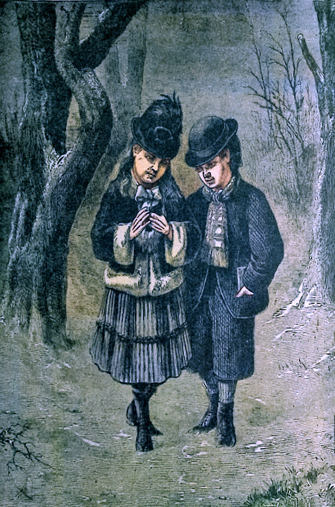
He left all his money to Helena's mother, and the little bit of a cottage home where she and her daughter used to live, was broken up, and they lived in the grand city home. Helena never saw Miss Penelope again; for, strange to say, before the uncle died, God called for the lonely old woman. So Helena doesn't know yet, but some day when she goes to heaven she will—for there will be a bright star in her crown, and when she inquires for whom it shines, she will learn in great astonishment that it stands for the soul of Miss Penelope, who was led, through those simple, earnest words of hers, and through the words read to her from the Bible that was among her "night things," to go herself and "ask Jesus."
————————————
P. S.
NOW, what does that stand for? Not "Postscript," because every one is to be told the first thing. So all you bright Pansies, now listen!
"P. S." forever and forever, and then again forever after this stands for—
"PANSY SOCIETY!"
And it is to be all our own? Yes, indeed! And we are to have all the say about it too? Yes, indeed! again.
Now, then, "who will join? What shall be our motto? What shall we do? How shall we do it? Where shall we meet? When shall we meet? What will come of it?"
Oh, wait—wait—wait! You fairly overwhelm me with questions. It is late, and this paper should go to press. I can't answer now. Let me give just a little hint.
In the first place, the name is the "PANSY SOCIETY." That's settled. Then the motto comes, and that is "Pansies for Thoughts." What kind of thoughts? Oh, sweet, good, pure, unselfish, helpful thoughts, such as Pansies, beautiful Pansies, ought to inspire.
And we'll have a badge? Of course we will! Whoever heard of a society without a badge. And ours will be the most beautiful in all the world. That's settled, too. Just hear what it is going to be. The most beautiful round locket of wood, on the face of which is a lovely pansy, naturally colored. Above is the name, "PANSY SOCIETY," underneath the motto, "Pansies for Thoughts." A perforation at the top holds the ribbon to suspend the locket on the neck.
Now, "who may join?"
Every boy and girl who takes the PANSY, and is willing to promise to try to overcome his or her faults, to encourage every good impulse, to try to conquer some hard lesson at school, to do "anything" that shows a disposition to help the cause of right in the world. Any one who will say from the heart: "I promise to try each day to do some kind act, or say some kind word that shall help somebody;" and honest effort will be rewarded as much as if success were gained. Whoever will promise this shall receive the badge "at once," on sending notice of such determination to the editor.
This promise must be dated, and will be copied into the "P. S." roll-book. Each child is invited to write to the editor how far the trial has proved a success, how many temptations have been resisted, how much progress in any direction has been made, etc., feeling sure of encouragement and loving help.
And we will have some beautiful books of our own to read, which all the "P. S." people can get for much less money than anybody else. We will have local meetings. If any of you want to ask, "what in the world are those?" Go to mother, or father, or big brother John. They will tell you.
That is enough for now—excepting the most important of all—our whisper motto: "I will do it for Jesus' sake."
"FOR JESUS' SAKE."
Whatever He will own, the "P. S." will be proud and glad to copy on its roll-book.
And the PANSY will help. As it has always been glad to encourage those who are struggling up toward the light, so now it reaches forth its helping hand to those little ones who will rally bravely around it, to the work of putting down the evil, and the support of all things good and beautiful. That is all for now. Just a hint in a hurry; more next month.
Meantime, how many names shall we receive? Send postal-card with name to D. LOTHROP & CO., 32 Franklin St., Boston, Mass.
————————————
SARAH LAMBERT.
SIDE BY SIDE.
[PART I.]
BEHOLD I WILL SEND MY MESSENGER, AND HE SHALL PREPARE THE WAY BEFORE ME. THE PEOPLE THAT WALKED IN DARKNESS HAVE SEEN A GREAT LIGHT. I, EVEN I, AM HE THAT BLOTTETH OUT THY TRANSGRESSSIONS FOR MINE OWN SAKE, AND WILL NOT REMEMBER THY SINS. REMEMBER THE SABBATH DAY, TO KEEP IT HOLY.
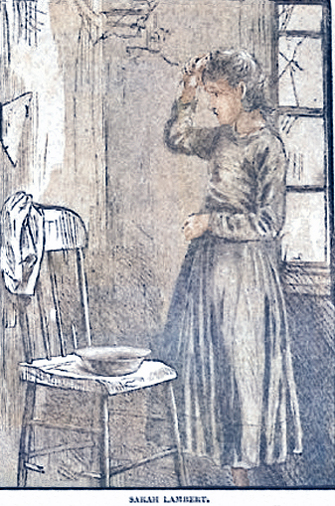
SARAH LAMBERT lived with her mother in one room over Mr. Dunlap's stable. The stairs leading up to it were narrow and steep and dark. The room was dark when you reached it; only one window, with small, old-fashioned panes of glass. The window was dirty, too, and trimmed with cobwebs. There were two wooden-seated chairs, a poor bedstead, a table of the old-fashioned kind, with one leaf gone, a cooking-stove that smoked, of course, as all worn-out stoves do, and that stood on three legs, its door hanging by one hinge.
In this room one winter morning, Sarah Lambert washed her face from a tin basin, on a corner of one chair, snarled at her tangled hair a few minutes with a broken comb, put on a pair of ragged stockings and ragged shoes, and, over some very thin and old undergarments, a dark brown calico dress, patched in three places, wound a piece of brown and white plaid shawl about her, put on a gray felt hat without any trimming, and without any breakfast stole out of the room.
Her mother was still sleeping, though the sun was high. She went to bed the night before intending to sleep until she was ready to wake up; for she knew that the next day would be Sunday. As for Sarah, she was going to Sunday-school, whatever that meant; she had promised a lady the day before that she would.
SIDE BY SIDE.
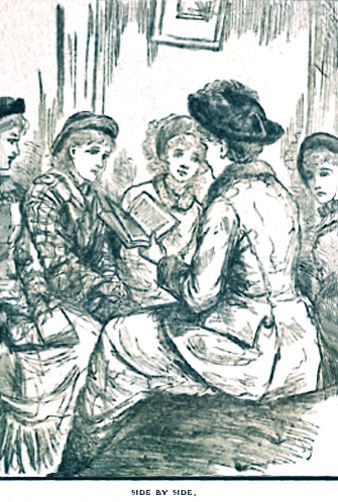
Ethol Harrison lived with her father and mother and brothers and sisters in the great stone house three squares away from Sarah Lambert's. The room in which she slept late that Sunday morning had a crimson carpet on the floor, and crimson curtains at the windows, and costly and elegant furniture.
When Ethol had eaten a breakfast of broiled chicken, and toast, and canned fruit, she was dressed by Hannah in a dark blue velvet suit with hat to match, having a long white plume winding all about it, kid gloves on her bits of hands, and kid boots on her bright stockinged feet, lovely white furs, cape, and muff, to crown all, and she too went to Sunday-school.
Behold, she and Sarah Lambert sat side by side in the bright room full of people. Ethol smoothed down her new velvet dress, and buttoned her glove, and tossed back her plume, and smiled and nodded to her friends, and Sarah sat like a statue at her side and stared. She had never seen such a light, bright, beautiful room as that in her life. Both of the girls received cards with the words on them that are at the head of this story. Both girls read them at once, for Sarah went to day-school and knew how to read. They were new words to her. She was so astonished over them, that she forgot her awe of Ethol and nudged at the blue velvet sack nod whispered:
"What was it?"
"What was 'what?'"
"That great light; where was it—what did it show them?"
Then Ethol giggled.
"Miss Mason," she said, "this little girl wants to know what they saw by the great light."
Miss Mason turned to Sarah, whose checks were now very red.
"Don't you know who the light is, dear?" she said gently.
"No," said Sarah, but she felt comforted. Miss Mason's voice made her think of the music that she heard as she passed the church.
"It means Jesus, my child; you know the world was very dark until he came."
"Wasn't there any sun to shine?" asked Sarah; and Ethol giggled again.
"Yes; but I don't mean that kind of darkness. I mean full of sin, and sorrow, and trouble; and the people did not know the way out. While He was here they used to bring sick people to him; those whom no doctor could cure; and he would just touch them, or speak to them, and they would be well at once."
"I don't believe it," said Sarah, promptly.
And Ethol said: "Oh-h! What a wicked girl!"
"That is what some of the people said who were looking on," Miss Mason told her. "'They' wouldn't believe in the great light though Jesus gave them so many reasons for believing. Open your Bibles, girls. Here is one for you, Sarah. Let us read the story about the sick woman who was cured of fever in an instant."
Sarah looked at the place pointed out to her, and listened, and read when her turn came; she had never heard of such a thing in her life. She asked a great many questions, and amused Ethol so much that she almost forgot her new hat with its long plume.
"Where has he gone?" asked, Sarah, suddenly, interrupting Miss Mason in the middle of a sentence. "Where has this great doctor gone to?"
Then Miss Mason tried to explain, that though he had gone back to heaven, his spirit was here and could do just as great and wonderful things as ever.
"He can't cure people in a minute now." said Sarah, positively; "'cause Mr. Dunlap's Nettie was awful sick, and had doctors and doctors, and she died. If this man could have cured her, Mr. Dunlap would have had him, for he loved her just awful."
"Did you ever 'see' such a girl?" whispered Ethol to the little girl on her left. "Why, she is a perfect heathen."
Well, the Sunday-school was over, and Sarah took her motto-card home with her, and thought about the verses, and studied them, and read them to her mother, and wondered over them, and wished a hundred times a day that she could see Jesus just for a minute.
Ethol put her card in her pocket—crumpling it as she did so—and I don't think she thought of it again until the next Sabbath morning.
Now I want, during the year 1882, to tell you a good deal about these two girls who often sat side by side, and stood side by side, and walked side by side, and yet were so different. You will see if you keep watch of their lives, that the difference between them reached beyond their clothes, and their homes, even into their hearts. But you must wait until next month to hear more. The name of this story, each month, will be, "Side by Side."
"THE OTHER ONE."
"SOME folks has everything, and some folks has nothing."
This is precisely what the sour-faced little girl, Hannah Bancroft, thought as she stood in the doorway and saw Helen's mother bend over the bed and kiss her. Hannah was this favored Helen's little nurse-girl, who had not yet been in the house twelve hours, and was taking her first peep at Helen and Helen's room. She had never seen such a beautiful room before in her life! Lovely carpet, that looked as though somebody had been to the woods for mosses and ferns, and strewn them all over the room. Lovely paper on the wall, that on the stormiest winter days made the room look as though a golden sun was setting. Soft couches and easy-chairs, and a mantel filled with many pretty things. She thought of the one in which she had slept only two nights before; no carpet on the floor, no mantel at all, no chairs, only a wooden one with three legs, and part of the back broken off.
"I've something for my darling when she gets up," the mother said, bending over Helen. "A nice surprise."
"Mamma, you always have nice surprises," said the little girl with a low, happy laugh.
"This is the nicest one mamma has found in many a day," the mother said and she began to make preparations for the little girl to get up.
"Lazy thing!" said Hannah to herself. "Lying there and letting her mother hunt her shoes, and pick up her things. Why don't she bound out and wait on herself? She is just horrid; I know she is."
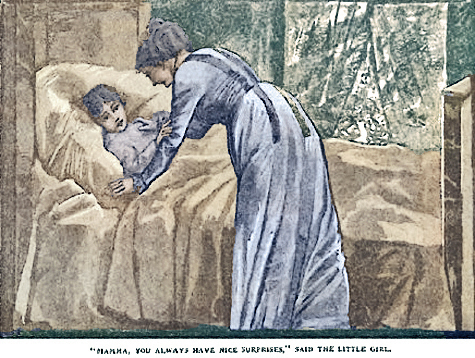
"MAMMA, YOU ALWAYS HAVE NICE SURPRISES," SAID THE LITTLE GIRL.
"Now, darling," said the mother, and she bent over the bed again, and to Hannah's great surprise lifted the slight little form in her arms and carried her to an easy-chair. Then Hannah saw that the poor little feet were much smaller than they ought to be, and that there was a bandage around one of them.
"Didn't you know that you were to be feet for my little girl?" Mrs. Stevens said, speaking to Hannah, an she saw her startled face.
"Can't she walk at all?" was her dismayed answer.
"Not now," the mother said, gently; "she is going to some day, we hope. You may come in now."
"Mamma," she said, "I can go visiting now whenever I want to, can't I?" And that happy little laugh gurgled out; then almost in the same breath she said: "Mamma, what about the other one?"
"I don't know about that yet," the mother said. "I will leave you to plan for it."
"The other one," muttered Hannah. "What can she want of two?" The sullen look had come back.
"Don't you think my new carriage is lovely?" Helen ventured this to the gloomy-faced little girl.
"Yes 'm," said Hannah absently; "yes 'm, I s'pose so."
"But you don't think you would like it as well as walking?"—this with the least bit of a sigh. "I like it very much, though; it is such a rest to me. I haven't walked a step in two years."
She expected to see the gloomy face change into one of surprise and pity; but Hannah said, speaking almost fiercely: "I know a boy who hasn't walked a step in five years."
"Oh dear me!" There was instant sympathy in Helen's voice. "Who is he? What is the matter with him? How old is he?"
"He's my brother," said Hannah in a gentler tone. "He is most twelve years old, but he is so little and weak, you wouldn't think he was six. I can carry him just as easy! He had a very had fall when he was seven, and he won't never walk again."
"Poor little fellow! And has he a wheeled chair, and a couch that can be raised and let down, and a sponge pillow when his head aches, and oh! I don't know: all sorts of nice things?"