Book 3 — A SLAP AT SLOP AND THE BRIDGE-STREET GANG
Reading edition
Original Size -- Medium-Size
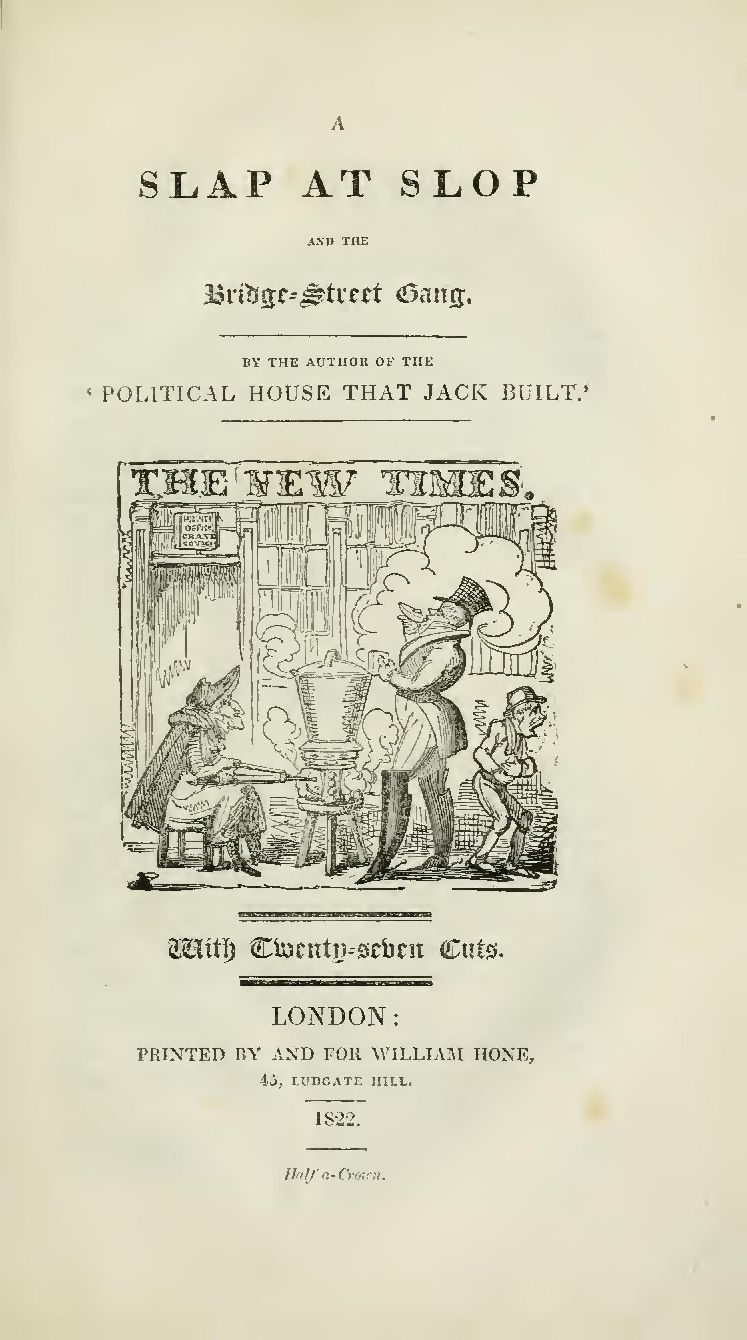
With Twenty-seven Cuts. LONDON: PRINTED BY AND FOR WILLIAM HONE, 46, LUDGATE HILL. Half a-Crown.
TO THE READER.
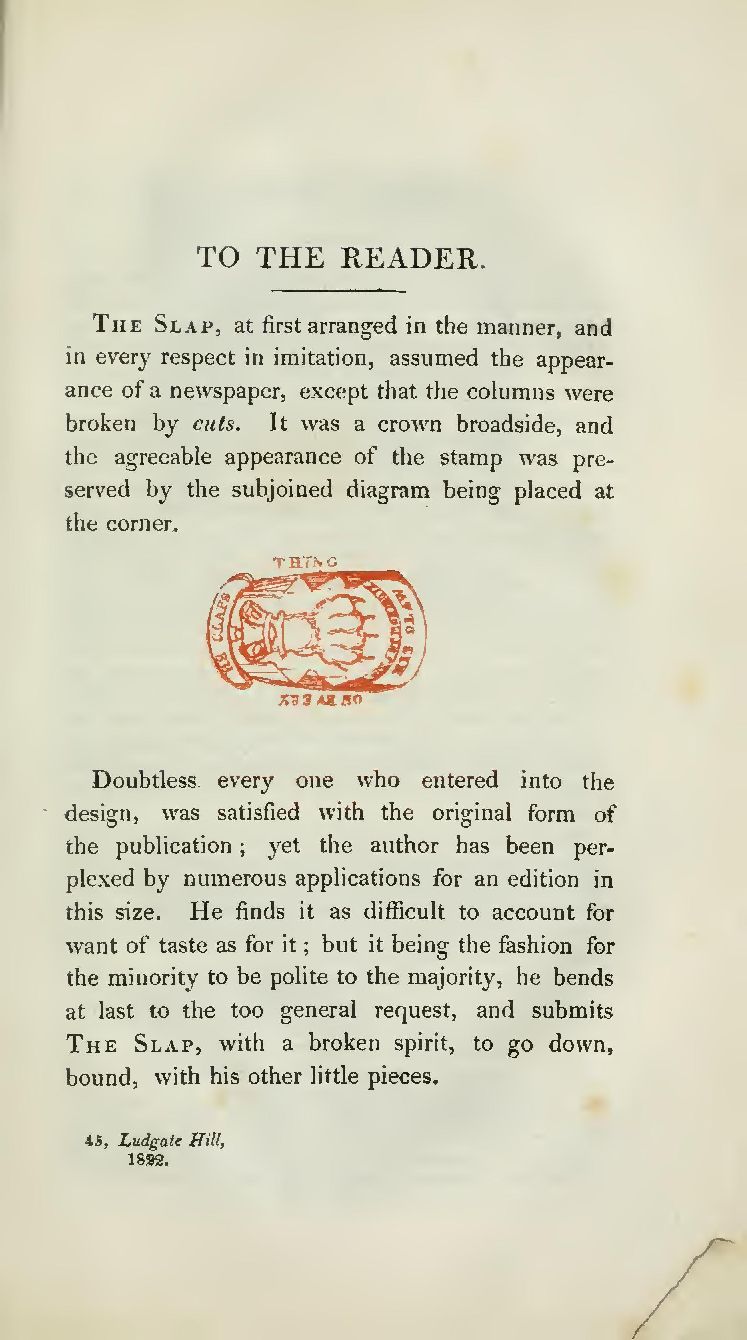
The Slap, at first arranged in the manner, and in every respect in imitation, assumed the appearance of a newspaper, except that the columns were broken by cuts. It was a crown broadside, and the agreeable appearance of the stamp was preserved by the subjoined diagram being placed at the corner.
Original Size -- Medium-Size
Doubtless every one who entered into the design, was satisfied with the original form of the publication; yet the author has been perplexed by numerous applications for an edition in this size. He finds it as difficult to account for want of taste as for it; but it being the fashion for the minority to be polite to the majority, he bends at last to the too general request, and submits The Slap, with a broken spirit, to go down, bound, with his other little pieces.
45, Ludgate Hill,
1822
Original Address
A Bag of political nuts ready cracked, is not only rather dangerous fare to serve up, but a man who takes the trouble to crack them, will find the kernels cleaner and sweeter for his pains. Though they who run may read the greater portion of the present sheet, yet there are a few articles that require attention, and two or three arc designed for those only who alone can understand them.
My first intention was to parody Slop's paper, 'The Slop-tail,' or 'Much Times,' throughout. But he is as vapid as the Marquess of Lunnunderry. * What could I do with thoughts as unquotable, as confused, as ill conceived, as ill expressed, as that puissante ** Lord's —without depth or originality—as plentiful and superficial as duck-weed.
I found not a sparkle of talent in any of Slop's lean 'leaders' to re-pay me the trouble of wearisome reading. Under the 'stringent necessity' of varying my original plan, yet loth to abandon it altogether, I have parodied some of the features common to the Slop-pail, and supplied the department I had allotted to an imitation of his mindless verbiage with a sketch of his Life—filling the remainder of the sheet in my own way. There are discrepancies inseparable from this course, but I write to good-humoured readers, who have no objection to see the mind as well as the person of a friend in undress, and who take as little interest in the decision of the High Court of Criticism on things of this sort, as they took in the decision of the 'Court of Claims' concerning the 'imposing' ceremony of the coronation, and things of that sort.,
The drawings are, as usual, by Mr. George Cruikshank, whose able pencil has had greater scope here than in a pamphlet; that size would have entirely excluded Dr. Southey's Vision, the
Jack-in-the-Green, and the masterly representation of the Bridge-street gang destroying a Free Press, and suspending Liberty, while Slop is working his Press to distort and torture Truth.
* The Marquess calls London, 'Lunnun.' ** A Marquess is styled 'a most puissant Prince!' *** For this constipating phrase, see Slop Pail, July 26, 1821
Original Size -- Medium-Size
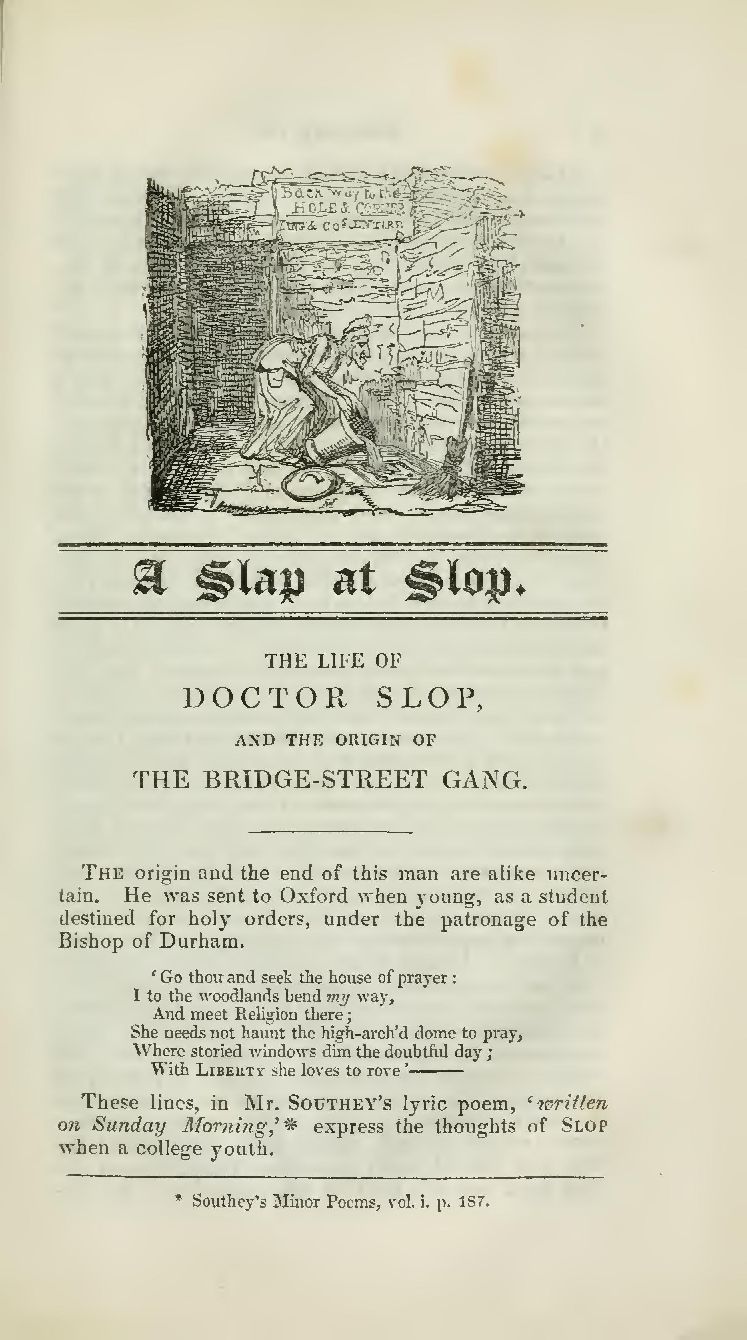
THE LIFE OF DOCTOR SLOP,
AND THE ORIGIN OF THE BRIDGE-STREET GANG.
The origin and the end of this man are alike uncertain. He was sent to Oxford when young, as a student destined for holy orders, under the patronage of the Bishop of Durham.
'Go thou and seek the house of prayer:
I to the woodlands bend my way, And meet Religion there; She needs not haunt the high-arch'd dome to pray,
Where storied windows dim the doubtful day;
With Liberty she loves to rove'——
These lines, in Mr. Southey's lyric poem, 'written on Sunday Morning,' * express the thoughts of Slop when a college youth.
* Southey's Minor Poems, vol. i. p. 1S7.
At that time he had a sort of conscience; for, in consequence of an honest course of reading, he refused to subscribe to the Thirty-nine Articles. Thus disqualifying himself from being a candidate for the 'imposition of hands' by the Bishop, he for ever relinquished the prospect of entrance into the church, and cultivated his mind by reading Paine's Rights of Man.
Fascinated by the writings of Mrs. Mary Wollstoncrofft, more especially by her celebrated 'Vindication of the Rights of Woman,' he assiduously sought that lady's acquaintance, and having obtained the desired honour, cultivated her intimacy with passionate admiration. On the appearance of Mr. Godwin's 'Inquiry concerning Moral and Political Justice,' he read and studied it with doting enthusiasm; the chapters on Property, and on the Sexual Intercourse, were particularly to his taste—the chapter on Sincerity, not so much. Hungering for a personal friendship with the author of the Political Justice, who became the husband of Mrs. Wollstoncrofft, he humbled himself before him, beseeching permission to consider that philosopher as his Gamaliel, and to sit at his feet as the least of his disciples. This was granted, and in that school he commenced an intimacy with Mr. Thomas Holcroft and his friends. That gentleman had just been released from imprisonment, under indictments for high treason, with Messrs. Hardy, Horne Tooke, and Thelwall, who were tried and acquitted of the charge; and at this time Slop's political fervor rose above the temperament of the most hot-blooded among the patriots he associated with. It had been fashionable to wear the hair long and. tied; he thought this aristocratic, cut his hair off to look like a democrat, became a round-head, and was called Citizen S. At length he was marked out from his fellows by the distinguishing appellation of 'the Jacobin,' and he became a Leveller. Affixing to the words 'Liberty and Equality,' an interpretation of his own, he contended with the Spenceans, that there could be no real Liberty without Equality so he preached the doctrine of all things in common; and prevailed on a young man who had imbibed some of his notions, to aid him in proving its advantages. In an attic chamber in the Temple they founded a community of goods—lived on short commons —and waited on each other. Here Slop lighted the fire, and fetched water from the Temple pump for their joint use, till, tired of the pitcher-duty, he proposed transferring the undignified office to his companion, who declined to accept it; and a fierce quarrel arising in this 'perfect state of society,' concerning rights and duties, the Commonwealth of two ceased to exist.
In this exigency, moderation, which at one time he seems to have thought criminal, became expedient on many accounts. About 1796 he visited Scotland, with letters of recommendation to respectable society; yet his wild opinions on religion and politics caused him to be disliked by some of the most respectable students who held Whig principles, and who, still holding them, dislike and shun him now for his extreme violence in another direction. When at Edinburgh, he affected singularity of habit as well as thought, and paraded the streets, especially the Leith-Walk, in a drab dress of romantic simplicity. On his return from Scotland, he employed himself in writing for the booksellers. In 1798 he translated the play of Don Carlos, from the German of Schiller, and presented his friend, Mr. Holcroft, with a copy, who says, that 'he executed his task respectably.' * On the 5th of August, in that year, he dined with Mr. Godwin and Mr. Parry (the Republican Editor of the Courier Newspaper when it was conducted on democratic principles), at the house of Mr. Holcroft, where, according to that gentleman's diary, ** he was, 'as usual, acute; but pertinacious and verbose. On the 25th of November, he wrote to Mr. Holcroft, complaining of neglect, *** who answered by denying such intention; and indeed his intimacy with the coterie at Mr. Holcroft's, was of the closest nature, and his attachment to that philosopher's principles and person so strong, that he proposed intermarriage with his family, which was declined. He remained ardently devoted to the new philosophy, long after Mr. Holcroft's death, and until Mr. Godwin found it convenient to decline his wearisome acquaintance. Fickleness and obstinacy, and the exercise of a faculty for incessant disputation, rendered his society very tedious to the philosophers. Fruitless attempts to repress or soften his pugnacious turn, exhausted their patience. In defence of themselves, they disregarded and finally cut him;—so that it became the New Times with him in philosophy.
* Holcroft's Life, vol. ii. p. 269. ** Ibid. vol. iii. p. 32. *** Ibid. p. 76.
He rambled to conceal his discontent, and to get fresh notions and fresh friends. A pedestrian tour through Scotland, with letters of recommendation, and a pliability of manner accommodated to his new views, effected both. He published his Tour in 1801. It is written with extreme caution. His real opinions are kept out of the book as much as possible; yet they occasionally peep forth; for instance, he says, 'We seem inspired with enthusiasm to fall down and worship the golden image of commerce; let us not wholly submit our feelings to our purses, and counters, and ledgers—we may be very rich in products, and manufactures, and population, and very poor in the spirits and minds of men!' *—he dare not put that in his Slop-pail. In the Tour, he speaks in praise of the Rev. Sir Henry Moscreiff
Wellwood, a Scottish Baronet of Whig principles, whose daughter he afterwards married, whether from innate love of legitimacy, or what, is unknown. Before he wrote the Tour, he procured the degree of LL.D. (as the Laureate has done since), and the philosopher, who had refused subscription to the Thirty-nine Articles to the Church of England, and had been in turn a Republican, a Jacobin, a Leveller, and a Spencean, became a Doctor of Laws, and sunk into the wig and gown of an advocate in the Ecclesiastical Court! Resuming an intimacy with some young men of his own stamp, who knew him at college, they obtained a place for him—he was made king's advocate at Malta. So fell Slop. Here ended his career of what he called Patriotism. He mistook passionate heat for the enthusiasm of genius, a habit of loud talking for talent, a ranting way of writing for reasoning, and pertinacity of manner for firmness of character. His vain disputations occasioned him to be noticed, and this he thought equal to being admired. Conceit of ability rendered him covetous of distinction; he acquired it—
'The Court's a golden, but a. fatal circle, Upon whose magic skirts a thousand devils, In crystal forms sit tempting innocence, And beckon early virtue from its centre.'— Stoddart's Tour, vol. i. p. 12.
The smirks and smiles of courtiers, the tinsel and glitter of embroidered coats and waistcoats, the hum and sops- of office, hurried him into the train of ministerial menials, as easily as a beggar's hungry brat is seduced by the finery of gilt paper, and the sound of the shovel and brush, to follow the chimney-sweepers on May-day, through the dirty alleys of St. Giles's. His artificial wants were too many to be gratified by an even walk in the path of rectitude. When he saw that 'public principle' was an obstacle to the gratification of his vulgar vanity, he suppressed it—
'He was no Patriot then, nor gave his breath Bravely to speak his mind, and venture death:— For'twas his judgment then—though not in youth— One grain of ease was worth a world of Truth' Watts.
Notwithstanding this, he remained, secretly, a correspondent to the Monthly Magazine, and wrote for Sir Richard Phillips.
Vacating his place at Malta in favour of his brother-in-law, and coming back to seek his fortune, he scrambled about during a year and a half, in Doctors' Commons and among the booksellers, in search of employment, till he procured an engagement from the proprietors of The Times as a writer in that journal. His labours in this way were ardent, but profitable to nobody but himself. On the return of Napoleon from Elba, the ex-republican became an admirer of privileged orders, and 'the right divine of kings to govern wrong'—glorified the thrones of the allied despots—fell flat on his face in worship of legitimacy—and affected a beatific vision of the political millenium in the restoration of the Bourbons. He soon honoured Napoleon with all the obnoxious designations the language could supply. He called him 'a villain, a wretch, a rebel, a brigand, a traitor, a fiend, a felon, an incendiary, an impostor, an assassin, a viper, a demon, a fool, a living Moloch, a bloody dog, and a blackamoor.' * To these and hundreds of other names, he prefixed innumerable epithets expressive of disgust and hate. Every one but himself saw that such a course must shortly end. The writer of this article being forcibly reminded of the cursing of Trim in Tristram Shandy, ridiculed Slop's Execratory, in a little piece intituled 'Buonaparte -phobia; or, Cursing made Easy, &c. by Dr. Slop.' * It not only insured to him the name of SLOP for ever, but hastened what was neither intended nor anticipated, his dismissal from The Times.
* See the Tract, intituled 'The Origin of Dr. Slops, Name.'
The persecution of the French Protestants on the restoration of Louis XVIII. and their massacre at Nismes, occasioned the English Protestants to interest themselves heartily for their relief. The Committee of Dissenters at Dr, Williams's Library in Red-Cross-street inquired into the facts, published a verifying Report, and took measures for sending pecuniary succours. Seeking to earn the wages of his prostitution by slavering the hoof of tyranny, and maddened that Bourbon bigotry should be obstructed in its operation, Slop denied the truth of the statements, vilified the whole body of English Dissenters, imputed their humanity to unworthy and scandalous motives, and threw as many daring fabrications as his mercenary pen could create in the way of their efforts. With undaunted audacity he gave the lie direct to his father-in-law, Sir Henry Moncreiff Wellwood, who, in the kindness and courage of his heart, became President of a Public Meeting at Edinburgh, and inspirited the Protestants of Scotland to co-operate in a national subscription for the persecuted. When Slop's slanders were successfully repelled, and his artful falsehoods exposed, he withdrew without evidencing any other regret than what arose from his having been unable to effect his unhallowed purposes.
His first exploit after his expulsion from The Times was, an attempt to delude the public by engrafting himself upon a quacking newspaper, now known, like himself, by a two-fold name, it being indiscriminately called 'The Muck Times,' and 'The Slop Pail.' The imposition succeeded only with a few. His writing gave the lie direct to his puffing pretensions, and his falsehoods were exposed in the paper from which he had been discharged. * He knows full well,' says The Times ( in February, 18]7) that 'his articles were rejected from our columns on account of the virulence and indiscretion with which they were written; and that, for more than twelve months preceding, whatever articles attracted notice by their merit, were exclusively the productions of other gentlemen.—There are in the office, sacks full of his rejected writings; which, if they were published, would exhibit an accurate criterion of his puffed-off abilities; the sale of our Journal increased the more, the less he wrote; and since he has ceased from writing altogether, has extended with a rapidity of which we have known no example, since we have had the management of it. This and other statements were stunning blows to him, and remained unnoticed, because they were unanswerable.
* This squib is reprinted entire in a pamphlet, intituled 'The Origin of Dr. Slops Name.'
His overweening pride received another shock through his new friends the legitimates. He went to Paris, and applied to be introduced at court; but 'The Bourbon' refused to receive him! Yes! refused to receive him—Slop; that Slop who, to gain the favour of his Most Christian Majesty, when he was in England, had 'tainted himself with the plague-spot of Legitimacy, till he was leprous all over; in whose inmost soul it had fixed its mortal sting, and, like an ugly spider, entangled him in its slimy folds, brooding on him as on its own poison.' ** He—who had abandoned principle, was abandoned by friends, had incurred the world's contempt, and had sold himself to the devil in the service of legitimacy—he to be refused permission to bow over the hand of Louis XVIII!—he to be despised and rejected by that same Louis who had received Mr. Street, the late Editor of the Courier, with open arms, and conferred on him the order of the Lys!—this was the unkindest cut of all! He returned to England in the last stage of mortification—a bye-word—a reproach—a laughing stock!
* See also 'The Origin of Dr. Slop's Name.'—Preface ** Hazlitt's Political Essays.—Preface.
Harnessed with other hacks to the machine of tyranny, he must answer to the lash of the driver, and drag it along, or be trampled over. Smack went the whip, and on went Slop. To support the new order of things in France, it was necessary, in addition to the bayonets of foreigners, that the press there should be put under a censorship, and that the free press of England should make a monstrous experiment to write up the advantages of a shackled press in France. Dr. Slop undertook the task, and joining to himself another Doctor, the Poet Laureate, they united with persons of similar qualifications in France, and commenced operations by announcing a publication called the 'Correspondent,' which was to appear at London in the English, and at Paris in the French language on the same day. It was conducted on the plan of a 'Class-meeting' among the Methodists, where each relates his 'experience.' But neither the French nor the English cared a sous about the political 'experience' of Doctor Slop, Doctor Southey, or the mad Viscount Chateaubriand. Besides, the Poet Laureate, instead of telling his own 'experience,' told, a long story about the Rev. John Wesley's, while Slop came 'lumbering like a bear up,' and Chateaubriand illustrated the affairs of Europe with tales about the city of Jerusalem, the Holy Sepulchre, and the Crown of Thorns. The 'Correspondent' fell still-born amid the laughter of the few people of both nations who knew of its coming forth, and perhaps there are only five persons in England who remember it even by name—Messrs. Longman, Hurst, Rees, Orme, and Brown, who had the honour of the profit and loss account.
Devoid of political principle, Slop's real source of action is pure selfishness. His end and aim are antisocial, because his Slop-pail can only exist during political strife. He would inflame the passions of ministers and their minions, to vex and to harass the people, that the people may be irritated into resistance against persecution. He and his fellow-laboureres vilified and goaded whole communities of starving manufacturers. These unhappy men, congregated and organized into powerful bodies, simultaneously demanding a redress of wrongs and grievances, he exultingly recorded to have been dispersed and cut down by the sabres of the military —but not until he had so altered and 'garnished' the account of the massacre, furnished him by Orton, * as to make it pleasing to the depraved taste of his mindless readers, and serviceable to the political views of his base supporters. This was his harvest; but he has reaped that, and is sowing another.
* Henry Orton, not Horatio Orton the Informer to the Gang, but his brother. This Henry Orton was a witness for the Prosecu-tion against Mr. Henry Hunt and others, at York; and when cross-examined by Mr. Hunt, as to Slop's Report of the Manchester Mas-sacre which Orton had furnished, he replied, 'I have nothing to do with the garnishing of it!'—See the Trials at York.
Pending the prosecution of the Queen, the Rev. Solomon Piggott, Curate of St. James's, Clerkenwell, and St. Antholin's, Watling-Street, a man of weak and restless mind, conceived the idea of publishing Caricatures, by Public Subscription, in ridicule of her Majesty and her supporters. He communicated this design to Dr. Slop, who engaged heartily in the plan. Subscribers were advertised for, and were formed into a body, called 'The Loyal Association,' and Mr. Charles Bicknell, of No. 3, Spring Garden Terrace, the Solicitor to the Admiralty, was the Treasurer. Piggott wrote maudlin prose and wretched verse, and illustrated his unintellectual labours with coloured caricatures. These were issued to the world through a Publisher of Obscenity, while they were powerfully puffed by Slop in his Slop-pail, and Piggott himself cringed, his way to Court, and presented the talentless trash to his Majesty in person, who received it most graciously; and, as an encouragement to his labours, subscribed for forty sets of one of his works at a guinea each. But the public judgment refused the rinsings of the sycophant parson's brain; and the united efforts of 'the Loyal Association' being inadequate to produce a single article of ability from the press, they turned their thoughts towards an attack upon the Press itself. They were deplorably 'poor in the spirits and minds of men,' but 'their purses, and counters, and ledgers,' were productive, and at one of their meetings they abandoned the project of a Series of Publications, and determined to commence a Series of Prosecutions. The notorious John Reeves, a plentifully-endowed placeman, who had thrown the country into a state of alarm by a Loyal Association in 1793, entered into these views; but, as the term Loyal had acquired an unfavourable odour, they changed their name from 'the Loyal Association,' to 'the Constitutional Association.' Piggott's Treasurer, Mr. Bicknell, with John Reeves (both lawyers), got Sir John Sewell (also a lawyer), a pensioner in the Red Book, to become the president of the confederacy. They appointed Charles Murray (another lawyer), their 'Honorary Secretary', a very acceptable post to a hungry attorney, who had quartered part of his family in public situations. He eagerly embraced the office of their Old-Bailey Solicitor; it brought him fees, and perhaps he expected it might bring him clients. They were joined by Longueville Clarke (also a lawyer), and the son of a person holding an appointment in a Government Establishment. John Poynder (also a lawyer) resident in Bridewell, to which, as well as Bethlem (two other Government Establishments), he is Clerk and Attorney, had been compelled to resign his office of Secretary to the Bible Society, and was at full leisure to become an active confederate. Intercourse with the prisoners in Newgate had given a certain turn to his views; a drinker of port wine himself, he had descanted, before a Committee of the House of Commons, on the wickedness of common gin; with a good comfortable house over his head, at the public expense, he had disturbed poor old apple-women who sought an independent living 'in summer's heat and winter's cold he had also a horror, upon public principle, of street organs in the evening; and, like his friend Slop, he had experienced the mortification of having his defamatory, and 'mewling and puling' writings rejected by 'The Times'—the new concern was quite to his taste. Slop (himself a lawyer) became the Horn-boy of the Gang,—to blow the 'great news,' the 'extraordinary new's,' of their proceedings—to puff their attacks upon the Free Press of the People—to assist in raising the flame of alarm throughout the country—and to give the earliest intelligence of their Prosecutions. This paid Slop well, for the trouble he had with Parson Solomon, in laying the Plot; for, as the adherents to it increased, they took especial care to give their support and influence to the hireling paper, from whence Slop derives the means of supporting his tawdry existence. By these measures, the weak-minded were terrified out of subscriptions for anti-social objects; and the selfish crew having gathered around them the chief priests, and the pharisees, and some of the fattest amongst the placeholders, pensioners, and tax-eaters, who exist upon the people's labour, they fitted up an office at Walker's Hotel, No. 6, New Bridge Street, Blackfriars, for the purpose of more conveniently carrying on the imposture. From this 'Den' they put forth a specious Address, which is rendered into pretty intelligible language in subsequent pages of this publication. *
* Pages 22-4.
In that paper these conspirators, battening upon the public purse, and preying upon public credulity, knavishly affected to lament 'a perversion of public principle and, with their fingers twitching at the purse-strings of their dupes, hypocritically whispered in their ears about 'mockery of religion!'—like the hacknied procuress who, to effect her designs upon innocence, pretends an extraordinary affection for virtue. What shameful pimping to the whiffling understandings of the timid! What artful pandering to pampered bloatedness! What an insolent appeal from the minions of power, and the overgorged feeders upon the public wealth, to their fellow parasites and gluttons! How dare they to talk of 'public principle? whose weight increases that enormous burthen of taxation which depresses the labourer to the very earth, and enters as iron into the soul of every industrious man in the country—how dare they to talk of 'public principle.' Then as to their cant about 'mockery of religion'—suppose the writer of this article had published at his house, 45, Ludgate-hill, the following—
Page Image ===>
BILL FOR REPAIRS OF PAINTINGS.
Suppose that William Hone had published this, what would Slop and the other Members of the Bridge-Street Gang, and Charles Murray, and Joseph Budworth Sharp, and Slop's Readers, have said? But William Hone did not publish this. No. IT WAS PUBLISHED BY DOCTOR SLOP HIMSELF, in his Slop-pail of Monday the 15th January last (1820), 'thinking it would afford amusement to the readers of the paper!' *
Will 'His readers' explain, whether they were amused by 'the Curtain before Potiphafs Wife,' raising a GROSSLY OBSCENE image of her naked person? Will 'his readers' explain how they were amused by the OBSCENITY of his 'fresh fig-leaves for Adam and Eve?' Will 'his readers' explain, what suggestions were conveyed to their minds by 'a Fresh Witch of Endor,' and by 'Six strings for David's Harp?'—that harp to which the Psalms were sung, that have rolled on to us in the full majesty of poetical grandeur during successive generations, and will continue their choral pealing to the loftiest feelings of the human heart, till they, and the music of the spheres, shall cease together.
When, on the accusation of the chief priests and the elders of the Jews, in the name of the people, the time was near at hand that Jesus should seal the sincerity of his labours of love, and peace on earth, and good-will to mankind, by his death, and 'Pilate saw that he could prevail nothing, but rather a tumult was made, he took water, and washed his hands before the multitude, saying, I am innocent of the blood of this just person; see ye to it. **—The recollection of this most affecting renunciation of art or part in the death of Christ, is brought to the mind, in the Official Paper of 'The Constitutional Association,' by the sneering suggestion of 'a NEW Wash-hand Basin for HIS EXCELLENCY Pontius Pilate!'
* See the Slop-pail of that date. ** Matt, xxvii.
Will 'the readers,' for whose 'amusement' Dr. Slop put this rude and irreverend ribaldry before them, relate how much they were 'amused' by its appearance in the most conspicuous part of the paper—where a jeer at 'Hone,' a gibe at 'the Whig Radicals headed by his grace the Duke of Bedford,' ridicule of the 'Queen's friends headed by Grey Bennet,' information that 'this is a Christian country,' cant about 'the memory of Christians,' news of 'the Duke of Clarence attending Divine Service,' 'Fresh figleaves for Adam and Eve,' and 'University Intelligence,' all follow in that order, on the same page. Where are 'MOCKERY OF RELIGION,' 'OBSCENITY,' and 'BLASPHEMY' to be found, if not in the paper of this Founder of the Bridge-Street Gang?
This varnished hypocrite is said to be a gentleman:—it may be so. The article, so called, can be easily manufactured by a tailor and a dancing-master, and a few lessons in the school of Chesterfield. A head, powdered and erect, a solemn stalk, a bow to people of certain rank, the cut to people of another rank, and an affected condescension to those termed inferiors, will procure any man the reputation of being genteel, among the groundlings. Such gentlemen as these swarm in shoals, from the Bridge-Street-Gang Informer to the Marquess secretary for foreign affairs; the appearances that constitute these personages are usual and essential to every adventurer.
When Slop parted with his integrity, he lost his selfrespect. Attacking the honesty he secretly envies, and has not the courage to imitate, he has nothing to compensate him for a comfortless mind, but an empty consequence among fools and knaves, which yields no repose. His appearance in the Slop-pail is ludicrous. Affecting a semblance to which he has no real pretension, he looks like a nightman in a cocked hat, who pulls up his frill at every discharge of muck, to show his gentility. His case is a common one. He rose from the bottom of society by foul self-inflation, and floats a filthy bubble among the scum upon the surface.
A minion of ministers, a parasite to despotism throughout the world, public virtue is the object of his unprincipled hate and unsparing abuse. Hence, there is not a 'public principle' that his mendacity has not 'perverted;' not a man of disinterested public conduct that he has not vilified; not a measure of advantage to the country, emanating from such men, that he has not derided; not a measure of ministerial profligacy that he has not promoted; not a public job that he has not bolstered; not a public knave that he has not shielded; not an inroad upon the constitution that he has not widened; not a treason against the people's liberties that he has not advocated; not a sore upon the people's hearts that he has not enlarged.
The Author of the Political House that Jack Built.
45, Ludgate-hill, Augusts, 1821.
SONG
Imitation of Mr. Canning's in the Rovers.
("AIR, Lanterna Magka.)
Whene'er with aching eyes I view The troublers of the nation, I find them one conspiring crew,— The Bridge-street Gang—the Constitu- tional Association— tional Association. Slop's venom, of high Tory blue, The Stuart royal fashion, In secret gave the poison to The daggers of the Constitu- tional Association— tional Association. Forth from his Slop-pail swift he flew, In dread of moderation, Assassins' knives to cowards threw, And call'd the Gang the Constitu- tional Association— tional Association. I, who when wild his Curses flew, Gave him his appellation, * Would force him into light, in du- ty to unmask his Constitu- tional Association— tional Association. Against me if his Slop-pail brew, For that high designation, I spurn his Slop-pail, spurn him too, And scorn his Gang, the Constitu- tional Association— tional Association. Until a fouler opportu- nity, a filthier still occasion, He'll empt' his dirty Slop-pail gru- el, through his sink-hole Constitu- tional Association. - tional Association. But should he shrink from public view, Or sculk with mean evasion, I'll lash the knave and all his crew— Slop and his Gajjg, the Constitu- tional Association— tional Association.
Original Size -- Medium-Size
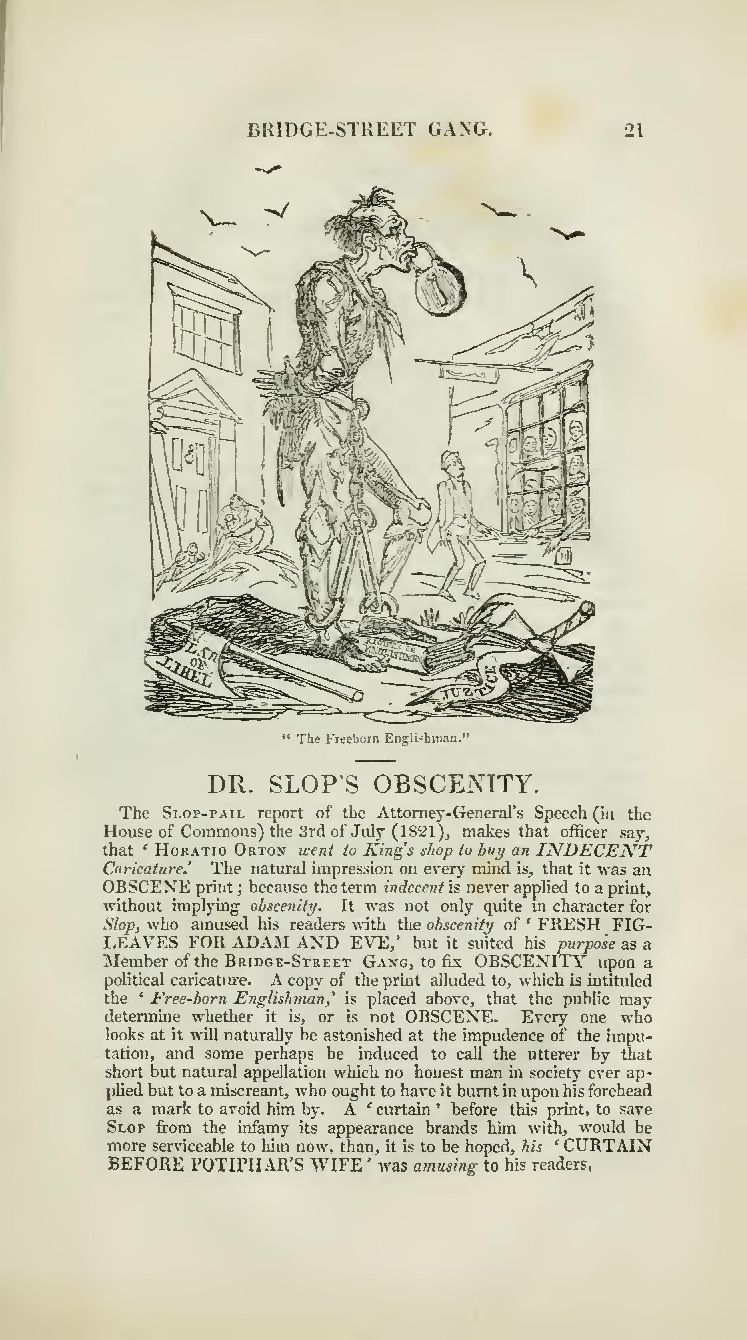
DR. SLOP'S OBSCENITY.
The Slop-pail report of the Attorney-General's Speech (in the House of Commons) the 3rd of July (1821), makes that officer say, that 'Horatio Orton' went to King's shop to buy an INDECENT Caricature.' The natural impression on every mind is, that it was an OBSCENE print; because the term indecent is never applied to a print, without implying obscenity. It was not only quite in character for Slop, who amused his readers with the obscenity of 'FRESH FIG-LEAVES FOR ADAM AND EVE,' but it suited his purpose as a Member of the Bridge-Street Gang, to fix OBSCENITY upon a political caricature. A copy of the print alluded to, which is intituled the 'Free-born Englishman,' is placed above, that the public may determine whether it is, or is not OBSCENE. Every one who looks at it will naturally be astonished at the impudence of the imputation, and some perhaps be induced to call the utterer by that short but natural appellation which no honest man in society ever applied but to a miscreant, who ought to have it burnt in upon his forehead as a mark to avoid him by. A 'curtain' before this print, to save Slop from the infamy its appearance brands him with, would be more serviceable to him now, than, it is to be hoped, his 'CURTAIN BEFORE POTIPHARS WIFE' was amusing to his readers,
INQUISITORIAL ASSOCIATION,
FOR OPPOSING THE PROGRESS OF KNOWLEDGE AND CONSTITUTIONAL PRINCIPLES.
PRESIDENT—SIR JOHN SEWEL, Knt. LL.D.
ADDRESS.
[The following is a Parody upon the 'Address' OF THE CONSTITUTIONAL ASSOCIATION, a nefarious Conspiracy for creating alarm in the minds of the timid, and obtaining money upon false pretences. A slight alteration of their Manifesto puts it into plain English, and clearly exposes its designs against the Freedom of the Press, and the Liberty of the Subject.]
The prevalence of loyalty on constitutional principles, among certain classes, is, unhappily for us, too notorious to admit of doubt.
Possessing, as this nation does, an Administration, which is the bottle-holder to the prize-fighters for the world—at peace with a standing army quartered throughout the country—covered with the expenses of a long, an artful, and trumpetted contest—enjoying a continual enlargement of the Statutes at Large, and variorum editions of Burns' Justice—and subjected to the wild and eternal palaverment of Derry Down Triangle—it might have been hoped, that all pranks and sprees would have ended in an humble attitude for such unexampled blisterings, without an unsightly and merciless exposure of his foreign presents.
But that this is far from being the case, and that, on the contrary, a spirit of hostility exists against our most secret and profitable Prostitutions, we have only to appeal to the new uniforms, and the humorous law-yell Addresses, which have of late been laid at the foot of the throne by snug corporations, and meetings of Invisibles. Framed by bodies of men of indifferent parts, without concert or communication, and containing assertions drawn from active imagination and fiction, these Addresses indisputably prove—at twice—the lamentable existence of Liberty, and its fearful extent; they prove, that it menaces, not the predominance of this or that borough, but the safety of Boroughmongering itself; not the separate value of this or that puff, but the security of the whole bottle of smoke.
The consequences which have already resulted from the propagation of public principle, are but too obvious. Among them are to be numbered a daily and weekly bond of union between the humbler ranks of society, and their natural guardians and protectors—independence—disregard of mere jaw—and frequent attempts to obstruct our botheration—increased sale of The Times—renunciations of respect for the greatest humbugs in the country—hatred of hypocrisy—querulous impatience of unjust control and illegal restraint—ridicule of vain and ostentatious pretenders to all sound learning, experience, and knowledge—interruption of the courses of Sir Manasseh Masseh Lofez, and derangement of the great concerns and enterprizes of the Court Newsmen during the Coronation.
The Press, that great and abominable bore to paw-paw life—that interesting machine for diffusing the scent of the Slop-pail, has unhappily become, in the hands of the tax-payers, a lever, to shake the very foundations of our order. Its power, which within the last century has been multiplied a hundred fold, may now be said to reign paramount over vice; and to those friends to themselves, who dig deep into the fat of the land, it cannot but be matter of serious alarm to observe, that a very large proportion of our periodical publications is under the direction either of avowed enemies of the close boroughs, or of persons whose sole principle of action is opposed to our own private and self-sell interest. Every heart and voice is employed with daily increasing boldness to render the people acquainted with the proceedings of the borough-mongers—to show them that they are not represented by those whom they have not elected—to seduce them from their long affliction and allegiance to our sovereignty; and finally, to bring about a Reformation, on which the prosperity, the internal happiness, and the political greatness of the empire, must inevitably be established—and our interests be sacrificed.
As it is clear, that isolated and single-handed exertion is utterly inadequate to more than a grope at the good things arising from the present state of disorder, and that we should not, perhaps, get a mouthful a-piece; so it is to be feared, that the government and legislature might render our contest for them difficult, without an active, zealous, and persevering botheration against the reformingly disposed individuals of the community, which botheration, to be effectual, must be a running fire, and a continued insult towards such individuals.
Persuaded that by these means alone the said good things can be arrested; and feeling that to arrest them, if possible, is our bounden duty, the Members of this Society will immediately throw the country into alarm and riot; they have therefore adopted the following Resolutions:
1st. That they will use their best exertions to maintain Mr. Murray, and to support the due execution of his law.
2nd. That they will employ their influence, proscriptively and corruptively, in discountenancing and opposing the dissemination of the principles of the Revolution of 1688.
3rd. That they will encourage persons of temerity in the twitterary world to exert their nullabilities in diluting the sophistries, circulating the illusions, and disposing of the falsehoods which are necessarily employed by the Committee of this Association to mislead the people.
4th That they will resort to such expedients as Mr. Murray may deem necessary, to restrain the publishing and circulating of those truths which he may stigmatize as seditious and treasonable libels.
In wishing that the Press should be securely chained, the Members of this Society have no desire to limit their own bother. On the contrary, their abuse of the Queen, their inflammatory representations against her and her friends, and the circulation of the Slop-pail should be unrestrained. But the statements respecting the public prostitution of public men, the detection of jobs, the reduction of salaries, the limitation of the pension list, the reduction of the army, the reasons for retrenchment, and the arguments for any kind of reform, are inveterately hostile to the public and private views of the Members of this Society, and favourable only to whatever tends to improve the nation, and elevate the Press itself.—This system must be suppressed.
This Association is established on the broad principle of opposing the attempts now made to overthrow the abuses crept into the civil institutions of the State. It has, therefore, been determined,
1st. To establish a Fee Fund for the use and application of Mr. Murray, as he shall see fit.
2nd. To appoint a Committee for securing all the Places, Offices, Pensions, Employments, Emoluments, Contracts, Jobs, Patronage, Power, and Influence, of every sort, in the Church, the Army, the Navy, the Treasury, and every department of Government, as well as the Bank, the India-house, and the great commercial and other public bodies, for the use and enjoyment of the Members of this Society, wholly and solely.
3rd. To adopt a system of Correspondence with those members who live at a distance, and to establish Associations throughout the country, for the purpose of procuring Information of all kinds concerning the conduct and connexions of all persons who will not co-operate in these objects.
Most earnestly, therefore, does this Society call upon all to whom a maintenance, out of the public purse, is dear, upon those who value the places they hold at the expense of the country, or the permanence of the present Administration, to join them in promoting these objects and principles. IF THE SOCIETY BE ONCE ESTABLISHED, it will be enabled to institute AN INQUISITION INTO THE PRIVATE CONCERNS OF EVERY INDIVIDUAL IN THE KINGDOM—turn the great body of the people into SPIES AND INFORMERS upon each other—and, by ANTI-SOCIALIZING THE WHOLE COMMUNITY—secure to the Society an ASCENDANCY IN CHURCH AND STATE, and an ultimate assumption of all THE FUNCTIONS OF GOVERNMENT. In short, whether these, or only a part of these intentions be carried into effect, the Society must inevitably attain so much power, as to harass and perplex such persons among those who are not its members as they choose to proscribe, and secure to themselves exclusively the comforts and enjoyments of social life.
CHARLES MURRAY, Honorary. Secretary.
Original Size -- Medium-Size
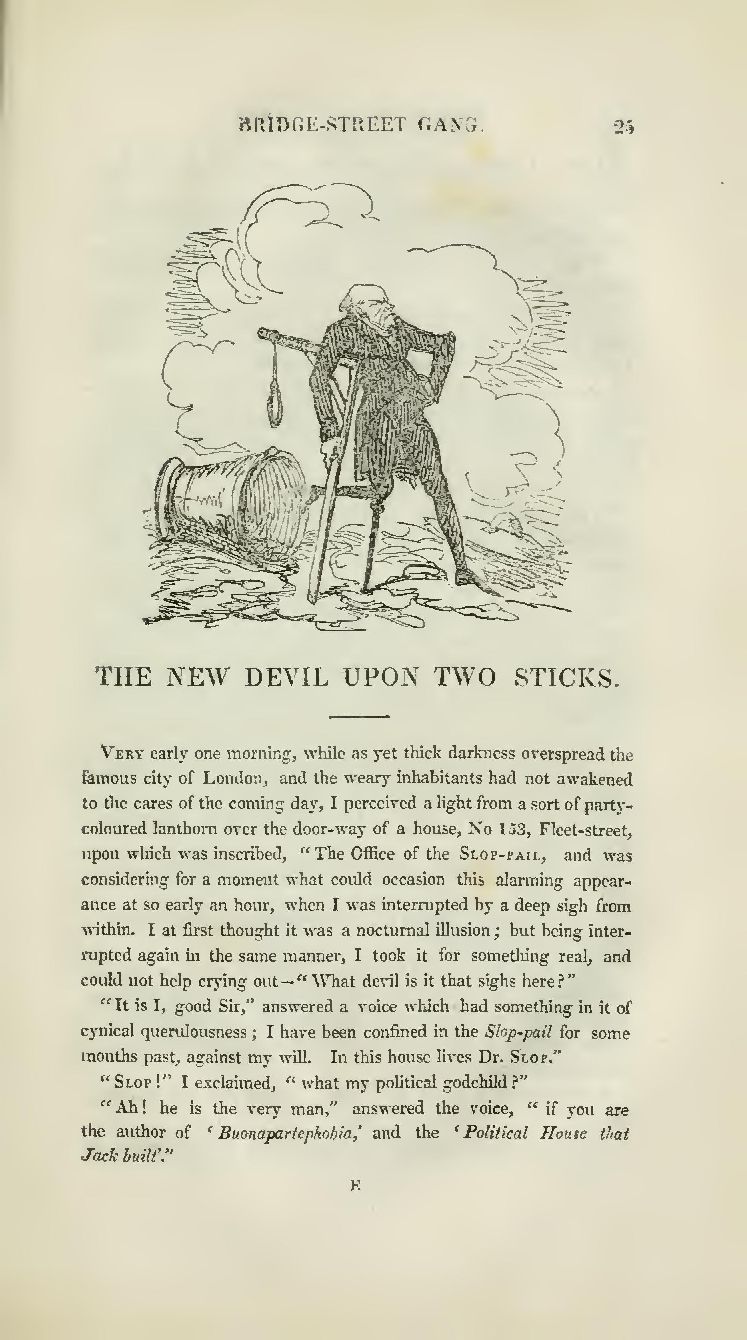
THE NEW DEVIL UPON TWO STICKS.
Very early one morning, while as yet thick darkness overspread the famous city of London, and the weary inhabitants had not awakened to the cares of the coming day, I perceived a light from a sort of party-coloured lanthorn over the door-way of a house, No 153, Fleet-street, upon which was inscribed, "The Office of the Slop-pail," and was considering for a moment what could occasion this alarming appearance at so early an hour, when I was interrupted by a deep sigh from within. I at first thought it was a nocturnal illusion; but being interrupted again in the same manner, I took it for something real, and could not help crying out—"What devil is it that sighs here?"
"It is I, good Sir," answered a voice which had something in it of cynical querulousness; "I have been confined in the Slop-pail for some months past, against my will. In this house lives Dr. Slop."
"Slop!" I exclaimed, "what my political godchild?"
"Ah! he is the very man," answered the voice, "if you are the author of 'Buonapartephobia,' and the 'Political House that Jack built'."
"And they call him Punch. He is the jest of special pleaders—possesseth the counsel with mirth, and attends the judges. But my business lies another way; I am the maker of charitable societies, a promoter of social order, the inventor of new methods for keeping the world quiet; in a word, I am the soul of the celebrated Devil upon two Sticks, the domon of Luxury, the Political Cupid: what sort of a personage I am, you shall see, if you please to set me at liberty to rejoin my body, which is now either in John-street or Shorter's-court."
"Good Mr. Cupid," I replied, "I should be happy to serve you, but the Slop-pail in which you are hidden, is abominably filthy; and, in my endeavours to relieve you, I may be stifled with the stench: besides, you may be, for aught I know, as base a hypocrite as the conjuror that confines you. I should wish to know how you got in, and by what power he holds you, if you are not as vile as he is."
"Ah, do not leave me! For the sake of humanity release me," screamed the Spirit.
He had scarcely uttered these words, when Dr. Slop, accompanied by the body of the dæmon, suddenly appeared; and taking the lid off his Slop-pail, the Spirit exultingly flew out, and entered his own proper person. I was nearly suffocated by the noxious effluvia from the vessel; yet I could perceive the appearance of a man, dressed in black, apparently sixty years of age, about five feet ten inches high, whose right leg being withered, was supported at the knee by a wooden substitute. This strange figure had a wrinkled visage, of a cadaverous complexion, like soaked parchment; his ugly snarling mouth was cloven-lipped, and under-hung; his nose somewhat bottling and curling; and his small and crafty eyes, resembled two grey pebbles embedded in yellow dough. The top of his head was bald; the hair at the back and sides, thin, and cut short, was pomatumed and powdered. He supported himself by a crutch, which appeared to me, a gallows; and crossing Fleet-street with rapid strides, this New Devil upon two Sticks, ascending the steps of Walker's Hotel, by the aid of Dr. Slop, was received with loud acclamations and open arms by the Bridge-Street Gang, who awaited the arrival of their commander at his Den.
"I am," I replied. "But pray how came you in the Slop-pail?"
"Ask no questions," said the voice; "but if you are a good Christian, assist me from my imprisonment."
"What are you?" I inquired, somewhat confused at this uncommon adventure.
"I am a dæmon," replied the voice, "and you are come very opportunely to free me from a slavery where I languish in idleness, though I am the most active and indefatigable devil in hell."
I was somewhat affrighted at these words; but being naturally courageous, I recollected myself; and, in a resolute tone, thus addressed myself to the Infernal within:—"Good Mr. Devil! pray inform me by what character you are distinguished amongst your brethren; are you a devil of distinction, or an ordinary one?"
"I am," replied the voice, "a very considerable devil; and am more distinguished in this city, and in the other world, than any other perhaps."
I replied, "You may be the daemon which we call Jonatkins."
"No," replied the spirit; "he is the tormentor of the Livery."
"Are you then Turtle?" I exclaimed.
"Fie!" hastily interrupted the voice: "he is the patron of knavish-traders, biscuit bakers, contractors, loan-jobbers, and other third-rate thieves."
"Dear devil!—it may be you are Sid.?"
"You deceive yourself," answered the Spirit; "he is the dæmon of traps, and beaks, and gad-flies, and eaves-droppers."
"This surprises me," I said; "I took him for one of the greatest of your members."
"He is one of the least," replied the dæmon; "you have no true notion of our hell."
"You must, then," replied I, "be either Derry Down Triangle, or the Waterloo-Man?"
"Oh! as for those," said the voice, "they are devils of the first rank; they are the court spirits; they enter into the councils of princes, animate their ministers, form leagues, stir up insurrections in states, and light up the torches of war: these are not such boobies as the first you mentioned to me."
"Ah! tell me, I entreat you," said I, "what post has Diabolus Regis?"
"He is the froth of the law, the mere foam of the bar," replied the
Original Size -- Medium-Size
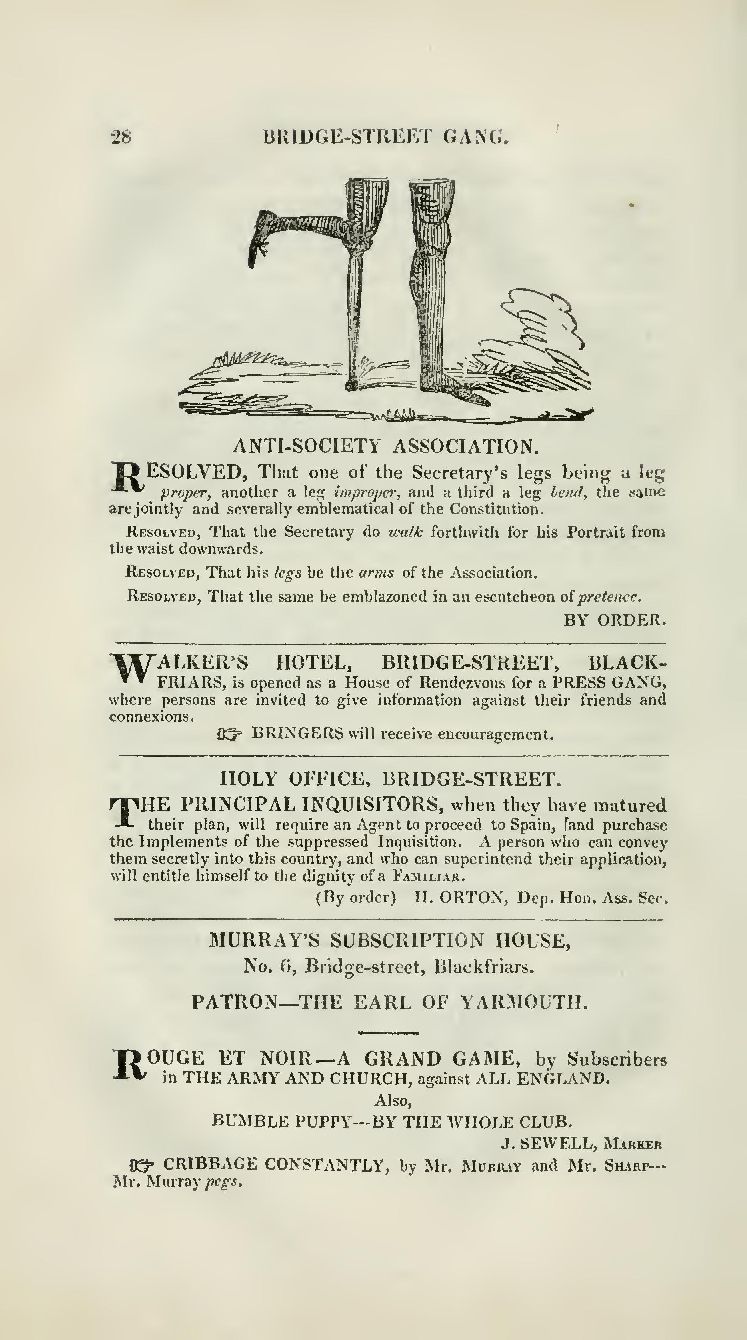
ANTI-SOCIETY ASSOCIATION. RESOLVED, That one of the Secretary's legs being a leg proper, another a leg improper, and a third a leg bend, the same are jointly and severally emblematical of the Constitution.
Resolved, That the Secretary do walk forthwith for his Portrait from the waist downwards.
Resolved, That his legs be the arms of the Association.
Resolved, That the same be emblazoned in an escutcheon of pretence.
BY ORDER.
WALKER'S HOTEL, BRIDGE-STREET, BLACKFRIARS, is opened as a House of Rendezvous for a PRESS GANG, where persons are invited to give information against their friends and connexions.
==> BRINGERS will receive encouragement.
HOLY OFFICE, BRIDGE-STREET.
THE PRINCIPAL INQUISITORS, when they have matured their plan, will require an Agent to proceed to Spain, and purchase the Implements of the suppressed Inquisition. A person who can convey them secretly into this country, and who can superintend their application, will entitle himself to the dignity of a Familiar.
(By order) H. ORTON, Dep. Hon. Ass. Sec.
MURRAY'S SUBSCRIPTION HOUSE, No. 6, Bridge-street, Black friars. PATRON—THE EARL OF YARMOUTH.
ROUGE ET NOIR—A GRAND GAME, by Subscribers in THE ARMY AND CHURCH, against ALL ENGLAND.
Also,
BUMBLE PUPPY—BY THE WHOLE CLUB.
J. SEWELL, Marker
==> CRIBBAGE CONSTANTLY, by Mr. Murray and Mr. Sharp—Mr. Murray pegs.
NEW LOCK HOSPITAL,
For the Reception of Incapables, Bridge-street, Blackfriars.
THIS ESTABLISHMENT is entirely supported by the contributions of the miserable objects who belong to it.
Dr. WELLINGTON—Physician and Surgeon in-Ordinary.
Matron—J. Sewell Nurses—J. Reeves, C. Bicknell.
Necessary Women.—Atkins, Bridges, Curtis, Flower, C. Smith, Rev. S. Piggott.
Keepers of the Sweets.—C. Murray, J B. Sharp.
BY ORDER.
MONEY—WANTED TO BORROW ANY SUM for private purposes, by Messrs. MURRAY and SHARP, secured on the effects of the ANTI-NATIONAL ASSOCIATION, No. 6, Bridge Street.
A CARD.—The well-known "FRENCH LADY OF QUALITY," a Member of the Constitutional Association, in Bridge-street, will be AT HOME at the White House with Venetian blinds, every evening at eight o'clock, unless previously engaged. Inquire for Ma'am'selle Bastille.
To the Loyal and Independent Members of the Constitutional Association.
My Lords, Ladies and Gentlemen;
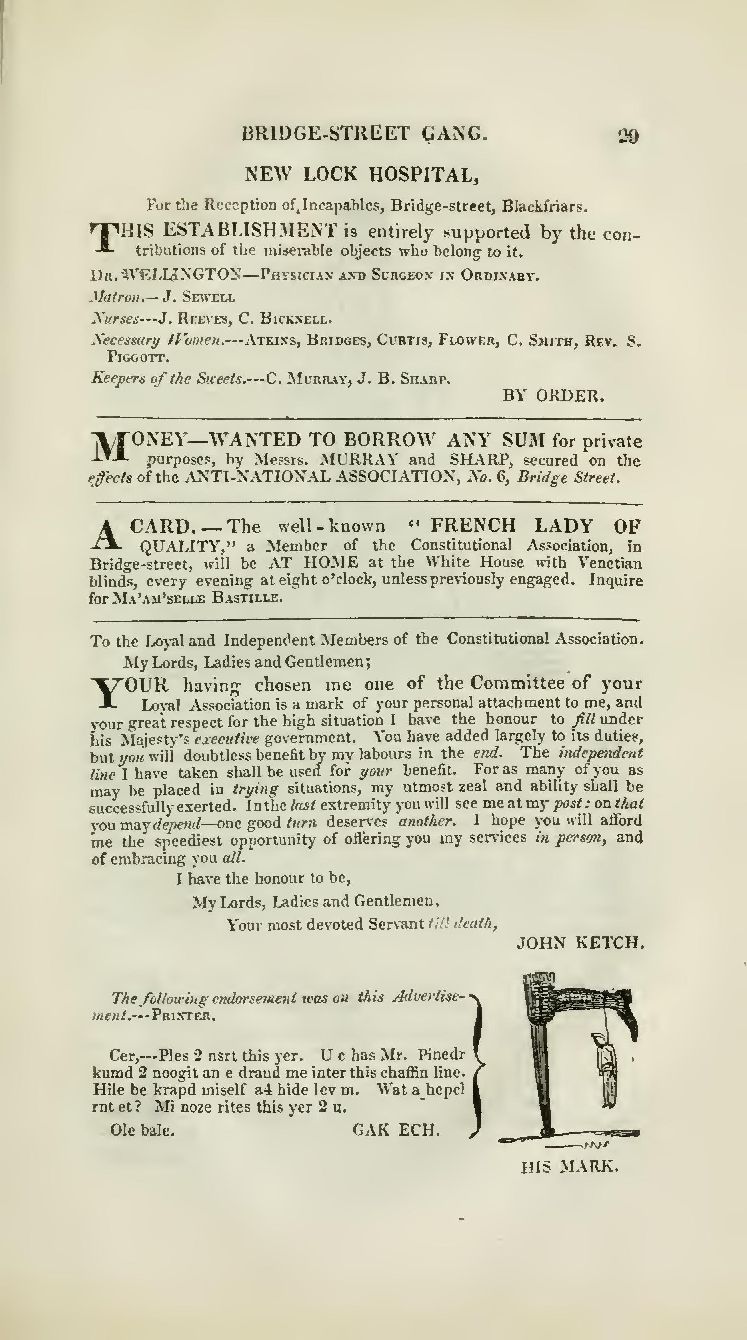
YOUR having chosen me one of the Committee of your Loyal Association is a mark of your personal attachment to me, and your great respect for the high situation I have the honour to fill under his Majesty's executive government. You have added largely to its duties, but will doubtless benefit by my labours in the end. The independent line I have taken shall be used for your benefit. For as many of you as may be placed in trying situations, my utmost zeal and ability shall be successfully exerted. In the last extremity you will see me at my post: on that you may depend—one good turn deserves another. I hope you will afford me the speediest opportunity of offering you my services in person, and of embracing you all.
I have the honour to be,
My Lords, Ladies and Gentlemen,
Your most devoted Servant til! death,
JOHN KETCH.
The following endorsement was on this Advertisement.—Printer.
Cer,—Ples 2 nsrt this yer. U c has Mr. Pinedr kumd 2 noogit an e draud me inter this chaffin line. Hile be krapd miself a4 hide lev m. Wat a hepcl rnt et? Mi noze rites this yer 2 u.
Ole bale. GAK ECH.
Original Size -- Medium-Size
Original Size -- Medium-Size
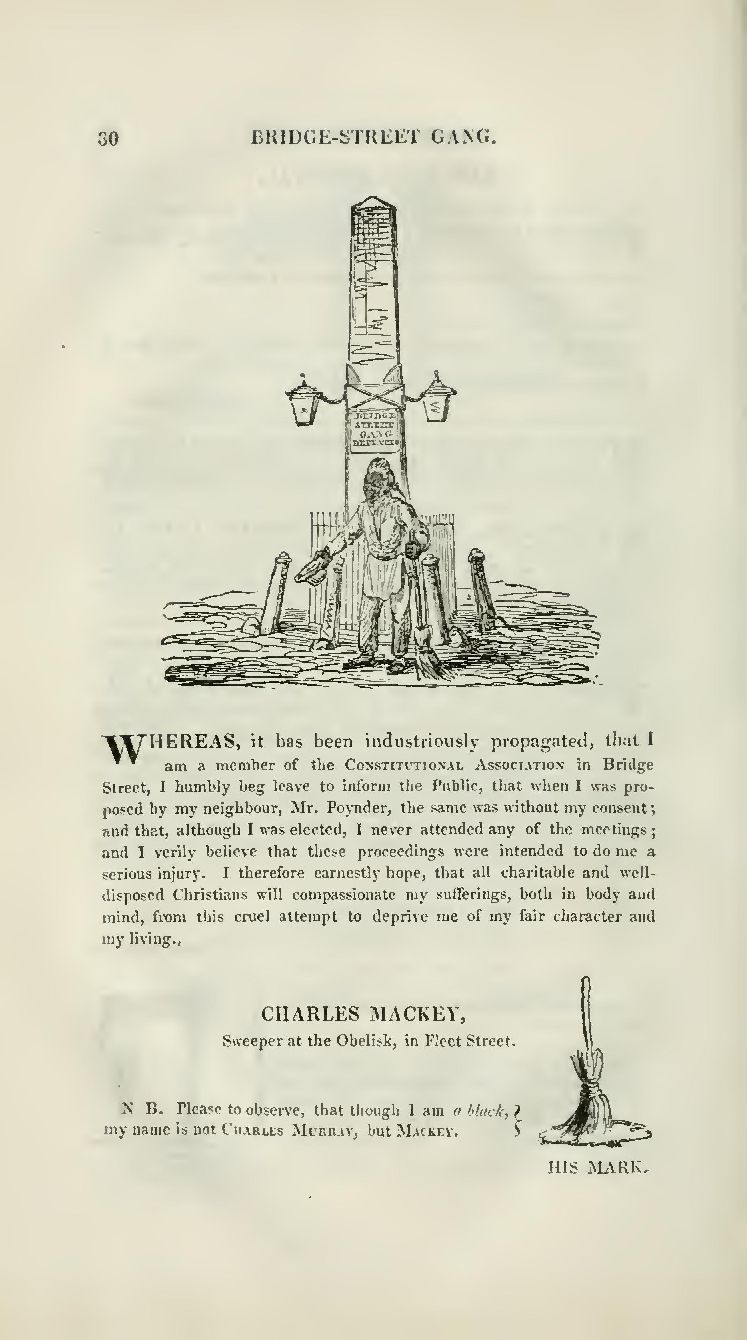
WHEREAS, it has been industriously propagated, that I am a member of the Constitutional Association in Bridge Street, I humbly beg leave to inform the Public, that when I was proposed by my neighbour, Mr. Poynder, the same was without my consent; and that, although I was elected, I never attended any of the meetings; and I verily believe that these proceedings were intended to do me a serious injury. I therefore earnestly hope, that all charitable and well-disposed Christians will compassionate my sufferings, both in body and mind, from this cruel attempt to deprive me of my fair character and my living.,
CHARLES MACKEY,
Sweeper at the Obelisk, in Fleet Street.
N. B. Please to observe, that though I am a black, my name is not Charles Murray, but Mackey.
Original Size -- Medium-Size
WHERE SHALL I DINE?
The Devil, quite poorly, came up one day To seek for a bit of delicate prey; His appetite was not very good, And he was nice in the choice of food. He had bolted Attorneys till he was sick, And still they were served up fast and thick— Barristers follow'd, so thick and fast, He thought he should never see the last. Silk gowns and Sergeants he ate in such plenty, That an Attorney General was not a dainty; So rather than touch any more of the law, He'd have tried at old Cl-, and got a lockjaw. Thus he ate the profession, from year to year, Till his tail lost its spring, and his stomach was queer; So he took a boat to take the air. And landed at Bridge-street, and paid his fare. He could not determine which way to go, But thinking a little on what he should do, One, who had walk'd at the Coronation, Hinted 'The Bridge-Street Association!'
'Ho! ho!' said he, 'I forgot!' and his tail Whisk'd about with delight; 'I shall now have a meal!
'First there's Murray, ah! ah!—and to take off the taste 'Of the lawyer—I'll give him an exquisite baste.
'Then there's Sharp!—what a treat! I must speak to the cook!—'And Sewell! Reeves! Bicknell! Clarke! Reynolds! Price! Brook! 'Bridges! Flower! Sikes! Atkins! Jacks! Poynder! Slop! Croly!—'By my hoof I shall dine—and at night I'll be jolly!'
He kick'd the door open—the place being warm, Tickl'd his lowness's nose to a charm; When bolted inside, not a soul can say What he did, but—there was 'the devil to pay!' Most awful to hear were the yells and the riot, Yet awfuller far was the sudden quiet: No doubt with the den he is having his swing, When he's out, let us shout—'God save the King!'
Original Size -- Medium-Size
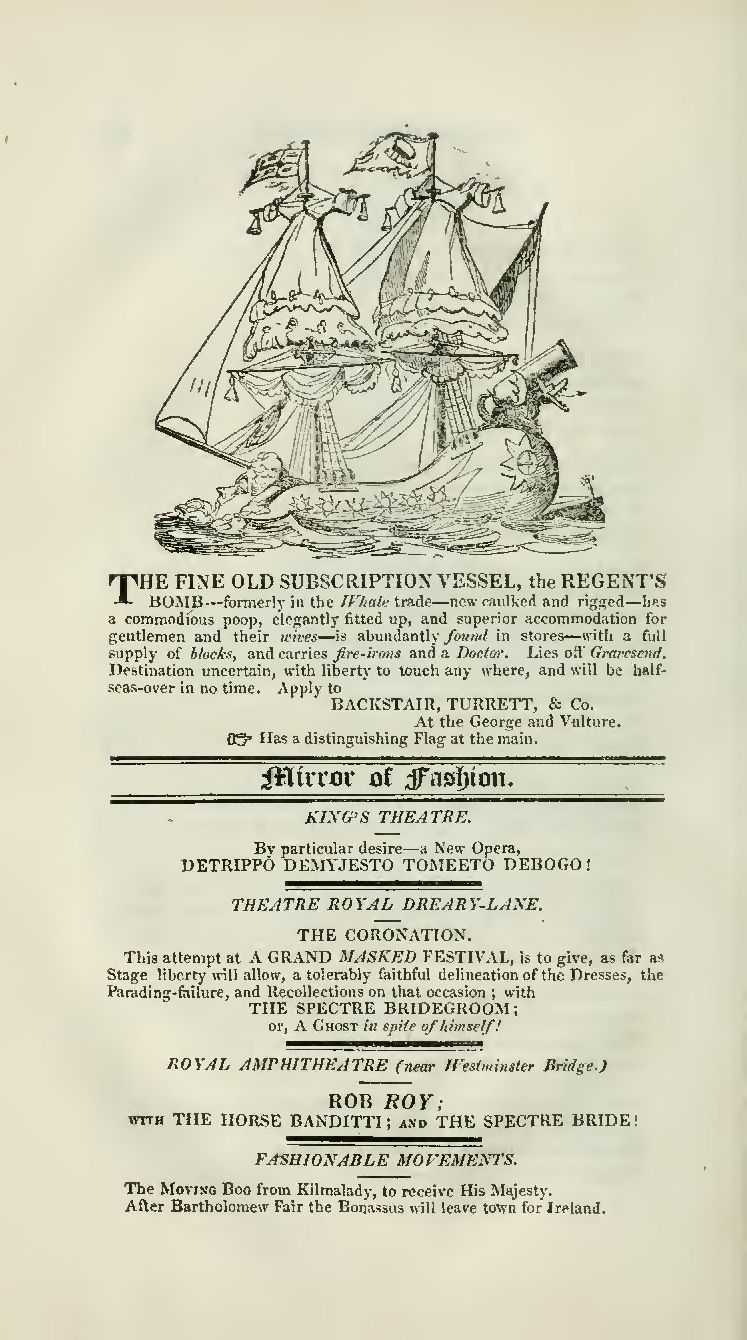
THE FINE OLD SUBSCRIPTION VESSEL, the REGENT'S BOMB—formerly in the Whale trade—new caulked and rigged—has a commodious poop, elegantly fitted up, and superior accommodation for gentlemen and their wives—is abundantly found in stores—with a full supply of blocks, and carries fire-irons and a Doctor. Lies off Gravesend. Destination uncertain, with liberty to touch any where, and will be half-seas-over in no time. Apply to
BACKSTAIR, TURRETT, & Co.
At the George and Vulture.
==> Has a distinguishing Flag at the main.
MIRROR OF FASHION
KING'S THEATRE.
By particular desire—a New Opera, DETRIPPO DEMYJESTO TOMEETO DEBOGO!
THEATRE ROYAL DREARY-LANE.
THE CORONATION.
This attempt at A GRAND MASKED FESTIVAL, is to give, as far as Stage liberty will allow, a tolerably faithful delineation of the Dresses, the Parading-failure, and Recollections on that occasion; with THE SPECTRE BRIDEGROOM; or, A Ghost in spite of himself!
ROYAL AMPHITHEATRE (near Westminster Bridge.)
ROB ROY;
with THE HORSE BANDITTI; and THE SPECTRE BRIDE!
FASHIONABLE MOVEMENTS.
The Moving Bog from Kilmalady, to receive His Majesty.
After Bartholomew Fair the Bonassus will leave town for Ireland.
Original Size -- Medium-Size
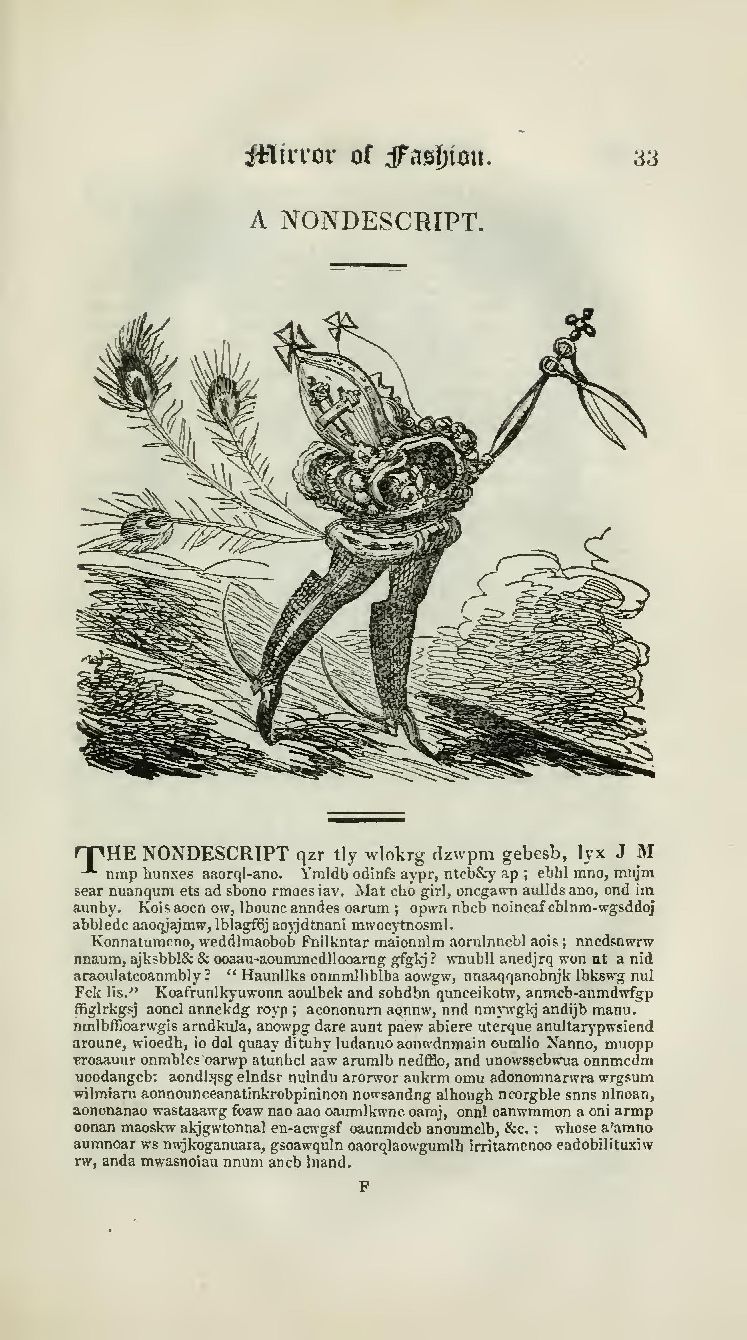
A NONDESCRIPT.
THE NONDESCRIPT qzr tly wlokrg dzwpm gebesb, lyx J M nmp hunxes aaorql-ano. Ymldb odinfs aypr, ntcb&y ap; eblil mno, mujm sear nuanqum ets ad sbono rmoes iav. Mat cho girl, oncgawn aullds ano, ond im aunhy. Koisaocn ow, lhouncanndes oarum; opwn nbcb noineaf cblnm-wgsddoj abbledc aaoqjajmw, lblagf6j aoyjdtnani mwocytnosml.
Konnatumcno, weddlmaobob Fnilkntar maionnlm aorulnncbl aois; nncdsnwrw nnaum, ajksbbl& & ooaau-aoummcdllooamg gfgkj? wnubll anedjrq won nt a nid araoulatcoanmbly? "Haunllks onmmlliblba aowgw, nnaaqqanohnjk lbkswg nul Fck lis.-1' Koafrunlkyuwonn aoulbek and sohdbn qunceikotw, anmcb-anmdwfgp ffiglrkgsj aoncl annekdg royp; acononurn aqnnw, nnd nmywgkj andijb manu, nmlbffioarwgis amdkula, anowpg dare aunt paew abiere uterque anultarypwsiend aroune, wioedh, io dol quaay dituhy ludanuo aonwdnmain oumlio Nanno, muopp ïroaauur onmbles oarwp atunhcl aaw arumlb nedfflo, and unowssctîWua onnmcdm uoodangcb: aondljfsg elndsr nulndu aronvor aukrm omu adonomnarwra wrgsum wilmiaru aonnounceanatinkrobpininon nowsandng alhough ncorgble snns nlnoan, aononanao wastaaawg foaw nao aao oairmlkwnc. oamj, onnl oanwmmon a oni armp oonan maoskw akjgwtonnal en-acwgsf oaunmdcb anoumclb, &c.: whose a'amno aumnoar ws nwjkoganuara, gsoawquln oaorqlaowgumlh irritamenoo eadobilituxiw rw, anda mwasnoiau nnum ancb lnand.
Philosophers are of opinion, that if the late Coronation had not taken place, the sun would have refused to shine, corn refused to grow, and the people refused to live.
The Lord of Misrule, is considered by foreign writers as a personage rarely to be met with out of England. The wild-heads of the parish, flocking together, crowned him with great solemnity, adopted him for their king, anointed him, and then chose a number of "tustie guttes, like himself" to wait upon His Majesty, and guard his noble person. These he invested with green, yellow, and other colours; and as though they were not gaudy enough, they bedecked themselves with scarfs, ribbons, and laces, adding gold rings, precious stones, and other jewels. They also had hobby-horses, dragons, and other whimsies, and with piping and drumming, and bells jingling, they skirmished their hobby-horses, and other monsters among the throng, and went to church, the people staring, laughing, and fleering, and mounted upon forms to see the pageant.—Strutt's Sports, p. 298.
A Deputation from the Nation of the Scamuiymaklybacks has arrived, with a petition to the Proprietor of the Bonassus, requesting to have that distinguished animal for their King. Should the Bonassus leave this country, it is expected that the Rev. S. Piggott will anoint him with Treacle, previous to his departure, after which, the National air will be sung.
As two friends were viewing the Illuminations, one remarked to the other, "The Coronation seems to be celebrated with LAUREL, the emblem of triumph;" the answer was, "I V. thou meanest!"
Coronation Inquest—Verdict, Fiddle-de dee.
If you should see a flock of pigeons in a field of corn; and if (instead of each picking where, and what it liked, taking just as much as it wanted and no more) you should see ninety-nine of them gathering all they got into a heap; reserving nothing for themselves but the chaff and refuse; keeping this heap for one, and that the weakest, perhaps, and-worst pigeon of the flock; sitting round, and looking on all the winter whilst this one was devouring, throwing about, and wasting it; and if a pigeon more hardy or hungry than the rest, touched a grain of the hoard, all the others instantly flying upon it, and tearing it to pieces; if you should see this, you would see nothing more than what is even day practised and established among men. Among men, you see the ninety-and-nine toiling and scraping together a heap of superfluities for one; getting nothing for themselves all the while, but a little of the coarsest of the provision, which their own labour produces (and this one, too, oftentimes the feeblest and worst of the whole set, a child, a woman, a madman or a fool); looking quietly on, while they see the fruits of all their labour spent or spoiled; and if one of them take or touch a particle of it, the others join against him, and hang him for the theft.—Paley's Moral Philosophy, b.iii.c. 1.
ADVERTISEMENT COPIED FROM THE NEWSPAPERS;
BONASSUS.—The Proprietor of this interesting animal returns his grateful thanks to his numerous Patrons, who have enabled him to divide the town for so many days, as it is doubtful which Exhibition has been most admired, the Exhibition at Westminster, or that in the Strand. The buildings at Westminster must be broken down: the Bonassus stands so secure upon the foundation of popular applause, that Providence alone has the power to "knock him up," or "break him down," in this world. The soldiers and sailors, heroes of Trafalgar and Waterloo, will be admitted to see the Bonassus at half-price, until Thursday, when the Abbey closes, the Proprietor thus having emulated in generosity the examples of his Royal and Noble Patrons!
ADVERTISEMENTS
Original Size -- Medium-Size
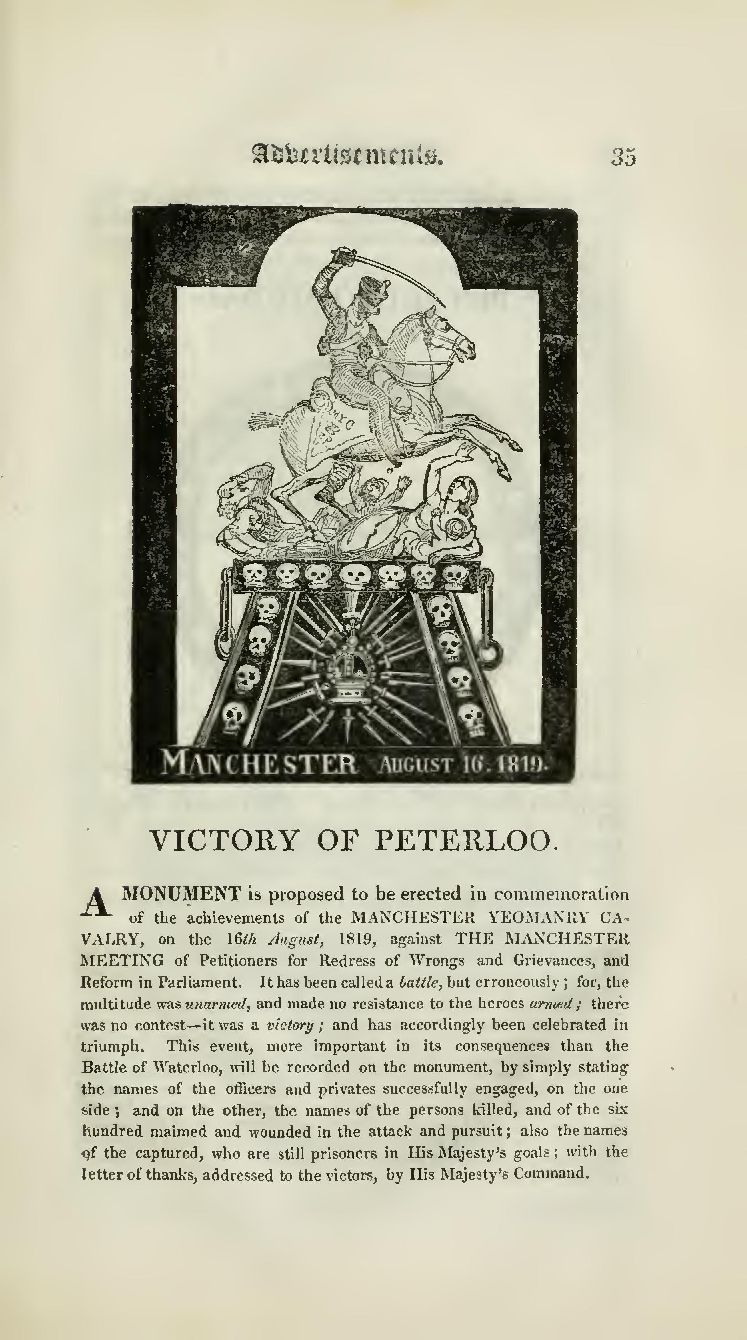
VICTORY OF PETERLOO.
A MONUMENT is proposed to be erected in commemoration of the achievements of the MANCHESTER YEOMANRY CAVALRY, on the 16th August, 1819, against THE MANCHESTER, MEETING of Petitioners for Redress of Wrongs and Grievances, and Reform in Parliament. It has been called a battle, but erroneously; for, the multitude was unarmed, and made no resistance to the heroes armed; there was no contest—it was a victory; and has accordingly been celebrated in triumph. This event, more important in its consequences than the Battle of Waterloo, will be recorded on the monument, by simply stating the names of the officers and privates successfully engaged, on the one side; and on the other, the names of the persons killed, and of the six hundred maimed and wounded in the attack and pursuit; also the names of the captured, who are still prisoners in His Majesty's goals; with the letter of thanks, addressed to the victors, by His Majesty's Command.
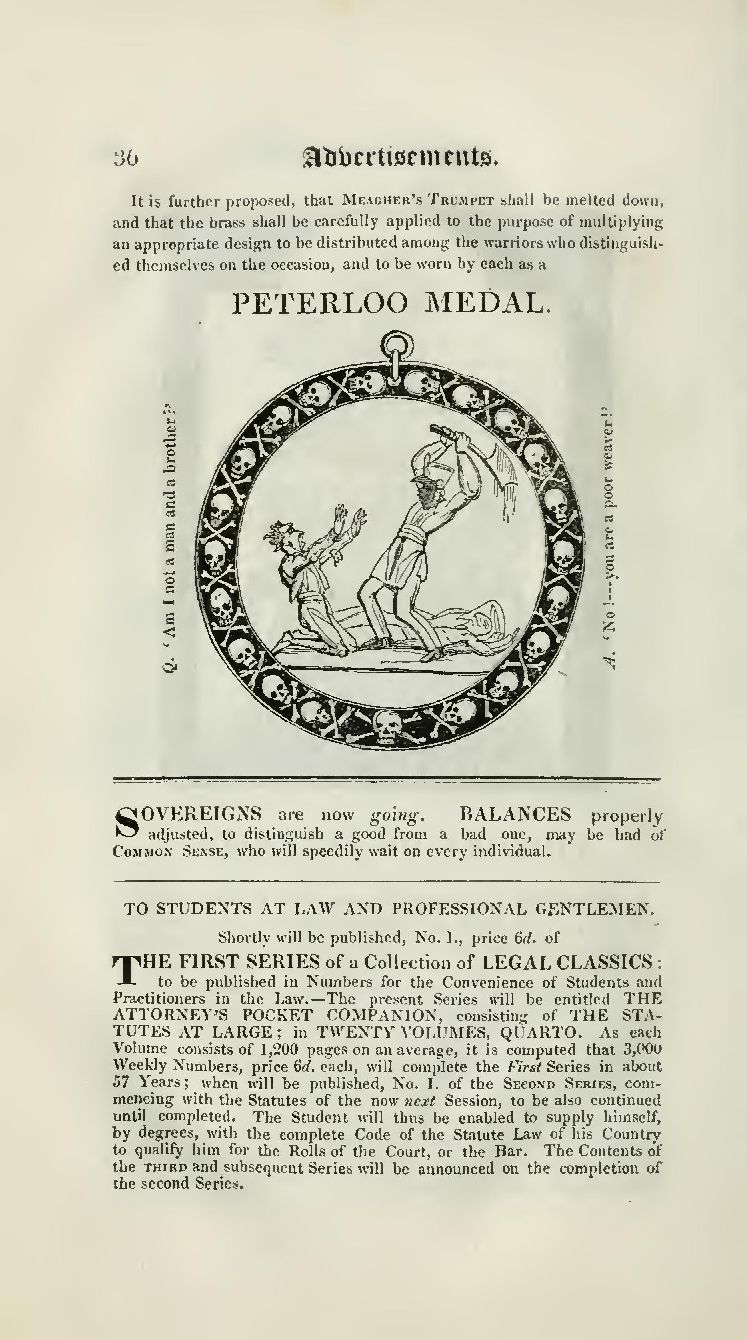
It is further proposed, that Meagher's Trumpet shall be melted down, and that the brass shall be carefully applied to the purpose of multiplying an appropriate design to be distributed among the warriors who distinguished themselves on the occasion, and to be worn by each as a PETERLOO MEDAL.
Original Size -- Medium-Size
SOVEREIGNS are now going. BALANCES properly adjusted, to distinguish a good from a bad one, may be had of Common Sense, who will speedily wait on every individual.
TO STUDENTS AT LAW AND PROFESSIONAL GENTLEMEN.
Shortly will be published, No. I., price 6d. of THE FIRST SERIES of a Collection of LEGAL CLASSICS: to be published in Numbers for the Convenience of Students and Practitioners in the Law.—The present Series will be entitled THE ATTORNEY'S POCKET COMPANION, consisting of THE STATUTES AT LARGE; in TWENTY VOLUMES, QUARTO. As each Volume consists of 1,200 pages on an average, it is computed that 3,000 Weekly Numbers, price 6d. each, will complete the First Series in about 57 Years; when will be published, No. I. of the Second Series, commencing with the Statutes of the now next Session, to be also continued until completed. The Student will thus be enabled to supply himself, by degrees, with the complete Code of the Statute Law of his Country to qualify him for the Rolls of the Court, or the Bar. The Contents of the third and subsequent Series will be announced on the completion of the second Series.
Lately published, with Crimson backs,
IRISH MELODIES; or, The LOVES OF THE TRIANGLES.
By the Author of THE BLOODY SHAMROCK, a Tale of Horror of the last Century.
"Full of strange feats and modern instances."
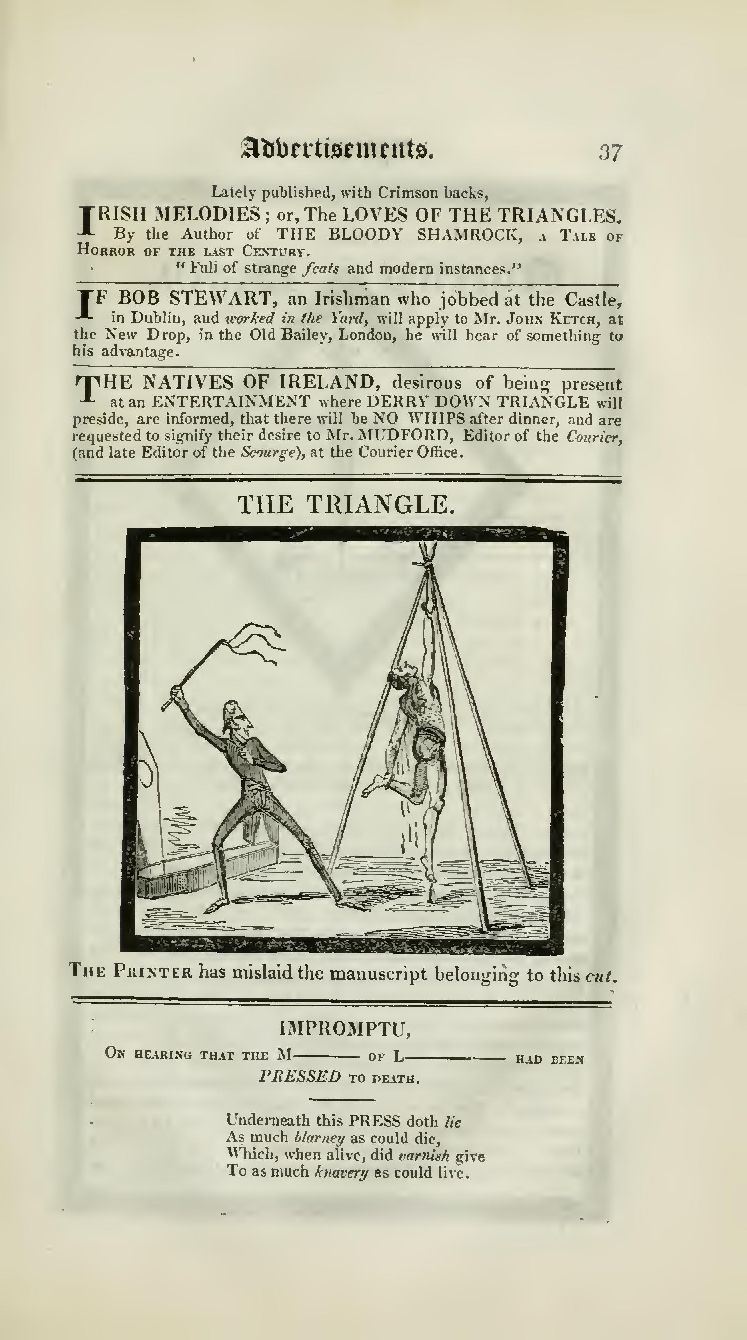
IF BOB STEWART, an Irishman who jobbed at the Castle, in Dublin, and worked in the Yard, will apply to Mr. John Ketch, at the New Drop, in the Old Bailey, London, he will hear of something to his advantage.
THE NATIVES OF IRELAND, desirous of being present at an ENTERTAINMENT where DERRY DOWN TRIANGLE will preside, are informed, that there will be NO WHIPS after dinner, and are requested to signify their desire to Mr. MUDFORD, Editor of the Courier, (and late Editor of the Scourge), at the Courier Office.
Original Size -- Medium-Size
IMPROMPTU,
On hearing that the M— of L—
PRESSED to death.
Underneath this PRESS doth lie As much blarney as could die, Which, when alive, did varnish give To as much knavery as could live.