W H G Kingston (continued 7)
Reading edition
“You can’t tell, my lads, when the bucketful will leak in that will send her to the bottom,” he said, and the men again turned to. He ordered, however, the carpenter to patch up such of the boats as could be made serviceable enough to float even for a short time, so that they might be employed in carrying us aboard the snow. Without the masts the launch could not be got off the deck, but we had three other boats fit to be repaired; all the others had been completely knocked to pieces. No one slept at all events during that night, for we were all kept spell and spell at the pumps and buckets. The certainty that relief was at hand if we kept afloat, inspired us with renewed strength. When morning dawned the snow came as close as she could venture. Three of her boats approached and pulled towards us. The order was now given for the men to prepare for leaving the ship. Sentries were placed at the gangways to prevent any crowding in till they received the order to go down the side, but this was unnecessary. The few survivors of the sick and wounded were first lowered into the boats, with the surgeons to attend them. The boys and midshipmen were then ordered to go down the side, the names of all being called in succession. As soon as the snow’s boats were filled and had pulled away, ours were lowered. Tom Pim and I went, with Larry, in one of them, Nettleship having charge of her. I looked up at the old ship. She seemed to be settling fast. The water came out of the scuppers, showing that, according to the captain’s orders, the hands were still at the pumps. There was no hurry, yet all was done rapidly. The moment we shoved off our crew gave way, and we were soon aboard the snow. While Nettleship returned for more men, Tom and I stood watching them anxiously. It seemed even now that before they could escape the ship would go down. Though the sea had much decreased, there was no little danger, while the boats were alongside the Hector, of their being swamped. As fast as they could the boats went backwards and forwards, taking their cargoes in through the lower ports. I saw Captain Drury and the first lieutenant pressing Captain Bouchier to leave the ship, but in spite of his wound he insisted on remaining to the last. Our men, as they arrived, stood watching the ship from the deck of the snow, and gave a cheer as they saw him descending, the last man, into the cutter, for they knew that not a soul was left on board the gallant Hector, Scarcely had the captain been helped up the side, than we saw the ship’s head begin to sink. Lower and lower it went, then down she plunged, her ensign flying from the spar secured to the stump of her mainmast, streaming upwards, alone showing us the spot where she was sinking into the depths of the ocean. A groan escaped from the breasts of many of those who had long sailed in her. We found that we were on board the Hawk snow, a letter-of-marque belonging to Dartmouth, Captain John Hill, and bound from Lisbon to Saint John’s, Newfoundland. When Captain Bouchier expressed his gratitude to the master for receiving him and his people, the reply was—
“Don’t talk of it, sir; I’m but doing my duty. I would wish to be treated the same way by others.”
Besides his own crew of five-and-twenty men, he had now two hundred of the Hector’s on board. We had brought neither provisions nor water, and were still many a long league from our port. The Hawk had fortunately hitherto had a quick passage. We had, therefore, more provisions and water on board than would otherwise have been the case. Still two hundred mouths in addition was a large number to feed, yet neither the captain nor his ship’s company grumbled or made the slightest complaint. To stow us all away was the difficulty. To solve it, the captain at once ordered his men to heave overboard the more bulky portion of his cargo. His owners, he said, would not complain, for he himself was the principal one, and he trusted to the justice of his country to replace his loss. We were, of course, put on an allowance, but after the starvation we had endured, it appeared abundance. Even when the cargo had been got rid of it was unpleasantly close stowing for most of us, but we had great reason to be thankful to Heaven for having escaped with our lives. The officers and crew of the Hawk treated us with the greatest kindness; most of our poor fellows, indeed, required help, and were unable to move about the deck by themselves. The wind, however, continued fair, and those who had abundant sleep recovered their spirits. Still several died, worn out by fatigue and sickness. We were safe for the present, and we did not allow ourselves to recollect that another gale might spring up before we could reach Saint John’s, to which port we were bound, or that contrary winds might keep us from our port, and that, after all, we might perish from hunger and thirst. I was talking of what we should do when we got ashore.
“Wait till we are there, Paddy,” said Nettleship. “I don’t say that we shall not reach it, but we may not. That noble fellow, Hill, knows that such may be the case as well as I do; and I admire his calmness, and the care he takes not to show us that he fears he and his people may suffer the fate from which they rescued our ship’s company. You see they are all put on the same allowance that we are, yet not one of them complains.”
I heartily agreed with him. Shortly afterwards I asked Nettleship what he had done with his letter.
“I left it in the cask aboard, Paddy,” he answered. “So in case we’re lost, our friends will know our whereabouts, though they’ll not hear of our being rescued, and the chance we have had of escaping; but that won’t matter much, though I should like to have made Hill’s conduct known.”
Never, perhaps, did seamen watch the weather more anxiously than we did. Our lives, as far as we could see, depended on the winds. Already the stock of provisions and water was getting low, and it was necessary to diminish the allowance of both. Still the crew of the Hawk would only receive the same quantity that we did. The sun rose and set, and again rose, and we sailed on. Mr Hill met us each morning at breakfast, his honest countenance beaming with kindness, and jocularly apologised for the scantiness of the fare. Even he, however, one morning looked grave; the wind had fallen, and we lay becalmed. He had good reason to be grave, for he knew what we did not, that he had only one cask of water left, and provisions scarcely sufficient for a couple of days.
“I have come away without fish-hooks,” he observed. “If I had had them, gentlemen, I might have given you cod for dinner; and I promise you I’ll never be without them again, when I make this voyage.”
“Then I only hope, captain, that you’ll take us up again if we happen to have our ship sinking under us,” I said, at which there was a general laugh.
As we had nothing else to do, all hands employed themselves in whistling for a breeze. Just before the sun again rose, a cheering shout was heard from the masthead—
“Land! land!”
In a short time the rocky coast of Newfoundland rose on the larboard bow, and we stood along to the northward for Saint John’s harbour, on the east coast. Before evening we were passing through the Narrows, a passage leading to the harbour, with perpendicular precipices rising to a considerable height on either side. Passing under Fort Amhurst, a voice came off hailing—
“Where are you from? What length of passage?”
The answer announcing, “We have on board the officers and crew of H.M.S. Hector,” evidently caused considerable excitement, and signals were made to a post on the top of a lofty hill on the right side, whence the information was conveyed to the town.
Before we dropped our anchor, the last cask of water was emptied, the last particle of food consumed.
The moment we brought up, the vessel was surrounded by boats, the news of our arrival having preceded us. Before landing, all the officers again expressed their thanks to our gallant preserver, who, I hope, received the reward he so well merited, from our Government, we ourselves being unable to offer him any. None of us, indeed, had more than the clothes we wore, and a few articles we had been able to carry off with us from the wreck.
We were received with the greatest kindness and hospitality by the inhabitants of Saint John’s. Nettleship, Tom, and I were lodged together in the house of a merchant, whose wife and daughters, pitying our condition, did everything they could to restore us to health. Certainly we were very unlike the gay midshipmen we appeared when we sailed from Jamaica. Both the young ladies were very nice girls; but Tom confided to me that his heart had become hard as adamant since Lucy’s cruel treatment of him.
“It will soften by and by, Tom,” I answered, laughing, though I could not say that I felt mine inclined to yield to their attractions.
We agreed, however, that Nettleship, as we thought, would knock under. What might have been the case I don’t know; but as soon as the men had somewhat recovered from their hardships,—there being no man-o’-war likely to call off the place,—the captain chartered two merchant brigs to convey himself and the survivors of the Hector to Halifax, Nova Scotia, whence he expected to get a passage home for us to England. Nettleship, Tom, and I, accompanied by Larry, had to go on board the Jane, one of the vessels, of which Captain Drury went in charge; while Captain Bouchier, though still not recovered from his wound, went in the other, the John Thomas.
I did not mention it at the time, but Larry had managed to save his riddle uninjured when he left the Hector, and his appearance with it under his arm afforded no small amount of satisfaction to the crew of the Jane.
The John Thomas proved a much faster sailer than the brig, and soon ran ahead of us. We had just lost sight of Cape Race when a sail was made out, standing towards us from the southward.
“I don’t like her looks,” observed Nettleship to me, as she approached. “I shouldn’t be surprised if she proves to be a French privateer.”
The captain appeared to be of this opinion, for, after: examining the stranger through his glass, he ordered all the sail we could carry to be set, and stood away right before the wind, to the north-west. The stranger, however, came up with us hand over hand. In a short time the French ensign was seen blowing out at her peak, leaving no doubt as to her character.
“We must not be taken, lads. I trust to you to fight to the last, before we strike our flag,” cried the captain.
The crew cheered, and promised to do their best.
The Jane had six nine-pounders, while the enemy carried twice as many guns, evidently of much heavier metal. As a few men only were required to work them, the captain ordered the rest to go under shelter. Tom and I were among those ordered below. In a short time we heard our guns go off, and the shot of the enemy came rattling on board. Presently there came a crash, and we guessed that the privateer had run us alongside.
“On deck, lads!” cried the captain. “Boarders, repel boarders.”
At the summons we eagerly rushed up through every hatchway, to see a number of Frenchmen swarming on board; but they didn’t get far beyond the bulwarks before they were driven back, we in return boarding them. Tom and I led our men into the fore part of the vessel. More and more of our fellows followed. The Frenchmen gave way, some leaped below, others ran aft, where they encountered Nettleship and his party; in less than five minutes the privateer was ours, and Larry, shouting—
“Wallop-a-hoo-aboo! Erin go bragh!” hauled down her colours.
The enemy had so completely been taken by surprise, that they had offered but a slight resistance, and few, therefore, had lost their lives, while we had only half a dozen wounded. Captain Drury, with two-thirds of our men, went on board the prize, retaining the larger number of our prisoners; while Nettleship, Tom, and I remained in the Jane, with orders to follow close astern.
“We must take care, Paddy, that our prisoners don’t play us the same trick yours played you,” said Nettleship. “They would like to try it, no doubt.”
We had thirty prisoners to look after.
“I’ll take remarkably good care that they don’t do that,” I answered; “and to make sure, it would be as well to keep them in durance vile till we reach Halifax.”
The Frenchmen grumbled at finding that they were to have their arms lashed behind them, and be kept below under charge of a couple of sentries. They were somewhat more contented when we fed them carefully, and told them that it was because we considered them brave fellows, and felt sure that if they had the opportunity they would take the brig from us, that we were obliged to treat them so unceremoniously. Fortunately the wind held fair, and we had a quick passage to Halifax, where we arrived before the harbour was frozen up. Of course we gained great credit for our last exploit at that favourite naval station.
We found the Maidstone frigate just about to sail for England, on board of which all who were well enough were ordered home. We were pretty considerably crowded, but we were a merry set, and had plenty to talk about. The midshipmen of the Maidstone, which had been for some time at Halifax, spoke warmly of the kindness they had received, and of the fascinations of the young ladies of the place, except an old mate and an assistant-surgeon, who declared that they had been abominably treated, and jilted by half-a-dozen whose hearts they thought they had won.
Old Grumpus, the master’s mate, was especially bitter. “Look here,” he said, producing a sketch which he had made. “See these old ladies seated on chairs on the quay, watching their daughters fishing. There are a dozen girls at least, with long rods and hooks, baited with all sorts of odds and ends. And see what sort of fish they’re after,—naval officers—marine officers—and of all ranks, from an admiral down to a young midshipman. And there’s a stout dame—she can’t be called a young lady exactly—casting her hook towards a sturdy boatswain.
“‘Look here,’ one of them cries out, ‘mother, mother, I’ve got a bite.’
“‘Play him, my dear,’ cries the mother, ‘till you see what he is.’
“‘Oh, mother, mother!’ she cries out presently, ‘I’ve caught a midshipman.’
“‘Throw him in, my dear, he’s no good,’ answered the old lady.
“Presently another sings out, ‘Mother, I’ve got a bite. I’m sure it’s from a lieutenant, from the way he pulls.’
“‘Let him hang on a little, my dear,’ says the mother; ‘may be if you see a commander or a post-captain swimming by, you may cast him off, and hook one of the others instead.’
“Presently a fourth cries out, ‘Oh, mother, I’ve hooked a captain!’
“‘Run, Jane, run, and help your sister to land him,’ cries Mrs Thingamebob; and just see the way they’re doing it, so as not to frighten him, and make him turn tail.
“At last another shouts, ‘Mother, I’ve hooked a master’s mate.’
“‘Then go and cut the line, Susan. Don’t let Nancy land that brute, on any account. He’s the worst of the lot.’
“And so it goes on,” exclaimed old Grumpus. “However, to my mind they’re all alike. Why, while we have been there a dozen officers from different ships have been and got spliced. It’s lucky for you fellows that you were not there long, or you would have been and done it, and repented it all your lives afterwards.”
During the voyage old Grumpus brought out his sketch a score of times, and repeated his story as often, with numerous variations, which afforded us all much amusement. He had anecdotes of other descriptions without end to tell, most of them hingeing on the bad way the junior officers of the service were treated. He didn’t say that most of those junior officers were rough diamonds like himself, who would have been much better off if they had not been placed on the quarter-deck.
We had a somewhat long and stormy passage, and were half frozen to death before it was over, most of us who had been for years in the West Indies being little prepared for cold weather. We should have been much worse off, however, in a line-of-battle ship, but in the midshipmen’s berth we managed to keep ourselves tolerably warm when below. At length we sighted the coast of Ireland.
“Hurrah, Mr Terence! There’s the old country,” said Larry, throwing up his hat in his excitement, and nearly losing it overboard. “If the captain would only put into Cork harbour, we would be at home in two or three days, and shure they’d be mighty pleased to see us at Ballinahone. What lashings of whisky, and pigs, and praties they’d be after eating and drinking in our honour, just come home from the wars. Och! I wish we were there, before a blazing turf fire, with the peat piled up, and every one of them red and burning, instead of being out here with these cold winds almost blowing our teeth down our throats.”
The picture Larry drew made me more than ever wish to get home. Not that I was tired of a sea life, though I had found it a pretty hard one in some respects; but I longed to see my father, and mother, and brothers, and sisters again, and my kind uncle the major, as I had not heard from them for many a long day. Letters in those days were conveyed to distant stations very irregularly. I had only received two all the time I had been away. Indeed, friends, knowing the great uncertainty which existed of letters reaching, thought it scarcely worth while to write them. We could just see the land, blue and indistinct, over our larboard bow, when the wind veered to the eastward, and instead of standing for Plymouth, as we expected to do, we were kept knocking about in the Chops of the Channel for three long weeks, till our water was nearly exhausted, and our provisions had run short. There we were, day after day, now standing on one tack, now on another, never gaining an inch of ground. Every morning the same question was put, and the same answer given—
“Blowing as hard as ever, and right in our teeth.”
We sighted a number of merchant vessels, and occasionally a man-of-war, homeward-bound from other stations, but all were as badly off as we were.
At last one morning the look-out at the masthead shouted, “A sail to the eastward coming down before the wind.” It was just possible she might be an enemy. The drum beat to quarters, and the ship was got ready for action. On getting nearer, however, she showed English colours, and we then made out her number to be that of the Thetis frigate. As soon as we got near each other we both hove-to. Though there was a good deal of sea running, two of our boats were soon alongside her to obtain water, and some casks of bread and beef, for, as far as we could tell to the contrary, we might be another month knocking about where we were. In the meantime, one of her boats brought a lieutenant on board us.
“Peace has been signed between Great Britain and France,” were almost the first words he uttered when he stepped on deck. “I can’t give particulars, but all I know is, that everything we have been fighting for is to remain much as it was before. We are to give up what we have taken from the French, and the French what they have taken from us, and we are to shake hands and be very good friends. There has been great rejoicing on shore, and bonfires and feasts in honour of the event.”
I can’t say that the news produced any amount of satisfaction to those on board the Maidstone.
“Then my hope of promotion has gone,” groaned Nettleship; “and you, Paddy, will have very little chance of getting yours, for which I’m heartily sorry; for after the creditable way in which you have behaved since you came to sea, I fully expected to see you rise in your profession, and be an honour to it.”
“What’s the use of talking to sucking babies like Paddy and Tom here about their promotion, in these piping times of peace which are coming on us,” cried old Grumpus, “if we couldn’t get ours while the war was going on?”
Chapter Twenty One.
Festivities at Home.
The news of peace was received perhaps with more satisfaction by the men who had no promotion to look for, and who now expected to visit their families, or enjoy themselves in spending their prize-money according to their own fashion on shore.
Parting from the Thetis, we continued beating backwards and forwards for another week, when the wind shifting suddenly to the southward, we ran up to Plymouth, and at last dropped anchor in Hamoaze. We lived on board till the ship was paid off. In the meantime, I wrote home to say that Larry and I would return as soon as we could manage to get a passage to Cork. Tom Pim was uncertain of the whereabouts of his family, so he also waited till he could hear from them. Nettleship had told us that his mother and sister lived near Plymouth, and he got leave to run over and see them.
“It won’t be a good thing for you youngsters to be knocking about this place by yourselves,” he said, on his returning; “and so, having told my mother this, she has invited both of you, with Larry, to come up and stay with us till you can go home. You’ll be much better off than in lodgings, or stopping at an inn, even though you may find it somewhat dull.”
Tom at once accepted the invitation, and persuaded me to do so, though I wanted to see some of the fun of Plymouth, which my other shipmates had talked about. I won’t describe the scenes which took place on board,—the noise and uproar,—the characters of all descriptions who crowded the ship, eager to take possession of the sailors, or rather of the money which lined their pockets. I saw very much the contrary of fun in it. We had then a midshipman’s paying-off dinner on shore, to which some of the ward-room officers were invited. The wine flowed freely. Healths were drunk and sentiments given, and in a short time most of the party became very uproarious, those who were sober enough on shore being as bad as the rest.
“Come, Paddy,” said Nettleship, “we have to get home to my mother’s house to-night, and I can’t introduce you, remember, if you’re not quite yourself.”
Tom Pim was ready.
“So am I,” I said. “I’ll not take another drop.”
Our intended departure being discovered, we were assailed with hoots, and shouts, and groans.
“Never mind them,” said Nettleship. “If we were to be moved by that sort of stuff, those very fellows would be the first to laugh at us another day.”
On seeing us gaining the door, several jumped up, intending to bring us back.
“Run for it, Paddy; run, Tom,” cried Nettleship. “I’ll guard your retreat. They’ll not stop me.”
“Hands off,” he shouted, as Grumpus and some others attempted to seize him. “I have made up my mind to go, and go I will, though every one in the room were to jump up and try to bar my passage.”
Tom and I got safe into the street, where we were joined by Larry, who had been waiting for us; and Nettleship came up, saying that he had got clear off, at the cost of flooring two or three of his assailants.
“Not a satisfactory way of parting from old friends,” he said, “but the only one which circumstances would permit.”
We at once set off, walking briskly, to get as soon as possible away from the scene of our shipmates’ revels. We at length reached a pretty little cottage, a short way out of Plymouth, where Mrs Nettleship and her daughter received us in the kindest manner possible. I was struck by the appearance of the two ladies, so nicely dressed, and quiet in their manners, while the house seemed wonderfully neat and fresh, greatly differing from the appearance of Ballinahone. It was the first time in my life that I had ever been in an English house. When Nettleship talked of his mother’s cottage, I had expected to see something like the residence of an Irish squireen. Both inside and out the house was the same,—the garden full of sweetly-scented flowers, the gravel walks without a weed in them, and the hedges carefully trimmed. Then when Tom and I were shown to the room we were to occupy, I was struck by the white dimity hangings to the beds, the fresh curtains and blinds, the little grate polished to perfection, and a bouquet of flowers on the dressing-table. Tom was not so impressed as I was, though he said it reminded him of his own home. Miss Fanny was considerably younger than Nettleship, a fair-haired, blue-eyed, sweetly-smiling, modest-looking girl, who treated Tom and me as if we were her brothers.
Nettleship and Tom accompanied me into Plymouth each morning, that I might learn if any vessel was sailing for Cork, and thus be saved the journey to Bristol, with which place and Ireland, as there was a considerable amount of trade carried on, I was told that I should have no difficulty in obtaining a vessel across. I was so happy where I was, however, that I was less in a hurry than might have been supposed. I had no want of funds for the purpose, for I had received my pay; and a good share of prize-money for the vessels we had captured was also due to me, though, as Nettleship told me, I must not count upon getting that in a hurry.
At last, one morning, on going to a shipbroker, who had promised to let me know of any vessel putting into Plymouth on her way to Cork, he told me that one had just arrived, and would sail again in a few hours. I at once went on board the Nancy schooner, and engaged a passage for Larry and myself, and then hurried back to wish Mrs Nettleship and her daughter good-bye. My old shipmates returned with me, and Larry carried our few traps over his shoulder, as I had not possessed a chest since mine was lost in the Liffy.
“Good-bye, Paddy, old fellow,” cried Nettleship. “If I get appointed to a ship I’ll let you know, and you must exert your interest to join her; and I hope Tom also will find his way aboard. We have been four years together without so much as a shadow of a quarrel; and if we were to spend another four years in each other’s company, I’m sure it would be the same.”
Tom merely wrung my hand; his heart was too full to speak.
“Good-bye, Mr Pim,” said Larry, as the schooner’s boat was waiting for us at the quay. “Your honour saved my life, and I would have been after saving yours, if I had had the chance, a dozen times over.”
“You saved it once, at least, Larry, when you helped to get me out of the water as the boat was leaving the Cerberus and I hope that we may be again together, to give you another chance.”
“There’s nothing I’d like better. May Heaven’s blessing go with your honour,” said Larry, as Tom held out his hand and shook his warmly.
Our friends stood on the shore as we pulled across the Catwater to the schooner, which lay at the entrance. Directly we were on board she got under weigh, and with a fair breeze we stood down Plymouth Sound. She was a terribly slow sailer, and we had a much longer passage to Cork than I had expected. We had no longer any fear of being snapped up by a privateer, but, seeing her style of sailing, I hoped that we should not be caught in a gale on a lee shore, or we should have run a great chance of being wrecked.
Larry made friends with all on board, keeping them alive with his fiddle, which he was excessively proud of having saved through so many and various dangers.
“Shure, I wouldn’t change it for all the gold in the Ville de Paris, if it could be fished up from the bottom of the say,” he exclaimed, “for that couldn’t cheer up the hearts of my shipmates as my old fiddle can be doing. Won’t I be after setting them toeing and heeling it when we get back to Ballinahone!”
At length our eyes were rejoiced by a sight of the entrance to Cork Harbour, and the wind being fair, we at once ran up to Passage, where I engaged a boat to take us to Cork. As we had no luggage except what Larry could carry, and he wouldn’t let me lift an article, we proceeded at once to the inn at which my uncle and I had put up.
I was just about to enter through the doorway, when I saw a tall figure standing before me, not older by a wrinkle than when I, a stripling, had last seen him, standing on the quay waving me a farewell; his hat and coat, the curl of his wig, every article of dress, was the same. For a moment he looked at me as if I were a stranger; then, recognising my features, though in height and breadth I was so changed, he stretched out his arms, exclaiming—
“Terence, my nephew! Is it you, indeed?” and embracing me, his feelings overcame him, and he could say no more for some minutes. “I came on the chance of meeting you, though I knew not when you would arrive,” he said at length. “I have been waiting day after day, every hour in expectation of seeing you; but faith, when my eyes first fell on your figure I forgot the change that four years would have produced in you, and took you for a stranger. And you have brought back Larry safe from the wars? Glad to see you, boy. I thought you would be taking care of the young master.”
“Faith, your honour, I should have been mighty grieved at myself if I hadn’t done the best I could; and it’s a pleasure to hand him back to you, major, without a wound or a scratch, though the round shot and bullets have been flying about pretty quickly round him; and we’ve escaped from fire and hurricane, and shipwrecks and earthquakes, and a mighty lot of other things besides.”
“And you, uncle, don’t look a day older than when I went away,” I said.
“You must not trust too much to appearances, Terence,” he answered, shaking his head. “The enemy has been sapping the foundations, though he has not as yet taken the fortress. I have a good many things to try me. Matters at home are not in a satisfactory state.”
“It was about them all I was going to ask, uncle,” I said. “How are my father and mother, the girls and the boys?”
“Your mother is not so strong as she was, though she bears up bravely; but your poor father has greatly changed. Though he has given up his claret, he still sticks to his potations of rum shrub and whisky punch, which are rapidly bringing him to his grave, though he won’t believe it Kathleen and Nora are married; Kathleen to Eustace Fitzgerald, and Nora to Tim Daley. I would rather they had found steadier husbands, but they’ll bring the boys into order, I hope, in time. Your brother Maurice got his commission soon after you left home, and, having seen some service in America, has lately returned home on leave. I was in hopes that he would have fallen in with you. Denis stops at home to help me mind the house and keep things in order. The rest have grown into strapping lads, and it’s time to be sending them out into the world to seek their fortunes. The Fitzgeralds and the Daleys are staying at the Castle, and they’ll be mightily pleased to see you. We will start to-morrow morning at daylight. I brought horses for you and Larry, with Tim Sweeney to look after them, for I suppose that Larry will scarcely know the head from the tail of one by this time.”
“Och, your honour, I’ll soon be after remembering which is which when I see the bastes again, though I haven’t crossed a horse’s back since I left,” said Larry, in answer to my uncle’s remark.
“I’ll trust you for that, my lad,” said the major; “and now, Terence, we will go in and order supper, and while it’s coming, you shall give me an account of your adventures.”
I was soon seated before the fire, briefly describing what I had gone through, in as clear a way as I could. My uncle was deeply interested, and constantly stopped me to put questions, when he did not clearly understand my descriptions. Even when we were at supper he made me talk on, appearing scarcely to think about what he was eating, so eager was he to listen to me. He was much struck on hearing of Dan Hoolan’s fate.
“I can’t say the country is much the quieter, for unfortunately there are too many boys of the same character to take his place,” he remarked, “but I hope we shall reach Ballinahone without meeting any of them.”
At last, seeing that I was getting sleepy, he advised me to turn in, to be ready to start in the morning.
Larry in the meantime had been well taken care of by Tim Sweeney,—indeed, too much taken care of; for when he came into my room to see if I wanted anything, he stood balancing himself with difficulty, and talking away, until I was obliged to turn him out and bid him go to bed as fast as he could.
The next morning we were on the road, the major sitting his horse as firmly as ever; and indeed, except that we were going in an opposite direction, I might have fancied, until I looked at Larry and felt the change that had come over myself, that we were but continuing our journey of four years back.
Having plenty to talk about, I rode alongside my uncle, Larry and Tim following us, the latter listening with eager ears to the wonderful accounts Larry was giving him. We pushed on as fast as our horses would carry us, but as the roads were none of the best, our progress was much slower than I liked.
The afternoon of the second day my uncle proposed that, instead of stopping at the village through which we were then passing, we should push on to a little roadside inn, that we might be so much the further on our way next morning. It was almost dark when we arrived, but the landlord, Pat Casey, who knew my uncle well, received us warmly, promising to give us all the accommodation we could desire, and a supper and breakfast not to be despised. Pat at once fulfilled his promise by placing some rashers of bacon and fresh eggs, and actually a white loaf, which with several others he said he had received that morning, on the table.
“I would be after having some tay for breakfast, but I wouldn’t dream of giving it to your honours for supper,” he said, as he placed instead on the table a bottle of the cratur, from which, he observed with a wink, the revenue had not in any way benefited, while a bowl of smoking hot potatoes formed the chief dish of the feast. I remember doing good justice to it, and was not sorry when my uncle proposed that we should retire to our downy couches. Unpretending as was the outside of the inn, they were far superior to what I should have expected; mine was a feather bed to which many hundreds of geese must have contributed, while the curtains were of silk, faded and patched, to be sure, but showing that they had come from some grand mansion. I slept like a top, till my uncle roused me up in the morning with the announcement that breakfast was nearly ready. To that I was prepared to do more ample justice than I did to the supper.
“Come, Terence, let us take our seats,” said my uncle. “Biddy has just placed the things on the table, and they will be getting cold.”
The breakfast looked tempting. There was a pile of buttered toast, plenty of new-laid eggs, a beautiful griskin broiled to perfection, and water boiling on the hot turf fire in a saucepan. The teapot having taken to leaking, as Biddy said, she had made the tea in the potheen jug. I was just about to follow my uncle’s example, when there came a rap at the outside door of the paved parlour in which we were sitting.
“Come in,” said my uncle.
No one answered.
“Go and see who it is, Terence; maybe it’s some modest fellow who doesn’t like to open the door.”
No sooner had I lifted the latch than I felt a heavy shove. The door flew open, and before I could get out of the way, in rushed a huge sow, knocking me over in a moment; and while I was kicking my heels in the air, over my body came nearly a dozen young pigs, their amiable mother making her way round the room, grunting, snorting, and catching the air through her enormous proboscis.
“Jump up, Terence! jump up, or she’ll be at you!” said my uncle, coming to my assistance; but the sow was too rapid in her movements, and, ere he could reach me, charged furiously at his legs. Fortunately he escaped her by springing with wonderful agility out of her way, and, mounting on a chair, got up on the top of a chest of drawers, which formed a convenient place of retreat. In the meantime I got on my legs, and, seeing the savage sow was inclined to attack me, I sprang on to the chest of drawers, the only safe place I could discover. Here we sat, regularly besieged, for our weapons of offence and defence had been left on the table. The sow, seeming to know the advantage she had gained, kept eyeing us savagely. Indeed, unless we had thought it worth while to run the risk of an attack from her, we saw that we must make up our minds to remain where we were. The louder we shouted for help, the more enraged the sow became, thirsting, as we had reason to believe, for our blood. She was the lankiest, the tallest, and grisliest beast I ever saw; her back, arching higher than a donkey’s, resembled a rustic bridge; her loose-flapping ears nearly hid her small sunken, fiery eyes, their ends just covering one half of her mouth, which divided her head, as it were, into an upper and under storey, clearly showing that she had the means of taking a huge bite out of our legs, could she get at them. Her tusks, like those of a boar, projected from under her nostrils, and the ring and hook in her nose was a formidable weapon of offence, though intended to prevent her from digging up the ground. Her promising family were not little pigs, but had nearly attained the age when they would be turned out to shift for themselves, regular hobbledehoys of swinehood.
After rampaging round the room, sniffing the air, and vainly attempting to get at us, the sow ran under the table, which she unceremoniously upset, when, with a peculiar grunt summoning her progeny to the feast, she and they immediately commenced gobbling up our viands. Seeing this, I jumped down, intending to drive her away, but scarcely had I reached the ground when she made so savage a rush at me that I was glad to regain my former position.
“This is too bad,” cried the major; and, slipping off the drawers, he seized a chair, with the intention of belabouring our assailant, when just at that moment one of the young pigs, of an inquisitive disposition, hearing the bubbling water on the fire, attempting to look into the pot, brought the scalding contents down upon itself. On feeling its tender bristles getting loose, it set up the most terrific cries, louder even than the most obstinate of its race when the butcher is making preparations for manufacturing it into corned pork. The sow, attributing the cries of her darling to some torture inflicted by us, rushed to the drawers, making several savage attempts to rear up against them so that she could seize us by the legs. Every moment we expected to be caught hold of by the hook in her nose, when we should have inevitably been brought down. In vain we kicked and stamped at her to drive her off, while we shouted loudly for assistance.
As it turned out, Larry and Tim were in the stables attending to the horses, while the landlord and his family, having performed, as they supposed, all their required duties in attending on us, had gone to the potato garden. Not for some minutes did Pat hear our voices, and then in he rushed, with astonishment depicted on his countenance. Seizing a stick, he began belabouring the sow, bestowing on her epithets numberless and profuse.
“Och! the curse of Crummell light on you for a greedy old sow as ye are,” he exclaimed, whacking away at the creature, who didn’t care for his blows, though she dared not attack him. At length Tim and Larry came in, and, seizing the sow by the tail, attempted to drag her out; she, supposing that they wanted her to go into the room, in the usual swinish spirit of contradiction turned to snap at their legs, and, followed by her hopeful progeny, bolted out of the door. My uncle and I burst into fits of laughter, though in reality it was no laughing business as far as our breakfast was concerned. Pat expressed his fear that there was not another morsel of food in the house; however, Biddy and her assistant, coming in from the potato garden, soon set matters to rights, and put some water on to boil, hunted up some fresh eggs, and produced another loaf. We were too hungry to let them toast and butter it, however. We made a very good breakfast after all, our appetites being sharpened by the exercise of our lungs, not to speak of the alarm we had been in. The occurrence delayed our departure till a later hour than we intended, and we pushed on to try and make up for lost time.
I confess that I occasionally looked round, half expecting to see some of Dan Hoolan’s successors come out from behind the rocks or bushes, and demand our valuables; but if any were lying in wait in the neighbourhood, they probably thought four well-armed men too formidable to be assailed, and we proceeded towards our journey’s end without molestation. I had at first felt a sort of callousness about reaching home, and should have been indifferent had any delay occurred; but as I approached Castle Ballinahone I became more and more eager to be there, and could scarcely restrain my feelings when I saw the towers rising beyond the trees in the distance, and the Shannon shining brightly in the rays of the setting sun. My uncle and I gave our horses the rein, and our two attendants clattered after us. The gate of the park was open, and as we dashed up the avenue at full speed, the sounds of our horses’ hoofs attracted the attention of the inmates of the castle. The door was thrown open, and my mother and sisters, and Maurice and Denis and my two brothers-in-law, appeared on the steps, down which the younger boys came springing towards us; while from the servants’ wing out rushed a whole posse of men and girls and dogs,—tumbling over each other, the dogs barking, the girls shrieking, and the men shouting with delight, as they surrounded Larry, and half pulled him off his horse. Dismounting, I sprang up the steps into my mother’s arms, where she held me for some time before she was willing to let me go. I received a similar welcome from my sisters. “You see I have brought him back safe after all,” said the major, benignantly smiling. My hands were next seized by my brothers and brothers-in-law, who wrung their fingers after receiving the grips which I unconsciously bestowed upon them.
“And my father?” I asked, not seeing him.
“He is in the parlour,” answered my mother in an altered tone; and she led me in. He was seated in his wheelchair, a look of dull imbecility on his countenance.
“What! are you Terence?” he asked in a quavering tone. “Come back from the wars, eh? I suppose you are Terence, though I shouldn’t have known you. We will drink your health, though, at supper in whisky punch, if he’ll let me have it, for we can’t afford claret now,—at least so he says, and he knows better than I do.”
I was much pained, but tried to conceal my feelings from my mother, though my father’s changed appearance haunted me, and prevented me from being as happy as otherwise would have been the case. His state had been that of many of his neighbours, whom he was fond of boasting he had seen under the sod,—once fine intelligent men, who might have lived out their natural course of years in health and happiness, with everything to make their lives pleasant, had it not been for the drinking habits so general among their class. After the greetings with my family were over, I went into the servants’ hall to have a talk with the old domestics. Larry was in the height of his glory, just getting out his fiddle to give them a tune in honour of our return. They all crowded round me, each eager to grasp my hand, and congratulate me on having escaped the dangers of the wars. I felt myself more of a hero than I had ever done before. The moment I retired I heard Larry’s fiddle going, and the boys and girls beginning to make use of their feet, for it was impossible to keep them quiet while such notes sounded in their ears. After a visit to my chamber, which had long been prepared for me, accompanied by Denis, who wanted to hear all I had got to tell him, I returned to the drawing-room. I there found the family assembled, fully as anxious as my brother to have a narrative of my adventures. My mother, taking my hand, which she held in hers, led me to the sofa, and fondly looked in my face as I described the battles I had been engaged in and the shipwrecks I had encountered. My uncle nodded approvingly as I described the actions in which I had taken a prominent part. My poor father, who had been wheeled into the room, stared with lack-lustre eyes, evidently only comprehending a portion of what I said. The rest of the family occasionally uttered exclamations of surprise and astonishment, now and then putting questions to help me along, when I stopped for want of breath or to recollect myself. I had never in my life talked so much at a stretch.
At last we went in to supper. My poor father, lifting his glass with trembling hands to his lips, drank my health. My brothers-in-law, Maurice and Denis, followed his example. The major kindly nodded.
“You have done well, Terence, and I’m proud of you,” he exclaimed; “and though the war is over, I hope you’ll still find means to climb up the rattlings, as you say at sea.”
Several neighbours looked in, hearing of my arrival, to congratulate me and my family. The whisky-toddy flowed fast. I as usual drank but little; in truth, I had no taste for the stuff, though probably it would have grown upon me, as it does upon others.
My uncle looked at me approvingly. “I’m glad to see, Terence,” he said, “that you possess one of the qualities of a good officer, and that even when off duty you retain the habit of sobriety.”
My brothers-in-law glanced at each other and laughed, but took care that the major should not observe them. The guests took no notice of my uncle’s remark, evidently intending to make the whisky punch flow freely, the great object for which they had come. Toasts and sentiments, according to the fashion of the day, were given. My father tried to sing one of his old songs, but soon broke down. Several of the other gentlemen, however, took up his stave, and soon began to be uproarious. My mother on this got up, and beckoned to my sisters to follow her. They whispered to their husbands, who, however, only nodded and laughed. My uncle’s object was rather to guide than to suppress the hilarity, and when he observed anything like a dispute arising, he put in a word or two nipping it in the bud in a calm, determined way, to soothe irritated feelings. In a short time Dan Bourke came in, and, putting his hands on the back of my father’s chair, said, “By your leave, gentlemen, I’m come to wheel the master away;” and without more ado, though my poor father stretched out his hand trying to grasp his glass, before he could reach it he was at a distance from the table. It was a melancholy spectacle, and I almost burst into tears as I saw him moving his arms like a child, and trying to kick out with his gouty feet. As Dan wheeled him round towards the door, he shouted and cried, “Just let me have one glass more, Dan, only one; that can’t be after doing me harm.”
One of the guests exclaimed, “Can’t you be leaving the master alone, and let him have a glass to comfort his soul? Just one glass can make no matter of difference.”
But Dan was obdurate, and, looking over his shoulder, he said, “It’s the orders of the mistress, and they’re to be obeyed.”
Had the major’s eye not been upon him, I don’t know how Dan would have behaved, but without another word he wheeled my poor father out of the room, and closed the door behind him. It was almost the last time he appeared at table. His state made a deep and lasting impression on me.
As soon as he was gone, the guests went on talking and singing as before, and would probably have kept up their revels till a late hour, had not my uncle reminded them that he and I had just come off a long journey.
“As I’ve been playing the part of host, I can’t be so rude as to leave you at table, gentlemen.”
The hint, as he intended it to be, was too broad not to be taken, and those whose brains had still some sense left in them rose to take their departure, hoisting the others in a friendly way out of their seats, when arm-in-arm they staggered to the door.
“The ladies have retired, so you need not stop to pay your farewell respects to them,” said my uncle; and he told Dan Bourke, who was in the hall, to order the gossoons to bring round the gentlemen’s horses. Some mounted without difficulty, but others had to be helped up on their steeds by my brothers-in-law and Denis. I thought they would have tumbled off.
“They’ll be all to rights when once in their saddles,” said Denis. “They’re accustomed to ride home in that state. To be shure, one of them now and then dislocates his neck or breaks his head, but that’s a trifle. It’s too common a way for an Irish gentleman to end his mortal career for anything to be thought of it.”
“I hope, Denis, that you’ll not be after following their example,” I remarked.
“Faith, the major keeps me in too strict order for that at present,” he said; “I don’t know what I should do if I hadn’t his eye upon me, but I’ll acknowledge I have no wish to become a brute beast, as some of them are.”
My first day at home was over. I felt less happy than I had expected. My father’s melancholy condition,—my mother’s sorrow, which she in vain tried to conceal,—and the fallen fortunes of the family, damped my spirits. My brothers-in-law were fine young fellows, but not altogether what I liked; and my sisters were graver than they used to be. Everything about the house looked in a dilapidated condition. My mother and sisters wore old dresses; the furniture was faded; the servants, if not ragged, were but poorly habited. Had it not been for the major, the family, I suspect, would long ere this have been turned out of house and home. I must not spend much time in describing my life at Castle Ballinahone. I soon got tired of it, and began to wish myself at sea again, for I knew that my only chance of promotion was to keep afloat. I told the major. He said that he perfectly agreed with me, and that he would at once write to Captain Macnamara, who was in London, and to two or three other friends, and ask them to try and get me appointed to a ship without delay. After I had been at home a few days, Fitzgerald and Daley invited me to accompany them to the fair at Mullyspeleen, where they wished to dispose of some horses they had bred on my father’s property. Larry begged that he might come, just to see the fun. I observed, as he mounted, that he had strapped his fiddle-case on his back. My journey had made me as much at home as ever on horseback, so that I was enabled to keep up with my brothers. The distance we had to go was about fifteen miles, through beautiful country, with a range of hills in the distance, below which is situated the old castle of Tullinhoe, once the seat of a powerful family, many of the descendants of whom were now probably selling pigs at the fair. We met people wending their way towards the place of meeting, some on foot, some on horseback, others in cars and carts of primitive construction, all grinning and shouting in high glee at the thoughts of the fun to be enjoyed. What that fun was we were soon to witness. Not only were there men, but women and children, down to small babies in arms,—the men with frieze coats, with shillelahs in hands, the women in cloaks and hoods, and caps under them. Others had gaily-coloured handkerchiefs tied over their heads. As we got near the fair the crowd increased, till we sometimes had a difficulty in making our way among the people. As we pushed them aside, however, they were in no way offended, but good-humouredly saluted us with jokes of all sorts. There were tents and booths of various descriptions, the most common among them being formed of wattles,—that is, young saplings cut from some neighbouring estate, the thick ends stuck in the ground some distance apart, and the thin ends bent down till they met, when they were fastened together with haybands. Some twenty or thirty of such arches having been formed, and further secured by a long pole at the top, were covered over with blankets, sheets, and quilts, borrowed from the nearest cottages, occasionally eked out with petticoats and cloaks of varied hue; the quilts, being of every variety of pattern, and of all the colours of the rainbow, had a very gay appearance. The tables were composed of doors carried off from farm buildings and cottages, elevated on hillocks of clay dug from underneath. The benches on either side generally consisted of doors cut longitudinally in two or three parts, and to be nailed together again when done with. Outside several of the tents were huge turf fires, on which pots were boiling, some containing lumps of salt beef and cabbage, while fried herrings were sending up a fragrant odour attractive to hungry visitors. There were cold viands also displayed, to tempt those disposed for a snack, rounds or rumps of beef, hams, bread and cheese, and whisky enough to make every soul in the fair moderately drunk if equally divided. Here and there were booths containing toys and trinkets; but the great object of the fair was for the sale of horses, cows, pigs, and poultry. Besides these were the more pretentious booths of the frieze merchants, who were likely to run a good trade to supply the place of the garments which would be torn into shreds before the fair was over. In other booths, earthenware, knives, and agricultural implements were to be procured. My brothers-in-law having disposed of their horses at a good price,—especially good to them, as the animals had cost them nothing since they were foals,—we agreed to ride round the fair and see the fun, which had now been going on for some time, while, as the eating and drinking booths had been constantly filled and emptied, a large portion of the visitors were already in a hilarious condition. We were passing a booth, when a man came out, who, taking off his long frieze coat, which he trailed along behind him on the ground, at the same time flourishing his shillelah, shouted out—
“Who’d be after daring to put a foot on that, I should like to know?”
He hadn’t gone far, when from another tent out sprang a stout fellow, holding a cudgel big enough to fell an ox with. Rapidly whirling it in the air, he exclaimed—
“That’s what I’ll dare to do!” and he made a fierce blow at the head of the owner of the coat, which would have felled him in a moment, had he not been prepared to defend himself with his shillelah. A clatter of blows succeeded, when the owner of the coat fell, stunned, to the ground.
At the same instant numbers of fellows in frieze coats, brogues, and battered hats, rushed forth from the various tents, flourishing their shillelahs, and shouting at the tops of their voices, some siding with the fallen man, others with the victor, till a hundred or more were ranged on either side, all battering away, as fast as they could move their arms, at each other’s heads. Now one party would scamper off as if in flight; then they would meet again, and begin cudgelling each other, apparently with the most savage fury, while the women and children stood around, the latter forming a squalling orchestra, which kept time to the blows. When matters were becoming serious, a number of the women, handing their babies to their companions, sprang into the fight, shrieking out, “Come out o’ that, Pat!”
“Come out o’ that, Tim!” and dragged their husbands, or sons, or lovers, away from each other.
The men mostly, however, endeavoured to release themselves by leaving their coats in the women’s hands, exclaiming—
“Let me get at them, Biddy. I’ll not be held back!”
The women succeeded in dragging but a very few out of the fray, and again the combatants went at it, till one after the other was stretched on the ground.
At length a priest arrived, and exhorted those who were of his flock to desist; and, rushing in among them, where words were ineffectual, dealt them pretty hard blows with his own cudgel. I was inclined to go and assist his reverence, but Fitzgerald advised me to do nothing of the sort.
“They treat him with some sort of respect,” he observed, “but they would treat you with none, and a broken head would be the consequence.”
The tumult and uproar had made our horses restive; and as a party of the combatants, with loud shrieks and clashing of shillelahs, came rushing against mine, he began to kick and plunge, and at length bolted with me, scattering the people in his course right and left.
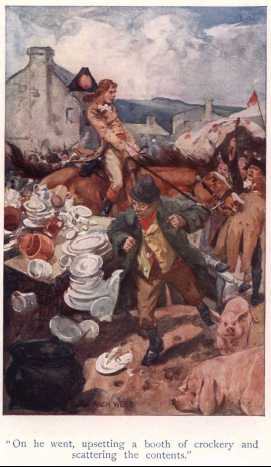
Shouts and imprecations followed me, but though I pulled at the rein with all my might, I could not stop him. On he went, upsetting a booth of crockery and scattering the contents; he dashed in among a herd of pigs, which scampered off in all directions; when finally, attempting to leap over a tent in our course, he went through one side of it, pitching me before him, and down he came on to the middle of the table, with his hind legs under the bench, and very nearly on the top of me.
I scrambled out of the way, bruised and scratched, receiving no very friendly greeting from the owner of the booth. Larry, who had seen what was going on, followed, and assisted to extricate my steed as well as me.
Its knees were cut and hind legs sprained, and I felt as if every bone in my body was broken, though I managed to get on my feet, and, giving myself a shake, had the satisfaction of discovering that nothing of the sort had occurred.
My brothers-in-law, coming up, paid the men for the damage done to the crockery booth and the tent my steed had upset, out of the proceeds of their sale; and I, to show that I was not daunted, remounted my horse.
“Have you sufficiently enjoyed the humours of the fair, Terence?” asked Fitzgerald.
“Faith, indeed I have, and sufficient to last me a mighty long time,” I answered.
In one place there were a dozen fellows piled up, one upon another, struggling and kicking, with their heads cut and their noses bleeding; but few of them had lost their voices, and not one of them was mortally wounded.
I had charged Larry not to join in any of the fights; and though he confessed that he had been sorely tempted, he had become too well disciplined at sea to disobey me. He came out of the fair, therefore, with a whole skin, having employed himself for a good portion of the time in amusing the boys and girls with some tunes on his fiddle. I took care to see him clear of the fair, and free from danger, before we put our horses into a trot.
The whole scene gave me some idea of the state of my native country, to become still more unhappy before many more years were over, owing to the misguiding of hot-headed men, and the cruel treatment of a Government whose only notion of ruling was by stern suppression and terrorism.
We rode too fast to allow of Larry playing his fiddle, so he was obliged to put it in its case, and trot after us.
I felt dreadfully stiff for several days after this adventure, and but little inclined to ride, though I managed to walk about.
Denis begged me to go with him to fish in a stream which ran into the Shannon three or four miles from the house. I agreed, for the sake of having his society, although no adept in the art of throwing a fly. Larry accompanied us, to carry our baskets, and the fish we intended to bring home. We started later in the day than we had intended, so that the best part of it had gone by before we could reach the stream.
I was more successful than I had expected, and succeeded in hooking and landing a brace of tolerably-sized salmon,—Denis having caught twice as many. This encouraged us to go on, and the shades of evening had already begun to spread over the beautiful landscape before we thought of giving in. At length Larry came up to me.
“I wouldn’t be after wishing to frighten you, Mr Terence,” he said in a whisper, “but I have just now seen something I don’t like.”
“What is it, Larry?” I asked. “Is it in human shape, or with four legs, a couple of horns, and a tail?”
“Don’t be laughing at it, Mr Terence. I’m thinking you don’t know where we are, or you wouldn’t be after doing that,” he whispered.
“We are fishing in the stream of Corregan,” I said.
“But does your honour know what happened here?” he asked, in a low voice. “It’s his ghost I’ve seen, as sure as I’m a living man, just behind yon clump of trees there hanging over the water; and I’m thinking he’ll be showing himself again if we stop here longer.”
“I shall be very happy to make his acquaintance, whoever he is,” I said. “Does Mr Denis know anything about him?”
“Master Denis would be only laughing at me if I were to speak to him about it,” said Larry.
I called to Denis, and said that I was ready to put up my rod, as I wished to make the acquaintance of a suspicious individual who was said to be lurking about the stream. He replied that he would be ready to come as soon as he had landed a salmon he had lately hooked.
“Come, Larry, tell me all about this ghost, or spirit, or whatever it was, you fancy you saw just now,” I said, while engaged in winding up my line.
“Hish! your honour; we mustn’t speak loud about him, if you plaise, and I’ll tell you,” he answered. “It’s just this, your honour: while we were away in foreign parts, there was a broth of a boy,—I knew him well,—Dominic Brian. Well, Nick was one evening going home from reaping, along this very part of the stream, when what did he do but cut his own head off. Why he did it no one to this day can tell; but certain sure his body was found on the bank, with his bloody scythe beside him, but his head was gone. They say he comes every evening at the same hour to look out for his head, since he doesn’t rest quiet in his grave without it. When they told me about it I laughed, thinking it couldn’t be true; but seeing’s believing, and as sure as I’m a living man, I saw Dominic Brian this very evening with his head under his arm.”
“I thought you said that he always came to look for his head?” I observed.
“Shure so I did, Mr Terence; but the ghost I saw had his head tucked under his arm, just as if it had been a keg of potheen.”
“Whether he has his head under his arm or has got it on at all, I’ll rout him out,” I exclaimed.
“Oh, don’t, Mr Terence, don’t!” cried Larry. “No one can tell what he’ll be after doing to you. Shure it will be safer for us to be away from this as fast as our legs can carry us. Just shout to Master Denis to make haste, or we don’t know what will be happening.”
Chapter Twenty Two.
A Ghost and a Wedding.
Laughing at Larry’s fears, I, having just finished winding up my line and disconnecting my rod, bade him take up the fish, while I walked towards the clump of trees where he had seen the headless ghost.
I didn’t feel altogether sure that something would not appear. I had not gone many paces before I caught sight of a white object. Larry saw it also, and my gallant follower, who would have tackled a dozen Frenchmen with a cutlass in his hand, fairly turned tail and scampered away, shouting out—
“The ghost! the ghost! It’s Nick Brian himself, barring his head. Run, Mr Terence! Run, Mr Denis! or he’ll be taking hold of us, and carrying us off into the river to help him to look for it.”
In spite of Larry’s shouts, I still went on, although not feeling over comfortable, when, as I got nearer, out flew, with a loud hiss, a large white swan, whose nest was probably thereabouts. Though I might have defended myself with the end of my rod, I thought it prudent to beat a retreat and leave her in quiet possession of the locality. On seeing this she also returned to her nest. When I overtook Larry,—who, finding that I was not following him, had halted,—I assured him that the ghost was only a swan. He, however, still remained incredulous, declaring that it might have appeared like a swan to me in the gloom of the evening, but he felt sure it was Nick Brian, and no one else. In vain I endeavoured to induce him to return with me.
“I’d rather not, Mr Terence, if it’s the same to you,” he answered. “It’s not wise to be hunting up them sorts of things.”
Denis now joined us, and though he laughed at the idea of a ghost, he remarked that it would be as well, while there was sufficient light to see our way, to commence our return home, which, as it was, we should not reach till long after dark. I saw Larry every now and then turning his head round, evidently expecting that Nick Brian the headless would be following us.
We got home without any other adventure, where Larry gave a full account of our encounter with Nick Brian’s ghost, and the gallant way in which Mr Terence had faced him, though he was not ashamed to confess that he had not backed me up as he should have done, had I been attacked by a human foe.
Though Denis had not seen the ghost, and I assured every one that it was only a white swan, I found that Larry’s account was believed in preference to mine; the general opinion being that I fancied I had seen the bird, though it was a ghost notwithstanding.
To do honour to my return, and to keep up the dignity of the family, my mother and sisters considered it necessary to give a ball to the neighbours, and invitations were issued accordingly. The major was rather against the matter, on the score of expense, but he didn’t hold out as stoutly as usual. The preparations, however, were not on a very extensive scale. Such flags and banners as were to be found in the castle—many of them tattered and torn—were arranged so as to decorate the entrance hall. The furniture was carried out of the dining-room—the largest room in the house—and piled up in the dingy study. Supper-tables were placed on one side of the hall; and my mother and sisters, and all the females in the establishment, were engaged for some days in manufacturing pasties, tarts, and jellies; while at the same time sundry pieces of beef, ham, turkeys, and poultry were boiling and roasting at the kitchen fire.
At the usual hour the guests began to arrive,—some in family coaches, once covered with paint and gilt, but now battered and dingy; others came in cars and gigs, and a considerable number of the fair sex on horseback, having sent their ball dresses on before, by the invitation of my sisters, who had promised their assistance in bedecking them. My father complained that he was hurried away from the dinner-table that due time might be obtained for making the necessary preparations. He was left in his chair in the corner of the room, whence he watched the proceedings with an expression which showed that he could not make out exactly what was being done. I went up to him several times and tried to make him understand.
At last the O’Maleys, the O’Flahertys, the Frenches, the Fitzgeralds, the Burkes, the Geraldines, and the members of numerous other families began to arrive, and Larry, habited in a sky-blue coat, a huge frill to his shirt, pink breeches and green stockings, with four or five other musicians, similarly attired, playing various instruments, took their places on a raised platform which served as an orchestra.
A country dance was speedily formed, the couples standing opposite each other, reaching from the top to the bottom of the room, and I had the honour of leading out Miss Nora O’Flaherty, who was considered one of the beauties of the county, though in many respects I doubt whether Tom Pim would have looked upon her with the same eyes as he had done on Lucy Talboys. Taking my partner, I led her prancing down the centre, and proud enough I felt as I heard the remarks made upon us. Then we had to come back and turn each couple, and so on in succession till we reached the bottom. It was pretty hard work, though my fair partner seemed to enjoy it amazingly. Of course, as was the custom of those days, I could not take another partner, and I had every reason to congratulate myself on having obtained so good a one. I suspect that many envied me. I was naturally over head and ears in love with her before the evening was over. There was very little rest between the dances. As soon as one was over another was started, the musicians playing away with might and main. We got through a few minuets, but such dances were too tame for my fair countrywomen; indeed, but few of the men were able to perform them, whereas all took to the country dances as if by instinct.
While we younger ones were thus amusing ourselves, the older people passed the time playing cards, and afterwards did ample justice to the supper. Indeed, very few of the young ladies were very backward at that. Even Nora managed to discuss the wing and breast of a chicken, with ham and a slice of beef, not to speak of tartlets and other delicacies, without the slightest difficulty.
I saw her to her family coach, which conveyed her mamma, two sisters, and a he cousin besides, of whom I felt prodigiously jealous. I could think of nothing and talk of nobody but Nora O’Flaherty all the next day, and proposed riding over to pay my respects to the family.
“You’ll do nothing of the sort, Terence!” said my uncle. “I should be the first to say ‘Go,’ if I thought it would add to your happiness; but, to the best of my belief, the young lady is engaged to her cousin; and even supposing that she cared for you, and would consent to wait till you became a post-captain, you would then only have your pay, and she has not a stiver in the world, and you would thus be doing her a great injustice. Talk of her as you like, think of her as a perfect angel; but angels don’t make good wives down here on earth, whatever they might do in ethereal regions.”
In fine, my uncle talked and laughed me out of my first love. Instead of going over to Castle Moirty, I employed myself in fishing, shooting, and other rural sports with my brothers and my brothers-in-law, and occasionally with the major. This sort of life, however, didn’t suit my taste, and I began to wish myself once more afloat.
Among the young ladies present at the ball given in honour of my return was a Miss Kathleen O’Brien, to whom I observed my brother Maurice paid the most devoted attention, and I guessed, as I afterwards discovered, that he was over head and ears in love with her. It was not a matter of surprise, considering that she was among the prettiest of the very pretty girls present. As she was an only daughter, and heiress of a very fine estate, my family were highly delighted at the prospect of his winning her; and as he was supposed to be crowned with laurels, had a couple of honourable wounds in his arms, and our family was equal to hers, it was hoped that no impediment would be thrown in the way of their marriage, provided the young lady would accept him. Young ladies in those days in Ireland had a free will of their own, and Maurice acknowledged that he was not certain what way he had made in her affections. My mother and sisters, however, encouraged him, and, considering that there was no young man like him in that part of the country, assured him that he had no cause to fear. Thus it appeared to me that the battle was half won, and I had no doubt, when he set out the next morning, attired in his red military suit, to pay his respects at Castle Blatherbrook, that he would return back an accepted lover. We cheered him as he set forth.
“Good luck go with you,” cried Denis. “We will welcome you as an intended Benedict when you come back again. Kathleen’s tender heart will never stand that gay coat and clashing sword. Talk of your laurels, Maurice, and tell her how beautiful she will look with a wreath of orange-blossoms across that fair brow of hers.”
Maurice, a good-natured fellow, took all our jokes in good humour, and, waving his hand as he put spurs to his steed, galloped off; while Denis and I went to amuse ourselves with our fishing-rods, in hopes of obtaining some variety to our usual fare. On our return we found that Maurice had not come back from his wooing. This was considered a good sign, as it was hoped that he was detained at the castle as an accepted suitor. Our own meal was over, and evening was approaching; still Maurice did not appear. My mother and sisters were very positive that he had won the lady. At length, just as it grew dark, his horse’s hoofs were heard clattering up the avenue.
“You must not be disappointed,” said the major, as we were all rushing out to welcome him. “Girls are not always to be won by once asking.”
Maurice threw his rein to Larry, who had taken up his old office of groom, with what we thought a disconsolate air.
“Well, my dear boy, has she accepted you?”
“Yes, I’m sure she has. She could not have said no,” exclaimed my mother, taking him by the hand.
“Faith, then, she has,” cried Maurice, “and I ought to be, and fancy I am, the happiest man under the sun. But I am to quit the army, and turn my sword into a ploughshare, and gather oats instead of laurels; and I am not quite certain how I shall take to that sort of life.”
We all congratulated him on his good fortune, and assured him that he would soon get accustomed to a domestic state of existence.
After this I had very little of his society, as he rode off every morning to Blatherbrook. He used to look bright and happy enough when he came back, and Denis and I agreed that he was by degrees getting accustomed to the thoughts of his expected change of life. This was very good fun for Maurice, but I began to find it rather dull, and even to wish myself afloat again. However, I wanted to wait for the wedding, which, to my great satisfaction, I found was fixed for an early day. I managed to spend the intermediate time much as before,—fishing or sailing and shooting on the Shannon, with Larry as crew and old Mike O’Hagan as pilot, when we explored not only the banks of the beautiful river, but the various lochs which opened out of it. At last the happy day arrived which was to see my brother united to his lady love. The ceremony was to take place at her father’s house, as was the custom of those days among people of rank and fashion. Everything was arranged on a splendid scale. All our neighbours from far and near assembled at Castle Ballinahone, to see the bridal party set off, and to wish us good luck. We had wedding favours down from Dublin, and wedding clothes of resplendent hue, no one just then troubling themselves much as to how they were to be paid for. My sisters were adorned with silks and satins, and looked unusually handsome; but my mother, as became her position, was attired in a costume of silver satin, so that when she put it on the evening before, the light of the lamps made her resemble a moving constellation. My brother, as became his military character, was habited in a scarlet uniform, to which the tailor had added a sufficient amount of gold lace to adorn the coats of half a dozen field-marshals, white satin breeches, silk stockings, and diamond buckles in his shoes, setting him off to great advantage, and we all agreed that a more gallant bridegroom never set forth on a matrimonial expedition. The family coach had been burnished up for the occasion, and was drawn by four of the sleekest steeds in the stable, Larry and the other boys having been employed for many a day previously in currying them down. Dan Bourke was turned into coachman for the occasion, dressed in a magnificent bright blue coat and hat adorned with gold lace. The footboys, Mick Kelly and Tim Daley, were habited in new liveries, of the same colour as Dan’s, and stood behind the coach, in which were ensconced my mother, two sisters, and the happy bridegroom. My uncle, disdaining to enter a coach, led the way on horseback, dressed also in full uniform; and amid the shouts and good wishes of the assembled spectators, the family coach set off, those who had horses or vehicles immediately following at a respectful distance. Denis, my two brothers-in-law, and I had a vehicle to ourselves, which it had not been thought necessary to furbish up. It was an old travelling chaise, which had long rested in an out house, covered with dust and cobwebs, and often the roosting-place of poultry. It was drawn by two sorry hacks, and driven by Phil Kearney, the gamekeeper, for so he was called, though there was but little game on the estate to keep, he being our usual attendant on all sporting expeditions; while Larry, dressed in the attire in which he had appeared at our ball, mounted the rumble with his beloved fiddle, all ready, as he said, for setting the heels of the boys and girls going in the kitchen, while their betters were dancing in the hall. Denis and our two brothers-in-law were habited, as became the attendants of the happy bridegroom, in white cloth coats with blue capes, waistcoats and breeches of blue satin, spangled and laced all over, while their heads were adorned with large paste curls, white as snow, and scented with bergamot. I was more modestly attired in a new naval uniform, carefully made from the pattern of my last old one under my uncle’s inspection. As we wished to reach Blatherbrook Castle before the rest of the party, we took a short cut across the country, so as to get into another high road, which would lead us directly to our destination. Phil lashed on our steeds, when, with a pull and a jerk, our horses, not being accustomed to work together, dashed forward at a rapid pace over the stones, in a way calculated not only to dislocate our limbs, but to shake the vehicle to pieces, but we held on to the sides, trying to keep it together as best we could.
When we settled to take this route, we forgot that there existed a turnpike on the road, an institution to which Irishmen have a decided objection. The old turnpike-keeper, a discharged soldier, who had only lately been sent there, and was thus unacquainted with any of us, cautiously closed the gate, knowing that travellers often forgot to pull up and pay. We, as loyal subjects of His Majesty, were ready to disburse whatever was demanded of us. I accordingly put my hand in my pocket, but not a coin could I find in it, and, knowing that my brothers-in-law were not over-willing to draw their purse-strings if there was any one else ready to do it, I desired Denis to give the gate-keeper the toll.
“I quite forgot to put any money in my pocket,” he observed. “But you can pay him, Daley.”
“I have not a stiver,” said Daley, feeling first in one pocket, then in the other.
“Well, we must come upon you, Fitz,” I said.
“Faith, I left my purse in my other small-clothes,” he answered.
“Is there any cash in it?” asked Daley, with a wink.
“Well, but the man must be paid,” I said. “I’ll tell Phil Kearney,” and, looking out of the window, I called to him.
“Sorra a ha’p’orth of coppers there are in my pocket, seeing not a sight of coin have I got from the master this many a day,” he answered.
I then turned to Larry, hoping that he might be better off than the rest of us.
“Faith, Mr Terence, it’s a long time since I have had a coin to boast of, and if I had that same, I’d not be after chucking it to an old spalpeen for just opening a gate.”
Phil at this juncture, observing that the gate was swinging slowly back, lashed on his horses, and attempted to pass through, on which the old soldier seized them by their heads; but Phil, not inclined to be stopped, furiously flourishing his whip, bestowed his lashes, not only on their backs, but on the shoulders of the gate-keeper. Fitzgerald, who was the most peppery of the party, tried to get out to join in the fight, but fortunately could not open the carriage door. Just then the gate-keeper’s wife hurried out, and joined her husband in hurling abuse at us.
“I see who you are,” she exclaimed, “a party of vagabond stage-players running away from Cork, where you haven’t paid your bills, and going to wheedle the people at Limerick out of their money.”
“That’s true enough, mistress,” said Fitzgerald, who had a soft tongue in his head when he chose to use it; “but we’re coming back soon, and we’ll pay you double for the beating your husband has got, and remember, the next time he deserves it you’ll pardon him for our sakes, and it will save you the trouble of giving it to him. It’s not to Limerick we’re going, but only to Castle Blatherbrook, where we’re to play for the entertainment of the wedding guests, for it’s Mr Maurice O’Finnahan is to marry Miss Kathleen O’Brien; and Mr O’Brien, the lady’s father, will be after paying us well, for he’s as rich as Croesus, and we’ll bring away a bottle or two of the cratur to comfort your old soul.”
As Phil had by this time ceased beating his horses, which stood quietly enough while Fitz was giving this address, the old man let go their heads and came to listen.
“Shure then you look like dacent stage-players, for certain; and as I’m mighty fond of a good tune, now just give us one, and maybe if I like it, I’ll let you off this time, and thank you into the bargain,” said the old soldier.
“With all the pleasure in the world,” answered Fitz. “There’s our musician sitting behind the coach, and he’ll tune up his fiddle while we tune up our pipes, and just consider what’s likely to please you.”
Larry, on hearing this, shouted out—
“I’ll be after giving you what’ll make your old hearts bump right merrily, if it doesn’t set your heels agoing,” and, putting his riddle to his chin, he began playing one of his merriest airs.
“Arrah now, but that’s a brave tune,” cried the old woman, beginning to shuffle her feet, though she hadn’t much elasticity in her limbs.
“It’s a song we’re after wanting,” cried the gate-keeper; “shure you’ll give us a song, gentlemen?”
“Well, you shall have one to begin with, and you shall have a dozen when we come back from the wedding,” cried Fitz, and he struck up—
“As beautiful Kitty one morning was tripping With a pitcher of milk from the fair of Coleraine, When she saw me she stumbled, The pitcher it tumbled, And all the sweet buttermilk water’d the plain. “‘Och! what shall I do now? ’Twas looking at you now; Sure, sure, such a pitcher I’ll ne’er meet again; ’Twas the pride of my dairy, Och, Barney McCleary, You’re sent as a plague to the girls of Coleraine.’”
So Fitz ran on, verse after verse, and tune after tune, till he stopped for want of breath.
Highly delighted, the old pikeman insisted on shaking us all round by the hand, and then, running in, brought us out a glass of whisky each. He was much surprised to find Denis and I declined taking it. Daley, however, prevented his feelings being offended by singing another song. Then Larry gave them a second tune on the fiddle, which pleased him still more, and he set to work with Phil to put to rights the harness, which had been considerably disarranged by the prancing of our steeds.
Then he exclaimed—
“Good luck to you. You’ll give us some more tunes when you come back. Off with you now. Success! success!”
Phil lashing on the horses, away we went, laughing heartily at our adventure. We soon arrived at the castle, where we found the guests rapidly assembling. I won’t describe the ceremony. My brother and Kathleen O’Brien were indissolubly united. No sooner was it over than every one rushed forward to kiss the blushing bride, and then we all heartily congratulated each other at the happy event. My mother took charge of her new daughter-in-law, who cried a little, but, soon recovering, looked as bright and blooming as any of her fair bridesmaids.
Plum-cake and wine were then handed round, just to stay our appetites till dinner was announced,—a substantial repast, to which all did good justice. Then the ball commenced, the bride leading off the dance. It was kept up, with an interval for a hot supper, until three or four in the morning. It was lucky for me that Nora O’Flaherty, for some reason or other, was not present, or I believe that in spite of my uncle’s advice I should have forgotten my poverty and confessed my love. But there’s luck in odd numbers, and there were so many charming girls present that my heart was pretty evenly divided among them. The whole of the guests were put up in the house,—and pretty close stowing it was, but no one complained,—and, after a breakfast as substantial as the supper, we set off to return home. We purposely went back by the way we came, and greatly astonished the old pike-keeper by not only paying him his toll, but treble the value of the whisky he had bestowed on us, as well as two or three additional songs. He had by this time discovered who we were, and was profuse in his apologies for the way in which he had behaved. We assured him that he had but done his duty, and as we had chosen to pass for stage-players we could not complain of him for believing us. For a few days things went on much as usual. At last my uncle received a letter from Captain Macnamara, saying that he had not been appointed to a ship himself, but had applied to Lord Robert Altamont, who had just commissioned the Jason at Plymouth, and who had agreed to receive me on board on his recommendation. “Your nephew will meet some of his old shipmates, who, I have no doubt, will be glad to have him among them,” he added.
At first I was highly delighted at this news, but when the time came for parting I wished that I had been able to remain longer at home. It appeared to me very unlikely that I should ever see my father again, and the state of our pecuniary affairs was evidently telling on my mother, though my brave uncle was doing his utmost to keep things together. It was settled, of course, that Larry was to accompany me.
“I should like to go with you,” said my uncle; “but you’re old enough to take care of yourself, and affairs at home require my presence. Two men will, however, attend you, to look after the horses and bring them back.”
I will not describe our leave-takings a second time, or my journey to Cork. I found there was a vessel just about to sail for Plymouth, and I therefore secured berths on board her for myself and Larry. Nothing particular occurred during the passage. We dropped anchor in the Catwater at Plymouth five days after leaving Cork. I at once repaired on board the Jason, lying in Hamoaze.
Who should I find walking the deck as first lieutenant but old Rough-and-Ready. He put out his hand and shook mine cordially.
“Glad to have you aboard, my lad,” he said. “You see, their Lordships, knowing my value as a first lieutenant, have taken good care not to promote me, lest my peculiar qualities should be lost to the service.”
“I should have been glad to have served under you, had you been in command of a corvette, sir,” I said; “and I’m very happy to be with you again.”
“You’ll find two or three old shipmates on board, for Lord Robert, being a friend of Captain Macnamara, applied to him to recommend such officers as he thought well of. He has immense interest, and I hope that we shall all get our promotion when he’s done with us, though he’ll take very good care it will not be till then.”