Chapter IV · THE COMING OF THE FRIARS (continued 2)
Reading edition
The arrival of the Archbishop at Oxford then, to hold a visitation at S. Mary’s was a signal for an outbreak. S. Mary’s was barricaded and a band of scholars armed with bows, swords and bucklers awaited the Primate. Notwithstanding the interdict laid on the Church, John Birch of Oriel, one of the Proctors, took the keys, opened the doors, had the bell rung as usual, and even celebrated High Mass there. S. Mary’s, it will be remembered, belonged to Oriel. Hence, perhaps, the active resistance of these Oriel Fellows and of the Dean of Oriel, John Rote, who asked “why should we be punished by an interdict on our church for other people’s faults?” And he elegantly added, “The Devil go with the Archbishop and break his neck.” The controversy was at last referred to the king. The Chancellors and Proctors resigned their office. The younger students who had opposed the Archbishop were soundly whipped, much to the delight of Henry IV. The bull of exemption was declared invalid; the University acknowledged itself subject to the See of Canterbury, thanks to the mediation of the Prince of Wales, mad-cap Harry, and the Archbishop Arundel made a handsome present of books to the public library of Oxford.
The committee desired by Arundel was eventually constituted. Two hundred and sixty-seven propositions were condemned and the obnoxious books solemnly burnt at Carfax. Not long after, a copy of the list of condemned articles was ordered to be preserved in the public libraries, and oaths against their maintenance were enjoined upon all members of the University on graduation.
The methods of the Archbishop met with the success which usually attends a well-conducted persecution. History notices the few martyrs who from time to time have laid down their lives for their principles, but it often fails to notice the millions of men who have discarded their principles rather than lay down their lives.
So the Wycliffite heresy was at length dead and buried. But the ecclesiastical repression which succeeded in bringing this about succeeded also in destroying all vigour and life in the thought of the University. Henceforth the Schoolmen refrained from touching on the practical questions of their day. They struck out no new paths of thought, but revolved on curves of subtle and profitless speculation, reproducing and exaggerating in their logical hair-splitting all the faults without any of the intellectual virtues of the great thinkers of the thirteenth and fourteenth centuries. It was against these degenerate dullards that the human mind at last rebelled, when intellect was born again in the New Birth of letters. What wonder then if, suddenly freed from the dead weight of their demoralising stupidities, men broke out in the exuberance of their spirits into childish excesses, confused the master with his foolish and depressing pupils, strewed the quadrangle of New College with the leaves of Dunce, and put them to the least noble of uses, as though they had been the Chronicles of Volusius.
The Archbishop’s right of Visitation was confirmed in Parliament and with it the suppression of Lollardy, of free speech and thought, in the schools and pulpits of Oxford.
The issue of the struggle practically closes the history of Lollardism as a recognised force in English politics, and with it the intellectual history of mediæval Oxford.
Up to that time the University had shown itself decidedly eager for reform, and for a few years the same spirit survived. Oxford had consistently advocated the summoning of a General Council to settle the claims of the rival popes and to put an end to the schism which was the scandal of Christendom. But for fifteen years such pacific designs were eluded by the arts of the ambitious pontiffs, and the scruples or passions of their adherents. At length the Council of Pisa deposed, with equal justice, the Popes of Rome and Avignon. In their stead, as they intended, but in addition to them as events were to prove, the conclave, at which the representatives of Oxford and Cambridge were present, unanimously elected Peter Philargi. This Franciscan friar from Crete, who had taken his degree of Bachelor of Theology at Oxford, assumed the title of Alexander V., and remains the only wearer of the tiara who has graduated at Oxford or Cambridge. He was shortly afterwards succeeded by John XXIII., the most profligate of mankind. It remained for the Council of Constance to correct the rash proceedings of Pisa, and to substitute one head of the Church in place of the three rival popes (1414).
But before the opening of this Council the University of Oxford had drawn up and presented to the King a document of a very remarkable character. It consisted of forty-six articles for the reformation of the Church. The Oxford masters suggested that the three rival popes should all resign their claims; they complained of the simoniacal and extortionate proceedings of the Roman Court, and of the appointment of foreigners to benefices in England; they accused the Archbishops of encroaching on the rights of their suffragans, and charged the whole Order of prelates with nepotism and avarice. Abbots, they contended, should not be allowed to wear mitres and sandals as if they were bishops, and monks should hot be exempt from ordinary episcopal jurisdiction. Friars should be restrained from granting absolution on easy terms, from stealing children, and from begging for alms in the house of God. Secular canons should be made to abandon their luxurious style of living, and masters of hospitals to pay more regard to the wants of the poor. Parish priests, who neglected the flocks committed to their care, are described as ravening wolves. The Masters also complained of the non-observance of the Sabbath and of the iniquitous system of Indulgences.
Shades of the founder of Lincoln College, what a document is this! It is Wycliffism alive, rampant and unashamed. Not perhaps altogether unashamed or at least not indiscreet, for the Masters go out of their way to call for active measures against the Lollards. But the whole of this manifesto is a cry from Oxford, in 1414, for reformation; it is a direct echo of the teaching and declamation of Wycliffe, and an appeal for reformation as deliberate and less veiled than “the vision of William Langland concerning Piers Plowman,” that sad, serious satirist of those times, who, in his contemplation of the corruption he saw around him in the nobility, the Government, the Church and the Friars, “all the wealth of the world and the woe too,” saw no hope at all save in a new order of things.
Oxford’s zeal for reformation at this time was made very clear also by her representatives at Constance, where a former Chancellor, Robert Halam, Bishop of Salisbury, and Henry Abingdon, a future Warden of Merton, very greatly distinguished themselves. Yet it was by a decree of this very Council of Constance (1415) that the remains of Wycliffe were ordered to be taken up and cast out far from those of any orthodox Christian. This order was not executed till twelve years later, when Bishop Fleming, having received direct instructions from the Pope, saw to it.
Wycliffe’s remains were dug up, burnt and cast into the Swift, but, as it has been said, the Swift bore them to the Avon, the Avon to the Severn, and the Severn to the sea to be dispersed unto all lands: which things are an allegory. For though in England the repression of his teaching deferred the reformation, which theologically as well as politically Wycliffe had begun, for more than a hundred years, yet abroad, in Bohemia, the movement which he had commenced grew into a genuine national force, destined to react upon the world.
Bishop Fleming, who had been proctor in 1407, seems to have thought that the snake was scotched but not killed. For though he had been a sympathiser with the Lollards in his youth, in his old age he thought it worth while to found a “little college of theologians,” who should defend the mysteries of the sacred page “against these ignorant laics, who profaned with swinish snout its most holy pearls.” The students in this stronghold of orthodox divinity were to proceed to the degree of B.D. within a stated period; they must swear not to favour the pestilent sect of Wycliffites, and if they persisted in heresy were to be cast out of the College “as diseased sheep.” It was in 1427 that Fleming obtained a charter permitting him to unite the three parish churches of All Saints’, S. Michael’s, and S. Mildred’s into a collegiate church, and there to establish a “collegiolum,” consisting of a rector and seven students of Theology, endowed with the revenue of those churches. No sooner had he appointed the first rector, purchased a site and begun to erect the buildings just south of the tower, than he died. The energy of the second rector, however, Dr John Beke, secured the firmer foundation of the College. He completed the purchase of the original site, which is represented by the front quadrangle and about half the grove; and thereon John Forest, Dean of Wells, completed (1437) the buildings as Fleming had planned them, including a chapel and library, hall and kitchen, and rooms. Modern Lincoln is bounded by Brasenose College and Brasenose Lane, the High Street and the Turl,[21] the additional property between All Saints’ Church and the front quadrangle having been bestowed upon the College during the period 1435-1700. Of Forest’s buildings the kitchen alone remains untouched, and a very charming fragment of the old structure it is.
The foundation of Lincoln was remodelled and developed by Thomas Rotherham, Chancellor of Cambridge, and afterwards Archbishop of York. His benefactions to the cause of learning were munificent and unceasing, and, so far as Lincoln is concerned, he may fairly be called the College’s second founder. The origin of his interest in the College arose from a picturesque incident. When he visited the College as bishop of the diocese in 1474, the rector, John Tristrope, urged its claims in the course of a sermon. He took for his text the words from the psalm, “Behold and visit this vine, and the vineyard which thy right hand hath planted,” and he earnestly exhorted the bishop to complete the work begun by his predecessor. For the College was poor, and what property it had was at this time threatened. So powerful and convincing was his appeal that, at the end of the sermon, the bishop stood up and announced that he would grant the request. He was as good as his word. He gave the College a new charter and new statutes (1480)—a code which served it till the Commission of 1854; he increased its revenues and completed the quadrangle on the south side. There is a vine which still grows in Lincoln, on the north side of the chapel quadrangle, and this is the successor of a vine which was either planted alongside the hall in allusion to the successful text, or, being already there, suggested it.
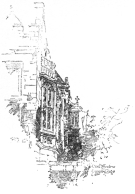
Oriel Window, Lincoln College