OXFORD AND HER COLLEGES. (continued 2)
Reading edition
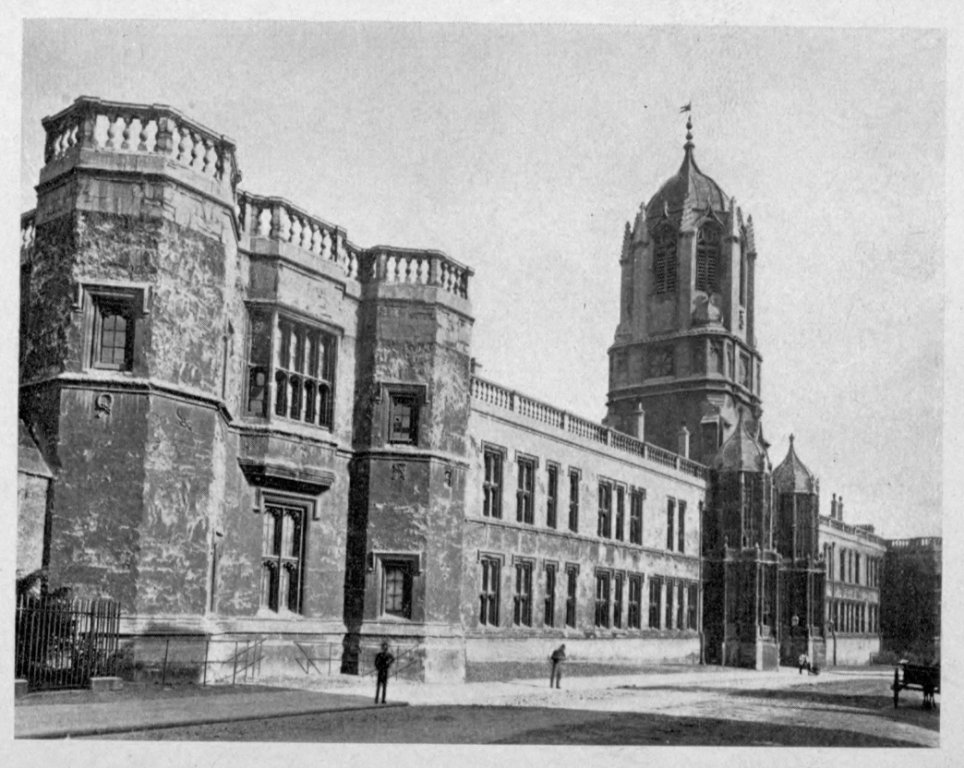
CHRIST CHURCH—FRONT.
Scarcely, however, had the University begun to awake to a new life, when it was swept by another ecclesiastical storm, the consequence of its unhappy identification with clericism and the State Church. The liberal movement which commenced after the fall of Napoleon and carried the Reform Bill, threatened to extend to the religious field, and to withdraw the support of the State from the Anglican Church. This led the clergy to look out for another basis, which they found in the reassertion of High Church and sacerdotal doctrines, such as apostolical succession, eucharistical real presence, and baptismal regeneration. Presently the movement assumed the form of a revival of the Church of the Middle Ages, such as High Church imagination pictured it, and ultimately of secession to Rome. Oxford, with her mediæval buildings, her High Church tradition, her half-monastic Colleges, and her body of unmarried clergy, became the centre of the movement. The Romanising tendencies of Tractarianism, as from the "Tracts for the Times" it was called, visible from the first, though disclaimed by the leaders, aroused a fierce Protestant reaction, which encountered Tractarianism both in the press and in the councils of the University. The Armageddon of the ecclesiastical war was the day on which, in a gathering of religious partisans from all sections of the country which the Convocation House would not hold, so that it was necessary to adjourn to the Sheldonian Theatre, Ward, the most daring of the Tractarian writers, after a scene of very violent excitement, was deprived of his degree. This was the beginning of the end. Newman, the real leader of the movement, though Pusey, from his academical rank, was the official leader, soon recognised the place to which his principles belonged, and was on his knees before a Roman Catholic priest, supplicating for admission to the Church of Rome. A ritualistic element remained, and now reigns, in the Church of England; but the party which Newman left, bereft of Newman, broke up, and its relics were cast like drift-wood on every theological or philosophical shore. Newman's poetic version of mediæval religion, together with the spiritual graces of his style and his personal influence, had for a time filled the imaginations and carried away the hearts of youth, while the seniors were absorbed in the theological controversy, renounced lay studies, and disdained educational duty except as it might afford opportunities of winning youthful souls to the Neo-Catholic faith. Academical duty would have been utterly lost in theological controversy, had it not been for the Class List, which bound the most intellectual undergraduates to lay studies by their ambition, and kept on foot a staff of private teachers, "coaches," as they were called, to prepare men for the examinations, who did the duty which the ecclesiastical Fellows of the University disdained. The Oxford movement has left a monument of itself in the College founded in memory of Keble, the gentle and saintly author of "The Christian Year." It has left an ampler monument in the revival of mediæval architecture at Oxford, and the style of new buildings which everywhere meet the eye. The work of the Oxford Architectural Society, which had its birth in the Neo-Catholic movement, may prove more durable than that movement itself. Of the excess to which the architectural revival was carried, the new Library at University College, more like a mediæval Chapel than a Library, is a specimen. It was proposed to give Neo-Catholicism yet another monument by erecting close to the spot where Cranmer, Latimer, and Ridley died for truth, the statue of Cardinal Newman, the object of whose pursuit through life had been, not truth, but an ecclesiastical ideal. Of the reaction against the Tractarian movement the monument is the memorial to the Protestant martyrs Cranmer, Latimer, and Ridley, the subscription for which commenced among the Protestants who had come up to vote for the condemnation of Ward, and which Tractarians scornfully compared to the heap of stones raised over the body of Achan.
Here ended the reign of ecclesiasticism, of the Middle Ages, and of religious exclusion. The collision into which Romanising Oxford had been brought with the Protestantism of the British nation, probably helped to bring on the revolution which followed, and which restored the University to learning, science, and the nation. The really academical element in the University invoked the aid of the national government and Legislature. A Royal Commission of Inquiry into the state of the University and its Colleges was appointed, and though some Colleges closed their muniment rooms, and inquiry was obstructed, enough was revealed in the Report amply to justify legislative reform and emancipation. An act of Parliament was passed which set free the University and Colleges alike from their mediæval statutes, restored the University Professoriate, opened the Fellowships to merit, and relaxed the religious tests. The curriculum, the examination system, and the honour list were liberalised, and once more, as in early times, all the great departments of knowledge were recognised and domiciled in the University. Science, long an exile, was welcomed back to her home at the moment when a great extension of her empire was at hand. Strictly professional studies, such as practical law and medicine, could not be recalled from their professional seats. Elections to Fellowships by merit replaced election by local or school preferences, by kinship, or by the still more objectionable influences which at one time had been not unfelt. Colleges which had declined the duty of education, which had been dedicated to sinecurism and indolence, and whose quadrangles had stood empty, were filled with students, and once more presented a spectacle which would have gladdened the heart of the Founder. A Commission, acting on a still more recent Act of Parliament, has carried the adaptation of Oxford to the modern requirements of science and learning further than the old Commission, which acted in the penumbra of mediæval and ecclesiastical tradition, dared. The intellectual Oxford of the present day is almost a fresh creation. Its spirit is new; it is liberal, free, and progressive. It is rather too revolutionary, grave seniors say, so far as the younger men are concerned. This is probably only the first forward bound of recovered freedom, which will be succeeded in time by the sober pace of learning and scientific investigation. Again, as in the thirteenth century, the day of Grosseteste and Simon de Montfort, Oxford is a centre of progress, instead of being, as under the later Stuarts, the stronghold of reaction. Of the College revival, the monuments are all around in the new buildings, for which increasing numbers have called, and which revived energy has supplied. Christ Church, New College, Magdalen, Merton, Balliol, Trinity, University have all enlarged their courts, and in almost every College new life has been shown by improvement or restoration. Of the reign of mediævalism the only trace is the prevalence in the new buildings of the mediæval style, which architectural harmony seemed to require, though the new buildings of Christ Church and Trinity are proofs of a happy emancipation from architectural tradition. The University revival has its monument in the new examination Schools in High Street, where the student can no longer get his degree by giving the meaning of Golgotha and the name of the Founder of University College. There are those who, like Mark Pattison, look on it with an evil eye, regarding the examination system as a noxious excrescence and as fatal to spontaneous study and research; though they would hardly contend that spontaneous study and research flourished much at Oxford before the revival of examinations, or deny that since the revival Oxford has produced the fruits of study and research, at least to a fair extent. The restoration of science is proclaimed by the new Museum yonder; a strange structure, it must be owned, which symbolises, by the unfitness of its style for its purpose, at once the unscientific character of the Middle Ages, and the lingering attachment of Oxford to the mediæval type. Of the abolition of the religious tests, and the restoration of the University to the nation, a monument is Mansfield College for Congregationalists, a vision of which would have thrown an orthodox and Tory Head of a College into convulsions half a century ago. Even here the mediæval style of architecture keeps its hold, though the places of Catholic Saints are taken by the statues of Wycliffe, Luther, John Knox, Whitefield, and Wesley. By the side of Mansfield College rises also Manchester College for Independents, in the same architectural style. Neither of them, however, is in the Oxford sense a College; both are places of theological instruction.
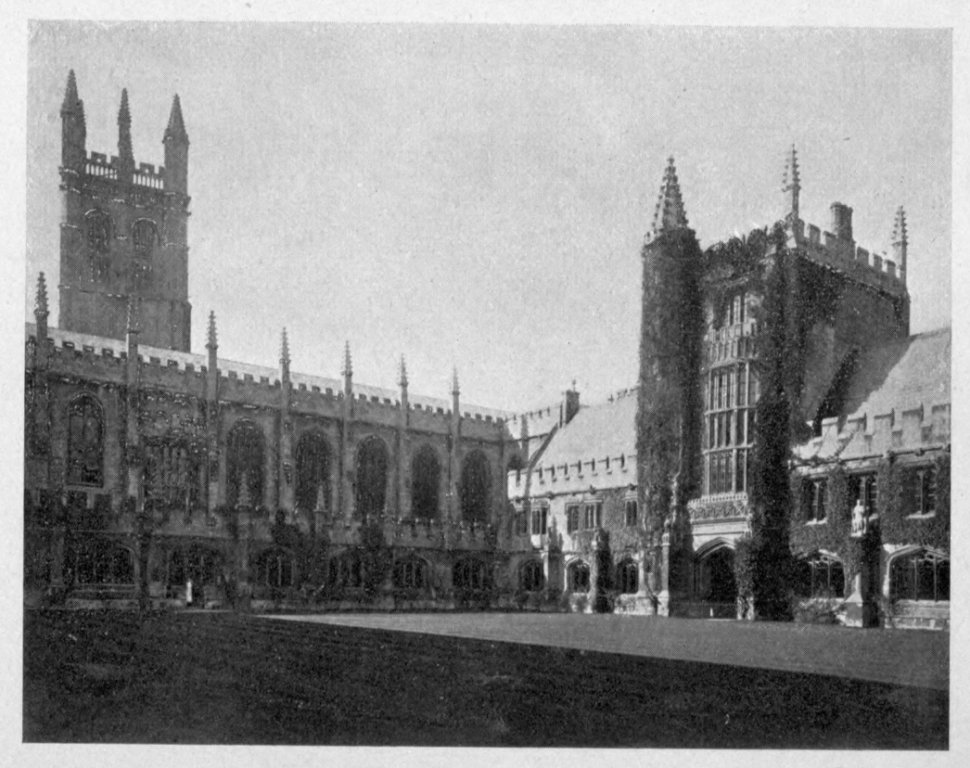
GATE TOWER AND CLOISTERS, MAGDALEN.
On the North of the city, where fifty years ago stretched green fields, is now seen a suburb of villas, all of them bespeaking comfort and elegance, few of them overweening wealth. These are largely the monuments of another great change, the removal of the rule of celibacy from the Fellowships, and the introduction of a large body of married teachers devoted to their profession, as well as of the revival of the Professorships, which were always tenable by married men. Fifty years ago the wives of Heads of Houses, who generally married late in life if they married at all, constituted, with one or two officers of the University, the whole female society of Oxford. The change was inevitable, if education was to be made a profession, instead of being, as it had been in the hands of celibate Fellows of Colleges, merely the transitory occupation of a man whose final destination was the parish. Those who remember the old Common Room life, which is now departing, cannot help looking back with a wistful eye to its bachelor ease, its pleasant companionship, its interesting talk and free interchange of thought, its potations neither "deep" nor "dull." Nor were its symposia without important fruits when such men as Newman and Ward, on one side, encountered such men as Whately, Arnold, and Tait, on the other side, in Common Room talk over great questions of the day. But the life became dreary when a man had passed forty, and it is well exchanged for the community that fills those villas, and which, with its culture, its moderate and tolerably equal incomes, permitting hospitality but forbidding luxury, and its unity of interests with its diversity of acquirements and accomplishments, seems to present the ideal conditions of a pleasant social life. The only question is, how the College system will be maintained when the Fellows are no longer resident within the walls of the College to temper and control the younger members, for a barrack of undergraduates is not a good thing. The personal bond and intercourse between Tutor and pupil under the College system was valuable as well as pleasant; it cannot be resigned without regret. But its loss will be compensated by far superior teaching. Half a century ago conservatism strove to turn the railway away from Oxford. But the railway came, and it brings, on summer Sundays, to the city of study and thought not a few leaders of the active world. Oxford is now, indeed, rather too attractive; her academical society is in danger of being swamped by the influx of non-academical residents.
The buildings stand, to mark by their varying architecture the succession of the changeful centuries through which the University has passed. In the Libraries are the monuments of the successive generations of learning. But the tide of youthful life that from age to age has flowed through college, quadrangle, hall, and chamber, through University examination-rooms and Convocation Houses, has left no memorials of itself except the entries in the University and College books; dates of matriculation, which tell of the bashful boy standing before the august Vice-Chancellor at entrance; dates of degrees, which tell of the youth putting forth, from his last haven of tutelage, on the waves of the wide world. Hither they thronged, century after century, in the costume and with the equipments of their times, from mediæval abbey, grange, and hall, from Tudor manor-house and homestead, from mansion, rectory, and commercial city of a later day, bearing with them the hopes and affections of numberless homes. Year after year they departed, lingering for a moment at the gate to say farewell to College friends, the bond with whom they vowed to preserve, but whom they were never to see again, then stepped forth into the chances and perils of life, while the shadow on the College dial moved on its unceasing round. If they had only left their names in the rooms which they had occupied, there would be more of history than we have in those dry entries in the books. But, at all events, let not fancy frame a history of student life at Oxford out of "Verdant Green." There are realities corresponding to "Verdant Green," and the moral is, that many youths come to the University who had better stay away, since none get any good and few fail to get some harm, saving those who have an aptitude for study. But the dissipation, the noisy suppers, the tandem-driving, the fox-hunting, the running away from Proctors, or, what is almost as bad, the childish devotion to games and sports as if they were the end of existence, though they are too common a part of undergraduate life in the University of the rich, are far from being the whole of it. Less than ever are they the whole of it since University reform and a more liberal curriculum have increased, as certainly they have, industry and frugality at the same time. Of the two or three thousand lamps which to-night will gleam from those windows, few will light the supper-table or the gambling-table; most will light the book. Youthful effort, ambition, aspiration, hope, College character and friendship have no artist to paint them,—at least as yet they have had none. But whatever of poetry belongs to them is present in full measure here.
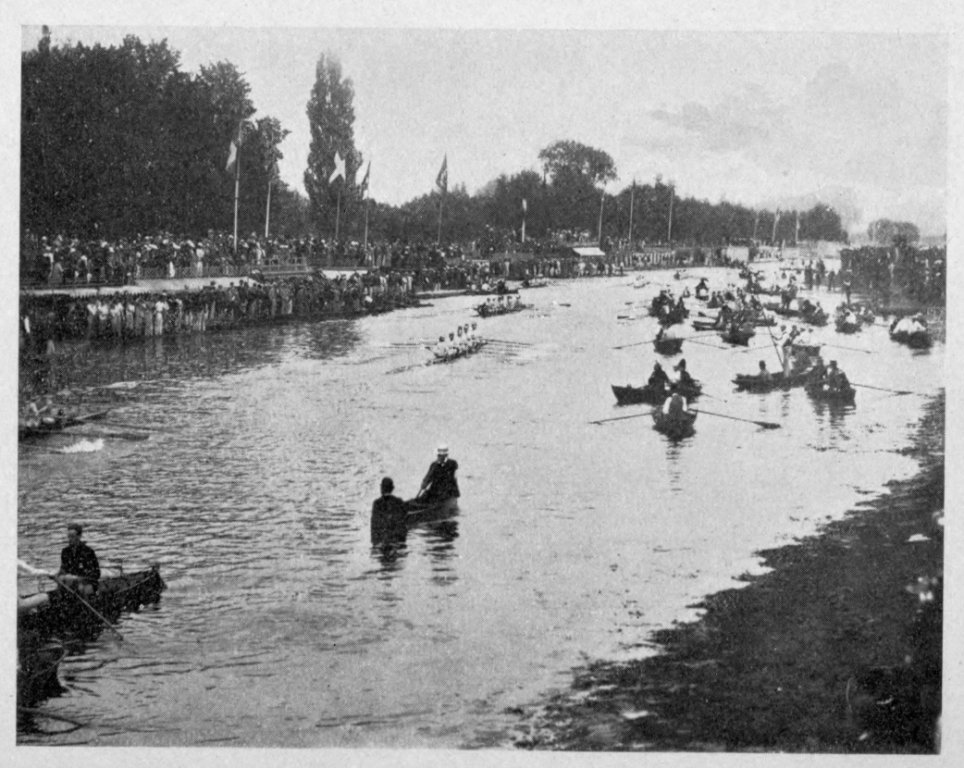
THE RIVER—BOATS RACING.