OVER THE FRONT IN AN AEROPLANE (continued 2)
Reading edition
No one who has not walked through this mushroom town or the many others like it can imagine the infinite variety of architectural forms which can be wrought in one-story shacks of wattle, clay and straw. The pliable wattle and clay lent themselves to effects which could not have been possible in stone, brick or wood. Extraordinary bays and alcoves, never before dreamed of by the Ecole des Beaux Arts gave light and shadow to long walls. Bas-relief and high-relief were done with spirit and often with fine art in the clay which covered the wattled walls, the thatched straw of the roofs was erected into strange gables, dormer windows, turrets and machicolations. Eccentric, grotesque many of these experiments unquestionably were, but they meant on the part of the tired soldiers hours and days and weeks of extra and unnecessary work, lavished, not for their creature comfort, not for their physical safety, but solely for their artistic satisfaction.
It was twilight when we took our leave and night had fallen long before we rolled into Château Thiery, whither Captain d'A——'s orderly had transported our bags, and where a very late dinner and comfortable beds were awaiting us.
V A GRENADE-THROWING SCHOOL
With the 5th French Army, Aug. 9.
I have just returned from attending a soldiers' school of bomb-throwing. The military authorities permitted my presence as an exceptional favor, informing me that this is the first time such a privilege has been accorded a foreign civilian.
This particular school holds its classes in a large green field in a peaceful little valley, within long artillery range of the firing lines. No German shells, however, have hitherto distracted the pupils from their rather gruesome lessons, and I will not endanger their continued studies by giving a more definite description of the locality.
This school is attended by privates from each regiment, who spend four days at their highly explosive studies. Toward the middle of the field, about two hundred yards from one end and about three hundred from the other, was a section of open trench about twenty yards long and some four feet deep. This trench was about the usual three feet in width except in its centre, where for about five feet it was recessed back to a width of some six feet. This was where the French instructor stood and whirled his arms to throw the bombs. A couple of feet to the left of this recess was another recess, covered with a bomb-proof roof of logs and earth.
Into this the instructor and his pupil sought refuge from the effects of the bomb explosion. As the explosion really is surprisingly violent and takes place at the longest only five seconds from the time the mechanism of the bomb is started, and at a maximum distance of thirty yards, the instructor and any one in the trench with him have got to be exceedingly spry in running under the bomb-proof in order to beat the bomb. There is, too, the danger of a premature explosion.
To make me feel more entirely at my ease, they told me that only a few days ago an officer of explosives brought a Colonel to see one of these demonstrations in another school, behind a different part of the line. As they came to the entrance of the trench the officer politely made way for the Colonel to enter the trench first. As the Colonel did so, the bomb exploded prematurely and killed the Colonel outright.
About twenty yards in front of the trench was dug a shallow dummy trench to represent a German target. Some 150 yards further distant was set up a section of wire entanglements.
We found the 128 soldiers ranged in line a few yards behind the trench. At its edge I took my place with the Captain of explosives and three or four other officers. The infantrymen lined up two deep behind us.
In the open recess in the trench stood the non-commissioned officer of engineers, facing backward toward us. He was the instructor. At the order of the Captain he placed an innocent-looking satchel on the trench edge at his right elbow, plunged a hand into it and briskly plucked out, one after the other, eight different varieties of bombs. Picking them up, one at a time, he gave a terse lecture on the construction and method of operation of each.
The bombs were all fully loaded, and the explosion of any one of them would have sent a great many of us well on the way to the cemetery. I noticed in some of the officers, and undoubtedly in myself, a certain tenseness as the engineer nonchalantly illustrated within an inch or two of actuality how a percussion bomb would explode if brought in contact with the ground.
In demonstrating the first grenade he adjusted around his wrist a loop with about eight inches of cord hanging from it. A heavy two-inch metal pin was attached to the end of the cord. Picking up a black spherical bomb slightly bigger than a baseball, he stuck the pin lightly into a hole in its side. The bomb was to be thrown with full force. In flying out of the hand it pulled itself free from the pin, causing a friction which ignited the five-second fuse. The pin of course remained behind, hanging to the cord, and was promptly stuck into another bomb. This bomb, being particularly heavy, could be thrown only fifteen metres by an average thrower and twenty as a maximum.
The second bomb was black and pear-shaped. It had a spring which looked like a nickel shoe-horn folded back tight against it. The pressure of the palm against the shoe-horn in throwing it released the spring and started the fuse, which, like all the rest, was set at five seconds.
The third bomb was a can of white tin attached by two wires to a white deal handle. A nail was stuck into a hole in the can. The nail was hammered in by a sharp rap against the ground. ("If you try to knock it in against the palm of your hand it would hurt," explained our instructor.) The nail, driven in, started the fuse.
In the demonstration of this particular bomb our mentor was quite peculiarly realistic, bringing it violently down to within what seemed like the fraction of an inch of the ground.
The fourth bomb was black and round and was started by scratching the tip of a stiffly projecting bit of ignitible fuse against a black band of raspy material worn round the thumb of the left hand. The fifth bomb was lighted in a very similar manner against the side of an ordinary safety-match box. These five were regular grenades.
The sixth and seventh were incendiary grenades to set fire to wooden obstructions, etc. The one, in exploding, scattered the burning liquid to a distance of a few yards, the other set fire only to the spot where it burst. These were both large spherical bombs. Before being thrown kerosene was poured into them through a little bunghole, which was then stopped up.
The eighth was an asphyxiating bomb. I cannot, however, be too careful in emphasizing the fact that this so-called "asphyxiating" bomb was not poisonous, like the German asphyxiating gases, but merely irritated the eyes, nostrils and throat, so that when thrown into a German bomb-proof it would force out the occupants. It left no ill after-effects.
Besides these there were two aerial torpedoes. One was shot out of an old-fashioned little mortar propelled by black powder. The other was bigger and more powerful, had a fin tail to keep its flight accurate and was fired out of a complicated little gun. As both this torpedo and its gun are new inventions, I am not permitted to give any closer details concerning them.
The Sergeant of engineers having completed his little lecture, with himself and his class still in this world, the soldiers and officers all withdrew to the end of the field, some 200 yards behind the trench, and there lay down on their stomachs. I got into the trench with the engineer, placing myself to his left in front of the entrance to the bomb-proof, and the demonstration in the gentle art of grenade-throwing began. He took bomb number one, stuck the pin at the end of the cord firmly into the hole, swung his arm back and let fly.
Having seen the departure of the bomb, I ungracefully tumbled into the bomb-proof, with the engineer a close second. Once there, there was an appreciable pause. Then came an explosion, the violence of which really astonished me. I could distinctly feel the ground shake.
After giving the fragments which had been hurled our way plenty of time to come down on the roof, we stepped out into the trench again. The engineer next picked up bomb number three with the deal handle, hammered the nail home with one sharp rap against the edge of the trench and sent the grenade hurtling through the air.
The mechanism of the first bomb had not been put in operation until the bomb started on its flight. But the fuse of this third bomb started burning the instant he hammered the nail in, and was burning while he was whirling his arm preparatory to letting it fly. As it thus got a running start on us, we had only barely time to get under cover before the explosion took place.
Next came bomb number four. The demonstrator adjusted the black band round his left thumb, took the bomb in his right hand and gave it a scratch.
He evidently had some doubts as to whether the first scratch had lighted the fuse, because after glancing at it he proceeded to give it a second scratch before throwing it.
I need hardly say that I had already made home base in the bomb-proof and was perfectly satisfied to watch from there his second effort to get a light, which was crowned with complete success.
After watching the way these three bombs were started and thrown I now wanted to watch the rest of them explode. So after considerable discussion between the staff-officer who had me in charge and the officer of explosives as to just how much danger there was in the operation, we moved out of the trench up to the top of a little rise about fifty yards to the right, where we ensconced ourselves in some bushes. The soldiers were all kept at their original distances of 200 yards behind the trench.
From my new position I got an excellent view of the engineer whirling his arm and letting fly; of the heavy black objects rushing through the air; of the accuracy with which they hit the dummy trench; of the lazy manner in which they rolled only two or three feet along the ground before coming to rest, and of the treacherous inertia with which each lay apparently as dead and cold as a piece of coal dropped by some passing coal-cart, while the second of time which possibly elapsed seemed like a minute at the least. Then came an amazingly instantaneous burst of lead-colored smoke covering a circle some forty yards in diameter, accompanied by an explosion of surprising violence. I could see no flash of fire at all.
Next came the new aerial torpedo fired from the new gun. (The old little mortar with the black powder was not used.) The new gun made practically no report in discharging the torpedo. It was beautiful to watch the slender fishlike projectile go sailing in a high and graceful arc up, up, up, against the sky and then down, down, down, until it landed just beyond the wire entanglements. But it really never did land, for it had a percussion device in its nose which exploded it on touching ground. This big torpedo had a reduced charge of explosive so as not to destroy too much of the field. Judging by the report of this reduced charge, the full charge going off must be the grandfather of all explosions.
Next came the two incendiary bombs. One of these burst on contact, setting fire to the patch of grass where it landed. The other had a fuse which shot out a stream of golden sparks like fireworks before exploding. This bomb threw burning liquid in all directions, setting many fires in the grass for a radius of several yards.
Last came the asphyxiating bomb. It consisted of a sphere formed by five pieces of perforated iron held loosely together in a sort of disjointed shell by a little wire basket. Inside this openwork ball hung a small glass vessel full of acid. When the engineer threw the ball against the ground the five pieces of metal shell collapsed onto the glass, breaking it and liberating the acid, which made a wet splash on the ground. This acid in turn makes a gas which the French somewhat euphemistically call "gas timide."
To show that this gas was not poisonous, like the German gases, we were invited to stand in a close circle right around the fragments of the bomb immediately after it had been thrown, with our heads bent over. We stood and stood, sniffing away, but could detect no gas of any kind.
"Ah," said the officer of explosives, "in the full open air like this our 'gas timide' takes longer to be noticed, but in an inclosed space it works very rapidly."
Hardly had he finished speaking when I began to notice a smell something like wood alcohol. At the same time my eyes began to stream with tears, my nose felt as though it was indulging in one long continuous sneeze, and I turned hastily away, coughing and sputtering and wiping my eyes, with an officer on each side keeping me active company.
"If that's a 'timide' gas," I remarked to one of the officers as we left the pupils to begin actual practice, "I'd hate to meet a fierce one."
VI WITH THE BELGIAN BATTERIES
Headquarters of the Belgian Army, La Panne, Belgium, Aug. 30.
Yesterday I spent a day with the Belgian artillery. In the morning at ten o'clock Commandant L——, who had me in charge, called for me at the very comfortable seaside hotel where I am staying. In his military motor we threaded our way through the streets of the town. These were jammed with thousands of Belgian soldiers enjoying their six days of rest before returning for three days in the front trenches (followed by six days in reserve and three days again in the front trenches). A cheerful, well-fed-looking lot of men they are, not smart, but husky-looking in their new khaki uniforms and greatcoats.
"Alas!" an infantry Captain yesterday complained to me, "they are fine soldiers and have good uniforms, but we cannot get the men to look 'chic' in them like the British. Just look at those caps! They've pulled them and twisted them about to suit their ideas! Those caps a few days ago were 'chic' caps! And now, mon Dieu! look at them!"
However, I confess I was not much interested in whether these privates were Belgian Beau Brummels or not. I had come to Flanders not to inspect them on parade, but to watch them work on the firing line. There I found them scrupulously clean, very patient and wholly courageous, attributes which are more important than creased trousers, unwrinkled jackets and well-blocked caps.
Once free from La Panne, our motor made good time along the country road till we reached Furnes. There we stopped to take some photographs of the beautiful old Hôtel de Ville which the German shells that drop in from time to time have left practically undamaged.
From Furnes on we took the straight road to Ypres. The road was for a time quite congested with ammunition-wagons, ambulances, supply-lorries, etc. On our left we passed an encampment of mitrailleuse dog-teams; on our right a park of British armored motor-cannon.
We passed, too, long lines of trolley-cars packed with cheerful soldiers being brought back from the front for their period of rest, and with others going out to take their places. Thus the humble street-car has taken its place in the machinery of war.
Soon we turned into another road which led us to the village of Lampernisse. Here we visited and photographed the ruins of the church. Not very long ago the Germans dropped a big shell into this church and killed forty-two chasseurs who were sleeping in it. They are buried in the graveyard in one big grave. Subsequently the Germans, believing that the steeple of the church was being used for observation purposes, kept on shelling it till they brought it all down, and incidentally wrecked what remained of the village.
From here on our movements must be shrouded in mystery, but ultimately at about 11.45 we reached a humble group of farm buildings, the headquarters of Colonel D——, commanding the artillery of the sector. We found him in a little bomb-proof telephone central built onto one of the farm buildings. With a Major and a Captain he was poring over very large scale maps spread on a table. Behind him a soldier sat at a telephone switchboard. From the outside a whole sheaf of telephone wires ran away, in various directions.
My Commandant presented me to the Colonel and explained my desire to see some howitzers in action.
"Perfect!" exclaimed the Colonel genially. "We have just definitely located a German blockhouse in their defense system and at two o'clock this afternoon we are going to destroy it with one of our 150-millimetre howitzers. So if you will honor the Villa Beausejour with your company at lunch you can afterward watch the howitzer work."
The old farm-house had been euphemistically christened the Villa Beausejour by the Colonel's staff.
Inviting me into the bomb-proof, the Colonel then showed me on one of the large scale maps the whole lay of the land. Red lines indicated the Belgian intrenchments, blue lines the German. In the same way all over the map behind the red line the Belgian batteries were indicated in red, while the same held good in blue of those German batteries which the Belgians had managed to locate. Some of these latter were false emplacements. It was only when a little blue cannon was drawn behind the emplacement that an actual gun was indicated.
The Colonel pointed out to me on this map the exact location of the Villa Beausejour, of the blockhouse which was to be destroyed, and of the gun which was to destroy it. He also showed me photographs of the German positions taken from Belgian aeroplanes. Taking one of these photographs and comparing it with a map, he explained to me how the map showed only one road leading to a certain spot, while the photograph showed a new second road leading to the same spot. This indicated the existence of a concealed battery at that place.
The telephone bell rang. "This is Number 12," answered the soldier-operator. He listened for a few moments and then told the Colonel that Headquarters wished him to send over an officer after lunch to cross-question the two German prisoners just captured for information which might be of use to his artillery.
"Tell them I shall do so," replied the Colonel.
As we had another half-hour before lunch, he deputed one of his officers to take me to a battery of 75's not far off and incidentally show me some of the shell-holes made in the neighborhood by the German "marmites," as the French and Belgians call the big high-explosive shells.
A brisk walk brought us to the 75's, cleverly concealed in an artificial wood which had been transplanted bodily. The Captain in Command showed me the guns, and also a fine bomb-proof shelter which he had just completed. It was very much needed, as, in spite of the artificial woods, the Germans had roughly located his battery, and whenever any Belgian 75's in his neighborhood open up on the enemy they immediately cut loose on his battery. The whole surface of the fields for hundreds of yards around was pockmarked with shell-holes.
He showed me one of his guns where a curious thing had happened. A couple of days before a German shell had hit obliquely the steel shield of this gun and had glanced off through the left wheel, knocking the spokes out on its way. The shell had then entered the ammunition-caisson standing next to the gun, had there burst, hurling the heavy caisson bodily through the air to where its wreck landed upside down, and had not exploded its contents of shells.
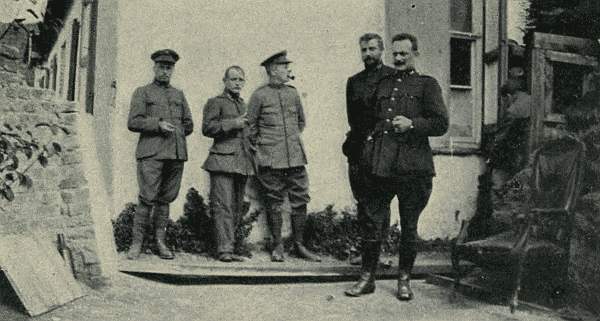
Page 101
"COLONEL D——, COMMANDING THE ARTILLERY OF THE SECTOR"
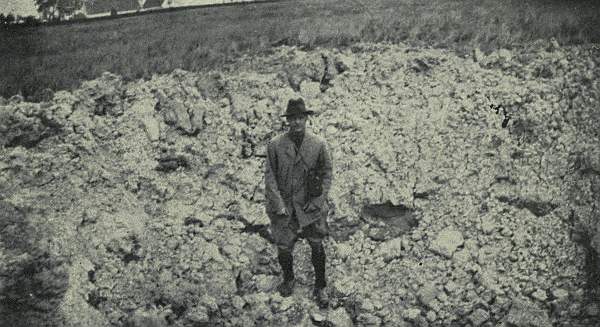
Page 105
THE AUTHOR IN ONE OF THE BIGGEST SHELL-PITS, WHICH WERE
TEN FEET DEEP AND TWENTY FEET IN DIAMETER
After taking photographs of some of the biggest shell-pits, which were some ten feet deep and twenty feet in diameter, we returned to the Villa Beausejour and lunch. We sat down fourteen to lunch—the Colonel, ten artillery officers, the Chaplain, my Commandant and I.
Lunch consisted of potato soup, paté de foie gras, vegetables, strawberry-jam pie, cheese and coffee. There was no wine to start with, but one of the officers soon came in with two bottles of white wine, which we all mixed with our mineral-water.
The talk ran mostly on the two German prisoners.
"I certainly hope we shall be able to find out from them just where that battery is that has been giving us all this trouble lately," exclaimed one officer.
"And those howitzers that I can't locate," from another.
"And where that body of troops to the right sleeps," from a third.
"Perhaps they'll know in which of those farms the German headquarters are," from a fourth.
It appeared that the prisoners were from German Poland. When the Belgian artillery had the day before driven the German troops into their bomb-proofs these two had seized the opportunity to crawl forward out of the trench, through the wire entanglements, across the open to a Belgian advanced listening-post, where they had surrendered. They were now at General Headquarters and had already given much valuable information, including the unusually large number of men who slept during the daytime in the blockhouse, and the presence in a certain farm of a number of German officers.
A Captain of a battery of 75's who sat near me at lunch, was going to tackle the farm-house that afternoon with his guns. The Captain in command of my howitzers was not at lunch, as he was already on his way to his observation-post, situated at the extreme front, within 270 yards of the blockhouse. From there he was going to correct the howitzer fire, over some four kilometres of telephone line connecting his observation-post with his guns.
A good deal of the talk at lunch was devoted to anathematizing a certain general-staff officer who had charge of the uniforming of the army and, apparently, was bent on changing the new khaki caps of the officers from the British shape, which they all liked, to the French shape.
A good story was told to illustrate the amazing efficiency of the German intelligence department. One day when the army was being reuniformed in khaki, a certain regiment of chasseurs was ordered to leave their trenches right after dark that night to march to the rear for the purpose of having their new uniforms issued to them. An hour or two after they had received this order the Germans right opposite them hoisted a great placard above their trenches. On it was sign-painted:
"Good-bye, brave chasseurs! Run along to get your new uniforms at seventeen francs fifty apiece!"
Lunch being finished, my Commandant and I said good-bye all round and, with detailed directions, started on a half-hour's walk to find the howitzer battery. The Chaplain, in khaki, with an old black umbrella and a long fishing-pole, came along as far as the first canal. There, standing on a flat bit of embankment between two shell-holes, he placidly began to fish.
The artillery, which had been booming in a desultory way all morning, had of course stopped during the lunch-hour. For the artillerymen on both sides certainly keep union rules in laying off when the time for the dinner-pail comes round. If the noon whistle blew they could not be more punctual in dropping work.
Now, however, the noon-hour was over and the guns again began to take up their monotonous bass drumming. For a full half-hour we walked, first along a deserted wagon-road, then to the left, along a path by the bank of a canal, past an artificial hedge here and an artificial grove of trees there. Some of these had batteries ambushed in them, others were shams to divert the attention of the German aviators and the fire of the German artillery from the real emplacements.
Finally, we came to a tall false hedge made of withered saplings wired together. In the lee of this hedge was a low flat roof, perhaps three feet above the surface of the ground, covered with a sprinkling of earth and boughs. Under this we climbed down into a cellar-like excavation about three feet deep, giving six feet of head room.
Here I first made the acquaintance of Julia. I found her standing with her back to me under the plank shelter, with only her exceedingly short and retroussé nose sniffling up at the leaden patch of threatening sky which showed between the forward edge of the roof and the top of the high false hedge in front. No one could well call Julia beautiful, but there was power in every line and curve of her. She was a particularly short-muzzled 150-millimetre heavy field-howitzer, and she had been christened Julia in chalk letters across the back of her thick steel shield by the members of her devoted crew.
On her breech were engraved a crown and a big "C. I.," for she and her three sisters had been intended for Carol I., King of Roumania, before they were bought up by the Belgian Government. One of the four had exploded through trying to fire a 155-millimetre shell through her 150-millimetre bore, but the other three were doing fine work for their adopted country. On my way to my appointment with Julia, we had passed one of her sisters, called "Zoe," cowering up against the wall of a very disreputable old farm-house, hiding her humiliation in a hole in the ground under a plank roofing and a false hedge much like Julia's.
Any one who thinks that nowadays he will see artillery ranged in imposing array, is doomed to disappointment. The artillery commander (especially of the heavier guns) goes around the countryside stealthily hiding one piece here, surreptitiously slipping another in there, always selecting the most separate and inconspicuous locations, much as a woman will wander around a hotel room stowing her pieces of jewelry here and there where the burglars will never think of looking for them. Only the burglars in the present case are hostile shells that make holes ten feet deep and twenty feet across.
Julia's crew consisted of a Lieutenant and eight men. The Lieutenant and seven of the men were grouped around the breech of the gun when I arrived. The eighth man squatted to the left by a field-telephone with the receiver held to his ear. Commandant L—— introduced me to the Lieutenant, and then asked whether his Captain had reached the observation-post. The Lieutenant had not heard from him yet, but imagined he must get there any moment.
It began to rain hard, much to the vexation of the Commandant, who feared it would hide the blockhouse from the observer and put an end to the bombardment.
"Oh! no," said the Lieutenant; "he's only 270 yards distant from it. He'll be able to see it all right."
On the board floor to the left, between the telephone and the front wall of the excavation, were piled twenty-five or thirty wicked-looking 150-millimetre high-explosive shells. They were conical in shape, about 2½ feet long and 6 inches in diameter, made of steel, with a copper band around them near the base, and a copper nose.
I started to lift one of them, and only succeeded at the second attempt. They weighed about 110 pounds apiece.
Stacked next to them were a corresponding number of hollow copper cylinders containing stiff little cream-colored children's belts, with eyelet-holes down the middle, coiled neatly inside them. Some of them had one coil; others two coils, one on top of the other; others three coils superimposed. These were the propelling charges for the shells, and were of three strengths according as one, two or three of the coils of cream-colored explosive were put in the copper shells. They were topped off with a heavy felt pad which fitted neatly into the cylinder.
Meantime the rain came down in torrents and began to leak through the thin plank roofing in little streams which were very hard to dodge.
The Lieutenant showed us a bomb-proof which he had just begun to build into the earth wall of the cellar, behind the stack of shells. He was going to cover it with a concrete roof, pile a few feet of earth on top of that, then some sand-bags, and top the whole off with boulders, so as to make any shell hitting it explode at once on the surface, instead of boring half-way down before exploding. He was doing all this work with his eight men at night when they were not handling the gun. During the day they slept except when, as now, they wanted to disturb the sleep of the enemy. This bomb-proof was only meant for refuge when the Germans began bombarding him. The men's regular sleeping-quarters were a little to the rear.
And still the rain came down, the air became raw and cold, and the little waterfalls became harder and harder to dodge. But the man at the telephone squatted patiently by the wall, and his seven mates chatted placidly together in incomprehensible Flemish, switching instantly to French when answering any question the Lieutenant put to them.
The Lieutenant explained how the gun was aimed, the sighting device showing a stake in line with a church steeple; only as there was nothing to be seen in front of Julia except an earth bank and ten feet of false hedge, it stands to reason that stake and steeple were behind her and appeared, not through a telescope as I had just stupidly thought, but as a reflection in a mirror—which is the way all well-conducted howitzers are aimed.
Finally, after an hour's wait the Lieutenant rang up his Major on the telephone and asked whether anything was amiss with the Captain. No; the Captain was only linking up a new telephone connection nearly four kilometres in front of us.
The Lieutenant pointed out a false hedge some hundred yards behind us.
"That is exceedingly dangerous for us here," he explained. "It is much too close to us. It should be at least 150 yards further removed. If it draws the German fire, as it is intended to do, that fire is just as apt to hit us as the false hedge. It was put up as a protection to another gun which was off there to the right, but it's a very uncomfortable thing to have near us, especially before we have a bomb-proof to crawl into."
"Ting—aling—aling!" went the telephone bell. The soldier listened. "The Captain says, 'Are you all ready?'"
"Tell him 'yes'," replied the Lieutenant.
"Aim for 3,750 metres," repeated the soldier at the telephone.
The Lieutenant and a couple of his men busied themselves around the sight and elevating cranks of the gun. Another man removed a leather cap which had been fitted over Julia's nose to keep the rain out.
I was busy sticking cotton wool in my ears.
"The Captain says to say when you are ready and he will give the order to fire."
"All ready," said the Lieutenant, backing away from Julia and holding a thick white cord in his hand which ran from her to him.
"All ready," replied the soldier into the telephone.
"Tirez!" ("Fire!") said he a fraction of a second later.
The Lieutenant's arm gave a jerk, the whole front of the shelter was a mass of blood-red flame, there was a bellow of sound, the barrel of the great gun ran smoothly three feet or so back into the cellar and then smoothly forward again. There was a rush of air around my legs.
Almost simultaneously with the report I heard with one ear the telephonist say, "Coup parti" ("The shot has left"), while with the other I listened to the long-drawn wheeze with which the projectile mounted into the sky on its mountain-high trajectory. In the second which had meanwhile elapsed one of the artillerymen had swung open the breech of the gun, another had taken out the now empty copper cylinder and placed it on the floor to the right of Julia, a third had lifted a new shell and with the aid of the second had run it into the breech, and a fourth had slipped in a fresh copper cylinder containing a full charge of three of the little cream-colored tape-coils. Whereupon the first artilleryman had swung to and locked the breech again.
"In eighteen seconds you should hear the shell explode," said the Lieutenant, taking his stand by the telephonist with an open notebook and pencil in his hands—"15, 16, 17, 18"—I finished counting. Boom! came the distant explosion.
A few seconds of silence.
"Plus 3," announced the telephonist, repeating an order from the distant Captain.
The Lieutenant made an entry in his notebook and simultaneously rattled off some figures like a football quarterback. The men worked over the sights and cranks, while my Commandant said to me: "That shot was too far to the right; plus 3 means five three-thousandths further to the left."
"All ready," said the Lieutenant.
"All ready," repeated the telephonist, and then:
"Tirez!" and again the twitch of the white cord, the blood-red flame, the roar, the slow, easy recoil, the diminishing wheeze, the "Coup parti," the eighteen seconds' silence, and the distant boom.
"Plus 4," sang out the telephonist, and there was a mechanical repetition of operations. "The observer corrected the first shot about ten metres to the left, and, finding that was not enough, corrected the second shot another fifteen metres to the left. They'll edge along like that till they reach the blockhouse, destroying the trench to right of it on the way. Then, when they've destroyed the blockhouse completely, if that does not take up all the day's allowance of shells, they'll expend the remainder on knocking out the trench to the left of the blockhouse. To-day's allowance for Julia is twenty shells, and probably she will use up most of them on the blockhouse to make a thorough job of it."
"Tirez!" came the telephonist's voice, and as the roar was succeeded by silence, my Commandant exclaimed to me: "Filons!" French slang for which the American equivalent is, "Let us beat it!"
As I reluctantly crawled up into the rain after having shaken hands with the Lieutenant, my Commandant explained that the Germans would undoubtedly begin to search the immediate vicinity with their artillery to try to silence the gun which was throwing the "marmites" into them. As we had the provocative false hedge right behind us and no bomb-proof to crawl into, I had to agree that he was prudent.
And so we "beat it" through the downpour, sliding around in the oily Flemish mud, while the German guns began to drop whole kitchen-loads of "marmites" into a poor wrecked village five hundred yards to our left, from which they evidently suspected that our shots had come.
As we slithered along, drenched to the skin, toward the "Villa Beausejour" and our waiting motor, we could hear the Captain of 75's letting off salvo after salvo at the farm-house of which the prisoners had informed him, while behind us Julia continued to explode at half-minute intervals. There was all the difference in the world between the dry short report of the big howitzer and the hollower, sharper, more penetrating explosion of the 75's.
To-day I learned from the Captain of the 75's that his first few volleys had set the farm-house on fire. A lot of soldiers had come running to put the fire out. His guns kept on dropping and scattering these until, with a series of loud explosions, the whole farm-house had blown up. It turned out that it was not an officers' headquarters, but an ammunition store-house.
As to our blockhouse, I understand that it was completely demolished, though whether or not it took the whole of Julia's twenty shells to complete the work I was unable to learn.
VII IN THE FLEMISH TRENCHES
Headquarters of the Belgian Army, La Panne, Aug. 30.
To-day I was given the opportunity of comparing the trenches of Belgium with those I had visited in France. It was a very interesting contrast.
Commandant L——, who still had me in charge, picked me up at my hotel at 10 o'clock in the morning. Proceedings were delayed while I insisted on taking a snap-shot of him in the nickel-steel skull-cap which he wore inside his khaki cap.
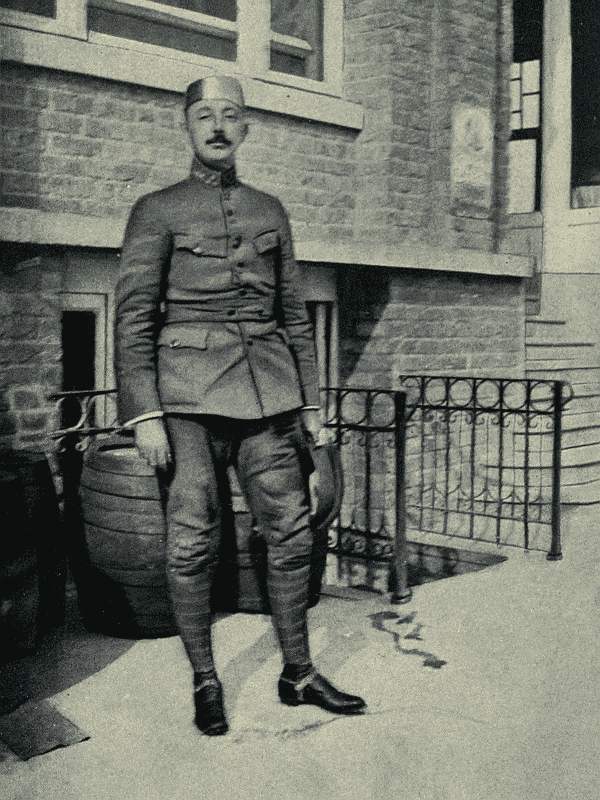
Page 121
COMMANDANT L—— IN THE NICKEL-STEEL SKULL-CAP WHICH
HE WORE INSIDE HIS KHAKI CAP
More and more of the French officers are wearing these helmets, and he had just ordered his from Paris. It is an admirable protection, very tough, not at all heavy, tucked inside the sweatband of the cap and entirely invisible. If a bullet hits it straight point-blank it will, of course, penetrate and carry a piece of the steel helmet into the wearer's head with it. But a bullet hitting thus would be fatal anyway. While if the bullet is spent, or if it hits at an angle, the helmet will deflect it.
On the way to the trenches we stopped off at the Belgian aerodrome, where an Aviation Captain showed and explained to me the details of the Voisin and Nieuport machines, which were chiefly used, including the ingenious bomb-dropping mechanism and the wireless apparatus.
The Belgians certainly deserve the utmost credit for the way in which they have developed their air service from nothing at the beginning of the war to a highly efficient aviation corps. But for that matter their whole army has been reorganized on an admirable basis.
One must realize the shattered condition in which they were swept from Antwerp back to the very fringe of their country behind the Yser. One must realize that they are practically an army without a country. One must understand that when they get furloughs they cannot spend them with their families in their homes, getting comfort and encouragement. They either stay within sound of the firing or spend a bleak six days among the strangers of England or of Northern France. When all this is considered their material reorganization and the preservation of their morale in its present splendid shape is a remarkable achievement.
And let no one forget that if the British proudly saved the French by their retreat from Mons (which no one seems likely to be allowed to forget) it is equally certain that the shattered Belgian army humbly saved the British on the Yser.
Rolling along the straight highroad to Y—— we passed the usual congestion of troop-filled trolley-cars, lorries, ambulances, farm-wagons, officers' autos and motor-cyclists. Our military motor was an excellent one, with the one fault that it seemed extremely difficult for the chauffeur to shift his gear from neutral into low speed, and he would frequently get hung up for several seconds with the car at a standstill till finally he got his gears in mesh.
At one point we stopped to see an interesting manifestation of the newly developing art of war. A giant 12-inch British naval gun was mounted on a specially designed railroad truck. It stood on a railway siding, with its ammunition-car coupled on behind. A kind of crane stood ready to swing the huge shells from the ammunition-car to the breech of the gun. When some object was found worth firing 12-inch shells at, the engine backed up to the gun-truck with steam up. The track was cleared.
Then the great gun did its firing at the object, and forthwith was whisked away one, five or ten miles down the track out of danger of the German replies. This is what, officers seem agreed, will take the place of the antiquated fixed fortresses—miles of railway loops and sidings running behind artificial concealments or in semi-open cuts, with batteries of heavy fortress guns shuttling to and fro, firing and changing position constantly.
We motored on till we neared the point where the Belgian army ends and the French begins. Here we paid our respects to the General in command of the division we were visiting. He promptly asked us to lunch, and a very good lunch it was: Vegetable soup, some entrée which I could not identify, shoulder of mutton with potatoes and beans, cantaloupe, cheese and black coffee, with a choice between beer, claret and white wine to drink at lunch, a glass of champagne at dessert, and liqueurs with the coffee.
The conversation of the officers turned largely on what was happening to their friends and acquaintances in Belgium, about whom they heard by mail through Switzerland or Holland. One young countess aroused considerable discussion. She had been sitting in a street-car in Brussels with a Belgian friend when a German officer boarded the car. Her friend bowed to the officer.
"What! You bow to a pig like that!" cried the countess. Whereupon the officer had stopped the car and placed her under arrest. She had been given her choice between two months in prison or ten thousand francs' fine, and had paid the fine.
Certain of the officers held that she had been unpatriotic in not accepting imprisonment rather than help the German exchequer. Others felt she had done enough in insulting the officer and rebuking her friend. The talk dwelt, too, on certain other Belgian ladies who had compromised with their patriotism to the extent of taking up social relations with the invaders. From what I heard I feel sorry for these over-hospitable ladies when the Belgians are once more masters of their own country.
After lunch I began to feel more and more impatient to get started for the trenches, but I had already learned too much of etiquette at the front to show it. For the officers of all the armies feel that it is infinitely more important to prove to you that they can give you a good cup of coffee and a good cigar than it is to show you the most beautiful battle that was ever fought. They are, too, all alike obsessed with the very human fallacy that the little ingenuities and contrivances which they have devised for their personal comfort, safety or delectation must be of infinitely more absorbing interest to the visitor than the guns and the trenches, which to them are such an old and boring story.
So now we had to admire the way one officer had had his sleeping-shack wall-papered, how another had invented some home-made shower-baths, how a third had had a genuine heavy wooden bedstead installed instead of a camp cot.
However, finally we made our adieus and motored away with full directions from the General as to how to meet him at 4 o'clock at an observation-post from which he was to witness an interesting bombardment. As it was then a quarter to 3, my hopes of getting into the trenches began to look slim.
We were now motoring straight toward the front over a stretch of country which the Germans had been profusely bombarding. The road was full of holes where the Belgian blocks had been torn out by shells. We bumped over the shallower ones and dodged the deeper ones, but every now and then the chauffeur would miscalculate the depth of a hole and the car would come down on its axle with a prodigious thump. By shutting one's eyes one could easily imagine one's self taxicabbing along a New York side-street.
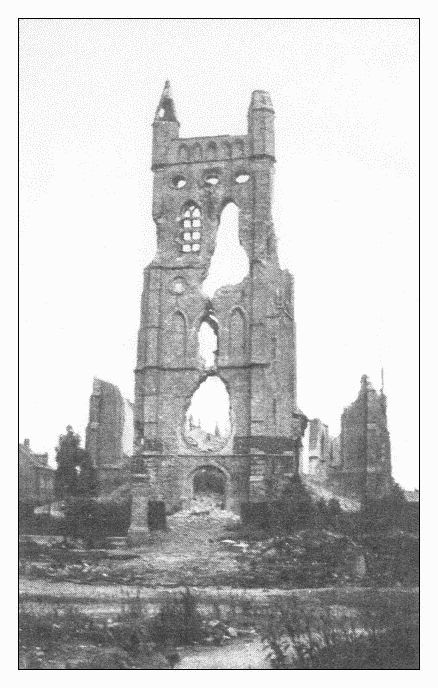
Page 127
"THE CHAUFFEUR REACHED THE
OPEN PLACE BY THE CHURCH"
Page 127
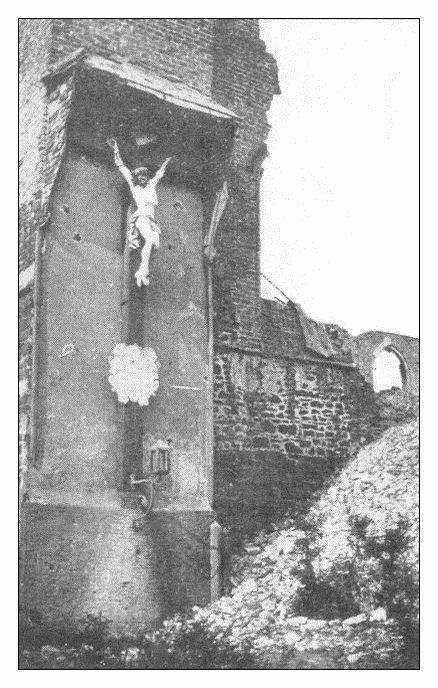
ON THE SHATTERED CHURCH HUNG
THIS CRUCIFIX INTACT THOUGH
SURROUNDED BY SHRAPNEL HOLES
The guns had, of course, by now resumed work after their lunch-time siesta and were grumbling away at each other in great shape. Presently we came to a deserted village, which could be seen from some of the German artillery positions and which they shelled on the slightest provocation. The General had particularly told us to run through the village in a hurry, especially across the open place around the church. When we got safely out of the other end of the place, he had said, we might leave our motor and sneak back on foot to take photographs. This having been carefully explained to the chauffeur, he bumped us swiftly down the ruined main street, reached the open place by the church, where he had to turn to the right, came suddenly on top of a big, deep shell-hole, just dodged it by slapping on his emergency, and stood stock-still trying to get into first speed.
The Commandant cursed and I swore, the Commandant's orderly sitting next the chauffeur shook his fist at the chauffeur, and the chauffeur shook one fist at his gears while with the other he wrenched and hauled at his lever.
There is no use denying that we were all equally nervous. Every instant we expected to see the first of a stream of shells explode near us. Finally, after the suspense had in reality lasted not more than six or eight seconds, the accursed low gear meekly meshed and we bumped off down the side-street, heaving deep sighs of relief.
Outside the utterly ruined village we left our car behind a clump of trees and walked back to take some photographs of what had been the church. Then into the motor and on again till we stopped at the cross-road which led directly to the front.
Here we left our motor. The rain suddenly beginning to come down in sheets, we ducked into a ruined house whose roof some freak of the shells had allowed to remain quite intact. We were quickly joined by about fifty infantrymen who had been working at a reserve line of intrenchments in the fields outside. Here we all waited for ten minutes till the rain-squall stopped.
It may not be a particularly pretty subject, but I think it well worth stating that that mass of soldiers, packed into the small inclosed space, left the air as pure and untainted at the end of those ten minutes as it had been before they jammed their way in. I had noticed the same thing the day before during the two hours that I had spent by the howitzer with the nine men of the crew. There is no doubt about it that even the English—who of course originally invented and patented personal cleanliness in this world—will have to scrub exceedingly hard to keep up with the Belgians.
The rain having stopped, we slipped and slithered on foot along the byroad till we came to a prairie-dog village of bomb-proofs with soldiers' heads popping out of the little openings and then popping in again. Here we met a young First Lieutenant, who very kindly offered to show us the quickest way to the communicating trench, and off we marched.
At this point we were just about half-way between the two opposing bodies of artillery. High in air, right above our heads, the shells of the two armies, hurtling along in opposite directions, met and passed each other on their way. These big projectiles in passing over us sounded exactly as if they were running along aerial rails. You could hear them rattling along these rails, bumping over the rail joints, banging over switches. It was a perfect illusion. By closing your eyes you could have sworn that you were standing under Brooklyn Bridge hearing the procession of street-cars, with silenced gongs, roll by at express speed overhead. First there would be a distant report, then silence as the shell rose, and then suddenly it would get on the rails, rattle up to the top of its grade, coast down the grade the other side and leave the tracks a second or two before the final explosion.
Some ten minutes later we were walking along a broad road, with the noise of exploding shells getting louder and louder ahead. Then suddenly a perfect swarm of bullets came chirping past us.
"Just this little bit of the road is visible from the German lines," remarked the Lieutenant. "They are about 500 metres away from us here."
It must have been comical to see the way in which the Commandant, his orderly and I did an Indian war-dance down that road, all three bent double. The Lieutenant must have caught the contagion from us, for, as more bullets came by, zeup! zeup! zeup! he doubled up himself. In a few seconds, however, he said we were out of sight again, and so we straightened up and walked forward proudly erect, although every little while when some bullets went by just over our heads we showed distinct tendencies to collapse anew.
Now we came to the communication trench and climbed down into it one after the other. It was very different from the French "boyaux," or communicating trenches. Those were dug a good seven feet deep almost everywhere, and never less than six feet. So that one could walk about in them at one's ease without paying any attention to the bullets that cracked up above. Only a shell plunging directly into one of these three feet wide, seven feet deep ditches could be dangerous.
But the Belgians could not dig down more than about two and one-half feet at the most without striking water. That, with an earth and sod rampart about two feet high, gave a protection never more than five feet at its highest and often under four feet in height. Now, it probably sounds very easy to keep sheltered while walking along behind four feet of ditch and parapet, but if any one tries it for more than five minutes at a time he will know what a real backache feels like.
This trench, which ran forward in very short abrupt zigzags, was floored with pieces of wicker-work to prevent sinking into the mud. The half-hour's rain had filled long stretches of it ankle-deep with water.
Crouched double, we waded along in single file, the Lieutenant, myself, the Commandant and his orderly. The bullets were striking some ruined farm buildings close on our left with sharp cracks. They hit the breastworks with muffled thuds and passed close over the breastwork with a kind of buzzing whistle. We paddled along till suddenly we came to a place where, for some unaccountable reason, the trench stopped, renewing itself again perhaps three or four yards further on. Across the unsheltered surface of the ground which intervened ran a slack telephone wire some two feet above the ground.
"You'd better hurry up across here," remarked the Lieutenant as he scrambled out of the trench, took a couple of strides, swung first one leg and then the other over the telephone wire, took a couple of strides more and dropped into the trench beyond.
There is not the slightest question as to the hurry in which I negotiated this obstacle. Then, to see what I must have looked like, I turned to watch the two who were following me. The Commandant, I must confess, managed to accomplish the feat in a fashion not wholly destitute of dignity. But the way his orderly bounded out of the trench, hurdled the telephone wire and with one lithe leap descended upon us in the other trench was a sight for sore eyes. It certainly must have drawn a chuckle from the German sharpshooters witnessing it through their telescopic sights.
A hundred yards or so further on we came to a halt at an angle in the communication trench from which could be had a good view of the front.
Lifting my head cautiously till my eyes were just above the edge of the rampart, I could see some 250 yards ahead the chocolate-colored back of the Belgian front trench. For where the chalky soil of Champagne makes the trenches there very white in color, the boggy soil of Belgium is a rich brown.
Beyond the Belgian front trench ran a line of tall trees; beyond the line of trees again ran another brown line.
"That's the German front line, I suppose?" I said to the Lieutenant.
"No, that's their second line you're looking at. Raise your head a little more, and right over the top of our front-line trenches you'll see their front line."
I craned my neck, and, sure enough, another brown line hove into view apparently only a few yards ahead of the Belgian front line, with the usual barbed-wire tangle in front of it.
"That trench is about 100 metres from our front trench," said the Lieutenant. "The Germans have got all that barbed wire before their front trench, but we don't need wire because we have the Y—— Canal right before our front trench. Only it flows so close under the breastworks that you can't see it from here."
A great cloud of jet-black smoke suddenly welled up from the Belgian front trench.
"Ah, that's a six-inch bomb they've thrown into our trench with one of their 'minenwerfer,'" exclaimed the Lieutenant.
The report of the explosion from where we stood, not more than 250 metres away, was not loud.
The artillery was hard at it. Big clouds of black smoke rose sluggishly by the German trench where the Belgian high-explosive shells were bursting. Livelier clouds of white indicated the shrapnel explosions.
I was craning my neck to see what damage was being done the German trench when a whole swarm of bullets struck very close indeed to my head. The Lieutenant pulled me down into the trench.
"They shot at you that time, all right!" he laughed.
"Impossible!" I answered. "I can only barely see their trench over the top of your first-line trench, so how could they possibly see me from there?"
"Ah, but they were not shooting at you from there. They are up in the tops of some of those trees," he explained, pointing to the row of tall, innocent-looking trees. "Their sharpshooters climb up at night and snipe from there all day, and those of them whom we do not locate and kill climb down again the next night. They have telescopic sights on their rifles, and these rifles are mounted on little tripods so that they can fix their aim immovably on some spot where they think they have seen a movement; and the next time the movement comes, ping! Only I don't think they can use the tripods up in the trees."
At the Lieutenant's suggestion we scattered down along the trench in case our little crowd might have been observed from a tree and an artilleryman might try his luck on us.
Further down the trench where I took my new stand I went on watching the shells burst, and listening to the projectiles from the opposing sides go rattling along their invisible rails high overhead.
A little off to our right the French 75's were firing so quickly that I hoped it would develop into the famous "trommelfeuer" ("drum-roll fire," as the Germans call it), but it did not. We had received word that they were going to fire 400 rounds at some objective whose nature I did not learn. They certainly were firing them, and losing no time about it, either.
I could not see their shells burst, as the lines took a turn just to our right and disappeared behind some trees.
At the points where the armies of different nationalities connect they are always scrupulously careful to inform each other what artillery work they have in preparation, so that a sudden violent cannonade on the part of one army will not alarm the next with the idea that a German assault is being resisted.
Page 135
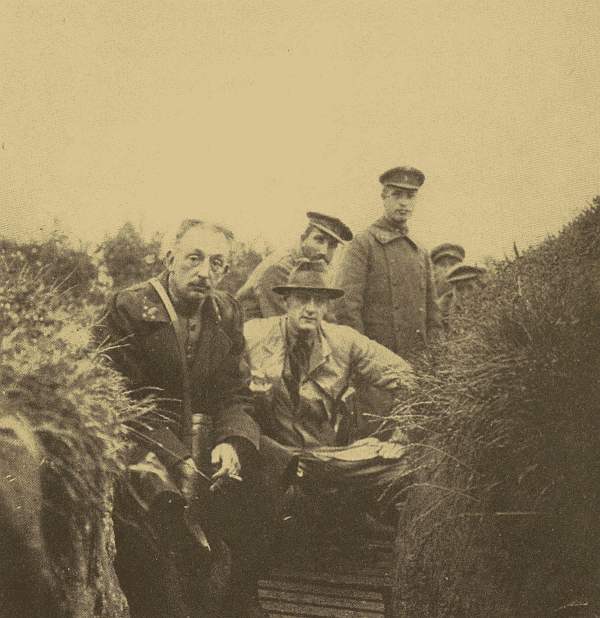
UNDER HEAVY FIRE IN A BELGIAN COMMUNICATING-TRENCH.
(THE FIGURE STANDING UPRIGHT JUST BEHIND THE AUTHOR
IS THE LIEUTENANT, WHO STRAIGHTENED UP DURING THE
MOMENT THE SNAPSHOT WAS BEING TAKEN BUT WAS NOT HIT)
It was particularly interesting to watch the Belgian soldiers, who every few yards squatted placidly in the trench, short spades and trowels in hand, busily engaged in digging little pits about two feet deep in the bottom of the trench, and then scooping out little channels running to these pits. These channels would drain the surrounding yard or two of trench bottom into the pits, leaving muddy patches where a moment before three or four inches of water had stood. There the Belgian soldiers squatted like children making mud pies at the seashore, and chatted complacently in Flemish while they fought the enemy, who was only less hateful to them than the Germans. A splendid, cool, nerveless lot of men, doing their work unostentatiously but efficiently, neither dashing on the one hand nor dogged on the other, but gifted with the admirable morale of the imperturbably matter-of-fact.
Suddenly I heard an exclamation from one of the soldiers. Looking where he pointed, I saw, just beyond the Belgian front trench, a huge column of muddy water standing bolt upright against the horizon. It stood there motionless until I began to think it would remain a permanent fixture in the landscape. Then it suddenly collapsed. A Belgian shell falling short had soused down into the Y—— Canal and exploded, sending up this five-story waterspout.
It seemed a shame not to go forward into the front trench, but with the Germans lobbing six-inch bombs in there with their "mine throwers" and the artillery getting busier all the time, the Commandant thought it would be taking too great risks. So we turned and crouched along back. As we did so, it is worthy of comment, three German shells struck not far to our left at not more than half-a-minute intervals and not one of the three exploded. It was a striking example of faulty explosives.
We returned by a different trench, so that we did not have to repeat the acrobatic feat over the telephone wire. But we had a little excitement to make up for it, for, as I splashed along with a most intense crick in my bent back, one of the German projectiles, which was apparently running on perfect schedule along its overhead rails on its way toward the Belgian artillery, suddenly jumped the track and came hissing down toward us.
Simultaneously with the crash of the explosion I saw the men ahead of me passionately hugging the bottom of the trench, and I found myself on my knees and elbows, not a whit behind them in my devotion.
"That was a close one," said Captain L——.
"What was it—a 75?" I asked.
"Seventy-five nothing," he replied; "that was a 150 millimetre, and it exploded within thirty metres of your head. There—see for yourself. If we had not been in the trench that would have caught us nicely!"
I peeped over the edge of the trench and there, sure enough, was a big cloud of sooty black smoke wallowing up from behind some broken masonry not more than thirty yards off.
"Filons!" ("Let us beat it!") said the Commandant tersely, and we did.
VIII LESSONS
The great lesson that a visit to England, France and what remains of Belgium to-day will teach any one who is willing to be taught by hard facts and not by wistful visions is that peace in the near future is quite impossible. For the only peace, in the conviction of the Allies, that will end this war is a peace neither of conciliation nor of compromise, but a peace whose terms are arbitrarily imposed by one side and of necessity submitted to by the other.
That is the end to which the Allies are determined to fight, whether that end is achieved by the more merciful method of decisive military victory or must be gained by the more terrible pressure of complete financial, industrial and economic prostration.
Any attempt to abort this object by mediatory proposals, whether Pontifical or Presidential, the Allies frankly declare they would consider an inopportune impertinence.
I have had the privilege of studying the spirit of the English, the French and the Belgians at a time when that spirit was being severely tested—when their fortunes were at their lowest ebb since the days just before the battle of the Marne. Their spring advance had utterly failed to materialize; throughout the summer they had been held in almost complete check by the Germans' depleted line. The Dardanelles had turned out to be a slaughter-house, with success appearing more and more precarious, and the only alternative to success seeming to be disaster.
The starvation of Germany had become a conceded impossibility. Her dearth of rubber, copper, cotton, etc., had assumed more and more the nature of a superable handicap rather than a decisive crippling. Her financial situation had already made fools of so many economic seers that they had become less and less didactic regarding her impending bankruptcy.
The practical success of allied diplomacy among the Balkan neutrals had grown to seem more and more dubious.
Finally, Russia had been so manhandled that in the opinion of British and French military authorities with whom I talked it would take her from one to two years to reorganize her armies into condition for an effective offensive.
Yet, in spite of all these admitted disadvantages, I did not meet a single Frenchman, Englishman or Belgian who was not sincerely confident of ultimate victory. But only an ultimate peace could, in their conviction, be victorious. An immediate peace, or a peace in the near future, no matter what the German concessions, would for the Allies be the peace of defeat.
From Germany must come, not concessions, but abandonments, or the war, with all its hideous sacrifices unredeemed, would be a failure. Such an artificially fabricated peace, such a compromise between irreconcilable principles, would be but the prelude, more or less dragged out, to a fresh conflict.
I have talked to men and women of many classes, of many degrees of education and of many grades of intelligence. I found their views unanimous and their reasons for these views so constantly the same as finally to seem almost hackneyed.
I am aware of the existence in England of such a body of peace propagandists as the Union of Democratic Control, and in Holland of some French pacifists, and scattered here and there of Internationalists. But of all the men and women with whom I casually talked there was not one who shared these gentlemen's views.
Of all the French statements of reasons why the war must go on, which were iterated and reiterated to me, the best came from a prince, a retired naval captain and a little dressmaker. Unfortunately, they may not be quoted by name.
The prince said: "After this taste of blood the world can never remain long at peace while any powerful nation dedicates itself to the ideals and instincts of militarism. Germany, under the guidance of Prussia, is to-day such a nation. These aims and instincts have been so thoroughly absorbed by her people that, even if they sincerely wished to, these people could not eliminate them inside of two or three generations. It is ludicrous to imagine that these characteristics, which have become nearly if not quite hereditary, could be negotiated out of them. They must be subjugated out of the German people."
The naval captain said: "It is a mere matter of arithmetic. It can be easily demonstrated that at the end of this war, with its cost on her shoulders, if France does not immediately reduce her armaments to a minimum she is absolutely bound to go bankrupt. Now, as we cannot conceivably trust any mere promises of disarmament which Germany might make, it is obvious that we must go on with this war until we have reduced her to such a condition that we can enforce disarmament upon her, and thus safely enjoy its benefits ourselves."
The little dressmaker said: "My husband has been fighting at the front for months. It would be natural for me to wish the war to end to-morrow, no matter on what terms, if I could get my husband back before he is killed. But I want the war to go on until the 'Boches' are crushed; otherwise in another ten years or so there will be a new war, and then they will come and take away not only my husband, but my son as well."
In England the same line of reasoning prevailed. And the fact cannot be too strongly emphasized that this reasoning did not take the shape of stock arguments devised by politicians to bolster up some expedient course and drilled into the people for parrot-like repetition. The arguments were the spontaneous expression of the heartfelt convictions of all these people.
Intelligent opinion in England ranges between the two statements made to me, respectively, by a very famous Tory statesman and administrator, and by one of the best-known Liberal statesmen in English public life to-day.
The first of these was terse and to the point:
"It is the greatest mistake for your Government to feel that the United States can, by remaining neutral, help to bring the war to a close. This war will be fought to a point where no mediation will be possible or needed. No peace with Germany, signed with a Hohenzollern in power, would be worth more than twenty years' peace to the world. To make Germany's promises binding on her, her people have got to have a share in her foreign policy, and that they cannot have under the present dynasty or system."
The second statement was:
"The best information that I can obtain from Germany is that, if she wins, the advanced party, which is in the ascendancy, plans to erect Poland into a semi-independent kingdom, contributing to it that portion of Poland which Germany herself now possesses. She will annex Belgium, probably a strip of Northern France, and possibly enough of Holland to give her command of the mouths of the Scheldt and Rhine.
"Personally I cannot feel it to be unreasonable from her point of view that she should plan to correct a situation where her great water artery, the Rhine, is bottled up at its outlet. She will also take all Courland, and this, too, is not so unreasonable, since the population is far more German than Russian. Nevertheless, if such geographical and ethnological changes as these were accomplished and to be maintained, who can conceivably imagine that Germany can afford to modify her militarism?
"My own views as to what the general terms of peace should be if the Allies win are shared by men in both England and France whose opinions will have weight in the peace negotiations. They are:
"To erect an independent Polish kingdom or state; to reconstitute Belgium with indemnity; to hold a plebiscite in Alsace-Lorraine, taken by a neutral, preferably the United States, in order to determine to whom they should belong, and in what proportions; to dismember Turkey, excepting Anatolia, which, being strictly Turkish, should be left to the Turks; to enforce a very large degree of disarmament upon Germany and Europe; to leave the German-speaking German Empire intact. (This talk about the deposition of the Hohenzollerns as one of the peace terms is sheer impertinence.)
"Now, you must readily perceive that any peace made in the near future must conform or approximate to the German plans which I have outlined and must involve a continuance of militarism and a standing incitement to fresh wars. While a peace on the terms which we favor, a peace that will perpetuate peace, must be wrung from a decisively beaten Germany, and is therefore a long way off. That is why we shall have to go through a very bad time of it for some period to come, and why our ultimate victory will be at least one year, and possibly two or three years off."
The keenest realization that victory will be slow, the completest confidence that its certainty is axiomatic, is to be found in the allied armies. There, ungrudgingly, they give the Germans fullest credit for their preparedness, for their foresight, for their powers of systematic and sustained labor, for their inventiveness. And they do not waste their time trying to devise discrediting substitutes for such words as "ability" in talking of their Generals, "courageousness" in talking of their soldiers, and "patriotism" in talking of their people. It is only when you get far behind the firing line that manliness merges into meanness in estimating the enemy.
Yet these very officers who paid such soldierly tributes to their antagonists were so wholly assured of eventual victory that any scepticism on my part did not irritate them, but merely moved them to good-natured smiles.
"So far," an English staff-officer remarked to me, "we English have been bungling amateurs in the art of war contending against trained professional specialists. But with a couple of years' more experience I believe we shall know as much about it as they do, and then we shall win."
"In the last analysis, talking from the military standpoint, this war, like every war, will be won by men," said a French staff-officer. "The Germans will not be beaten through lack of guns or ammunition or machinery or supplies, but through lack of men. How long by the aid of mechanics they can postpone the hour when the lack of men becomes fatal to them I do not know—one year, two years. But in the end, with the allied man-power steadily growing, and the German man-power steadily lessening, their military collapse is inevitable."
These are typical of a score of similar views advanced by officers, from Generals down to subalterns.
In the French army, as they show you their elaborate machine-shops mounted on motor-lorries for the repair of all the vehicles in the transport service, they will say with the most complete conviction: "This mobility is not of much importance now, but when we begin the pursuit of the 'Boches' then they will come in handy!"
When they show you their great parks of supply-trains, each carrying three days' complete provisions for one army corps, they will tell you earnestly:
"Not much use now when the railroads do most of the carrying of supplies to the armies, but wait till the advance begins and then we shall be useful!"
When they let you examine their wonderful 75's, mounted on an automobile capable of doing over thirty miles an hour over the road, and of starting a stream of twenty-five shells a minute one minute after coming to a standstill, they will shrug their shoulders and say: "Something of a waste just now, perhaps, but when the advance is on they will do wonderful work!"
The advance! The advance! is in all their minds.
"But when will the advance begin?" you ask a chalk-powdered infantryman sweating in the sun-soaked trenches.
"Ah!" he will answer with complete unconcern. "Not yet, Monsieur. They say next spring or next summer. But then 'On les aura!'" ("We'll get them!")
And that unconcern means far more than appears on the surface. It means that the "poilu" knows he will have another winter in the trenches, with all the terrible discomforts that soldiers dread so much more than they dread danger. He knows it, and is completely reconciled to it.
"That was the one thing we feared"—a French General admitted to me—"the effect on the men's morale of the certainty that they would have another winter in the trenches. But they know it now, and 'ils s'en fichent!'" (to which the nearest American slang equivalent would be "they should worry!")
In the amazing New France (which the French prefer to consider a reincarnated rather than a transformed France) the people are as determined as the army. A short time ago, when the authorities first began to give the soldiers at the front their "permissions" to go home for three days, they did so with considerable apprehension that the home influence on the soldier might be a disheartening one.
But, on the contrary, the reunion seemed to give mutual encouragement. The soldier braced up the "home folks'" confidence and pride in the army, and the home folks stimulated the soldier's confidence and pride in himself. Thus the experiment has turned out a great success.
The politicians and their fermentations are, in France, the bugbears of the army officers. This feeling of aversion and contempt extends, so far as I could make out, down through the rank and file. They feel that when a nation is at death-grips with its enemy even the most beautiful of democratic theories should be safely locked away with other luxuries; that the politicians should confine their activities to voting the funds necessary for the successful prosecution of the war, and should leave the conduct of the war severely alone.
But in France even those politicians who hanker after a finger in the military pie are unanimous for seeing the war through to a decisive victory. They may play politics about whether the Government should or should not have been removed from Paris to Bordeaux last September; they may squabble over whether General Sarrail is the persecuted military genius of the war or an incompetent officer whose removal from Verdun should never have been sugar-coated by his appointment to Gallipoli; they may intrigue to oust Millerand from the War Ministry and try to get together on Briand for his place; they may stick loyally to Joffre because an old man who is fond of fishing is not likely to become an old man on horseback.
But, whether tirading against the evils of a bureaucracy or perorating against the iniquities of the censorship, you will find the politicians of France, Royalists, Clericals, Conservatives, Radicals and Socialists with all their subtle subdivisions, having proved their patriotism by the greatest sacrifice of which a politician is capable—having for nigh on ten months kept silent!—earnestly and honestly working for their country. They are striving, not for the quick peace of compromise which would relegate the silent, efficient soldiers to their subordinate powers and would restore to themselves all the prestige of full-throated eloquence, but for the deferred and definitive peace of victory, with all the continuance of second-fiddling to which such a postponement subjects them.
It is indeed fortunate for the alliance that France—Army, Government and People—is united in the determination to fight this war through to its logical conclusion. For France is apt to be the nation which pays the piper. England is physically safe behind her fleets, Russia proper is physically safe behind her distances, for the German invasion is not apt to go far beyond her alien provinces of Courland and Poland.
But France is not at sword's length, but at dagger's point, with her enemy—one little slip by any one, from an absent-minded General down to a sleeping sentinel, and she may become not a defeated, but a conquered nation.
And this you can see in the faces of the French to-day. Not anger, not bitterness, not sadness; neither excitement nor despondency is in their faces, but a look of hushed and solemn suspense. It is a nation with straining ears, with straining eyes, with bated breath, waiting, waiting.
After leaving the hush of France, England appears at a disadvantage largely undeserved. Compared with the atmosphere of strain in Paris, the atmosphere of London seems one of relaxation. Contrasted with the breathless struggle for self-preservation in France, the British attitude toward the war seems almost dilettante.
This is unquestionably due in part to the fact that in England a very literal-minded race is shipping its soldiers to fight in merely geographical localities for seemingly abstract principles. The trouble is that England has the Channel and France has the imagination. It is obvious how markedly stronger the combination would be if Britain were fighting an invader and France were fighting for a sentiment.
The superficial impression of holiday soldiering that one gets in England is emphasized by the British hatred of the dramatic and the British worship of sport. The British go on laughing, dining, play-going, dancing, supping; in fact, frivolling, because they think it would be melodramatic to forswear these pursuits because of the war. They go on cricketing, racing, fishing, shooting, hunting, because they go on eating, drinking, sleeping and bathing. These are part of the bodily functions of the Briton.
To any other nation, sport, no matter how intimate a part of the national life, in certain emergencies becomes trivial. To say that to an Englishman would be equivalent to saying that under any circumstances childbirth or prayer could be trivial. It is a national characteristic which must simply be accepted.
The impression made on superficial observers by these manners and habits of casual unconcern does England a certain injustice. For as far as her duties to her allies are concerned she has undoubtedly gone far beyond her obligations.
As one of her Cabinet members (a man who may well be her next Prime Minister) put it to me:
"The best two ways that I know of to prove one's devotion to a cause are to pay for it and to die for it. England is voluntarily doing both in far greater measure than her commitments call for. When the war started she agreed to help France on land with an army of 150,000 men. She has now raised an army of 3,000,000 men.
"When the war started she agreed to assume the naval responsibility of protecting the coast of France. She has not only done that, and incidentally driven Germany from the seas, but she has thrown her ships into the attack on the Dardanelles and has helped Russia with her submarines in the Baltic.
"When the war started there was a financial understanding between England and France. England has not only carried out her share in this understanding, but has been instrumental in the financing of Italy, and stands ready to assume further similar responsibilities in the Balkans.
"How any candid mind in the face of such a record can charge Great Britain with shirking her share in the war passes my understanding."
There is no doubt about the truth of this. To get the voluntary gift of three million lives within one year, to get the voluntary loan of £600,000,000 in less than one month is probably an unparalleled achievement. Great Britain has done far more than her duty to others called for. And yet the question will not be smothered: Is she doing all that is called for by a strong, far-seeing nation's duty to itself?
She has thrown into the scales all the peculiar assets of a democracy in spontaneous zeal and voluntary sacrifice. But can a really great nation in such a crisis as this afford to be the recipient of only those contributions, no matter how prodigal, which are spontaneous and voluntary? Can a really proud nation afford to base its career at such a time upon the charity of its citizens? With Russia on the one hand purging herself of the bureaucratic evils of absolutism and forcing upon herself the pains of democratization, with France, on the other hand, sacrificing for the time her most cherished principles of republicanism in order to substitute the efficiency of Authority for the waste motions of Democracy, can England afford to remain complacently convinced that she represents the happy mean between these two extremes—a mean which needs no modifying?
Can England as a nation continue with admiring acquiescence to watch the cream of her manhood spend itself in Flanders and the Dardanelles; continue with deprecating acquiescence to watch the skimmed milk of her manhood preserve itself at home for the sacred duty of fathering a future generation?
Can England acquiesce placidly in the professional, the business, the financial sacrifices generally which so many Englishmen are splendidly making, and acquiesce plaintively in the disgusting treason whose guilt was shared in varying measure by the gouging coal-owners and the striking coal-miners of Wales?
Can England set out to curb the drunkenness which in certain parts is crippling her ammunition production and then sink back into acquiescence in the temporizing compromise which taxed drunkenness instead of terminating it?
Can England, in fine, afford to preserve Personal Liberty at the slightest risk of imperilling National Liberty?
Perhaps England can. Perhaps England must.
So long as England fulfils and far exceeds her covenants with her allies it is not a question for them to answer. It is assuredly not a question to which any neutral visitor can with seemliness hazard a solution.
It is not even a question, in my opinion, which is apt to affect the ultimate outcome of this particular war.
But it is a question to which on some future day Macaulay's New Zealander will, with positiveness and propriety, be in a position to find the answer.
Transcriber's Note:
Obvious typographical errors have been corrected. Printer's inconsistencies in the use of accents, hyphens, and punctuation have been retained. The original spelling has been used except where there was good reason to correct it.
Misprints and misspellings corrected in the text:
"avions de reglage" changed to "avions de réglage" (page 3).
"fusilage" changed to "fuselage" (page 4).
"aviatiks" changed to "Aviatiks" (page 4).
"pilot- spotted" changed to "pilot spotted" (page 10).
"practise" changed to "practice" (page 33).
"departs" changed to '"départs"' (page 57).
"leant themselves" changed to "lent themselves" (page 86).
"scrupulously cleanly" changed to "scrupulously clean" (page 100).
"drommelfeuer" changed to "trommelfeuer" (page 136).
Unusual words:
The word "exterpreting" appears on page 78. It is not a spelling mistake but neither has an adequate definition been found. From the context in which it is used it might be an amusing play on the word "interpreting."
Back to top