Chapter VII · the work of underground water.
Reading edition
We have already noted two means by which water finds its way underground. The simplest and largest method by which this action is effected is by building in the fluid as the grains of the rock are laid down on the floors of seas or lakes. The water thus imprisoned is firmly inclosed in the interstices of the stone, it in time takes up into its mass a certain amount of the mineral materials which are contained in the deep-buried rocks. The other portion of the ground water—that with which we are now to be specially concerned—arises from the rain which descends into the crevices of the earth; it is therefore peculiar to the lands. For convenience we shall term the original embedded fluid rock water, and that which originates from the rain crevice water, the two forming the mass of the earth water.
The crevice water of the earth, although forming at no time more than a very small fraction of the hidden fluid, is an exceedingly potent geological agent, doing work which, though unseen, yet affords the very foundations on which rest the life alike of land and sea. When this water enters the earth, though it is purified of all mineral materials, it has already begun to acquire a share of a gaseous substance, carbonic acid, or, as chemists now term it, carbon dioxide, which enables the fluid to begin its rôle of marvellous activities. In its descent as rain, probably even before it was gathered in drops in the cloud realm, the water absorbs a certain portion of this gas from the atmosphere. Entering the realm of the soil, where the decaying organic matter plentifully gives forth carbon dioxide, a further store of the gas is acquired. At the ordinary pressure of the air, water may take in many times its bulk of the gas.
The immediate effect of carbonic acid when it is absorbed by water is greatly to increase the capacity which that fluid has for taking mineral matters into solution. When charged with this gas, in the measure in which it may be in the soil, water is able to dissolve about fifty times as much limestone as it can in its perfectly pure form take up. A familiar instance of this peculiar capacity which the gas gives may often be seen where the water from a soda-water fountain drips upon the marble slab beneath. In a few years this slab will be considerably corroded, though pure water would in the same time have had no effect upon it.
The first and by far the most important effect of crevice water is exercised upon the soil, which is at once the product of this action, and the laboratory where the larger part of the work is done. Penetrating between the grains of the detrital covering, held in large quantities in the coating, and continually in slow motion, the gas-charged water takes a host of substances into solution, and brings them into a condition where they may react upon each other in the chemical manner. These materials are constantly being offered to the roots of plants and brought in contact with the underlying rock which has not passed into the state of soil. The changes induced in this stony matter lead to its breaking up, or at least to its softening to the point where the roots can penetrate it and complete its destruction. Thus it comes about that the water which to a great extent divides the rocks into the state of soil, which is continually wearing away the material on the surface, or leaching it out through the springs, is also at work in restoring the layer from beneath.
The greater part of the water which enters the soil does not penetrate to any great depth in the underlying rocks, but finds its way to the surface after no long journey in the form of small springs. Generally those superficial springs do not emerge through distinct channels, but move, though slowly, in a massive way down the slopes until they enter a water course. Along the banks of any river, however small, or along the shores of the sea, a pit a few inches deep just above the level of the water will be quickly filled by a flow from this sheet which underlies the earth. At a distance from the stream this sheet spring is in contact with the bed rocks, and may be many feet below the surface, but it comes to the level of the river or the sea near their margins. Here and there the shape of the bed rocks, being like converging house roofs, causes the superficial springs to form small pipelike channels for the escape of their gathered waters, and the flow emerges at a definite point. Almost all these sources of considerable flow are due to the action of the water on the underlying rock, where we shall now follow that portion of the crevice water which penetrates deeply into the earth.
Almost all rocks, however firm they may appear to be, are divided by crevices which extend from the soil level it may be to the depths of thousands of feet. These rents are in part due to the strains of mountain-building, which tend to disrupt the firmest stone, leaving open fractures. They are also formed in other ways, as by the imperfectly understood agencies which produce joint planes. It often happens that where rocks are highly tilted water finds its way downward between the layers, which are imperfectly soldered together, or a bed of coarse material, such as sandstone or conglomerate, may afford an easy way by which the water may descend for miles beneath the surface. Passing through rocks which are not readily soluble, the water, already to a great extent supplied with mineral matter by its journey through the soil, may not do much excavating work, and even after a long time may only slightly enlarge the spaces in which it may be stored or the channels by which it discharges to the surface. Hence it comes about that in many countries, even where the waters penetrate deeply, they do not afford large springs. It is otherwise where the crevice waters enter limestones composed of materials which are readily dissolved. In such places we find the rain so readily entering the underlying rock that no part of the fall goes at once to the brooks, but all has a long underground journey.
In any limestone district where the beds of the material are thick and tolerably pure—as, for instance, in the cavern district of southern Kentucky—the traveller who enters the region notes at once that the usual small streams which in every region of considerable rainfall he is accustomed to see intersecting the surface of the country are entirely absent. In their place he notes everywhere pitlike depressions of bowl-shaped form, the sink holes to which we have already adverted. Through the openings in the bottom of these the rain waters descend into the depths of the earth. Although the most of these depressions have but small openings in their bottom, now and then one occurs with a vertical shaft sufficiently large to permit the explorer to descend into it, though he needs to be lowered down in the manner of a miner who is entering a shaft. In fact, the journey is nearly always one of some hazard; it should not be undertaken save with many precautions to insure safety.
When one is lowered away through an open sink hole, though the descent may at first be somewhat tortuous, the explorer soon finds himself swinging freely in the air, it may be at a point some hundred feet above the base of the bottle-shaped shaft or dome into which he has entered. Commonly the neck of the bottle is formed where the water has worked its way through a rather sandy limestone, a rock which was not readily dissolved by the water. In the pure and therefore easily cut limestone layers the cavity rapidly expands until the light of the lantern may not disclose its walls. Farther down there is apt to be a shelf composed of another impure limestone, which extends off near the middle of the shaft. If the explorer can land upon this shelf, he is sure to find that from this imperfect floor the cavern extends off in one or more horizontal galleries, which he may follow for a great distance until he comes to the point where there is again a well-like opening through the hard layer, with another dome-shaped base beneath. Returning to the main shaft, the explorer may continue his descent until he attains the base of this vertical section of the cave, where he is likely to find himself delivered in a pool of water of no great depth, the bottom of which is occupied by a quantity of small, hard stones of a flinty nature, which have evidently come from the upper parts of the cavern. The close observer will have noted that here and there in the limestone there are flinty bits, such as those which he finds in the pool. From the bottom of the dome a determined inquirer can often make his way along the galleries which lead from that level, though it may be after a journey of miles to the point where he emerges from the cavern on the banks of an open-air river.
Although a journey by way of the sink holes through a cavern system is to be commended for the reason that it is the course of the caverning waters, it is, on the whole, best to approach the cave through their exits along the banks of a stream or through the chance openings which are here and there made by the falling in of their roofs. One advantage of this cavity of entrance is that we can thus approach the cavern in times of heavy rain when the processes which lead to their construction are in full activity. Coming in this way to one of the domes formed beneath a sink hole, we may observe in rainy weather that the water falling down the deep shaft strikes the bottom with great force; in many of the Kentucky caves it falls from a greater height than Niagara. At such times the stones in the basin at the bottom of the shaft are vigorously whirled about, and in their motion they cut the rocks in the bottom of the basin—in fact, this cavity is a great pot hole, like those at the base of open-air cascades. It is now easy to interpret the general principles which determine the architecture of the cavern realm.
When it first enters the earth all the work which the water does in the initial steps of cavern formation is effected by solution. As the crevice enlarges and deepens, the stream acquires velocity, and begins to use the bits of hard rock in boring. It works downward in this way by the mixed mechanical and chemical action until it encounters a hard layer. Then the water creeps horizontally through the soft stratum, doing most of its work by solution, until it finds a crevice in the floor through which it can excavate farther in the downward direction; so it goes on in the manner of steps until it burrows channels to the open stream. In time the vertical fall under the sink hole will cut through the hard layer, when the water, abandoning the first line of exit, will develop another at a lower level, and so in time it comes about that there may be several stories of the cave, the lowest being the last to be excavated. Of the total work thus done, only a small part is accomplished by the falling of the water, acting through the boring action of its tools, the bits of stone before mentioned; the principal part of the task is done by the solvent action of the carbonated waters on the limestone. In the system of caverns known as the Mammoth Cave, in Kentucky, the writer has estimated that at least nine tenths of the stone was removed in the state of solution.
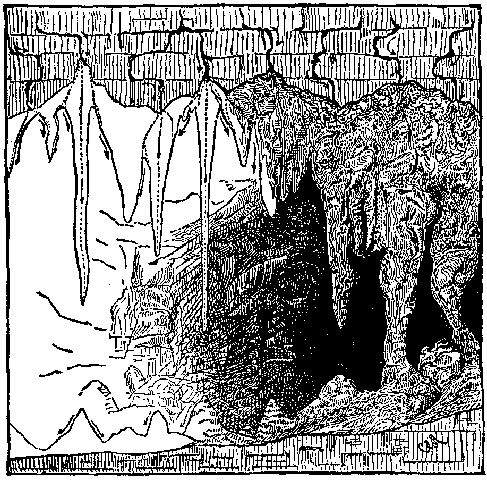
When first excavated, the chambers of a limestone cavern have little beauty to attract the eye. The curves of the walls are sometimes graceful, but the aspect of the chambers, though in a measure grand, is never charming. When, however, the waters have ceased to carve the openings, when they have been drained away by the formation of channels on a lower level, there commonly sets in a process known as stalactitization, which transforms the scene into one of singular beauty. We have already noted the fact that everywhere in ordinary rocks there are crevices through which water, moving under the pressure of the fluid which is above, may find its way slowly downward. In the limestone roofs of caverns, particularly in those of the upper story, this ooze of water passes through myriads of unseen fissures at a rate so slow that it often evaporates in the dry air without dropping to the floor. When it comes out of the rocks the water is charged with various salts of lime; when it evaporates it leaves the material behind on the roof. Where the outflow is so slight that the fluid does not gather into drops, it forms an incrustation of limy matter, which often gathers in beautiful flowerlike forms, or perhaps in the shape of a sheet of alabaster. Where drops are formed, a small, pendent cone grows downward from the ceiling, over which the water flows, and on which it evaporates. This cone grows slowly downward until it may attain the floor of the chamber, which has a height of thirty feet or more. If all the water does not evaporate, that which trickles off the apex of the cone, striking on the floor, is splashed out into a thin sheet, so that it evaporates in a speedy manner, lays down its limestone, and thus builds another and ruder cone, which grows upward toward that which is pendent above it. Finally, they grow together, enlarged by the process which constructed them, until a mighty column may be formed, sculptured as if by the hands of a fantastic architect.
Fig. 13.—Stalactites and stalagmites on roof and floor of a cavern. The arrows show the direction of the moving water.
All the while that subterranean streams are cutting the caverns downward the open-air rivers into which they discharge are deepening their beds, and thereby preparing for the construction of yet lower stories of caves. These open-air streams commonly flow in steep-sided, narrow valleys, which themselves were caves until the galleries became so wide that they could no longer support the roof. Thus we often find that for a certain distance the roof over a large stream has fallen in, so that the water flows in the open air. Then it will plunge under an arch and course, it may be, for some miles, before it again arrives at a place where the roof has disappeared, or perhaps attains a field occupied by rocks of another character, in which caverns were not formed. At places these old river caverns are abandoned by the streams, which find other courses. They form natural tunnels, which are not infrequently of considerable length. One such in southwestern Virginia has been made useful for a railway passing from one valley to another, thus sparing the expense of a costly excavation. Where the remnant of the arch is small, it is commonly known as a natural bridge, of which that in Rockbridge County, in Virginia, is a very noble example. Arches of this sort are not uncommon in many cavern countries; five such exist in Carter County, Kentucky, a district in the eastern part of that State which abounds in caverns, though none of them are of conspicuous height or beauty.[7]
At this stage of his studies on cavern work the student will readily conceive that, as the surface of the country overlying the cave is incessantly wearing down, the upper stories of the system are continually disappearing, while new ones are forming at the present drainage level of the country. In fact, the attentive eye can in such a district find here and there evidences of this progressive destruction. Not only do the caves wear out from above, but their roofs are constantly falling to their floors, a process which is greatly aided by the growth of stalactites. Forming in the crevices or joints between the stones, these rock growths sometimes prize off great blocks. In other cases the weight of the pendent stalactite drags the ill-supported masses of the roof to the floor. In this way a gallery originally a hundred feet below the surface may work its way upward to the light of day. The entrance by which the Mammoth Cave is approached appears to have been formed in this manner, and at several points in that system of caverns the effect of this action may be distinctly observed.
We must now go a step further on the way of subterranean water, and trace its action in the depths below the plane of ordinary caves, which, as we have noted, do not extend below the level of the main streams of the cavern district. The first group of facts to be attended to is that exhibited by artesian wells. These occur where rocks have been folded down into a basinlike form. It often happens that in such a basin the rocks of which it is composed are some of them porous, and others impervious to water, and that the porous layers outcrop on the high margins of the depression and have water-tight layers over them. These conditions can be well represented by supposing that we have two saucers, one within the other, with an intervening layer of sand which is full of water. If now we bore an opening in the bottom of the uppermost saucer, we readily conceive that the water will flow up through it. In Nature we often find these basins with the equivalent of the sandy layer in the model just described rising hundreds of feet above the valley, so that the artesian well, so named from the village of Artois, near Paris, where the first opening of this nature was made, may yield a stream which will mount upward, especially where piped, to a great height. At many places in the world it is possible by such wells to obtain a large supply of tolerably pure water, but in general it is found to contain too large a supply of dissolved mineral matter or sulphuretted gases to be satisfactory for domestic purposes. It may be well to note the fact that the greater part of the so-called artesian wells, or borings which deliver water to a height above the surface, are not true artesian sources, in that they do not send up the water by the action of gravitation, but under the influence of gaseous pressure.
Where, as in the case of upturned porous beds, the crevice water penetrates far below the earth's surface or the open-air streams which drain the water away, the fluid acquires a considerable increase of temperature, on the average about one degree Fahrenheit for each eighty feet of descent. It may, indeed, become so heated that if it were at the earth's surface it would not only burst into steam with a vast explosive energy, but would actually shine in the manner of heated solids. As the temperature of water rises, and as the pressure on it increases, it acquires a solvent power, and takes in rocky matter in a measure unapproached at the earth's surface. At the depth of ten miles water beginning as inert rain would acquire the properties which we are accustomed to associate with strong acids. Passing downward through fissures or porous strata in the manner indicated in the diagram, the water would take up, by virtue of its heat and the gases it contained, a share of many mineral substances which we commonly regard as insoluble. Gold and even platinum—the latter a material which resists all acids at ordinary temperatures—enters into the solution. If now the water thus charged with mineral stores finds in the depths a shorter way to the surface than that which it descended, which may well happen by way of a deep rift in the rocks, it will in its ascent reverse the process which it followed on going down. It will deposit the several minerals in the order of their solubilities—that is, the last to be taken in will be the first to be crystallized on the walls of the fissure through which the upflow is taking place. The result will be the formation of a vein belonging to the variety known as fissure veins.
Fig. 14.—Diagram of vein. The different shadings show the variations in the nature of the deposits.
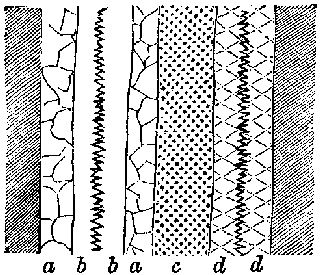
A vein deposit such as we are considering may, though rarely, be composed of a single mineral. Most commonly we find the deposit arranged in a banded form in the manner indicated in the figure (see diagram 14). Sometimes one material will abound in the lower portions of the fissure and another in its higher parts, a feature which is accounted for by the progressive cooling and relinquishment of pressure to which the water is subjected on its way to the surface. With each decrement of those properties some particular substance goes out of the fluid, which may in the end emerge in the form of a warm or hot spring, the water of which contains but little mineral matter. Where, however, the temperature is high, some part of the deposit, even a little gold, may be laid down just about the spring in the deposits known as sinter, which are often formed at such places.
In many cases the ore deposits are formed not only in the main channel of the fissure, but in all the crevices on either side of that way. In this manner, much as in the case of the growth of stalactitic matter between the blocks of stone in the roofs of a cavern, large fragments of rock, known as "horses," are often pushed out into the body of the vein. In some instances the growth of the vein appears to enlarge the fissure or place of the deposit as the accumulation goes on, the process being analogous to that by which a growing root widens the crevice into which it has penetrated. In other instances the fissure formed by the force has remained wide open, or at most has been but partly filled by the action of the water.
It not infrequently happens that the ascending waters of hot springs entering limestones have excavated extensive caves far below the surface of the earth, these caverns being afterward in part filled by the ores of various metals. We can readily imagine that the water at one temperature would excavate the cavern, and long afterward, when at a lower heat, they might proceed to fill it in. At a yet later stage, when the surface of the country had worn down many thousands of feet below the original level, the mineral stores of the caverns may be brought near the surface of the earth. Some of the most important metalliferous deposits of the Cordilleras are found in this group of hot-water caverns. These caverns are essentially like those produced by cold water, with the exception of the temperature of the fluid which does the work and the opposite direction of the flow.
In following crevice water which is free to obey the impulses of gravitation far down into the earth, we enter on a realm where the rock or construction water, that which was built into the stone at the time of its formation, is plentiful. Where these two groups of waters come in contact an admixture occurs, a certain portion of the rock water joining that in the crevices. Near the surface of the ground we commonly find that all the construction water has been washed out by this action. Yet if the rocks be compact, or if they have layers of a soft and clayey nature, we may find the construction water, even in very old deposits, remaining near the surface of the ground. Thus in the ancient Silurian beds of the Ohio Valley a boring carried a hundred feet below the level of the main rivers commonly discovers water which is clearly that laid down in the crevices of the material at the time when the rocks were formed in the sea. In all cases this water contains a certain amount of gases derived from the decomposition of various substances, but principally from the alteration of iron pyrite, which affords sulphuretted hydrogen. Thus the water is forced to the surface with considerable energy, and the well is often named artesian, though it flows by gas pressure on the principle of the soda-water fountain, and not by gravity, as in the case of true artesian wells.
The passage between the work done by the deeply penetrating surface water and that due to the fluid intimately blended with the rock built into the mass at the time of its formation is obscure. We are, however, quite sure that at great depths beneath the earth the construction water acts alone not only in making veins, but in bringing about many other momentous changes. At a great depth this water becomes intensely heated, and therefore tends to move in any direction where a chance fissure or other accident may lessen the pressure. Creeping through the rocks, and moving from zones of one temperature to another, these waters bring about in the fine interstices chemical changes which lead to great alterations in the constitution of the rock material. It is probably in part to these slow driftings of rock water that beds originally made up of small, shapeless fragments, such as compose clay slates, sandstones, and limestones, may in time be altered into crystalline rocks, where there is no longer a trace of the original bits, all the matter having been taken to pieces by the process of dissolving, and reformed in the regular crystalline order. In many cases we may note how a crystal after being made has been in part dissolved away and replaced by another mineral. In fact, many of our rocks appear to have been again and again made over by the slow-drifting waters, each particular state in their construction being due to some peculiarity of temperature or of mineral contents which the fluid held. These metamorphic phenomena, though important, are obscure, and their elucidation demands some knowledge of petrographic science, that branch of geology which considers the principles of rock formation. They will therefore not be further considered in this work.