Part 1 — [Footnote 1: Bud-scales are modified leaves and their arrangement is therefore the same as the leaves. This is not mentioned in the study of the Horsechestnut bud, because it cannot be proved to the pupils, but the transition is explained in connection with Lilac, where it may be clearly seen. The scales of the bud of Horsechestnut are considered to be homologous with petioles, by analogy with other members of the same family. In the Sweet Buckeye a series can be made, exhibiting the gradual change from a scale to a compound leaf. See the Botanical Text-Book, Part I, Structural Botany. By Asa Gray. Ivison, Blakeman, Taylor and Co., New York, 1879. Plate 233, p. 116.]
Reading edition
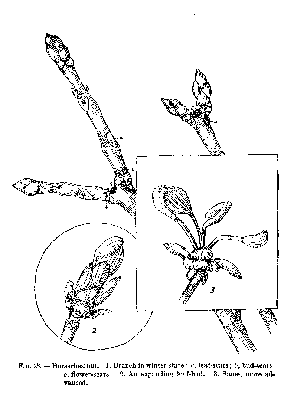
[Illustration: FIG. 13.—Horsechestnut. I. Branch in winter state: a, leaf-scars; b, bud-scars; c, flower-scars. 2. An expanding leaf-bud. 3. Same, more advanced.]
The Bud Scale-Scars. These are rings left by the scales of the bud and may be seen in many branches. They are well seen in Horsechestnut. If the pupils have failed to observe that these rings show the position of former buds and mark the growth of successive years, this point must be brought out by skilful questioning. There is a difference in the color of the more recent shoots, and a pupil, when asked how much of his branch grew the preceding season, will be able to answer by observing the change in color. Make him see that this change corresponds with the rings, and he will understand how to tell every year's growth. Then ask what would make the rings in a branch produced from one of his buds, and he can hardly fail to see that the scales would make them. When the scholars understand that the rings mark the year's growth, they can count them and ascertain the age of each branch. The same should be done with each side-shoot. Usually the numbers will be found to agree; that is, all the buds will have the same number of rings between them and the cut end of the branch, but occasionally a bud will remain latent for one or several seasons and then begin its growth, in which case the numbers will not agree; the difference will be the number of years it remained latent. There are always many buds that are not developed. "The undeveloped buds do not necessarily perish, but are ready to be called into action in case the others are checked. When the stronger buds are destroyed, some that would else remain dormant develop in their stead, incited by the abundance of nourishment which the former would have monopolized. In this manner our trees are soon reclothed with verdure, after their tender foliage and branches have been killed by a late vernal frost, or consumed by insects. And buds which have remained latent for several years occasionally shoot forth into branches from the sides of old stems, especially in certain trees."[1]
[Footnote 1: Structural Botany, p. 48.]
The pupils can measure the distance between each set of rings on the main stem, to see on what years it grew best.
The Flower-Cluster Scars. These are the round, somewhat concave, scars, found terminating the stem where forking occurs, or seemingly in the axils of branches, on account of one of the forking branches growing more rapidly and stoutly than the other and thus taking the place of the main stem, so that this is apparently continued without interruption. If the pupils have not understood the cause of the flower-cluster scars, show them their position in shoots where they are plainly on the summit of the stem, and tell them to compare this with the arrangement of a large bud. The flower-cluster terminates the axis in the bud, and this scar terminates a branch. When the terminal bud is thus prevented from continuing its growth, the nearest axillary buds are developed.[1] One shoot usually gets the start, and becomes so much stronger that it throws the other to one side. The tendency of the Horsechestnut to have its growth carried on by the terminal buds is so strong that I almost feel inclined to say that vigorous branches are never formed from axillary buds, in old trees, except where the terminal bud has been prevented from continuing the branch. This tendency gives to the tree its characteristic size of trunk and branches, and lack of delicate spray. On looking closely at the branches also, they will be seen to be quite irregular, wherever there has been a flower-cluster swerving to one side or the other.
[Footnote 1: The first winter that I examined Horsechestnut buds I found, in many cases, that the axillary shoots had from a quarter of an inch to an inch of wood before the first set of rings. I could not imagine what had formed this wood, and it remained a complete puzzle to me until the following spring, when I found in the expanding shoots, that, wherever a flower-cluster was present, there were one or two pairs of leaflets already well developed in the axils, and that the next season's buds were forming between them, while the internodes of these leaflets were making quite a rapid growth. Subsequently, I found the leaflets also in the buds themselves. I found these leaflets developed on the tree only in the shoots containing flower-clusters, where they would be needed for the future growth of the branches. I suppose the reason must be that the flower-cluster does not use all the nourishment provided and that therefore the axillary buds are able to develop. It would be interesting to know what determines the stronger growth of the one which eventually becomes the leader.]
There is one thing more the pupils may have noticed. The small round dots all over the young stem, which become long rifts in the older parts, are breaks in the epidermis, or skin of the stem, through which the inner layers of bark protrude. They are called lenticels. They provide a passage for gases in and out of the stem. In some trees, as the Birch, they are very noticeable.
After discussing the subject thoroughly in the class-room, the pupils should rewrite their papers, and finally answer the following questions, as a species of review. I have thus spent three recitations on the Horsechestnut. The work is all so new, and, if properly presented, so interesting, that a good deal of time is required to exhaust its possibilities of instruction. If the teacher finds his scholars wearying, however, he can leave as many of the details as he pleases to be treated in connection with other branches.
QUESTIONS ON THE HORSECHESTNUT.
How many scales are there in the buds you have examined?
How are they arranged?
How many leaves are there in the buds?
How are they arranged?
Where does the flower-cluster come in the bud?
Do all the buds contain flower-clusters?
What is the use of the wool and the gum?
Where do the buds come on the stem?
Which are the strongest?
How are the leaves arranged on the stem?
Do the pairs stand directly over each other?
What are the dots on the leaf-scars?
How old is your branch?
How old is each twig?
Which years were the best for growth?
Where were the former flower-clusters?
What happens when a branch is stopped in its growth by flowering?
What effect does this have on the appearance of the tree?
In some parts of the country the Horsechestnut is not so commonly planted as in New England. In the southern states the Magnolia may be used in its stead, but it is not nearly so simple an example of the main points to be observed.[1]
[Footnote 1: Reader in Botany. VII. Trees in Winter.]
MAGNOLIA UMBRELLA.
The bud may be examined by removing the scales with a knife, as in Horsechestnut, and also by cutting sections. The outer scales enfold the whole bud, and each succeeding pair cover all within. They are joined, and it is frequently difficult to tell where the suture is, though it can generally be traced at the apex of the bud. On the back is a thick stalk, which is the base of the leaf-stalk. Remove the scales by cutting carefully through a single pair, opposite the leaf-stalk, and peeling them off. The scales are modified stipules, instead of leaf-stalks, as in Horsechestnut. The outer pair are brown and thick, the inner green, and becoming more delicate and crumpled as we proceed toward the centre of the bud. The leaves begin with the second or third pair of scales. The first one or two are imperfect, being small, brown, and dry. The leaves grow larger towards the centre of the bud. They are covered with short, silky hairs, and are folded lengthwise, with the inner surface within (conduplicate). In the specimens I have examined I do not see much difference in size between the buds with flowers and those without. In every bud examined which contained a flower, there was an axillary bud in the axil of the last, or next to the last, leaf. This bud is to continue the interrupted branch in the same way as in Horsechestnut.
There are from six to ten good leaves, in the buds that I have seen. Those without flowers contain more leaves, as in Horsechestnut. In the centre of these buds the leaves are small and undeveloped. The flower is very easy to examine, the floral envelopes, stamens and pistils, being plainly discernible. The bud may also be studied in cross-section. This shows the whole arrangement. The plan is not so simple as in Horsechestnut, where the leaves are opposite. The subject of leaf-arrangement should be passed over until phyllotaxy is taken up.
The scars on the stem differ from Horsechestnut in having no distinct bands of rings. The scales, being stipules, leave a line on each side of the leaf-scar, and these are separated by the growth of the internodes. In the Beech, the scales are also stipules; but, whereas in the Magnolia there are only one or two abortive leaves, in the Beech there are eight or nine pairs of stipules without any leaves at all. The rings thus become separated in Magnolia, while in the Beech the first internodes are not developed, leaving a distinct band of rings, to mark the season's growth. The Magnolia is therefore less desirable to begin upon. The branches are swollen at the beginning of a new growth, and have a number of leaf-scars crowded closely together. The leaf-scars are roundish, the lower line more curved. They have many dots on them. From each leaf-scar runs an irregular line around the stem. This has been left by the stipules.
The flower-scar is on the summit of the axis, and often apparently in the axil of a branch, as in Horsechestnut. Sometimes the nearest axillary bud is developed; sometimes there are two, when the branch forks. The axillary buds seldom grow unless the terminal bud is interrupted. The tree therefore has no fine spray.
LILAC (Syringa vulgaris).
Ask the scholars to write a description of their branches and to compare them with Horsechestnut. These papers should be prepared before coming into the class, as before.
The buds are four-sided. The scales and leaves are opposite, as in Horsechestnut. The outer pair sometimes have buds in their axils. Remove the scales one by one with a knife, or better, with a stout needle. The scales gradually become thinner as we proceed, and pass into leaves, so that we cannot tell where the scales end and leaves begin. After about six pairs are removed, we come, in the larger buds, to leaves with axillary flower-clusters. The leaves grow smaller and the flower-clusters larger till we come to the centre, where the axis is terminated by a flower-cluster. There is a great difference in the buds on different bushes and on shoots of the same bush, some being large, green, and easy to examine, others small, hard, and dark-colored. It is better, of course, to select as soft and large buds as possible for examination.
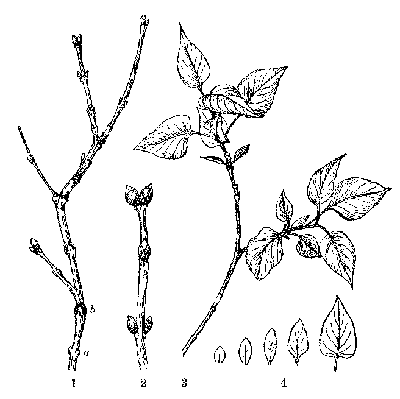
[Illustration: FIG. 14.—Lilac. I. Branch in winter state: a, leaf-scar; b, bud-scar (reduced). 2. Same, less reduced. 3. Branch, with leaf-buds expanded. 4. Series in a single bud, showing the gradual transition from scales to leaves.]
That the scales are modified leaves is plainly shown by the gradual transition they undergo, and also by the fact that buds are developed in their axils. If any of these can be shown to the pupils, remind them of the experiment where the top of a seedling Pea was cut off and buds forced to develop in the axils of the lower scales.[1] The transition from scales to leaves can be well studied by bringing branches into the house, where they will develop in water, and towards spring may even be made to blossom. Cherry, Apple, Forsythia, and other blossoming trees and shrubs can be thus forced to bloom. Place the branches in hot water, and cut off a little of their ends under water. If the water is changed every day, and the glass kept near the register or stove, they will blossom out very quickly. These expanded shoots may be compared with the buds. The number of leaves in the bud varies.
[Footnote 1: See p. 31.]
The leaf-scars of Lilac are horseshoe-shaped and somewhat swollen. It can often be plainly seen that the outer tissue of the stem runs up into the scar. It looks as if there were a layer of bark, ending with the scar, fastened over each side of the stem. These apparent layers alternate as well as the scars. The epidermis, or skin of the leaves, is in fact always continuous with that of the stem. There are no dots on the leaf-scars.
The rings are not nearly so noticeable as in Horsechestnut, but they can be counted for some years back.
The flower-cluster can often be traced by a dried bit of stem remaining on the branch.
The terminal bud in the Lilac does not usually develop, and the two uppermost axillary buds take its place, giving to the shrub the forked character of its branching. In all these bud studies, the pupil should finish by showing how the arrangement of the buds determines the growth of the branches.
QUESTIONS ON THE LILAC.
How do the scales differ from those of Horsechestnut?
How many scales and leaves are there?
How are they arranged?
Where does the flower-cluster come in the bud?
Do all the buds contain flower-clusters?
How does the arrangement of leaves and flower-clusters differ from that of Horsechestnut?
How old is your branch?
Which buds develop most frequently?
How does this affect the appearance of the shrub?
COPPER BEECH (Fagus sylvatica, var. purpurea).
The buds are long and tapering, the scales thin and scarious, the outer naked, the inner with long, silky hairs. Remove the scales one by one, as in Lilac. The outer four or six pairs are so minute that the arrangement is not very clear, but as we proceed we perceive that the scales are in alternate pairs, as in Horsechestnut; that is, that two scales are exactly on the same plane. But we have learned in the Lilac that the scales are modified leaves, and follow the leaf-arrangement of the species. The Beech is alternate-leaved, and we should therefore expect the scales to alternate. The explanation is found as we go on removing the scales. At the eighth or ninth pair we come upon a tiny, silky leaf, directly between the pair of scales, and, removing these, another larger leaf, opposite the first but higher up on the rudimentary stem, and so on, with the rest of the bud. There are five or more leaves, each placed between a pair of scales. Our knowledge of the parts of a leaf shows us at once that the scales must be modified stipules, and that therefore they must be in pairs.[1] Other examples of scales homologous with stipules are the American Elm, Tulip-tree, Poplar and Magnolia. The leaves are plaited on the veins and covered with long, silky hairs. The venation is very distinct. The outer leaves are smaller and, on examining the branch, it will be seen that their internodes do not make so large a growth as the leaves in the centre of the bud.
[Footnote 1: See the stipules of the Pea, p. 31.]
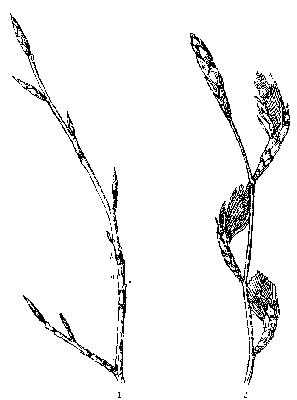
[Illustration: FIG. 15.—Copper Beech. 1. Branch in winter state: a, leaf-scar; b, bud-scar. 2. Branch, with leaf-buds expanding, showing the plicate folding of the leaves.]
The leaf-scars are small, soon becoming merely ridges running half round the stem.
The bud-rings are very plain and easily counted. For this reason, and because it branches freely, it is a good tree for measurements of growth, as is seen in the following tables. Nos. 1, 2, 3 and 4: were made by a class of girls, from fourteen to sixteen, from a tree on my lawn. No. 5 was made by a pupil, whom I taught by correspondence, from a tree of the same species in another town. No. 6 was made by myself from my own tree. The measurements of the first four tables were somewhat revised by me, as they were not perfectly accurate. The pupils should always be cautioned to measure from the beginning of one set of rings to the beginning of the next.[1]
[Footnote 1: Care must be taken to select branches well exposed to the light. Of course there are many circumstances that may aid or hinder the growth of any particular branch.]
NO. 1.
YEARS. GROWTH OF. MAIN AXIS. (in.) 1ST BRANCH. 2nd BRANCH. 3RD BRANCH. 4TH BRANCH.
'79 8-1/2 — — — —
'80 4-1/2 2 1-7/8 — —
'81 3-1/2 1-1/8 2-5/8 — —
'82 6 5/8 4-1/4 5-7/8 —
'83 7-3/8 3-3/8 5-1/4 4 5-3/4
'84 2 1/2 3/4 3/8 5-3/8
'85 5/8 1/4 3/8 1/2 1
'86 5-5/8 7/8 4-3/8 3-1/8 5
NO. 2.
YEARS. GROWTH of MAIN AXIS. (in.) 1ST BRANCH 2nd BRANCH 3RD BRANCH 4TH BRANCH 5TH BRANCH — —
'79 8 — — — — — — —
'80 3-1/2 5-1/4 5-1/2 5-5/8 — — — —
'81 4-3/4 3/4 1/2 2-1/2 2 — — —
'82 5-3/4 7/8 2 3/4 3/8 1/2 — —
'83 5-1/4 4-3/4 5-1/2 4 3-1/4 2-3/8 1-3/4 —
'84 1/2 1 3/4 3/8 1 3/4 1 3/8
'85 2-3/4 1-3/4 4-3/8 3/4 3/4 2-1/8 3-1/4 1-1/4
'86 7-1/2 5-1/2 6-3/4 3 3 4-1/2 3-1/8 5
NO. 3.
YEARS. GROWTH of MAIN AXIS. (in.) 1ST BRANCH 2ND BRANCH 3RD BRANCH 4TH BRANCH 5TH BRANCH
'80 8-1/4 — — — — —
'81 4-1/2 3-1/2 3-3/4 — — —
'82 5-1/2 3/4 1-1/2 1 — —
'83 3-1/4 3-3/4 4-1/2 3/4 2 1-1/4
'84 5-1/2 1/2 3/4 1 1/2 3
'85 1/2 1-3/4 1/2 3/8 1 1/2
'86 4-1/4 3-3/8 2-3/8 1-1/4 2-1/4 1-1/2
NO. 4.
YEARS GROWTH of MAIN AXIS (in.) 1ST BRANCH 2nd BRANCH 3RD BRANCH 4TH BRANCH
'81 7-3/4 — — — —
'82 8-3/4 6 6 — —
'83 6-3/4 5-1/4 4 4-3/4 5-1/2
'84 4-1/2 5/8 1-5/8 2-1/4 3-1/4
'85 2 5/8 3/16 2 3/4
'86 10-3/4 1-3/4 1/4 7-1/4 3-1/2
NO. 4. (cont.)
YEARS 5TH BRANCH 6TH BRANCH 7TH BRANCH 8TH BRANCH 9TH BRANCH
'81 — — — — —
'82 — — — — —
'83 — — — — —
'84 3/4 2-1/2 — — —
'85 7/8 5/8 1/4 3/4 —
'86 4-3/4 6-3/8 1 2-1/4 6-1/2
NO. 5.
YEARS GROWTH of MAIN AXIS (in.) 1ST BRANCH 2nd BRANCH 3RD BRANCH 4TH BRANCH 5TH BRANCH 6TH BRANCH
'82 6-7/8 — — — — — —
'83 6-1/2 4-3/4 4-1/4 — — — —
'84 4-3/4 1/4 1-3/4 3-1/2 — — —
'85 4-1/2 3/4 1 2-3/4 2-3/4 — —
'86 6-1/4 2-1/4 4-3/4 6-3/4 2-3/4 5-3/4 —
'87 6-3/4 1-1/8 3-1/4 4 2-1/4 3 5-1/2
NO. 6.
YEARS MAIN AXIS (in.) 1ST BRANCH 2ND BRANCH 3RD BRANCH 4TH BRANCH
1st side shoot. 2nd side shoot.
'80 6-1/4 — — — — — —
'81 8-3/4 6-3/4 — — — — —
'82 8-1/2 6-1/4 6-7/8 — — — .
'83 4-3/4 1-1/2 2-3/8 — — 4 .
'84 3-1/2 3-1/8 5-1/8 — — 1-3/4 7/8
'85 4-1/2 3/8 4-3/4 2-1/4 — 6 1
'86 6+ 6-3/4 12-1/8 5-1/2 10-1/2 8-7/8 5-1/8
'87 bough broken. 2-1/2 8-3/4 4-1/4 4-1/4 4-6/8 3-3/4
One question brought up by these measurements is whether there is any correspondence in growth between the main axis and its branches. It appears in these tables that there is a general correspondence, in this tree at least. In the recitation of the class, whose tables are given above (Nos. 1, 2, 3 and 4), we took all the measurements of these four branches for the year 1885 and added them. We did the same for 1886, and compared the results. The total growth for 1885 was 31-15/16 inches; for 1886, leaving out the measurement of the twig whose entire growth was in that year, 109-3/4 inches or nearly 3-1/2 times as much. The proportion held in a general way throughout, there being only a single case of a branch where the growth was greater in the first year.[1] But there is a point that must not be overlooked in this connection. The branches of the Beech seem to grow about equally well in the first, second, third, or any succeeding year. In some trees, as the Ash, the axillary buds make a large growth, and the succeeding terminal buds carry on the branch much more slowly; in other trees, as the Cherry, a branch grows very slowly in the first few years and then suddenly takes a start. These facts would appear in tables of growth, made from branches of these trees, but the addition of results for any particular year would have no significance.
[Footnote 1: The spring of 1880 was a remarkably early one. Thus I find in my diary of that year the following entries:—
April 17. The red maples are in full bloom, the elms almost over. The leaves of the Horsechestnut are quite large. The lilacs are nearly in leaf. April 24. We went up to Waverley and found bloodroot up, spice bush out, violets, dog-tooths and anemones, also caltha. April 28. All the cherries are in full bloom. April 29. Picked an apple blossom in bud, beautifully pink.
The season was nearly three weeks earlier than usual. 1885 on the other hand was a late spring.]
In table No. 5, the addition of the measurements for 1885 and 1886 shows the growth in the latter year to be about twice that of the former. This branch came from a tree in another town. We have tried also to discover whether the number of leaves each year has any relation to growth. I cannot see that it has, but it requires many experiments to determine these points. To study this, make tables of the number of leaves on the branch each year. I think teachers would find it interesting to keep all data of this kind of work done by their classes, with a view to tabulation and comparison. The scholars themselves are exceedingly interested in anything that partakes of the nature of an original investigation.[1]
[Footnote 1: The class, previously mentioned, were much interested in the addition of their results. One of them asked me whether this subject of measurements had been treated in any book. I replied that I had never seen it mentioned. My attention was afterwards called to "What may be learned from a Tree," by Prof. Harlan Coultas. D. Appleton & Co., New York, 1863. I found, greatly to my surprise, that he had not only given diagrams of growth, but that he also had selected a Copper Beech as his example.]
The leaf-arrangement of the Beech is alternate, on the one-half plan. The small twigs turn upwards, so that all the spray is on the upper side, giving a flat appearance to the branch.[1] This gives the leaves a better exposure to the light. Both the terminal and axillary buds grow freely, thus forming long, straight limbs, with many branches and much fine spray.
[Footnote 1: Phyllotaxy is treated later, by a comparison and study of many branches, but the teacher can draw the pupils' attention to the fact that each Beech leaf and twig is on exactly the opposite side of the branch from the preceding one. This allows all the twigs to grow towards one side of the branch, whereas in trees on the two-fifths plan, as the Apple, Poplar, Oak, etc., no such regularity would be possible, on account of their many different angles with the stem.]
The bark of the Beech is beautifully smooth. The extreme straightness of the trunk and limbs is very striking, and may be compared to the crooked limbs of the Horsechestnut, where the branch is continually interrupted by the flower-cluster. In the Beech the flowers are axillary.
QUESTIONS ON THE BEECH.
How are the scales of the Beech bud arranged?
How many leaves are there in the bud?
How does the arrangement of the scales and leaves in the bud differ from that of the Horsechestnut?
How are the leaves folded in the bud?
What is the arrangement of the leaves on the stem?
How does this differ from Horsechestnut and Lilac?
How old is your branch?
How old is each twig?
What years were the best for growth?
How does the growth of the branches differ from that of Horsechestnut? From Lilac?
Explain these differences with reference to the growth and arrangement of the buds?
In what direction do the twigs grow?
How does this affect the appearance of the tree?
Compare the amount of spray of the Beech and Horsechestnut and explain the reason of the difference.
These questions are only intended for review, they are never to be used for the first study of the specimen.
AMERICAN ELM (Ulmus Americana).
The buds are covered with brown scales, which are hairy on the edges. The flower-buds are larger than the leaf-buds and are in the axils of the lower leaves of the preceding year. Each leaf in the bud is enclosed by a pair of scales. They are so small that the pupils, unused to delicate work, will hardly discover them. Under a glass they can be seen to be ovate, folded on the midrib with the inner face within (conduplicate), and with an ovate scale joined to the base of the leaf on either side. The scales thus show themselves to be modified stipules. The venation of the leaves is very plain. The scales are much larger than the leaves. The flower-buds contain a cluster of flowers, on slender green pedicels. The calyx is bell-shaped, unequal, and lobed. The stamens and pistil can be seen. The flower-clusters do not seem to leave any mark which is distinguishable from the leaf-scar.
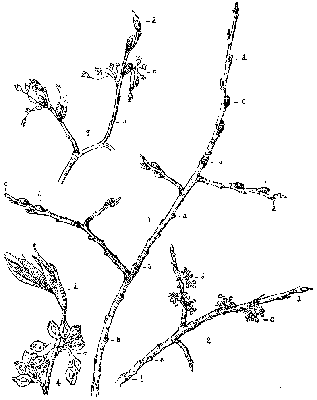
[Illustration: FIG. 16.—American Elm. 1. Branch in winter state: a, leaf-scars; b, bud-scars; d, leaf-buds; e, flower-buds. 2. Branch, with staminate flower-buds expanding. 3. Same, more advanced. 4. Branch, with pistillate flowers, the leaf-bud also expanding. ]
The leaf-scars are small and extend about half around the stem. The arrangement is alternate on the one-half plan. There are three dots on the scar.
The rings are quite plain. The tree can be used to make tables of growth, like those of the Beech.
The buds will probably be too small for examination by the pupils, at present, but their position and development can be studied, and are very instructive. As the leaf-buds are all on the ends of the branchlets, the twigs and branches will be just below the bud-rings, and then there will be a space where no twigs nor branches will be found, till the next set of rings is reached. This gives the branches more room to develop symmetrically. The terminal buds do not develop in the Elm, in old trees, the bud axillary to the last leaf of the season taking its place, and most of the other axillary buds growing also. This makes the tree break out into very fine spray. A tree like the Elm, where the trunk becomes lost in the branches, is called deliquescent; when the trunk is continued to the top of the tree, as in the Spruce, it is excurrent.
The small, feathery twigs and branches that are often seen on the trunks and great limbs of the elm grow from buds which are produced anywhere on the surface of the wood. Such buds are called adventitious buds. They often spring from a tree when it is wounded.
"The American elm is, in most parts of the state, the most magnificent tree to be seen. From a root, which, in old trees, spreads much above the surface of the ground, the trunk rises to a considerable height in a single stem. Here it usually divides into two or three principal branches, which go off by a gradual and easy curve. Theses stretch upwards and outwards with an airy sweep, become horizontal, the extreme half of the limb, pendent, forming a light and regular arch. This graceful curvature, and absence of all abruptness, in the primary limbs and forks, and all the subsequent divisions, are entirely characteristic of the tree, and enable an observer to distinguish it in the winter and even by night, when standing in relief against the sky, as far as it can be distinctly seen."[1]
[Footnote 1: A Report on the Trees and Shrubs growing naturally in the Forests of Massachusetts. By Geo. B. Emerson, Boston, Little, Brown and Co., 1875.
This book will be found very useful, containing careful descriptions of many trees and shrubs, and interesting facts about them.]
QUESTIONS ON THE AMERICAN ELM.
How do the flower-buds differ from the leaf-buds in position and appearance?
What is the arrangement of the leaves?
What other tree that you have studied has this arrangement?
How old is your branch?
Where would you look to see if the flower-cluster had left any mark?
Why is it that several twigs grow near each other, and that then comes a space without any branches?
What buds develop most frequently?
How does this affect the appearance of the tree?
What is a tree called when the trunk is lost in the branches?
BALM OF GILEAD (Populus balsamifera, var. candicans).
The buds are pointed: the terminal slightly angled, the axillary flattened against the stem.[1] Some of the axillary buds contain leaves and some flowers; the appearance of the leaf-buds and flower-buds being the same. The scales of the bud are modified stipules. The terminal buds have about three pairs of the outer scales brown and leathery. The inner scales, as well as the leaves, are coated with resinous matter, which has a strong odor and a nauseous taste. The smaller outer scales have no corresponding leaf, and apparently are modified stipules of the leaves of the preceding year, but the larger ones have a leaf to each pair of scales. The outer and inner leaves are small, the middle ones larger. Comparing the branch, it will be seen that these leaves make the largest growth of internode. The leaves are rolled towards the midrib on the upper face (involute). There are about ten which are easily seen and counted, the inner ones being very small, with minute scales. The axillary buds have a short thick scale on the outer part of the bud, then about three pairs of large scales, each succeeding one enwrapping those within, the outer one brown and leathery. The scales of the flower-buds are somewhat gummy, but not nearly so much so as those of the leaf-buds. Within is the catkin. Each pistil, or stamen (they are on separate trees, dioecious) is in a little cup and covered by a scale, which is cut and fringed.
[Footnote 1: These buds cannot be satisfactorily examined in cross section, on account of the resin. The scales must be removed one by one, with a knife, with a complete disregard of the effect upon the hands.]
The leaf-scars are somewhat three-lobed on the young parts, with three dots, indicating the fibro-vascular bundles, which ran up into the leaf. The scars are swollen, making the young branches exceedingly rough. In the older parts the scars become less noticeable. Strong young shoots, especially those which come up from the root, are strongly angled, with three ridges running up into each leaf-scar, making them almost club-shaped. There are often from twenty to thirty leaves in one year's growth, in such shoots, and all the leaves are not rudimentary in the bud. The growth in this case is said to be indefinite. Usually in trees with scaly buds the plan of the whole year's growth is laid down in the bud, and the term definite is applied. Branches, like the Rose, that go on growing all summer grow indefinitely.
The bud-scale scar is quite different from the other trees which we have examined. It is not composed of definite rings, but of leaf-scars with long ridges running from each side of them, showing the scales to be modified stipules. The leaf-scars have become somewhat separated by the growth of the internodes. In the Beech, there are eight, or more, pairs of scales with no leaves, so that the internodes do not develop, and a ring is left on the branch.
The flower-cluster leaves a concave, semicircular scar, in the leaf-axil.
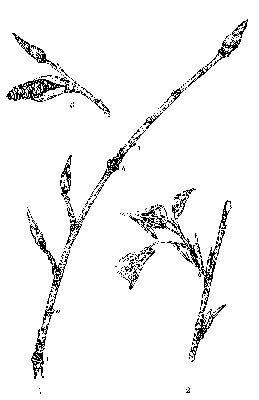
[Illustration: FIG. 17.—Balm-of-Gilead. 1. Branch in winter state: a, leaf-scar; b, bud-scar. 2. Branch, with leaf-buds expanded. 3. Branch, with catkin appearing from the bud.]
The terminal buds are the strongest and not very many axillary buds develop, so that the tree has not fine spray.
The leaf-arrangement is alternate, on the 2/5 plan. Phyllotaxy is not yet to be taken up, but the pupils should be shown the different angles of the branching of the twigs, and told to compare them with Beech and Elm.
QUESTIONS ON THE BALM OF GILEAD.
In which buds are the flower-clusters?
Are there flowers and leaves in the same buds?
What are the scales of the bud?
How are the leaves folded in the bud?
How do the axillary and terminal buds differ?
What are the dots on the leaf-scars?
Why is there no distinct band of rings as in Beech?
How old is your branch?
Where do you look for flower-cluster scars?
Which buds are the strongest?
How does this affect the appearance of the tree?
What makes the ends of the branches so rough?
Compare the arrangement of the twigs and branches with Beech and Elm, with Horsechestnut and Lilac.
TULIP-TREE (Liriodendron Tulipifera).
The buds are small, flat, and rounded at the apex. They are sheathed by scales, each leaf being covered by a pair, whose edges cohere. The outer pair are brown and are the stipules of the last leaf of the preceding year. The leaves are conduplicate, as in Magnolia, and have the blade bent inwards on the petiole (inflexed). Their shape is very clearly to be seen, and no bud is more interesting in the closeness of its packing. Axillary buds are often found within. The flowers grow high upon the trees and towards the ends of the branches.
The leaf-scars are round with many dots. The scar of the stipules is a continuous line around the stem, as in Magnolia.
CHERRY (Prunus Cerasus).
The leaf-buds are terminal, or in the axils of the upper leaves of the preceding year; the flower buds are axillary. There is but one bud in each axil, and usually two or three flowers in each bud, but the leaves on the twigs are crowded and the flowers therefore appear in clusters. The blossom-buds are larger and more rounded than the leaf-buds.
The buds of the tree develop very easily in the house, and as they are so small they can be better studied in watching them come out, than by attempting to dissect them, unless the scholars are sufficiently advanced to use the microscope easily. It is always bad for a pupil to attempt to describe what he sees but imperfectly. He will be sure to jump at any conclusions which he thinks ought to be correct.
The leaf-scars are semicircular, small and swollen.
The bud-rings are plain. The twigs make a very small growth in a season, so that the leaf-scars and rings make them exceedingly rough.
The flower-cluster scars are small circles, with a dot in the centre, in the leaf-axils. The flowers come before the leaves.
The leaf-arrangement is alternate on the 2/5 plan. The pupils may compare the branching with that of their other specimens.
RED MAPLE (Acer rubrum).
This is a good specimen for the study of accessory buds. There is usually a bud in the axil of each lower scale of the axillary buds, making three side by side. We have already noticed this as occurring sometimes in Lilac. It is habitually the case with the Red Maple. The middle bud, which is smaller and develops later, is a leaf-bud. The others are flower-buds.
The leaf-scars are small, with three dots on each scar. The rings are very plain. The flower-cluster leaves a round scar in the leaf-axil, as in Cherry.
The leaves are opposite and the tree branches freely. The twigs seem to be found just below the bud-rings, as the upper leaf-buds usually develop best and the lower buds are single, containing flowers only.
NORWAY SPRUCE (Picea excelsa).
The buds are terminal, and axillary, from the axils of the leaves of the preceding year, usually from those at the ends of the branchlets. They are covered with brown scales and contain many leaves.
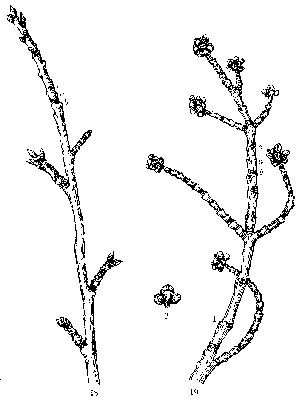
[Illustration: FIG. 18.—Branch of Cherry in winter state: a, leaf-scar; b, bud-scar; c, flower-scar.]
[Illustration: FIG. 19.—Branch of Red Maple in winter state (reduced). 2. Flower-buds]
The leaves are needle-shaped and short.[1] They are arranged densely on the branches, alternately on the 8/21 plan (see section on phyllotaxy). When they drop off they leave a hard, blunt projection which makes the stem very rough. As the terminal bud always develops unless injured, the tree is excurrent, forming a straight trunk, throwing out branches on every side. The axillary buds develop near the ends of the branchlets, forming apparent whorls of branches around the trunk. In the smaller branches, as the tree grows older, the tendency is for only two buds to develop nearly opposite each other, forming a symmetrical branch.
[Footnote 1: The pupils should observe how much more crowded the leaves are than in the other trees they have studied. The leaves being smaller, it is necessary to have more of them. Large-leaved trees have longer internodes than those with small leaves.]
The bud-scales are persistent on the branches and the growth from year to year can be traced a long way back.
The cones hang on the ends of the upper branches. They are much larger than in our native species of Black and White Spruce.
The Evergreens are a very interesting study and an excellent exercise in morphology for the older scholars.
2. Vernation. This term signifies the disposition of leaves in the bud, either in respect to the way in which each leaf is folded, or to the manner in which the leaves are arranged with reference to each other. The pupils have described the folding of the leaves in some of their specimens.
In the Beech, the leaf is plicate, or plaited on the veins. In the Elm, Magnolia, and Tulip-tree, it is conduplicate, that is, folded on the midrib with the inner face within. In the Tulip-tree, it is also inflexed, the blade bent forwards on the petiole. In the Balm of Gilead, the leaf is involute, rolled towards the midrib on the upper face.
Other kinds of vernation are revolute, the opposite of involute, where the leaf is rolled backwards towards the midrib; circinate, rolled from the apex downwards, as we see in ferns; and corrugate, when the leaf is crumpled in the bud.
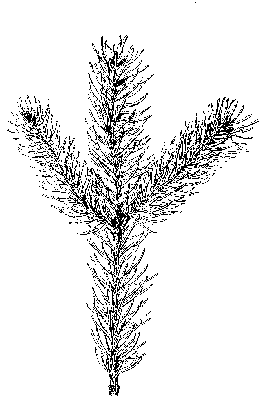
[Illustration: FIG. 20.—Branch of Norway Spruce.]
In all the trees we have studied, the leaves simply succeed each other, each leaf, or pair of leaves, overlapping the next in order. The names of the overlapping of the leaves among themselves, imbricated, convolute, etc., will not be treated here, as they are not needed. They will come under æstivation, the term used to describe the overlapping of the modified leaves, which make up the flower.[1]
[Footnote 1: Reader in Botany. VIII. Young and Old Leaves.]
3. Phyllotaxy. The subject of leaf-arrangement is an extremely difficult one, and it is best, even with the older pupils, to touch it lightly. The point to be especially brought out is the disposition of the leaves so that each can get the benefit of the light. This can be seen in any plant and there are many ways in which the desired result is brought about. The chief way is the distribution of the leaves about the stem, and this is well studied from the leaf-scars.
The scholars should keep the branches they have studied. It is well to have them marked with the respective names, that the teacher may examine and return them without fear of mistakes.
In the various branches that the pupils have studied, they have seen that the arrangement of the leaves differs greatly. The arrangement of leaves is usually classed under three modes: the alternate, the opposite, and the whorled; but the opposite is the simplest form of the whorled arrangement, the leaves being in circles of two. In this arrangement, the leaves of each whorl stand over the spaces of the whorl just below. The pupils have observed and noted this in Horsechestnut and Lilac. In these there are four vertical rows or ranks of leaves. In whorls of three leaves there would be six ranks, in whorls of four, eight, and so on.
When the leaves are alternate, or single at each node of the stem, they are arranged in many different ways. Ask the pupils to look at all the branches with alternate leaves that they have studied, and determine in each case what leaves stand directly over each other. That is, beginning with any leaf, count the number of leaves passed on the stem, till one is reached that stands directly over the first.[1] In the Beech and the Elm the leaves are on opposite sides of the stem, so that the third stands directly over the first. This makes two vertical ranks, or rows, of leaves, dividing the circle into halves. It is, therefore, called the 1/2 arrangement. Another way of expressing it is to say that the angular divergence between the leaves is 180°, or one-half the circumference.
[Footnote 1: The pupils must be careful not to pass the bud-rings when they are counting the leaves.]
The 1/3 arrangement, with the leaves in three vertical ranks, is not very common. It may be seen in Sedges, in the Orange-tree, and in Black Alder (Ilex verticillata). In this arrangement, there are three ranks of leaves, and each leaf diverges from the next at an angle of 120°, or one-third of the circumference.
By far the commonest arrangement is with the leaves in five vertical ranks. The Cherry, the Poplar, the Larch, the Oak, and many other trees exhibit this. In this arrangement there are five leaves necessary to complete the circle. We might expect, then, that each leaf would occupy one-fifth of the circle. This would be the case were it not for the fact that we have to pass twice around the stem in counting them, so that each leaf has twice as much room, or two-fifths of the circle, to itself. This is, therefore, the 2/5 arrangement. This can be shown by winding a thread around the stem, passing it over each leaf-scar. In the Beech we make one turn of the stem before reaching the third leaf which stands over the first. In the Apple the thread will wind twice about the stem, before coming to the sixth leaf, which is over the first.
Another arrangement, not very common, is found in the Magnolia, the Holly, and the radical leaves of the common Plantain and Tobacco. The thread makes three turns of the stem before reaching the eighth leaf which stands over the first. This is the 3/8 arrangement. It is well seen in the Marguerite, a greenhouse plant which is very easily grown in the house.
Look now at these fractions, 1/2, 1/3, 2/5, and 3/8. The numerator of the third is the sum of the numerators of the first and second, its denominator, the sum of the two denominators. The same is true of the fourth fraction and the two immediately preceding it. Continuing the series, we get the fractions 5/13, 8/21, 13/34. These arrangements can be found in nature in cones, the scales of which are modified leaves and follow the laws of leaf-arrangement.[1]
[Footnote 1: See the uses and origin of the arrangement of leaves in plants. By Chauncey Wright. Memoirs Amer. Acad., IX, p. 389. This essay is an abstruse mathematical treatise on the theory of phyllotaxy. The fractions are treated as successive approximations to a theoretical angle, which represents the best possible exposure to air and light.
Modern authors, however, do not generally accept this mathematical view of leaf-arrangement.]
[1]"It is to be noted that the distichous or 1/2 variety gives the maximum divergence, namely 180°, and that the tristichous, or 1/3, gives the least, or 120°; that the pentastichous, or 2/5, is nearly the mean between the first two; that of the 3/8, nearly the mean between the two preceding, etc. The disadvantage of the two-ranked arrangement is that the leaves are soon superposed and so overshadow each other. This is commonly obviated by the length of the internodes, which is apt to be much greater in this than in the more complex arrangements, therefore placing them vertically further apart; or else, as in Elms, Beeches, and the like, the branchlets take a horizontal position and the petioles a quarter twist, which gives full exposure of the upper face of all the leaves to the light. The 1/3 and 2/5, with diminished divergence, increase the number of ranks; the 3/8 and all beyond, with mean divergence of successive leaves, effect a more thorough distribution, but with less and less angular distance between the vertical ranks."
[Footnote 1: Gray's Structural Botany, Chap, iv, p. 126.]
For directions for finding the arrangement of cones, see Gray's Structural Botany, Chap. IV, Sect. 1.
The subject appears easy when stated in a text-book, but, practically, it is often exceedingly difficult to determine the arrangement. Stems often twist so as to alter entirely the apparent disposition of the leaves. The general principle, however, that the leaves are disposed so as to get the best exposure to air and light is clear. This cannot be shown by the study of the naked branches merely, because these do not show the beautiful result of the distribution.[1] Many house plants can be found, which will afford excellent illustrations (Fig. 21). The Marguerite and Tobacco, both easily grown in the house, are on the 3/8 plan. The latter shows the eight ranks most plainly in the rosette of its lower leaves. The distribution is often brought about by differences in the lengths of the petioles, as in a Horsechestnut branch (Fig. 22) where the lower, larger leaves stand out further from the branch than the upper ones; or by a twist in the petioles, so that the upper faces of the leaves are turned up to the light, as in Beech (Fig. 23). If it is springtime when the lessons are given, endless adaptations can be found.
[Footnote 1: Reader in Botany. IX. Leaf-Arrangement.]
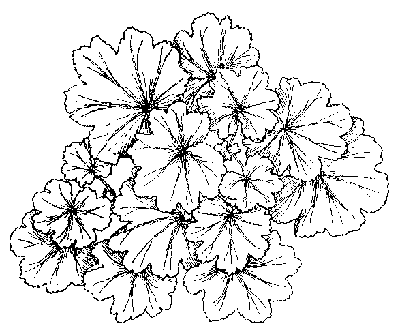
[Illustration: FIG. 21. Branch of Geranium, viewed from above.]
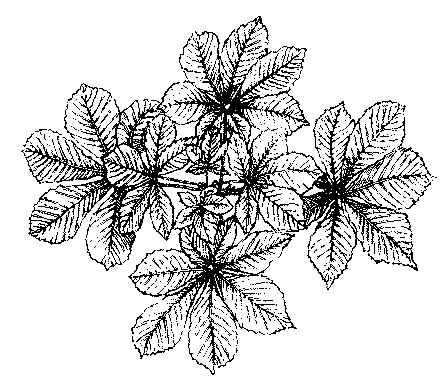
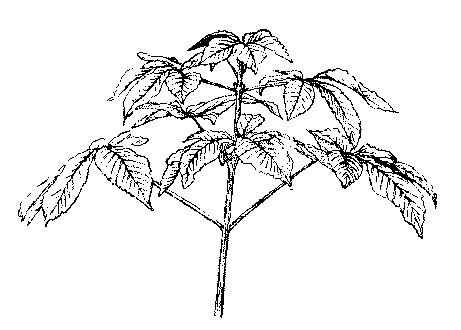
[Illustration: FIG. 22.]
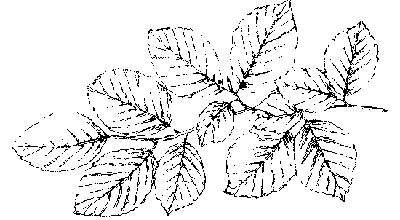
[Illustration: FIG. 23.]
Gray's First Lessons. Sect. IV. VII, §4. How Plants Grow. Chap. I, 51-62; I, 153.
V.
STEMS.
The stem, as the scholars have already learned, is the axis of the plant. The leaves are produced at certain definite points called nodes, and the portions of stem between these points are internodes. The internode, node, and leaf make a single plant-part, and the plant is made up of a succession of such parts.
The stem, as well as the root and leaves, may bear plant-hairs. The accepted theory of plant structure assumes that these four parts, root, stem, leaves, and plant-hairs, are the only members of a flowering plant, and that all other forms, as flowers, tendrils, etc., are modified from these. While this idea is at the foundation of all our teaching, causing us to lead the pupil to recognize as modified leaves the cotyledons of a seedling and the scales of a bud, it is difficult to state it directly so as to be understood, except by mature minds. I have been frequently surprised at the failure of even bright and advanced pupils to grasp this idea, and believe it is better to let them first imbibe it unconsciously in their study. Whenever their minds are ready for it, it will be readily understood. The chief difficulty is that they imagine that there is a direct metamorphosis of a leaf to a petal or a stamen.
Briefly, the theory is this: the beginnings of leaf, petal, tendril, etc., are the same. At an early stage of their growth it is impossible to tell what they are to become. They develop into the organ needed for the particular work required of them to do. The organ, that under other circumstances might develop into a leaf, is capable of developing into a petal, a stamen, or a pistil, according to the requirements of the plant, but no actual metamorphosis takes place. Sometimes, instead of developing into the form we should normally find, the organ develops into another form, as when a petal stands in the place of a stamen, or the pistil reverts to a leafy branch. This will be more fully treated under flowers. The study of the different forms in which an organ may appear is the study of morphology.
1. Forms of Stems.—Stems may grow in many ways. Let the pupils compare the habits of growth of the seedlings they have studied. The Sunflower and Corn are erect. This is the most usual habit, as with our common trees. The Morning Glory is twining, the stem itself twists about a support. The Bean, Pea and Nasturtium are climbing. The stems are weak, and are held up, in the first two by tendrils, in the last by the twining leaf-stalks. The English Ivy, as we have seen, is also climbing, by means of its aërial roots. The Red Clover is ascending, the branches rising obliquely from the base. Some kinds of Clover, as the White Clover, are creeping, that is, with prostrate branches rooting at the nodes and forming new plants. Such rooting branches are called stolons, or when the stem runs underground, suckers. The gardener imitates them in the process called layering, that is, bending down an erect branch and covering it with soil, causing it to strike root. When the connecting stem is cut, a new plant is formed. Long and leafless stolons, like those of the Strawberry are called runners. Stems creep below the ground as well as above. Probably the pupil will think of some examples. The pretty little Gold Thread is so named from the yellow running stems, which grow beneath the ground and send up shoots, or suckers, which make new plants. Many grasses propagate themselves in this way. Such stems are called rootstocks. "That these are really stems, and not roots, is evident from the way in which they grow; from their consisting of a succession of joints; and from the leaves which they bear on each node, in the form of small scales, just like the lowest ones on the upright stem next the ground. They also produce buds in the axils of these scales, showing the scales to be leaves; whereas real roots bear neither leaves nor axillary buds."[1] Rootstocks are often stored with nourishment. We have already taken up this subject in the potato, but it is well to repeat the distinction between stems and roots. A thick, short rootstock provided with buds, like the potato, is called a tuber. Compare again the corm of Crocus and the bulb of Onion to find the stem in each. In the former, it makes the bulk of the whole; in the latter, it is a mere plate holding the fleshy bases of the leaves.
[Footnote 1: Gray's First Lessons, revised edition, 1887, page 42.]
2. Movements of Stems.—Let a glass thread, no larger than a coarse hair, be affixed by means of some quickly drying varnish to the tip of the laterally inclined stem of one of the young Morning-Glory plants in the schoolroom. Stand a piece of cardboard beside the pot, at right angles to the stem, so that the end of the glass will be near the surface of the card. Make a dot upon the card opposite the tip of the filament, taking care not to disturb the position of either. In a few minutes observe that the filament is no longer opposite the dot. Mark its position anew, and continue thus until a circle is completed on the cardboard. This is a rough way of conducting the experiment. Darwin's method will be found in the footnote.[1]
[Footnote 1: "Plants growing in pots were protected wholly from the light, or had light admitted from above or on one side as the case might require, and were covered above by a large horizontal sheet of glass, and with another vertical sheet on one side. A glass filament, not thicker than a horsehair, and from a quarter to three-quarters of an inch in length, was affixed to the part to be observed by means of shellac dissolved in alcohol. The solution was allowed to evaporate until it became so thick that it set hard in two or three seconds, and it never injured the tissues, even the tips of tender radicles, to which it was applied. To the end of the glass filament an excessively minute bead of black sealing-wax was cemented, below or behind which a bit of card with a black dot was fixed to a stick driven into the ground.... The bead and the dot on the card were viewed through the horizontal or vertical glass-plate (according to the position of the object) and when one exactly covered the other, a dot was made on the glass plate with a sharply pointed stick dipped in thick India ink. Other dots were made at short intervals of time and these were afterwards joined by straight lines. The figures thus traced were therefore angular, but if dots had been made every one or two minutes, the lines would have been more curvilinear."—The Power of Movement in Plants, p. 6.]
The use of the glass filament is simply to increase the size of the circle described, and thus make visible the movements of the stem. All young parts of stems are continually moving in circles or ellipses. "To learn how the sweeps are made, one has only to mark a line of dots along the upper side of the outstretched revolving end of such a stem, and to note that when it has moved round a quarter of a circle, these dots will be on one side; when half round, the dots occupy the lower side; and when the revolution is completed, they are again on the upper side. That is, the stem revolves by bowing itself over to one side,—is either pulled over or pushed over, or both, by some internal force, which acts in turn all round the stem in the direction in which it sweeps; and so the stem makes its circuits without twisting."[1]
[Footnote 1: How Plants Behave. By Asa Gray. Ivison, Blakeman, Taylor & Co., New York, 1872. Page 13.]
The nature of the movement is thus a successive nodding to all the points of the compass, whence it is called by Darwin circumnutation. The movement belongs to all young growing parts of plants. The great sweeps of a twining stem, like that of the Morning-Glory, are only an increase in the size of the circle or ellipse described.[1]