THE RED-WINGED GOOSE.
Reading edition
Top
ONCE upon a time, when the rocks that make the earth were not so gray, and the beard of the sea-waves not so hoary,—when the stars winked at each other and said nothing, and the man in the moon thought of getting married,—once upon a time, I say, there lived on the edge of a pine-forest in Bohemia a poor peasant named Otto Koenig.
His hut was made of pine-branches, plastered with mud and thatched with rye-straw; a hole in the top let the smoke out, and a hole in the side let in father, mother, pigs, chickens, and children, beside a tame jackdaw, that slept on an old stool by the fireplace, and ate with Otto's nine children out of a wooden bowl.
Little enough the nine had to share with Meister Hans, as they called the jackdaw, for they lived on black beans and black rye-bread. Sometimes a bit of smoked bacon was found in the beans on great feast-days, and sometimes in summer wild berries helped the dry bread to savor and sweetness; but oftener the poor pig's-flesh and the red strawberries were put into a rush basket, covered with great cool leaves, on top of the eggs that lay so smooth and white below, and Otto carried them to Prague, when he went there at full moon to sell the turpentine he gathered in the pine-forest. With the money he got there he bought serge to clothe the nine children, rancid oil to burn in the clay lamp that sometimes they lighted in the long winter evenings, or some coarse pottery for larger vessels than he could hew out of dead branches with his dull hatchet. But it took all the coin that ever rattled in his sheep-skin pouch to buy any clothes or enough food for the nine black-eyed children who ran about in rags, and always wanted more bread and beans than poor Marthon, their brown, hard-working mother, had to give them.
At last, one winter there came a dreadful famine in Bohemia. There was no rye for the fowls, or the bread; it was blasted in the ear during a wet summer; and that same summer had given so little sunshine to the fields that no berries ripened; the turnips rotted in the ground, so the pig had nothing to eat; and between cold and starvation, quite tired of his wet sty and empty trough, master pig gave a loud squeak one November day, struggled out of his moist lodgings into a pool of water hard by, and died. For all that he was eaten up, because the nine children wanted food, whatever it might be, and the jackdaw scolded loudly for bread, but got less and less daily.
To be sure, the turpentine ran faster and clearer than ever from the trees, but then it was worth less to the old Jew who bought it, and the striped red serge and rancid oil were dearer than ever; so the children ate their supper by the light of the pine-cones they gathered in the forest, and went to bed to keep warm, where Mihal, the youngest boy, told them long stories of the old days in Bohemia, when there were fierce witches with steeple-crowned hats and flame-colored cloaks, who were burned to death in the market-place of Prague, and their ashes scattered on the waters of the Elbe, to find no rest on earth or in the water,—and legends of gnomes and elves that worked with little swarthy hands in the mountain mines, and hid their treasures away from human miners, unless spell and incantation brought them to light, and then the gnomes would scream and sob in the deep caverns till the miners fled away for fear.
These stories Mihal had learned from his old grandmother, who died the year before the famine. She used to sit in the open air knitting, or spinning with a distaff, and the scarlet yarn that trailed across the gray jacket and green petticoat glowed in the sun like a thread of crawling fire, and seemed to keep time to her droning voice, as she poured story after story into the wide-open ears of the child nestled on her feet.
But all these pretty tales of Mihal did not keep his eight brothers and sisters warm. Zitza, the least of all, cried herself to sleep often, and woke with hunger, wailing, in the sad and quaint accents of her land, for bread and berries. These were sorrowful sounds for poor Otto Koenig; he knew well the eager pain for food that forced that cry from the child's lips,—for his black crust was as small as it could be to keep him alive, and his cup of sour beer was only a quarter filled. Often, as he shouldered the rude axe with which he gashed the trees, and wandered out into the forest, the spicy smell of the pine-boughs seemed to make him sick and giddy, he was so faint with hunger; and instead of the hymns the wind used to sing in the long green tufts of leaves, there was a rush of unearthly whispering laughter, and mocking voices said in the poor man's ear, “Bread and beer! bread and beer!” chorused with another rustle of laughter; whereat the unlucky man, half crazed, would bless himself devoutly, and, taking to his heels, run like a scared cony till the woods were far behind him.
In the hut things went worse still; in vain did Matthias, the oldest of the nine children, take his twin sister into the fields to search the brambles for stray hips, or locks of wool the sheep had not left there willingly; men and women even worse off had been there before them, and they came home at night, tired out and footsore, only to hear Zitza's fretful cry for food, and the constant chatter of Meister Hans, croaking for his own share in what they had not.
One night, when Mihal had told more wonderful stories than ever, and fairly talked the other eight to sleep, he was still awake himself. Nothing stirred on the side of the hut where the children lay sleeping on some straw covered with sheep-skins, but Meister Hans, who, perched for the night on the arm of the grandmother's empty chair, rustled his blue-black wings now and then. But as Mihal lay thinking and hungry, his looks turned restlessly toward the uneasy bird; and presently he saw the creature's eyes begin to shine through the darkness brighter and brighter, till they made the room so light that one could plainly see the eight sleeping children, the straw-bed from which Father Koenig's snores were loudly heard, Mother Marthon's petticoat and red jacket hung against the wall, and the old black chair with the fiery-eyed jackdaw perched on one arm. Mihal lifted himself on his elbow and rubbed his eyes. Yes, it was really so! Meister Hans nodded gravely to him, and, hopping down to the floor, turned his eyes toward the boy, nodded again, croaked circumspectly, and walked with odd, precise steps toward the door, which was screened from the cold by a rough mat hung inside, and again turning, repeated the nod and the croak, as if he were inviting Mihal to follow him. The child gathered his rags more closely about him, and stepped across the threshold, at which Meister Hans gave a very satisfied croak and hopped along. The moon shone brightly on bare brown fields silvered with white frost, and in the still, cold air the distant forest stood like a black cloud just dropped upon earth.
In a strange, dreamy way Mihal followed the movements of the bird, stumbling over hard furrows, bruising his feet against stones, falling into ditches, but still straight after his odd guide, who peered at him now and then with one fiery eye, and wagged his head. On and on they went, away from the pine forest, but into places where Mihal had never been before, wide as were his usual rambles; on and on, over stone walls, ditches, stubble-fields, and wide meadows, till they found themselves at the foot of a high, round hill. Out of one side of this great mound ran a pure bubbling spring, and over its waters hung an old oak-tree, leafless now, but still strewing the ground beneath with dry acorns. Right at the root of this tree was an upright gray stone, apparently part of a rock deeply sunk in the hillside; dark lichens clung to its face, and dead leaves lay piled at its foot. Beside this stone Meister Hans paused, and, looking hard at the boy, deliberately picked up an acorn, and, hopping to the side of the little gravelly basin, dropped his mouthful into the fountain, and returned to the flat stone, where Mihal stood wondering much what was to follow.
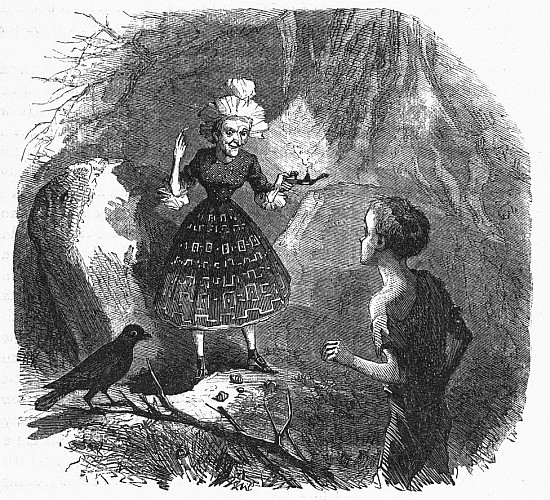
Presently the jackdaw approached the stone and knocked upon it three times. No sound replied, but the rock opened in the middle, and there stood a little old woman, as withered as a spring apple and as bright as a butterfly, dressed in a scarlet bodice covered with spangles, and a black petticoat worked in square characters with all the colors of the rainbow. She made a reverence to the bird and Mihal, and in a shrill, eager voice invited them to come in. The boy hesitated, but the little old woman snatched his hand and pulled him in. A draught of warm air and a delicious smell of food invited him still more charmingly, he was so cold and hungry, and he passed through the cleft stone to find himself in a high round cavern, of shining, sparkling crystals, that glittered like jewels whenever the light of the old woman's iron lamp shone across them. She opened a low door in the side of this cavern, and beckoned her companions to follow. In the middle of a still larger vault stood a great arm-chair, fashioned from beryl and jasper, with knobs of amethyst and topaz, in which sat a dwarf no taller than little Zitza. He was dressed in robes of velvet, green and soft as forest moss, and a ring of rough gold lay on his grizzled hair; his little eyes were keen and fiery, his hands withered and brown, but covered with glittering jewels.
About the cave a hundred little creatures, smaller still than he, were busied in a hundred ways. Some ran to and fro with long ladles, wherewith they stirred and tasted kettles of smoking broth; others shredded crisp salads, and sliced fresh vegetables for the pottage; some, with ready hands, spread a table with flowered damask, golden plate, and crystal goblets; three tugged and strained at turning a huge spit before a fire at the end of the cavern, while a dozen more watched the simmering of pots and pipkins, seething on the coals; and full a score moulded curious confections, adorned vast pastries, heaped fruits upon baskets of carved ice, or brewed steaming potions in great silver pitchers, whose breath of tropic fragrance curled upward in light clouds to the sparkling roof above; while the red flashes of the blaze on the hearth lighted up their swarthy little figures and merry faces, and cast grotesque, mocking shadows against the sides of the cave.
As Meister Hans hopped gravely past all this toward the chair of the Dwarf-king, making profound reverences all the way, the little monarch stretched out his sceptre, which was a tall bulrush of gold, and touched the jackdaw on the head, whereat, to Mihal's great wonder, his old friend turned suddenly into just such another little old woman as the one who had brought them in.
After another low reverence to the king, she turned to Mihal and made him aware, by a long speech, that she had been turned into a jackdaw for twenty years, because she had once presumed to say that gold was not so yellow as buttercups, or so bright as sunshine,—a statement altogether against the belief and laws of the dwarf; but now her punishment was over, and, knowing that she would never go back to the earth again, because she had lived there long enough to know better, and had learned that gold was the best of all things, she had resolved to bring little Mihal with her, (for she loved him almost as much as gold, and quite as well as silver, he was such a good boy), and persuade her master to grant him one wish before he left the cavern.
The king readily consented to do this, but ordered that the boy and his friendly guide should take their places at the table and be served with supper first, for well he knew that a hungry child's first wish must be for food.
The king had scarce given this order before a quick pair of hands stripped a tender sucking-pig from the spit, another filled a golden bowl with smoking stew from the caldron, another poured wine and ale into the clear goblets, and a fourth heaped porcelain dishes from every simmering pot and pipkin on the hearth; rolls of bread whiter than hoar-frost, and piles of purple and golden fruit followed, while the half-starved boy warmed his fingers at the blaze, and then ate and drank his fill of such viands as he had never before tasted, even in dreams. But when he could do no more good trencher-service, and the little old woman reminded him of the wish he was to ask the Dwarf-king to grant, he sat a long time pondering this important matter.
Now, among the legends that his old grandmother had recounted was one that had made especial impression on his fancy,—an old Bohemian tradition of a red-winged goose, followed by six goslings, which traversed the forests and valleys in the dead of winter, uncaught and unhurt, for hundreds of years, though whoever was so skilful or so lucky as to catch the goose would after that succeed in all his undertakings. Mihal bethought himself, as he sat there, that perhaps the Dwarf-king was master of this wonderful bird, and could give him the prize at once, without delay or toil; so he slid from his seat at the table, and, approaching the king, made known his request.
The dwarf fixed his keen eyes sharply on the child, and shook his grizzled head from side to side before he spoke, in his rough but kindly voice, and said: “I cannot do that for thee, little one! All the treasures in my mountain, or the heart of the dumb earth, could not buy for thee the red-winged goose. She must be caught; but there is only one way to this end, and that way hitherto hath no mortal known. He who would capture the goose must first have caught the goslings, and that not by two or three, or as he may choose to trap them, but always the nearest one first, which is ever the last, seeing that they follow her in line, unbroken and unwavering. Thou must take them one by one, and in their order, child, however sorely tempted to break the sequence. Keep thine eye and thy labor for the nearest one, and at last the red-winged goose itself will reward thy patience.”
Mihal heard and treasured up the Dwarf-king's orders, spoke his simple thanks, bowing low, and, after a gay farewell to the little old woman who had been his jackdaw, went his way into the upper air; and just as the sun arose, touching the pine-tree tops with fire, he came to his father's hut, where the eight children were rubbing their eyes and Zitza crying for her breakfast. No one knew that Mihal had been farther than the door-sill, nor did he tell the clamorous brood of children what he had seen, lest they should mock it as a dream, or attempt the pursuit themselves.
So he went patiently about his work, helped them look for Meister Hans, whom all mourned for many a day,—excepting Mihal, who well knew how much better off the jackdaw was than in any of the pitiful conditions they fancied, and the parents, who were too thankful to gain even the bird's small share of bread for their wasted and fretful children.
But after nightfall Mihal crept softly from his straw in the corner, tied a sheep-skin across his shoulders, and, with his uneaten supper, a crust of black bread, in the bosom of his ragged shirt, stole softly out of the door to seek his fortune. About two miles from the hut there was a clear space in the pine forest, where there stood a great stone cross, at the foot of which a tiny spring slept in the grass, and overflowed softly on the crisp turf at all seasons. At this place Mihal resolved to wait for the flight of the red-winged goose, and he knew the forest paths so well that a short half-hour brought him to the open glade. He knelt and bathed his face in the spring, drank deeply of its pure and tranquil waters, and then leaned back against the foot of the cross to eat his crust and wait till moon-rise. Overhead the dark blue sky seemed to be higher than ever, and the bright stars sparkled so kindly, and looked so much like watchful eyes to guard and bless him, that Mihal felt no fear, but gazed upward into the quiet depths of air so long that he fell fast asleep and dreamed about the Dwarf-king's hill-palace.
Rose Terry.